
With his overwhelming victory Robert Bruce established himself in a position of unassailable authority as King of Scots and won the independence of Scotland even though the English stubbornly refused to accept these facts. If the Scots had been able to mount a more effective pursuit after the battle and if the Earl of Dunbar had acted like Walter Gilbertson at Bothwell then Edward II might have been captured. As it was, the escape of the hapless English King made victory incomplete and a peace settlement proved elusive. Bannockburn marked the low point of Edward’s unfortunate reign but it was not the end of his misfortunes as Scottish raids across the Border became so frequent that they practically amounted to the subjection of England, north of the River Tees, to the Scots. Northumberland was reduced to anarchy not only by the depredations of the Scots but also by those of predatory local garrisons and robber bands. Many of the people of Cumberland and Northumberland despaired of relief from the English government and became ‘Scottish’, just as many in the Lothians had previously been ‘English’. Large areas of the northern counties were subjected to selective devastation and were forced to buy the Scots off with payments of ‘blackmail’, which further fuelled the Scottish war effort. In July 1315 King Robert boldly laid siege to Carlisle, but the town held out due to a well-conducted defence organised by Sir Andrew Harcla. In April 1318 Berwick, the only Scottish town to remain in enemy hands after Bannockburn, was betrayed to the Scots and taken by Sir James Douglas. The fall of Berwick was a severe blow to the English and its loss was compounded by the fall of the Northumbrian castles of Wark-on-Tweed, Harbottle and Mitford. In May that year a Scottish raid struck deep into Yorkshire and burnt Northallerton, Boroughbridge and Knaresborough and terrorised the citizens of Ripon, who bought them off with a payment of 1,000 marks.
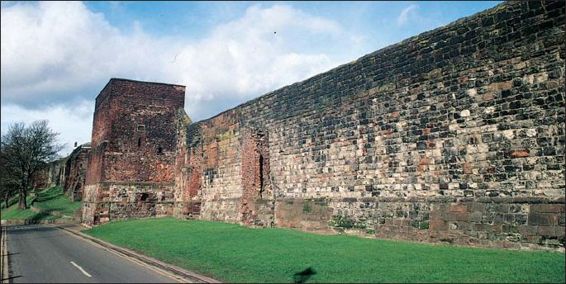
The Tile Tower and part of the City Walls of Carlisle. In 1315 Robert Bruce besieged the town, and despite the use of siege machines the garrison held out, losing only two men. All the Scots achieved was to trample down the cornfields and drive off the livestock.
In a desperate bid to salvage his pride, Edward II joined forces with his adversary Earl Thomas of Lancaster and laid siege to Berwick but met with no success. Moray and Douglas, with a force of 8,000 men, raided deep into Yorkshire in a bid to distract Edward from the siege. The mayor and Archbishop of York raised such men as they could and marched out to confront the marauding Scots. At Myton-on-Swale their motley force was soundly defeated by the Scots in an unequal affair known as the ‘Chapter of Myton’ because of the large number of clergymen killed and captured. Edward raised the siege of Berwick and retreated south of the River Trent, allowing the Scots to ravage Cumberland and Westmorland unmolested. In December the English negotiated a two-year truce but a long-term peace was still far off because of Edward’s arrogant refusal to relinquish his claims of sovereignty over the Scots. In 1320 the Scots addressed the famous Declaration of Arbroath to the Pope in which they made it clear that Scotland was and always had been an independent kingdom. Subsequent peace talks in 1321 ended in deadlock again. Later that same year relations between Lancaster and his adherents and the King and his favourites the Despencers deteriorated into civil war. In March 1322 the rebel barons were defeated by Sir Andrew Harcla at the battle of Boroughbridge, which resulted in Lancaster’s capture and execution.
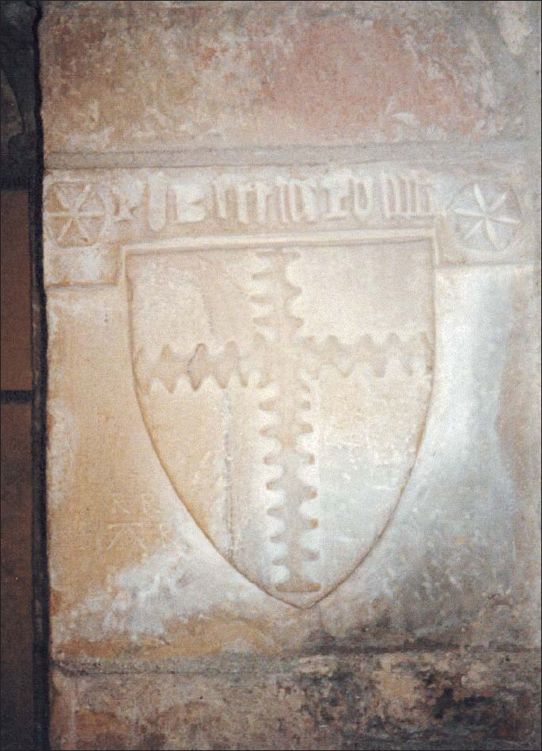
The arms of Sir Robert de Reymes, displayed at Bolam Church, Northumberland.
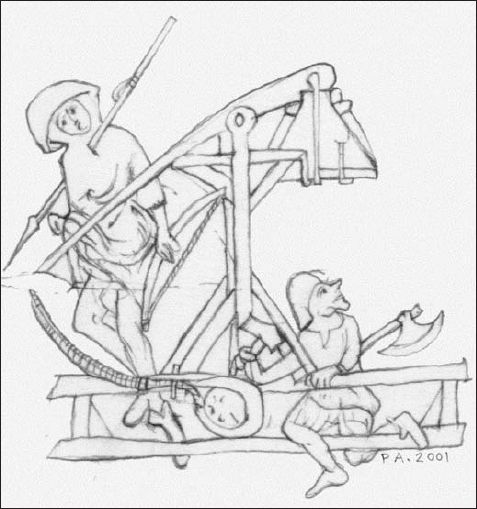
Drawing from the Carlisle Charter of 1316 showing the trebuchet that the Scots used to try to batter their way into the town (author’s drawing).
With his position strengthened for the time being Edward led what was to be his last expedition into Scotland in August 1322. The English marched through Lothian as far as Edinburgh but hunger soon forced them to retrace their steps as the Scots withdrew before them, leaving anything of use to the invaders in flames behind them. As Edward retreated south, Robert Bruce led a strong mounted raiding force across the Solway and down the Eden Valley into North Yorkshire. At Northallerton, on hearing that Edward was at Rievaulx Abbey 15 miles away, Bruce and his men rode without delay for the Abbey hoping to capture the English King. At Old Byland the Scots found their way blocked by John of Brittany, Earl of Richmond, with a considerable English force. Without delay Douglas and Moray dismounted their men and launched a spirited attack up the hill on which the English were posted. At the same time King Robert and his highlanders climbed what must have seemed impassable crags to the English and established themselves in a flanking position from where their wild charge swept the startled enemy before them. Edward was warned of his danger and for the second time he narrowly escaped capture but was again forced to abandon his personal equipment, silver plate, jewellery and horse trappings as he fled. The affair was not a disaster on the scale of Bannockburn but for Edward the humiliation of repetition was even greater. In 1323 a new Anglo-Scottish truce was agreed that was intended to last for 13 years, but final peace was to come only after further warfare. Edward II was deposed on 20 January 1327 and his 14-year-old son was crowned as Edward III on the first day of February. A council of regency was established to rule the country headed by Henry, the new Earl of Lancaster, though the influence of the Queen mother, Isabella, and her lover Mortimer pervaded the new government. In the summer a hugely expensive campaign in Northumberland, which ended with the embarrassing fiasco of Stanhope Park, failed to check the renewed onslaught of the Scots on the North of England. The situation was desperate as it seemed that this time Bruce intended to occupy demoralised Northumberland and parcel out lands there to his men. Isabella and Mortimer considered war but, fearful of the backlash of defeat, they chose instead to make peace. By the terms of the treaty of Edinburgh that concluded the long war the English finally renounced all claims of sovereignty over Scotland. It was a remarkably fair and statesmanlike settlement and ‘it would indeed have been well for both countries if the agreement of 1328 had governed the relations of the two countries for the rest of the middle ages’. But it was not to be as the belligerent young Edward III reopened hostilities within five years and a new phase of the Scottish Wars began.