
In 1943 Lord Louis Mountbatten was appointed to head the new South East Asia Command (SEAC). His previous experience as Commander of Combined Operations was of questionable value in Asia, but he was an approachable and realistic leader and, although he was prone to dramatic and innovative initiatives that were not always very practical, he was also open to persuasion and was a steadfast supporter of Gen. Slim. Mountbatten’s deputy was Gen. ‘Vinegar Joe’ Stillwell, an appointment that was politically necessary given the extensive American investment in support of China. However, this led to structural command issues since Stillwell was a subordinate to Gen. Giffard in his role as Commander of Northern Combat Area Command (NCAC), but was his superior in his role as Deputy Supreme Commander of SEAC. General Giffard was instrumental in persuading the Chiefs of Staff to organise East and West African infantry and artillery units into divisions, and having them deployed to Burma where they performed admirably. General Giffard was Gen. Slim’s immediate superior and the two men enjoyed a constructive professional relationship. Slim did not, initially, choose a military career, but worked as a primary school teacher and as a clerk in a West Midlands metal business. He joined Birmingham University OTC in 1912 and served at Gallipoli and in Mesopotamia during the First World War. In 1919 he transferred to the Indian Army and served as an instructor at the Senior Officers School at Belgaum. By early 1944 he had risen to the command of Fourteenth Army and had been instrumental in improving every aspect of the formation’s existence. He did his utmost to make life bearable for the troops and was a firm believer in the equality of every man in the command, regardless of race or creed; an attitude that did not always sit well with some of his contemporaries. Although Gen. Montague Stopford’s XXXIII Corps Headquarters would have responsibility for administering the battle, senior operational control passed to Gen. John Grover, who commanded 2nd Division in the relief of Brigadier (Brig.) Warren’s 161st (Indian) Brigade at Jotsoma and Kohima, and the subsequent operations to drive the Japanese 31st Division out of India.
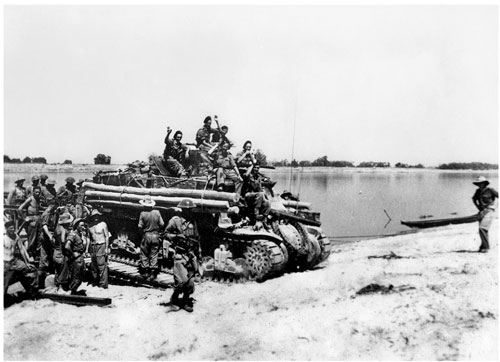
5 A Grant tank loaded onto a raft for a river crossing. (AB/AWH)
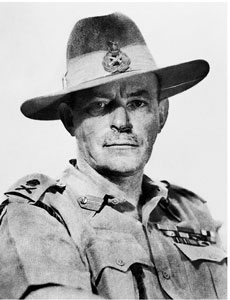
6 General Stopford. (Author’s collection)
At Kohima itself, Colonel (Col) Hugh Richards was the garrison commander during the siege. His conduct throughout the battle was exemplary, but he was rather undermined by the commanding officer of 4th RWK, Col Laverty.
One of the most remarkable figures in the Kohima battle was Charles Pawsey, the District Commissioner (DC). Pawsey took an active interest in the well-being of the Naga tribes people of the area for more than twenty years and was very popular throughout the region. His bungalow was the scene of intense fighting and the famous ‘battle of the tennis court’ was fought in its garden. He continued to campaign for fair treatment of the Naga people even after Burmese independence.
The strategic objectives of the Japanese offensive in March–May 1944 was to prevent the Allies from gaining the initiative and mounting a campaign to recover Burma, and to do so by destroying IV Corps of Fourteenth Army around Imphal, before pressing on into northern India. The role of 31st Division was to break the Allied lines of communication between Dimapur and Imphal, and to secure the enormous supply stocks held there. The Commonwealth commanders were, in fact, already preparing for their own offensive which would, they hoped, start the process of driving the Japanese out of Burma altogether. A successful offensive would provide protection for the Indian industrial and agricultural production that Fourteenth Army relied on and form a springboard for future operations to defeat the Japanese throughout South Asia. In turn, that would bring about the liberation of Malaya and Singapore and, in due course, the liberation of the Netherlands East Indies.
LEE AND GRANT TANKS
Designed in 1940 and coming into service in 1941, the original Lee tank weighed 30 tons, had a large crew and had poor off-road characteristics. The Grant model was essentially the same, but without the small commander’s cupola on the turret. The main gun was mounted in a sponson on the hull of the vehicle, which limited overall effectiveness. The Lee and Grant models were outclassed by German tanks in the desert, but were superior to Japanese vehicles in the Far East. Over 6,000 Lees and Grants were produced and they stayed in service in Asia until 1945, though by then they were being steadily replaced by Shermans.
In almost every conflict, success is a product of achieving local superiority in manpower and firepower. The nature of the terrain in western Burma and eastern India favoured determined dug-in defences so long as a steady supply of ammunition, food and replacements could be maintained; however, a weak defence could be compromised relatively easily by daring offensive tactics. When advancing, the Japanese tended to attempt to pin the enemy to the front while detaching troops to move around the flanks of the enemy and cut the road behind him, thus cutting off supplies and reinforcements and undermining the morale of the defenders.

7 Medium artillery. (AB/AWH)

8 Much of the field artillery had to be towed by jeeps due to the very difficult nature of the terrain. (AB/AWH)
VICEROY COMMISSIONED OFFICERS (VCO)
The VCO was a distinctive rank in the Indian Army. Senior to Warrant Officers and other NCOs, but junior to King’s Commissioned Officers, the VCO was invariably a man of proven abilities. VCOs were to be found in both cavalry (armoured) regiments and infantry battalions. There were three grades of VCOs: in the infantry these were the Jemadar, Subedar and Subedar-Major. Although, in theory, the VCO only had authority over Indian troops, a great many British soldiers were unaware of this and a VCO could generally count on having his orders obeyed. Subedar or Jemadar was a figure of some status and was entitled to be addressed or referred to as ‘Jemadar Sahib’ by all ranks.
When forced on to the defensive, the Japanese relied on strongly built bunkers and trenches, and the determination of the individual soldier to hold a position until told otherwise. Whenever possible, each position would be under observation from others to the flanks and rear so that when a particular strongpoint was eventually captured it would be vulnerable to an immediate counter-attack or could be subjected to intense fire to make it untenable to the Commonwealth troops who had seized it.
The Japanese tactical practice of isolating Commonwealth forces was countered by the development of the ‘box’ approach, the most famous example being the ‘Battle of the Admin Box’ at Sinzweya in February 1944, when administrative and line of communication troops supplied by airdrops held out for nearly three weeks. Under this ‘box’ policy all formations were trained to adopt an all-round defensive posture so that they could hold their position until such time as they were relieved. This was preferable to the formation attempting to break out and re-join the main body of the army; a practice which had led to a tendency to see retreat as the normal option when attacked, resulting in damage to morale and, very frequently, units and formations being forced to abandon stores and equipment to the enemy – so much so that at one point the Japanese were able to field a unit of captured Stuart tanks.
The success of the ‘box’ approach was demonstrated by an improvement in confidence and morale as it became clear that British, Indian and African troops were more than capable of holding their own against the Japanese, thus reducing the effectiveness of Japanese offensives. It became less practical for Japanese troops to rely on captured stores and the process of fighting for every yard of territory was immensely costly in casualties. The boxes inevitably slowed Japanese advances to crawling speed, which in turn allowed the Commonwealth forces to locate the enemy more easily and accurately for the deployment of shelling and aerial bombardment.

9 Senior officers in a jeep passing troops at Mandalay. The jeep became a vital tool in the Burma campaign. (AB/AWH)
Naturally, this all had a deleterious effect on the confidence of the Japanese forces and the higher casualty rate forced Japanese formations to transfer men from administrative and support functions to infantry units, thus compromising the general quality of the average soldier on the battlefield. Although the Japanese soldier continued to be a tough and committed adversary, this process of attrition did reduce the efficiency and the élan of the Japanese Army as a whole, which in turn helped to improve the self-belief of Commonwealth troops.
Maintaining a continuous front in either attack or defence was clearly impractical given the nature of the countryside and the immense distances involved, so the few road and river routes and mountain passes became even more significant than would be the case in other theatres. These factors meant that a great proportion of the fighting was conducted at very close quarters compared to operations in Europe or the desert, and battlefield casualties were very high on both sides. For the Japanese, casualty evacuation was often an almost insuperable difficulty and a great number of soldiers died who would, in other theatres, have received prompt and effective treatment. Overall, the Commonwealth soldier could expect to get medical attention and be removed, if necessary, to a major hospital far from the fighting. However, at Kohima there was really no means of evacuation throughout the siege and many men were wounded for a second or third time in the aid stations.
25-POUNDER GUN
The standard field artillery piece of the British Army for twenty years, the 25-pounder was, strictly speaking, a ‘gun-howitzer’ since it could be fired at both lower register (0–45 degree) and upper register (45–90 degree) elevation; though in the extreme reaches of upper-elevation firing, it might be necessary for the crew to dig a pit to accommodate the recoil of the barrel. Devastatingly accurate to a range of about 14,000yd (12.8km), the 25-pounder was a reliable and popular weapon, and is still in use for training purposes in several countries today. In other theatres, the gun and its thirty-two-round limber were towed by a ‘Quad’ tractor, although, in Burma, a good many were lightened so that they could be towed by a Jeep.

10 25-pounder guns; a workhorse of the Commonwealth artillery arm. (AB/AWH)
In keeping with the policy of imperial defence developed after the First World War, the British and Indian armies, along with those of all the other dominions and colonies, shared a broadly common system of organisation. The advantages of a pan-imperial military system are obvious: combining units from different territories and cultures into large formations was comparatively straightforward; arms and ammunition could be produced in several countries (Lee-Enfield rifles are still made in India to this day), and common training programmes made cross-posting of officers from one army to another relatively easily, so long as the men concerned could acquire the relevant languages. There were certain economic implications as well. Since each part of the British Empire was, to a certain extent, responsible for paying for their own defence, adopting the same weapons reduced the unit cost of arms, ammunition and other equipment. Virtually everything was either British-made or produced under licence in the different colonies or dominions.
However, the system was far from perfect. Dominion counties such as Australia and Canada were not necessarily bound by British plans and policies in wartime. Even when there was a shared general strategy British leaders could not simply decide on the deployments of dominion troops, but would have to take account of the foreign and domestic policies of those countries to a far greater extent than would be the case for India or the African colonies. Additionally, although British officers could obviously learn the language (or languages) of their men, it was a time-consuming process and involved finding large numbers of instructors. This was more of an issue with Fourteenth Army than any other formation due to the wide variety of cultures involved – in 1944 there were about forty different languages in use and a wide variety of cultural needs. Indian troops required rice and flour for chapattis, while British ones needed bread and potatoes. Muslim troops could not be given pork and Hindu troops could not be issued with that staple of the British Army, corned beef. It would also seem that no one was ever happy to see the soya link sausages which formed a major part of the diet of frontline troops; they figured regularly in personal accounts of the conflict and were widely, if not universally, loathed.
As if the Commonwealth army did not face enough difficulties in the early stages of the campaign, there were several manpower issues over and above the question of sheer numbers. The rapid expansion of the British and Indian armies had resulted in men who were not physically suited for frontline service being posted to combat units. The formation of large numbers of new battalions required substantial quantities of experienced officers and non-commissioned officers (NCOs) to train the new recruits, thus weakening existing units. These men had to be replaced and many of the newly promoted officers and NCOs who took their place were not really fit for the task. This was even more of a problem for Indian units due to language problems, and a considerable proportion of these officers were not, initially at least, able to communicate adequately in the different languages required. To some extent this was offset by the viceroy commissioned officers (VCOs), which were selected from men with good soldiering and language skills, and who had demonstrated leadership abilities. A VCO was junior to the king’s commissioned Indian officers (KCIO), but senior to warrant officers and NCOs. Unlike a KCIO, a VCO only had authority over Indian troops, but it was a position of some status and a VCO would be addressed as ‘sahib’ by all and sundry.
3.7IN HOWITZER
Often referred to as a ‘mountain gun’, the 3.7in howitzer came into service in 1917. It is mostly associated with action in North Africa, Italy and Burma, though considerable numbers were used in Europe as well. The gun could fire a 20lb (9kg) shell to a range of nearly 6,000yd (5.5km). It could fire high explosive and smoke shells, and a High Explosive Anti-Tank (HEAT) projectile was designed for use in Burma. A reliable weapon, it could easily be towed by virtually any vehicle available to the Commonwealth forces and could also be broken down for mule transport.
The trained manpower shortage was exacerbated by the extensive losses in North Africa in 1940–41. Large numbers of experienced officers, VCOs and NCOs assigned to new units in training were drafted back to their original battalions to bring them up to strength, but could not be replaced easily despite an enormous expansion of officer, VCO and NCO training schools and courses. This process was known as ‘milking’ and inevitably hampered the training schedules – and quality – of the new battalions. The morale and confidence of Indian troops was not helped by the heavy losses in Malaya where many Indian (and British and Australian) troops were sent into battle with virtually no training at all, let alone training for such a challenging environment against a very determined enemy. Additionally, both in Malaya and Burma, unrealistic assumptions were made about the ability of Indian and African troops to adjust to jungle conditions, as very few of either were recruited from jungle areas and had no more familiarity with the environment than troops from England or Scotland.
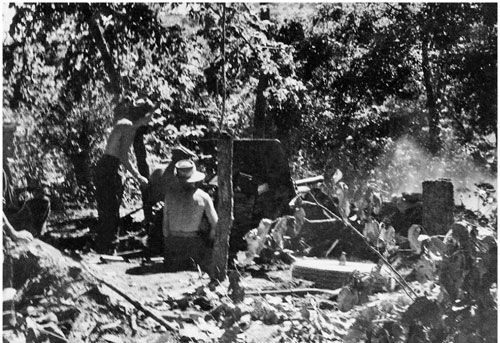
11 Commonwealth troops manning a light anti-tank gun. Although there was relatively little Japanese armour deployed to Burma, anti-tank weapons proved to be very useful against Japanese bunkers. (AB/AWH)
BREN GUN
Essentially of Czech design, the Bren was exceptionally accurate to about 550yd (500m) and weighed 22lb (10kg). Although the magazine was designed to take thirty of the same .303 bullets as the Lee-Enfield rifle, it was preferable to load only twenty-eight to reduce the risk of jamming. The basic structure of the rifle section was built around two component parts, each carried by a member of a two-man team – one member carrying the Bren gun itself, and the other carrying a spare barrel, spare magazines and a tool kit. The Bren was usually fired from a prone position with a bipod and acted as additional section-level fire support.
None of this was helped by a widely held prejudice against Indian Army troops among the British military hierarchy, despite the exemplary service of Indian divisions – most famously in the East Africa and North Africa campaigns. This was more than a question of race or culture as British officers in the Indian Army were often as much subject to prejudice as their men. This could extend to the very highest ranks. Lieutenant General Lewis Heath was appointed as a subordinate to Gen. Percival in Malaya, despite having a very good command record and being superior in rank, whereas Percival had no senior combat command experience whatsoever. As the war went on, the degree of racial and cultural prejudice did diminish, partly because it became clear that Gen. Slim – an Indian army officer himself – would not tolerate it, and partly through the professionalism and commitment of Indian soldiers at all levels. The first real Commonwealth victory in Burma – the defeat of 55th Division in 1943 – was very much the achievement of 5th Indian Division under Major General (Maj. Gen.) Harold Briggs, of whom Gen. Slim wrote:

12 General Slim. (Author’s collection)
General William ‘Bill’ Slim
Born in 1891, William Slim’s family could not afford to send him to university and the first phase of his career was spent as a primary school teacher, and later as a clerk in a metal pipe factory. Although he was not a student, he was able to enlist in the Officer Training Corp of Birmingham University and was able to procure a commission as a second lieutenant in the Warwickshire Regiment at the outbreak of war in 1914.
Slim was wounded at Gallipoli and served in Mesopotamia. He chose to stay in the Army after the war and was admitted to the Indian Army staff college at Quetta in 1926. When war broke out again in 1939 he was posted to command 10th Brigade in the 5th (Indian) Division and took part in the successful East Africa campaign to liberate Ethiopia from the Italians. He was wounded in an airstrike in January 1941 and, in the following May, was promoted to the command of 5th (Indian) Division, which he led in the Anglo-Iraq war and in the invasion of Persia (modern-day Iran).
In March 1942 he took command of Burma Corps (Burcorps), then XV Corps and then of the newly formed Fourteenth Army. The failure of the Commonwealth army in Burma prompted him to reorganise his forces and embark on an intensive training schedule. He dispensed with most of the Army’s motor transport in order to reduce dependence on roads and reliance of supplies of petrol, and also to make his troops fit to meet and defeat the Japanese.
The speed and audacity of the Japanese offensive of 1944 took Slim – and his staff – by surprise, but he recovered the situation quickly through tremendous skill and determination, inflicting a defeat from which the Japanese Army in Burma never recovered.
After the war Slim became the first Indian Army officer to be appointed as Chief of the Imperial General Staff (promoted to field marshal), a post he held for nearly four years before moving on to become the Governor General of Australia from 1953–59. Field Marshal Slim died in London on 14 December 1970, aged 79.
I know of few commanders who made as many immediate and critical decisions on each step of the promotion ladder and none who made so few mistakes.
(William Slim, Defeat into Victory)
Throughout the British Empire the basic building block of the infantry was the regiment. In peacetime a regiment might have one or two regular battalions, and one or more reserve or territorial battalions. The advent of war in 1939 brought a huge expansion of infantry, armoured and artillery regiments and, therefore, particularly in the infantry, a regiment might have half a dozen or more battalions serving in different divisions and in different theatres. The battalion structure itself varied a little from time to time and from place to place, but was fairly consistent in principle. Typically there would be four rifle companies of about 130 men divided into four platoons of thirty each, comprising three rifle sections of ten men each. In practice it was very rare indeed for a battalion in combat to operate at anything like full strength and it was not uncommon for the battalion to operate as three companies, or for each company to have only three platoons instead of four. Additionally, there would be a headquarters (HQ) company and several specialist platoons and sections; the mortar, carrier, machine-gun and anti-tank platoons, and the pioneer, signals, medical and engineer sections. In total, therefore, the battalion should have had a theoretical strength well in excess of 700, but very often the figure would be as low as 600 and frequently even less if the unit had been in action for any length of time. When the RWK were deployed to Kohima there were only 446 men of all ranks, and this was not an extraordinarily low figure.
The rifle section was the basic building block of the infantry unit and would, nominally at least, consist of ten men, eight armed with the Lee-Enfield .303 rifle, one carrying a Bren gun and the remaining man – often the lance corporal (L/Cpl) or corporal (Cpl) commanding the section – carrying a submachine-gun, either a Sten or a Thompson. The No. 4 Lee-Enfield was the standard model throughout the Burma campaign, though a variant – the No. 5 model, sometimes referred to as the ‘Jungle Carbine’ – did go into production early in 1944; numbers were limited and the weapon was not popular with the troops due to a poorer balance and doubts about accuracy. The No. 4 model was a remarkable piece of equipment and proved to be reliable and accurate in every theatre of the war, regardless of climate.
The Bren gun, like the Lee-Enfield, was a dependable weapon. Not unduly heavy and easily maintained, it was popular with the troops. One of the riflemen would be designated as the ‘No. 2’ of the Bren team and would replace magazines as required and periodically change the barrel to prevent overheating. The Sten, on the other hand, was widely hated. Designed and produced as an emergency stop-gap measure in 1940, the Sten was prone to jamming and generally seen as an awkward and sub-standard piece of kit, though German soldiers in the desert and in Europe found that, with a bit of care and the application of a file here and there, it could be a dependable item, so much so that a great many were produced and issued to Volkssturm units in 1945 and, apparently, to some armed police forces in German-occupied territories.
Section tactics largely revolved around the Bren gun. In theory, every man in the section carried two magazines for the gun – this requirement defined the shape of the webbing pouches worn at the belt – but this was found to be less than practical. If the section became scattered under fire then it would be difficult to pass the magazines to the gun, so it became normal practice for the No. 2 to carry a box or satchel filled with magazines, in addition to his rifle and the spare barrel. Each man was issued with conventional fragmentation hand grenades, and smoke grenades could be made available but do not seem to have been very widely used.
The other significant platoon-level weapon was the 2in (5cm) mortar. Weighing about 10lb (5kg) and with a barrel length of 21in (53cm), the weapon fired a high explosive or smoke bomb weighing just over 2lb (1kg) to a range of approximately 500yd (450m). The original design included a sighting device, but this was soon abandoned in favour of pointing the weapon toward the target area and relying on the operator’s judgement and experience to set the elevation. The platoon would normally carry one 2in mortar and a team of two could manage to discharge eight rounds a minute with reasonable accuracy, but it was a challenge to carry adequate quantities of ammunition.
The battalion’s internal support included a platoon equipped with either four or six 3in (7.5cm) mortars. The Mk 1 variant, which was universal at the start of the Second World War and remained in service until at least late 1943, had a range of 1,600yd (1,450m). This proved to be considerably inferior to the German equivalent, prompting the introduction of the Mk 2 model with a range of approximately 2,800yd (2,500m). Both models had a barrel length of 4ft 3in (130cm) and weighed 112lb (50kg). The 3in mortar could be carried over modest distances by the men of the platoon, but only at the cost of having a very limited supply of ammunition. In North Africa and Europe the mortar platoon would generally travel in Bren Carriers, but in the harsh environment of Burma this was often impractical and many units were provided with mules for the purpose, though Jeep transport was not unknown.
By the summer of 1944, the PIAT anti-tank weapon had become available to Commonwealth troops in Burma. Theoretically they were issued on a basis of one to each platoon, though quite often they were not taken into action, particularly in jungle areas where Japanese tanks were very few and far between. The PIAT could, however, be used against bunkers and it was an effective anti-tank weapon. In June 1944, 19-year-old Ganju Lama of 1st Battalion 7th Ghurkha Rifles won a Victoria Cross in an action at Ningthoukhong in which – though already badly wounded in both hands – he used a PIAT to disable two Japanese tanks in quick succession before engaging the crew of the second one as they dismounted.
The battalion machine-gun platoon would, as a rule, consist of four Vickers guns, but several units managed to ‘acquire’ an extra gun or two. The Vickers gun itself was not especially heavy at approximately 25lb (11.3kg), but the tripod – depending on the precise model – would weigh at least the same again so, coupled with the substantial quantities of ammunition required, the sections of the machine-gun platoon had a considerable burden to hump up hills, through jungles and across swamps and rivers. On the other hand, the Vickers was exceptionally reliable in the sustained fire role and was a popular weapon – except when being carried. Like the mortar platoon, the machine-gun company would generally have had Bren Carriers for transport, but in Burma these were often replaced with mules. The Vickers and the Bren gun both took the same .303 round as the Lee-Enfield rifle, thus simplifying ammunition supply. Based on the Maxim machine-gun, the Vickers was cooled by a jacket around the barrel, which held nearly 1 gallon (8 pints) of water. As the water boiled around the barrel it turned to steam, which evacuated into a small tank on the ground beside the gun where it would condense and then be fed back into the jacket. The Vickers was fed with canvas belts of 250 rounds and a rate of fire of 450 rounds per minute could be maintained for long periods though it was possible for a competent crew to discharge about 10,000 rounds in an hour with no ill effects to the weapon. The guns would generally be deployed in pairs, but might be brigaded together to provide a machine-gun barrage to cover an advance or suppress the enemy.
Each battalion was, nominally at least, one of three forming a brigade, and each brigade one of three forming a division, though in practice battalions might be switched between brigades and divisions as circumstances required. Of the thirteen divisions that served in Fourteenth Army, only two – 2nd and 36th – were British, though each of the twenty-four brigades in the eight Indian Army divisions included one British battalion, which was not the case in the three African divisions.
The British Soldier
Unlike other European countries – or Japan – Britain, and the British Empire and Commonwealth, had a long tradition of maintaining a small professional army. The universal conscription that had been required from 1916 was abandoned very shortly after the end of the First World War.
Until the threat of Germany became too great to be ignored, British governments had reduced defence spending to very low levels and the army in particular had been starved of funds. The Military Training Act of 1939 required all men aged between 20 and 21 to undertake six months’ service, but that did little to enlarge the army and full universal conscription was introduced on the outbreak of war in 1939, though there was a wide range of exceptions for reserved occupations, including dock and farm workers, miners and shipbuilders.
In general the standards of both health and education were low, and the problem was exacerbated by the system of enlistment. Many men preferred to serve in the RAF or Royal Navy, which starved the army of recruits, and the men allotted to the army were allocated to units with no regard to their existing skills or experience, or even physical fitness; a substantial proportion of men from poorer backgrounds suffered from the effects of malnutrition in their childhood and had to be ‘built up’ before they could cope with infantry training. Because of Britain’s highly industrialised economy, a greater proportion of conscripts came from factories and other commercial backgrounds, and a far greater number of women took up employment in industry compared to other nations. A typical army conscript might spend six to eight weeks in basic training before being assigned to a unit on a more permanent basis, at which point he would spend some months learning the skills of his new trade in an infantry, armoured or artillery unit. A good deal of such training proved to be of limited value in the field and local commanders were obliged to set up schools to train or re-train men to a standard that would enable them to become effective soldiers.
Each division would, in theory, have a reconnaissance regiment of armoured cars or scout cars, carriers and half-tracks. The division’s artillery element consisted of three regiments of field artillery equipped with either 25-pounder guns or the 3.7in (9.4cm) mountain howitzer (a high explosive anti-tank round was developed specifically for service in Burma) and an anti-tank regiment with 6-pounder anti-tank guns. The relative scarcity of Japanese armour meant that the anti-tank regiment would frequently be used in the sort of ‘infantry gun’ role common to other armies of the period and be deployed against pill-boxes and bunkers; consequently, both high explosive and smoke rounds seem to have been more widely used in Burma than elsewhere. Commonwealth forces enjoyed a real advantage over the Japanese in terms of artillery support: the 25-pounder was probably the finest field gun of the period; communications and fire control were better; and a small number of field regiments were equipped with self-propelled guns – an artillery piece mounted on a tank chassis – which naturally provided much better mobility. Additionally, there was not usually a critical shortage of ammunition. This was not the case for the Japanese, particularly at Kohima where ammunition had to be carried along dreadful paths over mountains and through the jungle on pack animals.
By the time of the U-Go offensive, the Commonwealth forces had also achieved a marked advantage in armour. At the start of the Burma conflict in 1942, Commonwealth armour had been limited to a small number of the Rolls-Royce India Pattern Armoured Cars – slow vehicles with very light armour and mounting a single Vickers machine-gun. Once the campaign was under way, 7th Armoured Brigade was diverted to Burma from North Africa. It had originally been intended that the brigade would go to Malaya, but this was pre-empted by the fall of Singapore in February 1942. The brigade took part in the retreat to India and was forced to abandon a considerable number of its Stuart tanks, which were captured and pressed into service by the Japanese.
The armour situation had improved enormously by the end of 1943. The Valentine tanks which had been deployed to Burma from the North Africa campaign – where they had been hopelessly outmatched by the German tanks and anti-tank guns – proved to be utterly unsuitable for the terrain and the climate in Burma, and in any case were not capable of matching the better Japanese models on the battlefield. The American-built Stuart (or ‘Honey’) tanks that had been committed to the earlier stages of the campaign were mechanically reliable and reasonably fast, but they too had been outclassed and outgunned by the better Japanese models. Even so, they were useful vehicles and continued in service as reconnaissance and infantry support vehicles until the end of the war. The big change was the arrival of the M3 Lee and Grant models which were issued to British and Indian armoured units in 1943. Although these vehicles were obsolete in comparison to German armour and were being replaced by Shermans just as quickly as they could be built and shipped, they were more than a match for the small number of Chi-has and Kyu-Go tanks available to the Japanese Burma Area Army.
In the early stages of each campaign in the war in South and East Asia, the Japanese army and navy air forces had achieved virtually total air superiority in a matter of days. Allied aircraft had been few in number and the majority were obsolete or simply unsuitable for the tasks assigned. By early 1944 this was no longer the case. The RAF and RIAF had procured better aircraft and had developed better combat techniques. Japanese aircraft design had not really kept pace with Allied aircraft development and Japanese industry and flying schools could not make good the increasing losses suffered in battle. The advantage gained was not, perhaps, so marked as it would have been in other theatres due to the difficulty of identifying targets in the densely forested terrain, the weather conditions that pertained through much of the year and the ability of Japanese columns to move at night with excellent discipline.
THE ‘KNEE’ MORTAR
The Type 89 Grenade Discharger was widely known to Commonwealth and American troops throughout Asia and the Pacific as the ‘knee mortar’, from a mistaken belief that it could be fired when bracing it against the thigh. Apart from the fact that this would hardly provide a stable platform for firing, the recoil generated would almost certainly break the operator’s leg. Grenade dischargers were issued in very large quantities to offset the relatively low availability of equivalents to the 3in mortar used in Commonwealth units; whole squads might be equipped with these weapons and a battalion might easily have more than fifty distributed through the rifle companies. The discharger was first issued in 1929–30 and remained in service throughout the war, utilising smoke, high explosive and fragmentation projectiles.
Combat air support was also often hampered by the fact that opposing troops frequently engaged at much closer quarters than elsewhere. Even so, airstrikes on line of communication assets, bridges, ferries and railway junctions did have a significant effect on the Japanese logistical effort. The Commonwealth forces also held a major advantage in air transport. The Chindit operations and the various ‘box’ actions could not have been sustained without effective air supply, though often the constricted nature of battlefields meant that a considerable proportion of airdropped food and ammunition fell to the Japanese. Air transport was, however, limited in quantity and the delivery of material was subject to strategic considerations; thus Slim and Mountbatten were obliged to wrestle with the American authorities to procure or retain transport aircraft on several occasions.

13 Gurkhas advancing with tanks to clear the Japanese from the Imphal-Kohima Road in North Eastern British India. (Author’s collection)
Air transport was a critical factor in what is, arguably, the most famous aspect of the war in Burma – the Chindit operations. Named for the guardian statues that stand before many Burmese temples, the Chindit operations were of questionable value in strategic terms, but they were very good for the morale of the army as a whole and helped to bring some recognition to the forces engaged in Burma since the army was now achieving tactical victories over the enemy. The drawbacks were, however, considerable. The initiative required a lot of manpower and, for the later expeditions, several of the better units in the army were committed to Chindit operations, thus weakening the army as a whole. Slim – and others – were not too happy about the diversion of resources, which he saw as being out of proportion to the results, but he was unable to reduce these heavy commitments since Brig. Orde Wingate, the instigator of the plan, had the ear of the prime minister.
Wingate, a committed fundamentalist Christian, had served in the British Army in the Palestine Mandate in the 1930s, where he had been instrumental in arming and training Jewish defence groups against Arab raiders. His experience had led him to believe that guerrilla tactics were the only viable approach to the Burma campaign, though he failed to understand that an insurgency only prevails once it stops striking from the hills and forms a more conventional administration.
Wingate believed that forming a specialist brigade for extensive operations over several weeks, or even months, behind Japanese lines to sabotage railway and other installations would have strategic benefits. The Japanese would be forced to deploy units in the interior of Burma to protect their lines of communication, which would obviously remove troops from the frontline. In addition, the operations would give a clear signal to the people of Burma that they had not been abandoned by the British and would – if successful – help to restore morale in the army by demonstrating that the Japanese were not invincible. The project enjoyed enthusiastic support from Winston Churchill, who – like most politicians – was attracted to dramatic ‘short cut’ operations.
Accordingly a brigade group – 77th Brigade – was formed from one British, one Ghurkha and one Burmese battalion. Once in the field, the brigade would operate as seven columns, each over 300 strong and consisting of two reinforced rifle companies, with additional engineering and reconnaissance platoons, and a string of seventy mules to carry the food, ammunition and the explosives that would be needed for the destruction of railway lines, bridges, tunnels and culverts. The brigade received arduous jungle training and men who were not physically fit were posted to other units. The force was to be resupplied by air, but there was no provision for the extraction of men who were wounded or fell sick. Men who could not march would, therefore, be left to die of their injuries, to starve, or to submit to the mercies of the Japanese.
The columns of 77th Brigade spent nearly four months in enemy territory and covered well over 1,000 miles (1,600km) before making their way back through Japanese lines into India. The units suffered heavy losses and by the time they rejoined the army they were utterly exhausted, half starved and racked with illness. In a strategic or tactical sense very little had been achieved other than sabotage of nuisance value, but a great deal had been learned about the war with the Japanese. Despite the high casualties – more than a quarter of the men had died and a very large proportion of the survivors would not be fit for battle again for many months, if ever – the operation was considered an overall success. The experience gained helped to improve training throughout the rest of the army and the operation was positive proof that the Japanese soldier was not invincible. Wingate’s Chindit operations had made the Japanese Army aware of the potential threat to their lines of communication by long-range penetration forces and to the impossibility of guarding every bridge and railway installation in the region, but the effectiveness of the operation as a whole was questionable.
The mission had succeeded in diverting Japanese forces from the main front, but at a considerable cost and it was not clear that the absence of the Japanese units which had been diverted had really had as much of a long-term impact on the wider campaign as had been hoped. On the downside, Gen. Kawabe, leading the Japanese forces in Burma, came to the conclusion that moving large bodies of troops through Burma and into India was not as difficult a challenge as he had previously thought, and this was a factor in persuading him that a major offensive to the west in early 1944 was a viable proposition.
The apparent – or claimed – success of the first Chindit penetration encouraged Wingate to pursue a similar project, albeit on a much larger scale, and he was successful in getting Churchill’s support for an operation that would consist of no less than six brigades. He even proposed that the whole army should adopt a guerrilla policy and might have been successful had it not been explained to Churchill that this would allow the Japanese to ignore the columns and march rapidly to seize the airfields on which the columns would have to depend when they were in the field. Wingate now developed a new approach. Instead of marching through Japanese lines and into their rear, the units would be airlifted and delivered by parachute and glider to various points, where they would build strongly fortified bases from which mobile columns would emerge and disrupt Japanese communications.
Superficially this might seem to conform to the guerrilla tradition of establishing strongholds in favourable territory, but in fact merely gave the Japanese targets that were easily identified and could be contained. By chance the Chindit forces were committed in areas that were crucial to the Japanese plans for early 1944 – Operation U-Go – and had a major effect on the wider campaign since large quantities of men, artillery and very scarce imperial airpower had to be allocated to reducing the Chindit forces. Whether the British, Indian and African units involved – highly trained and confident in themselves and one another – would have been better employed in the main battle is open to debate, but – as in 1943 – Chindit losses were heavy. Wingate himself never saw the end result of his labour; he was killed in an air crash on 24 March 1944 and was replaced by Brig. Walter Lentaigne.