
Lieutenant General Masakazu Kawabe was appointed to the command of the Japanese Burma Area Army in March 1943 after having seen extensive service in China. He was persuaded – against the better judgement of his staff and various subordinate commanders – to promote an ambitious strike against the Commonwealth forces at Imphal and Dimapur, and then into India. The plan – Operation U-Go – was the brainchild of Lt Gen. Renya Mutaguchi. Lieutenant General Mutaguchi had led the 18th Division during the campaign in Malaya in 1941–42 and was confident that the Commonwealth forces in Burma would collapse in the face of a rapid, determined offensive. While the bulk of his force marched on Imphal in March 1944, one division – 31st Division under Gen. Sato – was dispatched to take Kohima en route to the Allied railhead and depots at Dimapur.
The plan struck Sato as being completely unrealistic; he had no confidence in the ability of the Burma Area Army to provide the necessary logistical support and was highly doubtful about Mutaguchi’s low opinion of the Commonwealth forces facing him.
Contrary to common belief, there was not a great deal of jungle training – if any at all – for Japanese soldiers prior to the invasions of Malaya and Burma. Although some units did undergo training and took part in exercises on Hainan Island from March 1941 onward, the majority had to depend on their basic infantry training. Rapid success in Malaya and Burma gave the Japanese soldier an aura of competence, but his overall ability in the jungle was not particularly notable – he was just as likely to get lost, injured or suffer from disease and infection as any other soldier. Significantly, however, he was encouraged not to be afraid of the jungle, and his training and culture encouraged a far greater degree of self-reliance than the soldiers of other armies. Japanese troops were conditioned to expect very little in the way of supplies; the priority was always ammunition, with rice rations supplemented by rather irregular issues of tinned or dried food. Sheer survival in the battle area was dependent on active and effective foraging, even when the war was going well, and became an enormous challenge in the later stages of the campaign as many thousands of Japanese soldiers simply starved to death.
Resourceful and determined, the Japanese soldier led a hard life. His pay was pitifully low and throughout his service he was subject to a high level of brutality. Severe beatings from instructors for the most minor infringements or failures were a normal part of the training process, to the extent that it was not uncommon for a man to be permanently crippled or even killed. There was even a practice of ‘self punishment’; two men who had committed an offense, even at the most trivial level, could be set to beat one another until ordered to desist.
The strict military code was combined with a rigid system of rank and racial status. Korean and Taiwanese soldiers were seen as being racially inferior to the Japanese and received even worse treatment. The victory in Malaya and initial success in the Dutch East Indies, Burma and the Philippines encouraged a belief that the Europeans were inferior even to the Koreans and Taiwanese, which further bolstered confidence in racial superiority and – perhaps more importantly – the Japanese soldier was imbued with a belief in his emperor as an infallible and divine person descended directly from the gods.

14 Japanese anti-tank rifle. Virtually ineffective against the later models of Commonwealth tanks, the anti-tank rifle was still a potent weapon against Bren Carriers and armoured cars. (Author’s collection)
15 Japanese flag. (Author collection)
In reality, emperors had been subject to a succession of regents for many generations and had little control over any aspect of policy. This goes some way towards explaining the decision of the Allies to allow Hirohito to continue as emperor after the end of the war, though really it was much more a matter of retaining a superficial appearance of preserving the existing political structure against communist influence. Hirohito escaped blame for the war and responsibility for atrocities in China, Malaya, Singapore, Indonesia, the Philippines, Indo-China, Burma and throughout the southern Pacific, though, in theory at least, he could have prevented the progress to war by demanding the resignation of civilian ministers or generals.
JAPANESE PISTOLS
The Japanese Army adopted only one revolver, the Model 26. It was a double-action, 9mm six-shot weapon based largely on Smith and Wesson designs of the late nineteenth century. The most common automatic pistol was the Type 14 Nambu, which fired a low-velocity 8mm round. Neither model was especially popular and, since Japanese officers were obliged to provide their own side arms, many of them chose to purchase foreign models privately or to acquire them on the battlefield. The Nambu was quite accurate, but was prone to jamming. Something in the region of 200,000 Nambus were produced between 1906 and the end of the war in 1945.
The manpower demands of the war were too great to be met by the Japanese population and for this reason – and for political and propaganda purposes – efforts were made to recruit from other sources. Before the Malaya campaign had come to an end, Japanese officers were already busily trying to raise units from captured Indian soldiers. Initially this met with little success, despite a very understandable feeling among the troops that they had been, at best let down and at worst betrayed. Many Indian soldiers had been posted to Malaya with very little training and then put straight into combat with no opportunity to adjust to the climate. British command had been totally incompetent, both tactically and strategically, and many of the British officers were scarcely better trained than the men themselves and often had an inadequate grasp of the appropriate language. Given the absence of air cover, no armoured support and poor communications which hampered the use of the artillery, they had every reason to feel aggrieved and it is remarkable that so few men volunteered for service in the Japanese-sponsored Indian National Army (INA) in 1942. The following year, however, saw a marked increase in recruitment. The British seemed to be failing to make any progress – the more so since the Japanese had control of the media – and conditions in the POW camps were deteriorating. For many it must have seemed that their only hope of avoiding starvation and returning to India was to join the fight on the Japanese side. In total the INA would eventually grow to a strength of about 40,000 by the end of the war, roughly half of whom were former Indian Army soldiers, but was never regarded, either by the Japanese or the Commonwealth commanders, as a first-class formation.
General Kotoku Sato
Born in Yamagata Prefecture in 1893, Kotoku Sato joined the Army after high school and graduated from the Army Academy in 1913. As commander of 75th Infantry Regiment (a Japanese regiment equates roughly to a British Brigade Group, with three battalions and various integral supporting arms) he mounted a successful operation against the Russians at the Battle of Lake Khasan in 1938. In March 1943 he took command of the 31st Division in China and, after a short spell in Thailand, he took his division to Burma in September of that year.
General William Slim considered Gen. Sato to be:
… the most unenterprising of all the Japanese generals I encountered. He had been ordered to take Kohima and dig in. His bullet head was filled with one idea only – to take Kohima. It never struck him that he could inflict terrible damage on us without taking Kohima at all. Leaving a small force to contain it, and moving by tracks to the east of Warren’s brigade at Nichugard, he could, by 5 April, have struck the railway with the bulk of his division. But he had no vision, so, as his troops came up, he flung them into attack after attack on the little town of Kohima.
Slim, William, Defeat into Victory
He was deeply unhappy about the prospects of the 1944 offensive and, when it failed, refused to take his own life, demanding a court martial which he believed would clear his name. For fear that such a court martial would reflect badly on his superior – Lt Gen. Renya Mutaguchi – it was arranged that Gen. Sato would be declared to have had a breakdown and would be unfit to stand trial. Sato returned to duty in 1945 with no official stain on his record. He spent the post-war years looking after his former comrades and was instrumental in building a number of war memorials. General Sato died in 1959.
ARISAKA RIFLE
Although the Arisaka had been designated as the standard rifle of the Japanese Imperial Army and Navy, a good many of the previous rifle used – the Type 38 – remained in service, since it had proven impossible for Japanese industry to produce Arisakas in the volume required. Generally dependable, the Arisaka took five 7.7mm rounds in a short box magazine – half the magazine capacity of the Lee-Enfield carried by Commonwealth troops. It was not as accurate as the Lee-Enfield at longer ranges, though in practice an infantryman seldom saw a target more than 300yd (275m) distant. Large numbers of Arisakas were issued to Chinese troops after the war, and by Indonesian insurgents against Netherlands forces. The bayonet for the Arisaka was a well-designed weapon, complete with a curved quillion which could be used to hook around an opponent’s weapon, at which point a deft twist could disarm him.
The Japanese Soldier
The typical ‘Heitai’ or Japanese infantryman or gunner – like most servicemen the world over – was not a professional soldier, but a civilian drafted for military service. About one third of all Japanese conscripts came from a farming background and another third from factories and commerce, which would have a major impact on industrial and agricultural production as the war progressed. The heavy losses increased demand for conscripts, particularly for the infantry.
The majority of the men enlisted were well educated compared to their counterparts elsewhere; virtually all of them had completed an extensive elementary education and about 10 per cent – possibly more – had some familiarity with English.
New recruits were required to be at least 5ft (1.5m) tall and weigh 110lb (50kg). Conscription had been part of Japanese life since 1873 and the peacetime enlistment was for two years, which in theory was extended to three years in time of war, though very few men were released to return to civilian life.
A very large proportion had had some degree of military training before they went into the service. Once they were inducted, they underwent very rigorous training in conditions that can only be described as brutal. Beatings were a normal part of military life and were meted out for even the most minor infractions. Recruits might be ordered to inflict ‘self-punishment’ whereby two men would have to beat one another. Basic training lasted for about four months, which was followed by another four months of unit and field-craft exercises.
Officers were expected to develop a closer relationship with their men than was the case in most countries, sharing the same food and conditions. Japanese troops were very poorly paid – officers were expected to purchase their own uniform, sword and even their own pistol.

16 A typical Japanese soldier. (Author’s collection)
The other significant Japanese formation was the Burma Independence Army (BIA), though much of its membership consisted of groups of bandits who adopted the BIA as a justification for their activities. The Japanese were under no illusions about this and, although the BIA did perform some useful service, they were not generally issued with arms or equipment and were expected to arm themselves from captured or abandoned Commonwealth supplies. In August 1943 the Japanese declared Burma to be an independent country and installed a puppet government under Ba Maw. The BIA was now reformed as the Burma National Army and eventually grew to seven infantry battalions which were, from that point, rather better supplied by the Japanese. However, they continued to be treated as racial inferiors, with every Burmese soldier, including officers, obliged to salute even the lowliest private soldier in the Imperial Army, including the Koreans.
The Japanese Army saw very little in the way of development of arms through the war years in comparison with the United States, Britain or Germany. In part this was simply a matter of demand: so long as there was no great incidence of armoured warfare there seemed little value in investing in a major development and replacement programme for the armoured units. In fact, Japan never really developed an armoured doctrine as such: only one armoured unit – 14th Tank Regiment – served in Burma and they were so short of equipment – even in 1942 – that a whole company of the regiment was equipped with captured Stuart tanks.
The Japanese system of military organisation differed somewhat from that of the Commonwealth and had more similarity to the German and American models. The permanent unit of administration in the infantry was the regiment. The size and structure of the battalion varied in different theatres, so it is only really possible to give a rough idea of the numbers and equipment that might be involved.
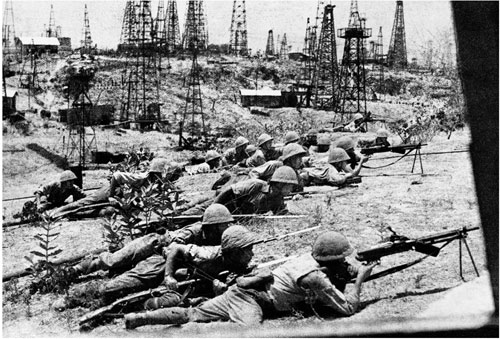
17 Riflemen with the Arisaka rifle. (Author’s collection)
The regiment consisted of three infantry battalions and various regimental assets, including a gun company, and was thus roughly comparable to a British or Indian brigade; however, the battalions themselves were larger and, at full theoretical strength, typically comprised about thirty officers – a rather smaller group than in a Commonwealth battalion – and over 1,000 men; roughly 25 per cent more than the British or Indian equivalent. Broadly speaking, the battalion would include the HQ and a gun platoon with two Type 92 howitzers. The Type 92 was a light 70mm piece with a range of about 3,000yd (2,745m); it could fire ten rounds per minute with a well-trained crew and utilise three types of shell – high explosive, armour piercing and smoke. Additionally, the battalion would have an ammunition platoon to support a machine-gun company of three platoons with four guns each and, in some cases, a mortar platoon equipped with two 90mm mortars. Both the mortars and the battalion guns could be broken down for transport by mules or ponies. Animal transport was extremely significant in Burma and a full division might have as few as 150 motor vehicles – and even these might be dispensed with due to the terrain – but might have well over 2,000 mules.
The four rifle companies would, at full strength, have a company HQ and three platoons consisting of three rifle squads and a grenade discharger squad, each thirteen men strong. The rifle squads were issued with adequate small arms which stood up to the Burmese climate fairly well, and the shortage of mortars at battalion level was offset by the large number of grenade dischargers. These weapons were roughly equivalent to the 2in mortar of the Commonwealth forces and were often referred to as ‘knee mortars’ from a mistaken belief that they could be braced against the leg for firing – a practice which would very likely have broken the leg of the operator.
Japanese anti-tank weapons were an area of serious weakness. A wide variety of anti-tank weapons were developed, including a reasonably effective dedicated 47mm anti-tank gun and armour-piercing rounds for most existing weapons, but Japan did not develop a real equivalent to the PIAT or Bazooka and an innovative anti-tank rifle grenade failed to live up to expectations. Anti-tank rifles were considered adequate at the beginning of the war when Japanese soldiers seldom encountered anything heavier than a Bren Gun Carrier or an obsolete armoured car, but were not very effective against Valentine or Stuarts tanks and were virtually worthless against the Lee and Grant tanks deployed from 1943 onward. A number of effective expedients were developed based on satchel and pole charges, but these could only be used at great risk to the operator.
Much of the artillery was horse-drawn, but horses did not fare well in Burma and were very difficult to replace. This was not as anachronistic as it might seem, though, as the horse was still an important asset in warfare. Germany and the Soviet Union were still heavily dependent on the horse even in 1944 and both countries had cavalry formations right up to the end of the war. An artillery regiment would be attached to each division and might typically consist of three battalions, one with three companies of six 75mm field guns and two armed with medium howitzers, although the distribution of weapons varied considerably throughout the war years. The weapons themselves were often of a decent standard, though there were serious shortages of shells and the production quality of ammunition was suspect. The artillery arm was further hindered by poor radio communications between infantry and artillery units, and by a lack of adequate maps which greatly reduced the effectiveness of indirect fire.

18 A speeding Ha-Go Type 95 tank. (Author’s collection)
The units that fought in Burma, Malaya and the Pacific in 1942 were determined and courageous to an incredible degree, but their ranks were dramatically reduced by disease and battle through 1942 and 1943, so a great many replacements were required. These men were generally not so fit and well trained and many of the men serving in infantry units in 1944 would not have been acceptable for infantry service in 1942. However, they did have the benefit of the experience of the veterans in their battalions and overall standards remained high, so long as the campaign was going well and adequate supplies were provided. Although the army was in good spirits overall, there was a serious lack of confidence among the senior commanders when the U-Go offensive was being planned. Several highly experienced and skilled officers had grave doubts about the ability of the supporting arms to maintain the levels of food and ammunition required and several felt that insufficient regard was being given to the abilities of the enemy.
Although the Allied Arakan offensive of 1943 had not been a success, bringing it to a halt had been a much harder business than might have been expected on the basis of the 1941/42 campaigns in Malaya and Burma. The Commonwealth troops on the ground were much more capable than they had been in the past and there was no prospect of gaining air superiority. Equally, although the objectives of Operation U-Go were overly ambitious, failure to launch a major offensive would simply allow the Commonwealth forces to grow in strength and confidence. Adopting a defensive policy would simply have handed the initiative to the enemy at a time when Japanese forces across the Pacific were already in retreat and Japan herself was increasingly subject to American air raids, which were demoralising the population and decimating industrial production. General Mutaguchi’s plans may not have been welcome, but the alternative was surely a long, slow and costly retreat through Burma against an enemy who was only going to grow stronger.
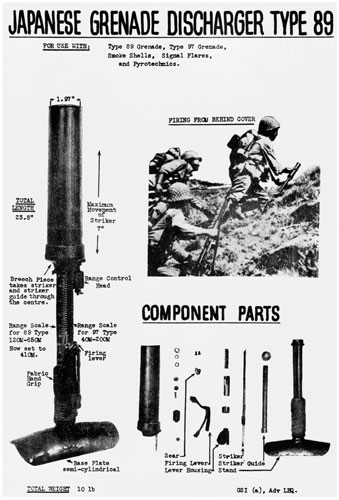
19 The Japanese knee mortar grenade launcher. (Author’s collection)