
1 and 2. MESNIL RIDGE CEMETERY AND KNIGHTSBRIDGE CEMETERY
These cemeteries are very difficult of access. The road to them is indicated by a CWGC sign on the western outskirts of Mesnil; like so many of the small roads in the Somme area, it promises well. However, it is not long before the surface progressively degenerates, from a metalled surface to a good track, to a hair-raising experience when the sump seems to be likely to be an early casualty! I have done it by car, but I would recommend that as soon as you feel that the going is getting tough that you stop there and make the rest of your way by foot.
See Maps 3, 14
To the left of the track for much of the way the line of the old Albert — Doullens light railway (which existed prior to the war) may be discerned — there was a station in Mesnil, to the immediate south west of where the turn to the cemeteries is made. After some distance Knightsbridge Cemetery may be seen to the right; Mesnil Ridge Cemetery is on the other side of the old railway line, to the left.
The cemeteries are situated on a featureless piece of ground. Mesnil Ridge Cemetery is small, with only ninety five burials in it. It is unusual in that all but one of those buried here is identified. It is a battlefield cemetery: that is that the men were buried here at the time of their death; concentration cemeteries were created by (in general) either extending an existing cemetery or by creating a new one by bringing in the dead who had been buried in small or scattered plots from the vicinity, or on occasion from further afield. Mesnil Ridge Cemetery was created by Field Ambulances and units mainly in the 36th (Ulster) Division and then the 29th Division from August 1915 to August 1916. Presumably the Field Ambulances were making use of the almost imperceptible fold in the ground to offer some shelter and the track of the light railway to provide a means of evacuation of the wounded. A number of the casualties of the raid on Mary Redan (all those here from 2/South Wales Borderers), referred to in the chapter on the Newfoundland Regiment, found their resting place here. There is only one casualty from the Newfoundland Regiment in this cemetery: Private George Curnew was killed by a bullet which struck him on April 24th whilst he was working on the parapet in the front line. It was the first fatality in France, the first time the regiment had entered the front line since they had arrived from Gallipoli and only one week since the unfortunate Private Curnew had joined the battalion with a small draft. He is buried in Row F Grave 1.
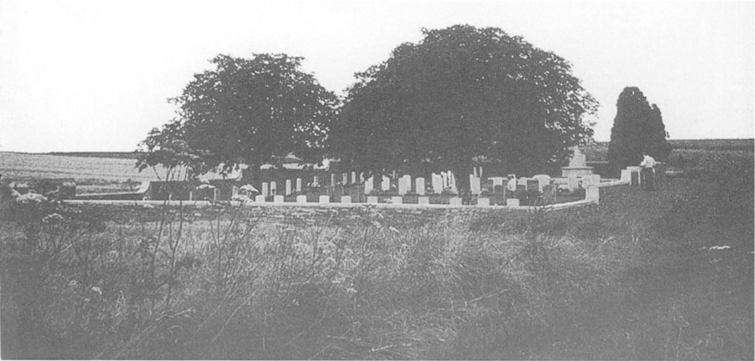
Mesnil Ridge Cemetery, with the trackway of the old light railway to the right.
Knightsbridge Cemetery is much the bigger of the two, opening when the Battle of the Somme began, and used by units whenever this area found itself in the battle zone — in 1916 and early 1917 and for a few months in 1918. Most of those buried straight in front, and to the right, of the cemetery entrance were brought in from the neighbourhood after the armistice. It is situated just to the west of the site of a communication trench, Knightsbridge Barracks which ran south of the car park of the Newfoundland Park. Amongst the men of the Newfoundland Regiment buried here is one of the Ayre cousins. Right at the end of Row B lie a group of eight officers of the 4/Bedfords, which was a part of 190 Brigade (63rd Division). They were all killed on November 13th, as their battalion advanced in support of the attack, possibly victims of the strongpoint in the German first line that caused so much trouble to the British on that day.
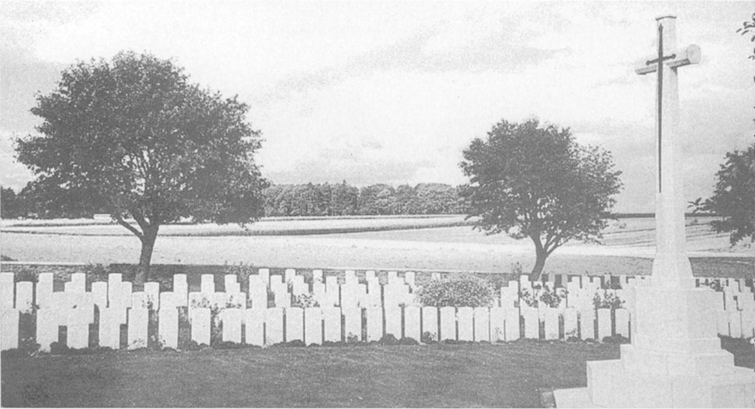
Knightsbridge Cemetery looking across to the Newfoundland Memorial Park, signified by the trees and the coach in the car park.
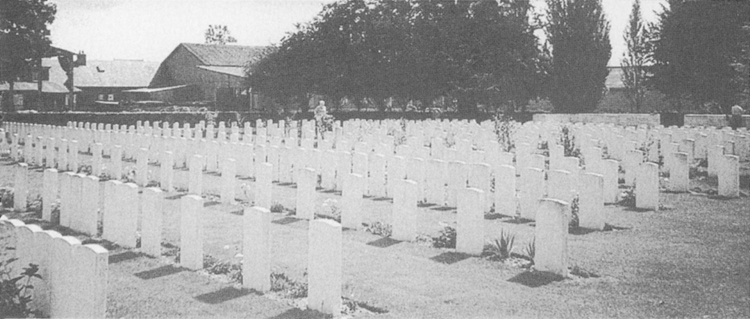
Auchonvillers Military Cemetery, looking across to the farm which was the site of the Collecting Post in the November attack.
3. AUCHONVILLERS MILITARY CEMETERY
This cemetery can be easily missed; it is set well back from the road, and is approached by a track on the right hand side of the Auchonvillers-Mailly road just after the last farm building in Auchonvillers. This farm is the site of the Collecting Post mentioned in ‘Saving the Wounded’. It was natural that the dead should be buried nearby, and the cemetery is almost a chronological record of the units that served in this sector of the front. From here there are good views across the country to Mailly Maillet, over the ground across which so many men passed for their last time in the bloody months of late 1916. Like so many of the Battlefield cemeteries, it has very few unidentified; under ten percent of the total, and of those a significant proportion are amongst the fifteen concentrated here after the armistice.
4. AUCHONVILLERS COMMUNAL CEMETERY
Besides the cemeteries that were built for the casualties of the war, a large number of ‘communal’ cemeteries were used by all sides during the conflict. Usually the War Graves Commission put a small green plaque on or near the cemetery gates (for those with only a few British buried there) to indicate the fact that there are Commonwealth burials in that cemetery. Since there are so few (the larger numbers of burials in a Communal are usually buried in what is described as an ‘extension’) buried in these cemeteries there is rarely a register in place, and one has to hope that it is included in a neighbouring British cemetery. In this case the details are to be found in Auchonvillers Military Cemetery.
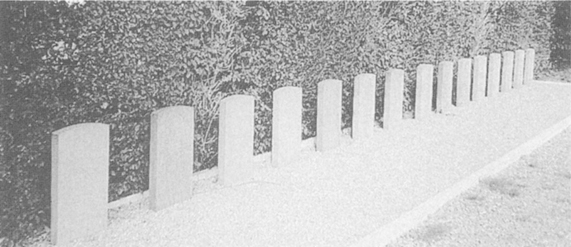
There are fifteen British soldiers buried in this cemetery, thirteen of them in 1/Border who were killed by a hurricane bombardment of a communication trench (Second Avenue) on 6 April 1916. There is also buried here one of the earlier superintendents of the Newfoundland Park; he has a CWGC type headstone and it is obvious that the grave is maintained by them.
The red coloured headstones were part of an experiment by the War Graves to find a long lasting stone (especially, but by no means exclusively, for use in these small plots) which could stand up to the ravages of the weather and not require the constant cleaning that the traditional stone has needed.
5. ‘Y’ RAVINE CEMETERY
The cemetery register is often a great source of knowledge, sometimes of a surprising type. This cemetery register tells the reader that Beaumont Hamel has been adopted by Winchester — a common practice after the war, as the towns and villages of the war-ravaged areas tried to recover from the cataclysm that had reduced them to being described as ‘ruins’ on maps. Sheffield, for example, adopted Serre and Birmingham took on Albert, which explains the Rue Birmingham that runs alongside the Basilica.
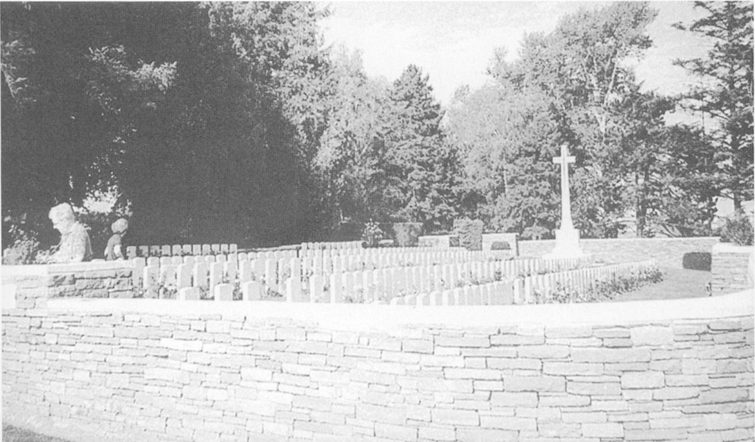
Y Ravine Cemetery
This is a concentration cemetery, like so many in this vicinity, created by the V Corps burial officer after the battle had moved on from here in the spring of 1917. It is situated just to the south of the fork of Y Ravine, which itself ran in a south westerly direction from the main ravine. It is no longer possible to see this fork, as part of it has been landscaped into a field; but there is quite clearly a bank remaining, which enables the position to be located. The cemetery is in No Man’s Land, and access is usually through the Newfoundland Park, within whose boundaries the cemetery stands.
Just under fifty percent of the burials are unidentified. Amongst those whose name is known is CSM Joseph Fairbrass of 2/South Wales Borderers, who fell on July 1st. He saw service at Gallipoli and was one of six brothers who served, three of whom were killed during the war.
The cemetery is a good place from which to survey the German position and their viewpoint of the British attack — this is why the cemetery is included on the map of the Newfoundland attack, so that readers may get their bearings.
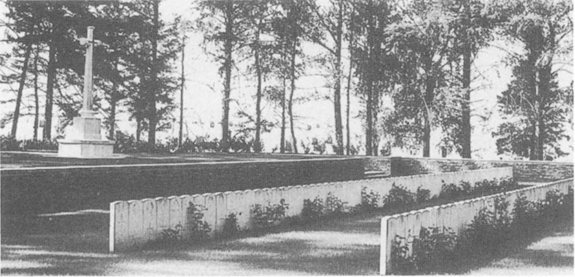
The closely packed graves of Hawthorn Ridge Number 2 betray its origins as a concenration cemetery.
6. HAWTHORN RIDGE CEMETERY NO. 2
Another concentration cemetery, this also is the work of V Corps. The open nature of the cemetery layout perhaps indicated more clearly than in other similar places that the cemetery was created specifically for burying a large number of dead simultaneously. In essence it consisted of two long trenches and the dead would, presumably, have been packed in together as closely as possible. One can almost imagine the scene of the burial officer matching bodies to names, ordering them to be put in the trench, a burial service for all of them and then covering the lot up. The packed nature of the burials is indicated not only by the fact that the headstones have no spaces between them, but also that more than one name appears frequently on the one stone; when they came from more than one regiment the War Graves came up with the strangely moving solution of having the two cap badges interlinked.
It is worthwhile mentioning here that V Corps were not the first to clear this battlefield; after the relative success of the November 1916 attack large numbers of the dead of July 1st were removed from the battlefield and were buried in the rear areas, in cemeteries such as that at Mailly Maillet.
The much smaller front row consists chiefly of those who were concentrated to this cemetery after the armistice.
7. HUNTER’S CEMETERY
This small cemetery (another one by V Corps) was created by using a large shell hole to create a mass burial; many of those who lie buried here were members of the 6 and 7/Black Watch which attacked this side of the Y Ravine in November 1916. It is also characteristic of the care that the War Graves Commission took in designing the cemeteries so that individuality could be expressed and that the final resting places would not just be a series of uninspired burial plots.
The register proclaims that the origin of the name of the cemetery is unknown; Martin Middlebrook suggests that it might be taken from the company commander who organised the burial of the dead; it might also come from Hunter’s Trench, which incorporated the infamous Sunken Road just to the west of Beaumont Hamel.
Just behind the cemetery, under the ground, is a network of tunnels and dug outs that have been rediscovered recently. Steve Austin Senior, who was Superintendent of the Park for many years, was aware of these tunnels, but on discovering that his son, Steve Austin Junior, had been discovered playing around them when a child, had the entrances filled in. Recent land slippage (1993) has revealed some of these entrances once more. Whilst interesting, I hope that it is quite clear to everyone how extremely unsafe these tunnels and dug outs are — observe, wonder, but keep well clear! Steve Austin Junior has succeeded his father as Superintendent of the Park.
8. HAWTHORN RIDGE CEMETERY NO. 1
This is yet another V Corps concentration cemetery. The dead buried here are mainly from the 29th Division, and of those who have been identified over half were members of 16th (Public Schools) Battalion the Middlesex Regiment. It is signposted from the Hamel — Auchonvillers road, and also from Newfoundland Park, where access is gained from a track around the west end of Y Ravine and then a short trek across a field. It provides an excellent point from which to view British and German positions, especially before the western side of Beaumont Hamel, It is unfortunate from this point of view that the trees in Newfoundland Park make it difficult to get a true impression of the strength of the German line here.
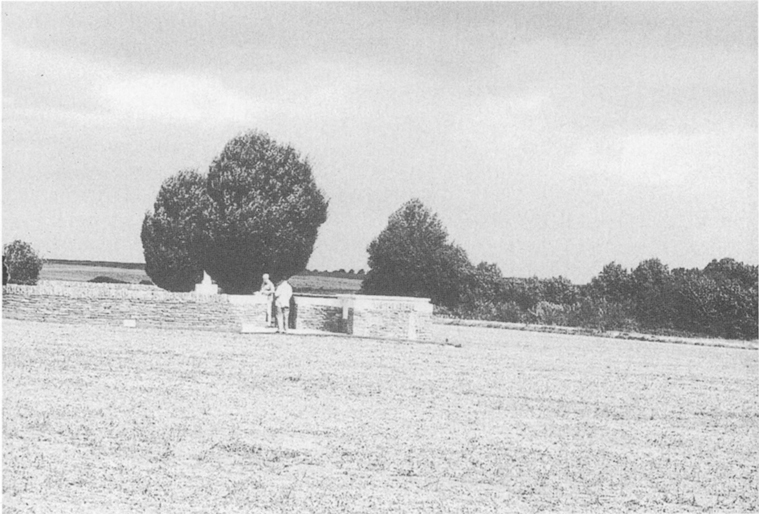
Hawthorn Ridge No 1, with the crater to the right in the mass of bushes and undergrowth.
9. BEAUMONT HAMEL BRITISH CEMETERY
This cemetery is situated in the middle of the July 1st (and November 13th, for that matter) battlefield. The high bank on its west side is the remnant of the remblai that provided yet another hazard for the men of 1/Lancashire Fusiliers on July 1st. It was also to cause trouble for the 8th Argylls in their attack on November 13th. German wire was protected by the bank and did not get properly broken up. The A Company of that battalion got caught up in it, and its commander, Captain Alastair Macarthur, to be followed in due course by his second in command, Lt Jack McKeller, were killed: they are buried at Mailly Wood Cemetery. The German line can be easily imagined, running around the small wood some yards to its east. The cemetery was created after the success of the November 13th attack and was used by the various units serving in this sector until February 1917, although about a fifth of the burials were concentrated here after the armistice. Amongst those buried here is 2/Lt Owen Fox, a rather elderly subaltern aged 47, who was killed in February 1917 whilst serving with 1/Dorsets. During the South African War he had been a lieutenant in the Cape Mounted Rifles, and possessed the Queen’s and King’s Medals with six clasps.
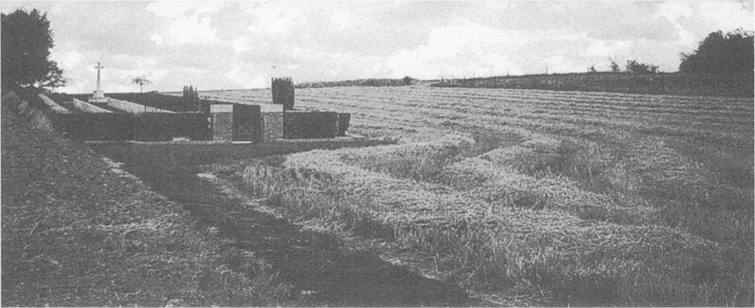
Beaumont Hamel British cemetery at the foot of the remblai, with the German line indicated by the wood to the east (ie right hand edge of photograph).
The view of the 1/8 Argyll and Sutherland Highlanders’ memorial, the Sunken Road, this cemetery and remblai and the German line signified by the small wood, which may be had from the lip of Hawthorn Crater, collectively provides to my mind one of the moving battlefield sights on the Western Front.
10. REDAN RIDGE CEMETERY NO. 2
This is situated some hundred yards west of the old German July 1st front line. It is situated close to the boundary between the 4th and 29th divisions. All but one of those buried here were killed in July and November 1916. Many of those buried here served with 1/Hampshires, a part of the 4th Division, which helps to explain the Winchester connection with Beaumont Hamel. The village also used to have a large German concentration cemetery, but in the early 1920s most of the German dead on the Somme were concentrated to Fricourt or to Rancourt.
11. ANCRE BRITISH CEMETERY
This was another of V Corps concentration cemeteries, created in the spring of 1917. After the Armistice almost two thousand graves were concentrated here to join the five hundred or so who had been buried in Plots 3 and 4. A surprising number of relatively large war time cemeteries were concentrated These included Ancre River British Cemetery No. 2, 350 yards further along the road to Beaucourt which contained sixty four men from the 63rd Division, Beaucourt Station Cemetery, close to that station with eighty five men from the winter fighting of 1916 — 1917; Green Dump Cemetery to the south west of station road, and probably named after the Green Line, an objective for the November 13th attack, which was another cemetery used during the winter of 1916 — 1917, with forty five burials; others in the open countryside between here, Beaucourt and Beaumont Hamel — RND Cemetery with 336 burials, Sherwood Cemetery with 176 burials and Station Road Cemetery with 82 burials. Finally, there was another ‘Y’ Ravine Cemetery (No. 2), which was situated in the open fields to the left of Mary Redan, not far from the British front line, where 140 men were buried.
The cemetery is in a deep hollow which was firmly in No Man’s Land in July 1916 but was either partly within, or just in front of, the British line on November 13th. From the top of the cemetery there are commanding views across the Ancre to the heights above, and a clear view over the ground that some of the units of the northern part of the 63rd Division attack had to cross.
Amongst the dead is the Honourable Vere Harmsworth, killed before the redoubt just above the cemetery. His father was Viscount Rothermere, proprietor of the Daily Mail. There is an interesting permanent plaque at the base of his headstone, recording a pilgrimage by Hungarian Boy Scouts to his grave in the inter-war years. The character of the early days of the Naval Division is perhaps summed up by his stone and that of Able Seaman William Brown, also of Hawke Battalion, who had learned articles published in the Philosphical Magazine in 1915 and posthumously in the Proceedings of the Royal Society of Edinburgh.
The cemetery is a quiet spot in an area which is well visited, and I have stopped here on more than one occasion to have a picnic lunch seated on the bench seats thoughtfully provided by the CWGC. The continuing work of the War Graves Commission was shown on my last visit here, when extensive work was taking place to rebuild the entrance wall, which had become dangerous because of land slippage.
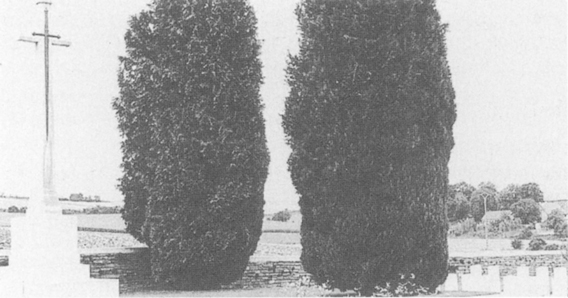
Hamel Military Cemetery. Jacob’s Ladder, a communication trench, ran down the slope behind it into the village.
12. HAMEL MILITARY CEMETERY
This cemetery does not appear on the main tour map, but is situated at the southern end of the village, on the road to Albert. It can be missed if the driver is not careful, as it is tucked off to the north side of the road. This was a battlefield cemetery (there was a dressing station in a house just south of the turning in the village to Auchonvillers) and was in use continuously through the fighting of 1916–1917 and again for a short while in 1918, with only a few concentrated here after the war. There are two 1919 burials — men from the Chinese Labour Corps. These men were brought to France during the war to act as labourers, and were obtained by the British Government contracting for them from Chinese War Lords. These two were likely to have died from one of two causes — Spanish ‘flu (unlikely) or as a consequence of a munitions explosion. They were used widely to help to clear the battlefield of war debris, and it is not uncommon to find one or two members of this Corps buried in various British cemeteries across Flanders. If the long coastwards journey to Le Croty is made to visit the grave of Sub Lieut Dyett, then a small diversion to visit the Chinese Cemetery at Noyelles-sur-Mer is well worthwhile. It consists entirely of members of the Chinese Labour Corps (838 of them, as well as a memorial to their missing), and is sited here because their headquarters was in the fields in front of the cemetery.
See Map 14
Amongst the casualties of the November fighting buried here are two of the commanding officers of battalions in the Royal Naval Division. On the slope above the cemetery lay a long communication trench, Jacob’s Ladder (not to be confused with the trench of the same name near Beaumont Hamel) which ran down to Hamel, coming out near the church, from Mesnil.
MEMORIALS
1. 29TH DIVISION MEMORIAL.
This memorial is immediately in front of the visitor on entering the Newfoundland Memorial Park from the car park. It sits on an artificial mound, and its chief characteristic is the red triangle that was its divisional sign.
2. THE NEWFOUNDLAND REGIMENTAL MEMORIAL
The proud caribou, the work of the English sculptor, Basil Gotto, sits on its artificially created eminence and surveys the ground over which so many men of this faraway colony were to die. This caribou is one of five placed in various locations across the Western Front, where the regiment fought major actions. The other one located on the Somme is to be found on the outskirts of Guedecourt. The selection and arrangement of the land to be purchased and the siting of the various caribou was the work of Father TF Nangle, the RC Chaplain to the Regiment in the latter years of the war. He was also Newfoundland’s representative on the (then) Imperial War Graves Commission. The caribou here is the most striking of them all, forming as it does but one part of this impressive memorial to the contribution that the country made to the allied effort during the Great War. At the base of the mound is the Memorial to the Missing from Newfoundland, which includes those who served at sea as well. The Park, too, is their memorial; and the decision to purchase this land has served Newfoundland well, for in all probability no part of the Western Front is more visited now than this small part of the Somme battlefield.
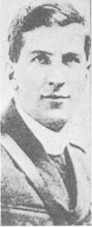
Father Tom Nangle
3 AND 4. 51ST (HIGHLAND) DIVISION MEMORIALS.
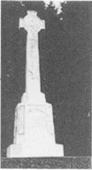
The 51st Division has two memorials here. The simple cross that stands close to Y Ravine was brought here from High Wood, the scene of a less successful series of attacks in the last days of July and the first days of August 1916. It was the first time the division had fought together as a whole formation. The simple memorial was moved here because it was considered to be in safer hands.
The magnificent bronze statue of a Gordon Highlander, modelled on CSM Rowan, stands on the old German front line and stares across Y Ravine and over the ground which the division fought over and captured in November 1916. It was unveiled by Marshal Foch.
5.1/8 ARGYLL AND SUTHERLAND HIGHLANDERS MEMORIAL
This is a huge memorial to this battalion, and is the largest to a single battalion on the Western Front. The memorial is sited very close to the location of the headquarters of the Battalion when it went into the attack on November 13th. It carries the battle honours, cap and collar badges of the battalion as well as a record of its casualties on the base of a Celtic cross.
16. 51ST DIVISION MEMORIAL, BEAUMONT HAMEL.
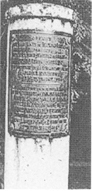
This is the memorial that most people miss in this area. On entering Beaumont Hamel from the west there is a confusion of road junctions. In the triangle between this road and the Rue de Montagne (known as Frontier Lane during the war) there is the metal base of a flag pole, in danger of being concealed by a tree. There is a plaque on it, explaining that it is a gift from the men of the Highland Division to the people of Beaumont Hamel. It would be fitting if it could be restored to its proper function, though the last time I was there somebody had put some flowers by it, so it is not completely forgotten.
7. ROYAL NAVAL DIVISION MEMORIAL, BEAUCOURT-SUR-ANCRE.
This is on the north east side of the road at the end of the village on the Beaumont Hamel side, just beyond the Church, which has been moved from its pre-war position. It has a simple inscription (no mention of 63rd Division here!) referring to the action of November 13 and 14 1916. Beware of traffic here, and take care with parking the car should you wish to take a closer look.
Although handsome enough, one would not think the memorial particularly prominent. The road between Beaucourt and Hamel is for the most part hemmed in by a quite steeply rising embankment, and so little impression is gained of the ground over which the Naval Divison fought. However, from just forward of the site of Mary Redan, near Newfoundland Park, the memorial is quite visible (binoculars do help, it must be admitted). It is possible, therefore, to see much of the ground over which the Naval Division fought during those tumultuous days of November 1916.