
Chapter Two
The First Ukrainian Front’s artillery began its initial barrage at 05.00 hrs on 12 January. Bursting out of the extensive bridgehead at Sandomierz, Konev’s push towards Breslau began wonderfully well. The German first line collapsed under the weight of a full-scale infantry attack, not the usual reconnaissance in force mounted by the Soviets in such operations.
A second barrage at 10.00 hrs took out Fourth Panzer Army’s headquarters, over half of its artillery and a quarter of its men, while others fled in panic. By the end of the day First Ukrainian Front had torn a 19km-deep gash across a 40km-wide stretch of Army Group A’s line. Into the breach were sent the T-34s of Fourth Guards Tank Army.
Preparing to face this armoured onslaught were the 16th and 17th Panzer divisions of XXIV Panzer Corps, a strong force of 350 tanks. Hamstrung by orders from Berlin to assemble near the town of Kielce, General Nehring, commander of XXIV Panzer, was caught by the speed of the Soviet armoured assault. Several days of confused fighting near the village of Lissow and Kielce itself reduced XXIV Panzer to a shadow of its former strength and Kielce was lost securing Konev’s right flank.
To the south of Fourth Panzer Army’s line, XLVIII Panzer Corps, which had not one full Panzer division on its strength, was, by the end of 13 January, in total disarray as the Soviets crossed the Nida river en route to Cracow. To the north of the line XLII Corps had collapsed and would eventually link up with the remains of XLVIII Panzer Corps retreating westwards as a part of what became known as Nehring’s ‘Roving Cauldron’.
The liberation of Cracow and the rapid success of Konev’s offensive took Moscow by surprise as much as it horrified the Germans. Stalin and the Stavka responded by setting new goals for First Ukrainian Front, which were Breslau, on the Oder river, and the Reich’s second-most productive industrial area after the Ruhr – Upper Silesia. So important an objective was this that Stalin dubbed it ‘gold’. Elsewhere too were the Soviets reassessing the tasks given to the Front commanders in light of their achievements.
Zhukov’s First Belorussian Front attacked from the Magnuszew bridgehead with the twin objectives of Lodz and Poznan on 14 January. Three infantry armies followed a short but intense bombardment and breached the German line, allowing the armoured exploitation by Second Guards Tank Army to begin earlier than anticipated. By 18.00 hrs Soviet penetration had reached up to 48km into the German rear.
The breakout from Zhukov’s smaller bridgehead at Pulawy began on the following day and achieved similar levels of success. Neither attack had the benefit of air support due to snow and fog. Poorly co-ordinated German counterattacks, although quicker off the mark than those against Konev, failed to create more than limited difficulties for the Soviet tidal wave.
The speed of First Belorussian Front’s advance equalled that of Konev and First Ukrainian Front, and denied the Germans any opportunity to construct defensive lines along the rivers that traversed this region. Indeed, the Soviets exploited the frozen waterways as roads whilst their engineers provided bridges capable of taking the weight of heavy armoured vehicles. The close support provided by the mineclearing and bridging teams was vital to sustain the momentum of the advance, which rushed ahead apace as the German situation descended deeper into chaos almost by the hour. Indeed, it was almost a case of ‘every man for himself and devil take the hindmost’.
First Belorussian Front’s First Guards Tank Army, followed closely by the infantry of Chuikov’s Eighth Guards Army, drove towards Lodz, Poland’s second city, which was liberated after token resistance on 19 January. However, Poznan, a vital road and rail network junction point, was an altogether different proposition as it was strongly garrisoned and well fortified. Poznan was bypassed by the Guards’ tankers, and its capture was left to Chuikov’s infantry, who made their first attack on 26 January.
On the Baltic coast, however, things were moving much more slowly for Chernyakhovsky’s Third Belorussian Front, which had opened its attack into East Prussia on 13 January with Konigsberg as its main objective. The terrain, marshy and wooded, favoured the Germans, who were also aided by strong defensive positions originally built before 1914, and extended since that time. Grinding through this region courageously defended by locally raised Volkssturm and regular troops occupied much of January but by the 27th a pocket with Konigsberg at its heart was under siege.
Rokossovsky’s Second Belorussian Front had two tasks, the first to support Chernyakhovsky’s advance into East Prussia, and the second to protect Zhukov’s northern flank. The attack began on 14 January and within five days the German line had been broken to a depth of 65km and the East Prussian border was in sight. However, a further mission was assigned to Rokossovsky’s forces. Fifth Guards Tank Army was ordered to push on to the Baltic coast and reach Ebling, at the mouth of the Vistula river. This ambitious plan was designed to cut off Army Group Centre from the rest of Germany. The march to the sea began on 23 January.
Konev’s tank dash had been equally successful, squeezing German Eighteenth Army out of the Silesian industrial area, which was occupied for a minimal loss of men and production capacity – this was a bitter blow to German munitions production. The pursuit of German forces to the Oder river resulted in the establishment of bridgeheads at Steinau and Ohlau, north and south of Breslau respectively. But Breslau itself, with its road and rail crossings, remained in German hands.
On 2 February Stavka ordered a halt to allow resupply, rest for the men and machines, the mopping up of German stragglers and the re-establishment of order behind the Soviet lines. Berlin, now within 150km of the Red Army, would have to wait. But as the Soviets rested, recuperated and reorganised, so did the ragged remains of Guderian’s forces.
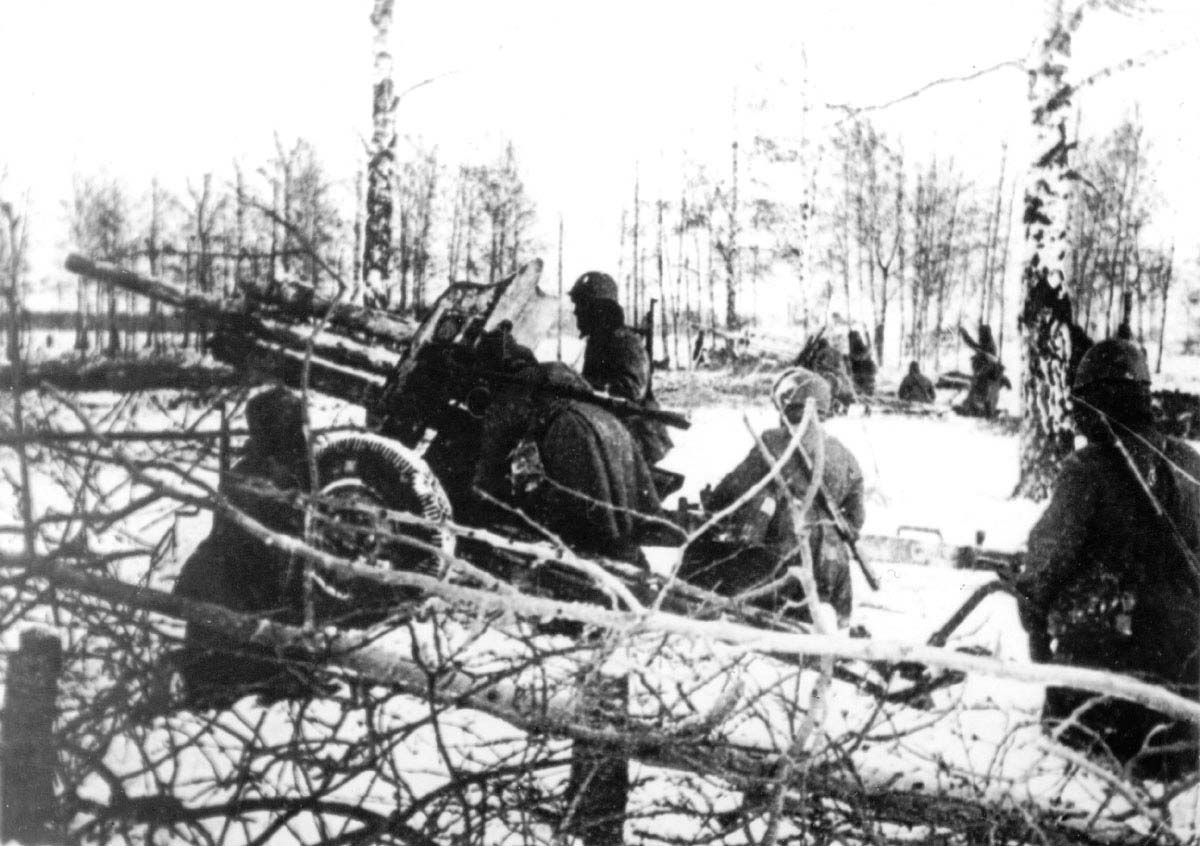
A 76mm Model 1939 divisional gun prepares to fire in support of Konev’s main infantry assault on 12 January. The Red Army’s artillery was a powerful, flexible tool, well-equipped with robust weapons such as this.
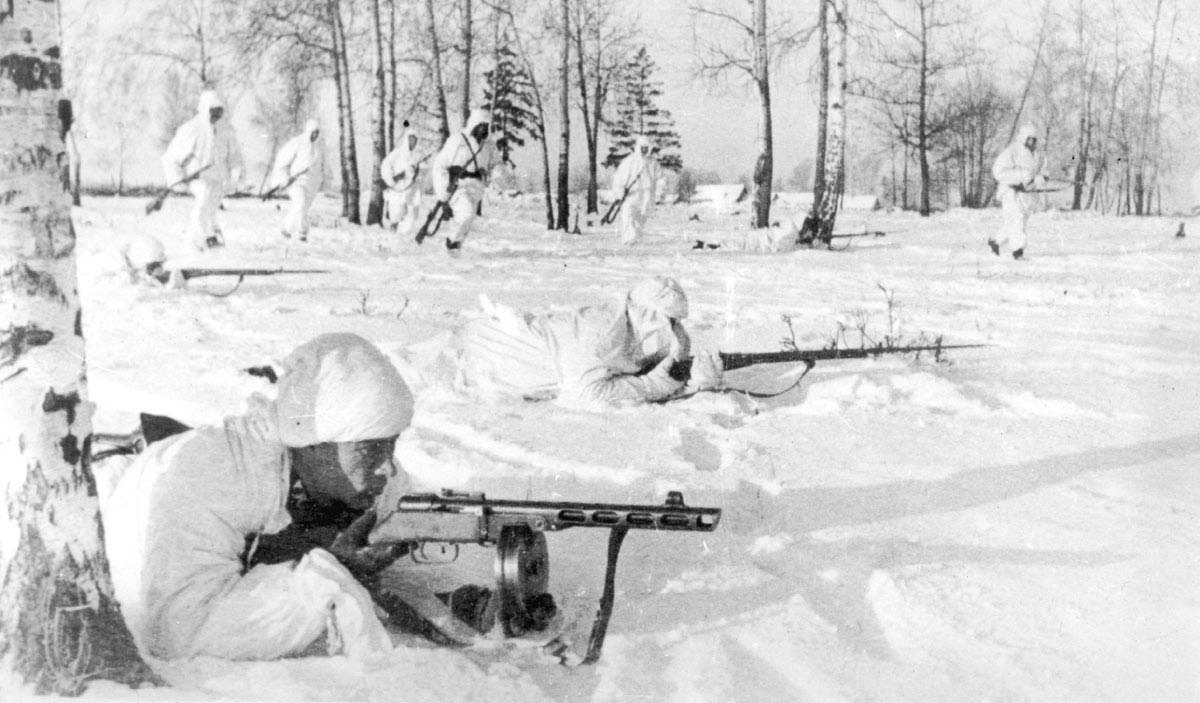
Suitably dressed for the weather, Soviet infantry move forward across unspoilt terrain. The second attack by Konev’s infantry followed 150m-wide lanes of ground that were specifically left clear of shellfire to ease the assault troops’ rapid passage into the German lines.
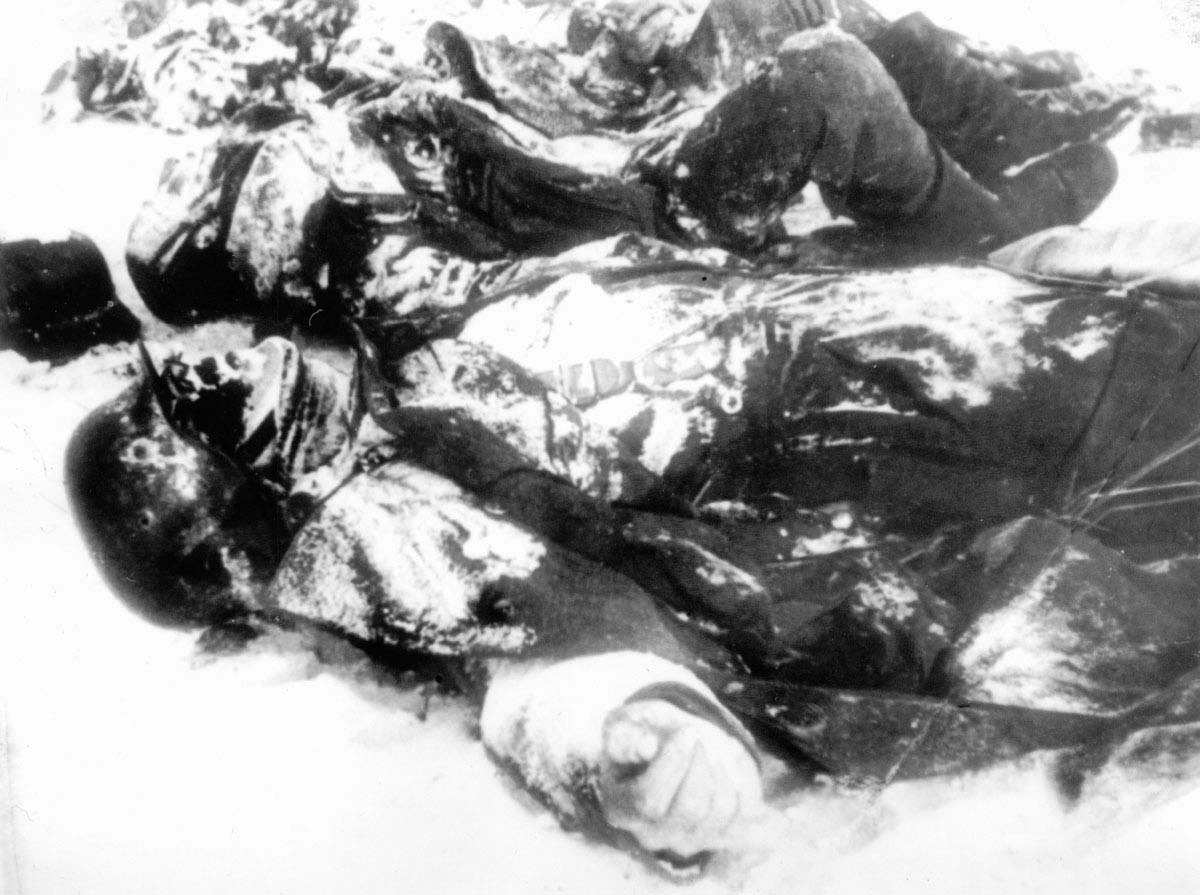
The grisly reality of war on the Eastern Front: as the men of First Ukrainian Front penetrated deeper into the German tactical zone of defence they could see clear evidence of their artillery’s success, and the failure of the ‘Fritzes’ ’ defensive methods.
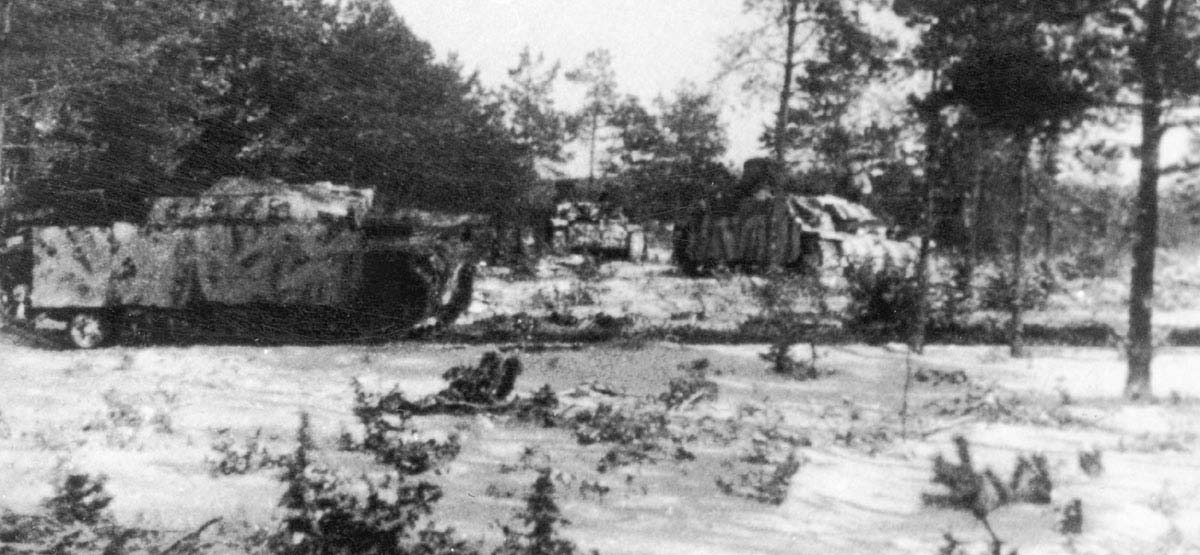
Barely discernable among the trees a trio of German assault guns moves cautiously into firing positions during the Kielce operation. The two Panzer divisions committed over 300 tanks to this action. However, their lack of co-ordination led to severe losses, including one Tiger battalion that was destroyed during refuelling.
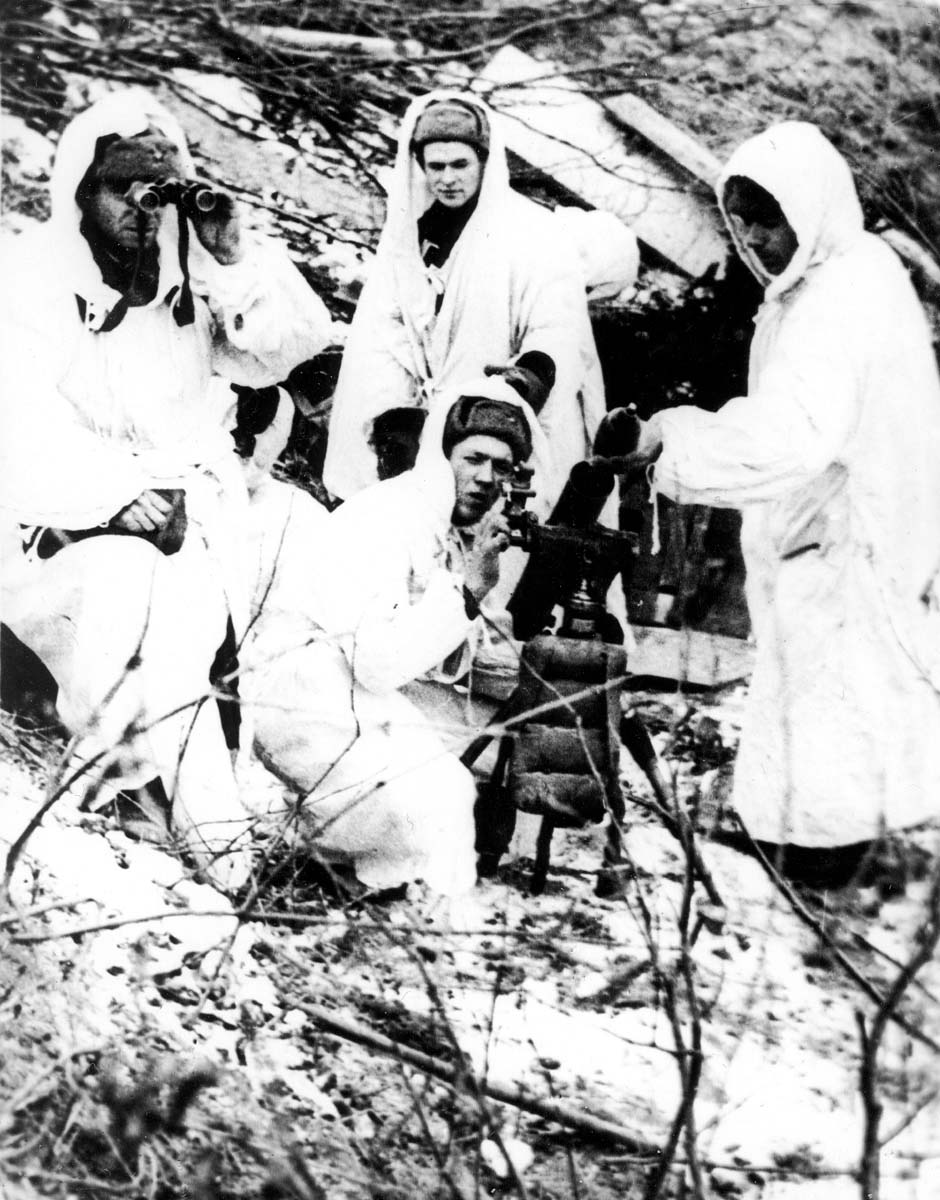
A Soviet 82mm Model 1943 battalion mortar prepares to fire in support of an infantry attack. The Soviets made extensive use of such close-support weapons during offensive operations. In wooded areas, firing into the branches of trees to create wooden shrapnel could prove devastating to lightly protected infantry.
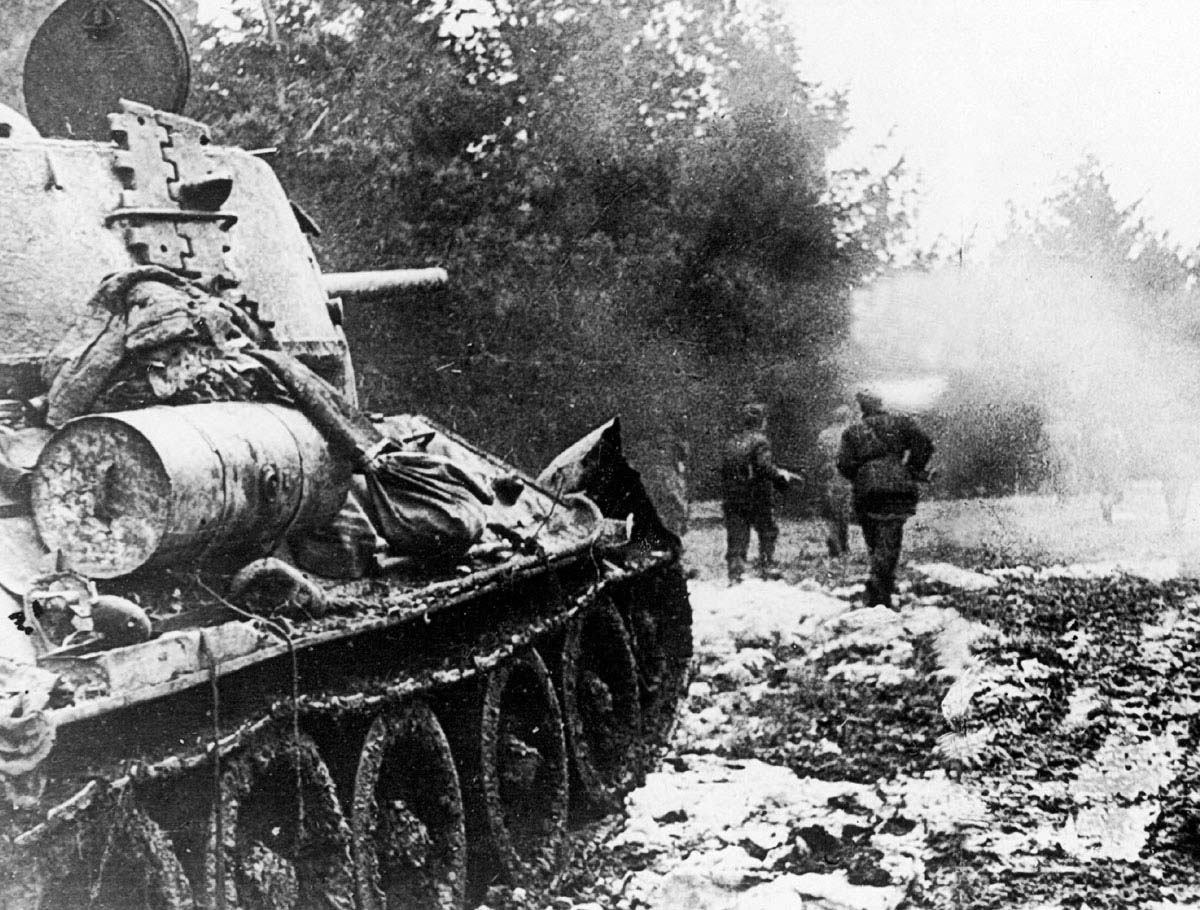
T-34/85 tanks and infantry of Zhukov’s Second Guards Tank Army go into action on 15 January to exploit the gap torn in the German line. The vehicle on the left has been disabled. On its side is one of the extra fuel tanks often carried. The spongy condition of the ground is obvious from the mud around the road wheels.
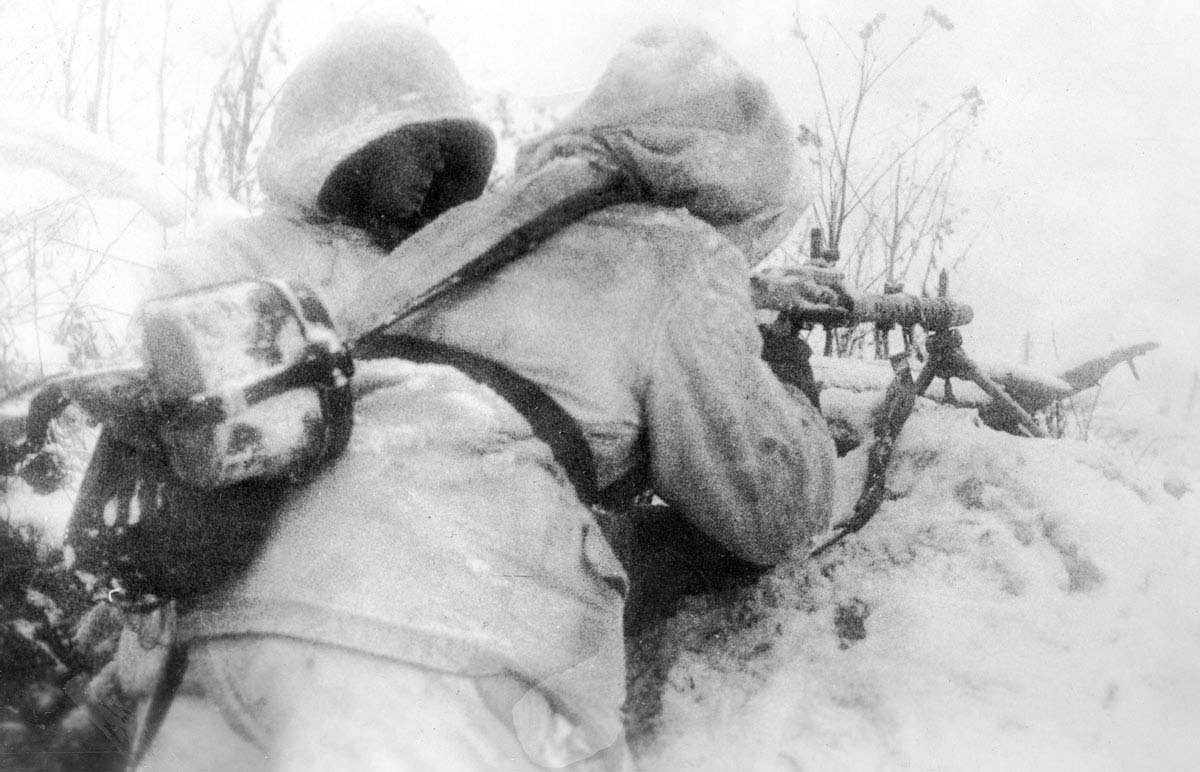
Operating an MG-34, German machine-gunners prepare to fire on advancing Soviet infantry. The severity of the weather is apparent judging by the build-up of snow on the men’s equipment. Although an excellent weapon, the MG-34 had a tendency to jam in snowy conditions. Groups such as these men guarded the retreat of their comrades by giving covering fire.
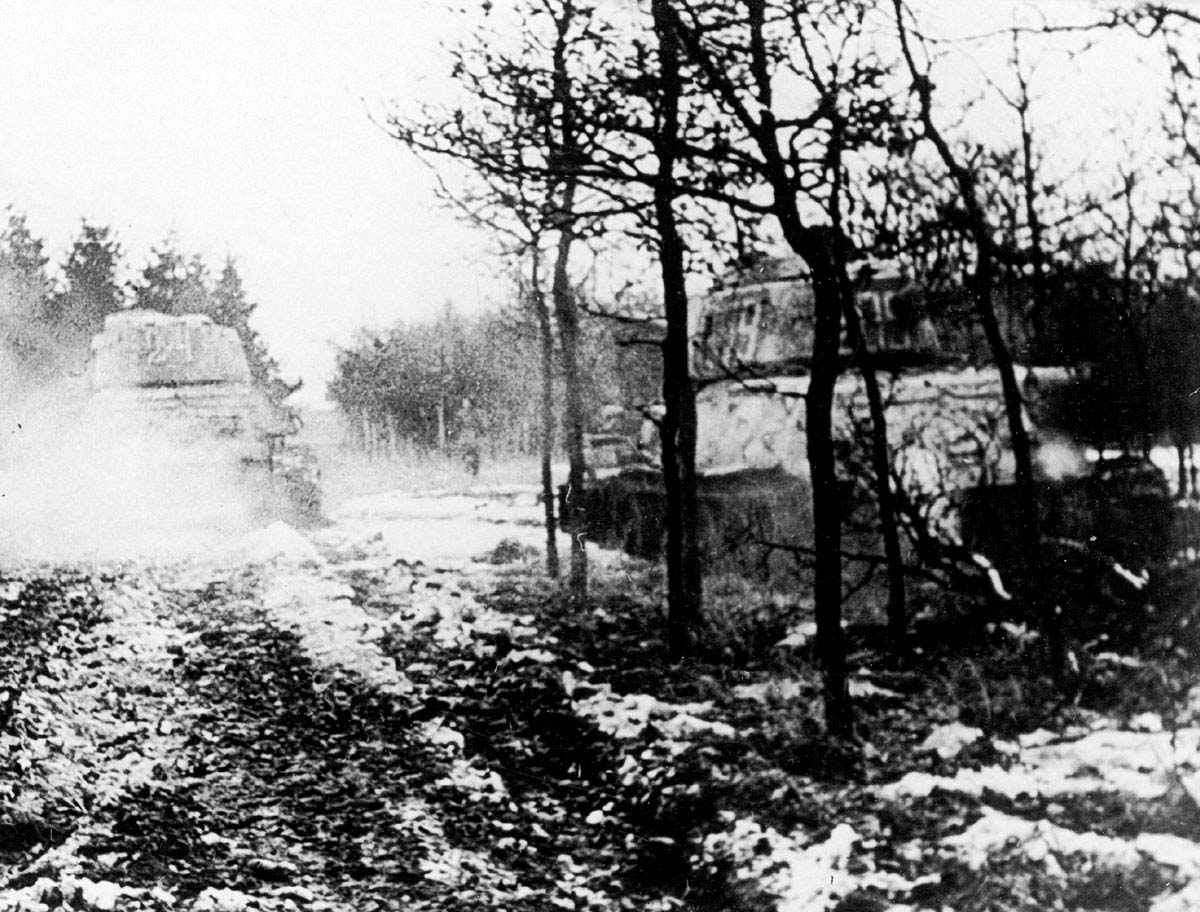
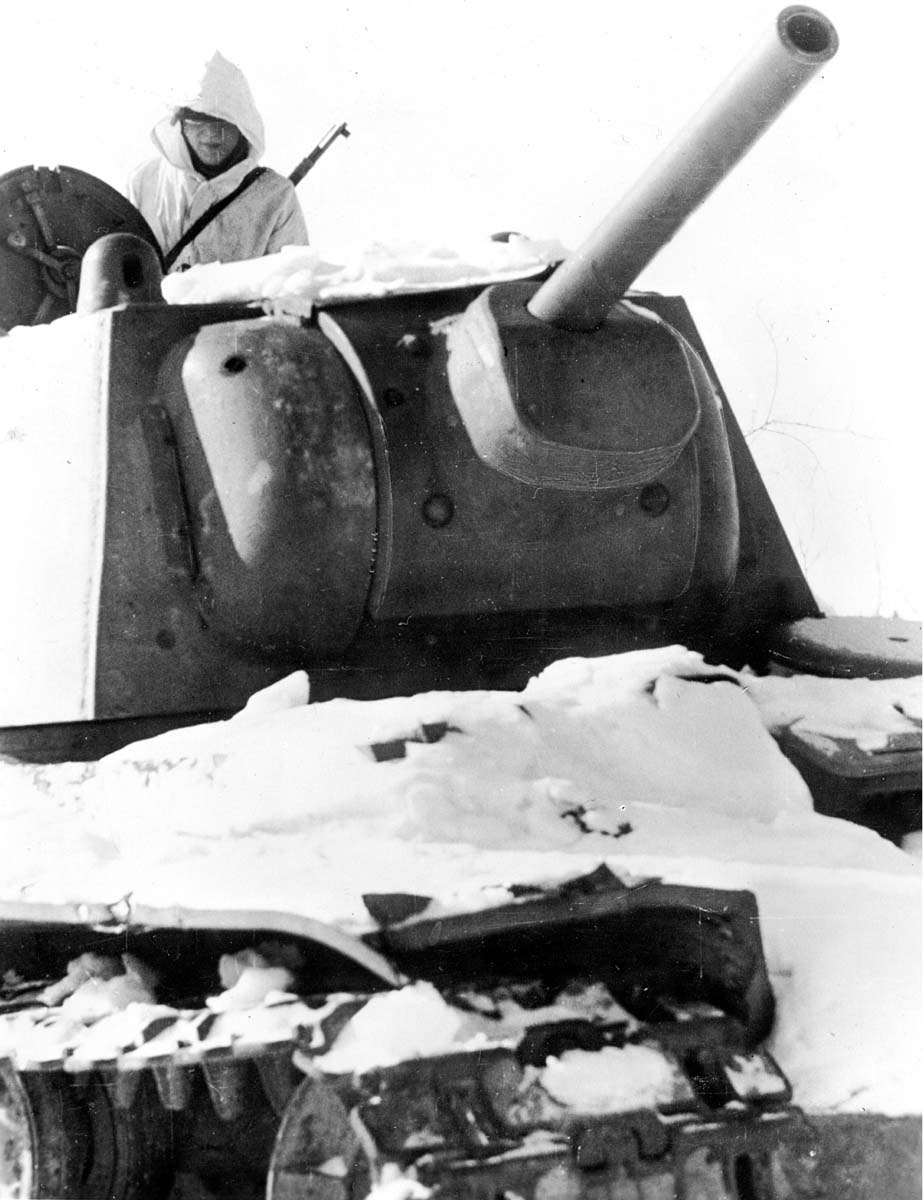
The Soviet armoured troops did not have things all their own way. Here a German admires his handiwork with a Panzerfaust antitank weapon. His victim is an early production KV-1 heavy tank. The KV-1 remained in service until the end of the war although superseded by more advanced tanks.
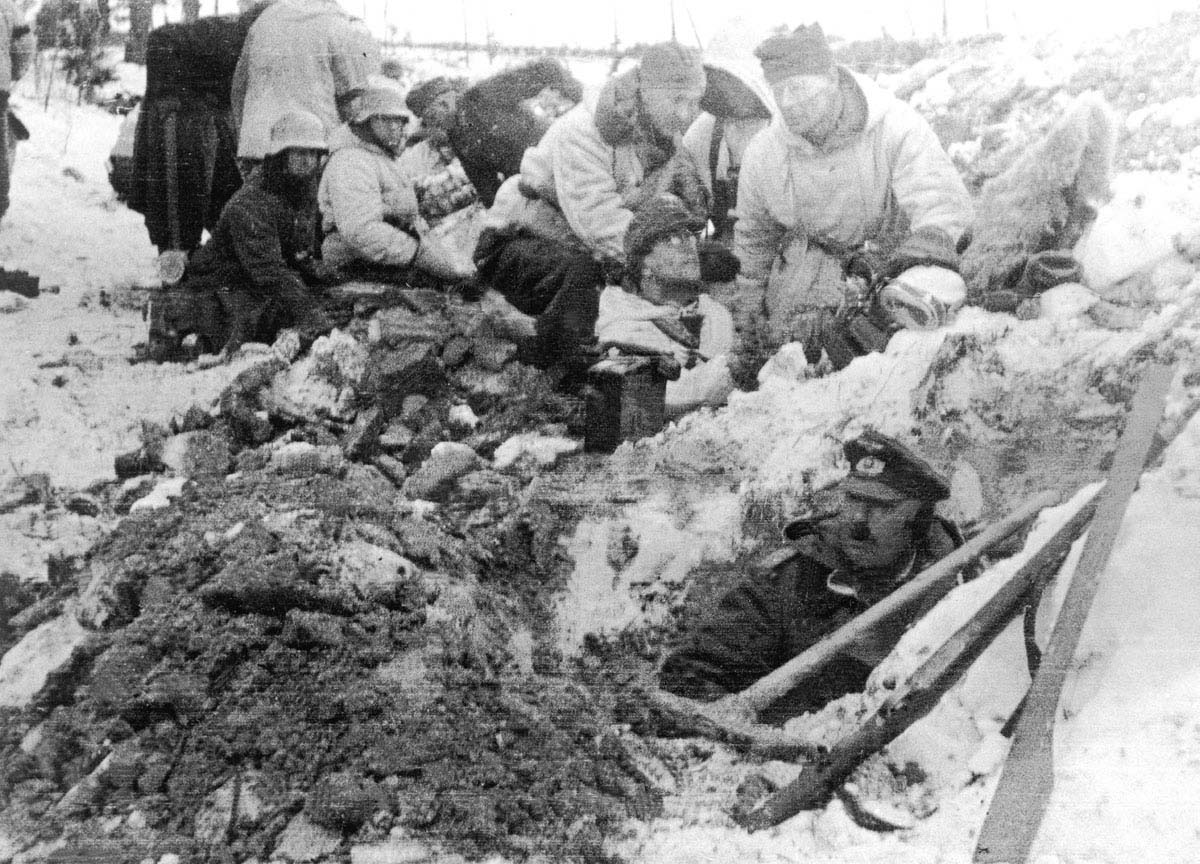
Members of the East Prussian Volkssturm take their positions in the line. Fighting on their soil, in defence of their own land, the Volkssturm in East Prussia gave a good account of themselves. Organised in battalion-sized units (roughly 600 men), they often served under retired officers and NCOs who were local men.
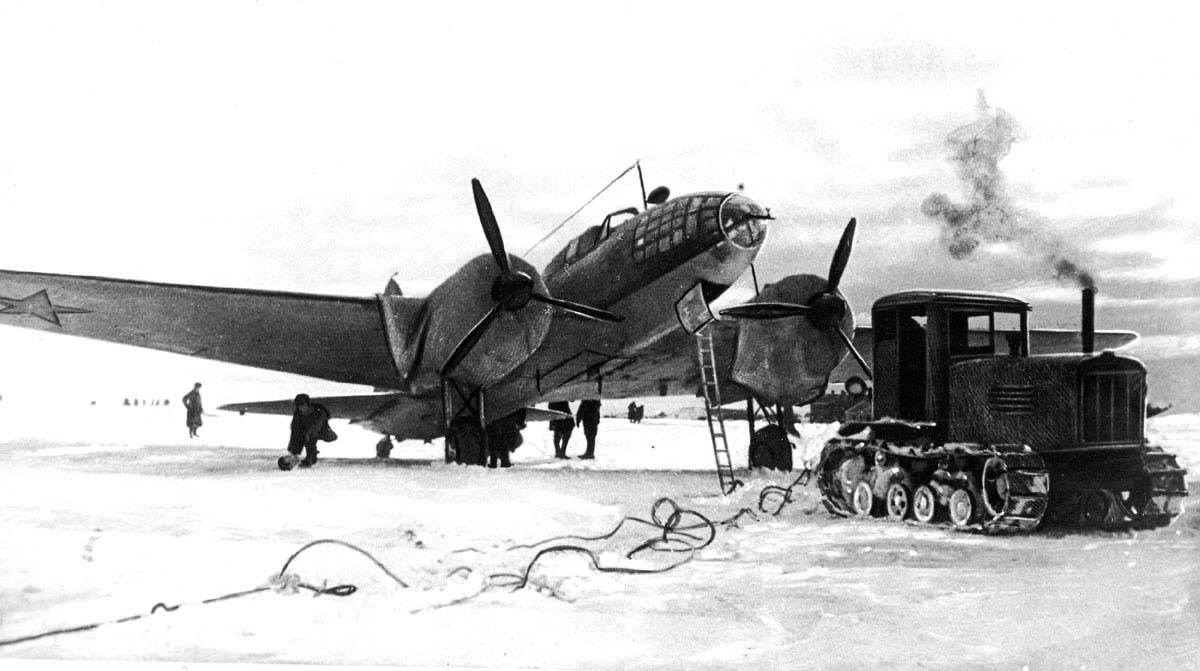
During January 1945 the Red Air Force was denied the opportunity to exploit its superiority over the Luftwaffe due to the severity of the weather. Equally problematic was the lack of all-weather runways which made take-off and landing difficult for the less-robust undercarriages of some types of aircraft. The machine shown here is an Il-4 medium bomber.
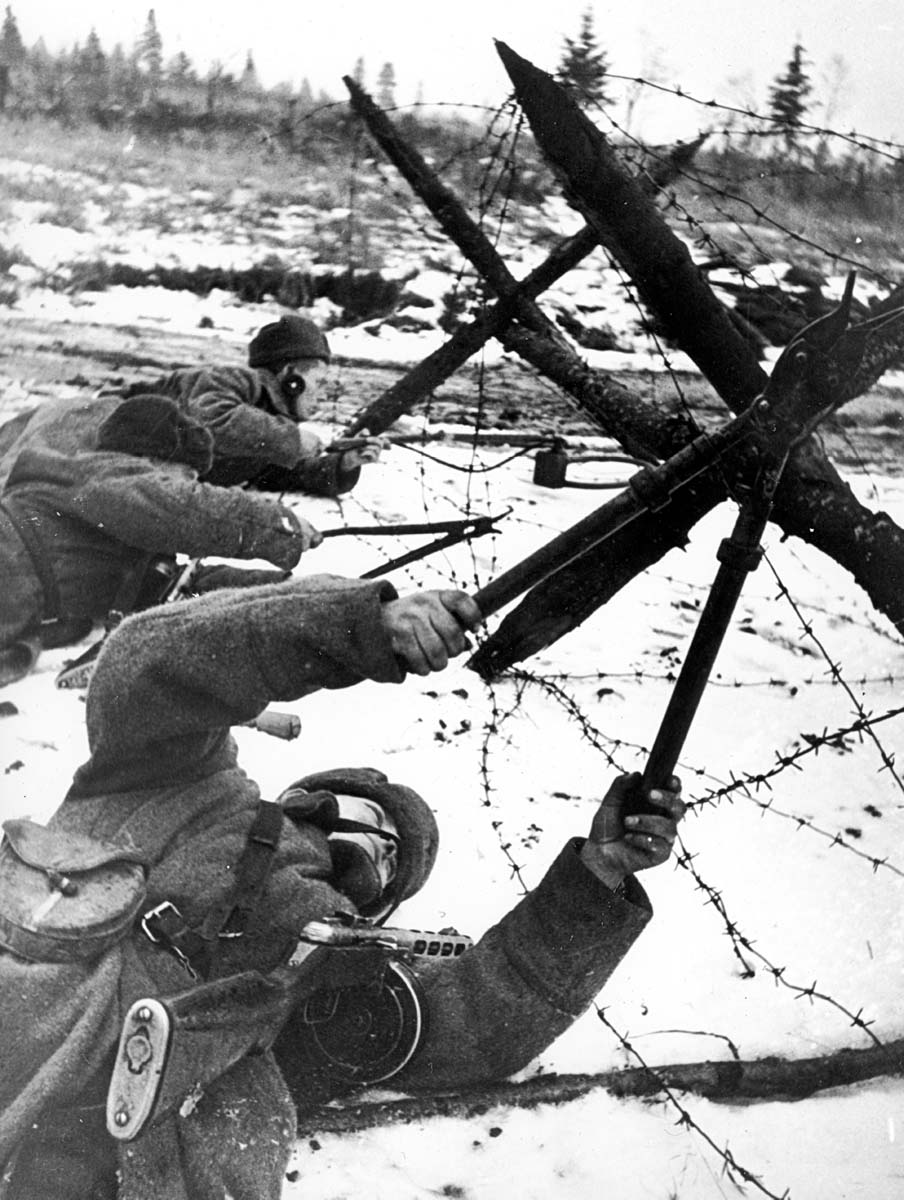
Nearer to the camera two Soviet engineers clear wire obstacles while to the far side a man listens through headphones to his mine detector. Although the German retreat often descended into chaos there were many occasions on which they had the time to mine and booby-trap roads and bunkers. Abandoned equipment was often booby-trapped and Konev’s men had orders not to gather souvenirs for fear of booby-traps.
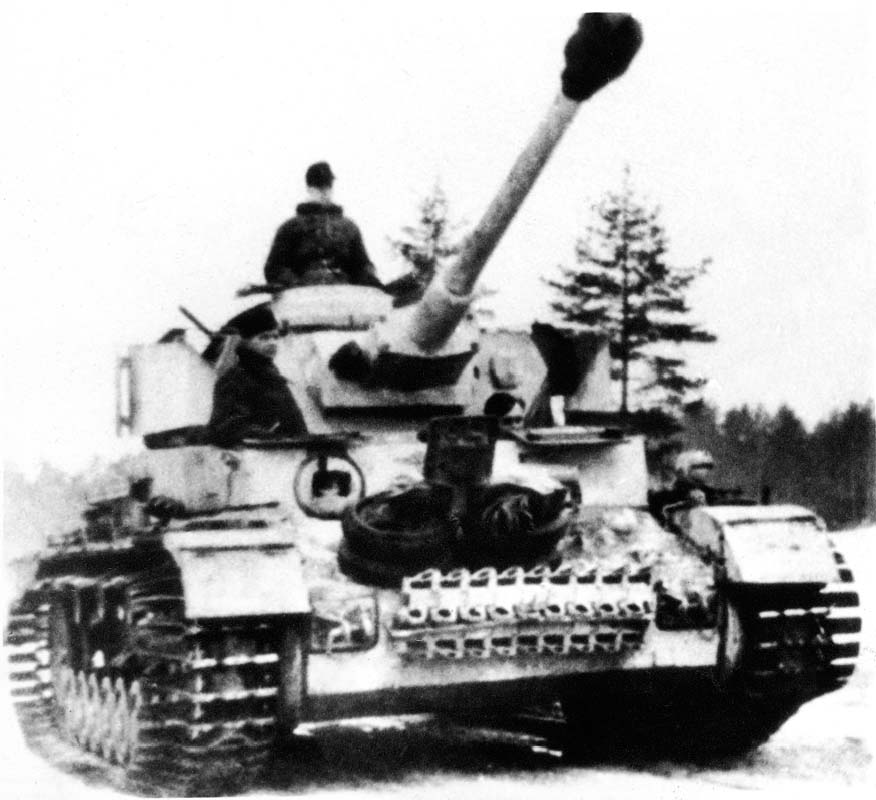
A Panzer IV with the wider tracks (Ostketten), which had been developed to give better performance over snow and soft, muddy ground. The workhorse of the Panzer divisions from 1942 onwards, this version has the long 75mm gun and 5mm armoured skirt around the turret. The unit is unidentified but it is a typical vehicle of the period.
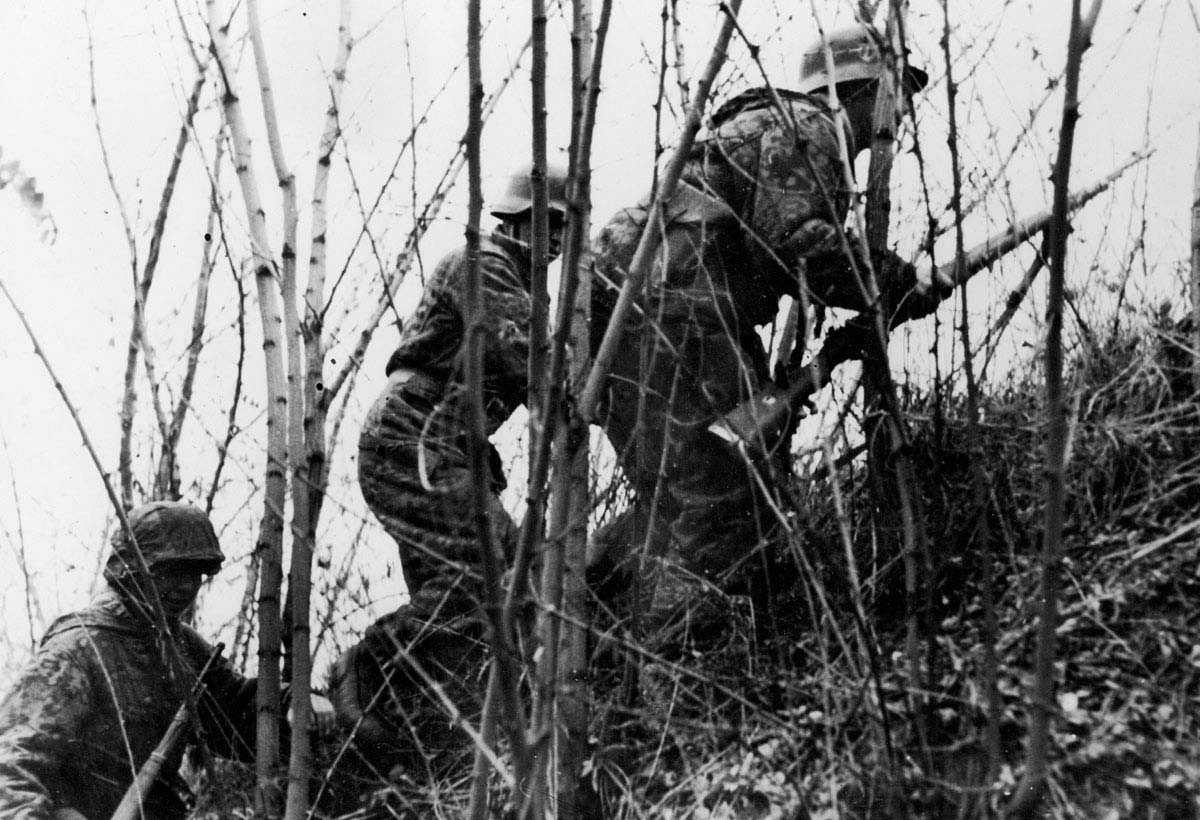
Troopers of the SS Cavalry Division Maria Theresa go into action in Budapest. They are wearing the SS camouflage suit that had become widely issued by this stage of the war. The division, formed from Hungarians of German descent (Volkdeutsche), was virtually wiped out during the siege of the city.
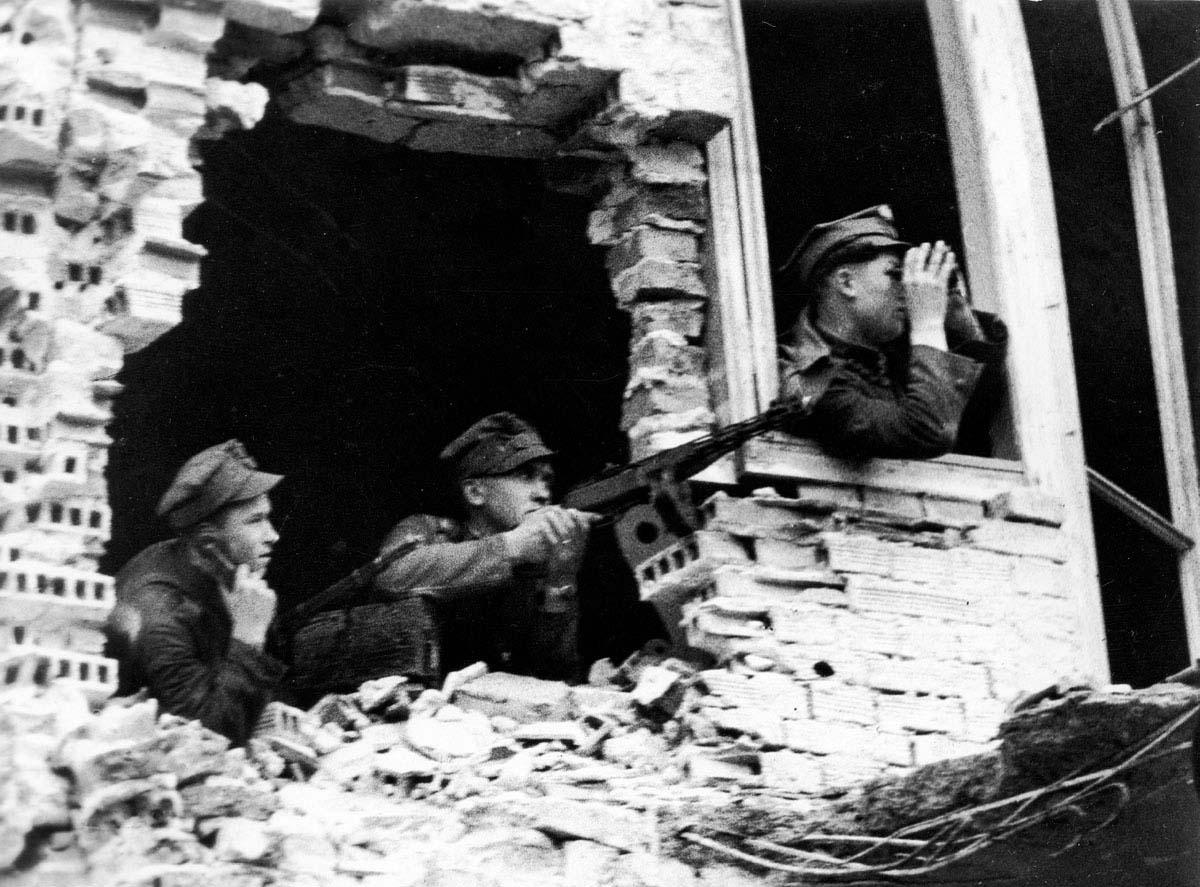
Warsaw was evacuated by the Germans on 16–17 January with little fighting. The 6th and 2nd Polish divisions, part of First Polish Army, under Zhukov, drove out the German rearguard. Here Polish artillery spotters call in mortar fire to suppress a German machine-gun nest. They are easily recognisable by their distinctive field caps, the square-topped Rogatywka.
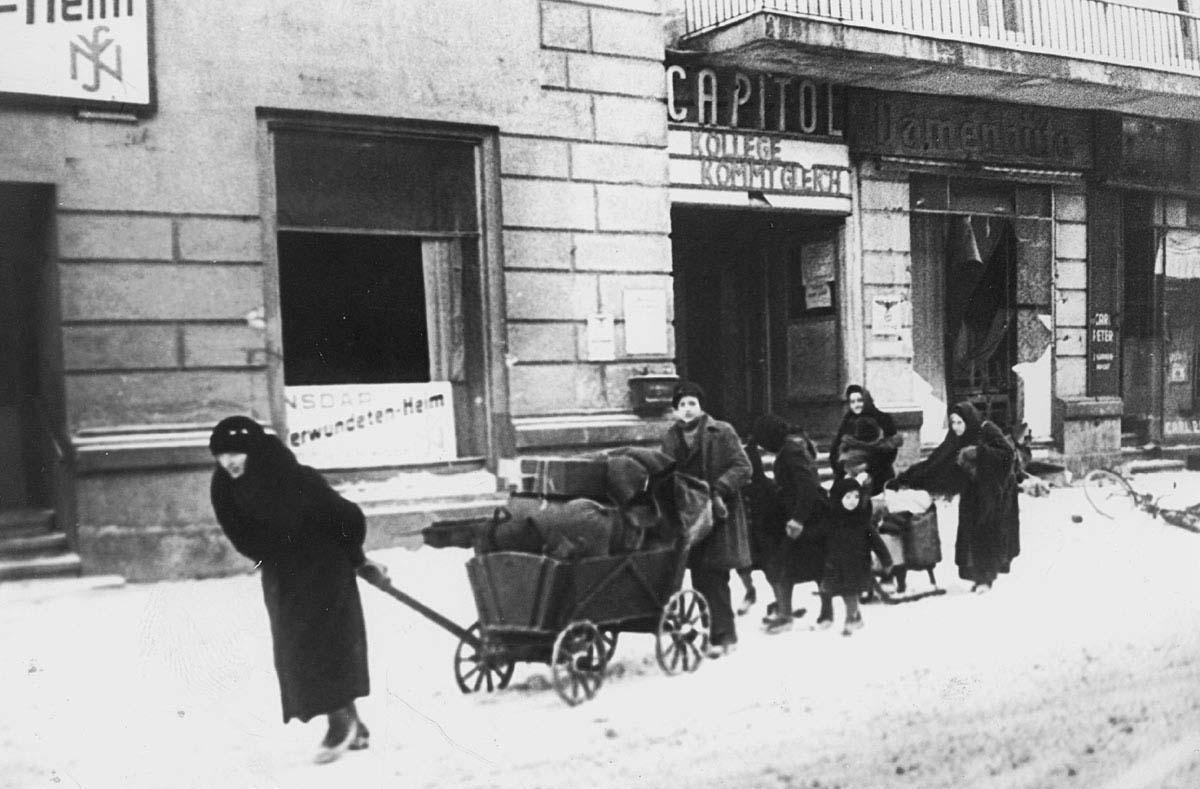
German refugees make their escape from a town in East Prussia. Millions such as these started the journey to the west during the early days of the Soviet offensive. However, there were few if any facilities for their welfare and most of the larger towns’ Nazi officials moved them on as soon as possible. This group is passing a cinema and a meeting point for wounded soldiers.
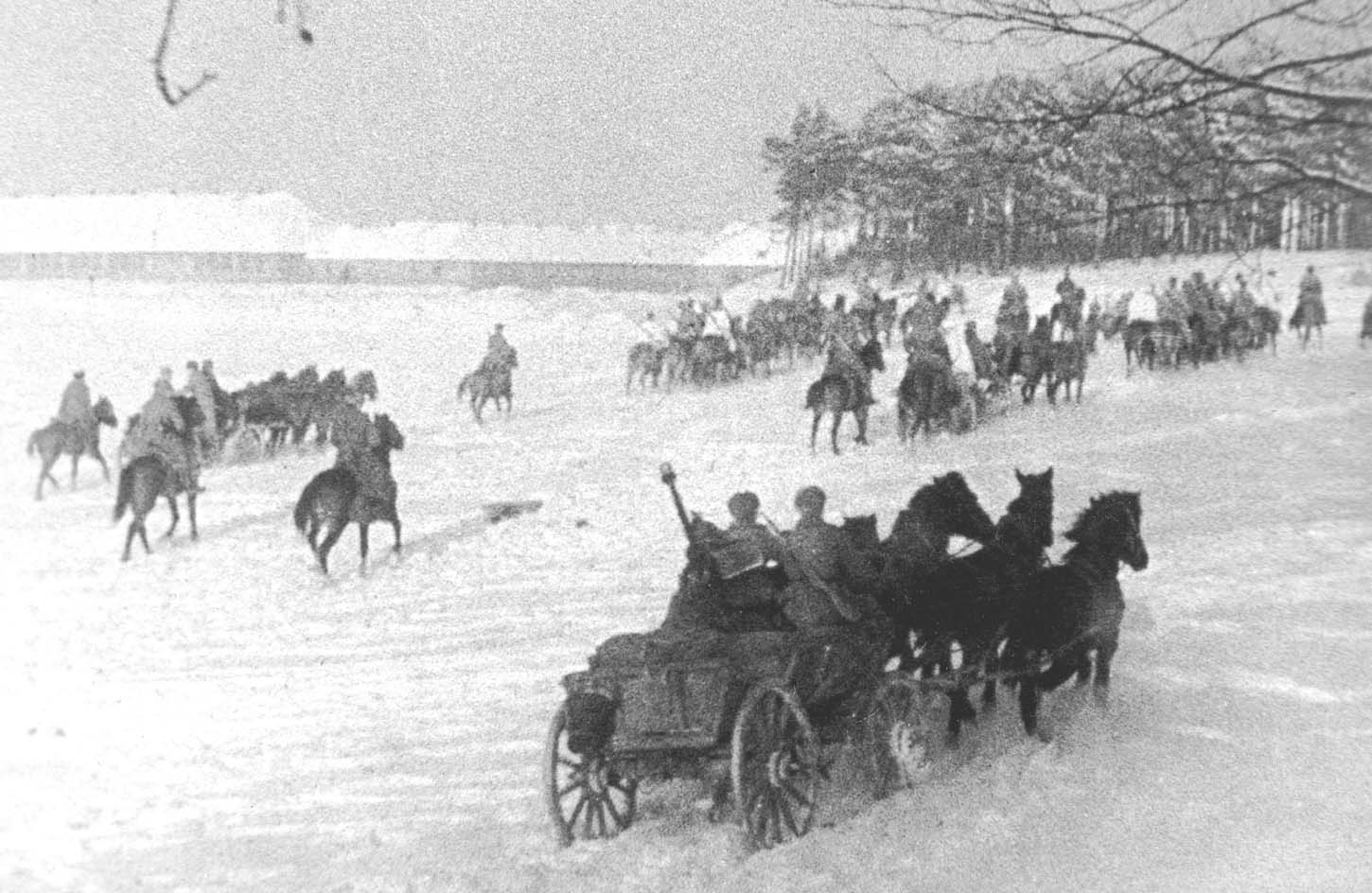
Where tanks and trucks found the going too hard Zhukov and Konev unleashed their cavalry formations. Here a platoon of Tachanka, carrying machine-guns and anti-tank rifles, gallop forward to provide covering fire for their sabre-wielding comrades who have passed into the woods to the right. To German civilians all Soviet cavalry were Cossacks and the alarm call ‘Der Kossacks kommen!‘ sent a chill down the spine of many a refugee, such was their reputation for brutality.
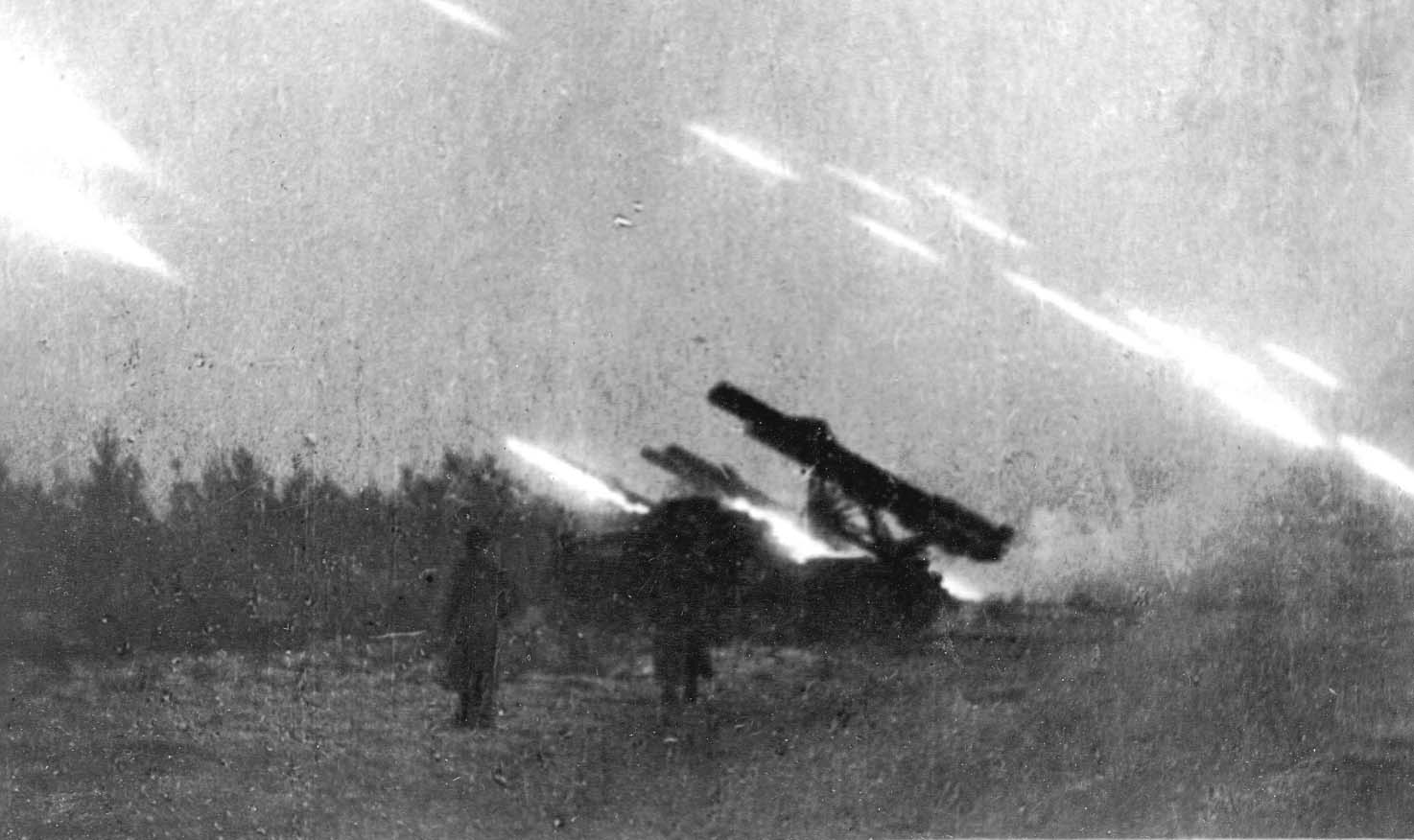
No respite was granted to the retreating Germans. A night-time barrage of Katyusha rockets speeds towards a road junction where a German traffic jam has developed. Organised into Guards Mortar Divisions, they were a less-than-subtle but highly effective weapon with which to saturate an area with explosives very quickly. Lorry-mounted, they rapidly switched locations to avoid retaliatory fire.
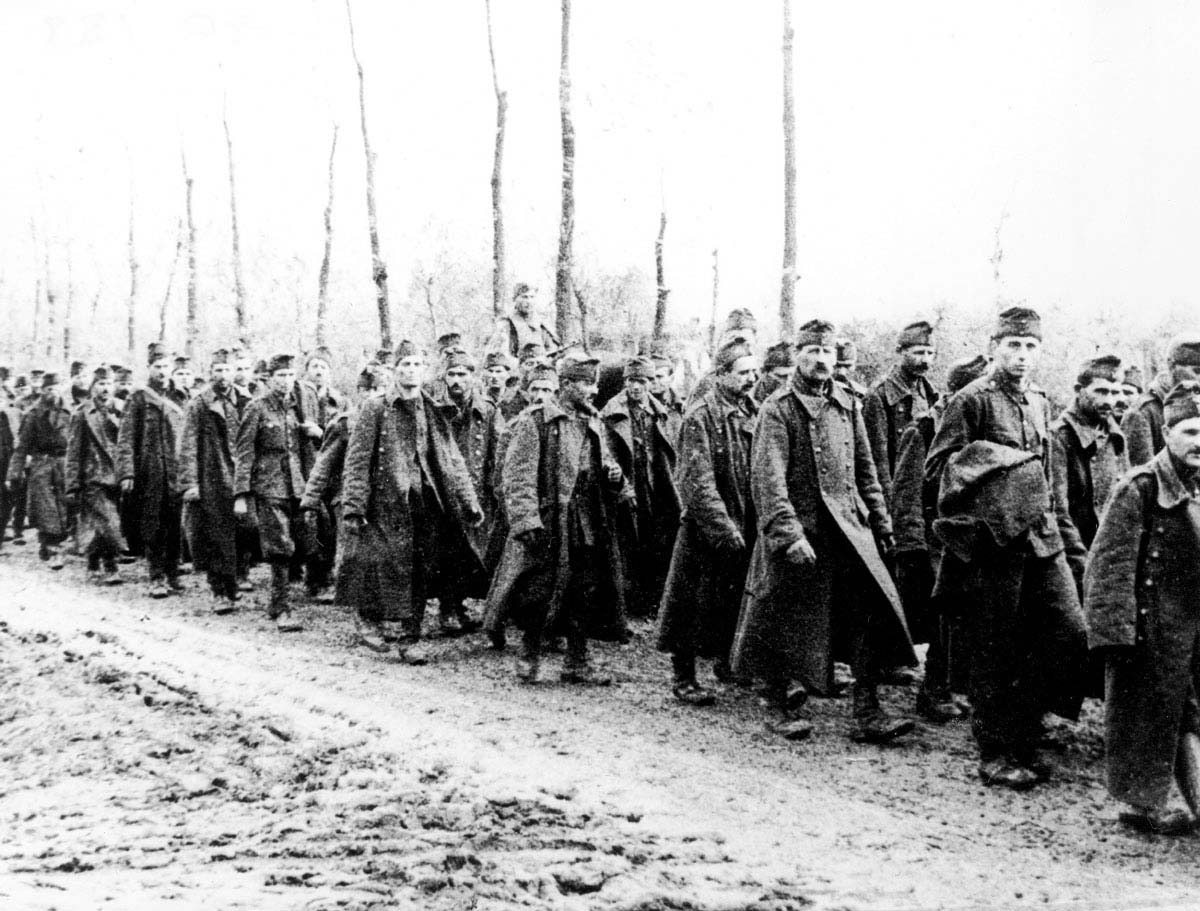
A column of Hungarian POWs passes into Soviet captivity. Often guarded by a single Red Army cavalryman, the majority of Hungarian troops were, by this stage of the war, more than willing to surrender if there were no Germans in the vicinity.
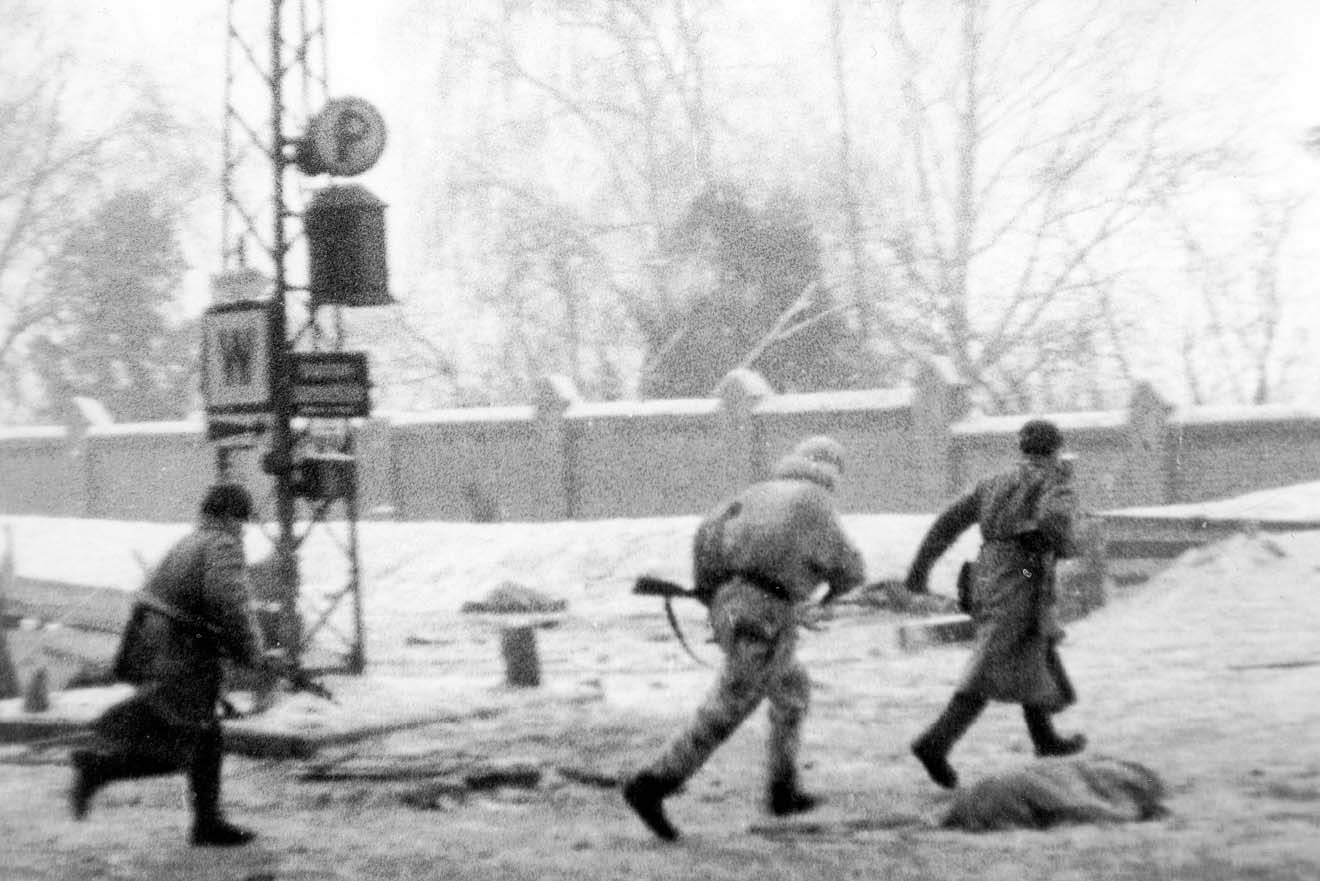
Men of Chuikov’s Eighth Guards Army deploy during the first attack on Poznan on 26 January. Chuikov’s forces included many Stalingrad veterans whose street-fighting experience would be put to good use during the course of the battle to capture the city.
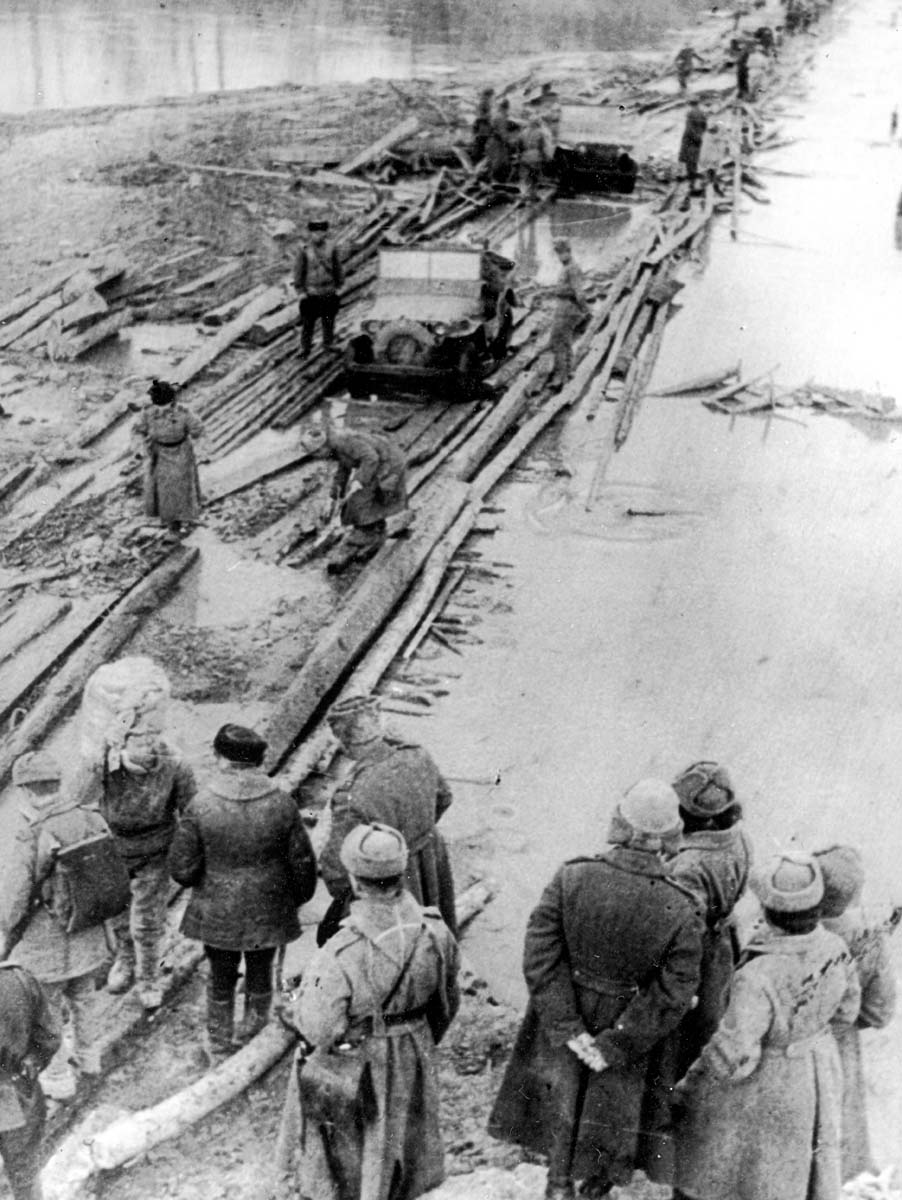
A major problem for the supply branch of the Red Army was the maintenance of river crossings when the weather became milder, as it sometimes did. A pair of Lend-Lease jeeps warily crosses a part-thawed river on the way to the Oder itself. The vast numbers of vehicles provided under the Lend-Lease scheme were almost solely responsible for the speed of the logistical follow-up to both Konev’s and Zhukov’s offensives.
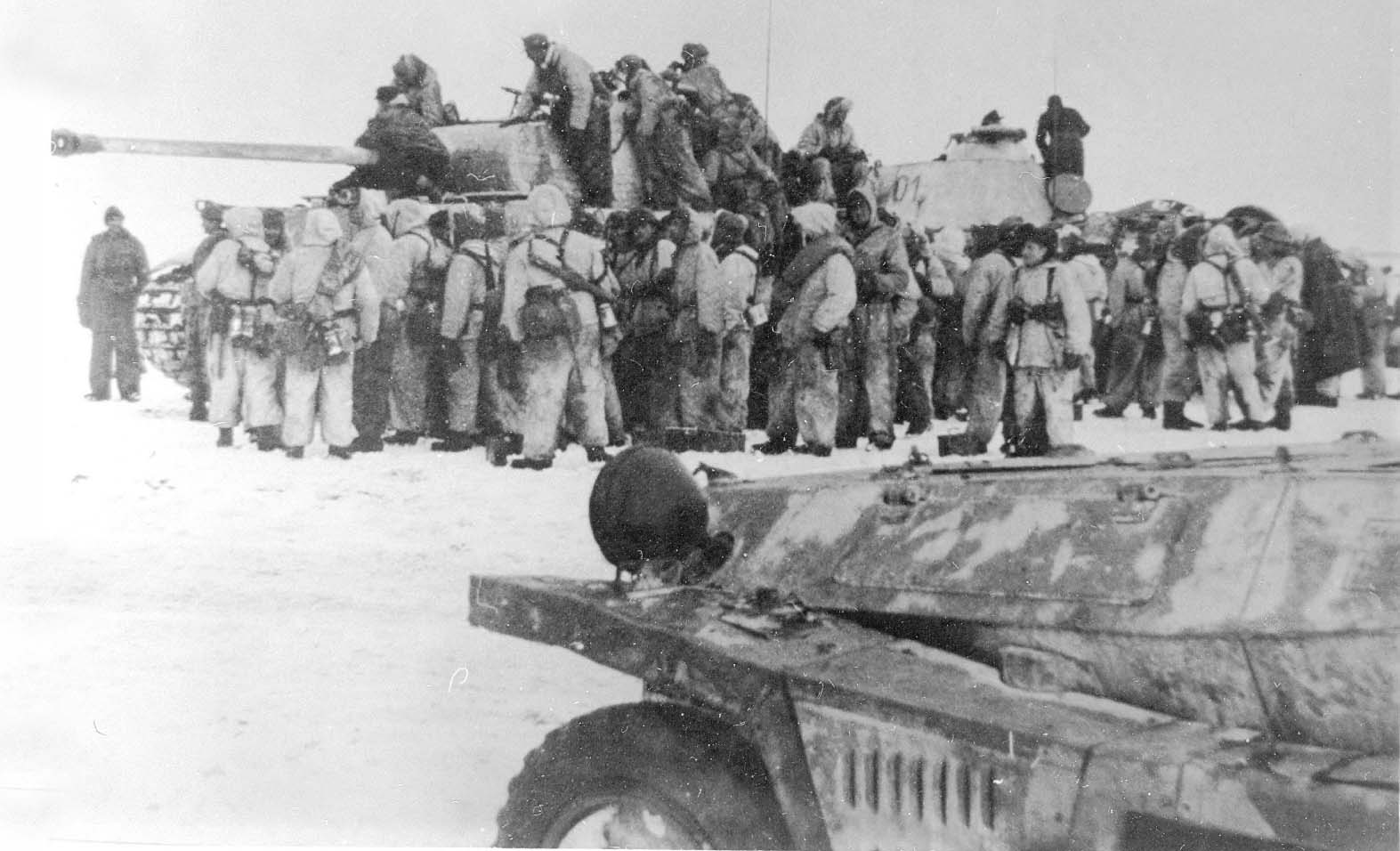
Panthers and infantry of a Grossdeutschland panzer formation prepare to retire to less-open ground near Lodz.