
Chapter Eight
The advance along Alt Moabit towards the Spree river by two infantry divisions of Third Shock Army, the 150th and 171st, had brought them, on 28 April, within 800m of the river, across which lay the Reichstag. To reach this objective they had to cross the Spree, and in front of them was the intact, inviting shape of the Moltke bridge. Barricaded and mined with artillery and machine-guns to both flanks, the bridge would not make for easy crossing, however. The task was made more difficult when, at 18.00 hrs, the Germans blew it up, but the explosives had only done a partial job and it was clearly passable on foot. Having arranged artillery covering fire, an infantry platoon, led by Sergeant Pyatnitsky, led the crossing. As the Hitlers celebrated their wedding, more and more men of both Soviet divisions crossed the river into the governmental sector, an area dotted with the monolithic ministerial buildings, many of which were heavily fortified and garrisoned. The first building that the 150th Infantry Division had to contend with was the Ministry of the Interior. As it was impossible to bring heavy guns over the Moltke bridge, hand-to-hand combat went on all morning.
At dawn on 29 April another of Fifth Shock Army’s units, 301st Infantry Division, attacked the Gestapo HQ on Prinz-Albrechtstrasse. Preceded by point-blank artillery fire, two battalions overcame the defenders and planted a Red Flag on the roof. But the victory was short-lived as a fierce counterattack by men of the Nordland SS Division reoccupied the building.
Simultaneously, Eighth Guards and First Guards Tank armies crossed the Landwehr canal and were now within 2km of the Reichstag. The guards infantry had either swum or used improvised rafts, accomplishing the crossing under cover of a smokescreen. However, the Potsdammer bridge was captured intact by the faking of a fire on board a T-34; oily rags on its hull were set ablaze, then the crew opened fire on the defenders at close range as more tanks followed through the smoke. A dug-in Tiger I formed part of the defences as by now almost all fuel had been used up. Damaged vehicles were used as anti-tank positions until they were overwhelmed.
Chuikov’s right flank was now almost opposite Weidling’s HQ in the Bendlerstrasse. Weidling, realising that the end was approaching rapidly, conferred with his senior officers informing them that Twelfth Army had reached Potsdam. Following a situation report that indicated that there were approximately 10,000 troops in the Citadel area, it was decided that a breakout towards the west would be made at 22.00 hrs the following day. Naturally Weidling had to seek Hitler’s permission for the breakout and visited him the next day. Two days earlier Weidling had proposed leaving the city with Hitler under close escort but the Fuhrer had declined. Weidling’s second attempt was initially refused but later in the day permission was granted as long as the escapees joined up with combat formations to continue the fight. Word of the attempt was spread as rapidly as possible. But as Weidling laid his plans, so did First Belorussian Front. Remarkably Stalin had been comparatively relaxed during the Berlin operation, allowing his Front commanders to guide matters more freely than had been the case. Possibly this light touch was the result of having surrounded the city, thereby denying access to the Anglo–American forces.
The Reichstag was the focus of attention for Zhukov and his subordinates; it was the symbolic building that he wished to present to Stalin in time for the 1 May parade in Moscow. The honour of mounting the first attack on the Reichstag fell to 150th Infantry Division, commanded by Major General V. M. Shatilov, a part of Third Shock Army. Under orders to carry submachine-guns, and having eaten a hearty breakfast prepared for them in the cellars of the Ministry of the Interior, the first wave went into the attack at 06.00 hrs on 30 April.
To reach the Reichstag the attackers had to cross the open ground of the Konigsplatz, which was cut across with a flooded anti-tank ditch some 3m wide. Heavy fire from the partially bricked-up windows of the Reichstag caused considerable casualties, which increased sharply when crossfire from the Kroll Opera House hit the attackers’ right flank and rear. Cut off while other units were sent to subdue the Opera’s defenders, the first assault wave hugged the ground until, a little after 11.00 hrs, they reached the anti-tank ditch. For another two hours they lay and endured fire from the Reichstag, itself under continual bombardment, until risking a further charge. Once again hit by flanking fire, this time from the flak tower in the zoo grounds, the Soviet infantry sought cover in shell holes and behind broken barricades. As they lay waiting for darkness few suspected that at 15.15 hrs Hitler and his wife had committed suicide. At 18.00 hrs Weidling was summoned to the Fuhrer bunker and told of Hitler’s death. Sworn to secrecy, he was also told to forget the breakout attempt, as an armistice was about to be requested and as Berlin’s commander he would be required to be present.
Less than a kilometre away from the bunker the Soviets launched their final attack on the Reichstag. Heedless of casualties and under cover of smoke, dust and the coming of darkness, three infantry regiments rushed the building with armoured support. Breaking into the vast reception hall the men of 150th Infantry Division found the defenders had either hurried upstairs or gone to the cellars. For several hours vicious fighting continued from room to room as flag bearers attempted to reach the roof.
Officially the Red Flag was planted on the Reichstag’s dome at 22.50 hrs as the fighting raged below.
Six hours later General Krebs was ushered into Chuikov’s HQ, where he remained while news of his appeal for an armistice was passed up the chain of command. Stalin was only prepared to offer unconditional surrender, which Krebs felt unable to accept. As May Day morning drew on and no word was received from the Germans they were given a reminder of the power they were facing as the guns of First Belorussian Front let loose a shattering bombardment. In the Reichstag and in other government buildings the battle continued into the afternoon. But elsewhere across the city isolated German units began to capitulate as the Soviet troops celebrated May Day.
At 06.00 hrs on 2 May Weidling crossed into the Soviet positions and while Martin Bormann and other of Hitler’s cronies tried to make good their escape, arranged the surrender of the Berlin garrison with effect from 15.00 hrs that day.
The agreement to surrender did not end hostilities immediately. Although a recording of Weidling’s voice was broadcast there were few who heard it. A leaflet-drop achieved more success and gradually the news spread across the city. However, there were those who did not wish to surrender, such as members of the foreign SS units who had no home to return to and only a cause to die for, as surrender, to them, meant, more often than not, immediate execution. Such men fought on until killed during the course of the next two or three days. Thousands attempted to escape in groups of varying sizes and with different results. Some reached Twelfth Army in Potsdam but many were rounded up by the growing cordon of NKVD and regular troops established by Zhukov to ensure that neither Hitler nor his closest followers such as Goebbels eluded capture. The hunt for Hitler and the others now proceeded apace as the population of Berlin tried to come to terms with their new situation.
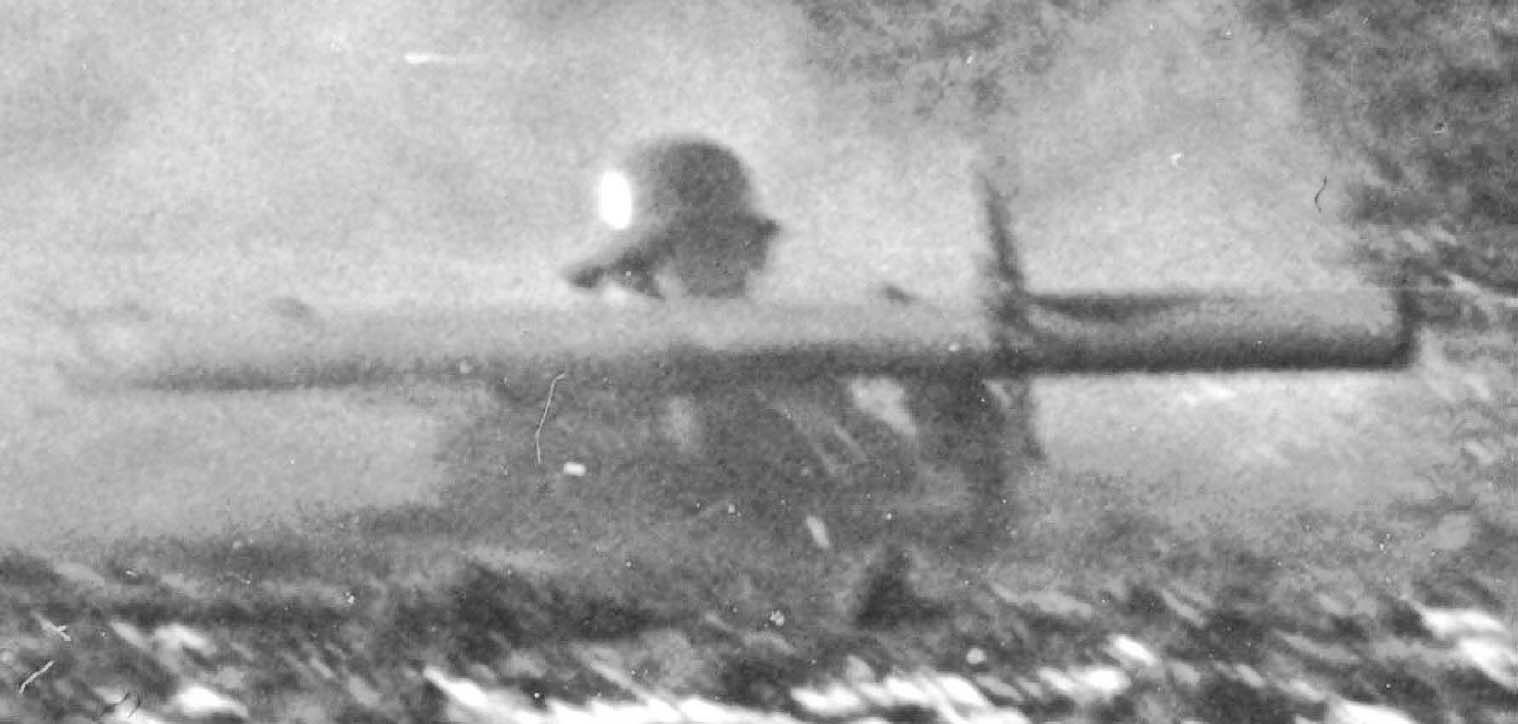
A German Panzerschreck whips up the dust as it is fired. Crewed by a loader and gunner, they were the responsibility of the regimental anti-tank company, which was issued with 36. The maximum range of later models was 180m and the hollow-charge warhead could penetrate 160mm of armour plate when set at a 60-degree angle. In an urban environment such a weapon was lethal.
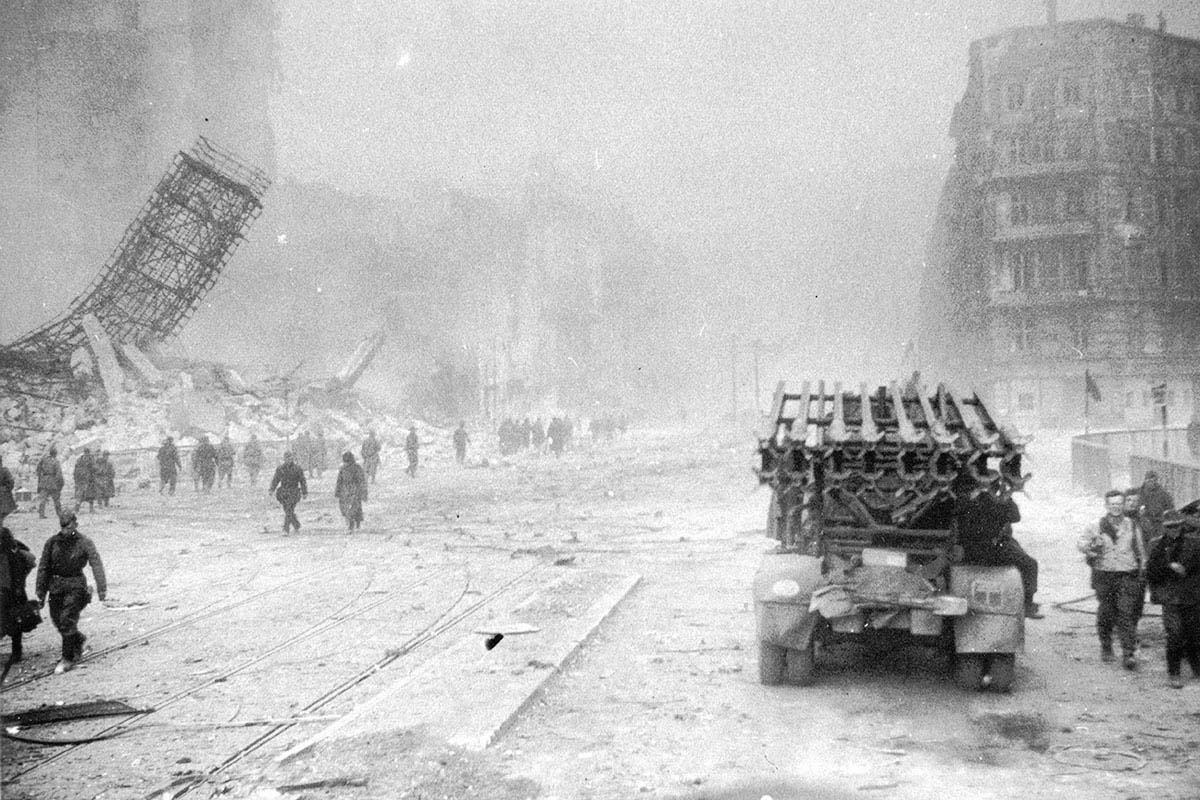
The smoke-filled air can almost be tasted in this image of a road junction in Berlin. The Katyusha system to the right is mounted on a US-made Studebaker lorry and is waiting for resupply, having fired off its rockets.
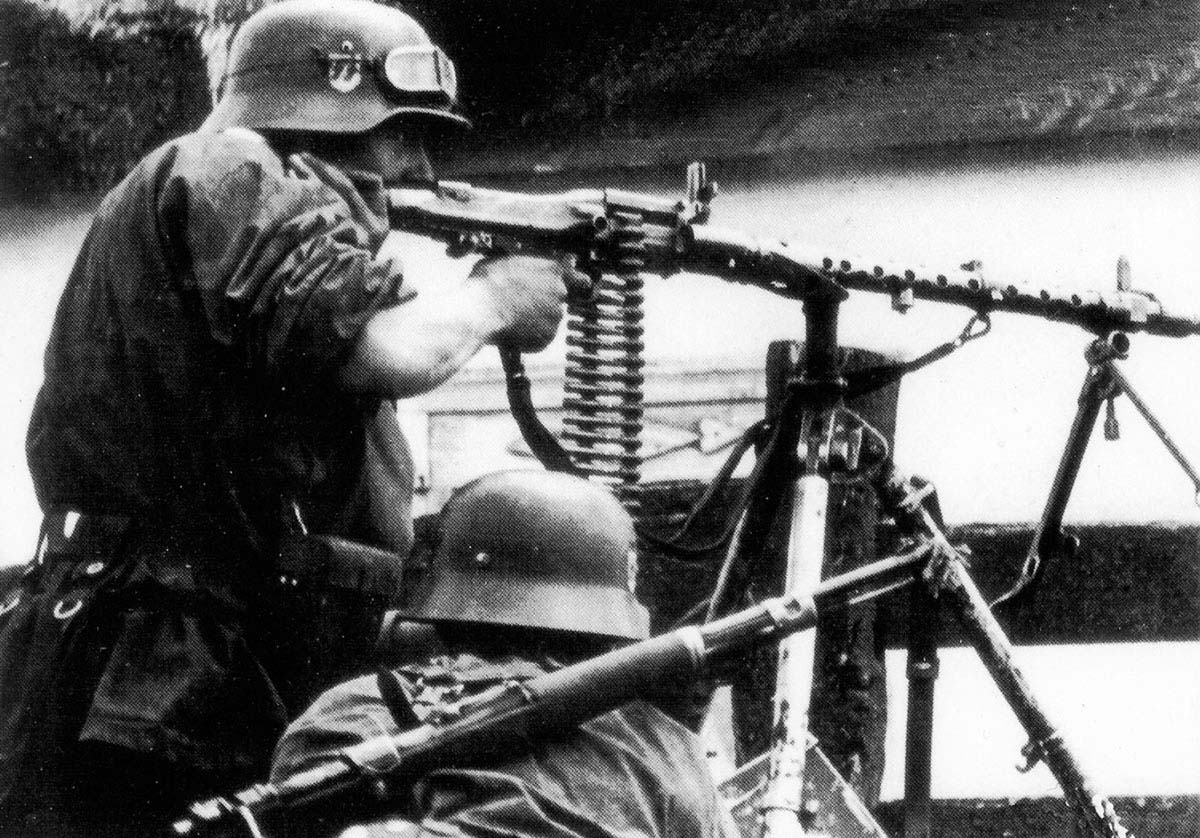
An SS machine-gun team fires down onto a Soviet infantry group during the last days of the Berlin fighting. The goggles are a useful addition, giving some protection against the dust and rubble that pervaded the atmosphere.
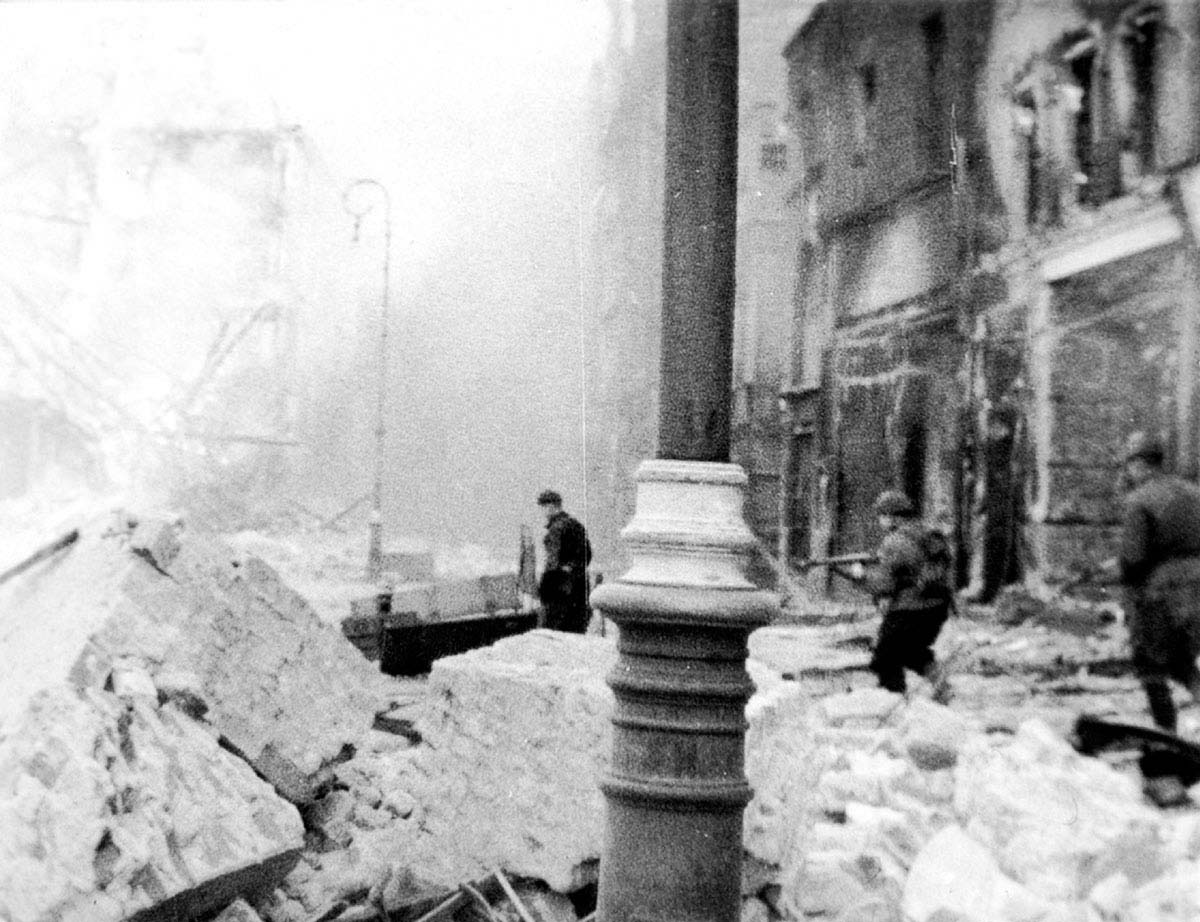
Men of Chuikov’s Eighth Guards Army move cautiously through the smoke towards the Tiergarten.
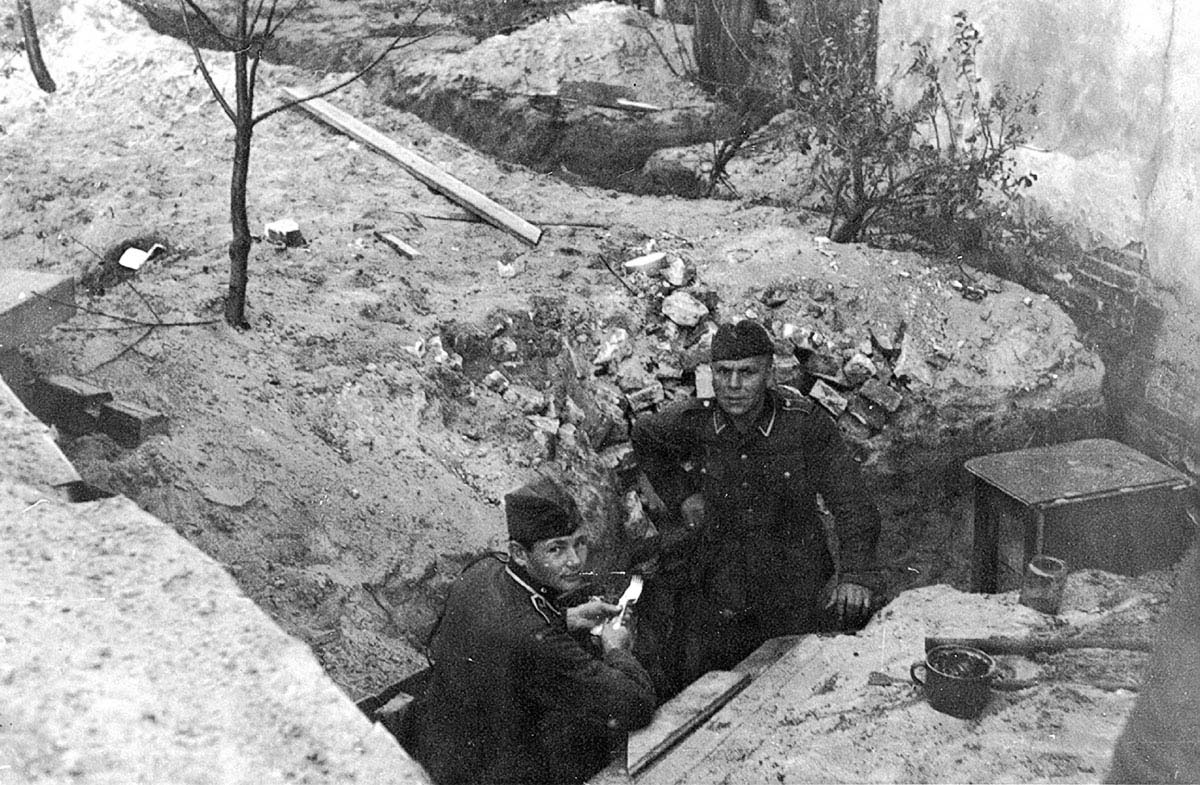
A shallow communication trench running through a public park in south-western Berlin. The original caption mentions that it is a battalion HQ for a Volkssturm unit manned by regular army personnel. However, the casual demeanour of the men indicates their situation is less than dangerous.
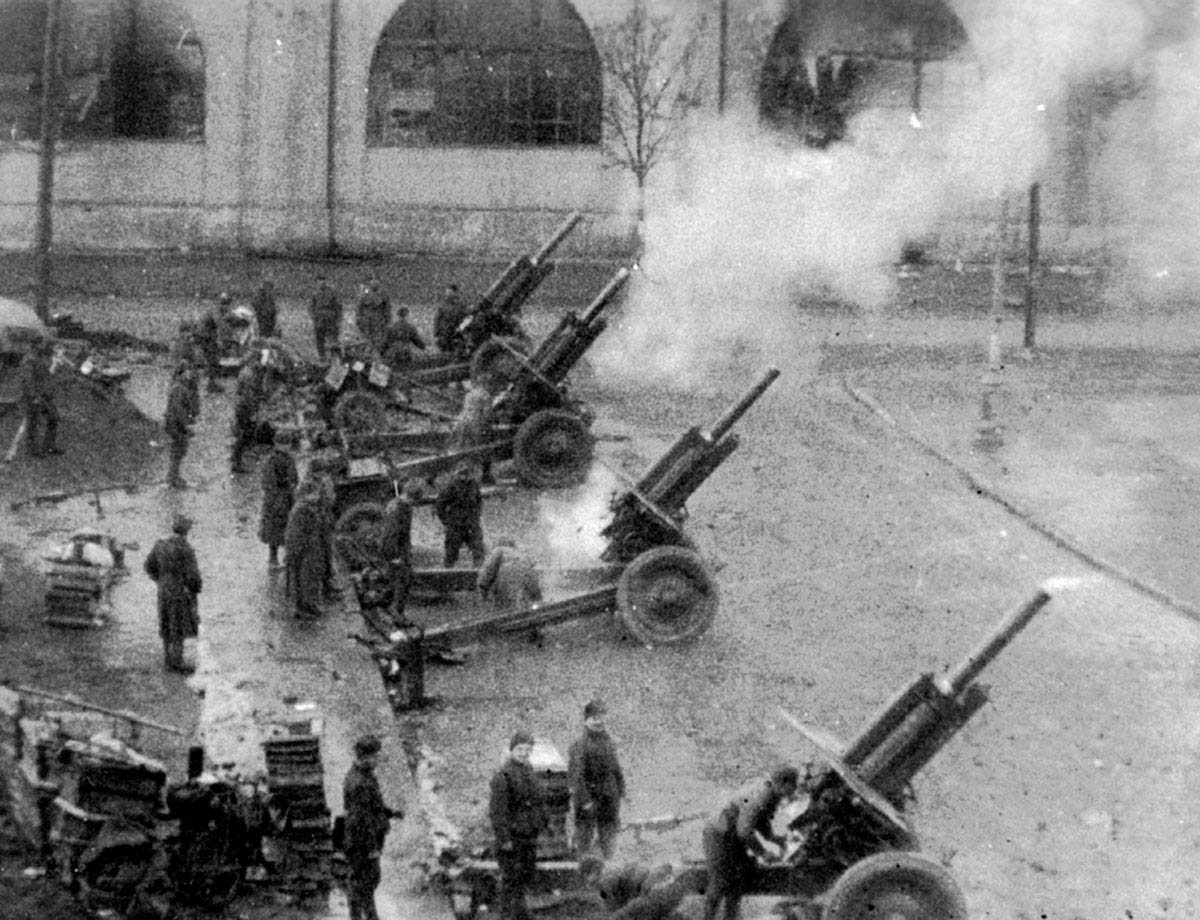
Neatly lined up as if on parade, gunners of Eighth Guards Army pound German positions across the Spree river The guns are 107mm M-60 howitzers firing at what appears to be maximum elevation. Although late April’s weather was generally dry there were one or two rainy days.
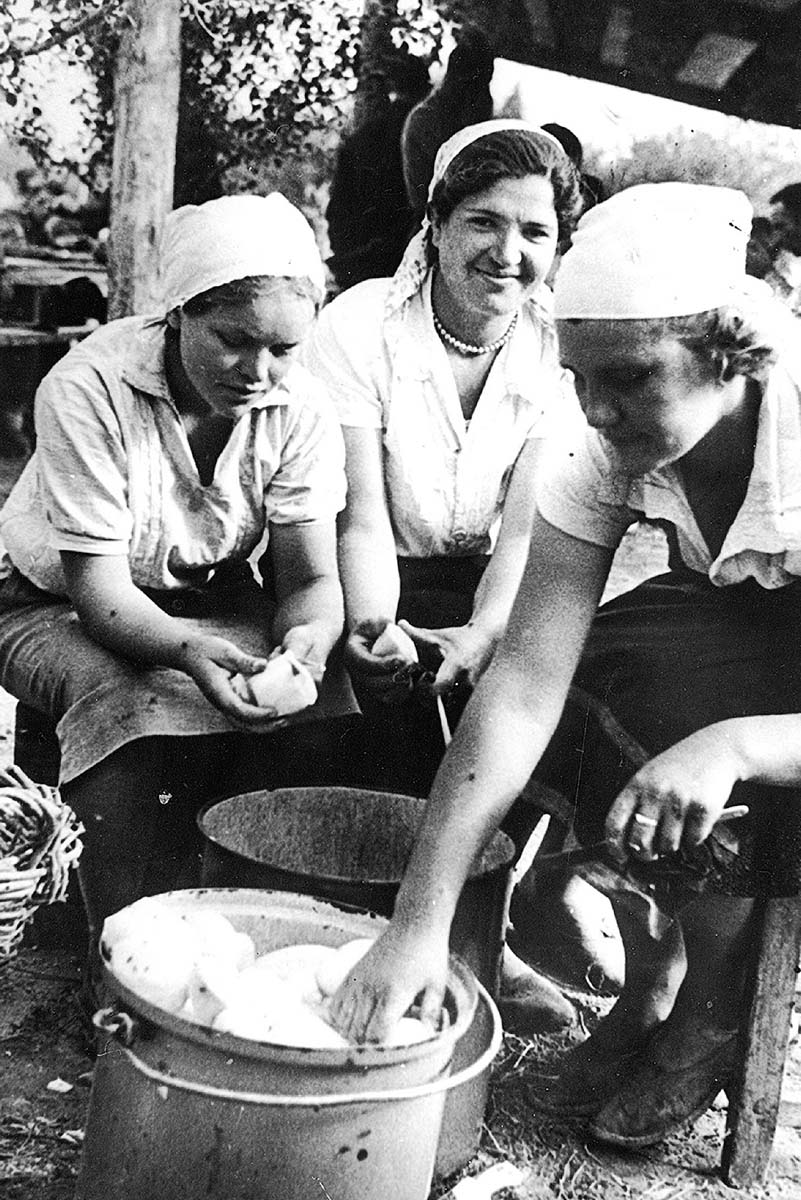
Three Soviet ladies, smiling following liberation after years working as forced labour in Germany, peel potatoes for men of the Red Army. The problems for such men and women would come later when the NKVD rounded them up for interrogation about their activities in the Reich. For many it would mean imprisonment or death at worst, or decades of being mistrusted and ostracised at best.
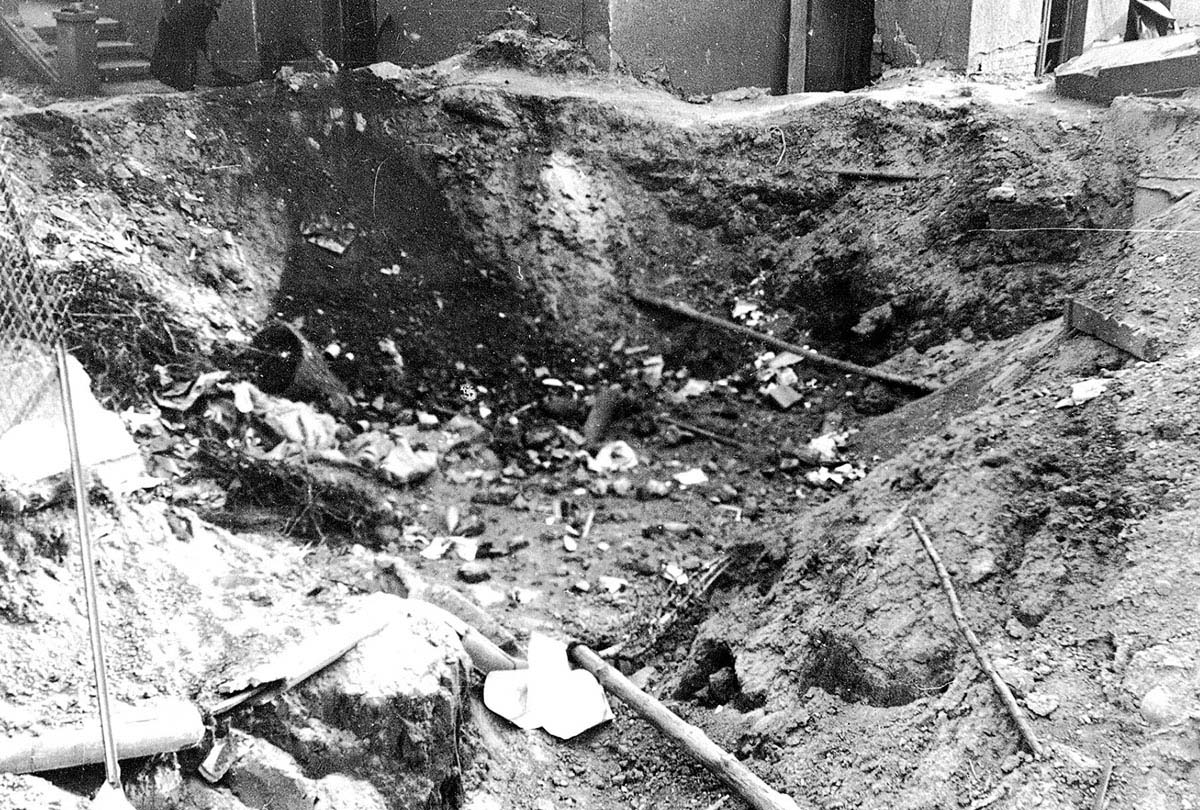
The destruction wreaked on the city’s infrastructure caused gas and electricity supplies to fail early on in the fighting. The restoration of such utilities was a priority for the Soviet occupation administration.
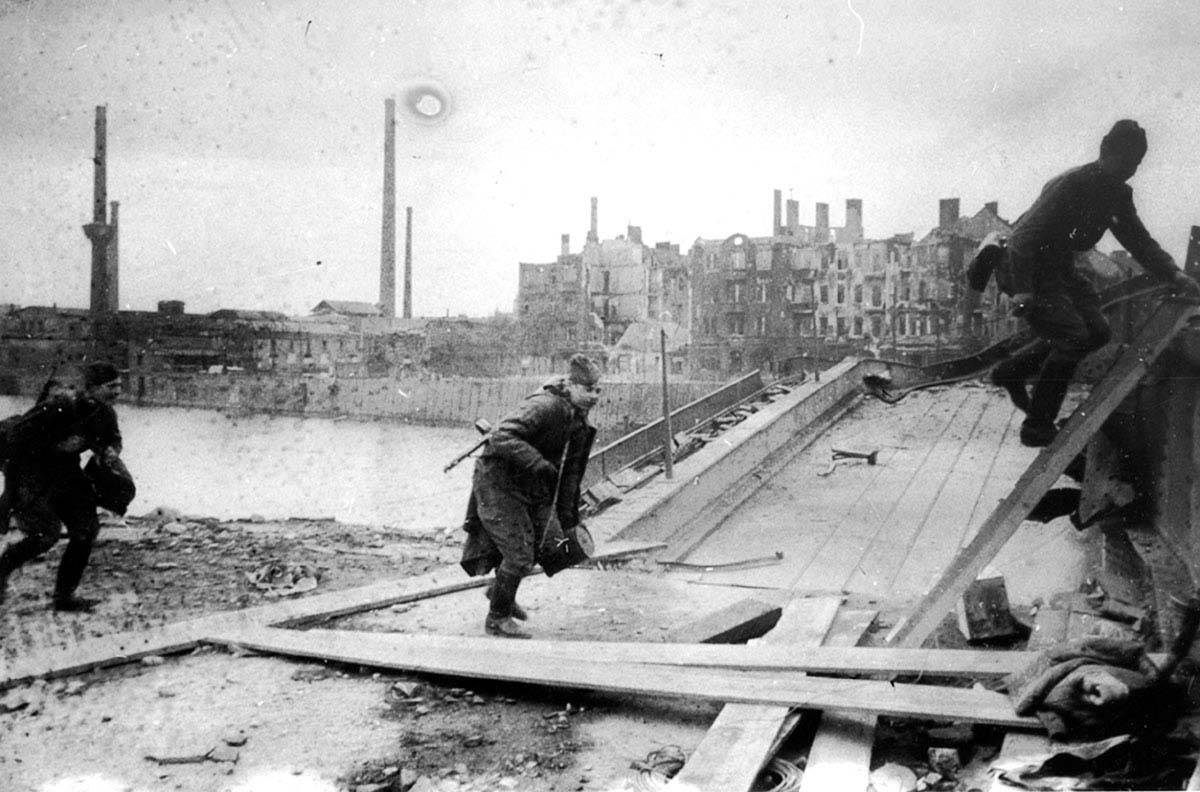
Soviet infantrymen sprint for cover near one of Berlin’s many bridges. The condition of the Moltke bridge was much as the one shown here, passable on foot. Destroying bridges was often left to the last possible moment as the possibility of using them for counterattacks would thus be denied: this was regarded as defeatist and therefore a treasonable offence, punishable by summary execution.
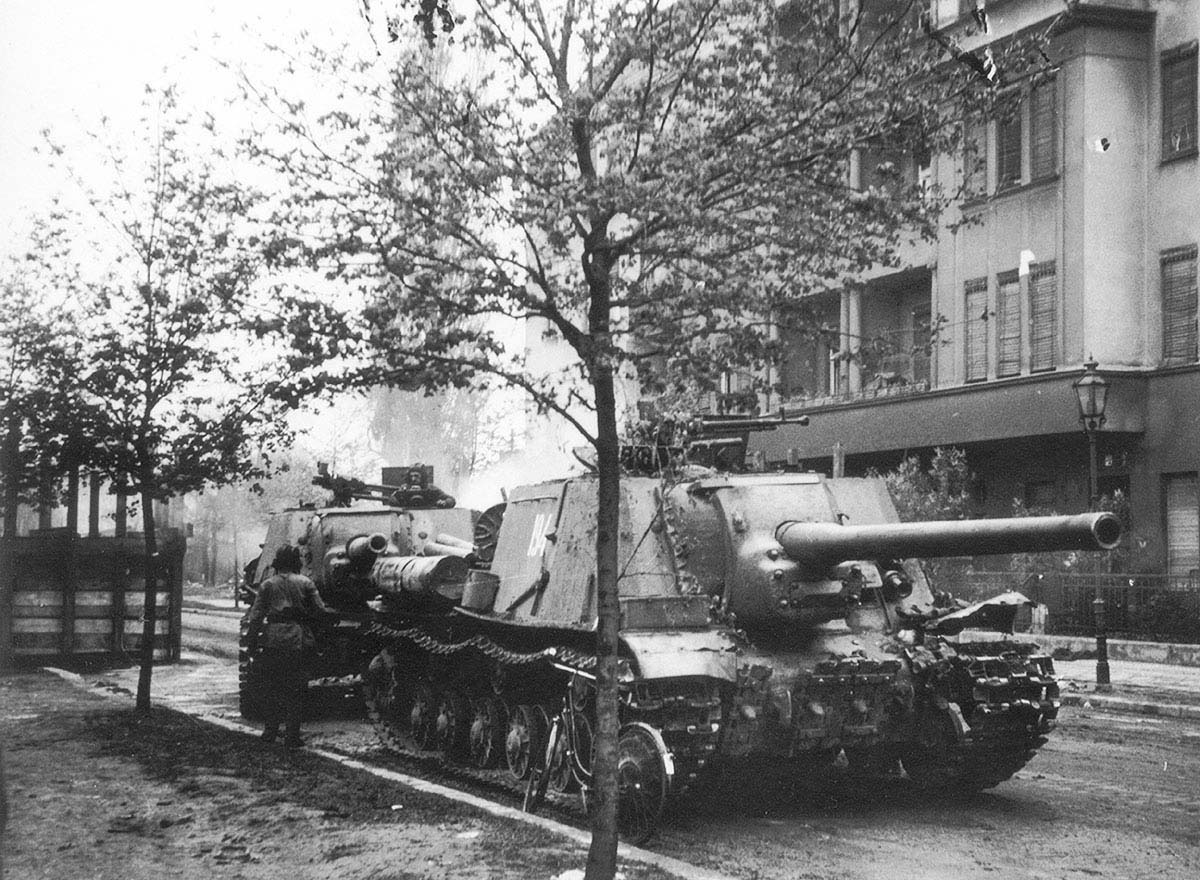
Two of a five-gun battery of ISU-122 heavy assault guns park up for tea in a remarkably undamaged residential area in Berlin. Apparently the men are discussing where they are and where to go next. No civilians are available to question. The bicycle, near the vehicle, was a popular item of loot.
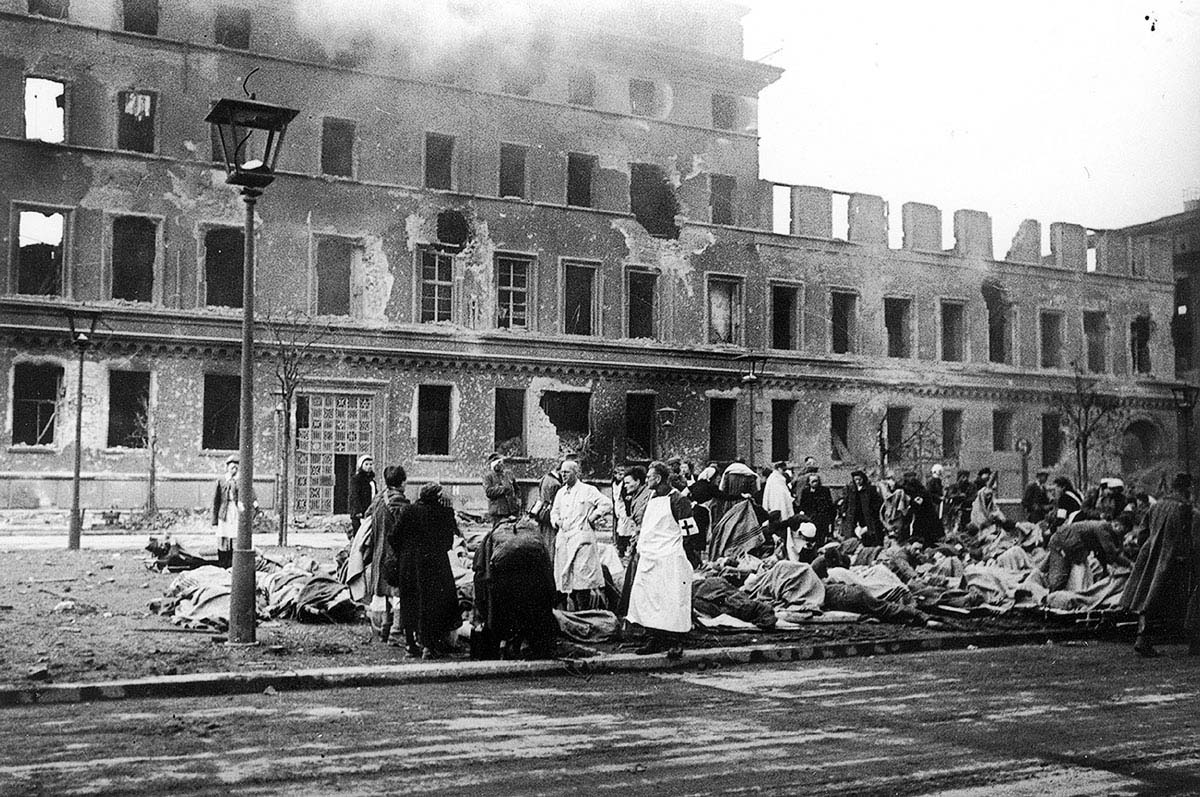
An improvised German field hospital attempts to cope with working out of doors in the lee of a gutted ruin. Medical supplies of all sorts were almost non-existent; surgery was usually performed without anaesthetic. Poison, however, was easy to obtain.
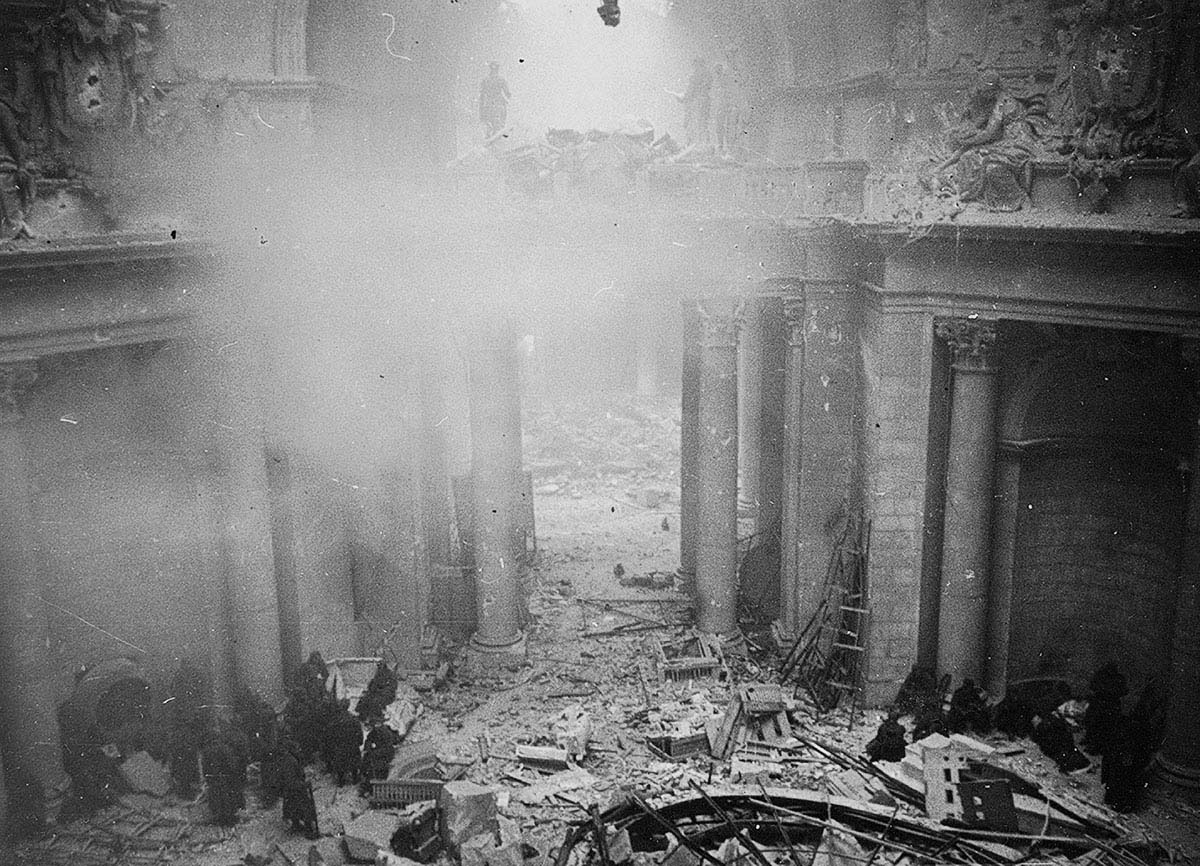
Inside the Reichstag itself the fighting continued. The forces defending this Nazi symbol included naval, SS and Hitler Youth personnel. Taken from the first-floor balcony, the image shows Soviet troops to left and right dealing with Germans holding out in the cellars.
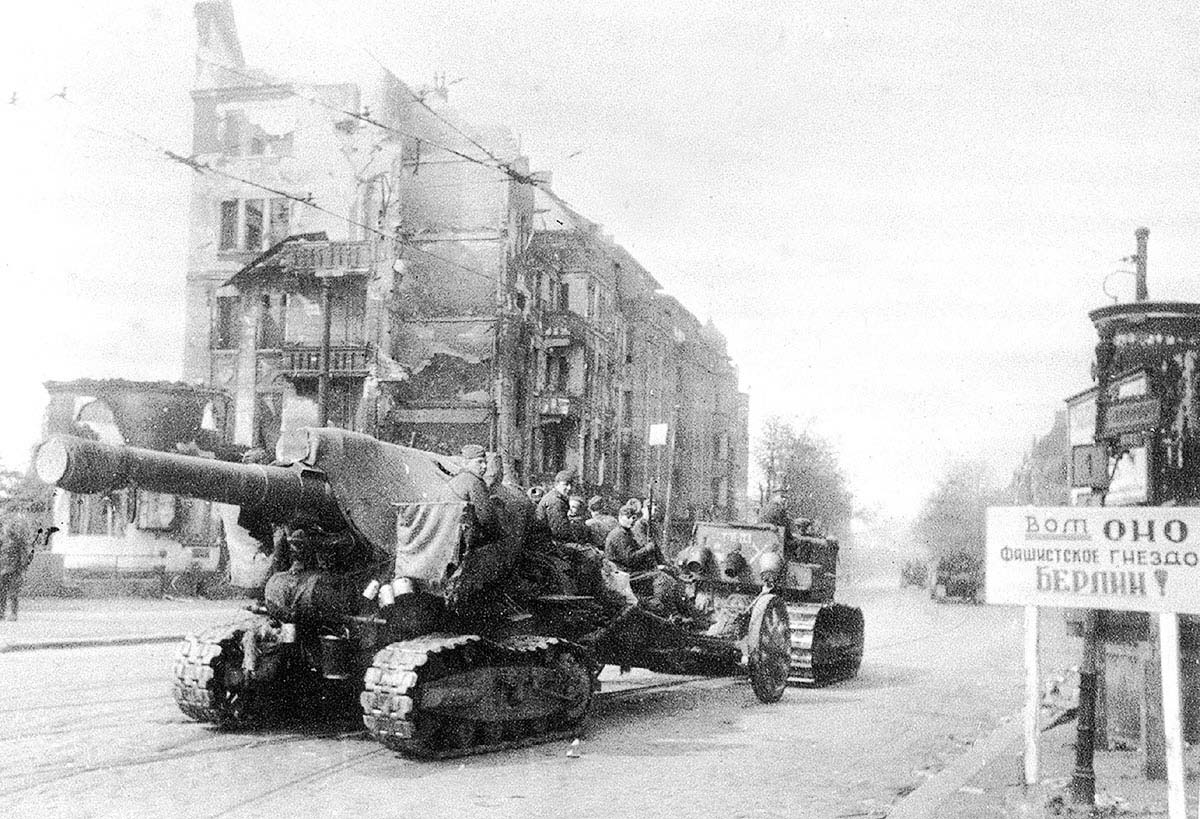
Bringing the heavy guns of Fifth Shock Army’s Breakthrough Artillery Division into the heart of the city: akin to the siege trains of earlier wars, these divisions were specialist, highly effective units. The road sign reads, ‘This is the Fascist nest Berlin.’ German civilians were mobilised to clear the rubble from the roads to allow clear access.
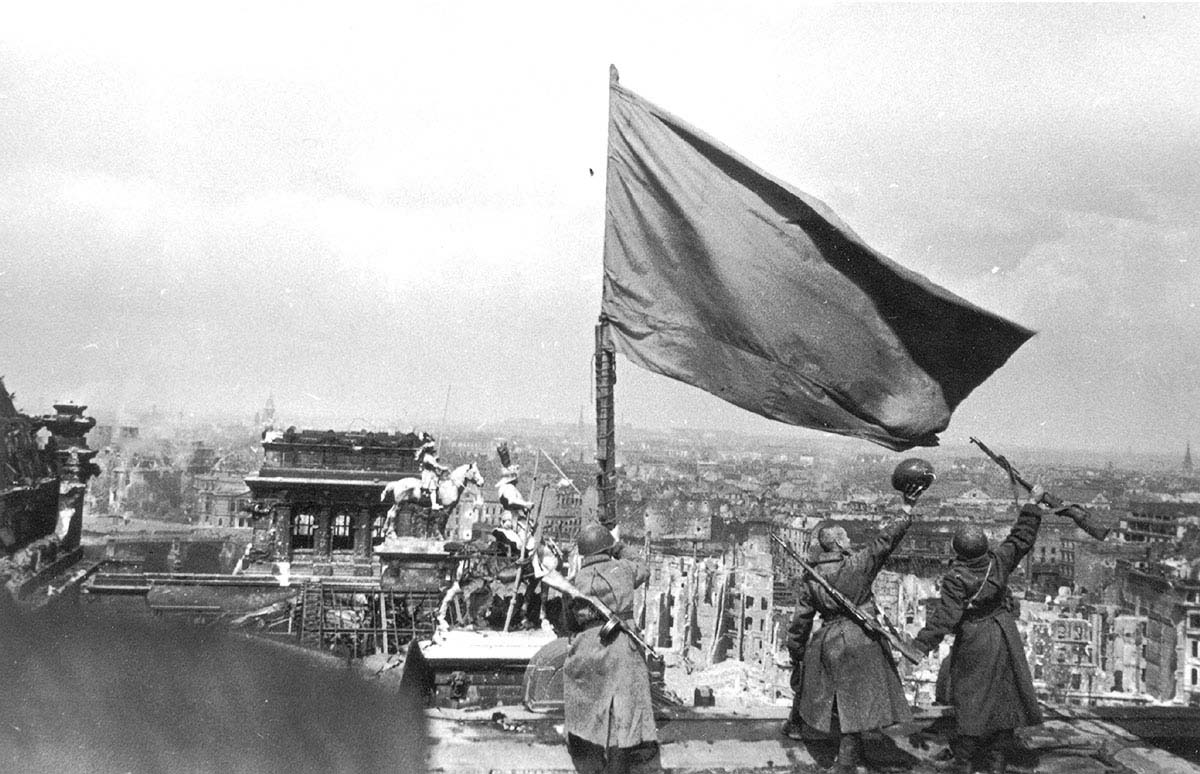
Finally the Red Flag is raised on the roof of the Reichstag by one of the banner parties. Many requests were made for the honour of raising the flag and many flags were issued; therefore it is difficult to say for certain who accomplished the feat. That it was done is sufficient.
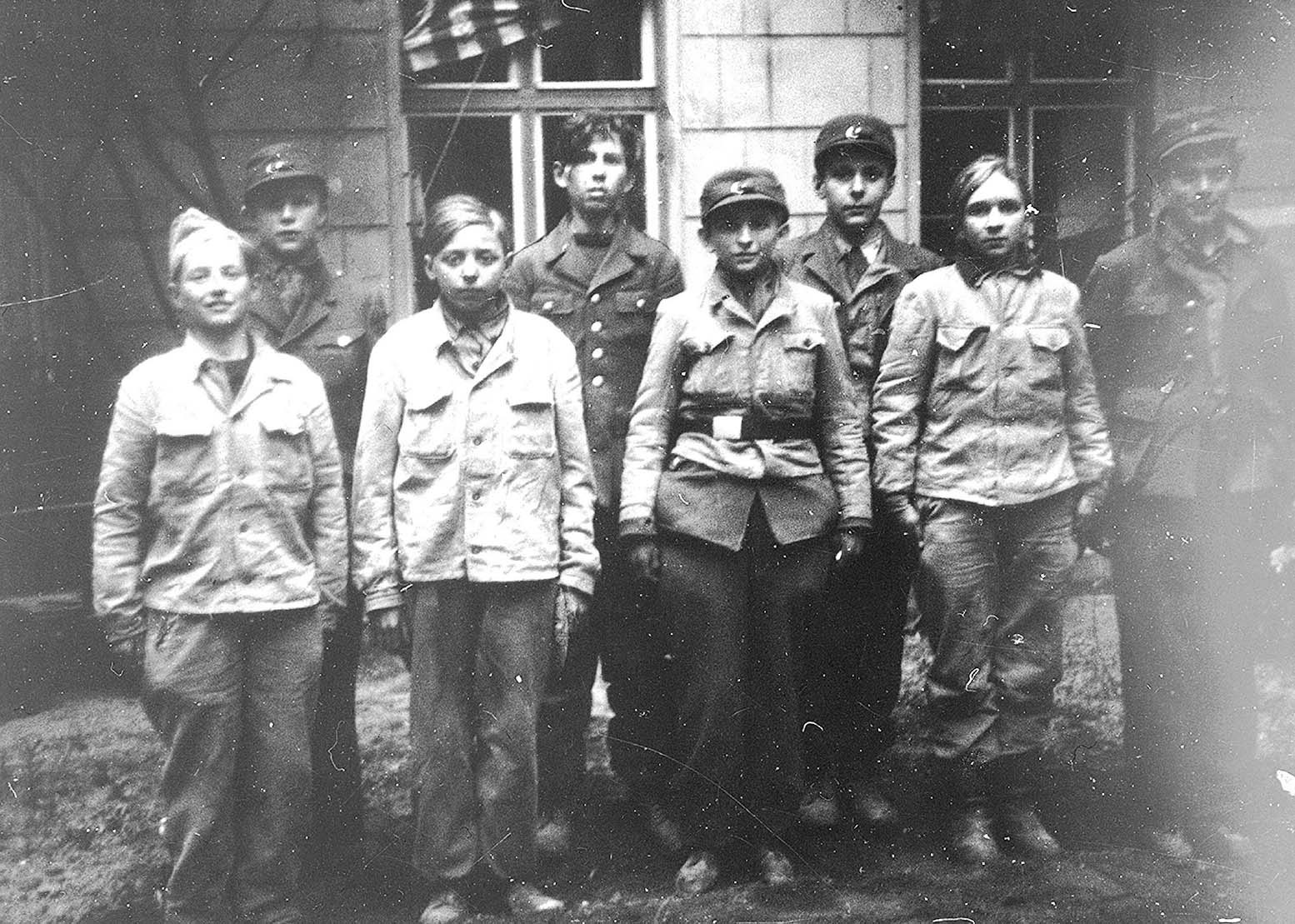
Hitler Youth POWs shortly after their surrender. Despite the Nazi regime’s attempts to involve members of the Hitler Youth in a post-war guerrilla campaign under the name of ‘Werewolves’, there were few incidents. However, the Soviets took the threat of such activities very seriously in the light of their own partisans’ activities.
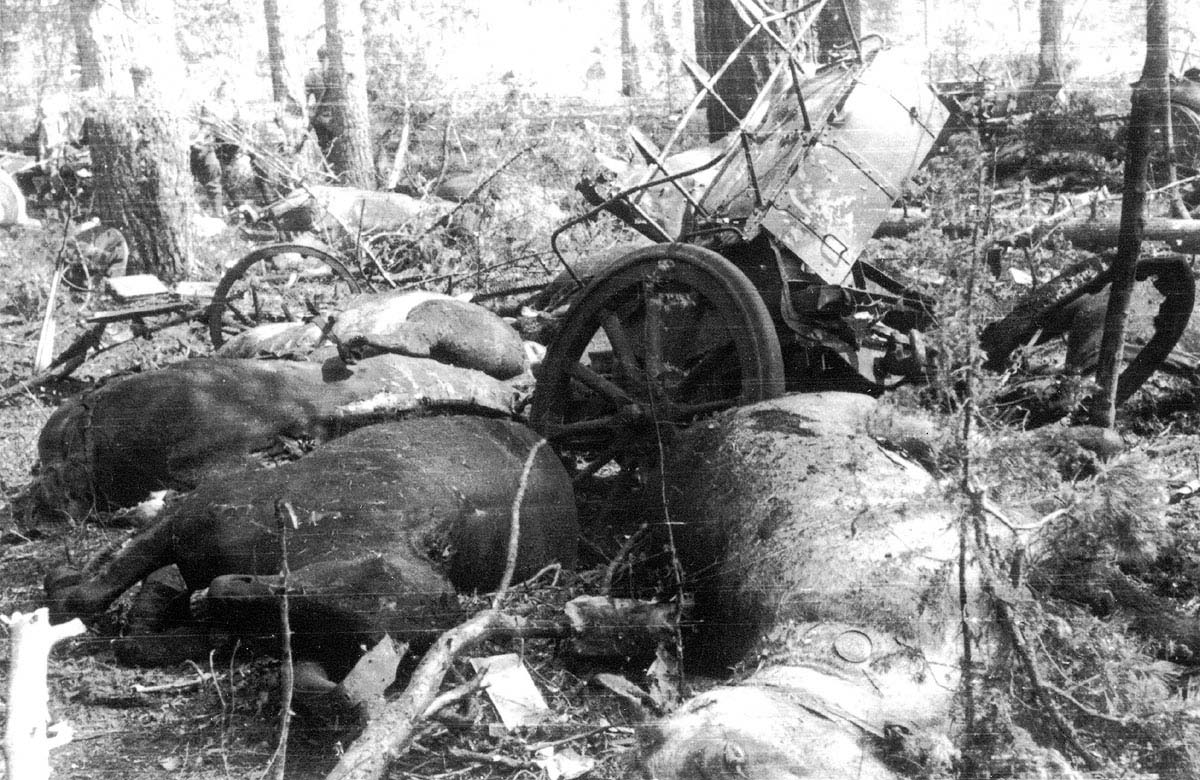
The wreckage of horse-drawn equipment that marked the passage of Busse’s Ninth Army. Tanks of First Ukrainian Front were sent into the Spree Forest to hunt down the remaining fugitives. Among them may have been hundreds of former Soviet citizens of whom over 9,000 were on the ration strength of Ninth Army when it was positioned along the Oder river.
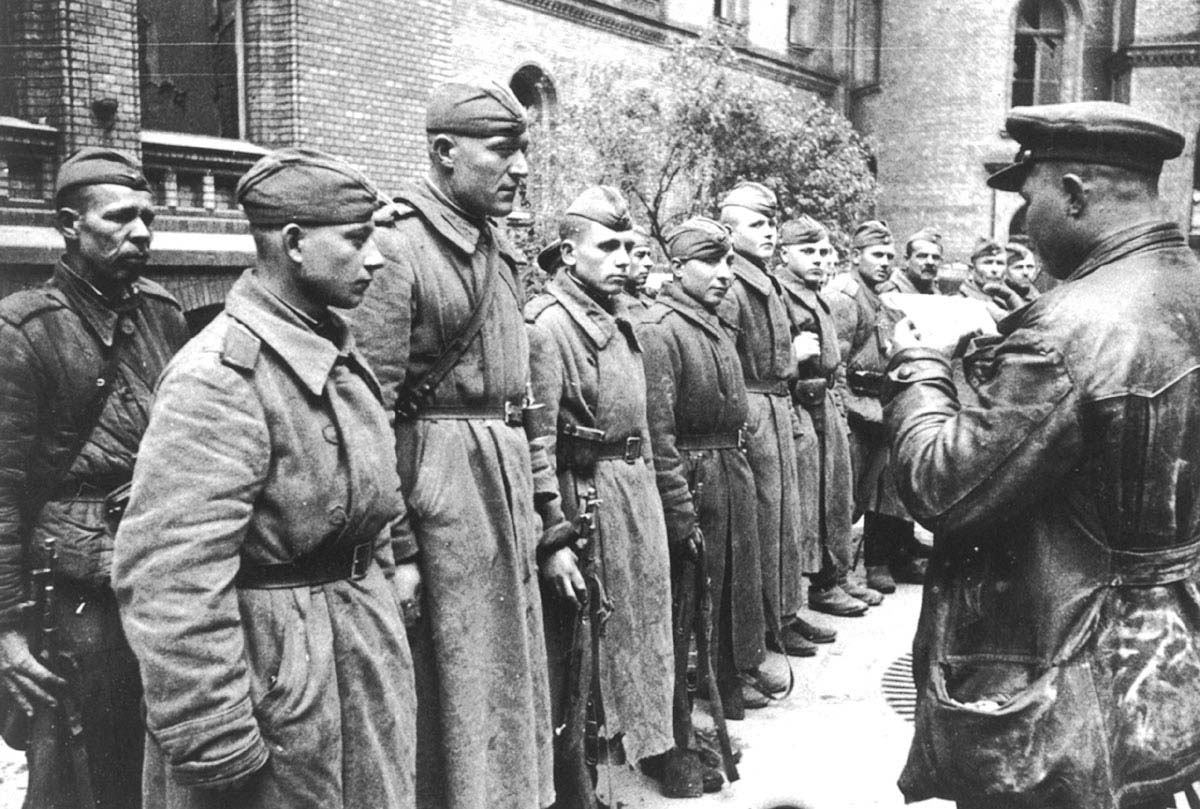
The original caption reads, ‘Senior Lieutenant Nikitin reads the order of the day to his men on 1 May.’ Although the fighting went on, the men were aware that the war was virtually over and many spent the day celebrating. Overindulgence in drink was not uncommon despite orders trying to contain the troops’ high spirits.
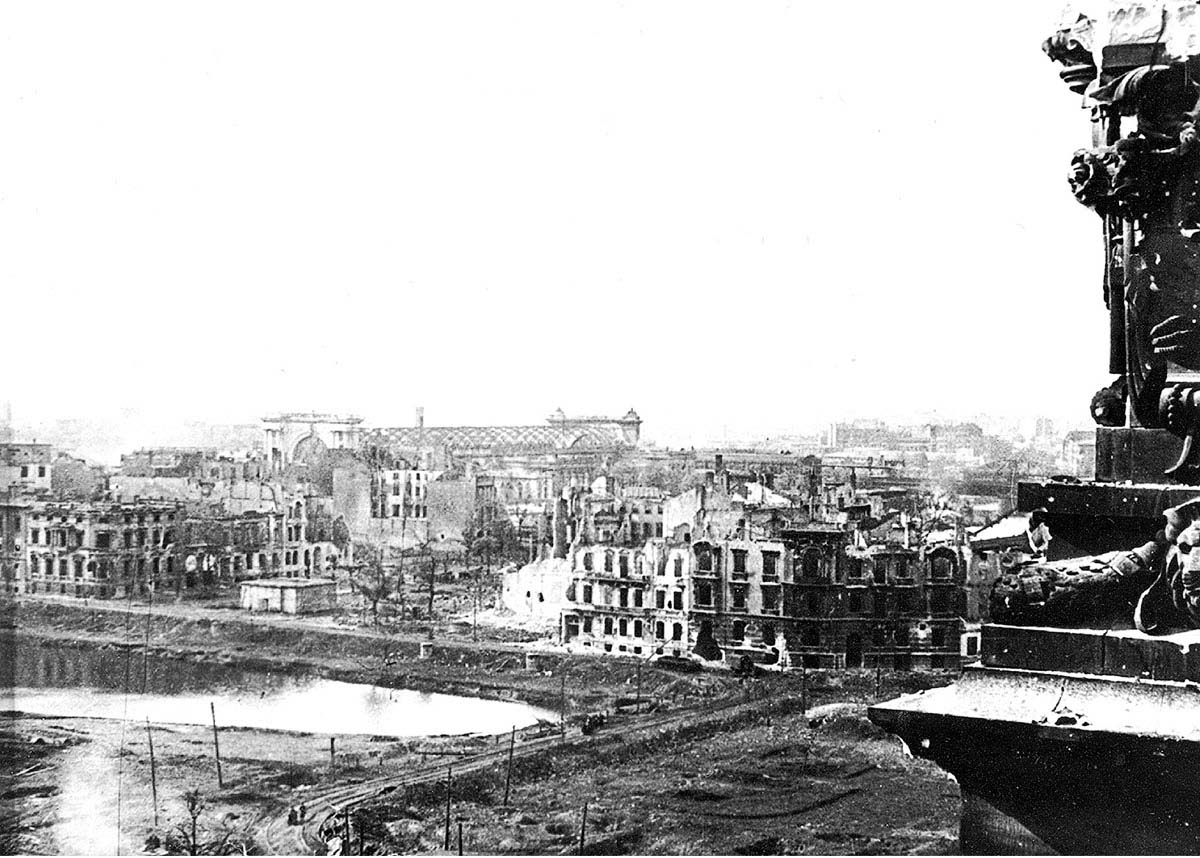
The view from the Reichstag roof looking towards the Spree river and the Diplomatic Quarter: the area’s main water obstacle, a flooded tunnel that acted as a moat, can be seen to the left running across the Konigsplatz. The large skeletal structure is the Lehrter railway station.
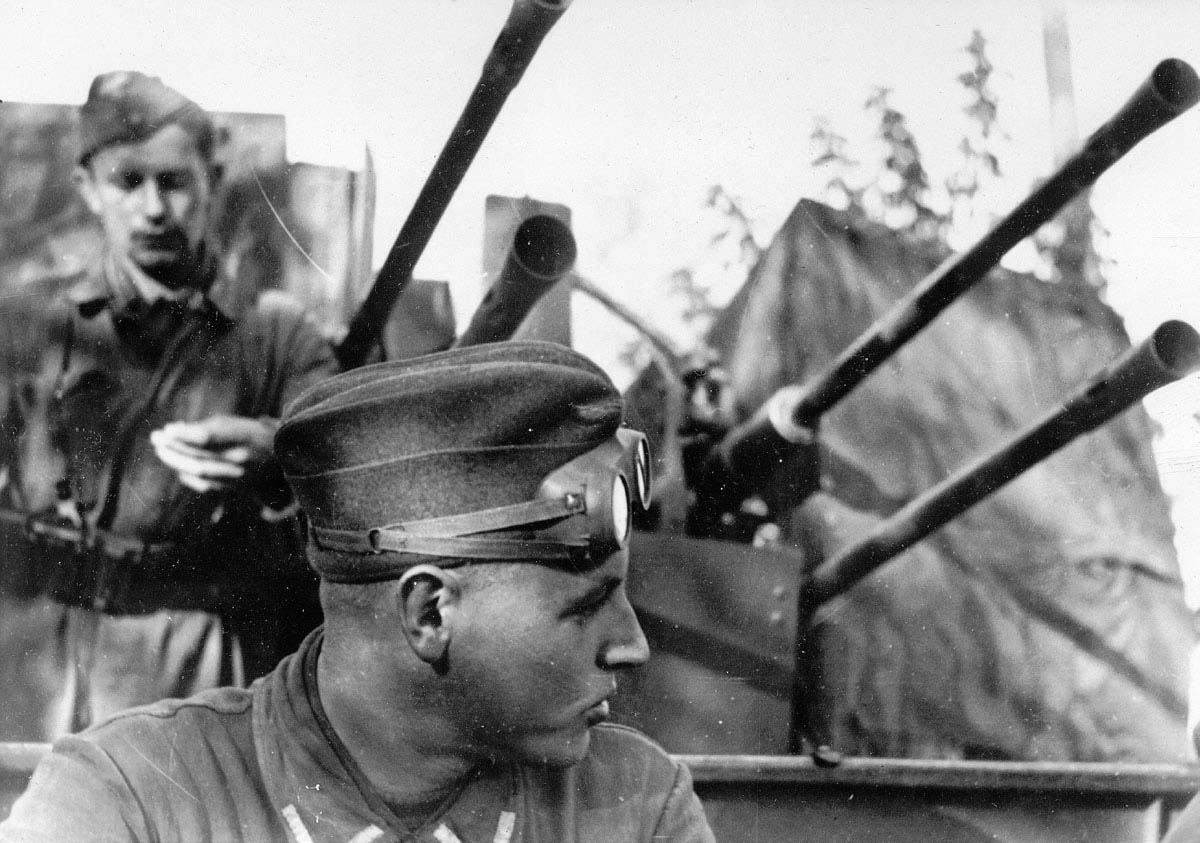
Vehicle-mounted, quadruple-barrelled antiaircraft guns like this one gave covering fire to those troops and civilians escaping across the Havel river to Spandau. Ernest Himmler, younger brother of the infamous Heinrich, died in the stampede across the bridge.
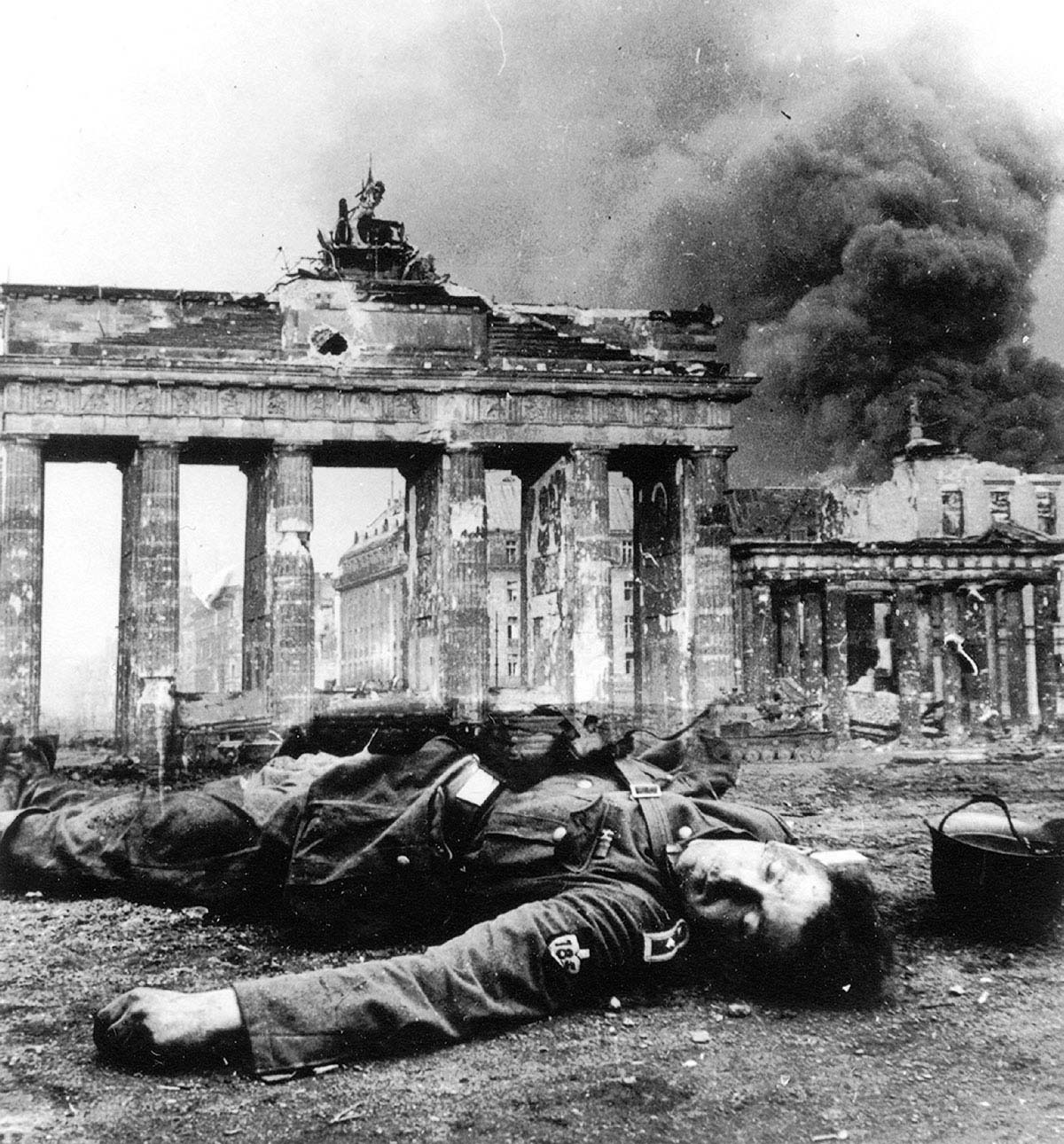
An NCO lies close to the rear of the Brandenburg Gate while the smoke rises from the Reichstag. The badge on his sleeve indicates membership of an unidentified formation numbered 185.