
4
“Overnight! This was all overnight.” Years later, Erika M. still could not hide her astonishment at the collapse of Austria, at the end of her country, on the night of the eleventh of March, in the pivotal year of 1938.
The Austria where Erika had spent a very happy Jewish childhood, “the most wonderful existence a child can have,” was perhaps an unlikely creation. In 1914, when the First World War began, “Austria” was simply the informal name of some German-speaking regions of the great power known as the Habsburg monarchy. When that war came to an end with the defeat of that empire, Austria was created as a new republic and the new homeland of those German-speaking people—including about 200,000 Jews, most of them inhabitants of the capital, Vienna. In the beginning, few believed that the small alpine country could survive. Lebensunfähig—incapable of life—was the verdict of economists and politicians alike. The population was only seven million, by comparison with the fifty-three million of the Habsburg domains. The richest lands of the old monarchy had fallen to the new state of Czechoslovakia. The separation of Austria from territories that fell to Poland, Hungary, Yugoslavia, and Romania destroyed a large and vibrant internal market. Most Austrians either had little sense of national identity or thought of themselves as Germans.
The leaders of the new country tried to found it as “German-Austria,” including in its constitution a promise to seek unification with the larger German state to its north. This was exactly what the victors in the First World War—the Americans, the British, and, above all, the French—wished to prevent. It had been precisely an alliance between Vienna and Berlin that had begun, as Paris and London saw matters, the bloodiest war in the history of the world. More than a million French soldiers had not fallen so that Germany could end the war holding Austrian territories it had not possessed at the beginning. Thus the peace treaties applied to Germany and Austria, signed at Versailles and Saint-Germain in 1919, explicitly forbade each country from uniting with the other. This was, of course, a resented violation of the principle of national self-determination, the moral cause that the American president Woodrow Wilson had brought to the western allies when the United States joined the war on the western front in 1917.
The contradictory Austria of the early twentieth century was frozen in the mind of Hitler and many other Europeans throughout the succeeding two decades. Hitler had no sympathy for the Habsburg monarchy, the land of his birth, nor for cosmopolitan Vienna, where he had failed as a painter. He saw the city as an unhealthy mixture of races, held together only by the iniquitous plans of the Jews, who held true power. When he moved from Vienna to Munich in 1912, he believed that he had left a non-German city for a German one. It seems that he went to Germany to avoid mandatory military service in the Habsburg army, but in 1914 he volunteered for the German one, and served in the trenches as a messenger during the First World War. A German by choice, he shared the view of many German soldiers and politicians that the old multinational monarchy was doomed by its very nature. For Hitler, Austria had a past that was unworthy of Germans and a future that was unworthy of mention. He was an Austrian who had joined Germany; at some point all of the others (except the Jews, of course) would follow.
Although Hitler did not place Austria at the center of his concerns in the 1920s and 1930s—that place was always held by the Soviet Union—he took for granted that Austria and Germany would one day be united. His National Socialist Party, including its paramilitary arms, the SA and SS, were active in Austria as well as in Germany. In Austria especially, it was obvious that the work of these racial organizations was directed towards something more ambitious than an internal transformation of Germany; after all, Austria and Germany had never in history been united in a single national state. The prospect of their unification—Anschluss—was the part of the Nazi program that was most relevant to Austrians.
Yet for Erika M., a Jewish girl whose whole life had been spent in independent Austria, and whose whole world was changed forever on March 11, 1938, Austria was real. Over the course of the two decades after the First World War, an Austrian state was constructed, despite everything. Austria inherited from the old empire major political parties with experience in mass politics. The Social Democrats, the largest party when Austria was established after the war, were discredited immediately by their failed attempt to join the new republic to Germany. Yet the Social Democrats ruled without interruption in the Viennese metropolis, the first socialist party to govern a city of a million people or more on its own. They built a miniature welfare state known as “Red Vienna,” which proved to be both popular and successful.
Beyond Vienna, the leading party was the Christian Socials, who, like their socialist rivals, had a rich history in democratic competition dating back to the monarchy. Unlike the Social Democrats, however, they had never believed in unification with some idealized Germany. They identified with the Roman Catholic religion, the one trait that distinguished most Austrians from most Germans. Some of them were monarchists, fondly recalling the old multinational empire.
Jews were relatively more numerous in Austria than in Germany, and functioned in both of the main Austrian political movements. Most Austrian Jews lived in Vienna, where most voted for the Social Democrats. Yet Jews were also to be found in conservative organizations. The leader of the Austrian monarchist movement, for example, was Jewish.
Austria’s major political conflict was between these two native traditions, the Right and the Left. In 1927, the Social Democrats, who had just won elections, organized a general strike in the capital, but were unwilling to try to seize total power. In 1934, the Christian Socials backed right-wing paramilitaries in conflicts with left-wing paramilitaries, leading to clashes that became a brief civil war. The Austrian regular army backed the Right, and the Left was crushed. The symbolic end came as army artillery shelled the great public housing complexes, the pride of Red Vienna, from the hills beyond the city. The Social Democrats were then banned, and the Christian Socials reformed themselves as the largest part of a right-wing coalition known as the Fatherland Front. Austrian politicians and journalists associated with the Social Democrats fled the country, among them a considerable number of Jews.
The Nazis were never the largest party in Austria, and never won an election. They were a significant but distant third in popularity. But with the socialists humiliated and Hitler’s model in display across the border after 1933, the Nazis could challenge the Austrian authoritarian regime. Austrian Nazis assassinated the Austrian chancellor Engelbert Dollfuß on July 25, 1934, but their coup did not lead to the national revolt they expected. On the contrary, the murderers were arrested and executed. Austrian Jews saw the Dollfuß regime as a barrier to National Socialism. Although the Fatherland Front looked very much like a fascist organization, complete with its own uniforms and salutes—and even its own version of a cross meant to compete with the Nazi Hakenkreuz—its politics were quite different. It identified Austria as “the better Germany” and Austrians as Germans, but did not identify Germans as a race. Although there were certainly antisemites in the movement, the Fatherland Front instituted no antisemitic policies on the model of Hitler. Despite considerable antisemitism on the Right and even on the Left, Jews continued to serve in Austrian ministries and to live more or less unhindered lives as Austrian citizens.
The rise of Hitler to power in Germany in 1933 raised the Austrian question in a new economic form. Germany’s recovery from the Great Depression created an attraction that could not be reduced to tradition or nationalism. Austrians who found jobs in Germany were impressed. Like its east European neighbors, Austria was an agrarian country and as such had been wracked by the Great Depression. The Fatherland Front, despite its radical iconography, was among the most conservative European governments in its economic policy. Whereas Germany under the Nazis accumulated huge budget deficits, Austria under the Fatherland Front pursued a tight fiscal and monetary policy, jealously hoarding its foreign currency and gold reserves. From Hitler’s perspective, this was one more reason, and an increasingly pressing one, why Austria needed Anschluss with the Reich. Germany needed the money.
As Germany asserted its place in Europe, Austria lost its allies. In 1934, during the failed Nazi coup in Austria, fascist Italy rallied to Austria’s defense. Benito Mussolini, Italy’s fascist Duce, was still hoping to create an Italian sphere of influence in the Balkans, Hungary, and Austria. Two years later, after Hitler had begun to rearm Germany, Mussolini had to accept the role of partner (and soon junior partner). He washed his hands of the Austrian question, leaving the matter to Hitler. Thus in 1936, in what was known as the “Gentlemen’s Agreement,” members of the Nazi party in Austria were amnestied, and some of them brought into government. Austrian Nazis used their access to the public sphere to press the case for an Anschluss. That October, Nazi Germany and fascist Italy announced their “Axis.” For Vienna this meant political isolation. As the saying at the time went, the Axis was the spit upon which Austria was roasted.
In February 1938, Hitler summoned the Austrian chancellor, Kurt von Schuschnigg, to his residence in the Bavarian Alps. Like his predecessor Dollfuß, Schuschnigg represented the Christian Socials and the Fatherland Front—and thus the sovereign Austrian Right that was opposed to Anschluss. Hitler demanded concessions that would have meant the end of Austrian sovereignty. Schuschnigg was intimidated, but upon his return to Vienna he regained his spine. In defiance of Hitler, he called a referendum on Austrian independence. Hitler was using the language of self-determination to press a German claim on what Hitler thought were German territories, so let the Austrian people decide. Schuschnigg was sure that he would win the referendum: The question was full of so many desiderata as to make clear that the correct answer was “yes”; the voting was to be open rather than secret; ballots were to be issued with answers already printed; much of the Austrian population really did favor independence in 1938; and, in any event, his regime was an authoritarian one that could arrange the results as necessary.
The days of March 9 and 10, 1938, were devoted to propaganda in favor of Austrian independence, over the radio, in the newspapers, and, following Austrian traditions, in signs painted on the streets of Vienna. The main propaganda slogan was simply Österreich—Austria. Abandoned by its former ally Italy and ignored by Great Britain and France, the country had no external backers. In rallying internal support, Schuschnigg was hoping to make a case against Hitler’s claims that European powers might heed. Hitler, understanding the risks, threatened to invade. Under this second round of threats, Schuschnigg yielded. No referendum took place.
—
Erika M. was right: Everything really did change overnight. On the evening of March 11, Austrians sat close to their radios to hear an important announcement from the chancellor. This was a Friday night, but Erika’s family, like other observant Jews, broke the Sabbath to listen to the radio. Although this was probably not a case of immediate threat to a particular person, which would technically justify the violation of Jewish law, Viennese Jews were right to think that this radio address was a matter of life and death. At 7:57 p.m. Schuschnigg announced his decision not to defend Austria from Hitler. At that moment the Austrian state in effect ceased to exist. Formal power passed to an Austrian Nazi lawyer, Arthur Seyß-Inquart, whose program involved the termination of the entity he now governed. Popular opinion assimilated the meaning of the end of Austria far more quickly than even Nazis in Vienna or Berlin expected. That same evening crowds appeared on the streets, shouting Nazi slogans and looking for Jews to beat. That first night of lawlessness in Austria was more dangerous for Jews than the preceding two decades of Austrian statehood. Their world was gone.
The next morning the “scrubbing parties” began. Members of the Austrian SA, working from lists, from personal knowledge, and from the knowledge of passersby, identified Jews and forced them to kneel and clean the streets with brushes. This was a ritual humiliation. Jews, often doctors and lawyers or other professionals, were suddenly on their knees performing menial labor in front of jeering crowds. Ernest Pollak remembered the spectacle of the “scrubbing parties” as “amusement for the Austrian population.” A journalist described “the fluffy Viennese blondes, fighting one another to get closer to the elevating spectacle of the ashen-faced Jewish surgeon on hands and knees before a half-dozen young hooligans with Swastika armlets and dog-whips.” Meanwhile, Jewish girls were sexually abused, and older Jewish men forced to perform public physical exercise.
The symbolic destruction of Jewish status was accompanied by and enabled theft from Jews. On March 11, 1938, about seventy percent of the residential property on the Ringstrasse, the beautiful circular avenue that encloses Vienna’s first district, had belonged to Jews. From the dawn of the twelfth of March, that percentage decreased by the hour. Jewish businesses were marked as such, and the automobiles of Jews were stolen. The SA had made lists of Jewish apartments that their members wanted for themselves, and this was their chance. Jewish professors and judges were driven from their offices. Austrian Jews began to commit suicide: seventy-nine in March, and then sixty-two more in April.
The “scrubbing parties” were also political. Jews were cleaning the streets at certain places, working with acid, brushes, and their bare hands to remove one sort of mark. They were erasing a word that had been painted on Vienna’s avenues only a few days before: “Austria.” That word had been the slogan of Schuschnigg’s referendum propaganda, of which Jews could now be portrayed as the organizers. It was also the name of a state of which Jews had been citizens. Jews were unwriting Austria, and they were doing it within the circles of onlookers on the streets, under the gazes and the grins.
Austrians separated themselves from their fellow citizens and the disappearing state not only by their behavior and by their expressions, but also by their lapel pins—like the pavement propaganda, another example of Austrian political culture. Not only Nazis but also people who had been Social Democrats or Christian Socials before March 11 began to wear Nazi lapel pins. Standing by during the “scrubbing parties” was thus by no means a neutral position or a simple act of observation. The very act of spectating communicated the new group boundaries and assigned blame for the past. We watch, they perform. The Jews were responsible for Austria, for that old order, not us. Their punishment now is proof of their complicity then. Our separation is proof of our innocence. Thus responsibility was perfectly excised, in perfect bad faith. In an instant, violence organized by race replaced two decades of political experience.
The Austrian satirist Karl Kraus had written in 1922 that Austria was a laboratory for the end of the world. It now became a realm of experimentation for the Germans, with some surprising lessons. One Viennese Jew recalled that “Austrians became antisemites all of a sudden and taught the Germans how to treat Jews.” There had been no Austrian Nuremberg Laws, no restrictions of Jews in public life, no exclusion of Jews from society. Until the day of Schuschnigg’s address, Jews had been equal citizens. Jews had an important role in the economy, and some had performed important functions in the regime. The end of the Austrian state brought violence against Austrian Jews in five weeks that was comparable to the suffering that German Jews had endured under Hitler over the course of five years. The organizers in Austria were usually Nazis, but they were operating in conditions of state collapse that allowed their revolution to proceed further and faster. Ironically, the SA, which had been humiliated in Germany in the Night of the Long Knives in 1934, did make something like the “second revolution” its murdered leaders had wanted—only in Austria rather than Germany.
What Austrian Nazis managed to achieve in a matter of hours and days was indeed an unexpected inspiration for German Nazis. Hitler himself was pleased and surprised by the immediate support for annexation. On the Heldenplatz, the grand square beneath the royal castle in Vienna, Hitler proclaimed the Anschluss. This was on March 15, four days after Schuschnigg’s capitulation. Along with Hitler came the Nazi leaders who exploited the anarchy created by the SA and turned it to their own purposes. On March 28, Hermann Göring required an orderly redistribution of stolen Jewish property. Some four-fifths of Jewish businesses in Austria were aryanized by the end of 1938, far surpassing the pace in Germany itself. In August, Adolf Eichmann, the head of the Jewish section of Reinhard Heydrich’s SD, established in Vienna a Central Office for Jewish Emigration.
In 1938, some sixty thousand Jews left Austria, as compared to some forty thousand who left Germany. And most of those German Jews emigrated after Nazis applied the lessons that had been learned in Vienna.
—
In 1935, German Jews had been reduced to second-class citizens. In 1938, some Nazis discovered that the most effective way to separate Jews from the protection of the state was to destroy the state. Any legal discrimination would be complicated by its unforeseen consequences for other aspects of the law and in bureaucratic practice. Even matters that might seem simple, such as expropriation and emigration, proceeded rather slowly in Nazi Germany. When Austria was destroyed, by contrast, Austria’s Jews no longer enjoyed any state protection and were victimized by a majority that wished to distance itself from the past and align itself with the future. Statelessness opened a window of opportunity for those who were ready for violence and theft. By the very logic of Anschluss, the Nazi state itself had to close that window, since Austria was meant to become a part of Germany, and anarchy fomented by the SA would undo its own ability to rule. But even a moment of temporary statelessness had profound consequences. March 1938 was the first time that Nazis could do as they pleased with Jews, and the result was humiliation, pain, and flight.
—
Avraham Stern, the radical Zionist and client of the Polish regime, happened to be in central Europe at the time. He was visiting Warsaw for consultations with Polish authorities after a Revisionist Zionist congress in Prague in January 1938. On his way back from Poland to Palestine he stopped in Austria and spoke to the new Nazi authorities about the emigration of a few right-wing comrades to Palestine—one of the men he brought out believed that Stern had “negotiated with Eichmann.” This was the kind of thing that Polish authorities had been hoping that Stern could do, though on a far larger scale.
On March 15, 1938, the day of the Anschluss, Polish diplomats were preparing a pro-Zionist request to the Americans. They asked the U.S. Department of State to pressure the British Foreign Office to open Palestine to Jewish migrants from Europe. In general the Poles urged American diplomats to support an independent Israel with the most expansive possible boundaries. The timing was no coincidence. The major consequence of Anschluss was exactly the opposite of what the Polish leadership desired. German policy and Polish policy both aimed to extrude Jews; now an enlarged Germany was dispatching Jews to Poland. Some twenty thousand of the Jews in Austria were Polish citizens, many of whom claimed and received the right to return to their country of origin. Since America and Palestine remained blocked (except to daredevils like Stern), Poland could expect ever more Jewish immigration as German power spread.
Polish diplomats worked unceasingly to open Palestine to Jewish settlement, but were in no position to force that issue. German repressions of Jews had led Britain not to soften but to harden its line on Jewish immigration to Palestine. The Polish foreign ministry asked the Polish parliament after the Anschluss for the right to review the documentation of all citizens who had resided abroad for longer than five years. This was granted on March 31, 1938. Although the law and most of the internal bureaucratic correspondence avoided the word “Jew,” the purpose of the new policy was clear: to block the next wave of returning Polish Jews. As Drymmer himself put it, the goal was “excluding the unworthy and above all disposing of the destructive element,” by which he certainly meant Jews. This was a qualitative change in Polish citizenship policy, occasioned by the pressure of Anschluss and immigration limits in Palestine and the United States, and inspired by German examples. Until 1938, Polish diplomats, whatever their personal feelings, had intervened on behalf of all Polish citizens, including Jews.
The Nazis understood the implications of the Polish initiative for the sixty thousand or so Jews of Polish citizenship residing in Germany in 1938. If these people lost their Polish citizenship while living in Germany, it would become very difficult to expel them later to Poland. Berlin asked Warsaw for a delay in the application of the Polish law, and the German coercive apparatus was mobilized for its greatest stroke thus far. With Himmler’s approval, Heydrich arranged for the forcible expulsion of some seventeen thousand Jews of Polish citizenship across the German-Polish border on the night of October 28. This was a shockingly massive exercise of coercion by the standards of the day. It was also the first major action of such a kind by the SS, whose capacity for violence expanded rapidly at the German border. The surprise deportation of Jews from Germany to Poland was a strange contrast to the words of Hitler, who was speaking just at this time to the Polish government about a common Jewish policy.
—
In European capitals in 1938, state destruction could appear to be something that happened to other people, perhaps even as a beneficial correction of the postwar order. Neither the western powers nor the Poles concerned themselves with the passing of Austria. The Jewish perspective was different: Jews could see the beginning of a general process of separation from European states, and began to sense that they had nowhere to go. In July 1938, representatives of thirty-two countries, led by the United States, discussed Jewish emigration at Évian-les-Bains in France. Only the Dominican Republic agreed to take any Jews. The various ways that Jews were separated from the state in Europe, meanwhile, began to interact and mutually reinforce. The German destruction of Austria brought Jews to Poland. Warsaw reacted by seeking to deny citizenship to Polish Jews living abroad. Berlin responded by expelling such people across the Polish border. By the standards of the time and place, this seemed to Jews like a catastrophe, above all to the individuals and families concerned. Very often these were people whose whole lives were in Germany and whose connections to Poland were quite limited.
The Grynszpan family, for example, had moved to Germany from the Russian Empire in 1911, seven years before Poland had regained independence. The children had been born in Germany, spoke German, and regarded themselves as Germans. They held Polish passports after 1918 because their parents hailed from a part of the Russian Empire that had become Poland. In 1935, the Grynszpans sent their son Herschel, then fifteen, to stay with an aunt and uncle in Paris. By 1938, his Polish passport and his German visa had both expired, and he had been denied legal residency in France. His aunt and uncle had to hide him in a garret so that he would not be expelled. On November 3, they showed him a postcard from his sister, mailed right after the family had been deported from Germany to Poland: “everything is finished for us.” The next day Herschel Grynszpan bought a gun, took the metro to the German embassy, asked to meet a German diplomat, and shot the one who agreed to see him. It was, as he confessed to the French police, an act of revenge for the suffering of his family and his people.
Some of the top Nazis saw an opportunity to move toward a Final Solution on the territory of Germany. With Hitler’s permission, Goebbels organized the coordinated attacks on Jewish property and synagogues on the night of November 9 that came to be known, as a result of all the broken glass, as Kristallnacht. The official pogroms were indeed a shattering experience for many German Jews. Some two hundred of them were killed or committed suicide. The deliberate violence in Germany itself in November 1938 was thus the closing of a circle that was opened with the destruction of the Austrian state. The Anschluss had led to the flight of Jews to Poland; this prompted new Polish restrictions on Jews living abroad; this led the Germans to expel Polish Jews; this caused an assassination in Paris that served as a pretext for organized violence in Germany. The Kristallnacht pogroms showed not only what the destruction of Austria had enabled, but also the limits of applying the violent side of the Austrian model within Germany. In Austria, public violence was possible during the interval between the end of Austrian authority and the consolidation of German authority. Such an opening could not really be created in Germany. The German state was to be mutated but not destroyed.
With Kristallnacht, Goebbels did show that the Austrian model of expropriation and emigration could function in Germany. It was only after violence had actually been delivered on a national scale that German Jews began to leave their homeland in large numbers. Nevertheless, disorderly violence within the Reich itself was revealed to be a dead end. Most of German public opinion was opposed to the chaos. Visible despair led to expressions of sympathy with Jews, rather than the spiritual distancing that Nazis expected. Of course, it was possible for Germans not to wish to see violence inflicted upon Jews while at the same time not wishing to see Jews at all. Göring, Himmler, and Heydrich immediately drew the conclusion that inspiring pogroms inside Germany had been a mistake. Not long after they would organize pogroms in much the same way as Goebbels had, but beyond the borders of Germany, in time of war, in places where German force had destroyed the state.
Hitler did nothing to defend Goebbels, whom he had unleashed in the first place, and said nothing in public about Kristallnacht. Three days after Kristallnacht, Göring said that Hitler would now approach the western powers with a Madagascar plan for the resettlement of Jews. Two weeks after Kristallnacht, Hitler was discussing the deportation of European Jews to Madagascar with confused Polish diplomats. The Poles could not understand how Germans could intend such a complicated logistical operation when all they seemed able to organize was chaos in Austria and Germany. Furthermore, in light of the consequences of previous German policy towards Jews, and in the context of the ongoing discussions of a “comprehensive solution” to the problems of German-Polish relations, the idea had a whiff of blackmail. More than thirty thousand Jews had been delivered by German policy to Poland thus far in 1938. If Poland agreed to improve relations with Germany on the terms proposed by Hitler, then Germany would stop sending Jews to Poland and instead cooperate in sending them somewhere else. The Jewish question had become a source of tension in German-Polish relations. German pressure was one reason Hitler’s idea of a comprehensive solution of German-Polish problems, with its promise of joint policy on Jewish matters, was unattractive.
In Warsaw in 1938, Hitler’s negotiating style, so effective in Vienna, had an effect opposite to what was intended.
—
Over the course of 1938, as Hitler was seeking, with success, to destroy the Austrian state, and working, without success, to recruit Poland as an ally, he was also trying to provoke a conflict over Czechoslovakia. The pretext was the status of the three million Czechoslovak citizens who identified themselves as Germans. In February 1938, as Hitler was threatening Austrian leaders, he also declared that the Germans of Czechoslovakia were under his personal protection. This had no legal meaning, but that was the point: States did not matter but races did; conventions did not matter but the personal decisions of the Führer did. When Austria fell in March 1938, the future of Czechoslovakia darkened.
Hitler had no sincere interest in the German minority question in Czechoslovakia or anywhere else. In his worldview, Germans were a race and had a right to what they could conquer for themselves. Hitler meant to use minority questions to confuse enemies and to foment the war in which all Germans would prove their racial mettle. He raised what he thought were impossible demands on behalf of Germans in Czechoslovakia, and was then frustrated when Czechoslovakia and its allies gave him everything that he said he wanted. The result was a second improvised destruction of a European state, further worsening the position of Europe’s Jews.
Czechoslovakia, like Austria, was a creation of the peace treaties after the First World War. Whereas Austria, as a rump successor state of the Habsburg monarchy, was punished as an enemy, the new state of Czechoslovakia was meant as a reward to people seen as allies. Before the First World War, Czech politicians had always been rather comfortable within the Habsburg monarchy, whose multinational character and liberal constitution protected Czechs from domination by Germans. It was only when the monarchy’s existence was threatened that they began to speak about an independent state. By the middle of the First World War, it seemed probable that the old monarchy was doomed whether it won or lost. If it won, it would be nothing more than a satellite of Germany, which would oppress the Czechs. If it lost, it would be destroyed by triumphant democracies of the West. In this situation, a few Czechs began to lobby for recognition in the western capitals. Because theirs was a small people, they claimed that Slovaks also belonged to the same nation. Because they wished their state to be defensible, they asked for mountain ranges inhabited mainly by Germans. Czechoslovakia was established on the principle of self-determination, with a generous admixture of political realism.
Czechoslovakia was thus like the old Habsburg monarchy: It was multinational and liberal. Unlike its neighbors, it maintained a democratic system through 1938. As Hitler sought to dismantle Czechoslovakia, he called the mountainous territories inhabited by Germans the invented name “Sudetenland,” which falsely suggested that they had some historic unity. Although the region defined by Hitler had a German majority overall, it included zones that had Czech majorities. It also included Czechoslovakia’s natural defenses, as well as the impressive fortifications built up by the Czechoslovak army. The Czechoslovak armaments industry was the best in Europe at the time, and Hitler’s zone also included its major factories. The famous Škoda works, one of the most impressive industrial complexes in Europe, was three miles inside the border of the “Sudetenland.”
Czechoslovakia was a creation of the western democracies and saw itself as one of them. It was an ally of France and enjoyed some sympathy in Britain, though perhaps less than it deserved. Wiser heads in Paris understood that Hitler’s proclaimed defense of the Germans was a political preparation for an invasion of Czechoslovakia, which, if the French fulfilled their treaty obligation, would lead to a general European war. The Soviet Union now expressed an interest in the well-being of Czechoslovakia and made overtures to Paris. French leaders hoped for an arrangement with Moscow that might deter Hitler, or at least decrease the likelihood that France would have to face Germany alone.
Unfortunately for the French, at precisely this time the Soviet NKVD was in the midst of executing half of the higher officers of the Red Army in a tremendous wave of terror. Although the details were not known to the French general staff, French officers and diplomats did notice that their Soviet interlocutors kept disappearing without a trace. Even absent this demoralizing development, the French would have needed to convince either Poland or Romania to allow Soviet forces to cross their countries. The USSR shared no border with Czechoslovakia, and so any intervention by the Red Army would involve the passage of Soviet troops through a third country. In Warsaw and Bucharest, the Czechoslovak crisis began to look like the pretext for a Soviet intervention in central Europe. The Poles and Romanians feared a Soviet invasion of their own countries more than a German invasion of Czechoslovakia.
In September, the second European crisis of 1938 reached its height. Hitler had ordered preparations for war with Czechoslovakia in May, with an expected invasion in October. He had also instructed the leaders of the German national minority to escalate their demands. On September 12, Hitler gave a rousing although factually absurd speech about the need to rescue Germans from Czech policies of extermination and to do away with Czechoslovakia generally. There was nothing at all inevitable about the fulfillment of his wishes. The Czechoslovak state was quite impressive in most respects; indeed, in its combination of prosperity and freedom, it was unmatched in central Europe and perhaps on the entire continent. Open talk of the destruction of Czechoslovakia made the destruction possible, especially insofar as European leaders could persuade themselves that yielding to such rhetoric somehow meant yielding to reason.
Even as London and Paris urged Prague to compromise, the Soviets provided indications of their willingness to intervene in central Europe to protect Czechoslovakia. Four Soviet army groups were moved to the Polish border. Three days after Hitler’s speech, the Soviet regime accelerated the ethnic cleansing of its western borderlands. From September 15 onward Soviet authorities carried out swift mass executions in the Polish Operation without any sort of review. Local authorities formed “troikas”—groups of three—from the local party head, procurator, and ranking NKVD officer. The troikas could sentence people to death and carry out the sentence without awaiting any sort of confirmation. Oral instructions made clear that “Poles should be completely destroyed.”
Throughout the territory of Soviet Ukraine, which bordered Poland, Polish men were shot in huge numbers in September 1938. In the city of Voroshilovgrad (today Luhansk), Soviet authorities considered 1,226 cases in the Polish Operation during the Czechoslovak crisis and ordered 1,226 executions. In September 1938, in the regions of Soviet Ukraine adjacent to the Polish border, Soviet units went from village to village as death squads. Polish men were shot, Polish women and children were sent to the Gulag, and reports were filed afterward. In the Zhytomyr region, which bordered Poland, Soviet authorities sentenced 100 people to death on September 22, 138 more on September 23, and 408 more on September 28.
That was the day that Hitler had set as the deadline for an invasion of Czechoslovakia. The German army was standing at the Czechoslovak border. The Red Army was standing at the Polish border; and the NKVD had cleared the hinterland of suspicious elements by massive shootings and deportations of Poles. A German invasion of Czechoslovakia would have provided the pretext for a Soviet invasion of Poland. Perhaps the Red Army would then have entered Czechoslovakia and sought to engage the German army. More likely it would have sought some truce with Germany that allowed it to take territory from Poland without having to engage the Germans. The suspicion is warranted, since the next time Soviet forces massed at the Polish border it was eleven months later, after Moscow had made just such a deal with Berlin. But this cannot be known for certain, since the crisis was resolved. At Munich on September 30, 1938, the leaders of Britain, France, Italy, and Germany decided that Czechoslovakia should cede the territories that Hitler wanted.
Czechoslovakia had no part in this Munich accord and was not legally bound by it. Abandoned by their friends and allies, its leaders decided not to fight the Germans alone. As Czechoslovak troops and police withdrew from the “Sudetenland” in October, political violence prevailed: mostly Germans attacking other Germans, pro-Nazis killing the rival Social Democrats whose orientation had been illegal in Nazi Germany for five years. In November the “Sudetenland” was joined to Germany—Germans, Czechs, mountains, fortresses, arms factories, and all. An Einsatzgruppeentered with the assignment of eliminating political opponents; its members were explicitly forbidden to kill. The thirty thousand or so Jews who had lived there, like the Jews of Austria a few months earlier, found themselves suddenly deprived of state protection. About seventeen thousand of them were deported by the Germans or fled; they lost their property. In what remained of Czechoslovakia, Jews rightly feared the total destruction of their state and thus the loss of their property rights. About a third of Czechoslovak banking and industrial capital was owned by Jews; much of this was acquired at tremendous discount by Germans in late 1938 and early 1939.
—
Poland bordered all parties most concerned by the crisis of state destruction of 1938: Germany, Austria, Czechoslovakia, and the Soviet Union. Warsaw had no sympathy for Prague, since the Czechoslovak army had seized some important industrial territory around Teschen in 1919 when the Polish army had been busy fighting the Soviets. Polish diplomats wrote of Czechoslovakia as an “artificial creation” and an “absurdity.” While Berlin presented itself as the defender of the rights of the German minority in Czechoslovakia, Warsaw followed suit and presented itself as the protector of Poles in Czechoslovakia. When Germany seized the territories it called the Sudetenland, Poland exploited the moment to claim the Teschen region that Czechoslovakia had taken in 1919.
Poland looked like a German ally in these days, although its policy was, in fact, an independent one that Warsaw had to explain to Berlin. Poland wanted the Teschen region for some of the same reasons that Germany wanted the Sudetenland: It was rich in resources, rail connections, and industry. Teschen would help Poland prepare for war, but Germans could not be entirely sure on which side Poland would be fighting. Polish diplomats tried to get credit in Berlin for their “decided position” against the Soviet Union, with no effect. Hitler was consciously provoking a European war, and would have taken it in whatever form it came. He could not be impressed that Poland had proven to be a barrier to a Soviet intervention in Czechoslovakia when what he really wanted was an offensive war against the Soviet Union. He expected much more from the Poles than an imitation of German policy in these local crises, and he was telling them so.
By November 1938, Germany had absorbed Austria and much of Czechoslovakia. Some nine million people had been added to the Reich, along with Austria’s gold and Czechoslovakia’s arms. No doubt Hitler thought that these gains made his offer of a “comprehensive solution” to German-Polish problems more difficult for the Polish leadership to refuse. After all, Germany had shown that it could take what it wanted in any case. Hitler believed that Warsaw had no choice but to recognize common interests with respect to the Jews and the Soviet Union. But Warsaw saw the Jewish and the Soviet questions rather differently than did Berlin, and it viewed growing German power as a source of worry rather than as a reason for compromise. The Poles understood, since the Germans had said so for years, that territorial adjustments in central Europe were only a small part of a much larger plan.
The destruction of Austria and Czechoslovakia raised the Jewish and eastern questions in ways that were disturbing in Warsaw. The “scrubbing parties” and Kristallnacht had brought tens of thousands of Jews to Poland. The Munich accords, meanwhile, opened the issue of the future of all Czechoslovak territories, including the far eastern region known as Subcarpathian Ruthenia. Germany declared the region autonomous in October 1938. By the terms of the First Vienna Award of November 1938, a southern zone was ceded to Hungary, and Germany then recognized the remainder as a state. Warsaw had some influence in the new statelet for two weeks in October, until its men were displaced by Avgustyn Voloshyn and other Ukrainian nationalists. These were people who believed that the Polish state should be dismantled and a Ukrainian state created from its territories. German-backed Ukrainian revisionists were thus in control of a sensitive territory on Poland’s border just as the future of German-Polish relations was being decided. During these last weeks of 1938, it appeared in Warsaw that Berlin was using Ukrainian nationalism against Poland—at the very moment that German diplomats were promising Poland Ukrainian territory from the Soviet Union.
Germany wanted Polish territorial concessions and promised three things in return: a war against the Soviet Union, a resolution of the Jewish question, and territory from Ukraine. Polish authorities wanted no war, and doubted German goodwill on all three issues. German proposals seemed either contradictory or made in bad faith. Uncertainty about Ukraine was a further reason, as 1938 came to a close, why Hitler’s proposal of a “comprehensive solution” failed to find support in Warsaw.
—
As 1939 began, Hitler finally faced international resistance he could not overcome with words. On the fifth of January, Polish foreign minister Józef Beck rejected Hitler’s proposals after a personal conversation. The Poles were prepared to offer concessions on the issues of Danzig and the corridor, but these of course were not the issue. From Hitler’s perspective these territorial matters were propaganda signals to German public opinion that his revisionism had something to do with what most Germans wanted. Beck was uninterested in Hitler’s main offer: vague promises of resolving the Jewish question and territorial gains in Ukraine after a joint attack on the Soviet Union. Thus Poland was revealed to be a problem, a barrier rather than a bridge to Hitler’s main object of dispatching Germans to a fateful war of racial destruction in the East. In these weeks the Poles did try to tilt their foreign policy back toward Moscow.
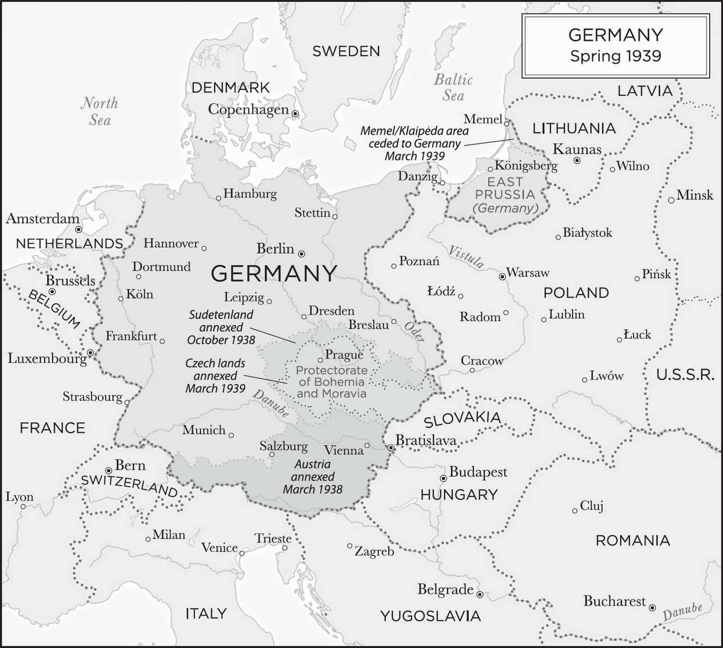
Hitler’s problem was that his Polish interlocutors understood his foreign policy, if not well, then at least better than the German public did. The German foreign minister, Joachim von Ribbentrop, made a final effort on the twenty-fifth of January, a symbolic date, the five-year anniversary of the signing of the German-Polish nonaggression declaration. Once again Ukraine was the bait. Once again the Germans failed. Polish diplomats asked Ribbentrop not to claim in Berlin that any agreement had been or might be reached. On the very day of that conversation, the New York Timespublished an article in which Poland’s foreign minister Beck presented the Soviet Union as an equal to Nazi Germany in its foreign policy. By calling both neighbors “allies” in front of the foreign press, Beck made clear that Poland would not join either in a war against the other. Ribbentrop returned to Berlin the next day with the certainty that Poland would never be a German ally against the Soviet Union.
The day of Ribbentrop’s return from Warsaw was a Thursday; the following Monday, Hitler gave the most notorious speech of his career. On January 30, 1939, Hitler proclaimed to the German parliament that if the Jews began a world war, it would end with their extermination. Poland had always been a matter of practice rather than theory for Hitler, and now improvisation gave way to rage. The particular style of international politics he had developed in 1938, the destruction of neighbors with words rather than weapons, had failed. His specific calculation about Poland, that its leaders would join in an antisemitic crusade against the USSR, had proven wrong. Both promises and threats regarding Jewish and Ukrainian questions had failed. The Polish choice was the end of a Nazi illusion that had lasted for five years.
Hitler decided to eliminate Poland as an object of international relations. The sudden necessity he felt to invade Poland had tremendous implications for Hitler’s plans. With Poland as an ally or benign neutral, Germany might have avoided the traditional problem of encirclement, its doom in the First World War. In such a scenario Germany could first invade France and remove the French army from the war, and then turn its attention to the real target, the riches of the Soviet Union. In Hitler’s basic scheme, Germany was to smash the USSR and become a world power after France was beaten and as the British (and the Americans) sat by and watched. Having redeemed the German race, attained continental power, and begun the grand project of planetary salvation from the Jews, Germany could later confront the British and the Americans as necessary. But with Poland as an adversary, the entire calculus was altered. As of January 30, 1939, as a result of his determination to begin a war despite his Polish miscalculation, Hitler had to contemplate a global conflict that would begin not after but before he won his European war. A German invasion of Poland might bring France into a war against Germany, thus creating encirclement. Worse still, it might draw in the United Kingdom, an eventuality Hitler always hoped to avoid. If Germany had to fight a long war in the west it was then to be feared that the USSR might intervene from the east.
Of course, in Hitler’s mind, any such insidious alliance against Germany would have to be the work of Jews. Since Jews, he believed, held the real power in foreign capitals, they would be the ones to determine whether or not a German invasion of Poland in 1939 actually did become a world war. If Jews could be made to understand that a world war was not in their interest, Hitler seems to have believed, then France and Britain and the Soviet Union would stay out of the initial conflict. If the Jews could be deterred with threats, then the German war against Poland could remain a local conflict in eastern Europe, a minor setback in Hitler’s plans rather than a major disruption. Thus Hitler’s failed Polish policy did not lead to warnings to the Poles. It led to warnings to the Jews.
Hitler’s notion that a threat to exterminate Jews would influence the future policy of the great powers was erroneous. The January 30, 1939, “prophecy,” as Hitler would call it in later speeches, had no resonance in Paris, London, or Moscow. What did matter was the continuation of German aggression in Czechoslovakia a few weeks later. On March 15, 1939, Germany moved forward to complete the destruction of that country, incorporating the Czech lands of Bohemia and Moravia as a “Protectorate” and creating an independent Slovak state that was to be an ally of Germany. Those who had betrayed Czechoslovakia to Germany at Munich in September 1938 were now betrayed by Germany in their turn. Since Hitler had taken lands that were populated by Czechs rather than Germans, it was clear that his claims to be interested only in national self-determination were lies. Those in London and Paris who had covered their complicity in the rape of Czechoslovakia with guilty references to the First World War realized that they had helped prepare the way for a Second. Paris and London in March 1939 now found themselves reaching the same conclusion as Warsaw had in December: Germany was about to undertake a massive war of aggression in which the only choices were resistance and submission.
On March 21, 1939, a few days after the destruction of Czechoslovakia, Germany unveiled its new propaganda line towards Poland. After five years of coordinating his propaganda with Warsaw, Goebbels could finally say what he, and no doubt many Germans, actually thought. From one day to the next Poland was again the ancient enemy, the oppressor of Germans, the grasping and monstrous creation of an unjust postwar settlement. Hitler’s diplomatic misfortune with Warsaw was good luck in domestic politics. War was not popular with Germans in 1939. But a war against Poland for border territories, now apparently in the offing, was far less unpopular than a massive ideological war of aggression in alliance with Poland against the Soviet Union would have been.
On March 25, 1939, Hitler ordered preparations for a war of destruction against Poland. Aside from the political preliminaries directed to Germany and world public opinion, the planned campaign had nothing to do with Danzig or an extraterritorial corridor. Indeed, it had little to do with war as conventionally understood. What Hitler suddenly wanted was the complete annihilation of the Polish state and the physical elimination of all Poles who might be capable of building such a state. He would say as much, repeatedly, in the weeks to come. This radical plan to destroy a polity and a political nation was consistent with his general ideas about Slavs, and the invasion was a step eastward towards the Ukrainian breadbasket. It was however inconsistent both with his actions of the previous five years and with the announced reasons for German hostility now appearing in the press. The goal of the propaganda was to propel Germans, unknowingly, into a far greater conflict in the East.
The Poles were in a relatively good position to know what the war would be about. They knew that their choice was not between war and peace, as British prime minister Neville Chamberlain had thought at Munich, but between one kind of war and another: an offensive campaign as a German ally against the Soviet Union, or a defensive campaign against a German attack. If Poland had chosen a submissive alliance rather than a defiant resistance, thought Foreign Minister Beck, “We would have defeated Russia, and afterward we would be taking Hitler’s cows out to pasture in the Urals.” Beck, who after a long tenure as foreign minister had made many enemies in Europe, now made a hero of himself by resisting Hitler in public. On the fifth of May, 1939, responding to Hitler’s speeches, he addressed the Polish parliament. He used the kind of language that, until that point, no statesman, including those enjoying greater safety and power, had directed to Hitler. There could be compromise on various issues. But there could be no compromise on sovereignty. “There is only one thing in the life of people, nations, and states that is without price,” said Beck, “and that thing is honor.”
—
Yet neither the collapse of German-Polish relations nor the threat of war with Germany had any effect on Polish policy towards its own Jews. That policy had always been a sovereign one, arising from popular antisemitism and mass unemployment, calculated from assumptions about Polish interests. From the Polish perspective, Germany was a confusing and unhelpful partner on the Jewish question, whose policies had closed the gates to Palestine and driven tens of thousands of Jews to Poland. When Britain responded to German aggression against Czechoslovakia by guaranteeing Poland’s security, this opened, from Warsaw’s perspective, the possibility of a promising new partnership in Jewish policy. Great Britain, after all, held the mandate to Palestine and determined how many European Jews could emigrate there.
Polish relations with Britain in the 1930s had been cool, and until spring 1939 diplomats had no good occasion to raise the Palestinian issue. In Geneva, at meetings of the League of Nations, Polish diplomats buttonholed their British counterparts and tried to explain the need for the immigration of Polish Jews to Palestine, but this could easily be turned aside. The closest thing the Poles had to an argument was that the world was focused only on the very small German Jewish population, while ignoring the much bigger Polish Jewish population. Polish diplomats cautiously made the case that an opening of Palestine only for German Jews (which did not, in any case, happen) would be seen inside Poland as unfair. In spring 1939 Polish diplomats could raise the matter of Jewish emigration apropos of something very important: the coming war.
When Beck flew to London in April 1939 for discussions that were supposed to concern the German threat to Europe, he treated the Jewish question as though it were the first order of business. Since Beck and the British foreign secretary, Lord Halifax, hardly knew each other, this priority led to a surreal exchange. Knowing of Beck’s preoccupations, Halifax had tried to get his ambassador in Warsaw to explain to the Poles that the two states had no “colonial question” to discuss. Halifax paid no heed to Beck when he raised the Palestine question, and British policy was moving in a direction opposite to Polish preferences. That same month, Prime Minister Chamberlain said that if Britain had to anger one side in Palestine it should be the Jews rather than the Arabs. The loyalty of Arabs and Muslims was too important in the British Empire as a whole to be challenged, especially at a time of coming conflict. A British White Paper of May 1939 recommended that future Jewish immigration to Palestine be made subject to Arab approval. London had decided to protect Poland from the German threat and in this sense, indirectly, Poland’s Jews. But the British were completely unmoved by the Polish idea that Palestine should be opened to massive Jewish settlement immediately.
Despite Warsaw’s new relationship with London, the conspiratorial track of Poland’s Palestine policy remained operative in spring 1939. Polish authorities maintained their friendly relationship with the Revisionist Zionist leader Vladimir Jabotinsky, who after Kristallnacht had hoped for an evacuation of a million Jews in 1939. He knew that his Polish patrons would make his case to the British. In the early months of the year, Jabotinsky, like his Polish partners, believed that the prospect of war might create an opening in London. He wanted to form Jewish legions that would fight for the British against the Germans, with the hope that the political capital thus earned could be converted into British support of a State of Israel after the war. Yet more and more of his followers were thinking not of the legionary but the terrorist strategy, whereby an empire weakened by war could be driven from the national homeland. Polish policy was aligned with the Jewish rebels whom the British had most reason to fear.
Between February and May 1939, at the very time that Britain and Poland joined forces against Germany, Polish military intelligence was training a select group of Irgun activists in a secret location near Andrychów. The Polish officers stressed the kinds of measures that Poles had used with success during and after the First World War: sabotage, bombings, and irregular warfare against an occupying army. The twenty-five Jews who were trained came from Palestine, but the language of instruction was Polish (with a Hebrew translation). At the end of the session Avraham Stern arrived and gave a rousing speech. In Polish he thanked the Polish officers for their support and noted the similarities between the Jewish and Polish liberation struggles. In Hebrew he described the future Jewish invasion of Palestine. As one of the participants later noted with a certain amount of understatement, “the Polish government’s support of the Irgun could be viewed as an unfriendly act toward Britain, with whom Poland wanted to sign a treaty.”
The men to whom Stern spoke became Irgun officers who would lead the revolt against the British. When they returned to Palestine in May 1939, just as the British White Paper was published, and right after Poland accepted a British security guarantee, these Jewish radicals began to employ their Polish weapons and training in operations against Poland’s new ally. The British noticed the training and confiscated some of the weapons, but never made the connection to Warsaw.
—
Polish military intelligence officers excelled in the kinds of insurgency in which they trained Irgun, as they did in certain aspects of counterintelligence work. A special unit of military intelligence, for example, had broken the mechanized German code system known as “Enigma,” and built duplicates of the machine in order to decode messages. In July 1939, Polish cryptologists passed on their knowledge and these duplicates to their British and French allies. This work would be important for the British later in the war, providing the basis for the decryption station at Bletchley Park. In their estimations of just how the war would unfold, however, the men and women of Polish intelligence committed a major error.
After 1933, Polish military intelligence, the Second Department of the General Staff, regarded both the Soviet Union and Nazi Germany as threats, with the Soviets seen as the more worrisome. The debate at the top of the Second Department was about whether a Soviet or a German invasion was more likely. Few if any officers recognized that Poland’s own decision not to ally with Nazi Germany would lead to a rapid German invasion of Poland. Once Britain and France had guaranteed Poland’s sovereignty, Germany faced encirclement from west and east. Hitler had lost, at least for the time being, any hope for the constellation he wanted: British indifference or support during a German war against the Soviet Union. Poland, which was not supposed to make a difference one way or the other, had altered the basic calculation of My Struggle. Logically, Germany’s only chance to avoid encirclement lay to the east of Poland: the Soviet Union itself. And this was the logic that Hitler indeed followed.
The Poles could be forgiven for not expecting this. They strongly suspected that Germany planned to invade the Soviet Union. Yet few people in Warsaw or elsewhere could anticipate Hitler’s rapid changes in tactics. Seeing only the final goal as important, he was capable of doing almost anything along the way. Thus after a whole career of anti-communism and after five years of recruiting Poland for a war against the Soviet Union, Hitler decided to ask the Soviet Union for a war against Poland. On August 20, 1939, he requested a meeting between his foreign minister, Ribbentrop, and the Soviet leadership. Stalin had been hoping for something like this. Berlin could offer what London and Paris could not: the remaking of eastern Europe. After German policy openly shifted against Poland in the spring, Stalin made a telling gesture towards Hitler. Knowing that Hitler had pledged never to make peace with Jewish communists, he fired his Jewish commissar for foreign affairs, Maxim Litvinov, a few weeks after the public break between Germany and Poland. Hitler told army commanders that “Litvinov’s dismissal was decisive.” When Ribbentrop arrived in Moscow he spoke with Viacheslav Molotov, a Russian.
The agreement signed by Ribbentrop and Molotov on August 23, 1939, was much more than a nonaggression pact. It included a secret protocol that divided Finland, Estonia, Latvia, Lithuania, and Poland into Soviet and German spheres of influence. Poland was split between the two, with the obvious implication that the Soviets would join the Germans in invading the country and cooperate in the destruction of the state and political society. The precise contents of the secret protocol did not have to be known for the meaning of the accord to be clear to intelligent observers. Peace with the Soviet Union meant, at the very least, a free hand for Hitler.
By chance the World Zionist Congress was in session in Geneva when news of the Molotov-Ribbentrop pact was reported by the world’s press. The Jews gathered from Europe and the four corners of the world were shocked. The leader of the General Zionists, Chaim Weizmann, closed the congress with the words “Friends, I have only one wish: that we all remain alive.” There was no melodrama in this. The regions covered by the secret protocol of the Soviet-German agreement were a heartland of world Jewry, continuously settled by Jews for half a millennium. This heartland was about to become the most dangerous place for Jews in their entire history. A Holocaust would begin there twenty months later. Within three years, most of the millions of Jews who lived there would be dead.
—
For Stalin, the deal with Hitler was a great relief. He and many of his comrades had read Hitler’s writings and took them seriously. Stalin understood that Hitler aimed for the fertile farmland of Ukraine and said as much on a number of occasions. In agreeing to divide eastern Europe with Hitler, he hoped to divert the armed conflict to western Europe, where Britain and France would have to deal with the Germans. From a Soviet ideological perspective, this meant that the contradictions of capitalism were working themselves out on the battlefield, with the help of a nudge from Soviet diplomacy. From Stalin’s tactical perspective, the best way to fight a war was to allow others to bleed themselves white, and then move to take the spoils.
Just as pertinent as Stalin’s calculations about future conflict was his present community of interests with Hitler. In 1939, Hitler reached the same conclusion that Stalin had reached in 1934: Since Poland was no longer a conceivable ally in a European war, it had no reason to exist. Molotov spoke of Poland as the “ugly offspring” and Hitler of Poland as the “unreal creation” of Versailles. Stalin proclaimed a “common desire to get rid of the old equilibrium.” He knew that the breaking of the old balance meant anarchy and pain for Jews. He was aware that dividing Poland in half meant giving two million Jews to Hitler. The Treaty on Borders and Friendship that the Soviets and Germans signed on September 28, 1939, shifted Warsaw, which capitulated that day to German siege, from the Soviet to the German zone. Stalin thus granted Europe’s most important Jewish city to Hitler. The joint invasion of Poland, Stalin said, meant a friendship with Germany sealed “in blood.” Much of the blood shed in wartime Poland would be that of Jewish civilians, including three hundred thousand Jews of Warsaw.
Aside from Soviet and German propagandists, working in harmony, few people could find anything good in the Molotov-Ribbentrop pact. One exception, thousands of miles away, was American evangelists, known as dispensationalists, who believed in a coming Armageddon in which they would be transported to heaven. They read the improbable accord between Nazis and Stalinists as the realization of a biblical prophecy (Ezekiel 38) of an alliance between Gog and Gomer that would attack the Land of Israel and thus fulfill one of the preconditions for the return of the messiah.
Avraham Stern in Palestine concluded from the Molotov-Ribbentrop pact that Hitler was more pragmatic than he appeared. If the Führer would deal with a Soviet Union that he had always condemned as a front for Jewish power, then why not with Jews themselves? Perhaps the coming conflict would, despite everything, provide Jews with some sort of opportunity for redemption. Stern, who had drunk deeply from the cup of secular messianism, was not so far away from the Americans who imagined Jesus returning as a savior bearing a sword rather than an olive branch, massacring his enemies rather than loving them. Stern’s poetic inspiration Uri Zvi Greenberg wrote of the messiah arriving on a tank. Stern himself prophesied that the blood of Jews would be the red carpet for the messiah, adorned by the white lilies of the brains blown from their skulls.
—
Stern was about to lose a patron in a bloody tragedy that was equal to the darkest poetic fantasy. On August 22, 1939, Hitler told his generals that the “destruction of Poland” was “in the foreground. The goal is to destroy living forces, not to reach any particular line.” Here was the opportunity, if unexpected, to begin a racial war. He continued: “Close your hearts to mercy. Brutal action. Eighty million people must get their due. Their existence must be secured. The stronger has the right.” Germany was indeed much the stronger, in no small measure because of what Hitler had acquired without war from Austria and Czechoslovakia in 1938.
The invasion of Poland came from all sides: on September 1 from the north and west by German forces from Germany, from the south by German forces from what had been Czechoslovakia with the assistance of Slovak troops, and then on September 17 from the east by the Red Army. German and Soviet forces met at Brest and organized a joint victory parade, swastika followed by hammer and sickle, “Deutschland über Alles” followed by the Internationale. The Soviet commander invited German reporters to visit him in Moscow after the common “victory over capitalist Albion.” Some of the German tanks admired on the streets of Brest were likely of Czechoslovak production; some of the German soldiers and SS men invading Poland were Austrian. German technical superiority, which Hitler saw as racial superiority, was a fact. When the German air force overflew the parade at Brest, its pilots were pausing from their terror bombing of Polish towns and cities. Bombing civilians was a tactic that Europeans generally saw as legitimate when used in colonial possessions; it was now applied in Europe itself. Far more Jews were killed in the German terror bombing of Warsaw in September 1939 than as a result of all prior German policies taken together in the six years since Hitler had come to power. Likewise, the seven thousand Jewish soldiers killed in action resisting the German invasion far outnumbered the Jews who had been killed in Germany to that point.
The German invasion of Poland was undertaken on the logic that Poland did not, had not, and could not exist as a sovereign state. Soldiers taken prisoner could be shot, since the Polish army could not really have existed as such. Once the campaign was over, what began was not an occupation, since by Nazi logic there was no prior polity whose territory could be occupied. Poland was a geographic designation meaning land to be taken. German international lawyers contended that Poland was not a state, but merely a place without a legitimate sovereign over which the Germans found themselves masters. Polish law was declared null and void—indeed, never to have existed. This state of affairs was based upon the simple will of the Führer; once war was under way this sufficed for important dispensations beyond the borders of prewar Germany. The true Nazi revolution had begun.
—
The nullification of statehood and law was no technicality, but rather a matter of life and death. Traditionally, European states understood one another’s regimes as legitimate. Even when they were at war, they recognized one another’s existence and the distinctiveness of one another’s constitutional traditions. Citizenship is meaningful only when recognized reciprocally; Hitler was destroying the principle of citizenship when he destroyed a neighboring civitas, moving Germany along with Europe towards lawlessness. Germany was treating Poland as European states in their most destructive moments treated settler colonies: as a bit of earth inhabited by ungoverned and undefined beings. SS publications described Poland, a country where more than thirty million people lived, as “virgin territory.” Italians quickly got the message, comparing Poland to Ethiopia, their own African conquest.
Coordinating this utopian colonial image with twentieth-century political reality in the middle of Europe required not just the subjugation of people, but also the destruction of the institutions that were, in fact, present. The bulk of Germany’s imperial work in Poland would involve not so much the creation of something new, as the removal of what was actually there. Restoring the law of the jungle in a country where forests had been cleared a thousand years earlier would require an enormous amount of work.
The destruction of the Polish state was achieved in both ink and blood. As the lawyers worked their typewriters, the murderers worked their guns. Hitler called for a “massive extermination of the Polish intelligentsia.” Insofar as Polish culture existed at all, thought Hitler, it would disappear with the physical elimination of its relatively few “bearers.” Hitler foresaw a “resolution of the Polish problem” by the murder of those who might be regarded as fully human. The invasion of Poland gave the state destroyers of the SS the cover of war for their lawless mission. Heydrich organized the Einsatzgruppen, task forces of policemen and SS members usually led by party and SS members of long standing. He instructed his subordinates to murder the Polish leading classes in order to render Polish resistance impossible. Thus, for example, all veterans of the Polish Legions and the Polish Military Organization were to be found and killed. The major operation of the Einsatzgruppen was known as Tannenberg, the plan to murder some sixty-one thousand Polish citizens.
The Einsatzgruppen killed about as many people as expected in Poland in autumn 1939, although they were at first inept in the actual tracking of particular individuals. Nevertheless, they kept up the killing of targeted groups after military operations concluded in October and as they established themselves in Polish cities as the stationary German police. Heydrich expected the “liquidation of leading Poles” to be complete by November. When the shooting of tens of thousands of Poles in 1939 seemed not to suffice, further “leadership elements” were identified in order to be “liquidated” in mass shootings in forests outside the major cities in spring 1940. Heydrich imagined that the killing of the elites would leave the Poles as a mass of laborers. Himmler predicted that the very idea of a Polish nation would disappear.
—
The first thrust of the German offensive—military, political, and racial—was directed against Poland as a political entity rather than against its Jewish citizens. But the destruction of the Polish state had the greatest consequences for Poland’s Jews. Minorities depend the most on the protection of the state and upon the rule of law, and it is usually they who suffer most from anarchy and war. The Jews of Poland, to be sure, had to fear official and popular antisemitism in Poland in the late 1930s. Yet they had much more to lose than other Polish citizens from the destruction of Poland. The annihilation of the Polish state by Nazi power was not a simple disappearance, but rather a shattering of existing institutions, and the resulting fragments had sharp, cutting edges.
The first fragmentation was that of national authority. The German-Soviet Treaty on Borders and Friendship of September 1939 spoke of “the collapse of the Polish state”; subsequent German legal language denied that there had ever been a Polish state. All at once Jews were no longer citizens of anything. For that matter, neither were Poles, Ukrainians, Belarusians, or anyone else with Polish documents (except members of the German minority, who were suddenly privileged). Much of the subject population adapted immediately to German racial expectations. The moment the Germans entered Polish cities to allocate food, some Poles pointed out the Jews waiting in line so that Poles would get more and Jews less (or nothing). Racism and materialism were intertwined right from the beginning. With the principle of citizenship abolished and the principle of race established, no one wanted to be treated worse than the Jews.
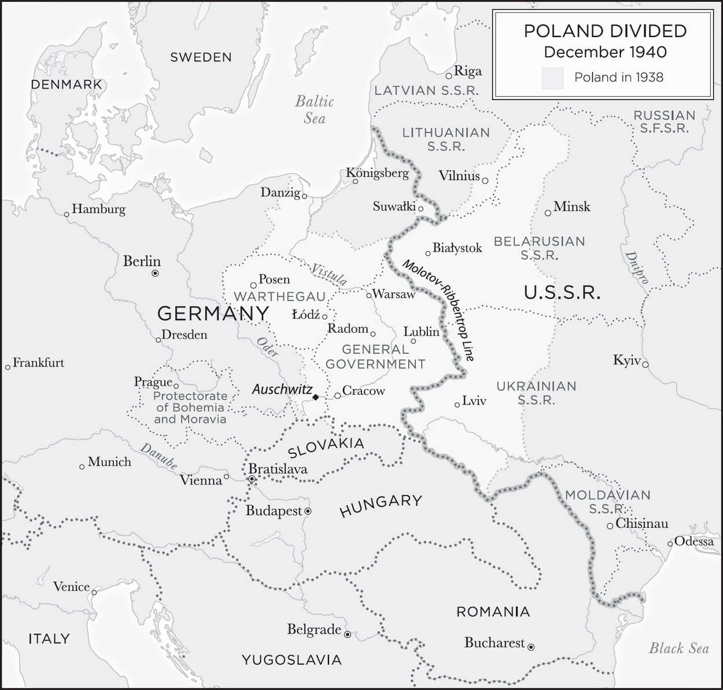
Much of Poland’s west was annexed to the Reich—or, officially, de-annexed back to the Reich. The new German districts drawn from Polish territories, the new Gaue, were governed by Hitler’s cronies, old Nazi party men. These leaders had much more freedom of action than their colleagues in the prewar German districts, who always had to deal with the burdens of law and bureaucracy. The largest and most important of the new Gaue was the Warthegau, home to 4.2 million Poles, 435,000 Jews, and only 325,000 Germans. This was a new kind of German district. Prewar Germany was overwhelmingly German; here Germans were a colonial elite and the majority population were “protected subjects.” Polish children, for example, were to be taught a pidgin German in school, so that they would be distinguishable as racial inferiors but capable of taking orders from Germans. Much of central Poland was transformed into a colony known as the “General Government.” It was initially called the “General Government of the Occupied Polish Lands,” but this qualification was dropped because of its suggestion that Poland had once existed. According to Nazi logic there was no occupation, but rather a colonization of legally “empty” territory. The degree of freedom was even greater here than in the new Gaue, since there was not even the pretense of German law.
In the annexed zones and in the General Government, Polish civil law was replaced by anti-Jewish repression, which accelerated at a pace impossible in prewar Germany. In October 1939, the Germans seized “the property of the former Polish state” and all Jewish property. Jews were banned from practicing professions, and Jewish males were required to report for labor. Jews lost the right to remain where they were. Both Heydrich and the new governor-general Hans Frank ordered ghettoization of Polish Jews. This proceeded differently in different regions; by the end of 1941 most Polish Jews were behind the walls of a ghetto. Crucial everywhere was the simple assumption that Jews could be separated from the protection of the law: They had no power to decide where their bodies would be, and no claim to possessions. Beginning in Poland, the Germans would establish ghettos in every country where they attempted to destroy a state, and in no country where they carried out a conventional occupation. The ghetto was the urban expression of state destruction.
The creation of ghettos in the cities meant a basic transformation of the Polish landscape. Jews, who had been almost everywhere in prewar Poland, were now concentrated in a small number of urban neighborhoods. This made possible the theft by Germans of all of the Jewish property that they could take (as well as the rape of Jewish girls and women). The signal to the surrounding population was unambiguous. Jews had often been beyond the world of moral concern in interwar Poland; now they were beyond the reach of law and indeed the ambit of daily life. By the time ghettos were established and Jews deported to them, their Polish neighbors had been pauperized by German rule for about a year. This presumably made Poles more likely to steal from Jews when the opportunity arose. As was the case everywhere, people in Poland tended to hate those from whom they stole because they had stolen from them.
For most Poles, the ghettoizations of 1940 and 1941 were the moment when Jews disappeared from their lives. Hundreds of years of mixed settlement were suddenly over, from one day to the next. Jews, once seen every day in every setting, were now seen only in work columns or through walls—or, very rarely, in hiding. Their houses in the villages and their apartments in the city were there for the taking. The traditionally Jewish vocations, in commerce and the professions, would now be performed by others. German occupation obviously did not mean social advancement for Poles as such, since educated Poles were killed and the rest were treated as a mute proletariat. Poles in the General Government were seized on the streets and sent to camps as forced labor. All of this created a setting of relative deprivation, wherein many Poles found it acceptable to seize what they could from Jews as the Jews disappeared. Polish theft of Jewish property did not make Poles allies of the Germans, but it did make them seek to justify what they had done and tend to support any policy that kept the Jews from regaining what had been theirs. In any event, helping Jews who left the ghettos was punishable by death in the General Government.
The second fragmentation brought by the German destruction of the Polish state was that of local authority, both that of the prewar village and county administrations and the prewar Jewish autonomous bodies. The Polish central government was destroyed, Polish law was abolished, and the Polish state was declared never to have existed. Polish local authorities did remain in place, but were now unmoored from prior law and tradition. Removed from the previous institutional hierarchy by German practice, their function was fundamentally altered by Nazi priorities. They no longer executed orders from central ministries or represented the interests of local citizens. There were no longer ministries and there were no longer citizens. Instead, local authorities were made personally responsible for the implementation of German racial policies. They oversaw the deportations of Poland’s Jews to ghettos and the distribution of property not taken by the Germans.
The Jews sent to the ghettos were met there by a melancholy parody of interwar Jewish authorities: the Judenrat, established by order of Governor-General Frank in November 1939. Under Piłsudski, Poland’s Jews had been allowed to choose local self-governing authorities, known as kehillotor gminy. These bodies took responsibility for matters of religion, marriage, burial, ritual slaughter, and in some measure for social welfare and education. Jewish communal authorities were authorized to receive money from abroad to fund these activities. Under the Germans, these local authorities, generally the same people, became the Judenrat, responsible for the execution of German orders. They were in no reciprocal relationship with the Polish state, which no longer existed, and were henceforth prevented from maintaining connections with other Jewish communities around the world. It was simplest for Germans just to take the kehilla as it was, just as it was simplest to take the Polish local mayors and county commissioners as they were. What was usually decisive was the destruction of the Polish state and the character of German policy, not the character of these individuals. Those who did leave could always be replaced by others.
New Jewish police forces, armed with clubs, were technically subordinate to the Judenräte, but in the crucial cases took orders from the Germans. The head of the two-thousand-strong Jewish police in the Warsaw ghetto was Józef Szeryński, who had served in the Polish police before the war. Young Jewish men from Betar, who had been trained in the use of weapons by the Polish state, also showed a certain inclination to join the Jewish police. Often Jewish policemen tried to resolve strife between Jews to prevent any recourse to German authority. From 1940, the Jewish police oversaw the mandatory labor required of all Jews. From 1941, they rounded up their fellow Jews for deportations from ghettos to labor camps; in 1942, to death facilities. The Jewish informers who offered their services to the Germans tended to be people who had a record as informers for the prewar Polish police. Naturally, they were now informing about different things.
The third fragmentation of the Polish state was the separation of a once-centralized institution from the shattered hierarchy: the Polish police. The regular Polish police had been a hierarchically organized institution subordinate to the Ministry of Internal Affairs. In the 1930s the Polish police were instrumental in defending Jewish life, commerce, and politics. Jewish tradesmen maintained friendly relationships, often by way of bribes, with the policemen charged with protecting town markets. The Polish police sometimes sided with Poles in fights between Poles and Jews, although Polish nationalists complained that policemen sided with Betar. Polish judges often found Jews guilty of provoking the violence that was directed against them. Yet on the whole, the Polish police were expected to prevent pogroms, and generally did so. In the Poland of the 1930s, a pogrom was a violation of public property and an attempt to demonstrate the weakness of the state. Most policemen, regardless of their views about Jews, understood their duties to the bourgeois order.
Then that order changed. A conventional state that sought to monopolize violence was destroyed by a racial regime that sought to channel anarchy. When the Polish state was destroyed in September 1939, its policemen no longer had superiors to instruct them. The highest authorities of the Polish state evacuated Warsaw, leaving policemen to decide their own course. It cannot be said that Polish policemen then sided with the Germans. Many policemen from throughout Poland chose to gather in Warsaw and fight the Germans as the Polish capital was besieged. After the capitulation, they faced the classical dilemma of forces of order. To leave their posts would provoke chaos and crime. To stay meant working for a foreign invader. Most Polish policemen chose the latter. The German Order Police then racialized the units that became the subordinate Polish Order Police (known as the Blue Police): Jews could not return to duty, and Poles could not arrest Germans. Whereas Germans were not usually punished for refusing orders to shoot civilians, Polish policemen could be shot. The Polish policemen were subordinated to a German structure that they could not at first hope to understand: to the German Order Police, which meant ultimately to Himmler. In coming years, some thirty thousand German Order Policemen would take part in the murder of Jews in Poland. The Polish police became, with time, a subordinate part of the German apparatus of racial war.
—
The Polish state was to be destroyed because in 1939 Hitler was angry and impatient and had no better way of approaching the Soviet border than by obliterating the country that lay between. Hitler was equipped by ideology to envision the destruction of states in the name of nature and had at his disposal an imposing army and special task forces whose essential mission was the destruction of institutions to permit racial war. The SS and the Einsatzgruppen first killed on a large scale in Poland—but their main target was Polish elites, not Jews.
Jews, not seen as a race, were to be removed from the habitat entirely. The new German lawlessness took its most striking form in the expulsion of Jews from their homes to ghettos in the cities. For the Germans, the ghettos were holding tanks where Jews were concentrated before deportation to some exotic place where nature would take its course. In the overpopulated ghettos, deaths outnumbered births by a factor of ten. Most of the people who died in the first months were Jews who had been deported from the countryside or from other towns and had few or no possessions and connections. The big ghettos, such as Warsaw, took on a kind of colonial appearance, as rickshaws replaced automobiles (stolen by the Germans) and the streetcar service (restricted by the Germans). The luster of subjugation attracted German tourists, who often returned home with a pleasant sense of imperial mastery. The problem for those responsible in Berlin was that there was no actual overseas colony to which Jews could be deported.
The Nazi racial policy of 1939 and 1940, the purification of the conquered Polish territories, was a cruel shambles. Himmler was given broad powers as a kind of racial commissar on October 7, 1939. His best idea was to deport Jews and Poles from the Polish territories annexed to Germany to the General Government. Even if this had somehow succeeded, which it did not, it would merely have displaced the racial enemies a short distance to the east. The vast number of Poles in the annexed territories made the scheme dystopian. In the territories annexed to the Reich, Poles outnumbered Germans about twenty to one, and even Jews slightly outnumbered Germans. The city of Łódź, incorporated into Nazi Germany, became, by population, its largest Jewish and its largest Polish city.
In practice, Himmler deported Poles first. They were regarded as the pertinent political enemy, and their farms could be given to Germans who were arriving from territories that the Soviet Union had invaded. Some 87,883 people were deported from the annexed territories in December 1939 and another 40,128 early the next year, most of them Poles. These numbers signify a vast amount of human suffering but hardly altered the demographic balance. The transport of Jews from the Reich to the General Government was pointless in conception and unachieved in practice. It was very exciting, however, to some Germans on the territory of the prewar Reich, who began to lobby for the deportation of Jews from their localities. Heydrich had to stop such local initiatives in December 1939. It was then, in January 1940, that Heydrich’s subordinate Eichmann made an approach to Stalin: Perhaps the Soviet Union would be willing to take two million Jews from German-occupied Poland? Stalin was not interested in admitting masses of unscreened people to the USSR; receiving Jews seems to have been one of the few Nazi requests he declined during the period of his alliance with Hitler.
The ghettos became a holding pen for a much more ambitious deportation plan: the evacuation of Jews to Madagascar. This was the black hole for Jews that had received the most attention in Germany and throughout Europe before the war. It was the solution that Hitler had suggested to Polish leaders in 1938, who could not understand how he meant to combine it with war. A victory over France, German leaders hoped, would open up Madagascar, which was a French colonial possession. Having defeated Poland, Hitler returned to his basic scenario for the war: remove the French threat from the west to avoid the strategic problem of encirclement, and then attack the Soviet Union to achieve the war’s aim, Lebensraum. After German troops entered Paris on June 14, 1940, Eichmann sent an envoy to look for the documentation of the 1936 Polish-French discussions about Madagascar. The new French government established in Vichy supported a Madagascar deportation. But shipping millions of people from Europe to the Indian Ocean was a project that would require the approval, and indeed the support, of the British Empire. When France fell, Britain remained in the war.
This was the latest surprise for Hitler, who was wrong about a number of strategic predictions. The western allies were supposed to defend Czechoslovakia but did not; Poland was not supposed to fight but it did; France was supposed to fight longer than it did; Britain was supposed to see the logic of peace if France fell but did not. Winston Churchill, who had succeeded Chamberlain as prime minister, was defiance itself. On July 10, 1940, Hitler began an air war with Britain, and expressed the conviction that the defeat of Britain would remove the final barrier to the Madagascar plan. But he was in no position to defeat the United Kingdom. The German air force was outfought by the British, who commissioned skilled Polish and Czech pilots. The German navy was too small to mount a serious amphibious assault on the British coast. Like so much else, the invasion had not really been thought through. An outline for a Madagascar deportation was already out of date when completed in August 1940, since by then Hitler had abandoned any intention to occupy Great Britain.
When Hitler understood that Madagascar was impossible, his thoughts turned back to the Soviet Union. On July 31, 1940, just three weeks after he had begun his halfhearted British campaign, he asked his generals to review plans for the invasion of the Soviet Union. The war against the USSR would make sense, he reminded his generals, only if Germany could “smash the state” and that “in one blow.” In December, he issued the formal directive for the submission of war plans to “crush Soviet Russia in a rapid campaign.”
Thus the black hole for the Jews migrated from one obscure and exotic imperial locale to another, from the tropical maritime south to the frozen tundra of the north. Hitler imagined that the Soviet state would be crushed in a few weeks, and that its Jews, and perhaps other Jews as well, could then be dispatched to Siberia. About this, too, he was mistaken. But erring was an essential part of Nazi logic. The Führer could never be wrong; only the world could be wrong; and when it was, the fault would be borne by the Jews.
—
Nazi strategic predictions about the behavior of particular states were often mistaken, but the Nazis were learning a lesson about what happened in general when states were destroyed. Indeed, misunderstandings of neighboring peoples forced unexpected campaigns to destroy states, which, in turn, opened a realm of experimentation. The annexation of Austria accelerated the deportation of Jews, the invasion of Poland created a new opportunity for their ghettoization, and then the war of annihilation against the Soviet Union would permit a Final Solution. It was not a Final Solution of the type that had been considered, a deportation to some obscure and distant place seized from another empire. It was a Final Solution of mass murder, in the Jewish homeland itself, in eastern Europe.
The three million German men assembled to invade the Soviet Union in June 1941 found themselves in Polish territories that had been colonized and terrorized. The Poland these three million German soldiers saw had been utterly transformed, its Jews humiliated and ghettoized, the rest of its population subjected to an improvised anarchy of exploitation. When these three million men crossed the German-Soviet border on the twenty-second of that month, they first set foot in a very special zone: the territories that Germany had granted to the Soviet Union in September 1939. The German invasion of the Soviet Union thus began as a reinvasion of territories that had just been invaded. The German attack on the Soviet Union meant destroying a state apparatus, the new Soviet one, right after the Soviets had destroyed another set of state apparatuses, those of the independent states of the 1920s and 1930s. A double invasion by great powers would have been dramatic enough, though not quite unprecedented.
Double state destruction of this kind was something entirely new.