
5
During the war, the gifted political thinker Hannah Arendt glimpsed what was happening. A Jewish political emigrant from Germany, she understood how National Socialist ideology could be realized. If Jews were to be removed from the planet, they first had to be separated from the state. As she wrote later, “one could do as one pleased only with stateless people.”
Like succeeding historians of the Holocaust, and in accord with the German Jewish experience she shared with some of them, she saw this separation from the state as the gradual deprivation of rights. As she observed, “the first essential step on the road to total domination is to kill the juridical person in man.” Yet the easiest way to deprive a Jew of law and to instruct non-Jews in lawlessness was to destroy entire jurisdictions, as with Austria and Czechoslovakia. As Arendt came to realize, the Jews “were threatened more than any other by the sudden collapse of the system of nation states.” Above all, Jews were placed in peril by the collapse of the states of which they were citizens. The war of 1939, the attack on Poland by Germany, brought new sorts of depravations as the state was fragmented along new, colonial lines. But even ghettoization and the proclamation of a colonial order were not enough to precipitate a Holocaust. Something more was needed: a double destruction of the state.
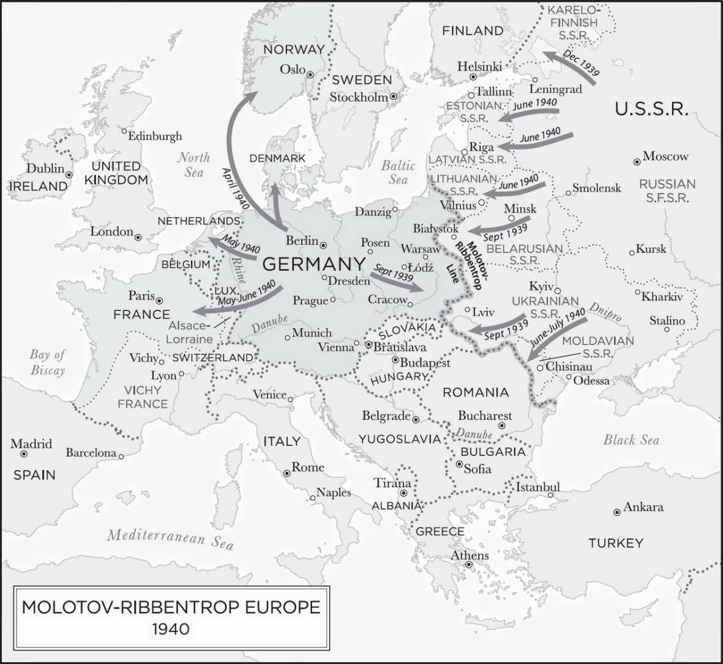
In 1939, when Hitler made his alliance with Stalin, he was undertaking to destroy states by proxy. Hitler had a vivid idea of what Soviet rule would mean for the places granted to Moscow by the German-Soviet Treaty on Borders and Friendship: the Baltic states of Lithuania, Latvia, and Estonia; and the eastern half of Poland. If anything, his notion of Soviet terror was exaggerated: the total elimination of all thinking people, the murder of tens of millions by starvation. Himmler wrote of the “Bolshevik method” of the “physical extermination of a nation.” Hitler, in making his alliance with the Soviet Union, was always planning to invade the lands that he granted his ally. His invitation to Stalin in 1939 to destroy states would precede his own campaign in the same lands to follow in 1941. The German Führer was therefore contemplating the double destruction of states: first the crushing of interwar nation-states by Soviet techniques, seen as extraordinarily radical, and then the elimination of newly created Soviet state apparatus by Nazi techniques, still in the making.
Germans found the conditions where “one could do as one pleased,” where they could kill Jews in large numbers for the first time, in 1941, as they invaded the Soviet Union. It was in the zone of double occupation, where Soviet rule preceded German, where the Soviet destruction of interwar states was followed by the German annihilation of Soviet institutions, that a Final Solution took shape. Almost all of the two million or so Jews who came under German rule in 1939 would die. The same was true of the two million Jews who came under Soviet rule in 1939 and 1940. Indeed, the Jews who initially fell under Soviet rule were the first to be murdered en masse by the Germans.
—
When the Germans and the Soviets undertook their joint invasion of Poland in September 1939, the Soviets were the senior partners in political violence. The Soviet secret state police, the NKVD, had experience in mass killing that was unrivalled by any German institution. Some 681,692 Soviet citizens had been arrested, shot, and buried in pits in the operations of the Great Terror of 1937–1938. The NKVD had shot twice as many Poles on its own territory while preparing for war in those years than the Einsatzgruppen shot when German forces actually invaded Poland in 1939. In proportional terms the contrast is far greater. The killing of 111,091 Soviet citizens in the Polish Operation of 1937–1938 changed the nationality structure of the western Soviet Union. A third of the male Soviet Poles of military age were killed before the war in this and other terror actions, their wives and children often sent to be denationalized at concentration camps or orphanages. The Soviet republics that bordered Poland, Soviet Ukraine and Soviet Belarus, lost a considerable part of their Polish minority to murder and deportation: some 59,903 people in Ukraine, some 61,501 people in Belarus.
Stalin’s rationale for the mass murder of Soviet citizens of Polish nationality was not racial but ethnostrategic. At Stalin’s behest and under his guidance, the NKVD used interrogations to develop a theory of a vast Polish plot against the Soviet Union, directed by the Polish Military Organization. This was entirely false. While veterans of the Polish Military Organization were quite active in Polish military intelligence and in the higher reaches of the state, the institution as such no longer existed, and certainly not as assassins and saboteurs on Soviet territory. The veterans of the Polish Military Organization, insofar as they were plotting acts of conspiratorial violence in the late 1930s, were thinking of the British in Palestine. By the end of the Great Terror, however, the NKVD had assembled enough confessions by torture to compose a fictional narrative in which even leaders of the Soviet state were secret Polish agents. This proved to be quite risky for the NKVD itself. Since the imagined conspiracy grew from week to week in 1937 and 1938, NKVD commanders could always be charged with having neglected the Polish danger in the past.
In 1938, Stalin was able to turn the Soviet communist party, an early target of the purges, against the NKVD. When higher officers of the secret state police were themselves arrested and killed, younger ones took their places. As a consequence, the nationality structure of the NKVD was altered. It was no longer an exceptionally cosmopolitan elite with revolutionary prestige in which Jews (and Latvians and Poles) were highly represented. Polish officers were removed and often executed in the Polish Operation. Then the entire NKVD was purged: first for not being vigilant enough, then for being too vigilant. By the end of 1938, the NKVD had become an organization dominated by Russians (65 percent of high officers) and Ukrainians (17 percent of high officers). Russians were now overrepresented in the NKVD by comparison to their share in the general Soviet population. The percentage of Jews was down from nearly forty percent to less than four percent. There were no longer any Poles at all.
It was this NKVD, experienced in murder, humbled by Stalin, and russified, that was turned against Polish institutions and elites after the Soviet invasion of eastern Poland of September 17, 1939. An actual assault on potential resisters in eastern Poland was a much safer assignment for the NKVD than the Polish Operation inside the Soviet Union had been, since real enemies could be found among the Polish citizenry, and real progress could be reported. The collapse of Poland brought by German and Soviet arms generated real chaos that could demonstrably be mastered. In eastern Poland, Soviet soldiers beat men to death for their gold teeth and raped women in the knowledge that this would be dismissed as “children playing a little.” Soviet invasion meant local uprisings by native communists, who often robbed and killed Poles who had been in authority, and by native nationalists, who often believed Soviet propaganda about national freedom to the east and national liberation by the Red Army. It meant attacks upon Polish officials and landowners, the score settling that is always to be expected when regimes change with sudden violence.
Against this backdrop the Soviet NKVD could bring to occupied eastern Poland calm and order of a certain sort. Unlike members of the Einsatzgruppen, who in 1939 were killing for the first time and who did so to create the conditions for a German racial triumph, NKVD officers were experienced administrators of life and death whose task was to establish the basis of a certain model of statehood. NKVD officers, generally Russians and Ukrainians, were transferred in large numbers to the newly conquered eastern Polish territories in late 1939. Over the course of 1940, the majority of arrests and imprisonments in the entire Soviet Union was made in occupied eastern Poland, a tiny percentage of Soviet territory. The typical sentence was eight years in the Gulag; some 8,513 people were sentenced to death in individual cases.
Unlike the Germans, the Soviets had mechanisms for and experience with large-scale deportations. Rather than colonial fantasies, they had time-tested destinations: the vast network of prison camps and special settlements known as the Gulag. Soviet internal colonization was inscribed in tundra and steppe. On December 5, 1939, Stalin ordered preparations for a first wave of deportations, to target the Polish state apparatus and its influential supporters. Some 139,794 people were accordingly forced from their homes onto trains and sent to the Gulag, usually to Soviet Kazakhstan, in February 1940. Polish Jews were deported as capitalists to the Gulag in large numbers in April 1940 and then still larger numbers in June 1940 for expressing the desire to retain their Polish citizenship. In the months after the Soviet invasion, some 292,513 Polish citizens were deported to the Gulag in four major waves, along with perhaps another two hundred thousand in smaller actions or after individual arrests. In these four large actions, almost 60 percent of the victims were Poles (who were about 40 percent of the population in eastern Poland), just over 20 percent Jews (8 percent of the population), about 10 percent Ukrainians (about 35 percent of the population), and about 8 percent Belarusians (8 percent of the population).
One of the individuals who was apprehended and sentenced to the Gulag was a young writer from Kielce, Gustaw Herling-Grudziński. The accusation leveled against him by Soviet authorities was that he had illegally left Poland for Lithuania to fight against the USSR. He politely asked his interrogators to alter the charge to indicate that he had intended leaving Poland to fight against the Germans. They assured him that it amounted to the same thing. Herling later provided one of the most powerful accounts of life in a Soviet concentration camp, where hard-won solitude is the only substitute for impossible freedom, and where a personality integrated under entirely different conditions can be disassembled into its component parts. “There,” in the Gulag, “it has been proved that when the body has reached the limit of its endurance, one cannot, as was once believed, rely on strength of character and conscious recognition of spiritual values; there is nothing, in fact, which man cannot be forced to do by hunger and pain.” Herling became convinced “that a man can only be human under human conditions.”
From the Soviet perspective the most dangerous Polish group was the officer class. It represented a threefold threat: It was the leadership of an enemy army; some of its senior officers were veterans of campaigns against the USSR; and its reserve officers represented the Polish educated classes. The Soviets saw the Polish educated classes as the basis for the Polish political nation. The immediate aim of the arrest and elimination of such people was to make political resistance more difficult. The officers of the Polish army who surrendered or were captured were placed in camps, where they were investigated and interrogated individually. Then NKVD director Lavrentii Beria sent a troika that judged the group collectively. “Each one of them,” wrote Beria to Stalin, “is waiting to be released in order to be able to enter actively into the battle against Soviet power.” He recommended “the supreme punishment—shooting.” Stalin approved.
In April 1940, some 21,892 Polish officers and other Polish citizens were shot by NKVD officers in the Katyn Forest and at four other sites. Because the Polish army was an instrument of social mobility, many of the victims, about forty percent, were from peasant and working-class backgrounds. Because the Polish officer class was multinational, many of the victims were members of national minorities, including Jews. Henryk Strasman, a member of Irgun, was among those killed by a bullet at the base of the neck and buried in a mass grave at Katyn. Wilhelm Engelkreis, a doctor and reserve officer, was also murdered at Katyn. His daughter, writing later from Israel, recalled her childhood despair at the loss of her father. Hironim Brandwajn, a doctor, was murdered at Katyn; his wife, Mira, died two years later in the Warsaw ghetto without knowing what had happened to her husband. Mieczysław Proner was a pharmacist and a chemist and a Jew and a Pole and a reserve officer and a combatant. He fought against the Germans in the Polish army, only to be arrested by the Soviets and murdered in the same action. A few months later his mother was ordered to the Warsaw ghetto; two years later she was deported to Treblinka and gassed.
With one exception, the 21,892 people murdered by the NKVD were men. Many of them, like these Polish Jews, had families in the German occupation zone, who now faced German repressions without heads of household. Since the Soviets were killing the same kinds of Polish citizens as the Germans—the educated elite—they were making the German task easier. When the families of the murdered officers were in the Soviet zone, the NKVD deported them to the Gulag. Surprised by a knock on the door, these people almost never escaped. One of the rare exceptions was the wife of a Polish officer who left her children with a trusted Jewish neighbor. But this was a rather isolated example of a failure of the NKVD. These Soviet deportations of 1940 repeated, on a smaller scale, the methods of the Great Terror. In the Polish Operation, Polish men had been shot and the families deported to be exploited and denationalized.
There was also continuity of personnel: Vasily Blokhin, one of the executioners of the Polish officers, had killed thousands of Soviet citizens during the Great Terror. Wearing a leather cap, apron, and gloves to the elbows, Blokhin personally shot about two hundred and fifty men each night. In the Soviet system, the number of executioners was very small, and they were officers. They followed clear written orders issued within a strict hierarchy. The Soviet system included within itself legal states of exception, which, once they had been used to justify the special measures needed for mass terror, could be terminated. In the German system, as it developed, innovations from below met wishes from above, orders were often unclear, and the officers tried to devolve the responsibility for the actual shooting to their men, or indeed to non-Germans who happened to be in the vicinity. The Soviet system was, therefore, much more precise and efficient in its campaigns of murder. But the German system was more efficient in creating large numbers of executioners.
The Soviets, at least some of them, believed in what they were doing. After all, they did it themselves and recorded what they did, in clear language, in official documents, filed in orderly archives. They could associate themselves with their deeds, because true responsibility rested with the communist party. The Nazis used grand phrases of racial superiority, and Himmler spoke of the moral sublimity involved in killing others for the sake of the race. But when the time came, Germans acted without plans and without precision, and with no sense of responsibility. In the Nazi worldview, what happened was simply what happened, the stronger should win; but nothing was certain, and certainly not the relationship between past, present, and future. The Soviets believed that History was on their side and acted accordingly. The Nazis were afraid of everything except the disorder they themselves created. The systems and the mentalities were different, profoundly and interestingly so.
Yet the two regimes acted in the same time and place. Whatever the Soviets did, and with whatever motives, they were doing to people who, if not killed or deported, would then face the Nazis and their methods. The damage that the NKVD inflicted was a matter of the deportation or death of human beings, and of the disruption of lives and the alteration of spirits. It was very important that the Soviets destroyed the Polish state in their half of Poland; it was very important that they physically removed those who were associated with Polish statehood. Yet perhaps most important was the way Soviet policies influenced those who survived and remained: these citizens of annihilated states, these new Soviet citizens, these people who would confront the Wehrmacht and the SS in 1941.
—
Like the Nazis, the Soviets began from the assumption that the Polish state created in 1918 had no right to exist and so could be eliminated by decree and then mocked. But the form of the mockery was tellingly different. The Soviets, like the Germans, destroyed Polish state symbols, but on the logic that they represented a “bourgeois,” “reactionary,” “white,” or “fascist” Poland. The problem with the Polish state, in the Soviet view, was that it was a creation of the upper classes. This was very different from the Nazi view, which was that lower races such as the Poles did not deserve a political existence.
In western and central Poland, occupied by Nazi Germany, the higher Polish officials were hunted down, imprisoned in camps, and often killed, whereas the lower-level officials, such as the mayors, county commissioners, and village heads, were expected to follow new kinds of orders from German authorities. As Hans Frank, the head of the German colony known as the General Government, described the task: “The leadership elements we have now identified in Poland are what is to be liquidated.” This was race war: extermination of the vital racial forces of the enemy, and then the exploitation of its lower elements.
An empire on Nazi principles required an open subordination of inferior races, and thus an extravagantly visible difference between the political existence of Germans and that of others. Soviet empire involved the territorial extension of the Soviet Union as it already was. In eastern Poland, occupied by the Soviet Union, higher Polish officials were treated much as they were in the German zone. But, for a time at least, their place was taken by people of humble social origins or even by imprisoned members of local communist parties. In one town after another, the political prisoners became the local authorities. This was a temporary but important phase in the change of regime, since it transferred the appearance of the responsibility for the Soviet revolution to local people. Some Polish citizens were thus implicated in Soviet-style class warfare: the decapitation of the bourgeois or feudal leadership of the enemy, the promotion of workers and peasants, and then the subordination of everyone to a larger order that proclaimed its own egalitarianism.
The Soviet decapitation of society was accompanied by a zombification of the social body. The Soviets took the possibility of Polish resistance much more seriously than the Germans did, since for them it represented one instance of the formidable power of international capitalism rather than the last gasps of a suffocating race. The NKVD applied far more sophisticated methods than the German Gestapo, usually observing resistance groups, arresting and recruiting their members one by one, and slowly trying to break the whole organization or, ideally, turn it to the Soviet side without its members realizing what was happening. Since resistance was for the Soviets by definition part of an international plot, the Soviet hope was always to follow the links from the Polish underground back to the Polish government-in-exile and to its British and French allies. In practice, Soviet rule meant the cultivation of distrust, as Polish citizens ready for conspiratorial work became unsure of one another and incapable of discerning which underground groups were legitimate and which were fronts for the NKVD. Thus equality in the Soviet sense emerged in occupied eastern Poland: Polish citizens learned to distrust one another equally. Everyone became a potential traitor, and appearances were not to be believed. This new reality undermined the old in a matter of weeks.
Whereas Germans excluded Polish citizens from participation in their new order, the Soviets forced Polish citizens to take part in Soviet political rituals, presented as exercises in liberation. The Soviets introduced their own version of democracy, in which participation was open and mandatory, and voters had no alternatives. On October 22, 1939, inhabitants of what had been eastern Poland were called upon to elect their representatives to national assemblies. In the Soviet zone of occupation, Poles were the largest national group, but not a majority. Ukrainians were a majority in the south, Belarusians in the north, and Jews were numerous everywhere. The Soviet notion was to divide most of the occupied lands between a Ukrainian zone in the south and a Belarusian zone in the north, which would then be attached to the existing Soviet Ukrainian and Soviet Belarusian republics. This is indeed what transpired.
After the obligatory, humiliating, and falsified vote, the national assemblies, meeting in the first days of November 1939, proclaimed the desire that their lands be incorporated into the Soviet Union. This opened the way for Soviet citizenship to be extended to all inhabitants of eastern Poland, a symbolic expression of equality that would have been unthinkable in the Nazi empire. Of course, it also opened the way for the arrival of thousands of Soviet officials from further east, mostly Russians and Ukrainians, who would hold the real power. Local people, usually communists and members of the Ukrainian, Belarusian, and Jewish minorities, had been useful as ostensible self-liberators. But their liberation simply meant inclusion in a powerful system with its own priorities, one of which was maintaining the alliance with Nazi Germany. To take one striking example: Jewish butchers lost ownership of their slaughterhouses and found themselves, as Soviet state employees, packing meat for the German troops fighting against the western democracies.
The Soviets behaved as if eastern Poland had been joined to their homeland of socialism forever. Of course, this would not be the case, since the leaders of Nazi Germany, the Soviet ally that allowed the new disposition of territory, were intending to attack the Soviet Union at the first opportunity. Stalin expected Hitler’s betrayal, but believed in 1939, 1940, and even 1941 that his ally could be placated with outspoken loyalty and regular deliveries of goods. Thus the Soviet Union supplied Germany not only with security in the east but also with some of the physical resources used to fight the wars in western Europe in 1940: the oil, the minerals, the grain. The Royal Air Force proposed to bomb Soviet airfields as a way to slow Hitler’s advance through western Europe. The peasants in Soviet Ukraine sang:
Ukraine is fertile
She gives her grain to the Germans
And she herself goes hungry.
—
In its newly acquired lands, the Soviet Union created material, psychological, and political resources for the Germans, openings for future Nazi power in eastern Europe that had not existed before 1939. Though the Soviets did not intend to create these resources, their availability was decisive for the course of events after the Germans invaded these lands. This was true in eastern Poland in 1939 and would be all the more true in the Baltic states after their occupation and annexation by the Soviet Union in summer 1940.
In putting an end to capitalism, the Soviets created a material resource. From the Soviet perspective the goal was equality, but equalization means losses for some and gains for others. Even before the Red Army arrived, local “communists went mad, carrying out revisions by night and robbing and killing Poles.” Joel Cygielman, a Jew fleeing the German invasion in his own automobile, lost it to a Soviet officer who threatened him with a grenade. In Kovel, Jews who greeted the Red Army with flowers found that the soldiers were interested only in what was in their shops. Soviet soldiers at first stole what they could and then bought what remained on the strength of an overvalued ruble. Local communists placed in positions of authority used the pretext of arms searches to rob their neighbors.
The end of the Polish civil code was experienced by most people as the legalization of theft. If property could be taken by the state, perhaps it was permissible to take it back again. The lack of legal assurances to property made those who claimed new land or residences believe that they themselves had to make sure that the previous owners never came back. Jews had the most urban property to lose, and usually lost it: in the double sense of the nationalization of their goods and the deportation of their persons to Soviet Kazakhstan. The Soviet Union did not discriminate against Jews as such; it was an anti-antisemitic entity that criminalized ethnic discrimination. Given the social structure of the market economy in eastern Poland, however, Soviet measures against capitalism affected Jews more than others. To be sure, eastern Poland was generally a very poor territory, although its society was far more prosperous than that of the Soviet Union to which it was to be leveled. Mendel Szef, a dairyman from Łuck, put matters this way: “after the occupation of our country, it was said that all are equal, rich and poor, but it turned out that all are poor, since the rich were arrested and sent to the depths of Russia.”
The massive scale of Soviet deportations and executions permitted a social revolution in both the countryside and the towns, as people scrambled for the tens of thousands of suddenly empty farms and homes. In the countryside of eastern Poland, where rural unemployment exceeded fifty percent in the 1930s, people were hungry for land. Not everyone took land from their neighbors, but many did. Here, as in all such cases, peasants knew that if they did not take a vacant farmstead, someone else would. Some Ukrainian peasants who refused to claim land from deported Polish neighbors were forced to do so at gunpoint. In many towns most of the good stone houses were owned by Jews, who were often deported to the Gulag. For their neighbors in wooden huts or hovels, a move to the center of town and residence in a stone house were the peak of imaginable social advancement. The Soviets did not expropriate Jews as a racial group. Even so, the fact of the prior expropriation of a large number of Jews created an opportunity, if an unexpected one, for the Germans who would later arrive. When Soviet power was replaced by German, non-Jews could try to get their property back, but Jews could not. The property that Jews had already lost could be claimed by others. The initial Soviet expropriations, swift and systematic, were racialized by the subsequent German arrival.
Most Jews in eastern Poland were of very humble means. Nevertheless, Jews provided the connection between peasants and markets, countryside and city. In other words, much of what Soviet officials would see as speculation, profiteering, and the like was commercial activity usually carried out by Jews. In Poland’s Volhynia district, for example, 75 percent of the registered traders (14,587 of the 19,337) were Jews. The radical devaluation of the Polish currency and then its abolition in December 1939 destroyed the social position of Jews who had some savings or investments. The end of debts denominated in Polish currency was a relief for many but a burden upon Jewish lenders and, indeed, the removal of their source of authority in communities. The ceaseless Soviet propaganda against commerce as such was, in fact though not in intention, directed against Jews, and weakened their standing.
—
In altering the character of politics, the Soviets created a psychological resource. Jews were given the appearance but not the reality of power. After the arrival of the Red Army in September 1939, local Jews appeared in visible positions of responsibility in greater numbers than had ever been the case between the wars. The Polish central government had acted to make sure that even towns with a Jewish majority did not have a majority of Jews on the city council. Although there were a few Jews in the Polish police and the Polish administration generally, the tendency was to keep those numbers low. The change in autumn 1939 was, therefore, experienced as dramatic. The Soviets had no particular desire to promote Jews as such, although a few commanders and officials opined that Jews were more reliable than Poles. Still, Jews were among those who were available and exhibited the willingness and skills to take up new positions. Jews were never the majority of local collaborators with the Soviet regime; Belarusians and Ukrainians were overall far more numerous. Local Jews never held real power, with the exception of a few weeks in autumn 1939, and that on a very local scale, and alongside other, non-Jewish, collaborators. Nevertheless, the change of regime made Jews collectively vulnerable. When the Germans invaded, the actual administrators of the new Soviet territory, the Soviet officials from the east, could marshal the resources they needed to flee. But the local Jews, those who had collaborated with the Soviets and those who had not, generally remained behind.
In other ways Soviet policy created the conditions for acts of revenge. In 1939, the Soviets had defeated, destroyed, and discredited traditional authorities, both secular and religious. They had presided over a moment of score settling and chaos in which many new scores were created that might be settled in the next moment of violent transition. They had deported or shot half a million people in lands where the total population was just over thirteen million, meaning that most families had been touched by the NKVD in some way. The rapid destruction of the Polish state was not simply a fact but a source of shame, a catastrophe that would beg for a scapegoat.
Even as Soviet power generated feelings of shame and resentment, it forced society to break the taboo of collaboration with a foreign power. Certain people had chosen, at the beginning, to collaborate; far more had collaborated simply by dint of continuing to hold their positions, fearful of deportation or worse if they did not demonstrate loyalty. With time, almost everyone had to engage with the Soviet regime in some way or another. The nature of the system demanded it. In seeking to transform eastern Poland into part of their own state, Soviet leaders included the local population in the process quite intensively: through coerced voting, through the encouragement of denunciations, through interrogation and torture and betrayal. Because the Soviet system was inclusive, there was often no clear line between victims and collaborators. Often the very experience that led to collaboration, such as torture and imprisonment, also meant victimhood. This refined the psychological resource in a special way. In Soviet conditions, victimhood and collaboration were widespread and hard to define, and so the next power holder would be the one to define them.
—
Finally, in destroying states, the Soviet Union created a political resource. As fragile and flawed as the Polish, Estonian, Latvian, and Lithuanian states might seem, they were the homelands of tens of millions of Europeans. The wholesale destruction of modern states with fully fledged political nations was an extraordinarily radical step. Of course, not all of the (former) citizens of these (former) states cared deeply about national independence, but many did. Insofar as the Soviets removed states that people wanted, and insofar as the Germans could pose as the ally of those who wished to restore them, the Germans could manipulate a powerful desire. The nature of this opportunity depended, of course, upon what leaders of national groups believed that they could gain or lose from occupiers. The joint German-Soviet invasion of Poland did not, for example, create much of a Polish political resource for the Germans. Having already invaded Poland once in 1939, they could hardly pose as a liberator of Poland when invading the Soviet Union from their Polish colony in 1941. Germans could take credit on a local scale for ending Soviet oppressions, but they could hardly promise political autonomy to Poland.
The perspective of some of the political leaders of Poland’s ethnic minorities was quite different. Poland had been the largest homeland of Ukrainians beyond the Soviet Union and the largest homeland of Jews in the world. Almost all of Poland’s Ukrainians and more than a third of Poland’s Jews fell under Soviet rule in 1939. Neither Ukrainians nor Jews fared well in the enlarged Soviet Union; in general their experience was far worse than expected.
In the Ukrainian case, the opportunity this presented to the Germans was rather strong. The Ukrainian minority in Poland was substantial and territorially concentrated, adjacent to the Ukrainian republic of the Soviet Union. Although Ukrainian nationalism was never the dominant political orientation in Ukrainian political life in Poland, it did attract attention in neighboring capitals. All regional powers had tried to turn the Ukrainian question to their own ends in the 1920s and 1930s. The Soviets pursued a policy of affirmative action of Ukrainians in Soviet Ukraine in the 1920s and established a Communist Party of Western Ukraine on Polish territory in the hope of drawing Ukrainians from Poland toward the Soviet Union. The Poles imitated this policy in their Volhynian district in order to draw Ukrainians in the Soviet Union towards Poland. The Germans had cultivated Ukrainian agents within Poland, usually nationalists, who believed correctly that Germany was the only power that could possibly destroy both enemies: Poland and the Soviet Union.
That said, the Ukrainian nationalists associated with Germany knew perfectly well that a major source of their local support was the social question—chiefly the redistribution of farmland. And the Soviets were quite aware that the Communist Party of Western Ukraine had to address the national question. With nationalists concerned with expropriating large estates and communists flying national flags, a certain amount of ideological syncretism was the rule in the 1930s. For example, a local Ukrainian communist leader could be a Jewish woman named Fryda Szprynger, and one of her more successful underground activists could, meanwhile, use the pseudonym “Hitler.”
The Soviet invasion of eastern Poland in 1939 meant the destruction of the mainstream Ukrainian political parties that had functioned legally in Poland: the Ukrainian National Democratic Alliance (UNDO), for example, which had tried to work within legal institutions and had opposed official antisemitism. Soviet rule created relatively favorable conditions for groupings that had been illegal: the nationalists and the communists—the first because they were accustomed to being underground, the second because they could emerge from underground and collaborate with the regime. Yet, as Jews and Poles tended to notice, often it was Ukrainian nationalists rather than communists (insofar as this distinction had meaning) who took up local positions of Soviet authority. Both Ukrainian nationalists and Ukrainian communists took the opportunity to denounce local Poles to Soviet authorities, no doubt from both political and self-interested motives. In most villages in southeastern Poland there was a Ukrainian activist who knew what categories of person the NKVD was looking for and was happy to supply an appropriate Pole. This created an empty homestead and farm; denunciation and deportation were a version of land reform.
During the first few months of Soviet rule, the social revolution from abroad attracted many Ukrainians. Polish authorities were often replaced by Ukrainians, although in meaningful positions these were Ukrainians from Soviet Ukraine. The handful of Jewish mayors were also replaced by Ukrainians from the east. The initial Soviet deportations chiefly concerned Poles and indeed Polish landowners, and so could be experienced as social advance for Ukrainian peasants. Soviet-style revolutions usually had two stages: first a gesture to the peasants, then the seizure of their land. In 1940, the Soviets began to collectivize agriculture in the territory they had annexed from Poland, just as they had done a decade earlier in the Soviet Union as a whole. Some Ukrainians recalled then the mass famine that had followed in the USSR. Virtually none wanted to concede land to the Soviet state. Collectivization discredited Ukrainian communists among the population and led some Ukrainian communists to shift toward nationalism.
Ukrainian nationalists, for their part, were hoping in 1940 for a German invasion of the Soviet Union that would create the possibility for a Ukrainian state. These were people who had been Polish citizens, and saw themselves as representatives of the millions of Ukrainians in Poland and the tens of millions of Ukrainians in the Soviet Union. From their perspective, only Germany could create the conditions for a Ukrainian state by destroying both Poland and the USSR. Poland was no more as of 1939; in 1940, some Ukrainian nationalists joined in the German preparations to annihilate the Soviet Union. The Germans used Ukrainian informers to prepare the way for the invasion known as Operation Barbarossa, and they recruited and trained hundreds of Ukrainians for advance groups to be used in Soviet Ukraine. In early 1941, the NKVD sensed the threat and began to arrest Ukrainians in high numbers. The fourth wave of Soviet deportations, in May and June 1941, was heavily Ukrainian. Many thousands of Ukrainians were also imprisoned. When the Germans did arrive in June 1941, they found the corpses of these people left behind in Soviet prisons.
—
All in all, Soviet occupation closed Jewish possibilities. Could it also have created a Jewish political resource for the Germans? As with the Ukrainians, there was a Jewish nationalist Right in interwar Poland, Betar, that was committed to building an independent national state by revolutionary and violent means. Unlike Ukrainian nationalists, however, Jewish nationalists were the clients and not the enemies of the Polish state. They wanted to leave Polish territory rather than claim it for their own. After the German invasion of September 1, 1939, leaders of Betar fled eastward from the Germans. They were then caught in the Soviet net. Jewish radicals, unlike Ukrainian radicals, had no experience of working underground. The Soviets quickly identified and arrested them. The NKVD was aware that Betar was a front for Irgun, and broke underground Irgun circles as well. Menachem Begin, the leader of Betar in Poland, fled from Warsaw to Vilnius and managed to hide for a time. He was eventually arrested by the NKVD—in the middle of a game of chess—and sentenced to eight years of hard labor at the camps of Vorkuta.
Betar was quickly powerless in occupied Poland. Its sister organization Irgun, based two thousand kilometers away in Palestine, was not. The conspirators of Irgun, most of them Polish Jews, found themselves in an unexpected predicament: considering the opportunities provided by war but deprived of the backer which had sought to prepare them for such a moment. They had received a certain amount of training from the Poles, as well as money and weapons. Yet the grand scheme for which all of that was mere preparation—a landing of thousands of Betar members in Palestine with Polish support—was now unthinkable. No further Polish help was coming. The Polish officers who had trained Irgun were dead or in camps or in hiding or in exile. The latest shipment of Polish weapons for Irgun in Palestine, on the docks in Gdynia in August 1939, was destroyed by German fire even as Poles scrambled to unpack the weapons to use them to defend themselves. Irgun had been preparing for a conflict with the British Empire, but not for one in which its Polish patron would be totally absent. As one Betar comrade wrote to another in distress in late 1939, “we feel that there is no one behind us.”
Of the three European states with an active interest in Palestine in the 1930s, only two remained as the decade came to an end: Nazi Germany and Great Britain. They were at war with each other, which meant that Jewish fighters in Palestine might gain some leverage by siding with one or the other. Nazi Germany was the enemy of Jews in Europe (although to what extent was not fully clear, even in 1939). It was also the enemy of the British Empire, which controlled Palestine and prevented Jewish emigration. Irgun could not decide between the obligation to defend Jews and the obligation to fight for a Jewish state, so chose neutrality between Germany and Britain. Avraham Stern now led a split within Irgun, establishing a splinter group eventually known as Lehi. He was joined by Yitzhak Shamir, another Polish Jew who had hoped for further training in Poland but had run out of time. Lehi then did exactly what other Far Right groups did at the time: It made a proposal to Hitler.
The appeals sent by Jewish and Ukrainian nationalists to Hitler were very similar. The Organization of Ukrainian Nationalists used this language in June 1941: “The newly emerging Ukrainian State will cooperate closely with the Great Nazi German Reich, which under the guidance of its Führer Adolf Hitler is forming a new order in Europe and the world and which will help the Ukrainian Nation liberate itself from Muscovite oppression.” In Palestine, Lehi saw the British much the same way as the Ukrainian nationalists saw the Soviets, and it drew the same practical conclusions. In January 1941, Stern proposed “cooperation between the New Germany and a renewed racial-national Hebrewdom,” which would involve “the erection of a historical Jewish State on national and totalitarian foundations, which would stand in a treaty relationship with the German Reich, in the interest of the protection and strengthening of the future German power position in the Near East.”
Stern assumed that Hitler wished to rid Europe of Jews and that a logical way to do so would be to send them all to Palestine. Perhaps misled by his contacts with Polish elites, he confused the Polish with the German approach. The Polish regime really had supported a mass Jewish emigration to Palestine and a Jewish state. Lehi could be trusted to make a Jewish state that would be a good partner for Nazi Germany, continued Stern, because “in its worldview and structure it is closely related to the totalitarian movements of Europe.” Stern was asking Berlin to replace Warsaw as the patron of Lehi. The documents concerning Poland’s official Zionism, he helpfully (and correctly) noted, could be found in the Polish archives, now under German control.
Neither of these nationalist proclamations, the Ukrainian or the Jewish, should be understood to express the desires of the nation concerned, or even for that matter the convictions of the authors. With the destruction of the Polish state and the advance of German power, an alliance with Nazis could seem logical, at least to radicals who expected the old order to collapse anyway. Of course, those who issued such appeals did not intend to be used by the Nazis but rather to use them for their own purposes, however unrealistic this calculation might have been. Even the expressions of ideological sympathy need not be taken too literally: Some Ukrainian nationalists had once been communists, and Lehi would shift towards a pro-Soviet orientation a few years later.
—
Every method of changing the world has advantages and disadvantages. Different tactics generate different needs. A group that chooses legions, as Jabotinsky was still urging Jews in Palestine to do, gambles that the occupying empire will win the war and will then owe something to the oppressed but supportive minority after the victory. A group that chooses terror needs the occupying empire to be destroyed, but almost always lacks the strength to carry out such a deed itself. Therefore it has an objective need for an outside backer. This need for help was the political resource available, in theory, to the Germans.
These Jewish and Ukrainian offers of collaboration with Nazi Germany had to fail, and did fail, and in a certain way failed together. In making their offer to Hitler, Ukrainian nationalists were revealing the political resource, a vulnerability that Hitler did exploit up to a point: the desire for a state. Because German forces really were going to enter lands inhabited by Ukrainians, it was possible for the German leadership to turn the desire of Ukrainian nationalists for a state towards their own purposes. With Jews in Palestine, matters were entirely different. No German troops would enter Palestine; and even if they had, they would have encountered an Arab rather than a Jewish majority. Insofar as the Germans wanted to exploit a local political force, it was far simpler for them to direct Arab nationalism against both the British and the Jews, as had been their practice already in the 1930s.
The Nazi leadership could reconcile, after its own fashion, the Jewish and the Ukrainian nationalist appeals. Hitler did favor the elimination of Jews from Europe, as Stern understood. But he had no desire to create a Jewish state, even beyond Europe, even as a way to draw Jews away from Europe. Germany was willing to use Ukrainians, as Ukrainian nationalists hoped. But that was only because the Germans were intent upon conquering Ukraine. The Nazis opposed Ukrainian statehood and would imprison the Ukrainian nationalists who declared independence. Insofar as Ukrainians collaborated with Germans, it would be as local administrators and policemen, with no political authority. It was precisely the murder of Jews that would become the Nazi substitute for political activity in Ukraine (and elsewhere). In 1941, the Nazis would tell aspiring political collaborators that the liberation to which they could contribute was liberation from the Jews, and that any future political cooperation would depend upon participation in this project. Thus Berlin addressed its Jewish and its Ukrainian problems together, twisting political aspirations toward racial murder and thereby beginning a murderous Final Solution.
—
In 1940, the application of Soviet power in eastern Europe during the German conquest of western Europe drove the Jews into an impossible position. Jews suffered as much or more than any other group under Soviet rule. They lost much from the end of Polish law, which was the basis of the commerce by which many made a living and of the property rights that gave their urban existence a foundation. They lost the communal autonomy that they had enjoyed under Polish rule and the associated rights to practice religion, run schools, and maintain contacts with Jews around the world. Jews were deported to the Gulag in large numbers in April and June 1940. The Jews of the second group were refugees of the German zone of Poland who imagined that the war would end and that they could return to their homes and businesses in places then occupied by the Germans. They thus declined Soviet citizenship, unaware that what they were being offered was a choice between that and the Gulag.
In the first half of 1940, when eastern Poland had been annexed by the Soviets but Lithuania was still an independent state, Jews fled from the enlarged USSR to Lithuania in the tens of thousands. Along with the large-scale attempts of Jews to return from the Soviet to the German occupation zone and the mass refusal by Jews of Soviet passports, this was another very strong sign that most Jews did not actually wish Soviet rule for themselves. The NKVD reported that Jewish refugees were particularly hostile to Soviet rule. But the Jews’ options were narrowing. The German victory over France in June 1940 meant a long war and thus no immediate prospect for the restoration of Poland. The Soviet occupation of Lithuania that same month destroyed the possibility of shelter within a neighboring and relatively supportive state. Judging from how Jews voted with their feet, the general order of preferences had been (1) Lithuania, (2) Poland, (3) the Soviet Union, and (4) Nazi rule. As of summer 1940, the possible rulers of east European Jews were reduced to two: Nazi Germany and the Soviet Union. Since emigration was for most east European Jews all but unthinkable—Palestine and America being closed—their mental geography was now limited to these two options.
With the wider world unattainable, with conventional states destroyed, with Nazi Germany on the march, Jews had no choice but to see the USSR as the lesser evil. For most of them, this was indeed a choice between varieties of evil. The joke among Jews in Łuck was that the life preserved by Soviet power was life imprisonment. As one Galician Jew remembered, already under the Soviet regime “fathers of families had become like loosely hanging limbs. The framework of their lives was torn away; their families became unsteady; their desire for society disappeared; and the authority of Jewish conscience crumbled.” The special Nazi enmity to Jews put them in a different position from all of their neighbors under Soviet power in 1939 and 1940, who could at least imagine that a German invasion would put Soviet repression to an end. The combination of a German threat and a Soviet reality left Jews doubly vulnerable. Given their greater fear of Nazi Germany, Jews could seem like the collective ally of the Soviet power that had in fact just dismantled their traditional communities and deported or killed many of their most active men and women.
—
The Jewish and Ukrainian questions are only a faint suggestion of the political resource that Soviet occupation delivered to Nazi Germany. The Organization of Ukrainian Nationalists and Lehi were fringe groups representing national minorities who could imagine that somehow the destruction of states provided opportunities. An infinitely greater political resource arose when the Soviet Union destroyed entire nation-states, such as Lithuania and Latvia. Soviet state destruction made the political perspective of people who had been marginal right-wing national terrorists seem like the mainstream.
Lithuanians and Latvians had enjoyed statehood between the wars, but lost it as a result of the Molotov-Ribbentrop pact. In this respect the Lithuanian and Latvian position was like the Polish one. Yet unlike Poland, which had been divided and destroyed by Nazi Germany and the Soviet Union together, Lithuania and Latvia were occupied and eliminated by the Soviet Union alone. Lithuanians and Latvians, unlike Poles, could therefore imagine a German liberation from Soviet power. Poles experienced a simultaneous double occupation, Lithuanians and Latvians a consecutive double occupation. During the German occupation, Jews in Lithuania and Latvia could thus be blamed for what happened during the Soviet period—not just for local oppressions, but for an entire national calamity. This was a tragically unique situation.
Before the consecutive Soviet-German occupation, Lithuanian and Latvian Jews had little reason to expect the fate that would befall them. Interwar Lithuania was a right-wing dictatorship, but not an antisemitic one. The dictator, Antanas Smetona, warned at home and abroad against racial and religious discrimination, and he campaigned in particular against what he called the “zoological nationalism and racism” of the Hitlerian variety. His enemies on the Far Right called him the “king of the Jews.” Such people he generally had imprisoned. Not a single Jew was killed in a pogrom in interwar Lithuania. The one major case of anti-Jewish violence led to arrests, a trial, and prosecution.
By the standards of Europe in the late 1930s, Lithuania was a refuge for Jews. In 1938 and 1939, some 23,000 Jews fled to Lithuania, some from Nazi Germany, some from the Soviet Union. Among them was Rafał Lemkin, who later invented the term “genocide.” In September 1939, Germany expelled some 1,500 Jews from Suwałki, a Polish town on the Lithuanian border that was to be incorporated into the Reich. This was the second time in a quarter century that such a thing had happened: Avraham Stern’s family, and many others, had been deported from Suwałki by the Russian imperial army in 1915. These Suwałki Jews were welcomed and cared for by Lithuanian authorities. During the German-Soviet invasion of Poland, the German leadership tried to encourage Lithuania to make claims against Poland, which the Lithuanian leadership refused to do. This was all the more significant since the Lithuanian government had been claiming the city of Vilnius from Poland for twenty years. The independent Lithuanian state, unlike the Soviet Union, declined to be a German ally as the war began.
As a result of the German-Soviet victory and the destruction of the Polish state, however, Lithuania did make some territorial gains. The Soviet Union granted the city of Vilnius, taken from northeastern Poland, to Lithuania. This added about a hundred thousand more Jews to the Lithuanian population. Many Jews saw Lithuanian rule as less nationalist than Polish rule, as indeed it was, at least with respect to them. As Soviet forces withdrew from the city and Lithuanian forces entered in late October 1939, residents of the city, mostly Poles, attacked Jews. The Lithuanianization of the city that followed was directed against the Polish rather than the Jewish population. Lithuania set about making Vilnius its capital and transporting tens of thousands of ethnic Lithuanians to the city.
In late 1939 and early 1940, Zionists and religious Jews saw Vilnius, which was a major Jewish city inside what was still then an independent state, as a place of safety. Zionists fled the Soviet zone of Poland on the correct assumption that the Soviets would otherwise destroy their organizations and arrest them. For Jews seeking a refuge from the enlarging USSR, Vilnius held a special hope. The writer Benzion Benshalom recalled the mood of Jews seeking an escape from German and Soviet power: “Faces were aglow, eyes ablaze, hearts feverish. Vilna!” (Ironically, his brother was a communist.) The leadership of Betar fled from the German occupation zone through the Soviet occupation zone to Vilnius, which they then treated as their base. “Only then,” as one of them remembered, “did we breathe more freely.” In London, Jabotinsky referred to the Betar men who made it to Lithuania as the “saved.”
The position of Jews in interwar Latvia was, if anything, somewhat better. Latvia was also ruled by a right-wing authoritarian regime, but not one that was oriented to race or antisemitism. The Latvian leader, Kārlis Ulmanis, a graduate of the University of Nebraska, took for granted the multinational character of his state. The main ethnic conflict in Latvia was not between Latvians and Jews but between Latvians and Germans. Nevertheless, Germans, like Jews, served as ministers of government in interwar Latvia. The Orthodox Jewish political party, Agudat Yisrael, had some sway with right-wing Latvian governments, as did the Jewish socialist party, the Bund, with left-wing governments. Latvia, like Lithuania, passed no racist or antisemitic legislation before the war, and took in Jewish refugees from Germany and Austria in the late 1930s. As in Lithuania there was a Far Right movement with an antisemitic stance in Latvia, and as in Lithuania it was illegal before the war.
Latvia and Lithuania were similar in that they were small countries (populations about two million and three million) with substantial Jewish populations governed by authoritarian regimes whose policies were tolerant by the standards of the Europe of the late 1930s. Their fates were brought together in June 1940, when the Soviet Union took advantage of the terms of its alliance with Nazi Germany to occupy and annex them both. Very quickly the Soviets decapitated the Latvian and Lithuanian political classes, deporting to the Gulag most of the leaders who had not already fled.
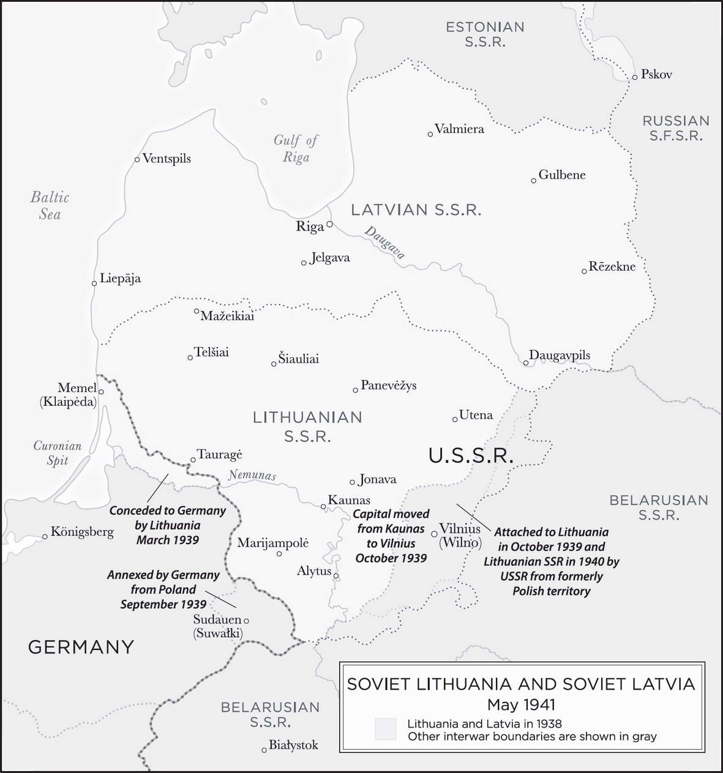
The subsequent and rapid Soviet takeover of the two sovereign states created psychological, material, and especially political resources in Latvia and Lithuania on a scale far greater than in Poland. The material resource was enormous: Soviet rule quickly opened the question of the property rights of the entire nation. The Soviets expropriated Jews (not as Jews, but as businessmen), raising the question of the ultimate ownership of their property. The psychological resource was also of an extraordinary scale. The destruction of the two states generated feelings of shame, humiliation, and the desire for revenge. In both Lithuania and Latvia, an entire political order was destroyed and an entire population could imagine its return. By destroying the Lithuanian and Latvian states, the Soviets gave the Germans the ability to promise a war of liberation. This was the political resource in its purest form.
The political resource included the supply of cadres: people displaced by Soviet policy who could be exploited by the Germans. The fact that the Soviets controlled the capitals and decimated the political elite enabled the Germans to make a certain important selection. In the main, the men who had actually ruled Lithuania and Latvia were sent to the Gulag or killed. But some Lithuanian and Latvian nationalists who had fled the interwar regimes or Soviet power made their way to Berlin. Beyond that, a considerable number of Lithuanians and Latvians posed as Germans in 1940, which allowed them to be “repatriated” to Germany under a German-Soviet agreement. The Germans could then decide which of these people they would bring when they reinvaded Latvia and Lithuania.
The timing of the Soviet annexation of Latvia and Lithuania led to a tragic coincidence. By the time the Soviets had readied the trains for their major deportations of Lithuanian and Latvian citizens to the Gulag, the Germans had prepared their trains for an invasion of the Soviet Union. The deportations from Lithuania began in the early morning of June 14, 1941. About seventeen thousand people were loaded onto boxcars (of whom only about a third ever returned). The German invasion came a week later. Because the Soviets were preparing major repressions when the Germans invaded, the prisons were full. Stalin raged until the very last moment that all reports of a German invasion were propaganda. As a result, no one could make preparations for evacuation or defense, and, of course, prisoners were the last priority and considered dangerous. Most of them were shot by their guards, in Lithuania and Latvia and everywhere across the front. As a result, Germans who arrived in Lithuania and Latvia were able to display the fresh corpses as palpable evidence of Soviet terror. In June 1941 in the Baltics the Soviet project of state destruction met the German project of state destruction in time and in place.
For the German state destroyers, the men of the Einsatzgruppen arriving to begin a second occupation of eastern Poland, Lithuania, and Latvia in summer 1941, the encounter with Soviet power was an opportunity. They could not have known beforehand how bountiful the political resource would be, since they had not been trained to think of the Soviet Union as a polity nor of Slavs or Balts as people with political motivations. Because Germans could not know how deep the Soviet reach into occupied societies had been, the new politics after summer 1941 would be a spontaneous creation of Germans and the local peoples whose lands they reinvaded.
The German entrepreneurs of violence would react to a new situation and exploit its possibilities. They did not know what they would find and were mistaken in some of their expectations. What they brought was the yearning for anarchy that can only be brought to the stranger, what they learned was to exploit the experience of the Soviet occupation to further the most radical goals of their own, and what they invented was a politics of the greater evil. In the zone of double darkness, where Nazi creativity met Soviet precision, the black hole was found.