
Chapter Two
ANY OPTIMISM THAT the war would be over by Christmas was finally knocked out of the public as the new year dawned and friends and loved ones remained entrenched in Flanders. 1915 would prove to be a disappointing year for the BEF and its commander, Field Marshal Sir John French, who would be forced to resign before the year’s end.
Among many letters written home to family in Carmarthenshire over the Christmas period were two of particular interest. Rifleman Ernest Charles Furneaux, a former colliery labourer and scout master at Kidwelly, wrote to his parents of his experiences at the front over Christmas. The letter was printed in The Western Mail on 4 January 1915:
‘I must tell you how I spent Christmas Day. Of course you would think under difficulties, but as luck would have it we were very happy. About five o’clock on Christmas Eve the Germans started lighting up Christmas trees in their trenches. We took no notice of them until they began to sing. Then we began to cheer them and to talk to one another as we are only about 80 yards apart. So by the light of their searchlight our officers went across halfway and their officers came to meet them. They shook hands and conversed for a while. It was agreed that we should have a day off and they would fire the first shot to start again. So from five a’clock on Christmas Eve until ten o’clock this morning (26 December) neither side has fired, only walked about. Some of the Germans came across to us and we shook hands and had some chocolate and cigars from them. They seem pretty young, some of them. I had a nice dinner, made it myself, stew, potatoes, carrots, turnips and meat, which we had out of a garden nearby and of course pudding.’
Second Lieutenant Tom Roberts of Swansea Road Nurseries, Llanelli wrote to his parents:
‘I’m off at last! and about time too! I go to Queensferry, near Edinburgh, tomorrow and from there take out 250 men in company with a Captain and another Sub. We go to the 2nd Battalion who have lost somewhat heavily lately and are supposed to come back after handing over the men but it is not likely that we will, thank goodness, because the last three groups of officers were supposed to do the same but when they got there they were kept. Brin Hughes is coming too. The funny part is that there are two drafts going, one from here and one from Scotland and Brin and another fellow come down from Scotland to take this one out while Captain Roddy and myself go from here to Scotland to take theirs out. Of course, the one I go out with is over twice as large as the one here and that may account for it.
‘I sent my sword home yesterday and am sending some more things tomorrow. Please keep them in case I shall want them in the future. If I remain out there and Frank gets a commission he could very well use them and save a tenner or so. I go out in web equipment the same as the men except that I have had it altered in a few details to suit myself and to make it lighter. I’m jolly excited, I can tell you, and could hardly believe the good news when I heard it. Oh! There’s one thing I wish to speak of seriously and that is my relationship with Joyce. If I had been in a position she is the girl I should have become engaged to and eventually married and if I get back when this is all over I hope to carry out my intentions. I should like you to remember this, please, Mam and Dad. You may think me an awful ass and all that but it’s the solemn truth and I have thoroughly made up my mind. With heaps of love etc...’
Private Evan James (11752), a soldier with the 2nd Welsh, wrote home to his brother-in-law, J. Johnson, at High Street, Llandovery. The Carmarthen Journal printed an abridged version of his letter early in January. He would be killed on 16 July 1916:
‘We had a bad smack up on Monday week, perhaps you saw the casualty list in the papers. The Germans are entrenched. We haven’t shifted them yet but we will. The weather is awful against us. The guns are playing on them all the time. We are suffering very bad with swollen feet and frost bite. The clay and water make your hands and feet swell. We are all in hope that this war will come to an end. South Africa was a picnic to it.’
The 15th Welsh had moved from Swansea to Rhyl to train and during January grew in strength. A draft of 350 men from Porthcawl joined the battalion on 23 January, with a further 250 men joining who had enlisted in Lancashire (mainly from the Bolton area), while The Carmarthen Journal reported twenty-seven men from Carmarthenshire joined the battalion at Rhyl during the first week of January.
A strike at the Tirydail Colliery proved to help the flow of recruits after Christmas, with a steady flow of men preferring to earn a living in khaki rather than suffer a cold winter in the Amman Valley with no money for food or fuel. Recruiting in the county on the whole was reported as satisfactory, with a steady flow of volunteers enlisting into Kitchener’s Army, the 4th Welsh and the Pembroke Yeomanry.
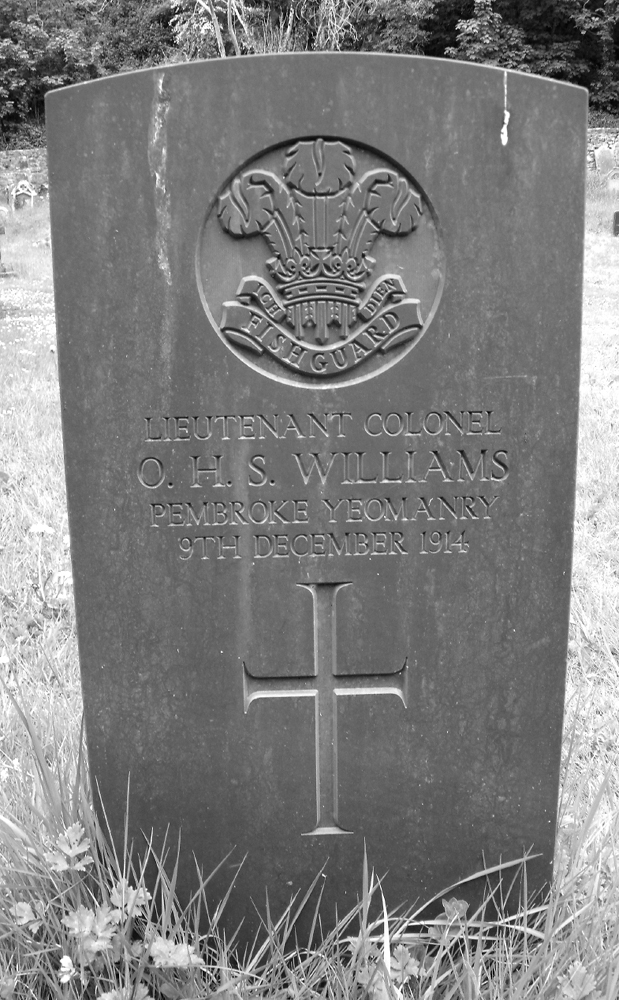
The grave of Lieutenant Colonel Owen Hird Spear Williams, late commander of the Pembroke Yeomanry, at Llawhaden.
Unfortunately the Commanding Officer of the Pembroke Yeomanry, Colonel Owen Hird Spear Williams, TD, was killed in a freak accident while clearing a blocked gutter on his house, when he fell from an upstairs window on 9 December 1914. He was buried in Llawhaden Churchyard. Promoted to take his place early in January was a member of the west Wales gentry, Cecil John Herbert Spence-Jones. He had married Aline Margaret Colby in 1908, the elder daughter of Major John Vaughan Colby, JP, DL, late Worcestershire Regiment, of Ffynone, Boncath, Pembrokeshire, thus guaranteeing himself a position in the officer ranks of the Pembrokeshire Yeomanry. He later assumed the name of Spence-Colby. Also in the newspapers was the report of a thirteen-month-old Belgian child, the son of refugees from Brussels, who died at Llansawel on 19 January. The boy, Octave Van Claven, was buried at St Mary’s Catholic Church, in Carmarthen. His father was serving with the Belgian Army on the Yser.
Private Tom Lewis, formerly a postman at Glanamman, was wounded before Christmas while serving with the Somerset Light Infantry; he wrote to his wife at Tabernacle Terrace, Glanamman from his hospital bed:
‘I wonder what sort of a Christmas Day you have had? Hope you had a pleasant and enjoyable one. If not, I shall be very cross when you see me.
‘Mine has been a very excitable and enjoyable one. I had two nice presents given me in hospital, Princess Mary’s and a nice little writing case from some old folk in Scotland. Princess Mary’s consists of a nice little box, pipe, fags and “bacca”.
‘I simply must tell you how I got wounded. Our Company was selected to make an attack on some trenches to our front about five hundred yards; the gunners bombarded them for a few hours before we commenced and my God what a sight.
‘We hadn’t been able to see the effects of our guns before. Their marksmanship and the many they had hit over, with their trenches to pieces; they must have killed hundreds.
‘After the bombardment, we made the charge; then we had it hot for a while. Our boys went at them like tigers, with the thoughts of revenge for the many they have hit over with their snipers.
‘I didn’t get right up myself; I got bowled over in front of the barbed wire entanglements, in the left buttock. I was very fortunate to have it in the fleshy part, though it is rather a nasty hit; it ripped me open so much. I am much easier now than I’ve been, my temperature almost normal; so things are looking a little rosy. I was left on the field from the time I was hit until eight o’clock without being dressed, nearly five hours; it was an awful time.
‘Of course no one could come to me as we were under fire the whole time and our boys had to hold on to what they had gained like grim death. However, I managed to drag myself back on my elbows to the edge of the wood [Ploegsteert Wood], about 300 yards; there I got picked up by stretcher bearers and here I am and very tired too.’
Letters were also published from members of the Pembroke Yeomanry, who were stationed around the coast of Norfolk, several of which noted a fine Christmas lunch which the men had been served as a surprise after returning to their billets after an exercise on Christmas morning. The dinner was laid on by Mrs Delmé Davies-Evans, with the help of some of the other officers’ wives.
Towards the middle of January a letter was received by Harry Williams, of Brongwylfa, Blaenau, from his brother, Private David Williams, who was serving with B Company, 2nd Welsh:
‘We have been in the trenches this last 14 days. We were there Christmas Day and New Year’s Day. It is very cold here and continually raining. I hope you all enjoyed your Christmas and that the works are going all right.
‘This is a grand country. It’s all farms here and there are some fine gardens and some good agricultural ground here. I should like to come across Dr Cook but he may be in another place. We have seen Daniel Lemonheigh today and he is all right. Give my best respects to Dai Isaac if you will see him.
‘A good many poor fellows got frost bitten here during Christmas time; they could hardly walk nor feel anything with their hands.
‘I would be very glad if you would send me a tin of cocoa and a bit of sugar, it is very scarce here and it is so easy to make. I would be very thankful if you would do that.
‘It is a pity to see the damage the Germans have done here to these poor people’s farms and houses and the hundreds of pounds worth of furniture lying about here.
‘I am in good health, hoping you are the same, so no more at present. Best love to all.’
Daniel Lemonheigh was from Talley. He was a Special Reservist and had served in South Africa with the 3rd Volunteer Company, Welsh Regiment and discharged upon completion of his engagement on 1 March 1911. He rejoined his regiment at the outbreak of war and served in France with the 2nd Welsh from 14 August 1914 until discharged from the army on 11 March 1916, due to wounds suffered in France. He died in 1935, leaving a wife and five children.
Jack Dudley of Maesycrugiau also wrote home to his mother from a hospital bed. Jack had been wounded at Ypres with the 2nd Welsh: ‘Dear Mother, just a word hoping you are well. I have not much to tell you this time except that I have been wounded in the head, from which I am recovering alright, and have also been wounded in my side, which is giving me great pain...’ Jack was discharged in 1915 due to his wounds and died in 1924, aged 40, having never fully recovered from them.

Lieutenant Theophile Lecompte Stewart, a well known Llanelli man, and one of the original officers of the 15th Welsh
An article in The Welshman that month publicised a novel recruitment campaign by local officers of the 15th Welsh, who were using a motor car to drum up interest in the local battalion during a tour of West Wales:
‘During the past week a number of officers and men of the Carmarthenshire Battalion have been on a visit to Llanelly with a view to obtaining recruits and the results are most satisfactory. The men have been marching through the principle thoroughfares and presented a smart appearance, being rather above the average height. Amongst the officers is Lieut. D.H. Thomas, the ex Llanelly centre three-quarter. The men would like some football outfits. The officers have already supplied the necessaries for four teams, but more are urgently wanted. There is nothing that the young fellows enjoy more than a game of football and nothing could be better to keep them in condition. If any local players have old jerseys, knickers, etc, on hand, they are asked to send them on at once to Lieut. Stewart, Morville, The Parade, Rhyl, by whom they will be thankfully received. Gifts of footballs would also be most welcome.’
Among the first local men to fall in 1915 was Rifleman Lloyd Owen Lloyd Price, the son of Meredydd and Frances Margaret Price, of Bryn Cothi Lodge, Abergorlech. He was working as a mining engineer in Rhodesia when war broke out and returned to Britain, enlisting in London on 13 October 1914 into the 2nd Battalion, Kings Royal Rifle Corps. He was killed in action on 10 January and is remembered on the Le Touret Memorial.
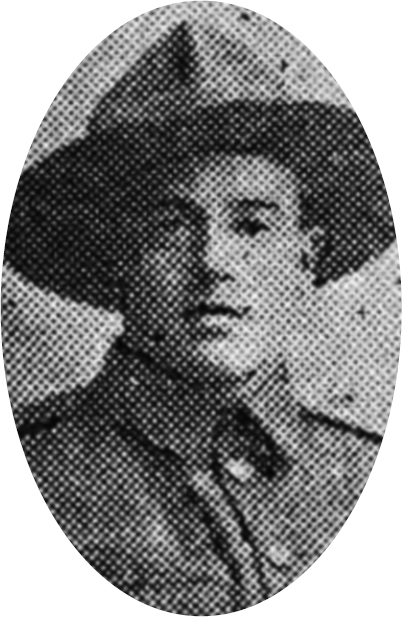
Rifleman Lloyd Owen Lloyd Price of Abergorlech.
Life continued more or less as normal for most of the people of Carmarthenshire during the early months of 1915 and local recruitment meetings continued to be staged around the county. A well attended meeting at Llandybie towards the end of the month promoted a good response in the village, gaining more recruits for the army.
Over the winter Edward Brown, a member of the Board of Agriculture and Fisheries, investigated poultry breeding in West Wales. He presented his findings at a poorly attended meeting at the Guildhall, Carmarthen early in January. During 1913 over ten million pounds worth of eggs had been imported into Britain, mainly from Belgium, and now that that country was mostly under German occupation the British would have to increase egg production to become self sustaining. A long meeting discussed the industry within Carmarthenshire at length and gave sound advice to local farmers, which included the distribution of fowl over larger areas of the farm, improving classes of stock, earlier hatching, care in feeding and marketing.
On the Western Front the war stagnated. The weather was dire and the men carried on with the dreary day to day life of trench warfare. In the weeks leading up to the first major British action of the year, the Battle of Neuve Chapelle, the county saw fifteen more sons killed. An action at Givenchy on 25 January and the little known ‘Affair of Cuinchy’, between 29 January and 6 February, caused the majority of these casualties, five of whom served with the 2nd Welsh. During this period the battalion suffered the misfortune of suffering the first of its five men to be executed during the course of the war. Private Richard Morgan, a reservist, shot dead his CSM whilst the battalion was in the trenches on 20 January. Morgan was handed swift justice, being found guilty by Field General Court Martial and was executed by men of the battalion at Béthune on 15 February. The story was retold in a letter from Lance Corporal John Parry to his uncle in Laugharne and is also quoted in Robert Graves’ book, Goodbye to all That.
The gruesome discovery of the headless body of Evan Jones, a mason with the Great Western Railway, was discovered on Saturday 13 February. The 67-year-old, from 36, Richmond Terrace, Carmarthen, was walking to work along the tracks when he was hit by a train and decapitated. His son, John, lived at Abergwili and told the inquest that his father had been to the station to pick up his timesheet before walking to his place of work when he was hit. The verdict of accidental death was recorded.
Throughout February recruitment continued in the county. The Carmarthen Journal of 26 February reported that:
‘The Battalion recruiting car of the 15th Carmarthenshire Battalion of the Welsh Regiment was touring Llannon Parish on Friday and Saturday last. There are many young men still available, both among the farming class and the collieries’ workmen and it is hoped that the efforts of the officers will be rewarded by more joining the colours.’

The 15th Welsh recruiting car finally reaches Carmarthen in its tour of the county and made this photo stop at the County Hall.
Great crowds gathered outside County Hall at Carmarthen when the recruiting car rolled into its car park that month, driven by local officer Lieutenant Herbert Lewis, one of the nine sons of local gas engineer and artist Benjamin Archibald Lewis [Lewis the Gas]. Along with him were thirty other well known local officers and men.
As part of another recruitment exercise and to gain further publicity for the battalion, a series of rugby matches were arranged throughout the county;
‘On Friday, 12th March, the Regimental Rugby Football Team of the Carmarthenshire Battalion, Rhyl, will specially travel down for the purpose of playing a number of matches against local sides.
‘On Saturday, a Llanelly XV will be met at Stradey Grounds at 3.30 pm; on Tuesday, the 4th Welsh at Carmarthen; on Thursday, Ammanford at Ammanford and on the Saturday, 20th March, Neath will be played at Neath. Amongst the players selected, the following well-known Llanelly footballers are down to play: Lieutenants D. H. Thomas and T. L. Stewart, Privates D. J. Rees, Arthur Howells and Hendy Evans.
‘The Carmarthenshire team is considered to be a very warm side, so lovers of Rugby football in the above places will be certain of witnessing healthy and vigorous games played in true sporting spirit.’
Ten more local men fell between 3 February until the opening of the Battle of Neuve Chapelle; two whilst on home service, seven in Flanders and a tenth, Master Mariner David Edmunds of Burry Port, who was killed when his ship, the SS Tangistan, was torpedoed and sunk on 9 March.
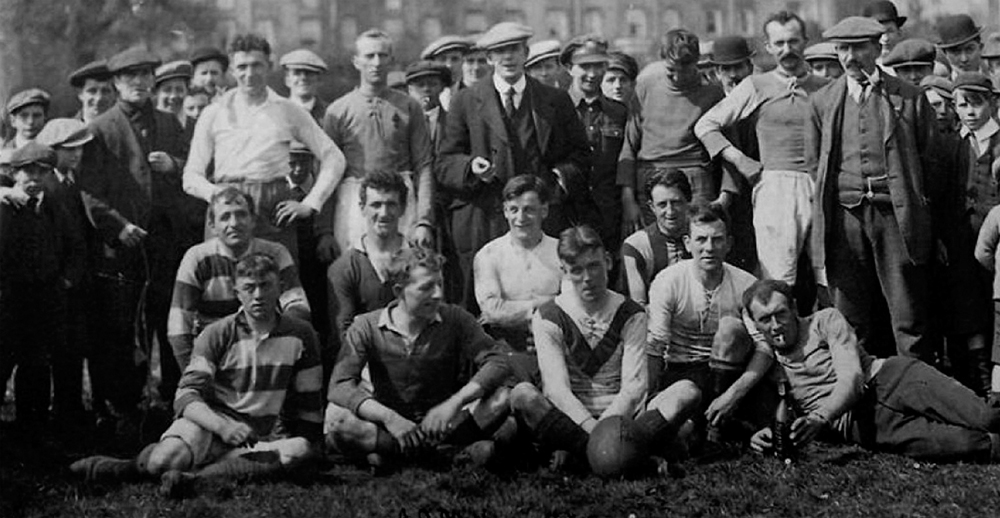
A rugby football team of one of the Welsh Regiment battalions; what a fine bunch of men, smoking and drinking beer!
Wednesday 10 March saw the opening of the Battle of Neuve Chapelle, the first of a series of costly major (for the British at least) engagements in 1915, which was born of a request by the beleaguered French for the BEF to apply pressure on their own front, and aimed to straighten out the line. The area for the attack was selected around the village of Neuve Chapelle, which lies on the road between Béthune, Fleurbaix and Armentières, near its junction with the Estaires to La Bassée road. Despite initial successes, the British were unable to exploit their breakthrough, partly due to a shortage of shells; after three days of bloody fighting the battle was called off, at a cost of over 11,000 British and Indian casualties.
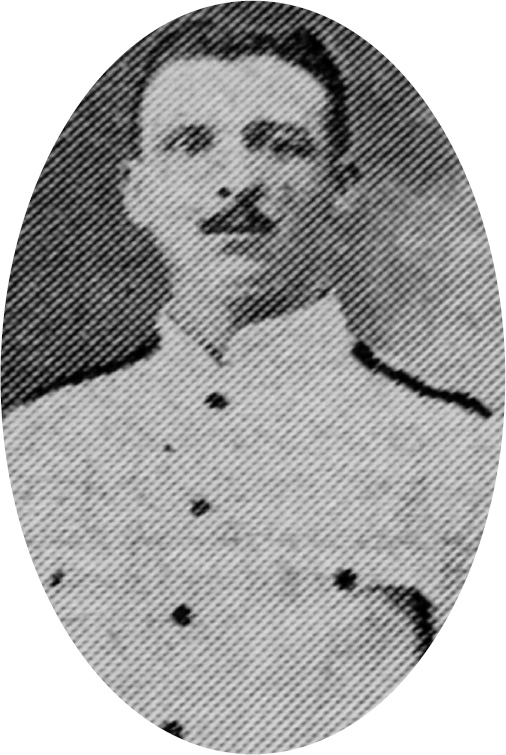
Rifleman David Walter Cainan of Llanelli, a career soldier.
Seven local men lost their lives at Neuve Chapelle: four from Llanelli, two from Pontardulais and one from Llandybie. One of the Llanelli men, David Walter Cainan (9866), was a regular soldier. He was born on 9 April 1886, the son of William and Catherine Cainan, of 49 Albert Street, Llanelli. He enlisted on 4 May 1903 and served in Malta and India prior to the outbreak of war with the 2nd Battalion, Rifle Brigade. Cainan was killed on 14 March and is commemorated on the Le Touret Memorial.
A prominent local figure, Second Lieutenant Harold Gostwych May, a young officer who had been a Games Master at Llandovery College, was badly wounded on 14 March. He was born in 1887, the son of Richard Cooke May and Emma Jane May, of Sherborne, 77, Woodside Green, London. He was educated at Sherborne School, Dorset from 1902 until 1907 and was a prefect and head of house (Harper House). He was Captain of the School Cricket Xl in 1907, played rugby for the School XV in 1905 and 1906 and also represented the school at boxing in 1907. On leaving Sherborne, he pursued an academic career and graduated MA from Trinity College, Dublin (1907 until 1911), becoming a member of the staff at Kelly College, Llandovery. He was commissioned on 2 December 1914 and served on the Western Front with the 1st Battalion, Dorsetshire Regiment. He was evacuated to the Stationary Hospital at Boulogne, but died of his wounds on 28 March, aged 27; he is buried in Boulogne Eastern Cemetery, France.

Second Lieutenant Harold Gostwych May, former games teacher at Llandovery College, who died of wounds on 28 March 1915.
Over subsequent weeks letters began returning home from local boys who had taken part in the battle. Two Llanelli men, Privates James Wade and Jack Jenkins, who had been wounded at Neuve Chapelle whilst serving with the 2nd Battalion, Royal Irish Rifles, recuperated at the Ormskirk Cottage Hospital. Wade wrote to his parents at Llanelli:
‘It was an awful slaughter and they (the Germans) lost heavily although we only lost eight officers, five wounded and three killed. We made a two mile advance on Thursday and were in the German trenches that night and when we entered them they were full of jars of rum, which had not been tapped. We and the Lincolns made another charge on them under an awful shelling, but on we went although we had now suffered a little. The Germans were giving themselves up in hundreds... I was caught by one of the German snipers who was in an old barn. I had lost Jack, because out there one is full of excitement and when I got back to the dressing station I found him there with a shrapnel wound... The Ghurkhas were next to us. They are an awful lot and never take any prisoners. When the Lincolns entered the first line of German trenches they found that two Belgian girls, who were still alive, had been kept there.’
Photographs began appearing about this time in the local press, sent home by some of the 15th Welsh men, who were training hard at Rhyl. Several were published in The Western Mail of 5 March and another was received by Lewis George Roberts, of Laugharne, whose son James Jeremy Roberts was serving with the battalion and had written to say that he had been promoted. William John Close of Llangennech also sent a fine portrait of his detachment back to his parents, which was made up wholly of men from Llangennech and Pontardulais. He was killed at Ypres on 1 August 1917.
On Tuesday 23 March Second Lieutenant Tom Roberts returned to his billets after his first spell in the trenches. He wrote to his parents at Llanelli:
‘I came out of the trenches last night. We were up in the fire trenches and it was a strange experience. Once in the trenches it was just like being in the butts, but the getting in was a little different. I must confess I “ducked” once or twice when the first few bullets came rather close but one gets used to it. Fortunately our trench did not receive any attention from the German artillery and things were fairly quiet, but we lost three men, two from my platoon, from a sniper, who managed to get enfilade fire on us. Their wounds were not very serious, they ought to make good recoveries. We go into the same trenches tonight again. The little village we are resting in today has been rather badly knocked about by shells and most of the houses are roofless, but still some of the inhabitants remain and trade with the British soldiers, although we are only a mile or so behind the firing line. The weather during our stay was glorious but it has changed today and there is a slight drizzle going on.’
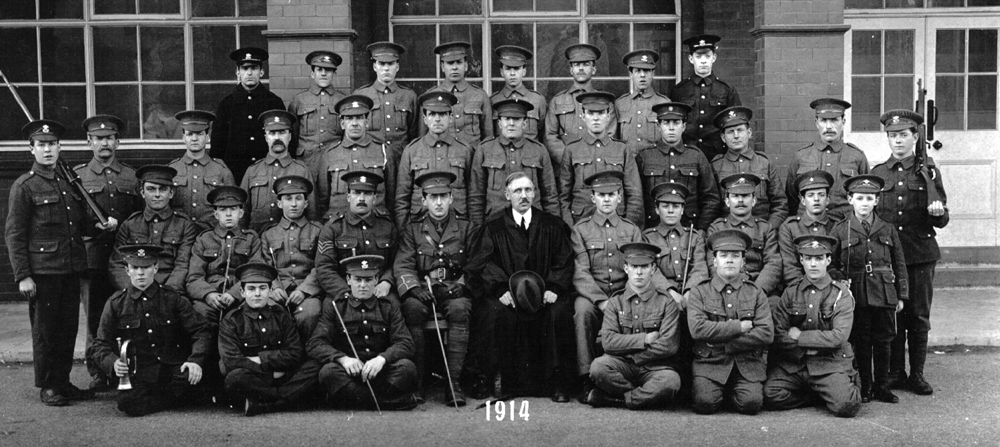
The Llangennech and Pontardulais detatchment of the 15th Welsh at Rhyl.
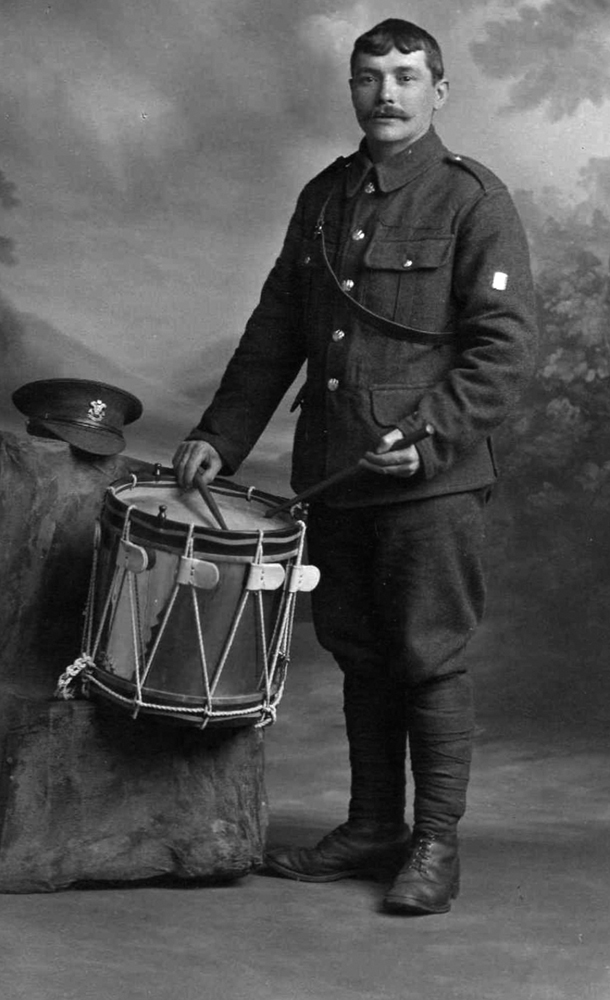
Private John Hirst, from 13, Water Street, Llanelli. Killed at Mametz Wood on 11 July 1916, and commemorated on the Thiepval Memorial.
The Carmarthen boys trained hard at Rhyl and as a treat their Commanding Officer, Lieutenant Colonel Scobie, arranged a Battalion Sports Day. Various events were organised and several of the local men distinguished themselves against their fellow ‘Honorary Welshmen’ from Bolton. Lieutenant Tom Roberts of James Street, Llanelli, won the officers’ blindfold race; Lieutenant Theo Stewart, from Llanelli, won the 100 yards dash; and the sack race was won by John Hirst, of Llanelli. John proudly sent this photograph of himself home with the news of his win. He went on to be killed at Mametz Wood on 11 July 1916.
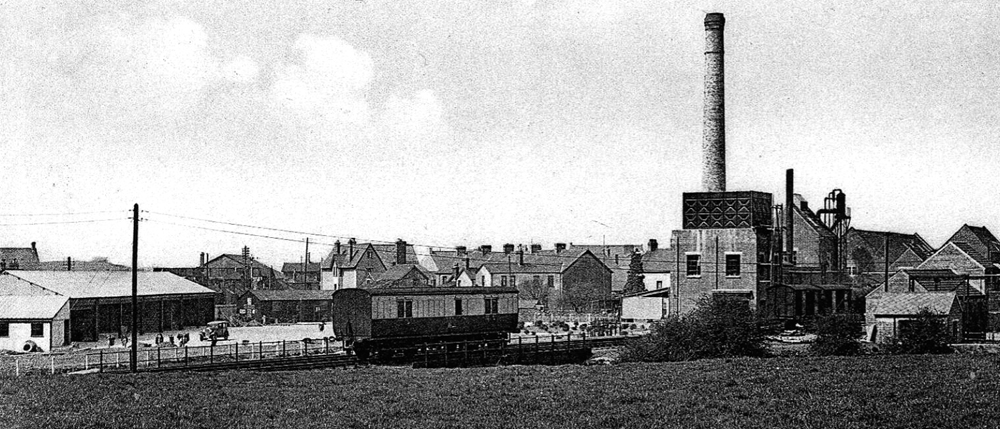
The original United Dairies factory at Whitland, later to become the largest dairy in the world. It closed in 1994, when the Milk Marketing Board was abolished
Farmers around the county began a series of meetings during March which debated the possibility of forming co-operatives for selling milk, cheese and butter. The resolution was passed that farmers should form the South-West Wales Dairy Farmers Association, which would be better able to control the dairy market and ensure that a fair price was charged for local produce. Mention was also made of the possibility of building another milk factory in the county along the same lines as one presently being run at Llandeilo. Other dairies would eventually be built at St Clears, Whitland, Carmarthen and Newcastle Emlyn.
At the Headquarters of the South Wales Mounted Brigade at Carmarthen, recruits continued to pour in. One recruit, Gerald Marston Owen, a young Yorkshireman, had travelled by train to Carmarthen. He had worked at a YMCA Camp at Scarborough and had keenly observed the soldiers of different regiments who frequented the hospitality of the camp before making his mind up to join a cavalry regiment. He chose the Pembroke Yeomanry and on arriving at Carmarthen Station on a cold, blustery day was to gain his first meeting with a Welshman:
‘After a ten hours journey I arrived at this neat little Welsh market and agricultural town. On stepping out of the train my first question was to ask for the nearest way to the recruiting office. This I asked of an old porter who took my ticket. To my surprise he stared at me in dumb amazement at the same time shaking his head and uttering some terrible oaths. What he said I never knew, but to hear him speak made me wonder whether I had already arrived in a foreign land. This was then my first encounter with the Welsh language and I shall never forget the impression it gave me on that dark, cold night of February. Everywhere people were chattering in this awful language. I have heard many since, but never one so terrible as this.
‘However I found someone who understood me at last and who offered to take me to my destination. The recruiting office, when I arrived, was overcrowded and a long queue of farmer lads was waiting outside to enlist...’
His experience got better as he was led to his billets with an elderly woman and her teenage daughter and Gerald tasted the best of Welsh hospitality over the coming days. Carmarthen at that time was buzzing and packed with soldiers. Being the home town for three different infantry battalions meant that rivalry abounded. The Welshman reported that the conduct of the troops had been ‘satisfactory’, but there was friction in the air when it was discovered that the townspeople who were billeting troops got more for a Pembroke Yeoman (twenty three shillings, seven pence), than they did for a Welsh Regiment man (seventeen shillings and six pence).
While the 1/1st Battalion, Pembroke Yeomanry was still in Norfolk, the Reserve Battalion of the Pembroke Yeomanry came up to strength by March 1915. It was based at Carmarthen under the command of Lieutenant Colonel F. Lort Phillips, the Squire of Lawrenny; B and C Squadrons had been detached to Llandeilo, where they were undergoing a strict training regime under their respective commanders, Major Protheroe-Beynon and Major Gillet. A Squadron at Carmarthen Barracks was under the command of Major H.B. Summers and the Adjutant was a well known local man, Captain H. O. Long-Price. Within weeks this Reserve Battalion, now numbered the 2/1st Battalion, moved to the east coast, around West Hartlepool.
The local branch of the British Red Cross was keeping itself busy. Notable members in the county included Lady Cawdor, who allowed her substantial home at Golden Grove to be used as a convalescent home for wounded men; Lady Lloyd, who took wounded soldiers at her residence at Bronwydd; Mrs Lloyd the same at Glangwili, and other local manors at Llwynbrain and Glahrhydw were also put to use. The men who were put up in the luxury of these grand houses had been discharged from the local War Hospitals at Llandovery and Carmarthen, with a dozen or so men arriving from Cardiff Hospital during the end of March. Fundraising to help cover the costs of nursing these men was carried out by local Red Cross groups at Trimsaran (£26 10s), Llanllwni (£11), Llansadwrn (£4 11s) and Rhydcymerau (£2) during the month and Mrs Mumme, of Brooklyn, New York, donated £1. The war was about to take a considerable turn for the worse over the coming weeks, and efforts by these local war hospitals and Red Cross groups would soon be severely tested to the limit.
On 12 April Second Lieutenant Tom Roberts went to Ypres with his battalion. He wrote home to his parents about the move:
‘Our rest has finished and today we marched out of the town to this village, which is quite near a town in Belgium of which so much has been heard. We go into the trenches about Thursday and remain in them for four days. The weather has taken a decided turn for the better, in fact, on the march today we found the heat almost trying. We were billeted during our rest in a very nice empty house owned by a Colonel in the French army and had many comforts which we had hitherto missed. I have not slept in a bed since I arrived in France but I’m becoming quite used to the hard floor now. I’ve just had your letter of the 9th. I am feeling quite fit and please don’t worry as I am taking every precaution and in this kind of warfare if you do this you are fairly safe. I should like another parcel please as all the fellows get them regularly. Do you mind if I mention what I should like? Two carriage candles, 1 loaf cake, tin Three Castles cigarettes, 2 pots or tins of cream, 1 tin of meat or game paste. If you would send it at once I should receive it just as I come back for my rest after the trenches. I have no more news for you just now but will write again at the first opportunity. Love to all and you both from your affectionate son, Tom.’
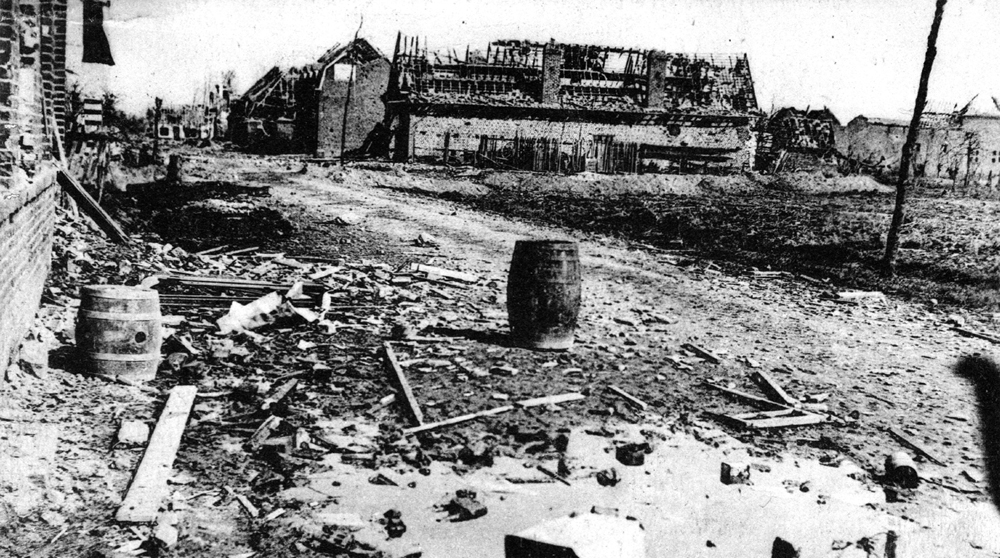
The ruined village of Neuve-Chapelle, at sometime during 1915. It was levelled during the course of the war.
Several more local men were killed after Neuve Chapelle, during March and early April, most of them members of the 1st and 2nd Welsh and 1st SWB, showing that it was still the regular soldiers of the BEF who were taking the strain. However, when the Germans launched their infamous gas attack at Ypres on 22 April it was the 1st Canadian Division, who initially plugged a gap in the line left by terrified French Colonial troops east of Gravenstafel. News of this barbaric act spread rapidly, used as propaganda to good effect by the British Press. This gas attack heralded the opening of the Second Battle of Ypres, which dragged on until the last week of May.
On 17 March the 2nd Battalion, South Wales Borderers had set sail from Avonmouth for Alexandria aboard the SS Canada. News of the sailing reached families back in Carmarthenshire by the beginning of April, when The Carmarthen Journal reported the receipt of a letter sent by Private Thomas James Jackson, of Laugharne, which detailed the movements of the battalion to Egypt to join the Mediterranean Expeditionary Force. The reasoning behind this new force was as yet unknown in Britain, but at the instigation of Winston Churchill, the First Lord of the Admiralty, an audacious plan had been hatched to force the passage of the Dardanelles Straits by a combined British and French fleet, allowing free entry to Russia, and the possibility of being able to bombard Constantinople and drive Turkey out of its alliance with Germany. The naval operation failed after the fleet struck a minefield while entering the straits on 18 March, which sank the French battleship Bouvet, and the British battleships HMS Irresistible and HMS Ocean. This ended Allied attempts to force the straits by naval power alone, so plans were drawn up to land troops on the Gallipoli Peninsula, the British on the European side, and the French on the Asian, and take control of the forts overlooking the straits. It was envisaged that the affair would be relatively straightforward.
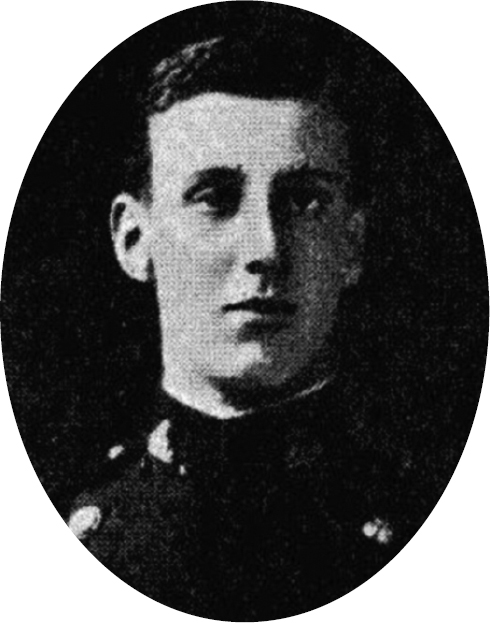
Lieutenant Robert Behrens of Llanwrda. He had fought at Tientsin and was killed when the 2nd SWB landed neat De Tott’s battery at Gallipoli.
The 2nd SWB was part of the 29th Division and was allocated landing beaches around Cape Helles. The newly formed Anzac Corps was to land at Gaba Tepe, with the Royal Naval Division in support. Several local men served with the 2nd SWB, including Lieutenant Robert Behrens of Llanwrda. He had been with the battalion when it famously captured the German held port of Tsingtao, in China, in August 1914.
On the morning of 25 April the Allies began landing on the hostile beaches of Gallipoli. The Anzac force was, fortunately as it turned out, landed on the wrong beach and their advance was slowed by steep cliffs and effective Turkish shellfire; while the elements of the 29th Division landed on their allotted beaches around Cape Helles. The 2nd SWB disembarked from their transport, HMS Cornwallis, into lighters and the separate companies were rowed to their landing places; B, C and D Companies landing near De Tott’s Battery, which was their objective. Lieutenant Robert Behrens, whose mothers’ family hailed from Froodvale, Llanwrda, was mortally wounded during the early stages of the attack on the battery; he was brought back aboard HMS Cornwallis, and died the same day. He was buried at sea and is commemorated on the Helles Memorial. His uncle was another well known local officer, Lieutenant Colonel Oswyn St Leger Davies, killed on 5 April 1918.
Private Thomas James Jackson was slightly wounded shortly after the landings, and wrote home to his parents at Holloway Road, Laugharne:
‘I am alright now. When we landed we had a fine reception and we went for the Turks like mad dogs let loose and soon shifted them. We were not long about it either. We sent them over the hill and we held the position for a few days. We were relieved by the French and then we joined our brigade and had a great battle. Had they not shifted we would have wiped them out. It is a funny feeling when you charge with the bayonet. When you are halfway you don’t aim for anything. We fought a good many fights before I was hit, but I am going to do my share again. Please send me some paper and envelopes.’
Sadly, this was to be the last letter that David and Harriet Jackson received from their brave young son. On 10 June Thomas was killed while taking part in an attempt to dislodge the Turks from a trench east of Gully Ravine. He was 29 years old and is buried in Twelve Tree Copse Cemetery. A relative of his, Barry Jackson, went on to become a well known rugby player in Carmarthenshire. After playing several seasons at prop forward for Llanelli, he later returned to play for and coach his native Laugharne.
While the 2nd SWB were fighting to consolidate their gains around De Tott’s Battery, at Anzac Cove 4th Battalion, Australian Imperial Force (AIF) had landed and was moving up the cliffs in support. Formed at Randwick Racecourse in Sydney in August 1914, the battalion not only included several Carmarthenshire men in its ranks (including the author’s great grandfather, David Thomas John), but was commanded by a wealthy landowner from Pontyates, Lieutenant Colonel Astley John Onslow Thompson.
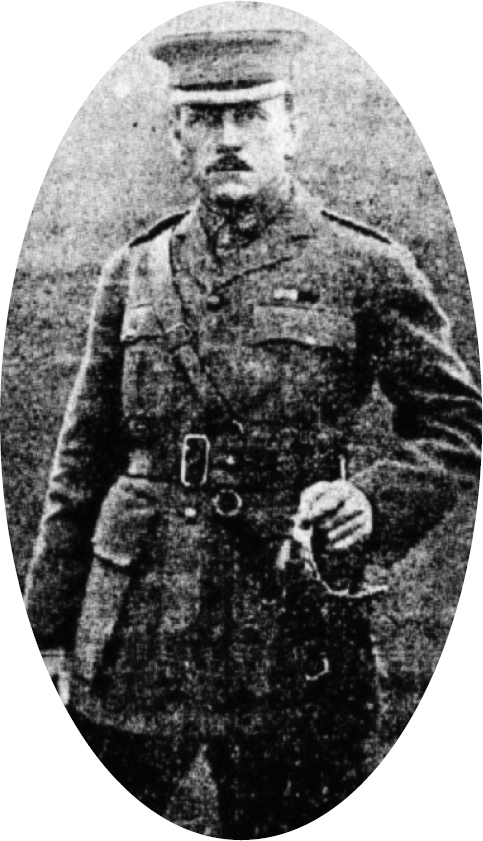
Lieutenant Colonel Astley John Onslow Thompson, the original commander of the 4th Battalion A.I.F., originally from Pontyates.
The ‘Fighting Fourth’ were rushed into action to plug a gap which had formed in the first waves of the assault, and encountered heavy Turkish fire at 400 Plateau. Casualties on that first day were remarkably light but, on the following day, Onslow Thompson and a group of his men got cut off and, while attempting to regain contact with the rest of the battalion, Thompson was killed by machine-gun fire. He was 50 years old. His body was recovered some weeks later and buried in the parapet of a trench, but he was later re-interred after the war and buried in the 4th Battalion Parade Ground Cemetery. The Parish Church at Pontyates contains a memorial to this gallant man. [Insert Photo 043]
Throughout April well-wishers were busy collecting subscriptions for the Lord Lieutenant’s Carmarthenshire Battalion fund. Many of the donors were prominent names in the county: Mr J.H. Thomas (High Sheriff); Lord Dynevor; Messrs Cleaves (Western Valleys Anthracite Company); Mr J. W. Gwynne Hughes; Sir Stafford Howard; Lady Howard; Sir Charles Philipps (Picton); Sir Owen Scourfield; Sir James Hills-Johnes VC; Mr John Hinds, MP; Lady Hills-Johnes; and Mervyn Peel of Danyrallt to name but a few.
Lieutenant Frank Roberts of the 15th Welsh was busy training the new recruits to the battalion at Rhyl. In the meantime his brother, Lieutenant Tom Roberts, survived his first major battle at Ypres and wrote a descriptive letter to his parents at Llanelli;
‘I do hope you will excuse me for not writing for the last few days and when you’ve read this I expect you will. Ever since last Thursday night I’ve been fighting in one of the most important battles yet fought in this campaign and I’m glad and proud to say that my company and the regiment played a chief part in it. Now for the narrative.
‘On Thursday 2 pm we were moved out of our comfortable billets in the last village and bivouacked for the night under a hedgerow. It was bitterly cold and there was a heavy frost and I had a most uncomfortable time. Next day the Germans continued their heavy bombardment of our sector of the line, which they had started in the early part of the week and now I understand that there is not a single house left standing in the fine old town of Ypres. About 9 am I saw a shell blow up the farm in which our men had been billeted the previous day. The fearful cannonade went on the whole day.
‘In the evening we went up to the trenches and my company went into dug-outs just behind. I was in charge of two platoons in a group of dug-outs and I had hardly taken my place when a shell flew into one of the dug-outs and killed three of my men, wounding three others. I did my best to save one of them who died later and nearly fainted when binding or rather attempting to bind up his wounds. After this I forbade the men to show a light or make a fire for fear of being shelled again. The whole of Saturday we stayed there, not daring to move.
‘Saturday night an order came up to me by phone to bring my men down to the rest of the company in fighting kit. I did so and found that we were wanted to support the Canadians, who were having a bad time in the trenches, the Germans using a horrible gas which asphyxiated fifty per cent of them. We started for this place which was some miles away and were under shell fire practically the whole way. To make matters worse, it came on to rain and we had no rations. Arrived at Headquarters, we were told to lie in a ditch behind a hedge and await further instructions. It continued to rain and we were hungry, wet and miserable, yet the spirit of the men was fine.
‘At dawn on Sunday the most fearful time started and for the whole of the day we were shelled from the front and from the left flank. German aeroplanes circled above us and gave their artillery all possible information. We were without the slightest information as to what was happening and we never heard a shot from our own guns nor saw a single friendly aeroplane. This nerve-racking bombardment went on until about 7 pm when the poor devils in the trenches in front were blown out and had to retire behind us. The enemy advanced in thousands, the country in front being simply stiff with huge dense masses of them. They came on until they were within 400 yards of us when our rapid fire effectively stopped them. It was wonderful - we were only about 120 of us with the Captain, another Sub and myself along with about 400 Terriers who had arrived in this country on Thursday, and yet we held about 6,000 Germans through the night.
‘At dawn on Monday a slight mist obscured the landscape and we were at a loss to know what was happening. Suddenly about 6 am some Terriers on the right legged it pretty hurriedly and the enemy also came round on our left so our little band was forced to retire. The Colonel of the Terriers, knowing nothing of the country, asked my Coy Commander to take charge of the retirement, which he did in a most business like way.
‘The Germans came on in hordes, jabbering like a cart-load of monkeys but, owing to the mist, seemed undecided as they could not find out our strength. Our strength was 450 and at each hedge we came to we called a halt and gave them a dose of rapid fire. Our men being regulars gave just the required stiffening to the Terriers who, poor devils, were having a terrible time as it was their first time under fire. Some men tried to break back but by threats and cursings from our men they regained their nerve and really did most creditably. We slowly fell back until we reached our second main line of defence about 2,000 yards behind, where we found the reinforcements we had been anxiously awaiting for two days. We then took up a line of trench that was vacant and stayed there until we were relieved about midnight Monday night when we went back to the dugouts...’
Events at home seemed another world away compared to this. The question of exporting anthracite coal overseas was raised by Sir Alfred Mond in London in April, when he headed a party of representatives from the Swansea Chamber of Trade, who were looking to get licenses to ship more coal from Swansea Docks to neutral countries, such as Italy, Norway and Spain, after the Admiralty had attempted to stem the export in case it found its way to Germany. Much of the coal from the Amman Valley was shipped from Swansea and the success of the meeting was good news for the Carmarthenshire miners as well as the Swansea businessmen.
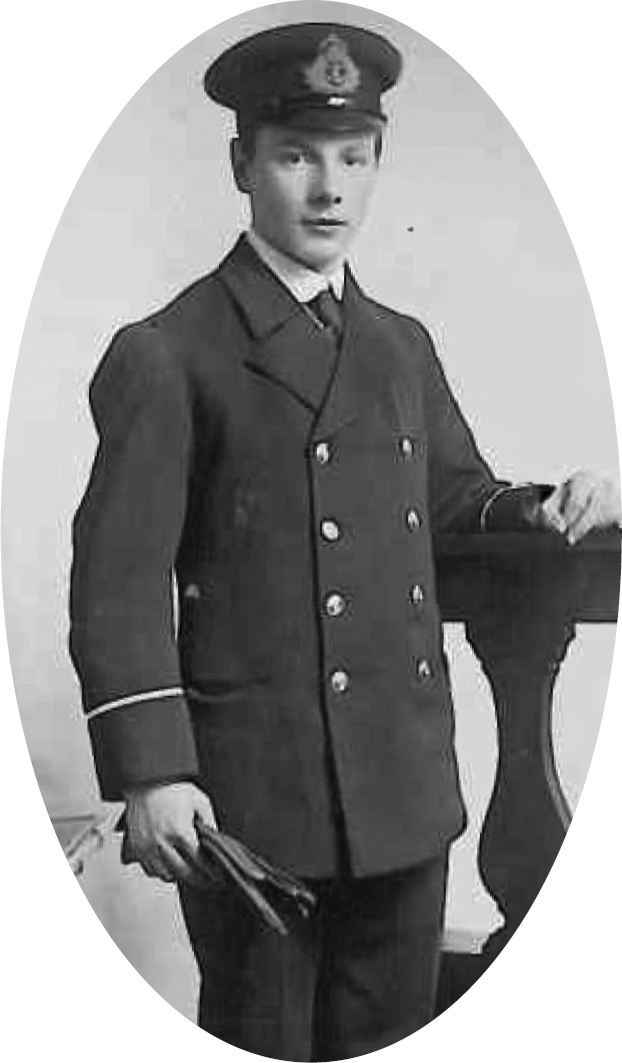
Midshipman Henry Brynmor John, later to become a Lieutenant Commander, who also served during WW2.
During April, Arthur Wilkins, a wireless operator aboard the White Star Liner RMS Lusitania arrived home at Brown’s Hotel, Laugharne on sick leave. This would prove to be a stroke of good luck for the young man, as on 7 May the luxury liner was torpedoed and sunk by the German submarine U 20 off the Head of Kinsale, southern Ireland, with the loss of 1,195 lives. Amongst the dead were a wealthy businessman from Tenby, Henry Adams, and a young couple from Whitland, Ernest and Mary Hannah Thomas, who had emigrated to Winnipeg and were returning home to visit family at St John’s Street. Ernest’s body was recovered and buried in grave 475 at Cobh Old Church Cemetery, Queenstown, while Henry Adams was buried at Tenby. Serving aboard one of the rescue ships, HMS Juno, was a young Narberth man, Henry Brynmor John, who would later become a Burgess of Laugharne and Paymaster Lieutenant Commander with the Royal Navy. He took part in the Battle of the River Plate in 1939, serving aboard HMS Exeter, before becoming part of the Combined Operations staff under Lord Louis Mountbatten and taking part in the planning for the D-Day landings. News of the sinking provoked condemnation throughout the civilised world, but many of the troops in France, as famously noted by Robert Graves, hoped that the disaster would finally force the hand of the Americans and bring them into the war.
Civilian life continued in its ordered way in the county. The Carmarthenshire Chamber of Agriculture held a meeting at the Ivy Bush Hotel during the first week of May, which was well attended and Mr John Hinds, the local MP was re-elected for a second term as President. His son, William Pugh Hinds, was serving as a lieutenant with the 15th Royal Welsh Fusiliers, training at Colwyn Bay. At the end of the meeting, which discussed among other topics the infertility of Welsh soil compared to English, a grand raffle was held, with such exciting prizes as a portable fowl house, a sheep shearing machine, a brass horse harness, a horse hoe, cart ropes and sheep shears. The various churches and chapels in the county were also busy collecting money to aid the many Belgian refugees who had settled in the county, with a total of over £651 raised already for the cause.
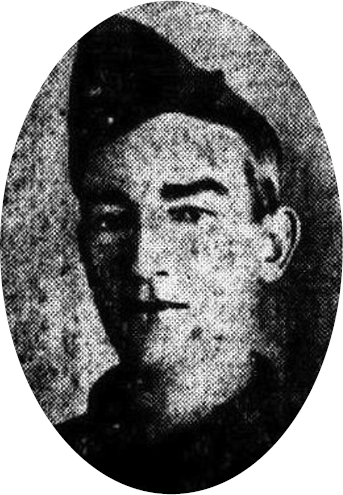
Private Robert Watson, 4th Battalion AIF, the nephew of the Bishop of St David’s.
On 9 May another of the Carmarthenshire contingent in the 4th Battalion AIF lost his life. Robert Watson was serving as a sergeant with the battalion when he was wounded the day after the Gallipoli landings. He was the nephew of the Bishop of St David’s, and lived for several years prior to emigrating with his uncle and aunt at the Bishop’s Palace at Abergwili, now the Carmarthenshire Museum. He was wounded on 26 April and evacuated to Number 5 Hospital at Alexandria for treatment. He died of his wounds on 9 May, aged 35, and is buried in Alexandria (Chatby) Military Cemetery.
By the end of April around 125 men from Carmarthenshire had fallen on the battlefields of France, Belgium and Gallipoli. While the situation at Gallipoli still hung in the balance, the situation in Flanders was not good. May saw the launching of a series of battles by the British during the tail end of the main Second Battle of Ypres: the Battle of Aubers Ridge, the Battle of Festubert (these two in France), the Battle of Frezenburg and the Battle of Bellewaarde, these part of Second Ypres.
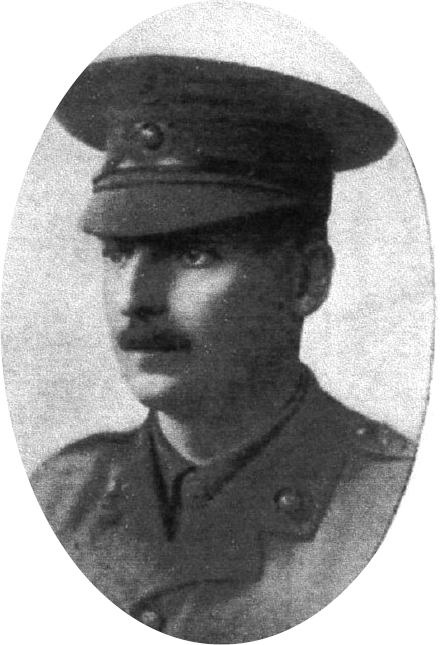
Major George Fison Muller, a career soldier, whose family resided at Laugharne.
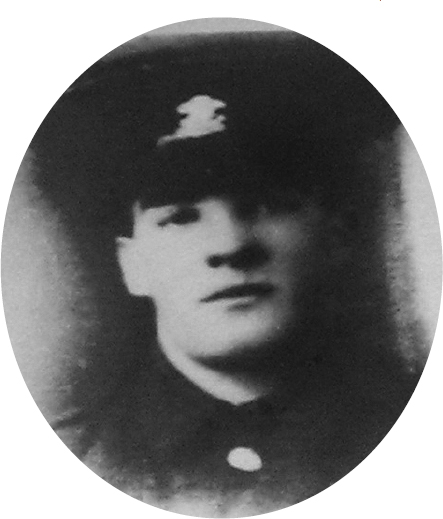
Private James Beynon of Whitland. Killed at Aubers Ridge on 3 May 1915.
May thus saw Carmarthenshire suffer more dead and wounded, among them Major George Fison Muller, whose family resided at The Glen, Laugharne. He was born on 28 May 1876 in Horsforth, Yorkshire, the son of Harry and Agnes Muller, later of 12, West Park, Eltham, London. On 1 September 1894, Muller had followed in the footsteps of his uncle, Commander Brayshay of The Glen, and joined the Royal Naval College at Greenwich. In 1904 he was appointed Naval Intelligence Officer at Hong Kong and held that post during the Russo-Japanese War. In 1911 he was appointed Musketry Instructor to the Chatham Division of the Royal Marine Light Infantry (RMLI). On 16 November 1914, Muller, now a major, transferred from the Chatham Division to the Deal Battalion, RMLI, and was attached to the Portsmouth Battalion for the Gallipoli campaign. He landed with the battalion at Gallipoli on 25 April and was killed during the Turkish counter attack at Anzac on 1 May.

Private James Verdi Davies, the cousin of James Beynon, also of Whitland, killed on 25 May 1915.
Private James Beynon of Whitland was killed whilst serving with the 2nd Welsh on 3 May, dying in the arms of his cousin, James Verdi Davies. Davies wrote a letter to his parents to inform them of his cousin’s death. By the time the letter reached Whitland, he had also been killed, on 25 May. James Beynon was the son of Alfred and Sarah Beynon, of Gorse Farm, Whitland, and James Verdi Davies was the son of Elizabeth Davies of Lowmead House, Whitland. Both men had been raised together and had enlisted together into the 2nd Welsh. The cousins are both commemorated on the Le Touret Memorial in France.
While dozens of families around the county were in mourning for their lost sons the Ladies Sewing Guild at Carmarthen were busy sewing and knitting comforts to send out to the men at the front. An article in The Carmarthen Journal listed the garments: forty-three pairs of socks, twenty-two body belts, fifteen helmets, seventy-three mufflers, thirty-eight pairs of cuffs, sixty pairs of mittens, twenty-nine shirts, ten pants, one suit, and three coats... The local soldiers would be the best dressed in the army!
On the Western Front the Battle of Aubers Ridge opened on 9 May and on that one day six more local men lost their lives; yet this would be just the tip of the iceberg, as within days many more local men would fall, not just in Flanders, but also at Gallipoli. On 13 May the old Canopus Class Battleship HMS Goliath was torpedoed and sunk off the Dardanelles, with the loss of 570 lives. The ship had been attached to the Pembroke Reserve at Pembroke Dock until re-commissioned in August 1914, and aboard her were many local men. Among the dead were two Carmarthenshire men; Thomas George Parry of Llanelli and Thomas Hall Brigstocke of Laugharne.

Lieutenant James Alexander Logan Stewart, of Alltrodyn Lodge, Llandyssul.
Another well known man was killed in Flanders that day. James Alexander Logan Stewart was born on 7 March 1893 and educated at Winchester and Trinity College, Cambridge. He was the son of Lieutenant James Logan Stewart, 7th Hussars and the Hon Eveline Mary, of Alltrodyn Lodge, Llandyssul. He was commissioned into the Rifle Brigade on 2 September 1913, was promoted to lieutenant on 30 November 1914, and sent to the front in December 1914, where he was posted to the 1st Battalion. He had not been on the Western Front for long when he found himself in charge of two platoons at Shell Trap Farm, Wieltje. He was reported missing on 13 May, later notified as being killed in action that day by the Red Cross.
On that same morning, Lieutenant Tom Roberts sent one of his final letters home to his parents:
‘I hope you received my letter of the other day and that you have not been worrying about me. My poor old battalion has been terribly cut up and why I should be the only one to come out scatheless [sic] I can’t make out yet. I’ve had some of the nearest shaves possible. I don’t know whether I thanked you for all the good things you sent me, if I didn’t, please accept my best thanks now...’
Local newspaper columns were filled with photographs of the fallen and letters from soldiers who had survived the terrible fighting. One such letter, in The Western Mail of 24 May, graphically spells out the ordeal suffered by the 2nd Welsh:
‘I am feeling a lot better since last Sunday’s battle. I told you I was going up to the trenches and everything went alright until Sunday morning, when our artillery opened a bombardment of the first and second line of German trenches. The bombardment was kept up for fully three-quarters of an hour and the noise was deafening. You would think the very heavens had burst. Just imagine 800 guns banging away for three-quarters of an hour, sending shells over your heads and our regiment in the front line of fire. It was like bedlam let loose. We could see nothing but a cloud of smoke in the German lines and after the bombardment had ceased B and C Companies had to mount the parapet of our first line of fire and advance. But, by George, it was an advance. As soon as our chaps got over they played their machine guns on us. Some poor chaps got no further. Some gained a small trench in front of our first line and opened fire on the Germans, but they kept on playing their machine guns on us.
‘My Platoon Commander, Lieutenant Betts, was shot. He was a good officer and a brave man to the last. This officer was a sergeant in the Norfolk Regiment and won his commission. He did all his service in India. He died with his revolver in his hand and he was in the act of bagging a Prussian Guardsman when he was shot. We would have followed him anywhere.
‘Four officers of our company were out of action (two killed and two wounded) but we went on until a few more of my section were put hors de combat. We were crawling up closer and closer and trying to keep up with the troops on our left. We got to within 30 yards of the German trenches and could not get another inch further without courting death. This was about seven o’clock in the morning of May 9. We could see our boys getting bowled over everywhere. We could not get any further or get back and could see the Prussian Guards and the Bavarian troops six or seven deep in their trenches waiting for us. I was in a pickle. I could not get back for hours after we received orders to retire. I was wet through up to my waist and covered with mud. They kept throwing bombs at us...’
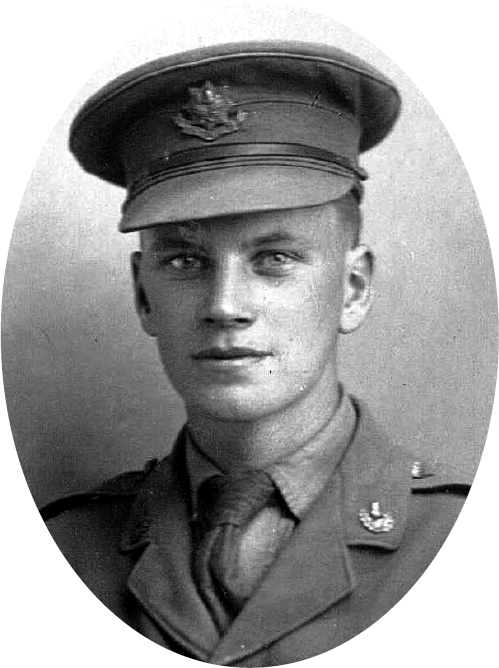
Lieutenant Tom Roberts, of Swansea Road Nurseries, Llanelli, a prolific letter writer to his parents.
The terrible state of the battlefield and the situation in which the 2nd Welsh were caught can be appreciated by the numbers of their dead who were never buried; only nine men out of over eighty killed in that single attack are buried in graves bearing their name, of whom two were found and identified after the war. The remainder either lie on the Aubers battlefield or are buried in some of the thousands of graves of unknown soldiers which are scattered around the area.
News appeared in the Llanelly Guardian of the death of Lieutenant Tom Roberts, who fell at Ypres on 24 May:
‘On Saturday morning the sad news was received that Lieut. Tom Roberts, son of Mr J.W. Roberts, Florist, James Street, had lost his life in defence of the honour of his country.
‘Lieut. Roberts was killed on May 24th, and the sad news of his death which was received in the form of a wire, the “deep regret” of Lord Kitchener was conveyed.
‘The story of how our gallant young townsman fell will not be forgotten for years to come. It was told in a letter that Mr J.W. Roberts received from a friend of the young Lieutenant a few hours after the War Office intimation was received.
‘Lieut. Roberts, suffering from the effects of the poisonous gases employed by the enemy, was removed to a farmhouse in the vicinity of the scene of the conflict, and the medical orders were that he should remain there. Full of the fighting spirit and anxious to avenge the deaths of many of his men, the gallant officer sprang to his feet immediately. He rushed out, and, overtaking his company, led them on in another attack on a German position.
‘“Come on, boys!” he shouted, taking the lead and, after advancing a little further, he fell with a bullet in his chest, being also shot in the leg.’
Casualties continued to be heavy throughout the month, the end of which would see the total number of dead in the county reach 175. The Second Battle of Ypres had taken a heavy toll on the allies, yet the trench lines had remained for the most part stagnant. Among the fallen was Lieutenant Lionel St George Mordaunt Smith from Laugharne, whose family traced its lineage directly from William the Conqueror. He was born on 23 April 1896, the son of Mordaunt Kirwin and Ethel Mordaunt Smith, of Milton Bank, Laugharne. His father had served as a major in the Loyal North Lancashire Regiment, before retiring into civilian life as a bank cashier and his grandfather was Major Lionel Seton Smith, late of the 54th Regiment, whose own uncle, Colonel Lionel Smith, 65th Regiment, had served with distinction in the Indian campaigns. Lionel’s father died in 1906 and his mother had remarried Major William Murray Mathew of the 4th Battalion Royal Inniskilling Regiment, who had fought in South Africa. Smith was educated at Elstree School from May 1906 to July 1910, then at Charterhouse until 1913, where he served as a sergeant in the Charterhouse OTC He was admitted into the Royal Military Academy during the November 1913 intake and was commissioned into the 2nd Battalion, Royal Inniskilling Fusiliers.

Lieutenant Lionel St George Mordaunt Smith, of Laugharne. His brother fought at Jutland, and survived the sinking of his ship.
According to the War Diary of the 2nd Royal Inniskilling Fusiliers, the Battalion was encamped at Montmorency Barracks, Béthune at the beginning of May and it traces their movements from trenches at Cuinchy, billets at Béthune, Le Hamel and Richebourg. From 9 May they remained in the Richebourg area, alternating time in the trenches with rest days. On 12 May they were posted to a front line trench, suffering several casualties whilst waiting for the order, which arrived on the night of 15/16 May, to attack the German lines. Lionel was killed during the assault of 16 May. He was just nineteen years old and is commemorated on the Le Touret Memorial.
During the month of May elections had been held to fill local council posts. Among the appointments noted in the Carmarthen Journal was the appointment of Mr Samuel Lewis Gravelle to the Chair of the Burry Port Urban District Council. The family was well known in the area and Councillor Gravelle had two brothers serving as officers in the army.
The ‘War Jottings’ column in The Welshman of 28 May noted that ten recruits from Llandyssul had been brought to Carmarthen by the recruiting lorry. It also reported that the Bishop of St David’s, whilst making a speech at Tenby, had condemned the people of west Wales as being very slow to take home to their hearts and minds the magnitude of the war and that they had not yet realised that we were fighting for our country. This demonstrates that there was still some apathy in west Wales about the war, with many people thinking that the European War was nothing to do with them.
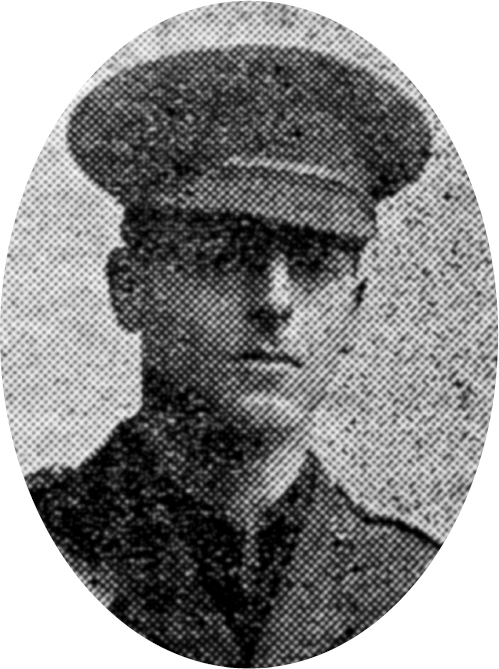
Lieutenant Hugh Graham John, of Llangennech, killed at Railway Wood near Ypres.
The month of June was to bring a slight lull in the severity of the fighting. Only twelve local men died during the month, six at Gallipoli, four in Flanders and two on home service. Lieutenant Hugh Graham John, a Llangennech man, was among the casualties. Hugh was the son of Hugh and Margaret John, of Bronygarth, Llangennech. He was commissioned in the Northamptonshire Regiment, but posted to the 1st Battalion, Northumberland Fusiliers. His unit had taken part in the Christmas Truce the previous year. He was reported as falling wounded in the arm and head during an attack near Railway Wood, near Ypres, on 16 June. Surviving men of his company reported that they thought he had been captured by the Germans, but no trace of him was ever found and he was listed as dead. He was just nineteen years old and is commemorated on Panel 36 of the Menin Gate Memorial.
The following month, July, followed a similar pattern, with most of the activity taking place in Gallipoli, where seven of the eight county men killed that month fell. Many more left the county for active service during July. At the beginning of the month the 1/4th Battalion, Welsh Regiment, its ranks filled with local men, marched through Biggleswade before entraining for Devonport, where, under sealed orders, it embarked aboard the SS Huntsend, the only clue to its destination being the issue of Eastern kit. Also embarking at Devonport was the Welsh Field Company, Royal Engineers. Huntsend sailed on 19 July for the Mediterranean, its final destination Gallipoli. Lieutenant Elydyr Lewis of the 1/4th Welsh wrote from Bedford back to his parents at Llwynycelyn, near Llanwrda, to tell them of his impending departure overseas and asking if they would wire him £5, as he had nowhere to cash a cheque. He survived the war, fighting in France with the 1/6th Welsh in 1916 before being discharged from his commission following a court martial on 12 December 1916, but later volunteered to serve as a gunner with the Royal Garrison Artillery.

Lieutenant Elydyr Lewis, 1/4th Welsh, a very interesting local character.
Another battalion of the Welsh Regiment, the 9th Welsh, was, together with the 9th RWF, attached to the 19th (Western) Division. Both battalions contained in their ranks hundreds of local men, all early enlistees into Kitchener’s First Army from August 1914 onwards. These battalions trained on Salisbury Plain over the winter, suffering in terrible conditions under canvas. On 12 May the battalions moved to Perham Down, receiving service rifles on 18 June and went into hutments at about the same time. On 23 June the 19th Division was inspected by the King and on 18 July it embarked at Southampton for Le Havre. Landing on 19 July, the battalions entrained to the Calais area, before marching in stages to the Laventie sector, where the division would be initiated into trench warfare.

A platoon of the 9th Welsh, ready for service overseas.
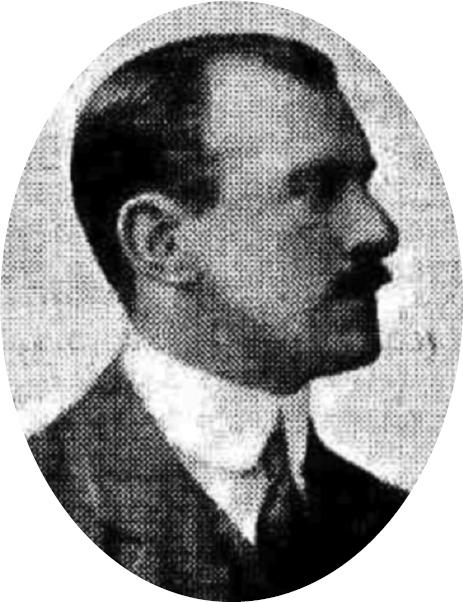
Captain Cecil Evelyn Long-Price of Talley.
August 1915 saw more loss of life. In the first week twelve men from the county were killed, almost all from Llanelli; five in Flanders, one at home and six at Gallipoli. On 6 August fresh impetus had been thrown into the stagnant Gallipoli campaign, with landings at Suvla Bay by a fresh force. As part of this new attack the Anzacs and British launched attacks on Lone Pine, Sari Bair and Laing’s Nek. Huge numbers of casualties were suffered over the coming days. Captain Cecil Evelyn Long-Price, of Talley, was killed when his battalion, the 9th Battalion, West Yorkshire Regiment, landed at Suvla on 7 August.

Captain William John Howells, of Eglwys Cymmin, a teacher at Lampeter College, and former student of Aberystwyth University.
On the following day, the 13th Division entered the fray alongside the Anzacs. Attached was the 8th Welsh, which attacked and briefly held the Turkish strongpoint at Sari Bair, coming under withering machine-gun fire the whole time. All that remained of the battalion on their feet by the following day were five officers and 274 men. The 8th Welsh listed among its long list of casualties over two days of fighting: killed, nine officers and thirty-seven other ranks; missing, 266 other ranks, most of whom were reckoned as dead; wounded, nine officers and 141 other ranks. Among the men killed were over twenty men from Carmarthenshire, including Captain William John Howells.
Howells was born in White Lion Farm, Eglwys Cummin, in 1888. He resided with his grandfather, Ben John, at Brook, Laugharne, prior to schooling at Tremoilet School and Whitland Grammar School, then gaining a BA with Honours at Aberystwyth University. He was a teacher at Lampeter before the war, enlisting into the Welsh Regiment at the outbreak of hostilities and was commissioned in the 8th Welsh. He was among the wounded in the attack of 8 August, was evacuated from Gallipoli, but died of his wounds on 10 August aboard the Hospital Ship H.M.H.S. Valdivia. He was buried at sea, so he is commemorated on the Helles Memorial.
Fighting continued at a frenetic pace all over the peninsula over the coming days. On 9 August the 53rd (Welsh) Division entered the fray, landing at Suvla Bay. The division had no idea of its objectives, had never set foot on Gallipoli before and was only issued with maps after it landed at Suvla, but still it was ordered into action, its three brigades being sent to different locations. The 1/4th Welsh was ordered to positions ‘somewhere in the bush’ near Hill 10 and on the following morning found itself caught in murderous fire. Some hours of chaos passed by and the attack by the 53rd Division turned into a rout. According to the History of the Welsh Regiment:
‘The troops of the 53rd Division set off about 6 am across the Salt Lake. The Turkish shrapnel and rifle fire poured upon them as they advanced and only increased at the foot of Scimitar Hill. To watch parties of them attempting to steal up sheltered portions of the hill was a piteous sight. The cover was much reduced because the ground was now black with burning and most of the bushes gone. Many fell on all sides. The corner of a small wheat field near Abrikja was fringed with dead who looked like a Company lying down in the shade. One saw many deeds of courage among officers and men.’
In five days the 53rd Division lost 123 officers and 2,182 other ranks. The casualties in the l/4th Welsh were: three officers and ninety-four other ranks killed; eleven officers and 178 other ranks wounded, including Majors J. F. de Rees and A. L. Bowen of Carmarthenshire. Altogether over fifty of the dead were from the county, including Second Lieutenant Allan Whitlock Nicholl Roderick, from Burry Port and Captain Hugh Mortimer Green, the teacher from Carmarthen College mentioned earlier.

Captain Hugh Mortimer Green, another former student of Aberystwyth University.
Hugh was the son of Thomas Mortimer Green and Catherine Green, of Aberystwyth, and the brother of Cyril Mortimer Green. He was educated at Carmarthen College along with his brother and was gazetted in the 4th Welsh. Green was 32 years old when he was killed on 9 August and is commemorated alongside many of his men on the Helles Memorial.
Within a week or so of the launching of these operations, news of the terrible fighting and the many casualties reached the families of the men back in Carmarthenshire. News of the gallantry of Lieutenant Cecil Phillips, the son of the Llanelli Postmaster, William Phillips, also reached the county. Colonel J. T. Perro of the 53rd Welsh Division staff recommended him for the Victoria Cross. His recommendation read:
‘For great gallantry in going out almost 70 yards under heavy shrapnel and rifle fire and assisted by an NCO bringing in a wounded officer to the covering of a trench and again returning and bringing in three other wounded soldiers.
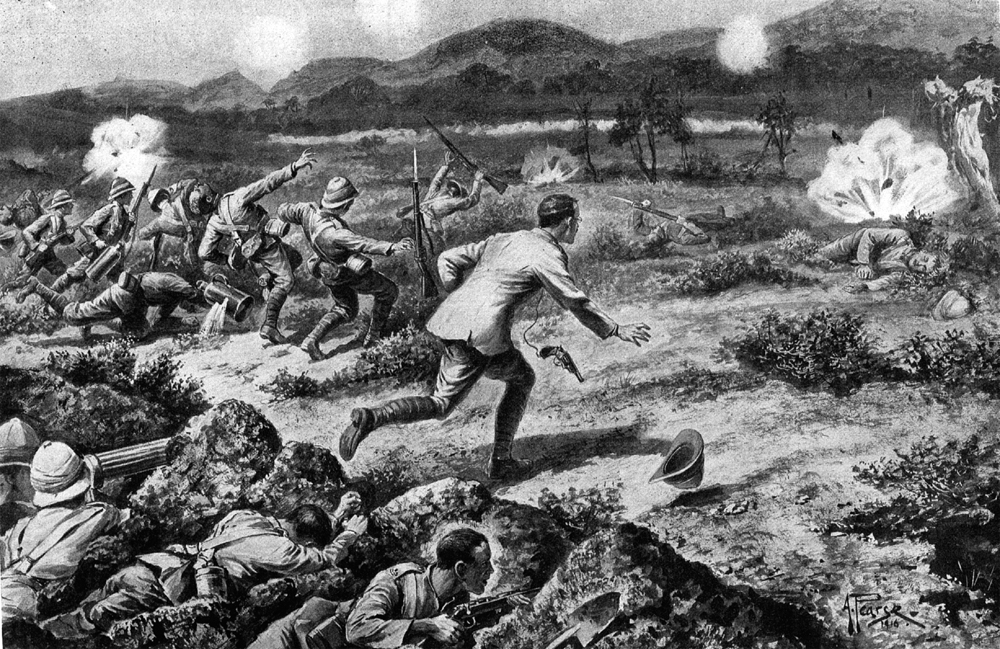
Lieutenant Cecil Phillips wins his Military Cross for his gallant rescue of Captain Shenston.
Phillips was eventually awarded the Military Cross; later in the war he was awarded the Distinguished Service Order. The wounded officer was Captain Shenston of the Essex Regiment. This brave and selfless act resulted in his deed being included in the illustrated book Deeds That Thrilled The Empire. He wrote a series of letters home to his parents and sisters, chronicling the period after embarkation at Devonport and the first two months of life on the peninsula. In one letter, dated 28 August, written in the trenches, he wrote of his experience of the landings:
‘Arriving just off the coast at dusk, we waited all night while our warships pounded shells into the hills which rose in the form of a horse-shoe from the beach. At about 8 o’clock A & B & C Coys and Machine Gunners all got off our ship on to a destroyer and at a tremendous rate were taken nearer the shore. Here we got into small boats right up to the beach.
‘When getting into the small boats, one filled with water and we nearly lost a boat load of men. Lieutenant Roderick was also in the boat and nearly went down. Each man was carrying much over 100 lbs.
‘Well the three Coys and gunners landed and joined up on the beach. Next the order came that they could prepare breakfast and as no-one had had anything since the previous evening. It was a very welcome order. Each man had brought some sticks and so fires were soon going. Then suddenly and without any warning a shell burst 50 yards on our right. In two minutes we had all disappeared over the sand-hills and no-one had been injured, “Thank God”.
‘The other Coy who were following us from the ship had to return and did not land for some hours. Shells dropped within yards of their boat. In the hurry of getting away and, having so much to carry, I found the gunners had left behind some of their gun parts.
‘Getting two volunteers we went back and I found a shell (exploded) lying two yards from my equipment. Then we moved off and all day we advanced very slowly under shrapnel fire. The enemy made a mark of the machine guns. How any of us came through is a miracle. Yet I did not lose a man except one through fatigue of carrying gun etc. Just before we started the Fusiliers (Welsh) passed us in fatigue dress carrying picks and shovels and within 20 yards of us a shell dropped in their ranks and before our eyes three of them had passed from this world. Still no-one hesitated. The stretcher bearers attended to the wounded, the rest went on. Men grew quieter, their set faces became even firmer, some tried to joke but the jokes failed. We realised for the first time how near death we all were and that was too serious to joke with. The 4th Cheshires and 5th Welsh went on, leaving the 7th Cheshires and 4th Welsh as supports to follow them.
‘They advanced miles over enemy country (open country at this part). At night fall we were under trees waiting for what the morning would bring forth. All that day we had seen no enemy and had done no fighting. Simply had to endure the thoughts of what we were to do. Then the wounded started coming back and being brought back. Think of our position, inactive, under heavy and accurate shell fire, seeing our fellow countrymen dropping and being brought through our ranks uttering the most fearful sounds, groaning etc. You can imagine how our blood boiled. How we longed to get at the enemy. Our chance came at daylight and we went forward. The order was to advance beyond the 5th Welsh, whose lines we had to pass through.
‘The enemy had (as he has now) a glorious position in the hills and from where he poured lead into the Valley in which we were advancing to where we are now. Thick scrub and trees everywhere, yet the lads advanced just like as in peace time practising at home. One of the first to fall was poor Captain Howard of Haverfordwest, who held his head high and cheered up his men. The Colonel was with the first line and he and the Adjutant directed the Coys into extended order in their positions for the advance and advance they did. Miles they drove back the Turks and had they the necessary supports would have advanced over the hills which guard and keep us in this valley. But few saw the enemy as they kept a respectable distance and simply kept us off by firing. However, many actually used the bayonet and one man in my Coy broke his bayonet in a Turk. I was in a farm house with the machine guns and, from my position of vantage, I was able to see more than most people. At 5 pm another charge was made and soon after this the white flag incident happened which I narrated when writing some weeks ago. I had taken my gunners and guns ahead of our Coys, but owing to being unable to find a fine position I had to cross our front to get to the farmhouse mentioned. Then our guns did tremendous slaughter and the General of the 32nd Division [sic; 32 Brigade] himself came up to see the hundreds of dead (work of machine gun) which I pointed out to him.
‘Towards evening we had as many as ten guns. Quite a stronghold I can assure you. Our Brigade used this farm for their head quarters part of the day. The farm house was filthy and I would not have gone in for a second in our country in peacetime yet I stayed there two days in the filth...’
The 1/4th Welsh had been thrown into an attack in unknown country, whilst pre-landing preparations had been limited as there was only one map available to the battalion before landing. The men had not even been trained in mobile warfare. The 53rd Division (including 1/4th and 1/5th Welsh) was evacuated off the peninsula on 11 December and the 13th Division (including 8th Welsh) followed on 19 December 1915. Both divisions had suffered terrible casualties from sickness during the final months of the campaign and moved to Egypt to rest and rebuild strength.
Some headlines appearing in the press during the first weeks of September included stories of local men wounded at Gallipoli:
‘Mr John Williams, of Fair View, Walter Road, has received information that his two sons have been wounded; Gunner W. R. Williams, of the 4th Welsh Machine Gun Section, has his hand injured at the Dardanelles and Private Wyndham Williams, of the 9th Welsh, now in France, has received injury to his face... A letter has been received at Mill Stores, Pantyffynon, that Sergt. R. H. Bevan is in hospital at Malta, suffering from a wound in the leg caused by shrapnel; Private P. C. Thomas, son of the late Mr C. Thomas, painter, Tirydail and Mrs Pendlebury, has written to say he had been shot in the leg; Private Wm. John Hopkins, of Tycroes, is in Malta Hospital from wounds received at the Dardanelles; In addition to those already reported, the following Carmarthen boys in the 4th Welsh have been wounded: Sergt. T. Yorke, now in hospital at Alexandria; Private Tom Evans, 15, St Catherine Street; Private F.W. Isaac, Llangendeirne; and Private A.E. Davies, formerly a fireman on the Great Western Railway...’
A seemingly inexhaustible list of names appeared in the local newspapers on a weekly basis, especially in Llanelli, where the majority of the men were from, along with letters telling heroic deeds on the battlefield involving the 4th Welsh. While families around the county were struggling to deal with the news of all of these losses at Gallipoli, the British were readying for their next great offensive on the Western Front, the forthcoming Battle of Loos, which commenced in late September. This would prove to be even more of a drain on the supply of local men.

Duncan Ian Bowen Lloyd of Llanllwni.

Gwion Llewelyn Bowen Lloyd, Duncan’s brother.
The town of Kidwelly was decorated with flags and bunting during the first week of September to welcome home several wounded men from France, including Rifleman Ernest Furneaux of the Rifle Brigade, who had taken part in a Christmas Truce. The half yearly rent audit of the Ffynone estate was also undertaken that month; at a meeting with Mr Colby and David Francis, his agent, at the Castle Inn, Mr Colby used the meeting to distribute portraits of his late brother, Major Lawrence Colby, killed at Ypres on 24 October 1914, and to announce plans for a memorial at Llandyryr Church.
Another memorial service had already taken place at the small village of Llanllwni on 1 September. Charles Lloyd of Waunifor had recently lost two of his sons, Gwion Llewellyn Bowen Lloyd and Duncan Ian Bowen Lloyd. Both men were well respected officers, Gwion a captain in the 5th Dorsets and Duncan a lieutenant with the 5th Ghurkha Rifles. Both men were killed at Gallipoli during August. Hundreds of local people turned up for the service at Llanllwni Parish Church to show their affection and respect for the boys. Standing out among all the military news, a small paragraph in The Welshman of 10 September reported the not unsurprising news that local farmers were beginning to feel the shortage of manpower to labour on their farms and that work was underway to recruit farm servants.
The local hero, William Fuller VC, was discharged from the army as a result of wounds suffered earlier in the year and after his recovery toured west Wales, helping in the recruiting process. The story of him getting into a lion’s cage during a fair at Fishguard to prove his courage circulated in the county, but some less flattering stories prompted Fuller to announce in The Carmarthen Journal that stories of him being intoxicated whilst on recruiting duties at Cothi Bridge Show were untrue and that he had never tasted intoxicants in his life!

38th (Welsh) Division’s Horse Transport, a waggon similar to the runaway at Rhyl.
The Welshman of 10 September printed a story about the Carmarthen Battalion, which was parading through Rhyl before entraining for a move to Winchester. (The parade was filmed for showing in cinemas. This film has survived, but is in the process of restoration and cannot presently be viewed.) In the middle of the parade a transport wagon belonging to the Carmarthenshire Battalion ‘was proceeding along High Street on its way to the station, when the two powerful horses attached to it bolted and dashed along in the direction of the sea front. A number of persons were knocked down, one lady being seriously hurt. One of the drivers was thrown off the wagon immediately the horses bolted; the other, George Davies, a Pembroke man, stuck to his post in a wonderfully plucky manner. Finally the wagon was completely overturned through contact with some steelwork, the driver just managing to jump clear. The horses then came to a dead stand. Driver Davies was congratulated upon his skilful handling of the horses throughout the emergency.’
The battalion moved to Winchester to train on the rifle ranges and to enable the whole division, which had been renumbered the 38th (Welsh) Division, to train as a complete division for the first time. The Divisional Artillery had been training in isolation on the Cardiganshire coast, using telegraph poles as mock artillery pieces! Reverend J. Johns, Congregational Minister of Llansteffan, visited the battalion to bid farewell to the men.
On Sunday 11 September, a man walking near the railway line at Pembrey came across a body. The man was identified as Private Roberts Stephens (20395), a soldier of the 5th Welsh from Llwynypia, who had been hit by a train. Stephens was buried at Trealaw Cemetery. During the same week a number of wounded soldiers arrived in the county, and were taken to the Red Cross Hospital at Llandovery, where Mrs Pryse-Rice and Sir James Hills-Johnes VC greeted them. The staff were shocked at the injuries these men had suffered, several having suffered the amputation of limbs.
In France, preparations were well under way for the Loos offensive. General Joffre, the French Commander-in-Chief, had successfully pressed the British to launch an offensive on the Loos-Givenchy front, in conjunction with a separate French attack to the south, near Vimy Ridge, on the Noyon salient and another French attack in the Champagne. Sir John French had eventually agreed to the attack, under pressure from his government, and planned an offensive with a force of nine divisions, preceded by a combined artillery assault and the release of poison gas from 5,500 cylinders.
Sir Douglas Haig, who commanded First Army, drew up two separate plans of operations;
(1) An attack without gas by the 47th and 15th Divisions on Loos and Hill 70 and by the 9th Division on the Hohenzollern Redoubt and Fosse 8; and the development of this first phase, if successful.
(2) An attack on the whole front by six divisions, employing gas and smoke, the two outer divisions forming defensive flanks while the remaining four rushed the German second system and established themselves on the Haute Deûle Canal line four miles distant. The Indian Corps, north of Givenchy, and two divisions of the Second Army, near Bellewaarde Lake, were to make subsidiary attacks to tie the enemy down to their ground.
There were many local men present in the attacking divisions, which included the 19th Division (including 9th Welsh and 9th RWF); 1st Division (including 2nd Welsh, 1st SWB and 6th Welsh); whilst in the follow up troops were the Guards Division, amongst which, seeing action for the first time, was the newly formed 1st Battalion, Welsh Guards.
By the time the Battle of Loos opened, on 25 September 1915, 370 men from the County had fallen on the field of battle. A further forty-two local men would be killed on this first day of the battle alone, the overwhelming majority of whom were Kitchener’s recruits, equally shared between the 9th Welsh and 9th RWF. Both battalions attacked near Givenchy during the morning and, as they rose from their trenches, were mown down by machine-gun fire, the attack faltering after just a hundred yards. The conduct of the 9th Welsh was illustrated in a letter received by their CO, Colonel C. H. Young, from a battery commander who had watched the assault;
‘May I be allowed to offer you my very real and sincere sympathy on the losses sustained by your Regiment... If ever a Regiment had won a VC pendant to their regimental crest it is yours, for they knew what they were in for and went forward without demur. The regrettable losses and behaviour of the men at all events show the nature of the Kitchener regiments and if all are imbued with the same spirit as your command the ultimate issue of the war cannot be in doubt.’
The small town of Kidwelly was hit especially hard by the assault of the 19th Division: Privates Morgan Morgan and John Tucker were killed, Tom Lewis, Volin Jones, Charlie Peck and Sid Busst were wounded, and Sam Evans fell into a ‘Jack Johnson’ hole and broke his arm. Within days news of the Loos debacle had reached Britain, yet the battle raged on, not being called off until it ground to a halt on 19 October, costing Carmarthenshire another twenty-four men dead by the end of September, and a further thirty-three dead by 19 October, with hundreds of men wounded. The Welsh Guards sustained a large number of casualties in its assault on the Hohenzollern Redoubt, where six of their Carmarthenshire members were killed on 27 September. One of the dead Guardsmen was Lance Corporal Ivor Emmanuel, another Kidwelly man, who had worked as an electrician at the Trimsaran Colliery for several years.
Lance Corporal Ivor Emmanuel, electrician from Kidwelly.
Throughout September precious newspaper column space was filled with row upon row of names of the fallen, the wounded and of gallant deeds in Flanders and at Gallipoli the previous month, although headline news about the war was limited to alleged Russian successes on the Eastern Front. Llanelli and Llandovery Hospitals were swamped with badly wounded men and Carmarthen Hospital received twenty-two wounded men, mostly Anzacs. By now the 38th Division at Winchester was almost ready to join the fray and during its last few weeks at home in November 1915 soldiers of the division attended several religious services, one at Winchester Cathedral and another in Winchester town. The Hampshire Chronicle reported:
‘Last Sunday afternoon a Welsh service was held by the Divisional Chaplain near King Alfred’s statue in the Broadway when 3,000 soldiers attended. The band of the RWF played selections and the hymns. An Eisteddfod was also held on Thursday evening “Agored I’r byd”. The organisation of this was admirably carried out by Captain Anthony of Kidwelly, the Divisional Chaplain, Rev P.J. Roberts, Lance Corporal Rees and Private W.J. Owen. Dr Prendergast, organist of Winchester Cathedral, was the musical adjudicator and the Reverends P.J. Roberts, Divisional Chaplain R. Jones (Llandinam) and Arthur Hughes (Carmarthen) adjudicated on the recitations and poetical compositions.’
The majority of the casualties from the county during November were suffered at Gallipoli, as the winter hit the peninsula hard, causing flash floods, which opened shallow graves and drowned men in the trenches, followed by a blizzard and typhoid. The campaign was now finally deemed as a failure and Kitchener visited the eastern Mediterranean to see how the situation was.
In the meantime, a platoon of men from the Welsh Horse Yeomanry, originally recruited to serve as Welsh cavalry, were at work in Gallipoli on a mine near Hill 60 on 20 November when the Turks blew a mine in the vicinity, collapsing the Welshmen’s mine on top of them. Eight men were buried alive in the collapse, three of whom were from Carmarthenshire: Private Philip Davies, of Llanelli; Private Llewellyn Jones, of Llangeler; and Private William Cooper Lewis, of Carmarthen. Philip Davies is commemorated on the Helles Memorial, while the two other men were buried in 7th Field Ambulance Cemetery. Their Commanding Officer, Major HO Pugh, wrote to the families of the men and one of the letters was printed in The Carmarthen Journal: ‘I am exceedingly sorry to inform you that your poor husband met his death on the 20 November in a mine explosion by the Turks on Gallipoli... We were able to recover your husband’s body and buried him with two comrades; L. Jones, of Llangeler and W.C. Lewis, of Carmarthen, at the foot of the little gully we live in, and which is called “Rhondda Valley”...’

Trooper William Cooper Lewis, Welsh Horse, killed in a mine explosion at Gallipoli.
Towards the end of the year local Voluntary Training Corps [VTC] units were set up around the county, for men who did not wish to serve overseas but who could instead volunteer for service on home duties. Two units which publicised their organisations freely in the local press were the Carmarthen and Ammanford branches, appealing for volunteers to join their ranks.
VTC units had to be self-supporting and members had to provide their own uniforms, which could not be khaki; Lovat green was recommended and the members were required to wear a red arm band, bearing the letters ‘GR’. No weapons or equipment were provided at first and membership of the Corps was only open to those who had genuine reasons for not enlisting in the regular armed forces.
‘With a company commander who is an old Volunteer, an instructor who is an ex-Territorial with South African War experience and with an executive committee comprising several ex-Volunteers, the movement is started on a sound basis and we have not the slightest doubt that before very long the membership will approach 200.
‘There is a great number of persons in the district eligible for enrolment regarding the need of more men to maintain the strength of the armies in the field, we take it for granted that they are patriotic enough to accept their share of the work now being done by trained soldiers, who might then be released for service with their regiments.
‘Such work consists of guarding bridges, water supplies and lines of communication. It is well known that the king takes great interest in the movement and is delighted at the satisfactory progress made by the volunteer training scheme.’
The VTC Battalions legally became Volunteer Regiments in July 1915. In August 1916, the War Office decided to include the VTC Battalions into the County Infantry Regiment system and in Carmarthenshire they became numbered Volunteer battalions of the Welsh Regiment. A Volunteer Act 1916 was passed which obliged members to remain in the Corps until the end of the war.
Also in various local newspapers was a public request by the Government for more doctors for the front, with a request that one in three doctors aged under forty should enlist in the army. There were already several local doctors in France, including: Captain Walter Henry Lloyd of Carmarthen; Captain Rowland Philip Lewis of Laugharne; Captain Lionel Gordon Crossman of Carmarthen; Captain David Brynmor Chiles-Evans of Burry Port; Captain Hugh ap Gwilym Morris of Llandovery; and Captain Rufus Haydon Thomas of Caio.
At the end of September a novel court hearing was held at Whitland, where the residents of Pendine were held to account for displaying lights at night. The proceedings had been brought under the Defence of the Realm Act and several prominent villagers, including David Lewis Ebsworth, of the Beach Hotel at Pendine, were charged: ‘for not obscuring on August 6th indoor lights visible from the sea so as to be invisible from the enemy...’ Ebsworth was fined £5 for the misdemeanour, which was blamed on a servant girl. The police also brought up several more accusations against local villagers, which the court then proceeded to work through. David’s son, Thomas Lewis Ebsworth, was serving as an officer with the 6th Welsh in France and after the war built up one of the first bus companies in west Wales, Ebsworth Brothers, which was later sold to Western Welsh.

Captain Thomas Lewis Ebsworth, of the Beach Hotel, Pendine. This was the famous base for all of the land speed records on Pendine Beach during the first half of the last century. It was where the body of John Parry Thomas was laid after he was killed when his car, Babs, crashed on the sands in 1927.
Throughout the last few months of 1915 the newspaper columns were filled with letters home from the men at the front, interspersed with names of enlistees and reports of soldiers home on leave. One page of The Carmarthen Journal of 1 October 1915 printed articles on a wide variety of local military matters, such as: ‘Local Boys at the Dardanelles [which was a long letter from Sergeant Higgs, of the 4th Welsh].
Private Ellis, SWB of Pontyberem has fallen at the front; Rifleman Dan Richards of Llandovery has been wounded; Rifleman William John Hendy of Llanelli has been wounded.
In the Amman Valley Chronicle, QMS W.E. Morgan of Tycroes wrote:
‘Just a few lines to let you know that I am still uninjured and happy under the circumstances... We are having plenty of shelling every day; but our good luck still lasts. They gave my Brigade a terrific bombardment yesterday, but we were very fortunate, only two officers and two men being wounded. One of the officers had both his legs broken and is not expected to live... The Welsh Territorials are camped half a mile from here, chaps from Ammanford, Llandilo and Llanelly. I took a walk down under shell fire to see if I knew any of them and met two or three that I knew from Ammanford; also some from Capel Hendre... One man from Ammanford used to live at Penybank, Sergt. Dai Thomas. I also met the Thomas who used to drive out for Rees Jones, cabinet maker. He was intending to come up to see me the next night, but was never seen after a fight they had during the day; so he is reported missing, poor chap. Dai Hughes, Tan-y-bryn, I have seen twice and he looks well, nearly too fat to move. I was so pleased to see him and he to see me. He had heard that Twm was out here, but had not seen him.’ [Twm was Tom Hughes, one of the Llandeilo men who was killed on 10 August.]
Recruiting men locally was now proving to be a real battle, with all of the districts around the county reporting disappointing numbers, showing that the surge of voluntary recruitment had almost fizzled out. This was a problem hitting the whole country and the matter of conscription was now looked into seriously;
‘The recruiting rally was in many parts of the district distinctly disappointing to the authorities and it would seem that the voluntary system, at least in the Amman Valley, is played out.
‘There seems to be a wholly unnecessary fear that men recruited now will have to spend the winter in the trenches, which is absurd, of course, as they will take at least six months to train and can only during that period take the place of those men who have answered their country’s call and are anxiously awaiting their turn to go abroad.
‘It is to be feared that even now quite a large number of young men altogether fail to realise their country’s peril, otherwise they would accept their responsibility and voluntarily do their share.
‘It is somewhat of a stigma on the character of Welshmen, especially those living in the country districts, that while all the English boys working on the farms took the first opportunity to join the Colours, they are content to remain behind and allow others to fight their battles for them.
‘But as Lord Kitchener has stated, ‘he knows the number of men he wants, where they live and the number on their doors and when he wants them, if they don’t come, he will fetch them’.
‘The vicar of Ammanford made use of strong remarks regarding the young men who still held back. He was ashamed of the young men of the district, who spent their time in horse racing and billiard playing when they ought to be doing something very much better.
‘Ald. W. N. Jones said he had failed to get a meeting at both Cwmamman and Penygroes that afternoon, because most of the young men had gone to the races at Ammanford...
‘There was a crowded gathering at the Town Hall, Llandovery, presided over by the Mayor, Mr J. C. V. Pryse-Rice. The speakers included Mr C. P. Lewis, Mr Mervyn Peel, the Rev H. Ifor James, the Vicar (The Rev D. Edmondes-Owen), a soldier who had returned from the front and Lieut. Skule, the recruiting officer for the district.
‘It was stated that, so far as the town itself was concerned, recruiting results had been satisfactory. In the rural districts, however, the reverse was the case.
As a response to this lack of keenness to enlist, the recruiting authorities throughout the country received instructions from the War Office. These instructions referred to an immediate recruiting canvass of men eligible for military service who had not been exempted due to their occupations. The text of the instruction read:
‘As it is evidently the duty of every man who has not been starred to at once join the Army, he being no longer required for necessary services in his country, you are to take whatever steps you consider most effective to induce such men to join the Army. In carrying out this you will doubtless be assisted by the local authorities.
‘You should see in your district that no un-starred man is able to complain any longer that he is not wanted in the Army as he has not been fetched.
‘You should report the number of non-starred men in your district who refuse to give their services to the country by enlisting in the Army, where they are so much needed.’
A meeting of the Carmarthenshire Joint Standing Committee on 12 October stated that crime had risen by almost ten per cent in the county over the last year, mainly due to drunkenness and absenting soldiers. Larceny and offences against the Coal Mine Act had reduced, but the main worry was about increased lawlessness at Pembrey and Llanelli, more especially Pembrey, whose population was reported as, ‘rather a rough class, consisting mainly of navvies’! The result of this increase in drinking was cause for concern and the committee passed a resolution to curtail the opening hours of public houses in the industrialised areas of the county. On another note, the Chief Constable, W. Picton-Philipps, noted that thirty-one policemen from the county were presently serving in the army, but an increase in budget due to having to provide extra manpower to police the area around Pembrey Munitions Works had compensated for the loss of these experienced policemen.

The young Bertie Richards, the son of William and Margaret Ann Richards, of Brynmefus, Talog Road, Trevaughan. Bertie and his father drowned while bathing at Llansteffan, just two weeks after the family had received news of the death of his elder brother, William John Richards, at Lemnos.
Tragic news at Carmarthen overshadowed any fears of local crime. During the summer a young boy, 13-year-old Bertie Gwyn Richards, of Carmarthen, had been swimming with his father at Llansteffan, when he was taken away by the current. His father, William, drowned whilst trying in vain to save his son. Towards the end of October the bereaved widow and mother, Margaret Ann, received a telegram stating that her eldest son, William John Richards, of the Welsh Field Company, had died of wounds received at Gallipoli in hospital at Lemnos on 14 October.
The militant sector of Carmarthenshire society was also beginning to speak out. At the end of 1915 the Carmarthenshire teachers applied for a ‘War Bonus’ of £10 per annum. The response to their request at the quarterly meeting of the Carmarthenshire Joint Education Committee was not very sympathetic:
‘We had all got to sacrifice at the present time. They had eighteen teachers in the county who had nobly responded to the call of their country and joined the forces. He did not know whether that was a very great record when they remembered that they had 700 teachers in the county. The enlistment worked out at a little less than three per cent. They had a large number of eligible young men of military age and ability remaining. It was to be hoped that this record would be greatly improved upon in the near future. They knew of the action of thousands of young men in various walks of life who had given up their educational and professional training and career and sacrificed everything for the sake of their country.’
Coal miners and railway workers would soon be jumping onto this bandwagon over the coming months and the dire need for manpower prompted the King to launch an appeal for men;
‘At this grave moment in the struggle between my people and a highly organised enemy who has transgressed the laws of Nations and changed the ordinance that binds civilised Europe together, I appeal to you.
‘I rejoice in my Empire’s effort and I feel pride in the voluntary response from my Subjects all over the world who have sacrificed home, fortune and life itself, in order that another may not inherit the free Empire which their ancestors and mine have built...
‘I ask you, men of all classes, to come forward voluntarily and take your share in the fight.
‘In freely responding to my appeal, you will be giving your support to our brothers, who, for long months, have nobly upheld Britain’s past traditions and the glory of her Arms.’
The realisation by the working man that the great crusade in Europe had turned into a charnel house was widespread by the end of 1915 and, as we have seen, the initial flood of volunteers in 1914 had gradually reduced to a mere trickle.
Carmarthen saw its fourth military funeral of the war when an Australian soldier, wounded at Gallipoli, died in Carmarthen Hospital. Albert John Guthrie was from Perth and had enlisted in Melbourne on 26 August 1914. He landed at Gallipoli in April 1915 with the 2nd Field Company, Australian Engineers. He was evacuated from Gallipoli on 10 September, suffering from gastritis, and was treated at Malta before being evacuated to England. He died at Carmarthen Red Cross Hospital after suffering an internal haemorrhage on Thursday 9 November and was buried with full military honours at Carmarthen Cemetery. News of the Australian’s death was published in The Carmarthen Journal the following week:
‘The funeral of Sergeant A. J. Guthrie, Australian RE, who passed away at the Red Cross Hospital, Carmarthen, took place on November 11, the interment being at the cemetery. The Rev B. Parry Griffiths, vicar of St Peter’s, assisted by the Rev. Itar Edwards, curate, officiated. Despite the rain, large crowds of townspeople watched the mournful cortege on the way to the burial ground, and there were manifestations of genuine sympathy in all quarters. Preceding the hearse was the Boy Scouts Band, under the scoutmaster, Mr G. Humphreys, and a large number of wounded soldiers. The coffin, which was draped with the Union Jack, was covered with a very large number of beautiful wreaths. The chiefmourners were Private H. D. Guthrie, of the AIF (brother of deceased), who has also been wounded; and an uncle of the deceased. Amongst those present were Lieutenant-General Sir James Hills-Johnes, VC G.C.B., Dolaucothy: Mr Pryse-Rice, Llwynybrain; Revs A. Fuller Mills, W. D. Rowlands and E. Ungoed Thomas; Drs Parry, Williams, and Harris; Nurse Ditcham, and a number of other nurses. The Last Post was sounded at the graveside.’ [His brother, Wilfred George Guthrie, later won the Military Medal at Villers-Brettoneux whilst serving with the 51st Battalion, AIF]

Lance Corporal Albert John Guthrie, who died at Carmarthen Hospital on 9 November 1915, and is buried in Carmarthen Cemetery
While talks of conscription were in the air, another scheme to get recruits, the Derby Scheme, was launched in October. The Derby Scheme was a voluntary recruitment policy. Men who registered their name would be called upon for service only when necessary and married men were promised that they would only be called up when single men became unavailable. Men were classified in groups according to their year of birth and marital status and were to be called up with their group when it was required. Newspapers throughout the county reported on this novel idea and also threw their own weight into the mix to attempt to shame men into enlisting;
‘The Voluntary system of enlisting is now undergoing its final test under Lord Derby’s scheme and within the next two or three weeks we shall know whether the fighting spirit of the nation is equal to the demands made upon it.
‘There are those who believe it will and that we shall emerge triumphant from the war without having recourse to compulsion. That there has been a great improvement in recruiting during the last few days is an evidence of the stimulating effect Lord Derby’s letter has had upon many young men, who now see that they can no longer hold back in face of the great national danger without becoming to themselves a source of perpetual shame.
‘No doubt some of them have had good reasons for putting off taking the final step. Some, we know, have failed to realise the seriousness of the situation, owing to the over-secretiveness of the Government as to what is really happening, but there are others over whom the fear of being branded as cowards has at last prevailed.
‘In the Amman Valley and adjoining districts there is a good deal of misapprehension as to the position of the collier and quite a number of people think it disgraceful that young men should be hanging about the streets in the afternoons and evenings – it is forgotten that they have been at work all the previous night – when older men of other trades have gone into the Army.
‘It is argued that only steam coal and not the anthracite is wanted for the purposes of the war, but enquiry reveals the many uses to which the stone coal is put in connection with war munitions and there must be something in it, or Germany would not have taken so much of this coal and made such desperate efforts to obtain control of some of our most important mines.
‘But while there is need for the collier to remain at his work, it is not pleasant to see others, who have not been brought up to that trade, giving up other occupations to rush to the mines in order to escape the pressing attentions of the Recruiting Committee.
‘Such action is a clear case of cowardice and anyone guilty of it must have a very hardened conscience... It is up to the young men to show their spirit and prove that compulsion is unnecessary.’
The scheme ultimately proved unsuccessful and was abandoned in December 1915, superseded by the Military Service Act 1916, which introduced conscription.
One of the last real items of news concerning the county in 1915 was the movement of the 38th (Welsh) Division from Winchester to Folkestone, where it began embarking for France on 2 December 1915. Over the coming days the various constituent parts of the division landed in France, assembling at Le Havre and Boulogne, before entraining for Aire, in northern France. The 15th Welsh assembled at ‘La Porte du Calais’, Boulogne, on 4 December, one of the four ancient gateways to the city, and spent their first night camped at Ostrohove, overlooking the harbour, before entraining for Aire to join the remainder of the division. The battalion had been inundated with congratulatory telegrams from most of the towns in Carmarthenshire.
Field Marshal Sir John French was forced to resign on 18 December 1915 and his place was taken by General Sir Douglas Haig, who had criticised French for his handling of the Loos offensive in September.

Lieutenant David John Montagu Stephens, of Carmarthen, who was blinded during the war, and lived until 1976
By the time the year drew to a close, over 530 men from the county had lost their lives as a result of the war. Many more had been maimed or wounded and would suffer for the rest of their lives. One such man, Lieutenant David John Montagu Stephens, who arrived home just days before Christmas.
He was born on 23 March 1887, the son of David and Lucy Stephens, of Trawsmawr, Carmarthen. He trained as an electrical engineer prior to emigrating to Canada in 1910. When war erupted, he enlisted at Valcartier, for the Canadian Expeditionary Force (CEF) and was sent to France with the 6th Battalion, CEF, 1st Canadian Division. A promising soldier, he was granted a commission in the Royal Welsh Fusiliers, joining the 9th RWF. He was leading his company to capture a section of German trench at Loos on 25 September when he was shot in the head by a sniper. He spent almost three months in hospital before arriving back at Carmarthen, totally blind. He lived in Carmarthenshire for the rest of his life, dying in 1976 aged 89, spending sixty-one years of his life without sight.