
Chapter Four
AS HARD AS 1916 had been there was no option open for the Allies other than to see it through till the bitter end, or to come to terms with the Germans. The latter option was deemed as impossible, as there was no way France would concede territory to the Germans, nor would Britain renege on its promise to aid Belgium.
Part of the Allied plan for 1917 was to open a new front in Palestine in order to force Turkey out of the war. This would then open the Dardanelles and allow open access to Russia through the Black Sea, helping her to press Germany and Austria-Hungary on the eastern front, thus forcing Germany to send more troops to that theatre. The Somme had proved as disastrous to Germany as to the allies. Its economy was starting to suffer due to the Royal Navy’s tight grip on the oceans. Manpower had been severely depleted by the Somme campaign and by continued fighting in the Champagne and Verdun. As a result, the Germans began preparations to withdraw to a newly constructed line of defence, known to the British as the Hindenburg Line, which stretched from Arras southwards to Laffaux, near Soissons, on the Aisne.
January was relatively quiet as far as the British were concerned apart from some minor operations on the Somme. The weather on the Western Front was harsh and troops suffered in the icy conditions. Military news fell to a trickle in the local newspapers, with only a few letters published along with news of gallantry awards to county men and of the deaths of several soldiers. Concern was raised about the state of education in the county, with figures released showing that 419 of the 495 teachers in the county were not fully qualified, mainly due to the demands of the war on local manpower.
The Carmarthen Journal printed an article about a young tenor from Carmarthen, Merlin Davies, who had impressed audiences during a recent series of performances at the Aeolian Hall, New York. Although the qualities of his voice were well known in Carmarthen, he was as yet unknown in Britain. Merlin made his reputation in America and Canada, becoming Professor of Music at McGill University in 1908. He remained in Montreal until his death in 1972, at the age of 93. Two years prior to his death he was still in fine voice, taking centre stage during his 90th birthday celebrations at Salem Welsh Church at Montreal!
The numerous festivities which had taken place over the Christmas period, football and rugby matches, fox hunts and concerts had raised morale throughout the county, but the mood was soon quenched again. The loss of so many men on the Somme during 1916 had necessitated the lowering of the call-up age from eighteen years seven months to eighteen years; whilst every colliery in Britain received notices that more colliers were required for the army. There were three conditions for this:
1. Those who have entered the mines since 14 August 1915.
2. Surface workers or officials supervising such workers as enginemen, pumpmen, weighmen, electricians, fitters and mechanics.
3. Workers of military age employed in the mines who during the last three months had lost on an average two or more shifts during the week from avoidable causes.
At the end of January these eighteen year olds were beginning to be called up for service, with posters put up around Carmarthenshire proclaiming:
‘Youths born in 1898 and 1899, who attested and were then transferred to the Army Reserve. Those in Group A, born in 1898, are required to report themselves fifteen days from the date of this Proclamation (January 30th); and men in Group B, born in 1899, thirty days from the date on which they attain 18 years of age.
‘Youths deemed to be Reservists under the Military Service Acts, 1916. These have been assigned to classes according to the year of their birth and men of Class A, born in 1898, are required to report for the purpose of joining the Colours within fifteen and thirty days respectively of January 30th.’
The decision to plough up and cultivate much of Carmarthen Park to grow green food for sick army horses was approved at a meeting of Carmarthen Town Council on 3 January; authorisation was given to the local Army Remount Depot, who agreed to carry out the necessary work themselves and to provide the manure.
An horrific occurrence shook the people of Carmarthen on Friday 26 January, with the tragic death of Thomas John Joshua, the 21-year-old son of William and Mary Anne Joshua, of 19, Quay Street, Carmarthen. Thomas had enlisted at the outbreak of war into the 9th Welsh, but was discharged as being unfit. He re-enlisted and joined the 4th Welsh and was stationed at Penally Camp. On the night of 26 January, Thomas and a friend, Private Edward Alcroft, were returning from a night out in Tenby and were walking along the railway line to Penally Camp when they were struck by a train. Thomas was killed instantaneously, his head crushed by the wheels of the train, while Edward clung onto life for several days before passing away. Thomas was buried at Carmarthen (Water Street) Calvinistic Methodist Burial Ground, with 300 soldiers from his battalion forming a guard of honour.
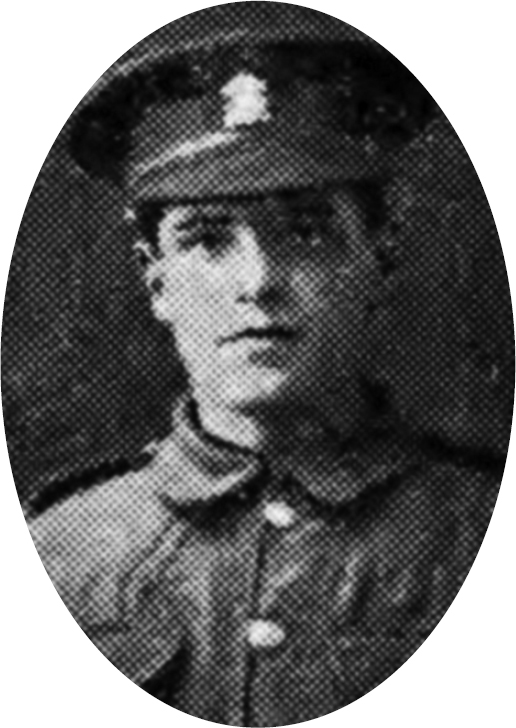
Private Thomas John Joshua of Quay Street, Carmarthen, tragically killed while walking on the railway line.
Thirty-one men from the county lost their lives during the opening month of 1917. The Carmarthen Journal of 26 January saw fit to print a special edition of their newspaper, the cover of which contained the portraits of sixty-eight men and Nurse Frances Brace who had fallen. The same issue contained the story of Eleazor Evans of 6, Prospect Place, Carmarthen. His son, David, won the Military Medal during the Somme offensive, but had been badly wounded, dying in Rouen on 18 September 1916. Eleazor was invited to Bush Camp at Pembroke, where a moving presentation ceremony saw him being awarded his late son’s Military Medal. The proud man put his son’s medal up for display in his shop window at Lammas Street, Carmarthen.
On 1 March several local newspapers published the details of a meeting of the coal owners of the Western District of the South Wales coalfield at Swansea, when the question was discussed of the utilisation for National Service of labour not required in the collieries owing to the scarcity of tonnage. Demand for coal had dropped and several of the collieries in Carmarthenshire had been put on short hours. It was stated that:
‘Thousands of men work only a few days per week, spending the remaining days in idleness and hundreds of horses have to be fed with hay and corn without giving an adequate return for food consumed. By recognising the fact that no material improvement can be expected in this district during the war, it is possible at most of the collieries to release a large number of men, amounting in the aggregate to many thousands, whose services could be utilised for the country’s needs.’
The following resolution was unanimously passed at the meeting;
‘That this meeting of representatives of colliery owners of the Western District of the South Wales coalfield respectfully draw the attention of the Government to the waste labour in the collieries in the Western District caused through lack of tonnage and suggest the release of as many young men as can be spared consistent with the maintenance of the output of each colliery per month to approximately the same quantity per month as was produced on an average for the three months ended February 28, 1917.’
Food was beginning to get scarce in Britain, with warnings of a forthcoming potato shortage and that strict regulations regarding foodstuffs were being examined. David Lloyd George even took the step of writing to the farmers of Britain, imploring them to keep food production up and informing them of a plan to bring extra labour into the market by moving men and women from other industries into land work to help the farmers. Local officials looked into utilising waste land around the county, with land on the Black Mountains in the area of Quarter Bach looking the most promising for food production. During a heated debate at a meeting of county councillors on 31 January, one member of the committee, W.N. Jones, spoke of a suggestion to punish farmers who did not make full use of their land. Mervyn Peel sided with the farmers, who were struggling for labourers; however Nathan Griffiths, also a member of the Carmarthenshire Military Tribunal, accused farmers of sending their sons to work in reserved occupations to evade military service and said that farmers were better off now than they had ever been!
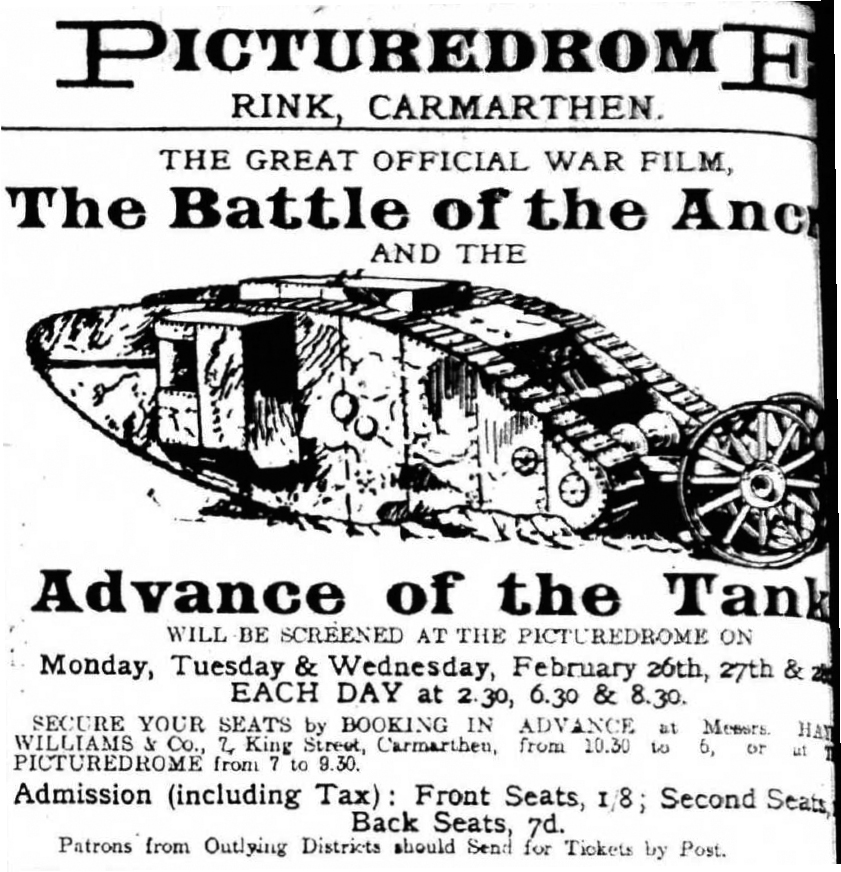
The advance of the tank, a popular film for movie goers during the war
Cinemas around the county were also playing the latest films which had been released following the success of The Battle of the Somme; The Advance of the Tank and The Battle of the Ancre. These films proved immensely popular and cinemas around the county regularly played these to full houses.
At the St Clears Licensing Sessions on Tuesday, 13 February, Superintendent J.E. Jones stated that there were forty-one licensed premises in the district (which included Laugharne and Llansteffan). The population in the area was 5,083, which meant that there was a pub for every 121 inhabitants. St Clears village itself had twenty public houses and a population of 1,250, making one pub for every sixty-two inhabitants. Concluding his speech, the Superintendent recommended the cancellation of the renewal of licenses for several public houses: the Rose and Crown, Chemical Inn, Gardde Arms and New Inn at St Clears and the Ship and Castle at Laugharne. The Chairman of the committee pointed out that the public houses served not just the community but were a vital focal point for fairs around the district, where goods were bought and sold. The Superintendent pointed out that fairs were dying out and local marts were becoming the norm. A resolution was passed to leave things be, but warn any licensees who had been convicted of any offenses about their future conduct. On the same day the Newcastle Emlyn Blacksmith’s Association attended a meeting at the Cawdor Arms regarding the undercutting of their prices by blacksmiths outside the area. A special meeting was agreed upon, to take place on 22 March. Tudor Williams, a motor garage proprietor of Laugharne and St Clears, also appeared in court that day, charged with falsifying documents relating to several purchases of gasoline in order to evade duty. Williams was find £5 17s for his misdemeanour.

Laugharne Motor Service, one of Tudor Williams’ charabancs.
The inaugural meeting of the Carmarthen National Service Committee took place at the Guildhall on Tuesday, 20 February. The new committee was formed after the declaration by Neville Chamberlain of the impending Military Service Act, which would come into force on 2 March. This first meeting of the committee was mainly interested in how they would apply the Act and how many people they would need to manage its demands properly. Carmarthen and Llanelli would have their own committees, while a separate committee to cater for the rest of Carmarthenshire would be formed.
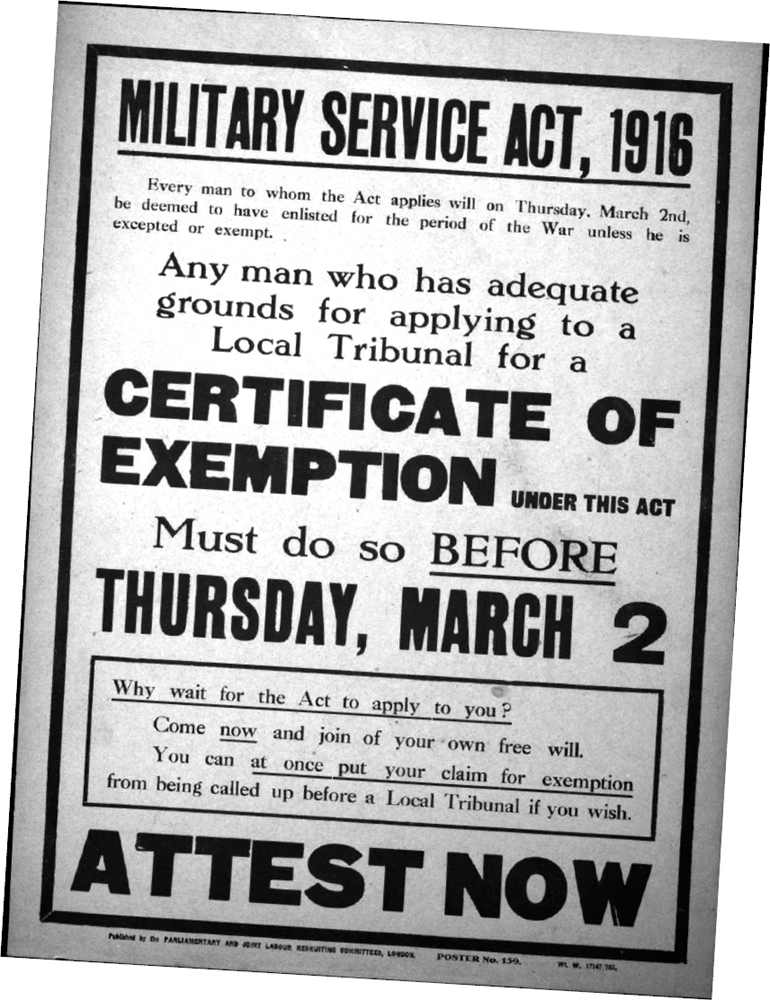
The Military Service Act 1916. Enlist now of your own free will before we make you enlist!
By now men from the county were serving in almost every regiment in the British Army, as well as the South African, New Zealand, Australian and Canadian forces. Large numbers of local men were also serving with the Royal Flying Corps and Royal Navy and hundreds of women from the county were serving around the world as nurses. Several local men had already been killed whilst fighting with the Australians and on 21 February another local man, Seymour Cadvan Jones, the son of Mr and Mrs David Jones of Cash Boot Stores, Hall Street, Carmarthen was killed.
Jones emigrated to Australia from London in 1913, but when war erupted he volunteered at Rosehill, NSW and served with the 13th Battalion, Australian Infantry. On 22 December 1914 Seymour embarked at Melbourne with the battalion and moved to Egypt. It landed at Anzac Cove on 25 April 1915 and took part in heavy fighting. On 20 May 1915 he was evacuated sick, spending several months in and out of hospital with various ailments. He landed in France on 8 June 1916, but was soon in hospital in England. Finally, on 19 January 1917 Seymour returned to duty, joining the 45th Battalion, which was still on the Somme, part of the 3rd (Australian) Division. On 21 February a party of the battalion attacked the German lines opposite Stormy Trench, near Gueudecourt, resulting in a heavy bombardment on their positions by the Germans, in the chaos of which Seymour was killed. He is commemorated on the Villers-Brettoneux Memorial. The Welshman printed a moving article about Seymour on 16 March, which spoke of the deep regret the people of Carmarthen felt about his death. He had only been back to Carmarthen once since emigrating, some weeks prior to his death, on a visit to his mother and sisters.

Seymour Cadvan Jones, another local ‘Aussie’, formerly of Carmarthen.
Twenty nine local men died during February, a relatively modest number by the standards of the Great War, but the calm of the winter months was soon to be broken. The first major offensive of the year took place in Palestine, where the British were about to launch their onslaught on the Ottoman ruled region. News was also fed to the local newspapers about a successful advance into Mesopotamia and of the capture of several villages on the Somme due to a withdrawal by the Germans, who were beginning to pull back to the Hindenburg Line. News was also released about a change to the selling of bread, which could not be sold until it was over twelve hours old, must be in the shape of a tinned loaf or a roll which contains no dried fruit, and that sugar must not be used. Bakeries would also be liable for inspection at any time by any Food Controller officers, who would be keeping an eye on the weight of loaves.
Llanelli Town Hall played host to a moving ceremony on St David’s Day when Daniel Meredith, the owner of the Glynea Colliery, along with four other employees: Griffith Davies, Thomas Daniel, David Howell and Evan Thomas, were each presented with the Royal Humane Society’s Bronze Medal for Lifesaving. On 15 November 1915 the five men had rescued David Bowen, a fellow collier, who had been trapped underground whilst working the Bushy Vein at Glynea Colliery. At great risk to themselves the men had dug into the collapsed vein to pull Bowen to safety. He was badly injured but survived his terrifying ordeal.
The people of Kidwelly turned out in their hundreds on Sunday 18 March to witness their first military funeral. Owen Lucius Edwards was the son of John and Mary Edwards, of Sea View, New Street, Kidwelly. He enlisted at Kidwelly in the 16th Welsh and landed in France in December 1915. Owen survived the horrific fighting at Mametz Wood but was wounded at Boesinghe in February, and was evacuated to the Norwich Military Hospital, where he died on 13 March aged 22.
On 20 March there were dramatic scenes in Parliament on the publication of the report on the Dardanelles Campaign. Asquith and Churchill, the main instigators, were put on the block and bombarded with criticism. Within days the report was published in the Carmarthenshire newspapers. Local politics was also in the headlines after John Hinds MP was made Lord Lieutenant of Carmarthenshire on 22 March in succession to John William Gwynne-Hughes. He would hold this position until his death on 23 July 1928 and would also become Mayor of Carmarthen.
During March 1917 the Pembroke Yeomanry was merged with the Glamorgan Yeomanry to form the 24th Battalion, Welsh Regiment. This battalion was attached to the newly formed 74th (Yeomanry) Division and was in the process of assembling in Egypt when the British launched the First Battle of Gaza on 26 March. Already in position across the Suez Canal and stationed around Deir el Belah ready to take part in the offensive was the 53rd (Welsh) Division, in which was the 1/4th Welsh. The objective of 158 Brigade, to which the battalion was attached, was a ridge at Ali el Muntar. According to the History of the Welsh Regiment:
‘The 4th Battalion consequently came up on the left of the 5th Battalion and the two Battalions, by their steady forward rushes, regardless of the enemy machine-gun fire, crossed the bare open plain, the 4th Battalion reaching the foot of the slopes of Ali el Muntar and the 5th Battalion the network of cactus hedges surrounding the patches of cultivation between Ali el Muntar and Clay Hill. Fortunately for the 4th Battalion the cactus hedges were not so frequent on the slopes of Ali el Muntar as they were further north in front of the 5th Battalion. With the help of the bayonet the 4th Welsh were able to clear their way and reach the top of the hill before darkness set in. It was close to the minaret on the top of Ali el Muntar that Major Picton Evans was wounded by a stray rifle shot, while overlooking Gaza and discussing the situation with me.’
The 1/4th Welsh lost two officers and forty-two other ranks killed, twenty three officers and 167 other ranks wounded during the action. Twenty-seven of the dead were from Carmarthenshire, including Company Sergeant Major William Henry Sebastian Rees, the son of Major William Henry Rees and Mrs Elizabeth Anne Rees, of Palmer Avenue, Llanelli. He was born on 1 August 1894. He was 22 years old when he was killed and is buried in Gaza War Cemetery.

Company Sergeant Major William Henry Sebastian Rees, one of the Llanelli men killed at Gaza.
Sixty-six local men fell during March, mainly due to the Palestinian campaign, with six more 1/4th Welshmen dying of wounds in the days after the battle. The attack was not a success for the British and a second assault would take place during April. On the Western Front the Germans completed their withdrawal to the Hindenburg Line during the month and the stage was set for the next major offensive, the Battle of Arras.
This opened on 9 April 1917 and would run until 16 May 1917, involving British, Canadian, South African, New Zealand, Newfoundland and Australian troops, who attacked the German positions east of Arras. It was planned in conjunction with the French, who were more or less simultaneously embarking on a massive attack to the south, the Nivelle Offensive. The aim was to draw German troops away from the ground chosen for the French attack and to take the German held high ground that dominated the plain of Douai.
The battle was fought on a broad front between Vimy Ridge in the northwest and Bullecourt in the southeast. When the battle officially ended on 16 May, British Empire troops had made significant advances but had been unable to achieve a breakthrough. The French offensive failed in its principal objectives, which exacerbated the low morale in the French army and led to mass disobedience, at least as regards offensive action.

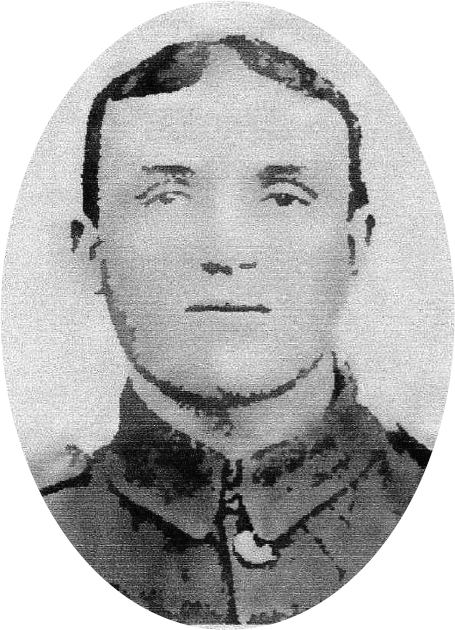
The Rees brothers of Trelech, both killed in Palestine in 1917. Left: Benjamin Simon Rees. Right; David John Rees
No local men were killed during the initial phase of the Arras Offensive, but on 17 April the British launched another offensive in Palestine, the Second Battle of Gaza. Another twenty-seven county men fell during the first day of the battle, all bar three with the 1/4th Welsh. Six more died of wounds in the following days. The battle also saw the 24th Welsh (formerly the Pembroke Yeomanry) in action under its new title for the first time; amongst their small number of dead were David John Rees of Trelech and Frederick Southgate of Llanllwni, who were killed by a bomb from an enemy aircraft. David’s brother, Benjamin Simon Rees, served with the 1/4th Welsh and was killed later in the year.
April saw the death of one of the highest ranking officers from the county to fall during the war, Lieutenant Colonel David Brynmor Chiles-Evans DSO, of Burry Port. He was the Medical Officer of the 1st Battalion, West Yorkshire Regiment and had played his part in a notable moment when a man from his battalion, Private Harry Farr, was court martialled for cowardice. He had twice been treated by Chiles-Evans for being ‘nervy’ before refusing to go into the front line, but for some reason Chiles-Evans had not put him on the sick list. Chiles-Evans was wounded at Ginchy on 17 September 1916 and as a result could not testify at Farr’s trial. Farr was executed at Carnoy on 18 October 1916. Chiles-Evans returned to duty soon after and was killed on 23 April 1917. He is buried at Béthune Town Cemetery. [Farr’s case was central to the recent successful campaign to pardon posthumously 306 of the men shot at dawn, which came into effect on 8 November 2006.]
Food rationing came into effect in April, with all of the local newspapers printing instructions for the use of the new ration books which would soon be issued. There were also mass miners’ meetings in the Amman and Gwendraeth Valleys during the month, with the miners pressed about the need for them to be recruited into the army, as further combing out of men from the collieries continued. The government announced that more men must be released from the coal mines for the army and, after consultation with the Miners’ Federation, it was proposed to recruit from among men who were of military age and who had entered the industry since 4 August 1914 and were of military age at that date, except men engaged as winding engineers, pump-men, electricians, fitters and mechanics.
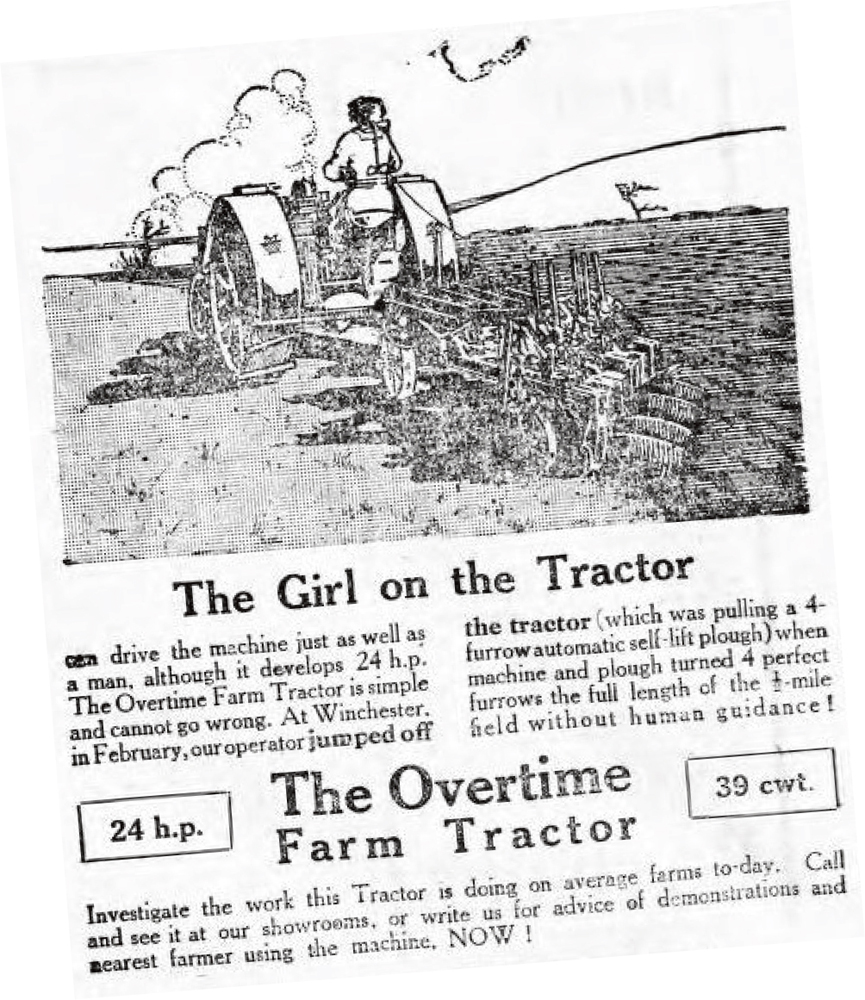
The Overtime Farm Tractor, which revolutionised farming.
D. Bradbury Jones, of the West Wales Garage, Carmarthen, began an expensive advertising campaign throughout Carmarthenshire during the month, splashing advertisements for The Overtime Farm Tractor for which he had just become sole agent and stockist in Carmarthenshire. His advertising centred around the fact that even a farm girl could handle the tractor! The outbreak of war had led to a great increase in mechanisation in farming but the less wealthy farmers of Carmarthenshire were slow to respond to this leap forward in technology.
The Second Battle of the Scarpe, part of the Arras offensive, opened on 23 April and over twenty men from the county fell during the two days that the battle raged.
Also killed on 23 April during the separate Nivelle Offensive was the son of a Carmarthen man, Sydney Puddicombe. Sydney was the eldest son of Sydney Dunsterville Puddicombe and Frances Andrews and the grandson of James Puddicombe, of the Ivy Bush Inn, King Street Carmarthen. He had moved the family to Asnières-sur-Seine, a suburb of northern Paris, some years prior to the war, where he married Frances Andrews and their son Sydney was born there in 1890. When war erupted in August 1914, Sydney enlisted at Paris in the 1st Battalion, French Foreign Legion. He was badly wounded during the ill-fated Nivelle Offensive on the Chemin-des-Dames and died in a hospital near Châlons sur Marne on 23 April, aged 25. He is buried at the French Military Cemetery at De-L’Est, Châlons-en-Champagne. The relative failure of the attack led to the sacking of General Nivelle. News of Puddicombe’s death reached Carmarthen after some weeks, published in a prominent article in The Carmarthen Journal.
On 27 April two local men, William Henry Thomas of Llandeilo and David John Williams of Llanelli, were killed when their ship, the SS Thracia, was torpedoed and sunk by the German submarine UC-69.
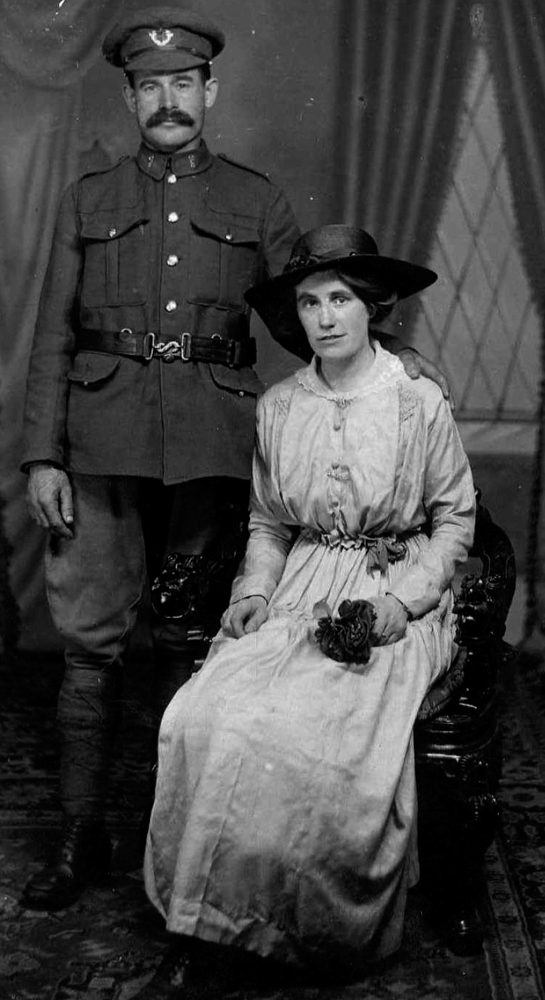
William and Harriet Ann Hurt-Peel in a posed shot before he sailed for England. The ‘Little Black Devil’ on his cap badge can clearly be seen.
As part of the Battle of Arras, the Canadian Corps made its famous assault on Vimy Ridge on 9 April, capturing the German positions which had dominated the area since the early days of the war. There were several men from Carmarthenshire serving in the Canadian Corps, one of whom, William Neville Hurt Peel, was a seasoned soldier, having fought in the Boer War with Brabant’s Horse. Peel was born on 24 February 1884, the son of Edmund and Winnie Hurt Peel, former cotton mill owners from Lancashire who had retired to Fern Hill, Laugharne. He was an adventurer and after the Boer War ran off with a fair girl and made his way to Canada. Having joined the CEF, he embarked on the troop ship SS Empress of Britain and arrived in England on 11 November 1916, spending a short spell at Laugharne on leave, before being transferred to the 8th (Manitoba) Battalion. The battalion was in reserve during the capture of Vimy Ridge, but played a full part in further operations, mopping up German positions to the east of the ridge. On 25 April the Battalion was sent forward, relieving the 1st and 2nd Battalions in reserve trenches. On 27 April orders were given to attack the village of Arleux en Gohelle. By the next day the village had been taken. The War Diary states that resistance was stubborn, with hand-to-hand fighting taking place in the village. Peel was killed in action on 28 April 1917 and is buried in Orchard Dump Cemetery.
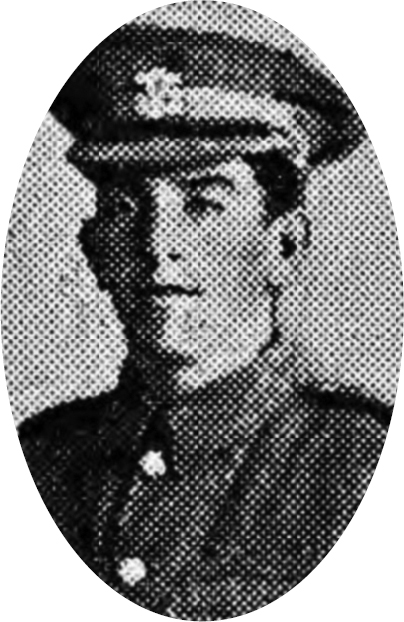
Private Jonny Davies, (20630), 15th Welsh, a well known and respected man at Ammanford and Penboyr.
At the end of the month the 15th Welsh suffered a number of casualties near Boesinghe, whilst carrying out a large scale trench raid on Mortjelde Estaminet, a strongly fortified German position situated on a part of the trench lines known as Caesar’s Nose. The raid was highly successful, with much intelligence being gathered and several pillboxes and machine-gun emplacements destroyed. Around a dozen men of the 15th Welsh died as a result of the raid that night and several died of wounds over the coming days. One of these, Private Johnny Davies, was from the village of Penboyr, near Newcastle Emlyn, who was well known at Ammanford. His death was reported in The Carmarthen Journal:
‘Private Johnny Davies, 15 Welsh Regiment, who died at a clearing station in France from wounds which he received while taking part in a night raid upon the German trenches. Officers and men regarded him as a brave and courageous soldier. His father is Mr David Davies, Pwllmarl, Drefach, Velindre, but prior to enlisting in March, 1915, he made his home with his sister, Mrs E. Thomas, 10, Tirydail Lane, Ammanford and worked as a collier at the Parke Colliery. After undergoing training at Kinmel Park, he crossed over for the great adventure in December 1915 and fought on the Somme and was with the Welsh Division in the great onslaught on Mametz Wood. He came through that fiery ordeal unscathed to share with his compatriots the glory which their gallantry so richly deserved, only to fall a victim to a German missile in a night affair on a much smaller scale though none the less exacting in its demands on courage and resource. A memorial service was recently held at St Barnabas Church, Drefach and his death is deplored both at his native place and at Ammanford, where he was popular among his friends. He was married while home on leave, the young wife being from Beulah, Newcastle Emlyn.’
April 1917 had cost a further eighty-six men from Carmarthenshire their lives. Reports of many of the local casualties were printed in the local newspapers, but the papers also included details of successes for the Welsh troops at Gaza.
May 1917 saw further fighting around Arras, where another well known local officer, Captain Harry Leonard Anthony of Kidwelly, a Veterinary Surgeon, was killed after a German aircraft dropped a bomb on his quarters near Arras on 2 May.
The previous day one of the county’s airmen was killed. Rhys Beynon Davies was born on 15 May 1896, the son of James and Margaret Davies, of Llwyngwern, Henllan. He was educated at Aberbanc and at Llandyssul County School, before attending St George’s School in London, where he joined the Officer Training Corps. He was commissioned in the 4th Battalion, Northumberland Fusiliers on 5 August 1915, and landed in France on 14 March 1916, where he was attached to a Trench Mortar Battery. On 23 October 1916, Rhys was attached to 2 Squadron, Royal Flying Corps, as an observer. He was wounded on 11 December 1916, while on patrol over Hulluch Wood, near Loos. After a spell at home recuperating, Rhys rejoined his squadron in France on 23 February 1917. 2 Squadron flew many reconnaissance missions over the German lines, directing artillery fire on key positions during the Arras offensive. On 1 May Rhys was an observer in an Armstrong Whitworth F.K.8., a biplane nicknamed the ‘Big-Ack’, Serial A9997, piloted by W.P. Eastwood, when they were attacked by German fighters. After a brief fight the outmatched F.K.8. received a bullet in its fuel tank, which exploded, sending the aeroplane crashing to the ground. Eastwood escaped without harm, but Rhys was killed and is buried in Monchy-Breton Churchyard.
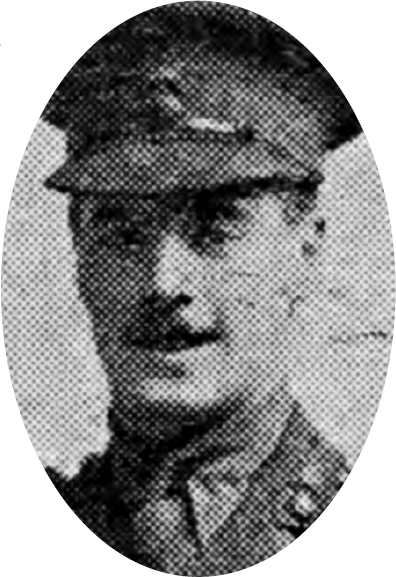
Lieutenant Rhys Beynon Davies of Henllan, whose life came to such a tragic end.
By 15 May the Arras offensive was halted in order to concentrate resources further north at Ypres. An offensive at Ypres had been on the planning table for months and as a preliminary part of the intended Third Battle of Ypres, an attack to capture the heights of Messines Ridge was planned for June.
A well known pair of brothers from Carmarthen, Richard Henry Watson and Arthur Watson, were reported as missing in an edition of The Carmarthen Journal on 4 May. Both brothers were educated at Carmarthen Grammar School and were close friends of Ira ‘Taffy’ Jones. They made names for themselves as fine all round athletes and played rugby for Carmarthen Harlequins prior to the war. Both brothers enlisted in the flying services, Arthur in the Royal Flying Corps and Richard in the Royal Naval Air Service. Both brothers were in France early in 1917 and during April both were reported as missing. Arthur was eventually found to have been shot down over German lines by a member of von Richtofen’s Flying Circus and taken prisoner of war on 14 April, while Richard was ‘killed in Hunnish circumstances’ after his Handley Page bomber was shot down over the sea off Nieuport on 26 April. Two French seaplanes attempted a rescue, but the aircraft into which Richard was hauled was attacked and destroyed by a German speedboat, killing all of the occupants. News of Arthur’s capture did not reach his parents until they received a letter from the Red Cross on 9 June.

The two Watson brothers from Carmarthen, well known local rugby players and friends of the airman Taffy Jones.
May 1917 had cost Carmarthenshire another sixty men killed. Amongst these deaths were two tragic incidents, both well known today, which caused the death of several local men. The first of these incidents occurred on 4 May in the Mediterranean, when the troopship SS Transylvania was torpedoed and sunk by the German submarine U-63 with the loss of 412 lives. The ship was packed with troops bound from Marseilles for Alexandria and sank off Savona, Italy. Amongst the losses were three men from Carmarthenshire: Edgar Williams and Thomas Smith of Llandeilo and David James Crawford of Llanelli. All three men are commemorated on the Savona Memorial. At least three local men survived the sinking: Captain Lionel Meredith Davies, Private V.H. Williams and Private Donald Evans, their stories appearing in The Welshman of 25 May.
Alongside the reports of the survivors of the Translyvania was a report of the trial of a Pontyberem man, charged with four counts of theft from the Glynhebog Colliery. The colliery was notorious for early deaths due to lung disease from anthracite dust, and doubtless the accused had been trying other means to earn his living. After a search of his home, several stolen items were recovered, mostly tools belonging to workers at the colliery, but the defendant was charged with just one count of theft, being given the benefit of the doubt about the rest.
The second incident took place on 6 May. A number of men of ‘P’ Special Gas Company, Royal Engineers, were labouring near Thilloy when a German shell set off a dump of propellant charges on a wagon. A huge explosion followed and all the men grouped around the wagon were killed instantly. The Germans, realising something was going on, bombarded the ridge. ‘P’ Special Company lost twenty-one men killed and fourteen wounded. Two Carmarthenshire men were among the dead: Charles Wyndham Lewis of Kidwelly and Haydn Gwion Morris of Llanglydwen. Both are buried alongside their comrades in Beaulencourt British Cemetery, Ligny-Thilloy.

Charles Wyndham Lewis, of Kidwelly, killed in an infamous and tragic incident.

Sergeant Alfred Goble of Carmarthen, a veteran of Kandahar, instrumental in the training of the 15th Welsh at Rhyl.
At the end of May one of the county’s oldest serving soldiers passed away whilst on duty with the 61st Training Battalion at Kinmel Park. Alfred Goble was a native of Worthing, Sussex. He was an experienced, old soldier, and took part in the Retreat to Kandahar in 1880, under Lord Roberts. He moved to Carmarthen many years before the Great War, as an instructor for the Royal Garrison Artillery. As soon as war broke out, he was anxious to do his bit once again and, after a period at the Army Remount Depot at Carmarthen, joined the 15th Welsh on 21 February 1915, which was then at Rhyl. He did not go to France with the battalion, but remained at Kinmel Park as an instructor with the 61st Training Battalion. His health deteriorated under the strain, however, and he died in hospital on Thursday 31 May, aged 64. His body was transported by rail to Carmarthen, where he was buried with full military honours at St David’s Churchyard. He left his widow Susan, four daughters and four sons, two of whom, Charles and Frederick, were serving with the army. Early in June, another Carmarthenshire man, a former officer with the 15th Welsh, was killed. Gwyn Arthur Griffiths was the son of John and Elizabeth Griffiths of Ty Pica, Golden Grove. After serving at Mametz Wood with the 15th Welsh, Gwyn transferred to the Royal Flying Corps and was posted to 35 Squadron. He was flying as observer in an Armstrong Whitworfh FK8 when it was shot down by anti-aircraft fire over Vermand on 2 June. He died the following day as a prisoner of war and is buried at Monsen-Chaussée Communal Cemetery.
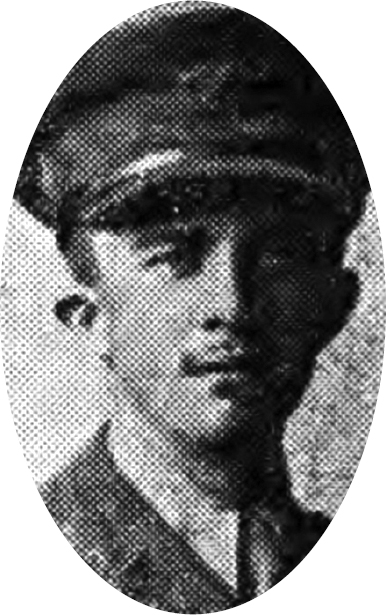
Lieutenant Gwyn Arthur Griffiths, who fought at Mametz Wood with the 15th Welsh before volunteering to join the Royal Flying Corps.
On 7 June a deafening series of explosions shook the Messines Ridge when nineteen massive mines exploded, sending hundreds of Germans to their deaths. Preparations had been underway for months, with twenty-six mines dug underneath tactical German positions along the ridge and packed with thousands of tons of high explosives. [Of the twenty-five mines originally started, one was lost to German counter mining, and one abandoned after a roof collapse. For tactical reasons only nineteen of these mines were actually fired; one exploded during a thunderstorm in 1955, and four lie dormant but still dangerous beneath the Belgian farmland.] Many Carmarthenshire miners were involved in the digging and construction of these mines, the detonation of which, it is said, could be heard in London. The battle raged on until 14 June 1917, when it was ended in preparation for the larger offensive at Ypres. During the course of seven days fighting, considerable gains were made, greater than any previous British offensive of the war so far, and all of the, admittedly limited, objectives had been captured.
‘We went over the top at 3.30. Three large mines on our immediate front, there were others, were blown. In one a whole company of Huns went up. Cheers. We were to have taken the 3rd and 4th lines, but it was all too simple, we just walked into them, thanks to the guns blasting every inch. This most intense barrage cleared the way and what Huns were left ran up to us with their hands up. They are too demoralised to make a big counter attack, just yet, the first twenty-four hours is the critical time. Hope they will not attempt it. May be moving further up this evening. Most of the Hun guns are drawn back and what they have left are firing at extreme range.’ [Going Across, Lieutenant St H. Evans, 9th Welsh]
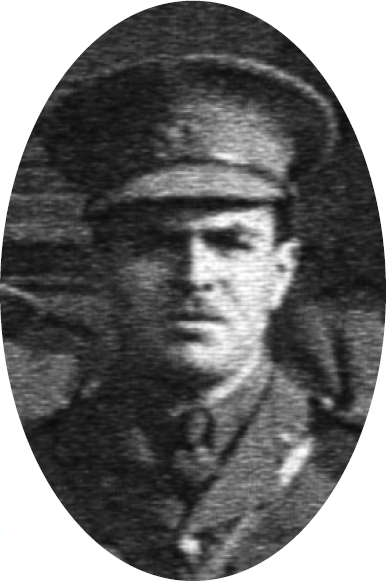
Lieutenant William Bertram Protheroe, another 15th Welsh veteran of Mametz Wood, who also joined the Royal Flying Corps
Eighteen Carmarthenshire men fell during the Battle of Messines Ridge, many of whom served with the 9th Welsh, which saw heavy fighting around Croonaert Wood. Lieutenant William Bertram Protheroe from Llanelli, another former officer with the 15th Welsh who had transferred to the Royal Flying Corps, was also killed while carrying out aerial reconnaissance work over Oostaverne Wood, on Messines Ridge. He was piloting an FE8, Serial A4207 when it was shot down in flames after a brief aerial combat. He is commemorated on the Arras Flying Services Memorial.
News of the successes at Messines soon reached Carmarthenshire. By 14 June stories of the mine explosions and the triumphant capture of such a dominant position as the ridge were trumpeted in the local newspapers. The award of the Military Cross to an Abergwili officer, Lieutenant Parcell Rees Bowen, was also published during June. Parcell was a real Boys Own hero. He was commissioned in the Welsh Regiment and served in Palestine, gaining his Military Cross at Gaza. The intrepid officer then volunteered to serve with the Royal Flying Corps, gaining another MC and a DSO later in his career, while flying in North Russia, during Operation Archangel, against the Bolsheviks. Bowen then volunteered to serve undercover in Dublin after the war and was murdered by the IRA. He was another close friend of Ira ‘Taffy’ Jones and served in the same squadron as Taffy in north Russia.
By the end of June, thirty-seven more local men had lost their lives, but the miners of the Amman Valley had other things on their minds. On Friday, 22 June a mass rally of local miners marched through the streets of Ammanford in support of a dispute at Caerbryn Colliery, where a man had been sacked, and against new management, which had started to take away workers’ rights, breaking customs and practises.
‘About 5,000 men took part in the parade, those from Gellyceidrim, Dyffryn Amman, Cawdor and Raven marching from Garnant and Glanamman to Ammanford, had assembled in the Square, to await the arrival of workers at Ammanford No 1 and No 2, Pantyffynon, Park, Rhos and Wernos and Tirydail... As luck would have it, either actually or at the instigation of the police, the supplies of beer in the various hotels ran out. The incident was accepted with good humour and in quite orderly fashion the procession reformed and the sections, headed respectively by the Ammanford Urban Band and the Cwmamman Urban Band, marched down Wind Street, up through Penybank and on to Tycroes Square. Here they found the men of Caerbryn, Llandybie and Emlyn Collieries, headed by Tycroes Band... A few thirsty ones assisted the revenue of one or two of the country public houses, but they quickly rejoined the procession, which continued the march... The proceedings were arranged by the Ammanford Trade and Labour Council at short notice, only two days, otherwise it was anticipated the number would have swelled to nearly 10,000 by the addition of the Tumble and Gwaun-cae-Gurwen Collieries.’
June 1917 saw the creation of a District Executive Office for the purchase of wool, with the South Wales Area being numbered District 13. Advertisements were placed in prominent local newspapers stating the names of members of the newly formed committee and showing a list of maximum prices to be paid by authorised local agents. Much of the wool being manufactured in the county was still being used by the army to create khaki cloth for uniforms and blankets. An article also showed that good prices were being fetched at Carmarthen Mart during the month, but there was not nearly enough livestock being sold to cater for demand.
During the month the publishing of the report of the Mesopotamian Commission about the campaign there caused widespread condemnation of the politicians in charge of the expedition, when the shortage of material for General Townsend’s force came to light. ‘The advance on Baghdad was in short a blunder ordered by Mr Asquith’s Government for political reasons.’
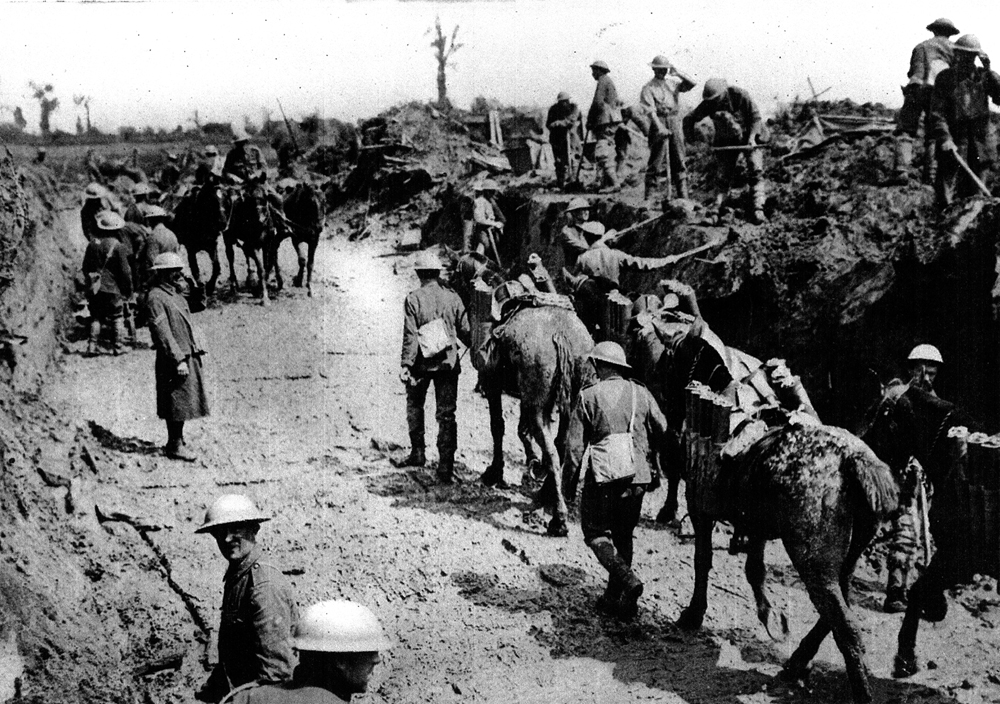
A road leading to Pilckem Ridge, where the 38th (Welsh) Division cemented its place in history.
On the Western Front, July 1917 witnessed the main build up to and the opening of the Third Battle of Ypres, which would become better known by the name of its final phase and objective, The Battle of Passchendaele. Men from Carmarthenshire would play their part in the forthcoming battle. The bulk of those men involved were serving with the various units among the 38th (Welsh) Division. The division knew the ground in front of it well, as it had been in the Boesinghe sector since August 1916. At the end of June 1917 it was withdrawn from the line to St Hilaire to train on a carefully constructed replica of its area of attack. The division returned to Boesinghe on 19 July, where it began making preparations for the forthcoming battle.
During the quarterly meeting of the Carmarthenshire Joint Standings Committee in July the pleasing statistics showing 200 fewer crimes throughout the county compared to the previous year were published by Mr W. Picton-Philipps. He also spoke at length about casualties amongst the county police officers who were serving in the forces and the death of one constable, John William Farrell, who was based at Ammanford prior to enlisting. Farrell died on 10 June at a casualty clearing station near Poperinghe and is buried in Mendinghem Military Cemetery. The responsibility for policing the Ordnance Factory at Pembrey had also been removed from the county police. Mervyn Peel asked Picton-Philipps for the number of aliens in the county. He replied that there were ‘376 adults and 264 children; 5 Austrians, 16 Germans, 3 Hungarians, 3 Turks, 124 Belgians, 17 French, 60 Italians, 9 Portuguese, 99 Russians, 15 Americans, 3 Romanians, 2 Danes, 3 Dutch, 2 Norwegians, 1 Spanish, 10 Swedes, 1 Swiss and 3 other nationalities.’There were also a number of enemy aliens unaccounted for in the county as well as some who had resided there for many years and been naturalised. There was still some worry about enemy agents in the county.
During the month there were pleasing reports of the harvest from farmers all around the county, who were now receiving help with their crops from recuperating soldiers and women, but this was tempered with news of an outbreak of typhus at Kidwelly, where over forty people had been taken ill and eight had died by the end of July.
Among the other stories in the newspaper columns of The Welshman of 20 July is the sad headline ‘Bathing Fatality Child’s Death at St Clears’. Thomas Bowen Jones, an 8-year-old boy, had been fishing with his friends on the River Cynin. He failed to come home and by 9.30 pm a search party went out looking for him. A local nurse, Gertrude John, found a bundle of clothes by the riverbank and spotted the young boy’s body in the water. Francis Jones, a Royal Navy seaman home on leave, waded into the river and pulled the boy’s body ashore, where he tried in vain to resuscitate him.
While the manpower of the county was preparing for the opening of the Passchendaele offensive, the 2,700 acre Glanrannell Estate at Llansawel was sold at auction for £40,000. The estate owned land and farmsteads around Llansawel, Llangadog and Llanfair-ar-y-Bryn and was broken up into separate lots, including the main house at Glanrannell Park and Llety-Liei, Maeslanwrthwl, Brondeilo, Penycoed, Rhos, Glanrannell Isaf and Island Farms. The breaking up of this once powerful estate was a taste of what would come in the years following the war, when many of the local estates, which included Dynefor, Golden Grove, Edwinsford, Cwmgwili, Stradey and Llanmiloe would be broken up.
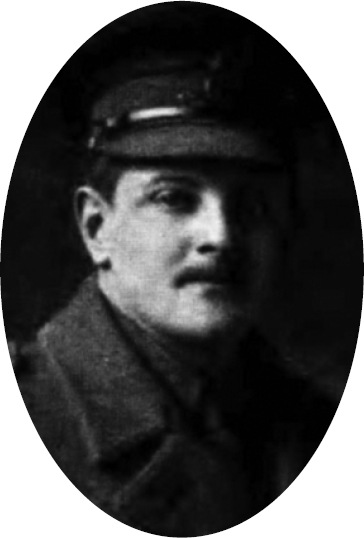
Second Lieutenant Wallis Austin Jonathan Marsden, of Carmarthen.
On the same page of the 27 July edition of The Carmarthen Journal were photographs and details of the deaths of two Carmarthen soldiers; Sapper John Davies of the Royal Engineers, a former postman in the town and Second Lieutenant Wallis Austin Jonathan Marsden, the son of Reverend Jonathan Marsden and Emmiline Marsden, of Llanllwch. Marsden was wounded during the Battle of the Somme, on 21 September 1916 and was brought back to England for treatment at the Empire Hospital, Westminster. He died of his wounds on 20 July and was brought home for burial in Llanllwch Churchyard.
The Amman Valley colliery workers were on the march again on 23 July and after a lively debate came up with a resolution to put to the Government;
‘That we, the miners from the Ammanford and district collieries, congregated here in this mass meeting, recommend to our respective lodges that they agree to vote at the forthcoming conference against any further combing-out orders in our coal mines and that, irrespective of any contrary resolution come to by the MFGB, we demand our Government immediately enter into negotiations with our Allies and the Central Powers and further call upon the industrial organisations of Europe, the Colonies and America to bring all their industrial power to bear on their respective Governments to declare an armistice and cessation of hostilities between the nations, with a view to laying down the foundation of a lasting peace among the future free democracies of the world.’
Whilst the miners were fighting against conscription, their brothers, cousins, sons and fathers were getting ready for the launching of the Third Battle of Ypres. The 38th (Welsh) Division moved into the front line on 27 July in readiness to launch their part of the plan, the capture of carefully laid out objectives along the Pilckem Ridge. To the north of the division was the Guards Division. The Welsh Guards would for the first time fight alongside their fellow countrymen. The 38th Division troops found that the Germans had evacuated their front line positions, so bridges were hurriedly thrown across the Yser Canal and the division advanced into the German lines, thus making the difficult task ahead considerably easier.
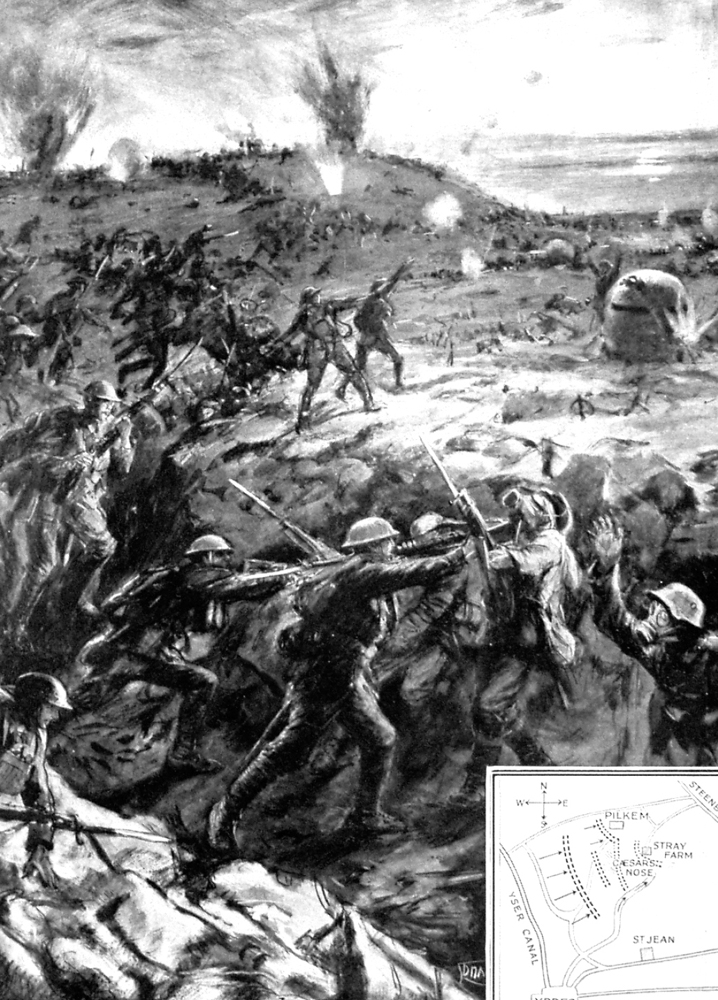
With the Welsh in the Great War’, a graphic portrayal of the struggle for Pilckem Ridge.
On the night of 30/31 July 1917 the divisional troops moved into their allotted positions. The objectives of 113 Brigade and 114 Brigade were to capture the village of Pilckem and the Pilckem Ridge up to half-way between the River Steenbeek and Pilckem itself. On this line being attained, 115 Brigade was to push through two battalions to capture the Steenbeek and its crossings. At 3.50 am the division attacked and, after heavy fighting throughout the day, reached its objective of the Steenbeek Crossings east of Iron Cross, where the men began consolidating their gains. Over thirty Carmarthenshire men were killed during the assault of the 38th Division that day, with a further three with the adjoining Guards Division and two men with other units; but the capture of Pilckem Ridge was a considerable success. The weather, however, turned for the worse and further operations at Ypres would be marred by mud and rain.
Local Officers Make Supreme Sacrifice

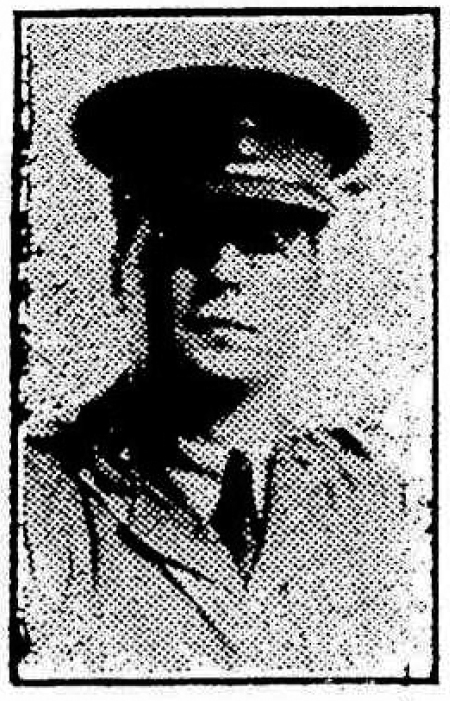


Local Officers Make Supreme Sacrifice - Lieutenants David King, William Lloyd Davies, and Francis Roderick, all killed at Ypres.
News of the great offensive reached the county newspapers by 3 August, when extravagant stories of the great advances began to be published. While the men of Carmarthenshire were dying on the sodden Flanders battlefield, the miners of the county reached an agreement at Caerbryn Colliery and had gone back to work. However miners at nearby Cwmllynfell were out on strike and the miners at Park Colliery at Pantyffynon were on the verge of walking out. During the first week of August the South Wales Miners Federation had voted against the government’s proposals about the ‘combing out’ of miners. With all of this uncertainty surrounding the miners, the local Labour Movement began to surge in popularity, which would eventually see the Liberal Party’s grip on South Wales lost forever.
Although the success of the Pilckem Ridge offensive was well received, the newspaper columns also began filling with the sad news about the many casualties suffered during this opening phase of Third Ypres. The Carmarthen Journal of 10 August printed the headline; ‘Local Officers Make Supreme Sacrifice’, when news of the deaths of four county officers reached their loved ones. Lieutenant David King, a well known solicitor from Carmarthen; Lieutenant Francis Roderick BA, from Cross Hands; Lieutenant William Lloyd Davies of Peniel and Lieutenant Clifford Jones of Whitland were amongst the men killed at Pilckem Ridge. Photographs of the first three men, former Carmarthen Grammar School Pupils, were printed with the article.
Apart from news from the front the same edition of The Carmarthen Journal printed a story about the Drefach Woollen Worker’s Branch of the Dockers’ Union, who had staged a mass open air meeting at Henllan Bridge on 6 August, aimed at recruiting members from the industry to join its ranks, in anticipation of forthcoming changes in the labour market. The Union was also avidly behind the Labour party and put forward its wish to enable workers to share in the wealth being generated by their hard work. Also on the same page was the story of the dedication of one Carmarthen family, when it was announced that the youngest son of Mr George Phillips of Red Lion Yard, Carmarthen had joined the colours, joining his seven brothers who were already serving in the forces. The eldest son, Ismael Phillips, had been killed at Loos in September 1915.
As the Third Battle of Ypres raged on, the newspapers struggled to find space in their columns for the casualties, with inch after inch of space being filled with news of the dead, wounded and missing. Mixed in with the bad news were snippets of good news; the awarding of gallantry awards to local men was always heralded and the news of Howard Victor Burnhill, the son of a Carmarthen policeman, awarded the Military Medal for Pilckem Ridge, was proudly displayed beneath a portrait of him in The Carmarthen Journal of 17 August. [Also awarded the DCM for Pilckem Ridge was Sergeant Alfred Speake, of the 15th Welsh, whose grandson, Alan, is currently a Carmarthen councillor.]

CSM Howard Victor Burnhill, a well known man at Llanelli and Carmarthen, who won the Military Medal with the 15th Welsh.
Amongst the obituaries was that of Reverend Geoffrey Maynard Evans MC, a chaplain to the forces, an adventuring grandson of Samuel Rees Evans of Cartref, Carmarthen, who was killed at Ypres. Evans served with the Leicestershire Militia during the South African War, before gaining a commission in the 1st Welsh in January 1903. He was advanced to lieutenant in July 1906, but resigned his commission in 1911, in order to enter the Church. Geoffrey volunteered for service again at the outbreak of the Great War and was appointed a Chaplain 4th Class in the Army Chaplains’ Department in 19 May 1915. He was attached to a battalion of the Worcestershire Regiment and won the MC for his courage during the Third Battle of Ypres. He was killed during the Battle of Langemarck on 11 August, aged 35 and is buried at Divisional Collecting Post Cemetery.

Chaplain Geoffrey Maynard Evans MC, an experienced campaigner who had fought in the Boer War.
August 1917 saw terrible fighting near Ypres as the offensive bogged down in the mud around Langemarck, where Geoffrey Evans had fallen. The 38th (Welsh) Division was withdrawn from Ypres that month after its gallant work at Pilckem Ridge and Langemarck and moved back to the Fleurbaix Sector to recover. Local men serving in other units were now to be thrown into the fight, large numbers of whom saw heavy fighting throughout the remainder of the month.
In July eighty-two men from Carmarthenshire were killed, while in August ninety-eight died. The opening of Third Ypres saw the worst loss of lives amongst the young men of Carmarthenshire than even in the dark days of the Battle of the Somme. The majority of the men who fell during the Pilckem Ridge offensive are buried in the numerous cemeteries which scatter the area today, or are commemorated on the walls of Tyne Cot. One cemetery still retains the personal touches of two bereaved families from Carmarthenshire whose sons are buried there. Artillery Wood Cemetery, near Boesinghe, is today a much visited cemetery, containing the graves of two war poets, the Irishman Francis Ledwidge and the Welshman Ellis Humphrey Evans, the ‘Black Bard’. In the cemetery two gravestones are marked at their bases by white marble tablets. The first is at the foot of the grave of Second Lieutenant David Charles Phillips, of The Albion Inn, Llanelli, killed at Langemarck on 16 August with the 2nd SWB. The second tablet is on the grave of Private Henry Evans of Llanllwni, killed at Pilckem Ridge on 31 July with the 16th RWF. It is carved in the form of a heart and is inscribed: ‘Melys Y Cof Am Danat Ym Penrhiw Llanllwni’. The plaque has remained since left by Henry’s parents, Evan and Mary, in the 1920s. News of the death of their beloved son reached them on 17 August in a letter from a comrade who was with him as he fell.
Men from the 38th Division began to return home on leave towards the end of August, some with interesting tales to tell of the recent offensive, while many were wounded. On the afternoon of Saturday 18 August the Pontardulais Silver Band met the train from Cardiff to greet Private Evan Allen (20557), a sniper with the 15th Welsh who had taken part in the Pilckem offensive. This was his first visit home since landing in France on 4 December 1915 as an underage soldier and the young man was carried shoulder high through the town, much to the delight of his father, David, the head mechanic at Craigola Colliery. He survived the war and was demobilised on 21 January 1919. He died during an air raid on Swansea on 2 September 1940, aged 42.
Throughout August, John Hinds MP led a campaign at Carmarthen for the town to form its own Volunteer Company. The forming of companies at Ammanford, Llanelli, Kidwelly and Llandeilo had embarrassed the county town, so a big campaign was begun to correct the situation.
By the end of August the Passchendaele offensive had stagnated. Command of the southern half of the battle was turned over to Sir Herbert Plumer of the Second Army and Sir Hubert Gough’s exhausted Fifth Army worked to the north around Poelcapelle, along with the French to its left. The attack would now largely focus along the Menin Road, with separate battles at Polygon Wood, Broodseinde, Poelcapelle and Passchendaele over the coming months, until the battle was finally formally ended on 13 November 1917.
The first week of September saw the death of Second Lieutenant Robert Lloyd Peel, the second son of Herbert Peel, of Taliaris Park near Llandeilo. He was 28 years old and was educated at Malvern College. When war was declared he resigned his appointment in India and arrived home in December 1914, and was commissioned in the Royal Field Artillery. He fought at Gallipoli and Egypt, before returning to the Western Front, where he won the MC for rescuing wounded men under heavy fire and preventing the explosion of ammunition dumps. He died on 3 September 1917 of a shell wound received the same day while on duty with the guns. His Commanding Officer wrote:
‘A man of very wonderful sympathies, whose fine sensibilities and humanity not even the worst side of war could blunt. He was one of my best officers and a very tower of strength and help at all times... He left the impress of his personality written large over all his men; he has ‘made’ by his example more officers than one. As he lived a splendid life, so he died a splendid death... Had anyone else met his death as he did we would have thought it was wonderful; as it was, he was just himself.’
He left behind a detailed diary covering his experience of the war, which is today in the keeping of Carmarthen Archives.
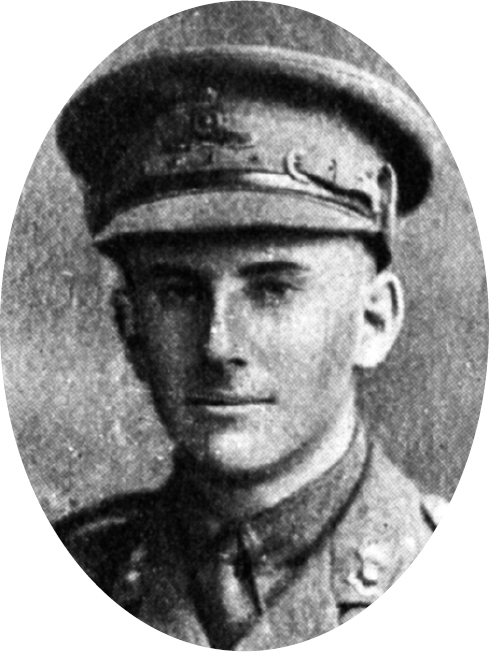
Lieutenant Robert Lloyd Peel of Taliaris, the second son of Herbert Peel to fall.
There was great celebration at Llanelli when news reached the town that one of its young soldiers had been awarded the Victoria Cross for his gallantry during the 38th Division’s capture of Pilckem Ridge. Ivor was serving as sergeant with the 11th SWB. The award of his Victoria Cross was published in the London Gazette of 14 September 1917: ‘At Pilckem, Belgium, on 31st July 1917, an enemy machine gun inflicted many casualties when it opened fire at close range. Sergeant Rees, leading his platoon, gradually worked his way round the right flank, by making short rushes, to the rear of the gun position. At 20 yards from the machine gun, Sergeant Rees rushed forward towards it, shooting one of the crew and bayoneting the other. He bombed a large concrete emplacement, killing five of the enemy and taking thirty prisoners, including two officers and capturing a machine gun, undamaged.’ In the Second World War Ivor served as a sergeant major in the Home Guard and died on 12 March 1967 at Llanelli.

Sergeant Ivor Rees VC, of Llanelli, who won his Victoria Cross at Pilckem Ridge.
Among a number of prisoners of war who were released by the Germans during a prisoner exchange in September 1917 was Private William Harkle of Ammanford, a former coal hewer and army reservist (1st RWF), who had been in captivity since the First Battle of Ypres. Part of a long article about his release in the Amman Valley Chronicle of 20 September reads:
‘In a vivid description of the scene, Harkle said his officers (Lieuts. Poole and Woodward) sent him, as he was an old soldier, down the trench to cheer and encourage the men. He was returning when a sniper’s bullet caught him in the side of the head, taking out his left eye. He distinctly recalls hearing a comrade saying, “Bill, you’re wounded”; while he replied, “I’m blind; bandage me up”. He fell unconscious, for how long he does not know, but when he came round, he was lying prostrate in the bottom of the trench and all by himself.
‘Blood oozed from his eye and there was a pool of blood where his head had lain and in it he saw the bullet which had inflicted the ghastly wound. This bullet he has now in his possession and it will be treasured as a family heirloom.
‘He crawled about looking for his comrades and he came across four lying in a heap, one of them being Private Smale, of Cwmbwrla, mortally wounded. He soon realised that he was surrounded by Germans and, wounded and dazed as he was, he stumbled across the open and was met by a German Red Cross soldier, who took him back to the village and placed him in a church, which was used as a collecting station for the wounded.’ [The Smale spoken of was another reservist in the 1st RWF, 5905 Private Frederick Smale, and died on 7 November 1914.]
In the same issue of the newspaper was news of another revolt by the miners:
‘A remarkable demonstration of miners was seen in the Amman Valley on Saturday last, when about 8,000 miners, from twenty-two lodges, formed in a procession and made a tour of the Valley to show their sympathy with the strikers at East Pit and Maerdy Pit, Gwaun-cae-Gurwen, who are abstaining from work owing to a dispute with the management on the question of Mabon’s Agreement versus the Minimum Wage Act.
‘Work was suspended at all the local collieries and a very large crowd of men from Emlyn, Caerbryn, Llandybie, Ammanford No. 1 and No. 2, Park and Pantyffynon, Rhos and Wernos Collieries assembled in the Square, Ammanford and, accompanied by three bands, marched in procession to Glanamman, where they were met by the Cwmamman section, comprising Gellyceidrim, Raven, Dyffryn Amman, etc, with another band.
‘Proceeding to the Globe Inn, the boundary between Carmarthenshire and Glamorganshire, they found there to meet them the demonstrators from Gwaun-cae-Gurwen and district with another band, who had already paraded to Cwmllynfell and brought back with them the Abercrave colliers from Swansea Valley.’
While the miners were worried about their wages, farmers around the county were reporting that the good start to the harvest had been ruined by the wet weather that hit the country during August and September, the same weather which had turned the Flanders battlefield into mud.
During the attacks on the Menin Road and Polygon Wood during September 1917 a further sixty-seven Carmarthenshire men died. Another man died in Salonika, a local holder of the Distinguished Conduct Medal, Sapper David Edward Lewis of Meidrim, a Royal Engineers tunneller, was killed near Loos and two men from the Llanelli area were killed when HMS Contest was sunk, torpedoed by U-106 on 18 September.
Also in the newspapers on 7 September was the sad news of the funeral of a young girl from Laugharne, Florence Martha Richards, who died on 1 September. Her mother, Mary Ann Richards, was the daughter of a well known fishing family, the Browns. Her husband, James Richards, was serving in the Middle East with the Hampshire Regiment and had never seen his daughter, who was born in December 1915 after he sailed for Egypt. The sad death of her child was a terrible blow to Mary, yet within three months she received a letter which dealt her a second crippling blow:
‘Dear Mrs Richards,—please accept my deepest sympathy with you in your sad bereavement. As I have been nursing your husband, Pte. J. Richards (2/5th Hamps), and was with him when he died I thought perhaps it might help you just a little to have some particulars about him. He was admitted to this hospital on December 3rd suffering from dysentery. On Wednesday evening it was found he had an appendix abscess which required immediate operation and he was transferred to this ward shortly after midnight from the operating theatre. He was very ill indeed, but by morning was considerably better. On Friday he had a very comfortable night and slept well and was quite bright on Saturday morning when I left him. In the afternoon he took worse and had a lot of pain. He was very ill when I came on duty on Saturday night. Everything that could be done to save him had been done, but without success. He seemed to decide in his own mind that he would not recover, but it did not appear to trouble him. When I asked him for a message for you, he said, ‘I love my wife so much until death’, to which I answered, ‘In death ye are not divided’. He had very little pain the last night and passed quietly away shortly after midnight on Sunday, December 9th. He was conscious until about ten minutes before the end. The Congregational chaplain was with him about 12.30, having previously visited him during the day. Your husband asked me to have his testament buried with him. I found amongst his belongings a khaki New Testament which had been presented him by the Congregational Church, Haverfordwest. Presuming that was what he referred to, I put it with his remains. There seems to be very little that we can do here to compensate you women in England for being unable to visit your loved ones when they are sick, but of course the distance to Egypt prevents anyone visiting here. Again assuring you of my sympathy in your sorrow and with kind regards, I remain, yours truly, M. Buchanan, Staff Nurse.’ [Mary married her cousin George Brown after the war and one of the couple’s children, Glynford Brown, served during World War Two with the army commandos before landing in Normandy in June 1944 with the 1/5th Welch.]

John ‘Patagonia’ Lewis, who was one of the pioneers of the Welsh colony in Patagonia but who returned home to Carmarthen.
Militancy was spreading from the coalfields and woollen mills to the other working trades throughout September. A meeting of Carmarthen Town Council during the month debated the election of Labour Councillors and local workers in the town demanded more war bonuses. Military Appeals Tribunals throughout the county worked flat out to work through the hundreds of appeals from civilians who did not wish to go to war and local dairy farmers were threatened with imprisonment for selling milk at higher prices than the government allowed. On a happier note, it was announced that a prominent Carmarthen insurance agent and school governor, John ‘Patagonia’ Lewis, had decided to retire and move to Abergwynfi to reside with his daughter. Lewis had spent many years with the Welsh Colony in Patagonia before returning to Carmarthen; at 76 years old he decided to retire from his many voluntary positions in the town to spend time with his grandchildren.
On the same page of The Carmarthen Journal, on 21 September, was a long report about the nomination of a new Portreeve for Laugharne, beneath which was the report of the death of another local man, Gunner William Waters. He was the son of John and Jane Waters of Pantyglass Farm, Broadway, Laugharne and served with 216th Siege Battery, Royal Garrison Artillery. On 15 August 1917, the battle for Hill 70, near Loos, began. He was part of the crew of No. 3 gun and while the battery was involved in laying down a bombardment in support of the assaulting Canadians on 16 August, a German shell fell into his gun pit, killing three men outright and severely wounding the remainder of the crew. William was one of the dead. On 27 August, William’s parents received a letter from his officer dated 22 August 1917:
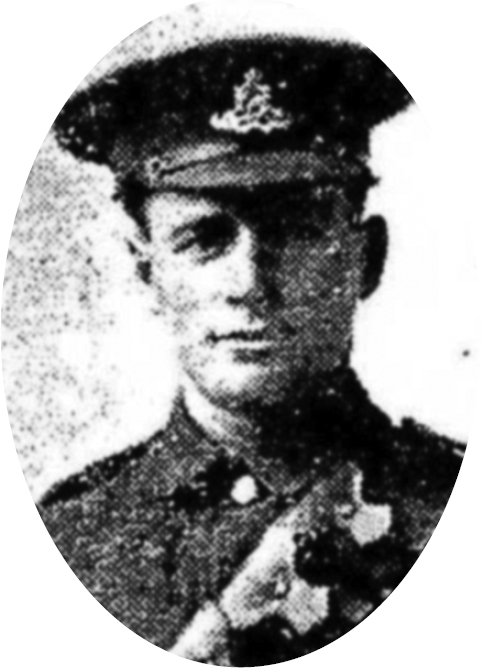
Gunner William Waters of Laugharne, killed in an explosion in a gun pit, which wiped out the crew.
‘France, 22nd August 1917. Dear Mrs Waters, it is my most painful duty to inform you that your son, Bombardier W. Waters, was killed in action on the afternoon of the 16th August. His gun was just ready to fire when a Hun shell fell into the gun pit causing the whole detachment to become casualties. It will be a little consolation to you to know that death was practically instantaneous and that he suffered no pain. He was buried on the following day at a British Cemetery, some distance behind the battery, being laid to rest with two others of the same detachment. The Chaplain read the burial service at the graveside and a cross has been placed on the grave. He was loved by the men of the battery for his great character, strength and industry. By the officers he was admired for his keen sense of duty. Two days before his death he was promoted to Bombardier and his future was very promising for further promotion. We feel his loss very much. Both officers and men combine in sending their deepest sympathy to you in your great bereavement. I am, Yours Sincerely, C. T. E. Murphy, Second Lieutenant.’ William was buried in Maroc British Cemetery, Grenay, and lies amongst a row of gunners from his battery.
A report of a tragic accident filled the local news, when on the evening of Saturday 29 September Isaac Hewitt, the 5-year-old son of David John Hewitt, grocer, of Bryndu, Llannon ran out of the door of his father’s shop and was struck by a passing motor car. Young Isaac was killed instantaneously. The vehicle belonged to Sir James Hills-Johnes VC, who was being driven home from a celebration at Llanelli after the town’s newest hero, Ivor Rees VC, arrived at Llanelli station after receiving his Victoria Cross at Buckingham Palace. Hewitt died in 1918, just over a year after the death of his son.
During October the Carmarthenshire Branch of the Red Cross was busy collecting subscriptions and made successful appeals for money for the Auxiliary Red Cross Hospitals locally by carrying out fund raising rallies at: Golden Grove, Bethel Chapel Cynghordy, Cofenberrach Church Llanelly, Llandeilo, Moriah Chapel Pencader, Llansawel, Carmel Church Hall, Clynderwen, Gwynfe, Llandovery, Gwernogle, Brynamman, Ammanford, Burry Port and Kidwelly. Events included jumble sales, fetes, concerts and eisteddfodau and well over £800 was raised during the four months up to October. Margaret Pryse Rice of Llwyn-Brain, Llandovery, was the County President and she also noted several other fund-raising events due to take place in the coming weeks. The Women’s Army Auxiliary Corps published a series of articles during the month, pressing the need for women to enlist into their corps. A well attended meeting took place at County Hall at Carmarthen, which emphasised the need for: orderly clerks, shorthand typists, accountants, librarians, cooks, waitresses, housemaids, vegetable women, pantry maids, laundresses, wine waitresses, by product women, scrubbers, storehouse women, driver-mechanics etc.
Local miners went out on strike as a protest against the owners of the Gwaun-Cae-Gurwen Colliery. The miners were concerned that the return of soldiers after the war would force down wages and they had begun their battle to ensure that this would not occur. Several meetings then took place in the Amman Valley during the month to discuss the matter. The miners had recently accepted another pay rise of 1s. 6d. per day. The price of coal was raised by 2s. 6d. per ton to cover the increased wages (the price of coal paid by miners remained at its pre-war state). Soldiers and sailors putting their lives on the line had also been awarded 1s. a day extra pay for each year’s service! Strikes continued intermittently throughout the South Wales collieries over the coming weeks.
October would be the worst month so far in terms of local casualties, due to the continued fight towards Passchendaele Ridge, with almost seventy more Carmarthenshire men being killed before the village finally fell on 6 November 1917 and the Third Battle of Ypres officially ended shortly after the Canadians captured the final piece of high ground on 10 November.
The casualties from the county at Ypres were attached to almost every unit of the British and Dominion forces; five men with the Canadian Forces; eight men with the Australian Forces; one with the New Zealand Forces, six men at sea with the Royal Navy and almost 300 men with just about every regiment of the British Army. Men from the county had also fallen while serving with the Royal Naval Division (RND), Royal Naval Air Service (RNAS) and Royal Flying Corps (RFC) during the course of the battle, but the war dragged on and 1917 was to see yet more bloodshed. The RNAS casualty was Seisyllt Hugh Lloyd of Caio. He was the son of Lieutenant Colonel George William David Bowen Lloyd and Lilian Emily Lloyd, of Brunant, Pumpsaint and was commissioned in the RNAS where he trained as a pilot. He joined 10 Squadron RNAS in France in July 1917, where he piloted a Sopwith Triplane. Seisyllt was flying over Zillebeke Lake on 14 August 1917 when he was shot down at around 4 pm by heavy anti-aircraft fire and his plane was last seen falling out of control. His body was never recovered, so he is commemorated on the Arras Flying Services Memorial.
On the Palestinian Front the British launched its final offensive against Gaza under General Allenby. This Third Battle of Gaza began on 31 October 1917 and among the forces taking part were the 53rd (Welsh) Division and 74th (Yeomanry) Division, with many hundreds of Carmarthenshire men in their ranks. The battle raged on for a week before successfully drawing to a close with the breaking of the Gaza to Beersheba defences, which opened the door to Jerusalem. By Western Front standards casualties were relatively light, but the conditions were hostile, with the intense heat, lack of water and disease taking a heavy toll throughout the campaign. Thirty men from the county were killed during the battle, including sixteen men serving with the 24th Welsh; eight with the l/4th Welsh; three with the l/5th Welsh; and three with the Royal Welsh Fusiliers. Former Carmarthen College student, Captain Cyril Mortimer Green, was killed whilst serving with the 16th Battalion, Royal Sussex Regiment. He was the son of Thomas Mortimer Green and Catherine Green, of Aberystwyth and the husband of Gwendoline Mortimer Green, of 23, Southwood Court, Golder’s Green, London. He was commissioned in the 2nd Battalion, Royal Sussex Regiment in October 1914, serving in France until he was severely wounded at Festubert on 9 May 1915 and returned home for treatment. After he had recovered from his wounds he was posted to Egypt, to the 16th Battalion. He was killed in action on 6 November 1917 and is buried at Beersheba War Cemetery. His brother Hugh had been killed at Gallipoli with the 1/4th Welsh
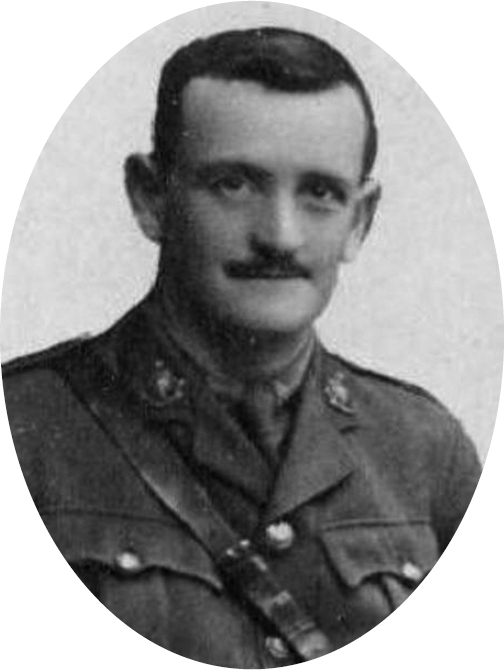
Captain Cyril Mortimer Green, another former Aberystwyth University student and a member of staff at Carmarthen College.
Back in Carmarthenshire, after appeals in the local press, families entertained Australian troops who were on leave. There was also reports of several local war casualties and the news that Carmarthenshire was going to have two Members of Parliament after the boundaries in Wales were redrawn. An abundance of salmon and sewin had been reported in the River Towy by the Head Bailiff, Charles Legg, who asked the Towy Fisheries Board for more bailiffs to control the waters. Carmarthen also hosted a very successful shorthorn cattle sale during the month; life seemed to be carrying on as normal.
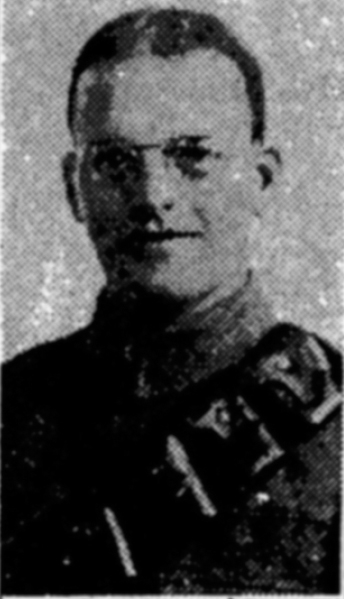

Aneurin Webber Evans and David Rees Thomas, two men from St Clears killed within two weeks of each other near Ypres
Bad news hit the small market town of St Clears during the first week of November when telegrams were received by two local families informing them of the deaths of their sons; Aneurin Webber Evans and David Rees Thomas. Both were killed near Ypres. Evans was killed by a shell which burst among a group of men from his unit, 717th MT Company, Army Service Corps, on 30 September and Thomas was killed during an attack by the 7th Battalion, Royal West Kents on 12 October.
The Carmarthen Journal on 9 November published among its pages several interesting articles: the election of Alderman William Evans as Mayor of Carmarthen; the news that Reverend W.C. Jenkins, of Capel Sul, Kidwelly had just celebrated fifty years as minister of the Chapel; details of General Allenby’s success against the Turks was also published in the same issue, as was the wedding of Herbert Cecil Lewis of the 15th Welsh, who was home on leave, to Olive Frances Marsden at Llanllwch Church. [Olive had not long previously buried her brother, Wallis Austin Jonathan Marsden, at the same church, where their father was the Minister. He was wounded in France while serving as a second lieutenant with the Royal Field Artillery and died on 27 July.] There was also the report on an important conference which was underway at Carmarthen, ‘The Carmarthen Conference of Food Control’, whose members attempted to deal with the ever rising costs of foodstuffs in the county. A big problem was that milk, butter and meat was being diverted from the county markets to larger industrial areas, where farmers could get better prices for their wares. The farmers’ market at Llandeilo that week had seen riots when colliers from nearby Ammanford had turned up and demanded to be sold butter and milk at cost price; a fracas ensued which required the local police to bring it under control. Butchers at Kidwelly and Pembrey reported that they could not compete with butchers in Llanelli who were undercutting their prices and forcing them out of business.
Worries were also raised at a meeting of the county worthies about the state of local roads, especially in the Llanwrda and Talley area, which had been heavily cut up by the heavy traffic of lorries carrying pit props cut in the area for use in the Amman Valley collieries. Sir James Hills Johnes VC commented that the recent accident he had suffered when the young boy was killed was contributed to by the poor state of the road surface.
While the fighting in Palestine was about to reach the walls of Jerusalem, in France the focus switched to a new sector east of Bapaume. A revolutionary artillery plan and the mass use of tanks, would become known as The Battle of Cambrai, the objective of which was limited. The battle was launched on 20 November 1917, the assaulting force of six infantry divisions, supported by some 430 tanks, against the Hindenburg Line defences protecting Cambrai.
There were no Welsh units in action that day, although the 17th and 18th Welsh would soon take part in heavy fighting in Bourlon Wood; but several notable local men were killed whilst serving with other units. Captain John Charles Lewis, the son of John and Alice Lewis, of Troedybryn, St Clears, was mortally wounded whilst gallantly leading his company of the 6th Battalion King’s Shropshire Light Infantry (KSLI) during an attack that day. His body was lost in coming battles and he is remembered on the Cambrai Memorial, Louverval. Second Lieutenant Richard Alun Jones of Llanedi was also killed. He was the son of the Reverend Griffith Jones of Capel Newydd Welsh Congregational Chapel, Hendy. On 20 November 1917 he was in command of Tank D41 ‘Devil II’, part of D Battalion, Tank Corps. On that day D Battalion attacked toward Flesquières; a shell made a direct hit on Richard’s tank, instantly killing all her crew. Richard was buried in Flesquières Hill British Cemetery, alongside his crewmen. In 1998 a tank was recovered from the Flesquières battlefield and was originally thought to be D41, his tank. It was, however, subsequently identified as D51 ‘Deborah’.
A sad incident had occurred elsewhere in France in November. Private Arthur Gower Jenkins of the 15th Welsh, a steel worker from Biggyn Hill, Llanelli, absconded from the trenches on 3 November 1917. He seemingly suffered mentally after the fight for Pilckem Ridge and had decided enough was enough, deserting his battalion. He was quickly arrested by the military authorities and taken to Wizernes, where he awaited trial by court martial. On the 23rd he somehow managed to escape and threw himself into the River Aa at Wizernes, and drowned. Although officially told that Arthur had been drowned after being wounded and falling into a shell hole on the battlefield, his widow, Letitia, was denied a pension by a military board after it decided that his death was entirely of his own doing and she was left alone to bring up their two young children.
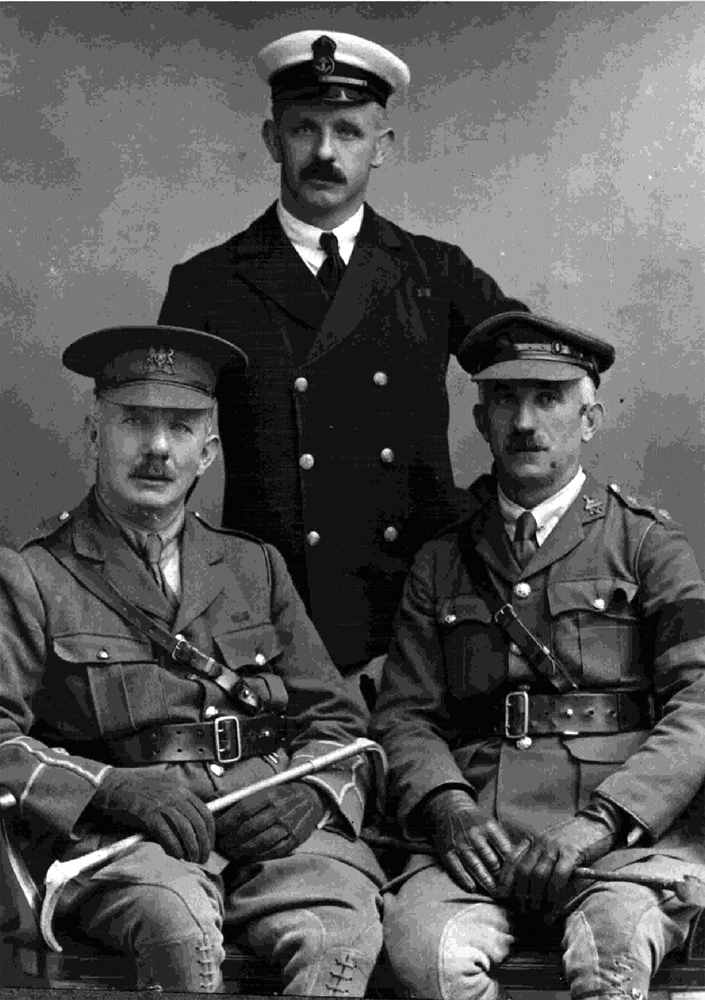
John Ernest Jenkins, on the right wearing a black armband in memory of his child who had just died. The other two men are his brothers, Thomas P. Jenkins (on the left), and Gwilym V. Jenkins (in the rear).
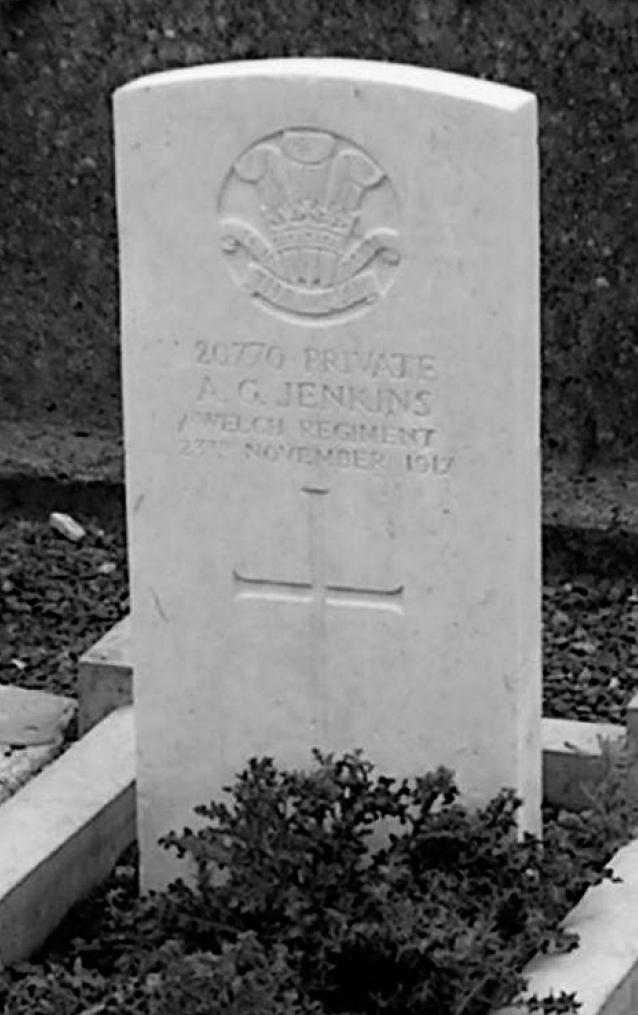
The grave of Private Arthur Gower Jenkins at Wizernes. He committed suicide, which would have been devastating for his widow who was refused a pension as a result.
At Cambrai the situation became very difficult. Haig had wanted only a restricted offensive and when the planned encircling of Cambrai failed to come off, the attack was limited in an attempt to take the commanding height of Bourlon Wood. However, the Germans soon launched a full scale counter stroke, with the considerable objective of rolling up part of the British line. This had, initially, considerable success, but this attack, too, broke down. The battle ended in stalemate, with British gains in the centre countered by losses on the right. But the attack did have an important consequence, as it was now quite clear that, no matter how complex the defence, an attack with an appropriate weight of artillery would break through the most sophisticated defensive line. It was a spur to the German high command to plan their high risk strategy of a new offensive in spring 1918.
Trapped in the maelstrom was a division with a strong Welsh contingent, the 40th (Bantam) Division, one of whose brigades was made up of Welsh units; the 17th Welsh, 18th Welsh, 12th SWB and 19th RWF. These battalions all became embroiled in bitter fighting within the confines of Bourlon Wood and suffered considerable casualties. At least fifteen Carmarthenshire men are known to have been killed in Bourlon Wood, including Captain John Ernest Jenkins, a former pupil at Llandovery College.
Jenkins was born on 14 February 1878, the second son of Councillor John Jenkins and Mrs E. Jenkins, of the Brickworks, Merthyr Tydfil. He entered his family’s brick and tile manufacturing business, was well known in local business and sporting circles, and rode with the Gelligaer Hunt. On 25 November he was wounded in the chest during an advance across the main German line in a sunken road and died from his wounds at a Casualty Clearing Station that same day. He was 40 years old, and is buried at Rocquigny-Equancourt Road British Cemetery, Manancourt.
On 3 December Haig ordered the British to straighten the Flesquières Salient and by 7 December the British and Germans ended their attacks, at the cost of around 45,000 British casualties. Carmarthenshire had lost almost fifty men killed during the battle.
While the British settled down in defensive lines on the Western Front for the winter, Jerusalem fell on 8 December and the 1/4th Welsh had the honour of supplying the first guards for the Jaffa Gate, saluting the victorious General Allenby as he walked triumphantly into the city on 11 December.
Even with the campaign in the Middle East turning in favour of the Allies, there was a desperate shortage of oil in Britain due to the submarine menace. With the onset of winter, people around Carmarthenshire found they were having to walk miles to locate stocks of paraffin for heating and lighting, and were frequently stuck in queues worse than those for food. For the people at Llannon this turned out to be a small blessing, as the owners of the Great Mountain Colliery volunteered to supply electricity for the houses in the locality, while the New Dynant Colliery hooked up supplies to Cwmmawr and the Emlyn Collieries began to supply the Gorslas district. Other areas would not be so lucky and the shortage of oil would continue until the end of the war.
Local newspapers throughout the county filled their pages with photographs and articles of the fallen and, as another traumatic year drew to a close, figures suggest 1,918 men from Carmarthenshire had fallen. The separate Palestine and Mesopotamia campaigns had recovered from early setbacks, and the two expeditionary forces were gaining ground from the Turks; the Salonika campaign threatened to become active once Greece finally declared war on Germany. The sea war was at a stalemate, with heavy losses amongst merchant shipping, due to the U Boat campaign; and the three main offensives on the Western Front had, at best, not lived up to expectations. Food shortages affected morale in Britain, but in Germany things were even worse, with the Royal Navy’s stranglehold on the seas cutting sources of supply to Germany. There was militancy amongst miners, railwaymen and munitions workers in Britain, but the German civil population was also on the verge of mutiny. The Italian army was on the brink of collapse after a disastrous set of offensives and had then been sent reeling by a German and Austrian offensive at Caporetto in November. Britain and France had sent troops there to bolster Italy’s defence.