
8
The military formations of all combatants, Allied and Axis, had greatly increased both in size and in the level of mechanization during the years between the wars. They were however designed for warfare on the open plains of central Europe; the mountainous terrain of Italy dictated a different approach, requiring specialist mountain expertise and such formations were in very short supply in the British Army. Mountain warfare had become regarded as a sideline, a skill for local colonial troops to exercise. Lieutenant General Leese’s Eighth Army was therefore largely unprepared for what lay ahead, containing only a few mountain-trained formations of any size – the Indian 4th, 8th and 10th Infantry Divisions, whose men were naturally acclimatized to mountain warfare. Thus, 1 Brigade of the Polish 3rd Carpathian Rifle Division along with 5 Brigade of the 5th Kresowa Infantry Division, with their extensive mountain training in Lebanon and Syria would be a real asset to the Eighth Army.
The Allied forces in Italy were facing a protracted campaign of mountain warfare posing many tactical and administrative problems that, especially in the winter months, were difficult to overcome. It was not just the German Army that was stalling their progress; it was the mountains that denied any rapid advances. Invariably, good roads through mountain passes were rare and sideroads amounted to little more than rough tracks. The landscape of the mountainsides was universally steep, punctuated with rough crests and serrated ridges that required little development by the Germans to create formidable defensive lines. This was the environment the men and machines of the Eighth Army were expected to conquer. Typical of the British-administered forces the formations of the Eighth Army were large and generously equipped. They were totally reliant on motor transport for their deployment and success. The rugged terrain would push the physical abilities of both man and machine to the limit.
Mountain warfare is a specialist skill and most of the Allied soldiers in Italy were novices in it. Only a few formations possessed any real understanding of the terrain, its hazards and advantages. For the majority the transition from field to mountain was painful and exhausting; life had to adapt to allowances of water, food, shelter and warmth that were far below what they were accustomed to in training or other campaigns. Along with having to acquire greater physical endurance the initiative of individuals and small groups of soldiers became pivotal to success, as communications between commanders and men were practically impossible. Once committed to action the soldiers had to think constantly for themselves, with their commanders in no position to control the action, a far cry from the highly coordinated methodology typically employed. Such skills were not learned in an instant and those who did attend the few mountain warfare courses available often had their instinctive aversion to mountain fighting reinforced.
This aversion to action in mountainous regions was not confined to the men actually conducting the fighting; the commanders, from brigade level to General Leese himself, considered the mountains to be obstacles best circumvented or if they must be tackled as a necessary hardship to enable their main plans to proceed. As such, there was little regard to using the mountains to advantage; rather, British battle plans concentrated on pushing as many formations as possible through passes and along valley floors, features that were inevitably confined amongst mountainous terrain and therefore failed to allow the troops and equipment committed to them to manoeuvre in any effective way. No attempt was made to streamline the size, quantities of heavy equipment or the dependency on road vehicles, to suit the terrain. Instead it was just accepted that movements and supply would be drawn-out cumbersome affairs. By contrast the Germans fully understood the strong natural defences the mountains offered and utilized the terrain to their full advantage. The British approach to planning was quickly understood and the Germans responded by preparing massive defences in depth and in good time. Stout fortifications covered the main routes through the passes and elsewhere the mountains themselves formed natural, strong defences.
Faced with such effective German resistance the Allies did not adapt their approach, instead intensifying it by committing ever larger formations to capture strongpoints in predictable set-piece attacks. They had little success and the Germans developed ever more effective defences against them. The mountainous terrain made the assaults mainly infantry work; a long slog on foot up slopes and crest and along ridges, with actions fought by small groups spread thinly over the ground. The Germans responded by making deadly use of light machine guns and mortars in well-prepared positions. The infantry brigades in the British divisions amounted to half the division’s manpower and this proved barely adequate in the rough terrain, which though steep covered a very large ground area through crests and gullies. Even large commitments of men achieved far less than anticipated, as they were spread thinly, with poor communications. By contrast the geographical features assisted the defenders, allowing them to infiltrate the attacking formations and to outflank and envelop them.
With the infantry struggling through the terrain, the supporting arms were ever more relied upon and artillery support became lavish. Unfortunately the masses of artillery guns available did not yield the devastating results desired, since they also were thwarted by the terrain. The narrow ridges and crests did not suit saturation shelling and the prepared strongpoints were of such immense structure and so well concealed as to often escape detection or neutralization. Immense artillery programmes, moreover, consumed equally vast amounts of ammunition and to bring such quantities through mountainous country was a difficult business. There were other disadvantages. Heavy artillery support required a long time to arrange and the infantry soon became unwilling to try to advance without it. This resulted in the tempo of attacks becoming slower and momentum spasmodic. Tanks were of little help, because the ground denied them mobility and forced upon them the role of self-propelled guns. When tanks were used to attempt a breakthrough, want of space to deploy reduced them to an immobile, armoured mass. Direct support from the air suffered much the same disadvantages as the artillery.
These factors coupled with atrocious winter weather, meant the Italian front had fought itself to a standstill by the close of January 1944. Several attempts to breach the German winter defensive line had not succeeded; the American II Corps achieved limited success in the Monte Cassino area in January, also in that month amphibious landings were made behind the German lines at Anzio with the objective of striking on to Rome. The operation, although initially successful, did not achieve the envisaged breakout from the beaches and these troops, isolated in their pocket behind enemy lines, were in a difficult situation. Allied efforts on the Italian front were accordingly concentrated first on Anzio and second, Cassino. The New Zealand II Corps launched an assault on Cassino in February, with little success on the ground, but it did cause the Germans to transfer the bulk of their formations to that sector, leaving only two infantry divisions to cover the 75km front stretching from Ortona on the Adriatic coast to Alfedena, following the course of the Sangro River. This was the area to which the Polish II Corps was assigned for acclimatization to the Italian front and for gaining combat experience before engaging in offensive action.
The dramatic Sangro River valley is flanked by steep mountains, scoured with deep gorges and fierce watercourses, and the region is dotted with ancient hilltop towns and villages. The winter of 1943/44 was particularly harsh; prolonged temperatures below zero and deep snowdrifts compounded the difficulties in occupying the region, with its rocky alpine peaks encrusted in ice and the limited road network making them almost impassable. It was in this environment that the first Polish soldiers saw combat in Italy. The Polish 6 Troop of 10 Inter Allied Commando travelled from Scotland to Italy in late 1943, arriving in Italy at Taranto on 1 December. The troop was assigned to the British 2 Special Service Brigade of Brigadier Tom Churchill. As they had not been in action before, Brigadier Churchill was anxious that the Poles should obtain some battle experience as soon as possible, so approached Lieutenant General Dempsey of the British Eighth Army’s V Corps to see if they could operate on his Corps’ front to obtain their ‘baptism of fire’. Dempsey replied that there would be a role for them carrying out fighting-reconnaissance patrols in the rugged mountains overlooking the Sangro River on the enemy’s front. Accordingly, from 13 December 1943, 6 Polish Commando Troop became established on the Sangro front at the remote but picturesque ski resort of Pescopennatro, on the right flank of the British 56th Reconnaissance Regiment, in atrocious and bitter winter weather.
Patrols were sent out daily with the first being led by Major Władysław Smrokowski on their first day. The fighting patrol moved through Castel del Giudice before crossing the Sangro River and upon approaching a farm they made contact with a German patrol, losing one man. On 20 December, the Poles learnt that two mountain-trained Jäger companies were planning to attack a British field artillery battery near Capracotta the following night. The Polish commandos deployed to thwart the Germans, but despite the efforts of the gunners firing on the San Angelo river crossing, the Germans pushed forwards and within the hour the Poles were surrounded. The commandos held their position and fought a nine-hour battle in the village – they got away with just three lightly wounded, but inflicted heavy casualties upon the Germans.
The Poles felt disadvantaged against the Jägers as the latter possessed skis and white winter camouflage smocks, equipment they did not have. After negotiations with the local mayor, several pairs of cross-country skis were procured. Two days later a patrol, dressed in the white flowing robes worn by local men at funerals, skied to a mountain plateau. There they encountered an Austrian light mortar detachment, and coming under fire, the Poles were forced to retreat, complete with several spectacular clifftop falls. Christmas Day was celebrated with half a pig and three sheep that had been acquired during a patrol the previous day, and despite having to patrol on Christmas Day itself, a hearty meal was thoroughly enjoyed by all. On New Year’s Eve the Poles moved to San Pietro Avellana, with heavy snowfalls the next day trapping them in the village – it was only after one of their number skied to Capracotta on 5 January that supplies were dropped to them by parachute. Five days later the Troop retired to a rest area.
The Troop’s next mission was to cross the Garigliano River alongside 169 Infantry Brigade from the 56th Infantry Division, with orders to pass through the forward troops and disrupt the German rear with ambushes near Carceri. At 1800 hrs on 27 January, the Troop, under the cover of heavy shelling, crossed the river under intense enemy fire; they then followed a white tape laid by the leading battalion through the minefields until it stopped near an orange grove. Continuing their advance, they entered the orange grove, where four Poles were wounded by mines, but nevertheless by 0330 hrs the troop had reached the proposed rendezvous with British infantry of the Queen’s Royal Regiment for an attack on the ridge above Sciullo. The British did not make the rendezvous and the Poles were ordered to seize the village alone. The Troop clambered towards the summit; when challenged, they charged into the German position and by 0430 hrs were in possession of the ridge. As dawn broke, the British infantry and 40 Royal Marine Commando arrived.
Later the same day, the Polish Troop was ordered to seize Monte Valle Martina to the northeast of Sciullo, and to patrol down the Valle Zintoni. Captain Woloszowski, the second in command, led the Monte Valle Martina patrol and captured a small German patrol. However, the firing alerted a large group of Germans higher up the mountain and the patrol found itself in serious trouble and taking casualties, including the death of Captain Woloszowski. Even with his Thompson sub-machine gun jammed, one Pole charged a group of Germans and convinced them to surrender.
Meanwhile, Lieutenant Czynski and the Valle Zintoni patrol had captured a six-man mortar team and a forward artillery observation post in a ravine, and were resting when they heard firing break out. Major Smrokowski and his Tactical Troop HQ then arrived, and both groups hurried through the trees; when they reached open ground they saw Woloszowski’s patrol had taken several prisoners but had suffered casualties. Smrokowski instructed Czynski that the high ground must be held at all costs; Czynski seized the summit shortly before the Germans arrived. The enemy was determined, and hand-to-hand fighting developed in which at least one Pole drew his commando knife. However, the Poles were outnumbered, and it was only when Smrokowski committed his reserve of Lieutenant Zalewski’s section that the fighting swung in their favour. By 1015 hrs the Poles had cleared Monte Valle Martina, at a cost of 4 killed and 22 wounded; the Germans left 30 dead. The troop continued patrolling until the 3rd Carpathian Rifle Division took over the sector from the British in early February, the commandos then retiring to conduct further training.
Movement of the Polish formations from the base into the Corps’ operational area along the Sangro River commenced with the 3rd Carpathian Rifle Division. Movement orders arrived on 4 January and between the 11th and 16th the division and its equipment left the Santa Teresa transit camp for the front. The division’s personnel transferred to the area surrounding Masseria S. Augustino, south of Barletta from where they moved north by rail, taking nine trains to complete the move. The division’s vehicles were transported by sea within the same time frame, at the end of which the commander of 2 Infantry Brigade oversaw the disbandment of the division’s camp at Santa Teresa.
With Polish troops now being deployed to the front Lieutenant General Anders flew from Cairo to Algiers on 30 January, for discussions with General Wilson concerning details of the deployment of II Corps in Italy – he also, taking a moment from his schedule, presented a silver Polish cap badge to Wilson’s secretary, the Countess of Ranfurly. From January 1944 the command of all Allied operations in the Mediterranean theatre came under General Maitland Wilson in his new role as Supreme Allied Commander, Central Mediterranean Force. His command extended over Italy, where General Alexander’s 15th Army Group coordinated General Clarke’s American Fifth Army and Lieutenant General Leese’s British Eighth Army, whilst troops in the Middle East were under General Paget and those in North Africa under Lieutenant General Gale.
General Wilson felt that occupying this 60km front would make it unlikely the Polish II Corps would undertake any major offensive actions and was thus limited to defending the flanks and lines of communication of the Fifth and Eighth Armies. Lieutenant General Anders formulated a defensive plan for the Corps based on analysis of the ground and the opposing German forces. Anders’ plan featured three key elements; ensuring the continuity of the front, securing lateral inter-army communications and protecting the flanks of the Fifth and especially the Eighth Army.
With the Poles now committed to battle Lieutenant General Anders set foot in Italy on 10 February. However, he was depressed at the international political situation. The Red Army had crossed the pre-war border into Poland on the night of 3/4 January and was fast advancing through the country. The Soviets made it plain they were claiming all liberated territory in the east that they had first occupied in 1939 as belonging to the USSR. They were also demanding changes to the Polish Government in London to make it more pro-Soviet, as well as official Polish acceptance of the revised eastern border of Poland. In the Western Allied camp there was also a marked change in the tone of the British and American press, which began urging Poland to accept these territorial adjustments. In light of these events Anders did his best to inspire the soldiers, hoping that the Soviet occupation would be a transitory step to Polish freedom.
On 11 February, Anders reported to Lieutenant General Leese at his headquarters in Vasto for a conversation upon the organization, location and battle readiness of II Corps during which Anders broached the subject of Poland’s political fate and the pro-Soviet stance adopted by the Eighth Army News that was proving damaging to morale. This struck a raw nerve with Leese, who was exasperated with the passions of Anders and his men, in particular their continuing vocal concerns over the future of Poland – for Leese such personal feelings and agenda had no place in the day-to-day business of war. He therefore acknowledged Anders’ remarks, but soon after issued a firm rebuke to Anders in a telegram: ‘In my capacity as Army Commander I have to point out to you how superfluous it is for a Corps Commander to express in public any opinions concerning the political situation, in particular at this present moment.’1 It was not until much later in the war that relations between the two men became more amicable.
With the final organizational debates concluded, the conditions under which the Polish II Corps would be deployed were agreed as follows:
(a) A liaison mission from the Polish Commander-in-Chief would be attached to Allied Forces Headquarters to present his wishes. The mission would also represent the General Officer Commanding the Polish 2nd Corps.
(b) The corps would go into action as one integral whole after all its units had arrived in Italy. Exception would only be made in case of real emergency.
(c) The corps would be used within the British Eighth Army.
(d) The corps, under General Anders, would be subordinated directly to the commander of the Eighth Army and given an independent sector of the line.
(e) The Polish Commando unit operating in Italy would be brought under the control of the Polish Corps.
(f) The Polish sick and wounded would be treated in Polish hospitals.
(g) Polish prisoners of war from the German Army would be made available for service with the Polish forces.2
The last point on the list, securing reinforcements, was of vital importance for the continuation of the force as a corps level command. Alexander agreed to the recruitment of Polish prisoners of war from the German Army, who were to be sent to screening camps separate from other prisoners of war and then for training with the 7th Reserve Division. Indeed, Alexander was ‘glad that I was able to reward his spirit of enterprise by making the necessary arrangements for the accommodation of this unusual accession of strength to the Polish Corps.’3 This unique facet of Polish recruitment was achieved in practice by screening Polish prisoners of war at the forward detachment of 3 Military Draft Office based at Mottola. The facility consisted of a reception camp, selection wing and holding companies, and potential recruits were assessed by an administration officer, a medical officer and a psychiatrist. During the course of the war in Italy, a total of 35,000 such recruits were found suitable for military service and were subsequently trained by the 7th Reserve Division.
The 22nd February was to prove a dark day for the Poles. Winston Churchill delivered a statement on Polish affairs to the House of Commons in which he announced that the British Government agreed to the Soviet acquisition of eastern Poland and that Poland should be compensated with German land in the west and north. These decisions had been arrived at during the Tehran conference of November 1943, notably without the Poles being present. The news was a heavy blow to II Corps. Anders summoned a conference of senior commanders at which all agreed a great injustice had been done and that confidence in Great Britain had been badly shaken. Nonetheless, Anders was adamant that the Polish must continue the fight and performed a most sterling achievement in maintaining a united II Corps, dedicated to fighting alongside the Allies. Whilst power politics meant this Polish crusade could not succeed in delivering their freedom, it most certainly would result in the destruction of the German enemy, and without defeating Germany there could be no hope for Poland. Accordingly, II Corps entered into battle with the Germans in Italy, hell-bent on vengeance for the plight of their nation.
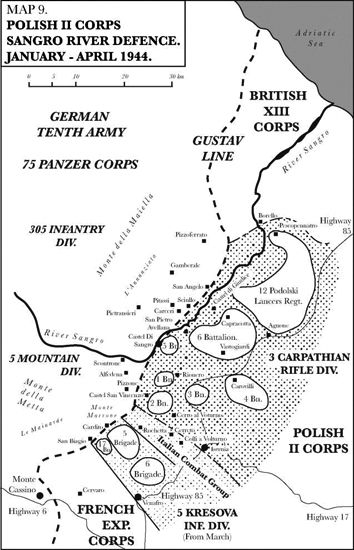
The 3rd Carpathian Rifle Division began relieving the British 78th Infantry Division during the first week of February, taking up positions along its 45km section of the front running north of Passo del Monte to Castel Vincenzo. The changeover period lasted until 25 February because deep snowdrifts hindered motor vehicles on the narrow, winding mountain roads. The Polish II Corps took over the sector from 13 February; the Corps Headquarters was based at Vinciaturo with initially only the 3rd Carpathian Rifle Division under its command. General Anders anticipated two possible lines of attack the Germans could launch – a direct southerly advance to Isernia or a push through the mountains heading southwest towards Venafro – both of which would if successful destroy the supply lines of the Eighth Army. The commanding officer of the 3rd Carpathian Rifle Division, General Duch, now set about organizing the division’s defence of their sector centred on S. Pietro Avellana and the mountain ridges of M. Pagano–La Caprara–M. Morrone–M. S. Croce. General Duch analysed the potential lines of German attack and identified key locations that must be denied to the enemy, those being the mountains M. Morrone–M. Curval, along with the ridges and crests leading to Montenero. If the Germans were to place artillery on these features they would hold sway over the sector.
The defence of S. Pietro Avellana depended on securing the hills to both the east and west of the town, with the naturally strong defensive position of Castel di Sangro lying to the west providing an effective block to a German advance upon Isernia. Duch decided to concentrate his division’s efforts on thwarting this possible line of enemy attack, deploying both infantry brigades and the reconnaissance regiment. Such a number of troops was essential due to the wide area the division was tasked with defending – even so, the manpower was thinly spread. The area was split into three sectors with the 12 Podolian Cavalry Regiment conducting reconnaissance of the most northerly boundary of the division’s operating area, while 2 Carpathian Rifle Brigade would hold the northern sector and 1 Carpathian Rifle Brigade the south.
The 12 Podolian Cavalry Regiment’s sector stretched for 20km and was characterized by inhospitable and inaccessible mountainous terrain (the area had earlier been held by 6 Polish Commando Troop). The regiment aimed to secure village strongpoints and patrol the many tracks and trails crossing the sector. One squadron was based in Pescopennataro, with detachments of half-squadron size assigned to Collidimezzo and Montazoli. Reserves were held in Castiglione and Agnone.
In the northern sector, 2 Carpathian Rifle Brigade was focused on the front running Castel del Giudice–S. Pietro–Castel del Sangro, but owing to severe snowfall the position of Castel di Sangro could not be fully developed. It was held by two companies who were completely cut off until 26 February, when they were relieved by three companies of the 5th Battalion. These positions would secure the right flank of the divisional area and patrol the roads leading to Rionero; the next layer of defence was provided by three companies of the 6th Battalion based in Capracotta, S. Pietro and Vastogiraidi; the last-named settlement lay at the confluence of the valleys leading from Capracotta and S. Pietro and thus would act as a break to any German thrust in that area. The 4th Battalion lay to the southeast of the sector at Carovilli.
In the southern sector, 1 Carpathian Rifle Brigade held the region Rionero–Cerro with the 1st Battalion based in Rionero and a patrol base established at Montenero that was intended to maintain a constant activity in the hills, although the appalling weather delayed such deployments. The 2nd Battalion was based in Cerro with a company assigned to Castel S. Vincenzo. The 3rd Battalion was held in reserve in the area Forli del Sannio, just west of the 4th Battalion’s position.
Artillery support was vital for the troops and the 2 Light Artillery Regiment covered the northern sector being located on the southeast slope of the ridge M. Miglio– M. Pagano. The southern sector was covered by the 1 Light Artillery Regiment whilst the 3 Light Artillery Regiment covered the divisional area as a whole, with both regiments located at Rionero. Major General Duch ordered the preparation of artillery fire upon the suspected lines of German assault and the suspected forming-up areas between Scontrone and Pizzone. In addition, the 1 Rifle Brigade was assigned one platoon of 17-pounder anti-tank guns from the divisional anti-tank regiment.
The Polish formations on the front overwintered in the mountainous country along the course of the Sangro River, with resulting hardship to the Polish troops, who, after two years in the Middle East now had to adapt themselves once more to life in the frost and snow. Specialist white winter camouflage smocks were issued for wear over the standard khaki battledress, while woolly hats and gloves were eagerly sought-after luxuries. Skis were distributed. The weather strongly influenced the Corps’ defensive layout – in particular it was necessary to find suitable accommodation for the greatest number of troops, since any prolonged exposure to the elements in the front line was liable to affect the health of the soldiers. This was the case in the 2nd Carpathian Rifle Battalion where 200 men reported sick following four days on the hillsides of Montenero. As many personnel as possible were billeted with local families, the first time these men had experienced family life in five years. The Poles readily integrated with the sociable Italians, enjoying the warmth of their fireplaces and their hospitality.
Activity on the Sangro River sector was largely confined to patrolling, owing to the ground conditions during the winter months. Under these conditions even patrol work was particularly difficult; soldiers had to trudge through the snow over hilly country for several kilometres before reaching the German positions, then lie in ambushes among the rocks and snow, often for forty-eight hours at a time, to intercept an enemy patrol. Enemy patrols were not aggressive and the Poles soon gained dominance over the no-man’s land. This was achieved by a great effort from all units, 2 Carpathian Brigade sending out 180 men a day to patrol and lay ambushes, and they returned with detailed information on German positions and strengths.
Commensurate with the Sangro River deployment was the development of the vast system of supply and replenishment for the front-line formations to sustain large-scale, intensive combat operations. The considerable task of supplying and maintaining the Army in the field was undertaken by the Corps Headquarters under the oversight of the deputy quartermasters. The various services responsible for keeping the Army supplied with the material of war, with petrol, oil and lubricants, food, clothing and necessities, effected delivery through an ordered chain of base depots, advanced depots, sub-depots and detail issue detachments. Each service branch: Ordnance, Supply and Transport, and Electrical and Mechanical Engineers had their own individually tailored supply system, but were all intermeshed to use trunk lines for transport, and at each stage in the chain the depots were organized into areas and sub-areas for administration and protection. The whole organization was referred to as the Lines of Communication and stretched from the heel ports of Bari and Taranto across the open Foggia plain, over the Apennine Mountains to the Sangro.
At first, Polish units deployed along the River Sangro were supplied directly by the British Eighth Army. The Poles soon began taking over responsibility with II Corps quartermaster’s office up and running in Campobasso from 18 February. During the next fortnight the numerous service sections – supply, transport, ordnance, workshops and medical – arrived in the Corps’ operational area, enabling the Polish services structure to take over the role of supplying II Corps from the Eighth Army.
From 7 March, the principal supply delivery point for II Corps was the railway station in Lucera. Trucks then conveyed goods from the railway station to the supply base at Campbasso. Here food was collected from 326 Detail Issue Depot, with the large formations collecting their provisions every alternate day: even dates for the 3rd Carpathian Rifle Division and odd dates for Corps units. In addition to these regular supply runs stockpiles of food and other staples capable of lasting twenty-four hours were established at the supply centres in Isernia, Molise, Pescolanciano and at the division’s positions. Supplies of road fuels were held in the British fuel repository at Termoli on the Adriatic coast. Distribution of fuel was organized by the British mobile fuelling point in Cassaralenda, from where the Polish allocation was dispatched by the third line transport companies to the storage and distribution centre, 334 fuel section in Campobasso. Here, the fuel reserve was stored for distribution to the formations in jerry cans and also provided a direct vehicle filling service. Ammunition arrived by rail at the Polo Matese station near Bojano. Here two ammunition-handling sections were established from 5 March.
The medical service now established a line of evacuation from the front line to the base hospitals. Advanced dressing stations of the 3rd Carpathian Rifle Division were established in Isernia, Bojano, Forli del Sanio and Carovilli. These facilities then passed on patients to 3 Casualty Clearing Station in Campobasso that housed 23 British Blood Transfusion Unit, Polish 344 Medical Supplies Depot and the American 567 Motorized Ambulance Convoy. In addition, 29 and 31 British Field Surgical Units were utilized in Isernia and in Agnone respectively. These facilities in the Corps’ operational area were supported by the three military hospitals located in the base area around Taranto. The role of 3 Casualty Clearing Station was to process the evacuated wounded and sick soldiers, who were kept there up to three weeks and if their health had not improved by then they were transported to 50 British Evacuation Hospital in Termoli.
The Corps remained at the strength of a single division until March, when as a result of the large-scale regrouping of Allied formations preceding the spring offensive, the 5th Kresowa Infantry Division relieved the 2nd Moroccan Division of the French Expeditionary Force along a 14km front on the sector from Castel Vincenzo to Hill 850. Also deployed to the front was 2 Army Group Polish Artillery, supporting both divisions. The neighbouring Italian Combat Group came under the command of the 5th Kresowa Infantry Division.
With the entry of the 5th Division to the Corps area the defensive front now stretched for 60km. In light of this increased frontage and the tortuous geography of the region, Anders reassessed his strategy on 19 March; the Corps could only perform a defensive role guarding the flanks of, and communication between the Fifth and Eighth Armies. Anders foresaw possible offensive German action being focused on either a southerly push towards Isernia, potentially cutting the Allied armies in Italy in two, or more likely an attack through the mountains to Cardito and on towards Venafro, thus paralysing the supply lines to Monte Cassino. What Anders saw as inevitable was that the Germans would attempt to reinforce and consolidate their positions along the Sangro River, capturing as much high ground as possible to afford them extensive observation posts whilst simultaneously increasing their threat to the eastern flank of the Eighth Army. The vital task was to hold and protect Highway 85, the principal communications route from Isernia to Venafro that was pivotal to the supply and maintenance of the Eighth.
Anders devised his defensive strategy to achieve complete mastery of the mountains, dominating the vital lines of communication to the Allies by focusing the actions of II Corps in two regions. The northern section would hold the plateau between San Pietro and Rionero along with the heights in the Montenero area by securing the track between Rivisondoli and Villetta, along with the establishment of strongpoints at Monte Migli, Monte Pagano, Montagnola, Monte Marrone and Monte Curval. The southwestern section would block any route of advance towards Cardito and hold the rugged peaks and gorges between Monte Casale–Monte Passero and La Falconara. Thus Anders divided the Corps’ area into two parts in his orders of 19 March 1944:
(a) The northern sector was to remain in the hands of the 3rd Carpathian Rifle Division whose task was expanded to encompass:
• The defence of the sector of the Sangro River from Borrello to the ridge southwest of Montenero and Castel S. Vincenzo, its main efforts being to focus upon the routes to Isernia, securing the roads Alfedena–Castel San Vincenzo and Zittola–Rionero and defending the ridge Rionero–Monte Sitaccario;
• Defence of the divisional boundary focused on Castel San Vincenzo;
• Establishment of a reserve brigade (minus one battalion) at Vandra.
(b) The southwestern sector was entrusted to the 5th Kresowa Infantry Division which was assigned the Italian Combat Group to bolster its defence. The formations were spread out to the southwest of Castel San Vinzenco, where one company was based to secure the division’s boundary with the 3rd Division. The front of this sector ran along the ridge Monte Castenuovo, Le Mainarde, then through Cardito and along the southern edge of the road to the village of San Biagio, skirting the peaks of Monte Sante Croce, Colle dell Arena and Hill 1019, and finally bordering on the French Corps along elevations 850–1000.
• The core of the defence was the ridge Monte Passero, Monna Casale and further to the east of La Falconara. The division established a reserve in the area of Colli al Volturno, again formed of one brigade minus one battalion.
• The Carpathian Lancers Regiment also formed part of the Corp’s reserve.
The role of the Carpathian Division was largely unchanged, its original plan proving well capable of the defence of a wide front. The division was bolstered from 25 March through the arrival of the 15 Poznan Lancers Regiment in the area of Capracotta. This addition enabled the 6th Battalion to be assigned as the divisional reserve whilst elements on the 2 Brigade’s front were strengthened by two infantry companies. Simultaneously the division’s artillery was bolstered by the advent of one battery of the 10 Heavy Artillery Regiment. The Carpathian Lancers Regiment remained in the division’s reserve until 25 March, after which it transferred to Corps command but remained in the same location of San Massimo – one half-squadron was left assigned to 1 Carpathian Rifle Brigade.
The defence of the 5th Kresowa Division’s sector was much more involved. In order to hold its rugged sector the Italian Combat Group was placed under its command, boosting the number of soldiers by 7,000, whilst the division’s organic 15 Poznan Lancers Regiment was transferred to the northern sector. Artillery support was provided by the Artillery Group Polish Army comprising the 11 Heavy Artillery Regiment, one battery of the 10 Heavy Artillery Regiment and the 7 Horse Artillery Regiment. These regiments had the principal role of providing counter-battery fire and for shelling the possible lines of German advance, thus the main focus was upon the San Biagio sector since it was the most probable direction of German attacks.
Major General Sulik, commander of the 5th Division, reviewed the challenging task presented to him. In the event of a major German attack Sulik foresaw the main axis would follow the highway running Biagio–Cerasuolo, with supporting assaults being launched from the area Monte della Metta towards Rochetta to threaten the southern flank of the division. Sulik decided to divide his operational area into two sections:
(a) The northern sector ‘Mare’ would be assigned to the Italian Combat Group tasked with the defence of Monte Mare–Colli al Volturno in order to prevent the enemy from launching strong thrusts from Pizzone–Monte Mare to the south and southeast, and also securing the slopes of Regione Valle di Mezzo.
(b) The southwestern sector of San Biagio was held by 5 Wilenska Brigade, tasked with blocking the main direction of German attack on the wide belt along the axis running east of Cardito–Hill 1029–Cerasuolo.
In the northern sector, the alpine massif and pathless ridges of Le Mainarde and Colle S. Pietro constituted strong natural defences. Sulik saw the numerous gorges and valleys that cut through the mountains as making good paths for counter-attacks against German advances. The Italian Combat Group assigned to this sector comprised two battalions of the 68 Infantry Regiment, 29th and 33rd Bersagalieri Battalions, Alpine Battalion, d’Arditi (commando) Battalion, 5th Anti-tank Battalion, two batteries of the Italian 11 Light Artillery Regiment and the 5th Engineering Battalion. The northern flank of this group secured the boundary with neighbouring 3rd Carpathian Division in the area of Castel San Vincenzo, with two companies occupying the southern and central parts of the ridge Monte Castelnuovo and the projection stretching to the southwest. A further kilometre to the south, two and a half companies barred any possible attack from the slopes of M. Mare. Reserves were held in the towns of Rochetta and Scapoli and also to the north at Colli a Volturno and Fornelli. Artillery support was bolstered by a battery of the Polish 4 Light Artillery Regiment located west of Cerasuolo.
The southwest sector was characterized by high mountains and deep gorges that would challenge any German advance. Deep gullies amongst the hills to the west of Cardito offered strongpoints from which to launch counter-attacks against loss of the high ground running through Hill 1029 and Colle dell Arena. Sulik opted for a strong defence of the southern sides of Le Mainarde combined with securing the valleys and roads running south and finally holding the peaks of Hill 1029 and Colle dell Arena. The addition of 17th Lwów Infantry Battalion that was based in San Biagio and two heavy machine gun companies bolstered 5 Brigade. The three battalions of 5 Brigade each formed a base of defence: one was sited in the area Le Mainarde–Colle San Pietro, covering the approaches and road to Cerasuolo, another held the hills surrounding Cardito to thwart assaults from Monte San Croce, and the third Colle del Arena, marking the boundary of the left flank. All three bases were located close to the front line, only two to three kilometres distant, with local reserves of a strength of one or two companies a further kilometre behind. Artillery support was provided by the 6 Light Artillery Regiment (less one battery) located on the southern slopes of Monna Casale.
Meanwhile, the natural elements continued their assault on all in the region, with blizzards and snowdrifts hampering communications between strongpoints and company positions frequently out of touch. This entailed the keeping of considerable reserves of stores, for example on the Capracotta sector, there was always a reserve stock for twelve to fourteen days, dumped to meet an emergency. The mountaintop roads were also particularly exposed to snowdrifts and ice, notably on the night of the 25/26 March when a column of 31 mules and 25 Indian muleteers became buried in the snow in the Pescopennataro area, several of whom could not be saved. Considerable attention was therefore given to the problems of keeping the roads clear of snow.
Great attention was also paid to the preparation and improvement of the defensive positions. During the 5th Kresowa Division’s stay in the sector, 180 tons of barbed wire and 220,000 sandbags were used on such work. Throughout the Corps’ area 74km of roads were repaired, 282m of Bailey bridge were laid and the Pagano tunnel, 3km long, was cleared of rubble, mines and booby traps and adapted for motor vehicle traffic. These efforts provided secure communication with the defended locality of Castel di Sangro and reduced the fifteen to twenty casualties per day from German artillery fire to an average of five. Defensive construction work included digging trenches, gun emplacements and smaller fortifications from the mountain stone, the creation of observation posts for coordinating artillery support, mine laying and the establishment and protection of telephone lines and exchanges. These works proved very useful in subsequent operations, allowing the Allies to man the sector with weak but mobile units, concentrating the bulk of their forces on the anticipated May offensive against Rome.
With the prevailing weather conditions and the rugged terrain, combat activity was restricted to patrolling, particularly on the 3rd Carpathian Division’s sector where units were thinly spread in its area coupled with the considerable distance that had to be covered to encounter the enemy. Nonetheless, as mentioned earlier, 2 Brigade sent out up to 180 men a day, always with artillery observers and with good preparation. The resulting Polish dominance over the no-man’s land are confirmed by the casualty figures – the Poles suffered 3 killed, 7 wounded and one missing, against German losses amounting to 35 killed and 26 taken prisoner.
The principal objective of the 3rd Carpathian Rifle Division was the reconnaissance of the strategic high ground of Montenero, with the aim of denying this terrain to the Germans who could then have threatened the eastern flank of the Eighth Army. From as early as 8 February, patrols were being sent out with the 1st Company of the 2nd Battalion patrolling for two days in the Alfedena region, while other units established camouflaged positions on Monte Curval. The next significant action was Patrol Foxtrot, sent out by the 2nd Battalion on 17 February and supported by a battery of artillery. This formation advanced through Colle Alto–Il Calvario to the railway station at Alfedena, where they destroyed the German defences and inflicted significant losses on the enemy. Further Polish patrols gained dominance over no-man’s land as far as Colle Gallina. Numerous smaller patrols were active on the south slopes of M. Curval and M. Fosse, these culminated in the final occupation of the latter hill on the 2 April. Some of the reconnaissance patrols penetrated as far as the area of Pizzone and Monte Mattone. The aim was to deny the Germans access to favourable forming-up positions at the source of the Sangro River.
Frequent clashes and exchanges of fire occurred between the Polish strongpoints of Capracotta and San Pietro Avellana on the one side and the German positions on the rising ground to L’Annunziata on the other. The Germans attempted to push south towards the Sangro River from their advanced strongpoints located south of the village of Gamberale, and from neighbouring strongpoints. In spite of deep snowdrifts and sleet showers, the Poles launched a series of ten patrols and raids in February and six in March towards Gamberale, Checo, Pitassi and along the gorge east of Cle Checo towards Pietransieri and M. Toceo, that prevented the enemy from reaching the Sangro. One particularly successful patrol from that action was conducted against Gamberale on 19/20 February, when they reconnoitred towards Colle Bucci searching for German observation posts on Monte dell Ellera. The patrol succeeded in capturing several prisoners and threatened to surround the garrison at Gamberale.
Reconnaissance actions of the 12 Podolski Lancers Regiment stretched between Colle di Mezzo and Pescopennataro. The regiment had to reckon with not only a large geographical area, but also numerous minefields strewn throughout the valleys and hillsides of this stretch of the Sangro River. Sabotage action by Italian Fascists was widespread in this region, as were fierce incursions especially in early March. Faced with such challenges combat activity was limited to diligent observation of the enemy’s front, with patrols only being sent forward to investigate suspicious sightings. The regiment deployed more aggressive patrolling during 21–23 March, launching successful attacks upon Pizzoferrato and Gamberale.
The 15th Poznan Lancers Regiment took over the Capracotta strongpoints on 6 April, continuing their predecessors’ patrolling activity and maintaining control of their sector of no-man’s land. From 13 April a particularly successful two-day reconnaissance action was conducted by two sections of the 1st Squadron in extremely difficult rocky terrain, with snow up to the waist, when the detachment succeeded in climbing the southern slopes of Hill 1613 and there destroying a five-man strongpoint.
In the 5th Kresowa Infantry Division’s sector, in view of the nearness of enemy defensive positions, patrolling was much more difficult, but seven major patrols were sent out exclusively by night. Apart from this, ambushes and listening posts were established with good results. The main patrol areas were the hills to the north of the Cardito–San Biagio road where patrols were sent on average every third night, the area south of the same road but on a less frequent basis, the southern slopes of Monte Carella on average three or four times a week, and Monte S. Croce every other night. The patrols were effective at eavesdropping and setting ambushes – several combat clashes ensued with a patrol on Monte Carella attacking a German position on the night of 3/4 April, scattering fifteen Germans.
During the first days of 5 Infantry Brigade establishing itself on the front there was considerable aggressive action from the enemy: on the night of 31 March/1 April a strong force of German troops attacked the 13th and 15th Battalions several times, but upon meeting strong Polish resistance they withdrew, having sustained considerable casualties. The most decisive action on this sector was a major assault conducted by the Italian Combat Group, launched at dawn on 31 March against Monte Marrone, the southernmost projection of the German defences in the Monte della Metta mountain range and a prominent observation post. The attack came as a surprise to the Germans as the Alpine Battalion Piedimonte charged up the ridge of Colle Rotondu–Monte Maronne with supporting attacks by 185th Parachute Battalion capturing the eastern end of the ridge and 33rd Bersaglieri Battalion seizing Le Mainarde. The offensive was supported by the 11 Italian Artillery Regiment with counter-battery fire provided by the Polish 2nd Artillery Group and divisional artillery regiments. The German forces quickly retreated, outflanked and under increasing artillery fire. The Italians sustained only minimal losses, and the success of the operation was largely attributed to careful planning and only weak German resistance. Not that the enemy had yet quit: a series of counter-attacks by fifty Germans were launched to regain the position, but all were thrown back and after their attempt to recapture Monte Marrone on the night of 9/10 April was repelled, the Germans made no further efforts.
The relatively quiet sector enabled intensive training of the Army Group Polish Artillery to be conducted against the enemy; special emphasis was given to training forward observers and to gunnery and target computing practice. The observers occupied extremely exposed observation posts, several at altitudes of 1,800m that could only be reached through technical rock climbing. The winter cold was intense, a far cry from the warmth of Palestine.
The Eighth Army News reported on the efforts of the Poles on the Sangro front, highlighting the traditional Polish bugler: ‘Each day at noon a Polish Corporal, watched by local inhabitants and Allied troops climbs to the top of the municipal building in a small mountain village and sounds the call, which is carried for miles on the clear air.’4