
15
DECEMBER 1942
THE TIME HAD come for the Northland to leave.
Lieutenant Commander Frank Pollard acknowledged in a message to Rear Admiral “Iceberg” Smith that the ship lacked “sufficient fuel and supplies for wintering in Comanche Bay.” A message sent earlier by Pollard, seeking Smith’s guidance, revealed how conflicted he felt between wanting to stay and needing to go: “Northland desires to continue rescue operations as long as probability exists of assisting B-17 and Northland plane personnel.” On the other hand, the message continued: “Paramount regard for Northland safety under present circumstances necessarily entails immediate abandonment of rescue operations because [of] inevitable risk attached to such operations. Orders are requested.”
The ship almost waited too long to leave the coastline, forcing it to break through a five-mile-wide belt of pack ice to reach open water. Once there, the Northland was out of range of radio communications from the men on the ice or at the army’s bases and stations, ending the ship’s direct involvement in the rescue efforts. Yet the Northland left a great deal in its wake.
Still ashore were the remains of the rescue team of Pritchard and Bottoms, as well as their passenger, Howarth, and also the wreckage of the Duck. Also left behind were five members of the Northland’s crew, led by an intrepid twenty-two-year-old ensign named Richard Fuller. The Coast Guardsmen under Fuller’s command, all fellow volunteers, went ashore by boat at Beach Head Station on December 4. They hoped to help Monteverde’s PN9E crew and recover the bodies from the Duck. They might also have looked for McDowell’s C-53, but the cargo plane remained lost, likely buried under snow with the bodies of its crew.
Fuller and his team made several valiant attempts to reach the B-17 and the Duck, but were unable to reach either plane. It wasn’t for lack of trying. The rescue effort, supposed to last no more than two weeks, turned into a five-month ordeal. Over the winter of 1942–1943, much of their time was spent trapped at Beach Head Station, a wooden hut described by Chief Pharmacist’s Mate Gerard Hearn as “an overgrown crate, about thirty feet square.” With Fuller and Hearn were Stanley Preble, a seaman; Harold Green, a fireman; and Donald Drisko, a mechanic.
Fuller and dogsledder Johan Johansen also holed up at Ice Cap Station during the rescue attempts. When the stove vents there filled with snow, they lived in fear of death by carbon monoxide poisoning. Their kerosene ran out, and they spent long stretches in the dark or in flickering candlelight. Over time and repeated blizzards, the flat-roofed shack was buried in snow. Fuller suffered a frostbitten foot, and three of his toes turned black, though he later recovered. Their radio died, two inches of water pooled on the floor, and nine dogs on their sled team froze to death. The men shared their quarters with the remaining six dogs, whose wastes turned the station into a reeking kennel.
They spent days tucked in their bunks for warmth. They emerged to play cards by the light of a single candle, or to use a snow tunnel they’d carved for a latrine. Ice Cap Station was eventually deemed unfit for human habitation and they rejoined the other men at Beach Head Station. Conditions were little better there, a sixteen-by-twenty-four-foot shack so covered by snow that their only access was through an attic loft window.
By the time they were picked up the following spring, the Coast Guardsmen had spent more than five months in conditions hardly better than those of the men they’d hoped to help. Perhaps most frustrating, they initially were given the wrong coordinates to search for the Duck; even when the location was corrected, Fuller’s team wasn’t told. Nevertheless, Fuller received the Navy and Marine Corps Medal, and all five received commendations for “courage, energetic and cheerful cooperation, and devotion to duty.” The official Coast Guard history of the war gently acknowledged that they never found the downed air crews: “This expedition had to be evaluated more in terms of heroism than accomplishment.”
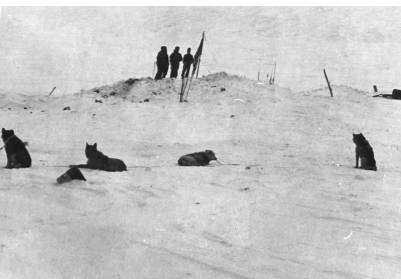
MEMBERS OF A RESCUE TEAM STAND ON THE ROOF OF SNOW-COVERED BEACH HEAD STATION. (U.S. COAST GUARD PHOTOGRAPH.)
BECAUSE OF DWINDLING daylight hours, Pappy Turner and the five men of his B-17 crew relocated from Greenland’s west coast to the unfinished base at Bluie East Two. There, they’d be less than 150 miles from the downed PN9E, minimizing nighttime flights from one coast to the other. Storms grounded Turner’s B-17 for two days after he spotted the downed Duck, but he was able to get his bomber back into the air on December 9.
By a stroke of good fortune, Turner and his crew spotted Spencer, Tetley, and O’Hara at what became known as the Motorsled Camp. With no way to communicate, the men on the ice couldn’t tell Turner’s B-17 what had happened to Wedel, so Turner and his crew didn’t know who or how many men they were helping. Among the supplies they dropped was the motor oil that Tetley had requested days earlier. Spencer and Tetley worked for days on the motorsled but couldn’t restart the engine. They abandoned it, and soon the machine was buried under several feet of snow.
Indeed, more snow was the one thing they could count on. Drifts piled up so high that O’Hara’s side of the small tent threatened to collapse and bury him alive. Spencer and Tetley spent that night taking turns shoveling it away from the canvas. When morning came, Spencer announced that they needed to prepare for the long haul. That dealt a blow to Tetley’s spirits, and he remained cooped up in his snow hole for several days.
In the meantime, Spencer, with a little help from O’Hara, dug an ice hole they could use for cooking. Then they dug an adjacent hole about three feet deep, with floor space about six feet by nine feet, to sleep and pass the days. With nothing else to do, they burrowed deep enough to create a six-foot ceiling in their ice den where Spencer could stand and stretch.
Tetley emerged from his funk and dug a passage from his hole to Spencer and O’Hara’s, the start of what turned into a warren of connected holes in the glacier. On the surface of the ice cap, they built a wall of snow blocks around a tunnel-like entrance and covered it with ice-encrusted sleeping bags, which served like the flap of a tent. They cooked beneath the entrance, so the heat from their stove wouldn’t melt the roof of their cave and send icy rivulets pouring onto their sleeping area.
Nighttime snowfalls drove down into the entrances, so Spencer kept his shovel with him to dig out every morning. Then he’d go to Tetley’s hole and dig him out, too. They expanded their quarters again, arranging their skis like an A-frame hut over a new opening to their subglacial home. The snow piled up around the skis, and the men turned the frozen tepee into a cold storage room for rations and other supplies.
Pappy Turner’s crew dropped provisions whenever possible, but the Motorsled Camp men couldn’t always collect them. One day, with two K rations remaining, they decided to eat everything and take their chances until the next drop. Their stove was unreliable, so Tetley babied it to keep the flame alive. But hypothermia made him sluggish, and as he warmed their last meal he knocked over the stove, spilling their rations into a nasty mixture of snow and gasoline. They ate what they could and made coffee, but then that spilled, too. Fortunately, Turner returned the next day with fresh rations. Their food supply ran low again as Christmas approached, but the Motorsled Camp crew ignored the risk. They ate full shares, sang carols, and tried to make the best of it. Pappy Turner’s B-17 returned three days later to restock their storehouse.
They’d found a way to survive, but O’Hara’s feet continued to get worse. A bout of diarrhea cost him more weight, and he was often sluggish. Yet he held on without complaint. Back when their B-17 first crashed and O’Hara could go outside, he marveled at how the night sky glowed with the aurora borealis. But as weeks of misery dragged on without end, the northern lights seemed to taunt him with their liquid beauty. O’Hara dreamed of shooting them from the sky.
IN THE SNOW cave beneath the PN9E’s right wing, Monteverde, Spina, and Best settled into their own routine.
Much of their day, and much of their energy, revolved around making trips outside to collect supplies dropped by Turner’s B-17. Inside their igloo, they tried to be creative with their rations, at one point using chocolate and malted milk to make snow-based ice cream. They improvised a recipe for fudge, too.
The trio lived every moment with the pain of being wet to the skin and cold to the bone, of weakened muscles that ached from shivering, of stiffened joints locked like rusted machinery. Candles that Turner dropped rarely lasted long, making the twenty-hour Arctic nights seem even longer. During storms, entire days passed when they didn’t see light. Like the men at the Motorsled Camp, Monteverde, Spina, and Best had no working radio or walkie-talkie, so they couldn’t communicate with anyone but each other. They couldn’t ask for items they wanted or needed, and they couldn’t enjoy the comforting sound of a voice, or even a coded message, from beyond their frozen room. Turner and his B-17 supply crew weren’t even certain that all three men were still alive. When they flew overhead, they might see one or two emerge from under the wing to collect the dropped packages. They could only hope that the third was resting inside.
Monteverde and Spina struggled but bore up under the deprivations, the boredom, and the stress. But Clint Best’s mind bent under the strain.
FROM HIS POST at Bluie West Eight, Colonel Bernt Balchen closely tracked the failed efforts to reach the stranded men by land. On December 1, he wrote in his log, two dogsled teams left Beach Head Station for Ice Cap Station, intending to go from there to the PN9E. But they turned back because an army lieutenant leading one of the teams couldn’t control his dogs. Two days later, another search team left Ice Cap Station but returned because they “saw lights moving toward station [and] decided Tetley had returned.” They were mistaken. Another attempt began four days later, but returned as a result of bad weather and rough terrain. Three dogs died and one ran off during that effort. On and on it went, with dogsleds and motorsleds breaking down or bogging down; dogs running off or dying; men suffering from frozen feet; and storms making travel and navigation impossible.
As days stretched into weeks, the inability to retrieve Tetley and the five remaining survivors of the PN9E crash stirred worry, frustration, and embarrassment not only in Greenland but throughout the military. Brainstorming about possible ways to bring the men home reached the highest levels of the U.S. Army and Navy, though at least some ideas reflected a lack of understanding about the severe conditions on Greenland’s ice cap.
Military planners discussed using helicopters, not realizing that storms would spin the whirlybirds like tops before smashing them to pieces. Another idea proposed by army leaders was to drop large cargo gliders onto the ice. Under that plan, the six men would climb aboard, and then low-flying planes would snatch the gliders back into the air with hooks hanging from their bellies. As crazy as it sounded, the idea was only half nuts. In fact, the Army Air Forces would employ a glider drop-and-snatch scheme in June 1945 in Dutch New Guinea. The targets of that rescue were three plane crash survivors, one a beautiful member of the Women’s Army Corps, who were stranded among Stone Age tribesmen in a remote valley known as Shangri-La.
“Has Army considered use of auto-gyro or helicopter as means of rescuing personnel in Greenland?” the navy’s commander in chief of the Atlantic Fleet inquired. Two hours later, a reply came from Admiral Ernest J. King, the navy’s overall commander in chief: “Army has considered use of auto-gyro helicopter and gliders, but has rejected their use as impracticable under existing high-wind conditions.”
None of these discussions were known or even hinted at outside government and military circles. Newspaper reporters and radio correspondents were covering every aspect of the war, and journalists would have salivated at the prospect of telling stories of multiple Greenland plane crashes and heroic rescue attempts. The ongoing drama of six servicemen trapped in ice caves six miles apart would have been like catnip to battle-weary newsmen and newswomen.
But all war-related events in and around Greenland were Allied military secrets, and no stories leaked into newspapers or onto the airwaves. If the Nazis learned from news reports about a B-17 bomber lost on the ice, the thinking went, they might try to find it, kill its crew, and steal its Norden Bombsight. Or, if the enemy knew that the Northland was anchored in Comanche Bay, the ship would have made an appetizing torpedo target for a U-Boat.
Even when family members were told that their husbands, sons, or brothers were missing or killed on the ice cap, they were instructed not to share any details until the military made the news public. Loose lips sink ships, they were told, and they listened.
The six men on the ice had no idea what, if anything, their loved ones knew of their plight. But they understood the rules of war and the larger forces at work. Their job was to stay alive long enough to explain why they’d stopped writing letters home.