
16
MARCH–MAY 2012
BEFORE LEAVING THE gloomy January 2012 meeting at Coast Guard Headquarters, I sought out Commander Jim Blow, the Coast Guard’s point man on the Duck Hunt. I expected Blow to confirm that we’d just witnessed a bureaucratic waterboarding.
“Now what?” I asked, as plaintive as Lou had sounded in the meeting.
When Blow answered, I suspected that he’d nodded off during the dour, you’re-on-your-own message delivered by Lieutenant Colonel James McDonough from the Defense Department’s missing-in-action office. But Blow is career Coast Guard, a man used to doing more with less. Also, he has the steady pulse of a rescue pilot. Harsh words in a boardroom don’t faze him.
He looked at me as though I’d asked a foolish question. “We’ll need a detailed mission plan,” Blow said. “This isn’t over. We’re proceeding as if we’re going.”
I nodded and left, unsure whether to feel confused, calmed, or both.
But that was two months ago. Since then, wheels have spun, calls have gone out, and hundreds of e-mails have flown, yet progress has ground to a halt. Lou’s plan to go to Greenland in May is off; it will happen in August, at earliest. As far as I’m concerned, the Duck Hunt is in peril.
THE COAST GUARD remains open to providing a huge C-130 cargo plane, but by all indications there’s no money in the service’s budget for more than that. Lou’s been seeking contributions from private supporters, but that hasn’t panned out, either. Everyone likes the idea of bringing home the remains of three brave American airmen trapped under the ice since 1942, but no one is willing to pay for it. No one, apparently, except me.
Using the advance payment from my publisher to write this book, I’ve written a check to Lou’s expedition company, North South Polar. Ostensibly, it’s a loan that guarantees me a seat on a trip to Greenland. Lou promises to return the money by May 1 or to apply it to the cost of my travel and provisions and refund the rest. But May 1 passes, the money remains in Lou’s hands, and no travel date is set. I’d like to think that my money has been sitting in a bank account, but I’m not that naive. Lou’s been floating this mission for two years, exhausting his savings as well as himself, and I’m certain that the money was used to keep things afloat. I could ask Lou about it, but I’m not sure I want to know.
In the hope of raising significant sums, Lou’s been relying on a Los Angeles–based producer named Aaron Bennet. He’s been pitching television networks on a reality/adventure show based on searches for missing airplanes and lost airmen, with Lou and North South Polar as the stars. Lou has a whole series in mind, with missions not only in Greenland but everywhere from Antarctica to the South Pacific, from planes lost in the 1930s to Vietnam-era wrecks. The Duck Hunt is first on the list. Bennet believes in Lou, and I can tell from e-mails and phone calls that he’s working hard. But so far he’s only received what I call “Hollywood yeses.” They’re better than no’s, but they’re really maybes, which makes them the contractual equivalent of air kisses.
Television networks are overwhelmed by pitches for reality shows featuring daring adventurers, as well as shows about celebrity lifestyles and dysfunctional housemates. Another problem facing Bennet’s pitch is more basic. It’s the same issue that troubled the military’s missing-in-action experts: no one is certain where to find the Duck. Like the Defense Department, Hollywood wants a sure thing.
AT FIRST BLUSH, the Duck’s resting place might seem relatively easy to pinpoint. In the months after the crash, the wreckage was spotted multiple times on the ice. Those sightings all but eliminated any possibility that the Duck plunged into the water and sank to the bottom of Koge Bay. The last confirmed sighting was in 1947, five years after the crash. That’s good news, because it meant that the Duck wasn’t on a fast-moving glacier carrying it swiftly toward the bay.
Also significant were the hand-drawn historical maps that witnesses made after their sightings, especially two by Bernt Balchen, each with an X marking the spot where he saw the Duck. Lou has grown spellbound by Balchen’s maps, the original version torn from Balchen’s notebook as well as a later one that Balchen did in watercolor. By comparing radar data and satellite imagery with these maps, Lou has concluded that geographic features long dismissed as fanciful flourishes correspond to real parts of the landscape. If so, they represent potential landmarks for the Duck Hunt.
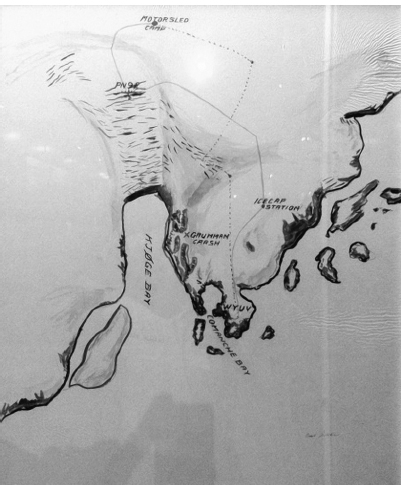
WATERCOLOR VERSION OF BERNT BALCHEN’S MAP OF THE KOGE BAY AREA. (U.S. COAST GUARD IMAGE.)
Lou has also been studying a topographical map by Herbert Kurz, the navigator on Pappy Turner’s B-17, who marked a similar spot with the Duck’s location. The maps made by Balchen and Kurz tell roughly the same story, and both fit the known facts about the Duck’s disappearance. For instance, they place the Duck’s wreckage in a spot about halfway between the PN9E and Comanche Bay, where the Northland waited in vain. The location matches evidence that Pritchard radioed the ship for help—his requests for magnetic orientation—about nine minutes into what should have been a twenty-minute flight.
If the Duck had crashed in a South Pacific jungle or in a European forest, searchers likely would have more than enough information to find the wreckage. Not in Greenland. The search for the Duck is complicated by three main factors: accumulating snow, glacial movement, and a mixture of errors and conflicting accounts in official reports about where it went down.
First, despite recent melting of Greenland’s ice, during the seventy years since the crash some thirty or more feet of snow and ice might have built up atop the Duck. That means finding it will require ground- and ice-penetrating radar, followed by drilling, digging, or melting for confirmation. Second, despite the 1947 sighting, it’s not certain that the Duck wasn’t on an active glacier moving toward Koge Bay. On their trip to Greenland in 2010, Lou and his team left behind tracking devices that suggest the ice in the area is barely moving. But if that’s not the case, the Duck would be nowhere near where it crashed. At some point since November 1942, it might have splashed into the bay with a newly calved iceberg.
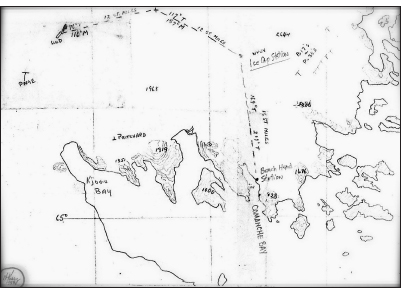
MAP BY LIEUTENANT HERBERT KURZ, SHOWING THE CRASH SITES OF THE PN9E AND THE DUCK. (U.S. COAST GUARD IMAGE.)
The third factor is the conflict in historical records. The Coast Guard’s John Long and other researchers have found nearly a dozen sets of reported latitude and longitude coordinates for the crash site. Some were clearly erroneous and were later corrected, but even the ones considered credible are inconsistent. Most are on a tongue of land on the east side of Koge Bay, but when plotted on a map they make a shotgun pattern. For example, the military’s official PN9E accident report from April 1943 places the Duck’s wreckage at the intersection of latitude 65 degrees 8 minutes north, and longitude 41 degrees 0 minutes west. That’s more than two kilometers, or one and a quarter miles, from the coordinates that Pappy Turner gave to Colonel Balchen in December 1942. Some points are even farther apart, but those two locations are considered among the most credible by Duck Hunt historians, notably John Long and retired Coast Guard captain Donald Taub. On the other hand, the accident report from April 1943 was focused on the PN9E, so there’s lingering skepticism about how precisely it places the Duck crash. And even if the coordinates were once correct, there’s no telling how much the Duck might have moved since then along with the glacier.
To narrow the search, Lou and the Coast Guard have collected radar data from planes that have flown over the area on scientific missions. Among their sources are the University of Kansas–based Center for the Remote Sensing of Ice Sheets, known as CReSIS; a U.S. Navy plane with advanced radar equipment that was returning from Iraq and Afghanistan; and a NASA mission known as Operation IceBridge that’s collecting data on changes to the polar ice sheets. In addition, while in Greenland in 2010, Lou and his team did a boots-on-the-ground survey of one radar-identified site that the Coast Guard considered promising. It was a false lead; Lou thinks that a radar image resembling a plane was in fact meltwater that pooled atop bedrock under the ice.
Lou has spent countless hours this year combing through the historical coordinates and the radar data, and he’s become a proficient computer-aided cartographer. After plotting and cross-referencing all the potential locations on two- and three-dimensional maps, Lou declared in a memo to the Coast Guard that he’s reached “a very high degree of certitude on the [Duck’s] current location.” Lou’s target coordinates are within five miles, or less than eight kilometers, of the official PN9E crash report, and even closer to Turner’s December 1942 sighting. Privately, though, Lou knows that even the best use of radar and historical data is educated guesswork. The only way to be sure of the Duck’s location is to burrow inside the glacier and obtain hard evidence such as a photograph.
But time is slipping by, and the weather makes late spring and summer the only practical times to search Greenland for missing planes. If a green light isn’t lit soon, a year or more will pass before we step onto the ice. Momentum might wane and money might get even tighter, increasing the likelihood that the Duck and its men will be lost forever.
This prospect worries me. I’m determined to get to Koge Bay this summer, to walk the glacier in my own boots, to see the area where the men of the PN9E holed up and where the Duck went down. I’ve begun contacting private expedition companies on the east coast of Greenland, inquiring what it would take to mount a micro-mission on my own. I’m the first to admit that this would be far from ideal. I’m up for a challenge, but my experience in extreme cold consists of shoveling snow from my driveway. My poor directional sense is a source of humor for family and friends. It’s possible that I’m neither as young nor as fit as I think.
When I set aside romantic fantasies of finding the Duck, I know that I’d be lucky just to avoid falling into a crevasse, getting lost in a storm, or upsetting a hungry polar bear. I’m also aware that going alone means that I wouldn’t have access to advanced ground-penetrating radar, and I wouldn’t have the equipment or the necessary permits to dig deep enough to rule out or confirm possible sites. I’d be relying on luck, on a Greenland guide whom I’ve never met, and on the remote possibility that recent melting had exposed part of the wrecked plane. By comparison, Lou seems like a model of moderation. But I don’t see any other choice. One way or another, I’m going to Greenland.
Meanwhile, Lou’s been picking up odd jobs to stay afloat. One night he e-mails me from a work site, asking for a historical document I promised to send him: “I’ve got the computer out on top of a Dumpster working away! So shoot me anything you have. I’ll be here for a few hours.” The image of Lou using a trash bin as a desk fills me with a nauseating mix of despair and admiration. I know how hard he’s trying, how much he’s put into this, but outside sponsors still haven’t signed on; no television network has committed to film the expedition; and time is growing short. Lou remains optimistic—“Don’t worry, we’re going” is his new favorite line—but from our daily e-mails and phone calls, I know that he’s feeling the stress.
Worried that Lou is about to delay the trip, I put my backup plan in motion. I choose a guide; select commercial flights to the Kulusuk Airport on Greenland’s east coast; buy glacier glasses and new snow pants; and, with my guide’s help, tentatively hire a speedboat captain for a ride to Koge Bay.
JUNE–AUGUST 2012
Just when I’d abandoned hope for Lou’s mission, there’s an unexpected turn of events. Leading with his heart and an almost religious fervor, Lou has gained traction. A big moment comes when Lou tells me that the Coast Guard has lined up a C-130 for the expedition, with plans to depart from a small airport in Trenton, New Jersey, on August 20.
Excited, I telephone Commander Jim Blow to confirm the good news. When I reach him, Blow is in the middle of arranging helicopters to take us from Kulusuk to Koge Bay. He’s too much of an officer and a gentleman to say so, but I swear that I can read his mind: “I told you we’re going.” He says final approval for the C-130 is still pending, but he feels good about our chances and tells me to plan for a week or more of glacier camping.
With a departure date in hand, Lou’s groundwork pays off. Government officials in Greenland issue an elaborate fifteen-page permit for North South Polar to search out not only the Duck but also McDowell’s C-53 and planes left behind from the Lost Squadron. Corporate sponsors step up with equipment and supplies. Lou slashes his original million-dollar budget by more than half, to the narrowest margin that assures a safe and well-provisioned mission. Lou’s revised plan focuses purely on finding the Duck, with a recovery mission to follow, if and when the plane and its men are located. “If we don’t get onto the ice we have nothing,” Lou tells me. “Once we get there and we’re successful, everything else will follow.”
I cancel my plan to go it alone and send more money to Lou’s nonprofit Fallen American Veterans Foundation. Three weeks later, I send even more.
Lou’s team starts to congeal, bringing expertise in fields ranging from geophysics to radar to mountaineering to excavation. They trade flurries of e-mails on everything from bedrock depths to the warmest sleeping bags to the best method of polar bear deterrence. This last leads to a lengthy discussion of weaponry, electrified fences, and something called a “Snublebluss,” a tripwire that activates an alarm and warning lights around a campsite. I like the name but worry about its effectiveness. One e-mail includes grisly photos of a polar bear attack victim.
In the midst of these discussions, I pull from my files a government pamphlet titled Encounters with Wildlife in Greenland. I highlight a long section on mortal dangers: “Despite its size and awesome strength, the polar bear is swift and agile, moves easily on rough ice and steep slopes, and is an excellent swimmer. . . . Polar bears are meat eaters . . . [and] any animal, including humans, is potential prey.” The recommended response is avoidance, and the guide offers instructions to make a “Chili-Con-Carne Alarm,” using a can of strong-smelling meat stew as bait to trigger a siren. Call it a Chili-Con-Snublebluss. If escape or scaring the bear isn’t possible, hope that a gun is handy. “Avoid head shots,” the guide cautions, “as they often do not kill a bear. Do not check the results of your shot. If the bear goes down, keep shooting vital areas until it is still. Make sure it is dead.” Noted.
When I show Lou the guide, he assures me that the chance of encountering a polar bear is almost zero. Still, Lou has recruited a medical student and U.S. Army National Guard captain just back from Afghanistan named Frank Marley to be the expedition’s chief of health and security.
Yet for all the fears of polar bears and hidden crevasses, of vicious storms and killing cold, our biggest worry can’t be overcome with Snubleblusses, electrified fences, safety ropes, guns, or extreme weather gear. Hovering over every conversation, every e-mail, every decision, is the nagging anxiety that even if we reach Koge Bay, we won’t find the Duck.
IN JULY, AFTER the team is assembled and a mission plan is written, Lou sends a triumphant text message at one in the morning: “Everything is a go.” We’re bound for Koge Bay with radar-generated search coordinates, a historic treasure map, an expert team, the Coast Guard’s support, and Greenland’s approval, for what might be the last chance to find John Pritchard, Ben Bottoms, Loren Howarth, and the Duck.
By phone the next day, I admit to Lou how deeply I’d doubted him. “Yeah, I figured,” he says, laughing. “No sweat, man. We’ll just leave you on the ice.”
But during the weeks that follow, the mission again teeters on the edge of oblivion. Money remains the main sticking point, as hopes for a television deal fizzle and counted-on sponsors come up short. Stressed, I unload on Lou and his producer/partner, Aaron Bennet, for not having everything in place, even as I send Lou more cash and use my credit card to pay the balance of a bill for sleeping bags. A few days later, I give Lou my credit card number so he can buy tents, a rifle and a shotgun, boots, gear, and assorted other equipment, with an understanding that I’ll be repaid when other money arrives. Soon I’m answering antifraud calls from American Express, which apparently wants to be sure my account hasn’t been hijacked by a mad survivalist.
After thanking me for the card, Lou asks, “What’s my limit, Dad?” We both laugh, me more ruefully than him. In no time, Lou blows past the limit I set.
FORTUNATELY, I’M NOT the mission’s only potential funder. In addition to the C-130, the Coast Guard appears ready to provide as much as $150,000, as “support for expedition to Greenland to provide positive location of USCG J2F-4 Grumman Duck suspected crash site.” A document seeking bids for the job talks about “positive location,” but if the contract comes through, Lou and North South Polar will only be expected to investigate—and either confirm or rule out—six “Points of Interest” considered the most promising from radar hits and historical research. If those sites don’t pan out, up to four more locations might be examined, time permitting. Effort is guaranteed, success isn’t. Yet what’s happening is clear: at the urging of Jim Blow, the Coast Guard is getting ready to close the major gaps in the expedition’s streamlined budget.
It’s safe to say that there could be no odder couple than the Coast Guard and North South Polar. If the contract is consummated, it would be a marriage of discipline and dreams, and the Duck Hunt’s civilian and military point men personify the contrast. While Lou sallies forth to slay dragons, Jim Blow is a study in precise control and military planning, as rooted in reality as his regular haircut appointment.
AT FORTY-FOUR, JIM is married to his college girlfriend, a nurse in a neonatal intensive care unit. They live in suburban Virginia with their three sons, at least two of whom can imagine becoming pilots like their father. He’s spent nearly twenty years in the Coast Guard, and the service defines him. His father was a navy flier, but Jim prefers rescue work. “The navy is always training for something that might never happen. With the Coast Guard, you’re training for what you do day in and day out. Making that rescue, making an impact on people’s lives.”

COMMANDER JAMES “JIM” BLOW. (MITCHELL ZUCKOFF PHOTOGRAPH.)
The lineage from rescue flier John Pritchard to Jim Blow is easy to trace. One of Jim’s best days at work came when he was flying a twin-engine Falcon jet, searching for a missing diver in the Gulf of Mexico. “Those searches usually don’t end well,” he says. He was assigned to fly a search pattern a maximum of four miles from where the diver was last seen. Jim decided that wasn’t far enough, so he stretched the area to seven miles. When turning his jet at the far edge of the enlarged area, he spotted the missing diver from his left-side window. Soon the man was safe and dry.
To win Coast Guard funding to find Pritchard, Bottoms, and Howarth, Jim has written his superiors a lengthy brief titled “Operation Duck Hunt 2012,” with justifications including the military ethos of “leave no man behind”; the risk of climate change exposing the crew’s remains to wildlife; the rising value of World War II aircraft luring unscrupulous salvagers; and Nancy Pritchard Morgan Krause’s advancing age.
Unknown to Lou, Jim also arranges for the U.S. Army’s Cold Regions Research and Engineering Laboratory, known as CRREL, to send a radar team to Greenland. His reputation at stake, Jim wants reconfirmation that something might be found under the ice near Koge Bay. While Jim awaits those results, his superiors approve his “Operation Duck Hunt” request and authorize spending up to $150,000 on the mission.
But then Lou submits a bid seeking almost $200,000, and the mission flirts with disaster. For Lou, the bid reflects something closer to his true costs, with all the technology needed to do the job. Even at that price, he says, he would take significant loss, after working unpaid on the mission for two-plus years. Having seen how Lou operates, from a trailer in his yard as an office, I don’t doubt that money is secondary. But the government can’t pay Lou for the work he’s done on his own, only the work being requested on the ice. Jim Blow recoils at the high bid.
“We found this money,” he says angrily, “but he’s asking for more, without justifying why.” Jim won’t ask his superiors for more, and in mid-August he sits at his desk at Coast Guard Headquarters ready to scrub the mission. He’s spent countless hours studying charts and photographs, puzzling over Balchen’s treasure map, and imagining himself in the Duck’s cockpit, to calculate where Pritchard might have gone wrong. Still, he can’t defend a wild goose chase, and he worries that Lou doesn’t have his act together.
Before Jim can bring himself to abandon the mission, the CRREL folks call with results of the radar survey. More than half a dozen locations inside the glacier reveal “anomalies,” potential metal targets. Several are labeled “strongly prospective targets.”
In quick succession, a chastened Lou lowers his bid to $150,000, the contract is approved, and Jim commits himself and the Coast Guard to the expedition.
“That radar report gave me the warm and fuzzy feeling I needed. That report probably saved this mission,” he says. Jim repeats a line I’ve heard from Lou: “If it’s there, we’re going to find it. If we don’t, it’s not there.”
Lou says that he, too, was close to abandoning the expedition rather than being driven deeper into debt. He says he went ahead because he was determined to complete the mission. “It’s never been about the money,” he says. “We—the families, the Coast Guard, and all those who put in so much time, effort, and energy—have come too far to let it all end here. So I bit the bullet.”
WHEN THE LAST major hurdles are cleared, Lou and I agree to pack a bottle of Scotch. We’ll toast either to our success or to the respectable failure of having given our all. But not just any whiskey will do. Lou likes the idea of drinking the same liquid fortitude that explorer Ernest Shackleton hauled to Antarctica in 1907 during a failed attempt to reach the South Pole. Shackleton left behind three cases, which were found buried in permafrost in 2007. A Scottish distillery replicated the blend and now sells it for $170 a bottle.
Apparently I’m buying.