
21
FEBRUARY–MARCH 1943
THE WIND WAS screeching, the snow was blowing, and temperatures on the glacier were subhuman. Armand Monteverde and Paul Spina knew that if their delusional companion Clint Best remained outside their snow cave, death would come quickly. Yet they feared that if they followed him into the pitch-black night, they might die alongside him.
Spina urged Monteverde to shine the flashlight around the tunnel entrance, so Best might see the beacon and follow it back inside. Monteverde moved to the doorway with the light, but before he reached the entrance they heard a crash. Unable to see in the dark, Best had somehow tripped and fallen headfirst back into the tunnel. His companions rushed to him and saw that his face and hands were a deathly shade of blue. Monteverde pulled Best inside and, with Spina’s help, wrapped him in a sleeping bag.
Half afraid and half angry, their emotions overflowing, Monteverde and Spina yelled at Best, and he began to cry. Still gripped by delusions, he told them that he’d gone outside to get their car, because neither of them had had brains enough to move it into the garage before the engine froze. It was hard for Monteverde and Spina to stay mad at him after that.
The pilot and the engineer stayed up all night with Best, praying that Pappy Turner would fly over in the morning with supplies, advice, and news about the next rescue attempt. Turner’s B-17 did come, but it made only one supply drop and flew off before they could connect on the walkie-talkie. Monteverde uncovered the entrance to the tunnel and found a package just feet away, as though Turner and his crew were milkmen who delivered to the front step. Inside were rare treats: roast beef sandwiches, cookies, candy, and toothbrushes with paste. Monteverde and Spina thawed out the sandwiches and brushed their teeth for what seemed like hours. Best’s mental state remained unchanged. Still unhinged, he wouldn’t eat. They took turns watching him all day and night.
Turner flew over again the following day, and this time Monteverde and Spina described Best’s breakdown over the walkie-talkie. Turner said he’d speak with a medical officer at Bluie East Two and return with medicine and instructions. Before leaving, Turner dropped bacon, ham, candy, and cigarettes. One package also included candles, which they needed to watch Best at night.
The medicine arrived as promised. Antipsychotic drugs were a hit-and-miss proposition in 1943, so the pills Turner dropped might have been barbiturates, widely used at the time as powerful sedatives and anticonvulsants. After taking the pills, Best slept for about four hours and stopped shaking and sweating. When he woke, he looked and seemed more like himself. Best wolfed down bacon sandwiches and seemed to reclaim his right mind.
That night, Best offered to reprise his role as camp cook. All was well at first as he prepared their meal, but then he grew quiet and unnaturally still. Monteverde called to him but got no reply, so he tucked Best into his sleeping bag. Aware that he was sinking into a new delusion, Best told them that “his wires were getting crossed again,” as Spina put it. He asked for another pill, which put him to sleep.
WITH BEST UNRAVELED and Spina’s arm still ailing, Monteverde was the only one who could look for the supply plane or rid their hole of trash and waste. The heavy snows of February piled on top of their quarters, turning the tunnel passageway to the surface into a narrow, icy chimney. One day while trying to shimmy up to go outside, Monteverde became stuck halfway, his arms pinned to his sides and his ice-logged clothes making it impossible to wriggle free. Best couldn’t rouse himself to help, so Spina used his good arm to grab one of Monteverde’s thrashing legs and pull him back down.
Another time, Monteverde was gone awhile, so Spina poked his head outside to look for him. Fear swept over Spina as he saw nothing but an empty, endless glacier. He yelled for Monteverde but heard no answer. Verging on panic, Spina thought that Monteverde had fallen into a crevasse. Roused from sleep by Spina’s yells, a now-clearheaded Best told Spina not to go outside. Best knew that Spina had spent most of the past three months inside the PN9E tail or the snow cave, so he might not recognize hidden crevasses. As Best got dressed to search for their leader, Monteverde appeared in the tunnel entrance. He explained that he’d gone down into a sunken ice bridge to retrieve a can of precious kerosene for a new stove that Turner had dropped. He said he didn’t answer Spina’s cries because he feared that Spina would hear his voice and think it was coming from a crevasse, then race outside to rescue him.
After that, Monteverde and Spina developed a routine in which Monteverde went outside to haul in the packages to the entrance and Spina pulled them into the cave with his good hand. As weeks passed, the food supplies became plentiful and more elaborate, with deliveries that included a dozen roast chickens, pork chops, and cooked steaks. One night when Monteverde and Spina dove in to a chicken feast, Best told them he didn’t feel well and needed another pill. Again it put him to sleep.
When the weather eased in early March, Turner’s B-17 returned bearing a natural remedy for Best’s troubled mind: letters from home. When they learned by walkie-talkie about the incoming mail, all three men went outside to watch as Turner circled overhead, lining up for a low and careful drop of the irreplaceable cargo. They pounced on the package as soon as it hit. Best got the lion’s share, but there were letters for all three. Each man read them again and again, sharing the best parts with the others. A favorite passage came in a letter from Monteverde’s family. It said the War Department wouldn’t reveal where his plane crashed, but the family pieced together enough clues to conclude that he was stuck in a place with lots of ice. Monteverde’s relatives in sunny California advised him to be patient and wait for it to melt. The trio laughed at the thought, knowing that if they followed that advice they’d be stuck in Greenland for several millennia.
Whether a result of the pills, the letters, or something else, Best climbed from the depths of despair and regained his hold on reality. He continued to feel downhearted, but he no longer showed signs of being delusional.
Life settled into a tedious routine in the PN9E cave. The men had enough food and an endless supply of snow to melt for water. They had reading material and candles to read by. They read aloud, each man taking a turn until his hands ached from the cold while holding a book or magazine outside his sleeping bag. Then he’d hand off to the next man in their reading circle.
Their favorite selection was an essay in Reader’s Digest about the power of prayer. One section seemed especially apt for their predicament:
It is the only power in the world that seems to overcome the so-called “laws of nature”; the occasions on which prayer has dramatically done this have been termed “miracles.” But constant, quieter miracles take place hourly in the hearts of men and women who have discovered that prayer supplies them with a steady flow of sustaining power in their daily lives.
The essay renewed their hope, and they read it again and again.
ON A DAY clear enough for a supply flight, Pappy Turner told the survivors that Bernt Balchen and Barney Dunlop would try another rescue attempt with a PBY Catalina. The plan called for the rescuers to land briefly near the now-empty Motorsled Camp. Then, a dogsled team would snake its way through the crevasse field to the PN9E crash site and guide or carry the three remaining crewmen back to the Motorsled Camp. The PBY would then fly them all to Bluie East Two.
Several weeks of storms intervened, and the PN9E trio went for a long stretch without fresh supplies. Temperatures fell and winds raged at up to 125 miles per hour. The three men had a cache of food, but they wouldn’t leave their sleeping bags to cook or even thaw it. They lived on concentrated chocolate bars. Their candles ran out and their sleeping bags froze.
When Turner flew overhead after the storms eased, he told the survivors that some of the men at the base had bet that Greenland’s weather had finally killed them. It sounded heartless, but he meant it as praise for their endurance. Turner rewarded their stubborn refusal to die with gallons of strawberry jam that Spina had requested; new sleeping bags; three air mattresses; and a bottle of whiskey. This time Spina took sips, not gulps.
On March 17, 1943, the planners at Bluie East Two concluded that the weather was clear enough to try a second Dumbo-on-ice landing. Along for the trip with Balchen, Dunlop, and their volunteer crew were the trail team of Captain Harold Strong and sergeants Joseph Healey and Hendrik “Dutch” Dolleman, three men who’d come to Greenland with a wealth of experience on ice.
Healey had grown up in Boston’s Irish-American enclave of Dorchester. Tall and strong, as a teenager he’d been a second mate aboard the supply ship Jacob Ruppert during Admiral Byrd’s 1933–1935 Antarctic expedition. Healey joined Byrd again for a 1939–1941 polar journey, this time as a dog wrangler. During the latter expedition he received a singular if obscure honor: on the east coast of Antarctica, in a place called Palmer Land, on the north side of the entrance to a body of water called Lamplugh Inlet, lies a square-shaped outcropping of rock named Cape Healey. Six months before the attack on Pearl Harbor, Healey left Byrd’s service and joined the U.S. Army as a sled dog trainer.
Dolleman was born in the Netherlands and immigrated to the United States with his parents. After a boyhood in Manchester, New Hampshire, he joined the U.S. Army, which sent him to Antarctica on a scientific expedition to study penguins. Short and lean, days away from his thirty-seventh birthday, Dolleman also was the namesake of a little-known land mass. Off the east coast of Palmer Land in Antarctica lies the ice-covered, thirteen-mile-long Dolleman Island. After his army-sponsored penguin studies, Dolleman was sent to Greenland.
Of the three, the most exotic backstory belonged to Strong. A native of Gloucester, Massachusetts, the forty-year-old Strong graduated from Princeton in 1924, then spent two years studying art and architecture in Europe. He returned to the United States in time to make a killing in the stock market, cashing out before the 1929 crash. Flush with cash, Strong and a friend went to Alaska to herd reindeer for two years. On a trip home they saw the ongoing effects of the Great Depression, so they returned to Alaska and worked for five more years in the 1930s as fur traders, buying fox pelts from Inuit hunters along a twelve-hundred-mile circuit they traveled by dogsled. Later, incongruously, Strong worked as a wallpaper executive in Texas before growing bored of civilized life. He joined the Army Air Forces in 1942, and his peculiar expertise earned him a spot on an Arctic search-and-rescue team in Greenland. Muscular, tanned, tall, and square-jawed, Strong cut a dashing figure as he cruised around Bluie West One in a Jeep pulled by a team of huskies. For a valet, Strong employed a huge black Newfoundland dog equipped with saddlebags to carry his lunch and his holstered .38.
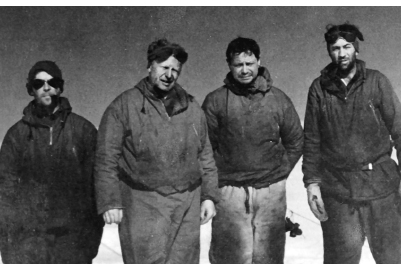
FROM LEFT, SERGEANT JOSEPH HEALEY, COLONEL BERNT BALCHEN, CAPTAIN HAROLD STRONG, AND SERGEANT HENDRIK “DUTCH” DOLLEMAN. (U.S. ARMY PHOTOGRAPH.)
FLYING SOUTH FROM Bluie East Two, Barney Dunlop lined up to land the PBY Catalina one hundred yards to the right of the Motorsled Camp. As he descended, the clear weather several thousand feet above Greenland became what Balchen called “an opaque sheet of driving snow particles, whipped up by the wind. Our visibility is no more than fifty feet, and the blowing snow is so thick that we can barely see our tip floats.”
Dunlop fought the elements and slid the Dumbo to a stop about five hundred yards from where he’d intended, but in one piece. The three-man trail party climbed out with their dogs, sleds, and gear. Before heading toward the PN9E, they rocked the plane free from the glacier’s grasp. With the windshield coated by ice and winds toying with the rudder, Dunlop returned to the air with little more than a prayer to guide him. Soon he cleared the weather and returned to the base.
Strong, Dolleman, and Healey could only manage part of the six-mile journey before darkness fell, so they camped that night on the ice. The following day, Turner’s B-17 flew one pass after another to guide the dogsled team toward the PN9E wreck.
Monteverde, Spina, and Best knew from walkie-talkie chatter that the rescue team was approaching. They climbed up their igloo’s ice chimney and made a smoky oil fire on the glacier to serve as a beacon. They made extra coffee and assembled ham sandwiches, as though waiting for neighbors to drop in for lunch. The three survivors stared into the blinding white distance as tiny black specks grew larger. They grew impatient as long stretches passed without any apparent progress. Going was slow, as the men on the trail team avoided crevasses and repeatedly lifted their sleds past waves of sastrugi. Several times the sleds overturned as they hauled them through deep drifts, tiring and slowing them further.
Spina grew impatient and climbed atop the front end of the PN9E like a hood ornament. As he waited for the trail team, he spotted a can of milk some fifty feet away. Without thinking, he climbed down and walked across the glacier toward it. When Spina reached the can, he noticed a small crack in the ice. He stared down at it, mesmerized by the jewel-like blue-green translucence. Monteverde inched in his direction and told Spina that he was standing on a bridged-over crevasse. If it collapsed, he’d be enjoying the lovely view for the rest of his short life.
Chastened, Spina backed away. Safe inside the snow cave, he got an earful from Best for risking his life—without retrieving the precious milk.
Hours passed, and finally the survivors could hear sled dogs barking and the trail team calling out commands. For a time, rescuers disappeared from sight in the dip of a small ravine. Monteverde, Spina, and Best called to them for a half hour but received no answer. Fearing the worst—three more men lost in a crevasse—they slouched back into their cave and broke down in tears. The dread they’d felt that more men would die on their behalf, a motive for their brief suicide pact, had apparently come true.
As they wept, the trio heard someone walking on the bomber wing that served as their roof. Spina heard a voice call, “I guess these ice worms don’t want to leave this joint!” The survivors rushed outside and shook hands with Strong, Healey, and Dolleman. The trail team explained that they’d disappeared in a gully a half mile away to pitch camp and to chain their dogs out of range of the crevasses. The men got to know one another, drank coffee, and ate ham sandwiches. Then the trail team returned to their dogs.
Back in the ice cave, the survivors talked about how little exhilaration they felt at the rescuers’ arrival. Spina suspected that their emotions, like their bodies, had been dulled by the cold. He wrote in a journal, “After 129 days of fighting everything the Arctic could throw at us, I guess nothing could excite us.”
That night, the PN9E trio unwrapped clean, dry socks and fresh clothes they’d saved for their departure. They’d been unwashed and unshaven for more than four months, their hair so long and unkempt that they barely resembled their fresh-faced military portraits. They reeked, and they knew it. But at least when they left their Greenland snow cave, they’d be wearing clean underwear.
They climbed into their sleeping bags but couldn’t sleep, so they talked all night. Spina spent the next morning vomiting, either from too much ham or too much bottled-up anticipation. While Spina emptied his stomach, Best dug up the PN9E’s Norden Bombsight, which they’d buried in ice for safety. Spina pulled himself together, and the three men carried out their sworn duty, destroying the bombsight by throwing it into a crevasse. They listened for it to hit bottom, but they never heard a sound.
When the trail team arrived, it was time for Monteverde, Best, and Spina to abandon ship. Before leaving, Spina suggested that they burn the PN9E’s cockpit, to keep its secrets from enemy eyes. Strong told him not to worry; no one would ever be brave, foolish, or unlucky enough to come this way again.