
23
MARCH–APRIL 1943
CAUTIOUSLY AVOIDING CREVASSES during the first mile to the Motorsled Camp, Monteverde, Best, and Spina each walked under his own power, as did the three-man trail team. The nine dogs pulled a main sled, behind which was a tow sled loaded with everything the men and beasts would need until Barney Dunlop’s Dumbo returned to fetch them or Pappy Turner’s B-17 resupplied them.
The team’s lead dog was Rinsky, a fierce husky born in Antarctica and brought to Greenland by Healey, its owner. Two other dogs on the team were called Pat and Mopey. Raised in barren lands with no trees or hydrants, male sled dogs had no targets upon which to relieve themselves, so they usually squatted rather than raising their legs. Sometimes, though, a man’s pant leg might get watered in a display of disdain or dominance. Greenland dogs tended to be aggressive, often fighting among themselves for scraps and power. Straddling the line between wild and tame, most had little use for affection or human company. Some were whip-smart and some were dumb as sleds. Some were handsome and some were not. All were tough and seemingly immune to pain and cold. Most seldom barked, but they’d howl like their ancestors at night and at meals. When tired, they’d curl into tight balls of fur, their faces against their flanks, to sleep through Arctic winds.
As the men and dogs marched across the snow-covered ice, Spina was the first to falter. During more than four months since the crash, the farthest he’d walked was fifty feet in pursuit of the milk can. He tried to keep up but soon he fell to his knees every twenty or thirty feet. He’d rise and stumble forward with his eyes shut, then fall again into the snow. After one fall Spina made no effort to rise. He felt resigned to die in place. Strong had other ideas; he bundled Spina aboard the tow sled. Best fell next. Monteverde teetered, tempted to pitch forward into a snowbank and sleep forever. Strong called a halt.
Dolleman raised a tent and climbed inside with Best and Monteverde. They’d remain behind to rest while the others raced ahead to the Motorsled Camp. Strong and Healey continued on foot while Spina reclined on the tow sled. As they hustled across the ice, Strong stepped over the edge of a crevasse. But he was no greenhorn in Greenland; he held tight to a rope attached to the dogsled, and the sled’s momentum pulled him up to safety.
Along the route, they planted red warning flags to mark crevasses and yellow guide flags to mark the safe path. When they reached the empty Motorsled Camp, Strong and Spina climbed into a tent. Healey and the dogs swung around to retrieve Dolleman, Monteverde, and Best.
Once reunited, the six men spent the next two nights in tents on the ice. During the day, Strong, Dolleman, and Healey enlarged and improved the warren of snow caves left behind by Don Tetley, Harry Spencer, and Bill O’Hara. When they climbed inside, Monteverde, Spina, and Best were astonished: their friends had created an underground ice palace.
The entrance was a large hole with a fifteen-foot staircase cut from snow. That led to a hallway about six feet wide, twenty feet long, and ten feet high, with an oil stove at the far end to keep the lair warm and to dry their clothes. Along the hallway were openings that led into small sleeping rooms, like berths on a train. Each was about five feet off the ice floor, to keep water from accumulating in them. The hallway also led to a kitchen with shelves cut into the ice and a vent to the surface for cooking and heating fumes. A large room off the kitchen was the pantry. Past the stove at the end of the hallway was a second set of stairs, leading down another ten feet, to a latrine carved from ice and snow. The three remaining PN9E survivors were so impressed that they renamed the Motorsled Camp: now it was the Imperial Hotel.
The six men enjoyed several days of good weather, during which Turner’s B-17 boosted their supply cache. But several days of storms followed. The wind was so strong and the snow so fierce that Healey brought the dogs down into the human quarters. One husky that refused paid for his disobedience with a case of frostbite, though he recovered. The dogs treated the underground maze like a kennel, fighting and running through the rooms. When the dogs settled down, they became warming blankets for the men, who tucked their sleeping bags against them at night.
TWO WEEKS PASSED during which Strong, Healey, and Dolleman cared for the needs of their three Imperial Hotel guests. Healey cooked, and with a wide variety of available supplies he took dinner orders from each man. Healey didn’t like coffee, so he resisted making it, but he kept a pot of tea boiling on the stove around the clock. They stayed up late every night, talking by candlelight and telling jokes. Spina, the jokester of the PN9E, credited Dolleman for keeping them all in stitches. Between laughs, the three trail men told the three fliers stories from their Arctic adventures.
When it was light they climbed up from the cave, and Healey strapped Spina to the sled for daily exercise runs with the dogs. They made multiple passes over the designated landing area, to tamp down new snow.
When Strong was still at Bluie East Two, Don Tetley gave him a detailed map of the Motorsled Camp that included the general location of the buried motorsled. When the weather cleared, Strong decided to get some exercise by digging for it. Dolleman and Healey joined in, and in time so did Monteverde and Best. Spina, his arm still recovering, appointed himself foreman. They dug for three solid days before finding the missing motorsled under twenty feet of snow.
AT BLUIE EAST TWO, rain replaced snow and coated the runway with slush. A bigger worry for Balchen was that melting would make the snow at the Motorsled Camp/Imperial Hotel sticky, preventing the PBY from taking off after it collected the six men and dogs. Adding to Balchen’s concerns were high winds that wreaked havoc on the two PBYs on the tarmac. Both suffered broken ailerons, the hinged sections on the trailing edge of the wings that allow an aircraft to bank left or right. Time was passing, and repairs added to the delays.
ON APRIL 5, 1943, nineteen days after the trail team arrived on the ice, Harold Strong radioed Bluie East Two with good news. The ground temperature was relatively warm and the wind had taken the day off. Balchen ordered him to break down the sled and get ready to load everything aboard the rescue plane.
Worried about the Dumbo’s weight on takeoff from the ice, Balchen had crews strip the plane of everything not essential to flight or stability. He filled its fuel tanks with only enough for the round-trip, plus a little extra for safety in case of delays.
Before the Dumbo arrived, Pappy Turner flew over the Imperial Hotel in his B-17. Spina got on the walkie-talkie and promised his friend Carl Brehme, Turner’s engineer, that he’d buy him the biggest steak he could eat if the rescue succeeded. During the same conversation, Monteverde heard good news: he’d been promoted to captain during his nearly five months on ice.
As the Dumbo approached, the six men on the ground turned themselves into human weathervanes: they lined up facing into the wind, a signal they’d devised to let pilot Barney Dunlop know the wind direction. He landed as smoothly as he’d done twice before, sending plumes of snow into the air that briefly obscured the plane. Dunlop taxied in a wide circle and stopped near the waiting men.
Balchen wanted to hustle the six men, dogs, and equipment aboard to keep the Dumbo’s belly from freezing to the ice. But the plane’s crew hopped off, wanting to take pictures and to welcome the long-missing men. When the greetings ended, the dogs and equipment were loaded first, followed by the six men. Balchen noticed that Monteverde, Spina, and Best boarded in silence, as though unable to believe that their long wait was nearly over.
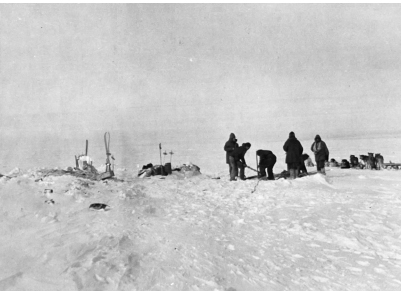
STANDING ATOP THE IMPERIAL HOTEL ARE (FROM LEFT) BARNEY DUNLOP, HENDRIK “DUTCH” DOLLEMAN, ARMAND MONTEVERDE, JOSEPH HEALEY, AND PAUL SPINA. (U.S. ARMY PHOTOGRAPH BY BERNT BALCHEN.)
But once again, the Dumbo’s belly froze to the ice. Strong and Healey got out and rocked one wing, while Dolleman and the plane’s engineer, Alex Sabo, rocked the other. Dunlop gunned the engines and the plane shook as it fought to free itself. When the Dumbo broke loose, Dunlop made four laps around the field. Each lap allowed another man on the icebreaking crew to board on the run through the side blister.
Dunlop steered the plane into position for a long, uphill takeoff run. The passengers stood as far back in the tail as possible, to make it easier for the Dumbo’s nose to lift. Dunlop leaned hard on the throttles and the plane sped across the ice, rising three or four feet then dropping back down, then rising, then dropping again. Dunlop turned around and tried a downhill run, but again he couldn’t gain enough lift. He eased back on the throttles just short of a crevasse.
The Dumbo had four pilots aboard: Dunlop, Balchen, Monteverde, and the copilot, Nathan Waters. By the second failed attempt, none could have doubted that they faced a nasty combination of too much weight from the passengers, dogs, and cargo, and too much friction from the slush coating the Dumbo’s fuselage. A strong headwind would have lowered the ground speed needed for takeoff by creating greater airflow over the wings. But even that might not have been enough, and it was a moot point, anyway. On the one morning when they needed it, the notorious Greenland wind was nowhere to be found.
The Dumbo’s twin engines began to overheat, but Dunlop pressed on. He turned the plane uphill for one more run. As he gained speed, the right engine burst into flames. A line broke and shot black oil onto the wings and fuselage. Dunlop shut down both engines, and crew members jumped out to extinguish the fire. The vacuum pumps were damaged, the fuel pressure gauge line was burned, the cowling on the damaged engine was melted, the engine had lost oil, the exhaust rings were burned out, and the entire works were black with soot. The engine wasn’t quite dead, but any hope of flying that day was gone. Dunlop taxied back to the Imperial Hotel.
Monteverde, Best, and Spina couldn’t believe their bad luck. They seemed doomed to remain on the glacier.
But Balchen and Dunlop weren’t done. The crew began emergency repairs, holding together the damaged, twelve-hundred-horsepower engine with steel straps from equipment cases. Pappy Turner dropped them fresh oil and a replacement oil line, but installing it would mean the time-consuming task of taking apart the engine. The repair crew held off, waiting for a decision from Balchen on whether to make the repairs quick and dirty, or take several days to install the new oil line. His decision depended in part on when he thought the winds would return. They had no way to anchor the Dumbo, so a powerful storm might toss the plane like a dry leaf.
Everyone left the plane and holed up in the overgrown snow cave, discussing their options and dining on a meal prepared by Balchen himself. Balchen thought aloud about the challenges ahead. The second PBY was damaged and unavailable, so they had neither a backup plane nor a backup plan. Getting the three PN9E survivors off the ice soon meant relying on the Dumbo parked outside the Imperial Hotel.
Balchen worried that installing the new oil line would take too long and endanger the mission. The plane would be exposed to windstorms without being tied down. Or, it might freeze to the ice so solidly that no amount of rocking would free it. Balchen believed that they had one last chance to get airborne without the new oil line. To do so, Barney Dunlop could use both engines for takeoff, and then rely on the undamaged engine for the return flight to Bluie East Two. Balchen calculated that just enough fuel remained if they lightened the load. Having made his decision, Balchen announced that he, Strong, Healey, and Dolleman would remain behind, along with their dogs, camping equipment, supplies, and sled.
The plan was pure Balchen. Taking off from the ice cap was, by itself, a dangerous maneuver in the best conditions, accomplished only four times previously, twice by Pritchard in the Duck and twice by Dunlop in the Dumbo. Now, ignoring the possibility of an explosion or a crash, Balchen wanted Dunlop to take off with a half-blown engine, and then fly the survivors back to the base with barely enough fuel to get there. Meanwhile, Balchen and the trail team would trek to the coast, with little hope of rescue if disaster struck.
The three PN9E survivors were skeptical, but they trusted Balchen. And after five months on the ice, they were ready to try almost anything.
After dinner, Balchen and Dunlop spent the night in the cave with the six regular guests of the Imperial Hotel, while the rest of the crew returned to the plane. Monteverde, Best, and Spina went to sleep praying for good luck and good weather.
THE SURVIVORS’ PRAYERS were answered almost too well. The day was clear and the air dead calm the morning of April 6, 1943. Balchen wanted at least some headwind to lift the Dumbo, so they ate breakfast and waited. They also waited for Pappy Turner’s B-17 to arrive overhead, so he could follow the Dumbo back to the base. With Turner tracking the plane, rescuers would know where to look if its engines failed.
When winds picked up in the afternoon, Balchen and Dunlop decided it was time. The survivors and the Dumbo crew scrambled on board while Balchen, Strong, Dolleman, and Healey rocked the plane to break its icy cradle.
Dunlop raced down the glacier runway. He tried for nearly a mile, occasionally bouncing several feet off the ground. But just as on the previous day, he couldn’t gain lift. He turned the Dumbo around and tried in the opposite direction, but again had no luck. Their chances were running out. The plane’s already slim margin of fuel was nearly gone. The damaged engine wouldn’t take much more strain. Dunlop got out and strategized with Balchen.
“If I hadn’t flown in this ship before,” Dunlop told the legendary pilot, “I’d almost say that this ship wasn’t built for flying.”
Confident as ever, Balchen claimed that all they needed was more wind. The pilots and crew stood around, talking and taking pictures. After several hours stronger winds arrived. One cost of the delay was the absence of an escort: Turner’s B-17, running low on fuel, had returned to Bluie East Two.
Balchen and the three trail men shook hands with the men boarding the Dumbo, as both groups headed toward uncertain futures.
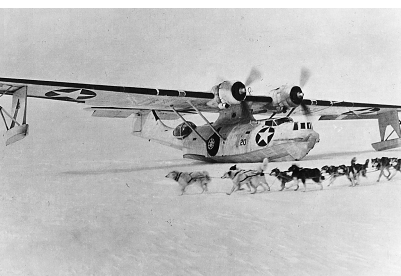
THE SLED DOG TEAM PASSES THE PBY DUMBO AS IT WARMS ITS ENGINES. (U.S. ARMY PHOTOGRAPH.)
THE FOUR-MAN TEAM of Balchen, Strong, Dolleman, and Healey soon began the demanding march with their dogs to Beach Head Station. They followed a winding route that stretched more than forty miles with detours to avoid crevassed areas.
Later, Balchen recounted the journey with undisguised pride: “I have no instruments along for land navigation, and I have to guide the party by dead reckoning. With a prismatic pocket compass and a protractor, I make computations in pencil on a diary page, and clock off our mileage on a distance-measuring wheel fastened to the runner of the sled. For five days, we hole up [during] a williwaw”—a frightful storm—“staking our dogs securely, and digging under the snow ourselves to ride out winds up to 150 miles an hour. Ten days later, we have worked our way to the coast, through drifts and sastrugi as high as three feet.”
All four men and their dogs arrived safely at Beach Head Station. On April 18, 1943, a plane picked them up there and returned them to Bluie East Two.
AFTER BALCHEN AND the trail team rocked the Dumbo free from the ice, Dunlop set off down the glacier runway once more, heading uphill into the resurgent wind. Again the Dumbo bounced along the way, but this time the wind rushing over the outstretched wings provided enough lift to separate the plane from the ice cap.
With the damaged engine straining, Dunlop gained altitude slowly. Low on fuel and losing oil, he cut the dying engine when the Dumbo was about one thousand feet above the ground. Then he adjusted the angle of the right propeller so it sliced through the wind, a technique called “feathering the engine.” Otherwise, drag created by the shut-down engine would have threatened the plane’s ability to fly. But Dunlop’s prudent move triggered a new problem.
Without power from the right engine, the Dumbo hung in the air as though planning a return to earth. Balchen’s scheme seemed to be failing, and the passengers feared for their lives. After a heart-stopping pause, the plane went into a dive. Dunlop fought in the cockpit, but the Dumbo kept losing altitude. He leveled off, but soon the plane was barely more than fifty feet above the ground.
Spina looked out the window in the Dumbo’s side blister and saw the ice cap rushing toward them. He and Best thought they were about to crash, ending their ordeal and their lives in the cruelest possible way. Harold Larson, the Dumbo’s radioman, saw the survivors’ white-knuckled distress. He patted them on the backs and told them everything would be fine, whether he believed it or not.
No one was comforting anyone in the cockpit. Fearing disaster, Dunlop resolved to restart the damaged engine to gain altitude. It was a risky move—if the engine exploded, they’d be done for. But if they didn’t want to crash, they needed its power, even briefly.
Dunlop restored power to the engine; it strained and complained, but it held together. With both propellers spinning, Dunlop pulled back hard and got the Dumbo’s nose pointing upward. But now he faced a new obstacle: the mountains that guarded Greenland’s coastline. Dunlop demanded that the plane continue to climb, hoping to gain enough altitude while both engines worked to clear the highest peaks. In the cabin, the passengers watched silently through the windows as the mountains approached.
As Dunlop struggled, the instrument panel before him displayed a terrifying sight: the cylinder head temperature gauge for the damaged right engine was deep in the red, far past the danger zone. Leaking oil and pushed beyond its limit, it threatened to catch fire and explode. With no other choice, Dunlop continued to climb.
The Dumbo rose, and the jagged mountains passed beneath them. When Dunlop felt confident that they’d cleared the peaks, he shut down the damaged engine and began to lose altitude. He pointed the plane east toward the water, in case they had to employ the seaplane’s buoyant qualities. That move reflected Dunlop’s newest worry: using the second engine for part of the flight hadn’t been part of Balchen’s calculations. Now they were nearly out of fuel.
Listening to the crew’s conversations over a headset, Monteverde heard Dunlop ask the flight engineer how much fuel remained. The disturbing answer was, about 120 gallons. The Dumbo was burning seventy-three gallons of fuel an hour, and was still more than an hour from Bluie East Two. Monteverde could do the math. Based on their distance and fuel consumption rate, they’d have perhaps thirty gallons to spare. For a plane with a fuel capacity of almost 1,500 gallons, that translated as a teacup of water to sustain a thirsty elephant. A strong headwind could suck the Dumbo dry.
FOR THE NEXT hour, Dunlop tried every trick in his pilot’s bag. Yet nothing could prevent the plane from losing altitude. From his desk outside the cockpit, radioman Harold Larson called Bluie East Two to say that the Dumbo might not make it. Without Pappy Turner’s B-17 as an escort, no one would know where it went down. The base answered that it would send a new spotter plane, and soon a twin-engine Beechcraft AT-7 appeared alongside the Dumbo.
Somehow, Dunlop kept the air beneath his wings. About five minutes from the base, he spotted the mouth of the fjord leading to Bluie East Two. Dunlop asked again about fuel. The engineer told him that the gauges read empty.
Dunlop faced a choice upon which all their lives depended. He could aim toward the fjord for a controlled water landing, or he could go for broke. Dunlop chose the latter. He’d fly toward the base until the last fumes were gone and the lone engine quit. Then he’d glide the rest of the way and make what pilots call a dead-stick landing.
Dunlop told everyone aboard the Dumbo that if they heard the remaining engine sputter out, they should prepare for a crash. The men in the cabin piled bags and equipment against the hard metal bulkheads to soften the blow. They sat together with their backs against the cushioning material and braced for impact.
As the Dumbo lost altitude, Dunlop lined up for his one shot at an approach. Now he discovered yet another problem. The dead right engine controlled the hydraulic pump for the landing gear. Using a hand crank, his crew lowered the main wheels manually, but they had no manual control for the nose wheel. Dunlop would have to bring the Dumbo down onto a hard runway on its snout.
This was the very danger the plane’s manufacturer had expressed two months earlier in the message to Balchen. Too much pressure on landing might collapse the forward bulkhead. But with no fuel and a dead engine, Dunlop had no choice.
He touched down with the plane’s main wheels. Dunlop fought to keep the nose up and away from the landing strip, without raising it too high and bouncing the tail on the ground. Within seconds, he began to run out of runway. Dunlop eased down the Dumbo’s nose, to use it as a brake. The maneuver had to be handled just right—fast enough to stop, but not so fast and hard that he’d break the plane in two.
When the nose touched down, the Dumbo made a sharp turn, veering directly toward Pappy Turner’s B-17, which happened to be parked at the far end of the runway. Dunlop braked as hard as he could. The men in the Dumbo braced for impact. Turner’s bomber loomed ahead. The two planes, one in motion, one a stationary target, both of them committed to saving the PN9E crew, closed to fifty feet.
Then forty. Thirty.
Fifteen feet from Turner’s B-17, the Dumbo skidded to a stop.
The plane carrying the last three survivors of the wrecked PN9E balanced motionless on its nose with its rear end high. The Dumbo looked as though it was taking a deep, well-deserved bow.
THE BASE AT Bluie East Two emptied to greet them. The survivors grabbed handfuls of dirt from the runway to celebrate their deliverance from ice cap purgatory. If they had continued their matchstick calendar to the last day, the top row would have displayed four sticks, the bottom row six. They’d been on the ice from November 9, 1942, to April 6, 1943. One hundred and forty-eight days.
Armand Monteverde, Alfred “Clint” Best, and Paul Spina joined Lloyd Puryear, Alexander Tucciarone, Harry Spencer, and William “Bill” O’Hara as PN9E crash survivors rescued from the glacier beyond the Koge Bay fjord. The five C-53 crewmen they’d hoped to find remained lost. Also left behind were PN9E fliers Loren “Lolly” Howarth and Clarence Wedel, and would-be rescuers John Pritchard Jr., Benjamin Bottoms, and Max Demorest.
SOME FORTY-FIVE YEARS later, a fully recovered Clint Best told his grandchildren about the crash, the bitter cold, the deprivation, and the fear. He explained how the hardships were offset by the caring he’d felt from his friends. Best left out the worst parts, so as not to upset the children, but he did mention his bouts of dementia.
Above all, Best marveled at the efforts made to save him and his crewmates. “Money was never an object. If there was someone out there that needed rescuing, the air force went out to the rescue,” Best told his family. “They never give up. They never gave up on us.”
Despite the passage of time and the wisdom of age, Best struggled to describe how it felt to have survived. “As I’ve gone on through the years, it’s hard to figure out how you can be with eight other people, and one falls into a crevasse and disappears. It’s, ‘Why me, Lord?’ In this case it’s, ‘Why him?’ And the radioman goes after a plane and he gets killed, and the lieutenant comes down on the motorsled to rescue you, and he gets killed. You wonder why it’s all of them.”
Finally, Best settled on divine intervention: “I figured God must have had some plan in this world, that He let me along with the others remain.”