
Chapter Four
ON THE SIXTH DAY OF JUNE, 1944, five divisions of Allied troops from three different nations landed on the German-held coast of Lower Normandy, and three other divisions, in which the same nations were all represented, came down upon this region from the air. This was the beginning of what may well be called the most momentous military enterprise in modern history; for these eight divisions were only the vanguard of a tremendous armament and the events of that day led directly to another day, eleven months later, which saw the unconditional surrender of the once proud armies that had subjugated Western Europe for Adolf Hitler.
In war, successes such as this are the dividend of many months of arduous preparation. In one sense, indeed, the preparation for Operation OVERLORD began immediately after the British Army was driven from the soil of France at Calais and Dunkerque in June 1940, for when the Government and people of Britain set about the re-equipment and reorganization of their military forces, they thought in terms not only of the defence of their island but also of the day when the British Army could resume the offensive in Europe, re-cross the Channel and fight towards the borders of Germany. At least as early as the summer of 1941, British military planners were specifically contemplating an invasion of Western Europe; for the German attack on Russia had suddenly made such an operation infinitely more likely than it had been when the two powerful dictatorships of Stalin and Hitler had been in alliance. Then in December 1941, Japan, followed immediately by Germany and Italy, declared war on the United States. GIs began to appear in the British Isles soon after, and the prospect of great American armies being available for the assault on the continent brought it still closer to realisation.
Nevertheless, that so-called Second Front was being considerably delayed for there was much to be organised before the day of liberation dawned for France. During 1942, Allied leaders were continually in conference concerning the times and places where forces might be most effectively deployed. However, by the end of July, the push to drive Rommel out of North Africa had begun and this meant that any large-scale operations in Europe would have to be put on hold.
It was necessary, however, to keep the German high command in constant doubt as to the Allies’ intentions with regard to an invasion. It was no less vital to offer all possible assistance to Russia in her attempts to repel German advances on the Eastern Front, while intelligence units needed time to compile and analyse information regarding German defences in northern France – and the best method of breaking them down. It was with these objectives in mind that the ill-fated raid against Dieppe was launched by a military force of which almost ninety per cent was Canadian, on 19 August 1942. Moreover, in a sense, it was that raid which marked the beginning of the real preparation that led directly to the commencement of Operation OVERLORD almost two years later.
On 2 August 1944, Prime Minister Winston Churchill, looking back upon the successful assault in Normandy and the long train of events preceding it, told the House of Commons;
I was opposed to making this great invasion across the Channel in 1942, and, thereafter, it was plainly impossible in 1943, owing to our having chosen the Mediterranean and to our amphibious resources all being concentrated there … I do not believe myself that this vast enterprise could have been executed earlier. We had not the experience; we had not the tackle.
By the spring of 1944, however, things were very different; the enemy had been cleared out of Africa and Sicily and slowly pushed halfway up the Italian Peninsula; the lessons of Dieppe had been learned and five successful opposed landings in the Mediterranean had taken place. Specialised landing craft and armour had been developed by the British and been tested in these operations so it was now available for work in the Channel.
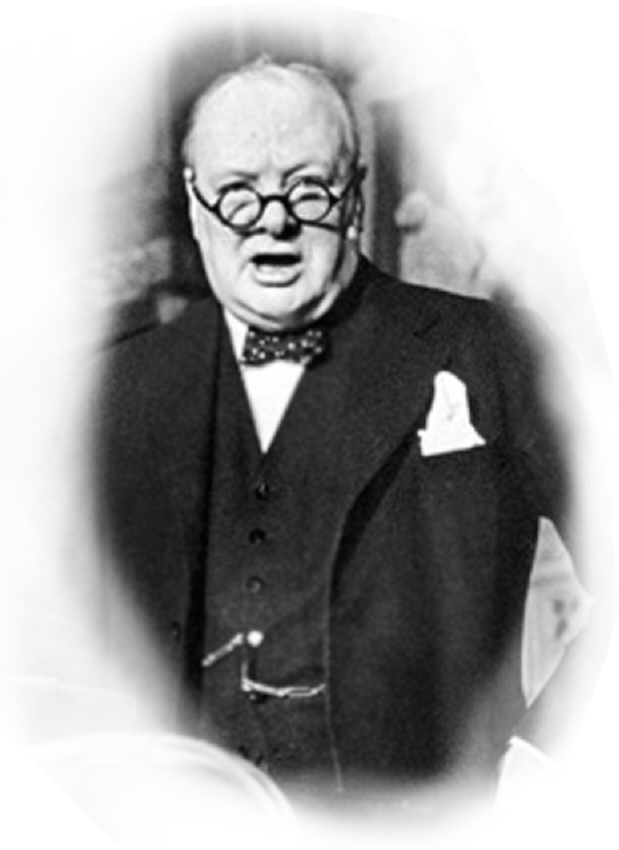
Prime Minister, Winston Churchill, addressing the House of Commons.
Throughout 1943, while success followed success in the Mediterranean, Allied statesmen and officers had been planning in increasing detail the still greater enterprise ahead. Intensive planning began in London in April under the direction of a British officer, Lieutenant-General F.E. Morgan, who was designated as COSSAC – Chief of Staff to a Supreme Allied Commander – who had not yet been appointed. By July, an outline plan for the invasion of the Continent was in existence. This plan recommended breaking into Europe by way of that part of the coast of Lower Normandy near Caen and was approved by the Allied leaders during their historic conference at Quebec in August 1943.
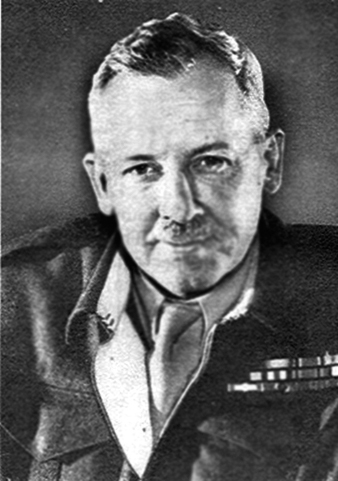
F.E. Morgan.
On Christmas Eve, 1943, London and Washington announced the appointment, as Supreme Allied Commander, of the American officer who in a similar appointment in the Mediterranean had shown himself to have a remarkable talent for the coordination of the efforts of Allies. General (now General of the Army) Dwight D. Eisenhower, was to oversee Operation Overlord, while Air Chief Marshal Sir Arthur Tedder would serve as his deputy. It was also made known that General (now Field Marshal) Sir Bernard Montgomery, the commander of the victorious Eighth Army in North Africa, Sicily and Italy, would command the British armies in the invasion of Europe. Only after the invasion had begun was it announced that Monty was also to direct all the ground forces engaged. The Allied Naval Commander, Expeditonary Force (ANCXF) was to be Admiral Sir Bertam Ramsay; and Air Chief Marshal Sir Trafford Leigh-Mallory was appointed Air Commander-in-Chief, Allied Expeditionary Air Force.
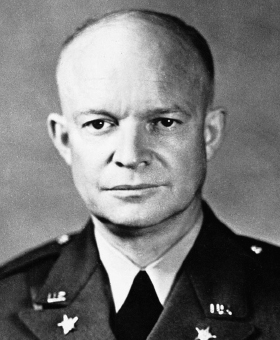
Dwight D. Eisenhower.
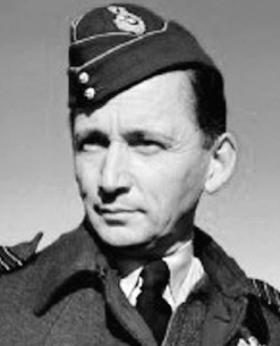
Sir Arthur Tedder.
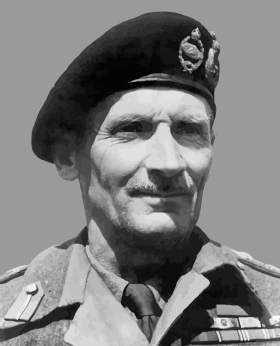
Sir Bernard Montgomery.
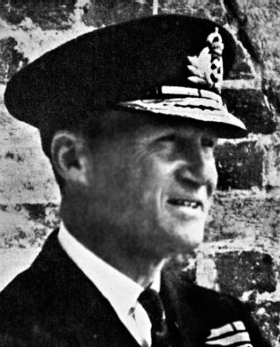
Sir Bertam Ramsay.
General Montgomery arrived in England from Italy in the first week of 1944. Thereafter, the COSSAC outline plan was amended, the attack front widened to include the lower part of the Cherbourg, or Cotentin, peninsula, and the number of troops to be employed in the first assault was increased. By February 1944, the naval, ground and air commanders had completed an Initial Joint Plan, which provided the basis on which planning by subordinate commanders proceeded, and included all the essential features of the assault as finally carried out.
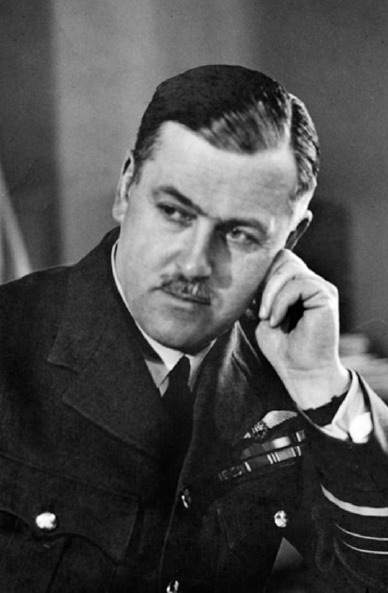
Sir Trafford Leigh-Mallory.
Canadian military forces had begun to arrive in the United Kingdom in 1939, and from that year onwards they had grown steadily in numbers and in efficiency. The decision to declare war on Germany had not been an easy one for the Canadian government, which was struggling with widespread poverty at home and would need to invest considerable monies to bring their armed forces to fighting strength. But, after waiting until 10 September, 1939, to declare war on Germany, prime minister William Lyon Mackenzie King was merely establishing Canada’s autonomy from the UK as public opinion was very much in favour of joining the conflict. The French surrender in 1940 resulted in Canadian forces finding themselves confined to a role which, however important, was too benign for the proud Canadians – a defensive role in Britain against an invasion which never materialised. So it was no surprise that they looked more and more to the coming assault on Fortress Europe as the fulfilment of their destiny – and in this most deadly of ventures, they were set to play no minor part.
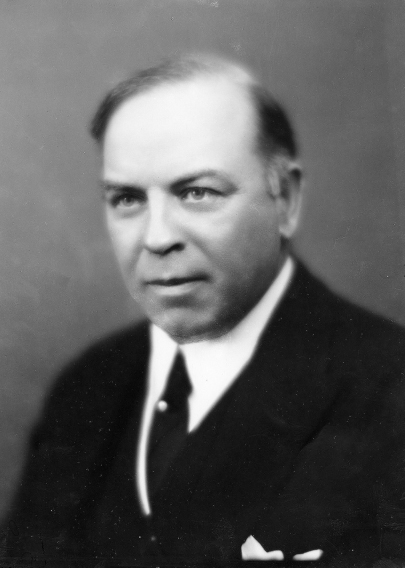
William Lyon Mackenzie King.
CANADIAN ORGANISATION
The Canadian Army which had taken up residence in the United Kingdom by 1943 consisted of an Army HQ, two Corps Headquarters, three infantry divisions, two armoured divisions, two independent armoured brigades and a number of miscellaneous Corps and communications units.
For a long time, it had been anticipated that this force would operate as a national strike force when the time came to invade the continent. During 1943, however, a considerable part of the force was despatched to the Mediterranean. The 1st Canadian Division and 1st Canadian Armoured Brigade played a significant part in the Sicilian campaign, and, subsequently, the 5th Canadian Armoured Division and the Headquarters and Corps Troops of the 1st Canadian Corps, then commanded by Lieutenant-General H.D.G. Crerar, joined them for the 1944 campaign on the Italian mainland. The consequence was that the approach of Operation Overlord found the Canadian force in the United Kingdom reduced to the Headquarters of the First Canadian Army, the Headquarters of the 2nd Canadian Corps, the 2nd and 3rd Canadian Infantry Divisions, the 4th Canadian Armoured Division, the 2nd Canadian Armoured Brigade and a large force of ancillary troops. Since Canada had contributed one Corps of her Army for service in Italy, where it now formed a large proportion of the Eighth British Army, the British War Office would have to find the reserve troops to take its place under the Canadian Army in Overlord.
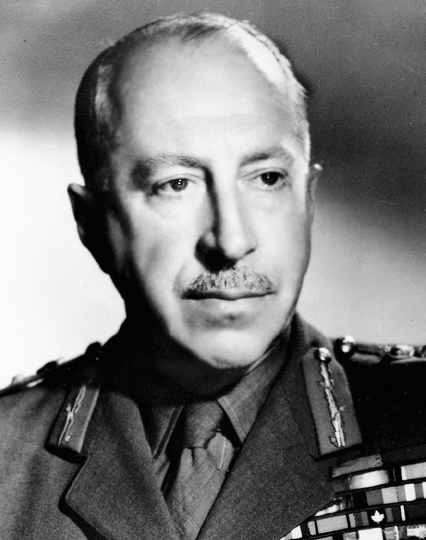
Henry Duncan Graham Crerar.
The command of the Anglo-Canadian force preparing for action in the United Kingdom was to be split between the Second British Army, commanded by Lieutenant-General Sir Miles Dempsey, and the First Canadian Army, commanded in the beginning by Lieutenant-General A.G.L. McNaughton and, after the latter’s retirement, by General Crerar who returned from Italy to the United Kingdom and assumed command of the Army 16 March, 1944.
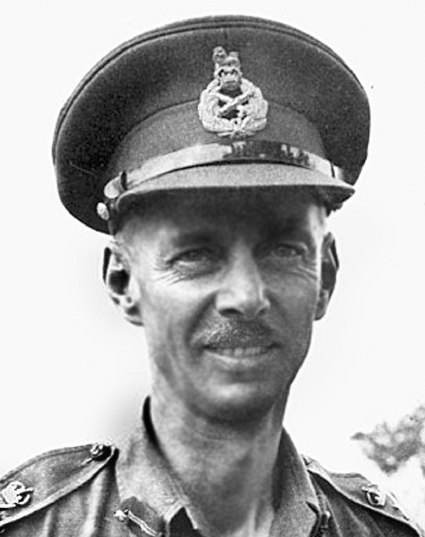
Sir Miles Dempsey.
So, while the Canadian troops were usually under General Crerar’s command, Canadian formations frequently fought under General Dempsey, and throughout the campaign (until the return of the 1st Canadian Corps from Italy in the early spring of 1945) about fifty per cent of the divisions of the First Canadian Army were normally British or Allied. But the composition of both Armies changed constantly in line with the operational situation and for a time in February 1945, Canadian General Crerar actually had under his command almost every British division on the Western Front, a fact that went unreported by the media of that time.
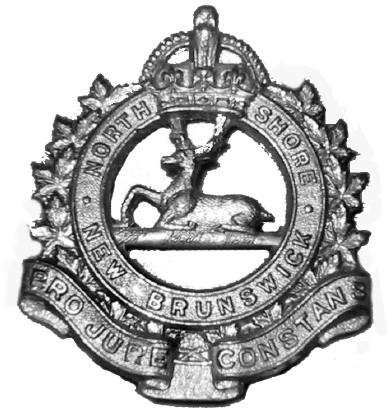
One of the regiments whose history was destined to be intertwined with the Atlantic Wall was the North Shore. Raised in the untamed coastal province of New Brunswick, the North Shore could trace its origins back to 1793 but their arrival in England proved a shock to the system of the soldiers. Sailing up the Mersey on the approach to Liverpool docks, the regiment were greeted with the sight of bombed-out ships, now no more than partly submerged wrecks, and devastation along the water front. The issue of rations cards and respirators were other reminders that they were now in a country that was firmly in the grip of war.
At an early date, it had been decided that, as far as the Anglo-Canadian forces were concerned, the Second Army would have the task of establishing the bridgehead on the continent, while the role of the First Canadian Army would be the break-out and advance from the bridgehead. This had been settled even before Exercise Spartan, the extensive army manoeuvres overseen by Montgomery himself and staged between 28 February and 14 March in southern and central England. In that exercise, the First Canadian Army, with a compliment of six divisions, three of which were British, rehearsed fulfilling the objective to which it had already been assigned.
In Exercise Spartan, the Canadian Army were to break out from a theoretical bridgehead on England’s south coast and advance north to encounter the ‘hostile’ forces that had been placed to meet it. Although this designated role deprived the Canadian Army as a whole of a leading share in the earliest phase of operations, Canada was, nevertheless, still to be well represented in the first attack on Hitler’s Atlantic Wall. It was decided about a year before OVERLORD was launched that one Canadian division should participate in the assault and on 3 July 1943, General McNaughton wrote to the Commander of the 1st Canadian Corps, formally advising him that the 3rd Canadian Division had been selected for assault training with a view to taking part in the initial assault.
ASSAULT DIVISION TRAINING
The 3rd Canadian Infantry Division, commanded by Major-General R.F.L. Keller, had never seen action before. The first stage of its assault training was directed by the 1st Canadian Corps, but from 1 December 1943 it passed for operational direction under the 1st British Corps, which was to command it in the actual assault on Normandy. Throughout the summer and autumn of 1943, the Division, along with the 2nd Canadian Armoured Brigade, were in intensive training. In the latter part of May, troops took part in another exercise on battalion level called Breach, which consisted of breaching a strong field defensive position with Bangalore torpedoes used under cover of mortar fire. A month later, Exercise Smashex saw the Division practice breaking through a heavily mined field defence to reach a target roughly twenty-five miles away. The North Shore Regiment left the breached minefield at seven in the morning and fought their way for twenty-four miles, arriving at their objective at one the following morning only to find they had to dig trenches in hard chalk to protect themselves against tank attack.
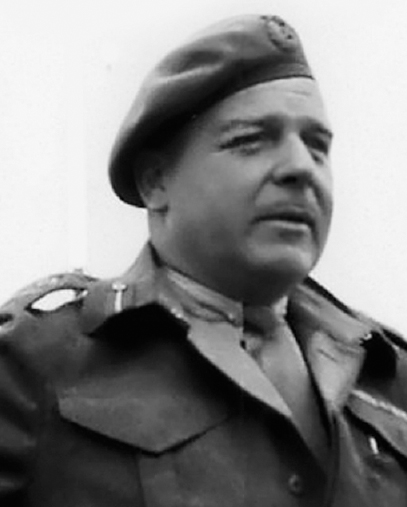
Rodney Frederick Leopold Keller.
A period of preliminary and elementary combined operations training was followed by more advanced training at Combined Training Centres in Scotland. Exercises here, such as those staged in the grounds of Inveraray Castle, were receiving more of an assault training flavour with one officer called Airedale, for example, demanding that ‘All personnel will march, walk or run five miles per day, four times per week’.
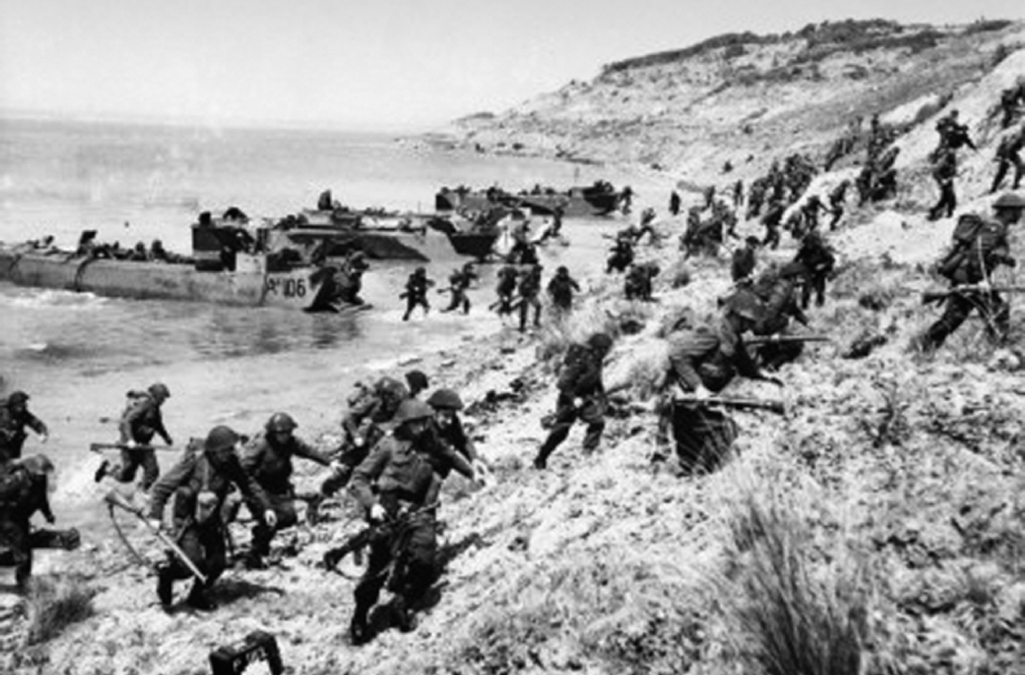
Rehearsing to breach Hitler’s Atlantic Wall.
By the autumn, however, the Division was back on the Channel coast ready to carry out large-scale assault exercises in conjunction with the Royal Navy and the Royal Air Force. Exercise Pirate was designed to train the assault troops in establishing and defending a bridgehead. Held at Studland Bay on the coast of Dorset, Pirate applied in practice, for the first time on any large scale, the new technique that was being developed. The assault brigade (the 7th Canadian Infantry Brigade) went ashore under cover of supporting fire form all three services. Destroyers (representing much heavier ships that would be available on D Day) brought down a heavy bombardment, and in addition, the Navy provided a rocket barrage fired by armoured landing craft. The RAF bombing attack, which was an integral part of the plan, had to be cancelled owing to unfavourable weather, but fighter-bombers still attacked with cannons. The army itself helped clear the way for its own assault with self-propelled field artillery firing on the beaches from Centaur tanks in landing craft.
When the exercise was over, experts analysing the results decided that this combined fire plan had proved both workable and feasible, though many of the finer details remained unresolved. A basis had been found for the operation, however, and the tremendous bombardment by land, sea and air which struck the Germans on the coast of Normandy 6 June, 1944 was undoubtedly devolved from tactics first tried on a grand scale at Studland Bay nine months earlier. The 2nd Canadian Division, which was involved on that ill-fated raid on Dieppe, had gained the hard-won experience on which the plan was based and the 3rd Canadian Division served the Allies as guinea pigs on which the invasions plans were worked out in detail.
Further exercises came thick and fast. Can-Opener coordinated the anti-tank platoons, Ozone, which determined the capability of medical orderlies to treat casualties from landing craft, was swiftly followed by Turtle II, an exercise in signals communications, and Cordage which co-ordinated the fire plan of all the services together. Soda Mint, Flash, Gold Braid, Savvy and Trousers, training for the Division was relentless, all of it now implemented from the new advanced HQ at Brockenhurst in the New Forest, where it was to remain until April 1944 when moved a short distance to the outskirts of Winchester. Changes in organization suitable to the assault role also remained ongoing, the most telling being the addition to the Division of a fourth regiment of field artillery armed with Priest 105-millimetre self-propelled guns.
At this juncture it should be pointed out that neither the Canadians, nor indeed the British or American troops in the invasion fleet, had any real concept of what would be required to breach the Atlantic Wall in the various sectors. The one major Allied enterprise against the French coast, the raid on Dieppe, had failed to achieve its short-term objectives and had cost many hundreds of casualties and it was known that the Germans had further strengthened their defences in the intervening two years.
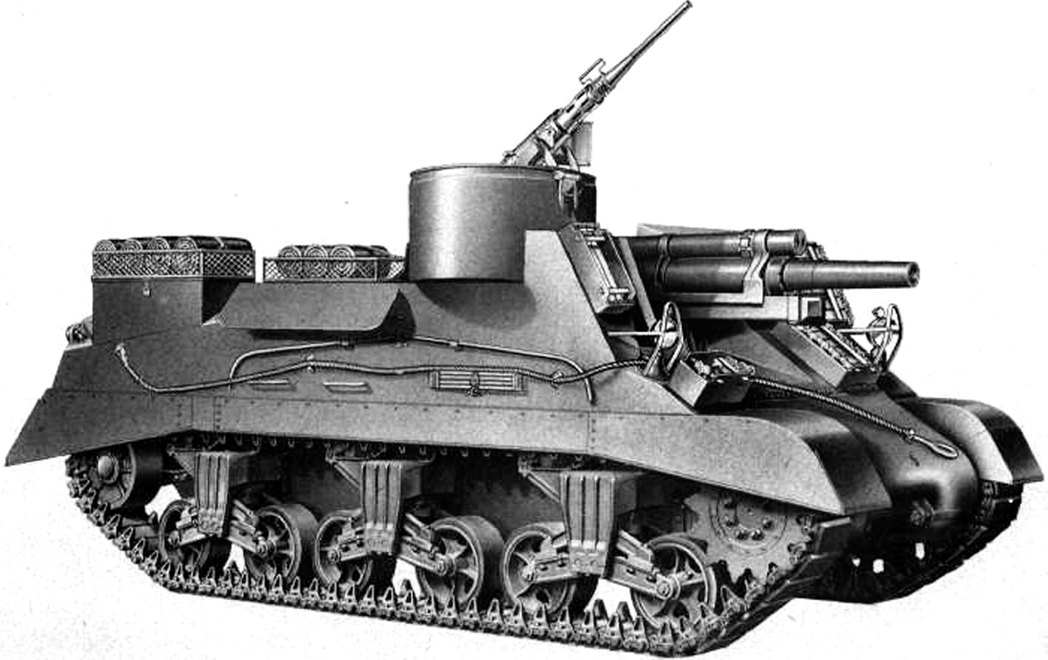
Priest 105-millimetre self-propelled gun reproduced from the vehicle manual. Named ‘Priest’ because of the pulpit-like turret.
The lessons of 1942, however, had been learned. Not least the need for the development of overwhelming fire support in the earliest stage of an amphibious assault operation against fortified coastal defences. In the last week of July 1943, the 1st Canadian Corps held a Combined Operations Study Period, based upon a hypothetical renewal of the attack on Dieppe, in the course of which the whole problem was intensively examined; and at the end of the sessions General Crerar summed up in an address on fire support which foreshadowed in detail the principles followed in the assault on Normandy.
The final full-scale rehearsal, known to the Canadians as Fabius III, took place at Bracklesham Bay, east of Portsmouth, 4 May. Chosen for its similarity to the Cote de Nacre in Normandy, where the Canadians were to launch their initial attack, the exercise was considerably hampered by bad weather and was initially postponed for twenty-four hours as the result of rough seas. When it was finally held, the sea was still so rough that the Royal Navy were soon forced to put a stop to disembarkation with the fear that casualties would ensue.
For nearly eight months prior to the assault on Normandy, the 2nd Canadian Armoured Brigade had worked as part of the 3rd Canadian Division, and its three armoured regiments carried out intensive amphibious training in conjunction with the infantry brigades to which they were attached. That meant further intensive training on the Duplex Drive tanks, amphibious Shermans capable of leaving tank landing craft a considerable distance from the coast and ‘swimming’ ashore under their own power. These were to form the first wave of the assault, going in five minutes before the actual H Hour--the moment at which the first wave of landing craft hit the beach.
As May drew to a close, General Keller’s force was a in a full state of readiness. New equipment was distributed by quartermasters, including a redesigned steel helmet which gave additional protection to the back of the head.
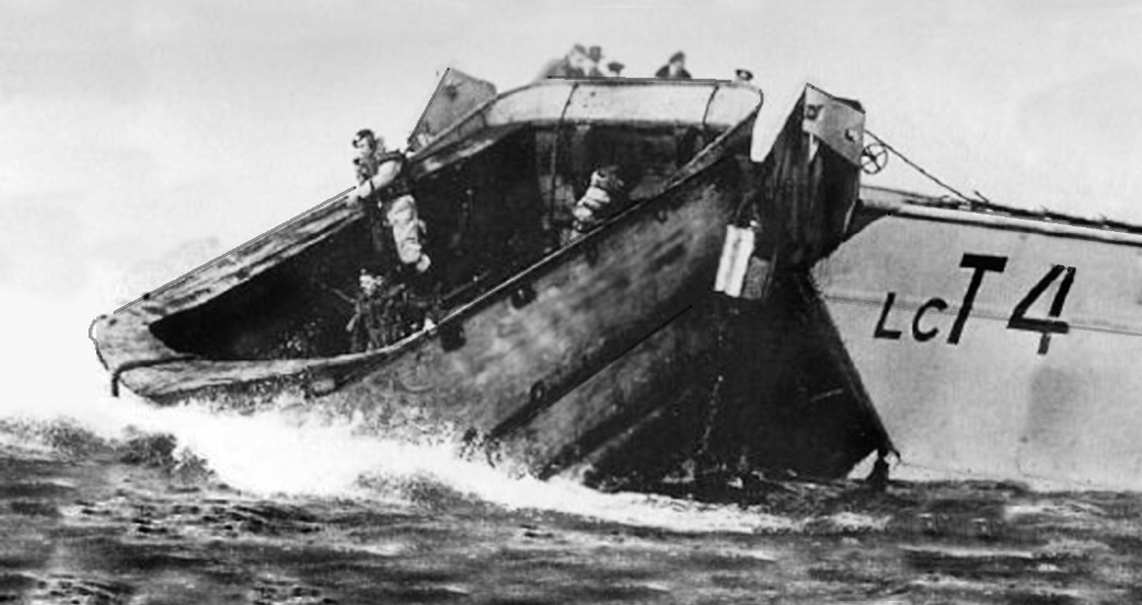
Training with the Duplex Drive amphibious Sherman tanks.
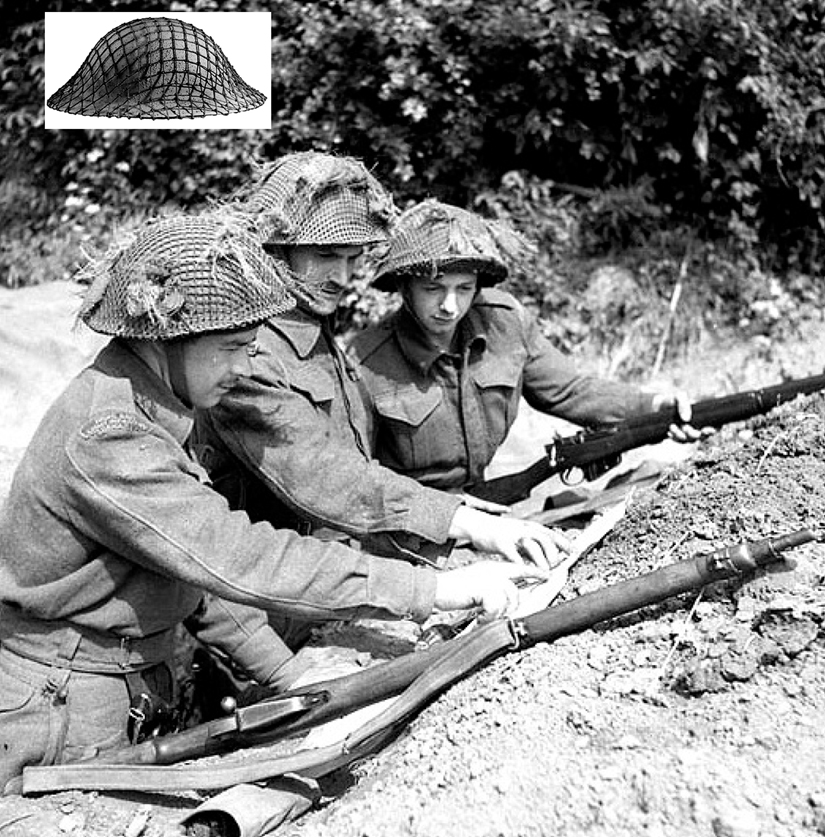
Canadian troops wearing the new steel helmet. Compared with (inset) the former shape which had remained unchanged from the Great War 1914-18.
Among the standard issue for Canadian infantry in WWII was the Number 4, Mark 1 Lee Enfield. The Short Magazine Lee Enfield No.1 was used up until November 1942 when the Number 4 was issued. In June 1943, the Canadians started using the Number 4 made in Canada (designated the Mark I). With a box-type magazine, extending through the bottom of the stock forward of the trigger guard, it carried two 5-round clips of .303 ammunition. The Lee Enfield was the fastest operating bolt-action rifle in the world and a trained rifleman could fire between fifteen and thirty aimed rounds a minute and be effective up to 900 yards. Various sights could be fitted and it could also launch a grenade from a cup adapter or discharger. Canada was to manufacture almost a million Lee Enfields between 1939 and 1945.
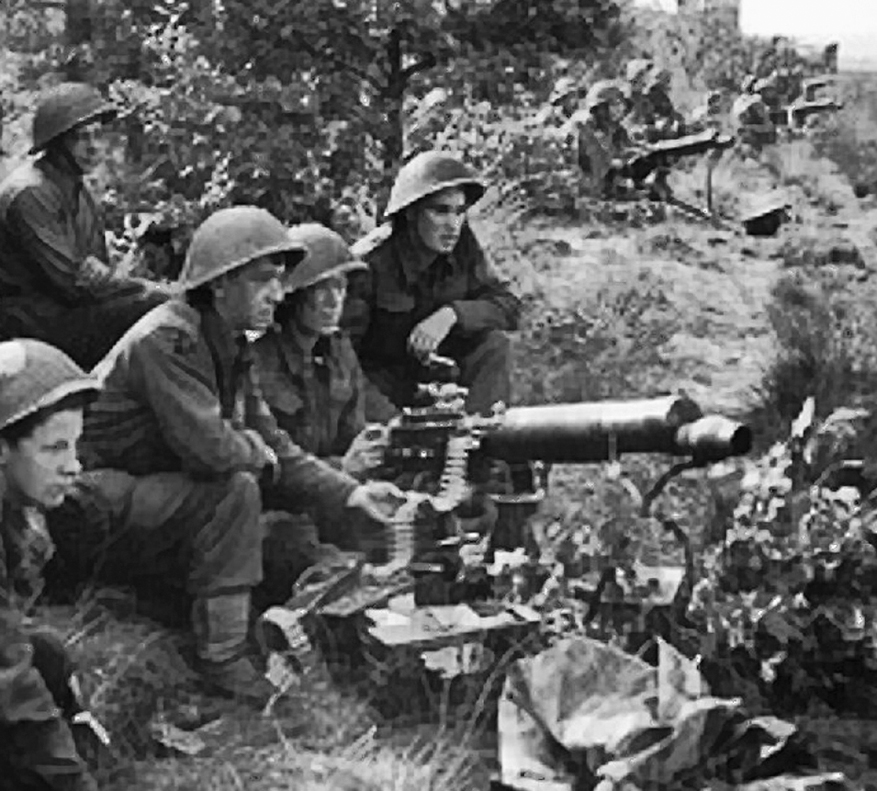
Other weapons carried included the Vickers .303 Machine Gun, which could be fired at high or low angles from a tripod. It operated on a simple gas-assisted, water-cooled recoil system and was fed by 250 round cloth belts of .303 ammunition and fired in full automatic bursts of 10 to 20 rounds. Able to be fired at sixty shots per minute (rated as slow fire) or at a rate of 250 rounds per minute (rapid fire), the gun was accurate up to 1,100 yards and was fired by grasping both traversing handles and depressing the trigger with both thumbs.

Above: Canadian manufactured Lee Enfield rifle and below Canadian troops training with the Vickers Machine Gun.
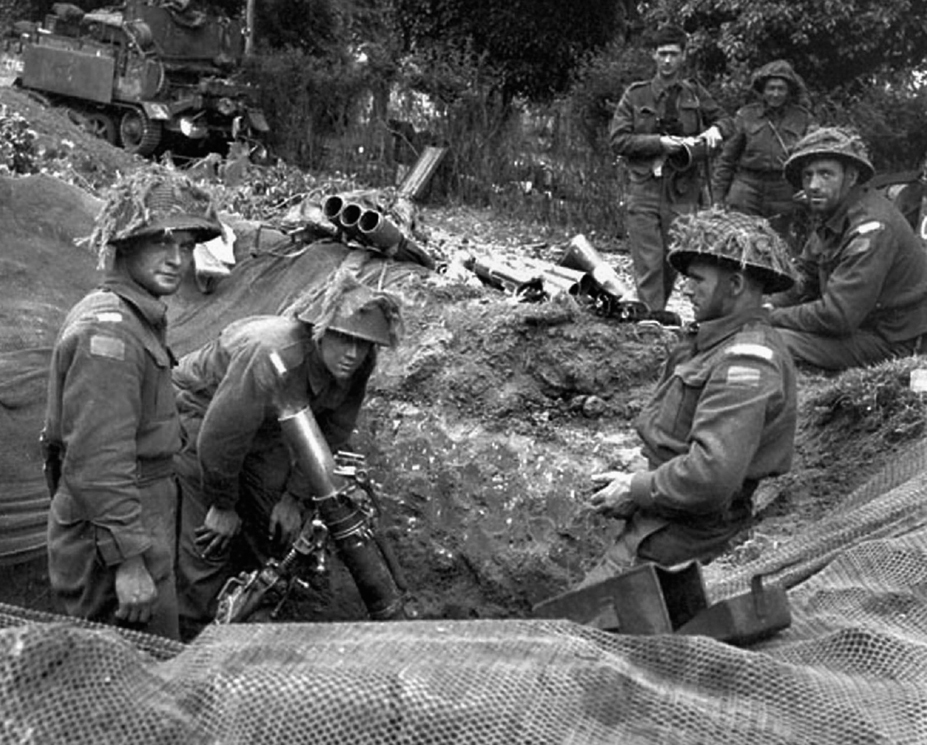
The 3-inch mortar was the standard mortar used by Canadian infantry battalions.
The 3-inch mortar was the standard heavy mortar used by the Canadian infantry battalions and could propel shells into enemy positions from a high angle and hit targets with a 10lb shell from as close as 125 yards to a maximum of 2,800 yards. It was carried in three separate parts (the smooth bore barrel, the base plate and the mounting which supported the barrel providing elevating and transverse adjustments). This mortar had a poor range compared with German and other mortars, all of which, including the 3-inch mortar, were actually of 81 mm calibre.
There was also the PIAT (Projector Infantry, Anti-Tank), a cross between an anti-tank rifle and a bazooka which fired an anti-tank grenade up to one hundred yards, and the Bangalore Torpedo. This was a simple explosive device, first used extensively on D-Day by Allied troops to clear the barricades, mines and barbed wire that comprised elements of the Atlantic Wall. The torpedo consisted of three different sections, a nose section for penetrating obstacles, an explosive section filled with TNT or C4, and hollow lengths of pipe to build the device up to the required size. Up to 4 sections, each 3 inches wide by 6 feet long, could be connected by metal collars and it was designed so that as few as two men could make it battle-effective. The elongated tube was placed on the ground and then pushed forward below bunkers, tank traps, barbed wire entanglements or into mine fields and then detonated with either a remote-controlled electric detonator or a blasting cap with delayed-action fuse.
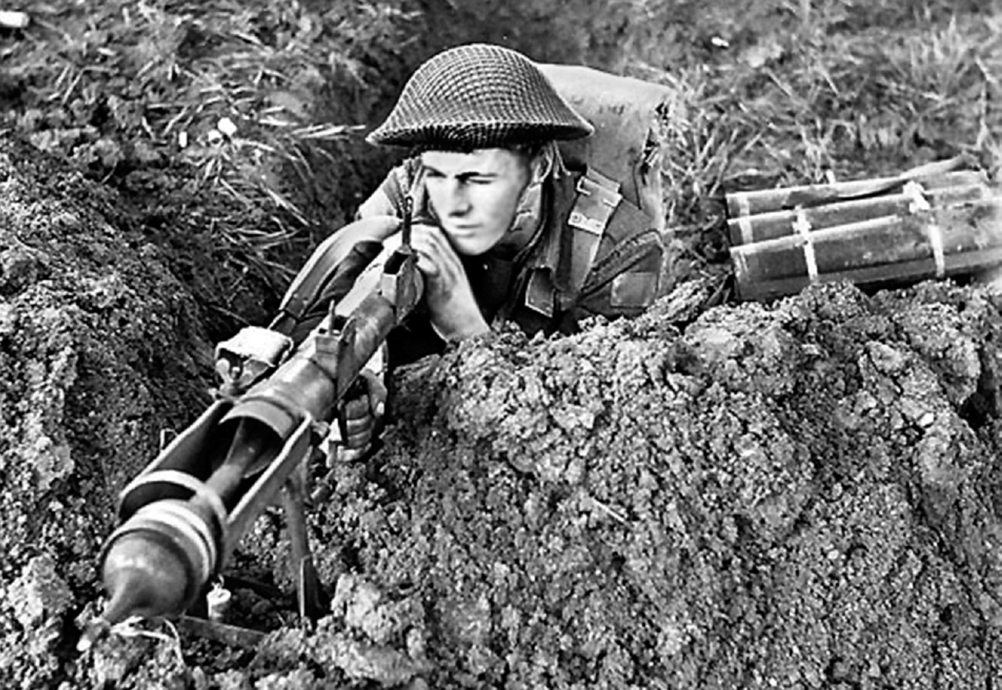
The Projector, Infantry, Anti Tank (PIAT).
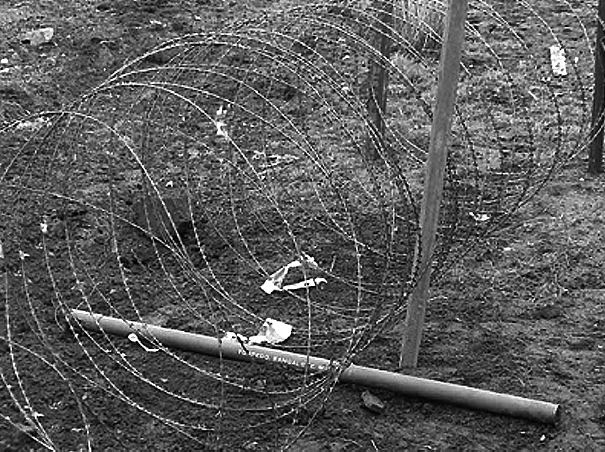
The Bangalore Torpedo, designed for blowing gaps in barbed wire defences.
The Armoured Brigade also finally received its full complement of Sherman tanks after the men of the Royal Canadian Electrical and Mechanical Engineers had ensured all were in the right shape for the rigours of the battlefield and they were supported by the Priest self-propelled guns.
While the Canadian assault troops were making their final preparations in Hampshire, the second wave that were to follow them into France were busy elsewhere. Spring had found the HQ of the 2nd Canadian Corps located at Three Bridges in Sussex, but in April it moved to Eastling Wood, just north of Dover. Sections also moved into East Kent, as did the 2nd Canadian Division, which established its headquarters in Dover itself.
As D-Day drew near, the camps of the Canadian assault force, lying between Winchester and Southampton, were sealed with all contact with the outside world cut off. Similar restrictions were put in place in Kent and Hampshire. Special precautions were put in place to guard against an attack of German airborne troops and anti-aircraft guns concentrated in case of air attack. There were also fears that Hitler would target his new vengeance weapons, the V1, on the south coast if he realized an invasion force was massed. British authorities were still reluctant to acknowledge the existence of these new weapons, despite several attacks on London. Canadian antiaircraft units had been briefed on the characteristics of the flying bomb in case they were targeted but the Germans were obviously oblivious to the threat gathering across the English Channel and made no effort to disrupt Allied troop movements on the run-up to D-Day, apart from the normal night bombing of the naval shipyards in the Portsmouth area. Indeed, it was to be more than a week after the bridgehead had been established in Normandy before the Germans thought to try and target a V1 on the Channel ports and, by that time, the die had already been cast.
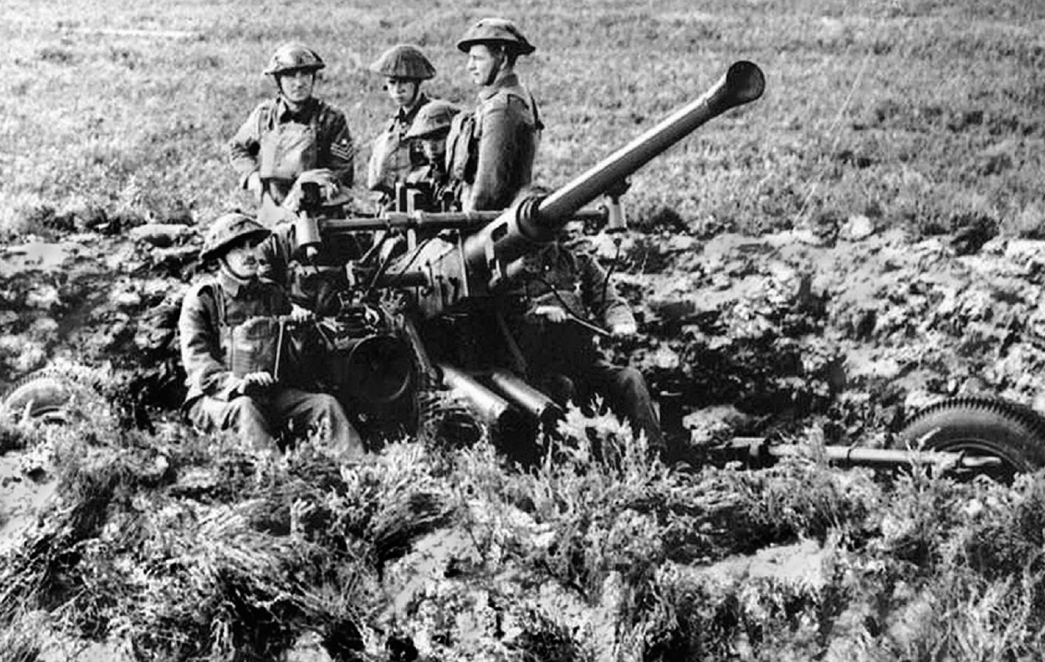
The 40 mm Bofors anti-aircraft gun.
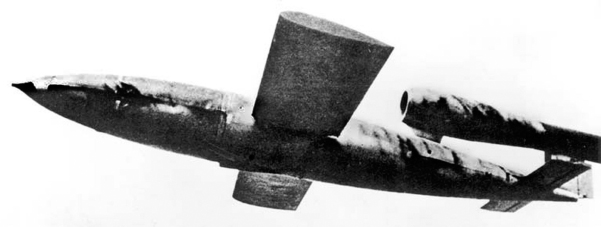
One of Hitler’s vengeance weapons – the V1.
During the final few weeks prior to the assault, the nerves of the troops confined to base were undoubtedly being stretched to breaking point. Fear of the unknown and a desire to get on with the job caused an outbreak of ‘Channel Fever’, with a few men ‘invalided’ out of the invasion force having suffered a form of mental breakdown. It was arguably worse for the officers, who had the most operational knowledge of the task in hand. The secrets were kept, however, and it appeared German high command remained completely in the dark about D-Day plans to the moment the guns of the Crisbecq Battery at St Marcouf on the Cotentin Peninsula first fired a salvo just before 5.35 am on 6 June 1944.
Careful consideration had been given to selecting the date for the assault. The target date was fixed in the Initial Joint Plan and that date ‘in respect of which all preparations will be completed’ was 31 May 1944. It had been decided to attack in daylight as half an hour of good light was essential to ensure the greatest possible accuracy for the preliminary naval bombardment, and would also enable landing craft to land the troops with much greater certainty at the desired points of entry. The flotillas, accordingly, would cross the Channel under cover of darkness and assault soon after dawn had broken. The first wave of landing craft were to hit the beaches about three hours before high tide, hopefully meaning that the depth of water would allow the craft to float over submerged beach obstacles yet still be shallow enough to enable the troops to wade ashore with their equipment (each man would be carrying a pack weighing between 60lb and 72lb). The date of the assault was therefore planned for a morning when this state of tide would exist half an hour after the beginning of clear daylight. From the point of view of the airborne forces, moreover, it was desirable that the night preceding D-Day should be lit by a near full moon so gliders and transport planes carrying paratroopers could identify landmarks and target areas for disembarkation. All these conditions were due to synchronise towards the end of the first week in June. On the 8 May 1944, the momentous decision was taken to designate 5 June as D-Day, with postponement acceptable if necessary to either of the following two days.
Unfortunately as 5 June approached the weather, always the most uncertain factor in the joint plan, suddenly took a turn for the worse. Conditions in the Channel in early summer can deteriorate rapidly and a light squall had developed into a fullblown storm. Supreme Allied Commander General Eisenhower had a decision to make.
Hopeful reports of calm seas had given way to forecasts of high winds and twenty foot waves by the morning of 4 June, by which time US landing craft were already on the move from the south west. Ordering them to retreat to port, Eisenhower postponed D-Day for twenty-four hours as his advisors studied the weather charts. Waiting for the next suitable tide would mean a delay of almost a fortnight and cause planners a logistical nightmare. Some troops had already been on board their cramped ships for several days, feeding and subsequently re-embarking the force efficiently would be next to impossible. Moreover, every day’s delay increased the risk of a security breech and lessened the possibility of surprising the German forces in Normandy.
Lieutenant Bernard McElwaine was a pioneer officer with the North Shore Regiment, and a journalist in civvy street. During his service with the regiment, he contributed a diary (censored, naturally) for an English newspaper, and his chronicle covering the 6 June 1944 read,
The deck of this glorified tin can provides a spot for the long letter I’ve promised. When you get it is a toss-up. For three weeks now we have been more rigorously secluded from contact with the outside world than any debutante, monk or cloistered nun. After the last 24 the lid went down, no pubs, no visits outside. We used to watch the locals going into that rarity, an uncrowded pub from our unhappy post inside the wire compound. Our gum-chewing American friends provided the guard. How the boys burned when they saw them chatting with passing girls. Any girl who passed the camp received a tremendous ovation of whistles, sighs and invitations to come in none came. Then there was the final packing up someone somewhere some time worked out the load carrying capacity in relation to weight of all beasts of burden. Man topped the list. This curious fact inspired the powers that be to prove it. Amazing what can be draped on a man. When I was a kid I used to feel sorry for Atlas not now. He had a soft touch, just had to hold up the world. I’ve got to carry my mountain up umpteen yards of beach and hence inland.
When we left camp it was in penny packets – each to his own particular niche in the giant jigsaw. I went off with a bunch of carriers. Made a first brew of tea with the boys and away. Next day to the clicking of movie cameras we marched off our carriers for the short jaunt to the ship – a ride to remember. People thronged the streets and windows because the whole procession had the real McCoy look about it. On every road there were long lines of M.T., trucks, tanks, jeeps, bulldozers, guns, ducks and other devices of a secret nature that I’ve never seen before. Heath Robinson and Rube Goldberg must have collaborated to design them. If I should see a vehicle take wings and fly, then burrow underground like a mole or go into a chorus girl routine I wouldn’t be surprised. I’ve seen everything now. Then we hit the ‘hards’ from which we embarked, but only after surrendering myriad pink forms, tickets, nominal rolls, etc. Then the jaws of the craft snapped shut and we puttered around a while and formed an armada of our own. Then we anchored – no invasion that day!
A decision had been made, however, and at 11 pm on the night of 4 June, the Allied Supreme Commander issued orders to the effect that, subject to verification on the following day, D-Day would be 6 June. Operation OVERLORD was given the green light, but the weather was a long way from being ideal.
The total of landing ships and craft required to carry the troops and vehicles of the initial assault and second phase numbered 2,154. In the operation as a whole, 6,483 ships and craft of all types were deployed from England. Of the naval vessels, a large number were provided by the Royal Canadian Navy which most of these assigned to Force J. As well as two medium-sized Canadian Infantry Landing Ships, HMC Prince Henry and Prince David were included in the force as were two flotillas of large Canadian Landing Craft, while a third flotilla of the Royal Canadian Navy were assigned to an adjacent force landing British troops. A total of sixteen Canadian minesweepers helped sweep a clear passage into French coastal waters and Tribal Class destroyers flanked several Escort Groups composed of Canadian frigates and corvettes. Fleet Class destroyers, HMC Algonquin and Sioux were also elements of the squadron attached to Force J that was detailed to bombard German batteries and strongpoints along JUNO, SWORD and GOLD Beach.
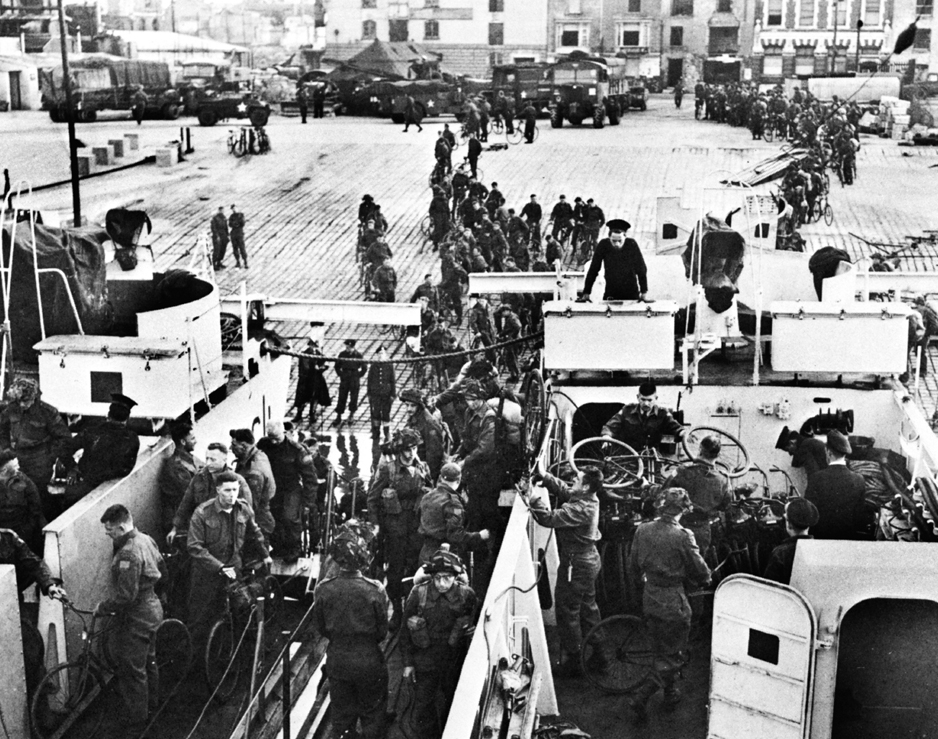
Canadians of J Troop embarking at Portsmouth.
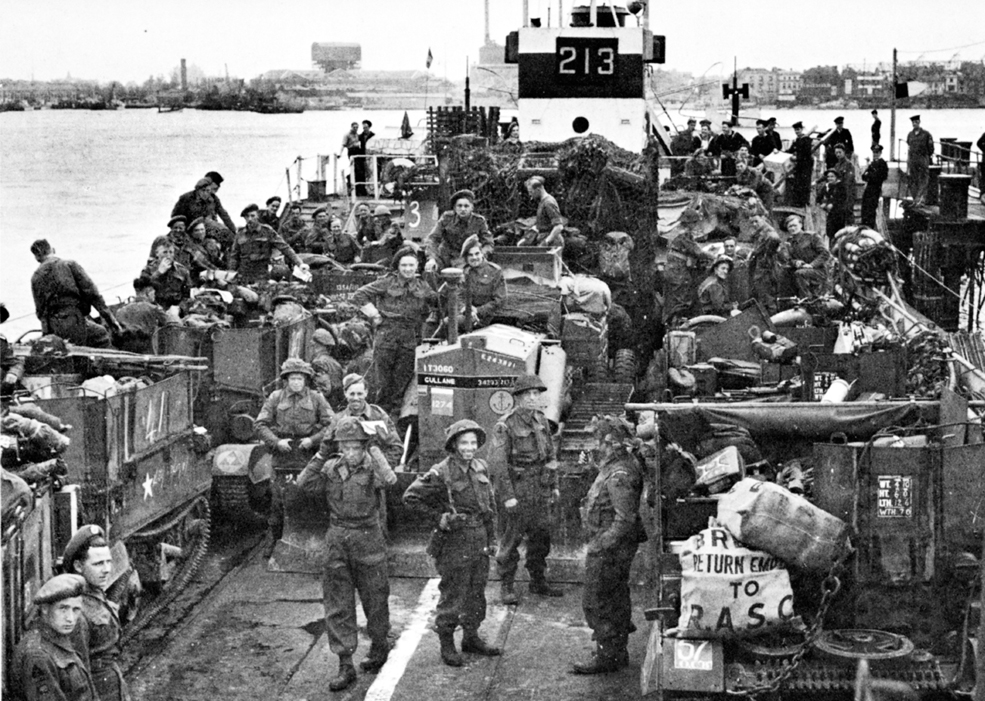
British troops of Force S aboard their transport at Gosport.
The long wait was over. The next twenty-four hours were to prove pivotal in world history, just as Rommel had predicted when addressing his generals a few months earlier on a stretch of the Atlantic Wall.
Just look at it, gentlemen. How calm… how peaceful it is. A strip of water between England and the continent… between the Allies and us. But beyond that peaceful horizon… a monster waits. A coiled spring of men, ships, and planes… straining to be released against us. But, gentlemen, not a single Allied soldier shall reach the shore. Whenever and wherever this invasion may come, gentlemen… I shall destroy the enemy there, at the water’s edge. Believe me, gentlemen, the first 24 hours of the invasion will be decisive. For the Allies as well as the Germans, it will be the longest day… The longest day.
During 5 June, landing ships and craft and their escorts slipped their moorings in harbours and ports from Suffolk to Cornwall. The Americans, due to land on the most westerly beaches, had embarked from ports like Poole and Plymouth while the British and Canadians departed from the areas around Portsmouth and Southampton, though several of the reserve battalions came from as far afield as Felixstowe. The waiting troops had gazed in astonishment at the seemingly endless expanse of vessels.
‘The concentration of shipping in Southampton and the Solent has to be seen to be believed’, wrote one unit diarist. By the time darkness had fallen on 5 June, the men of the 3rd Canadian Division and the 2nd Canadian Armoured Brigade were beyond the Isle of Wight and being tossed around on the Channel, with the winds and waves still battering their landing craft. In a typical case of understatement, the regimental diaries of the Regina Rifles described the weather as ‘cool and cloudy.
The invasion was underway.
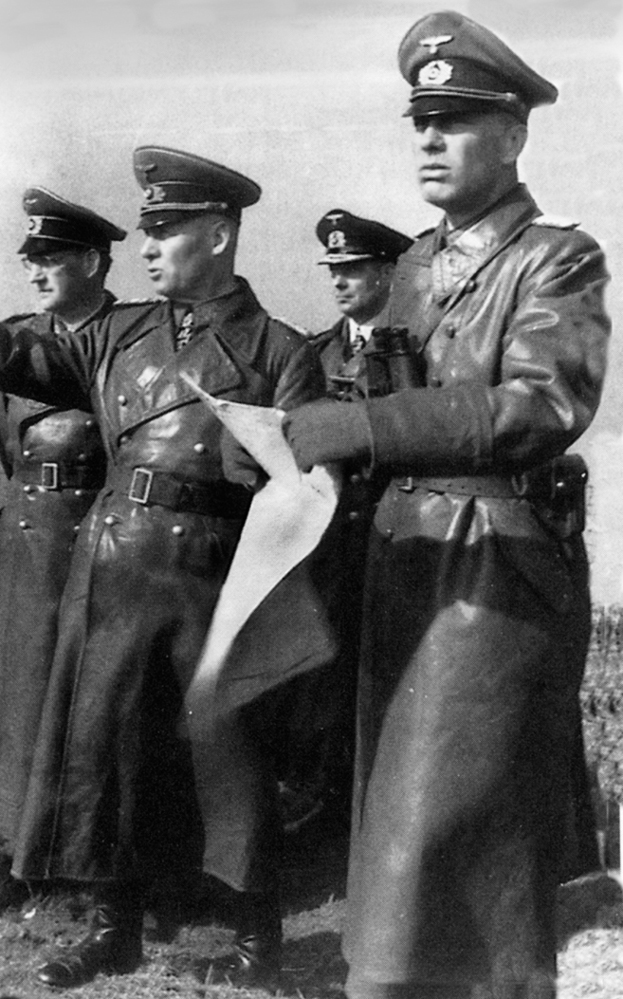
Rommel was determined to stop the Allies whilst they were still at sea and commented: ‘For the Allies as well as the Germans, it will be the longest day.’
On the eve of D-Day, General Crerar had sent a personal message to all Canadian servicemen poised to go into battle, many of them experiencing combat for the first time.
It is not possible for me to speak to each one of you, but by means of this personal message, I want all ranks of the Canadian Army to know what is in my mind, as the hour approaches when we go forward into battle.
I have completed confidence in our ability to meet the tests which lie ahead. We are excellently trained and equipped. The quality of both senior and junior leadership is of the highest. As Canadians, we inherit military characteristics which were feared by the enemy in the last Great War. They will be still more feared before this war terminates.
The Canadian formations in the assault landing will have a vital part to play. The plans, the preparations, the methods and the technique, which will be employed, are based on knowledge and experience, bought and paid for by 2 Canadian Division at Dieppe. The contribution of that hazardous operation cannot be overestimated. It will prove to have been the essential prelude to our forthcoming and final success.
We enter into this decisive phase of the war with full faith in our cause, with calm confidence in our abilities and with grim determination to finish quickly and unmistakably this job we came overseas to do.
As in 1918, the Canadians, in Italy and in North West Europe, will hit the enemy again and again, until at some not distant time, the converging Allied Armies link together and we will be rejoined, in Victory, with our comrades of I Canadian Corps.
The Canadian’s main objective was JUNO Beach. Five miles wide, it stretched on either side of Courseulles-sur-Mer incorporating the resorts of Bernieres-sur-mer and Graye-sur-mer with La Riviere to the west and St Aubin-sur-mer to the east.
The 3rd Canadian Infantry Division with the 2nd Canadian Armoured Brigade landed in two brigade groups and each Brigade had three Infantry Battalions and an armoured regiment in support. Two artillery field regiments, combat engineer companies and extra units from the 79th Armoured Division, Hobart’s Funnies, also accompanied the first wave launched from LCI (Landing Craft Infantry) and the smaller LCA (Landing Craft Assault) with the armoured support carried to the beach on board LCT (Landing Craft Tank) which could accommodate up to four Sherman tanks. Other duplex drive tanks ‘swam’ ashore from transport in deeper water.
The Fort Garry Horse tanks (10th Armoured Regiment) supported the 7th brigade landing on the eastern flank and the 1st Hussars supported the landing on the western edge. The 9th Canadian Infantry Brigade was kept in reserve and landed later that day and advanced through the lead brigades with the tanks of the Sherbrooke Fusiliers (27th Armoured Regiment) providing tank support.
The initial assault was carried out by the North Shore Regiment on the east at St. Aubin (Nan Red beach) with the Queen’s Own Rifles in the centre at Bernières (Nan White beach). The Regina Rifles landed at Courseulles (Nan Green beach) alongside the Royal Winnipeg Rifles on the western edge of Courseulles (Mike Red and Mike Green beaches).
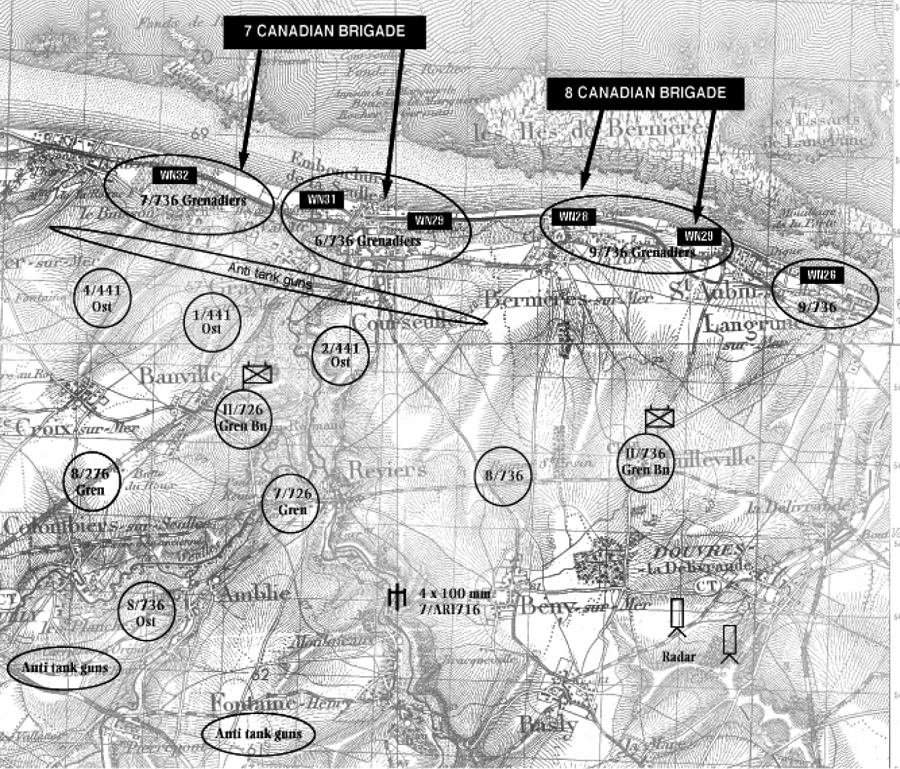
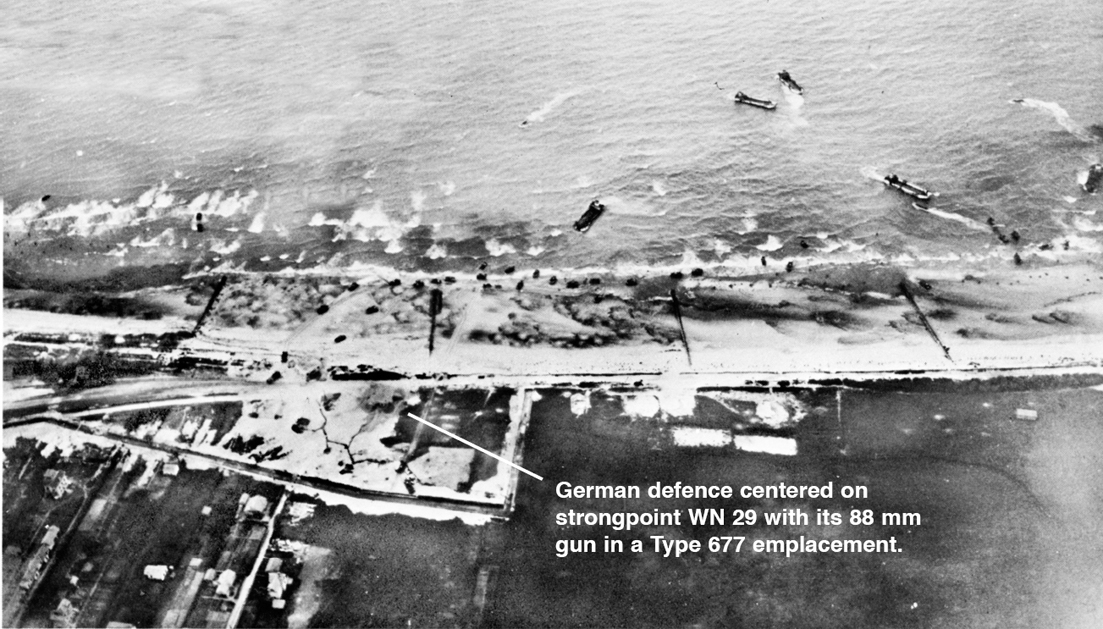
Canadian 6th Armoured Regiment landing on Nan Green Beach. Nineteen DD tanks ‘swam’ towards shore, fourteen made it.
The units had been stripped to ‘assault scales’, meaning no men were to be landed on D-Day who did not have urgent jobs associated with the actual invasion. The force embarked under General Keller’s command for the actual assault amounted to just over 15,000 Canadians, with over 9,000 British troops attached. Included among the latter were the 4th Special Service (Commando) Brigade but the 15,000 Canadians did not include the 1st Canadian Parachute Battalion, who were attached to the 6th British Airborne Division and were the Canadian Army’s spearhead in the invasion of North-West Europe.
This was D-Day where all five beachheads were established, thus becoming a pivotal event in the Second World War. However, there was another landing, although far smaller than the main beach landings, was considered even more dangerous. It took place at Pointe du Hoc.