
Chapter Five
ON THE WEST of the Cote de Nacre, between Grandcamp les Bains and Vierville sur Mer, a rocky promontory called Pointe du Hoc (originally known as Pointe du Hoe) emerges out of the cliffs, tall stacks and crumbling arches extending out into the foaming sea. Even today the site remains isolated and, was it not for the signposts and modern visitors’ centre and memorial, a place that would be easy to miss from the main road. When Germany was building its Atlantic Wall defences against Allied invasion in 1943 and 1944, they chose Pointe du Hoc, with its rock-strewn slopes, tiny shingle beach and views of the adjacent coastline, to build a defensive strongpoint.
POINTE DU HOC – THE SIXTH D-DAY LANDING
According to Allied intelligence reports and data supplied by the local French Resistance (one of whom was a blind pianotuner who was allowed to walk the cliffs unhindered and paced the gaps between defensive elements such as barbed wire) six 155 mm guns (reputed to be French long-range 1917 Puteaux guns), artillery which could hit positions several miles away, were encased in thick concrete casemates and connected by underground bunkers. That intelligence proved not to be wholly accurate but the site did contain concrete observation posts, gun emplacements and a maze of trenches and armoured bunkers, and was regarded as being among the best-defended positions on the Nazi’s Western front. So how would the Allies set about ensuring the Pointe du Hoc wasn’t the rock on which the invasion foundered?
The beaches guarded by the Pointe du Hoc strongpoint had been chosen as the two American D-Day landing points, UTAH and OMAHA. Therefore, with the capability to cause untold damage to invading forces, the guns had to be neutralized as soon as possible. Unfortunately, the thick concrete infrastructure prevented Allied bombers from achieving a guaranteed success. Although the RAF and USAF, in combination with US navy warships, dropped explosives equivalent to the Hiroshima bomb (approximately five megatons) upon the fortifications and surrounding countryside of the Pointe du Hoc; Allied infantry would still have to attack the strongpoint on D-Day – but at least one thing was in their favour. The Germans had placed the majority of their defences and men, estimated around 200 in total, to guard against an attack from inland, believing the 100ft cliffs formed an impregnable barrier from the beaches below.
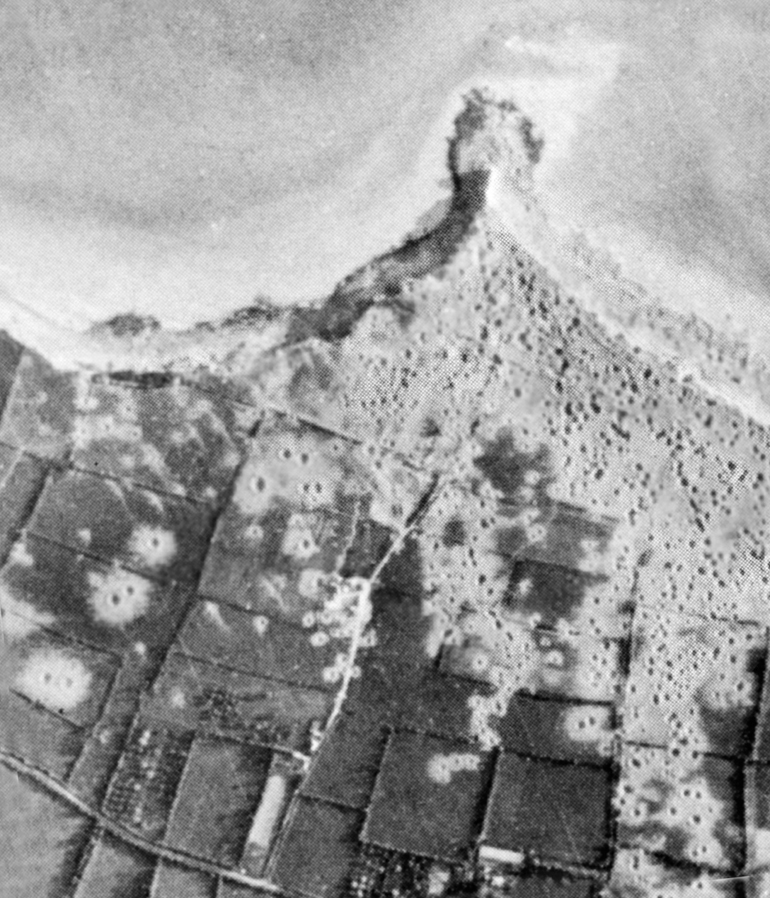
Pointe du Hoc showing the amount of attention given this battery position by the Allied air forces prior to the assault on it by the US Rangers.
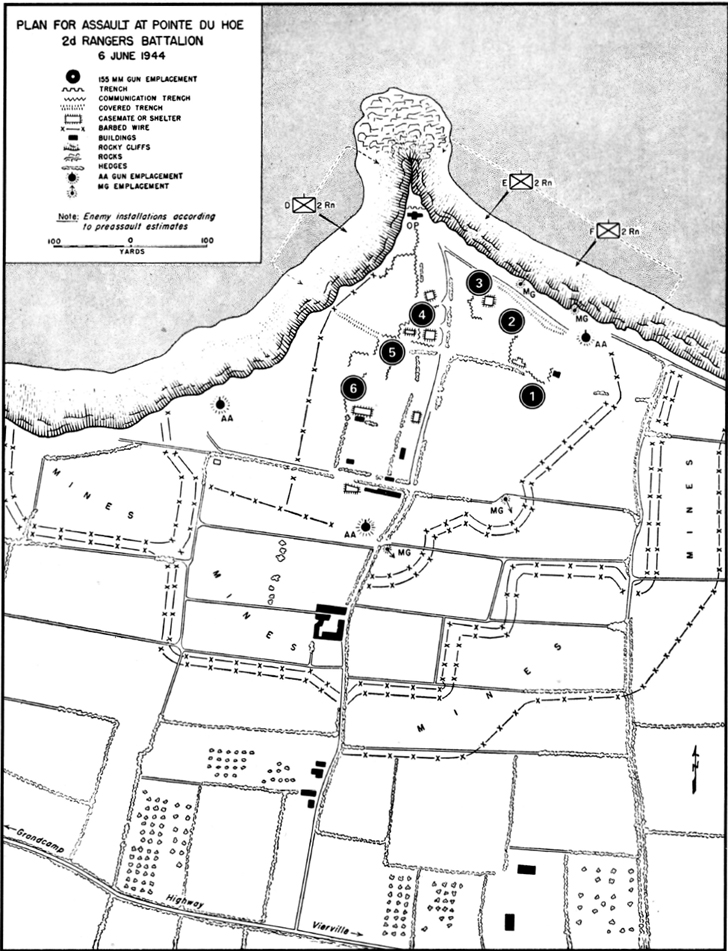
The mission to neutralise Pointe du Hoc was assigned to the 2nd and 5th battalions US Rangers, the American version of the more established British commando units. Under the command of Lieutenant Colonel James Earl Rudder, D, E and F companies of the 2nd Battalion would form the first wave, beaching at the cliff base and attacking the sheer rock face with grappling hooks and ladders at first light (approximately 6.30 am) 6 June. Company D would move in from the west, E and F from the east. When a route was open the remaining force, A and B companies as well as the whole of 5th Battalion, would follow. If the initial attack failed and no signal had been given by 07:00 am, the remaining force would follow the alternate plan, landing to the west of OMAHA Beach and attacking the Pointe from inland, though this ran the risk of suffering heavy casualties with German defences massed on that side as well as along major routes. Meanwhile, Company C of 2nd Battalion would make a similar assault on Pointe de la Percée, between Pointe du Hoc and OMAHA beach. From here Company C would head overland across the cliff tops to Pointe du Hoc. Lieutenant Colonel Rudder was the ideal man to lead the Rangers’ assault. A former college football coach, he was a stickler for preparation and believed the men under his command should be as physically fit as possible and able to act on their own initiative. Forced marches in doublequick time, exercises in demolition using live explosives and survival courses with minimum rations were all part of a Ranger’s training under Rudder. They completed preparations for Normandy on the cliffs of Cornwall and the Isle of Wight.
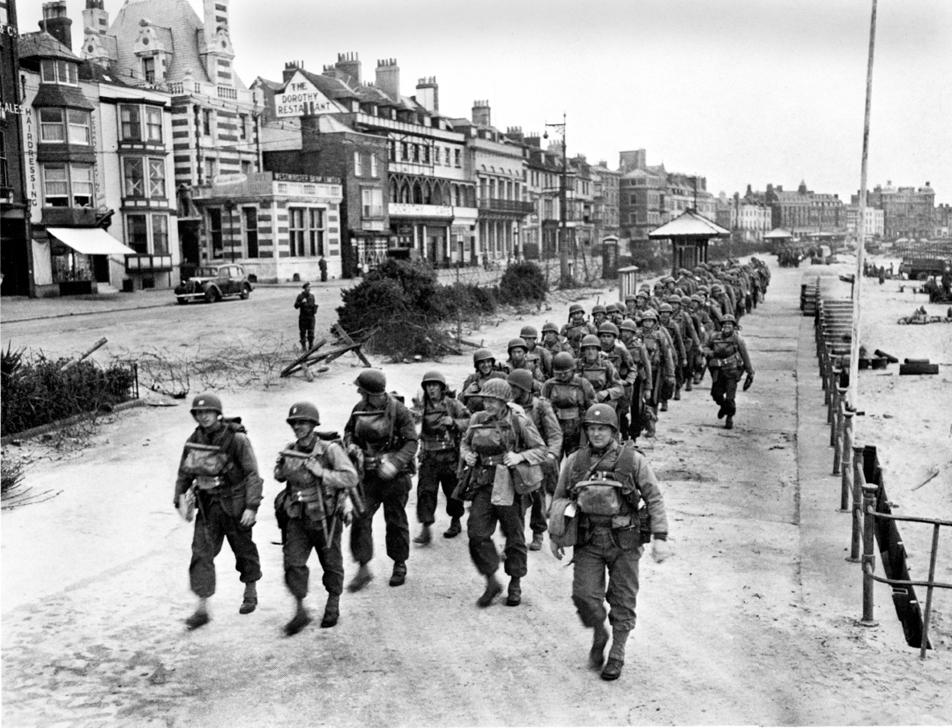
Lieutenant Colonel James E. Rudder (right) 2nd US Ranger Battalion was given the task of planning and neutralising the gun battery on the Pointe du Hoc
The primary target was the six French-made 155 mm howitzers, but the Rangers were also briefed to neutralise the position and seize a main road which ran past the Pointe and along the coast, severing the German connection between Grandcamp Les Bains and Vierville sur Mer, and thus between UTAH and OMAHA beaches. This position was to be held until troops from OMAHA were able to link up with the Rangers, hopefully at around midday.
As 6.30 am (H-Hour) approached, D, E and F companies approached the Normandy coast in a flotilla of twelve landing craft. There were nine LCAs (Landing Craft Assault) carrying the Rangers and three DUKWs (armoured amphibious transports) carrying supplies including pre-fabricated ladders, ropes and grapple hooks. The tenth LCA, with Company D’s Captain Slater and twenty men, had sunk shortly after embarking, and the rough seas also capsized a fourth DUKW soon after, though Slater and his men were rescued later that morning.
At H-Hour the guns of USS Texas ceased pounding the Pointe du Hoc and the Rangers headed for shore. Unfortunately, a combination of strong tides and navigational errors, which were to combine to the benefit of invading forces on UTAH beach, had pushed the Rangers’ craft off course: and they found themselves adjacent to Pointe de la Percée further to the east. Rudder quickly realised and ordered the flotilla west along the coast, but the delay cost the Rangers thirty-five minutes. They reached the Pointe at 7.05 am, five minutes after the deadline to signal the remainder of their force. Divisional commanders, fearing the attack had been a total failure, ordered 5th Battalion – accompanied by A and B companies from 2nd Battalion – to move towards OMAHA beach instead. Rudder had been left with only three companies to take Pointe du Hoc.
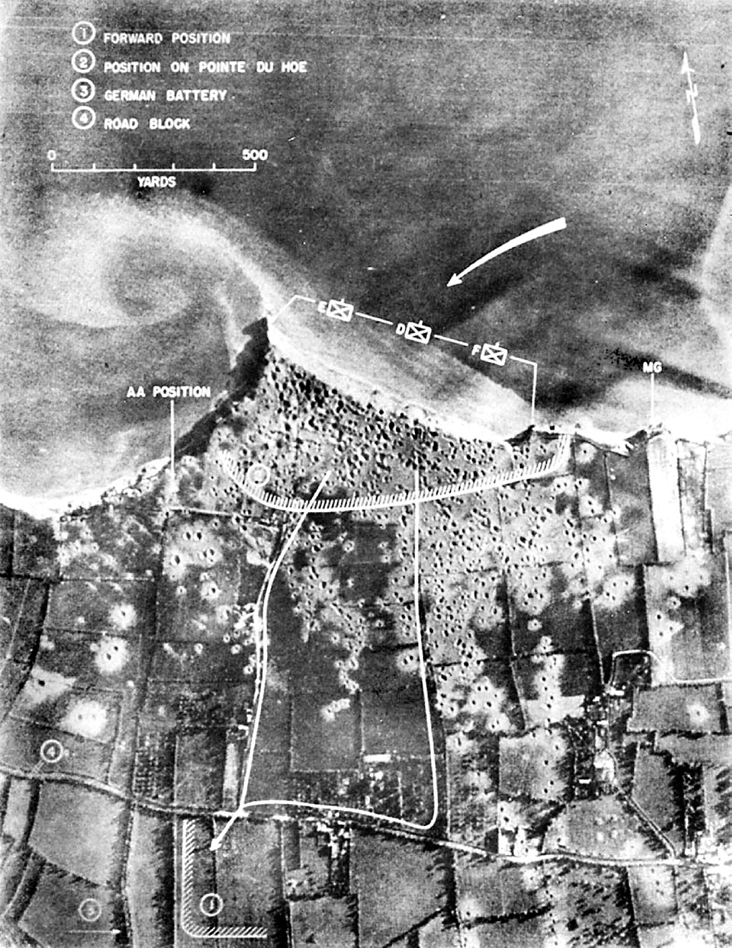
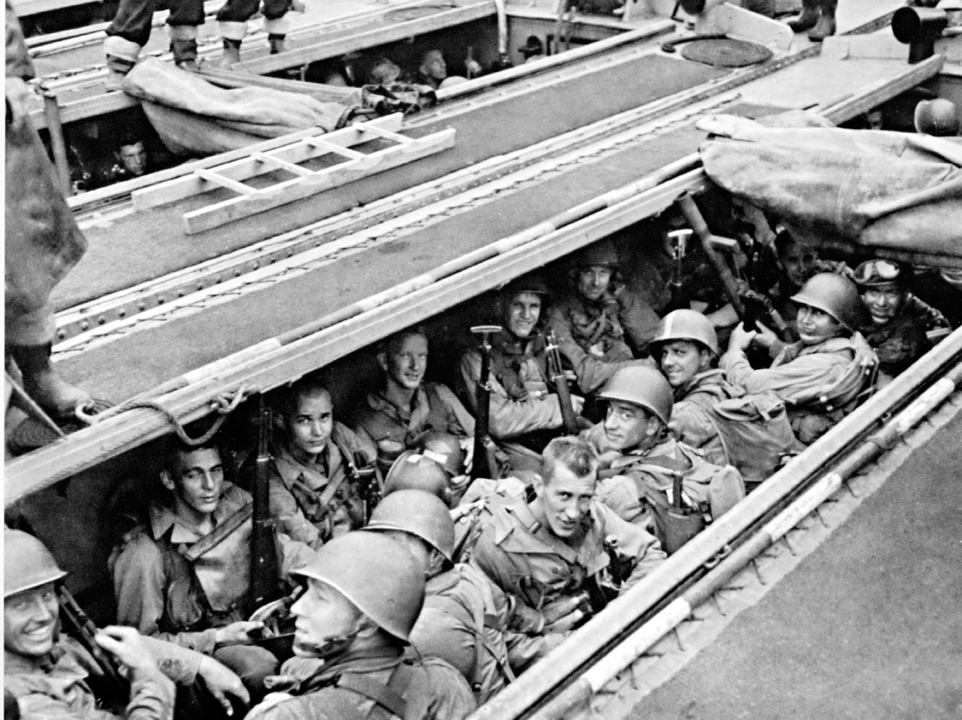
Rangers on their way.
The mistake had other consequences. As the Rangers’ flotilla sailed to the Pointe they moved parallel to several miles of defended coastline and came under attack from shore-based machine guns, mortars and artillery. Despite the efforts of USS Satterlee and HMS Talybont, whose captains realised the situation and began firing at the coast, forcing the Germans to take cover, another DUKW was hit several times and sunk. In addition, those inside the Pointe Du Hoc strongpoint who had been under heavy fire from the guns of USS Texas, had begun to return to their positions as they realised the bombardment had ceased. All three companies therefore approached from the East, with the remnants of Company D coming in from the same direction as they fought to regain lost time.
As the men leapt from the LCAs into the waves, they scrambled for footing on the slippery and uneven shingle beach. Some were killed or wounded by a partly concealed machine-gun post on cliff tops to the left of the landing party, but most made it safely to the base of the cliffs despite several stepping into craters beneath the surf and having to rely on their Mae West lifejackets and more fortunate comrades to keep heads above water. Quickly, the Rangers began climbing the cliff face via toggle ropes, rope ladders and grappling hooks, fired by special rocket propelled launchers from the landing craft. However, soaked by the sea water and intermittent rain, some of the ropes were now too heavy to reach the cliff top. There was another problem as the DUKWs weren’t able to land on the shingle for fear of being stranded and their ladders couldn’t be used. In addition, German defenders were firing down from the cliffs with rifles and lowering grenades on cord over the precipice so they exploded alongside the climbers. Others defenders hacked through some of the ropes, which were now greasy with rain and difficult to grip.
Amidst all this, the Rangers followed their training and took advantage of what luck they had. Allied bombing and the bombardment from USS Texas had caused part of the cliff to collapse, creating a muddy hillock which the Rangers could clamber up, or hide behind for cover. The grappling hooks had lit fuses on top, designed for no other reason than scaring German troops away with the threat of explosion, while US ships continued to give what supporting fire they could without endangering the climbers. One soldier even gave his colleagues covering fire from the extended ladder of a DUKW, spraying the cliff edge with bullets as he was swinging back and forth in midair as the waves buffeted the wallowing transport. Remarkably, the Rangers’ intensive training paid off and, inside five minutes of landing, the first wave had crawled over the precipice and opened fire on nearby tobruks.
In the heat of battle, some still retained their sense of humour. Sergeant Gene Elder was heard to tell his men,
‘Boys, keep your heads down, because headquarters has fouled up again and has issued the enemy live ammunition’, (from The Victors: Eisenhower and His Boys: The Men of World War II by Stephen Ambrose)
Once on top of the Pointe, the Rangers divided themselves into platoons and went after their assigned guns. By this time the landscape, which had been heavily cratered by aerial and naval bombardment, meant that their maps were largely useless. But the huge craters did provide cover from the intermittent rifle fire and machine-gun Tobrukstände, of which many had already been put out of action by the bombs and lay at oblique angles to the field they, were built to defend. The Rangers were able to form up and move quickly between the huge holes with far less casualties than over a level surface and quickly captured ground. An anti-aircraft gun had been lowered and begun firing from the right (western flank) and the Germans had reorganised and fallen back into trenches and tunnels. Nevertheless, the Rangers soon reached the gun emplacements where Allied intelligence had said they’d find the guns – but they were wrong.
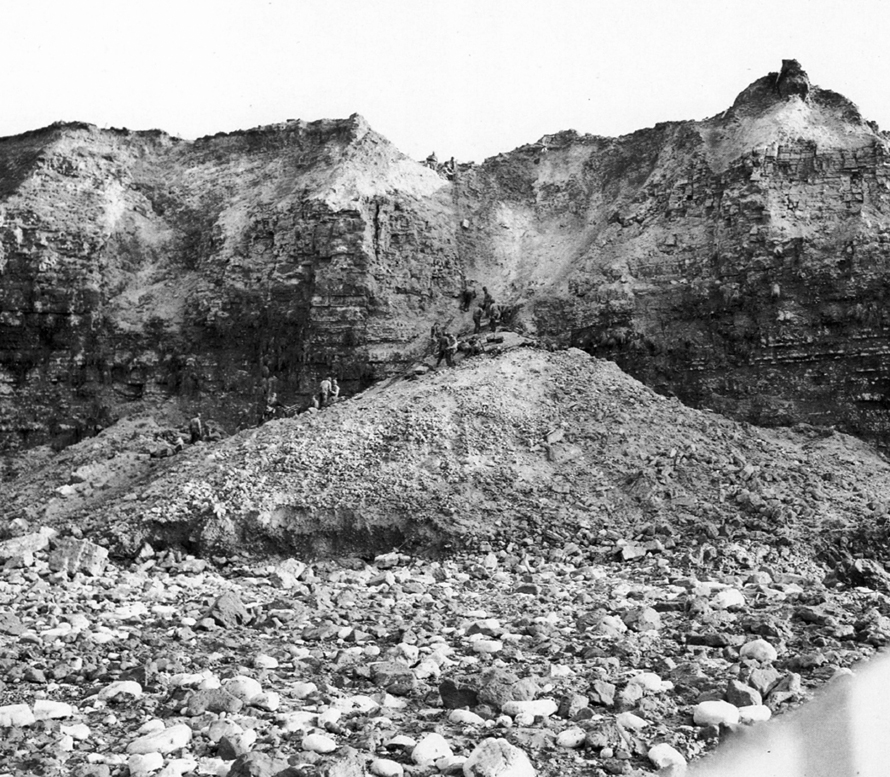
Cliff brought down by allied bombing and shell fire from ships.
The six Vf 600 concrete gun emplacements were in their described locations, though most had suffered some degree of blast damage, as were the interlinking trenches, but there were far fewer German troops than had been anticipated and more importantly, no guns. Instead, telegraph poles had been put in place to look like guns and been covered with camouflage netting. Tracks leading inland revealed that the Ranger’s targets had been moved.
As a medical post was established in an abandoned armoured bunker on top of the Pointe du Hoc Colonel Rudder, who’d been wounded in the leg by a sniper, moved his forward command post from a crater on the cliff face to higher ground. A stray rangefinder shell from HMS Glasgowhad landed in his original position, killing Captain Jonathan Harwood who had been directing the naval artillery, and Rudder decided his officers would be of more use and safer nearer the front line. In the meantime, Ranger groups moved along the access towards the main road, their secondary target. This involved moving through the Pointe’s heavily defended perimeter; not an easy task as Lieutenant Kerchner described,
I remember landing in this zigzag trench. It was the deepest trench I’d ever seen. It was a narrow communications trench, two feet wide but eight feet deep. About every twenty-five yards it would go off on another angle. I was by myself and I never felt so lonesome before or since, because every time I came to an angle I didn’t know whether I was going to come face-to-face with a German or not.
While the minefields, bunkers, machine guns and barbed wire had been designed to repel attacks from the opposite direction, the defences were still time-consuming and dangerous to clear and most were occupied by a full compliment of German troops. When Company D reached the road they only had twenty fully functioning men still standing.
By 8.15 am, around thirty-five of the Rangers had created a roadblock, achieving the secondary objective. However, the situation across the Pointe was still chaotic, as fighting broke out sporadically, usually when opposing sides took shelter in the same building, trench or crater. A machine gun to the west was still firing at anyone who put his head above ground level but fortunately Lieutenant James Eikner was carrying a First World War signalling lamp in case the mission’s artillery spotters were incapacitated. He was able to send a message via Morse Code to the command post, who contacted USS Satterlee and directed gunfire onto the machine gun – its position was obliterated by a five inch shell.
Unaware of the situation at Pointe du Hoc, a large German armoured column passed along the main road, forcing the Rangers to temporarily lift their roadblock, but men were still searching for the missing guns, aware that the Rangers still had not achieved their primary objective. Among them were Sergeants Leonard Lomell and Jack Kuhn, who followed a dirt road inland to where it met a tree-lined lane, where they had an extraordinary piece of luck. Sergeant Lomell tells the story,
We didn’t know where we were going, it was the only road there and we saw the marks, like wheel marks. We thought, let’s go see.
There, half a mile inland, in an apple orchard separated from the road by a hedgerow and hidden beneath a swathe of camouflage netting which rendered them invisible to Allied spotter planes, were the five 155 mm guns, spaced out and ready to fire upon UTAH beach once communication with the Pointe’s observation bunker had been re-established. In a later interview, Lomell describes what happened next,
We just lucked upon them, there was nobody guarding them. We looked around cautiously and over about a hundred yards away in a corner of a field was a vehicle with what looked like an officer talking to his men. We decided, let’s take a chance. I said “Jack, you get up on a hedgerow with your .45, and you protect me. If I hear you open fire, I’ll know they saw me” All I had was two thermite grenades – his and mine. I went in and put the thermite grenades in the traversing mechanism and that knocked two of them out because that melted their gears in a moment. Then I broke their sights. We ran back to the road and got all the other thermites from the remainder of my guys manning the roadblock and rushed back and put the grenades in traversing mechanisms, elevation mechanisms, and banged the sights. There was no noise to that. There is no noise to a thermite grenade, so no one saw us.
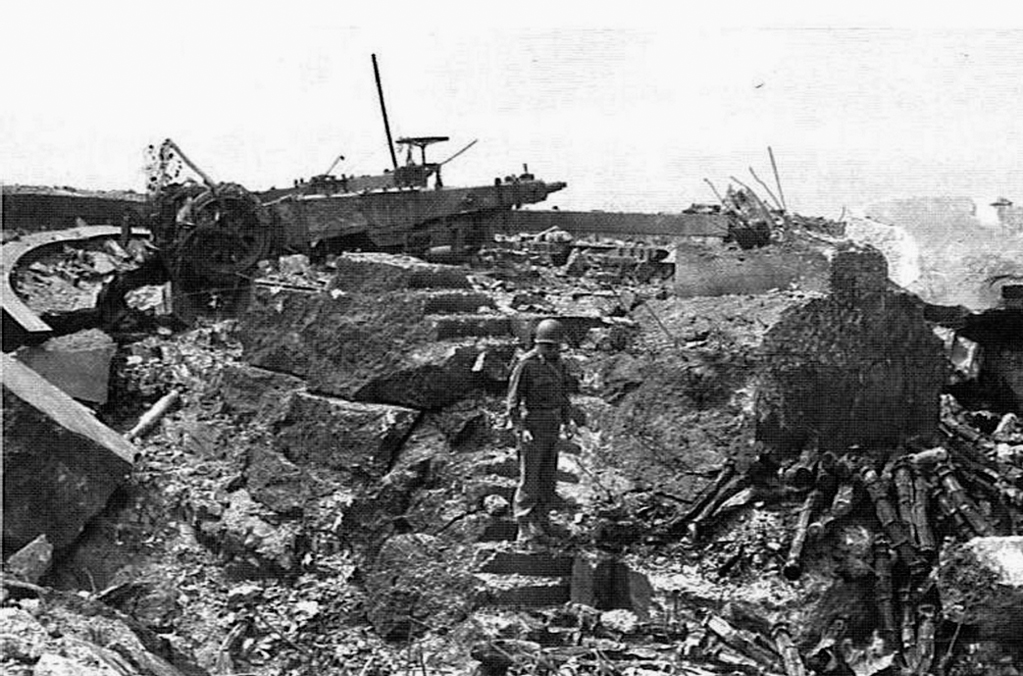
Totally wrecked gun position.
(From Remembering D-Day, Personal Histories of Everyday Heroes by Martin Bowman and the History Channel’s ‘Battlefield Detectives’.)
At around the same time the patrol from Company E had discovered the German guns’ ammunition dump, also undefended. Under the command of Sergeant Rupinski, the Rangers blew up the dump, creating a huge fireball that rained debris on the retreating Lomell and Kuhn. Rudder’s command post relayed the message to the USS Satterlee; the guns had been destroyed, the primary objective achieved – it was not yet 9.00 am.
But the Rangers’ job still was not over. They had to hold off a German counter-attack until help arrived. According to the original plan, troops from OMAHA would meet up with the Pointe du Hoc force at around mid-day. Unfortunately things had gone badly wrong on the beach and many of the US soldiers who had made it off the beach were short of their inland targets. The elements of 5th and 2nd Ranger Battalions which diverted away from the Pointe, landing at 7 am, had made little progress because they had also been involved in the struggle to secure OMAHA. This meant Rudder and his men needed to hold the Pointe for much longer than expected. Only two platoons of Rangers had made it from OMAHA, one platoon on the evening of the 6th and a second on the afternoon of the 7th, though three US paratroopers who’d been dropped outside their landing zone surprised everyone by fighting through German lines to join Rudder and his men.
Ultimately, the Rangers held onto their Pointe du Hoc foothold until they were relieved late on the morning of 8 June. Throughout the intervening period they suffered five major counter attacks by German troops from 1st Battalion, 914 Regiment, who had recovered from their confusion, regrouped and made a determined effort to recapture lost ground. The Rangers, however, were now being aided by the fort’s own defences, which had been set-up to repel just the kind of landward attack the Germans were attempting. Supporting fire from the USS Satterlee, as well as USS Barton and USS Thompson also did much to dissuade continuous attack though, on occasion, the Rangers were pushed close back to the cliffs.
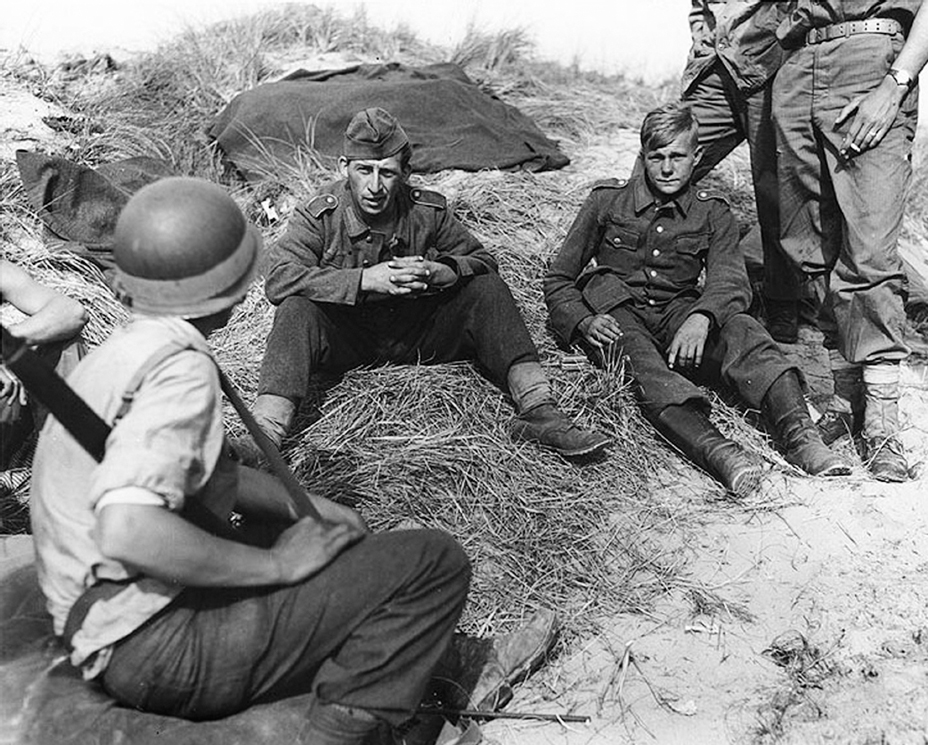
Captured Polish conscripts under guard near OMAHA Beach.
‘They really rolled over on a lot of our fellas there,’ said Lieutenant Eikner, ‘and we lost some fellas captured and killed or wounded. The remnants, we retreated back to the point and reinforced the defence we had around the point proper.’
This period was the darkest for the men of D, E and F companies, but had the Germans retaken the Pointe, they might have brought replacement artillery up and shelled the fragile hold on OMAHA beach.
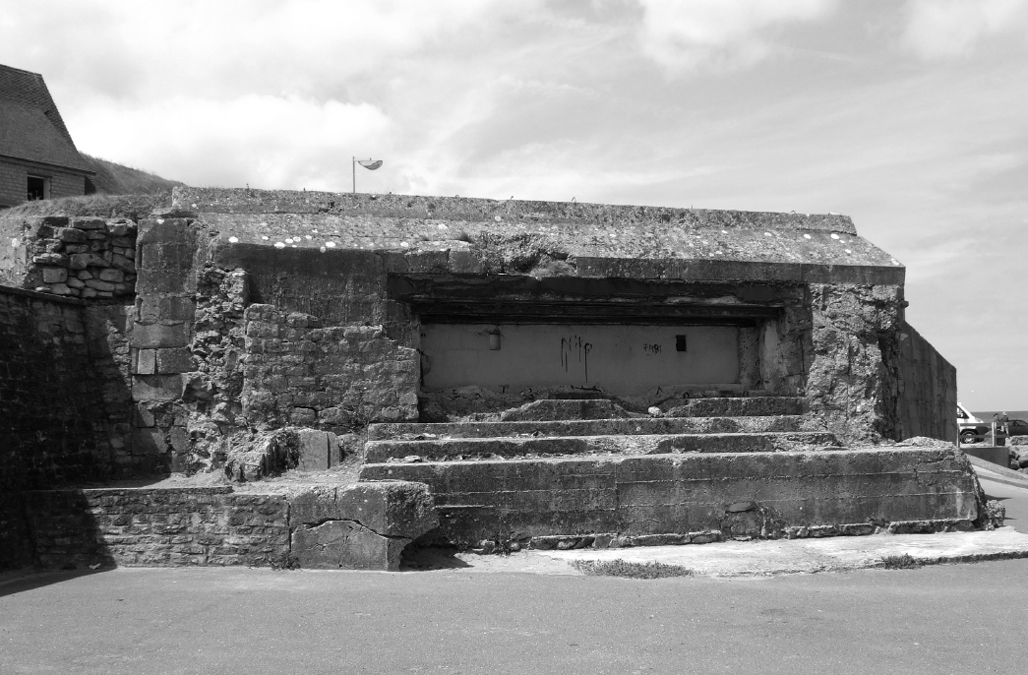
Casemate for an anti-tank gun, OMAHA BEACH.
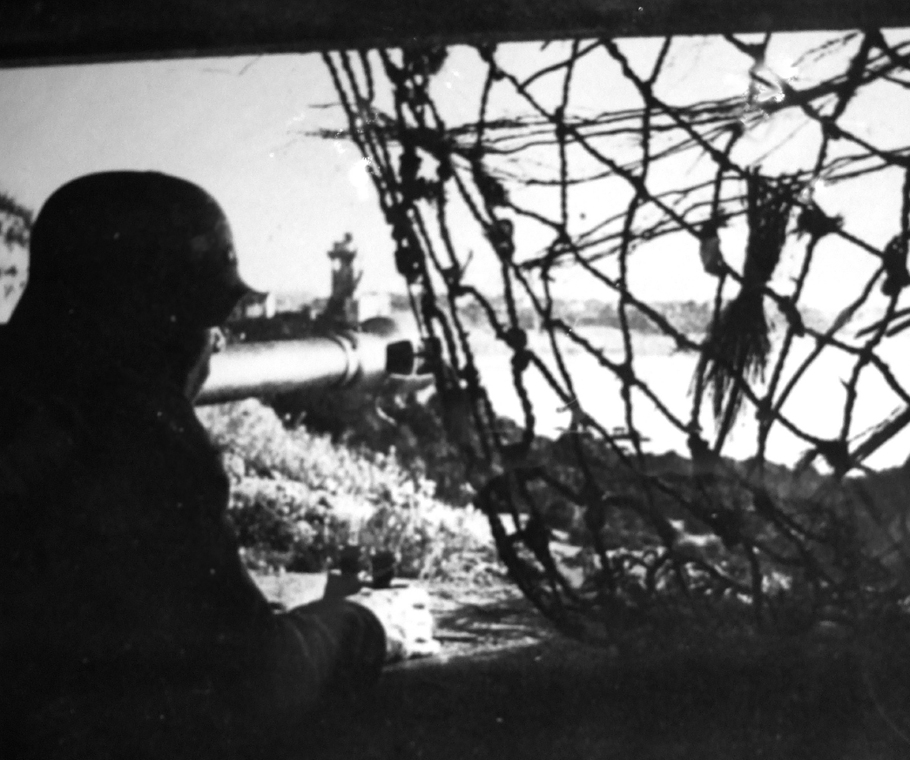
From a casemate overlooking the Cotentine Peninsula
By the evening of 8 June, Rudder’s original force of 225 Rangers from D, E and F companies had suffered 135 killed, wounded or missing, with around eighty dead. Had the five 155 mm guns fired upon the Allied landings, casualties would almost certainly have been far worse. It turned out that the missing sixth gun from the Pointe du Hoc had been taken away for repair having been damaged in a bombardment prior to D-Day. A, B and C companies of the US Rangers suffered equally with half of the first two units were mown down after landing on OMAHA beach. Company C lost thirty-eight out of sixty-four men trying to reach Pointe du Hoc across the cliffs.
The 2nd Battalion was the first unit to complete their assigned D-Day mission and received a Presidential Unit Citation as well as the French Croix de Guerre. Colonel Rudder and Lieutenant Lomell were awarded the Distinguished Service Cross, while Lieutenant Kuhn received the Silver Star. The first significant battle on the Atlantic Wall had been decided but and, up and down the Normandy coast, similar stories were unfolding.
CRISBECQ – NO SURRENDER
The battery of St Marcouf/Crisbecq was built to be the main strongpoint of the Cotentin peninsula’s east coast, but only two casemates had been completed out of the four planned by D-Day.
By the time measures were taken to ensure the Crisbecq battery at St Marcouf was fully garrisoned at the beginning of May, 1944, the Germans had lowered the conscription age to seventeen, but many of those on duty on the Atlantic Wall in Normandy were even younger.
Some of those had papers which assigned them to the Azeville battery, but construction was well behind schedule at Crisbecq, a few kilometres nearer the coast, and resources were being diverted to bring defences there up to speed.
Oberleutnant Walter Ohmsen had taken command of Crisbecq, also known as Marine Küsten Batterie ‘Marcouf (Naval Coastal Battery Marcouf) or Seeziel Batterie ‘Marcouf’ (Sea Target Battery Marcouf), on 1 February 1944. His command, including himself, consisted of three officers, twenty-four non-commissioned officers and 287 men of the Kriegsmarine. The unit was responsible to the Marine-Artillerie-Abteilung 260 – MAA 260 (260th Naval Coastal Artillery Battalion) and the battery’s personnel was further augmented by members of 6 Grenadier-Regiment 919 (6th Company, 919th Grenadier Regiment) of the 709th Infanterie-Division (709th Infantry Division) which brought the estimated compliment to around 400 men.
Ohmsen was born in 1911 in Elmshorn and joined the Reichsmarine in 1929. He became a Matrosengefreiter (seaman 2nd class) in 1933 and a Bootsmannmaat (coxswain) a year later. He was then to serve time at sea on the battleship Schleswig-Holstein, the training vessel Gorch Fock, the training ship Carl-Zeiss, the torpedo boat T-153 and the cruiser Königsberg, attaining the rank of Oberstabsbootsmann (chief boatswain) in 1940 and being awarded the War Merit Cross 2nd class in April, 1941. Assigned to the Naval Artillery School, Ohmsen became a Leutnant zur See(Second Lieutenant – Naval Artillery) in January 1942 and an Oberleutnant (MA) (First Lieutenant) shortly after but, in February 1944 he inherited a shambolic command at Crisbecq. In contrast to Azeville, which was a model battery and commanded by an ‘old school’ officer in the shape of Hauptmann Treiber. Crisbecq had a reputation for indiscipline and was regarded as a punishment posting where lower ranks were bullied by officers who had failed elsewhere. Ohmsen could also be harsh with his men but he was determined to turn around his new command.
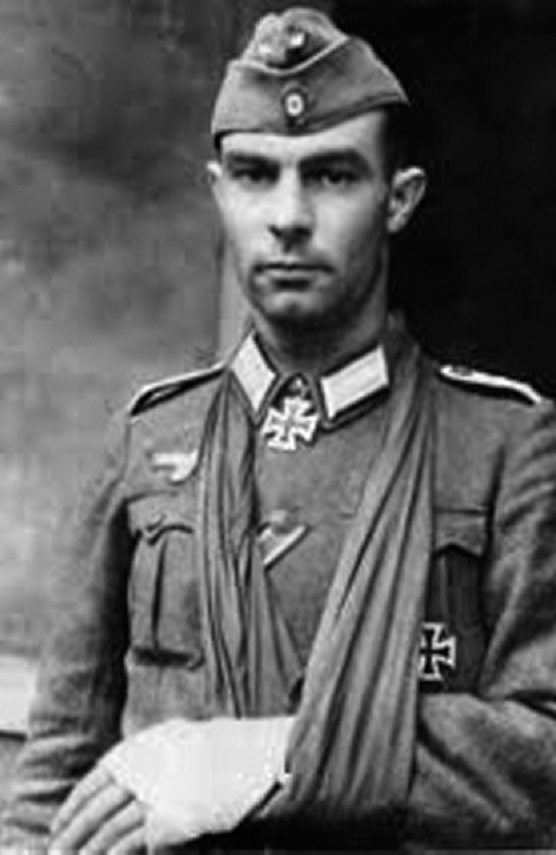
Oberleutnant Walter Ohmsen.
It didn’t help that conditions at Crisbecq were cramped and claustrophobic with up to twenty men on duty billeted in each of the R502 personnel bunkers. Ohmsen favoured addressing his troops from a huge circular concrete platform in the heart of the battery, the base of what was intended to be the third casemate. Work was to continue on the site day and night in the spring of 1944, but it was never completed.
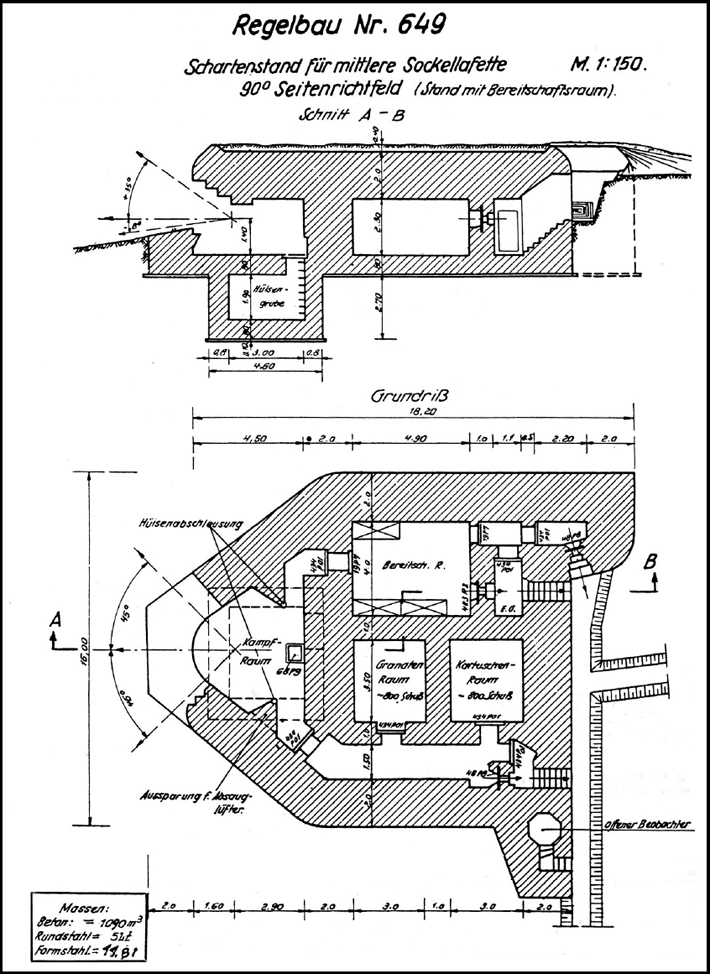
Diagram for constructing the type of casemate at Crisbecq.
Ohmsen did his utmost to maintain morale at Crisbecq, congratulating new recruits on arriving just in time to fight a real war and not the phoney one the garrison had been engaged in for six months. To many of the regular soldiers who were accustomed to officers who threatened and bullied to maintain discipline, Ohmsen didn’t seem so bad but he still governed with a rod of iron and men were often seen lugging bags of cement around the perimeter as punishment duty.
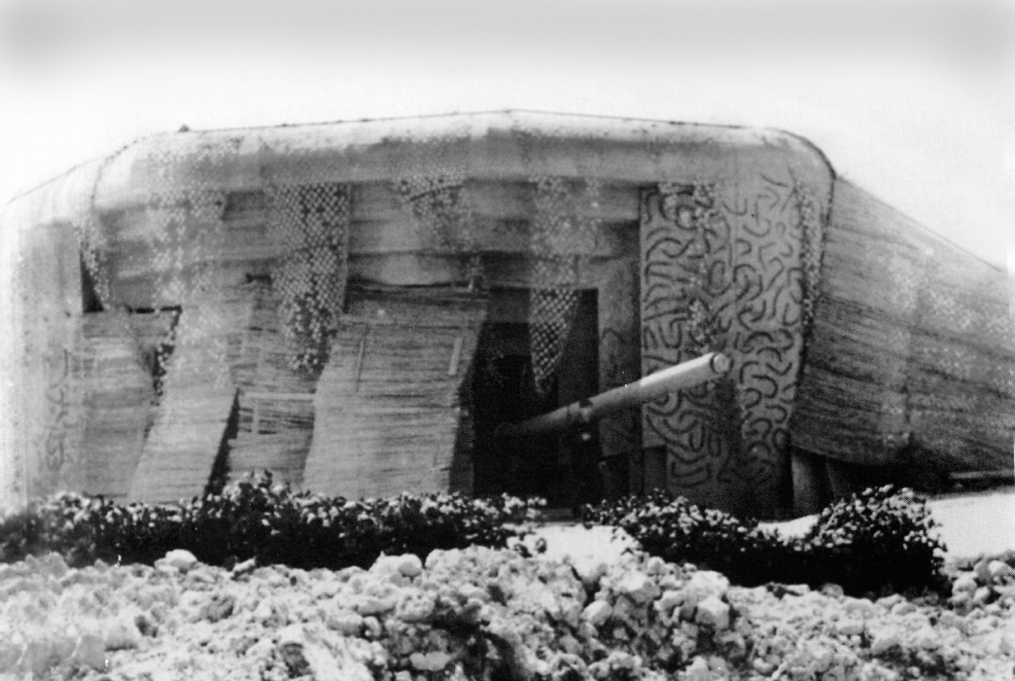
Casemate manned by the Kriegsmarine at St Marcouf/Crisbecq a few weeks before the invasion.
By June 1944, the landscape in and around the tiny village of St Marcouf was pockmarked with craters, scorched remnants of gorse barely tufting above ground level. Allied air supremacy meant Spitfires and Mosquitos could reconnoitre the Normandy coastline unopposed and an artillery battery the size of Crisbecq was mapped immediately initial test-firing took place.
The first of the new Czech Skoda K52 guns fired their first rounds on 19 April, and the very next day the Allied bombing of Crisbecq began. The K52s had a calibre of 210 millimetres and built to launch 135 kilogram shells at 40 second intervals up to thirty kilometres but, of course, they were an easily identifiable target. By mid-May, more than 800 bombs had fallen on the battery and its immediate vicinity. After a particularly heavy air raid, Ohmsen even suspended firing from the battery. None of the guns had been damaged, but it was useful to make the enemy believe they had succeeded in disabling some or all of them.
Unwittingly or not, the self-obssessed Ohmsen had managed to protect his guns from the worst of the bombing. The Oberleutenant hadn’t placed his guns where he was told to. They were, for example, not at the highest point of the promontory where regulations demanded and so the enemy could not get an easy fix on them. The foundations of the casemates were dug nearly four metres deeper than planned, and as a result were finished late. But the depth meant that there was a steady downhill slope from the munitions stores, deep inside covered tunnels and trenches, and those guns were still fed with shells even though the ground above was blasted and reshaped out of all recognition.
Both the Crisbecq casemates took many direct hits from naval guns, but they kept firing. Ohmsen had been vilified for taking additional time to build heavy duty submarine nets into the roof, but they contained tonnes of falling masonry and probably saved many lives.
Ohmsen regarded the security of Cribecq as a personal quest. An example of that fastidiousness came only a week before the Americans landed. Seeking out the smallest man in the garrison, he walked him to the edge of a cliff to the north of the battery where there was a sewage outfall that served all the bunkers. Bombing had exposed a concrete sluice going down into the ground.
The unfortunate soldier was lowered by rope into the slime and told to report back what he finds. When he told his commander there was a steel grille blocking the shaft about twenty metres down he said, ‘Good, then nobody’s going to be able to get behind us that way’.
For the ordinary troops, the days on the run-up to the invasion at Crisbecq were spent labouring on casemate construction, interspersed with some training in handling munitions and small firearms practice. Ohmsen realised his battery would be probably besieged if the Allies forced their way off the beaches in his sector though, of course, he had no way of knowing Crisbecq would be at the sharp end of D-Day operations.
In early firing, one of the problems the gun crews at Crisbecq had discovered with the K52s was that they couldn’t be loaded with the barrel inclined upwards, in the attitude for long-range firing. The gun had to be brought nearly horizontal before the heavy shells could be pushed up the slope into the chamber meaning that the guns had to be retargeted every time they were fired. Marks had been painted on the walls to help crews restore the gun to its desired firing position but the system was still only approximate and unreliable as a ranging tool.
Defences at Crisbecq were being refined right up to D-Day as the garrison desperately tried to make up for time lost through earlier indiscipline. An attack on the battery from the south or east necessitated the scaling of steep cliffs so they were classed as low priority but, from the north and west, the approach was over level ground. Rommel had personally inspected the area and specified the construction of a minefield, as usual Ohmsen supervised the work himself and made sure his men did a thorough job.
There was only a single road through the minefield but this was still cut through by a deep trench, which itself was mined. A steel bridge spanned the gap but was pivoted and only controlled from the Crisbecq side and could be winched upright to create a wall. The minefield itself was the widest on the whole of the Cotentin peninsula. It ran between two prominently-marked fences, around 200 metres apart. There was a dispute with the officers at nearby Azeville, who protested that Crisbecq was using the mines intended for use in their own minefield so Ohmsen was forced to lay his share only along the outer perimeter, leaving the remainder to the imagination of the enemy.
On Monday 5 June, the weather in the English Channel had turned stormy but all of the local garrisons had been set at battle stations because of the possible implications of a forecast high tide at dawn. Ohmsen refused to have his men sat around in full combat gear, however, deciding the guns needed further firing practice and the range-boat was sent out into the bay.
The trials went well, but before nightfall the air raid sirens were sounding again and for the next eight hours, waves of American bombers pounded the Cherbourg peninsula and around 600 tons of high explosive fell on Crisbecq and Azeville. Several explosions rocked the battery but didn’t cause any real damage to the guns, though dust and rubble had partly blocked the casemates. Crews were still digging out fallen masonry when, almost as soon as the all-clear had sounded, the sirens began to wail again. This time, though, it was a call to battle stations. D-Day had begun.
Nobody at Crisbecq knew it, but the battery stood at the western extremity of a sixty-mile chain of planned beach-heads. Ten miles to the East, the US Army encountered disaster and carnage on OMAHA Beach but the stretch of sand that extended eastwards right below the Crisbecq promontory was codenamed UTAH, and there the American invasion was proving far more successful.
For the first few hours, none of this held any interest for Oberleutnant Walter Ohmsen. His pre-defined targets were out in the bay and his three main guns were still intact, including the one in the half-built third casemate which was open to the sky.
Crisbecq had the distinction of being the first major battery to identify the invading forces (at around 5.10 am) but it still took Ohmsen almost an hour to gain permission to open fire. By around 6.00 am, all three Skoda K52s had been cleared of debris resulting from the night’s bombardment and each was test-fired at longer range targets over the course of the next few minutes. Among several warships in close proximity within the western end of the Bay of Seine was one already firing at the battery itself. From his elevated observation bunker a little south of the battery, Ohmsen identified it as a light cruiser, though in fact the USS Corry was a destroyer.
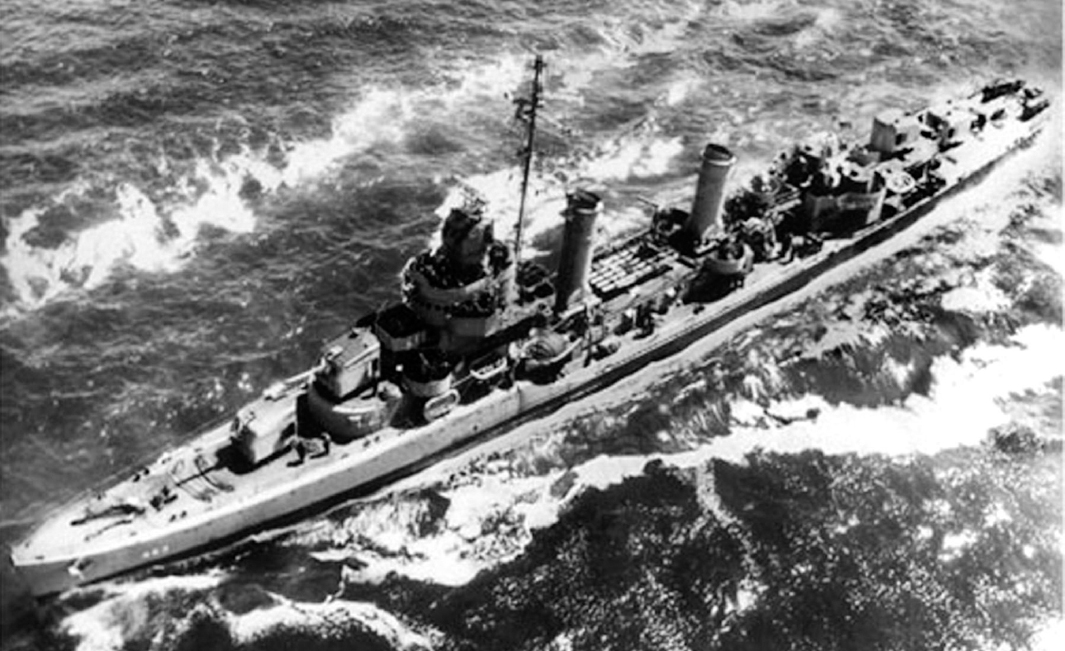
USS Corry.
Just after 6.30 am, all three K52s at his disposal fired on the ship at under four miles range – point blank in artillery terms given the size of the guns. A salvo of three shells hit the Corry midships almost simultaneously, breaking its back in a violent explosion. It sank within minutes, with the loss of twenty-four of its crew and was to be the only sinking of a warship connected to D-Day itself. But the Allies were determined not to acknowledge the threat posed by a battery like Crisbecq for fear of affecting the morale of invading troops. After initially reporting that the Corryhad been struck by shell fire, the commanding officer apparently changed his mind and told his superiors that the ship had struck a mine.
The first day of fighting, D-Day itself, saw a relentless bombardment of Crisbecq and, for the large part, the garrison was almost powerless to fight back. The sinking of the USS Corry had taught the Allied naval commanders a lesson and the larger ships now stood off the coast, outside the angle of fire of the battery’s K52s. Casemate construction meant that the guns could be manoeuvred through approximately 120 degrees, while the K52 operating in the unfinished emplacement could pivot on its base through more than 150 degrees but trying to push the boundaries further could lead to disaster. At one point, the crew of the No.2 gun had their barrel tight against the edge of the opening but when fired, a huge chunk of concrete broke off and rebounded around the casemate – the tactic wasn’t tried again.
Ohmsen redirected fire towards UTAH Beach, trying to stem the flood of Americans from the 4th Infantry Division that were already pushing over the dunes toward the strongpoint at La Madeleine. But Crisbecq’s guns were constantly overshooting their targets. On that first day, it was mainly the guns from Azeville that bombarded the landing area but, by the time they had been brought into action, the first waves had cleared the beach and were plotting to work their way towards a join-up with the remnants of the US 82nd and 101st Airborne Divisions, which had established a command post in the village of Ste Mere Eglise after a bloody street battle with outlying sections of the German 91st Infantry Division and attached Austrian antiaircraft gun crews. The machine gun nests on the bluffs surrounding Crisbecq were keeping the advancing Americans pinned down, however, and garrison morale was lifted by radio reports of an American massacre in the east towards to Vierville. As far as the Germans were aware, the invasion had been repulsed though they heard nothing about the fighting further east still or the fact that the British and Canadians were already pouring inland around Arromanches. They just had no concept of the width of the invasion front in Normandy or how massive the Allied force now in France was.
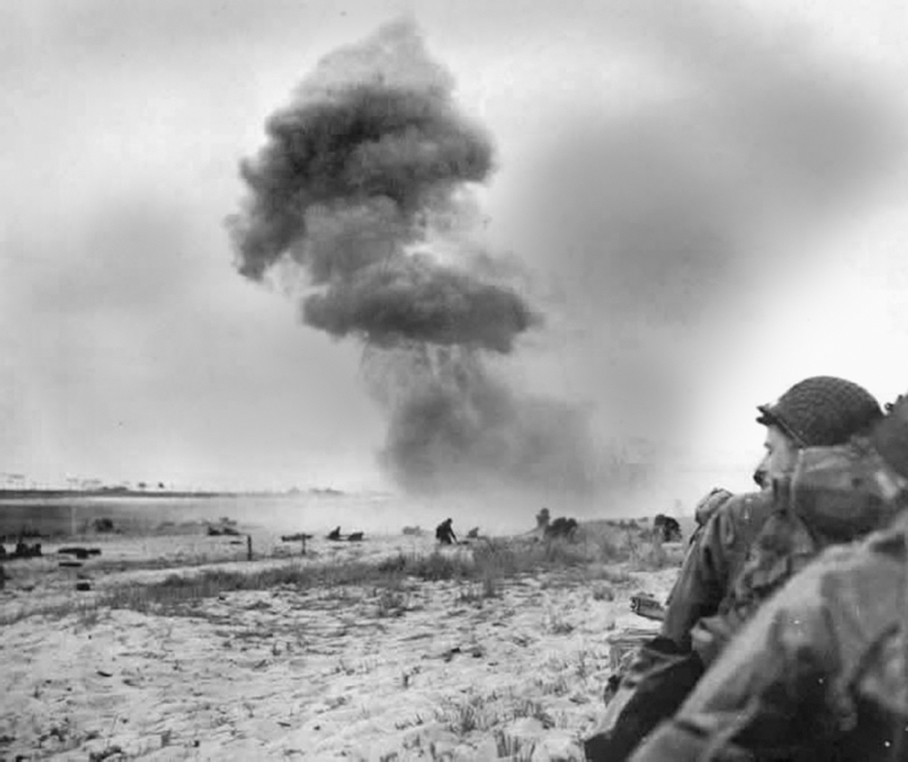
Shells hitting UTAH Beach.
Those commanding the 4th Infantry Division had confidently expected to overrun the Crisbecq/St Marcouf battery before nightfall on D-Day but the most advanced units had barely cleared UTAH beach and were concentrated two kilometres east of their intended position after the tide had dragged them north of their intended landing position. The eventual breakthrough at UTAH only came about when the 82nd and 101st Airborne Divisions pushed toward St Martin de Varreville from Ste Mere Eglise, though the first round of engagements in the Crisbecq vicinity saw the 101st sustain severe losses. UTAH Beach was by no means as bloody for the Americans as OMAHA but casualties were still a lot higher than on either of the British beaches or the Canadian one, and the progress was slower too.
Crisbecq, too, was to suffer on D-Day itself. At around 4.30 pm, the No.3 gun in its partly-built casemate took a direct hit from either the USS Quincy or the USS Nevada. Most of its crew were killed and the gun disabled. Walter Ohmsen was to suffer a severe shrapnel injury to his left arm around this time, though it was never confirmed that he was in the vicinity of the gun when it was hit.
As dusk began to gather, the Americans finally started to move away from UTAH beach. Pre-ordained ‘Exit 2’ had been cleared of obstacles, meaning the invasion force could land their tanks and armoured half-tracks and move onto pre-planned targets in the Western sector. The Germans were being kept at comparative arm’s length as the Allies enjoyed near-total air supremacy and with the Allies making rapid progress further east, the speed of advance of the Americans was no longer critical. The US navy therefore began to target artillery field pieces in the area. Two 105 mm guns stationed beside a road junction between Azeville and Crisbecq were destroyed and so were all but one of the six local anti-aircraft emplacements to prevent them using their 37 mm guns on the advancing troops and tanks.
The only real threat to the relentless push inland was the artillery of the St Marcouf battery. Crisbecq and Azeville had always been major strategic targets for the Allies and the garrisons now had to prepare themselves for a siege.
A sense of bewilderment had descended over the Crisbecq battery. Every few minutes, the ground shook as the fourteen inch guns of USS Nevada rained shells down from her position anchored in the bay. The men just carried on with their duties, taking shells from their boxes and manhandling them onto the small cart on rails that carried them the hundred feet or so to the No.1 blockhouse, anytime expecting a shell to land on the ammunition bunker and wipe out the garrison.
But Ohmsen, arm bandaged and in a sling, was calmness personified and made sure his men didn’t have time to dwell on what would happen should the Nevada find her range. He ordered the men to remove all the shells from their boxes and then had them smash the wooden crates with crowbars and axes, stacking the resultant timber alongside bunker walls. Given something to do, men almost forgot about the bombardment.
By the morning, 7 June, Ohmsen felt confident enough of the immediate security of Crisbecq’s perimeter that he sent second-in-command, Leutnant Grieg out onto the road between the battery and Azeville on a fact-finding mission. He was given a hundred men to reconnoitre beyond the minefields, but hardly encountered any American infantry. Grieg’s men did, however, capture some lost paratroopers after they came across a downed American airman carrying a hand-held clicker being used for identification purposes. Grieg guessed its use and spent the late morning sending out dummy calls rounding up paratroopers who answered.
The sudden need to oversee twenty prisoners of war didn’t go down well with Ohmsen. however, there were no facilities in which to guarantee their security or any means with which to feed them so, after collecting their names and numbers and confiscating their boots, he locked them in the battery’s strongroom with a supply of bread and water, a couple of chamber pots and a pack of playing cards. It is said the last-named was a rare act of compassion shown by Ohmsen but, after some of the prisoners were abusive, he theatrically removed one of the playing cards and slipped it into his pocket before tossing them the pack. The armoured door was then bolted and padlocked the behind him.
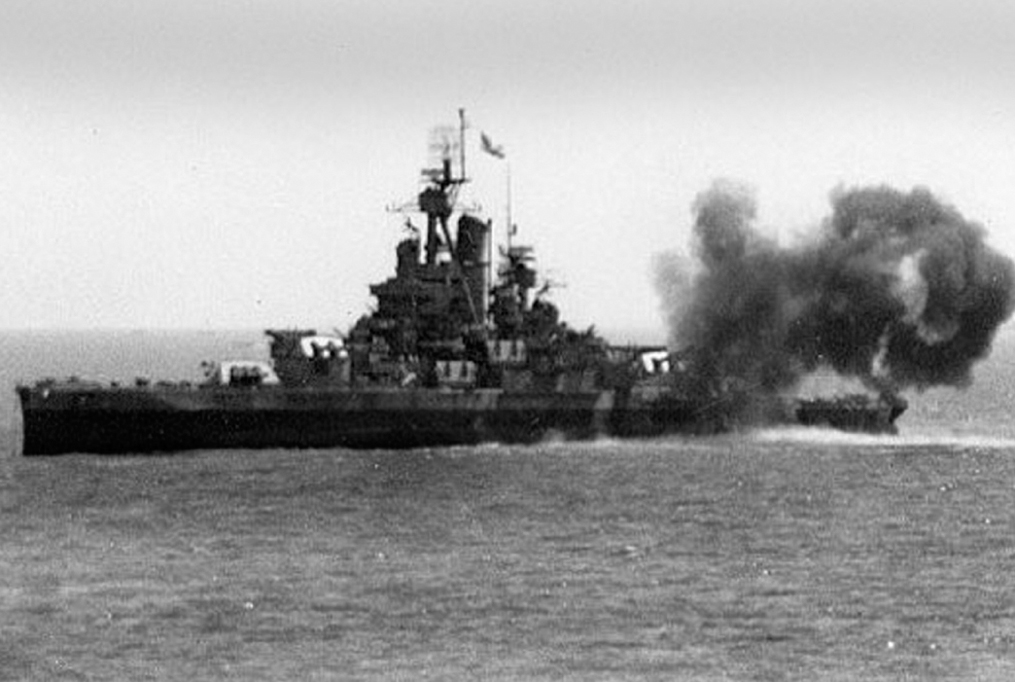
fourteen inch guns of USS Nevada bringing down fire on the German batteries shelling UTAH Beach.
At just before noon, 7 June, orders were given to the gun crews to begin firing until further notice. No.1 gun was to aim at the beach area around the WN5 strongpoint at St Martin de Varreville at ten minute intervals, day and night, while No.2 gun was to fire on offshore targets every twenty minutes as long as daylight permitted.
Ten minutes was about the fastest firing rate of a K52 before the barrel would become overheated. If Ohmsen’s men could keep up the firing rate, the Crisbecq battery would run out of ammunition some time in the early hours of 11 June. By then, Ohmsen reasoned, the battle would be over one way or another.
Firing to a strict schedule was typical of the discipline Ohmsen inflicted on his men and twofold in its reasoning. He endeavoured to, not only, concentrate the minds of the garrison on the task in hand but also to convince the enemy that the sustained barrage against the Crisbecq battery was having no effect whatsoever.
He only half-succeeded, however. The Americans had begun to pick up the pace once clear of the beaches and now closed to within hailing distance of Crisbecq – a first direct ground assault being launched as night fell 7 June. A British Sherman Crab equipped with flails came crashing through the remains of the wood behind the battery and ploughed a path some fifty metres beyond the outer perimeter fence before being disabled by a mine exploding underneath one of its tracks.
The tank crew were unaware of a 37 mm anti-aircraft cannon that had been trained on them throughout their advance. It was hidden under a mound of barbed wire that encircled the No.1 casemate, inside a hastily-constructed pyramid of surplus steel plate. Grieg had ordered the gunner to hold fire until the tank cleared the mined area so the vehicle’s crew were able to escape via the floor hatch and retreat in a crouch along the path they had cleared.
Ohmsen convinced himself that the Americans would not try the same tactic again as the flail hadn’t got halfway across the minefield but the truth was the tank had only been disabled by the very last mine in its path and Crisbecq battery now lay defenceless in that area.
The following morning, the Americans tried a different route. Rope ladders were put in place and men began scaling the cliff directly below the No.1 casemate. But Ohmsen had foreseen the possibility of a direct frontal assault and positioned a heavy machine gun inside the casemate at the sea-facing end of the aperture. It was even fitted with a periscope so the gunner didn’t have to expose himself to return fire. A combination of barbed wire and mines had also been dug into the coastal path running beneath the casemate to deter attack from the flank.
The first wave of infantry attacked just before dawn, seconds after the gun had recoiled from firing down onto the beach. But the gun crew were under instruction to be on their guard while the barrel was being raised in preparation for reloading. At any sign of movement in the scrub at the edge of the cliff, the barrel was to be raised again to negate the possibility of a grenade being thrown down the barrel.
The American troops charged from the cover of the bushes but those in the front rank were cut down by the machine gun before they’d barely covered a quarter of the 100 metres to the casemate itself and those in the second wave turned tail and threw themselves back into the scrub. About twenty minutes later, however, they came again and though dozens were killed or wounded by the machine gun and others became entangled in the barbed wire, some got through and climbed onto the roof of the casemate. A Bangalore torpedo was forced through an aperture, causing a large explosion inside the gun control room at one end of the blockhouse. Ohmsen’s reaction was to become folk-lore in German military history.
Picking up the telephone, he said a pre-agreed codeword and one of the World War One 105mm Schneider cannons at the Azeville battery fired a shell into the casemate. The Americans scurrying across the top the battery never stood a chance and those still moving forward were too dazed to put up much resistance when Grieg’s Grenadiers, backed by a further contingent from Azeville under the command of Leutenant Geissler, emerged from the blockhouse.
The Germans lost three men themselves in firing on their own battery, burned to death in the control room, and several more injured. The damage can still be seen today at what is now the Crisbecq museum. But the Americans losses were much greater and they were forced to rethink their strategy in how to capture the battery.
Ohmsen achieved something remarkable during the siege of Crisbecq. It could be argued that he was always in a no-win situation. The battery was ill-disciplined when he arrived and none of his superiors would have been surprised had it continued that way. Crisbecq was going to fall sooner or later once the Americans had established a beachhead, and resistance only meant prolonged hardship for the garrison, and mounting casualties. Ohmsen wasn’t even an attractive or particularly endearing character. He was described as aloof and was often derogatory according to his men and, though he liked to supervise projects personally, was never known to get his hands dirty. But he made up for much of that with an almost uncanny ability to second guess the enemy. He appeared to anticipate every eventuality and was unflappable under pressure, and his men were prepared to trust him because of it.
Even when the two intact casemates were little more than blackened shells, surrounded by scorched earth and charred bodies, men still believed he would get them out alive – and some he did.
In the early hours of 9 June, Ohmsen gave orders for his men to use the shell-boxes they’d been systematically breaking apart to make two metre-wide bridges capable of supporting half a tonne in weight, one five metres long and the other two. They were meticulously designed, with abutments positioned to engage with the casemate masonry. As well as the bridges, the men in the casemates were told to send a sealed drum of gasoline, with the strap handle prised open so that it could accommodate a stick grenade. Finally, Ohmsen wanted the grenade itself and some cloth that could be used to wedge it in place under the handle.
The first shorter bridge was to span the gap between the gun base and the lip of the casemate aperture, while the longer bridge overhung the aperture and stretched beyond the barbed wire in front of the casemate. It only took a short time to put everything in place and everything was achieved under cover of darkness so the American snipers, suspected of observing from an adjacent field, couldn’t disrupt operations. The grenade was fitted to the fuel drum before it was rolled out over the first bridge. Poised at the aperture mouth, Ohmsen pulled the pin himself and two men pushed the drum over the edge. Everyone dived for cover as Ohmsen watched through the periscope of the machine gun.
The improvised explosive device did its job. The drum picked up speed as the ramp slope increased, flattening the barbed wire. It rolled quickly down the hill, now devoid of any foliage, and plunged out of sight over the ridge. A moment later, there was a huge blast and a sheet of flame lit the night, followed by screams in the darkness. Ohmsen calmly told everyone to be on their guard in case the Americans attempted another dawn raid, and gave the command to resume the firing cycle but he did allow some of his men to grab some sleep for the first time in more than 48 hours.
Thursday had been a bad day for the US 4th Infantry at Crisbecq and the gasoline drum blast had begun the Friday badly as well. No surprise, then, that for the remainder of the 9th the Americans concentrated the bulk of their operations against the Azeville battery.
Azeville’s commander was Hauptmann Hugo Treiber, a good soldier but not one that pursued his duty to the Nazis with the same zeal as Ohmsen. The Americans also had detailed plans of the defences of the Azeville battery because the French Resistance had men in the adjoining village and had visited the site on several occasions. There were no submarine nets on the casemates and only token road blocks on the approach roads. Crisbecq had the advantage of location as well – Azeville had no cliffs to protect it.
The Americans still could not believe that Crisbecq’s commander had ordered a strike on his own battery but they redoubled their efforts to force the garrison to surrender. On Saturday 10 June, they bombarded the site throughout the night causing the partial collapse of the roof of No.2 casemate. The submarine nets prevented most of the masonry from falling in but the gun was still buried and barely functioning. There were only a dozen shells left in its bunker in any case.
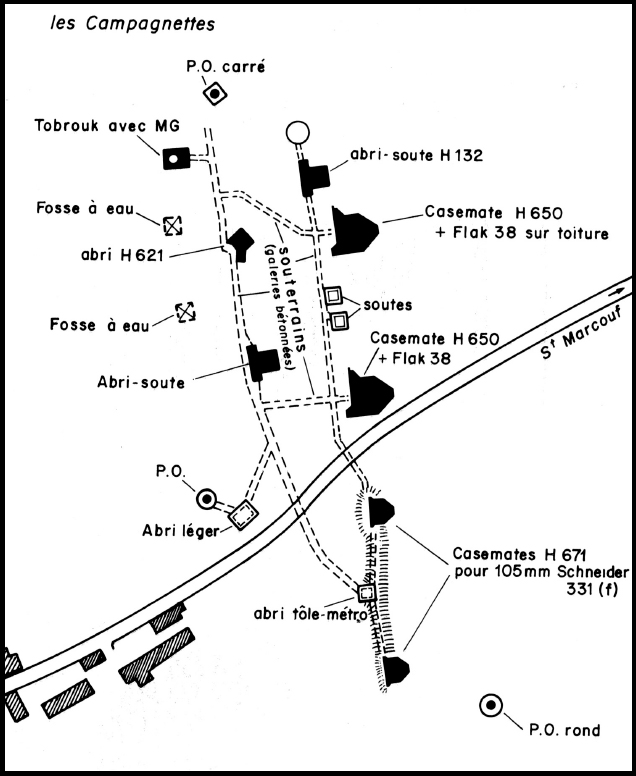
Layout of the battery at Azeville.
The No. 1 gun was still firing on the beach around the clock, but the Americans were now swarming forward in waves up the cliffs on the east side of the battery. The mines on the path had been cleared and the barbed wire cut away. They had now fought their way into the trenches of Crisbecq and were systematically clearing the personnel bunkers with flamethrowers. The Germans fought back with small arms fire, the machine gun Tobrukstände having been evacuated or destroyed. Ohmsen, himself, was hit by a rifle round in the same arm that was already wounded. It’s estimated that more than 150 men on both sides lost their lives in the fierce close-quarter fire fight that ensued but the Americans were again forced to withdraw as night fell.
After nightfall, Ohmsen gathered his surviving men around him. The mood was very sombre – barely a fifth of the original garrison of more than 400 men were left standing. Leutenant Grieg was particularly morose and had retreated into a bottle of brandy intended as a birthday present for Ohmsen. Hardly any of his men from 919 Grenadier-Regiment had survived yet he had emerged virtually unscathed from the carnage. The smell of death was everywhere – the stench of rotting corpses and cordite settling in the ruins of the bunkers.
The ammunition available for No. 1 gun was virtually spent. But as daylight broke, it appeared the Americans classed the taking of Crisbecq among their priorities. Ohmsen would probably have surrendered had they attacked but Allied forces were now pouring ashore without serious opposition up and down the Normandy coast. German forces in the Cherbourg peninsula had been effectively cut off and there was now no need to risk further high casualties in operations against heavily defended sites without strategic importance.
Ohmsen’s left arm was now a mess. The bullet had gone through his palm and exited close to his elbow but only two corpsmen remained, the doctor and medical orderly for St Marcouf having been killed on the road between Crisbecq and Azeville in the 24 hours after D-Day. The shrapnel wound of a few days earlier was also infected but there was little morphine left so Ohmsen poured iodine over the wound and asked his men to bandage the entire arm.
Admiral Hennecke, to whom Ohmsen had reported the initial sighting of the Allied invasion fleet on D-Day, telephoned Crisbecq’s commandant during the afternoon of 11 June. The Supreme Commander of Marine Command at Cherbourg offered his congratulations for a heroic defence but ordered Ohmsen to gather his men together and abandon the battery. Ohmsen didn’t protest, he knew it was the right decision. No. 1 gun was down to its last few shells and he saw no point in sacrificing his men to a lost cause.
At about 2.00 am in the morning 12 June, seventy-nine survivors walked out of the Crisbecq battery and followed Ohmsen through the minefield to the north west, clambering over the abandoned British Sherman Crab and following its tracks into the wood beyond. They were unmolested as the Allies thought the route impassable so hadn’t posed any sentries. They carried their wounded on hastily-constructed stretchers, using shell-boxes, flags and bed sheets. Just before dawn, almost three hours later, they reached the German lines and the headquarters of 26 Artillery Regiment near La Pernelle. It was Ohmsen’s last act in command of the Crisbecq battery and probably his most compassionate.
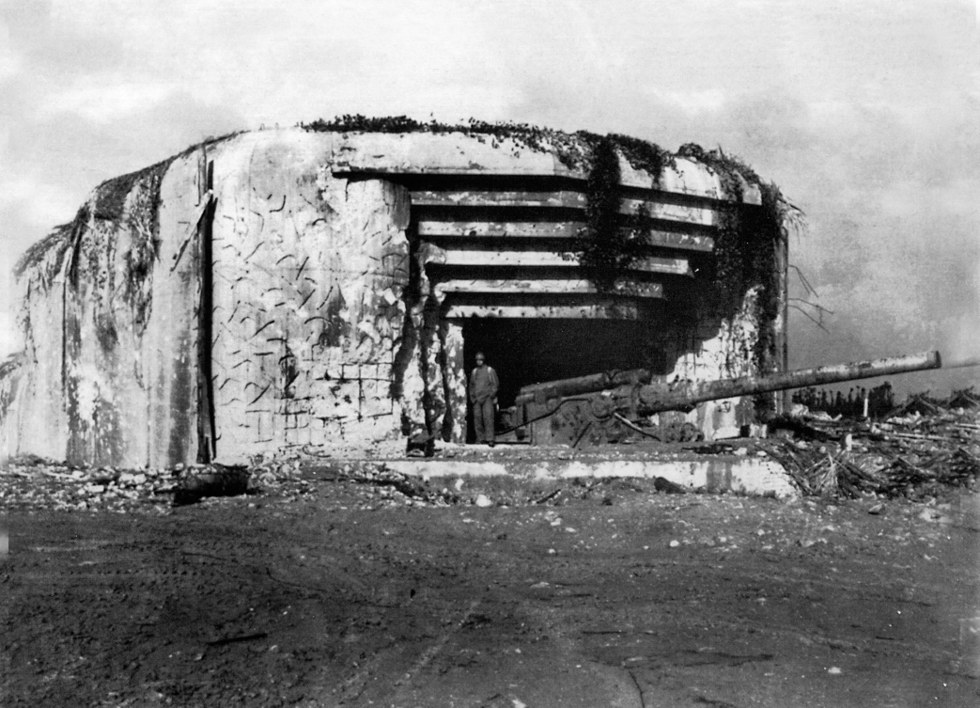
After the capture of the Crisbecq battery.
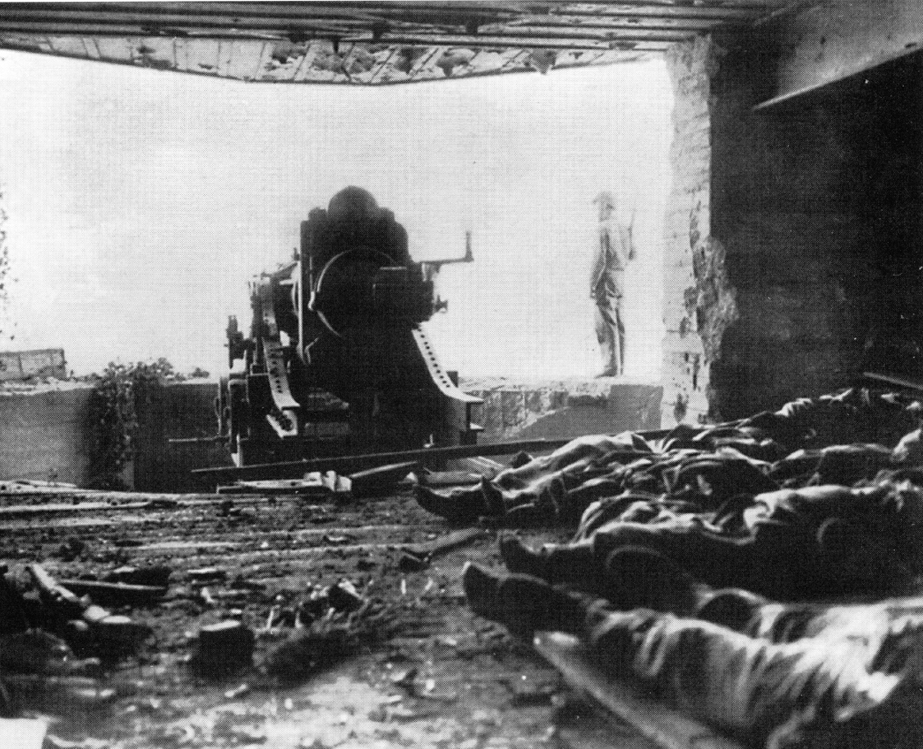
German soldiers killed in battle were brought into the firing chamber of one of the casemates.
The Americans entered the trenches of the Crisbecq battery later that morning in eerie silence. They found twenty of their countrymen locked in the strong room and cable snaking all over the site. The site was immediately evacuated again and it took sappers more than a week before they realised the cables were nothing more than yet another ploy to delay the Allied advance. Ohmsen and his men hadn’t wasted their final hours at Crisbecq. According to several accounts, a note was found attached to the breech of the now-silent No.1 gun. It read as follows:
Dearest Enemies,
You know that these are fine guns. Please care for them.
Heil Hitler and Adieu.
Walter Ohmsen received the Knights Cross for his organisation of the defence of the Crisbecq battery. He insisted on rejoining the front line, despite the injuries to his left arm, but was finally captured by American forces at Quineville, south of Cherbourg, almost three weeks after D-Day.
Ohmsen survived the war in captivity and, following his release, worked as a employee of the Schleswig-Holstein agricultural ministry. He ran for public office in 1954 but was still facing his adversaries head-on, criticising his boss during an election speech and finding himself out of a job. He joined up again in March 1956 as a Kapitänleutnant of the Bundesmarine and was promoted to Korvettenkapitän (Corvette Captain) in November 1957 and Fregattenkapitän (Frigate Captain) in August 1965. He retired in September 1967.
Between 1968 and 1978, Ohmsen became a key figure in international sailing events, helping to organise the Munich Olympics in 1972. He also served as a member of the consultative council of the city of Kiel and helped channel support for war victims for which he was to receive the Freiherrvon-Stein commemorative medal and Federal Cross of Merit 2nd Class. Walter Ohmsen died in Kiel, 19 February, 1988, aged 77.
AZEVILLE – A TRIUMPH FOR PERSISTENCE
If Crisbecq’s capture was one episode in the history of the Second World War that the Americans would rather have brushed under the carpet, the assault on nearby Azeville - Stützpunkt 133 – will hold more positive memories.
In common with most of the installations on the Atlantic Wall, the battery was constructed by the Todt Organisation and the majority of the 300 construction workers were ‘guest’ workers from other nations. In Azeville’s case, mostly from Poland, Russia and Italy. The Italians were paid and also received rations but the Poles had to steal supplies or barter on the black market to live from day-to-day. The Russians’ plight was even worse as they often had to work long hours on meagre rations and many died from exhaustion and malnutrition. In contrast to the hi-tech construction sites in the Pas-de-Calais, Azeville was completed mostly by hand and shovel and any heavy materials had to be moved by horse and cart. Concrete mixers were on site but they couldn’t keep up with the rate of construction so most of the concrete had to be mixed by hand. The first weaponry installed was a 37 mm anti-aircraft gun, installed on top of casemate No. 1 to protect the site in case of air-attack. But it wasn’t fired in anger until 1944.
Azeville had a garrison of 170 men and, completed in 1941, had been one of the first constructions on the Atlantic Wall in Normandy. The battery was one of ten on the Cotentin peninsula staffed by Heeres Küsten Artillerie Regiment 1261 regiment. Unlike most German coastal batteries, Azeville didn’t have a direct view of the sea and had to rely on an observation bunker and ranging post attached to Crisbecq which was nearer the sea and on marginally lower ground than Azeville.
The fire control post, built on the hill overlooking the tiny village of St Marcouf, should have been equipped with a telemeter. But these were in short supply and, because the Cotentin peninsula was regarded as a low-risk zone, none were supplied and the men stationed there had to make their own improvised devices. A telemeter is a device like a wide pair of binoculars that plot both the distance and direction of long-range targets, normally out at sea. But the scarcity of both men and equipment at Azeville was evident from the start. During construction of the battery, there were no trucks available for transporting materials and local farmers had to be press-ganged into fetching and carrying machine parts and supplies from the railway station by horse and cart.
The cannons installed at Azeville were captured French Schnieder 105 mm guns of First World War vintage. The Germans were never averse to adapting captured weapons for their own use – it saved money and also freed up newer weaponry for more vital areas. But the guns were undoubtedly less accurate and more cumbersome to operate because of their age having been built in 1913. The casemates at Azeville were all H650 bunkers, the later ones having rounded corners which had been proved to help deflect incoming shells. As mentioned before, the senior officer at Azeville on D-Day was Hauptmann Hugo Treiber. But he spent most of his time on duty at the ranging post next to the Crisbecq battery, directing fire on UTAH beach, so the actual operation and security of the battery was left to his second-in-command Leutenant Kattnig.
Treiber knew that if he fostered good relations with the local population that the garrison at Azeville was likely to benefit. Most of the troops lived in the adjoining village with more than twenty men billeted on some of the area’s bigger farms. A few of the Germans would share their food allowance with their hosts but pilfering was more common, with eggs particularly prone to ‘disappearance’ from French hen-houses though the population of Azeville, on the whole, was undoubtedly better treated than some of their fellow countrymen.
The Germans also constructed a small theatre at the rear of the battery to relieve the tedium of a posting in an isolated section of Festung Europa. The theatre was, in reality, little more than a wooden hut near the kitchens, adjacent to the road and setback from the gun casemates. It had at least one piano and a bar, however, and even a small stage at one end with red velvet curtains. Dubbed as ‘The Casino’ by those allowed access, the theatre would frequently import dancers and singers from Cherbourg and there were even ‘girls of ill-repute’ shipped in on special occasions to entertain the officers.
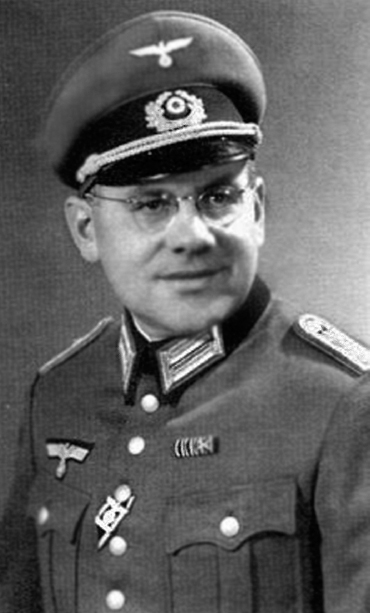
Hauptmann Hugo Treiber.
Azeville was initially staffed by battle-hardened army veterans who had been fighting on the Russian front. In common with other similar locations on the French coast, the men would use the reservoir, fed by an artesian well which took water away from the villagers, as an impromptuswimming pool in fine weather during the summer and even went to the extent of painting a seaside fresco on surrounding walls. But when the situation deteriorated in the east at the end of 1943, these men were largely replaced by younger conscripts attached to the 709 Static Infantry Division.
Just after first light 6 June, 1944, many of these conscripts were to see their first action. Azeville’s 105 mm guns lacked the range of those at Crisbecq so attacking American ships out at sea was beyond them. They could just about reach the strongpoint at La Madeleine, ten kilometres to the south east, and thus hamper the landings on UTAH beach. The guns may have lacked precision at their maximum range but such was the volume of men and machinery coming ashore that even those shells which landed off-target tended to strike the invasion force. There wasn’t a tremendous amount of ammunition at Azeville, however, and Leutenant Kattnig was forced to limit regular firing onto the beach to conserve stocks. But the firing continued throughout the whole of D-Day and, by the evening of 7 June, the 4th American Infantry Division was still pinned down on the coast road and adjoining fields.
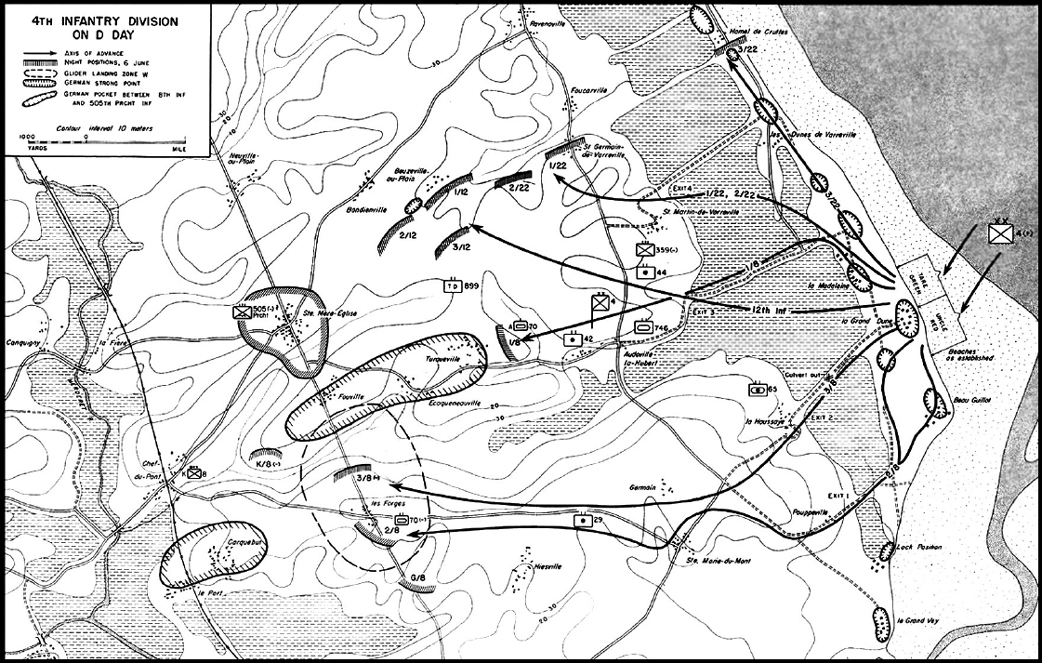
How the battle began to develop following the landings at UTAH Beach.
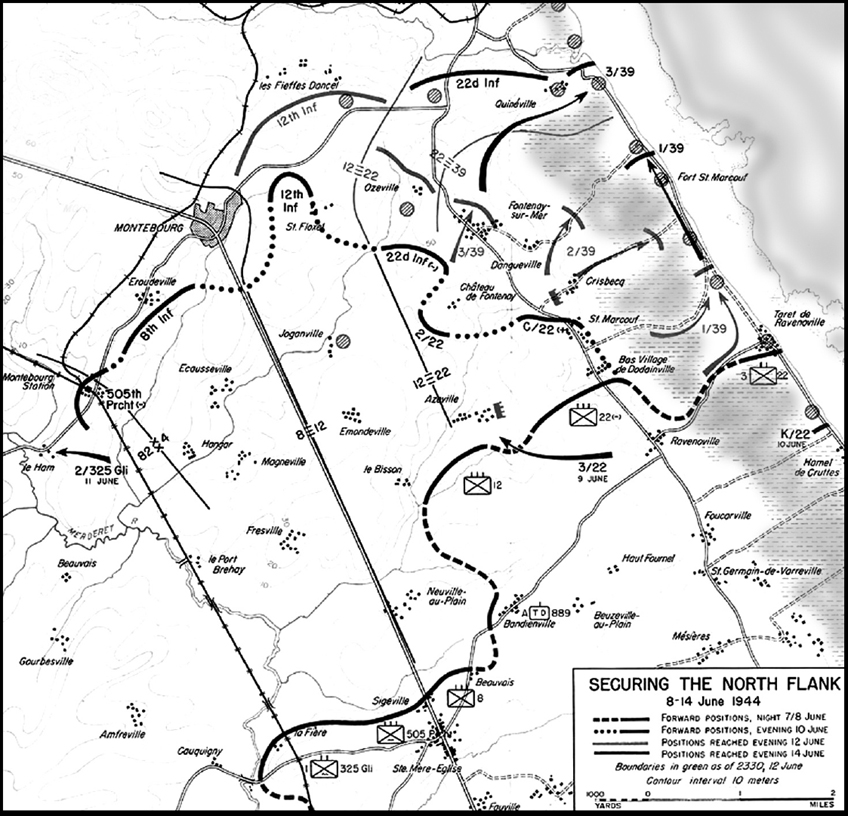
Fighting around the two gun batteries.
On the morning of the 7th, the Americans finally managed to launch their first frontal attack on Azeville, Members of the 4th Infantry Division, supported by Sherman 75 mm tanks, approached casemates 3 and 4 from the south east, getting to within eighty metres of the casemates before they were confronted. One of the Shermans managed to inflict minor damage on the cannon in No 2 bunker but the Shermans were comprehensively outgunned and, after two were knocked out in quick succession, US forces quickly retreated leaving several dead and wounded. Some of the inexperienced garrison, caught out in the open, had also paid the ultimate price.
With Crisbecq’s capture deemed more of a priority by American commanders, Azeville was spared a further assault that day and sporadic shelling by the USS Nevada tended to overshoot the battery and land in the adjoining village. Fortunately, Treiber had warned the villagers that they would be in danger if they stayed in their homes and all had fled into the woods or to outlying farms to take shelter.
The 8 June saw the renewing of hostilities around Azeville, however, with the Americans attacking from several directions to negate the impact of the battery’s big guns. The Germans still had their anti-aircraft guns fully operational however and, mounted on the top of casemates 1 and 4, these fired on the tanks approaching from the west. The FlaK gun on casemate No 4 had been damaged in an earlier attack but was working again by the time and the machine guns in strategic-placed Tobrukstände were also able to offer full support. Also suffering losses through anti-tank mines, once more, the Americans were forced to retreat. It was during this attack that Walter Ohmsen at Crisbecq ordered one of the Azeville 105 mm guns to fire on his own battery.
The Americans were beginning to accept the storming of Azeville was going to prove more difficult than intelligence had led them to believe. So, during the night of the 8th and 9th of June, they called up the USS Nevada again to start shelling the position. Now better placed to relay coordinates to the ship, which had effectively been firing blind with the battery not visible from the coast, infantry observers could now direct the battleship’s fire more accurately, though gunners can hardly have planned for the stroke of good fortune they had in hitting casemate 1. In quick succession, a first shell struck the right flank of the casemate, directly beneath a machine gun Tobrukstände. The crew were killed and the position disabled, a large section crumbling away from the main part of the casemate. A second shell entered the gun aperture. It didn’t explode but the impact concussion killed the gun crew of five immediately before it entered the plotting room. The two men in there also died instantaneously and the shell continued until hitting the rear exterior wall of the casemate, leaving a huge hole. It wasn’t uncovered until some fifty years later when munitions experts destroyed it in a controlled explosion.
The incident rocked the garrison at Azeville and Kattnig in particular and the fight had gone out of the Germans when the Americans attacked again during the morning 9 June. The Azeville mission had now been assigned to the 3rd Battalion of the 22nd Infantry, which had again moved inland from Ravenoville. Forming up around one kilometre south east of Azeville, it crossed to the south west of the village at about 11 am with one company moved west in a wide arc in order to enter the village from the opposite side and capture any reserves the enemy might have to the rear of the fort. Five assault sections moved north and advanced through fields to approach the fort from its right rear under the cover of a bombardment from the 44th Field Artillery Battalion. By noon, the Americans had crossed the outer minefield and cut the barbed wire to begin crawling their way through the fields and orchards. Less than an hour later, they were in a position to attack the casemates. The Germans had failed to cover an approach from the south west and the outlying smaller bunkers had been deserted.
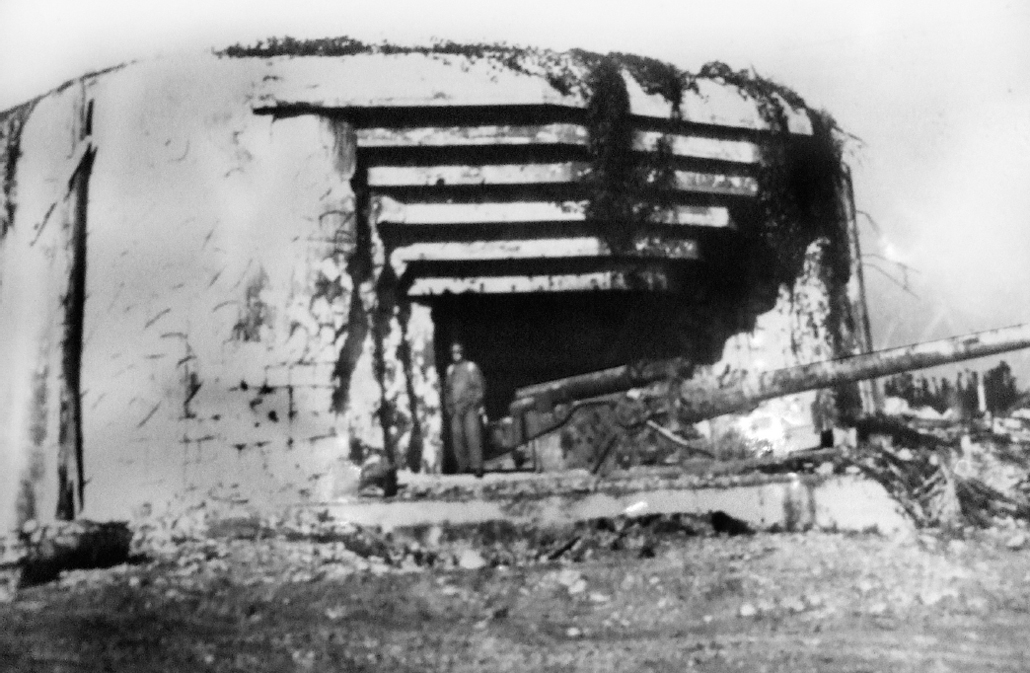
Casemate Turm 1 smashed by fire from the guns of the USS Arizona.
The first assault took place with bazookas and a lone Sherman which had braved the anti-tank mines but the attack accomplished little other than chip the reinforced concrete. There was still little sign of resistance, however, so a team of sappers was then sent in to blow a hole in the rear entrance with explosives. A flame thrower was then tried, followed by a pack charge. But this still had no effect on the massive structure, nor did a second or third attempt with a still heavier satchel charge. Becoming increasingly desperate as the Germans finally woke up to the fact that the Americans were now right under their noses, Private Ralph G. Riley finally decided enough was enough and said he was going to run to the bunker ‘give it a few more squirts’. With the last flame thrower on his back, he ran seventy-five yards under enemy fire and dropped into a shell hole for cover. The flame thrower had, at this point, decided it wasn’t going to work, however. Undeterred, Riley opened the valve, held a lighted match to the nozzle, and trained the stream of fire on the base of the steel door. Suddenly, he heard a popping sound, followed by muffled explosions within the blockhouse. The enemy’s ammunition had been ignited by the dying jets of the flame thrower. Almost immediately, Kattnig emerged with a white flag raised and the rear door of the bunker swung open to reveal an American parachute officer, captured on D-Day, followed by two more German officers. They formally surrendered on behalf of all 169 men remaining. The way was now clear for the advance towards Cherbourg.
FORT ROULE – THE LAST BASTION OF CHERBOURG
Some of the toughest fighting during the first week of the invasion took place on the north flank of the US VII Corps where the 4th Division, together with the 505th Parachute Infantry, struggled to achieve their D-Day objective and clear a line from the small port of Quinéville to the Merderet River. Defenders in this area had the advantage of higher ground which rises gradually to the outskirts of Quinéville, and the Germans didn’t hesitate to making maximum use of the countless hedgerows along major routes to ambush American columns.
The tortuous grind to flush out the enemy is outside the remit of this volume but that in no way is meant to cheapen the commitment or the sacrifice undertaken by the men of the US VII Corps in the course of their duty. But with the effectively marooned German defenders on the Cotentin peninsula now being severely hampered by a shortage of ammunition and their plight being compounded by the fact that they were being subjected to almost constant Allied naval bombardment and air attacks, by the evening of 21 June, the vanguard of the American forces were within sight of the vital port of Cherbourg and ready for the final assault.
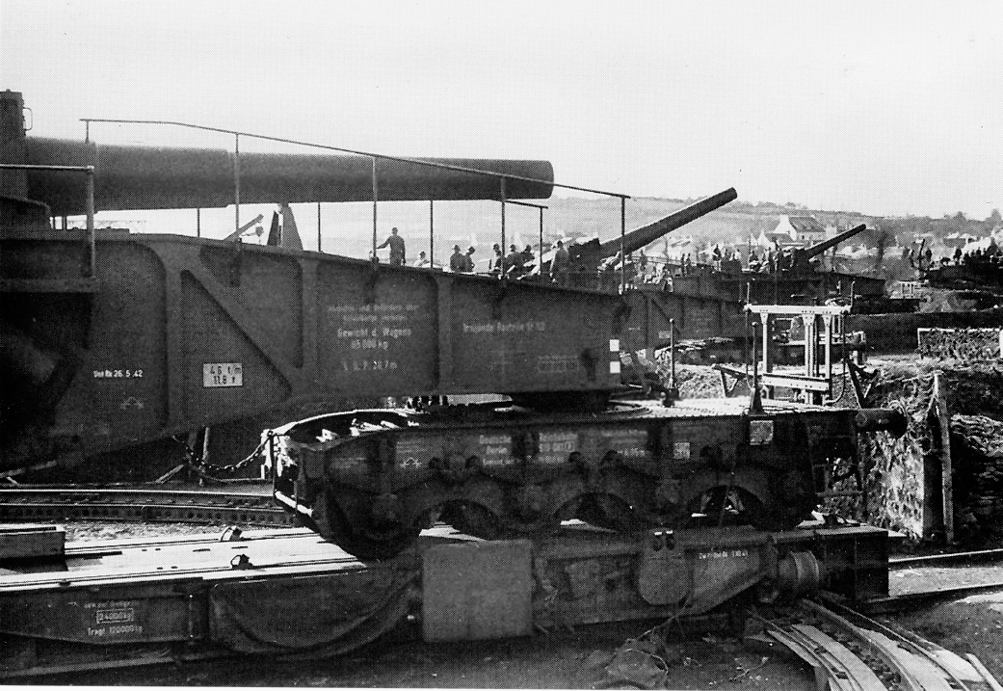
Railway battery ‘Kurze Bruno’ E701, three 280 mm guns in Cherbourg in 1942.
The swift capture of Cherbourg became a priority after a violent storm blew up suddenly over the English Channel on 19 June. With the beachhead finally established on OMAHA beach, supplies had begun to flood ashore via an artificial MULBERRY Harbour offshore. But the storm lashed the Normandy coast, breeching a line of decommissioned ships that had been sunk to provide an outer breakwater to shelter the giant metal structures. Two of these ships had in fact been sunk by German coastal batteries but as they settled in virtually their assigned position, the American Navy simply worked around them and the breakwater was completed on 13 June. However, huge waves battered the piers, roadways and pontoons and put the artificial harbour out of action and the Allies realised that they needed to secure a major port (some supplies were being brought ashore at the fishing ports of Grancamp-les-Bains, Isigny-sur-mer and Port-en-Bessin) as quickly as possible if the invasion wasn’t to stall, though the MULBERRY Harbour at Arromanches in the British sector had avoided serious damage and was still operational. There was one bonus, however, as enemy air activity was proving much less troublesome than expected. The storm inconvenienced German aircraft fortunate enough to get as far as the beaches and shipping lanes, as much as the British and Americans.
The storm was also battering Cherbourg but General Collins, overall commander of VII Corps, decided that he could wait no longer and, on 21 June, issued orders for the attack on Cherbourg.
Collins began the assault by calling in a massive bombing raid on the port, probably more to demoralize the Germans than for any strategic reason. The raid used the entire 9th Bomber Command as well as large numbers of US and British fighter-bombers – it was launched on the morning of 22 June.
Four squadrons of Typhoons from the RAF’s 2nd Tactical Air Force attacked anti-aircraft positions around the massive inner harbour and in the north of the city, followed in by six squadrons of British-flown Mustangs. Waves of fighter-bombers from the US Ninth Air Force then bombed and strafed enemy strong points at five-minute intervals. Translators were then brought in to broadcast to German positions in German, Russian, Polish and French, pointing out the impossible position the defenders were in and demanding the immediate surrender of Cherbourg. Generalleutenant Karl-Wilhelm von Schlieben, the fortress commandant, was given until 9.00 am the following morning to comply. But the ultimatum expired without response so preparations for the assault went ahead.
The attack on key installations in Cherbourg was to be made primarily by the 9th and 79th Divisions, while the 4th Division was tasked with sealing off the city from the east. The 79th Division’s main objective was to capture the high ground to the south including the strategically important Fort Roule, which overlooked the city and had command of a gun battery in the hillside beneath.
All three divisions made slow advances during the day. The 9th Division attacked with the 60th Infantry on the left, and the 47th Infantry and the 39th Infantry on the right. The 79th Division formed the central prong of the attack but met strong resistance along the main road from Valognes to Cherbourg and, as darkness fell, actually bypassed a German communications bunker which was in direct contact with Generalleutentant von Schlieben in Cherbourg. The bunker wasn’t discovered until the following afternoon and continued to pass on information on US troop movements until the occupants were forced to surrender.
By the night of 22 June, VII Corps were beginning to flush out the Cherbourg defences. The Americans were encountering German infantry units comprising engineers, MPs and remnants of naval artillery personnel that had fled north when their strongpoints had been over-run further down the Cotentin peninsula.
Schlieben was ready to throw in the towel but Hitler himself demanded that,
Even if worst comes to worst, it is your duty to defend the last bunker and leave to the enemy not a harbour but a field of ruins. The German people and the whole world are watching your fight; on it depends the conduct and result of operations to smash the beachheads, and the honour of the German Army and of your own name.
Schlieben pleaded with Rommel to provide reinforcements, knowing that Cherbourg’s garrison had neither the equipment, the numbers nor the will to continue their resistance. But Rommel had no way of getting extra men into Cherbourg even if he’d wanted to. The Allies commanded the skies and charges had already been laid in and around the harbour in preparation for its destruction.
On the morning of the 24th, with the Americans now clearing the suburbs, one house at a time, Schlieben accepted that his position was impossible. He’d committed the last of his reserves, poorly armed conscripts in the main, and gave orders for his men to fight to the last bullet. ‘We are lost. The only question is whether it is possible to postpone it for a few days.’ he told his senior officers.
Supported by P-47 fighter-bombers of the Ninth US Air Force, the Americans advanced steadily toward Fort du Roule, finding opposition disintegrated when forced into close-quarter confrontation. Several attempts to break through to the actual fort were halted by shelling from the hill battery itself, however.
Elsewhere, the entire Cherbourg defence plan was falling apart though some pockets of stiff resistance remained. Using anti-aircraft guns and mortars, the Germans were still inflicting heavy casualties. Lieutenant Colonel Conrad Simmons and Lieutenant Colonel John W. Merrill were among those who lost the lives. The 12th Infantry were to take 800 German prisoners in their push, however.
The day of the 25 June commenced with a US naval bombardment of Cherbourg. Three battleships, four cruisers, and several destroyers put down a creeping barrage to shield the men of VII Corps as they advanced toward the heart of the city. Resistance at a coastal battery north of Tourlaville collapsed and the garrison of 400 men threw their arms down and surrendered, leaving the battery’s three 20 mm guns intact. Another 350 Germans surrendered at a coastal battery east of the Fort des Flamands when the tanks were brought in.
In the early afternoon, Schlieben reported to Rommel,
In addition to superiority in materiel and artillery, air force and tanks, heavy fire from the sea has started, directed by spotter planes. I must state in the line of duty that further sacrifices cannot alter anything.
To this Rommel responded, ‘You will continue to fight until the last bullet in accordance with the order from the Führer.’
The garrison of Fort du Roule took Rommel at his word. The coastal artillery divisions and remnants of the German 709 Static Infantry tasked with defending Cherbourg included a number of Ostlegionen, units of conscripts or volunteers predominantly from the occupied countries of eastern Europe. But those ensconced in the caverns and galleries of Mont Roule, beneath the walls of Fort du Roule, were largely German and most had some form of combat experience even though many were still teenagers or in their early twenties.
The fort had always been the principal objective of the US 79th Division in Cherbourg as, built into the face of a rocky cliff above the city, it housed coastal guns commanding the entire harbour complex, main coastal road and rail terminal. The guns were in lower levels under the edge of the cliff while the upper ramparts were dotted with concrete machine-gun tobruks and adapted mortar emplacements, and protected by an anti-tank ditch. Below this upper level were a series of galleries, caves and underground passages linking the four outer-facing R671 casemates which housed Skoda 105 mm guns. Cherbourg was a base for S-boats. The lower tunnels were largely empty at this time but had been used to store torpedos for the S-boats between 1940 and 1943 and is shown as Stp255 on contemporary maps
Fort du Roule was attacked on the morning of 25 June by the 314th Infantry, after a bombardment by a squadron of P-47s. The bombs missed their targets, however, so the defences were still intact even after a short bombardment by the guns of the 311th Field Artillery Battalion.
Opposing forces traded machine-gun and small arms fire as the infantry approached from the rear but the Americans found themselves largely pinned down until Corporal John D Kelly took matters into his own hands. Under fire, he crawled up the muddy slope and fixed a pole charge to the rear door of a machine-gun bunker. With the door blown of its hinges, Kelly than began to hurl hand grenades inside until the survivors stumbled out into the open and surrendered. Lieutenant Carlos C Ogden, who had just taken over the 3rd battalion from its wounded commander, was also distinguishing himself. Armed only with a rifle and hand grenades, he advanced alone under fire toward the enemy emplacements.
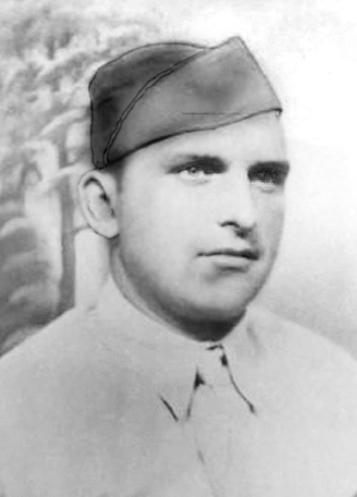
Corporal John D Kelly.
Despite being wounded, Ogden got close enough to an antiaircraft emplacement to fire a rifle grenade, putting the 88 mm gun out of action. He then knocked out accompanying machine guns with his hand grenades, despite receiving a second wound, enabling his men to swarm inside the upper fort. The Germans, realising that further resistance was now futile, began to surrender their weapons.
Inside Mont Roule, the fighting continued. The earlier shelling had forced most of the defenders deeper inside the mountain but they now awaited an attack, crouched in dark recesses and sheltering behind overturned bunks and ammunition crates. Some Americans entered via an emergency exit door on the lower levels but Staff Sergeant Paul Hurst and other engineers were lowered into the open gun emplacements from above after charges had been dropped into the caverns. Others scrambled around the cliff face as anti-tank fire from below peppered the slope. The fighting inside the mountain was ferocious. Fearful of small arms fire sparking explosions among the large cache of German arms and munitions, both sides resorted to hand-to-hand fighting with knives and bayonets and the casualty rate quickly mounted. It was inevitable, however, that American numbers would eventually prevail, though there was thought to be less than thirty Germans still standing when they finally surrendered.
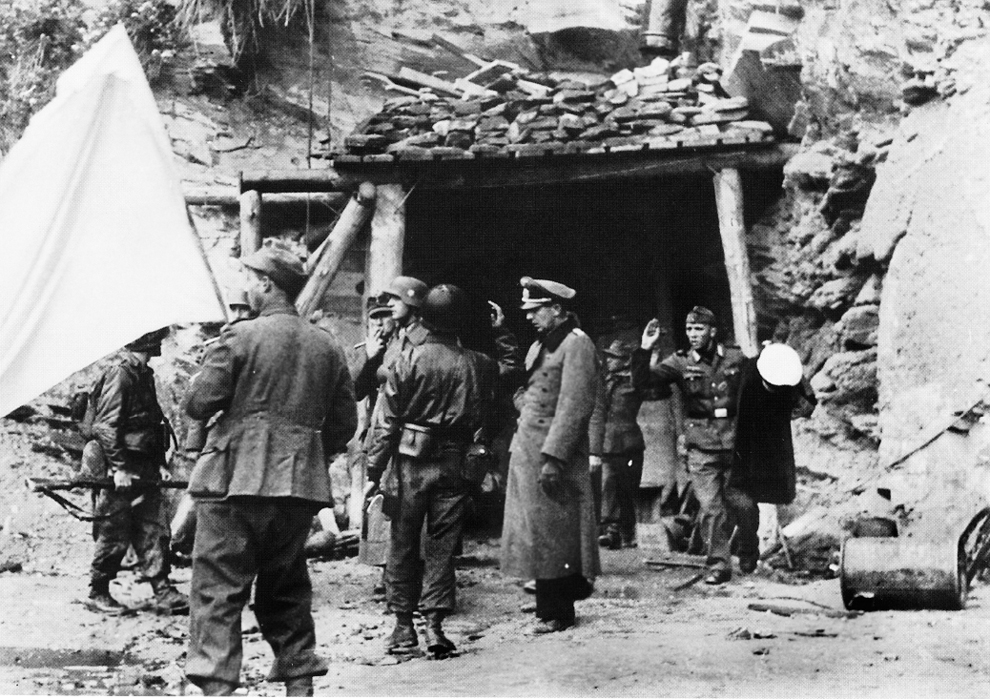
The moment of surrender. Generalleutenant Karl-Wilhelm von Schlieben faces the victorious Americans.
With virtually all resistance in Cherbourg now at an end, Generalleutenant Schlieben was finally found in an underground shelter at St. Sauveur on the southern outskirts of the city on the 26 June. He had destroyed all of the documents and codes from his headquarters and was discovered alongside Admiral Hennecke, the Naval Commander of Normandy. Schlieben surrendered to General Eddy on behalf of the 800 men, many of them staff officers, in his bunker. His second in command, General Sattler, followed suit the following day with a further 400 men. Cherbourg had finally fallen, though a last stand was made at Cap de la Hague.
An advance party of the 1056th Engineer Port Construction and Repair Group had arrived in Cherbourg by the 27 June and begun efforts to reopen the harbour to traffic. The first cargo was landed by DUKW on a nearby beach 16 July and, further east, the British and Canadians were also making significant inroads into Fortress Europe.
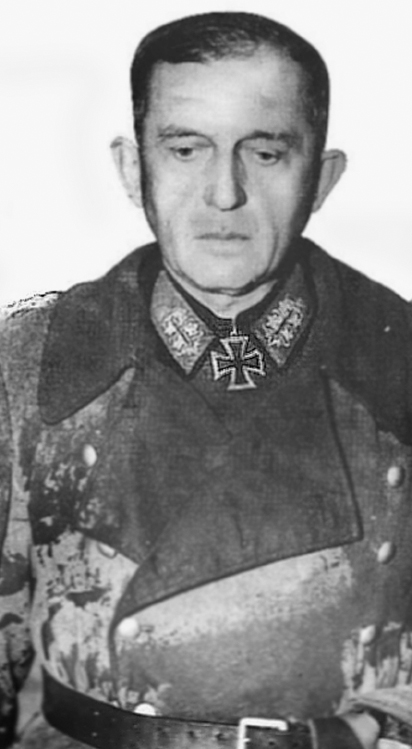
Cherbourg. General Karl-Wilhelm von Schlieben, the fortress Kommandant, having just surrendered.