
Chapter Six
GERMAN Kriegsmarine and Heer gun batteries were spread fairly evenly behind the D-Day landing beaches in Normandy but the fortified strongpoints were more concentrated on the eastern flank, where the coastline was more accessible.
UTAH Beach, for example, was only defended by strongpoint designated WN105 and WN103 at La Madeleine and WN104 at La Grande Dune. On GOLD Beach, there were almost a dozen fixed fortified positions including H612, H679, H669, H677 and H667 bunkers and open Vf600 gun emplacements at WN38 St Come-de-Fresne and WN36 Cabane des Douanes.
There were H612, H604 and H677 bunkers on JUNO Beach, as well as a Vf600 emplacement at WN27 St Aubin-sur-Mer. But the Germans relied heavily on minefields and beach obstructions/anti-tank deterrents on this relatively flat stretch of the Normandy coast and also reinforced a number of the bigger houses that sat on or just behind the promenade, particularly at Courseulles-sur-Mer.
SWORD Beach had most protection, however, as this included the port of Ouistreham that not only guarded the entrance to the Orne River and, hence, access to the major objective of Caen. But also the battalion headquarters of the 736 Grenadier Regiment. There were four 155 mm guns and an H669 bunker at WN12 Ouistreham, as well as field artillery and armoured FlaK emplacements that could be used against aircraft and tanks. There were also four 100 mm guns at WN16 Colleville-Plage, while six 155 mm guns were installed in gun pits at Riva Bella, behind Ouistreham’s harbour. A multi-story observation post dominated the skyline in Riva Bella and now houses the Atlantic Wall Museum. Two 50 mm guns occupied Vf600 emplacements at WN21 Lion-sur-Mer and H677 bunkers housed 88 mm guns at WN20 La Breche and WN19 at Hermanville-La-Breche, where a concrete casemate and a Vf600 pit also housed a further three 50 mm guns.
From their HQ at Colleville (code-named Hillman by the Allies) and a billet at St Aubin, men from the 736 Grenadier Regiment patrolled this key area. The 716 Infantry Division, under Generalleutenant Willem Richter, had its headquarters in Caen and also supplied the 1716 Artillery Regiment, who staffed Merville. In reserve, the 642 Ost-Battalion, made-up of Russian conscripts from the eastern territories, was a little inland but within sight of the Orne estuary.
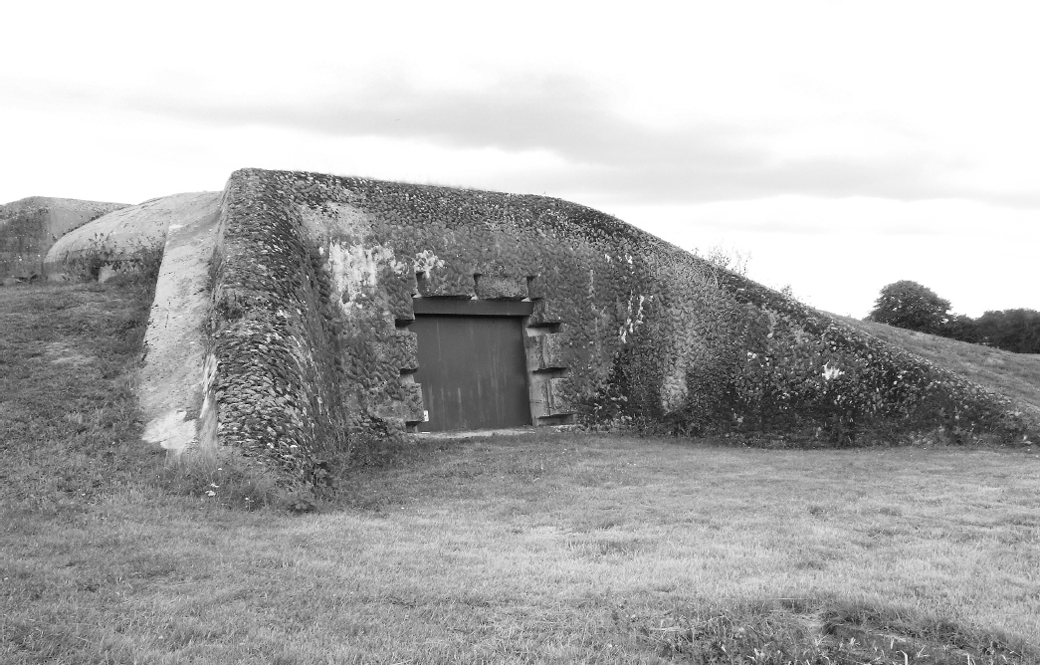
Turm 2 Merville Battery.
So it was vital that the Allies, or more specifically the British 3rd Infantry Division, achieved their objectives on D-Day and breached the Atlantic wall defences so a pincer movement on Caen could be initiated in conjunction with the Canadians who, hopefully, would be pressing inland from JUNO Beach. But, of course, there were complications. Not least the batteries at Longues-sur-Mer and, more significantly, Merville.
The Todt Organisation had sub-contracted the building of Merville to Rittmans, a local construction company based in nearby Houlgate. But, as elsewhere on the Atlantic Wall, slave and forced labour (drawn largely from the French Service Travail Obligatoire) was used to ensure building was completed near enough on schedule. The first casemate on the site was an H611, with three H669s following. In addition, a command bunker and personnel bunker were constructed with individual machine-gun Tobrukstände, bomb shelters and a kitchen. The latter was also the base for an anti-aircraft gun platform. By May 1944, all the defences had been completed apart from the antitank ditch which was supposed to run around the entire perimeter of the battery but only covered a one-hundred metre stretch directly in front of the casemates.
Lieutenant-Colonel Terence Otway and the 9th Battalion, 3rd Parachute Brigade, was given the task of destroying the coastal battery at Merville before the seaborne invasion began at dawn 6 June, and afterwards of occupying a key feature of the heavily invested defence perimeter on the Allies’ eastern flank.
Terence Brandram Hastings Otway was born in Cairo 15 June, 1914 and educated at Dover College. After attending Sandhurst, he was commissioned into the Royal Ulster Rifles in 1934 and served with the 2nd Battalion before being deployed in Hong Kong the following year.
Two years later, he was sent to India before being posted to the North-West Frontier. Not a week passed, he recalled afterwards, without a skirmish with the local tribesmen, often hand-to-hand with swords and knives.
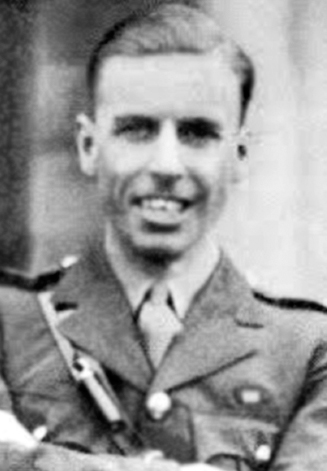
Lieutenant Colonel Otway.
Otway returned to England and attended Staff College, where he passed out fourth among a class of 200. After a staff job at the War Office, he returned to the Royal Ulster Rifles in 1943 as a company commander. He transferred to the Parachute Regiment shortly afterwards and, in March 1944, was promoted lieutenant-colonel on taking command of 9th Parachute Battalion.
Merville Battery, situated on the eastern bank of the River Orne, was believed to be equipped with four 150 mm calibre guns capable of laying down fire on SWORD Beach, the planned landing area for the British 3rd Infantry Division. Intelligence had revealed Merville, whose guns were guided by a forward observation bunker on the edge of the Orne estuary and could also be linked to the area’s main observation bunker in Riva Bella, was guarded by a garrison of between 130 and 160 men. It was surrounded by a two-metre high barbed wire fence and minefields which fanned out in all directions for 100 metres. Aerial reconnaissance had picked out various open gun emplacements, including 20mm anti-aircraft guns and several machine gun tobruks, as well as the four large casemates and there were also isolated minefields laid across all likely approaches. In addition, an anti-tank ditch had been dug on the north-west side of the battery where it faced the small seaside commune of Franceville.
The airborne assault, supported by three gliders with orders to crash-land directly on the battery, was to go in at 4.30 am, thus allowing the battalion an hour to destroy the guns before the assault-craft landed on SWORD Beach as close as three miles from the battery.
Otway was a meticulous planner and had mock-ups made of battery’s casemates, taking his men through planned assault routines time after time. He divided his force into eleven groups, each with its own specific task. Among them was a reconnaissance party, minefield pathfinders, a breaching unit and the actual assault group.
All of the aircraft assigned to the assault took off on time but, just four minutes before reaching the drop zone, the assault group’s Dakota troop carriers ran into intensive anti-aircraft fire and were forced to take evasive action. Given the demands of D-Day, there was a shortage of experienced fliers and Otway’s force was relying on inexperienced pilots to drop them in the right spot. Unfortunately, several of the transporters’ air crews became disorientated in low cloud and as a result, instead of being dropped in a concentrated area, the battalion was spread over fifty square miles. There were even reports that some of the paratroopers had to threaten the air crew, who wanted to abandon the mission and turn for home, to force them back over the drop zone.
With FlaK bursting all around, a shell exploded close to Otway’s aircraft and a tracer bullet went through his parachute as he was about to jump. He landed safely, however, alongside his batman Corporal Wilson, though both touched down close to a farmhouse which turned out to be a local German headquarters. Unfortunately, Wilson fell through the roof of a greenhouse which immediately attracted fire from a German sentry. But Otway’s corporal was nothing if not resourceful and picked up a loose brick and threw it through one of the farmhouse windows. The Germans mistook it for a grenade and dived for cover, allowing Otway, Wilson and a companion vital seconds to escape into the darkness.
Taking time to re-gather his thoughts, Otway realised that something had gone badly wrong with the parachute drop. Smoke from an earlier bombing raid by RAF Halifax and Lancaster bombers still hung in the air and, as a result, few of the pilots had seen the beacons that had been lit by an advance party and there were parachutists who had missed the drop zone by up to thirty miles.
Many had landed chest high in fields that had been flooded by the damming the River Dives on the direct orders of Rommel to deter airborne assaults and, weighed down by their 60lb kitbags, were drowned. Otway and Wilson themselves tried to rescue one unfortunate they came across but were powerless to prevent the man being sucked into the clawing mud. On reaching the rendezvous, the operation’s commander discovered that he had no transport, sappers, mortars, anti-tank guns, radio sets that worked and only a few medical orderlies. More importantly, less than a quarter of his original 650 men were in attendance. Five of the gliders accompanying the assault had disappeared over the English Channel, taking men and most of Otway’s specialised equipment with them.
Otway was left in a quandary; he knew his mission was vital to safeguard the British landings on SWORD Beach but realised that his resources were barely adequate for the task in hand. His decision to proceed with the attack was made easier, however, when he discovered that the advanced reconnaissance party had penetrated the outer minefields at Merville. The minefield clearance team then also arrived at the rendezvous, albeit without tapes or mine-detectors. But Sergeant Major Miller, in charge of the advance party, convinced Otway that they could still mark a route through the minefields by scratching marks in the dust with their boot heels.
The original plan had had to be torn up and thrown away, with the men from B Company now divided into two smaller breaching teams. The assault was to be made by the remnants of A and C companies, comprising about fifty men under the command of Major Alan Parry. It was 2.50 am and the battalion were less than two miles from their objective.
By 4.00 am, with dawn beginning to emerge from a cloudladen horizon, the attack formations began to form up. The assault group’s only surviving Vickers machine gun, manned by Sergeant McKeever, was positioned to cover the left flank of the battery, giving Major Parry and his team a fighting chance of reaching the main gate unmolested but, just as the order to advance was about to be given, two Horsa gliders swooped low over the battery from the north, a third having been cast-off over England when its tow rope snapped.
The gliders were supposed to have been guided to the battery by the troops on the ground using Eureka beacons. However, none had been recovered from the parachute drop and the spares had disappeared over the Channel so the remaining glider pilots were flying almost blind, their view obscured further by low clouds and smoke from the earlier RAF bombing raid. One of the gliders mistook a village two miles away for their objective, fooled by a fire in a barn. Gonneville had also mistaken for Merville by the RAF and bombed. The second glider, however, found the battery and was making its final approach when it was spotted and fired upon by the Germans’ 20 mm anti-aircraft gun, wounding four of the men inside and forcing pilot Lieutenant Hugh Pond to take evasive action so he landed almost half-a-mile away from his target, in an orchard on the perimeter of the battery.
Several of the troops were injured in the crash and they immediately ran into a small number of Germans who were on their way to the battery to report for duty. But Sergeant Major Miller and his men rushed to their aid as Otway decided he could wait no longer and gave the order to attack. Major Parry blew his whistle and Bangalore torpedoes were detonated to clear away the remaining barbed wire between the four assault groups and the battery. In the gloom, the marked paths were not clearly visible and some men strayed from the path and stepped on mines while the German machine guns began to cut loose. But these were being engaged by the battalion’s Bren guns and snipers, who also ensured the remainder of the battery’s garrison kept their heads down. The paratroopers charged on towards the first of the casemates with Otway to the fore screaming, ‘Get in! Get in! Get in!’.
Initially taken by surprise, the German garrison had quickly organised themselves. Alarms were sounding across the site and flares lit up the sky. Leutnant Raimund Steiner, the battery’s commander, was at a forward observation bunker overlooking the coast but immediately in communication with his men at Merville by telephone as the assault commenced. Steiner had been placed in charge at Merville following the death of Hauptmann Karl-Heinrich Wolter in April 1944 while visiting his mistress during an air raid. Sergeant-Major Johannes Buskotte was the senior NCO at the battery at the time of the attack and Steiner felt he had to do something to help, directing fire from a battery at nearby Cabourg onto British troops still picking their way through the outer minefield.
But the men of the Parachute Regiment were now in the ascendancy, Otway ordered the last of his men in reserve to join forces with Lieutenant Pond and those from the shot-down glider and they silenced the last of the German machine guns, allowing A and C companies to enter the casemates and force the gun crews to surrender by tossing grenades through the firing aperture, clearing the rooms of the massive concrete structures one by one. The guns were intended to be destroyed with specialist explosives, but they had gone missing in the flooded fields so the paratroops had to improvise, using high-explosive anti-tank Gammon Bombs which disabled the gun’s gearing and aiming mechanisms but were insufficient to destroy the barrel. Major Parry, despite wounds in both a leg and arm, personally supervised the placing of the charges in each casemate while Otway ran from one building to the next assessing the condition of his remaining men and the state of the guns.
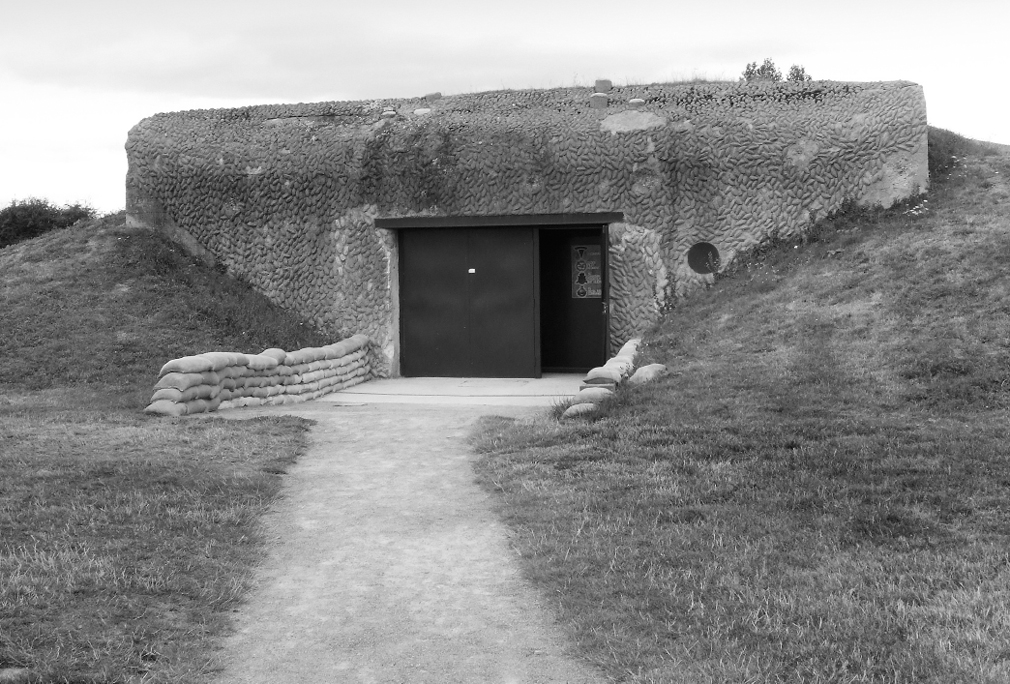
Turm 3, Merville Battery.
By 5.00 am, the fighting began to die down as the garrison’s survivors surrendered. Inside and around the battery, dead and wounded on both sides lay all around. Of the German garrison, only six remained unscathed. The 9th Battalion had sixty-five men either dead or wounded within the battery’s perimeter. Uppermost in Otway’s mind, however, was that he had to get a message to the Royal Navy cruiser HMS Arethusa, which had been ordered to turn her six 6-inch guns on Merville had the 9th Battalion’s assault been unsuccessful. Otway, of course, had no radio so was forced to rely on flares and a carrier pigeon to stop a potential barrage. As a precaution, he ordered an immediate evacuation of the area in case the message had not got through – it had.
As a final irony, it was discovered that the guns which were regarded as such a threat to the landings were found to be largely nigh-ineffective 100 mm 1916 Skoda FH 14/19s. The assault upon the Merville Battery by a depleted and wholly ill-equipped force is still regarded as one of the most outstanding achievements in the history of the Parachute Regiment, however, and was to earn Lieutenant-Colonel Terence Otway, DSO, the Legion d’Honneur in 2001.
That wasn’t the end of the story of Merville Battery. Otway and his men had further objectives on D-Day and, after securing their prisoners, advanced towards the Orne estuary. But by 8 June the Germans, some of whom had hidden in the many tunnels beneath the battery, had re-occupied the site and, according to some reports, repaired two of the guns sufficiently so they could fire on the invasion forces as they moved off Sword Beach, albeit blindly with their forward observation post disabled and communication outlines cut. At this point, one has to stress that the guns were reportedly repaired. Many, especially survivors of the 9th Battalion and 3 Commando Royal Marines who were ordered to re-take the battery on the 8th June, insist that the guns were in no state to fire after the initial capture of Merville – most remain bitter that a second attack was to cost the lives of so many men. Major John Pooley, in charge of the RM detachment and a man much admired by those who knew him, was one such casualty. Shot by a sniper lying atop number one casemate as he led the attack – his death was not to go unavenged.
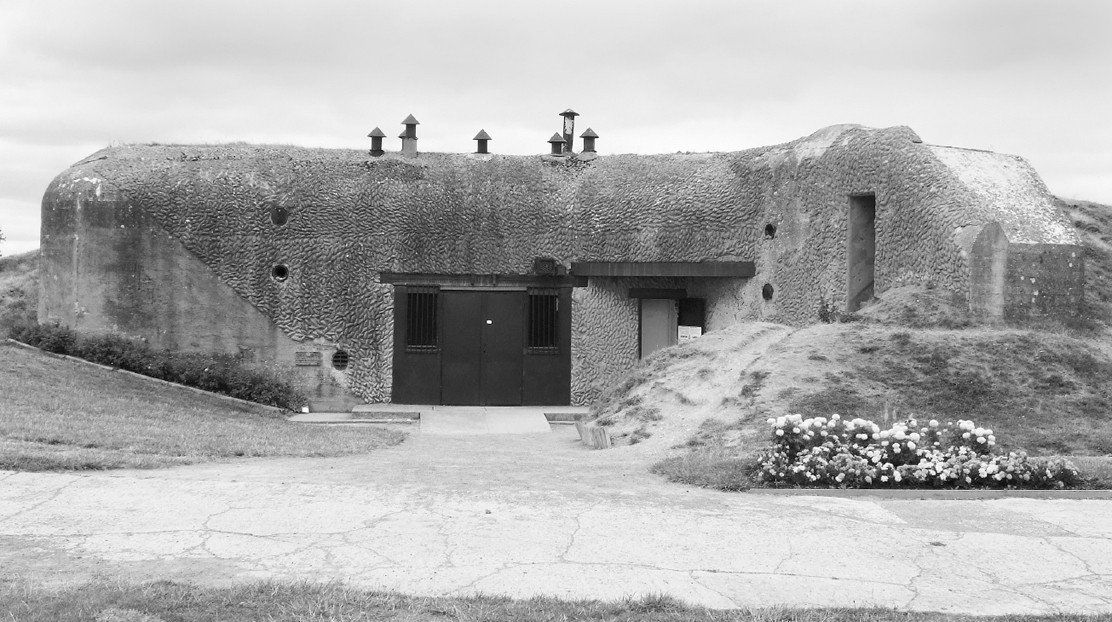
Turm 1, Merville Battery. Now housing the museum.
A more detailed account of the episode can be read in Neil Barber’s The Day The Devils Dropped In (Pen & Sword) but for the critical few hours the Merville battery appeared silent and deserted and the landing on SWORD Beach was relatively unopposed.
After taking the Merville Battery, the 9th Battalion pushed into Le Plein, where they encountered stiffening resistance and, despite their depleted numbers, took the Chateau St Côme on the ridge.
Two days later, while making a routine tour of his positions, a stray shell landed close to Otway. He was diagnosed with severe concussion and internal injuries and subsequently evacuated, then graded unfit for a return to active service.
In May 1945, Otway took command of the 1st/5th King’s Regiment in India with instructions to convert it into an airborne battalion. He was made divisional chief of staff in September and, in 1946, he was again posted to the War Office. There he wrote the official history of Airborne Forces, which became available to the public in 1990. Disillusioned with the post-war Army, Otway resigned his commission in 1948 and joined the Colonial Development Corporation, for which he worked in the Gambia and Nyasaland. Failing health brought him back to England the following year and he became general manager of the Empire News, eventually ending up with a career in the life insurance industry at Scotia Investments. On retirement in 1979, he remained to the fore in promoting the welfare of the former soldiers of the Parachute Regiment and their widows. For almost 30 years, he pursued a claim that he was being deprived of his full pension rights as a disabled officer, which was eventually acknowledged. “Colonel X” (as Otway became known in legal circles) had won a final battle for his men.
Otway was to meet Leutnant Steiner, the Merville commander, at the battery in 1993. He admitted that he did not have the bad grace to refuse a proferred handshake but said afterwards that he would never forget how some of his men had been shot by the Germans as they hung, trapped helpless in their parachute harnesses, in trees. He sparked further controversy by chasing away snacking day-trippers from the battery, which is now a memorial and museum. ‘I don’t like people eating and drinking where my men died,’ Otway exclaimed.
In 1997, Otway unveiled a bronze bust of himself at the site and in 2001, was awarded the Legion d’Honneur by the French government – he passed away in July 2006, aged 92.
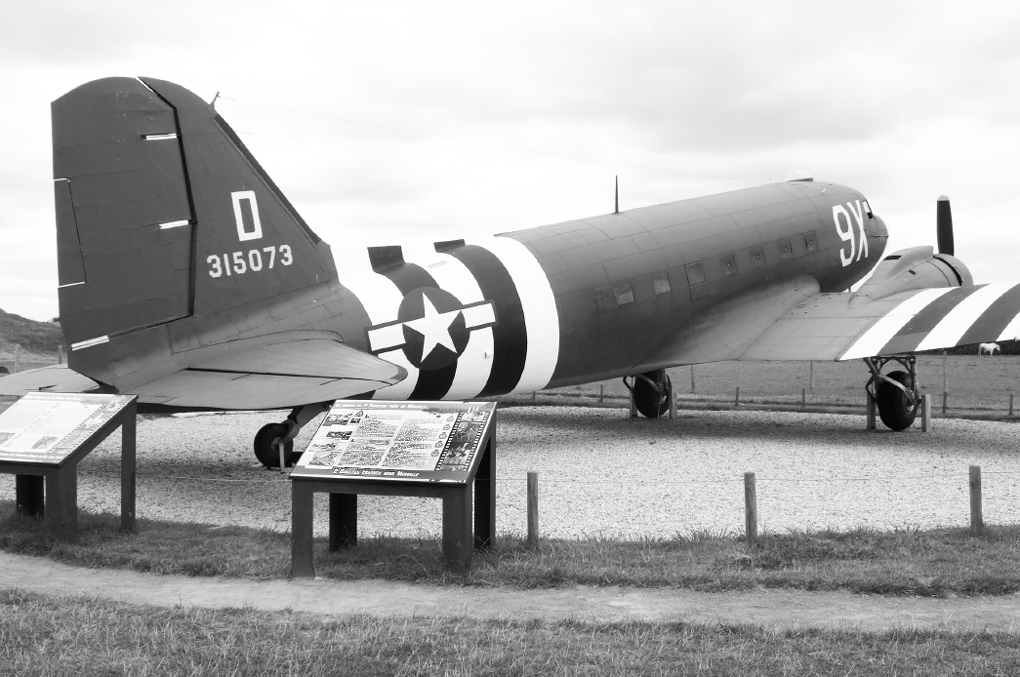
Restored DC3 at Merville Battery Museum.