
Chapter 3
Planning for an attack against the Western Allies began even before the conquest of Poland was completed. On 27 September 1939 Hitler informed his commanders that he intended to unleash an offensive in the West as soon as possible. On 9 October Hitler issued Führer Directive No. 6 calling for an attack on the northern flank of the Western Front with the objective of smashing large elements of the French and Allied armies and capturing as much territory as possible in Holland, Belgium and northern France. His strategic goal was to create favourable conditions for follow-on air and sea warfare against Great Britain and to ensure the defence of German industries in the Ruhr valley. By January 1940 Hitler’s strategic vision had broadened to encompass an attack on Norway and Denmark in order to forestall Allied intervention in Scandinavia and the Baltic Sea area, obtain air and naval bases to extend the reach of the Luftwaffe and Kriegsmarine, exploit the area’s rich mineral resources, and provide security for the sources of Swedish iron ore. An incident in February, in which a British destroyer entered neutral Norwegian waters and recovered British prisoners from the German tanker Altmark convinced Hitler to speed up planning for the German occupation of Norway.1
Hitler’s 1 March Directive for Case Weserübung (Operation Weser) outlined an air, sea and land invasion of Norway and Denmark and gave a significant role to the fledgling German airborne forces. Some seven groups of Ju-52 transports, consisting of 500 aircraft, would transport parachute and air-landing troops to Oslo and Stavanger in Norway and to Aalborg in Denmark. Those troops included the 1st Battalion of the 1st Parachute Infantry Regiment, which was tasked with seizing two airfields in North Jutland and the bridges connecting the island of Falster with Zealand, on which is located the Danish capital of Copenhagen, with the support of three battalions of the 305th Infantry Regiment. Two other companies would drop on the Norwegian Fornebu airfield, seize and hold it, pending the arrival of two battalions of the 324th Infantry Regiment. The Germans began landing troops in Denmark and Norway on 9 April 1940. That same day the Danish Army halted its resistance and by 9 June the Norwegian Army had surrendered as well. In general, the airborne operations went as planned, although inclement weather forced the Germans to make some improvisations.
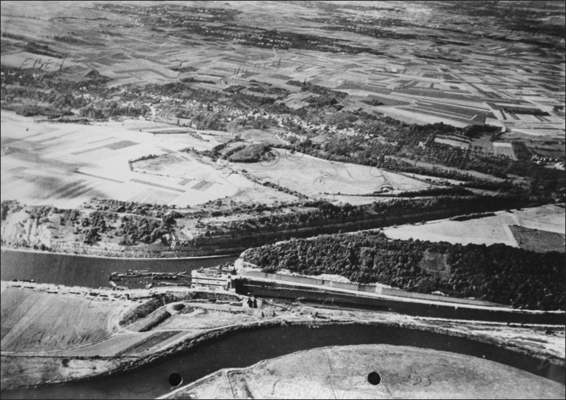
An aerial view of Fort Eben Emael from the south-west.
The German paratroopers were blooded in Norway and the campaign there served to demonstrate their immense potential. However, weaknesses had been uncovered and the German High Command had learned that heavy casualties would result from their improper employment. ‘For Kurt Student, who had been promoted to the rank of Generalleutnant on 1 January,’ writes German historian Volkmar Kuhn, ‘this campaign had important lessons for the impending operations by airborne troops on the Western Front.’ Rudolf Witzig and his colleagues took no part in the Norwegian campaign. Instead they were preparing for a very special mission. It would be in Belgium that the German Fallschirmjäger would display their greatest effectiveness and lethality in combat.
Located between Maastricht and Visé, Eben Emael was built between 1932 and 1935 to cover the Visé Gap to the north and the major crossings over the Albert Canal from the Netherlands into Belgium to the south. These crossings included the bridges at Veldwezelt, Vroenhoven, and Kanne. Situated atop St Peter’s Hill, some sixty metres over the strategic Albert Canal near Caestert, the fort was in essence a reinforced artillery position and one of a series of four new strongholds constructed east of Liége after the First World War to defend Belgium. The most technologically advanced citadel of its day, it cost 24 million Belgian francs to build, the equivalent of about £2 billion today. Constructed in the shape of a rough equilateral triangle, with sides of 800 metres, Eben Emael had a surface area of 75,000 sq m, with the superstructure itself measuring 45,000 sq m.2
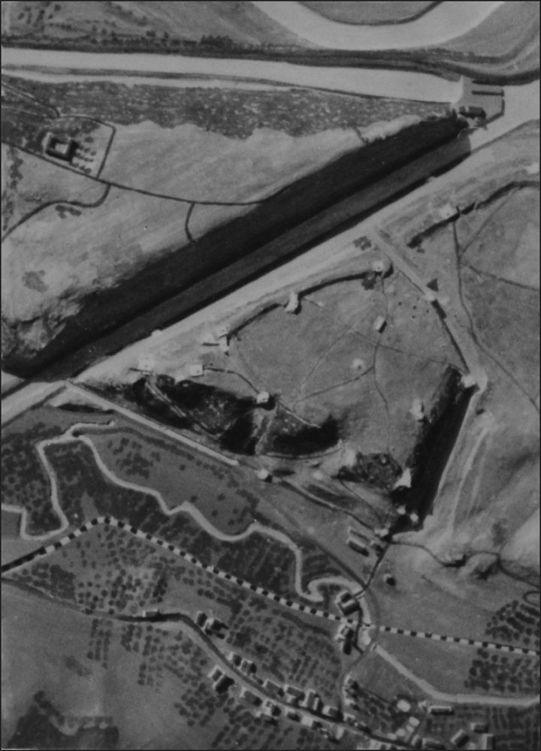
This model depicting Belgium’s mightiest fort was used by Hitler’s paratroopers to plan their assault on Eben Emael.
A small, self-contained, underground city, Eben Emael consisted of three levels. The lowest level, located almost sixty metres underground, was the living area. It was made up of large galleries, central stairs and elevators, oil and water tanks, an electrical power plant powered by six diesel engines, barracks for the men and separate sleeping quarters for the officers, toilets, showers and washrooms, an armoury, and even a prison. The second or intermediate level, located forty metres underground, consisted of a system of tunnels and galleries four kilometres in length. With a few exceptions, all the fighting bunkers were accessible only via this level, which housed ammunition storage rooms under each bunker. These storage rooms were connected to the bunkers with lifts and stairs. The intermediate level also housed the air ventilation system. Finally, the upper level consisted of all the firing and observation cupolas and machinegun bunkers. Thick, hermetically sealed armoured doors, resembling those found on a battleship, separated the various levels and parts of the fort.
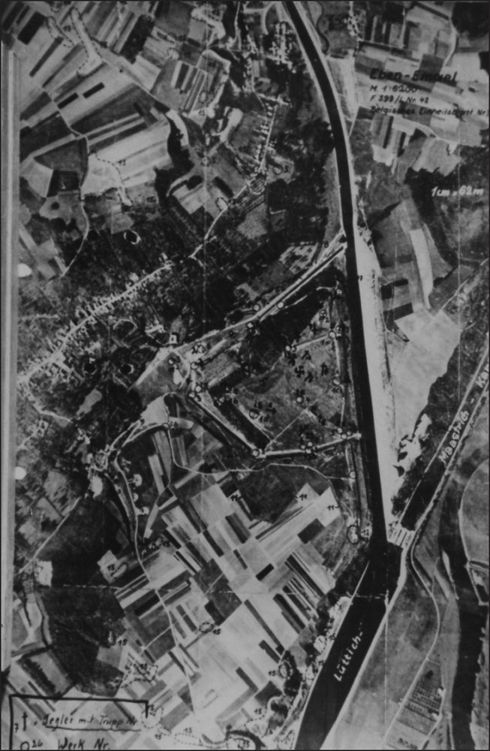
Aerial photographs such as these were also used for planning the assault on Eben Emael.
Eben Emael’s technical innovations included air conditioning, central heating, and a filtration and overpressure system designed to filter the air constantly and vent dangerous gases. With its 1,200-man garrison, including 1,000 artillery and 200 support personnel, underground tunnels, and robust defences, the fort was thought by many at the time to be impregnable. Indeed, in the event of a war with Germany, the French General Staff relied on the fort to hold out for at least five days.3 And the Belgian Army’s eighteen divisions counted on its border forts and their artillery as their first line of defence. The forts, however, were never intended to stop the German Army alone, but rather first to deter an attack by making the cost of offensive operations too great and then to delay an advance and win time for the Belgians and their allies to mobilize their forces.
On paper, Eben Emael appeared well designed and equipped to accomplish this mission. Its defences included an intimidating array of moats, anti-tank ditches, trenches, minefields, barbed wire, blockhouses, real and false artillery cupolas, and observation cupolas. Provision had been made for an emergency evacuation by the garrison with the construction of three major exits and six emergency exits. In addition to the seventeen bunkers in the fort, there were also two other bunkers, at Kanne and Hallembaye, and six observation posts (at Loen, Caestert, Opkanne, Vroenhoven, and Briegden) outside Eben Emael. All were connected to the fort by telephone. Eben Emael was also connected to the Belgium Army General Staff in Liége by both telephone and radio. The fort bristled with guns, which provided a 360-degree defence. Eben Emael’s main mission was to provide artillery support to the troops in the field. Its inventory thus included an impressive array of artillery pieces, including two 120-mm and sixteen rapid-firing 75mm guns, a dozen 60-mm anti-tank guns, more than two dozen heavy machine guns and six light machine guns. The fort also boasted 19 searchlights for night combat. The 120-mm artillery pieces, mounted in a non-retractable cupola, had a range of more than 17 km, while the 75-mm guns, mounted in both retractable and non-retractable cupolas, could shoot 8 km, well within the range of the farthest bridge at Vroenhoven, only 7.5 km away. Finally, the 60-mm anti-tank guns could fire out to a range of 3 km.4
The fort’s guns were manned by two groups of artillerymen numbering 500 men each. The men rotated on a weekly basis between duty in the fort and rest-and-recuperation at their barracks in the small village of Wonck, 4 km to the south. There were also 200 electricians, armourers, cooks, medical personnel and administrative staff. These men were billeted on civilians in the village of Eben-Emael or stayed in the wooden barracks located at the entrance of the fort. Commanded by a Belgian Army major, they worked eight hours a day.
The command relationship between the Belgian Army and the various batteries of the fort was excessively complicated and convoluted, diluting Eben Emael’s tremendous firepower. The reason for this is unclear. While Eben Emael’s commander and his fire-control office could give fire commands, the targets were determined by the Belgian field commanders themselves. Thus, Cupola 120, a non-retractable cupola with two 120-mm guns capable of revolving 360 degrees, was under the direct command of the Belgian I Corps, while Cupola North and Cupola South, retractable cupolas each containing two rapid-fire 75-mm guns capable of revolving 360 degrees, were allocated to the commander of the Belgian 7th Infantry Division. Maastricht 1 and 2, each containing three 75-mm guns, were under the commander of the 18th Infantry Regiment, while Visé 1 and Visé 2, each also containing three 75-mm guns, were controlled by the commanders of the 2nd Grenadier Regiment and the Lower Meuse Region respectively.5
Defending the Albert Canal in conjunction with the garrison of Fort Eben Emael were the men of the Belgian 2nd Grenadier Regiment. Although the unit was authorized 3,400 men (including 3,000 enlisted personnel, 300 NCOs, and 100 officers), it was, like many Belgium formations at the time, understrength and numbered only 2,600 men. These grenadiers were responsible for defending a front 9 km long and 1.5 km deep. The regiment defended in depth along the Meuse River and Prince Albert Canal, with the 2nd and 3rd Battalions on the front line running from Kanne to Emael, Leon and Lixhe. The 1st Battalion was positioned on a line farther to the rear running from Fall to Weer and then Wonck. The 2nd Grenadier Regiment was supported by the 105th Artillery Battalion of the Belgian Army’s 20th Motorized Artillery Regiment, located at Sichem.6
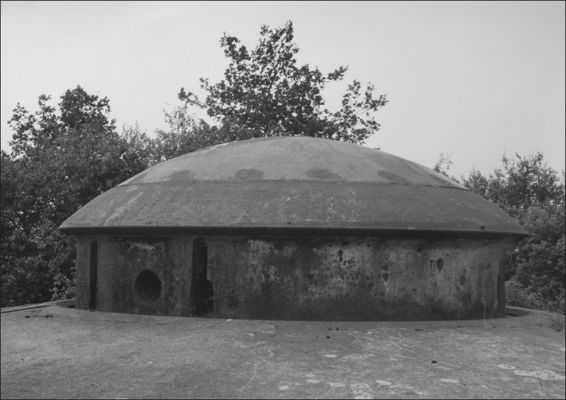
Eben Emael. This retractable armoured cupola mounted two 120-mm guns.
On paper, the defences of Eben Emael appeared imposing. Yet the fort and its garrison suffered from a number of critical deficiencies. There was, for example, insufficient barbed wire, minefields, or trenches near the bunkers or on the superstructure, where they were the most needed. Indeed, although Eben Emael’s designers had never envisioned an airborne assault on the structure, the commander of the garrison, Major Jean Fritz Lucien Jottrand, had recognized the utility of the large flat meadow atop the fort’s concrete roof and had considered using it for aerial resupply. It served, however, as a football field for the garrison’s soldiers, a morale booster in a unit and an army plagued with questionable esprit de corps, and it was probably for this reason more than any other that obstacles were not placed on the superstructure. Other critical defects were also evident. Some of the cupolas were missing their firing periscopes, rendering them useless. Furthermore, there were insufficient explosives in the fort to seal off its main gallery in the event of a breach by an enemy force, as called for by the Belgian Army regulations for its forts. And many telephone sets had been removed for use at a rifle range some 30 km distant. Moreover, the hilly terrain surrounding the fort blocked the garrison from firing effectively on Aachen or Maastricht, should the latter city fall to the enemy. In addition, the original ventilation system was defective, while a new one had not been fully installed. Finally, the fort lacked sufficient means to defend itself against an aerial attack. Its anti-air defences consisted of only four anti-aircraft machine guns situated atop the superstructure.7
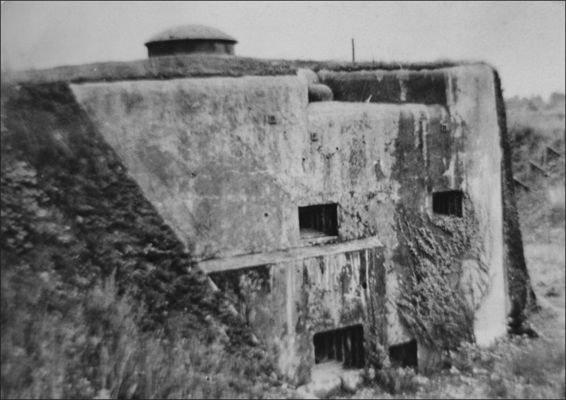
Another of Eben Emael’s massive forts.
The poor state of the Belgian garrison only aggravated Eben Emael’s weaknesses. Training was at a very low level with many of the soldiers having never fired live ammunition. Furthermore, although they had been trained as artillerymen, the men of the garrison were also expected to fight as infantry and immediately launch local counter-attacks in the event of a penetration. As a result, morale among the men was low. Also, many of the soldiers were frequently absent from their posts due either to throat infections, a common malady among those constantly exposed to the dusty and mouldy atmosphere of the forts, or special leave commonly granted to miners, farmers, and fathers of families with many children. All these shortcomings were well known to the Belgian senior leadership, which was attempting to rectify them when the war began.8
Planning for the assault on Eben Emael began on 27 October 1939, when Hitler summoned General Student to Berlin for consultations. Student remembered that Hitler presented his views on the use of airborne troops during the discussion that followed. Student’s own philosophy on the use of his Fallschirmjäger would soon be put to the test.
His opinions were explained with a clear sighted lucidity and with his own inimitable persuasiveness. I was astonished at his knowledge of what was virtually a new field – of the potential of gliders in particular. To begin with, the Führer himself stressed that one had to realize that paratroopers and the airborne arm were a completely new, untried and – so far as Germany was concerned – still secret weapon. The first airborne operation had to employ every resource available, and be delivered boldly at a decisive time and place. It was for this reason, Hitler said, he had refrained from using airborne troops until there were appropriate objectives.9
Hitler had ordered planning for the war in the West to commence and wanted to know if Student’s gliders and paratroopers could take Eben Emael by landing on the large grassy field on top of the complex and then storming the works. The rapid breakthrough of the German Sixth Army between Roermund and Liége depended on capturing the bridges over the Prince Albert Canal undamaged. In order to accomplish this, Eben Emael had first to be neutralized. Student replied that he was not sure and needed time to consider the proposal. Hitler, no doubt perturbed at having his competency questioned, responded: ‘Go away and sleep on it and come back in the morning.’ Returning the next day, Student told the Führer that he thought it possible, but only if the landings were made in daylight. Hitler agreed, then surprised Student again by telling him about the development of a fantastic new explosive, which weighed 50 kg and could blow through any known steel or ballistic concrete fortification. Called a Hohlladung, or hollow charge, this secret weapon would guarantee the success of the operation. Hitler then issued his order to Student outlining what he expected of the Fallschirmjäger in the coming offensive:
1. The 7th Fliegerdivision and the 22nd Airborne Division under Generalmajor Student will seize the Reduit National [the chain of forts along the Belgian border] and hold this important line of fortifications until the arrival of the mechanized columns of the Wehrmacht.
2. Parachutists and a glider-borne force are to launch surprise attacks on Eben Emael, and the bridges across the Albert Canal north of it, and the Meuse Bridges near Maastricht. The aim is to facilitate the speedy passage of the Sixth Army across the Maas and Albert Canal.10
After the war, Rudolf Witzig told two U.S. military officers interviewing him for the Army Center of Military History that there was another reason for the airborne assault on Eben Emael:
It was essential to land on the fort and attack the artillery positions that protected the river and canal crossings in order to convince the French and the British that the Germans were making their main effort in the north. That is, attacking through Belgium as they did in the First World War. In fact, they did believe that, and to make it more believable, the Sixth Army had to strike into Belgium as quickly as possible, driving as far to the west as it could. Thus the enemy would say ‘Ah, they are coming again just like in 1914. Move everything forward quickly!’ Then the two armoured groups in the south could attack and set the ‘Sichelschnitt [Sickle-Cut] Plan’ into motion. In operational terms, that was the real mission of Koch and Witzig and the attacks on the bridges and Eben Emael.11
Together with Colonel Bruno Bräuer, Commander of the 1st Parachute Regiment, Student selected Captain Walter Koch to seize the Albert Canal crossings and Lieutenant Rudolf Witzig to seize Eben Emael. ‘The task came to my platoon simply because there were no other engineers in the airborne forces, which were still very small in 1940’, Witzig explained. ‘The [German] air force engineers simply didn’t have the type of training we had undergone . . . In our eyes they were not really engineers, but I suppose the correct expression would be “infantry engineers” – while we were real “black engineers”.’ Witzig was referring to the black piping worn on their uniform epaulettes by German Army engineers, though now his fully qualified Army combat-engineer platoon had been transferred to the Luftwaffe.12 As a result of their long and comprehensive training and preparation, especially for assault missions, Witzig described his unit as ‘a self confident’ and ‘proud group of men’.13
My engineers, like Koch’s infantrymen, were superior soldiers in every respect. There is no other way to describe them. There was not a single case of one wanting to withdraw. That was so because every one of my soldiers was a volunteer. They had first volunteered for parachute training, joined the parachute infantry battalion, and then came as volunteers into the parachute engineers. They were volunteers, high quality soldiers of good morale. I believe one could say in general that this was true not only of the airborne units, but also for the entire [German] army, air force and navy alike. The armed forces were, at that time, at their peak morale. Not that we necessarily reacted coolly to everything, but simply and plainly, the morale of the German army was, at that time, absolutely first rate.14
Witzig went on to observe that unlike his Army engineers, the Luftwaffe’s parachute engineers, at least initially, had a far more restricted mission and thus restricted training. ‘They were organized only for the so-called “demolition missions”,’ he noted after the war, pointing out that they had been originally trained and organized as ‘human smart bombs’:
The parachute troops jumped in, marched to their objective, blew it up, and then tried to return to their own lines. How they got back was their own business. In the 1937 manoeuvres, parachute troops were supposed to have been picked up by aircraft after blowing up their targets. In fact, they wound up being given train tickets [for their return]! The army, on the other hand, organized its parachute units from the beginning for a full range of tactical and strategic missions. Therefore, my engineers had expected more than just to supplement the standard air force missions, and had the training to do more than that. They were so well qualified that they were called upon in the winter of 1938–1939 to teach demolition techniques and certain engineer skills to other soldiers in the regiment.15
For the assault on Eben Emael, Witzig’s platoon, which originally numbered 40–50, was reinforced to 70–80 strong. The additional personnel were all paratroopers from Captain Koch’s parachute infantry company.16
Witzig received his orders directly from General Kurt Student in November. ‘I was summoned to a discussion at the division staff at Berlin-Templehof, and was told about it then,’ he recounted. ‘At the same time Hauptmann Koch and Oberst Bräuer, the [1st Airborne Regiment] regimental commander, were informed. It was at that time we were given the mission.’ Afterwards both Koch’s 1st Parachute Infantry Company and Witzig’s reinforced parachute-engineer platoon were detached from the 7th Fliegerdivision.17 Later that month, Student ordered the creation at Hildesheim of a special battalion-strength airborne task force, Sturmabteilung Koch, consisting of hand-picked officers and men from the German airborne forces. Security was tight and Witzig and his men began practising assault techniques using the Polish fortifications at Gleiwitz. Commanded by Captain Koch, the detachment consisted of 11 officers and 427 men. This included 42 glider pilots and four reserve gilder pilots under the command of Lieutenant Walter Kiess.18 The air component for the operation consisted of another 16 officers and 182 men and included a flying group of 44 Ju-52 tow pilots with four in reserve and a second reserve group of 6 Ju-52 tow pilots with one pilot in reserve. In all, some 84 tow aircraft and gliders were allocated to the operation. The air component was organized into four Staffeln (squadrons), one for each of the assault groups. Each squadron consisted, in turn, of two Startegruppen (sections), with three to six Ju-52s in each section. Thus the first squadron consisted of 11 aircraft, the second of 10 aircraft, the third of 9 aircraft, and the fourth of 10 aircraft for a total of 40 tow planes. A fifth squadron held all the reserve aircraft and pilots.19
For the assault on Eben Emael, Koch had divided his detachment into four Sturmgruppen (assault groups), each made up of roughly an understrength company of paratroopers. Each group was to seize and hold an objective pending the arrival of elements of the German 61st Infantry Division. Assault Group 1, code-named Granite, was commanded by Witzig and had the mission of eliminating the outer ring of forts at Eben Emael and neutralizing the position until relieved by the 51st Engineer Battalion. Consisting of two officers and 83 parachute engineers, it would be transported into battle in eleven gliders. Assault Group Iron was commanded by Lieutenant Martine Schächter and had the mission of securing the bridge at Kanne and holding it until relieved by the German 151st Infantry Regiment. It consisted of two officers and 88 men and would be transported in ten gliders. Assault Group Concrete was commanded by Lieutenant Gerhard Schacht and had the mission of securing the bridge over the canal at Vroenhoven and holding it until relieved by the 162nd Infantry Regiment. The largest of the assault groups, it consisted of five officers and 129 men. The German High Command placed the highest importance on the capture of the bridges at Kanne, Vroenhoven, and Veldwezelt. For this reason the task force commander, Captain Koch, would accompany Assault Group Concrete into battle. Finally, Assault Group Steel was commanded by Lieutenant Gustav Altmann and had the mission of securing the bridge at Veldwezelt pending the arrival of the 176th Infantry Regiment.20 It consisted of one officer and 91 men. With Assault Detachment Koch deployed in Belgium, the remainder of the 7th Fliegerdivision was assigned to attack Dutch airfields and bridges.
Each man in Witzig’s platoon, which Koch had designated the 17th Reserve Squadron, was an experienced paratrooper, a veteran of the Polish campaign, and an expert in demolitions. ‘We were the only parachute unit composed entirely of sappers, and all of us were volunteers,’ Witzig wrote after the war. ‘Among us were the best amateur glider pilots from prewar days when Germans already excelled in the sport of gliding; and during the two years of the unit’s existence, it had grown into a sturdy, close-knit community in which each man had confidence in his fellow soldiers.’21
At Hildesheim, Witzig’s company lived in a gymnasium at the airfield. It was there that he informed them of their mission without ever mentioning their objective – Eben Emael. Special restrictions were imposed on Koch’s command and the area was surrounded with security troops. ‘No one was permitted to leave the gymnasium without permission,’ remembered Witzig. ‘One could not send letters freely. Every letter, every postcard, everything that went out, I had to read. Everything that came in, I had to read. Total censorship, and for the soldiers, no permission at all to send mail or use the telephone.’22 The paratroopers also had to divest themselves of their cherished airborne insignia and distinctive uniform items, a move which proved highly unpopular. ‘My men wanted to wear their uniforms after duty hours’ explained Witzig. ‘They were proud of their first decorations and medals, their parachute badges. People recognized them for what they were and their uniforms drew women.’23 In addition, special meals were arranged for Koch’s command and the men were not allowed to associate with any other units on the base or even to take a stroll outside their quarters. And the punishment for any violations was severe. ‘Just for example, three soldiers decided to leave the Kaserne for a cup of coffee,’ recalled Witzig. ‘They were apprehended, tried, and sentenced to death. Although the sentence was never carried out, it does indicate how seriously the authorities took our security measures.’24 Witzig was also provided with a cell to incarcerate without food any soldier he placed under arrest. But because of the security arrangements, only his paratroopers could guard the cell. ‘Naturally, my guards provided their friends with food as soon as I wasn’t watching,’ he recounted.25
Security was vital, since our success – indeed our survival – depended on taking the enemy by surprise. No leave was granted, nor were we allowed out, or to mix with men from other units. The sapper detachment was constantly moved around under different code-names, and all parachute insignia and uniforms were left behind. Even glider practice in the Hildesheim area was carried out on the smallest scale possible; the gliders were then dismantled, moved to Köln in furniture vans, and reassembled in hangars surrounded by wire entanglements and guarded by our own men.26
As there was not enough transport available to move Witzig’s platoon quickly in the event of an alert, it was transferred to Köln and Düsseldorf in order to shorten its travel time to the departure airfields at Köln-Ostheim and Köln-Butzweilerhof. ‘In these places we were living a secret life under false names,’ remembered Witzig. ‘No one was allowed to know who we were and what we were doing.’27
Under Witzig’s watchful eye, his assault group trained relentlessly, practising glider landings and developing and rehearsing tactics, techniques and procedures for neutralizing their objectives. ‘I was given only ten to fourteen days to prepare for the planned attack,’ revealed Witzig. ‘The anticipated date of the attack was 13 November [1939].’28 Initially Witzig thought this was sufficient time to prepare for an assault on Eben Emael:
In 1940 I was a 23-year old Oberleutnant. My knowledge of tactics and strategy was not really comprehensive. I was unaware of the large considerations. I was absolutely restricted in what I knew I had to have, and placed an uncommonly great trust in the command structure that assigned the mission. Expressed in another way, we had no misgivings that any part of our assignment was impossible or unreasonable. We were certain that we could succeed in such an attack . . . “What we didn’t know, we didn’t consider unreasonable. This is something of a question of morale and trust as well as operations . . . What we had was sufficient.29
Witzig reported to Captain Koch periodically to inform him of his platoon’s progress and how he planned to proceed with his training. ‘Still, I was the specialist and not he,’ Witzig noted. ‘I had certain experience with attacking formal fortifications on the basis of my training, from my knowledge of theory, and from practice. He had none.’30 Koch listened to Witzig’s plans and facilitated logistical and administrative support to the parachute-engineer platoon, but left the matter of training and assaulting Eben Emael to his eager subordinate. ‘When a mission is assigned an officer in the German Army, it is typical that the responsibility for training, planning, and execution are his alone,’ recounted Witzig.31 Witzig in turn sat down with his sergeants and discussed the entire operation thoroughly, working out how best to accomplish the mission using a sand-table model. ‘They made suggestions and put forward ideas,’ Witzig noted. ‘And out of all of that our plan arose.’32
By February 1940, Witzig and his men had honed their demolition skills on the casemates of the Czechoslovakian Beneš Line, along the former Czech–German border, where they practised assaulting strong – points with flamethrowers and a large arsenal of explosives, including Bangalore torpedoes. This was a fortunate opportunity for the parachute-engineers. ‘The Czech fortifications were considerably better secured and protected against infantry and engineer assaults than the Belgian ones turned out to be,’ remembered Witzig. ‘At the time I could only hope that the Belgian positions would be weaker. But I had no certainty about it, because the data available to us were not really sufficient.’33
Although this was an important part of their training, the preparation programme for the parachute-engineers also included other venues. ‘Lectures at the sapper school at Karlshorst introduced us to the principles of fortress construction,’ Witzig recorded. ‘Finally deserters from Belgian fortifications were interrogated and we were able to check what we had been learning against the information they supplied. Thus, the picture became complete, and the sappers acquired confidence in their weapon: none of us would have changed places with anyone, not even with the men in the armoured forts.’34 Witzig’s papers reveal the full extent of German intelligence on Eben Emael. They include overhead photographs of the fort and detailed engineering diagrams of all aspects of the stronghold, inside and out.
At first there were stereoscopic photographs [remembered Witzig]. Once you put on your stereoscopic glasses, you could see elevations and depths. Out of those photographs [the Luftwaffe Intelligence section] highlighted . . . particular factories or places . . . No single person in the engineer platoon even knew what this objective was called or where it was. The name of Eben Emael or Albert Canal was crossed or cut out of all documents or pictures. Nothing was left.35
For the assault, Witzig and each of his paratroopers would carry miniature maps of Eben Emael in a pocket-sized case.
Training was comprehensive and relentless. ‘We exercised lifts, loading and unloading, and quick exiting of the plane,’ remembered Witzig.
As for all the preparation, the training was never executed in one complete step. The functions or tasks were broken into parts, so that a spectator would never even know what was going on. In the Pioneer School in Dessau, we trained in demolitions and attacking from the ground and air. In Sudetenland, we practised on Czech fortifications, which were a lot more difficult than the ones at Eben Emael. We also trained with our glider pilots. They had to learn infantry/pioneer warfare; not just learn it but also master it.36
For the assault, Witzig organized his men into eleven squads, each consisting of two or three NCOs and four to six enlisted soldiers, a move necessitated by the number and carrying capacity of the Ju-52 and the load assigned to each squad to accomplish its mission. Each squad was tasked with capturing two emplacements or casemates and, in addition, to be equally ready to take over for any squad out of action. The first nine squads were given specific objectives to seize, while the tenth and eleventh squads were designated as the company reserve.
Moreover, unlike other pilots, a glider pilot, who is in command up to the time of landing, cannot stand aside during the actual battle. So our pilots took their turn as sappers in the detachment and the section to which they were allocated so that they would be reliable in action.37
Witzig planned to position himself initially with the eleventh squad. His deputy company commander, Lieutenant Delica, would accompany the first squad into battle. ‘X-Day was several times postponed, but our time was fully occupied in practising new techniques’, Witzig went on to write, ‘such as pin-point landing with explosives on an airstrip and in open country, or rapid disembarkation when fully armed.’38 In addition to flamethrowers and collapsible assault ladders, which Witzig’s men had constructed themselves, the special equipment for the operation consisted of some two-and-a-half tonnes of explosives, predominantly hollow charge devices, which were used for the first time at Eben Emael for penetrating the armoured cupolas.
Hitler’s paratroopers would use two secret weapons in their attack on Eben Emael. The first were combat gliders. The Germans had developed the DFS 230 to insert squads of paratroopers armed and equipped to go immediately into action as a group, a task impossible to achieve with conventional airborne operations and the limitations imposed by parachutes. The DFS 230 was a fabric-covered glider with a tubular fuselage. Some 11.3 m long and with a wingspan of 29.1 m, it had a maximum towing speed of 160 km/hr and when released descended at 72 m per minute. The glider transported ten men, including the pilot, copilot, and eight fully loaded infantrymen sitting uncomfortably astride a wooden bench running down the centre of the interior. The last four infantrymen faced to the rear of the glider, where the door was located.39 The one-tonne DFS 230 could also carry its own weight in supplies, a handy capability in light of the fact that Witzig’s men would be transporting around 5 tonnes of explosives, including 28 x 50-kg shaped charges, 28 x 12.5-kg charges, 83 x 3-kg charges, and more than 100 other explosive charges. In addition, the assault group would be armed with six medium machine guns, 18 submachine guns, 54 rifles, 85 pistols, more than 30,000 rounds of ammunition, and almost 750 hand grenades. Each airborne engineer squad was literally a walking arsenal.40
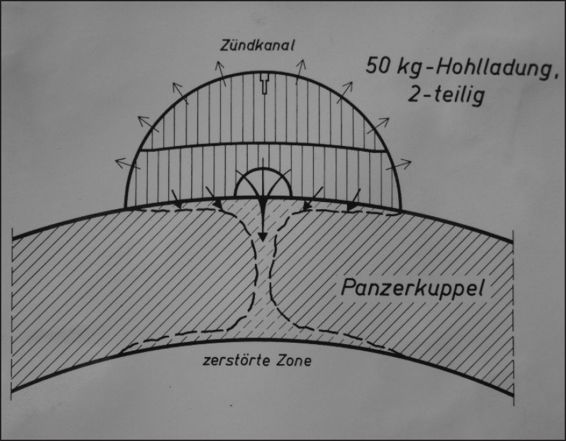
A German schematic depicting the explosion of a shaped charge on an armoured cupola.
Witzig’s paratroopers were equipped with a second secret weapon, the shaped charge. ‘We were the first soldiers to use them,’ remembered Witzig. ‘There was no experience for use of shaped charges in the attack, no doctrine for their use, and no programme of instruction. There were only the workers from the factories that made the explosives and the engineers and technicians from the Explosives Branch who had developed them.’41 Although the theory of the shaped charge had been known since 1883, its first-ever military use would be by Witzig’s airborne engineers in their attack on Eben Emael in May 1940. When a shaped charge detonates its energy is concentrated to the centre of the hollow space in front of and along the axis of the charge. A powerful jet of explosive gases results, which strikes the target at super-high speed (8,000 m/sec) and with tremendous penetrating pressure (in excess of 10 million kg/cm2). To be most effective, the shaped charge has to be detonated at the right distance from the target. If detonated too close, the jet will not form properly before hitting the surface and the effect is lessened. If detonated too far from the surface, the jet is unfocused and weakened.
Witzig and his men were issued two types of shaped charge, one weighing 50 kg and the other weighing 12.5 kg.
The 50-kg shaped charges, carried in two parts, were in the shape of hemispheres [Witzig wrote]. They could penetrate armoured domes 25 cm thick, and even where this armour was 28 cm thick, it was likely that weapons and troops below would be put out of action by flying splinters. Where the armour was thicker still, several explosions in the same hole would be necessary. Even the smaller 12.5-kg charge penetrated armour of 12–15 cm and it was also suitable for precision blasting of loop-holes and heavy artillery. All charges were detonated by ten-second fuses.42
The men of Witzig’s platoon were required to place the charges on Eben Emael’s armoured cupolas, the large one in two halves which were joined. Upon detonation, pieces of the interior of the cupolas would be blown off to fly around with great speed, destroying and damaging equipment and wounding and killing the defenders. ‘Remember that it wasn’t necessary for us to force an entry into the cupola,’ explained Witzig. ‘It was only necessary for us to put the position out of action, and we could do that in some cases without breaking through the armour. That would be sufficient.’43 Witzig’s men conducted experiments to determine how close a man could be to a shaped charge so as to reduce the interval between ignition and detonation to as little as possible. They determined that ten seconds was the appropriate interval. Every soldier trained with the shaped charges, although not all had the chance to detonate one as available stocks were, according to Witzig, ‘unbelievably small’.44 Only a few of the soldiers carried the shaped charges. The rest of the assault detachments carried standard infantry weapons. ‘A final stroke of ingenuity, characteristic of our thorough preparation, was the plan to drop by parachute several groups of uniformed dummies behind the Albert Canal to the west,’ recalled Witzig. ‘As we had guessed, this caused considerable confusion to the Belgian command.’
After six months of strict isolation and several postponements, the alert came in the afternoon of 9 May. That day Hitler issued a proclamation to the German soldiers on the Western Front, ending with: ‘The battle which begins today will decide the fate of the German nation for the next thousand years. Now do your duty. The German people give you their blessing.’45
‘We drove in trucks from Seldorf Flakkaserne – we were living in a new building, which wasn’t occupied by anyone else – to Köln-Ostheim,’ remembered Witzig. ‘We had to load our machines in the hangars and had to wait and see what would happen.’46 Platoon leaders checked their troops and ensured everything was ready. ‘Having reported ‘All ready’ to Lieutenant Witzig at 2100, I paraded my troop and addressed them as follows,’ remembered Lieutenant Ernst Arendt, commander of Witzig’s 3rd Platoon: ‘“Comrades, we will be going into action tomorrow morning. We have to prove that we haven’t wasted our time and that we have learned everything that we were supposed to learn.” Then I dismissed them, telling them to get some rest.’47
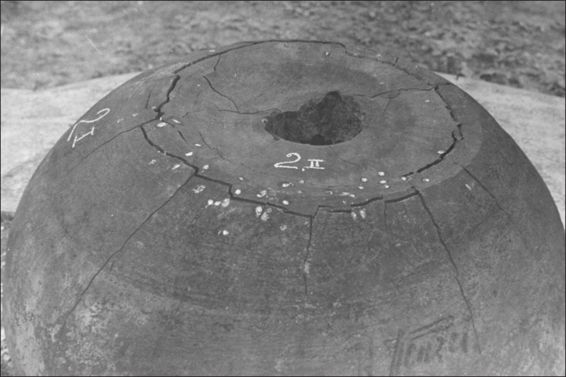
The effect of a 50-kg shaped charge on an armoured cupola.
Reveille the next morning was at 0245. The men of Assault Detachment Koch gathered at the airfields of Köln-Ostheim and Köln-Butzweilerhof. ‘We paraded in full kit ready to emplane at 0330,’ continued Arendt. ‘Lieutenant Witzig then said a few words, concluding with the order “An die Maschinen!” [“Board the aircraft!”] We walked over to the gliders, climbed in, and at precisely at 0430, the eleven aircraft tugs took off towing us up towards the morning sky.’48 The 0430 takeoff had been planned to allow the four assault groups to land simultaneously, at 0525 hours, at Eben Emael and the bridges – five minutes before the German Army crossed the border. ‘From that moment on we were in the hands of our pilots,’ remembered Witzig, ‘whom we expected to take us to the right altitude, at the right time and location . . . Morale was good [but] tense. We were sure we had prepared ourselves as well as possible. The rest was up to us . . . We were full of confidence.’49
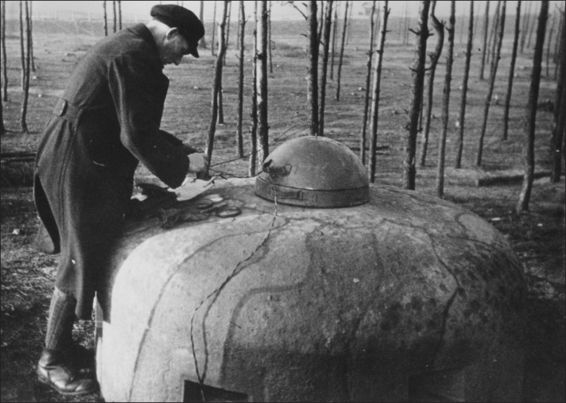
The Germans experimented with various sizes of shaped charges on fortifications in Poland and Czechoslovakia before their assault in the West. Here a German worker sets a charge on an armoured cupola at Katowice in Poland in late 1939.
The aircraft took off in complete darkness and started their journey through the night. They gained height by circling to the south then turned westwards, following a route which had earlier been marked with beacons and searchlights. By the time they reached Aachen the aircraft and gliders were at a height of 2,500 metres, giving the gliders a range of 30 km. The Belgian border was only 10 km away and Eben Emael only 25 km. Assault Group Granite travelled to its objectives in eleven DFS 230 gliders. The gliders were towed into battle by the tri-motor Ju-52. Beginning life as a Lufthansa airliner and evolving into an ad hoc Luftwaffe bomber during the Spanish Civil War, the Ju-52 found its greatest success during the Second World War as a troop transport. With a top speed of 276 km/hr and a range of 870 km, the Ju-52 could land and take off from very small airfields. Some 18.9 m long and with a 29.25-m wingspan, its most distinctive feature was its corrugated aluminium fuselage, which amplified the sounds of the three engines and forced the paratroopers inside to rely on hand-signals, klaxons, and lights. The stripped-down interior featured basic canvas seats on which the German paratroopers flew into battle. At 0515 the tow planes released the DFS 230s, which still had some 30 km to go before reaching their objective. Two gliders were lost during the flight, including that of Lieutenant Witzig. Ten minutes later, at 0525, the nine remaining gliders began arriving over the fort, where they were greeted by belated fire from the four anti-aircraft machine guns located atop the superstructure.
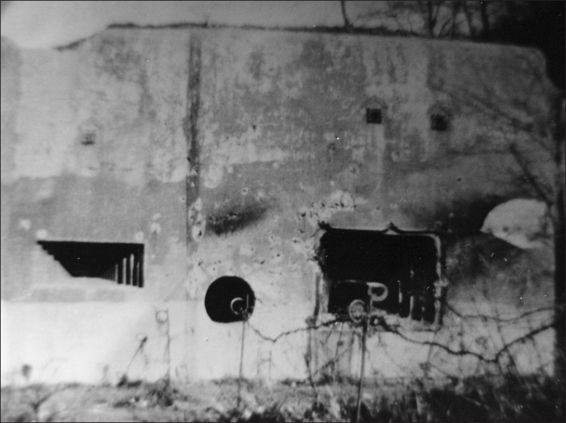
Eben Emael was impervious to German machine-gun and cannon fire, whose effects are visible on the outer walls of this fort. Shaped charges, however, brought the fort and its garrison to their knees.
Though surprised by the glider assault, the Belgian soldiers of the fort had not been caught napping. Indeed, the garrison had been alerted by their headquarters in Liége at 0030 – three hours before Witzig’s force had taken off. ‘Alert Fort Eben Emael!’ had come the order. ‘There are German troop movements along the border.’ Two minutes later klaxons had begun sounding throughout the interior of the fort and Belgian artillerymen had begun moving to their positions. By 0315 the batteries were firing blank rounds at thirty-second intervals alerting members of the garrison in surrounding villages, the defenders of the bridges, and civilian personnel to the existence of a military emergency. The break of dawn heralded a clear sky with a wispy haze blanketing the fort.
At around 0500 hours, a Belgian outpost north-west of Kanne reported 30–50 aircraft approaching from the direction of Maastricht at 1,200–1,500 metres. Soon afterwards an observation post called Eben Emael and reported: ‘Aircraft overhead! Their engines have stopped! They are almost motionless in the air!’ The DFS 230s descended to a height of almost 350 metres then flew over their objectives, executed a 180-degree turn, and completed their final approaches from the west, diving the last twenty metres and skidding to halt close to their objectives. The fort’s machine gunners fired belatedly on the gliders as they came into sight, but the light aircraft were too low, too close, and approaching too fast to make effective targets, especially since the machine guns had been set for high-angle fire.
The skids of the gliders had been wrapped in barbed wire to help the aircraft stop more quickly. Even before they had stopped moving, however, the paratroopers in each aircraft hurtled out the rear doors with their weapons firing. Once the gliders had come to a complete halt the pilots and copilots quickly ejected the cockpit cover and joined the assault groups.
We had been thoroughly drilled in our tasks [wrote Rudolf Witzig afterwards] and in the strict orders which our small number – eighty-five men, including the pilots and allowing for no losses during the flight – made it imperative to observe. Our earlier study of aerial photographs and a relief model, made to scale on a sand table, had convinced us that our initial assault had to be restricted to the central installations. First, we were to destroy all infantry weapons and anti-aircraft guns firing in the open and after that the artillery, particularly where directed north. Speed was essential, since anything not accomplished in the first 60 minutes would be made practically impossible by the increasing strength of enemy defence.50
As Assault Group Granite was landing, Ju-87 Stukas were pounding the towns of Kanne and Eben Emael and the soldiers of the Belgian 2nd Grenadier Regiment to prevent them from reinforcing the fort. Only five minutes later, at 0430, Hitler’s armies began pouring across the Dutch and Belgian borders.
Witzig’s was one of two sections that had not reached the fort with the main body:
Soon after the start, the [tow] rope of my glider ripped and I was separated from the squadron. There wasn’t a lot of space in the air. My tow pilot went into an abrupt dive to avoid a collision. That’s when our tow rope, [which] was under too much stress, broke. The squadron was descending westwards and I was alone in the air with my glider. I told the pilot ‘Turn back towards the Rhine! Try to get over the Rhine again!’ because Köln-Ostheim and Köln-Butzweilerhof were on the eastern side. In order to start again, we had to get to the east side of the Rhine.51
Witzig’s squads moved quickly into action and the specially trained airborne engineers began assaulting their assigned objectives using flamethrowers, special explosives, and shaped charges.
Anti-aircraft Post 1 was captured immediately [he reported]. The occupants of Hut 2 offered some resistance, but were soon silenced, and in the first ten minutes the sections successfully attacked nine occupied and defended installations . . . although [one] installation . . . later started firing from its sunken dome. Charges were placed on seven armoured domes and five exploded with complete success; nine 7.5-cm guns in three casemates were destroyed, and in installation 8 – a flat armoured dome 6 metres in diameter, which was not penetrated by the 50-kg charge – the twin 120-mm guns were effectively attacked by two 1-kg charges thrown into the barrels, jamming breeches as they detonated.52
Within ten minutes of landing, the paratroopers had both silenced and blinded Belgium’s mightiest and most modern fortress, capturing or neutralizing Maastricht 1 (equipped with three 75-mm guns), Maastricht 2 (three 75-mm guns), Mi North (machine guns), Mi South (machine guns), Cupola North (two 75-mm guns), Cupola South (two 75-mm guns), and Block IV. Only seven sections of fifty-five men took part in the action, while two other sections had been sent to destroy what turned out to be dummy positions in the northernmost complex of the superstructure. ‘We came across no mines anywhere’, remembered Witzig. ‘The only installations protected by barbed wire were in the north, where the sappers had to free themselves with wire cutters and turn their flamethrowers on a machine-gun position firing from an embrasure, before they could place charges.’53 Still, not all went as well as it could have. According to Witzig, the dummy positions diverted the efforts of two squads for ninety minutes. ‘If they had been on the southern side of the fort where there were worthwhile objectives they would have been more effective,’ observed Witzig. ‘And perhaps we might have taken position 23 [Cupola South] earlier and forced an earlier surrender.’54
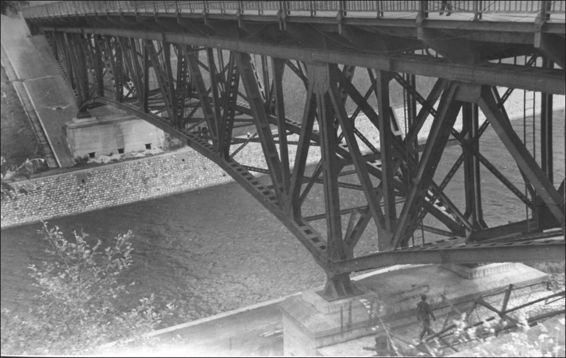
The Veldwezelt Bridge was the objective of Group Steel. Commanded by Lieutenant Gustav Altmann, it consisted of ninety-two men and nine gliders. The group accomplished its mission, again, against heavy Belgian resistance, suffering eight dead and thirty wounded.
Meanwhile, having come this far, Lieutenant Witzig was not about to quit and let his men take Eben Emael without him. He instructed his pilot to look for a meadow large enough not only to land the glider but also to take off again and begin the mission anew. Once the aircraft was on the ground he instructed his soldiers and pilot to unload the aircraft, move it to the edge of the meadow, and load it once again, then to tear down any fences which might hinder a take-off. In the meantime, Witzig started to make his way back to Köln-Ostheim. He began by walking and then confiscated a bicycle from a railwayman. Next he confiscated a car from ‘a very astonished medical officer’ and was able to reach the Luftwaffe headquarters in Köln-Ostheim. ‘There I was lucky enough to find a flight commander who knew what we needed to do,’ he remembered, smiling. ‘He managed to get a reserve Ju-52 . . . from General Student, all on his own responsibility. Meanwhile I got a parachute in the event we would not be able to land. And so I started again!’ Witzig explained the situation to the pilot while the two were still in the air and told him where to land. The pilot landed the Ju-52 and rolled to the edge of the field where the glider was waiting. ‘My orders to the Ju pilot were to fly to Aachen along the same course to the western border [of Germany] at an altitude of 750 metres. What happened after that I didn’t care!’ And so Witzig and his men started the mission once again under a beautiful morning sun and released over the German border. ‘During our flight we saw squadrons of the Luftwaffe fly westwards. The war had obviously already begun,’ he remembered. ‘We could see every now and then small black clouds [flak] in the air. None of them hit us. We then flew to Eben Emael; our pilot knew the way.’55 Witzig arrived at the fort more than three hours late. The other ‘lost’ section was not so fortunate, landing near Düren, where they joined the first ground troops advancing to the west. They crossed the Maas River at Maastricht and eventually fought with the storm detachment on the western bank of the Albert Canal.56
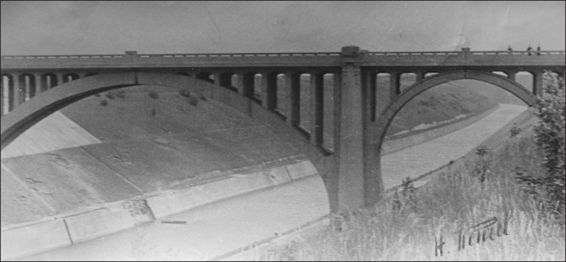
Capture of the bridges spanning the Albert Canal was critical to the success of the German campaign in the West. The Vroenhoven Bridge was the objective of Group Concrete, commanded by Lieutenant Gerhard Schächt and consisting of ninety-six men in eleven gliders. The group accomplished its mission despite heavy Belgian resistance, suffering seven dead and twenty-four wounded.
By the time Witzig arrived, most of the fort was in German hands, as he recalled:
There wasn’t much shooting at the time. I went to Objective 19, where our command post was supposed to be. I went to Feldwebel Wenzel to receive all battle information. He had taken over the position, in the meantime, and was already receiving reports from some of our troops. We established our fighting position. The essentials – such as [overhead] photos, call signs, radios and whatever else needed to keep a platoon alive were with me.57
Later, Witzig described Wenzel, who would serve with him in North Africa and win the coveted German Cross in Gold, as ‘a first-rate man . . . [an] old engineer with vast experience’ as well as ‘a vigorous troop leader’.58
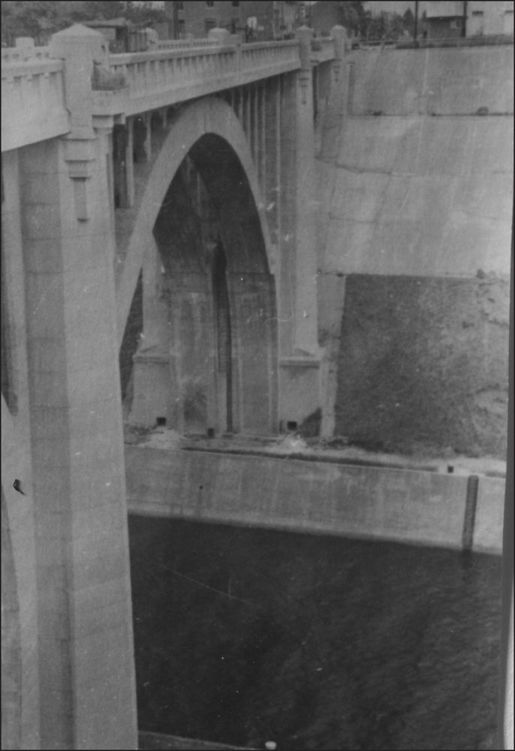
Another view of the Vroenhoven Bridge.
Assault Group Granite’s two remaining tasks were to blow in the fortified entrances in order to press the attack into the depths of the fortress and to hold all captured positions until relief arrived. ‘During some hours of moderate fighting, we managed to reconnoitre the entrances and we penetrated the installations already captured,’ Witzig reported, ‘but then the Belgian artillery started to shell our positions and their infantry attacked us repeatedly over the north-western slope, which was covered with dense undergrowth.’59 A series of belated Belgian counter-attacks, beginning at 1000 hours, were indeed launched to regain control of the fort’s surface. The first assault was smashed by Ju-87 Stuka dive bombers. A second counter-attack by reserve troops from near Wonck also failed. The situation, however, forced Witzig and his men to defend themselves in the north-western sector of Eben Emael, which they occupied against the advancing Belgians.
In the meantime, his command continued with their mission of penetrating the fort. ‘During the afternoon and night we detonated charges up to 100 kg each at the bottom of the ascent shafts, each about forty metres deep, below installations 3, 4, and 6, defended by barricades of rails and sandbags,’ he recorded. ‘In the narrow passages the explosions had a devastating effect.’60 In fact, the explosions caused huge shock and sound waves, which reverberated throughout the tunnels and underground galleries, knocking out electricity and producing panic among the garrison. The situation inside the fort further deteriorated with the sympathetic bursting of barrels of calcium chloride, a disinfectant stocked throughout the fort, which filled the air and acted as a choking agent. According to the official Belgian report by Major Jottrand, commanding the garrison: ‘The first contact with the enemy made a disastrous impression on those who lived through it. They had always thought themselves safe and secure under their steel and concrete. Now they felt like prisoners of their own fort.’61 The Belgian commander felt that his troops could not offer an effective defence against the Germans armed with shaped charges.
Meanwhile, the paratroopers who had landed at Vroenhoven and Veldwezelt had successfully accomplished their mission. The bridges were captured undamaged and small bridgeheads were established and defended with the assistance of machine-gun detachments dropped later by parachute. During the afternoon of 10 May, these troops were relieved by German infantry. At Kanne, however, the Belgians succeeded in blowing up the bridge and the attacking paratroopers were engaged in a long day of hard fighting, which prevented the 51st Engineer Battalion, detailed to relieve Witzig’s men at Eben Emael, from crossing the Albert Canal. The engineers’ attempts to cross in rubber dinghies were prevented by Emplacement 15 (Canal North) on the western side of the canal. ‘We ourselves could hear the gunfire far below us,’ remembered Witzig. Eventually he and his men managed to neutralize the emplacement by lowering charges in front of the observation slits and detonating them. The resulting smoke and dust obscured visibility and the explosions no doubt encouraged the defenders to move elsewhere.
At 2000 hours, with the Germans firmly in control of the superstructure and his garrison trapped in the bowels of the fort, Major Jottrand called for further counter-attacks and, shortly afterwards, issued orders for defence during the night. Belgian guns and mortars from Forts Pontisse, Barchon, and Evegnée fired almost 1,000 105-mm and 150-mm rounds at Eben Emael during the night, but Witzig’s men were well protected inside captured casemates.62 ‘I expected a massive attack by well-trained [Belgian] infantry during the night,’ Witzig remembered. ‘If that had happened we would have been lost.’63 Fortunately for the Germans a concerted attack failed to materialize.
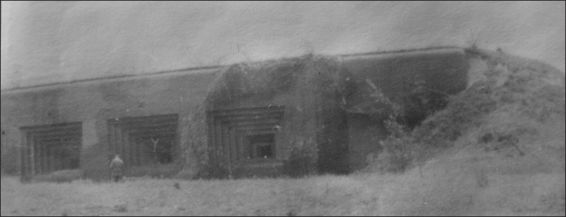
A German soldier stands in front of one of Eben Emael’s massive artillery fortifications.
The night was uneventful [recorded Witzig]. After the hard fighting during the day, the detachment lay exhausted and parched, under scattered fire from Belgian artillery and infantry outside the fortification. Every burst of fire might have signalled the beginning of the counter-attack we expected, and our nerves were tense.64
Witzig was fortunate that an aerial resupply drop earlier that day had provided him with additional ammunition, although no food or water had been received. Witzig also discovered his single medic could not meet the unit’s medical needs.65
At 0700 hours on 11 May, the advance elements of the 51st Engineer Battalion arrived at Eben Emael, having crossed the ditch in front of installation 4 in a rubber dingy. They silenced the position, which Witzig’s men had twice tried to destroy, and thus opened the way for the entire battalion to enter the fort. Towards noon, other reinforcements arrived from the west and the last Belgian installations, Canal North and Canal South, ceased firing. Major Jottrand surrendered the fort at 1227 hours. Five hundred Belgian soldiers walked out of the fort and into five years of German captivity. The prisoners were kept in strict isolation until 4 July 1940, as the Germans wished to keep their use of both glider troops and shaped charges a secret. Twenty-three Belgian soldiers died and another 62 members of the garrison were wounded in the fighting.66
As we retired, after burying our dead and handing over 30 Belgian prisoners to the 51st Sapper Battalion, we saw scattered around the entrance installations the weapons of the garrison forces, who, with their commander, Major Jottrand, were taken away into captivity, According to a Belgian source, there had been about 750 men initially present out of a regular force of 1,200; it seems that some 15 per cent were absent on leave and that others were quartered in nearby villages – many arrived later.67
Of the 85 German paratroopers who had set out on 10 May to subdue the fort, 6 were killed and, apart from injuries sustained in hard landings, 20 were wounded.68
In the campaign as a whole, the Belgians finally capitulated to the Germans on 28 May; the Dutch had already done so two weeks earlier, after the Luftwaffe had levelled Rotterdam. Perhaps the Dutch received some small satisfaction in the fact that the man who had planned the airborne invasion of their country that had proven so effective, General Kurt Student, had been seriously wounded by a German soldier in Rotterdam, only moments before it was surrendered. A Dutch doctor saved his life after several hours of surgery.
Witzig wrote afterwards:
Although an attack was clearly not expected, our use of tactical and technical surprise made the destruction of the vital surface installations, artillery, and observation posts possible, and this in turn made the enemy uncertain about the general situation. Damage to the ascent shafts and ventilating system only increased their confusion; all help from the outside, including the field artillery, failed. They felt captives in their own fortress and their fighting spirit was stifled. Although defeated only in their surface positions, they were not prepared to make a counter-attack in the open field, even before the fortress was surrounded; while they may have been trained only to fight under cover, this nevertheless reveals shortcomings. Certainly an attack by night would have hurt us considerably . . . The disposition of the fortification itself seems to have been a disastrous mistake: defended trenches in front of the casemates would have made entry into the gun embrasures much more difficult for us – but there were no such close defences, even for the heaviest guns. Moreover, the defenders should have had sufficient imagination to cover the surface with mines and wire entanglements. On the other hand, the two dummy installations . . . were extremely effective in deceiving us, and the canal defences, which were immune to attack at close quarters, ensured for a long time the security of the canal.69
The shaped charges played an important role in the fall of Eben Emael. Witzig himself describes their effects as ‘tremendous’:
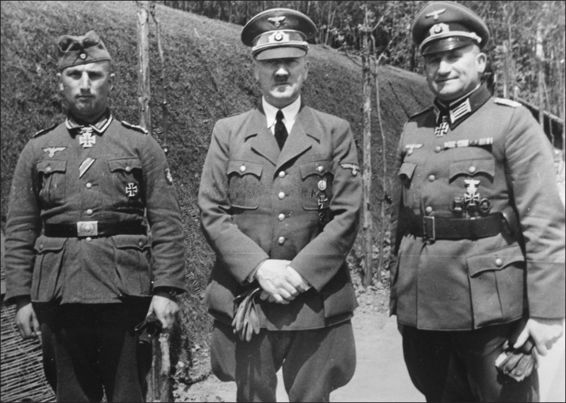
Adolf Hitler with (left) the commander of the 51st Engineer Battalion.
We hadn’t expected such destructiveness. We later saw what had happened inside the Belgian positions, and that the effects of the explosions reached throughout the interior of the fort. I attribute the precipitate surrender of the fort to the effects of these shaped charges and the fact that the defenders did not know where and when the next explosion would come.70
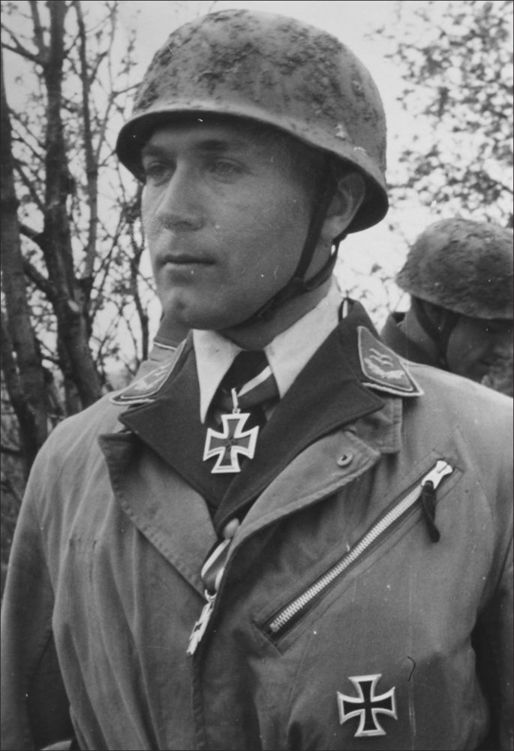
Lieutenant Gustav Altmann, shown here wearing the Knight’s Cross presented to him by Adolf Hitler. Altmann led Group Steel’s attack on the Veldwezelt Bridge.
After the war, Witzig would tell his son: ‘If more time had been devoted to indirect defensive measures atop Eben Emael – including more machine guns, wire, anti-personnel mines, and obstacles – we would have run into real problems taking the fort!’71 However, once ensconced first atop and then inside the superstructure, the German paratroopers proved impossible to dislodge. With hindsight, Witzig also thought little of the Belgian defenders:
An examination of Belgian sources suggests that, in spite of all preparations, the Belgian soldiers did not believe in the war, and, furthermore, that what happened at Eben Emael was typical of the whole 18-day campaign. Morale in Belgium had been weakened by neutralist politics, and an ill-prepared army fought badly because it was badly led. For the most part, it lacked the will to fight.72
Witzig went on to note that Major Jottrand had few options available to him in the defence of Eben Emael:
With good units, long occupation of the position, good training, he might have abandoned the fort except for a couple of bunkers that would still fight – all the others being unimportant – and fought us in the open, on top of the fort. It could have been done, because we were not besieging the entrance to the fort. With well-trained soldiers and careful orders given inside the fort, he might have marched out and fought as infantry and, with artillery support, anything would have been possible. But it required a good troop unit and requisite training . . . I assume, however, that all of this was not the Belgian commander’s fault . . . He could not, at the last moment, turn the Belgian fortress artillery into another sort of unit . . . He couldn’t do that, and I can’t reproach him for it. The planning of the Belgian General Staff for the defence of the Albert Canal and its bridges was faulty: a big, modern fort with an unclear mission, inadequate weapons and no support.73
A Belgian history of the Second World War supports many of Witzig’s conclusions and provides further insights. It notes, for example, that at the tactical level the fort was poorly equipped to deal with the threat from the air. ‘From the onset of operations, the Belgians were dominated from the air,’ writes Professor Luc De Vos from Belgium’s École Royale Militaire (Royal Military College). ‘The consequence was the loss of all initiative.’ Also, reliable liaison between the Belgian infantry and artillery was lacking, leading to the loss of a number of artillery pieces without a shot being fired. In addition, troop training in the Belgian Army was weak in many aspects in 1939 and 1940 and exercises almost non-existent. In comparison, the Germans trained twelve hours a day, six days a week and incorporated realistic and demanding live-fire exercises into their programme of instruction. Finally, the use of obstacles on the superstructure of the fort had been badly neglected, allowing the attacking paratroopers rapidly to establish an airhead directly atop Eben Emael.74
If the Belgian Army and garrison of the fort were caught unprepared, the same cannot be said of their opponents. The Belgian history points out that the German Army achieved its objectives in a ‘magnificent’ manner, using a small force to accomplish ‘spectacular’ results. Assault Detachment Koch is credited with achieving almost total tactical surprise and local fire superiority through the use of gliders, paratroopers, shaped charges, sub-machine guns and flame-throwers. Surprised was achieved despite the fact that the fort was on alert when the Germans landed. The crack-of-dawn timing of the attack, in conjunction with an early morning fog, added to the confusion of the defenders. German air superiority, and especially the use of Stuka dive-bombers as aerial artillery, robbed the Belgians of the initiative and more than compensated for the lack of heavy fire-power amongst the glider troops, with air power used to prevent reinforcements from reaching the fort in strength or launching effective counter-attacks. Detailed planning, preparation and training ensured the parachute-engineers were more than prepared for the challenges of seizing Eben Emael. Finally, the valour of the German paratroopers, many of them receiving their baptism of fire, was, according to the Belgian historian, ‘conspicuous’.75
‘The storming of Eben-Emael was the first sapper attack ever made from the air,’ Witzig boasted afterwards, lauding the achievements of his command and the German airborne engineers. ‘That it was successful is due to the efficiency and enthusiasm of the parachute sappers, using new weapons and new means of transport, aided by careful preparation, the participation of the Luftwaffe, and clear conditions of command.’76 Student agreed wholeheartedly. ‘So far as Germany was concerned the paratrooper and airborne assault on Fortress Holland, the bridges across the Albert Canal, and Eben Emael justified the airborne force concept,’ he wrote after the war. ‘Everybody sat up and took notice, including the Wehrmacht. During the Polish campaign nobody had much faith in the idea, and the prestige of the parachutists suffered a setback. But after the operations in the West morale soared and the paratroopers became an elite corps.’77
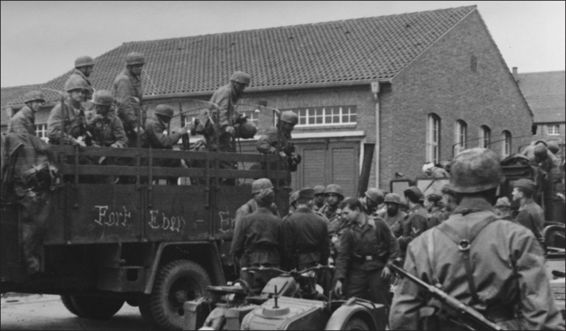
The heroes of Eben Emael returning to garrison on 12 May 1940 after having seized the greatest of Belgian forts. Eben Emael capitulated the previous day with some 1,200 Belgian soldiers surrendering.
The fall of Eben Emael and its associated bridges dealt a tremendous psychological shock to the Allies. Indeed, one historian, James Mrazek, author of a book on the fall of Eben Emael, goes as far as arguing that it led directly to the Dunkirk evacuation and sealed the fate of France in May 1940 by allowing the Wehrmacht to slice its way across Belgium and France, stopping only when its panzers reached the English Channel.78 This is overstating the case. The Allies, with their overwhelming quantitative superiority in infantry, modern tanks, artillery, and aircraft, could still have turned the tide against the Germans at Sedan or Arras had they been better prepared or their forces more aggressively employed. However, according to Field Marshal Albert Kesselring, who served as the commander of the German Second Air Fleet during the Netherlands campaign and later as the German Commander-in-Chief, South-West:
With the capture of Fort Eben Emael, the enemy flanking actions against the Maas crossing were eliminated. The capture of the most important bridge guaranteed that the Maas River would be crossed according to plan and thus established the necessary conditions for the coordination of ground and air operations in Holland. The dawn missions succeeded surprisingly well.79
According to one postwar report written by a group of German generals, which included General Student:
This success was connected not so much with the achievement of the tactical objectives, such as the capture of a number of bridges, which were important to the attacking ground forces, as with the moral influence exerted upon the enemy by a wholly new method of fighting. The very fact that, in this way, large forces could penetrate deep behind Dutch defences at the outset of the fighting undoubtedly broke the resistance of the Dutch and saved the German Army the cost of a serious fight in capturing Holland. Success is attributed mainly to the surprise achieved by this method, which was used for the first time in the history of warfare.80
Hitler’s decision to use airborne troops against Eben Emael was an inspired one. But a quick German victory was not as inevitable as many historians suggest, even in light of the many shortcomings of the Belgian Army, as shown by the concurrent events in Holland. In May 1940 the Germans employed some 5,000 paratroopers to seize three key Dutch airfields – Ockenburg, Ypenburg and Valkenburg – ringing the Hague in the north of the country, as well as to secure nearby bridges across the Maas River at Rotterdam, Dordrecht and Moerdijk. Student’s airborne forces consisted of four parachute battalions and one air-transport regiment of three squadrons. In five days of fierce resistance the Dutch Army, whom few observers would have rated more effective than their Belgian counterparts, inflicted some 2,735 casualties on the German paratroopers and air-landing forces in the Hague sector alone, capturing no fewer than 1,745 enemy soldiers, of whom 1,350 were sent back to England as prisoners. According to reliable Dutch and German sources, as many as 525 aircraft, including many of the valuable Ju-52 transports, were damaged or destroyed during the battle for the Hague.81 This figure appears to be extremely high. Nonetheless, one Dutch historian, Lieutenant-Colonel Eppo Brongers, asserts that the Luftwaffe’s losses precluded the Germans from marshalling enough transport aircraft to conduct an airborne assault on England that year and that, even a year later, during their costly attack on Crete, Hitler was critically short of Ju-52s as a result of losses in Holland and was forced to commit his paratroopers piecemeal. There is evidence to support this statement. The Luftwaffe’s Ju-52 transport fleet in 1939 consisted of approximately 1,000 aircraft, a number which the Germans tried to maintain throughout the war. Monthly production of new aircraft ran at 80–120 planes but this was only sufficient to offset ‘normal’ losses.82 Approximately half of the available transport had been used for the attacks in Holland and Belgium.83
There also appears to be a great deal of truth to the rumour that the Dutch were forewarned by German officers and diplomats about the impending German invasion of their country. Indeed, Rudolf Witzig indicated to U.S. Army interviewers after the war that he believed that Admiral Canaris, the head of German military intelligence, had tipped off the Dutch military attaché as to the date of the German assault on the Low Countries. ‘Happily,’ Witzig concluded, ‘they didn’t believe the reports.’84 In the end, however, the Wehrmacht’s preponderance on the ground and in the air prevented a complete disaster. Senior German commanders blamed their difficulties on ‘the inadequate strength of parachutists in the air attack group’ as well as ‘the command technique of General Student’ who ‘neglected liaison with the Second Air Fleet, especially during the most decisive hours’, for the operation’s failures and losses.85 These same deficiencies would resurface with a vengeance at Crete a year later.
Thus, a successful attack on Eben Emael was not as predestined as many believe. Indeed, had the German Army used traditional infantry and artillery attacks against Eben Emael or had the Belgian defenders and the fort simply been as well forewarned as their Dutch brethren, a bit better prepared, or even more fortunate the outcome might have been very different. The smaller and weaker Belgian fort at Aubin-Neufchâteau, east of Visé, for example, held out until 24 May against an entire German infantry division and surrendered only when the enemy were already at the beach near Abbeville in France.
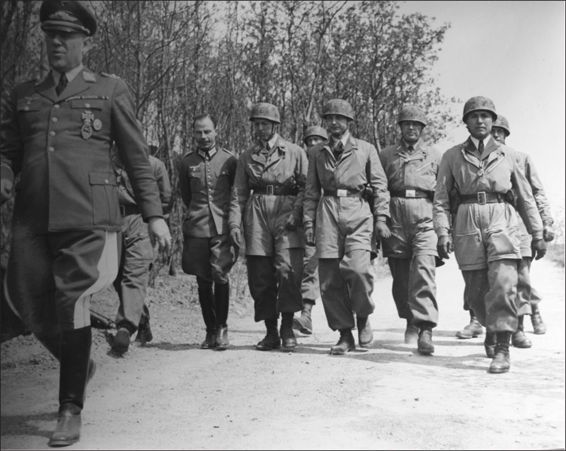
The commanders of Sturmabteilung Koch returning from receiving their Knight’s Crosses. Rudolf Witzig is the first fully visible paratrooper on the left.
Several days after their return to their home base, Walter Koch, Rudolf Witzig and all the officers of Assault Group Koch were ordered to report for a special ceremony. Adolf Hitler addressed the group and then awarded each officer the prestigious Knight’s Cross, then the highest class of the Iron Cross, awarded for exceptional gallantry in the face of the enemy, for their successful accomplishment of their mission. The enlisted men were awarded the Iron Cross by General Albert Kesselring. In addition to the award, each participant was promoted one rank. There was only one exception, a member of Witzig’s command, a paratrooper named Grechza, when it was discovered that he had carried a canteen full of rum with him into Eben Emael. Within nine months of the outbreak of the Second World War in Europe, Witzig and Koch had thus joined the ranks of a new and select few. They were also awarded both the Iron Cross First Class and the Iron Cross Second Class. And the government even printed postcards, suitable for autographing, with faces of its new Knight’s Cross winners on them. The heroes of Eben Emael and the Albert Canal were lionized by the German public as celebrities. In May, shortly after receiving the Knight’s Cross, Witzig was assigned as adjutant to Reichsmarschall Göring, Hitler’s second-in-command and the Commander-in-Chief of the Luftwaffe.
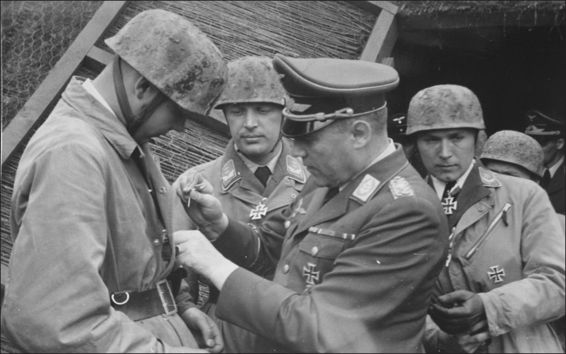
Captain Koch being pinned with the Knight’s Cross.
Although the head of the German Air Force was always kind to him and Witzig found him to be ‘a good family man’ and even ‘interesting’, the hero of Eben Emael also believed the Reichsmarschall to be a ‘salon soldier’, in self-designed uniforms of white and powder blue. As a result, Witzig wanted very much to return to his paratroopers. Jürgen Witzig told the author how his father contrived to do so. One day, as Witzig was driving Göring to a hunt near Höxter, a large deer stepped onto the road nearby. The Reichsmarschall immediately grabbed his gun and attempted to shoot the animal without getting out of the car. However, Witzig, who hated hunting, leaned on the horn ‘accidentally’, scaring the deer away. A furious Göring, who could not have been unaware of his adjutant’s desire to return to his unit, bellowed out: ‘Witzig! It is better that you go back!’ The young captain did not leave empty-handed, however. Göring asked Witzig if he liked the car that they were riding in, a BMW two-seat sports convertible. When Witzig admitted to admiring the vehicle, Göring said: ‘It’s yours!’ According to Jürgen Witzig, his father took the car to Braunschweig in 1940 and paid to have it garaged there for the duration of the war. When he returned after the war to claim his property, he found the city completely devastated from Allied air raids. Miraculously, the garage holding his car, and the vehicle inside, survived! However, Witzig soon lost the vehicle to a British officer, who claimed it as ‘reparations’!86
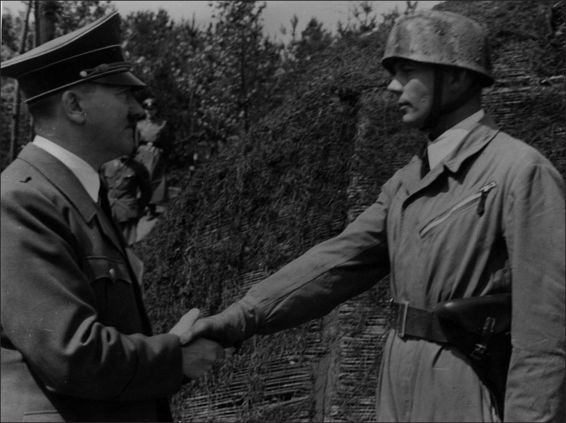
Adolf Hitler shakes hands with Captain Koch following the German seizure of the Belgian fort and surrounding bridges.
Witzig’s tenure with the head of the Luftwaffe lasted only three months, but was nonetheless a fruitful one in other ways also. On 16 August 1940 Witzig was promoted early to captain.
That summer of 1940, Witzig attended a ball in Höxter honouring Germany’s airborne victory at Eben Emael. The large hall where the event took place was decorated with parachutes and the young and handsome Captain Witzig was the guest of honour. However, Gerda Remmers, to whom he had grown quite attached, was absent as she was in Münster diligently studying for her medical exams. When the hero of Eben Emael asked her younger sister, Hanna, now sixteen, to dance, she and her friends were ‘astonished’. After the dance, the young woman purchased a Rudolf Witzig postcard for 50 Pfennig and had him autograph it. Witzig only danced once with Hanna. ‘He did not like dancing,’ she remembered with a laugh, almost sixty-five years later. ‘He acted like a young boy!’87 She would not see him again for almost two years.