
Chapter 4
The success at Eben Emael had moved airborne operations to the forefront of Hitler’s thoughts, and after the conclusion of the Western Campaign in 1940 the Wehrmacht began preparations for the invasion of England, Operation Sealion, which included an airborne operation. Two trains of thought governed the selection of objectives. The first idea was to establish airheads to assist the naval landings. Two divisions of airborne and air-landing troops were to capture from the rear the locations suitable for landings from the sea. The second idea was to capture airfields in order to paralyse the Royal Air Force, while at the same time obtaining landing fields for the Luftwaffe. A large number of objectives thus emerged, including simultaneous airborne landings at Dover, Beachy Head and Brighton, as well as the seizure of numerous airfields. However, these could not all be supported due to the limited number of paratroopers and transport aircraft available. In the end the objective selected was the establishment of an airhead at either Folkestone or Dungeness.1 The airborne landings were initially part of a thirteen-division assault, but this was later scaled back to nine divisions with two airborne divisions.2
The airborne troops selected for the invasion of England were the 7th Flieger and the 22nd Air-Landing Division. By August the Luftwaffe had been able to make up some of the losses in personnel suffered in May 1940. According to German sources those losses included some 1,000–1,500 paratroopers. In reality they probably exceeded 2,000 men.3 The paratroopers would have been supported by some 400–700 transport aircraft, depending on whether the operation would have taken place in July or August, along with some 100–150 gliders.4 The number of transports and gliders available for Sealion was not enough to carry the entire airborne force in one lift and multiple sorties would have been required.5
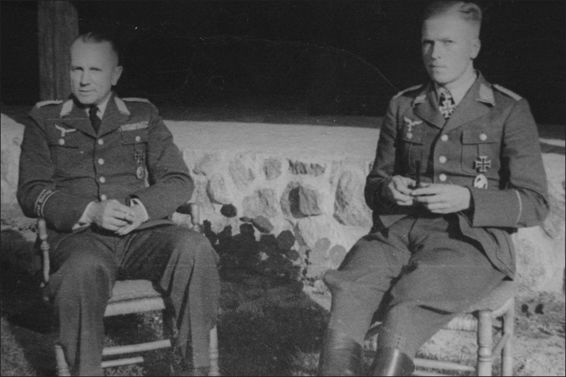
Witzig at Göring’s Karinhall some time between May and August 1940.
The prospects of success were variously assessed, with Field Marshal Kesselring favouring an invasion of England, believing that while an airborne assault, as in the Western Campaign, would not have decided the whole campaign; it would have helped, perhaps very effectively, to attain final success. While an essential condition for Operation Sealion was the achievement of German air supremacy over southern England, it is questionable whether the Luftwaffe could have effectively protected the airborne and air-landing forces against the extremely aggressive and lethal Royal Air Force. The Battle of Britain disclosed that the strength of the RAF had been dangerously underestimated by Hitler and Göring. Furthermore, the Kriegsmarine, which for the most part had been annihilated by the Royal Navy off Norway, would have been unable to launch or safeguard an amphibious landing across the Channel. In the end, an airborne operation against England was cancelled with the termination of Sealion. ‘It is unlikely that the airborne landing would have been really successful,’ concluded a panel of senior German officers after the war. ‘Any minor local successes would have been balanced by heavy losses in personnel and material.’6
Soon after Sealion was shelved, Hitler asked General Student to study the possibility of capturing Britain’s greatest overseas fortress, Gibraltar, by airborne assault much in the same way as the Germans had captured Eben Emael. That such an operation, code-named ‘Felix’, was under serious consideration was verified by Hermann Göring, after his capture by American forces. ‘Lack of shipping had prevented us from invading England, but before the difficulties with Russia we could have carried out the “Gibraltar” plan . . . The entire Italian Army, which was unfit for a major war, could have been used for occupation forces,’ he explained to U.S. interrogators. ‘The loss of Gibraltar might have induced England to sue for peace. Failure to carry out this plan was one of the major mistakes of the war,’ he continued. Göring claimed the plan as originally his and noted that the Kriegsmarine was in favour of it as it would have provided the Germans with better naval bases. ‘Instead of being cooped up in Biscay and Bordeaux, it could have had U-boat bases much farther out in Spain and on the Atlantic islands,’ explained Göring. ‘If the campaign succeeded, I personally wanted to attack the Azores to secure U-boat bases there, which would have crippled British sea lanes.’ Göring stressed that the main task in seizing Gibraltar would have fallen to the Luftwaffe and his Fallschirmjäger. ‘So I was chiefly concerned and I would have eagerly carried out the operation. The Luftwaffe had many officers who had participated in the war in Spain a year and a half [sic] before and knew the people and the country.’7
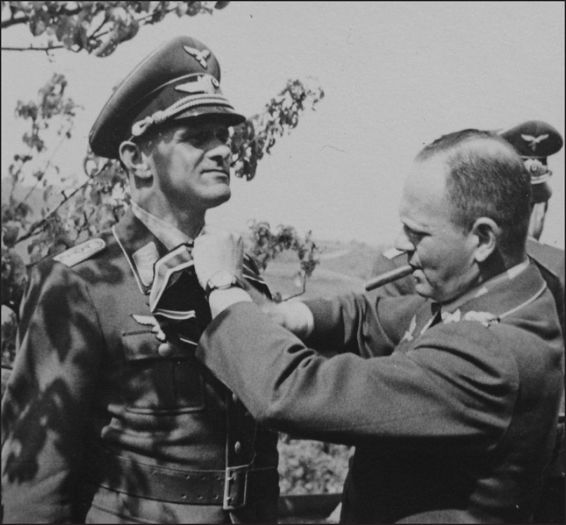
General Milch decorating a Luftwaffe officer at Karinhall, summer 1940.
Once the invasion of the British Isles was deemed impractical, planning for the seizure of Gibraltar was moved to the forefront and on 14 August 1940 Hitler consented to a proposal by the Wehrmacht Operations Staff for the seizure of the fortress and ordered that an operational study be prepared. The study was completed on 20 August and approved by Hitler four days later. ‘The High Command of the German Wehrmacht anticipated a successful outcome to the undertaking,’ recorded Helmuth Greiner, the keeper of the War Diary in Hitler’s headquarters from August 1939 to April 1943. Indeed, an estimate produced by the Armed Forces Operations Staff concluded: ‘If Spain decides to enter the war, Gibraltar can easily be captured by specially trained German troops.’ This, however, was not the conclusion of General Student, well aware that tentative plans called for the use of his airborne forces to capture and hold the Rock, pending the arrival of the ground forces, which included formations from the Grossdeutschland Regiment, the 98th Mountain Infantry Regiment and particularly strong artillery elements grouped together under General Keubler’s XLIX Infantry Corps. Part of that study included an assessment ordered by Student, as commander of German airborne forces, and written by Rudolf Witzig. On 1 August, Witzig had submitted a concise, three-page report, complete with a photograph of one of the potential landing zones, concluding that the capture of Gibraltar from the air was not feasible. ‘The use of parachute and air-landing units to seize or assist in the seizure of Gibraltar,’ he wrote, ‘is precluded for the following reasons: The terrain, except for the windmill flat to the south of the peninsula, is not suitable for air landing [operations]. Even the exception allows only for the use of gliders in a small number . . . The [aircraft] exit/drop point would be very difficult to determine due to unpredictable wind conditions and the fact that the approach is hindered by southern hills.’ Witzig concluded that the lack of sufficient landing space for gliders and paratroopers, the steep terrain, the heavy British fortifications and defensive armament, the low speed of the Ju-52 transports, and the probable loss of surprise would result in the failure of the operation. According to Jürgen Witzig, prior to writing the report his father conducted a reconnaissance of the potential drop zones in person under the very noses of the British themselves, assisted by the Armed Forces Intelligence (Abwehr), which shuttled him through diplomatic channels into Spain. Witzig carried out his on-the-spot assessment in mufti prior to writing his report.8 While difficult to believe, this story is very much in keeping with Rudolf Witzig’s nature and that of most Fallschirmjäger officers, who valued boldness. The venture was also consistent with Hitler’s Directive 18 of 12 November 1940, which mentioned the possible German seizure of Gibraltar. ‘Reconnaissance parties (officers in plain clothes) will draw up necessary plans for action against Gibraltar and for the capture of airfields.’9
It is unclear how much Witzig’s report, which stressed that surprise was the key to success and that such surprise would be impossible in any airborne attack on Gibraltar, contributed to Hitler’s eventual cancellation of Operation Felix. When General Franco made it clear that Spain would not enter the war on the side of the Axis unless Britain was on the eve of collapse, Hitler postponed Felix. On 11 December 1940, Hitler ordered the Armed Forces High Command to discontinue preparations for the seizure of the island. On 28 January 1941, General Jodl informed Hitler that an attack on Gibraltar could not be launched before mid-April if preparations were not completed by 1 February and stated that the forces needed for Operation Felix would not be available for Operation Barbarossa, Hitler’s planned invasion of the Soviet Union scheduled for mid-May. Hitler then decided to drop thoughts of taking Gibraltar.10
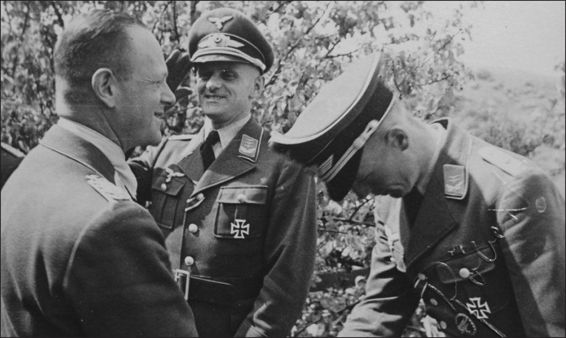
General Milch at Karinhall with two officers who are to be decorated by Göring.
After its return to Germany, the 7th Fliegerdivision was expanded to three parachute regiments, each with three battalions. In addition, Assault Detachment Koch became the 1st Battalion of the newly formed Luftlande-Sturmregiment, or Air-Landing Assault Regiment, comprising four battalions of paratroopers trained as a glider-borne infantry air-landing assault force. Command of the new regiment was bestowed on Colonel Eugen Meindl with the newly promoted Major Walter Koch assuming command of the 1st Battalion. The 7th Fliegerdivision and the 22nd Air-Landing Division were then incorporated into the XI Fliegerkorps, established that summer, along with the six transport groups of the 7th Fliegerdivision, each equipped with 52 Ju-52s.11 Upon his return from Göring’s personal staff in August 1940, Witzig was assigned to the Air-Landing Assault Regiment as commander of the 9th Company, 3rd Parachute Battalion. Witzig’s company and a good part of the 3rd Battalion consisted of parachute engineers. Captain Witzig’s company spent the winter of 1940–1 conducting winterwarfare training in the Harz Mountains. An artillery officer and veteran of the First World War, Meindl, by now a legendary figure in the German airborne forces for his exploits in Norway, had served in both the Imperial German Army and its successor, the Reichswehr. After ten years of working in the Reichswehr Ministry, he went on to command a mountain artillery regiment. During the invasion of Norway, he had led Group Meindl at Narvik, where he parachuted into combat without any previous airborne training. Appointed commander of Assault Regiment Meindl of the Army’s parachute troops in August 1940, he and his command were transferred to the Luftwaffe shortly afterwards.12
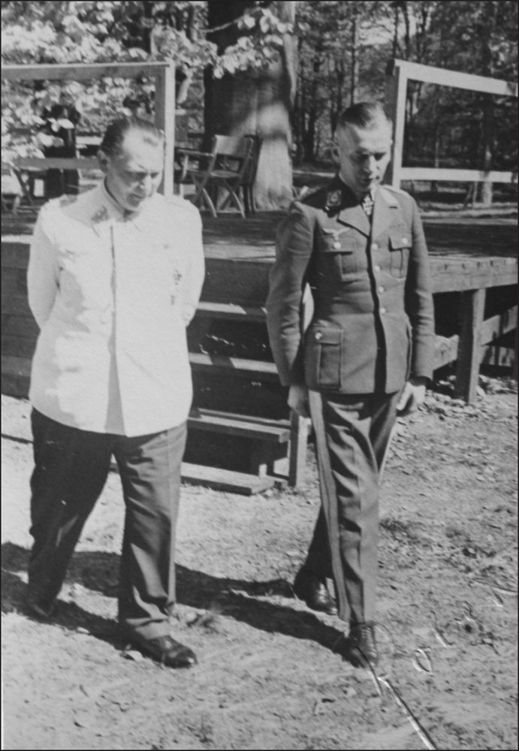
Hermann Göring, Commander of the Luftwaffe, with his Chief of Staff, General Hans Jeschonnek, May 1940. Jeschonnek would commit suicide in August 1943.
During the second half of the 1930s the Balkans became the centre of conflicting interests of Germany, Italy, Russia, and Great Britain. From the beginning of the war Hitler had consistently stated that Germany had no territorial ambitions in the Balkans. Indeed, his primary interests in that area were economic and included vital oil and food supplies. As the war progressed, the Balkans constituted the southern flank for an invasion of the Soviet Union. Hitler was thus prepared to do his utmost to preserve peace in that part of Europe. For this reason he attempted to keep Italy’s aggressive Balkan strategy in check, to satisfy Hungarian and Bulgarian claims to Romanian territory by peaceful means, and to avoid any incident which might lead to direct British intervention in Greece. However, Mussolini’s invasion of Greece on 28 October 1940 and the almost immediate setbacks suffered by the Italians at the hands of the hard-fighting Greeks brought the Balkans to the forefront of Hitler’s strategic thinking. On 4 November, seven days after Italy had attacked Greece through Albania and four days after the British had occupied Crete and Limnos, Hitler made the decision to intervene militarily. He ordered the Army General Staff to prepare plans for an invasion of northern Greece from Romania via Bulgaria to deprive the British of bases for possible ground and air operations across the Balkans against the Romanian oilfields. Moreover, such an invasion would assist the Italians by diverting Greek forces from Albania. The plans for this campaign, together with Hitler’s intentions for Gibraltar and North Africa, were incorporated into a master plan to deprive the British of all their Mediterranean bases. On 12 November 1940, the Armed Forces High Command issued Directive 18, which outlined Hitler’s plans for future operations to the three services.
On 25 March 1941, the Yugoslav government yielded to German pressure, joined the Axis Alliance, and agreed to let German troops cross its territory – despite growing opposition among the Yugoslav people to closer association with Germany. Two days later, a coup d’état toppled the government. The new leadership was determined to stay out of the coming German–Greek conflict and went to great lengths to assure Hitler that it was friendly. Hitler, who harboured a long-standing antipathy towards the Yugoslav nation and was furious over the government’s change of face, added Yugoslavia as a target of invasion.
On 6 April 1941, the Wehrmacht therefore invaded Greece and Yugoslavia, quickly overrunning both countries, despite determined Greek and British resistance. Hitler attempted to justify his invasion of Greece by accusing the country’s leaders of cooperating with the British. In the case of Yugoslavia, the Führer was determined to destroy it as a nation and ordered the Luftwaffe to demolish the capital city of Belgrade. On 17 April, the Yugoslav government surrendered and six days later the Greek Army capitulated. Between 24 and 29 April, the British evacuated some 50,000 British and Greek soldiers from mainland Greece. The Germans had suffered some 5,000 casualties against 12,000 British and 16,000 Greeks killed, wounded, missing or captured. Hitler had crushed Yugoslavia, conquered Greece, and shored up his Italian allies, while establishing a military presence in the Mediterranean area that Mussolini had tried to avoid.
Although the invasion of Crete was not part of Hitler’s original attack plan, he sanctioned Operation Mercury while the invasion of Greece was still under way. Although Gibraltar was not deemed ripe for capture by airborne assault, Hitler felt that the island of Crete was. Its possession would allow him to control the Aegean, secure the sea route from the Danube through the Dardanelles and the Corinth Canal, so essential to Italy – especially for its oil, limit the influence of Allied air and sea power in the eastern Mediterranean, and use the island as a base on the flank of the North African theatre and of the sea route between Alexandria and Malta, for future conquests. Furthermore, it would prevent the British from using the island as a staging base for bombers to strike at the Ploesti oilfields in Romania.13 Even Witzig agreed, long after the war, that the Germans had to capture the island. ‘Taking Crete was essential and made sense from the strategic point of view of the war of the German Reich,’ he emphasized in an interview. ‘The British fleet ruled the Mediterranean Sea, the Italian fleet was weak from the beginning . . . One had to keep the British out of the Balkans, the Black Sea and the Aegean. Crete could not stay in British hands. Crete had to be eliminated as a British attack base!’14
Crete is approximately 260 km long and 12–55 km wide. The interior is barren and covered by eroded mountains, which rise to an elevation of 2,470 metres in the west. There are few roads and water is scarce. The south coast descends abruptly towards the sea and the only usable port along this part of the coast is the small harbour of Sphakia. There are hardly any north–south communications and the only road to Sphakia which can be used for motor transport ends abruptly 400 metres above the town. The sole major traffic artery runs close to the north coast and connects Suda Bay with the towns of Maleme, Canea, Rethymnon and Heraklion. Possession of the north coast is vital for an invader approaching from Greece, if only because of terrain. The British, whose supply bases were situated in Egypt, were greatly handicapped by the fact that the only efficient port was in Suda Bay. The topography of the island therefore favoured the invader, particularly since the mountainous terrain left no other alternative to the British but to construct their airfields close to the exposed north coast.15
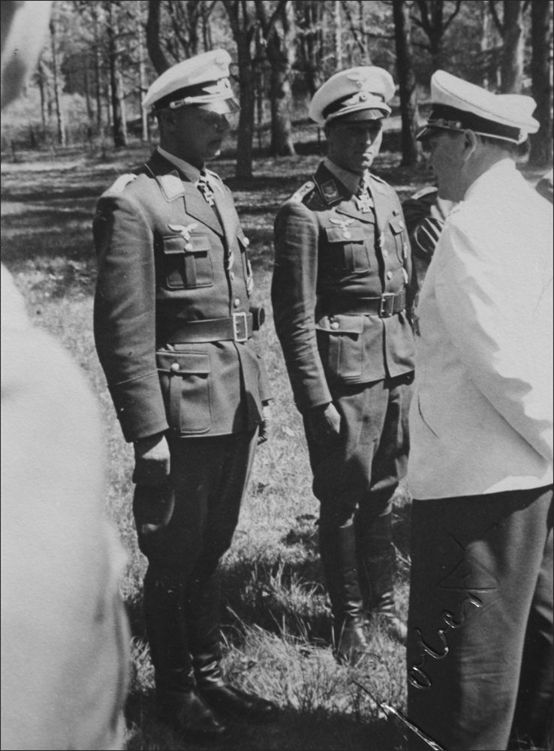
Göring with Koch and Witzig, May 1940.
According to General of Mountain Troops Julius Ringel, commander of the 5th Mountain Division, who later became the ground forces commander on the island, the plan for the invasion of the island consisted of five phases. The first was an air supremacy campaign. The second part called for the employment of paratroopers via parachutes and gliders to capture the airfields on Crete with the main effort at Maleme. In the third phase, mountain troops would be landed to complete the conquest of the island and conduct mopping-up operations. Next, additional reinforcements would arrive by sea on small vessels, landing on the open beach at Maleme. Finally, once a harbour suitable for unloading had been seized, a naval force transporting artillery, tanks, pack animals, and wheeled vehicles would follow. According to Ringel, no definitive plan was developed for these follow-on ground operations, and the sites for the landings of mountain troops, either Heraklion or Maleme, would depend on the success of the paratroopers.16
Hitler placed Hermann Göring in overall command of the operation. Its implementation, however, was left to Generaloberst Alexander Löhr, commander of Fourth Air Fleet and the senior Luftwaffe officer in the Balkans. A Knight’s Cross winner, Löhr had served as an infantry officer before the First World War and as a staff officer during much of that war, ending it in command of an infantry battalion. In 1934 he had been assigned to the Luftwaffe, where he had excelled in a series of command assignments.17 Available forces for the airborne assault on Crete consisted of VIII and XI Fliegerkorps. The actual operation called for a two-wave attack by three groups over four sectors on the first day of the operation. In the first wave, scheduled for the early morning, Group West would attack in the Maleme sector, while Group Centre would attack in the Canea sector. In the second wave, scheduled for mid-afternoon, the remainder of Group Centre would attack Rethymnon, while Group East would attack Heraklion. This assault would be carried out by some 11,500 men of the 7th Fliegerdivision, augmented by 3,500 men from the Air-Landing Assault Regiment. The attack would be supported by 228 bombers, 205 dive-bombers, 114 twin-engined and 119 single-engined fighters, and 50 reconnaissance aircraft from VIII and XI Fliegerkorps, a total of 716 planes, of which 514 were reported serviceable on 17 May. In addition, XI Fliegerkorps possessed over 500 transport aircraft, mostly Ju-52s, and 72 gliders for the operation.18 Once the key airfields and ports were seized, the airborne troops would be reinforced by some 14,000 mountain troops, including two rifle regiments from the 5th Mountain Division with a third from the 6th Mountain Division added later. These would be transported by relays of transport aircraft as soon as the captured airfields were prepared. Elements of the 5th Panzer Division, including a tank battalion, a motorcycle battalion and anti-aircraft detachments, would arrive by sea later.19
It was truly, as one German history notes, ‘an ambitious, audacious, and risky plan’.20 Ringel called it ‘a historic, singularly hazardous enterprise without equal in the daring of its planning, but even more daring in its execution’.21 However, as Ringel noted:
The first few sentences of the Operations Order sent a cold chill down one’s spine, for it was clear that the operation so laconically and soberly described would be a suicidal adventure. Anyone who had anything to do with Operation Mercury felt uneasy about it, to say the least, and those who actually had to go by boat regarded it with horror. Officers and men alike said they would rather fly to Crete than risk going by sea.22
The plan was indeed risky. The Germans had grossly underestimated the size of the island’s garrison: ‘So far as the Germans knew at that time, Crete had been occupied by British troops since the end of October 1940, and the approximate strength of the forces on the island was believed to be not more than 15,000 men, some of whom were believed to be exhausted from operations in Greece,’ wrote Freiherr von der Heydte, who commanded the 1st Battalion of the 3rd Parachute Regiment. Von der Heydte was writing with the benefit of postwar hindsight.23 In fact, at the time, the Germans believed there were no more than 5,000 combat-capable troops on the island. They were convinced, with good reason, that the island’s defenders were disorganized and suffered from not only a lack of equipment, but also the will to fight. During Operation Demon, the evacuation of British and Commonwealth soldiers from the Greek mainland in April 1941, more than 50,000 military personnel had been rescued. ‘Some 25,000 of these troops, the majority of whom had no equipment other than their rifles, were being re-organized in Crete,’ reported Admiral Sir Andrew Cunningham, Commander-in-Chief of Britain’s Mediterranean Fleet. ‘A large number were useless for defence purposes and were awaiting removal.’24 At the time of the airborne invasion the Germans faced almost three times the number of defenders they expected, including 15,000 British, 10,250 Greek, 7,700 New Zealand and 6,500 Australian soldiers, and a large number of Greek policemen. Not all, however, were equipped or prepared to contest an air- and sea-borne invasion. Three battalions of Greek Army recruits were, for example, poorly trained and badly armed, with rifles of many different calibres, and were short of everything from ammunition to clothing. Furthermore, malaria was endemic among those units. The 3,000 Greek policemen, on the other hand, were somewhat better armed and fed.25
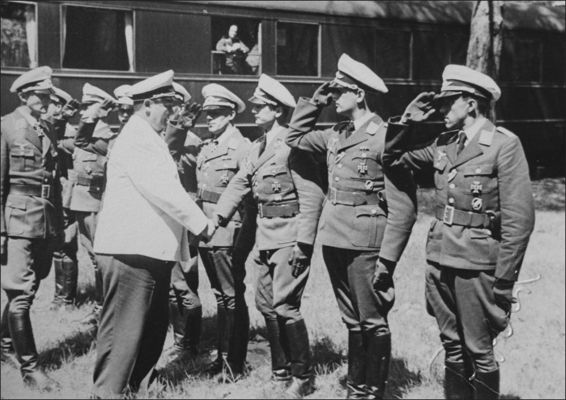
Field Marshal Hermann Göring greets Luftwaffe recipients of the Knight’s Cross following the Luftwaffe’s successful assaults on Eben Emael and the Albert Canal bridges.
Allied ground troops were supported by 6 Matilda infantry tanks, 15 light tanks, and 85 serviceable anti-aircraft and artillery pieces, a not insignificant contribution to the defence of the island.26 Against lightly armed parachute troops, reliant on large numbers of lumbering transports to deliver them to their objectives, the tanks and anti-aircraft artillery were particularly dangerous. At sea, four mixed naval task forces, three destroyer groups and a torpedo boat flotilla, under the command of Admiral Cunningham, stood ready to intercept and destroy any seaborne invasion. Furthermore, Ultra intelligence ensured that the Allies were forewarned about the impending German invasion. However, despite the availability of Ultra information General Sir Bernard Freyberg, commanding the Allied forces on the island, did not know precisely when the attack would take place. ‘Although intelligence suggested that an attack on Crete was very likely, the exact date of the attack could not be forecast,’ reported Admiral Cunningham. ‘It was thought that the most probable date for the attack to begin was about the 17th of May.’27 Furthermore, Freyberg had concluded that the real threat to his force was from the sea and not the air. This impression would later prove fatal to the defenders.
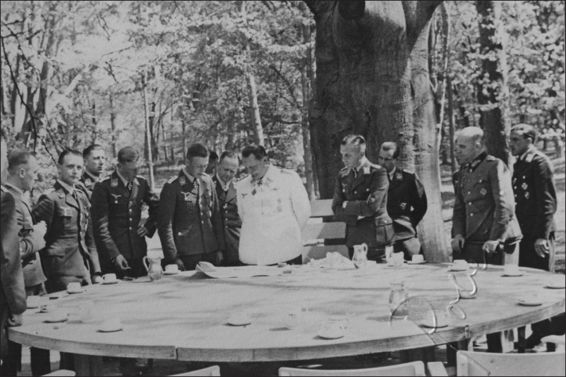
Field Marshal Göring with a group of Luftwaffe officers. General Milch and Rudolf Witzig are to Göring’s immediate right. General Jeschonnek is to Göring’s left.
On 20 May 1941, a perfect summer day, Hitler unleashed Operation Mercury, the airborne invasion of Crete. During the previous ten days, the Luftwaffe had achieved total air superiority over the island. On the morning of the battle, Witzig and his paratroopers received a special ration, aimed at building morale and increasing physical stamina in preparation for their impending combat jump. The ration included items considered real luxuries by the German soldier, including white bread, milk, butter and fresh eggs. For most of the paratroopers, this was the last real meal they would eat for some time; for many it would be their last meal altogether. During the course of battle, those who survived would rely on their iron ration, intended to sustain them for three days. It contained cans of sausages and cheese, chocolate substitute, crackers, chewing gum, lemonade powder, coffee and sugar and fuel tablets.28
Prior to the jump, Witzig and every paratrooper of the airborne division and assault regiment received a copy of Student’s ‘The Parachutist’s Ten Commandments’:
1. You are the elite of the German Army. For you, combat shall be fulfillment. You shall seek it out and train yourself to stand any test.
2. Cultivate true comradeship, for together with your comrades you will triumph or die.
3. Be shy of speech and incorruptible. Men act, women chatter; chatter will lead you to the grave.
4. Calm and caution, vigour and determination, valour and a fanatical offensive spirit will make you superior in the attack.
5. In facing the foe, ammunition is the most precious thing. He who shoots uselessly, merely to reassure himself, is a man without guts. He is a weakling and does not deserve the title of parachutist.
6. Never surrender! Your honour lies in Victory or Death.
7. Only with good weapons can you have success. So look after them on this principle – first my weapon, then myself.
8. You must grasp the full meaning of an operation so that, should your leader fall by the way, you can carry it out with coolness and caution.
9. Fight chivalrously against an honest foe; armed irregulars deserve no quarter.
10. With your eyes open, keyed up to top pitch, agile as a greyhound, tough as leather, hard as Krupp steel, you will be the embodiment of a German warrior.29
Student’s ‘Ten Commandments’ were no doubt meant to inspire his paratroopers on the eve of battle and to remind them that they were the elite of the Wehrmacht and that the eyes of Hitler would be upon them in history’s first attempt to capture a fortified island by an assault from the air. The Commandments, however, had an unintended consequence that would forever influence the reputation of the Fallschirmjäger.
As part of Group West, Generalmajor Meindl’s Air-Landing Assault Regiment was tasked with a number of missions. First, paratroopers arriving by glider in the Maleme area would destroy nearby British flak batteries and seize the bridge located south-west of the airfield. Shortly afterwards, the rest of his regiment would jump in the vicinity of Maleme to seize and hold that airfield as well as to establish contact with Kampfgruppe Heidrich, a regimental-size parachute combat group from the 7th Fliegerdivision scheduled to land later south-west of Canea. The union of these two forces would provide Generalleutnant Süssmann (commander of the 7th Fliegerdivision) with unified command of both groups.30 Meindl’s 3rd Parachute Battalion, commanded by Major Otto Scherber and to which Witzig’s company belonged, was scheduled to drop north and east of Maleme, clear resistance in the town and secure the river bed to the east, and then, under the direction of the regimental commander, to advance east and link up with the Central Force.31
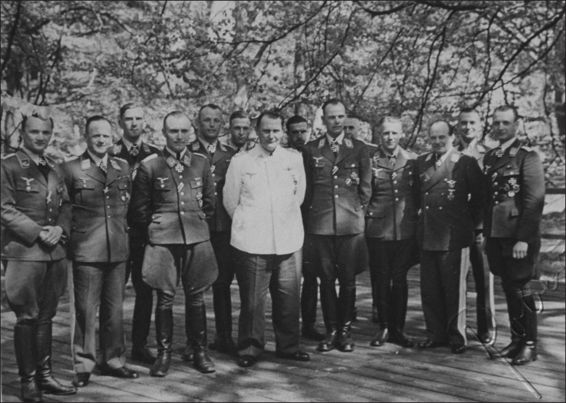
Field Marshal Göring and Luftwaffe recipients of the Knight’s Cross, May 1940.
Witzig’s 9th Company had a strength of about 144 men, including four officers and 26 NCOs, and had been allocated twelve Ju-52s for the flight to Crete. The company would fly in four flights of three aircraft each. Its mission was to parachute into the area east of the airfield at Maleme and support the 1st Battalion in its assault from the east.32 The 3rd Battalion was also given the mission of seizing an attack position for the assault on Canea. But as they boarded their aircraft, the officers and men of the 9th Company were unclear as to what exactly they would find once they hit the ground. ‘There were no major preparations,’ revealed Witzig in an interview long after the war,
. . . we knew very little of our enemy and the terrain. Our camp was in the south of Greece, which the British had just recently evacuated, but they had observation points and information [gathering] centres all over the country. The Greeks were not our friends, but friends of the British . . . and they knew exactly what was going to happen.33
Scherber’s 3rd Battalion experienced problems from the very beginning of the operation. It was the last in line at Megara airfield, one of six departure airfields in Greece, and its departure was delayed forty minutes due to heavy clouds of thick dust raised by the previous waves of aircraft taking off. ‘These auxiliary airfields were not of an ideal type,’ remembered General Ringel.
The dust conditions presented quite a problem. Yellow-brown dust columns extended skyward with every start and landing and it was frequently so bad that, despite all measures, such as [the use of] fire hoses, salt water, etc, necessary intervals between aircraft taking off and landing had to be established to avoid collisions.34
The flight to Crete from the Greek mainland, depending upon the location of the departure airfield, took between seventy-five and ninety minutes. At first, Witzig and his men would have seen nothing but dust clouds from the windows of their Ju-52s. As they left the airfield behind, Athens and the Acropolis would soon have appeared. ‘Suddenly, the blue shining sea, sky, and water,’ wrote General Ringel: ‘It was impossible to estimate if one was flying only a few metres over the blue surface or several hundred metres above the sea.’ To the left and right, as far as the eye could see, and above them flew squadrons of Ju-52s and gliders, some 600–650 in all, protected by fighters and fighter-bombers. The island of Milos, in the blue Aegean, would have appeared next. ‘And then finally, after endless minutes, greeted with great relief, land is sighted,’ continued Ringel. ‘Huge mountains emerged from the haze like a mighty fortress. It was the objective, Crete.’35
As a result of its delay, Witzig’s 3rd Battalion did not arrive over Maleme until 1030 hours, well after the fighters and bombers of VIII Fliegerkorps finished their bombing and strafing runs. In order to avoid dropping paratroopers into the sea, a common occurrence during previous sorties due to unexpected winds, the 3rd Parachute Battalion was released over the hills to the south of the Maleme–Platanias road. A paratrooper assigned to one of the twelve gliders of the Assault Regiment’s 3rd Battalion, which was tasked with seizing the airport, remembered: ‘At 5 am we took off from Megara in Greece. My main concern was the landing. I hoped that we would not have too much trouble as we could carry out our mission. Unfortunately, we were not delivered onto the right spot, Maleme airport, but some distance away, in an olive grove midway down Ridge 107.’36 The high losses among the 750 airborne troops who assaulted the island in gliders was a harbinger of things to come. In addition, many of the paratroopers dropped at Canea and Rethymnon were released from too high an altitude and had landed highly dispersed.
As the transports carrying Witzig’s company approached the coast, the planes dropped to an altitude of 100–150 metres. The dangerously low altitude of the drop minimized the time each paratrooper spent in the air vulnerable to ground fire. On command, each paratrooper stood up, attached the snap hook of his static line to the cable running down the length of the right-hand side of the aircraft, and awaited the final signal to jump. Unlike in the operation at Eben Emael, Witzig and a number of his men were now armed with MP40 submachine guns in addition to their P08 pistols. Ammunition for both would have been slipped into magazine pouches and attached to their brown leather uniform belts secured with an aluminium buckle. A spare magazine would have been carried in the right chest pocket and a hand grenade in the lower left-hand pocket of the paratrooper’s jump smock. The pistol would have been carried in a back right pocket.37
The vast majority of Witzig’s men, however, still carried only pistols and knives and counted on reaching the weapons containers to retrieve their rifles and sub-machine guns. As they approached their designated drop zone the jump master in each aircraft sounded a klaxon. The paratroopers immediately began taking turns assuming a good door position and hurling themselves, spreadeagled, out of the right-hand side of the aircraft. The parachutes deployed automatically five seconds later, by which time each man had dropped twenty-five metres. After they all exited, four equipment containers were thrown out the exit door of the Ju-52. Each contained weapons, ammunition and equipment for three or four men. At this early stage in the development of airborne troops it was still considered very difficult for a man to land safely if he carried any weapons other than an automatic pistol and a large knife, although the men in the first platoon to land were equipped with up to four hand grenades, and every fourth man carried a sub-machine gun. Other containers were used to drop disassembled light field guns and mortars in loads weighing up to 120 kg. Within ten seconds, each aircraft had been emptied of its twelve paratroopers and four containers. The sky was filled with silk parachutes of various colours, announcing the arrival of the 3rd Parachute Battalion and Witzig’s 9th Company: green and brown for the Fallschirmjäger (to make them less conspicuous on the ground and to serve as camouflage for motor vehicles later); white for equipment containers; and pink for medical supplies. Witzig and his men would have reached the ground in 20–30 seconds, with very little control over their parachutes or the direction of travel. During this period, they were at the mercy of the wind and the enemy below.38 Unbeknownst to them, the entire battalion was jumping directly atop two enemy battalions.
The 3rd Parachute Battalion’s drop zone was defended by the 21st and 23rd New Zealand Battalions, which German reconnaissance photos had completely failed to detect. The Kiwi infantry were well entrenched and camouflaged along the terraced slopes and had been manning their positions for some time when the German transports arrived overhead. As the paratroopers leaped from their Ju-52s, they were met by a dense and lethal barrage of fire. Richard Kienzen, a member of the 3rd Battalion’s 11th Company, recalled the ordeal experienced by hundreds of paratroopers like him: ‘[Lieutenant] Jung, my company leader, was killed in action. I was wounded during the descent (hit in the arm by a bullet which struck between the elbow and shoulder). I landed in an olive tree and was hit again. The bullet struck with such force that I could no longer use my arm. Dangling from my harness, totally defenceless, I was then captured by the British.’39 Kienzen was one of the more fortunate ones. Many of the paratroopers were dead before they even hit the ground, while a large number died within seconds of landing. The commander of the 23rd Battalion, Lieutenant-Colonel D. F. Leckie, for example, reported shooting five of the descending Fallschirmjäger from his headquarters, while his adjutant, Captain R. M. S. Orbell, killed another two ‘without getting up from his packing-case deck’.40
The New Zealanders responded quickly and aggressively to the German airborne assault, which had been expected for some time. ‘Suddenly they came amongst us,’ remembered Captain C. N. Watson, Commander of Company A, 21st Battalion. ‘I was watching the 21 Bn. Area and a pair of feet appeared in a nearby olive tree. They were right on top of us. Around me rifles were cracking. I had a Tommy gun and it was just like duck shooting.’41 Paratroopers who dropped farther east met the same fate at the hands of the New Zealand Engineers and the men of the Field Punishment Centre, commanded by Lieutenant W. J. Roach. The soldiers under sentence were given rifles along with the promise of a pardon if they fought well. They were then released to hunt down paratroopers scattered in their area. Sixty prisoners killed 110 Germans in less than an hour.42
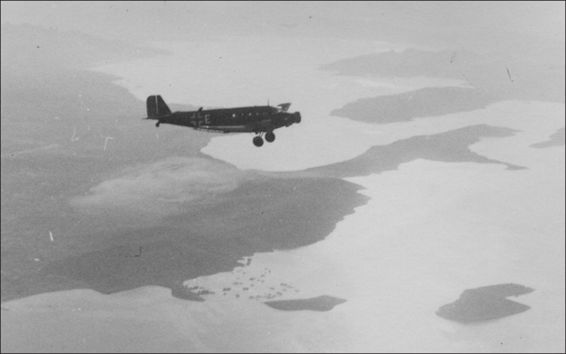
A lone Ju-52 over the Mediterranean en route to Crete. Almost 300 were destroyed or damaged during the battle for Crete, crippling the Luftwaffe’s transport fleet prior to Hitler’s invasion of the Soviet Union.
‘The [21st] battalion’s own casualties were light because their positions were under cover of the olives and the men moved into aggressive action so quickly,’ remembered D. M. Davin, a platoon leader with the battalion, who would later write New Zealand’s official history of the battle. ‘Even so the companies had plenty to do outside the perimeter, clearing up prowling bands of paratroopers.’43 Two-thirds of Witzig’s battalion had been killed and the unit ceased to exist as a coherent fighting force even before it reached the ground. ‘What a welcome they gave us!’ remembered Witzig. ‘Our battalion took heavy losses at Hill 107. From my company only one-third survived. I was the only one who survived, severely injured, from my plane load of ten men.’44
Few Germans escaped the New Zealanders and, during the course of the day, the 3rd Parachute Battalion was almost completely annihilated. According to an XI Fliegerkorps report, many of the paratroopers were killed or wounded while still in the air or when caught in trees. ‘Those parachutists who landed in the valleys unharmed had no opportunity of joining up or searching for their weapons containers. The greater part of the containers fell into the hands of the enemy who put the weapons into immediate use. All the officers were killed or wounded.’45 With the loss of virtually all of their key leaders, the survivors of the battalion, though of considerable nuisance value, were unable either to launch their planned attack against the airfield or make their way farther east to join Group Centre. Although some 10,000 paratroopers had landed by parachute, glider or troop transport by the end of the first day, only 6,000 were still in action by last light and the survival of the entire German force on the island hung precariously in the balance.46 Forty per cent of the first two assault waves had been killed, wounded, or captured. The casualties included General Süssmann, who was killed during the approach flight to the island, and General Meindl, who was in command of the Maleme group and was critically wounded shortly after landing. As a result, both the Maleme and Canea groups were left without their commanders.47
By the evening of 20 May, not a single airfield was securely held by the Germans. The most favourable reports came from Maleme, where the defenders were falling back from Hill 107 and their defences around the airfield, which, however, was still under British artillery fire. Moreover, parts of the airfield were obstructed by crashed and destroyed transports and gliders. There was thus no field available for the landing of elements of the 5th Mountain Division, scheduled for the next day. The division was scheduled to be transported to Crete by both sea and air. Canea was still in enemy hands and the troops there had landed at four different points and remained isolated and unable to form airheads. But while the attackers had run into unexpectedly strong resistance and had failed to reach their first day’s objectives, the defenders were surprised by the fury and strength of the onslaught.48 ‘It was apparent that due to heavy casualties, the fighting power of the FS [Fallschirmjäger] would hardly suffice to capture an airfield,’ wrote Ringel. ‘Maleme offered the best chance as the airfield had been mopped up and somewhat secured in the west and the south. Only the east was troublesome [as] the British were still able to cover the field in that direction with MG [machine-gun] and Arty [artillery] fire. One had to start where the easiest success could be expected.’49
Student thus decided to form a battalion of paratroopers from his last available and uncommitted reserves and to employ them, under the command of Colonel Bernard Hermann Ramcke at Maleme, where he would relieve the wounded General Meindl. A tough and experienced veteran of Germany’s Imperial Navy in the First World War, Ramcke had been commissioned during that war and then distinguished himself as a member of the Marine Assault Battalion Flanders in its last year. On 10 May 1919 he had joined the Reichswehr and transferred to the Army as an infantry officer after serving as a member of the Freikorps. In 1940 he transferred services once again, joining the 7th Fliegerdivision after commanding an infantry battalion. Ramcke earned his Parachutist-Rifleman’s Badge that year at the age of fifty-one.50 There was little else that Student could do but commit his remaining reserves under this battle-hardened, skilled and reliable officer. Ringel and Student would have agreed with British newspaper assessments that day emphasizing that there was more at stake on the island than strategic deliberations. ‘A German defeat here on Crete would mean a severe and presently quite disastrous setback to German prestige.’51
‘It was obvious that the British were tougher and much stronger than we thought,’ reported Student later, in a gross understatement aimed at justifying the near-failure of the Crete operation, ‘but at that moment there was nothing we could do but hold our breath and leave the conduct of the battle to the commanders on the ground.’ There was little fighting left to be done by the 3rd Battalion, which had suffered catastrophic losses. Three of its four company commanders had been killed during the battle and the fourth, Rudolf Witzig, had been seriously wounded in the right leg shortly after landing, losing a sizeable portion of his inner right thigh. Despite the severity of the wound, he managed to drag himself out of sight into a shell hole hidden by brush, attend to his wound, and await assistance. With his battalion almost wiped out, Witzig decided his best hope for survival lay in hiding until the arrival of German reinforcements. ‘I was lucky to be picked up by our soldiers after one-and-a-half days and to be brought to a field hospital,’ he recounted afterwards.52 In the interim, the wounded Witzig had to endure, along with his Fallschirmjäger comrades, all the miseries Crete had to offer.
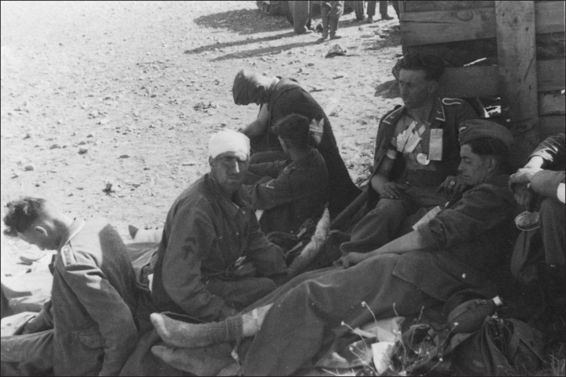
German wounded during the battle of Crete. According to German after-action reports, their casualties on the island were estimated at between 4,000 and 6,500 men, with two-thirds of those killed.
The sun beat down merciless from the clear blue sky during the day [remembered General Ringel]. The thermometer registered from 40 to 50 degrees [Celsius, 104–122 °F] in the shade. Even the night did not bring relief. Blistering hot, burnt-out rocks emitted during the night the heat they had stored up during the day. Vermin and gnats, the lack of drinking water, the heavy cloth uniforms of the paratroopers drenched with sweat, heavy equipment, heavy weapons, lack of roads and the difficult desertlike terrain made life unbearable.53
In the meantime, the beginning of the second day of the operation brought little relief to the attackers. By late afternoon, however, the German paratroopers were in control of Maleme airfield, despite several fierce counter-attacks by the two New Zealand infantry battalions. During the night a convoy carrying the men and equipment of the 5th Mountain Division to Crete was engaged and destroyed by the Royal Navy, killing 330 men and forcing the surviving ships to turn back. Only the timely and energetic rescue of survivors by the Italian Navy averted, greater loss of life among the German troops. By 22 May the Germans were in complete control of Maleme airfield and using it to pour reinforcements into the island by Ju-52, despite heavy losses to the air transport fleet. By the following day, twenty Luftwaffe transports, each laden with troops, light artillery and other heavy equipment, were landing every hour and returning to the Greek mainland loaded with wounded German soldiers, including Rudolf Witzig.
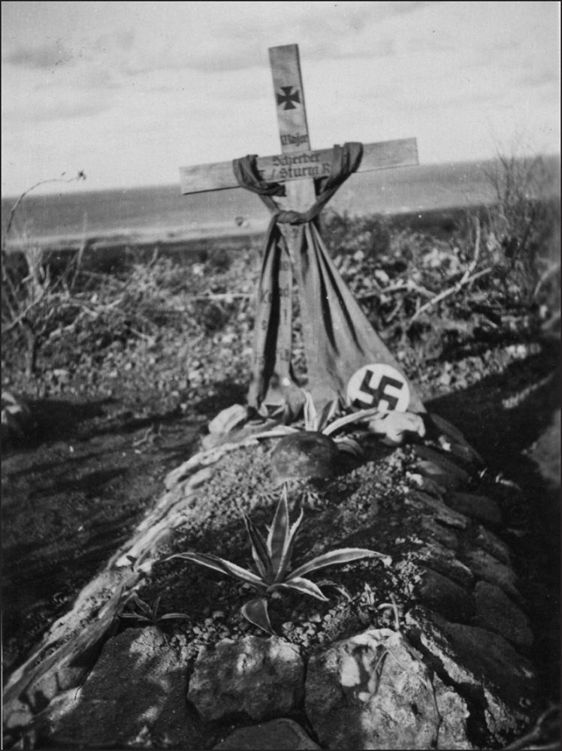
The temporary grave of Major Scherber, commander of Witzig’s battalion, on Crete.
By 24 May, Operation Mercury had gathered sufficient momentum that a German victory was no longer in doubt. That night Admiral Cunningham advised the British Chiefs of Staff that the scale of enemy air attacks was such that the Royal Navy could no longer operate off Crete in daylight. The following day considerable resistance from Cretan civilians, unexpected by the invaders, resulted in the first executions, pillaging and burning of villages by German troops. A British air attack on the Maleme airstrip destroyed twenty-four Ju-52s, but such efforts were no longer enough to prevent the Germans from taking the island. On the morning of 27 May, the Royal Navy managed to land 750 Special Forces commandos at Suda Bay and later that day the New Zealanders and Australians counter-attacked to stop the German advance west of Suda Bay. But the end was now in sight. On the 28th the Allies began evacuating the island, in an operation which cost the Royal Navy dearly. By 30 May, Crete was in German hands. The final capitulation order for British forces on the island came at 0900 hours on 1 June. By that time the Royal Navy had evacuated 7,000 British, 4,500 New Zealanders, and 3,000 Australians from Crete to Egypt.54 A large part of the defending force would thus live to fight another day.
‘Mission completed. Crete is clear of the enemy as of today,’ reported General Löhr the same day. After General Freyberg departed the island and the British War Office announced its fall: ‘After 12 days of, doubtless, the hardest fighting of this war so far, it was decided to withdraw our troops from Crete.’
The battle of Crete had been concluded [wrote General Ringel after the war]. A victory without equal was achieved through the sacrifices of the soldiers. With the capitulation of the British and the Greeks, the guerrilla groups also disbanded or retreated to the impassable hideouts of the White Mountains.55