
Chapter 5
At a victory parade in Germany following the epic battle, Student praised his Fallschirmjäger.
Our victory banners wave over Crete. You, my paratroopers and airborne troops, have, under your proven leaders, achieved unprecedented feats. Paratroopers! Filled with an unstoppable offensive spirit you, entirely on your own, defeated the numerically superior enemy in an heroic, bitter struggle. Wherever you landed on Crete you both stormed heroically and held stubbornly.
After the war, however, when he had had time to reflect on the operation, he confessed:
I find it very hard to write about Crete. For me, the commander of the German airborne forces, the name of Crete conjures up bitter memories. I miscalculated when I proposed the operation, and my mistakes caused not only the loss of very many paratroopers – whom I looked upon as my sons – but in the long run led to the demise of the German airborne arm which I created.1
As Student said during his post-war interrogation: ‘Crete was the grave of the German parachutists.’2
The Battle of Crete had indeed been a disaster for the German airborne forces. For weeks after the battle, newspapers all over Germany published black-bordered statements announcing the names of the dead. One military family lost three sons during the attack. At twenty-four years old, Lieutenant Wolfgang Leberecht Graf von Blücher was a veteran of Holland, where he had won the Iron Cross First Class for storming and conquering a nest of bunkers. Assigned as the commander of the 2nd Company, 1st Parachute Regiment, he was killed in action on the second day of the battle after capturing a key hill at the eastern end of the Heraklion airport. Three days later he was awarded the Knight’s Cross. His two brothers, Private Leberecht Graf von Blücher, nineteen years old, and Rifleman Hans Joachim Graf von Blücher, only seventeen, were also killed on Crete. The body of the youngest brother was never found.3 ‘Beyond all human conception, great and overwhelming is the watch of the dead,’ wrote Ringel, ‘who sacrificed their lives for their fatherland and the conquest of Crete.’4
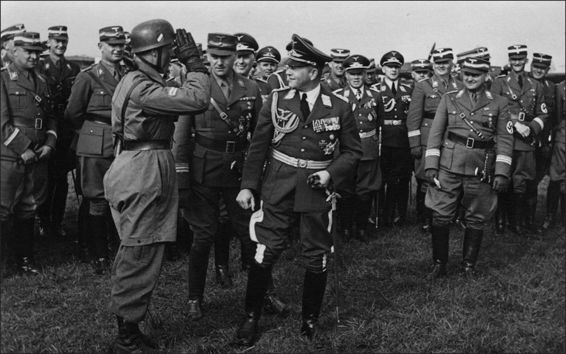
Lieutenant Rudolf Witzig reporting to Colonel-General Milch following a parachute jump of the Engineer Parachute Platoon in Lippstadt in May 1939.
According to German after-action reports, their casualties on Crete were estimated at between 4,000 and some 6,500 men. Generalmajor Burkhart E. Müller-Hillerbrand, adjutant to the Chief of the Army General Staff, wrote that these included 4,000 men killed and missing and another 2,000 wounded.5 Ringel cites a figure of some 6,000 men for both the Army and the Luftwaffe.6 Student’s own figures for the battle were 3,250 killed and missing and another 3,400 wounded.7 Those casualties included Generalleutnant Süssmann, commander of the 7th Airborne Division and highest-ranking German officer killed at Crete. He died, along with almost his entire staff, when one of the wings of the glider they were riding in snapped off, sending it plummeting to the rocky ground below.8 Another high-ranking casualty was Generalmajor Meindl. Refusing to accompany his own staff into battle on their glider, he jumped instead with his 4th Battalion. So fierce was the fighting on the ground that, within an hour of landing, he had been wounded twice, including once in the chest. And out of the 500 men of Witzig’s 3rd Battalion, some 400 had been killed, including its commander, Major Scherber, and its adjutant, Captain Heinz. Witzig himself was fortunate to have survived and to have been transported back to a German military hospital in Greece aboard a Ju-52.
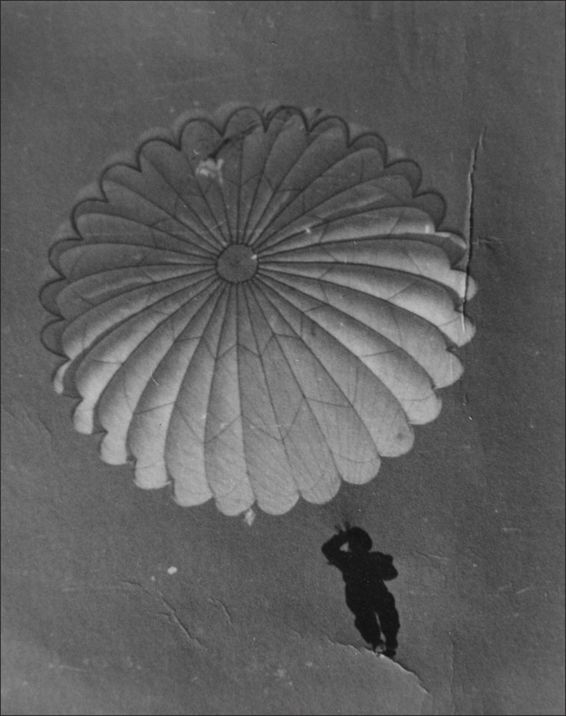
German Airborne School, Stendal, 1938. A German paratrooper descends to the ground under his fully inflated canopy.
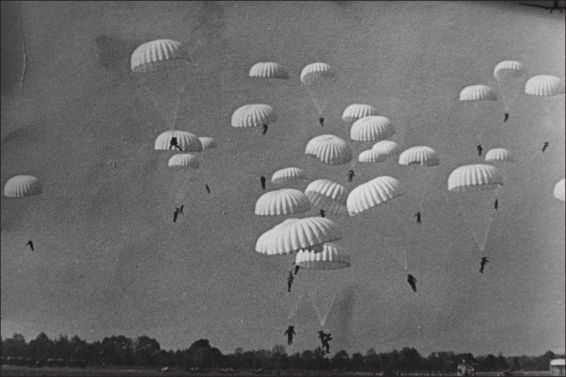
German Airborne School, Stendal, 1938. Paratroopers of a Fallschirmjäger company descending to the ground. The vulnerability of German paratroopers in the air would become all too evident during the Battle of Crete, where thousands would be killed or wounded.
Losses to the Luftwaffe’s transport fleet were equally heavy. Of the 600–650 Ju-52 transports used in the operation, some 270 were destroyed, seriously damaged or missing.9 This represented more than a quarter of the entire Ju-52 transport fleet available to the Luftwaffe. The Ju-52 fleet would never again be used on such a large scale in support of airborne operations but instead would spend the remainder of the war hauling reinforcements and supplies. Generalleutnant Walter Warlimont, the Deputy Chief for Operations of the Armed Forces High Command, admitted that the loss of so many transports meant a considerable depletion in the strength of the Luftwaffe at the beginning of the Russian campaign.10 Furthermore, their absence precluded any airborne invasion of Cyprus as a follow-on operation to Crete, a venture favoured by Göring and Mussolini. ‘We could have taken Cyprus, too,’ boasted Hitler’s Reichsmarschall after the war. ‘I would have taken it right after we took Crete. We could have also taken Malta easily. Then the Atlantic islands would have been a further protection for the coast of Africa. But fear of Russia stopped us.’11 In light of the debilitating losses suffered by the Fallschirmjäger and the Luftwaffe’s transport arm in the Crete operations, Göring’s claim was an empty one. Still, statements like these would give rise to a myth that only the lack of an order from Hitler prevented his paratroopers from continuing their airborne blitz across the Mediterranean to take Cyprus and Malta as well.
Nor was Göring alone with regard to myth-making; in view of the high losses suffered on Crete it is astounding that, in his order of the day for 12 June 1941, Löhr announced: ‘True to our oath to the Führer and supreme commander of the Wehrmacht: “We stand ready for new tasks.”’12 This was clearly impossible as the loss in officers and NCOs alone precluded the commitment of the German airborne troops on any meaningful scale for some time to come. ‘Our proud paratroop unit never recovered from the enormous losses sustained on Crete,’ admitted Martin Pöppel frankly.13
Churchill was closer to the truth when he told the British people after Crete: ‘The very spearhead of the German lance has been shattered.’ However, he too engaged in myth-making, when he wrote after the war that the Germans had suffered well over 15,000 casualties.14 According to the British official history of the battle, out of the 8,060 paratroopers from 7th Fliegerdivision and the Air-Landing Assault Regiment deployed on Crete, more than 4,500 became casualties. Yet Churchill was in effect correct when he wrote: ‘But in fact the 7th Airborne Division was the only one which Göring had. This division was destroyed in the Battle of Crete. Upward of five thousand of his bravest men were killed, and the whole structure of this organization was irretrievably broken.’15 Indeed, the 7th Fliegerdivision never appeared again in any effective form. In comparison, British and Commonwealth forces suffered almost 16,000 casualties in the battle. Some 14,800 men were evacuated from the island by the Royal Navy, a task it was becoming quite proficient at accomplishing, to fight another day.16 Of the more than 10,200 members of the Greek Army and Gendarmerie who fought with the British, some 1,500 were killed and another 5,000 taken prisoner.17 The German victory was thus as lopsided as it was close.
Although Witzig believed the German attack on Crete was ‘essential,’ he called the execution ‘weak’. ‘Everyone thought the Fallschirmjäger could do everything; they would be able to master this as well,’ he remembered. ‘Our preparations were weak’ he added, ever the meticulous planner. ‘We were dropped at the wrong places . . . the wind had not been calculated correctly and many paratroopers fell with their parachutes into the water and drowned.’ Furthermore, the 3rd Battalion jumped on top of ‘many British defensive positions’ and ‘there was nothing known about their strengths and locations. Everything had to be figured out on the ground.’18
German after-action reports of the battle substantiate Witzig’s observations and conclude that the operation’s ‘many deficiencies’ gave it the characteristic of an improvisation. ‘German air reconnaissance during the period preceding the invasion was inadequate and the intelligence picture presented by the Luftwaffe did not correspond to the actual situation on the island,’ noted a group of senior German officers, including Student and von der Heydte, who compiled the report. The British had succeeded in concealing fortifications and camouflaging their gun positions. Dummy flak positions were extensively bombed, while the real ones were not discovered. Some British positions were erroneously marked as artesian wells and the prison on the road to Canea was thought to be a British ration dump. The German Twelfth Army had a more accurate intelligence picture from local agents, but the Luftwaffe, believing that the British garrison consisted of only 5,000 combat troops and that they intended to evacuate the island immediately after the first airborne landings, refused to consider other estimates of enemy preparations. The same report went on to note that troops had indeed jumped at the wrong places ‘in most instances’, with some landing as far as 15 km to the east; others were dropped from too high an altitude and were exposed to enemy fire for much longer than necessary. ‘Their conduct’, noted the report, referring to the German transport pilots, ‘jeopardized the success of the operation’. The report also concluded that a strong and well-integrated defence system could not be overcome by landing on top of it ‘unless it has previously been smashed by continuous bombing attacks’. Furthermore it recommended that better results could be achieved by jumping ‘at a distance from the objective’ which had to be reduced by customary infantry actions, thus necessitating that the paratroopers ‘receive infantry training’.19
These deficiencies indicate a potential problem among the Fallschirmjäger with the tactics, techniques and procedures they used, resulting in higher casualties than might have been the case had they been trained differently. The need for readily available ‘strong reserves, including flying formations’ is also highlighted, indicating a command deficiency in this area as well. It was also noted that the arms and equipment containers often fell onto enemy positions and were used by British troops against the paratroopers ‘inflicting heavy casualties on them with their own weapons’. Other containers fell into gullies and deep streams and could therefore not be recovered. The report recommended that individual soldiers jump with light machine guns, recoilless rifles and rocket launchers since they might be forced to fight before recovering their weapons containers. Finally, the German paratrooper uniform proved unsuitable for the hot climate of Crete. During combat many men suffered from heat prostration. ‘Every movement on the battlefield involved terrific physical efforts, and the efficiency of the troops was thus considerably impaired.’20
While quick to point out deficiencies in the operation, Witzig was equally fast to praise those deserving it:
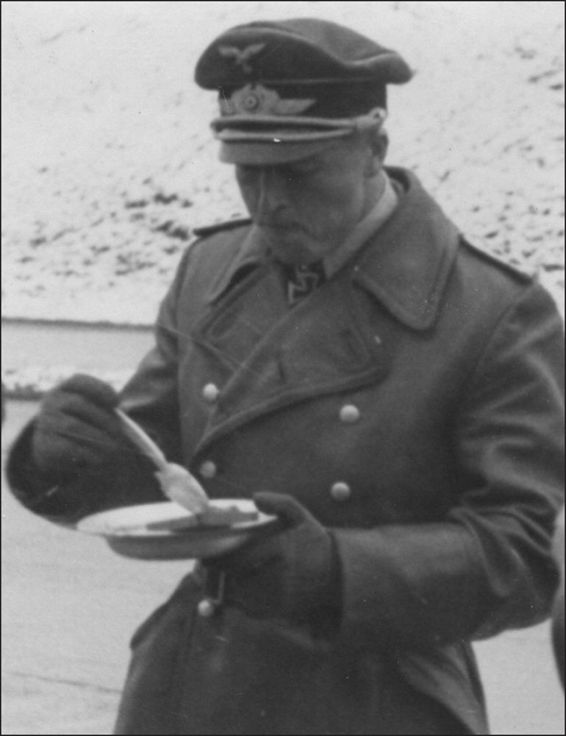
Rudolf Witzig eating a meal in the field during training prior to deploying to Greece for the Battle of Crete.
The battle was won due to the initiative of the few: commanders, NCOs, even corporals and privates who took the initiative and did their best in the situation until the first landings in Maleme, under enemy artillery fire and with great losses of aircraft, could take place; until the landing of the mountain troops . . . These started the push from Maleme to the east, south-east and south that kicked the British off the island. This was not the task of the paratroopers any more but of the mountain troops.
Witzig was also not afraid to praise his opponent: ‘Large parts of the British [Army] were captured in Greece,’ he observed, and then asked in hindsight: ‘What more could be left? Consequently, how difficult could this task be? But it was. The British defended their island vigorously. They did everything possible to hold Crete. They had the same exact reasoning we did for wanting Crete.’21 General Ringel agreed to an extent with Witzig, but qualified his praise of the British: ‘The enemy’s stubborn defence could have led to our defeat if he had grasped the situation from the very outset and had made use of all his available forces and resources.’22
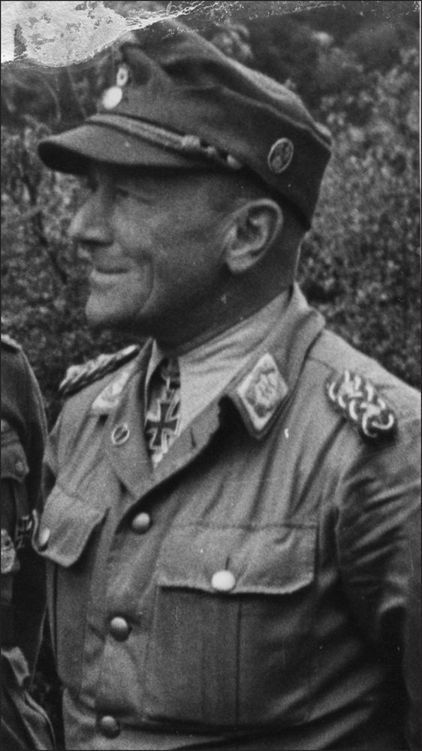
Generalmajor Meindl was seriously wounded within an hour of accompanying his regiment into battle on Crete.
Commanders at all levels had their own explanations for the heavy German losses. ‘Our losses had been caused by multiple reasons,’ Freiherr von der Heydte later informed General Student, when the commander of Germany’s airborne forces visited Crete after the battle:
The troops had been inexperienced in parachute warfare. For many of them the Battle of Crete had been their first taste of action, and for most of them it had been their first drop against an enemy. The training of the officers had been none too thorough, and their personal bravery had not proved sufficient compensation for their lack of knowledge. But most important of all was the fact that in Crete we had encountered for the first time an enemy who was prepared to fight to the bitter end . . . It seemed almost a miracle that our great and hazardous enterprise had succeeded.23
Student partially agreed, later writing:
The capture of the island of Crete was the most interesting and eventful German airborne operation. The initial attack contained all the germs of failure. Only the fact that the defenders of the island limited themselves to purely defensive measures and did not immediately and energetically attack the landing troops saved the latter from destruction.24
Von der Heydte did not entirely agree:
On the other hand the German paratroopers demonstrated that it was possible to carry out an airborne operation on a large scale in which parachute units were not employed solely in support of ground forces, but on their own in order to solve unique and isolated strategic problems. They demonstrated that it was possible to attack an island – equal in area to one-fifth the size of Switzerland – and to take it by airborne operation despite the enemy’s absolute supremacy at sea.25
Excessive casualties and the loss of large numbers of valuable transport planes, coming so close on the heels of the heavy losses suffered in Holland the previous year, convinced Hitler that airborne troops had lost much of their strategic surprise value and, thus, utility. ‘The day of the paratrooper is over!’ he declared to Student after learning the true extent of the casualties. ‘The parachute arm is a surprise weapon and without the element of surprise there can be no future for the airborne forces.’ Freiherr von der Heydte objected: ‘Hitler and his military advisers did not draw the right conclusions from the experience in Crete,’ he argued, though almost certainly not to Hitler. ‘They saw only the losses, but not the reasons for the losses or the possibilities for the future.’26 Interestingly enough, Witzig agreed with Hitler’s reasoning, even more than sixty years after the battle:
We couldn’t expect that a surprise like that [at Eben Emael and the Albert Canal] would be possible again anywhere during the war. One had to be prepared [for the fact] that our enemy had woken up and henceforth would be informed of how we were preparing to use our [parachute and air-landing] forces. And this is what happened. The attack on Crete with our air-landing forces was not a surprise at all for the English. They knew exactly what was planned, just not where the air-landing and parachute troops would land. They knew they had to face both. The surprise was gone!27
Not surprisingly, it was the Führer who had the last word and, despite objections from his Fallschirmjäger officers, Operation Mercury was the death-knell of the German airborne forces in the role for which they had been created. ‘After the Crete operation no German parachute division was committed in airborne operations as a whole unit,’ protested Student. Indeed, according to him, only parts of the remaining divisions, of which there were six in 1944 and ten or eleven at the end of the war in 1945, were trained for airborne operations.28 The decision was not as wrongheaded as Student would have his American and British counterparts believe after the war. Hitler realized, perhaps better than anyone else, that the training of an elite paratrooper was a long, arduous and resource-intensive process and one increasingly difficult for him to support as the scope of the war spiralled out of his control. The German leader realized too well that his Fallschirmjäger could no longer establish the strategic pre-conditions for success as had been the case in Norway, the Low Countries and Crete. From then on, the Fallschirmjäger would be used as fire brigades of elite infantry to attack and defend where the fighting was the toughest, such as the Eastern Front. There, in Russia, according to von der Heydte ‘the greater part of those who survived the Battle of Crete bled to death’.29
Many historians consider it ironic that the German experience at Crete led Hitler to turn his back on the further development and use of parachute and glider forces, while at the same time prompting Roosevelt and Churchill to develop parachute and glider forces that would total almost eight divisions and include an airborne army and two airborne corps headquarters by the end of the war. But while Germany could no longer afford the expense and time involved in producing elite paratroopers, the Allies, and especially the United States, could. The expansion of the American armed forces, which would eventually total some fourteen million young men and women and be equipped on a lavish scale unprecedented for any army in history, was only just beginning. The Americans and British felt that they could provide the manpower and technology to ensure the success of future large-scale airborne operations. The dubious results of U.S. and British airborne operations in Sicily, Normandy, Holland and Germany, however, would later cause many Allied commanders to question whether those elite soldiers might not have better served their armies in the ranks of the infantry. Indeed, after the near disaster of the Sicily drop, Eisenhower and other senior U.S. Army generals concluded that division-size airborne operations were impractical. Only the personal and vigorous intervention of the commander of the 82nd Airborne Division, Major General Matthew B. Ridgway, prevented the dissolution of his division.30
Hitler arrived at the same conclusion Eisenhower and his lieutenants had contemplated, and he implemented changes affecting the future employment of his Fallschirmjäger. The performance of his elite paratroopers, used as the backbone for regular infantry and even second- and third-rate formations in defensive operations in Russia, North Africa, Italy (especially at Monte Cassino), Normandy and finally inside the Reich itself, validated, to a large extent, Hitler’s decision. The Allies learned that wherever they encountered Fallschirmjäger units, they could expect the fight of their lives against an unyielding, extremely skilful, and almost fanatical foe. It was a lesson the Allies themselves applied with equal success at Ste-Mère-Église, Carentan and Bastogne.
The heroism of the German Fallschirmjäger at Crete would forever be marred by the actions of some German soldiers against the island’s population after its capture. According to German accounts, such actions were prompted by rumours of large-scale mutilation by Cretan partisans of the bodies of a number of German paratroopers. General Ringel was quick to exonerate his soldiers for the reprisals that followed: ‘As long as the Fallschirmjäger occupied the island, which was until the end of the year 1941, there was not a single case of sabotage nor attack by the Cretans,’ he told American interrogators. ‘On the contrary, the attitude improved, relations with the population became more and more friendly and there were touching scenes when the Parachute Division left.’31 It is clear, however, that Ringel was attempting to convince the allies that the Fallschirmjäger had not been involved in large scale atrocities on the island. This is simply not supported by historical evidence. As a result of the alleged mutilations, Student ordered harsh retaliatory measures against Greek civilians who participated in the fighting. ‘The German units concerned were to return to the respective villages, exterminate the male population, and demolish or burn down all the houses,’ notes the official postwar German history of the battle. Student expressly ordered the officers concerned not to wait for a special military court but to set a ‘warning’ example. ‘He believed that in this way he could create the best conditions for his work as the future German commander on the island.’32
In the end, possession of Crete was not as crucial to Germany’s war strategy as Hitler, Student and even junior officers such as Rudolf Witzig had believed. The island proved of little value to the Axis powers because subsequent developments in the overall strategic situation prevented them from exploiting their victory. But all that was irrelevant to Witzig. Evacuated to hospitals first in Athens, then Berlin and finally Braunschweig, near his home, he spent almost a year recovering from his wounds. During this period he wrote articles on Eben Emael for the local schools and various papers. It is illustrative that so little is said about Crete in his informal memoirs. His only comment to his family long after the war was short, concise, and typical of Witzig: ‘Right strategy, wrong tactics!’33 It is perhaps natural that it is to Eben Emael, the site of his greatest conquest, that he returns, again and again, during and even after the war. Crete, the graveyard of not only the German airborne and so many of his own friends and colleagues, but also of Witzig’s innocence with regard to the infallibility of Adolf Hitler and the Third Reich, appears best forgotten.
One wonders if contemplating the loss of so many of his men, as he lay hospitalized for months on end, caused Witzig to waver in his loyalty to Hitler or his faith in a victorious ending to the war. True, Germany was at the zenith of its power in Europe, the Balkans and the Mediterranean and, shortly after Witzig was hospitalized, the Wehrmacht began over-running most of Russia as well. To accommodate the Führer’s latest act of aggression, the size of the Wehrmacht had ballooned to 8,254,000 men, a significant increase from the 6,600,000 men of the previous year.34 At sea, German U-boats were savaging Allied shipping. And at the beginning of December 1941, Japan gutted the American fleet at Pearl Harbor and then surged through Asia and the Pacific riding the crest of a tidal wave of victory, defeating one British and American force after another. In response, Hitler had declared war against the United States. But already, unbeknownst to the Axis and Allies alike, the tide was beginning to turn.
It is now clear that Operation Barbarossa, Hitler’s invasion of the Soviet Union launched on 22 June 1941, soon after the end of the Crete invasion, was the beginning of the end of the Wehrmacht and the Third Reich. The start of the campaign in Russia was characterized by a series of unparalleled German victories that many believed spelled the imminent collapse of the Soviet Union. Within weeks the Wehrmacht had travelled half the distance to Moscow, killed half a million Russian soldiers and taken one million prisoners. The German successes prompted General Franz Halder, Chief of the General Staff, to exult: ‘It is thus probably no overstatement to say that the Russian campaign has been won in the space of two weeks.’35 Within a month the German Army conquered an area twice the size of Germany and by August the Russians had lost three million men. But Hitler and his generals had dangerously underestimated the fighting abilities and tenacity of the Russian soldier and by 13 August, Germany had suffered almost 400,000 casualties on the Eastern Front, including more than 83,000 killed. This represented 11.4 per cent of the total German strength in the east.36 The Wehrmacht lost more soldiers killed between June and August 1941 in Russia than had died between September 1939 and May 1941, prompting Halder to lament: ‘The whole situation makes it increasingly plain that we have underestimated the Russian colossus.’ While Rudolf Witzig was well into his recuperation period, German forces had bogged down at the very gates of Moscow after advancing more than 2,000 km. The true situation was recognized by many, but especially by those serving in the armed forces, such as Rudolf Witzig, for what it was: Germany’s first major setback in the war. It was soon followed by a massive Soviet counterattack which succeeded in throwing the Germans back 100–250 km from Stalin’s capital and proving that the Wehrmacht was far from invincible and the Red Army far from beaten. By the end of December 1941, less than six months after the beginning of Barbarossa, more than a quarter of the men of the German Army who began the campaign on the Eastern Front were dead, wounded, prisoner or missing.
The situation in North Africa, the Reich’s other active front, was little better. Earlier in the year, on 18 November 1941, a British offensive, Operation Crusader, hit Rommel hard, throwing him back and relieving Tobruk. As a result, the German High Command was forced to come to Rommel’s aid, transferring the Luftwaffe’s Second Air Fleet Headquarters, under Field Marshal Kesselring, from the Eastern Front to the Mediterranean in the critical days of early December.37 Thus did the British contribute to reverses suffered by the Wehrmacht on the Eastern Front, at a critical time when every combat and transport aircraft counted.
As a result of severe manpower shortages, the German High Command was increasingly forced to use airborne formations in the ground role in Russia. Towards the end of September 1941, the 7th Fliegerdivision received a warning order to have some of its units ready for deployment to Russia, where they would be used as infantry. The unit selected was the 1st Parachute Regiment, based at Stendal and now commanded by Generalmajor Bruno Bräuer. The regiment deployed shortly afterwards to the Leningrad area, where it was involved in hard fighting before returning to Germany in January 1942. While still in Russia, it was joined by other elements of the division, now commanded by Generalmajor Erich Petersen. An Army infantry officer, Petersen had taken command of the 7th Fliegerdivision on 1 October 1941, the day he entered the Luftwaffe.38 His selection to command the elite formation is indicative of the ground role Hitler had in store for his paratroopers. The units he took to Russia included the 3rd Parachute Regiment, the Parachute Engineer Battalion, the Parachute Artillery Detachment, the 7th Medical Detachment, and most of the division’s attached panzer units. These formations were deployed to the Neva, where they saw bitter fighting, suffering some 3,000 casualties.39
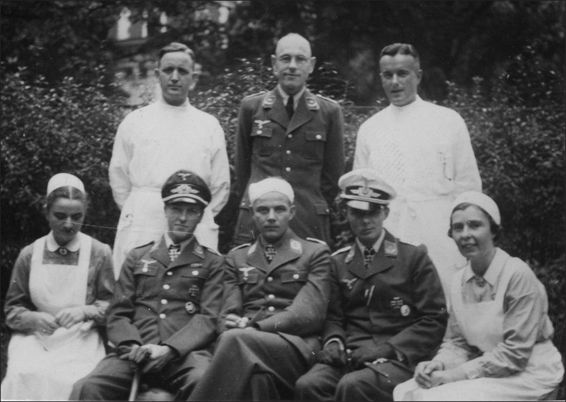
Rudolf Witzig recovering at the Berlin Hansa Clinic. Witzig spent four months at the clinic before being transferred to a hospital near his home. The sole surviving officer of his battalion, Witzig spent almost a year recovering from his wounds.
The critical shortage of German infantry on the Eastern Front even necessitated the deployment of the understrength Air-Landing Assault Regiment, which had been brutalized in Crete. It was sent to Russia in December 1941, minus two battalions, which previously went with the 1st and 2nd Parachute Regiments, to defend an airfield. Like their paratrooper brethren, the glider troops also suffered extremely heavy casualties. And as soon as these depleted formations returned from Russia, they were replaced by other elements of the fully reconstituted 7th Fliegerdivision, which was at full strength with some 21,000 men, all trained as paratroopers. The division was stationed in Normandy and came under the command of Generalmajor Richard Heidrich, a parachute artillery specialist and the former commander of the 3rd Parachute Regiment.40 Thus began a constant rotation of Fallschirmjäger units through the Russian meat grinder that would last most of the war.
While in hospital, Witzig lost not only a portion of his leg, but a piece of his heart as well. He had fallen in love with and become engaged to Gerda Remmers, now a doctor of medicine in Münster, whom he had first met in Höxter, where she had been a medical student. Gerda died, however, from an infection in January 1942. Witzig was devastated. It was to her younger sister Hanna, now seventeen years old, that he turned increasingly. The two met again at Gerda’s funeral, a sympathetic chord was struck, and they started to exchange letters on a regular basis. Hanna had attended the boy’s high school in Höxter and received her diploma the previous year. She was one of only two girls in a class of twenty-seven students and only one of five students to remain in school long enough to complete the course. ‘All the others were already soldiers, somewhere at the front,’ she wrote in a short autobiography.41 Hanna would have preferred to study medicine and everything had been arranged at Berlin University. However, as a result of ‘the worsening military situation’ and the targeting of Berlin by British bombers, her parents did not allow her to go. ‘Therefore I attended the Housekeeping School in Höxter for one year until March 1942. In January 1942 my sister Gerda died. This was quite shocking for my parents and me.’42
In April 1942 Hanna, like all German men and women her age, reported for her Reichsarbeitsdienst (RAD, or Reich Labour Service) duty, to Herringhausen in Westphalia. Unemployed workers were ‘voluntarily’ drafted into service on public-works projects after the Nazis came to power and a compulsory six-month period of labour service was introduced for all young men in June 1935. Labour service remained voluntary for young women until 15 February 1938, when all single women under the age of twenty-five were required to undertake a ‘duty year’ of labour service.43 Hanna worked alongside other young women in a warehouse and enjoyed her service ‘despite the strenuous work and the many privations’.44 After her RAD obligation was over, she supported her father, a doctor, during office hours and drove him as he made his house calls. ‘Then I studied two semesters of medicine in Göttingen, but I had to stop because of the total war and I worked for the Red Cross as an assistant at the Protestant Hospital in Höxter.’45
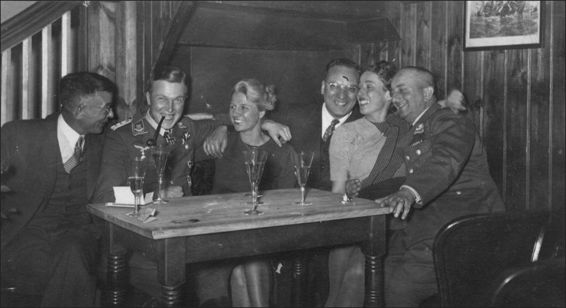
Witzig enjoying an evening with friends in Berlin prior to the battle of Crete.
In the meantime, her relationship with Rudolf Witzig blossomed into romance, a not unwelcome development for her parents, who liked him a great deal. She appreciated his strong personality and good sense of humour. He liked her beauty and musical talent. He liked to sit with her while she played the piano, and the two would sing the songs his mother used to sing to him when he was a child. True, there were important and major differences between them. Hanna and her entire family were staunch Lutherans, and she loved singing in the choir at the Protestant Church in Höxter. Witzig, on the other hand, professed to be non-religious and was put off by the clergy, whom he perceived as ‘zealots’ and ‘fanatics’ because they opposed the war and called on young German men to avoid service in the military.46 His attitudes towards religion and the clergy were in lock-step with those of the Nazi Party, which believed priests and pastors were nothing more than ‘viruses and agitators’ and ‘closet reactionaries misusing religious beliefs in order to fish in dark waters’.47 Yet Witzig had never been a member of the Nazi Party and he was in love nonetheless. With his full recovery imminent, the war and his paratroopers started calling once again and any doubts about the future he might have contemplated were cast aside as he marched to answer, his upper right leg wrapped tightly to prevent thrombosis.
Although his wound would plague him for the remainder of his life, it failed to slow him down. On 10 May 1942 he was posted as commander of the newly formed Corps 11th Parachute Engineer Battalion. The battalion had been formed earlier that year in Dessau. Some officers, especially engineers and intelligence and communications specialists, were transferred to the new battalion from the Army and the Luftwaffe, while a number of others volunteered. An entire company from the Independent Engineer Battalion in Tangermünde was assigned to the battalion. A number of its officers and NCOs had taken part in the attacks on Eben Emael and the Albert Bridges in Belgium as well as the German air assault on Holland and the invasion of Crete.48