
Chapter Two
On the evening of Tuesday 14 May 1940 The Secretary for War, Anthony Eden, issued an appeal for volunteers to defend against the expected threat of invasion by German parachute forces:
We want large numbers of such men in Great Britain, who are British subjects, between the ages of 17 and 65, to come forward now and offer their services in order to make assurance doubly sure. The name of the new Force which is now to be raised will be ‘The Local Defence Volunteers’. You will form part of the armed forces, and your period of service will be for the duration of the war. You will not be paid, but you will receive uniform and will be armed. You will be entrusted with certain vital duties for which reasonable fitness and a knowledge of firearms is necessary. In order to volunteer, what you have to do is to give in your name at your local police station; and then, as and when we want you, we will let you know. This appeal is directed chiefly to those who live in country parishes, in small towns, in villages and in less densely inhabited suburban areas. I must warn you that for certain military reasons there will be some localities where the numbers required will be small, and others where your services will not be required at all. Here, then, is the opportunity for which so many of you have been waiting. Your loyal help, added to the arrangements which already exist, will make and keep our country safe.
Around the country thousands came forward to volunteer. In the county of Kent, this appeal was enthusiastically embraced. In Dover over twenty people had given their names by 8.00am on the following day. On the Wednesday throughout the day there was a steady stream of volunteers arriving at the police station to register. It was reported that volunteers were of all classes but included a retired general and several officers. By Friday, 17 May, over 400 men had signed up.
The LDV eventually became better known as the Home Guard. In Kent, forty battalions were eventually formed. The Kent Home Guard also formed units that manned coastal defences and anti-aircraft defences.
Kent Home Guard battalions, as of 1944:
1. Ashford
2. Charing
3. Canterbury
4. St. Augustine’s
5. Wingham
6. Thanet
7. Lyminge
8. Cinque Ports
9. Faversham
10. Sittingbourne
11. Maidstone
12. Chatham
13. Rochester
14. Hoo
16. Gravesend
17. Northfleet
18. Dartford
19. Farningham
20. Sevenoaks
21. Tonbridge
22. Tunbridge Wells
23. Goudhurst
24. Malling
The following battalions were utility battalions raised by major industries in Kent:
25. GPO
26. Kent Bus
27. Kent Electric
28. 1st Southern Railway
29. Mid-Kent
30. Sheppey
31. Dockyard (Chatham)
32. Edenbridge
33. Short Brothers
The following seven battalions were part of the London zone, but were also included as part of the Kent Home Guard:
51. Bromley
52. Farnborough
53. Orpington
54. Chislehurst
55. Beckenham
56. Erith
57. Sidcup
An example of one of the Home Guard Units was No.3 Company of the Cinque Ports Battalion located in Dover and which had become fully established by the end of August 1940, and published orders for the week in the local newspaper The Dover and East Kent News. A sample of the weekly orders for 23 August 1940 is recorded below:
HOME GUARD
CINQUE PORTS BATTALION

No. 3 Company
Orders for week ending 31st August 1940, by Capt. W. Moore, Commander.
Officer of the week: Platoon Officer Doyle.
No. 11 Platoon – Parade on Monday. 7pm to 8pm, for instructional purposes.
Section leaders please note.
Recruits – All recruits who have not yet passed their test to parade under instructors on Monday, Wednesday and Friday, at the Drill Hall at 7pm, and on Tuesday, Thursday and Saturday, to report to their section leaders at their Platoon HQ from 9pm to 10.30pm, for guard duties, etc.
“N” Platoon – A Platoon of No. 3 Company has been formed at the Dockyard for Admiralty establishments at Dover. Mr G.S. Henderson is Platoon Officer and Mr M.W. McGrath, Assistant Platoon Officer.
Light Automatics-Platoon Commanders to submit the name of a man with special training in Light Automatics. He should be available for duty every night, and will probably have to undergo a short course. Travelling and subsistence allowance will be paid.
Notices – Members of the Company have been elected honorary members of the Buffs Club at the Drill Hall, Shellons Street, Folkestone, and the Friendly Societies Club, Biggin St., Dover.
It is hoped that members of the Home Guard will support the concert to be held at the Town Hall on Monday in aid of the “Spitfire” Fund. (Signed) M.G. Lohan, Second-in-Command and Adjutant
The Kent Home Guard continued to serve throughout the war, fulfilling an important role. They trained hard and much of this training was as dangerous as that carried out by any regular army unit. On occasions fatal accidents occurred.
In June 1942 Capel Home Guard member Charles Arthur Holman was fatally injured at Alkham, near Capel le Ferne, whilst taking part in a live firing exercise. Charles Holman had recently joined the Home Guard and was married with two young children. The exercise involved the Home Guard troops being formed up in two sections, where bursts of machine gun fire would be directed near the group as part of a battle inoculation exercise. Four Bren guns were used, one to fire in front of the group, one to the rear and two for effect only. The guns were manned by experienced regular Army NCOs who were performing a demonstration that was carried out regularly at army battle schools. When the firing commenced one witness stated that the rounds were striking within three to four yards of the group, causing him to become alarmed. It was at this time that Charles Holman fell injured. He had been struck in the forehead by a bullet. It was acknowledged at the enquiry held after the incident that the fire was closer than intended but it would have been impossible for the victim to have received a direct hit. The accident was deemed to have been caused by an unfortunate ricochet and a verdict of accidental death concluded.
Another aspect of the defence of Great Britain after the fall of France was the forming of highly secret Auxiliary Units. These were essentially a secret resistance network of highly trained volunteers, recruited from the best members of the Home Guard, prepared to be Britain’s last-ditch line of defence and operated in a network of cells from hidden underground bases around the UK. Being at the front line of a possible cross-channel attack a number of auxiliary units were formed in Kent.
A headquarters was set up at a house called the Garth near the village of Bilting, between Ashford and Canterbury. In command here was Captain Peter Fleming (the brother of the author Ian Fleming). In the woods nearby, a number of subterranean chambers were dug by the Royal Engineers. Nearby another large underground shelter was created in a large boat-shaped depression in Kings Wood. This was large enough to shelter up to 120 men.
One unit south of Faversham, whose hideout was located at Stocking Wood near Baddlesmere, found an imaginative solution to the problem of disguising the digging of a hide-out in the chalky Kent soil from air observation. The spoil was placed in a natural hole in the wood. Using explosives, a series of charges were laid in line with the spoil dump. The charges were then blown forming what then looked like a line of bomb craters from the air.
Many other Auxiliary patrols existed in Kent. Much of the story of these units still remains secret today.
As the war progressed, no doubt many of the tasks carried out by the Kent Home Guard became tedious and repetitive. For many they were carried out in conjunction with other occupations. Hours of training and guard duty were carried out. It is said however that the Kent Home Guard never lost the ‘Spirit of 1940’. The Home Guard was eventually stood down on 1 November 1944.
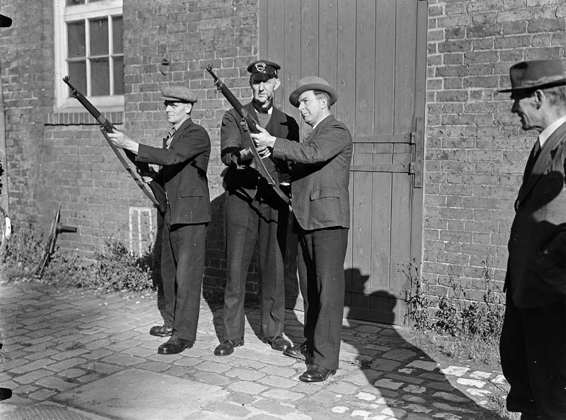
These men of the Kent Home Guard are receiving instruction with their .30-06 Model 1917 rifles. Britain received large numbers of these rifles from the United States. They were chambered for the American .30-06 cartridge rather than the standard British .303 round. To help differentiate these rifles as being non-standard calibre a red band was painted on the fore end of the rifle. These can be seen in this photograph just before the front swivel housing. The decision was taken to arm the Home Guard with these rifles to simplify the supply of ammunition. (WanPs-2259)
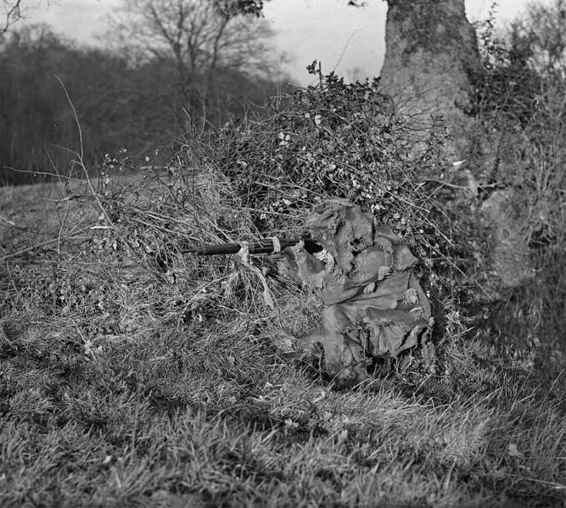
This photograph shows a member of the Kent Home Guard armed with his rifle and skilfully camouflaged in ghillie suit. (WanPs-0076)
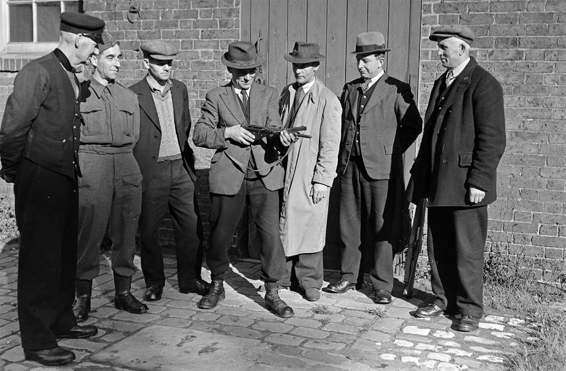
Another shot of the Home Guard. The man in the centre is holding a Sten Mk II sub-machine gun. (WanPs-00179)
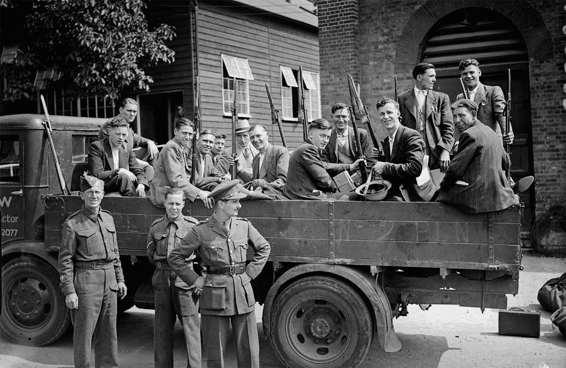
Members of the Kent Home Guard photographed in the back of a civilian lorry. They are all armed with Model 1917 .30-06 rifles. Curiously, this detachment all seem to have the front upper wood fore end removed from all their weapons. (WanPs-2332)
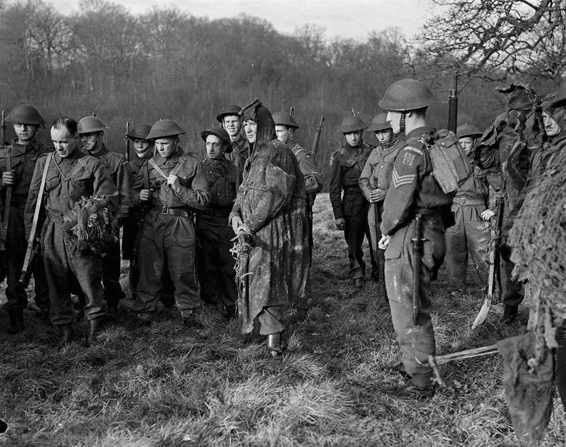
Members of the Kent Home Guard photographed during a training exercise in Kent. (WanPs-2480)
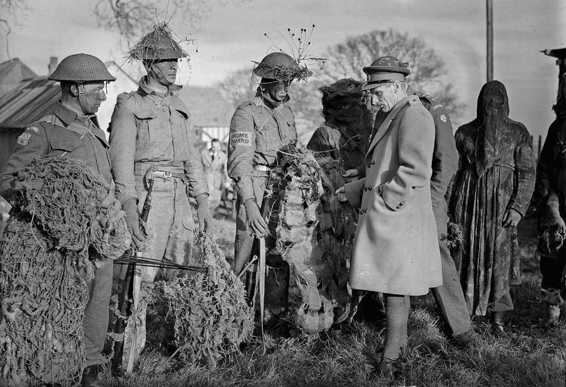
Lieutenant-General Bernard Montgomery with members of the Home Guard. In April 1941, General Montgomery became commander of XII Corps responsible for the defence of Kent. The man in the cenre has a later issue ‘reduced pattern’ Home Guard armband. (WanPs-2464)
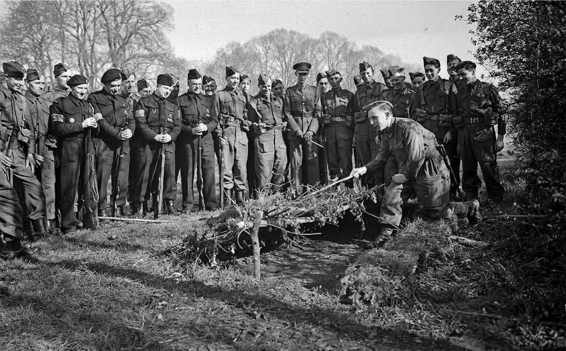
Home Guard members under instruction. This group is made up of members from a number of different units, some of which are wearing Civil Defence ARP uniforms, and some the uniform of the Royal Observer Corps. (WanPs-2272)
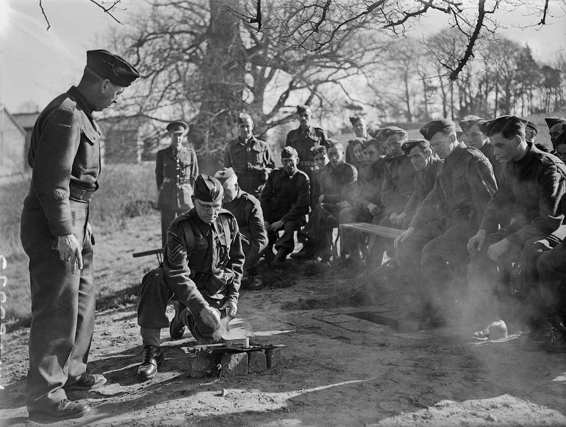
Members of the Kent Home Guard undergoing instruction for field cooking. The sergeant performing the cooking instruction would appear to be an experienced soldier judging by the First World War medal ribbons he is wearing on his battledress. A warrant officer looks on from the left. The men observing the demonstration on the bench are wearing the cap badge of the Queen’s Own Royal West Kent Regiment, the affiliated regiment for a number of the Kent Home Guard battalions. (WanPs-2273)
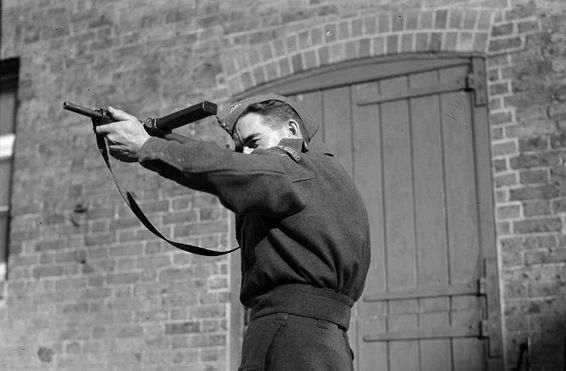
A Kent Home Guard soldier with Mk II Sten gun. (WanPs-0178)
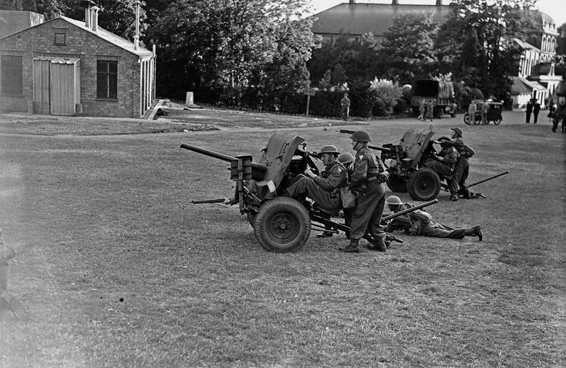
Members of the Kent Home Guard training with their 2-pdr anti-tank guns. To accord them their proper title, these guns are Ordnance QF 2-pounder Mk IX on Carriage Mk I. They were superseded very early in the war by larger weapons in front line service. They were issued to some Home Guard Units in 1943. This series of photos was taken in Calverley Park in Tunbridge Wells. (WanPs-0065)
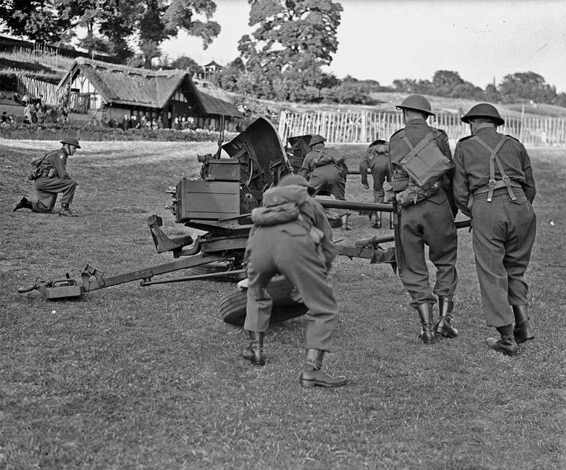
A second photograph of the Home Guard exercise in Calverley Park, Tunbridge Wells. (WanPs-0066)
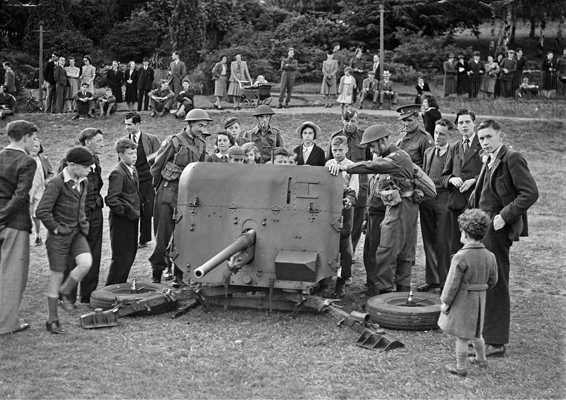
The third photograph of the Home Guard exercise in Calverley Park, Tunbridge Wells. The gun is in the firing position and appears to be of great interest to the school boys of Tunbridge Wells. (WanPs-00312)
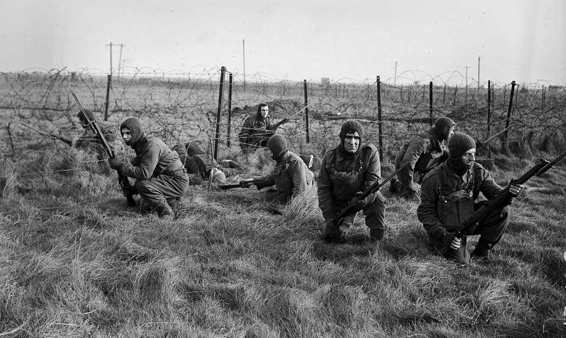
The actual unit the men in this photograph belong to is unknown. They are most likely a regular unit exercising, but the photograph perhaps forms a good representation of how an Auxiliary unit may have looked. The grim-set determination of these tough-looking men shows what a German invader might have been confronted by. (WanPs-2451)
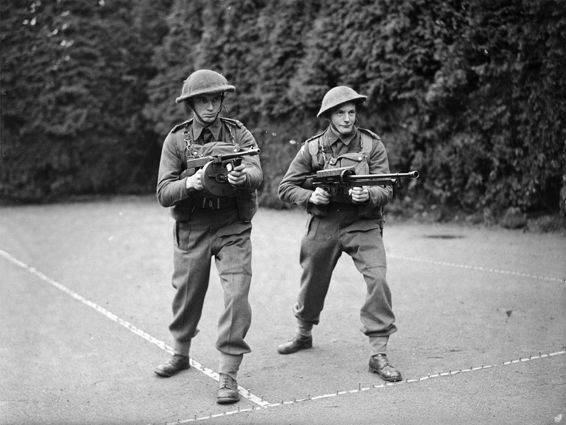
This image shows what is most likely regular soldiers armed with two weapons that were issued to the Home Guard. On the left the soldier is holding a Thompson model M1921 or M1928 sub-machine gun. Examples of these weapons came to the Home Guard under the unofficial scheme operated by the American Committee for the Defence of British Homes in 1940. The first weapons to actually enter British service were guns originally destined for the French Army, but as France had fallen by the time the guns were ready for shipping, they eventually ended up at Liverpool, re-directed to the French government in exile in the UK. The guns were duly appropriated by the British. The soldier on the right is holding a 0.303in Lewis Machine Gun Mark SS, originally introduced for Naval use as a ‘shoulder shooting’ weapon with modified shortened butt, removed radiator assembly and muzzle compensator. Owing to the shortage of machine guns after Dunkirk it was issued to both the regular army and the Home Guard as a stop-gap weapon. (WanPs-0063)