
Chapter Eight
The Auxiliary Territorial Service
The Auxiliary Territorial Service (ATS) came into being on 9 September 1938. It was initially organised on a regional basis in the same way as the Territorial Army. It incorporated members of the First Aid Nursing Yeomanry (FANY), the earliest women’s voluntary corps, which had served with distinction in the First World War. The first women who joined the ATS had no uniform and received only an armband with the initials ‘A.T.S.’ which they put over the sleeve of their civilian clothing. They received little training and worked mainly on such duties as cooks, clerks and storekeepers. In April 1941, the members of the ATS were given full military status. In December 1941 the government passed the National Service Act, which allowed the conscription of women into war work or the armed forces. Women could choose to join the ATS or its naval or air force equivalents, the WRNS and the WAAF. After the initial influx of volunteers a system of basic training was established lasting six weeks. New recruits were issued with their uniform and asked to carry out trade tests to establish which area they should go into. Experience in civilian life was usually taken into account; for example, if a woman had been a shorthand typist she would almost certainly be assigned clerical duties. During the course of the war the range of duties undertaken by the ATS expanded and women worked as telephonists, drivers, mechanics, mess orderlies, butchers, bakers, postal workers, ammunition inspectors and military police. The expanding role of the ATS in Kent was made apparent in a local newspaper report in May 1942:
ATS Women are to be trained at civilian garages in order to speed up the output of qualified driver mechanics. The first batch of 45 ATS trainees are now taking a six weeks course. They are all recent recruits, who have already done a driving course at an ATS MT Training Centre.
An appeal was also issued for recruits in May 1942:
Several hundred women of exceptional intelligence and proved organising ability are wanted at once to train as ATS cooks.
Whilst some members of the ATS may have been engaged in more traditional female roles, by 1944 some were employed in trades usually associated with men. The Dover Herald reported on 25 August 1944:
Armoured fighting vehicles, including tanks, armoured cars and Bren gun carriers, are now being repaired and adjusted by the A.T.S. before being sent to battle areas. It is a tough job, and before A.T.S. do it they train for a stiff six months training course, becoming skilled vehicle mechanics able to tackle such work as, stripping down tank engines, assembling Bren gun carriers and rebuilding armoured cars. Despite the constant clang of the R.E.M.E. workshops where they are employed and the dirt and grease connected with their work these A.T.S. consider themselves fortunate to be doing a ‘man-sized’ job.
The report went on to cite the personal story of Private Bessie Hayes of Lyndale House, Ashley near Dover who while training for her work first met her husband Roy Topley of Melton Mowbray who was also learning to become a welder.
The work of the ATS was not limited to work providing support services to the Army. In Kent they worked as plotters for the channel guns. It was members of the ATS who plotted the course of the Scharnhorst, Gneisenau and Prinz Eugen during their Channel dash in February 1942. The plotters worked in 24-hour shifts, manning the front line plotting rooms on the South Coast. Their job was to chart the course of every Allied or enemy ship which passed our shores within their area.
In one plotting room the ATS had a collection of trophies: splinters or shells fired in action and sent by a coast regiment, as recognition of the behind the scenes work performed by ATS which enabled them to engage the enemy. One exhibit of which the ATS plotters were immensely proud was the tracing of the SS Munsterland which they plotted throughout its two hour run before being finally sunk by coast artillery of the Wanstone and South Foreland batteries. The Munsterland was a German blockade-runner which had sailed from Japan with a cargo vital for Germany’s armaments industry. The sinking of this ship was a significant blow to German industry.
Whilst much of the work performed by the ATS was in a supporting role, some members lost their lives as a result of the sometimes hazardous duties they had to perform. One of those that paid the ultimate price was 42-year-old Corporal Lilian Bidgood of Loose, near Maidstone. She was crushed to death by the wheels of a 50 ft tank transporter and trailer at a southern base Army Reception Park. She is commemorated today at the Brookwood Military Cemetery in Surrey.
The Women’s Land Army
The Women’s Land Army was formed in 1939. It called for volunteers to take the place of thousands of young male farm workers who had gone off to fight in the war.
With the country at war and all able-bodied men needed to fight, there was a shortage of labour to work on farms and in other jobs on the land. At the same time it was becoming increasingly difficult to get food imported from abroad, so more land needed to be farmed to provide home-grown food. The Women’s Land Army provided much of the labour force to work this land.
The advertising slogan read, For a healthy, happy job join The Women’s Land Army’. In reality, the work was hard and dirty and the hours were long. Some of the girls received training before they were sent to farms; the farmers themselves trained others.
The Timber Corps was set up in 1942 to teach women to make pit props, necessary for working in mines. By 1944 the WLA had over 80,000 members. It lasted until its official disbandment on 21 October 1949.
Life in Kent for the Women’s Land Army was certainly eventful. In September 1942, at Westcourt Farm, Shepherdswell, a village between Canterbury and Dover, the farmer Mr James Weir on a Monday afternoon was driving some heifers, with a bull, into a field when the bull attacked him and he fell unconscious. Without hesitation, 26-year-old Miss Laura Jennings, a member of the Women’s Land Army, attacked the offending animal but was injured and thrown to the ground. She got up and continued to attempt to drive off the bull, which was afterwards successfully secured by other workers after it had been attacked by Mr Weir’s collie dog. Both Mr Weir and Miss Jennings were taken to Canterbury hospital as a result of the attack. Originally from Huddersfield, Miss Jennings had only been at the farm for six weeks!
Working for the Women’s Land Army in Kent also included other hazards, such as fires – some provided courtesy of the Luftwaffe.
A local newspaper report describes an event that took place in October 1942:
The girls and workmen at a farm near the S.E. Coast were machine gunned by a German raider last week. ‘I was on the horse’ said Theodora Marsh, ‘when I saw a big plane very low, just seeming to skim the stacks. The noise was terrible, but my horse was really good and stood still. Of course we were scared but we soon got over it.’ ‘This is our hot field’ said another girl. ‘We’ve had missiles, fire, and now this Jerry. He must have missed the bus because the harvest is in.’
There are some of the girls who helped put out a fire in the barley a few weeks back and worked hard until the fire service arrived. They are indeed plucky girls, there is not much cover in the field but on they go with their work.
The report named the plucky’ girls to give them a little limelight. Their names were recorded as: Theodora Marsh, Doreen Watts, Edith Beer and Ruth Fassams.
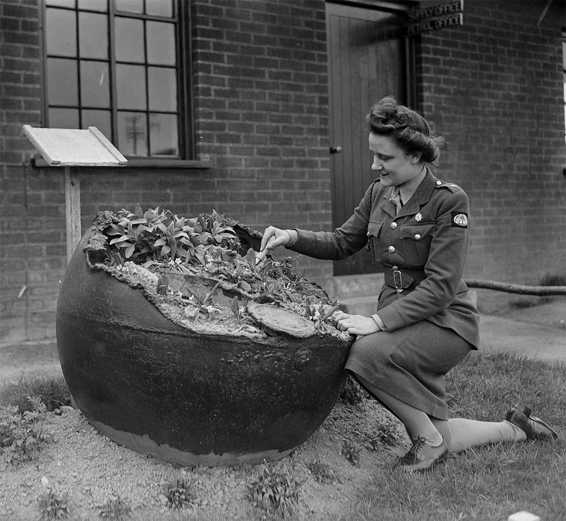
A member of the ATS tending some plants in a sea mine which is being used as a flower garden. This photograph is believed to have been taken at an ordnance store located at Appledore Road, Tenterden, c.1943. (WanPs-2267)
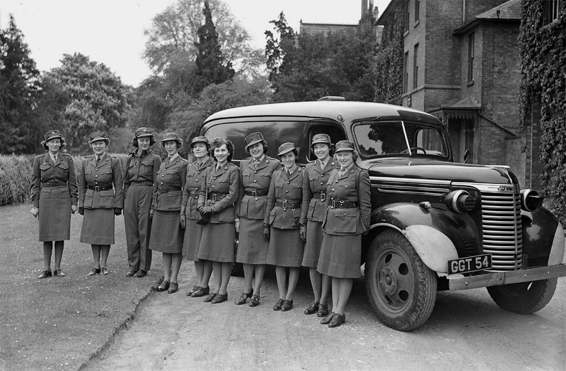
Members of the ATS next to an American Chevrolet 1940-model panel van. The photograph was taken at Somerfield Terrace, London Road, Maidstone. (WanPs-0079)
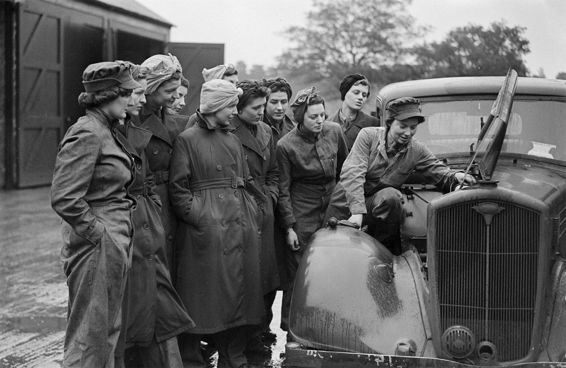
This photograph shows ATS female motor mechanics, being instructed on a Wolseley Saloon staff car. (WanPs-0173)
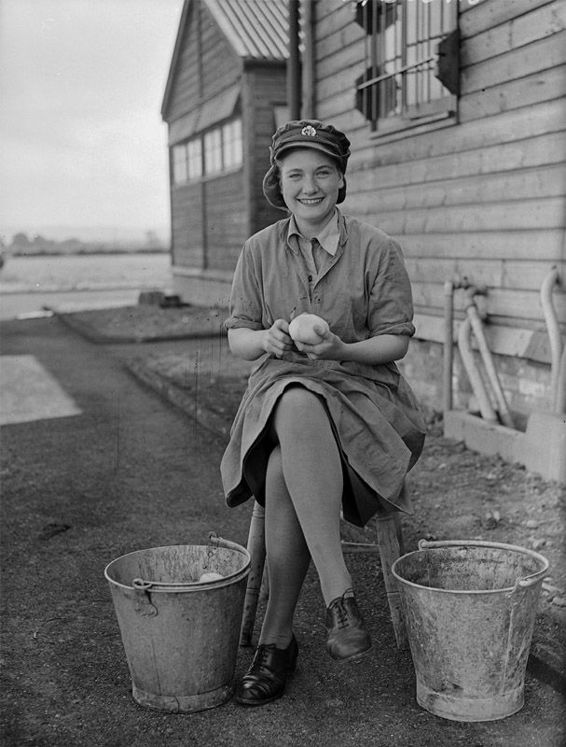
A photograph of a cheery ATS girl ‘spud bashing’, c.1941. (WanPs-0242)
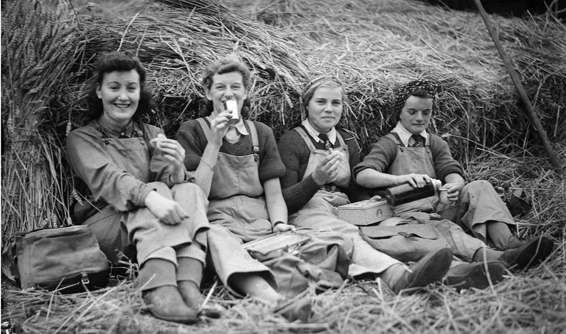
Land Army girls taking a break at a farm somewhere in Kent. (WanPs-0041)
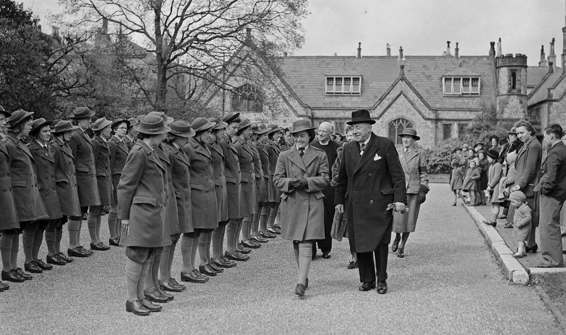
Land Army girls photographed on parade in Tunbridge Wells, c.1943. (WanPs-0324)
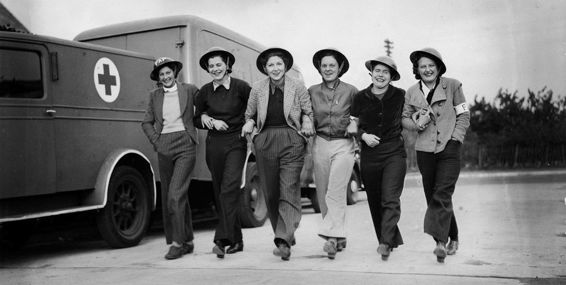
Ambulance girls photographed on 28 October 1939. Marked on the steel helmet of the woman on the left, the FAP stands for first aid post. The lady on the far right also has an armband marked the same. (WanPs-0112)
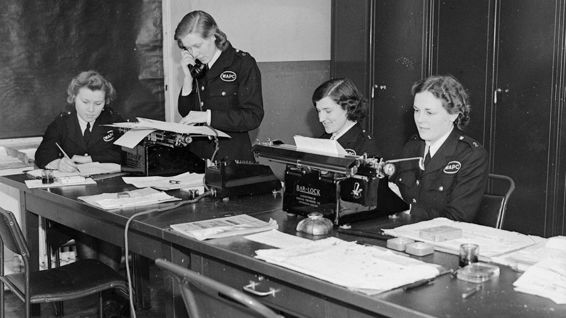
Members of the Women’s Auxiliary Police Corps on duty, c.1943. At the outbreak of the Second World War the Women’s Auxiliary Police Corps was formed. WAPC duties consisted of giving assistance to the regular police, and included the driving and maintenance of motors and the repair of other equipment as well as clerical work and acting as telephone operators. In London and other cities there were also women beat patrols. At its peak in June 1943, 7,300 women were serving with the police. (WanPs-0184)
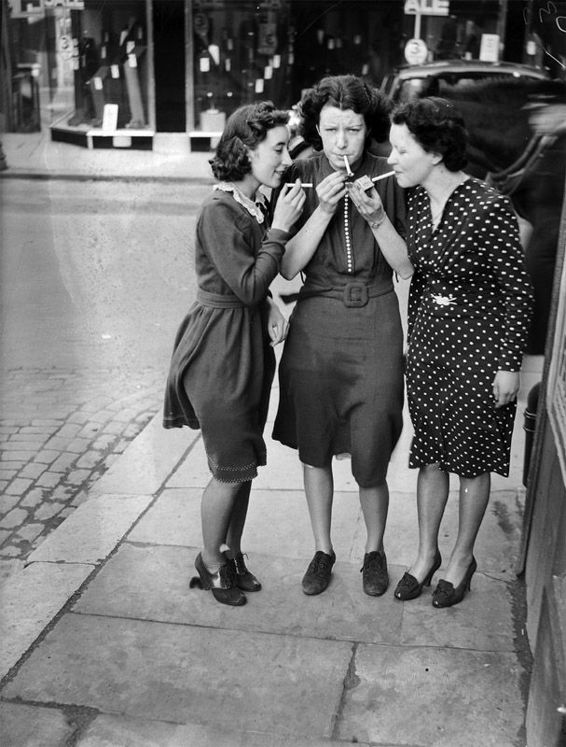
Three girls photographed lighting up a cigarette in the street, Kent, c.1940. (WanPs-0159)
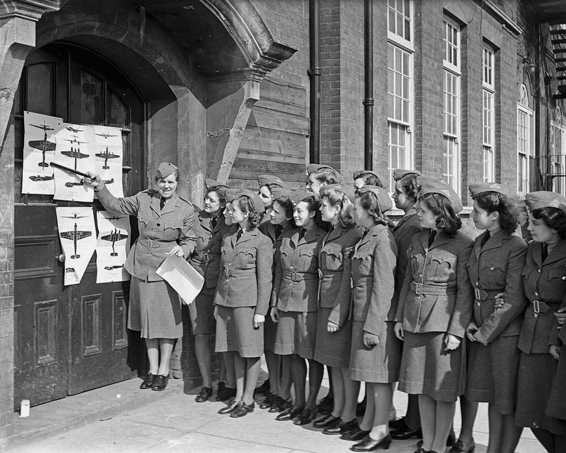
Girls of the Women’s Junior Air Corps being instructed in aircraft identification. This photograph is believed to have been taken in Gravesend. The instructor is pointing to an identification silhouette of a Fairey Fulmar British carrier-borne fighter aircraft that served with the Fleet Air Arm (FAA) during the Second World War. (WanPs-0218)
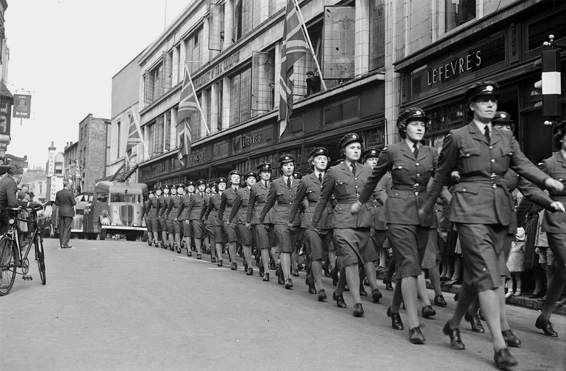
Members of the Women’s Auxiliary Air Force (WAAF) parading during a Wings for Victory parade in Guildhall St, Canterbury, c.1942. (WanPs-0226)
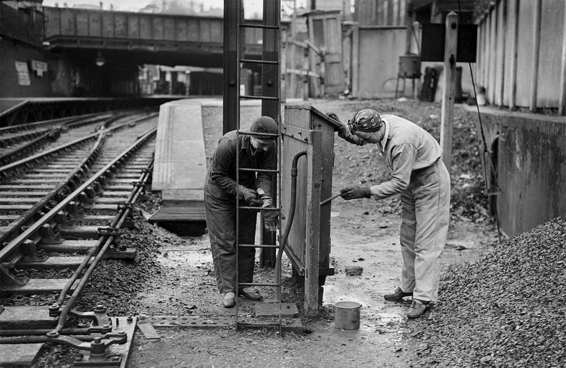
Female railway maintenance staff at Tunbridge Wells Station. During the Second World War women performed many roles on the railways. They were luggage porters, railway station announcers, booking clerks, ticket inspectors, welders, lathe operators and blacksmiths. They were also involved in manufacturing telegraph poles, manufacturing concrete railway sleepers, ticket printing, painting railway bridges, and crane operation – in fact many of the roles usually performed in peacetime by men. This vital work freed up hundreds of men for service in the Navy, the Army and the Air Force. (WanPs-2458)