
The unfortunate German soldier convicted of a military crime during the period of the Third Reich, but not sentenced to death, could still expect an extremely harsh fate. Any sentence handed down by the court was expected to be served after the end of hostilities. For the remaining duration of the war, the convicted soldier would be interred in one of the notorious Strafgefangenelager or punishment camps. The conditions in such camps were scarcely better than in some concentration camps.
As the war progressed however, the desperate need for manpower at the front saw soldiers incarcerated in such camps on sentences of three months or more transferred to penal battalions, or Feldstrafgefangenenabteilungen. In such units, convicted soldiers were kept on much reduced rations, and employed- unarmed -on the most dangerous of tasks. Mine clearing, bunker building and road construction were the tasks most likely to be imposed on them and often in areas heavily infested with enemy partisans. Casualty rates, as can be imagined, were extremely high.
Those who, by hard work and brave actions for between three and nine months were considered as having redeemed themselves could be transferred to a probationary unit, where though conditions were still harsh, it was possible for the soldier to regain his freedom in time. These Feldstrafgefangenenabteilungen, all of which were used on the Eastern Front, each consisted of a headquarters element and five companies as follows.
1 (Gefängnis) Kompanie
2 (Gefängnis) Kompanie
3 (Gefängnis) Kompanie
4 (Straflager) Kompanie
5 (Zuchthaus) Kompanie
A total of 22 such units were eventually created numbered between Feldstrafgefangenenabteilung I and Feldstrafgefangenenabteilung 22, being formed between April 1942 and March 1945.
As well as Feldstrafgefangenenabteilungen, other units also existed which were used to both punish and/or rehabilitate convicted soldiers. For those convicted of lesser crimes, usually some minor disciplinary offences, and who were still considered worthy of wearing uniform and bearing arms, a number of Bewährungsbataillonen or probationary battalions were created. Initially, the opportunity for rehabilitation in one of these units was open to soldiers who fulfilled certain conditions, namely.
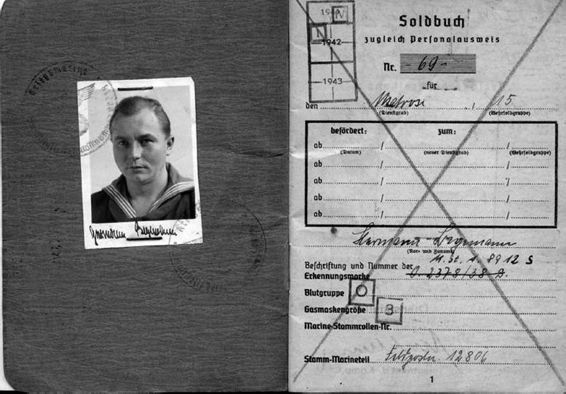
Soldbuch to Matrose Hermann Bergmann who was convicted and sentenced to serve in a Penal unit. (Ian Jewison)
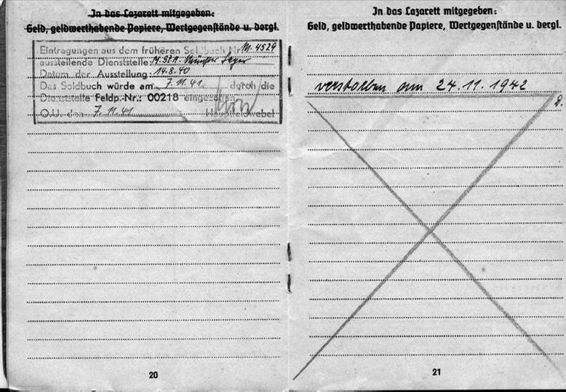
Soldbuch entry showing that Begemann was killed on 24 November 1942. (Ian Jewison)
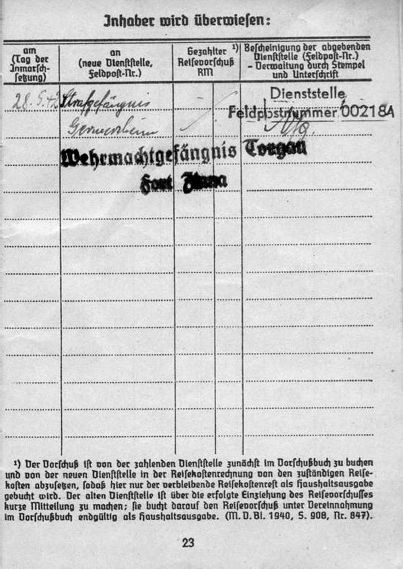
Entries showing that Begemann was held first in Strafgefängnis (Military Prison) Gemersheim, then at the notorious Torgau prison. (Ian Jewison)
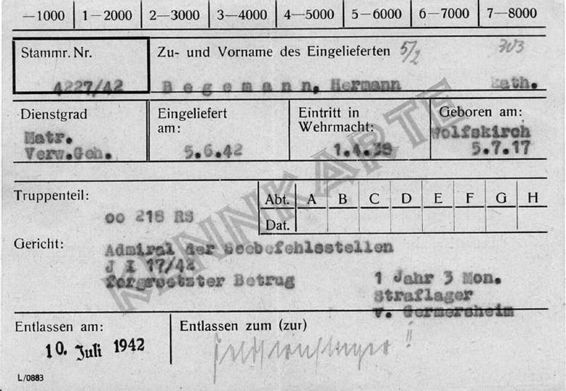
Index card for Begemann showing that he was sentenced to 1 Year and 3 Months imprisonment.
The individual before being convicted had previously conducted themselves well, with no more than insignificant issues.
The offence for which the individual was convicted could be considered as a ‘one-of’ incident and out of character.
The individual must have shown a genuine desire to prove himself against the enemy and have expressed this in writing.
The individual had to be a member of the armed forces or at least liable for military service.
The sentence received must have been at least 6 months imprisonment.
The individual had to be capable of serving in an Infantry unit.
Prisoners serving sentences in civil or military prisons must serve at least one month of their sentence before being accepted. Service in a Bewährungsbataillon was considered honourable service and it was made clear that these were probationary, not punishment units though promotions were intentionally harder to achieve and the only awards which could be earned were combat awards such as the Infantry Assault Badge and Wound Badge.
The following Infantry Probationary Battalions were formed:
|
Infanterie-Bataillon z.b.V. 491 |
Formed November 1944 |
|
Infanterie-Bataillon z.b.V. 500 |
Formed April 1941 |
|
Infanterie-Bataillon z.b.V. 540 |
Formed December 1941 |
|
Infanterie-Bataillon z.b.V. 550 |
Formed November 1941 |
|
Infanterie-Bataillon z.b.V. 560 |
Formed August 1942 |
|
Infanterie-Bataillon z.b.V. 561 |
Formed January 1943 |
The Luftwaffe also maintained a small number of probationary units within which those convicted of lesser offences could redeem themselves. Most of these eventually came under army control around the time the Luftwaffe’s field divisions were absorbed into the Heer.
Battalions 1–3 in the following list were subsequently renamed as Jäger battalions. Unlike their army counterparts, several of these Luftwaffe probationary units served on the Western Front, and in Italy in particular:
|
Luftwaffen-Feld-Bataillon z.b.V. 1-2 |
Formed November 1942 |
|
Luftwaffen-Feld-Bataillon z.b.V. 3 |
Formed March 1943 |
|
Luftwaffen-Feld-Bataillon z.b.V. 4-5 |
Formed April 1944 |
|
Luftwaffen-Feld-Bataillon z.b.V. 6 |
Formed June 1944 |
|
Luftwaffen-Feld-Bataillon z.b.V. 7 |
Formed October 1943 |
|
Luftwaffen-Feld-Bataillon z.b.V. 8-9 |
Formed March 1944 |
|
Luftwaffen-Feld-Bataillon z.b.V. 10 |
Formed April 1944 |
|
Luftwaffen-Feld-Bataillon z.b.V. 100**** |
Formed December 1942 |
|
Luftwaffen-Feld-Bataillon z.b.V.Finland |
Formed 1942 |
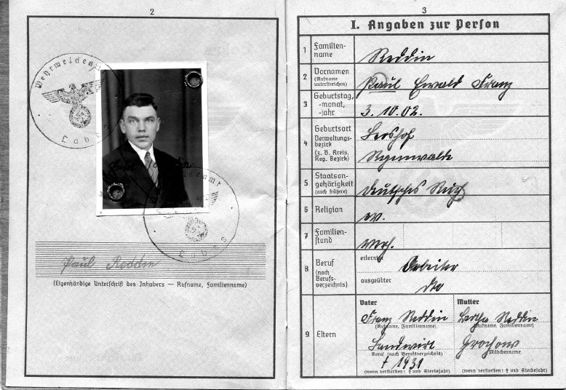
Wehrpass of Gefreiter Paul Reddin who served as a guard with a penal unit.
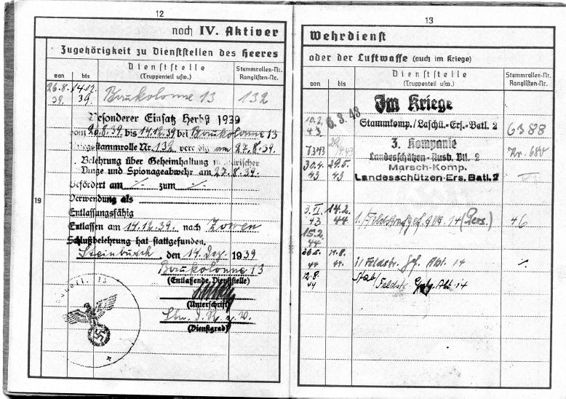
Entries from the Reddin Wehrpass. Note that he served with Feldstrafgefangenen Abteilung 14.
Unsurprisingly the navy, as the smallest branch of the services, had the fewest of this type of unit, with just three known to have existed. These were probationary rather than penal units with the normal length of stay for errant sailors around three months or so. Prior to the outbreak of war, the Navy’s disciplinary unit, formed in 1936, was known as the Sonderabteilung der Kriegsmarine, but on the outbreak of war was renamed as the Kriegssonderabteilung. At some later date, exactly when is not known, a second unit was formed, known as Kriegssonderabteilung Ost. It is believed that the original Kriegssonderabteilung was responsible to the North Sea (Nordsee) command and the Kriegssonderabteilung Ost to the Baltic (Ostsee) Command.
In July 1942, both of these units were disbanded and replaced by the newly formed 30 and 31 Schiffstammabteilungen with the former responsible to Nordsee command and the latter to the Ostsee command. Later in the war, serious disciplinary problem cases would be sent to designated naval companies within the Feldstrafgefangenenabteilungen of the army.
Both the staff elements and those serving sentences wore field grey naval uniform, but staff were also provided with regular blue naval uniforms for off-duty and walking out wear. Initially, staff wore the cap ribbon of the ship or establishment they were seconded from but from September 1938, were ordered to wear the ribbon ‘Kommandantur Kiel’. On the outbreak of war, the standard ‘Kriegsmarine’ ribbon was used. The shoulder straps worn featured crossed un-fouled anchors with the letter S (for Sonderabteilung) above.
A number of units with numbers in the 900 series were also created, but are outwith the scope of this book as rather than being filled by soldiers who were being punished due to having fallen foul of the Feldgendarmerie and the military justice system, these units were created from those who previously been classed as Wehrunwürdig or unworthy of military service for various reasons.
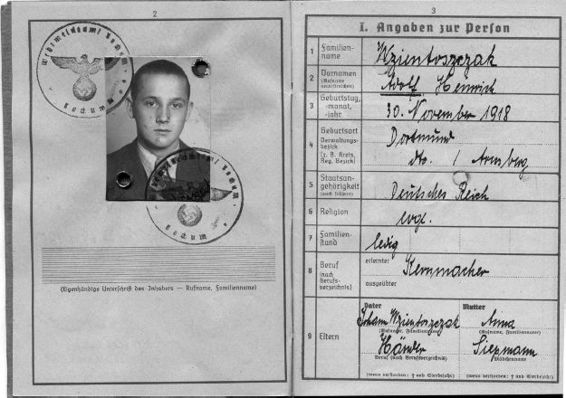
Wehrpass to Adolf Wzientoszczak, of Feldgendarmerie Trupp 336.
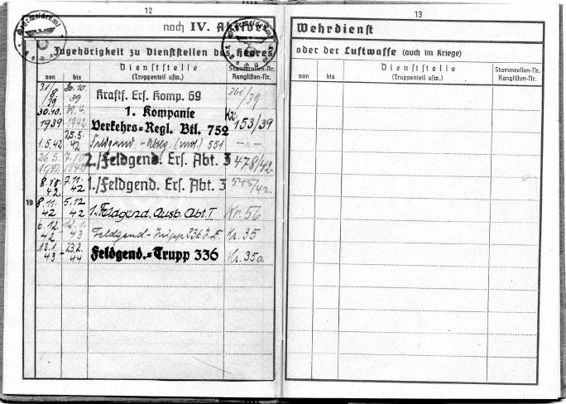
At first a fairly unremarkable document, showing him serving first with a Traffic Control unit and ultimately with the Feldgendarmerie Trupp of 336 Infanterie Division, with service throughout the campaign in the West and on the Eastern Front.
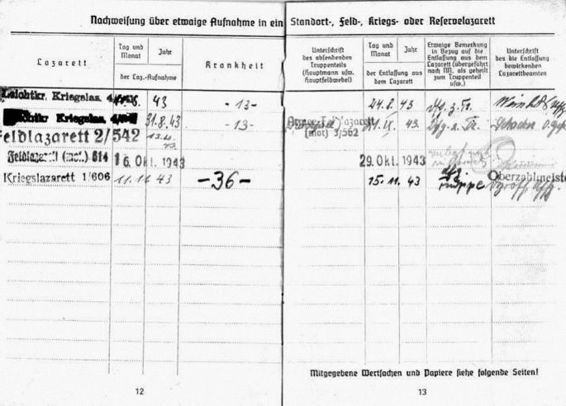
The Wzientoszczak Soldbuch also still exists however and as well as showing the medical code 13 for Venereal Disease (considered a self-inflicted illness) it also shows 36, a code used for faking illness.
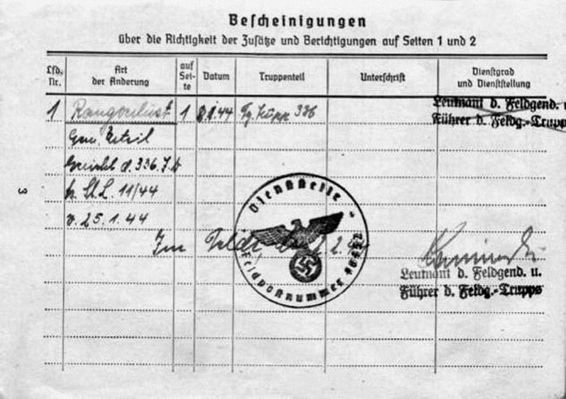
This behaviour earned Wzientoszczak a demotion (Rangverlust) from a junior NCO (Unteroffizier) to private with the resultant loss of pay and status.
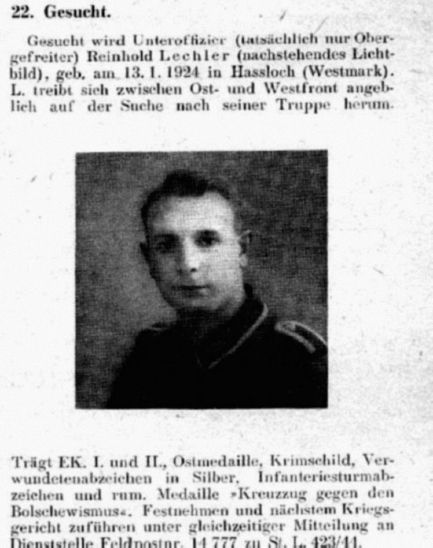
A 1945 dated ‘Wanted’ notice stating that if the suspect is apprehended he is to be handed over to the nearest Court Martial.