
The German military justice system was rather complex and would require far more space than is available here to cover in detail. What is provided here is an overview to illustrate the fate awaiting some of those who may have fallen foul of the Feldgendarmerie and related units covered in this book.
After the end of the First World War and the creation of the Weimar Republic, the military lost all jurisdictions over the punishment of German soldiers. Thereafter any charges against a soldier would be processed through the civil courts.
The situation swiftly changed however, when the Nazis came to power. Hitler, along with many of his senior military officers, believed that Germany had been far too lenient with any soldiers who had contravened military regulations and that this had contributed to the rapid breakdown of order and discipline in the closing weeks or the First World War. It seems in fact that they may have had a point. It may surprise many to know that during the First World War the Germans had executed a total of 48 soldiers on various charges, whilst Great Britain had executed 346, figures which suggest that the German courts martial system was indeed lenient.
The Military Penal Code was reintroduced by a special decree of 12 May 1933, and a further decree on 5 September 1936 created the Reichskriegsgericht. This was to be Germany’s highest military court. In the event this military court would also be responsible for the punishment of civilians as well as soldiers.
The military courts would prosecute charges in five basic areas:
|
(I) |
Treason. |
|
(II) |
High treason. |
|
(III) |
Undermining military morale. |
|
(IV) |
Conscientious objection. |
|
(V) |
Assisting the enemy. |
The Reichskriegsgericht was based initially in Berlin but due to the bombing, was moved first to Potsdam and eventually to Torgau. Having reintroduced the Military Penal Code, the Nazis set about removing any clauses which they considered too lenient, desirous of a draconian set of rules by which miscreant German soldiers would be harshly dealt. In the event, a formal new code was never completed and published, but continued to be worked on throughout the period of the Third Reich.
The next most significant step was the creation of a special Wartime Military Penal Code, the Kriegssonderstrafrechtsverordnung (KSSVO), on 17 August 1938. At the same time a new order, the Kriegsstrafverfahrensordnung (KstVO) was signed outlying the procedures to be carried out under this new code.
This new code was indeed draconian, with the rights of the accused reduced to a bare minimum and all rights of appeal abolished. Deserters in particular were to suffer the harshest of punishments. Hitler himself stated in Mein Kampf:
At the front one might die, as a deserter one must die.
The new attitude towards accused soldiers was apparent in a comment made by the Oberbefehlshaber des Heeres just after the outbreak of war. Despite being considered by history an anti-Nazi and opponent to Hitler, Generaloberst Walther von Brauchitsch eagerly supported the harsh new system. His attitude towards errant soldiers is clearly reflected in a statement he made in December 1939.
The more quickly a military parasite receives his just punishment, the easier it will be to deter other soldiers from committing the same or similar acts and to maintain military discipline among the troops…
This attitude towards those soldiers convicted by the military courts resulted in a massive increase in death sentences. In comparison with the 48 German soldiers executed during the First World War, during the Second World War, at least 33,000 German soldiers were put to death and this number is almost certainly well below the true figure as no accurate records exist of those executed on the orders of the notorious fliegende Standgerichte, or ‘flying courts martial’ which roamed Germany dealing out swift summary ‘justice’ in the closing stages of the war. Estimates of as many as 50,000 German soldiers being executed on the orders of the military courts is probably not far from the true figure.
One of the most heinous crimes in the eyes of the Wehrmacht was of course desertion or Fahnenflucht. It is interesting to note that even the harsh new penal code allowed for a jail sentence of up to 15 years for this crime—i.e. non-capital punishment. In reality however, such sentences were rare and only tended to occur in the early part of the war. From 1941 onwards such a crime almost invariably resulted in the accused being executed by beheading if tried in the Reich, or execution by firing squad if tried in the field.
At lower levels, the court through which many errant soldiers found themselves processed was the Feldgericht (field court martial) or Standgericht (summary court martial).
Summary courts martial were authorised in circumstances where:
|
a) |
For sound military reasons, the trial cannot be delayed. |
|
b) |
A military judge is not immediately available. |
|
c) |
Witnesses and evidence are available. |
In these circumstances a regimental commander or officer with equivalent status could act as proxy for the Judge. Military Justice personnel were considered army officials rather than regular soldiers. They were effectively civil servants (Reichsbeamte) attached to the armed forces and thus classed as Wehrmachtbeamte.
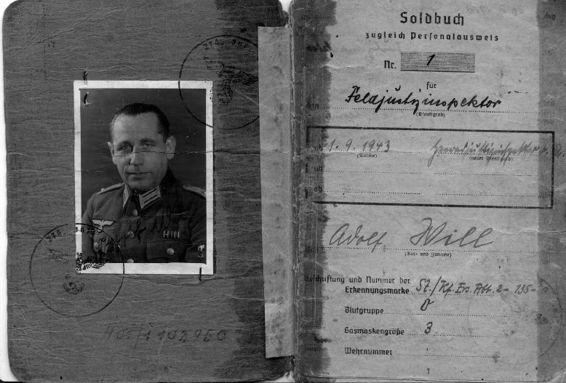
Soldbuch for Feldjustizinspektor Adolf Will. (Ian Jewison)
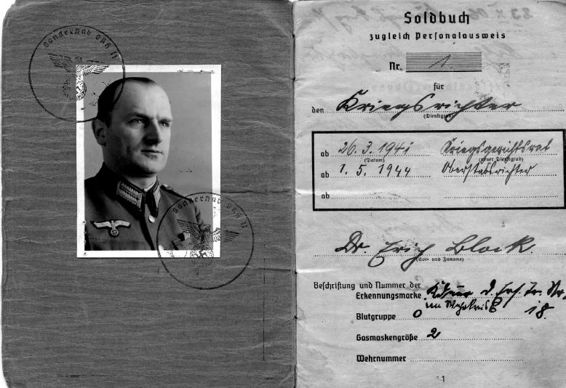
Soldbuch of Oberstabsrichter Erich Block. (Ian Jewison)
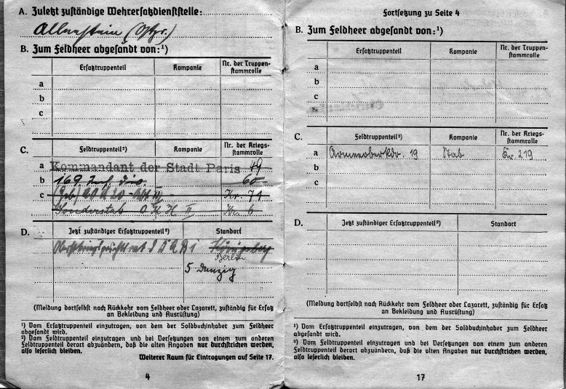
The entry in Section D shows Block in the position of Oberkriegsgerichtsrat (Senior Court Martial Councillor). (Ian Jewison)
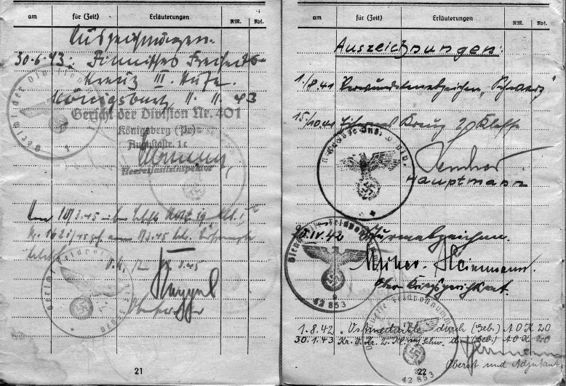
Note the ink stamp in the Block Soldbuch for the ‘Gericht der Division 401’. (Ian Jewison)
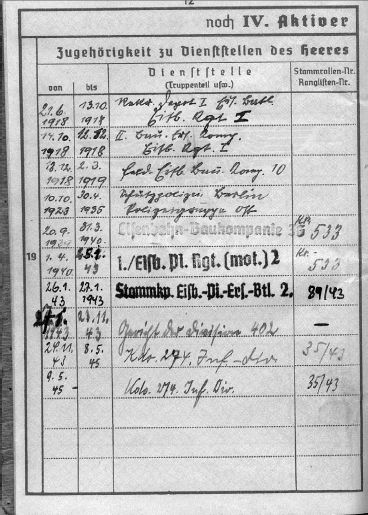
Entry from the Wehrpass of Adolf Will showing as third from last entry ‘Gericht der Division 402’, the divisional Court. (Ian Jewison)
Justice personnel fell into three different career bands:
höherer Dienst: for which a university education with an appropriate degree was required. This band contained ranks from the equivalent of Leutnant up to Generalleutnant.
gehobener mittlerer Dienst: for which an educational level equivalent to somewhere between high school and college level was required, plus a further two or three years of training. This band contained ranks from the equivalent of Leutnant up to Oberstleutnant.
einfacher mittlerer Dienst: for which a high school level qualification was required plus having completed an apprenticeship or some form of trade training. This band contained ranks from the equivalent of Feldwebel up to Oberleutnant.
The overlap in ranks between these bands means that the relevant shoulder straps indicated rank, whilst the undermentioned special collar tabs indicated the career band. This means that the same shoulder straps may be seen with different collar tabs. The actual rank titles and equivalents were as follows
|
Generalleutnant |
= |
Senatspräsident beim Reichskriegsgericht |
|
Generalmajor |
= |
Reichskriegsgerichtsrat |
|
Oberst |
= |
Oberstjustizrat; Oberstkriegssgerichtsrat |
|
Oberstleutnant |
= |
Oberheeresjustizrat; Oberkriegsgerichtsrat |
|
Major |
= |
Heeresjustizamtmann; Kriegsgerichtsrat |
|
Hauptmann |
= |
Heeresjustizoberinspektor; Reichskriegsgerichtoberinspektor |
|
Oberleutnant |
= |
Heeresjustizinspektor; Reichskriegsgerichtinspektor |
|
Leutnant |
= |
Heeresjustizsekretär; Reichskriegsgerichtsekretär; |
|
Oberfeldwebel |
= |
Heeresjustizoberwachtmeister; Reichsgerichtoberwachtmeister |
|
Feldwebel |
= |
Heeresjustizwachtmeister; Reichskriegsgerichtswachtmeister |
The uniform worn by these officials was identical to that worn by regular soldiers. Only their distinctive insignia set them apart. The Waffenfarbe of the Beamte was dark green, worn as piping top the visor cap and as underlay to the shoulder straps. The straps featured the same light blue Nebenfarbe as the GFP until March 1940 at which point a pale grey Nebenfarbe became standard for all branches. In place of the GFP cipher worn by the Geheime Feldpolizei, a white metal HV cipher was worn on the centre of the strap. Prior to the outbreak of war, officer grade equivalents wore a gilt cipher comprising the letters ‘HV’ ( for Heeresverwaltung) on the shoulder strap whilst NCO grade equivalents wore a white metal cipher. From the outbreak of war, the cipher was in light grey metal for all ranks.
Further changes came in January 1944 when a new Branch of service was created for some of the officials of the Wehrmacht. According to Heeresmitteilungsblatt 44, Nr 263 of 3 May 1944, this new branch, the Truppensonderdienst (TSD) would absorb the justice officials and would introduce a new shoulder strap for justice officers. It would have the normal grey aluminium braid cords as used by regular branches, but on a wine red base. In place of the old ‘HV’ cypher, the strap now featured a bronzed sword emblem mounted with the point towards the buttonhole.
Standard officers collar litzen were used with a wine red Waffenfarbe strip down the centre of each bar.
All those serving as officials in the judicial branch (Heeresjustizbeamte) were transferred to the TSD into the following rank equivalents:
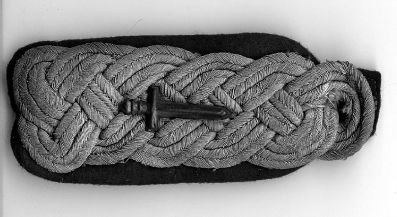
The Administrative style shoulder straps were later replaced by a regular army style strap on a Bordeaux red base with a metal Sword of Justice emblem. (Ian Jewison)
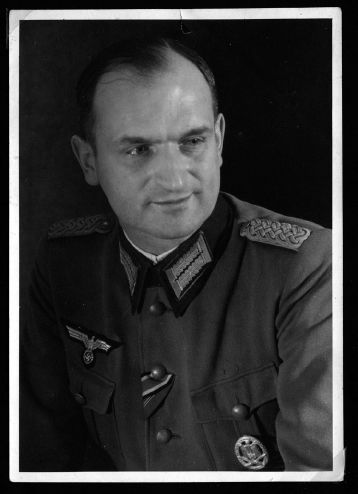
A fine portrait study of Block. The Administrative style shoulder straps for court martial officials lack the normal ‘HV’ (Heeresverwaltung) cipher of regular admin officials. (Ian Jewison)
|
Generalleutnant |
= |
Generaloberstabsrichter |
|
Generalmajor |
= |
Generalstabsrichter |
|
Oberst |
= |
Oberstrichter |
|
Oberstleutnant |
= |
Oberfeldrichter |
|
Major |
= |
Oberstabsrichter |
|
Hauptmann |
= |
Stabsrichter |
An additional grade, of Generalrichter fell somewhere between Oberst and Generalmajor in the same manner as the SS rank of Oberführer, effectively a senior full colonel.
Collar Patches
Collar patches were the standard Beamte pattern as worn by the GFP, with the same light blue piping to the top, rear and lower edges. The Luftwaffe had its own corps of administrative officials, the career bandings and qualifications etc for which, were identical to those for the army.
Shoulder straps for officer grade Luftwaffe administrative officials used identical bright silver braid as their regular Luftwaffe counterparts. Their status as officials was indicated by the use of a dark green base to the strap with an intermediate layer (Nebenfarbe) showing their specialisation. Both court martial and judicial officials used Nebenfarbe of wine red (weinrot) and Bordeaux red (Bordeauxrot) depending on their career band.
|
Justizwachtmeister |
= |
Feldwebel—Weinrot |
|
Justizoberwachtmeister |
= |
Oberfeldwebel—Weinrot |
|
Reichskriegsgerichtsekretär |
= |
Leutnant—Bordeauxrot |
|
Kriegsgerichtinspektor |
= |
Leutnant—Weinrot |
|
Reichskriegsgerichtobersekretär/ |
= |
Oberleutnant—Bordeauxrot |
|
Reichskriegsgerichtsoberinspektor |
= |
Hauptmann—Weinrot |
|
Kriegsrichter |
= |
Hauptmann—Weinrot |
|
Amtsrat beim Luftwaffengericht |
= |
Major—Weinrot |
|
Amtsrat beim Reichskriegsgericht |
= |
Major—Weinrot |
|
Bürodirektor beim Reichskriegsgericht |
= |
Oberstleutnant—Bordeauxrot |
|
Oberkriegsgerichtsrat |
= |
Oberstleutnant—Weinrot |
|
Oberkreigsgerichtsrat beim |
= |
Oberstleutnant—Weinrot |
|
Oberstkriegsgerichtsrat der Luftwaffe |
= |
Oberst—Weinrot |
|
Oberstkriegsgerichtsrat beim |
= |
Oberst—Bordeauxrot |
|
Ministerialdirigent |
= |
Generalmajor—Weinrot |
|
Reichskriegsgerichtsrat |
= |
Generalmajor—Bordeauxrot |
|
Senätspräsident beim Reichskriegsgericht |
= |
Generalleutnant—Bordeauxrot. |
Collar patches followed the normal Luftwaffe format, but with small triangular embroidered pips in place of the normal wings. A base colour of dark green was used as standard in collar patches for Luftwaffe officials with the following exceptions in the legal branch.
Weinrot –
Kriegsrichter
Kriegsgerichtsrat der Luftwaffe
Oberkriegsgerichtsrat
Oberstkriegsgerichtsrat der Luftwaffe
Ministerialdirigent
Bordeauxrot-
Oberkriegsgerichtsrat beim Reichskriegsgericht
Oberstkriegsgerichtsrat beim Reickskriegsgericht
Reichskriegsgerichtsrat
Senätspräsident beim Reichskriegsgericht
The Luftwaffe differed from the Heer in that both the collar tabs and shoulder straps indicated specific rank. In order to reflect the careers banding therefore, different cord piping colours were used for the collar tab edging. For höherer Dienst , gold twist cord piping was used, for gehobener mittlerer Dienst, silver twist cord piping and for einfacher mittlerer Dienst silver and green twist cord piping. As with the other Wehrmacht branches, judicial officials from the Luftwaffe were absorbed into the Truppensonderdienst in 1944. The new branch utilised the regular design of collar tabs and shoulder strap but in the case of judicial officials, with Weinrot underlay to the collar tabs and shoulder straps.
The following ranks existed in the new judicial branch of the Truppensonderdienst in the Luftwaffe.
|
Stabsrichter |
= |
Hauptmann |
|
Oberstabsrichter |
= |
Major |
|
Oberfeldrichter |
= |
Oberstleutnant |
|
Oberstrichter |
= |
Oberst |
|
Generalrichter |
= |
Generalmajor |
|
Generalstabsrichter |
= |
Generalleutnant |
Naval Officials wore a uniform virtually identical to that used by their regular naval compatriots but for the fact that all insignia, buttons and trim were in silver rather than gold colour. This led to them being referred to by regular naval personnel as ‘Silberlings’
As with the regular navy, rank was indicated by a system of rings around the lower sleeve. Career banding was indicated by a hand embroidered silver wire motif worn above these rings. In the case of justice officials, the insignia consisted of a Wehrmacht pattern eagle and swastika with folded wings over a depiction of the scales of justice. For officials in the höherer Dienst career band three swords were positioned over the scales, for those in the gehobener mittlerer Dienst band, two swords and for those in the einfacher mittlerer Dienst band a single vertical sword. Rank titles were similar to those of the army but with the prefix ‘Marine’, thus an army Kriegsgerichtsrat would have as his naval equivalent a Marinekriegsgerischtsrat.
With the creation of the Truppensonderdienst in 1944, naval judges were transferred to this new branch.