
7
After the massive October 1969 Moratorium and the disclosure of the My Lai Massacre, it seemed that during the winter and spring of 1970 Nixon would do something to at least attempt to pacify the American antiwar movement. In fact, he did nothing. Instead, on April 30, Nixon further stoked dissent by announcing that he had expanded the Vietnam War into Cambodia. While the White House explained that the aim of Nixon’s “incursion” was to eradicate communist strongholds and supply routes, the antiwar movement saw it as an illegal invasion, because regardless of North Vietnamese presence in the country, since 1954 Cambodia had maintained neutrality in the conflict.1
The New York Times called Nixon’s actions a virtual renunciation of his pledge to end the war, and a number of protests broke out all across the United States, especially on college campuses.2 Protests turned violent at Kent State in Ohio, where on May 4, national guardsmen killed four students and wounded nine others. A similar event occurred at Jackson State on May 14, when protests against the invasion—which also focused on racism, repression, and the inclusion of the experiences of women and minorities in the educational system—led to the killing of two students and the wounding of at least twelve others.3 The shootings at Kent State and Jackson State led in turn to a sea of student protest across the country. In all, some four million students mobilized at half of the country’s universities and colleges during the spring of 1970. Either because of the students’ refusal to go back to classes or because of institutional fear of further violence, classes were canceled on more than five hundred campuses across the country—that is to say, in excess of 80 percent of campuses in the United States. Approximately fifty schools closed their doors for the rest of the semester.
The New York art community reacted to Nixon’s invasion through The New York Art Strike Against Racism, War, and Repression, the most significant extra-aesthetic action to occur in the United States during the Vietnam War, and what would be the largest collective protest action organized by American artists during the twentieth century (fig. 60). The Art Strike was a one-day strike of museums and galleries in New York City that took place on May 22, and it was specifically rooted in a protest against the invasion of Cambodia, the shootings at Kent and Jackson State, and the country’s racial divide. (The name sometimes included “Sexism,” too, and the strike sought to embrace this issue as well.) While the strike built on earlier Vietnam-era artist protest efforts—such asAPC’s White Out and the political engagement of those involved with AWC—its roots could be found more in an unprecedented torrent of labor revolt across the United States, and even more prominently, in shutdowns of the Jewish Museum and the Whitney by contemporary artists, motivated by the invasion of Cambodia and societal repression, during the weeks preceding the Art Strike. Artists involved in the Jewish Museum’s Using Walls exhibition—Richard Artschwager, Mel Bochner, Daniel Buren, Craig Kauffman, Sol LeWitt, Robert Morris, and Lawrence Weiner—decided on the day of the opening by a majority vote to shut down their show (which was supposed to be installed from May 13 through June 21).4 The resolution to close the exhibition was meant to highlight the fact that “the crash course [being] pursued by the administration would lead to a creative blackout,” and to urge other cultural institutions “to take an unequivocal stance on the issue[s] of war, racism and repression”—hence the full name by which the Art Strike was eventually best known.5 The museum negotiated with the artists and agreed to close the show on June 1.
At the Whitney, Robert Morris, who in 1968 denied any interest in politics, suddenly ended his one-person exhibition almost two weeks before it was scheduled to close, in an act inspired by the Jewish Museum artists.6 In a statement Morris composed for the Whitney trustees and the press, he explained there was a “need . . . to shift priorities at this time from art making or viewing . . . to unified action within the art community against the intensifying conditions of repression, war, and racism in this country.” Echoing the Jewish Museum artists, Morris asked that the Whitney “take an unequivocal stand on these issues” by stating its position, suspending “all normal cultural functions” for two weeks, and during the two weeks, making staff and space available to have meetings open to every level of the art community. Morris ended with the following threat against the museum: “A lack of vigorous positive response to these . . . issues can only be interpreted as condoning the militarist and repressive policies which the faculty of the School of Visual Arts and participants in the current Jewish Museum show have publicly abhorred. Beyond this a reassessment of the art structure itself seems timely—its values, its policies, its modes of control, economic presumptions, its hierarchy of existing power and administration—with the view of changing that which is outmoded and corrodes our lives as people and artists.”7
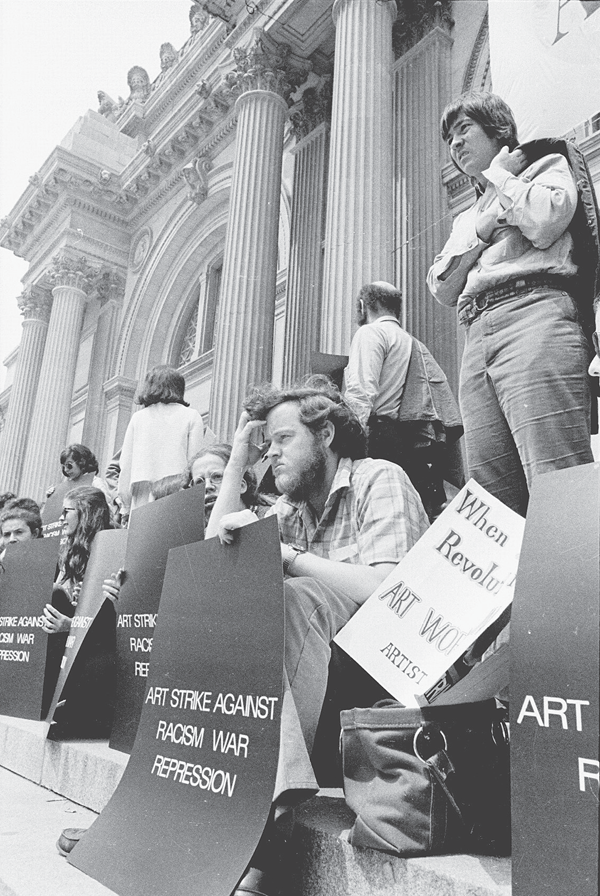
60. Jan Van Raay, photograph of The New York Art Strike Against Racism, War, and Repression outside the Metropolitan Museum of Art on May 22, 1970. 35mm black-and-white image, size variable.
Although influenced by the actions of the Using Walls artists, Morris’s thinking was also in line with previous actions taken by factions of AWC, and the general societal movement toward strikes by students and organized labor.8 Morris’s actions, like Andre’s sculptures, have also been linked to Herbert Marcuse’s theory of a “Great Refusal”—that is, “the negation of the entire establishment” outlined in his 1969 An Essay on Liberation.9 Marcuse saw hopeful indications that this refusal was undermining mainstream society in the late 1960s, especially in the widespread “collapse of work discipline, slowdown, [the] spread of disobedience to rules and regulations, wildcat strikes, boycotts, sabotage, [and] gratuitous acts of noncompliance.”10 Julia Bryan-Wilson has recently commented that another possible motivation for Morris’s decision to shut down his own show was that his exhibition’s foregrounding of artistic labor—in a collaborative production with a team of dozens of workers—no longer had resonance in the United States. Labor riots in New York City, in which hardhat construction workers attacked antiwar protestors, had severed the connection the leftist world had been trying to forge with organized labor. (This was an outcome of Nixon’s strategy of giving voice to the silent majority.) Beforehand, Morris and other artists like Richard Serra had been pronouncing such a connection.11 As a final note, what was included inside the walls of Morris’s exhibition has been conceived as rejecting the state of the country and relating to Morris’s cancellation. Because Morris’s process or “anti-form” installation valorized labor and democratic creation through its participatory nature and the use of construction equipment in the creation of the exhibition, it has been read as being predicated on the New Left’s broader sociopolitical foundation, which was also committed to overturning the commodity-based dynamic of modernist culture and capitalism. In this way, Maurice Berger comments that “the nature of the New Left, summarized in a single word . . . [was] process. It signals an almost religious return to experience . . . [and a] retreat from the abstractions of the red politics of yesterday . . . rhetorical repetition, procedural debate, moral invitations to kindness and equality were all part of the process of community building, a psycho-political experience in which duration played a purgative part in transforming traditional political interactions into what was described as ‘movement behavior.’”12
In this way, Morris reflected other lessons of Marcuse, especially in his call for “liberated work” whose instinct is “cooperation, which grounded in solidarity, directs the organization of the realm of necessity and the development of the realm of freedom.”13Morris’s stipulation that all the materials would be acquired “on loan”—that is, cycled back into the economy of construction after the exhibit was taken down as untransformed materials, and that the economic value of the show cost no more than the value of the materials—is understood much like Andre’s work, as a “liquidation” of the commodity nature of the art object.14
Interpretative efforts to connect Morris’s strike to his work have repeatedly ignored a series of five 1970 prints he made that directly referenced the war. These five representational prints were a definite departure from the conceptual work of the Whitney show and reflected a return to an outright reference to war in Morris’s work, which had been unseen since the early 1960s (when he made a series of drawings titled Crisis that responded to the harrowing events of the Cuban Missile Crisis).15 The representational nature of this work is arguably the main reason it is often glossed over. Titled Five War Memorials, these prints present, like the work of Kienholz, Hanson, and Flavin, examples of advance memorials (fig. 61). Phrased between the language of minimalism and earthworks—and in certain respects very much like Maya Lin’s eventual national memorial to the war—Morris’s concepts for monumental memorials visually testify to the emptiness that remains after a war, and at the same time serve as sites for personal or societal reflection. Three out of the five prints are at the same time contemplations of twentieth-century weapons of mass destruction: a triangular lead brick wall housing scattered atomic waste; an enormous smoking crater, which suggests an eternal testimony to a missile or bomb attack; and a cross dug out into trenches filled with chlorine gas. Morris’s remaining two memorials were a half-mile-wide concrete star surrounded by a stainless steel bar that listed the names of the war dead (which, again, uncannily resembled Lin’s eventual memorial); and an infantry archive to be walked on barefoot that is oddly similar to Carl Andre’s floor pieces.
Initially the Whitney refused Morris’s demands. Yet after Morris threatened a sit-in, the museum capitulated and closed his exhibition on May 17.16 This triumph—the heroic cancellation of a crowning one-person exhibition at one of the most prominent museums in the world—propelled Morris to the front of New York activist artist circles, even though he had not been involved in them at all before that point. Not everyone was happy about it. While his name was allegedly “on everyone’s lips,” stickers appeared all over downtown New York that read “Robert Morris: Prince of Peace,” mocking his sudden political awakening.17 (Exactly who these dissenters were is unknown.)
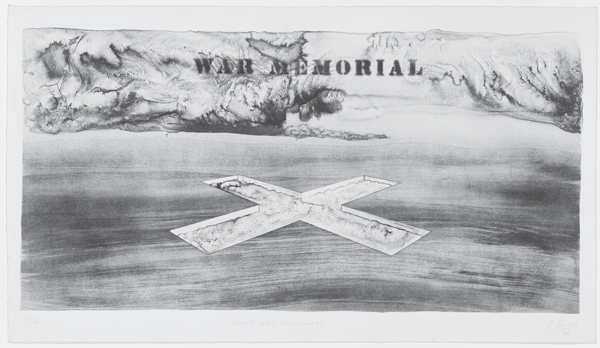
61. Robert Morris, Trench with Chlorine Gas, from Five War Memorials, 1970. Lithograph, 243-3/16 × 42-1/2 in. Whitney Museum of American Art, New York. Purchased with funds from Print Committee 2003. 108.1. © Whitney Museum of American Art 2012. Robert Morris/Artists Rights Society (ARS), New York.
A massive New York art world strike to protest Cambodia and the shootings at Kent and Jackson State, on the heels of the Whitney and Jewish Museum walkouts, was first formally proposed by the School of Visual Arts faculty immediately after the Kent State shootings. (Morris alludes to this fact in his demands of the Whitney.) The idea spread quickly and led to the SVA faculty’s organization of a mass meeting that ballooned to one to two thousand attendees and took place the day after Morris’s show was closed, at New York University’s Loeb Student Center on May 18, 1970. At the Loeb Center, speeches by Morris, Poppy Johnson, Andre, Petlin, and other representatives from AWC, AWP, and the Student Committee of Artists United discussed a range of strike options.18Eventually the crowd elected Morris and Johnson (who were linked romantically at the time) as its cochairs and agreed on four resolutions.19
The four resolutions were as follows. First, the Art Strike would seek a “cultural blackout” in New York: the closure of all the major New York museums and many of the influential galleries, as well as the suspension of artists’ production of objects for one day (and possibly extending the closing for two weeks). Second, the strike would establish an “emergency cultural government . . . to sever all collaboration with the Federal Government on artistic activities.” Third, artists would use the ground floors of galleries and museums “to help politicize visitors.” And fourth, 10 percent of the sale of every artwork made would go toward a fund for “peace activities.”20 Morris and Johnson concluded that they saw art as the fig leaf of American life—a cover for the U.S. war machine. Removing the leaf would starkly expose the government’s wrongs as well as express the art world’s refusal to be associated with government-linked art institutions.21
The night after the meeting at the Loeb Center, a small steering committee met at Yvonne Rainer’s loft and hammered out a more definite course of action.22 The strike would focus on closing down the five major New York museums: the Met, the MoMA, the Whitney, the Guggenheim, and the New York Cultural Center. Letters would be hand-delivered to each institution, stating the Art Strike’s intentions. Two days later, on May 21, the committee decided that if any of these museums did not close, the organization would protest one museum at a time. The committee decided not to protest all the museums at once in order to not dissipate the strength of their activity.
The museums demonstrated mixed reactions to the Art Strike demands. On the day of the strike, the Jewish Museum and the Whitney sympathized the most. On the twenty-second, they both closed for the day. The Whitney even designated a wall on its ground floor for peace information, during and beyond the day of the strike, and they hung Peter Saul’s Saigon (fig. 29, ch. 4) next to an antiwar petition signed by the staff. The Guggenheim stayed open, but as a concession offered free admission. Additionally, in a slightly paranoid move, the museum removed all art from its galleries, fearing damage. Director Thomas Messer explained that the museum’s decision should not be misinterpreted: “The museum has always stayed clear of political issues. . . . Empty walls are in themselves a sobering comment on violence and coercion of every kind.”23
Like the Guggenheim, MoMA stayed open for free, and took several actions it believed would satisfy the strike. At the request of Frank Stella (mobilized to political action again as he had been in relation to the Peace Tower), they closed his exhibition, and they allowed Jo Baer and Robert Mangold to remove works they had on view for the month of May. MoMA also set up information centers on the war in the lobby and the garden, screened a film on the bombing of Hiroshima and Nagasaki, and organized an exhibition of photographs of recent antiwar events such as the Kent State protest. Despite these concessions, Director John Hightower took the opportunity to harshly criticize the Art Strike. He called its demand that museums close repressive and even compared their actions to those of Hitler and Stalin and the Soviets’ suppression in Czechoslovakia. He also commented that the Art Strike’s demands would delight “those people in the United States . . . most responsible for repression . . . [that the strikers] . . . are striving so hard to resist.”24 The Art Strike actually responded to Hightower with a letter that spoke to each of his criticisms. GAAG sent a response, too—a cable telling Hightower to hold a press conference where he should confess his guilt while pouring a gallon of blood over his head.25
Like MoMA and the Guggenheim, the Met refused to close for the strike. In a provocative move, it pushed back its closing time from 5 p.m. to 10 p.m., believing access to the museum after-hours to be a more constructive move than a strike. As a result, the Art Strike decided to visibly protest the Met. Five hundred strikers showed up at the museum on the day of the strike. They carried signs, handed out pamphlets and statements against the war, and blocked the building’s monumental front entrance for the entire twelve-hour day the museum was open. Their actions cut attendance from the usual four thousand to sixteen hundred people—and those sixteen hundred made it in only because the museum eventually opened its side doors. The strikers prompted the Met to close its galleries of European paintings because, like the Guggenheim, the museum believed there could be vandalism. This occurred even amid “a vote of good faith” by the strikers—which was communicated to the museum and to the press—“that they would not allow the destruction of works of art or of anything else.”26 The majority of the art media—almost all of which were involved with the strike—wrote of the Art Strike as an “immense success.”27 It was the largest statement yet in New York of artists’ ability to influence the mainstream art world and its institutions, and it included an unprecedented cross-section of the art world, unseen in previous protests.
After the Art Strike, Morris, Petlin, Stella, and Max Kozloff, working as the Emergency Cultural Government (ECG)—a group formed at the Loeb Center meeting—sought to extend the momentum of the strike by attempting to organize a boycott of the Venice Biennale, which AWP had attempted but failed to do in 1968.28 The ECG called on all artists who had been invited to participate in the American Pavilion to withdraw their work from the exhibition to protest, as the Art Strike had done, “against the U.S. government’s policies of racism, sexism, repression and war.”29 In response, twenty-six of the thirty-three artists who had originally been scheduled to exhibit withdrew their works.30 The State Department strongly opposed the withdrawal. When informed of the impending boycott, they tried to stop the ECG by stipulating that each artist could only withdraw individually. This had little effect, and when the government realized it, it surreptitiously added new names to the list to conceal the mounting absences from the public.31 Eventually, the State Department could not field a complete roster of artists and decided to exhibit works by artists they were able to retain and then install a poster in the exhibition space that explained that some artists had withdrawn and the State Department accepted their dissent.32
On July 22, back in the United States, the ECG organized an alternative Biennale of works at the SVA to showcase artists who declined to be involved in the Venice exhibition. Ironically, controversy plagued this exhibition as well. It was attacked for being racist, sexist, and ageist because it included only the white male artists who were originally slated for the Biennale.33 The group Women Students and Artists for Black Art Liberation (WSABAL) led this attack and demanded that in order to best represent working artists, the show should include half African Americans, half women, and a quarter students.34 WSABAL also rejected the SVA as a site for the exhibition, claiming that the institution was racist. In response, the alternative Biennale eventually became an open call, available for any artist’s participation. It was also moved to Museum: A Project for Living Artists. Museum had been founded in 1968 by eight artists, including Arthur Hughes, Gary Smith, Sharon Brant, and Robert Resnick. According to Julie Ault, a former member of the art collective Group Material and a historian of New York alternative art, Museum was “governed by artists and intended as a communication and community center with social, aesthetic, and political fluidity. The agenda was to make available services, facilities, a meeting place, a social environment, information and exhibition space. The organization’s stated goal was to forge a more alive connection between art and society, without the dissipation of force and quality occurring so frequently in the current art establishment.”35 Unfortunately, in the course of the show’s movement to Museum, many of the original artists dropped out. Then, for unknown reasons, works were stolen from Museum. This prompted the removal of the rest of those works originally included in the Biennale and soon thereafter the closing of the entire exhibition.36
Apart from the Biennale protest, the energy of the Art Strike quickly vanished from the New York art world. The strike’s lack of a developed ideological program—other than a broad strike—made it collapse “under the weight of dissension and disagreement,” in the words of Maurice Berger.37 Outside the strike, a few peace activities were organized during the successive months of 1970. One was the exhibition My God! We’re Losing a Great Country, held at the New School for Social Research during the month of June.38Another was the organization of the Peace Portfolio, an original print portfolio of twelve nonobjective abstract prints published in an edition of 175 and sold by the Academic and Professional Action Committee for a Responsible Congress in order to raise money for the politics of peace.39 The artists involved in the project were Allan d’Arcangelo, Herbert Ferber, Adolph Gottleib, William Stanley Hayter, Lee Krasner, Ibram Lassaw, Motherwell, George Ortman, Rauschenberg, Saul Steinberg, Esteban Vicente, and Larry Zox. Harold Rosenberg wrote the introduction. In it he explained how—in line with his beliefs regarding the division between politics and art—the abstract artists included were relieving “their frustration” over current events by making art that supported the antiwar movement as benefit works. In this way, Rosenberg argued that artists were no longer creating “mollifying” works but ones that could “act” for them “by being translated into cash.” (Rosenberg’s use here of “act” recalls his concept of “action painting,” and the existential struggle it was conceived to emphasize.) According to Rosenberg, “The politics not in the works themselves can be introduced by the way the works are disposed of. The sale of this portfolio is an instance of genuine artist–audience collaboration. Through it art overcomes its silence by placing megaphones in the hands of peace candidates.”40 Unfortunately, it was only toward the end of the war that the antiwar movement was given this explanation, its best definition to date of benefit work.
On the whole, when conceptual art was emerging into a recognizable movement during the late 1960s, its radical, often ephemeral, anti-institutional, systems-based works were rarely regarded as being socially aware or antiwar. In this way, like the dominant formalist, pop, and minimalist movements preceding it, and though there were exceptions like Luis Camnitzer, Liliana Porter, and the New York Graphic Workshop, politically speaking, conceptual art was highly ambiguous. Conceptual artists tended not to incorporate war themes into their work, and even with their anti-institutional stance, these artists made it clear that they could exist only because of art institutions.41 In this respect, Lucy Lippard explained, “While trying to escape the frames imposed by convention and market, [conceptual] artists nevertheless made framing their prime device for self-containment. The only way they could maintain their ‘art function’ in the wide-open context they desired was to put an art framework over life. They did so in ways that blew the definition of art in many directions and in the process they also defined the limits of art.”42 Nevertheless, there are two examples of conceptual work that were understood as engaging with the war at the time they were made: Hans Haacke’sMoMA-Poll (called alsoVisitor’s Poll) of 1970 (fig. 62) and On Kawara’s ONE THING-1965-VIET-NAM of 1965.
Haacke’s MoMA-Poll, featured in Kynaston McShine’s Information at MoMA in 1970, is the major example. It is one of the foundational moments in postwar institutional critique, because it provided a route through which conceptual work could be politically engaged. Poll—whose details were unknown to McShine and MoMA trustees until the exhibition was installed—consisted of color-coded ballots, which indicated the visitor’s income, and two clear boxes, labeled yes and no, rigged with electronic counting devices.
MoMA asked visitors to drop a ballot in the appropriate box to answer the following question: “Would the fact that Governor [Nelson] Rockefeller has not denounced President Nixon’s Indochina policy be a reason for you to not vote for him in November?” Rockefeller was not only a member of the founding family of the museum and already a subject of critique from groups like GAAG and AWC (with which Haacke was involved), he was also a high-profile member of the MoMA board of trustees and was running for reelection as governor of New York in 1970.
The Poll achieved three things, through what Haacke would call a “real-time system.”43 First, by asking a decidedly leading question that immediately questioned Nixon’s policies, it denounced the war. Second, by outlining Rockefeller’s simultaneous positions as member of MoMA’s board, governor, and someone associated with the various Rockefeller companies (which had in turn been connected to the production of weapons for the war), the poll made links between the museum and the war overt.44 Third, the poll pressed MoMA visitors to voice their sentiments, transforming the passive art audience into active citizens. Final results of the poll were approximately two to one against Rockefeller (25,566 yes, 11,563 no), though Haacke afterward alluded to the fact that MoMA did not follow his instructions for the work carefully. If they had, he said, there would have been even more yes votes.45
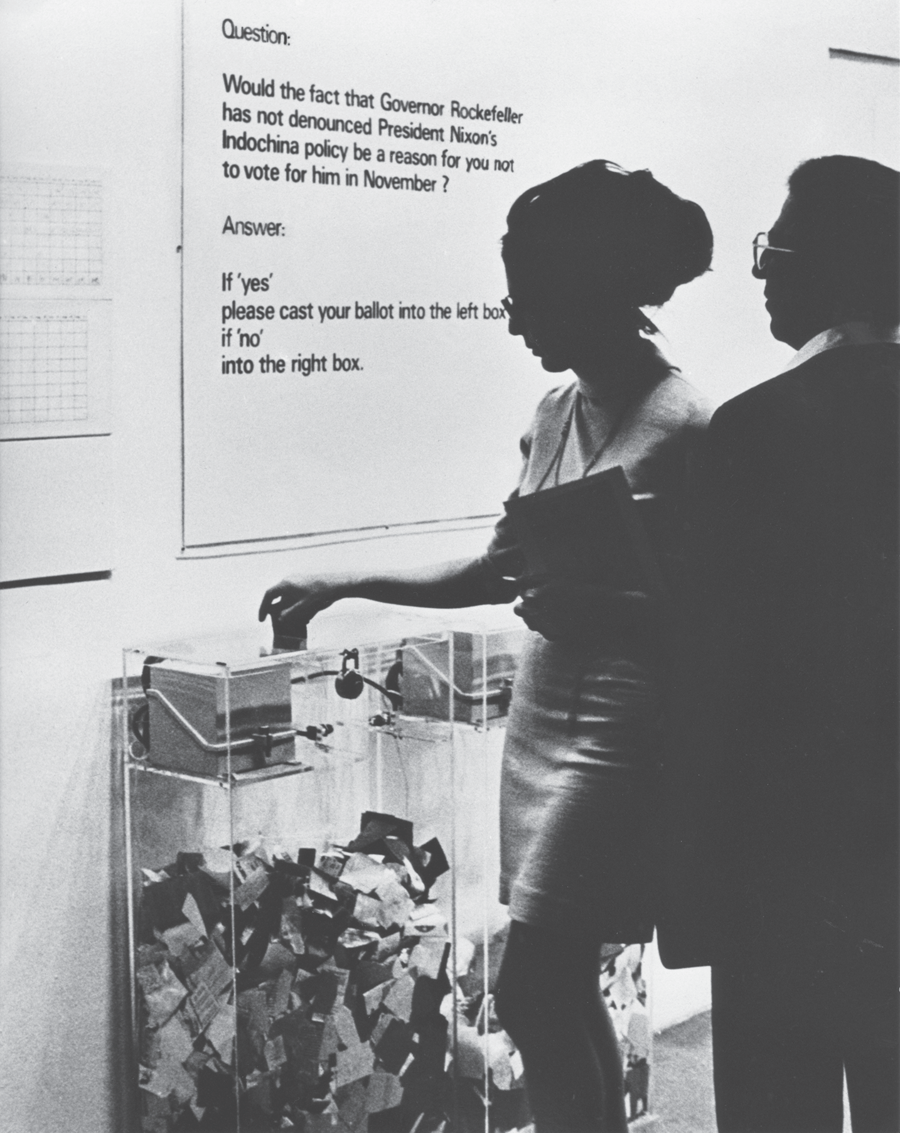
62. Hans Haacke, MoMA-Poll, 1970. Two transparent acrylic boxes, photoelectric counting devices, paper ballot boxes. 101.5 × 51 × 25.5 cm each. © Hans Haacke/Artists Rights Society (ARS), New York. Courtesy Paula Cooper Gallery, New York.
Not often discussed in relation to the MoMA-Poll is the harsh press reaction to the work from both conservatives and constituencies allied with conceptual art. On the conservative side, Emily Genauer wrote in the New York Post, “One may wonder at the humor (propriety, obviously, is too archaic a concept even to consider) of such poll-taking in a museum founded by the governor’s mother, headed now by his brother, and served by himself and other members of his family in important financial and administrative capacities since its founding 40 years ago.”46 Haacke took note of Genauer’s comments and responded as follows:
With this little paragraph [Genauer] provided some of the background for the work that was not intelligible for the politically less-informed visitors of the museum. She also articulated feelings that are shared by the top people at numerous museums. It goes like this: We are the guardians of culture. We honor artists by inviting them to show in “our” museum, we want them to behave like guests, proper, polite and grateful. After all we have put up the dough for this place. . . . Information presented at the right time and in the right place can be potentially very powerful. It can affect the general social fabric. Such things go beyond established high culture as it has been perpetrated by a taste-directed art industry. Of course I don’t believe that artists really wield any significant power. At best, one can focus attention. But every little bit helps. In concert with other people’s activities outside the art scene, maybe the social climate of society can be changed.47
Hilton Kramer, never one to applaud contemporary art, went further than Genauer. He saw the poll and the exhibition as a whole as a new low point for MoMA. He called Information “unmitigated nonsense . . . tripe . . . an intellectual scandal.”48 Even Gregory Battcock, usually a champion of conceptual art, wrote critically about the show in Arts. “Protest, not art, was a loser in this particular fight,” he said. He was particularly concerned by how the museum space neutralized protest works.49 Julia Bryan-Wilson has recently read Battcock’s comments through those of Marcuse, whose writings Battcock drew from at the time.50
Some AWC participants were also unhappy with Information. Concurrent with the Art Strike, they protested outside the museum and distributed a flyer which read as follows:
INFORMATION! INFORMATION! . . . 1) You are involved in the murderous devastation of S.E. Asia, 2) You are involved in racism, in persecution of Young Lords and Black Panthers, 3) You are involved in discrimination and exploitation of women, 4) You are involved in political repression at home, 5) You are involved in the support of fascist dictators abroad, 6) You are involved in these crimes, committed in your name by your government. . . . YOU ARE INVOLVED UNLESS YOU STOP IT! . . . The museum is also involved, that is what we want to change, That is why we are here.51
In this way the pamphlet labeled conceptual practice as apolitical, and MoMA as ignorant of its own identity. The AWC participants then provided their own kind of information to the museum and artists in order for them to gain awareness.
On Kawara’s three-part canvas, one thing-1965-viet-nam of 1965 is the other significant instance of late 1960s engaged conceptualism. Kawara’s work consists of three uniformly covered, magenta canvases. The middle canvas is slightly bigger than the two flanking it, and text in capital letters is centered in the middle of each canvas. On the left canvas it reads, “ONE THING.” On the middle canvas it reads, “1965.” On the right canvas it reads, “VIET NAM.” Kawara’s consciousness of the war is reinforced in the light of Kawara’s series of Today paintings, which the triptych initiated (though it is not considered part of them). The series chose to concentrate on daily events, and through their “subtitles” and accompanying newspaper clippings highlight hundreds of significant historical occurrences. As such, against the backdrop of the multitude of important events in later years, the one event, the “one thing” of note for Kawara in 1965, was the war. Kawara’s conceptual political engagement was rooted in his initial, much more outspoken paintings. His 1954 Tokyo exhibition, for instance, included paintings of grotesque and ravaged bodies only two years after U.S.-imposed postwar censorship laws were lifted in Japan.
Kawara’s postwar grotesques unfortunately had parallels with other artists’ ways to capture the events of 1970 and, sadly, those of the following year.