
IN 1471, Jean du Bueil, ageing veteran of the Hundred Years War, was present at the council of war of the French King, Louis XI, when the Burgundians invaded France. ‘War has become very different,’ he commented. ‘In your father’s days, when you had eight or ten thousand men, you reckoned that to be a very large army: today it is quite another matter. One has never seen a more numerous army than that of my lord of Burgundy, both in artillery and munitions of all kinds: yours also is the finest which has ever been mustered in the kingdom. As for me, I am not accustomed to see so many troops together.’ De Bueil’s shrewd remarks highlight what were probably the two most important developments which, at the end of the middle ages, were visibly changing the face of warfare. One was the capacity of governments to field military forces on an unprecedented scale, and to maintain substantial numbers of troops on a permanent basis. The other was the growing significance in war of ‘artillery and munitions’, of guns and gunpowder.
Two engagements of the year 1453, when Jean de Bueil was at the height of his soldiering career, seem to foreshadow the way in which, twenty years later, he thought change was taking place. One was the battle of Castillon, the final act of the Hundred Years War; when the massed English columns of John Talbot, attacking the entrenched French camp, were mown down by enfilade fire from the guns of Jean Bureau, Master of Artillery in the new French army that Charles VII had been building up since 1445. The other was the siege and ultimate capture of Constantinople by the Turks. For nearly a year before the siege, Sultan Mehmed II, with the aid of the renegade Hungarian gunfounder Urban, had been building up a massive artillery, including one great bombard with reputedly a twenty-six-foot barrel. In six weeks of bombardment his guns carved great breaches in the famous walls of Constantinople, which had so often defied onslaught. The Ottomans had an overwhelming advantage in numbers as well as in artillery, and on the night of 29 May, after bitter fighting, the city was taken by assault.
Stated succinctly, the lessons to be drawn from these two dramatic events look a good deal clearer than they really were. Castillon was in no sense a victory for field artillery. Talbot made the mistake of launching his attack on a fortified camp in such a way as to expose his advancing troops to enfilade fire from guns that Bureau had brought to batter the walls of Castillon, not for a field engagement. Nor was the Turkish capture of Constantinople a walkover for gunnery. So stoutly was the city defended that only days before the final assault Halil Pasha, the old and trusted councillor of Mehmed’s father Murad, was urging that a siege which had made no headway should be abandoned before aid should arrive for the city from the west and expose the Sultan to the risk of humiliating defeat. And when, twenty-seven years later in 1480, Mehmed’s lieutenant Mesic Pasha, with a still more massive artillery and comparable superiority in numbers, subjected the Hospitaller stronghold at Rhodes to two months’ bombardment and breached its walls, his final assault was repulsed, with huge losses. Gunpowder and larger armies were forcing change, but at an evolutionary rather than a revolutionary pace, neither as fast nor as sharply as the famous encounters of 1453 at first sight suggest.
By the 1450s, gunpowder artillery already had a substantial history. The basic recipe for mixing powder from charcoal, sulphur, and saltpetre was known to Roger Bacon in the thirteenth century. The first sure reference to guns is the written authorization by the Signoria of Florence of 1326 for the casting of ‘cannons of metal’ for the defence of the city. Very soon after that, references to the casting of cannon, the making of stone balls, and the purchase of ingredients for powder become frequent, especially in urban records. By the 1370s, guns were coming into extensive use in siege warfare.
From the first, many cannon were made of bronze. Bell founding was a well-established skill, and bell founders could easily be transformed into cannon founders. The earliest cannon we hear of were mostly relatively light pieces, but because their principal potential was seen as being for siege operations, there was a natural urge to seek to increase their size, and so their range and the force of their projectile delivery. The tendency towards massive size becomes marked in the late fourteenth century, and many of the larger pieces were now constructed of wrought iron rather than brass. Iron rods were heated and hammered together round a wooden core (to be later bored out), and bound with iron hoops to form a barrel. They were usually breech loading. The powder charge was packed in a separate metal chamber, often as long or longer than the barrel. Plugged with a wooden plug, this chamber was wedged against the breech of the barrel, the plug resting against the ball, and wedged into position in the grooved channel of the wooden baulk in which the cannon was mounted. Then it was ready for firing through a touch hole in the chamber. By providing several chambers, which could be loaded in advance, the rate of fire could be increased. Great bombards of this type—and cannon generally—were transported by wagon, and mounted for action in a wooden frame or stall. A Nuremberg account of 1388 records that twelve horses were required to draw the wagon carrying the barrel and chambers of the great gun Kreimhild (great guns in this age were commonly given individual names: they were personalities in their own right on the martial scene). In addition, ten horses were needed to draw the stall, four to draw the winch (needed for mounting the gun in position), and twenty horses for the wagons loaded with stone balls (560 lbs weight each) and two hundredweight of powder. These were ponderous and expensive weapons.
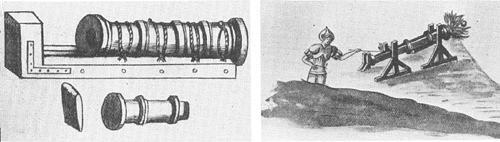
The first of these two sketches shows an early cannon mounted in a grooved wooden baulk, together with (separately below) the chamber and the wedge which will be hammered in to hold the chamber firmly against the breech. The second shows a similar cannon mounted in a wooden frame for firing.
There were a good many accidents with early cannon, through bursting barrels or in consequence of the chamber wedge flying out on firing: James II of Scotland, killed when the chamber of a bombard exploded at the siege of Roxburgh in 1460, was only the most distinguished casualty. But with experience, technical skill accelerated, both in the manufacture of guns and projectiles and in the preparation of powder. From around 1420, it became customary to use ‘corned’ gunpowder, dampened with wine or spirits,rolled into granules and dried, which much improved the force of combustion. At the same time, large-scale production of powder was bringing the price down sharply. By the mid-fifteenth century French gunners were commonly using iron balls, which were much more effective against masonry than stone ones. After the mid-century, the fashion for giganticism—for pieces like the great bombard founded by Urban the Hungarian for Sultan Mehmed or ‘Mons Meg’ (c.1460; calibre of 20 inches, length thirteen foot six inches, and weighing 5 tons)—began to wane; better ways were being found to achieve the same ends.
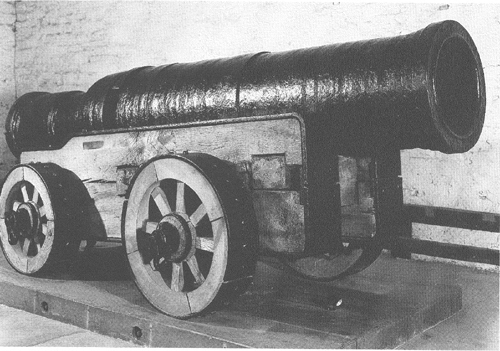
‘Mons Meg’, a large bombard of c.1460, now at Edinburgh Castle, constructed from iron bars 2½ inches thick welded together, with welded over them rings of the same material. The chamber screws into the barrel, and has notches for the insertion of levers for this purpose. It is not known when it came to Scotland, but it was there in 1497, when a new ‘cradill’ (carriage) was made for it (the carriage illustrated is modern).
The cannon of the impressive siege train which accompanied Charles VIII’s army when he invaded Italy in 1494 were lighter and of lesser calibre, but not less effective. Chambers were of reduced length in relation to the barrel: most were of bronze, and a good many were now cast in a single piece and muzzle loading. The barrels moreover were now cast with trunions (projecting gudgeons on each side) so that they could be mounted on their own carriages (two wheeled, sometimes four wheeled for heavy pieces), and pivoted to the required angle when firing. This greatly increased their mobility: Charles’s artillery could keep pace with his army. ‘What above all inspired terror were thirty six cannon with their carriages, drawn by horses at a speed that was incredible’ wrote one astonished observer of the royal host. The number of draught animals needed to draw such an artillery was, of course, enormous.
The impact of gunpowder weapons on siege warfare took a long time to have decisive effect. There were a number of reasons for this. Heavy cannon were cumbrous instruments, and transportation (unless by water) was perforce very slow (see Chapter 8, p. 181). Furthermore, if bombardment was to be effective, guns had to be brought uncomfortably close to the walls of a town or castle. If and when they had been got into position, the rate of fire, especially of larger guns, was disappointingly low (see Chapter 8, p. 182).
In campaigns in Gascony and Maine in the 1420s, however, English artillery was proving significantly effective: and in Charles VII’s campaign in 1449–50 for the reconquest of Normandy the French strength in artillery was a decisive factor. ‘He had such a great number of large bombards, large cannon… ribaudequins and culverins that no one can remember any Christian king having such an artillery, nor one so well furnished with powder, shields and all other necessities for approaching and taking castles and towns,’ wrote Berry Herald. To bring the guns up to the range where they would be effective, the Bureau brothers were already using the methods described a little later by Jean de Bueil, constructing trenches from one point of a siege to another, so as to bring guns close under cover from defender’s fire and to maintain protected contact between units. At Rouen in 1449, when the Duke of Somerset in the citadel saw that ‘great trenches were made there round about the said palace, as well in the fields as in the town, and bombards and cannon were laid on all sides’, he lost heart and treated for surrender. In 1450 Harfleur, which in 1415 had withstood Henry V for six weeks, submitted after being bombarded for seventeen days. The English captains of a great many other places, recognizing that their walls could not face the artillery brought before them, did not wait for bombardment, but like Somerset capitulated on terms. It took a bare year to recover for France the Norman duchy that Henry V had conquered at the expense of so much ‘blood and treasure’, and that the English had defended so tenaciously in previous campaigns.
Siege of a fifteenth-century castle: from a miniature by Loyset Liedet in an illuminated manuscript (c.1470) of the Histoire de Charles Martel The two light cannon (one mounted with two barrels) have been brought close to the walls; the brazier in the foreground heats metal rods to apply to the touch-holes for firing.
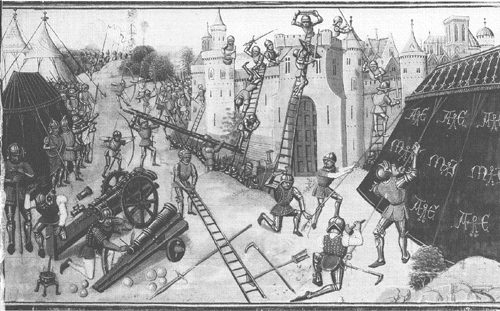
Artillery was comparably decisive in the Spanish campaigns in the 1480s for the reconquest of Granada, and in Charles VIII’s lightning conquest of the Kingdom of Naples in 1494/5. Medieval walls were too high and too thin to resist prolonged bombardment. They could be lowered and strengthened, of course, and arrow loops could be altered to make gunports for the defenders’ cannon, but as Richard Jones has written, ‘no true artillery fortification can be said to have been constructed before 1450’. Soon after that, however, measures of defensive engineering began to be widely taken that would restore the balance more favourably to the besieged.
Walls were scarped with earth, so as to reduce their vulnerable height, and wall walks widened so as to carry guns. Towers along their circuit were constructed to a new design, lower, with a wide level area atop to act as a gun platform that would give heavy guns a wide angle of fire, threatening the besiegers’ concentrations. Closer to ground level, they might be pierced with gunports, whence an assault could be raked with enfilade fire. These measures foreshadowed the development, from Italy, of the ‘angle bastion’, replacing the round tower. Its angular design greatly reduced the vulnerability of the whole structure by exposing the minimum face to frontal bombardment. By the 1520s (at latest), siege was well on its way back to the long hard slog of pregunpowder days. It was only for a relatively short period, from around the middle of the fifteenth century till its end, that the attackers really held the initiative, though much always continued to depend on how far cities and princes had felt able or inclined to afford the building cost of new and more effective fortifications.
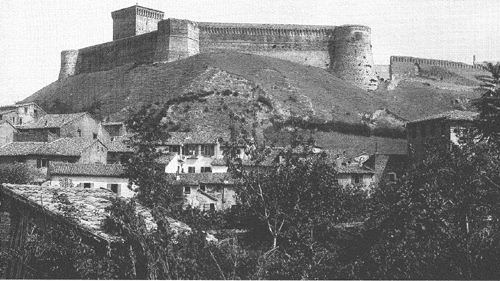
The Rocca Malatestiana, castle at Cesena, showing an early angular tower bastion (c. 1466), in the walls and level with them, near the gate. Later bastions were often of considerably more complex angular construction.
By the early sixteenth century, artillery, in consequence of its greater mobility, was coming to be of significance in the field (see below, p. 290). Much earlier, hand guns had begun to be important in battle. The earliest hand culverins were a kind of mini-cannon with a touch hole, attached to a pike staff and propped in a rest for firing. John Zizka, the Bohemian leader of the Hussite Wars, made good use of handgunners armed with culverins in his Wagen-burgen, the laager of wagons that constituted a kind of mobile fortress (see above, Chapter 7, p. 158 and p. 159). His handgunners stood in the wagons, whose sides made an excellent rest for their weapons. The wagons could also be mounted with light cannon; while pikemen and halberdiers sheltered behind the carts, ready to make their charge when the advancing enemy had been halted and disordered by gunfire and archery. Zizka’s Wagenburgen proved formidably successful against the German armies sent to fight him. Unlike the Hungarians, or the Russians in their wars against the Tatars, the Germans learned little from this experience.
The hand cannon was a clumsy weapon, and a thoroughly inaccurate one. The arquebus, which came into steadily extending use from the mid-fifteenth century on, had much greater possibilities. A metal tube, mounted on a wooden stock and fired from the shoulder, by means of a touch hole and a match device, it was not a difficult weapon to handle. Its ball had considerable penetrating power, and it was accurate. It took a while to reload, and that was no doubt why it only very gradually displaced the crossbow as the infantryman’s favoured missile weapon. Its potential nevertheless had been appreciated early. In the 1470s Charles the Bold of Burgundy already had a good many arquebusiers in his service. His contemporary, the fighting King Matthias of Hungary, was decidedly keen on them: ‘we make it a rule that one fifth of the infantry should be arquebusiers.’ Later, in the Italian Wars, the Spanish in particular would make very effective use of them.
‘As for me, I am not accustomed to see so many troops together. How do you prevent disorder and confusion among such as mass?’ Thus, Jean de Bueil, quoted earlier. There was certainly something novel about the size of the armies that kings and princes brought together in the later fifteenth century, about their discipline, training, and ongoing terms of service. This was not however the consequence of any radical new perception about the political potential of military force. Development seems rather to reflect ad hoc reactions to particular circumstances and particular problems. In the matter of maintaining forces in permanent readiness for operations, the Lancastrian English system for the defence of conquered Normandy, and the growing practice among Italian city-states, in particular Venice (see above, Chapter 10, p. 221), of retaining their condottieri on a more long-term, settled basis may have been influential by example.
Numerically, the Turkish was the most powerful army operating in Europe in the closing middle ages. To besiege Constantinople, Sultan Mehmed brought together a force of perhaps 80,000 combatants. The Ottoman empire, which had its origin in the confederation of ghazi groups (‘Holy Warriors’) of the frontier between Christian Byzantium and Islam, was virtually a state organized for war. The sipahis of Anatolia and of Rumelia (the European provinces), cavalrymen settled on non-hereditary fiefs with an obligation to provide a fixed number of horsemen, were experienced fighting men rapidly mobilizable by their regional banner holders (sancak bey). The Sultan’s elite troops were the Janissaries, reorganized by Mehmed’s father Murad. They were recruited by the regular five yearly ‘levy of boys’ among the Christian subjects of the Ottomans, and reared to a fanatical devotion to Islam and to the calling of arms. In Mehmed’s reign their numbers rose from 5,000 in the early years to 10,000 by 1472: no Western European ruler ever attempted to maintain a personal, ‘household’ force on any remotely comparable scale. Cavalry was the predominant arm in the Turkish army, but as we have seen, Mehmed had a formidable artillery: he made very good use of turn coat or captive Christian gunfounders like Urban the Hungarian and George of Nuremberg.
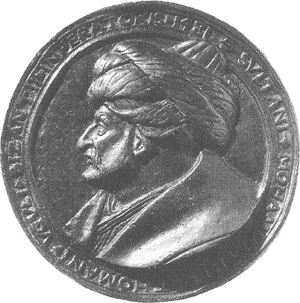
Sultan Mehmed II (1451–1481), conqueror of Constantinople (1453). In south-eastern Europe his armies subjected the Morea, Serbia, Bosnia, and Albania to Turkish authority, and threatened Hungary. His sieges of Belgrade (1456, held by the Hungarians) and of Rhodes (1480, held by the Knights of St John) were not, however, successful.
It was in response to the Ottoman threat that King Matthias of Hungary (1458–90) set about establishing a military force on a permanent footing. It was especially strong in light cavalry (‘hussars’: see above, Chapter 9, p. 196): and Matthew also came to dispose of a respectable artillery, including thirty powerful bombards. This was a largely mercenary army. Outside Hungary, Moravia and Bohemia (whence came the famous ‘Black Company’) were with Serbia and Bosnia important recruiting grounds. Reinforced by the followings of the voivodes of Moldavia and Wallachia, which were strong in infantry, King Matthias could muster a very substantial field army, which was seasoned by his repeated campaigns (as often against his Christian neighbours in Bohemia, Austria, and Poland as against the Turks). The difficulty was in raising the money needed to pay his soldiers. G. Rázsó has calculated that, with an annual revenue of some 900,000 ducats, Matthias needed to set aside 400,000 ducats, given the rates of pay of the time, in order to maintain a force of 15,000 mercenaries. The fiscal burden was one that could not be borne indefinitely, and his army was disbanded after his death. It was a comparatively non-professional levy, recruited in traditional medieval manner, that in 1526 went down before the Turks at Mohacs.
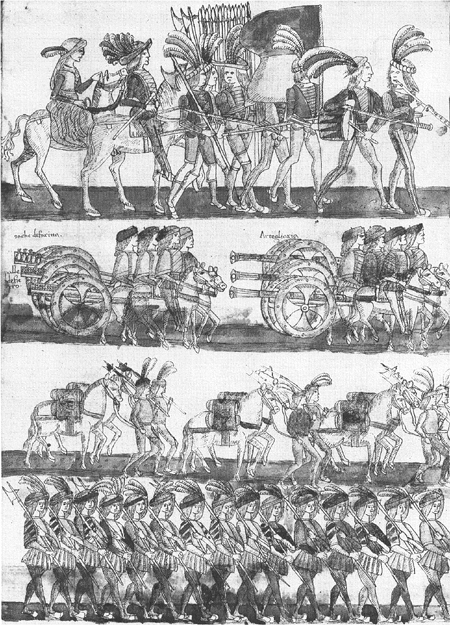
Units of the French royal army, at Charles VIII’s entry into Naples, 1495. The illustration shows a standard borne, a fifer and a drummer, pack horses with baggage and wheeled cannon (‘drawn by horses at incredible speed’). Carts behind these carry bags of powder and balls (palle de tiero); infantry at the foot are in the uniform of their company.
The real founders in the West of the permanent armies that came in due course to dominate the battlefields of Europe were the Valois Kings of France, whose success in channelling sufficient funds to pay their soldiers was the ultimate key to their achievement. The inspiration behind the measures taken in 1445 by Charles VII, the founding father of this permanent army, was not however a perceived need for a new kind of force. It was rather the opportunity which the brief truce agreed with the English the previous year seemed to offer to purge the realm of the worst of the freebooting companies who for years had lived off the land to its ruin, and to bring under effective royal control such soldiery as remained under arms against the end of the truce. A number of royal captains were appointed and commissioned to select the best troops from the existing companies, and to supervise the disbandment of the remainder. There was no general expectation in 1445 that the troops then retained would remain in service, or that the taxes(tailles)imposed to ensure their regular payment would continue, once the threat of military emergency had lifted. After the conclusive victories of the French over the English in Normandy in 1449–50 and in Gascony in 1451 and 1453, the troops were not disbanded, however, and the taille continued to be collected. A permanent French royal army thus came into being, and the French Kings, unlike the Hungarian rulers, were able to tap into sufficient fiscal resources to go on paying for it, year after year.
Charles VII’s ordonnance of 1445, established fifteen compaignies d’ordonnance for Langue d’oïl, to which in 1446 were added five for Languedoc. Each company comprised notionally 100 ‘lances’, a unit of six mounted men: a man-at-arms, a coutillier(armed with sword and knife), a page, two archers, and a valet. The company’s captain, as a paid officer of the crown, was responsible for keeping up the numbers of his men and for their discipline. Outside periods of mobilization, the component lances were billeted on the community regionally in garrison towns. By an ordonnance of 1448, these mounted troops were reinforced by a reserve infantry of francs archers, recruited on the basis of one equipped archer for every fifty hearths. Later, in Louis XI’s reign, this infantry was reinforced by the recruitment of pikemen rather than archers in the provinces, and by bringing into royal pay a substantial and more professional body of Swiss pikemen. For the remainder of the fifteenth century and into the sixteenth, mercenary infantry, Swiss and German Landsknechte, always constituted an important element in the French army. The requirements of the substantial royal siege artillery meant that in wartime large numbers of carters and pioneers (to dig fortifications, siege trenches, and mines) had additionally to be mobilized.
The Burgundian army which Duke Charles the Bold (1467–77) sought to establish in a series of ordinances between 1468 and 1473 was modelled on the French one. The core element was a force of 1,250 lances ‘of the ordinance’, divided into companies of approximately 100 lances apiece. Each lance was supported by three infantrymen, a crossbow-man, a culverineer (or arquebusier) and a pikeman. In order to supplement the service of soldiers from his own territories, Charles recruited lances on a very large scale from Italy, and also from England and Germany: he also set about organizing a formidable artillery (he had some 400 cannon with him at the battle of Morat in 1476). Though most of Charles’s native captains came of distinguished families, they were appointed, as in the French army, not on account of their fiefs and standing, but as ducal officers, and on the basis of regular pay for themselves and their men at stipulated rates (in both the French and the Burgundian armies, this made service as a man-at-arms attractive to thenoblesse). The captains’ revocable commissions were for a year at a time. Each on his appointment received a baton of office, and a ‘paper book, bound in cramoisy, with a gilt clasp with the ducal arms on it’, containing the duke’s ordinances for war.
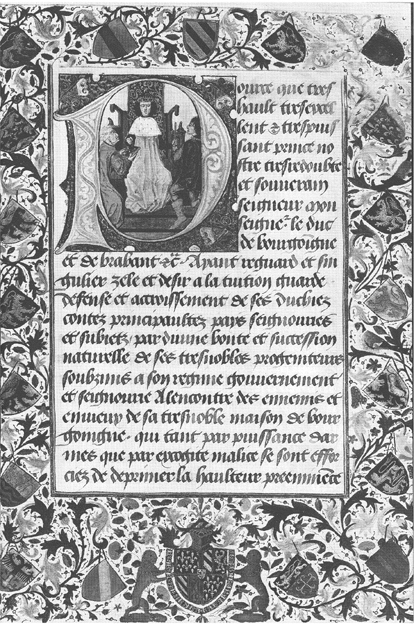
Though Charles’s successive defeats suggest only mediocre talent for field command at best, in the sphere of military organization he showed real ability as well as enthusiasm. His 1473 ordinances carefully outlined the structure for his ‘companies of theordinance’, each to be divided into four squadrons under a chef d’escadre, and subdivided into four ‘chambers’ of five men at arms leading their ‘lances’. In order to preserve order on the march and in the field, each captain was to have his distinctive ensign; each squadron was to carry a cornet (or pennon) of the same design, embroidered with a gold letter C for the first squadron, with two Cs for the second, and so on. The leader of each chamber carried a banderole on his sallet (helmet), ‘with a painted device … numbered I, II, III, IV respectively, inscribed beneath the C of the squadron’.
Text of Charles the Bold’s military ordinance of 1473: the illuminated initial capital shows Duke Charles presenting bound copies to the captains of the newly organized companies ‘of the ordinance’. The margins are decorated with arms of Burgundy and his other fiefs.
For this uniformed army, organized in readily recognizable units, Charles laid down strict disciplinary regulations, with heavy penalties enforceable on the spot by his captains. Most remarkable of all, however, were his provisions for martial exercises in peacetime: ‘When they are in garrison, or have time and leisure to do this, the captains of the squadrons and the chambers are from time to time to take some of their men at arms out into the fields… to practise charging with the lance, keeping in close formation . . . (and how) to defend their ensigns, to withdraw on command, and to rally . . . and how to withstand a charge.’ These detailed regulations for drilling and exercises open a genuinely fresh chapter in the story of the developing professionalism of the late medieval soldier.
Before Charles’s time, his father Philip the Good of Burgundy had relied militarily on men-at-arms raised and led by the leading nobles of his territories and paid for their campaign service only, and supplemented by infantry contingents from the towns. Comparably, Ferdinand and Isabella of Spain relied principally in their first great military endeavour, the reconquest of Granada from the Moors, on contingents raised and led by their leading nobles in the traditional way, and on infantry from the town militias organized by the hermandadas (civic brotherhoods). But when the ‘Catholic Kings’ became involved in the wars in Italy after 1494, the need to establish more regular forces became apparent, and the Ordinance of Valladolid of 1496 imposed on one man in twelve, between the ages of 20 and 45, the liability to serve in the royal army. The organization of the army, as it evolved in the course of the wars, took definite shape in the form of units and sub-units comparable with those of the Burgundian army described above. The basic infantry unit was the regiment or coronelia (whence the word colonel) which was composed of twelve companies, notionally of 500 men each. Two of these companies were solely of pikemen; the other ten were each composed of 200 pikemen, 200 short swordsmen (the rough equivalent of the French coutilliers), and 100 arquebusiers. Every regiment of infantry was accompanied by a detachment of 600 cavalry, half heavy and half light. By the end of the fifteenth century, the Castilian monarchs had also acquired a substantial artillery. Among its infantry, the army of Ferdinand and Isabella was thus particularly strong in its pikemen and handgunners. On the mounted side, light cavalry (genitors) were always numerous, but Spanish armies were weaker in cavalry than the French or, in Charles the Bold’s day, the Burgundians.
Not all rulers of this time had permanent armies. In Germany (an important European recruiting ground), the martially ambitious Emperor Maximilian was constrained by the consistent refusal of the Diets to provide the necessary funds. Nor was there in England, at the beginning of the sixteenth century, any standing force comparable with those of France or Spain. The campaigns of the Wars of the Roses had been of brief duration, and the armies that rival leaders had gathered for them did not outlast them. The hosts that Edward IV in 1475 and Henry VII in 1492 mustered for their abortive invasions of France were raised by the old-fashioned method of short-term contract. England, after the Hundred Years War, was no longer a major player in European land warfare; her kings had no need to tax their subjects in order to maintain substantial standing forces in the way that the French and Spanish monarchs did.
The later fifteenth century and the early sixteenth witnessed more major field engagements than had been the average in the wars of the middle ages. The attraction of quick results, given the enormous and spiralling cost of large-scale war (together with the temptation to believe that with large, readily mobilizable and well-armed forces such results might be achieved) was no doubt a large part of the reason for the frequency of such confrontations. In them, the martial potential of the new armies of Burgundy, France, and Spain was put to trial: they were also a testing ground for new weaponry, and for new tactical combinations of infantry (above all pikemen), cavalry, and gunners.
The fourteenth-century victories of the Swiss over the Hapsburgs at Mortgarten and Sempach had made them a name as among the most formidable soldiers of Europe (see above, Chapter 10, p. 227), and the most ferocious: they gave no quarter. The three great defeats that they inflicted on Charles the Bold’s forces at Granson (1476), Morat (1476), and Nancy (1477) raised their reputation to its height. These engagements demonstrated dramatically the potential of the Swiss pike phalanx in offensive operation, closing with the enemy and charging at close quarters. Well drilled, and lightly armoured with only breastplate and helmet, the Swiss could move very swiftly, advancing to the tap of the drums which kept their pace even. Cavalry charges proved quite insufficient to halt them, let alone to throw them into disorder: it was the pikes that halted the cavalry, not vice versa. Artillery, in this Burgundian war, did not provide any better answer: it was still too cumbrous to manoeuvre in a tactical emergency. At Nancy the Swiss were onto Charles’s guns before these could be trained on them.
Yet the three battles of 1476–7, Granson, Morat, and Nancy were not triumphs for the Swiss pike alone. At Granson Burgundian casualties were light, and Charles was able to re-form his defeated army: the reason for this was that the Swiss had no cavalry to follow up their success. Morat and Nancy were much more decisive. At Morat the Swiss were nominally in the service of René, Duke of Lorraine, and he and his mounted men pursued the Burgundians fleeing along the lakeside, turning defeat into disastrous rout. At Nancy the fugitives, pursued by the cavalry of Sigismund of Austria, finally found their retreat cut off by the mounted forces of the Count of Campobasso, who had gone over from Burgundian service to the side of the confederates. The two battles effectively destroyed Charles’s magnificent army; but if it had been opposed by Swiss infantry alone at them, then its history might have been longer, and different.
The engagements of the early period of the Italian wars show still more clearly how misleading it was to draw from these successes of the Swiss infantry the easy inference (as many at the time did), that the pikeman was master of the field. After Gonsalvo de Cordoba, the ‘great captain’ for Ferdinand and Isabella, had been roughly handled by the Swiss at Seminara in 1495, he took steps to reorganize his troops and to provide himself with substantial numbers both of pikemen and arquebusiers. When the Duke of Nemours was induced to attack him at Cerignola in 1503, his charging Swiss and French found themselves halted by the ditch that Gonsalvo had hurriedly constructed in front of his line, and subjected to a hail of arquebus fire. The counter charge of the Spanish pikemen then drove them back downhill, and the Spanish light cavalry made the victory decisive in pursuit. Cerignola is often hailed as the first victory of the arquebus. Though Gonsalvo’s choice of ground, the work of his pioneers on the ditch, and his capacity to pursue all contributed too, the weapon had made its mark. It did so again at Bicocca, a very similar engagement, in 1522. All agreed that at Pavia (1525), where the Spanish arquebusiers had to operate in open ground, and not from an entrenched position as in these two earlier battles, they played a significant part in the total defeat of the French.
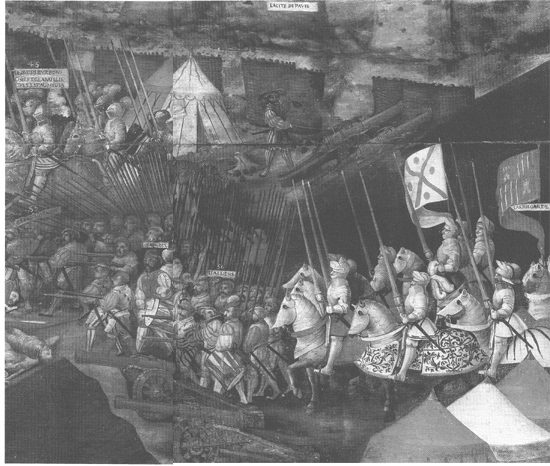
The Battle of Pavia, 1525, where Charles V defeated and took prisoner Francis I of France: showing in the foreground field guns and a group of arquebusiers, with massed pikemen behind them. The heavy cavalry still carry the long lance that was the traditional arm of the mounted, chivalrous warrior.
The hard fought battle of Marignano (1515), where Francis I and the French finally triumphed over the Swiss in the pay of the Duke of Milan, illustrates other aspects of the picture. On the first day of the battle (13 September), the repeated charges of the French men-at-arms succeeded in slowing the Swiss columns sufficiently to ensure that when they closed, Francis’s rival infantry of German Landsknechte held firm. On the second day the advancing Swiss column suffered severe losses, caused by the fire of the French artillery, and though it struggled forward it was halted by cavalry charges with the guns still playing on it. The Swiss losses were so great that they were forced to draw off, retreating in good order; the French cavalry was too tired to offer pursuit. The fighting demonstrated effectively what havoc could be wrought on a pike phalanx, if it could be halted by repeated charges in a position where it was exposed to fire from field artillery.
As the narratives of the Italian battles of the first decades of the sixteenth century make clear, black powder did not as yet rule the battlefield, though there was now a great deal more smoke. No more did Swiss or German pikemen, formidable as they were. Heavy cavalry had not lost its significance on the battlefield. The charge with the lance, in the traditional mode of chivalry, could still in the right circumstances be an effective and important manoeuvre. As ever, mounted men-at-arms formed the core of thecompaignies d’ordonnance of the French royal army which was the model for so many others, and as Malcolm Vale has remarked, governments ‘did not usually spend money, painfully gathered from taxation and loans, to underwrite forces which had outlived their usefulness’.
All the same, the signs of change, and of the passing of ‘chivalry’ are clear enough. Thanks in particular to the Swiss, war had become for the combatant more bloodthirsty and ferocious: casualties, among all classes, had grown in number. In battle as well as at sieges, guns had come to play a very significant role, even if not as yet a fully decisive one. Perhaps most importantly, war had become more professional for all those involved. More treatises on the art of war were written in the sixteenth century than ever before, and among their authors were some distinguished and experienced soldiers, such as Robert de Balsac, Berard Stuart, and later Gaspard de Saulx-Tavannes, who wrote with instruction in mind. Though the captains and commanders of the new armies (and indeed their elite men-at-arms) were still largely drawn from the nobility of birth, their experience and expertise were more varied than they had been traditionally. The Chevalier Bayard served for a while as captain of an infantry company; Gaspard de Saulx-Tavannes began his career as an archer: the family of Genouillac, of the old nobility of Quercy, provided a succession of Masters of Artillery to the kings of France. Old chivalry adapted itself to new ways, but there was a real difference, clearly demonstrated in a more self-conscious professionalism and in added emphasis on the honour of service to the prince as head of the common weal.
Christopher Allmand, commenting on this growing professionalism of soldiering in the new age of permanent armies, writes thus, ‘The aristocratic view of war as a moment of individual opportunity was giving way to another... The imperative to win, indeed to survive was now taking over. The requirements to avoid the collective consequences of defeat thus led to societies choosing both soldiers and, in particular, leaders from those who had good practical experience of war.’ His remarks catch aptly the changing social conception of what had once been the chivalrous calling of arms. Bayard, from whom Francis I begged knighthood on account of his reputation for prowess, was in an almost demonstrable way more of a loyal officer and less of a knight errant than had been, say, Jean de Boucicault, Marshal of France, champion of the jousting field, crusader and veteran of Nicopolis and Agincourt, a hundred years before him.
There was still a place, though, for individual adventurers in this fast altering world. If one wants to gauge whether the developments that were taking place around the end of the fifteenth century merit the fashionable title of a ‘military revolution’ or not, one needs to throw into the equation not only permanent armies, new gunnery, and growing professionalism, but also the new designs in shipbuilding and new advances in the art of navigation that Felipe Fernández Armesto has described in an earlier chapter in this book. These would affect significantly the pattern of warfare of the sixteenth century. They also made it possible for the early conquistadors to transport men, guns, gunpowder, and the knowledge of how to mix it, to lands of whose very existence the knights errant of the past had been unaware, with momentous consequences for the future.