
WHEN in 1095 Pope Urban II preached the First Crusade, he initiated a tradition of Christian holy war which was to last well beyond the medieval centuries and which came to embrace wars fought in a wide variety of different theatres and in vastly contrasting contexts. In the course of time, crusades were directed against pagans in Lithuania, Muslims in Spain, heretics in southern France and Bohemia, and against Greeks, Turks, Mongols, and Russians to name just some, and inevitably the military techniques, the types of warriors employed, and the organization of warfare differed greatly. But for many people in the middle ages the first goal of the crusades—Jerusalem and the Holy Land—continued to hold pride of place, and it is with the warfare waged in the Near East with the aim of winning or defending the places made sacred by Christ’s presence on earth that this chapter is concerned.
The First Crusade attained its primary objective in 1099 with the capture of Jerusalem, and in its wake Western European warriors, clergy, and settlers were able to seize lands and establish themselves in Syria and the Holy Land. The crusaders founded a seriesof principalities in the East—the kingdom of Jerusalem, the counties of Tripoli and Edessa, the principality of Antioch—and the last of their strongholds were only retaken by the Muslims in 1291. At their fullest extent the lands conquered by the crusades comprised the entire Levantine coast and many inland areas including the whole of the present-day states of Israel and Lebanon. Most of these conquests were at the expense of Muslims, although the crusaders also found themselves on occasion in conflict with the Byzantine Greeks in northern Syria or with the Armenians of eastern Anatolia and Cilicia; and in 1204 the Fourth Crusade, recruited to fight the infidel, ended by sacking Christian Constantinople. The crusaders did not see their gains in the Levant simply in terms of territorial aggrandisement. Rather, they were inspired by the belief that the shrines and the other places associated with the life of Christ and the Christians who served them should be freed from the yoke of unbelievers and delivered into the safe-keeping of the faithful.
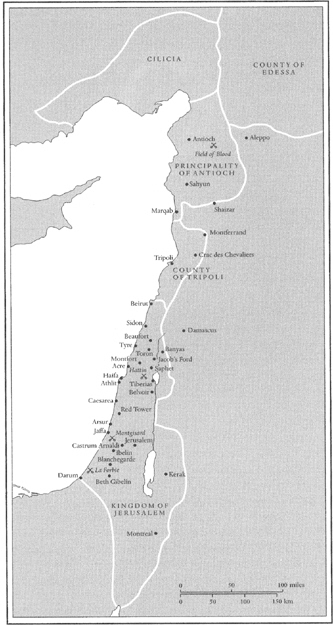
THE LATIN EAST IN THE AGE OF THE CRUSADES
Not surprisingly the Muslims were keen to expel these Westerners whom they regarded as intruders into the Dar al-Islam. There were, it is true, periods of truce, but there could be no permanent peace between Christian and Muslim, and, although a measure of accommodation could be achieved and instances of Christians forming alliances with Muslims against other Christians or Muslims did occur, in the twelfth century at least warfare persisted as a constant fact of life. To the Muslims, as to the Christians, Jerusalem was, and is, a holy city, and within a generation of the arrival of the crusaders—men fired with the idea of waging war on Christ’s behalf—the Muslims were preaching the jihad (Islamic holy war) to repel them. Ultimately the Muslims were successful, but the fact that the crusader principalities lasted for almost 200 years is in itself testimony to the martial prowess and persistence of the West.
In the early twelfth century the crusaders were able to take advantage of disunity and political fragmentation in the Muslim world to expand and consolidate their gains, but by the late 1160s the balance of power was beginning to tilt decidedly in favour of the Muslims as successive rulers were able to unite more and more of the Islamic lands in the Near East under their sway. The Muslims had to hand greater resources of wealth and manpower than the Christians, and, once a ruler emerged who could provide adroit political leadership and military direction, it was perhaps inevitable that the Europeans would be forced on to the defensive. Such a ruler was Saladin, who from 1174 was ruling in both Damascus and Egypt and so for the first time since the arrival of the crusaders in the late 1090s had control over all the Muslim lands bordering the kingdom of Jerusalem. In 1187 Saladin defeated the Christians in battle at Hattin (in Galilee) and went on to capture Jerusalem itself and almost all the other crusader territories. Until 1187 the Christians had been able to mount a vigorous defence of their possessions. Now it required a new crusade, the Third (1188–92), to give their presence in the East a new lease of life. But despite some successes, the Christians never regained their former territorial power. Except for a brief period between 1229 and 1244 they were denied possession of Jerusalem, and the area under their control was largely restricted to the coastal regions. Even so, they were able to retain this attenuated position for another century. After the Third Crusade the character of warfare in the Latin East changed. It was now rare for the Christians to be able to go on to the offensive unless they were joined by a crusading expedition from the West. Instead we find much longer periods of truce and much greater emphasis on the defensive use of fortifications.
It will be immediately clear from this brief sketch that warfare and needs of defence loom large in any account of the Christians in the Levant during the twelfth and thirteenth centuries. The Westerners brought with them to the East ideas of how to wage war and how to build and utilize fortifications, and during the two centuries under consideration their practices continued to be affected by contemporary changes in the West. But they also learnt from their experiences of warfare with their Muslim and Byzantine neighbours, and in the process they were able to work out for themselves their own solutions to problems of recruitment, strategy, and castle design.
Throughout the history of the Latin East, pride of place was assigned to the heavily armed mounted warrior, the knight. Knightly arms and equipment would seem to have kept pace with developments in the West, and, as in the West, during the course of the twelfth and thirteenth centuries the knight’s social standing steadily rose. But the number of knights that could be retained permanently as fief-holders was limited. A list drawn up in the mid-1180s suggests that the king of Jerusalem could call on the services of no more than about 675 feudatories, which in the context of the need to defend fortresses and conduct campaigns virtually every year suggests that there was a severe shortage. How many other knights—mercenaries or volunteers—the kings could recruit is not known. Towards the end of the twelfth century the sources begin to refer to mounted sergeants, presumably men whose arms and equipment were similar to the knights’ but who lacked their status in society. Here too the emergence of this class paralleled developments in the West.
In Syria the crusaders’ chief enemies were the Turkish rulers of Damascus, Aleppo, and the other Muslim cities of the hinterland, and such potentates employed Turkish horsemen whose equipment and techniques differed markedly from the Westerners’ (see further, Chapter 9, p. 190). These warriors were lightly armed mounted archers whose speed and ability to manoeuvre in formation while firing a rapid barrage of arrows from the saddle had from the time of the First Crusade posed major problems for the heavier Western knights whose standard technique was the massed charge with the couched lance. The effectiveness of the Turkish mounted archers is beyond doubt, although it seems that their arrows had limited capacity for penetrating armour. Before long the Christians were employing troops armed and equipped in the Turkish manner and known in the sources as ‘turcopoles’. Some may have been recruited from among the indigenous Christian communities in the Levant, while others would have been of Western extraction,perhaps the sons of mixed marriages between crusaders and local women.
For cavalry forces to be effective they needed infantry. Whether as archers, crossbowmen, spearmen, or sappers, their role, and also their training and efficiency, would have varied considerably. When confronted by the Turkish mounted archers, their job was to keep them at bay long enough for their horses to tire and so allow the Christian knights to pick the optimum moment for their charge. To be able to stand firm under fire from volleys of Turkish arrows required courage and discipline, but it was often essential for Christian success. If the cavalry charge, when it came, proved ineffective, it would be difficult for the knights to regroup and repeat the operation, and so patience was needed in choosing the best possible opportunity. Turkish mounted archers could be particularly dangerous when deployed against a Christian army on the march. Troops strung out in a long line with their baggage train were especially vulnerable to the Turks’ ability to approach, discharge their arrows, and then make a rapid retreat, and the only way to counter this harassment was by organizing the column in close formation and maintaining strict discipline. The most famous instance of this technique occurred in 1191 at Arsur when on the Third Crusade King Richard the Lionheart was marching south towards Jaffa. The infantry shielded the flank and the knights of the military orders the rear. In the event the Christian cavalry charge seems to have been launched before the king gave the order, but, although the Christians had much the better of the encounter, the main Muslim army was able to regroup and resume harassing Richard’s forces almost immediately.
In siege warfare, the foot soldiers, and especially those skilled in operating siege machinery or in techniques of mining, were of the utmost importance. Evidence for how the infantry was recruited is sparse, but it would appear that the towns and the greaterchurches had responsibilities. Recent research has suggested that there may have been far more Western settlers in the Holy Land than used to be thought, with ecclesiastical and presumably also secular landlords promoting Frankish settlement in the countryside, and it looks as if it was from these settlers as well as from the burgesses in the towns that the infantry was drawn.
It is evident that the crusaders lacked sufficient resources of manpower or money to garrison their defences adequately and at the same time also take the offensive against the Muslims. This shortage of manpower may explain the generous terms under which fiefs were held. In contrast to the situation in England, kings and lords were anxious that the feudatories should serve in person when summoned but were not much concerned with profiting from entry fines, control of wardships, or those other fiscal aspects of fief-holding familiar from England and elsewhere in the West and known collectively as feudal incidents. It is doubtless significant in this respect that in the Latin East there was no systematized institution of scutage (payment in lieu of service): if a vassal wished to avoid service he had to surrender his fief for a year and a day. Manpower shortages meant that rulers were cautious about committing their armies to pitched battle, and in the thirteenth century they came to rely increasingly on fortifications and a largely passive defence strategy. In 1187 it would seem that King Guy had to strip many of the fortifications of their garrisons in order to raise a field army large enough to challenge Saladin’s invasion, and, with this army destroyed at Hattin, the Muslims encountered few cities or castles with enough armed men to put up any meaningful resistance.
The simple fact was that throughout their existence the Latin states in the East needed financial and human resources from Western Europe to sustain their position. Right from the start it would seem that warriors were coming to the East as pilgrims and remaining there for one or more campaigning season, thus providing a useful adjunct to the military strength furnished by the more permanent settlers. In some cases young men who had yet to enter their inheritances would occupy themselves in this manner. But sometimes major aristocrats from the West—for example Count Fulk V of Anjou or the successive counts of Flanders, Thierry of Alsace and his son Philip—would spend time in the East, sharing in the military action. It is also clear that almost until the loss of the last strongholds in 1291, well-born immigrants from the West could still gain entry into the aristocracy of Latin Syria, and there was ample scope for Westerners of more lowly origin to find military employment.
The biggest contingents of armed men to come to the aid of the Latin East were of course those recruited for specific crusades. There were many more crusading expeditions to the East than the handful of numbered campaigns familiar from the standard modern accounts, but it has to be said that apart from the First Crusade and, to a lesser extent, the Third, and despite the high hopes that the crusaders themselves often entertained, these expeditions had only limited or temporary success. Increasingly people were becoming aware that Western crusaders might succeed only in destroying the existing modus vivendi with the Muslims and that, once they had returned home, they would leave the Christian defenders of Latin Syria dangerously exposed to retaliation. It was with this thought in mind that King Louis IX, who was in the East between 1248 and 1254, established a standing garrison at Acre, the capital of the kingdom now that Jerusalem was lost, at French royal expense. This French force remained in being until 1291.
Not only did the Latin East look to the West for manpower, it also relied heavily on Europe for money to pay for its military expenditure. Crusading was expensive, and the costs were borne by the crusaders themselves, their families, their lords and, increasingly from the end of the twelfth century, by taxes levied on the Church in the West. In addition, the capacity of the Christians in the Levant to sustain their military resources benefited from a transference of wealth from Europe—directly in the form of donations or legacies, and less directly thanks to Western endowments for churches in the East and to the large numbers of European pilgrims to the Holy Land who by their very presence there would have bolstered the local economy. Monetary historians are in no doubt that large quantities of Western silver flowed into the crusader states and had a considerable impact on the economy of the region, and, though a good deal of that bullion would have arrived as a consequence of the thriving long-distance trade with the Levant which developed during the course of the twelfth century, much would have resulted from the piety of Christians in Europe.
But for the historian, the most striking and at the same time the most direct way in which the West channelled wealth and manpower into the defence of the Latin East was through the institutions known as the military orders. The Hospital of Saint John began as a religious corporation attending to the needs of pilgrims, and throughout its history it has continued to provide accommodation and medical care. From the early twelfth century the Hospital in Jerusalem was arranging armed escorts for pilgrims taking the route from Jaffa to Jerusalem and then on to the Jordan and the other pilgrimage sites—evidently a very necessary precaution—and it was a small step from supplying armed guards to garrisoning fortresses along the way or making troops available when the king was on campaign. The process whereby the members of the Order themselves came to serve in a military capacity is controversial, but what is clear is that their services were much appreciated and led directly to their acquiring substantial landed endowments in WesternEurope which were to provide them with the wherewithal to diversify and extend their activities. The beginnings of the other leading Order, the Templars, differed in that the earliest members seem to have been drawn from an association of warriors whose original vocation had from the outset been the protection of pilgrims to Jerusalem. In about 1120 King Baldwin II gave them the al-Aqsa mosque in Jerusalem, which popular tradition identified with Solomon’s Temple, to be their headquarters, and it was from this building that they took their name. Like the Hospitallers, their military function expanded, and they too received lavish endowments in Western Europe. By the middle decades of the twelfth century both the Templars and the Hospitallers were powerful ecclesiastical corporations whose military might had reached significant proportions. In the East they came to acquire lands and castles, including many in northern Syria, well away from the principal pilgrimage shrines, but most of their endowments were in the West, and it was from the West that they drew most of their recruits. Their wealth and military role meant that they also acquired considerable political influence. As warriors, the brothers of both Orders were respected and feared by the Muslims. Their reputation for military discipline when on campaign was recognized as early as the 1140s when King Louis VII of France had the Templars organize his own forces while moving through hostile territory in Asia Minor during the Second Crusade, and such was their prowess and devotion to the Christian cause that Saladin had all the Templar and Hospitaller prisoners taken at Hattin executed. In the thirteenth century their wealth and resources probably equalled those of the secular lords in the East.
Both institutions employed mercenaries and allowed volunteers to fight under their banner for limited periods, but they were led by brother-knights who, as professed members of a religious order sworn to obedience, poverty, and chastity, counted as members of the regular clergy. The concept of men subject to monastic discipline who could at the same time bear arms and shed blood was a radical departure from the commonly held view that clergy should eschew violence. But the idea of the ‘armed monk’ proved popular. It was soon to be copied in Spain and elsewhere. Perhaps the most famous of these later foundations was the Teutonic Order. This originated at the close of the twelfth century in the Holy Land, where it continued to play an active military role until 1291, but it is chiefly remembered for its activities in the Baltic region, fighting the pagans of Lithuania.
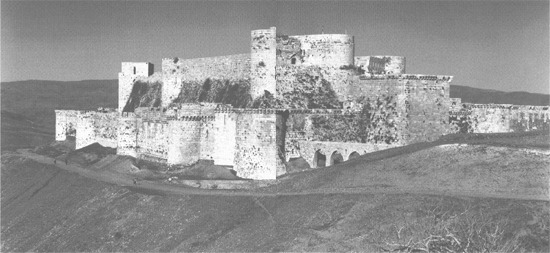
For many people, the Hospitaller castle of Crac des Chevaliers epitomizes crusader military architecture. The existing structure dates mainly from the first half of the thirteenth century. It formed the centre of a Hospitaller lordship straddling the main route between the Christian Tripoli on the Mediterranean coast and Muslim Hamah.
Warfare in the East shared many characteristics with contemporary warfare elsewhere. Major pitched battles were few, and when they did occur it was frequently in the context of attempts to raise sieges. Thus the Christian disaster at Hattin in 1187 came about when what may well have been the largest army ever mustered by the Franks in the East—the best estimates suggest 18,000 men of whom 1,200 were heavily armoured knights, 4,000 light cavalry, and the rest foot—allowed itself to be outmanoeuvred and stranded in a waterless area when attempting to advance against an even larger Muslim force besieging Tiberias. When Christian and Muslim armies did meet in open combat as at the Field of Blood in 1119 or at La Forbie in 1244, the Christians could suffer serious losses, although, as in these two instances, the Muslims were not always able to capitalize on their success. Generally the Christians adopted the more prudent tactics of not exposing their field armies to the risk of full-scale conflict, not least because they could not afford the loss of too many men.
But although prudence and the occasional spectacular defeat may have characterized much of the military action of the Franks settled in the East, the continued survival of Christian rule testifies to their strengths and effectiveness. As in all frontier societies, the essential elements were the raid (or chevauchée, see Chapter 4, pp. 67–9) and the use of fortifications and sieges. Raiding was perhaps the commonest form of military activity for both Christians and Muslims. Its objectives varied. At one level, campaigns designed to devastate the countryside would impoverish the enemy and destroy morale, thus making siege operations and permanent annexation at a later date more likely to succeed. Mounted warriors could move fairly freely, and, provided they took sensible precautions such as attending to reconnaissance and avoiding passing too close to the enemy’s castles, they could normally use their mobility to avoid encountering serious opposition. Occasionally exploits of this type did come to grief, as for example in 1177 when Saladin led a large chevauchée into southern Palestine only to be badly mauled by a hastily assembled and much smaller Christian army at Montgisard. The Christians became adept at handling Muslim raiding parties. Perhaps the classic example was Saladin’s raid of 1183. Then the regent of the kingdom and his men were able to garrison their strong points, occupy the main sources of water in the areas in which the Muslims were operating and shadow their forces. There was no attempt to challenge them in open conflict, although presumably there would have been skirmishes with small bands of foragers. The strategy was one of damage-limitation, and the Muslims duly withdrew without having achieved any major success.
Other raids might be little more than rustling exploits, perhaps directed against the nomadic Bedouin pastoralists. William of Tyre recorded a particularly spectacular example led by King Baldwin III of Jerusalem in person in 1157, but it is clear that smaller scale exploits of this type were common. Frequently these were simply instances of stealing livestock, but rulers also sought to coerce the tribesmen into paying tribute, and the occasional show of strength or a punitive attack would have been needed to enforce earlier agreements. Rather similar were the attacks on merchant caravans. In the 1180s the Christian lord of the Transjordan region, Reynald of Châtillon, staged at least two major raids on Muslim convoys moving between Damascus and Mecca. Supposedly it was these actions that precipitated Saladin’s invasion of 1187 and the battle of Hattin, but how far Reynald was simply being opportunistic and how far he was using force to assert his claims to make the Muslims pay tolls when passing within range of his fortresses is not clear.
Raiding and tribute-taking were inextricably linked. In the early decades of the twelfth century the princes of Antioch were able to place the Muslim rulers of nearby Aleppo and Shaizar under tribute. If the payments were to continue there would have to be continuous military pressure, and it has recently been suggested that the situation closely paralleled the subjection that the kings of the Spanish kingdoms were able to exert at this period over the neighbouring Muslim taifa kingdoms (see Chapter 4, pp. 61–3). In his writings Usamah ibn Munqidh, a member of the family that ruled in Shaizar in the first half of the twelfth century, has left an impression of the low-level military activity on the border that characterized relations between Christians and Muslims. It was a question of petty raiding and skirmishing in an attempt to probe the weaknesses of the opposition and assert localized dominance. At a rather later date the Templars and Hospitallers from their strongholds in northern Syria were able to exact tribute from the Isma’ili sect of the Assassins who from the 1130s had established themselves in the mountains between the county of Tripoli and the principality of Antioch—a fact that belies their fearsome reputation which gave their name to the English language. Far more ambitious were the attempts of the kings of Jerusalem in the 1160s to place Egypt under tribute. The regime there was unstable, but successive campaigns designed to assert Frankish dominance alarmed Nur al-Din, the Muslim ruler of Damascus (1154–74), who sent his own troops to intervene. The war in Egypt became a race between Christian Jerusalem and Muslim Syria to see which could seize power first and so pre-empt the other’s ambitions. It was a race the Muslims won, and their triumph led directly to the rise of Saladin.
Sometimes the Christians and Muslims would agree to put an end to border warfare and seek ways of sharing the frontier zone by tallaging the rural population in a condominium. It is difficult to assess how successful such compromise arrangements were, but in the second half of the thirteenth century, when the Muslims were extending their control at Christian expense, agreements between the two sides carefully defined which rural settlements each were to possess and which, if any, were to be shared.
The most tangible reminders of warfare in the Latin East are of course the castles which to this day dot the landscape. Some, such as Crac des Chevaliers, Sahyun, Marqab, Belvoir, or Kerak, provide spectacular testimony to the achievements of the military architects and masons who built them (see further, Chapter 8, p. 176). Situated on hills and ridges, often in an inhospitable terrain, it is easy to see why in the past they have fired the imagination of people such as T. E. Lawrence, who was originally drawn to the Near East in order to study them. Of all the crusader castles, the most famous has to be the Hospitaller fortress known Crac des Chevaliers situated in the hills to the north-east of Tripoli. Most of the structure, which exhibits considerable sophistication in its design, dates from the thirteenth century, and in its heyday the castle could have held a garrison of 2,000 men. The problem with these castles is that they are so impressive that it is all too easy to forget the less spectacular fortifications in the countryside or the urban fortifications, and attach more significance to these famous places than perhaps they deserve.
When the crusaders arrived in the East they came to a land with comparatively few fortresses. In Palestine there were walled towns along the coast, and Jerusalem itself was well defended, but there were not many castles. Further north, where for a century or more the Byzantines had confronted their Muslim neighbours, they were more numerous, and pose the question of how far the designs of the crusaders’ own castles were influenced by Byzantine or Arab prototypes. The crusaders occupied existing strongholds—the castles at Sahyun and Crac des Chevaliers had originally been built by the Byzantines and Arabs, respectively—but the consensus among modern scholars is that they adapted little of what they found when they came to build their own structures. Instead it would seem that they relied far more on the traditions of castle building with which they were familiar in the West. For example, characteristic of much of France, notably Anjou and Poitou, was the donjon, the square tower, often with interior stone vaulting which contributed to the structural solidity, and the crusaders were to build many such towers in the East, often with a cistern at the base. Elsewhere in the West where the terrain lent itself to this type of construction, the Europeans were siting castles on hills or ridges, making the most of the natural escarpments which frequently meant that only on one side, where the ridge abutted the massif, did they need to build elaborate defences. This sort of fortification was not of course unique to Western Europeans, but in the East, where the crusaders built a number of strongholds of this type, they employed their own characteristic designs for the towers, crenellations, and the internal arrangements. The castles of the Latin East necessarily varied greatly in scale, but, insofar as it is possible to pinpoint specific influences on their design, the models seem to have been Western rather than Eastern. In particular they avoided fortified enclosures consisting of a curtain wall with semi-circular flanking towers, preferring instead the square donjon or a fortified complex with one or more donjon-like towers flanked by curtain walls with smaller square projecting towers. Unlike the Byzantines and the Muslims, it was very rare, at least in the twelfth century, for the crusaders to build circular or semi-circular towers. At Sahyun, a ridge castle where the Byzantines had excavated a deep ditch to separate the fortress from the adjacent hill, the crusaders took full advantage of the ditch but found the Byzantine structures inadequate. They redesigned and rebuilt the castle, employing noticeably better quality masonry. The end-result was altogether more formidable.
In the early years of the Latin states in the East, the new rulers concentrated their efforts on capturing and holding existing fortified sites. The kings of Jerusalem were particularly keen to bring the cities of the coast under their rule, and in almost every instance they needed naval support in order to do so. Occupation of the coast and its urban fortifications had major strategic implications. Christian control precluded the use of these places by Muslim warships, with the result that the Egyptian navy, the only significant Muslim sea-borne force in Eastern Mediterranean waters, had nowhere to take on fresh water and supplies and so found that its operational range was severely curtailed. That in turn meant that the seas around the coasts of Syria and Palestine were correspondingly safer for Christian shipping. This security was very necessary, for although the armies of the First Crusade had travelled overland across the Balkans and Asia Minor to reach Jerusalem, it was immediately clear to the crusaders that in the future merchants, pilgrims, and settlers would find it far easier to travel by sea. The Christian capture of Tyre in 1124, following a major victory by a Venetian fleet over the Egyptians off the coast of Palestine the previous year, was crucial in this respect as it meant that the Muslims now had no naval facilities north of Ascalon.
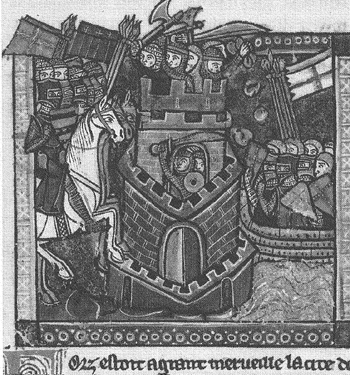
the crusaders besiege Tyre (1124). (From a French manuscript of the third quarter of the thirteenth century.) Tyre and the other Muslim-held cities on the coast needed to be invaded by both land and sea. Note the defenders dropping rocks from a great height into the boat attempting to approach the walls.
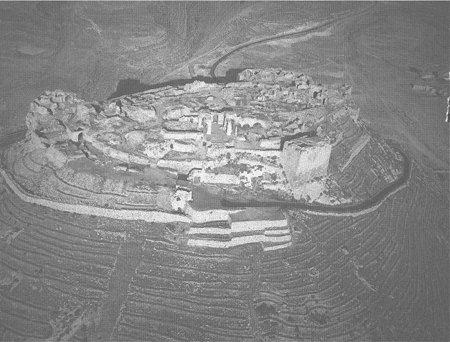
Originally built by King Baldwin I of Jerusalem in 1115, Montreal, to the south east of the Dead Sea, helped establish Frankish control over the roads from Damascus and both Egypt and Mecca. It fell to Saladin in 1189 after a long siege.
The Christians seem not to have engaged in much castle-building during the first two decades of the twelfth century. One early—and ambitious—example of a new fortification was Montreal (al-Shaubak) beyond the Dead Sea near the ancient city of Petra. Montreal dates from 1115 and was designed to assert control over the caravan routes between Damascus and Mecca. Another new castle was at Toron, built, so we are told, as a refuge for troops from Tiberias campaigning against Tyre. Toron is an appreciable distance from Tyre, but building castles as part of a long-term offensive strategy for investing major centres was a tactic employed elsewhere. During the First Crusade small forts were constructed outside Antioch during the siege of 1097–8. Later, during the siege of Tripoli (1103–9), Raymond of St Gilles erected a fortress known as Mons Peregrinus overlooking the town. With the Christian capture of Tyre, the one remaining Muslim stronghold on the Palestinian coast was Ascalon, and during the 1130s and early 1140s the Franks built a series of castles—Castrum Arnaldi, Bethgibelin, Ibelin, Blanchegarde—to serve as bases for attacks on Ascalon and its environs. Ascalon duly fell to the Christians in 1153.
After the capture of Tyre in 1124, the kingdom of Jerusalem was much less exposed to Muslim attack, and this state of affairs was to last until about 1170. But it was precisely during these middle decades of the twelfth century that large numbers of for the most part quite small fortifications were put up. It would be natural to associate the construction of castles with external danger, but for this period at least no such correlation is possible. The castles just mentioned that faced Ascalon were all built after the Muslimgarrisons there had stopped posing a major threat to the security of the Christian-controlled areas of southern Palestine, and it is for that reason that historians have concluded that their primary purpose was offensive, not defensive, and can point to the fact that they also provided the nuclei for rural settlement, feasible now that the military danger had receded. But there were many more castles dating from these middle years of the twelfth century, mostly in the lordships of Arsur and Caesarea or in the royal domain around Jerusalem and Acre—areas that remained virtually free from external attack during these decades. A recent count has suggested that the fortifications of this date in these areas may have amounted to more than half the total of 162 fortified sites identified within the area occupied by the kingdom of Jerusalem. They were clearly not being built as defences against Muslim attack, and so we need to consider what alternative purposes they would have had. There is no doubt that they functioned as centres for rural administration, and it may well be that they should be seen as evidence for more intensive exploitation of the countryside. In many cases the structures, perhaps consisting simply of a donjon and associated outbuildings, sometimes with an outer perimeter wall, should be seen as fortified manor houses. Maybe there were still sufficient brigands in the countryside to make this type of defence necessary. Maybe there was a need to overawe the local peasantry. In some instances they were clearly intended to provide a focal point for rural settlement for Frankish settlers from the West, and it could well be that, as in the West, the local landholder regarded the possession of fortifications as a symbol and assertion of his own status in society. The conclusion to which such considerations point is that at least in the middle decades of the twelfth century these fortifications denote confidence and an expanding economy rather than fear of invasion or a preoccupation with the neighbouring Muslims. It should be called to mind that in many parts of Europe at the same period this same phenomenon, which historians have dubbed incastellamento, was in full swing for much the same reasons (see Chapter 8, pp. 164–5), and it has been suggested that in the mid-twelfth century the countryside in the heartlands of the kingdom of Jerusalem was no less secure and enjoyed just as much local prosperity as many regions of the West.
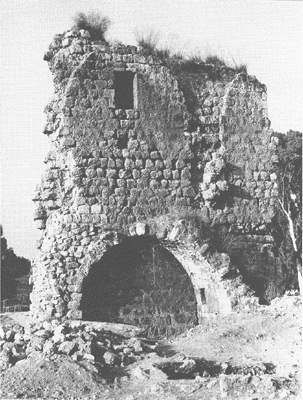
The Red Tower (Burj al-Ahmar). Situated south east of Caesarea, the remains of this two-storey vaulted donjon provide a good example of the small fortress or fortified manor-house that would have functioned as a local centre for rural administration. Many such fortresses were erected in the course of the twelfth century.
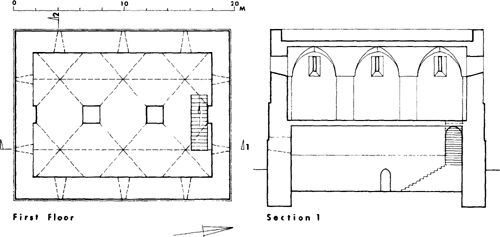
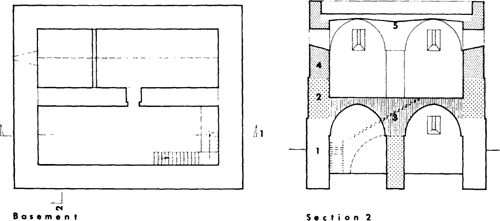
The Red Tower (Burj al-Ahmar): plan from excavations carried out by the British School of Archaeology in Jerusalem in 1983.
After the late 1160s the situation changed. The comparative security gave way to a series of damaging Muslim raids as Nur al-Din and then Saladin were able to take the offensive. During the 1170s and 1180s these attacks became more frequent and succeeded in penetrating more deeply into Christian-held territory, culminating in the Hattin campaign of 1187. The Christians in the kingdom of Jerusalem responded with a marked increase of castle building in the key frontier areas, and it would seem that this was first time in the kingdom’s history that a defensive building strategy had been adopted. There is some evidence to suggest that the two great castles of the Transjordan region, Montreal and Kerak, were enlarged and strengthened at this time. In the late 1160s a fortress was built at Darum on the direct coast approach to Ascalon from Egypt. In the north of the kingdom, in the area closest to the Muslim centre of power at Damascus, the castles at Belvoir and Saphet, acquired by the Hospitallers and Templars respectively, were extensively rebuilt. At Saphet the construction is not clear—there was further rebuilding in the mid-thirteenth century and considerable earthquake damage subsequently—but at Belvoir excavation has revealed a precocious example of a concentric design. Evidently it was much admired: in the 1190s the new Frankish rulers of Cyprus had a castle built at Paphos with a ground plan which though smaller was otherwise virtually identical. The Franks also set to work to build a castle at Jacob’s Ford to the north of the Lake of Tiberias athwart one of the most obvious routes into Christian territory from the direction of Damascus, but Saladin reacted swiftly and in 1179 the still-incomplete fortress was captured and destroyed. All these fortresses were constructed on a massive scale. After the battle of Hattin, Saphet, Belvoir, Kerak, and Montreal together with Beaufort in the lordship of Sidon were the fortresses which almost alone resisted Saladin’s victorious progress. Darum was the one fortified site in southern Palestine apart from Jerusalem itself which Saladin decided not to slight when confronted with Richard the Lionheart’s advance into that region in 1191.
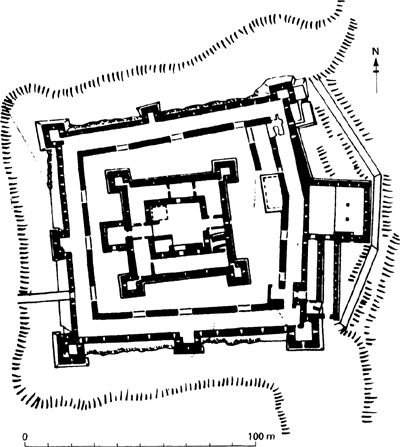
Belvoir Castle. The Hospitallers built this castle in southern Galilee during the years leading up to the Hattin (1187) and the collapse of the kingdom of Jerusalem. It consists of an almost square inner court with towers at each corner surrounded by an outer court. Note the elaborately fortified entrance to the right of the plan.
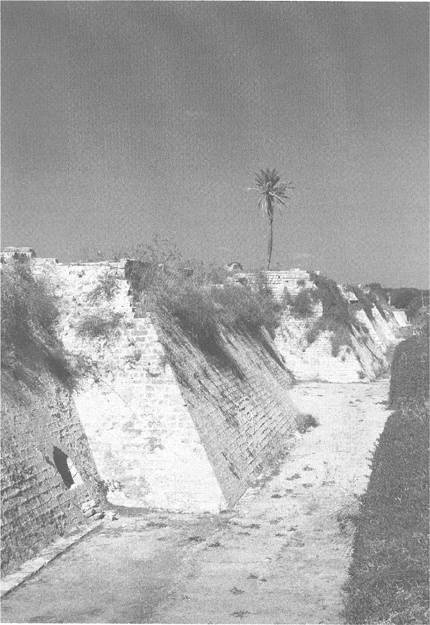
King Louis IX rebuilt the fortifications at Caesarea in 1251. The walls originally stood to a greater height above the existing talus, but when the city was taken by the Muslims in 1265 the higher sections were toppled into the moat. The moat itself was designed to be flooded by the sea, thus rendering mining operations impossible.
Despite the partial recovery effected by the Third Crusade after the collapse of the kingdom of Jerusalem in 1187, the Christian-held territory at the close of the twelfth century must have been largely in ruins. Only Tyre had successfully resisted Saladin’s assaults, and, what with a two-year siege of Acre and a systematic scorched earth policy adopted by the Muslims in southern Palestine, both the defences and the economy would need extensive restoration. King Richard’s works at Ascalon and Darum were destroyed under the terms of the 1192 truce which signalled the end of the crusade, and his rebuilding at Jaffa was nullified by the Muslim capture of the town in 1197. New defences elsewhere took time. The castle of Beirut was restored during the first decade of the new century. At Caesarea work was put in hand in 1217, but interrupted by a Muslim assault two years later. At Sidon and Jaffa we have to wait until the late 1220s before the crusaders could restore the fortifications. Major new castles were build at Athlit on the coast south of Haifa (for the Templars) beginning in the winter of 1217–18, and at Montfort in the hills north-east of Acre (for the Teutonic Knights) beginning in about 1227. In 1240–1 Richard of Cornwall built a fortress at Ascalon, and at precisely the same time work was started on restoring the Templar castle at Saphet in Galilee. It was also during the first half of the thirteenth century that the Hospitallers remodelled their two major strongholds in the north, Marqab and Crac des Chevaliers. Between 1250 and 1254 King Louis IX of France strengthened the fortifications of Acre, Caesarea, Jaffa, and Sidon, but in 1260, when Palestine was threatened for the first time with Mongol invasion, the master of the Templars voiced the opinion that in the kingdom of Jerusalem only Tyre and Acre and two Templar fortresses—presumably Saphet and Athlit—and one fortress belonging to the Teutonic Knights—Montfort—were in a state to offer serious resistance. He also mentioned three Templar castles in the principality of Antioch and two Templar and two Hospitaller fortresses in the county of Tripoli.
The Templar master may have been exaggerating the plight of the Christians in the Holy Land—there is no mention of Beirut where the castle had held out for several months when besieged by the Emperor Frederick II’s forces during the civil war in the early 1230s, nor of Jaffa where considerable resources had been expended on the defences in the 1250s. But his remarks do highlight the reliance by the Christians in the thirteenth century on a handful of strongly fortified sites and the fact that the castles in the countryside were mostly in the hands of the military orders. However, walled towns and their citadels were of the utmost significance, and the fact that nothing or almost nothing remains of the defences at towns such as Jaffa, Tiberias, or Beirut tends to distort the picture and allow undue attention to be given to the fortresses in the rural areas where, with fewer people bent on robbing the stonework to build their own dwellings, they survive in a better state of repair.
The whole point of building castles or placing walls around towns was to enable them to withstand sieges. Military architects were well aware of the weapons and techniques available to the enemy and tried to devise ways of countering them. The great castles had ample storerooms and frequently a good water supply. In fact there is no known instance of castle surrendering through lack of water, although in 1137 Montferrand surrendered when the food gave out, as did Kerak and Montreal in 1188 and 1189, respectively.Armies could normally only remain in the field for the duration of the campaigning season, and so the chances of a castle putting up a successful resistance was strong. At the time of the First Crusade, the Westerners had only fairly simple siege techniques. They would have been used to the need to fend off relief columns and engage the besieged garrison in exchanges of archery or in hand-to-hand fighting should they attempt a sally. But their ideas about how to assault the walls were fairly primitive. At the capture of Jerusalem in 1099 they had scaling ladders and a movable siege tower. Scaling ladders were little use against an adequately defended circuit of walls, and towers were vulnerable to incendiary devices and were clumsy to operate. Ditches and other obstructions had to be overcome, and the tower had to be hauled into place against the wall. Only then could hand-to-hand fighting commence. There was no opportunity for surprise and plenty of chances for the defenders to meet the challenge. The remarkable thing is that at Jerusalem the use of a siege tower in the principal assault worked. At the siege of Acre during the Third Crusade the Christians used protected battering rams called ‘sows’ or ‘cats’—a device apparently not used by the Muslims; but these too were vulnerable to Greek fire—an incendiary mixture of naptha and petroleum—which the Muslims defenders were able to put to good effect.
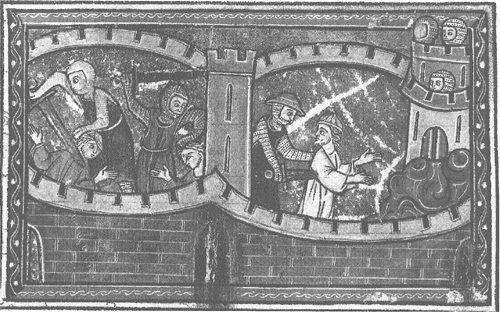
The crusaders massacre the citizens of Antioch in 1097. The massacre of civilians was commonplace when a city was taken by assault and helps explain why commanders would surrender when successful resistance seemed out of the question, even though their supplies and manpower were not yet exhausted. (From a manuscript copied in Acre in the 1280s.)
Where the crusaders trailed behind the Muslims was in the construction of stone-throwing machinery and in mining techniques, neither of which were in regular use in the West until the beginning of the thirteenth century. It could well be that during the twelfth and thirteenth centuries the Muslims themselves made significant advances in these areas. According to Usamah ibn Munqidh, in 1115 they used sappers from Khurasan in north-eastern Persia when attacking a Frankish-held town, and this suggests that the experts in this field were to be found much further to the east. When the 1191 Richard the Lionheart attacked Darum he is said to have employed Muslim sappers from Aleppo. Muslim expertise in mining proved crucial in inducing the surrender of the castles at Saphet (1266), Crac de Chevaliers (1271), and Marqab (1285).
The Muslims also made extensive use of machines designed to hurl stones against or over the walls of fortifications. Variously known by Western writers as ‘trebuchets’ (see further, Chapter 8, pp. 174–5), ‘mangonels’, or ‘petraries’, they seem to have depended on a counterweight (or human effort) to pull down the shorter arm of the beam and so release the projectile. (The use of torsion instead of a counterweight may also have been used: unfortunately the narratives rarely provide sufficient information about the technology involved for there to be any certainty.) It has been estimated that the counter-weight trebuchets had a range of up to 200 metres which meant that they could be sited beyond the reach of archers whose arrows would not have been effective at more than about 140 metres. Their capabilities are not in doubt, and they could be aimed with pinpoint accuracy. Saladin employed trebuchets during his victorious campaigns of 1187 and 1188, but it was the Mamluk sultan Baybars (1260–77) who gained the maximum advantage from them. He had them constructed in prefabricated sections so that they could be erected speedily at the site of operations. At Beaufort in 1268 he had no less than twenty-six in operation at the end of the siege. Bombardment could knock holes in the walls and in particular destroy crenellation or the wooden hoardings which were frequently employed to give the defenders cover. Stones lobbed into the fortification would cause casualties and an extended assault would doubtless damage morale. Trebuchets would also help provide cover for miners to operate, and what is significant about many of the successful sieges of the second half of the thirteenth century is that both tactics were used in tandem. The Muslims had developed their siege techniques to such a degree that in the second half of the thirteenth century they never needed more than six weeks to reduce any of the great Frankish fortresses to submission.
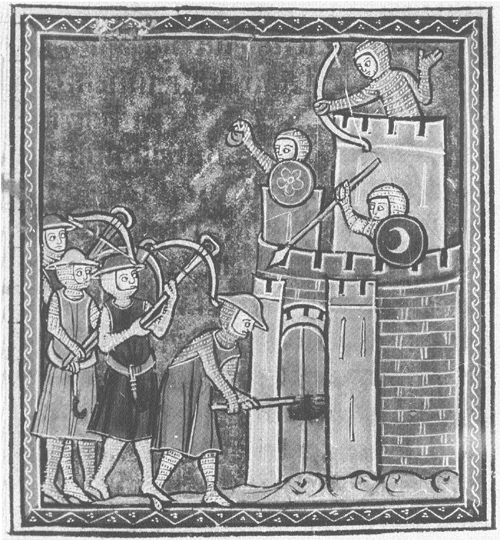
The crusaders besiege Nicaea. Note the Christian use of the crossbow while the Muslim archer in the tower has a simple bow. (From a manuscript copied in Acre shortly before its fall in 1291.)
The defenders might hope to put trebuchets out of action by making their destruction the object of a sally or by setting them on fire. It is also clear that they modified the design of their fortifications to take their effectiveness into account. In the thirteenth century both Christians and Muslims built fortifications with thicker walls and massive towers in an attempt to withstand bombardment, and, as at Jaffa in the 1260s, they could mount their own trebuchets on the towers. The development of concentric castles would have meant that the main stronghold was further from where the machines could be sited. It may be that the use of round or semicircular towers in the thirteenth-century defences at Crac des Chevaliers, Marqab, and a few other places were also conceived as a riposte to improved artillery and were less susceptible to mining.
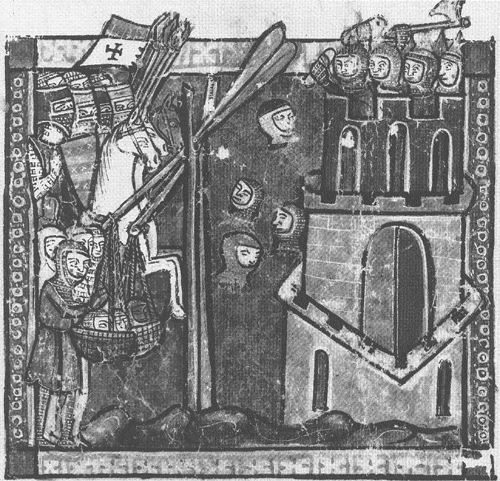
Demoralizing the besieged. Gaining psychological advantage over the opposition has always been an essential element in warfare. Here the crusaders hurl decapitated heads into Nicaea during the seige of 1097. (From a French manuscript of the third quarter of the thirteenth century.)
In 1291 the last major conflict in the history of the Latin states in the Levant was played out at Acre. The Mamluk sultan brought up a huge army. The Muslim trebuchets kept up a constant bombardment, and their archers gave solid support. All the while sappers undermined the towers at the most vulnerable corner of the defences. The defenders’ sallies came to naught, and, though they fought valiantly when the Muslims began to force their way into the city through the breaches in the walls that their mines had opened, they were overwhelmed by force of numbers. Such was the impact of the defeat that the Franks surrendered Tyre and their other remaining strongholds without further resistance.