
CHAPTER 7

Detail of the battle between the USS Monitor and the CSS Virginia at Hampton Roads on March 9, 1862.
Though it remained all quiet along the Potomac during the winter of 1861–62, that season marked a period of active operations in what was called the Western Theater — the area between the Appalachian Mountains and the Mississippi River. There the control of the major river systems was a key factor in all military operations. In February, the Union naval squadron of Flag Officer Andrew Hull Foote, and a Union army commanded by a little-known brigadier general named Ulysses S. Grant, captured two key forts in a campaign that smashed the Confederate defensive line in Tennessee.
As The Times correctly noted, the capture of Fort Henry on the Tennessee River on February 6, and Fort Donelson on the Cumberland River on February 15, were the most important strategic successes of the war to date, and led directly to the capture of Nashville, the first state capital to be reclaimed by the Union. An important factor in these riverine victories was Foote’s squadron of iron-armored warships that had been built under the supervision of James B. Eads. The Union’s ability to produce such specialized vessels in quantity gave it an unquestioned advantage in the western war. On February 17, The Times boasted that the success of the armored river gunboats demonstrated “the ingenuity, mechanical skill, perseverance and calm courage of a Northern free people over the ardor and impulse, and want of thoroughness, of a Southern and slave-holding population.” The ironclads, plus another novel weapon, huge 13-inch mortars on rafts, also proved useful in the investment of Island Number Ten on the Mississippi River, though it held out until April.
Iron armor proved newsworthy in the Eastern Theater as well when, on March 9, the USS Monitor, built in only 93 days by John Ericsson in Brooklyn, arrived in Hampton Roads, Virginia, literally in the nick of time to thwart the ambitions of the Confederate ironclad Virginia (which The Times, like everyone else in the North, called the Merrimac). The conversion of the wooden-hulled steam frigate USS Merrimac into the iron-armored CSS Virginia was no secret, for its transformation had been chronicled in the Southern newspapers. The Times exalted when a Southern newspaper called it “an abortion,” though its subsequent success in the destruction of the sailing frigates USS Cumberland and USS Congress on March 8 was sobering until the arrival of the littleMonitorthat very night neutralized its offensive power.
Even as New Yorkers followed the course of the new armored warfare both on the western rivers and along the Atlantic coast, reports of these events were interlaced with speculations about the future of slavery. The progress of the war was the main story to be sure, but the backstory — the future role of the slaves in a postwar America or, alternatively, the role of free blacks — remained a constant counterpoint to the stories of battles and leaders, victories and defeats. Northerners, including many New Yorkers, wondered in print what would happen to the former slaves if the institution of slavery itself were to be abolished. In a speech at the Cooper Union (then called the Cooper Institute), Frederick Douglass, who as much as anyone was a spokesman for the black race, assumed that the war would result in black emancipation, and suggested that “after the slaves were emancipated to let them alone, do nothing with them.... Let them take care of themselves as others do.” But others were not so sure. One article in The Times written by the Maryland reformer Anna Ella Carroll suggested that the solution was relocation: “a settlement beyond the limits of our own territory.” Clearly, despite the Lincoln administration’s official policy that the war was being fought only to reunify the country, the public was already engaged in a discussion about what a post-slavery America would look like.
THE ABOLITION OF SLAVERY IN DELAWARE
FEBRUARY 5
A bill will be introduced in the Legislature providing that every slave 35 years of age and upwards, shall be free within 90 days after its passage; and all slaves under 35 shall become free as they reach that age; and that from and after the 1st day of January, 1872, there shall not be Slavery or involuntary servitude, except as a punishment for crime.1 Males born of a slave mother after the passage of the act, shall be held as indentured servants until the age of 21, and females until they are 18. The above provisions are based upon the condition that Congress will ... engage to pay to the State of Delaware, in bonds of the United States, bearing interest at the rate of six per centum per annum, the sum of $900,000, in ten annual installments, $90,000 to be payable on some day before the first day of September, 1862, to establish a fund for securing full and complete compensation to the owners of slaves who shall have been divested of their property by force of the act in question. The bill provides for the appointment of an assessor in each county, who shall estimate the value of the slaves, and fix the price which shall be paid for them. The salary of the State Treasurer shall be raised when the act goes into operation from $500 to $1,000, on account of his increased responsibilities and duties in making payment to the owners for their slaves. If Congress will make the appropriation of $900,000 for this purpose, we think every man in the State will esteem the act calculated to promote the interests of our people. Many of the slave-holders would gladly exchange their slaves for money, which they could use in payment for their lands and contemplated improvements. We are informed that many of the largest slaveholders favor the measure.
1. Though officially a slave state, Delaware had only about 1,800 slaves in 1861. That fall, Lincoln proposed to Delaware Congressman George P. Fisher a plan to compensate Delaware’s remaining slave-holders with federal funds if they would free their slaves. The proposal was never implemented, and Delaware’s slaves were not liberated until the ratification of the Thirteenth Amendment in late 1865.
OUR FIRST VICTORY IN TENNESSEE.
FEBRUARY 8
We have cheering news this morning from Tennessee. The United States soldiers and sailors have at last attained a foothold in that State, after a brilliant naval engagement, a foothold at a point, too, most important for operations, which will now very soon be begun, against Nashville, Memphis, and the whole of the rebel region of the Southwest. As Gen. HALLECK1 says in his brief bulletin of victory: “The flag of the Union is reestablished on the soil of Tennessee. It will never be removed.” It must henceforth be borne steadily southward to the Gulf of Mexico.
Our late military operations in the West have been remarkable for one thing; they have uniformly achieved the purpose for which they have been undertaken. We have had several considerable actions in, and on the line of Kentucky, and we have not there yet suffered one defeat. This augurs well for our success in the two decisive engagements which must yet be fought there ere the rebel hordes are finally expelled from the soil of that proud and loyal State. The battle and the victory at Fort Henry, on the Tennessee River, which this morning we record, and the subsequent seizure of an important strategic point on the line of the Memphis and Ohio Railroad, are, in their bearings on the pending general advance of our troops from Kentucky, by far the most important events that have taken place in that section since the war began. Not on account of the greatness of the rebel force defeated — for it was not very great — nor on account of the deeds of valor wrought by our brave troops — though we doubt not they have earned laurels as gay as ever decked a soldier’s brow; but because the points gained give us the control of the direct line of railroad which connects the great rebel force at Columbus with that at Bowling Green — and because, also, it clears away another, and perhaps the last, of the obstacles which have heretofore prevented the southward advance of the grand Western army under Gen. Don CARLOS BUELL.2 There is another and stronger rebel fort on the Cumberland, a few miles eastward of the scene of our present victory; but considering the fact that our troops are now in the rear of that fort, and learning, as we do, from the West, the movement that is on the tapis to bring it down as suddenly as Fort Henry has been brought down, we look upon the victory we have gained as being full and complete, as regards the object in view. Look at the map at that part of Tennessee where Fort Henry is located, and at that point of the Memphis and Ohio Railroad which our troops now hold, and see how far we have penetrated in the rear of Bowling Green — see how far in the rear of Columbus — how convenient we are for sweeping down on the railroad to Memphis — see how near we now are to Nashville — and how Nashville is related to the whole State of Tennessee, and that again to the whole of the rebel States of the Southwest, and some idea will be had of the value of the present advance and victory.
From our telegrams, and the official dispatch of Commodore FOOTE,3 it appears that this victory was entirely a naval one — the troops of the expedition not having come up to the scene of action until the rebels had surrendered. The gunboats engaged are a part of those strong iron-clad river boats, or turtles, which were built, within the last few months, at St. Louis, Carondelet, and other points, and which were originally destined for the expedition down the Mississippi....
The boats are built very wide, in proportion to their length, giving them almost the same steadiness in action that a stationary land battery would possess. They are constructed upon the same principle as the famous iron battery at Charleston,4 the sides sloping both upward and downward from the water line, at an angle of 45 degrees. The bow battery on each boat consists of solid oak timber 26 inches in thickness, plated on the exterior surface with iron 2 1/2 inches thick. The side and stern batteries are somewhat thinner, but have the same thickness of iron over that portion covering the machinery. The boats are not plated on the roof, which consists of a 2 1/2 plank. Of course a shot falling upon this deck, even at an acute angle, would go through, and a heavy shell so entering would blow up the boat; but the chances of this occurring are not as one in a thousand.
The boats are intended, in action, to be kept “bow on;” hence the superior strength of the bow battery. Broadsides can be delivered with terrible effect while shifting position. To facilitate movements in action, the engines and machinery are of the most powerful kind. The boilers are five in number, constructed to work in connection with or independently of each other. In case of damage done to any one or more of them, a valve closes the connection between the damaged and undamaged boilers, and the latter operate as if nothing had happened.
The most dreadfully savage contrivance upon these boats is that to prevent boarding. Each boat is supplied with a number of large hose-pipes for throwing hot water from the boilers, with a force of 200 pounds pressure to the square inch. Any human being who shall encounter this terrible stream of hot water will be boiled in an instant. Fort Henry, situated in Tennessee, upon the Tennessee River, and a short distance from the northern boundary of the State, was constructed last Summer by the rebels. It is an earth-work, and stands in the river bottom, about the high water mark, just below a bend in the river, and at the head of a straight stretch of about two miles. It, therefore, commands the river for that distance down stream, and very little else. The land around it is a little higher than the fort, and a portion of it is covered with heavy timber. On the opposite side of the river are three hills commanding the fort completely. The armament of the fort, according to Commodore FOOTE’s report, was twenty guns and seventeen mortars. It consisted, we understand, of two 64-pounders, eight 32-pounders, four 12-pounders, and the rest 6-pounders, most of them smooth-bore. It was also supported by a battery of two guns planted on the commanding hills on the opposite side of the river, but of whose capture we have no record. A small creek setting into the Tennessee just at the south of the fort admits back water into the low lands behind the fort, forming a pond of marsh. Across this a bridge or causeway has been constructed, giving communication by means of a military road . . . recently cut directly back to Fort Donelson, at Dover, on the Cumberland River. From a point on this road back of the pond another road has been cut, leading around under the bluffs back of the bottom land to the Pine Bluff landing, six miles below the fort. The chart of the fort, which we give, will furnish an idea of the position of the guns of the battery on the west side of the Tennessee, and of the relation of Fort Henry to Fort Donelson, which at latest accounts, was still unreduced.
Until lately, the garrison of the place was but one regiment, the Tenth Tennessee, 900 strong, and composed mostly of Irishmen; but since the fort was menaced, reinforcements of two Mississippi and one Louisiana regiments, have been sent, and likely also some additional Tennessee troops. The Memphis Appeal of the 12th of January said that the rebel authorities had taken into consideration the critical condition of Fort Henry, and that vigorous and energetic preparations had been made, by land and river, to meet our advance. The whole force was placed under command of Gen. LLOYD TILGHMAN, of Kentucky, a graduate of West Point, and reported an able commander.5 He is now a prisoner in our hands, and this most important and strategical position is in possession of United States troops.
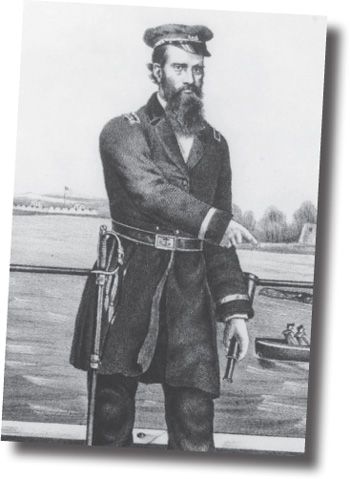
Commodore ANDREW H. FOOTE, who so gallantly led the gunboats in the action at Fort Henry, is a native of Connecticut, and entered the service from that State in 1822. Since that time he has been continually in service, making the whole time of his naval career extend over forty years. He is still, however, full of the fire and vim of youth, and is one of the best specimens of the old sea dogs in America. Over twenty years of his time he has been on ocean service, cruising in almost every sea; ten years he has been on shore duty, and twenty years of his time has been what is designated as unemployed. He received his commission as commander in 1852, and was last at sea in 1858. Since that time he has been on service in the Brooklyn Navy-yard; but about eight months ago was assigned to the duty of superintending the putting up of the great Mississippi flotilla. Commodore FOOTE is known in the navy as one of its most efficient officers, and distinguished himself greatly in China by the bombardment and breaching of a Chinese fort, the fort, in all respect, a superior work of masonry. The feat called forth the praise of all foreign naval officers on that coast. Commodore FOOTE is an affable gentleman, and, as will be seen by his reply to the rebel TILGHMAM, never surrenders.
Capt. PORTER,6 of the gunboat Essex, who is reported as badly scalded by the bursting of his boat’s boiler, is a native of Louisiana, but entered the navy from Massachusetts in 1823. He is a son of the renowned Commodore PORTER, who figured so prominently in the war of 1812. He has been thirty-eight years in the service, and has seen twelve years sea duty, five years shore duty, and the rest of the time unemployed. He was last at sea in 1850, and was then and has been since until recently in command of the sloop St. Marys. His commission as naval commander dates only since 1855. When the Mississippi flotilla was projected, he was detailed to the command of a gunboat. The Captain christened his boat the Essex, after his father’s renowned vessel, and judging from precedent, Capt. PORTER is the “bull-dog,” or fighting man of this expedition. He has Dahlgren guns for his armament, and delights in “shelling.” He worked prodigiously getting his boat ready, and since then he has been cruising round, stirring up the rebels wherever he could find them.
It was the boast of Commodore PERRY that he built some of his vessels on Lake Erie in twenty-six days. Capt. PORTER took the ferryboat New Era, completely stripped her of everything but the framework of her hull, and entirely remodeled, rebuilt, and planked her, strengthened her with additional timbers and knees, caulked her, put in bulkheads, built strong and ample gun-decks, cased her hull with iron plates, in fact, constructed a new vessel, carrying nine heavy guns, and floated her out of her dock in fourteen days. The mechanics tell with considerable zest how, on the fourteenth day, Capt. PORTER, who had been crowding the work night and day, without giving notice, opened the gates of the floating dock, let on the water, and, to the astonishment of the industrious artisans aboard, the craft was in her element.
It is earnestly to be hoped that the gallant Captain will speedily recover, and be ready once more for active duty on his loved element.
The rebel commander of Fort Henry [Tilghman], who was so gallantly captured by our navy boys, is a native of Maryland; entered West Point as a cadet in 1831; was made brevet Second Lieutenant in the First Dragoons in 1836, but shortly after resigned, and became division engineer on the Baltimore and Susquehanna Railroad, and afterward on the Baltimore and Ohio Railroad. In the Mexican war he reentered the service as volunteer Aid-de-Camp to Col. [David] TWIGGS, and was present at the battles of Palo Alto and Resaca de la Palma. He commanded a Volunteer till October, 1846, and in January, 1847, was made Superintendent of the defences of Matamoras; finally he acted as Captain of Volunteer Artillery in [George W.] HUGHES’ regiment from August, 1847, till July, 1848. At the close of the war he again entered civil life, and was chosen principal Assistant Engineer in the Panama Isthmus Railroad. On the breaking out of the war he was acting as railroad engineer, but joined the rebels, and was appointed to command at Fort Henry, where he has been ingloriously captured.
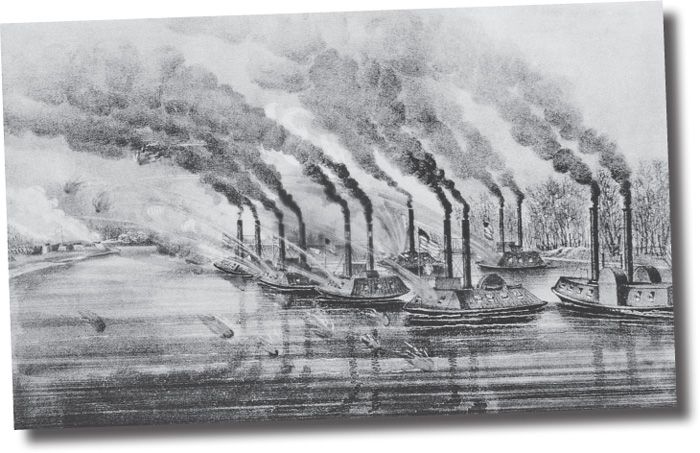
Bombardment of Island Number Ten by federal Flag Officer Andrew H. Foote’s fleet.
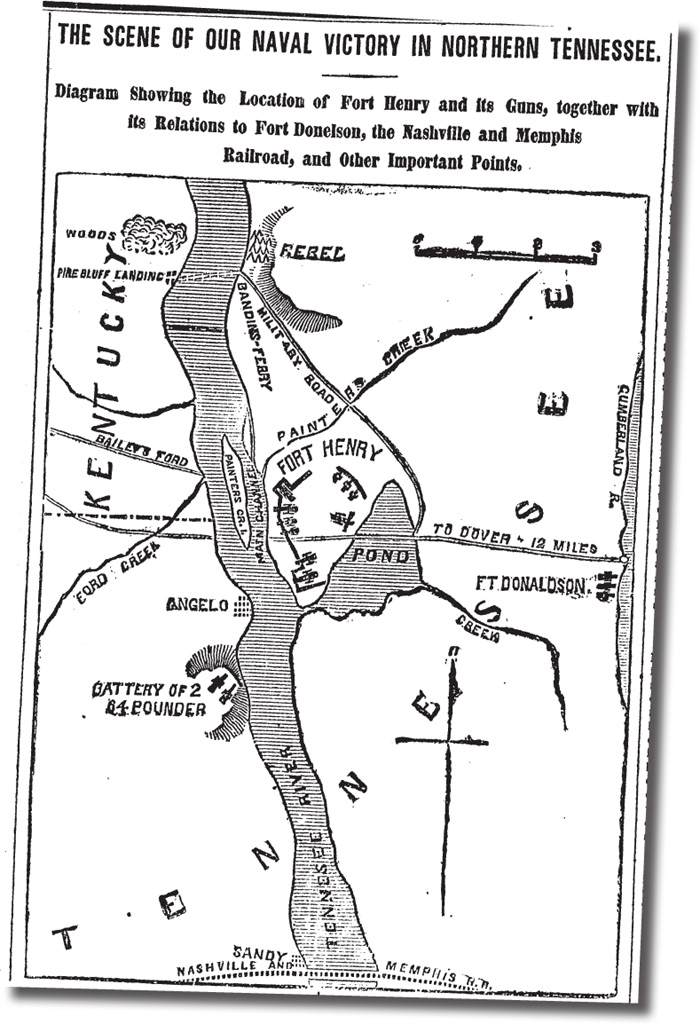
A map published in The New York Times showing the attack on Fort Henry.
1. Major General Henry Wager Halleck (1815–1872) was the Union theater commander in the West.
2. The Times reporter showed great strategic insight in this analysis, for cutting the Memphis and Ohio Railroad just below Fort Henry did indeed compel Albert Sidney Johnston to abandon Bowling Green and retreat southward (see below). Major General Don Carlos Buell (1818–898) commanded the Army of the Ohio.
3. Flag Officer Andrew Hull Foote (1806–1863) commanded the Union naval squadron in the West.
4. This is a reference to the floating Iron Battery anchored off Morris Island during the bombardment of Fort Sumter in April 1861. That battery had an iron shield placed at an angle atop a wooden raft.
5. Lloyd Tilghman (1816–1863) was a former railroad engineer from Maryland. He was later killed at the Battle of Champion Hill in Mississippi.
6. William D. Porter (1809–1864) was the son of Navy Commodore David Porter and the older brother of David Dixon Porter. He was known as “Dirty Bill” for his financial irregularities, for which he was court-martialed in 1855. He was restored to active duty in 1859.
THE TENNESSEE VICTORY AND ITS FRUIT
FEBRUARY 9
The victories of Mill Spring1 and Fort Henry, followed as they have doubtless been by the reduction of Fort Donelson, have cleared both flanks of Gen. BUELL’S army of opposing enemies. The former success, preceded by the dissolution of Humphrey Marshall’s corps, compelled the rebels to evacuate Eastern Kentucky, leaving all the approaches into Eastern Tennessee open to the Unionists. The capture of Fort Henry, if supplemented by the capture of Fort Donelson, exposes both Nashville and Memphis to attack; and will doubtless compel the retirement of [Albert Sidney] JOHNSTON, and the evacuation of Columbus. Indeed, the movements of Gen. GRANT and Flg. Offr. FOOTE are so very energetic, that at any moment we may receive, without astonishment, news that the capital of Tennessee has fallen into their hands. A gunboat squadron is known to have entered the Cumberland, where the water is at the high stage of the Winter months. There is nothing to interrupt its voyage to Nashville. If the land forces could move with equal celerity, the movement would be the work of a day.
The importance of the plans which this portion of Gen. HALLECK’s command is realizing, as subsidiary to the task assigned Gen. BUELL, is not to be overrated. Already the Memphis and Clarksville Railroad is in the possession of our forces. Over this route the army of Gen. JOHNSTON has received the bulk of its supplies and reinforcements since the destruction of the bridge over the Cumberland at Nashville. Merely to have lost this communication would of itself be the worst conceivable omen to the rebel army at Bowling Green; but when the advantage thus secured by the National force is followed up actively by land and water, there will be reason for the utmost consternation in the rebel lines. We may be assured that the first move backwards, or the first attempt to detach a force to cut off the advance of GRANT, will be the signal for a grand attack, before which the insurgent army is in no condition to stand.
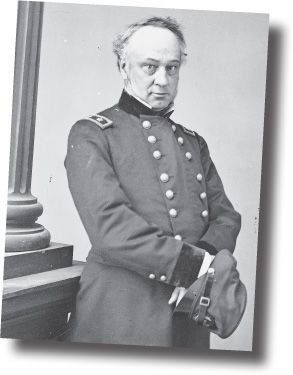
Major General Henry W. Halleck, U.S.A.
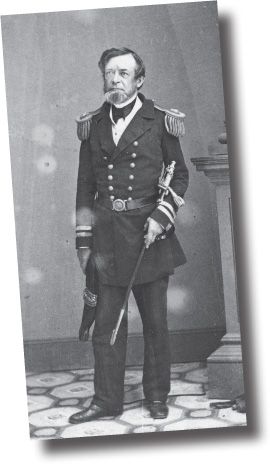
Flag Officer Andrew H. Foote, U.S. navy.
1. The Battle of Mill Springs, in Kentucky, also known as the Battle of Fishing Creek (January 19, 1862), was a Union victory. Confederate Brigadier General Felix Zollicoffer (1812–1862) was killed in the battle, the first Confederate general officer to die in the Western Theater.
THE MERRIMAC AS A TYPE OF THE REBELLION
FEBRUARY 9
The rebel iron-sheathed annihilator, the Merrimac, is reported a total failure. We might suppose that this was given out as a rebel ruse, with the design to throw our naval force on the Potomac off its guard, had not various facts come out in the course of its construction that made it pretty evident it would be a failure. Months ago, on trying the iron-sheathing with columbiads it proved to be almost worthless. It now appears that an enormous error in the calculation of displacement, amounting to two hundred tons, was discovered when the ship was floated off lately, and that she “hogs” and “logs” and is a botch generally. The Norfolk Day Book, while censuring certain Richmond journals for letting out the fact of the Merrimac’s failure, declares it is “an abortion.” Horrors — an abortion! But it is very much such “an abortion” as the rebellion, of which it is a very good type, is beginning to prove. Both have been put forth with the most blustering claims of what they would do — both have been gigantic blunders in construction — and the fizzle of the one is a sure harbinger of the failure of the other.
BURNSIDE AT ROANOKE ISLAND — NORFOLK THREATENED
FEBRUARY 12
We have now news enough from Southern sources to infer that BURNSIDE1 has achieved a complete success, and that the rebels have suffered a severe defeat by land and by water. With Norfolk in a panic, as is reported from Fortress Monroe, we can hardly expect to receive a composed or consistent account of the affair, even if there were the disposition to give it, and we shall probably have to await a dispatch-boat by way of Hatteras for detailed intelligence. For the information that we have, we, in common with other journals, are indebted to the enterprise of the Fortress Monroe correspondent of the Philadelphia Inquirer, and it establishes, beyond a doubt, that Roanoke Island is in the possession of our forces, after a three days’ combat, naval and military, which brilliantly illustrated the resources, the pluck and the valor of both arms of the National service. For, in this victory, the cooperation of the land and sea forces seems to have attained a completeness not reached in any of our former expeditions. Port Royal and Hatteras were exclusively naval victories, but Roanoke called forth and combined the effective qualities of both arms of the service. We have as yet no details of the work done on the island after landing, and only know it was triumphantly done, and that the National Standard was planted over the enemy’s fortifications. But the naval bulletin is certainly as brilliant as one could well desire....
1. Brigadier General Ambrose E. Burnside (1824–1872) led a combined army-navy expedition into the sounds of North Carolina. Though he successfully seized Roanoke Island, a lack of available support prevented his campaign from achieving an important strategic success.
FRED. DOUGLASS ON THE WAR.
AN INTERESTING MEETING AT THE COOPER INSTITUTE.
FEBRUARY 13
A very large audience assembled at the Cooper Institute last evening, on the occasion of the lecture of FRED. DOUGLASS1 on “The War.” A somewhat unusually large number of policemen were visible in all portions of the house, although the necessity for their presence was not apparent....
Mr. DOUGLASS, in commencing, said that at the time he proposed to speak, the victories of Fort Henry and Roanoke Island had not been fought, and even those victories had not removed the somewhat sombre view which he took of the war. This war had developed our patience. (Laughter.) He was not here to find fault with the Government; that was dangerous. (Laughter.) Such as it was, it was our only bulwark, and he was for standing by the Government. (Applause.) He would not find fault with Bull Run, Ball’s Bluff or Big Bethel, but he meant to call attention to the uncertainty, and vascillation and hesitation in grappling with the great question of the war — Slavery. The great question was, “What shall be done with the slaves after they are emancipated?” He appeared as one who had studied Slavery on both sides of Mason and Dixon’s line. He considered himself an American citizen. He was born on the most sacred part of the soil. (Laughter and applause.) There was nothing in the behavior of the colored race in the United States in this crisis, that should prevent him from being proud of being a colored citizen of the United States. (Applause.) They had traitors of all other nations in Fort Lafayette as cold as Stone — (laughter) — but they had no black man charged with disloyalty during this war. Yet, black men were good enough to fight by the side of WASHINGTON and JACKSON, and were not good enough to fight beside MCCLELLAN and HALLECK. (Laughter.) But, he would not complain — he only threw out these hints. (Laughter.) The question was simply whether free institutions and liberty should stand or fall. Any peace without emancipation would be a hollow peace. Even that rhinoceros-hided place, Washington, had by a species of adumbration, come to realize this truth. (Laughter.) What had Slavery done for us, that it had any claim upon us that we should spare it? Tens of thousands of American citizens were now taking their first lessons in Anti-Slavery. He held up in a ludicrous vein the tenderness of many who, like the New-York Herald, would hang a rebel and confiscate all his property — except his slaves. Slavery had kept our army quiet for seven months, and displaced good and loyal men by incompetent and disloyal ones. The question was, What shall be done with the 4,000,000 slaves if emancipated? He might ask what shall be done with the 350,000 slaveholders? His plan was, after the slaves were emancipated to let them alone, do nothing with them. (Laughter.) Let them take care of themselves as others do. (Applause)....
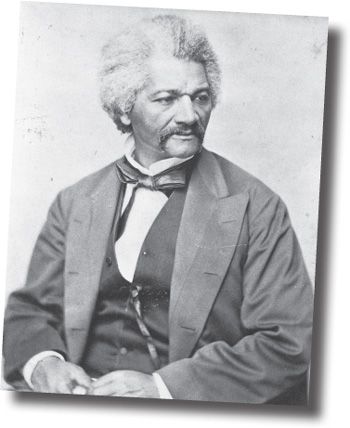
Frederick Douglass.
1. Frederick Douglass (1818–1895) was born a slave in Maryland, escaped to freedom, and became editor of Douglass’ Monthly and an acclaimed orator in support of abolitionism and black rights.
FORT DONELSON ATTACKED.
DESPERATE FIGHTING FOR AN ENTIRE DAY.
FEBRUARY 15
CHICAGO, FRIDAY, FEBRUARY 14
Fort Donelson is invested by our troops. Our lines are formed from right to left and from north to south, nearly surrounding the fort. A heavy cannonading and skirmishing have been going on since 7 o’clock this morning, but, owing to the extent of our line of action, but little can be learned of the result....
FORT DONELSON.
ITS POSITION, ARMAMENT AND STRATEGIC VALUE.
FEBRUARY 17
The news of the capture of Fort Donelson — or at least its virtual capture by the taking of the redoubt commanding the rebel positions that still held out on Saturday — which is announced by telegraph this morning, and the still more important news of the rebel evacuation of Bowling Green, will attract undivided attention to the great military operations now being carried out in the Southwest. To render more clear to everybody the value of these victories, we give the above map, showing not only the important positions which have of late been the scenes of Union triumphs, such as Fort Henry on the Tennessee, Fort Donelson on the Cumberland, Bowling Green on the Big Barren, Mill Springs on the Eastern waters of the Cumberland, and other strategic localities, but showing also the bearing of these points on Columbus and Memphis, on Clarksville and Nashville, on Cumberland Gap and Knoxville, still in rebel hands; and exhibiting, too, the relation of the several places captured, and of those on which our army is now rapidly advancing, to the rebel States immediately south and east of Tennessee, to the Gulf States of Mississippi and Alabama, and to Georgia, North and South Carolina. If the reader will give a few minutes’ study to this little reference-map, to its topography, railroads, rivers and mountains, he will gain a more accurate knowledge of our present military situation in the Southwest, and of the directions and places whence our banners will next be borne, than could possibly be given by verbal descriptions. As the scene of our main operations for some time to come is likely to be within the territory included in this map, those who wish to follow them up intelligently will find it convenient to clip out and preserve for reference.
Fort Donelson, as will be seen, is situated at Dover, Tennessee, on the west bank of the Cumberland River, a few miles south of the northern boundary of the State, and was built last Summer, about the same time as Fort Henry. It is located at a point where the river washes an obtuse angle in its northward course. It is twelve miles southeast of Fort Henry, which was captured just nine days before the present victory. The main object of the fort was to stand as a rear defence to Bowling Green, and also as a defence against our approach to Nashville by the Cumberland River. It was believed by the rebels that it would block up effectually our passage into Tennessee in this direction. Some seven or eight post roads here intersect each other, and the railroad from Bowling Green to Memphis passes but four miles south of it. This same railroad, it will be remembered, was cut a short distance west, at the Tennessee River, by our gunboats, immediately after the fall of Fort Henry, and is now again destroyed at the crossing of the Cumberland. Fort Donelson controls the river as far up as Clarksville, where the rebels may perhaps again make a stand as we advance onward to Nashville. At Clarksville they have fortifications and a pretty strong armament, and lately they had there also a considerable body of troops.
The enemy are supposed to have had three batteries at Fort Donelson — one near the river’s edge, one fifty feet above this, on the high ground, and a third fifty feet above the second; this upper one mounted four 18-pounder guns. Our gunboats first attacked the water battery, but the rebels held back the fire of their upper and strongest work until Commodore FOOTE, with his usual daring, had brought his boats within 400 yards of the fort. He still advanced, however, until he got within 100 yards of it. At 4 o’clock on Saturday this upper redoubt, constituting the right wing of the enemy’s fortification, and which commands the remainder of the rebel works, was taken by our troops, and from it the old flag was flung to the breeze. Of the exact armament of these various works we have not information, but, at the latest date to which our knowledge extends there were mounted some 20 heavy guns, 18, 32, and 64-pounders. It is not to be wondered, placed as these were, that they should have done considerable damage to even such strong boats as compose our iron-plated Western river fleet. And there is no doubt that large additions to the number were within a week made from Bowling Green — as Commodore FOOTE says, in his official dispatch, that in the upper and lower re-doubts alone there were mounted 20 guns.
The number of rebels manning the fortifications was estimated, last Thursday, by our commanders on the field, in the dispatch published last Saturday, as high as 15,000. No further reinforcements could have been thrown in after that time, as our forces then had invested the fort. If Gen. HALLECK’s statement was correct that FLOYD (the thief) was then inside the fort, it is likely that he had taken the division with which he left Bowling Green last Monday, along with him, instead of having taken it to East Tennessee to fight Gen. THOMAS, as was supposed. That division consists of three brigades, one of which was immediately commanded by FLOYD himself, another by HARDEE, and a third by SIMON BOLIVAR BUCKNER. The regiments were from Arkansas, Mississippi, Tennessee, Virginia and Kentucky, and were the flower of the rebel army in the Southwest. The four regiments also which fled from Fort Henry on its capture by Commodore FOOTE, had probably also taken refuge in Fort Donelson. The rebel troops at Clarksville too, could have been easily thrown forward after the fall of Fort Henry. There is no doubt that all the rebel forces that could possibly be spared were there. Up to the 20th of last month, the fort was occupied by only a few companies of Tennesseeans, and so strongly were the rebels there posted that they did not believe we would dare to assail even them. But give the rebels all the reinforcements and the largest number claimed, and there was still an immense preponderance of men on our side — the Union force investing the fort being stated by Gen. HALLECK to be fifty thousand strong. Considering the location of the fort, its defences, and the force manning it, and it will be seen that the rebels could make a severe fight. There are other things beside superior numbers to be taken into consideration in estimating the chances of a battle. The rebels succeeded, too, in disabling the most efficient of our gunboats. But as at the latest hour, the mortar boats were nearly ready to open fire on the positions the rebels still held, in connection with the guns from the commanding position we had captured, and as our brave troops were breast to breast with the rebels, we may at any hour anticipate news of the complete reduction of Fort Donelson.
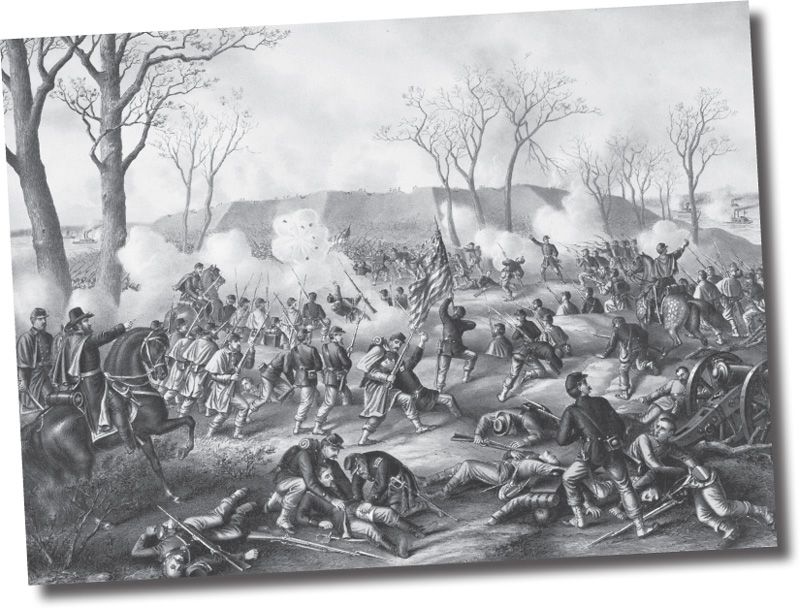
A postwar Kurz and Allison chromolithograph of the Battle of Fort Donelson.
1. The loss of Forts Henry and Donelson allowed Union forces to cut the Memphis and Ohio Railroad that connected Bowling Green (where the Confederate theater commander, Albert Sidney Johnston, made his headquarters) with Memphis. This prompted Johnston to evacuate Bowling Green and fall back, through Nashville, all the way into northern Alabama.
2. A shot from Fort Henry punctured the steam drum on the ironclad USS Essex, scalding ten men and putting her out of the fight.
THE MEANING OF THE IRON GUNBOATS.
FEBRUARY 17
It is not becoming in us, as yet, to be too confident, but we think it may now be fairly said that the iron gunboats have settled the question where the Mississippi River shall belong. Whatever fortune betide the Virginia army, or the rebel States on the Atlantic, the Valley of the Mississippi has now passed over to the control of those to whom, in the natural course, it must belong — the ingenious and hardy population of the West and Northwest. The iron gunboats are merely an exponent of those qualities which have gained the victory — the ingenuity, mechanical skill, perseverance and calm courage of a Northern free people over the ardor and impulse, and want of thoroughness, of a Southern and slaveholding population.
If half a dozen of these gunboats could reduce a strong fort, with 20 guns, in an hour and a quarter, there is certainly nothing from Cairo to the Balize1 which could long withstand thirty of them, with the enormous Pittsburgh mortars, and a hundred thousand men following in transports.
For it must be remembered that in modern days the great difference between the armies of civilized nations is not so much in personal courage as in equipment and discipline. Accordingly, numbers, with artillery and under good drill, must prevail. There is scarcely such a thing in modern warfare as a small army beating, in a long campaign, a large army.... War among civilized peoples, equal in number, is a contest of Science and Wealth. It is true, that in the beginning a people like ours, composed so largely of those engaged in agricultural and mechanical employments, and unaccustomed both to the implements and the passions of war, may receive severe checks from a population much lower in intelligence, but used to weapons, and in the habit of giving loose rein to resentment and passion. But this is a mere matter of loss in the opening of a war. Such a people as ours, hardy, ingenious and naturally bold, as they become accustomed to martial operations and dangers, make the best kind of soldiery. Their invention is incessantly at work; the genius which has won such successes in the arts of peace is now applied constantly to the formation of implements of destruction, or to the combinations of strategy. We are to have enormous floating batteries of iron, which no existing fortifications can resist; mortars throwing their tremendous projectiles, weighing, it is said, thirty tons, for six or eight miles; new weapons will be invented, and all the energy of our untiring and ingenious national improvement will be turned to the shortest and most terrible methods of destruction.
...The iron gunboats which are now deciding the fate of the Valley of the Mississippi, are merely an index of the power which must now henceforth bear down overwhelmingly from the North upon the South. If they had not been invented, something else would have been. The old, steady and patient courage which in all ages has given a Northern people victory over a Southern, is now winning our battles....
1. Balize (or La Balise) was the first French settlement in Louisiana (1699) and was at the very mouth of the Mississippi River.
THE FALL OF FORT DONELSON.
FIFTEEN THOUSAND … PRISONERS
FEBRUARY 18
The following brief telegrams announcing the surrender of Fort Donelson to the land forces under Gen. GRANT, were received in this City, yesterday and appeared in “Extras” and in the afternoon papers.
...Dispatches from Gen. GRANT to Gen. HALLECK announce the surrender of Fort Donelson, with 15,000 prisoners, including Gens. JOHNSTON, BUCKNER and PILLOW.1
Further official advices from Fort Donelson, say that Gen. FLOYD escaped during the night, and the rebels in the fort denounced him as a black-hearted traitor and coward....
1. Though Confederate Brigadier General Simon Bolivar Buckner was captured along with nearly 15,000 Confederate soldiers at Fort Donelson, neither Albert Sidney Johnston nor Gideon Pillow were. Johnston remained at his headquarters in Bowling Green, and Pillow escaped along with John B. Floyd, who handed command of Fort Donelson and most of its garrison to Buckner before taking the last steamboat out of the surrounded fort. The next day, Buckner asked Grant for terms.
CHIVALRY.
FEBRUARY 19
Gen. Buckner, when told by Gen. GRANT that no terms but absolute and immediate surrender would be accepted, replied that, “notwithstanding the brilliant success of the Confederate arms,” he was obliged to “accept the ungenerous and unchivalrous terms” which were proposed. We are ready to make all reasonable allowance for a man who two days before had boasted of the impregnability of his position, and who found himself suffering severe punishment and disastrous defeat; but we must say that this reply of Gen. BUCKNER’s was one of the silliest sentences ever written. Why, the absolute and immediate surrender of that post, and the punishment of those who held it, was the very object of the expedition under Gen. GRANT’s command. It was to attain that end that he planned, and that the brave fellows with him fought, and bled, and died. And when by skill, courage, endurance, suffering and death their prize was within their grasp, what absurdity to expect that they would forego one jot or tittle of it!
And then this talk of chivalry! Good people at the South, understand us plainly, we had enough of this, long ago, and we are now heartily sick of it. Chivalry had its place in the world once, when common sense, and common honesty, and the spirit of Christianity, were more prevalent than they are now. And even now there is in gallantry an element of accomplished manhood which is akin to chivalry. But chivalry has done its work in the world, and is dead and buried. There stalks about a mouthing sham which assumes its name, but it is mostly given to the oppression of the miserable, to getting drunk in the morning, to elaborate and inordinate profanity, to belching tobacco-juice, flourishing bowie-knives, and to shooting “on sight” people with whom it has a misunderstanding....
Finally, let the insurgents understand that we are not sacrificing our brothers by thousands and our money by millions for the sake of having knightly passages at arms with them. We go out to fight them because they are banded together to destroy a beneficent Government, to resist laws which they have helped to make, to set at naught a Constitution which the people whom they assume to represent voluntarily accepted. The President read the riot act to these men last April; and now we are the officers of the law who are putting that act into effect. In so doing, we take the risk of suffering ourselves; but neither reason, nor generosity, nor gallantry lays upon us the obligation of staying our hand short of the absolute submission of the culprits.
SECRETARY STANTON ON THE WAR AND THE CREDIT OF OUR VICTORIES.
FEBRUARY 21
To the Editor of the New-York Tribune:
SIR: I cannot suffer undue merit to be ascribed to my official action. The glory of our recent victories belongs to the gallant officers and soldiers that fought the battles. No share of it belongs to me.
Much has recently been said of military combinations and organizing victory. I hear such phrases with apprehension. They commenced in infidel France with the Italian campaign, and resulted in Waterloo. Who can organize victory? Who can combine the elements of success on the battle-field? We owe our recent victories to the spirit of the Lord, that moved our soldiers to rush into battle, and filled the hearts of our enemies with terror and dismay. The inspiration that conquered in battle was in the hearts of the soldiers and from on high; and wherever there is the same inspiration there will be the same results. Patriotic spirit, with resolute courage in officers and men, is a military combination that never failed.
We may well rejoice at the recent victories, for they teach us that battles are to be won now and by us in the same and only manner that they were ever won by any people, or in any age, since the days of Joshua, by boldly pursuing and striking the foe. What, under the blessings of Providence, I conceive to be the free organization of victory and military combination to end this war, was declared in a few words by Gen. GRANT’s message to Gen. BUCKNER — “I propose to move immediately on your works!”
YOURS, TRULY, EDWIN M. STANTON.
THE NEWS OF THE CAPTURE OF NASHVILLE CONFIRMED.
FEBRUARY 26
Gen. MCCLELLAN received a dispatch an hour since, from the West, confirming the report that Nashville, Tenn., is taken by Gen. Buell’s army, and stating that the rebels have fallen back on Murfreesboro, about thirty miles from Nashville.1
1. Albert Sidney Johnston and his army abandoned Nashville on February 23. Union Major General Don Carlos Buell did not so much capture Nashville as occupy it after the Confederates evacuated.
THE SUPPRESSION OF WAR NEWS.
FEBRUARY 28
The order of the War Department suspending the publication of news of military movements, naturally provokes the comment of the Press. The Press is the ear of the people. It collects and transmits to the popular sensorium all the passing events of the hour. When the newspaper is bidden to silence, the people. . . is bidden to be deaf, and its censure to be dumb. The public has, therefore, its incontestible right to question this curtailment of its privileges of hearing and judging the doings of its servants. The same right belongs to the Press, that immediate servant of the people. The journals, which are looked to as the most prompt and trustworthy reporters of intelligence, maintain their repute for promptitude and accuracy, by untiring enterprise and the lavish outlay of money. At great conjoint expense, they support a system of telegraphic communication which reaches over the entire surface of the loyal section, from ocean to ocean. The NEW-YORK TIMES has its special telegraphic reporters at every point of interest, its correspondents with every division of the army. Our readers are able to judge the results of this extended enterprise. The columns of this paper have furnished the earliest and fullest intelligence of those brilliant actions which, during the last six weeks, have done imperishable honor to the soldiers of the Union, as well as to those who planned and directed their movements, and to those who gave to those movements a necessary impulse. With the entire system, which at a cost hardly less than would suffice to sustain an army, has produced results so satisfactory to the public, the order of the War Department is in conflict, and if correctly interpreted as a permanent war measure, must be fatal to newspaper enterprise. Journals whose arrangements are of the same comprehensive and elaborate character as our own, are, therefore, warranted in scrutinizing this step of the Administration with jealous eyes, and only surrendering their well-ascertained privileges upon thorough conviction that the public is best served by misinformation, and that the duty of the Press is to reverse its mission, and propagate ignorance. The Secretary of War, we doubt not, has given due weight to considerations like these. He has not taken the step unadvisedly. We are impelled to believe that the restriction is a necessary protection to the movements of the utmost importance now making by a portion of the army, which has so long stood inactive; and that its duration will only extend to the time, which may be reached at any moment, when those movements have been crowned with victory. In this light, the order may be submitted to patiently, and even hailed as an omen of that triumph which has been so long awaited, and which is now hopefully expected. In any other light, the very general expression of discontent with which the public has received the regulation, would be well grounded, and would presently require its abrogation.
THE REBELLION.
FEBRUARY 26
The Secretary of War has issued an order announcing: 1. That from and after to-day, the President takes military possession of all telegraph lines; 2. All telegrams relating to military operations, excepting those from the Department and the Generals commanding, are prohibited transmission; 3. Journals publishing military news, unauthorized, are to be punished; 4. Appoints a military supervisor of messages, and a military superintendent of telegraph offices; 5. This order not to interfere with the ordinary operations of said companies....
THE WESTERN SANITARY COMMISSION.
MARCH 2
This body has issued its report for the month of January, 1862, under date of St. Louis, Feb. 10. It has distributed 15,589 different articles, consisting, among other things, of 696 bed comforts, 1,507 towels, 2,328 pairs of socks, etc. The total number of articles distributed to Feb. 1 was 34,604, and since its establishment the Commission has received 525 boxes and barrels of goods from different States and cities, and the sum of $2,276[.] 45 has been received in money, two-thirds of which has been expended. The Commission calls for additional contributions, and asks that all boxes of goods may be directed to JAMES E. YEATMAN, President Western Sanitary Commission, St. Louis, Mo., as heretofore, and the names of the parties sending, and of the place sent from, should be plainly marked on the boxes, that their receipt may be more readily acknowledged.1
1. The Sanitary Commission was founded in 1861 by the Women’s Central Relief Association of New York. A forerunner of the Red Cross, its purpose was to promote clean and healthy conditions in the Union army camps. The Western Sanitary Commission, founded in St. Louis, was independent of the national organization.
ABANDONMENT OF MURFREESBORO BY THE REBELS.
OFFICIAL ANNOUNCEMENT BY GEN. BUELL.
MARCH 3
WASHINGTON, SUNDAY, MARCH 2
Gen. BUELL telegraphed to Gen. McCLELLAN last night that the rebels have abandoned Murfreesboro, and are in full retreat towards the Tennessee River. Crossing this river will place them in Alabama, and free Middle Tennessee of every armed rebel force. Inasmuch as the enemy retreat along a railroad line, tearing up the rails as they pass, it will be difficult for Gen. BUELL to catch them ….
NEWS FROM THE REBEL PAPERS.
MARCH 4
ST. LOUIS, MONDAY, MARCH 3
The Memphis Appeal1 of the 28th ult., has the following:
We have information from Nashville up to noon of Wednesday. Gen. BUELL and Commodore FOOTE arrived and occupied the place. The United States [flag] was raised over the dome of the Capitol, and floats there now. But one Federal flag was exhibited, and that from the shop of a Yankee jeweler, who had long been suspected of disloyalty.
The feeling in Nashville is strongly southern. A deep gloom seemed to cover the community. Citizens avoid intercourse of any kind with the invaders. Two British flags have been raised by the property holders, thus evincing their intention to claim the protection of that Government....
1. The pro-Confederate Memphis Appeal had a curious history during the Civil War. On June 6, 1862, with Union forces closing in on Memphis, the presses and plates were loaded into a boxcar and moved to Grenada, Mississippi. The Appeal later journeyed to Jackson and then Meridian in Mississippi, to Atlanta, and finally to Montgomery, Alabama, where the plates were destroyed on April 6, 1865.
THE FREEDMEN OF THE SOUTH — WHAT SHALL BE DONE WITH THEM?
MARCH 6
Hundreds of thousands of this unfortunate people, and among them many of the most advanced intelligence, in the South, can now be colonized and made free and independent, without any other action on the part of the National Government than the gift of a settlement beyond the limits of our own territory. This can be done now. Hereafter it will be too late, when the Union is restored and the rights of all will stand again on the basis of the Constitution.
To provide a settlement and government for the African race on this Continent, is a duty, which, if promptly performed on the part of the Government, will secure an inestimable blessing to the future of our own country as well as to the cause of humanity and civilization; while it would be an impossible bar to future litigation in the Courts, which will otherwise occupy the attention of the next generation.
To provide a government for the colored population within the limits of any State of this Union is too palpable an infraction of the Constitution to admit of any controversy, whatsoever.
There is no territory belonging to the United States adapted by soil or climate to the African people, and even if this were not the case, the very purpose would be defeated for which the colony would be initiated — the object being to secure freedom forever for these Africans, by putting them beyond the power of molestation by the rebels who have held them as slaves.
Liberia is too remote to meet the exigency of the case, and beside the enormous expense which it would cost the Government, these people would never remove there without compulsion.
Hayti is wholly under European influences, which are intensely hostile to the United States, and will forever remain so, unless at some future day this Government shall extend its jurisdiction over the West India Islands.
The policy of colonizing our African people would be to place them under an influence friendly to this Government, and favorable to their political and social advancement.
Central America presents this field. Its climate soil, and wealth in natural products, preeminently, adapt it to the African — whilst there he would at once be placed upon an entire social and political equality with the native or other resident.1
It must be plain to every statesman that, upon the restoration of the Union, Central America and Mexico will become more and more under the influence of the United States; while England and France, hitherto so potential, will be constantly diminishing in influence over these Powers.
Thus the United States Government is destined to become really the guardian and protector of both Central America and Mexico.
Could we look into the vista of the future, it might be clearly seen that, by the necessary operations of social and natural law, the negro race of this Continent will be the predominating and governing race of all tropical America; and this Government, in settling a colony there to-day, will be but laying the foundation for a vast colored empire....
Thousands of slaveholders in the South would joyfully emancipate their slaves, were a settlement in Central America provided, as it would impose on the owners no further obligation than the actual cost of their transportation.
ANNA ELLA CARROLL2
1. Abraham Lincoln supported the notion of establishing a colony in Central American (in present-day Nicaragua) for emancipated slaves. His notion was that such a colony would provide a safety valve for emancipated slaves who found life in the post-war South intolerable.
2. Anna Ella Carroll (1815–1893) was a Maryland reformer and author who became an unofficial advisor to President Lincoln. Her support of a Central American colony for emancipated slaves may have triggered Lincoln’s effort to establish such a colony.
THE BATTLE OF HAMPTON ROADS.
MARCH 10
For a Sea-piece, that fulfills all the conditions of dramatic art as completely as it is possible for a real event to do, commend us to the recital of the battle of Hampton Roads, which we publish to-day.1 ARISTOTLE himself could not ask a nicer observance of the unities than it displays; and it needs no aid from the playwright’s craft to throw the series of naval actions that took place off Newport’s News, on Saturday, between noon and night, into the form of a dramatic composition, perfect in design and execution, with its beginning, middle and end, and its moral lesson all included.
The scene opens with the sudden appearance in Hampton Roads of that mysterious marine monster, the Merrimac, and two attendant rebel war-dogs. Down they come, belching fire and destruction, and heading straight towards the National fleet that lay at anchor in the Roads. Imagine the thrill of terror that ran through their wooden walls as the terrible mailed monster made his appearance. Such as had steam to aid their flight, hastily rushed, like herring chased by a shark, for the protecting guns of Fortress Monroe; but alas for those that had not! Two fine old sailing frigates lay at anchor off Newport’s News — the Congress and the Cumberland. Into the latter the iron-clad steamer plunged her steel plow, crashing through the frigate’s bow, sinking her instantly, and it is said, carrying down half her crew of five hundred souls. Later accounts diminish this tragic catastrophe to one hundred men. Let us trust that further reports will show this to be still an exaggerated number.2 The other frigate, the Congress, was next attacked in turn, and after pouring in a shower of shot, which rained like pebbles on the mailed sides of the Merrimac, she surrendered. The events which immediately succeed are but obscurely reported in the telegraphic dispatches; but we catch glimpses of a scene that is painfully dark and disastrous.3 The National steamers that had taken to flight on the approach of the Merrimac appear all to have grounded on the way between Newport’s News and Fortress Monroe; and it seems inevitable that the iron-sheathed annihilator shall go on destroying each in turn, and make her way out to sea, to descend in a new destroying avatar on the blockading fleet along the coast.
In the midst of this gloomy scene the exclamation which spontaneously leaps to the lips is, “Where is the Ericsson Battery?” It alone is able to cope with this destructive monster. Sudden as the realizations of a fairy tale the Battery makes her appearance.4 A deus ex machina! one may well exclaim. Here, indeed, is a knight in mail fit to cope with Sir Merrimac. At this most critical and interesting “situation” the telegraph becomes tantalizingly brief; but we learn that the Battery made its appearance late in the evening and put her iron sides between our vessels and the enemy. Yesterday morning the fight began, and the Battery, after engaging the Merrimac and the two rebel gunboats, in a five hours’ action, put them all to flight, the Merrimac slinking off “in a sinking condition.”5The timing of the action is really so nice that it sounds like a romance, and one might well be incredulous, were not our tidings official, and were it not known that the Ericsson Battery sailed from New-York last week for Fortress Monroe, with the express purpose of going up to Norfolk and bearding the monster in his den. Her arrival was certainly in the very nick of time, and the result one which does honor not only to the officers and men, but to the ingenious inventor who shaped the victorious creation of naval art.
And this reminds us that we must not, in the contemplation of the merely aesthetic aspects of the battle of Hampton Roads, lose sight of the practical import of this brilliant affair. The Merrimac is undoubtedly a most formidable engine of war, and previously to the construction of Ericsson’s iron-clad Battery, we had nothing in our navy that could begin to stand before her. The stories of her inefficiency and failure, that the Richmond journals have published at various times, were probably in great measure intended as a mask; the work on her has been done by Northern mechanics, and is no doubt well done. The rebels have thrown their whole resources into her, and, in despair of obtaining a navy of their own, thought to send out an engine of war that would utterly destroy ours. The vision was not altogether baseless. If they had been only a month earlier with the Merrimac, it is hard to set limits to what the might have done. That she would have been able to destroy every vessel in the Roads, brave the batteries of Fortress Monroe and the Rip Raps, and make her way out to sea may now be considered a demonstrated fact. Once out on the rampage, she would play the butt in the crockery-shop with our wooden blockaders; and it is difficult to see what would have prevented her going down the coast like a destroying angel and annihilating our whole fleet. The London Times not long ago threatened to lay the Warrior broadsides of New-York and Hoboken; what was there to hinder the Merrimac’s realizing the threat? One can imagine how the rebel chiefs at Richmond will gnash their teeth over this fatal delay that has dashed their hopes of success on the sea, and put an end forever to their navy.
If the Battery had not arrived in time! — one trembles to look along the line of this contingency. Suffice it to say that it did arrive in time, and that the National cause has had an escape and a triumph whose romantic form stirs the mind with mingled wonder and joy.
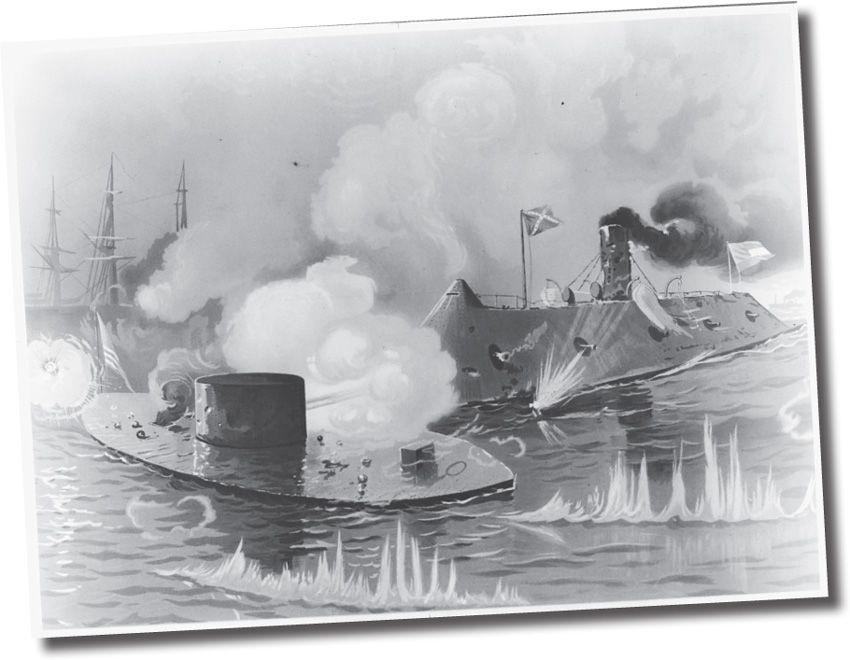
The USS Monitor, left, attacking the CSS Virginia.
1. Often labeled the Battle between the Monitor and Merrimac, this engagement in Hampton Roads, Virginia, on March 9 was the first-ever contest between armored warships. The Southern ironclad Virginia was built on the hull of the former USS Merrimack, which is why Northern papers continued to refer to it as the Merrimac (often spelled without the terminal “k”).
2. Of the Cumberland’s crew of 376, 111 were killed.
3. Despite the surrender of the Congress, soldiers on shore (part of McClellan’s army) continued to fire, which meant the Confederate could not take possession of their prize. In consequence, the Confederate commander Captain Franklin Buchanan ordered the Congress burned by firing hot shot into it.
4. The USS Monitor arrived the same night after the Virginia/Merrimac sank the Cumberland and Congress.
5. The Monitor actually retired from the fight first after commanding officer, John Worden, was wounded. The Merrimac retired after the Monitor returned to the fight, but it was in a sinking condition; it retired because (1) it was running low on both coal and powder, and (2) the resulting loss in weight threatened to expose its wooden lower hull.
THE BATTLES IN HAMPTON ROADS.
SPECIAL DISPATCH FROM WASHINGTON.
MARCH 11
WASHINGTON, MONDAY, MARCH 10
A gentleman who witnessed the naval engagement in Hampton Roads, on Saturday and Sunday, says that only one man was killed by the shelling of Newport News. The fire of our ships had no effect on the Merrimac until the arrival of the Monitor. The Merrimac can do no damage to a vessel or fort, unless within a half mile, on account of the lowness of her guns, which are barely above the level of the water; in a gale she would be powerless.
The report of the Monitor’s guns was much heavier than those of the Merrimac’s.1 Not a man was to be seen on either ship — all being housed.
Our informant says the Merrimac is a “devil,” but the Monitor a little more so: and that unless a gun explodes on the Monitor, she would have the advantage over her adversary....
The Government has no uneasiness about the Merrimac. The Monitor is considered, by naval men to have clearly established her superiority in the conflict of Sunday. The Merrimac cannot escape.
Lieut. [John L.] WORDEN, who handled the Monitor so splendidly, and who was the only man wounded in the engagement, arrived in Washington to-day, and reported to the Navy Department in person. WORDEN is injured about the eyes, which are closely bandaged and he has to be led from place to place. He gives many interesting incidents of the fight, and is quite sure that three of his heavy shot penetrated the Merrimac.2
When the news was received in Washington of the Merrimac’s advance, and the havoc she was committing among our war-vessels, there was a burst of indignation against the Navy Department for not having been prepared to meet her. It was for the moment forgotten that Congress had made no appropriation to enable Secretary [Gideon] WELLES to build iron-plated ships, although he had urged it three months ago, and, if Congress had acted, the iron-plated ships might now be in service.
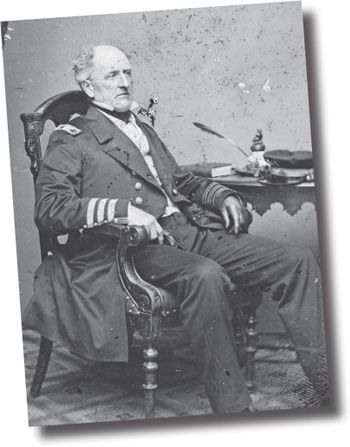
Franklin Buchanan, C.S. navy.
John L. Worden, U.S. navy.
1. The Monitor carried 11-inch guns whereas the largest gun on the Virginia (Merrimac) was a 9-inch smoothbore.
2. After hearing a firsthand account of the Monitor-Virginia fight from Henry A. Wise, Lincoln declared his desire to go see Worden. He made his way across Lafayette Square to Wise’s home, where the temporarily blinded Worden was recuperating and, with tears in his eyes, told Worden that he was being promoted to captain. Worden’s account was incorrect in that no shots from the Monitor actually penetrated the casmate of the Virginia/Merrimac.
THE FUTURE OF SLAVERY.
MARCH 17
What is to be the effect of the war upon Slavery? is a question more easily asked than answered, but one which presents itself continually before the mind of almost every one. And naturally enough. The Slavery question has been so much before the people of late years that not only those who have made a specially of it, but every one at the North has had something to say upon it, and has come to recognize it as the greatest question of all which were devolved upon the American people to settle. And now when from the same quarter of the land whence in past years have arisen political controversies based upon this question, there has come up this tempest of rebellion, having the same source, it would be most extraordinary if we did not ask ourselves what was to be the effect of the war upon its cause; no one can tell this as yet, because it is not yet settled what steps are to be taken against Slavery in the prosecution of the war. If it is long enough and embittered enough by defeats on both sides, to lead our generals to declare the slaves free as a military measure, then, of course, the war will be the utter destruction of the system, bringing it to a sudden and violent end. And there are those who are impatient to have that course pursued, because they earnestly desire the overthrow of the systems and believe that such a sudden and violent destruction is the only way to reach the evil. And there are those, too, who argue, that we shall never establish a firmly cemented Union again, unless Slavery is first utterly overthrown.
But let us suppose that no such measure is adopted; that the rebellion is subdued before it has developed enough latent heat to bring out the force necessary for its adoption, and that without the passage of any act of Congress declaring all slaves of rebels free, without the issuing of any proclamation by any one of our Generals giving freedom to all within his Department, the armed traitors are quelled, and their leaders scattered in flight or in prison, and the authority of the Constitution and laws of the United States again recognized as before throughout rebeldom. Is it not perfectly clear that even in that case, the ruin of Slavery, though not so speedy, is no less certain? What would be the condition of the system if the rebellion were to be overthrown to-day? Over wide tracts of country, which but a few months ago were tilled by slaves alone, now no master’s authority is recognized, no overseer’s lash is authorized by the law. The South has lost more slaves in this one year of rebellion than in any ten years that preceded it. But the loss in those that have run away is as nothing in its effects upon the system compared with the effects of the recognition by the Government as free men of those who remain behind in the Port Royal District and around Fortress Monroe when their rebel masters fled, of the schools set up for these freedmen by Government authority, and the teachers and missionaries provided for them at Government expense. These things cannot be limited in their effect to the districts immediately around them. They will be felt throughout the utmost bounds of Slavery. They will lessen the value, as a slave, of everyone upon whom the yoke of servitude rests. They will lessen the gulf which now for each one of them yawns between a chattel and a man....
THE FIGHT AT ISLAND TEN.
A DISPATCH FROM COMMODORE FOOTE.
MARCH 21
WASHINGTON, THURSDAY, MARCH 20
An official dispatch from Commodore FOOTE, received at 12 o’clock last night at Cairo, and telegraphed hither to-day, says:
“Island No. 10 is harder to conquer than Columbus as the island shores are lined with forts, each fort commanding the one above it. I am gradually approaching the island, but still do not hope for much until the occurrence of certain events, which promise success.” Commodore FOOTE adds:
“We are firing day and night on the rebels, and we gain on them. We are having some of the most beautiful rifle practice ever witnessed. The mortar shells have done fine execution. One shell was landed on their floating battery, and cleared the concern in short metre.”
WASHINGTON, THURSDAY, MARCH 20
The following dispatch has been received here, dated St. Louis, March 20:
“The enemy’s flotilla, which is hemmed in between Commodore FOOTE and Gen. POPE,1 has made another attempt to escape down the river. Their gunboats engaged Gen. POPE’s batteries on the 18th for an hour and a half, but were driven back, with a severe loss. One gunboat was sunk, and several badly damaged. They are completely hemmed in, and can escape only by fighting their way out.”
Between 5 and 6 o’clock P.M., the fleet appeared in sight, and rounding to, landed at Hickman, Ky. The reception was not very cordial, however, although a number of Union ladies appeared at the doors and windows of their dwellings and waved their handkerchiefs, while the men cheered the old flag. The town had been partially deserted. A detachment of rebel cavalry were seen leaving the place as we approached — a portion being visible from the tops of the bluffs. The telegraphic operator “departed” for Union City, on a fiery charger, (taking along his instrument,) but before leaving, took the precaution to notify all Secessia that our fleet had arrived. A portion of his instrument, and a number of dispatches and other papers, left in his office, were appropriated by the soldiers as trophies. It was a grand and thrilling spectacle to see our infantry land and quietly march through Hickman, with the old banner flourish proudly to the breeze, the field band playing “Yankee Doodle,” “Dixie,” and other patriotic airs....
We conversed with a number of citizens, both loyal and rebel. One old gentleman, Mr. FREELEY, introduced to us by Capt. MCMILLAN, of the [ship] Silver Wave, was almost overcome with joy. He hailed the old flag with tremulous and tearful emotion. “Ah!” he says, “you don’t know — can’t imagine — how and what we’ve suffered. But, thank God, there’s the old flag! I knew it would come; yes, I knew it would come!”
The Secessionists were bitter and determined in their denunciation of Lincolnites, yet argued the point mildly. One portly, red-faced, Wigfallish-looking2 institution, asked us, “Which way is your gunboats bound?” “For Memphis and New-Orleans,” was the reply. “When do you expect to get to Memphis?” “Well, I don’t exactly know: some time next week, I suppose.” He replied, “Next week! I’ll just bet you ten dollars (putting his hand in his pocket, and hauling out a Confederate shinplaster) that you don’t get to Memphis for six months! Don’t you know Island 10’s fortified?” “No,” we replied, “Well, I think you’ll find out soon enough to your sorrow.” The majority of the Union people appear to have been badly used, but are in high glee now, and take pains to post Flag-Officer FOOTE relative to the strength of the enemy, and location of rebel batteries. Between Columbus and Hickman many of the people came to the doors of their farm-houses, and out on the river bank, and waved their hats, bonnets and handkerchiefs, as the fleet passed down. While at Hickman, the transport Dan Pollard, from Cairo, joined us, laden with stores for the army and gunboats.
Before leaving Hickman, a bearer a despatches from Cairo brought the intelligence that the rebels had evacuated New-Madrid. Gen. POPE was to have erected a battery of twenty-three 24-pounders at a formidable point below New-Madrid, for the purpose, we suppose, of cutting off the rebels in their retreat, by boats, down the Mississippi.
ISLAND NO. 10.
On Saturday, the 15th inst., at 6 A.M., the expedition left Hickman for Island No. 10 — the weather being cold, and raining, with high winds. Just below the foot of Island No. 8, (twelve miles below Hickman,) the rebel gunboat Grampus, observing our fleet approaching, rounded down from the Kentucky shore in a hurry, being some two miles ahead of the flag-ship Benton — the latter sending a couple of rifled 42-pounders after her both shots falling short. In the meantime the Gram-pus scudded off down the river at her best speed, her steam whistle shrieking and screaming incessantly, in order to warn the rebel batteries below of our approach. At 8 A.M. we were signaled to follow the movements of the flag-ship, when all the gunboats dropped down stern foremost, to a point within one mile of the head of No. 10. Being formed in a line across the river, all headed up stream — the flag-ship several hundred yards in advance, and the furthest down. The fleet dropped down slowly to within half a mile of the Missouri Point above the Island, which by an air line, is 2 1/2 miles distant, while by the river owing to the head, it is four miles from the head of the Island.
While in this position the flag-ship opened fire on the Kentucky shore, two and a half miles above No. 10, discovering an unknown rebel battery — gave it three 70-pound rifled shells, which fell short of the battery half a mile. They responded promptly, their shots not touching to within one mile of us. At 12 M., weather raw and chilly, still floating around in the stream; the flag-ship again tried her guns, but was at too great a distance to reach the enemy. Our decks were all cleared for action. At 2:40 P.M. a couple of mortar-boats3 were got into position on the Missouri shore, half a mile above the Point, when they commenced throwing across or over the point on Island No. 10. Owing to the intervening woods the effect produced was not learned. After throwing three or four shells in that direction, they turned their attention to the rebel battery previously shelled by the Benton. The first two shells falling short, were immediately replied to from the batteries, when, at our next shot — having got the proper elevation — some eight or nine of our shells appeared to land and explode directly amidst and over the enemy’s works. There was not a single gun afterward fired, indicating that their battery was effectually silenced. The distance was fully two miles. With the aid of the glass, several of the mortar shells were seen to explode — one, in particular, striking their earthwork, sending up a column of dirt as high as the tall cottonwood tree-tops.
This battery being silenced, the mortars again turned their attention to Island No. 10, which they continued to shell until dark, but with what success we could not learn.
The Kentucky shore is lined with tents for two miles at the head of Island No. 10. A glimpse of the head of the Island is all that was perceptible through the timber. Seven or eight transports, including the Ohio Belle and John Simonds could be seen occasionally crossing to and from the Island to the Kentucky shore.
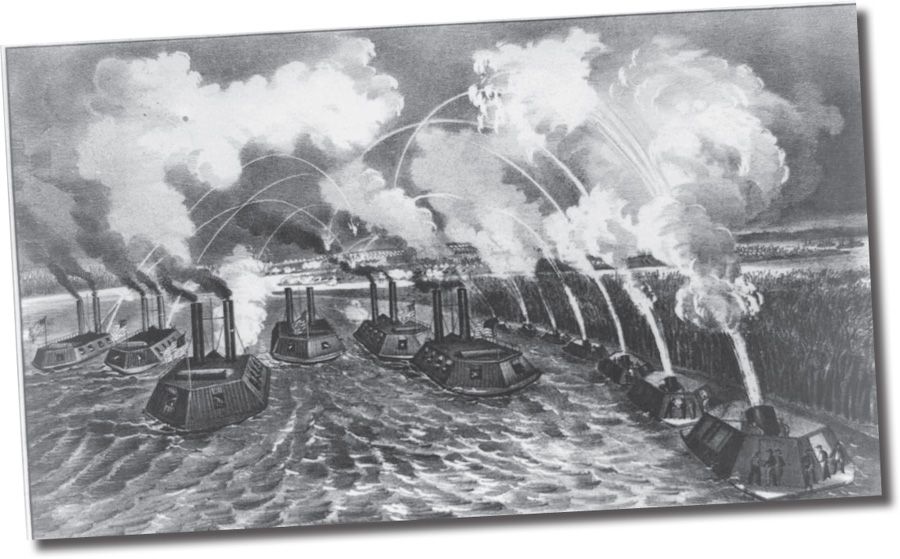
A Currier and Ives lithograph portrays the bombardment of Confederate-held Island Number Ten by Flag Officer Andrew H. Foote’s fleet.
1. Brigadier General John Pope (1822–1892) was the commander of the Union Army of the Mississippi. He captured New Madrid, Missouri, on March 14 but needed the support of Foote’s squadron to get across the river and encircle the Confederate defenders of Island Number Ten.
2. This is a reference to Texas Congressman Louis T. Wigfall, a portly and bewhiskered Southern politician and volunteer general.
3. These were essentially rafts each bearing a heavy 13-inch mortar that fired shells on a high arcing trajectory to targets beyond the range of conventional artillery.
OUR NEW IRON-CLAD NAVY — SUGGESTIONS AND CAUTIONS.
MARCH 21
SIDNEY SMITH1 used to say that if needed a surgical operation to get a joke into a Scotchman’s skull; and, in like wise, it required the terrible surgery of Hampton Roads to arouse the Naval Committee of Congress to the importance of armored ships of war. If, however, our legislators were, previous to the combat between the Merrimac and the Monitor, chargeable with remissness in this respect, we are bound to give them credit for promptly acting on the light which that wonderful and epoch-making event has let into their minds. Senator HALE,2 as Chairman of the Senate Committee on Naval Affairs, has reported a bill appropriating fifteen million dollars for the commencement of an iron-clad navy. The terms of the bill are comprehensive and judicious, and provide for the construction of a steam-ram of five or six thousand tons burden, at a cost of a million of dollars or under, and appropriate $13,000,000 for the building of iron-clad gunboats, $783,000 for the completion of STEVENS’ Battery,3 and $500,000 for extending the facilities of the Washington Navy-yard, so as to roll and forge plates for the armored ships. We trust the bill may pass without any further delay than is necessary to secure the most judicious investment of the money appropriated.4 There is no provision of the bill more important than that contemplating the construction of a mail-clad steam, battering-ram, and this arm of our new navy should receive the very first attention of the Department. The country will never feel secure while the Merrimac and the four other shot-proof batteries which the rebels have nearly ready, (two on the Lower Mississippi and two at Mobile) menace our navy and our seaboard cities with destruction. Now the Steam-Ram is the only engine of naval warfare capable of sinking these vessels with absolute certainty. Admirably as the Monitor behaved, and perfectly as it realized all the ends of its design, its slowness forbids its utilizing the tremendous force of momentum by hurling its weight against the enemy and if it succeeds in sinking the Merrimac and her mates, it will be by picking out the weak places in the hull below the armor, of by the impact of the still untried wrought-iron shot. Not a moment, therefore, should be loss in providing the country with at least one of these tremendous engines, the direct shock of which the hull of no iron-plated vessel can resist.
We are glad to see that the Senate, in proposing for the construction of a ram, has borne in min the two great elements of weight and speed. It is to be “of not lost than 5,000 or 6,000 tons burden, and of great swiftness and strength,” and if constructed in accordance with these conditions, it will undoubtedly be an engine of warfare against which no iron-plated vessel, battery, or ram in the world, either built or being built, can cope. The British steam-ram, the Defence, which, like the Warrior, may be considered the pioneer of her class, and which has just made her official trial of speed at Portsmouth, England, is only of 3,668 tons, which is not much over half the burden of our proposed ram. Moreover, her mean speed was but a fraction over eleven knots per hour; whereas the Stevens Battery will make more than nineteen knots per hour: so that either the ram or the battery would be able to sink the Defence itself, if Iron should meet Iron in the shock of war.
If we once had provision made for our present safety and for the destruction of the rebel iron-plated floating batteries — which we should consider done were the Pain, a brace of Monitors, and the three iron-clad gunboats now in process of construction, completed -we could almost wish that we should pause awhile before going any further — at least that we should await the results of the experiments that will be made with these, before spending many more millions. It is our National temperament to “put things through,” and rush to an extreme, and there is just a danger that the mania for iron-clad vessels may cost us dearly.5 We shall consider, for example, that every dollar expended in the construction of such plated eggshells as the Galena (built at Mystic, Conn., and now being completed at Greenpoint,) is so much money thrown away. The action of the Monitor and Merrimac has already taught us a great deal, of which we shall avail ourselves, and impending naval developments will no doubt touch us a great deal more. It may, further, be mentioned that a series of experiments with regard to the backing and joining of the plates has just been initiated at Shearness, England, which will, in a large measure, determine the future of iron-plated vessels.
Of course the first thing is to provide for our immediate needs; and all questions of form, material or structure, however important in themselves, are, and should be, subordinate to the supreme question of putting afloat, at the earliest moment, armed engines of naval warfare enough to send to the bottom all the devices of the enemy. But that done, let us bear in mind that we have large and prospective needs as well as present demands; and that it is the plain dictate of prudence to avail ourselves of all the experiments, on both sides of the Atlantic, that tend to throw light on these novel and still obscure, though overwhelmingly important questions. One thing is certain, we are bound to have an iron-clad navy that will defy those of the most powerful European nations. Already, at one leap, we have taught the world more than all it before knew respecting this new warlike enginery. The country is opulent with creative genius and engineering skill. This genius and skill will now largely take the direction of iron-clad vessels. Let us, therefore, not sink money in building structures which the rapid strides in the science may soon render obsolete.
1. A reference to British Admiral Sir Sidney Smith (1764–1840), a dashing hero of the Napoleonic wars.
2. New Hampshire Senator John P. Hale (1806–1873) chaired the Senate Naval Affairs Committee. He was a critic of Gideon Welles, with whom he quarreled for most of the war.
3. The Stevens Battery had been laid down in the 1840s as an iron-armored warship, but was never completed. By the time of the Civil War, technology had advanced so far as to make its design obsolete. Though the navy ended up spending a half million dollars on it, it was never commissioned as a warship.
4. Despite The Times’ enthusiasm for it, it proved an expensive failure.
5. The Times was correct. A so-called “Monitor fever” swept the north leading to appropriations for no fewer than 64 Monitor type ironclads before the war was over.