
CHAPTER 6

Detail of the cover of sheet music devoted to Major General George B. McClellan.
After the demoralizing Union defeat at Manassas, the Lincoln administration entered the fall of 1861 determined to save the federal capital and reorganize the army — and not altogether certain it could accomplish either goal.
Inertia followed on the heels of humiliation. The Times likened the Union’s new commanding general’s vast army to that of Louis XIV. But it was to another Frenchman that George B. McClellan would more often be compared: he was breathlessly greeted as the “Young Napoleon.”
Unlike the original, however, “Little Mac” showed no immediate determination to invade. However frustrated, as The Times reported, Lincoln would not yet entertain the notion of deploying one major weapon at his disposal: emancipation. A move to liberate would score points with Northern progressives, but Lincoln believed it would anger pro-war Democrats, particularly in the loyal border states of the South, who were willing to fight to restore the Union, but not to free slaves. Lincoln would do nothing yet to upset his fragile coalition. The Times both reported and supported this wait-and-see position.
Of immediate concern, the President concluded he must strengthen Union command in the west. Though enormously popular with liberal politicians, General John C. Frémont, the Republican Party’s first presidential candidate (in 1856) was proving himself ineffective in the field. Defying a vocal pro-Frémont claque, Lincoln replaced him with Major General David Hunter in early November, stirring much controversy. The administration was not averse to using either so-called political generals like Frémont, or ethnic generals like Franz Sigel (who was even more inept in battle). The Times could be critical of such commissions, but not, of course, when New York’s own Irish brigade marched off to war under the command of Colonel Thomas Francis Meagher. Then the paper all but burst with pride.
Desperate for victories, even small ones, the Union celebrated minor successes on the sea as well as on land. In November, a federal flotilla bombarded Confederate forts around Hilton Head Island, South Carolina, after which Union troops occupied Port Royal, an important anchorage between Charleston and Savannah. The Times reprinted the blunt warnings issued to South Carolina by General Sherman — not the more famous one, but Thomas W. Sherman, one of the heroes of the federal invasion force. Out west, a little-known brigadier general named Ulysses S. Grant captured the river town of Belmont, Missouri. This news was enough to invite cautious optimism in the North.
There was a cost attached to these minor successes. The wide circulation of paper currency and the suspension of specie payments worried fiscally conservative Northerners. And to the horror of many, early in the year Congress began debate on a 3 percent income tax (5 percent for incomes greater than $10,000) to pay for the war. Not until 1863 would a desperate Confederacy violate its own principles of state rights and limited government and impose an income tax levy, too.
The year 1861 ended with a diplomatic crisis that nearly catapulted the Union to the brink of a potentially catastrophic war with England. It began in November, as The Times reported, when the USS San Jacinto, commanded by the mercurial Charles Wilkes, confronted the British mail packet Trent in the Old Bahama Channel, seizing two Confederate emissaries headed to London and Paris, respectively: James M. Mason and John Slidell. Arousing an instant international uproar, the “Trent Affair” dominated the press for the next two months, as Richmond and London alike charged the Lincoln administration with violating international law. Parliament lobbed threats of retaliation against Washington. Seeing no way to end the crisis without capitulating, the President ordered the diplomats’ release in late December. By then, much of the public enthusiasm for Wilkes had dissipated, though administration enemies nevertheless cited the capitulation to Britain as a national humiliation.
APPOINTMENT OF GENERAL MCCLELLAN AS COMMANDER-IN-CHIEF.
NOVEMBER 8
GEORGE B. McCLELLAN is Commander-in-Chief of the Armies of the United States! This important step was taken, to-day, in Cabinet Council. The young General finds himself at the head of a force as numerous as that of Rome in her palmiest days, and not since equaled except by a monarch of the last century — LOUIS XIV — until we descend to the wars of NAPOLEON. What changes have nine centuries introduced in the mode of warfare. How different our weapons from those of the Legions who fought under CAESAR, or defended the throne of the Antonies. The open helmet, the lofty crest, the breast-plate of mail, the greaves for the legs and the buckler for the arms, would be useless defences to the modern soldier; while, for aggressive warfare, the pilum and sword bear no comparison to the cannon and rifle, in death dealing properties. With such an army Rome extended and maintained her sway from the Western Ocean to the Euphrates, embracing the fairest portion of the earth, and peopled by one hundred millions of souls. Our own army, inspired with valor, improved by discipline and commanded by officers of education, will be found adequate to suppress domestic treason, as well as to repel foreign invasion. May they never lay down their arms until the Government is restored in all of its purity and integrity. May our young General prove a fit leader for such an army. Amid disheartening incapacity, may he be alive to his own glory and the regeneration of his country. Modest and simple in his habits, he has thus far yielded, through a spirit of discipline, to those superior in station, whose counsels might become fatal to the Republic. Six months ago a private citizen, to day he finds himself vested with almost supreme power. May he use that power with moderation, and with a single view to his country’s good. Above all, may he not become ensnared in political intrigues, or inspired with political ambition.
Gen. [Winfield] SCOTT this day retires with the best wishes of his countrymen. Two generations have been witnesses of the services which have made his name illustrious. It was to his firmness and that of the little band that surrounded him on the 4th of March last, that we owe the preservation of the Capital. Since then, incessant labor has pressed heavily upon his declining frame, and he himself has felt that that power which he has wielded so long and so well, must be transferred to a successor, so soon as one worthy of it could be found. To-morrow he will be escorted by his own staff and by Gen. MCCLELLAN and staff to the cars, on his way to New-York, where a cordial reception will await him. Peace to his declining years.
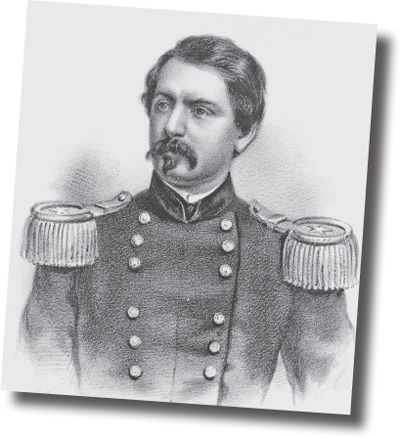
Major General George B. McClellan, U.S.A.
MOVEMENTS OF THE ARMY.
NOVEMBER 8
To the Editor of the New-York Times:
In your paper of to-day you manifest impatience in regard to the movement of the army of the Potomac, and you cannot brook the idea of going into Winter quarters without a decisive battle with the enemy. As a constant reader of the TIMES, and one who has generally approved its course, I cannot but regret this feeling on your part. It may do wrong in two ways — first, by giving erroneous views to your numerous readers; secondly, by its tendency to urge the army into conflict before it is ready. From the commencement of this war I have urged upon the powers at Washington not to move against the enemy until they had a well-disciplined and overwhelming force. Had such counsels prevailed, we should never have heard of the disastrous result at Bull Run, but, in due time, our arms would have been crowned with victory. The urgency of editors and the clamor of politicians overruled the judgment of military men, and the consequences followed as they anticipated. The injurious effect, both at home and abroad, we have all seen and felt. We are just beginning to recover from it. But now an effort is again being made to supersede the judgment of military commanders, and substitute for it the feelings, and wishes, and anxieties of those who are incapable of judging, because they have not the information from which to draw proper conclusions. After the Bull Run affair it seemed to be conceded that, in future, military matters should be left to military men. There I am content to leave them. Individuals may make suggestions, but the decision must be left to those to whom it properly belongs.
In the recent affair at Ball’s Bluff, there was either a misapprehension or a military blunder. We are again defeated by a superior force. This is generally the case. Why is this? Why are the rebels permitted to have this advantage over us? If we cannot outnumber them, we should, at least, be equal to them. It is true, our men behave gallantly and fight bravely, But the enemy has the prestige of victory! If the enemy will meet us in the open field, man to man, I will guarantee a victory to our aims in any conflict in which he may see fit to engage. But the rebel will not, and dare not, do this. They always retire before an equal or superior force, and wait till their own force is overwhelming. Fas est, et ab hoste doceri,1 is an old maxim, and it is not too late for us to act upon it. The recent disaster, for aught I know, may have been occasioned by an outside pressure — a desire to satisfy supposed public expectation, without being prepared for each an emergency....
N.P.TALLMADGE.
CORNWALL, N.Y.
1. Latin: “It is right to be taught, even by an enemy.”
THE SLAVERY QUESTION — NECESSITY FOR SOME UNIFORM POLICY
NOVEMBER 9
How to deal with slaves in the Southern States must speedily become a practical question, and the sooner the better. Hitherto it has been mainly a theme for speculation. Every man has had his theory about it, and has been urgent for its immediate adoption. The Government has shown a disposition, very natural and proper, to postpone the subject as long as possible, and especially to leave it to the control of Congress. The landing of troops upon the Southern coast, however, in the very midst of the densest slave population, and in the heart of the Cotton region, where the treatment of slaves is the most severe, and their desire to escape the strongest, will compel prompt and decisive action on the subject.
Beaufort District, at the head of Port Royal harbor, contains 38,805 inhabitants, of whom 32,279 are slaves, the slaves thus outnumbering the whites in the proportion of more than five to one. They are mainly employed upon large cotton plantations, are severely worked, given to insurrectionary schemes, and more intelligent than the corresponding class in Alabama and Mississippi. There can be no doubt that thousands of them will flock into the National camp, with the expectation of protection under the National flag.
It has been stated that in certain parts of Tennessee the slaves are drilled and equipped as soldiers for service in the field. In South Carolina, where they so largely outnumber the whites, no such rash experiment will be hazarded. The masters there will be very careful about putting arms in their hands. If any such step should be taken – if our troops should meet regiments of slaves in the field against them, or employed in any way in actively aiding the rebellion — our commander would be perfectly justified in offering them freedom on condition of surrender. As a military act, he certainly would have quite as much right to free them as to kill them, and it would be for him to decide which of the two would best promote the success of his military operations. But it is not likely that the question will be presented to him in any such shape. The slaves are not likely to be employed as rebel soldiers. They will either remain on their plantations, or come into camp in search of freedom. If they are entirely passive, Gen. SHERMAN will probably not interfere with their condition. He could scarcely appeal to them to rise against their masters, or offer them freedom as an inducement to come into our camps. His instructions on this subject, issued by Secretary CAMERON, state that he is to “avail himself of the services of any persons, whether fugitives from labor or not, who may offer than to the National Government;” assuring the loyal masters “that Congress will provide just compensation to them for the loss of the services of the persons so employed.” This limits his action to the specific cases of those who may offer their services to the Government; — though the mere fact of coming into camp will doubtless be regarded as such an offer. What is to be done with them afterwards, whether they are to be returned to their masters, compensation being merely for their services while thus employed, — or whether they are to be set free and paid for in full, the letter of instructions does not state. If they belong to rebel masters, the manner of dealing with them, beyond setting them to work, is not specified.
A paragraph in one of our exchanges, a few days since, stated that in Western Virginia many fugitives were arriving in the camp of Gen. KELLEY,1 who put them in confinement, “awaiting the claim of their masters.” By what authority Gen. KELLEY pursues this course we arc not aware. He has no commission, we presume, to act as slave-catcher for Southern slaveholders, nor to imprison any man whom he may suffer to enter his camp, on suspicion of belonging to somebody else. It is no part of his duty to enforce the local laws of the States he may invade, — nor to arrest and detain persons whom he may suspect of trying to escape from their operation. He may refuse to permit a slave to come within his lines, — but if he does permit it, he must treat him as a person simply, — and precisely as he would treat any other person to whom he may accord a similar privilege. He has no means of knowing whether he “owes service or labor,” — any more than whether he owes money, to any other person or not: — nor has he any more right to inquire. That is a matter which belongs wholly to the local, civil tribunals of the State: and it should be left solely and exclusively to their jurisdiction. If they are suspended or nullified by the rebellion, so much the worse for the rebels; — but it is their own act, and they must hear both the penalty and the responsibility.
Gen. LANE,2 of Kansas, gave a clearer definition of the duty of the Government in this matter than we have met elsewhere. He said it was to “put down rebellion, and let Slavery take care of itself.” This is the simplest solution of the whole problem — at least in the present stage of the war. Our Generals have nothing to do with Slavery; they are under no necessity of recognizing its existence. If men, black or white, anywhere tender their services, let them be employed, if needed, if not, let them go their way. If they choose to travel Northward, no General has any right to interrupt them. If they wish to remain in camp, it is for the General to decide whether they can be accommodated or not, and to act accordingly. But he has no right to return them, or to detain them, as fugitives. If he can make them prisoners at all, it can only be as prisoners of war, or as suspected spies, or as persons who have come improperly within his lines. And any man who comes to claim them at his slaves is equally liable to the same arrest, and upon precisely the same grounds.
We have been and still are opposed to the adoption by the Government, under existing circumstances, of any general policy of emancipation, — either as the object of this war, or as a means of carrying it on. We do not believe such a policy either necessary, wise or feasible in the present condition of affairs. But the Government should adopt some general rule in regard to the action of our Commanders in their several Departments. That action ought to be uniform and explicitly understood. And whatever else may be done or left undone, our camps should not be degraded into slave-pens, nor our armies sent South to act as constables for the seizure of fugitive slaves.
1. Benjamin Franklin Kelley (1807–1883).
2. James H. Lane (1814–1866, a suicide), a Republican senator who raised a Kansas regiment in anticipation of a Confederate invasion from Missouri.
MITTENS FOR SOLDIERS.
NOVEMBER 8
To the Editor of the New-York Times:
As you recommend the employment of “nimble patriotic fingers” in making mittens or gloves for the army, I would suggest that the mittens be made with a first finger as well as thumb. It is quite difficult to pull a trigger with a mitten of the usual shape, and the finger could be used or not as required. Mittens are much warmer than gloves, for the same reason that four children would be warmer in one bed than sleeping alone.
VERY RESPECTFULLY, A PHYSICIAN.
IMPORTANT IF TRUE.
NOVEMBER 8
The Independent of this week has the following paragraph:
“Just as we are going to press, we receive a most important piece of information from a reliable source. It is nothing less than the expressed conviction of Mr. Seward that the Government cannot succeed in this war; that the Confederacy will probably be recognized by the European Powers; and that peace will be the result in sixty days. In view of this, Mr. THURLOW WEED1 has been sent to England, and if he shall find the British Ministry determined to recognize the Confederacy, the Administration here will prepare at once for peace.”
The fact that Mr. SEWARD has selected the Independent as the special organ of the State Department, for the publication of the laws of the United States, may give this paragraph more apparent importance than it deserves. We do not believe there is a particle of truth in it, or the slightest foundation for it. Mr. SEWARD expresses uniformly in conversation, and in all his communications with the public, precisely the opposite conviction from that which he is here said to entertain. He believes that the Government can succeed in the present war, and that its prospects of speedy and decided success were never brighter than at this moment. He has no fear, moreover, that the Confederacy will be recognized by any leading foreign Power, nor would such a recognition change in the least the determination of the Government to crush the rebellion. The Independent has been very grossly misled into making a very serious imputation upon the Secretary of State. We venture to predict that when his correspondence with our Minister in England shall come to be published, it will indicate anything but a purpose of being governed by the action of Great Britain in the course to be pursued by our Government. If England were to recognize the Southern Confederacy to-morrow, the war would be not an hour nearer its end than it is now.
1. Thurlow Weed (1797–1882), an Albany, New York, publisher (Albany Evening Journal) and Republican political leader, was Seward’s chief political advisor.
STORY OF AN EXCHANGED PRISONER.
NOVEMBER 10
FROM THE LOUISVILLE JOURNAL, NOV. 5.
We have had an interview with Mr. P. H. LIPPERT, of the Twenty-fourth Illinois Regiment, who was taken prisoner some months ago, about twenty miles from Centerville, Mo., while acting as a messenger bearing dispatches. He was arrested by rebel Missourians and placed under charge of Gen. HARDEE’s1 command in the southeastern part of the State, where he was exposed to great privations and sufferings. In company with twenty other Union prisoners he was lodged in a horse-thief jail at Bloomfield, for nearly a month. This place was an apartment 16 by 18 feet in dimensions, and 7 feet high, with two air holes on two sides. In this cage the twenty were cooped during the hottest weather, without any effort being made to remove their excrement, which of course produced the foulest stench. Their food was dough and water, and even that in insufficient quantities, and they were never once taken into the fresh air, which produced great sickness. While there three Union men were hung, and five shot, because they refused to take the oath. These villainies were committed by Capt. [Robert M.] WHITE and his Texan Rangers. From Bloomfield, Mr. LAPPERT was taken to New-Madrid for a few days, during which he received no food at all, and was nearly starved; thence he was transferred to Columbus, with seven prisoners from Cape Girardeau, and placed at work on the fortifications; and they were so engaged, being driven to the works in gangs, like slaves, at the time of the engagement between the batteries and the Union gunboats, exposed to all the fire and bursting shells, but providentially none were injured. They were by this time greatly in need of clothes and blankets, and their wants were contumeliously neglected....
1. Confederate General William J. Hardee (1815-1873), a native of Georgia.
DYING STRUGGLES OF THE SLAVE TRADE.
NOVEMBER 11
The vigorous measures set on foot by the new Administration, for the suppression of the slave-trade, have already succeeded in reducing that infamous traffic to its last extremity. It was one of the first points to which Mr. LINCOLN and Mr. SEWARD gave their attention, and they have followed it up with vigor and success. The meeting of the United States Marshals, some weeks since, did a great deal to infuse vigor and harmony into their action, and the conviction last week of Captain GORDON,1 will satisfy the parties who have hitherto grown rich on the profits of this nefarious trade, that the law is no longer to be a dead letter.
We believe there is now not a single port in the United States from which a slaver can be fated out. The attempt has been made at nearly every port from Bangor to Baltimore, and in every instance the design has been detected and defeated. One or two vessels have recently left this port for Portuguese ports with legitimate cargoes, but with the well-understood purpose of refitting there and going to the coast of Africa. Through the vigilance of Marshal MURRAY, however, our Government has made full representations to our Consuls at the ports in question, and the vessels will he sharply watched from the moment of their arrival. Secretary SEWARD has also informed the British Government that, since the slavers have been driven out of the United States, some of them have resorted to Liverpool for the purpose of securing outfits. He has sent full descriptions of the vessels implicated, and so pressed the matter upon the attention of the British authorities that they cannot avoid prompt and effective action. Within a few days a person resident in this City, extensively engaged in the traffic, becoming alarmed at the vigor with which these prosecutions are pressed, has fled to Canada. Some others will probably find it expedient ere long to follow his example.
1. Captain Nathaniel Gordon (1826–1862) was convicted as a slave trader in November 1860 and sentenced to death. Lincoln refused to stay his execution.
GENERAL MCCLELLAN’S PROGRAMME.
NOVEMBER 10
CORRESPONDENCE OF THE PHILADELPHIA PRESS.
WASHINGTON, WEDNESDAY, NOV. 6, 1861.
Gen. MCCLELLAN heartily approves the proposition for an exchange of prisoners. This has been his sentiment from the start and I believe the majority of the Cabinet have always taken the same side. Gen. McCLELLAN’S views are sustained by his confidential friend, the distinguished Ex-Attorney-General, EDWIN M. STANTON, who, notwithstanding his connection with the Buchanan Administration, now maintains, as during his association with that Administration, the most decided and uncompromising Union doctrines. He declares that “the principle of an exchange of prisoners is demanded by the highest considerations of policy and humanity.” I have, therefore, no doubt that some arrangement will be made, in a very short time, by which our absent and beloved fellow-citezens in the Southern prisons may be restored to their families and friends. The reasons for refusing such an arrangement have passed away. The highest considerations require that the health and lives of our captured fellow-soldiers should alone be taken into view. Etiquette and diplomatic forms have too long impeded the consummation of this important arrangement.
So much has, been said of the safety of Washington, and many complaints have come from the Western Department, that a sufficient number of troops had been, concentrated at this point, that a few words upon the probable programme of Gen. MCCLELLAN may not be inopportune. Now that he is clothed with supreme power, and a thousand ardent expectations are indulged that he may win a conclusive victory, it is well to state that he has never faltered in the belief that it was his first duty to see that the National capital was put in a position of impregnable defence, and that no movement should be made until this was entirely settled. Previous to the ill-fated reconnoissance at Bell’s Bluff, a large number of troops were taken from his military district, and sent to other points, Had that reconnoissance been crowned by the seizure of Leesburgh — had MCCALL been enabled to effect a junction with STONE and BAKER — vast advantage would have been secured, and the facilities for a forward movement immeasurably increased. The failure of that reconnoissance has necessitated new delays.
You will perceive that the Secessionists in Maryland are held down only by the strong hand. The proclamation of Gen. DIX,1 admonishing all persons of secession proclivities against interfering with, or exercising the right of suffrage at the election to-day, show the absolute necessity of maintaining a large force of United States soldiers in Maryland, and proves, also, the persevering purpose of the traitors now in Virginia to take possession of this Capital if they can. Within the last ten days Gen. MCCLELLAN’s column has been greatly augmented by accessions from the reserves of the different States, but it must be recollected that a large force has been thrown — some estimate the number at twenty thousand — opposite the rebel batteries on the Potomac, and that the late offensive demonstrations in Maryland will compel an increase of the forces under Gen. DIX in that quarter. Gen. MCCLELLAN cannot, therefore, advance until every position in his rear is thoroughly and impregnably fortified, nor should he attempt to attack without such a force as will render defeat impossible. Meanwhile the late news from Western Virginia indicates that our armies are triumphant, and unless the removal of Gen. FREMONT has entirely demoralized the army of Missouri, we ought to expect a victory in that State.
I recur to these points to show that the programme of Gen. MCCLELLAN has been wise from the first, and especially to convince that large class of critics who have been complaining that too much attention has been given to the protection of the Capital that all their censures have been unjust. On or about the 10th of November you may look for a forward movement. I am sure that if it is made, unless the rebels retreat before our advancing troops, there will be a complete and annihilating victory.
1. John Adams Dix (1798–1879)
RETIREMENT OF GENERAL FREMONT.
NOVEMBER 11
SPRINGFIELD, MO., MONDAY, NOV. 4, 1861.
We have had stirring times here yesterday and today. Late on Saturday night, one of three messengers sent forward by Col. LEONARD SWETT,1 from St. Louis, succeeded in eluding the vigilance of the guards stationed to prevent access to Gen. FREMONT’S2Headquarters, and served on the General personally the orders from Washington turning over the command of the Western Department to Maj.-Gen. DAVID HUNTER.3
Upon this there was, of course, unutterable consternation and commotion in and around headquarters, and it appeared doubtful for several hours what course Gen. FREMONT would pursue. Many of his leading personal adherents, chiefly of the Teutonic stripe, were in favor of disregarding the removal and refusing to recognize Gen. HUNTER’s appointment — a course which, if they had persisted in it, (and it was not wholly abandoned until late last evening,) would have caused a very considerable row — for Gen. HUNTER is not the sort of man it would be safe to trifle with.
In the end, however, wiser counsels prevailed, — Gens. SIGEL and ASBOTH4 both refusing to countenance or be concerned in the mutiny; and Gen. FREMONT, it must be said, either not knowing anything of the contemplated movements, or opposing them, as in duty bound, with all his force. On this point, however, we are in the dark. Certain only it is that a council now known as the “Council of Insubordination” was held last evening only a few hours before Gen. HUNTER’s arrival; that regular invitations to it had been issued, and that the affair looked very threatening until suppressed by the emphatic course of Gen. SIGEL. Early yesterday morning, therefore, Gen. FREMONT issued his farewell address to the “Soldiers of the Mississippi Army,” — though to say why “Mississippi Army” and not “Western Department,” might well puzzle a Philadelphia lawyer to explain. Here is the document, neatly printed as you see and placed in the hands of all the soldiers in the army....
1. “Of all living men,” a contemporary once asserted, “Leonard Swett [1825–1899] was the one most trusted by Abraham Lincoln. Swett had been his legal colleague in Illinois for years, and carried the title of “colonel” from his Mexican War service.
2. Major General John C. Frémont (1813–1890).
3. David Hunter (1802–886) had been corresponding with then President-elect Lincoln since the fall of 1860 and rose quickly in the ranks once war broke out.
4. German-born Franz Sigel (1824–1902) and Hungarian native Alexander Asboth (1810–1868) were among the many “ethnic generals” commissioned by the Union early in the war to rally support from foreign-born Northerners. After the war, Sigel became a journalist and politician, Asboth a diplomat.
MILITARY CRITICISMS OF THE NEWSPAPER PRESS.
NOVEMBER 12
It has been the fashion of very foolish people to speak disrespectfully of the military suggestions of newspapers. It has rather come to be considered the thing to warn the Government against listening to the mere wild and unskillful speculation of writers, whose knowledge must necessarily spring from other sources than the lessons of experience; and invite it to throw itself wholly upon that sounder understanding of martial affairs, which comes from active and successful action on flood and field. Clamor of this description, which, unhappily, had an apparent warrant in the disaster upon which undue precipitancy urged the army on the 21st of July, has served to silence a criticism, which might at all times have proved wholesome, and to suppress suggestions dictated by practical common sense — in the present instance a better adviser than an experience which has no application to the anomalies of civil war, and an attachment to routine, slow to abandon the inadequate machinery of a peace establishment.
We indulge these remarks because in the supposed success of the expedition to Port Royal, there is an ample vindication of the rectitude of the judgment the Press has most generally exercised in such matters. In the TIMES, of April 23, the following passage occurred in an editorial discussion of the plan upon which the war, not yet fairly begun, should be conducted:
FROM THE NEW-YORK TIMES, APRIL 23.
“At the very moment we are striking a blow at Virginia, we should fit out a large naval and military force to operate against the Cotton States. Both Charleston and Savannah might be threatened and captured by a force landed at Port Royal, a deep estuary about equidistant between these two cities. The capture of the City of Mobile, which is almost entirely unprotected, would be an easy matter. New-Orleans might be threatened or assailed at the same time. Such an expedition would keep President DAVIS, and all this forces he could raise, at home, and constantly on the look-out for his winged enemy, which, beyond reach of attack, could select his own time and place to deal a decisive blow.”
This was written during the seven days following the fall of Fort Sumter; at the moment when the nation had just awakened to a consciousness that war had begun; while the Administration and the country were in a mad panic in regard to the safety of the Capital; and before the first outline of a campaign had been conceived of by those in command of the National army. Advice thus calmly given was at that period of general trepidation lost upon the Government. But it was not thrown away. We have reason to believe, that strongly impressed with the wisdom of the suggestion, Maj.-Gen. WOOL, from his retirement at Watertown, addressed an able letter to the War Department, advocating its early adoption, especially so far as it related to Port Royal and Beaufort. This letter was submitted to Gen. SCOTT, who at once acquiesced in the ultimate propriety of the measure; but believed that the Summer was too far advanced to render the expedition safe in a sanitary point of view. The TIMES repeatedly recurred to the importance of the immediate execution of the plan; showed what seemed to have escaped the attention of the authorities at Washington, that Beaufort was entirely exempt from the prevalent unwholesomeness of the Southern coast at Mid-summer; and pointed to the alarm the landing of a large National force in that very heart and centre of the slave region would communicate to the entire population of the rebel States.
Now, it is quite possible the arguments of this paper are not the immediate, motives which at last prompted the action of the Government. We are not, indeed, participants in the counsels which regulate such matters at Washington; and are certainly without the very common ambition to be considered the prime motors of all there is sensible and energetic in the conduct of public affairs. But it is due to the Press to show that its opinions, even in professional and purely strategic questions, are not without claim to careful and respectful consideration; and that, when put in action, they sometimes result in positive success. And the success in the present instance, if it be not exaggerated in transmission, or lost through inadequate support, is certainly the most brilliant of the war.
GENERAL SHERMAN’S PROCLAMATION TO THE PEOPLE OF THE SOUTH CAROLINA.
NOVEMBER 14
After landing and taking possession of the forts, Gen. SHERMAN1 issued the following proclamation:
To the People of South Carolina: In obedience to the orders of the President of these United States of America, I have landed on your shores with a small force of National troops. The dictates of a duty, which, under the Constitution, I owe to a great sovereign State, and to a proud and hospitable people, among whom I have passed some of the pleasantest days of my life, prompt me to proclaim that we have come amongst you with no feelings of personal animosity; no desire to harm your citizens, destroy your property, or interfere with any of your lawful laws, rights, or your social and local institutions, beyond what the causes herein briefly alluded to may render unavoidable.
CITIZENS OF SOUTH CAROLINA: The civilized world stands appalled at the course you are pursuing! Appalled at the crime you are committing against your own mother, the best, the most enlightened, and heretofore the most prosperous of nations. You are in a state of active rebellion against the laws of your country. You have lawlessly seized upon the forts, arsenals and other property belonging to our common country, and within your borders with this property you are in arms, and waging a ruthless war against your Constitutional Government, and thus threatening the existence of a Government which you are bound by the terms of the solemn compact to live under and faithfully support. In doing this you are not only undermining and preparing the way for totally ignoring your own political and social existence, but you are threatening the civilized world with the odious sentiment that self-government is impossible with civilized man....
T. W. SHERMAN, BRIG.-GEN. COMMANDING,
HEADQUARTERS, G.C., PORT ROYAL, S.C.,
NOV. 8, 1861.
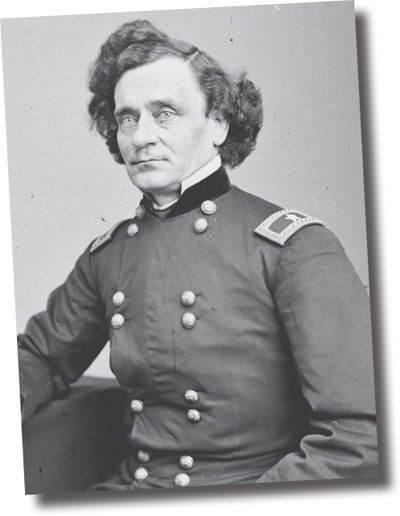
Brigadier General Thomas W. Sherman, U.S.A.
1. General Thomas West “Tim” Sherman (1813–1879) was a Rhode Island–born, West Point–trained career army officer, and no relation to William T. Sherman, who became famous later and with whom he is often confused.
IRISH BRIGADE OFF TO THE WAR.
NOVEMBER 14, 1861
The First and Fourth Regiments of the Irish Brigade proceed to Washington on Monday next. It has been so determined by the Governor of the State, in accordance with the earnest desire of the President and Secretary of War. Gen. MCCLELLAN also has expressed an ardent wish to have the soldiers of the Irish Brigade in his command as soon as possible. Nothing, therefore, will prevent the regiments above mentioned from marching on Monday, the 18th. The regiments will leave Fort Schuyler at 7 o’clock, on board one of the largest river steamers. Disembarking at the foot of Thirty-fourth-street, the troops will proceed to Madison-avenue, and halt in front of Archbishop HUGHES’ residence. They will here be presented with their colors. After which, marching through Fifth-avenue, and thence into Broadway by Fourteenth-street, they will proceed to the Jersey ferry, en route for the Philadelphia cars.
On Saturday, at 2 o’clock P.M., there will be an inspection and review of the brigade, by the Acting Brigadier, Col. THOMAS FRANCIS MEAGHER.1 Every private and officer will have to appear in complete marching trim. No visitors will be permitted to the fort on that day. To-day and to-morrow, however, all who desire to see their friends will have free access to the brigade. But on Saturday and Sunday there will be a peremptory exclusion of all strangers. Parties wishing to visit Fort Schuyler to-day and to-morrow will have to apply for passes at the headquarters of the brigade, No. 595 Broadway.
The colors of the brigade are now on exhibition at TIFFANY’s, Broadway, at which establishment they were manufactured. They are of the costliest material, splendid design and the most artistic workmanship. The motto of the brigade, a line from the grand old Celtic Homer, OSSIAN — “They shall never retreat from the charge of lances” — is worked in gold, in ancient Irish characters, on the emerald field, whilst the symbolic harp of Erin appears amid all the splendor and glory of the famous sunburst, the war-signal of the Irish in their fierce battles with the Danes....
1. Onetime revolutionary leader of the “Young Irelanders,” Irish-born Meagher (1823–1867) formed Company K of the 69th New York Regiment following the attack on Fort Sumter — the regiment that earned fame as the “Fighting Irish.”
THE NAVAL VICTORY AT PORT ROYAL.
NOVEMBER 14
We print a brilliant chapter of history this morning. In other columns will be found the official dispatches of Commodore DUPONT1 and Gen. SHERMAN, with proclamations, general orders, and the exhaustive rehearsal of our special correspondent, who gives a complete view of the entire affair. The detailed official account of Commodore DUPONT is not yet issued indeed; but the ample materials we publish leave little to be desired.
The dead under the smoking ruins of the forts that flank Port Royal, the troops of rebel planters flying in dismay before the avenging oriflamme of the Union, and the swarms of slaves flocking to our ships and our lines for deliverance and protection, are the flaming initials with which the Book of Retribution — just retribution, if ever such were! — opens in South Carolina. Twenty millions of loyal freemen are shut up in measureless content at the tidings. Now, indeed, Sumter begins to be avenged!
Few naval expeditions of a large scale — none of the proportions of this — have been successful. We trembled for its safety; we exult at its success. If not a victory which takes its lustre from the accomplishment of an end by disproportioned means, it is a success, the result of a plan admirably conceived and carried out with skill, with energy and with pluck. “I think my plan was clever,” remarks Flag-Officer DUPONT, in an unofficial letter to the Assistant Secretary of the Navy.2 The whole country will answer YES, in capital letters. Neither will the country forget the gallant marines and seamen who so finely sustained the glorious traditions handed down by American sailors of an earlier age.
The general outlines of the bombardment have already been anticipated. The leading plan of the manoeuvre was as masterly as it was novel, and was executed with splendid success. The seventeen men-of-war, forming in double line of battle, performed three magnificent intersecting circles, delivering raking broadsides from their starboard and port sides successively, and bringing the forts on either sides in range by turns. Five gunboats formed a flanking division, and did excellent service. “In truth,” says Commodore DUPONT, “I never conceived such a fire as that on the second turn.” This triple circle, pouring its showers of shot and shell on the forts, occupied three hours. When preparing for the fourth round of “damnable iteration,” the fortifications surrendered! It was a hotly contested fight. The South Carolina journals, in declaiming on the imbecility of the artillerists that manned the batteries, have done them great injustice. All our accounts concur in testifying that the rebels fought bravely and well. But our broadsides were overwhelming. The masterly manoeuvre of Commodore DUPONT, in causing the fleet to describe a series of intersecting circles, had at once the effect to destroy the range of the rebel guns, and to greatly diminish the exposure of our ships to the rebel fire, and when the action was over, nothing had befallen our fleet that could have prevented its paying its respects to Charleston or Savannah the next morning.... Such is the brilliant chapter of History made on that beautiful Autumnal morning, under the splendid Southern sky. The drama was not without spectators. Numerous steamers, with excursion parties on board from Charleston, Savannah, and other neighboring towns, stood off, at safe distances, to view the combat. The denouement was not exactly that of Fort Sumter, witnessed by a like assemblage! It is stated that on board some of these craft were the consular agents of France and England: they probably found suggestive materials for dispatches!
It is impossible to over-estimate the importance of this successful lodgment of Union forces on the soil of South Carolina. Securely intrenched on Hilton Head Island, the whole entourage of which is commanded by our fleet, there is a point d’appui for indefinite future operations. Henceforth the rebels cannot but know that any point upon their extended coast is equally untenable in the presence of the overwhelming naval power of the loyal States. The inland water-way which the rebels have hitherto so effectually used, is now wholly cut off and in our possession. There are also some illusions dispelled. There is an end to some old assumptions of South Carolina courage. The nonsense of the readiness of the slaves to fight for their masters is also for ever ended. Some were dragged away by force, others, refusing, were shot down like dogs, while a black tide poured towards the Union forces for protection....
We cannot see but that this success is the prologue to the swelling act of the imperial theme of Union triumph and rebel discomfiture; and the national salute booming from the Navy-yards of the States at noon to-day will awaken such echoes of high hopes as nothing in the war has yet inspired.
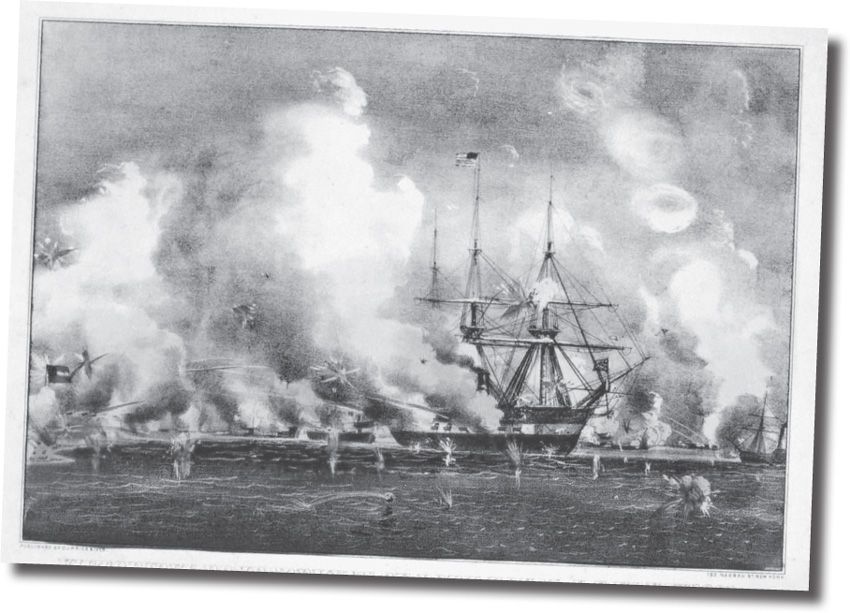
Lithograph depicting the bombardment of Port Royal, South Carolina, on November 7, 1861.
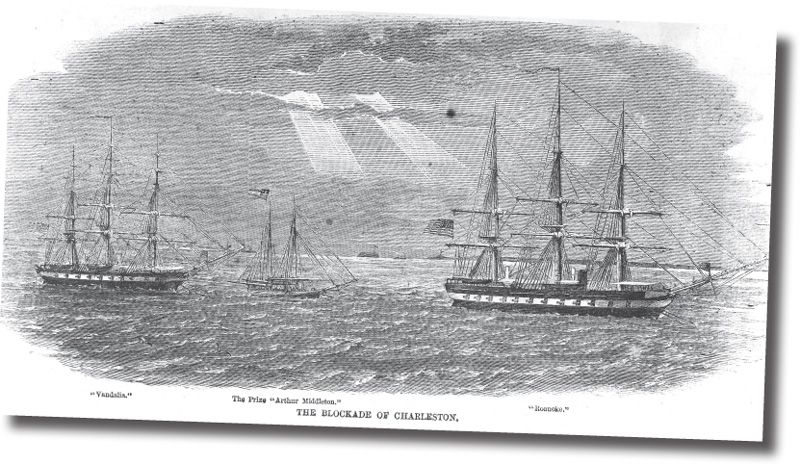
Three Union blockade ships at Charleston harbor.
1. Samuel Francis Du Pont (1803–1865) received a special commendation from Congress for securing southern coastal waters in this engagement.
2. Assistant Secretary of the Navy Gustavus Vasa Fox (1821–1883)
THE CAPTURE OF SLIDELL AND MASON.
NOVEMBER 17
We do not believe the American heart ever thrilled with more genuine delight than it did yesterday, at the intelligence of the capture of Messrs. SLIDELL and MASON,1 recently of the Senate of the United States, the most prominent and influential actors in the rebellion, and on their way to England and France, to represent the rebels at the Courts of these countries. The capture of Beaufort [Port Royal] may have created a deeper and more lasting impression, from a consciousness of the important results accomplished, but really no satisfaction is equal to that experienced when base and treacherous knaves meet their deserts. If we were to search the whole of Rebeldom, no persons so justly obnoxious to the North, could have been found as those just caught. DAVIS himself has some redeeming qualities; MASON and SLIDELL, none ….
Both are sworn enemies of order and law — of constitutional Government — of free labor — of human progress. They belong to an age in which the basest of passions and motives bore sway. For seeking to restore such an age they fled their country, and are now happily the prisoners of the very Government they sought to overthrow.
These are the men whom we have just caught and who are now safely caged. All thanks to Capt. WILKES,2 who, consulting the dictates of common sense alone, marched straight to his object, unmindful of protests, convinced that an act which every honest heart must approve, could not be contrary to usage and law. In this he was perfectly correct. The only mistake he committed was in not seizing the ship from which he dragged the traitors.3 England fully recognizes the right of belligerents to search, on the high seas, the vessels of neutrals for articles contraband of war. We do the same, as a pact of the laws of nations. About this right there is no dispute. If the English steamer had been captured, she would been condemned in any English Court of Admiralty, the proclamation of the Queen at the outbreak of the rebellion, forbidding her subjects to take any part in the war, or to transport arms or munitions for either belligerent, even dispatches of their Governments, was only a reiteration of the laws of nations, applicable to the position she assumed. Her subjects were told that the violation of these laws would be at their own peril. The steamer in question was the bearer of articles contraband of war, and was liable to seizure and confiscation. This, however, would have been a small matter after we had taken out the freight. We have not the slightest idea that England will even remonstrate. On the contrary, she will applaud the gallant act of Lieut. WILKES, so full of spirit and good sense, and such an exact imitation of the policy she has always stoutly defended, and invariably pursued.
There is, consequently, no drawback whatever to our jubilations. The universal Yankee Nation is getting decidedly awake. Its naval arm begins to tell. It is not only all powerful, but will soon be omnipotent at sea. The cordon we have thrown around the rebels is being drawn tighter and tighter. It will not be long before they will find their quarters very circumscribed and very uncomfortable. For a long time they jeered at the turfs we were throwing at them. They are beginning to feel something much denser, although we have not fired the train that would overwhelm them in an instant. Every day we are addressing ourselves more earnestly to our work, and persistence much longer in the rebellion will lead to the extremest of measures, perfectly justifiable from the outset, but which we have thus far waived, on the ground, very probably, of mistaken humanity.
As for Commodore WILKES and his command, let the handsome thing be done. Consecrate another Fourth of July to him. Load him down with services of plate and swords of the cunningest and costliest art. Let us encourage the happy inspiration that achieved such a victory. In this contest it is safe to adopt the Irishman’s advice to his son on leaving for a fair: “When the music opens, whenever you see a (rebel) head, hit it!” A clear instinct is always in harmony with law.4
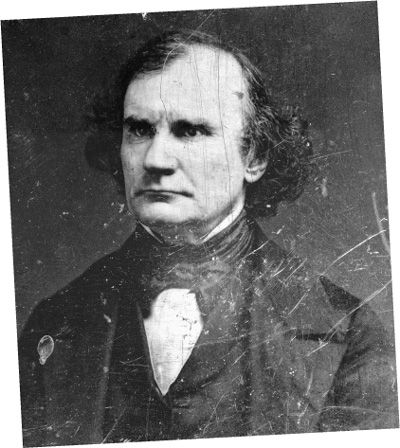
James M. Mason.
1. Former U.S. Senators James Murray Mason (1798–1871) of Virginia and John Slidell (1793–1871) of Louisiana were named as Confederate envoys in 1861. They would assume their posts in early 1862, following resolution of the Trent Affair.
2. Navy Captain Charles Wilkes (1798–1877) of the USS San Jacinto ordered the seizure of Mason and Slidell from the British mail packet Trent on November 8, 1861.
3. Indeed, this omission was the key to British objections. According to the laws of war at sea, Wilkes should have taken the Trent as a British prize and carried it to a port for adjudication by a Prize Court. By removing four men (Mason, Slidell, and their two male secretaries) and letting the ship continue on its way, he played the role of both captor and prize court judge.
4. The North did indeed lionize Wilkes; he was feted in both Boston and New York for his actions.
EARL RUSSELL TO LORD LYONS.1
DECEMBER 29
FOREIGN OFFICE, NOV. 30
… Her Majesty’s Government having in mind the friendly relations which have long subsisted between Great Britain and the United States, are willing to believe that the United States naval officer who committed the aggression was not acting in compliance with any authority from his Government, or that it he conceived himself to be so authorized, he greatly misunderstood the instructions which he had received. For the Government of the United States must be fully aware that the British Government could not allow such an affront to the National honor to pass without full reparation, and Her Majesty’s Government are unwilling to believe that it could be the deliberate intention of the Government of the United States unnecessarily to force into discussion between the two Governments a question of so grave a character, and with regard to which the whole British nation would be sure to entertain such unanimity of feeling. Her Majesty’s Government, therefore, trust that when this matter shall have been brought under the consideration of the Government of the United States, that Government will, of its own accord, offer to the British Government such redress as alone could satisfy the British Nation, namely: The liberation of the four gentlemen, and their, delivery to your Lordship, in order that they may again be placed under British protection, and a suitable apology for the aggression which has been committed....
1. British Prime Minister Lord John Russell (1792–1878) sent this harsh letter to his ambassador to the United States, Lord Richard B. P. Lyons (1817–1887), for delivery to Secretary of State William H. Seward.
FINANCIAL CONDITION OF THE COUNTRY.
DECEMBER 10
We present this morning the Report of the Secretary of the Treasury, which has been awaited with an interest quite as great as that felt in reference to the Message of the President. No matter what may be the magnitude of the task in hand, the crushing of the rebellion, or what may be our relations with other countries, the public will clearly see its way out of all our difficulties, provided everything is sound in the department of “ways and means.” In the predicament we are in, abundance of money is always success. So far there has been no lack, and with a vigorous and successful prosecution of the war, and a wise administration of the National finances, there need be no apprehension for the future....
The report of the Secretary has many things to commend it. It is lucid and frank in its statements; and as far as it proposes any plans for the future, it is without arrogance or assumption. His suggestions are timely, as bases for discussions in Congress, where they will be considered in the same liberal and candid spirit with which they are made. Mr. CHASE’s present wants are so well supplied that ample time can be taken for deliberation. The means of the country, as experience has shown, are sufficient for all the wants of the Government. We need have no fear on this score, if we only make the right use of them. It is a matter in which the Government and the people have a common interest, and we have no doubt it is one in which they will work to a common purpose.
MR. SEWARD TO LORD LYONS.
DECEMBER 29
…This dispatch has been submitted to the President....
The question before us is, whether this proceeding was authorized by, and conducted according to, the law of nations. It involves the following inquiries:
1. Were the persons named, and their supposed dispatches, contraband of war?
2. Might Capt. WILKES lawfully stop and search the Trent for these contraband persons and dispatches?
3. Did he exercise that right in a lawful and proper manner?
4. Having found the contraband persons on board and in presumed possession of the contraband dispatches, had he a right to capture the persons?
5. Did he exercise that right of capture in the manner allowed and recognized by the law of nations?
If all these inquiries shall be resolved in the affirmative, the British Government will have no claim for reparation....
In the present case Capt. WILKES, after capturing the contraband persons, and making prize of the Trent in what seems to us a perfectly lawful manner, instead of sending her into port, released her from the capture, and permitted her to proceed with her whole cargo upon her voyage. He thus effectually prevented the judicial examination which might otherwise have occurred. If now the capture of the contraband persons, and the capture of the contraband vessel, are to be regarded, not as two separable or distinct transactions under the law of nations, but as one transaction, one capture only then it follows that the capture in this case was left unfinished or was abandoned. Whether the United States have a right to retain the chief public benefits of it, namely, the custody of the captured persons, on proving them to he contraband, will depend upon the preliminary question whether the leaving of the transaction unfinished was necessary, or whether it was unnecessary, and, therefore, voluntary. If it was necessary, Great Britain, as we suppose, must of course waive the defect, and the consequent failure of the judicial remedy. On the other hand, it is not seen how the United States can insist upon her waiver of that judicial remedy, if the defect of the capture resulted from an act of Capt. WILKES, which would be a fault on their own side....
The four persons in question are now held in military custody at Fort Warren, in the State of Massachusetts. They will be cheerfully liberated. Your Lordship will please indicate a time and place for receiving them.
I avail myself of this occasion to other to your Lordship a renewed assurance of my very high consideration.
WILLIAM H. SEWARD.
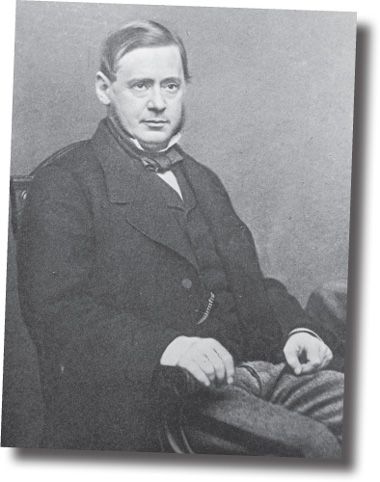
Lord Lyons.
INTERNATIONAL LAW AND THE CASE OF THE TRENT.
DECEMBER 31
Several momentous questions of maritime law have been raised in the discussion of the Trent case, which will, it is hoped, by the action of an International Congress, or by special treaties with the various Powers of Europe, be set at rest forever. Should this result be achieved, it will be of immense value to this country, and the peaceful negotiations of 1862 will contribute even more than the war of 1812 to the growth of our commerce and the development of our national prosperity. Prominent among the questions which invite such international action as we have suggested, is that of contraband of war. No better proof is needed of the obscurity which has hitherto surrounded this question, than may be obtained from the dispatches of Messrs. SEWARD and THOUVENEL,1which appeared side by side in our columns yesterday. From a comparison of those documents it will be seen that while the American and British authorities attach a contraband character, under special circumstances, to civilians, the French Government assumes that the civil servants of a belligerent Power are never contraband, though the military officers and forces of such a Power are so. Now, as the precise conditions under which persons, whether civil or military, acquire a contraband character are thus seen to be uncertain, and as different nations hold conflicting views on this important subject, it is obviously desirable, for the prevention of future complications, that an exact definition should be mutually agreed upon, and should be embodied in treaties or protocols under the authority of the Governments of this country and of Europe.
Besides the question of contraband as applied to persons and to merchandise, there are other equally important points which claim attention. There is, for instance, the belligerent right of visit and search, which has always been a fruitful source of international trouble, and needs to be regulated by new and more satisfactory rules. Connected with this is the obligation to take every captured vessel into port for adjudication, which has not always been insisted on, though our Government, as Mr. SEWARD properly claims, has always contended that it is indispensable to the legality of the capture. This rule, we believe, has never been authoritatively affirmed, and it is certain that in searching our vessels and impressing our sailors, Great Britain formerly violated it most flagrantly and in very numerous instances. Another point requiring attention is the privilege of refitting belligerent vessels in neutral ports. France and some other nations have established by law certain municipal regulations, which place this privilege under a certain degree of control. But in England and elsewhere there is no such established and permanent rule. It could not be a difficult matter for all the Great Powers to agree upon some definite united action on these and other points, in which all commercial nations are so deeply interested. We do not wish, however, to discuss these several questions in this place. We would only suggest the propriety of holding an international Congress or of concluding special treaties with the various Powers of Europe, in which the uncertain and vexed claims of maritime law may be so completely settled as to prevent, if possible, the danger of any misunderstanding between ourselves and those Powers of Europe with whom it is both our highest interest and our established policy to live on terms of perfect friendship and national comity.
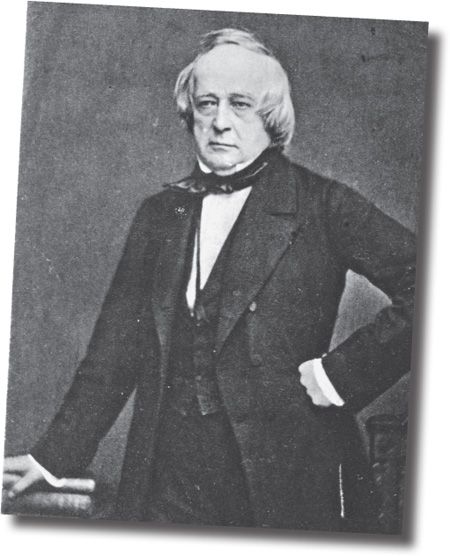
John Slidell.
1. Edouard Antoine de Thouvenel (1818–1866) was French minister of foreign affairs.
SUSPENSION OF SPECIE PAYMENTS.
DECEMBER 31
BOSTON, MONDAY, DEC. 30
The Presidents and Directors of the Banks of this city held a meeting this morning and resolved to suspend specie payments forthwith.
PHILADELPHIA, MONDAY, DEC. 30
The Banks of this city have resolved to suspend specie payments in consequence of the suspension in New-York.1
ALBANY, MONDAY, DEC. 30
In consequence of the action of the New-York Banks, the Banks of this city suspended specie payments to-day. The suspension occasions no excitement.
PITTSBURGH, PENN., MONDAY, DEC. 30
The news of the suspension by the Eastern Banks was not wholly unexpected here, and created little or no alarm. Our banks have not generally suspended. Three of them, it is understood, have suspended, but four are still paying specie, viz.: The Old Bank, of Pittsburgh, the Mechanics’, Citizens’ and Iron City.
CLEVELAND, MONDAY, DEC. 30
The Cleveland Banks suspended specie payment this morning.
1. With controversial new government-supported greenbacks increasing in circulation, the traditional right of exchanging paper currency for gold or silver was suspended. The suspension lasted for another 17 years.
NEW-YEAR’S DAY.
JANUARY 1
The darkest and gloomiest year in our country’s history has passed away. It opened with a portentous cloud in the Southern sky, then not bigger than a man’s hand; but which has since overspread and wrapped as in a pall the whole nation. Last NewYear’s Day, only South Carolina had committed herself to dis-union; and almost every one then thought and hoped that the process of disintegration would not go any further; but that the conservative element in the South, and the conciliatory element in the North, would speedily devise some way by which the old fraternal Union would he peacefully maintained, and the Ship of State, compact and strong though storm-beaten, would again pursue her course in placid seas. But before the first mouth had passed away, seven States were in the hands of the mutineers, and it seemed for a time almost as though the whole National fabric would tumble to pieces. The second month of the year shaped and compacted the revolt, by giving it a Confederated legislature and an Army, and by placing at its head the adroitest of the conspirators. In April the war — henceforth to become a war of sections and systems — opened in Charleston Harbor. Then followed the formation of the two great armies — by this time thirteen rebel States contributing their troops to the one, while twenty-three Union States furnished the soldiers for the other. Since then, for nine dreary months past, the progress of the National arms has been fitful and uncertain — reverse and victory checquering the record of each week. But at the close of the year of rebellion, we can at least say that the military forces of the nation; on land and sea, have been brought together, and are, apparently, ready to descend effectively upon the nation’s foes.
The opening of the year found South Carolina assailant and defiant, with her clutch upon the nation’s throat; its close finds her assailed, confused and desperate, with the sword of the nation planted well in her vitals. The opening of the year found a cowardly old fool and a Cabinet of knaves ruling in Washington, while the nation was doubtful even of its capital: now we have upright and courageous rulers, and half a million Republican bayonets to do their bidding. January found the nation struggling in the dark, and not knowing what to do; December leaves it with a clear purpose and a fixed aim. The outlook, too, has appeared gloomy enough all the year; but it seems now as though light was almost ready to break forth, all round the horizon, upon our arms and our cause.
It is to be hoped that the old year carries with it too the final solution of the trouble lately threatening us from across the seas. It carries a message and a pledge of peace from us to England; and if England does not desire to thwart this nation’s purposes and destiny, (which it is not, indeed, in her power to accomplish,) she will accept our pledge of peace in the spirit of conciliation in which it is offered....
We begin the new year with hope, and with a consciousness of National strength which contrasts wonderfully with the dubious feeling of a year ago. And we believe that many of the weeks of the year will not pass away before light and victory will break forth over the whole country, and that, before its close, the full fruition of the nation’s hopes will he realized. In this consciousness, we wish to our brave soldiers in their tents, to our gallant sailors in their ships, and to all true men the world over. A Happy New Year.
THE CONVICTION OF GORDON, THE SLAVE TRADER.
JANUARY 4
FROM THE LONDON HERALD.
As to the law of the United States upon the subject there is no doubt. Since the year 1819 it has been a capital offence for American citizens to engage in the African Slave-trade; and had this law been duly enforced, there would have been an end of the traffic long ago. But it is notorious that this has not been the case. The continued refusal of America to allow the right of search under any circumstances in time of peace has hitherto proved fatal to every attempt upon our part and upon the part of other nations to put down the Slave-trade. It is notorious that that trade has of late years been carried on principally by means of American capital, and under the American flag, which could alone protect it. Vessels were built and fitted out at New-York and Baltimore expressly for the purpose, and they could pursue their lawless traffic without the risk of interruption from any cruiser except those of the Union. There is no doubt that for some time past joint-stock companies have been established expressly for the purpose of carrying it on. It may be said, in short, that American enterprise and avarice has for years past supplied Cuba with slaves. What effect is this recent conviction at New-York likely to have upon this disgraceful state of things? Let us hope, whether the extreme penalty of the law is inflicted or not, that it will prove salutary. It is the capitalists of the North, not the slaveowners of the South, who now encourage the African traffic. We shall soon know whether President LINCOLN is true to his professions in this important matter, or whether he has adopted them for personal and party purposes.
THE IRON-PLATED GUNBOATS.
JANUARY 7
People addicted to naval matters have become suddenly awakened to the importance of iron-clad vessels of war. It is generally the case, where we have been criminally apathetic upon a subject of National importance, and have finally come to give it attention, we go at once to the opposite extreme. So, in this instance, we delayed too long the construction of iron-clad vessels, of which every great Power should possess a few, and when we tardily determine upon providing ourselves with this class of war-engines, we pour out our ten or twelve million dollars like so much water, to build twenty vessels upon entirely novel plans, designed by people who have never seen such ships, or even the detailed designs of any of the considerable number which have been built in Europe.
The extra session of Congress last year acted very judiciously in directing the construction of one or more such vessels, and appropriating one and a half million dollars for the purpose; the bill directing that the talent of the country should be called, forth by the issue of advertisements for plans, and that these should be submitted to a Board of competent officers for approval and selection. This was done; three plans were adopted, and one vessel directed to be constructed upon each, one of which is now nearly completed in this City, and will be ready for service before this month is out.1 With the commencement of this session, however, the Navy Department asked for the immediate construction of twenty more, and pending the decision of Congress upon the subject, the officials in the Bureau of Construction have completed a design upon which they propose to build them, and have invited to Washington and been in consultation with representatives of all the principal builders in our Atlantic cities. The House of Representatives has passed the bill appropriating ten millions for the purpose, but it has not yet been acted upon by the Senate.
In the designs we, allude to, the vessel just described as nearly completed is followed in many of its important features, and its imitators intended to carry precisely the same armament, namely, two guns of the largest calibre used in the navy. If, therefore, the vessel now building is successful, and can place her two guns in position to destroy our enemies, and can maintain them there until such destruction is completed, it is clear that every additional dollar which vessels carrying the same armament shall cost is thrown away, even if we were certain that the more costly vessels would be entirely successful. The batteries, designed by the officials in Washington, are expected to cost at least ten million dollars; whereas we have reason to believe that twenty like the one now nearly completed could be built in less time for five millions.
It is true that this Naval Board affects to believe that the one they have partially followed will not be successful, but would not any prudent and disinterested man consider it much the wiser course to unit a few weeks, and ascertain, beyond the possibility of a doubt, whether it was necessary to go to this additional expense of five or more millions to attain the desired end?
The subject, we repeat, is still before the Senate. We trust the Committee on Naval Affairs in that body has not overlooked the considerations we have hinted at; so may it give the navy far more efficiency, and leave the Treasury millions the richer.
1. This is the vessel that became the USS Monitor.
HOW THE EXPENSES OF THE WAR ARE TO BE MET.
A PROPOSED TAX OF ONE HUNDRED AND FIFTY MILLIONS.
JANUARY 8
WASHINGTON, TUESDAY, JAN. 7
The Committee of Ways and Means have concluded to provide by taxation for a hundred and fifty millions during the current year.
The Committee of Ways and Means should not fail to impose a monthly tax on those who perform the office of sutlers to our armies.1 It is an exclusive privilege and a very valuable one. Merchants in civil life always pay a license. Those who sell in the camps should do likewise, and the funds go into the Government treasury. The average value of a sutlership to a regiment is said to be $6,000 a year. If we have 600 regiments in service, the furnishing of sutler’s goods to them yields a profit of nearly four millions annually. Why should not a fair per cent. of this sum go to the Government, that furnishes the customers and the money they buy with?
Senator HALE’s2 bill to protect the Government Treasury from swindling contracts comes none too soon. Its introduction to-day was marked by a severe speech from that Senator.
1. “Sutlers” were civilians who set up huts in army camps to sell approved items such as newspapers, tobacco, and cutlery to the troops. Throughout the war, these businessmen were accused of inflating prices and profiteering from the soldiers’ deprivation.
2. John P. Hale (1806–1873) of New Hampshire.
REBEL TESTIMONY TO THE EFFICIENCY OF THE BLOCKADE.
JANUARY 9
It is very curious that while the British journals tell us a great deal about the utter inefficiency of the blockade, the Southern journals, on the contrary, are constantly testifying to its rigor. We have repeatedly quoted testimony to this effect from Richmond Charleston and New-Orleans papers. The latest we copy this morning from the Richmond Examiner, of the 30th December. It contains this emphatic statement:
“The only effective weapon of assault that the public enemy have yet wielded against us, is the weapon of blockade; and, so far, neither Southern ingenuity, statesman-ship, nor pride has been able to provide a single measure for its counteraction.”
This is evidence which the journals of secessionist proclivities, on the other side of the water will hardly attempt to rebut, however indiscreet they may consider their rebel friends in blazoning forth to the world the proofs of the extraordinary perfection of our blockade, and thus spoiling the efforts they have been making to convince Europe that it is of no account.
INACTIVITY OF THE AMERICAN ARMY.
EXTRACTS FROM THE SPECIAL CORRESPONDENCE OF THE LONDON TIMES.
JANUARY 9, 1862
WASHINGTON, DEC. 9
There is little probability of anything occurring to disturb the march of events, which are the only things that march at Washington, and which have got into a humdrum sort of parade and review order, making one day as like the other as can be. There is, to be sure, always the confidential assurance that “there will be a move soon,” and perhaps there may; but hitherto Gen. McClellan has succeeded in averting the danger which is presented to him of making an attack on a desperate and brave enemy with an ill-disciplined army. He may, however, at any moment be led to order an advance, and his army is certainly better prepared to make it now than it has been at any previous time. It would be amusing to took back to the Northern journals, and see how much of the pompous programme of “our Fall campaign” has been fulfilled. New-Orleans was to have been seized, Charleston laid waste, Memphis, Savannah, Richmond, and Nashville occupied, and the seceding States held in subjection till the loyal men could be induced to come out and vote themselves back into the Union. The good public is presented with a strip of sand at Hatteras, and an inlet at Port Royal, and so far it is thankful for the results of these conquests. The “Rat-hole squadrons” are at their work, and the task of the blockading vessels will soon be light enough. In fact, the weather is such on the Southern coast during January, February, and March that it would not be possible to maintain a force of observation off the harbors; hence most of them will be blocked up, and the others can be watched from time to time by vessels running out of Port Royal. Another great expedition, the naval part to be commanded by a very dashing officer, Capt. DAVID PORTER, is to be prepared immediately, and Gen. BURNSIDE’s Corps is now ready to start from Annapolis. The utmost exertions are made by Government to procure mortars of the largest size, but these are not to be made in a day. Nothing indicates any expedition of the first class — one intended to operate against Charleston or New-Orleans, which are the favorite objects of the Northerners.
To the earnest, self-sacrificing thousands who regard this war as the holiest and best in which man ever drew a sword, the conduct of affairs must be most discouraging and irritating. There are myriads of people who literally worship the Union, and who would gladly lay down their lives for that political “idea.” But they have no opportunity. They have left professions, trades, and pleasant homes to go out and fight, and as they stand in front of the battle, they feel the ground for which they are striving crumbling under their feet. There are hundreds of men in the Northern armies, like JAMES WADSWORTH, Gen. SPRAGUE and Gen. BUTTERFIELD, who have abandoned ease and comfort to set an example in person of devotion to — well, not their country so much as to — the Union, or, as Earl RUSSEL styled it, “Power.” And the Union was assuredly power. It was power for the slaveholder, power for Slavery, power for democratic institutions to affront the world. Without the Union, the Northern States would be cabined and confined within the Canadian lakes and Virginia, and no reasonable human being can object to their refusal to submit to such a fate. To be deprived of the Mississippi would be to have the main artery torn from the heart. Are they not justified in striking for life at the hand which is stretched out for the purpose? But it is beyond conception that, all this being so, the war is carried on as if it were intended to irritate to madness rather than induce “surrender to force of arms.” God and Nature may not, indeed, have put the Black into the hands of the Northerners any more than the Indian was placed at our disposal by the same Power in the American war. But here are all the horrors without any of the results of war. Conquest over the South may mean great ruin to the North, but at least it would be a proof of strength given in the achieving of the result; now all the cost of armaments, prodigious and profuse, is endured without any actual operation in esse to realize the Northern idea. That it may at last be attained I cannot hesitate to admit, but the realization will be terrible to victor and vanquished alike. The question of the fate of that which is not yet in the power of the North already distracts and convulses the country before the battle has been fought at all. It is not, indeed, unlikely that Gen. MCCLELLAN may be averse to a great battle, on the mere grounds of aversion to bloodshed, and the hope of success by milder means; and the smaller operations of war may encourage him to resist the suggestions which are to my knowledge made to him for an attack upon the enemy. Magnificent weather is lost, and no sign of an advance is visible. There are impatient Senators and angry Congressmen, but no one dares open his lips who remembers the result of the “On to Richmond!” cry of June and July last. The expeditions, and the news of others about to be, amuse the people for the time, but the pressure of taxation will soon render them irritable in their clamors for peace or victory. As yet the war has not pressed hardly on the bulk of the people. Six hundred thousand of the people are amply paid and well fed, and to them are joined hundreds of thousands who are employed in civil work about the army. The noble army of contractors and sutlers is making a fortune, and the theory that the country cannot be losing anything because all the money is spent in it, finds universal acceptance. There are large frauds understood to have been detected in commissariat transactions recently. No doubt greater may be undiscovered. Many persons have already made large fortunes very honestly. Fraud seems somewhat superfluous where prices are so rumunerative and examiners so lenient. “All is quiet along our lines.” The river blockade still continues. No men-of-war except a tiny gunboat has passed up or down in front of the enemy for weeks. Mr. SICKLES is still at work on board the Pensacola, which lies motionless off Alexandria. Reviews go on daily, and for the most part satisfactory in all that relates to the marching of the men, but I never chance to see a decent battalion drill, or any formations, except of the most rudimentary kind, and I much doubt if there are half a dozen regiments here which could form square with steadiness and rapidity against a charge of cavalry.
IMPORTANT FROM THE WEST.
THE ADVANCE OF GEN. GRANT’S FORCES DOWN THE MISSISSIPPI.
JANUARY 18
CAIRO, SUNDAY, JAN. 12, 1862.
In common with everybody else, your correspondent was electrified by the announcement on Friday last, that the long-expected “advance” was about to take place — in fact, was already begun. I hastened here as fast as steam could whirl me; found crowds at every station, who fought, crowded, struggled to gain admittance to the train in order to be in time to hang on the skirts of the grand forward movement; heard every hour, as I neared this notorious town, exciting rumors of a fight already commenced at Columbus, of day-long cannonades heard in the direction of Cairo; rushed from the train the instant it was consistent with safety; “broke” for a livery stable to overtake the advance by land, and when I made known my wishes, was — laughed at!
Forward movement! Troops embarked! Gen. GRANT and Staff en route for the Tennessee River! Gunboats, tugs and transports all left this morning! Such was the telegraph news which went over the wires the day before. The levee was alive with tugs and steamboats — out upon the river, like huge black whales sleeping on the Pacific, lay the gunboats. I visited the headquarters and found a quiet-looking man in a farmer’s dress, lazily smoking a meerschaum, and he was the departed General. His Staff was there too — one was smoking with an air of placid contentment — another was brewing a small fight between a couple of specks of children — a third was lazily reviewing the dispatches of a telegraphic reporter for a St. Louis journal — in short, the Staff were just as far from Columbus, and looking just as little like going, as their chieftain.
The troops were not “all embarked” either — across the Ohio the white tents and broad shanties of the usual force gleamed clear against the dark background, formed by the leafless woods of Kentucky — over the Mississippi could be seen the huge encampment, whose occupants guard the fortifications of Bird’s Point, while on this side the black muzzles of the Columbiads still looked grimly over the parapet of Fort Cairo; sentinels paced around its walls, naval and military uniforms thronged the streets or lounged in the hotels without number; from the long lines of barracks arose the smoke of a thousand fires.
After taking in all these points, I became satisfied that the “forward movement” had not taken place, and that some unblushing liar had “sold” the public most unmercifully. Upon inquiry, I find that the dispatches announcing the movement are said to have been written by some Government official, handed by him to the agents of the St. Louis and Chicago papers, and, of course, forwarded by them under the supposition that they were reliable. The thing has excited a good deal of angry discussion, particularly among the classes “sold” by the operation; while ingenuity is exhausted in trying to find a reason, ever so slight, for making such an announcement. Even the St. Louis papers seem to have been a party to the thing, for, in the dispatch from this point to them, it was stated that 25,000 troops had left St. Louis for Cairo, and although they must have known its falsity, they did not contradict it. It is asserted that Gen. HALLECK originated the canard, but this I do not believe, as he is at once too much of a gentleman and a soldier to perpetrate a huge lie upon the public, even under the pressure of a military or any other necessity.
A few ill-natured ones argue that the whole thing was done by way of a sop to a public, ravenous for an advance; but even this is too shallow a trick for any one above an idiot, because the reaction of the public feeling, as any one would know, would produce a state much worse than before.
That there was a small movement is true. Five thousand infantry and one thousand cavalry, under [John A.] MCCLERNAND, went down the Mississippi a distance of seven miles, to a point upon which once stood an old Indian fort, and named Fort Jefferson. Here they rested, and went into camp. Being on the east side of the river, on the Kentucky shore, it may be used as a base of operations for excursions into the interior, in the direction of and to the rear of Columbus; and possibly it may be a link in the chain of events intended for direct operations upon that town.
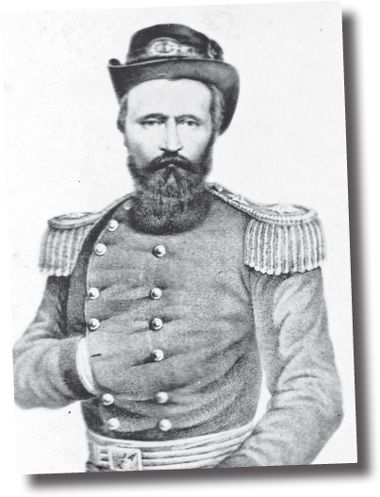
Brigadier General Ulysses S. Grant, U.S.A.
ARMY OF THE POTOMAC.
JANUARY 10
CORRESPONDENCE OF THE RICHMOND EXAMINER.
MANASSAS....
To-day our whole army is engaged in building log houses for Winter quarters, or in moving to sites already selected. Several brigades will remain where they now are, near the fortifications in Centreville, and the remainder will fall back a mile or two upon Bull Run....
In case of an attack by the Yankees, it will take about two hours to get the main strength of the army across to Bull Run. Information of an approach would be given at least two hours before an enemy could come up, and in that time we could be well prepared to resist any force that can be brought up. This is about the situation of affairs for the Winter, and it remains to be seen whether our men are to have an opportunity of a brush with the Yankees, or whether they will be allowed to enjoy their new houses in quietness.
WHO INVENTED “CONTRABAND?”
JANUARY 20
An enterprising antiquarian has discovered that the happy epithet of “contraband,” which Gen. BUTLER applied to the slaves of rebels, and which was at once universally recognized as both a pun and a stroke of genius, is not so much the impromptu inspiration it was thought to be. It seems the original author of the term is our present excellent Mayor, GEORGE OPDYKE.1 Ten years ago he published a treatise on Political Economy — a book whose merit has never received adequate appreciation — in one chapter of which, treating of Slavery, the following passage occurs: “Slaves are not often furnished, as they formerly were, by African traders, at the cheap rates of stolen goods — the article being now contraband with us,” etc. Now, it is not improbable that BUTLER’s happy hit was a reminiscence of this, though it is not impossible — for such coincidences do occur — that similar reasonings brought out similar results. If BUTLER has been pilfering, one would like to know it. So good a thing should have its proper paternity. We venture to suggest the matter as a proper subject for inquiry by the V.W.C.I.C — i.e., the Van Wyck Congressional Investigating Committee.2
An escaped slave, a “contraband of war,” greeting Union soldiers.
1. Millionaire clothing manufacturer George Opdyke (1805–1880) served as mayor of New York from 1862 to 1863.
2. New York Congressman Charles Van Wyck (1824–1895) chaired House committees on Mileage and Revolutionary Pensions.