
CHAPTER 8

Detail of a drawing of the Battle of Shiloh.
Throughout the winter, even as his army drilled and paraded, McClellan had made no move against the enemy. The country grew impatient, and sensing that, Lincoln attempted to prod and encourage his young general. When McClellan fell ill with typhoid fever in January, Lincoln held a council of war with his leading subordinates. Jealous of his command authority, McClellan got out of his sickbed and appeared at the next meeting. When Lincoln asked him if he had a plan of operations, he replied that he did, but that he could not reveal it because people in the White House could not be trusted to keep it secret. Despite this implied disparagement of the President, Lincoln agreed that he would not press McClellan for details. The plan, when it was revealed, turned out to be a massive turning movement by sea: the entire Army of the Potomac would be sent by transports to the Virginia coast and advance on Richmond from there.
The move took place during the last two weeks of March 1862, as 389 ships carried more than 120,000 men, 15,000 animals, and 1,200 wagons to Fort Monroe at the tip of the peninsula of land formed by the York and James rivers. It was a remarkable demonstration of the North’s material superiority and impressive sealift capability, as well as McClellan’s logistical skills. Once there, however, McClellan behaved as if he expected that the rebels now might as well simply give up. The Times thought so too. An article that appeared on April 7 suggested that “the rebels are preparing to flee from Virginia altogether.” They were not. Instead, McClellan spent all of April and part of May besieging the Confederate defensive lines at Yorktown on the site of the old Revolutionary War battlefield. Once again, critics in the North grew impatient.
At the same time, Confederate Major General Thomas J. “Stonewall” Jackson inaugurated a campaign in the Shenandoah Valley that was destined to become a model of effective small-unit warfare. It began poorly. On March 23, 1862, Jackson launched an attack on a Federal force at Kernstown that was stronger than he thought. He was driven off with heavy losses, and The Times crowed that “we will not be likely to hear any more of this audacious rebel in this quarter.” Seldom has a prediction been more wrong. By the end of May, Jackson had chased his Federal foe, Major General Nathaniel P. Banks, all the way back across the Potomac and disrupted McClellan’s plans as well. Once again The Times came to the defense of a much-criticized general proclaiming that Banks’s ability to retreat “so far in the face of an enemy so overwhelming,” and to get his men safely across the Potomac was “proof of the highest generalship.”
Great events were taking place to the west as well. In Tennessee, Albert Sidney Johnston tried to recoup his prolonged retreat by attacking Grant’s army at Pittsburg Landing near Shiloh Church on April 6. The surprise attack drove Grant’s men to the bank of the Tennessee River on the first day of fighting, but a reinforced Grant counterattacked the next day and regained all the lost ground. With a total of 24,000 casualties on both sides — five times the losses at Bull Run — Shiloh was the first battle of the war that presaged just how costly the conflict was likely to be.
Two weeks after that, the naval squadron of Flag Officer David G. Farragut fought its way past the forts guarding New Orleans to capture the South’s largest and most important commercial city.
The conversation about slavery and its future continued. Congress abolished slavery in the District of Columbia on April 16, though this did not mark the onset of a general movement toward emancipation. When on May 9 Major General David Hunter, commanding the Department of the South, declared that slavery was abolished within the area of his command (Florida, Georgia, and South Carolina), Lincoln felt compelled to repudiate Hunter’s action, saying as he did so, “Whether it be competent for me, as Commander-in-Chief of the army and navy, to declare the slaves of any State or States free; and whether at any time, or in any ease, it shall have become a necessity indispensable to the maintenance of the Government to exercise such supposed power, are questions which, under my responsibility, I reserve to myself.”
JACKSON’S CAMPAIGN IN NORTHERN VIRGINIA.
APRIL 1
The column of the rebel Gen. JACKSON, which has just been routed at Winchester,1 chased from Strasburgh, and is now probably plodding its weary, way through the mountains, and up the Shenandoah Valley for Stanton, was, as Gen. [James] SHIELDS says, considered the bravest and best-disciplined corps in the rebel army. It was composed of men who had been in the very hardest service ever since the war opened; and, for its supposed invincible qualities was known as the “Stone Wall Brigade.” The rebel papers have given it credit, too, for a continuous series of quite wonderful victories. At the beginning of last Winter, JACKSON was put in command of Northern Virginia, and he was ordered to drive the National troops from that part of Virginia between Harper’s Ferry and the western line of Maryland, and to destroy whatever had been rebuilt of the Baltimore and Ohio Railroad, which was then guarded by the troops of Gen. [Nathaniel] BANKS. With a force estimated at 6,000 strong, JACKSON set out from Strasburgh last December, advanced rapidly to Winchester, and thence toward Martinsburgh, destroying the Baltimore and Ohio Road, tearing up the rails and using them to finish the line between Winchester and Strasburgh. In the beginning of January he advanced toward Bath, in Morgan County, where were two National regiments and a force of cavalry and artillery, supported by two other regiments at Hancock, ten miles north. Our troops at Bath were driven across the Potomac, and a number of them taken prisoners. He then advanced to Hancock, sent notice to the Mayor that he intended to cross at that point, and began shelling the town. He next moved upon Romney, and our troops stationed there retreated north to Cumberland. Having thus cleared that entire section of the National forces, he returned to Strasburgh, but in February again occupied Romney, from which he was driven by Gen. LANDER. From Strasburgh he advanced once more to Winchester, and of late has been flitting between these two points, and occasionally approaching well up to the Potomac. When he saw his best line of retreat cut off by our occupancy of Manassas, and found Gen. BANKS’ corps d’armee advancing in force against him, he began to move up the Shenandoah Valley; but, imagining that BANKS’ army had nearly all gone to Manassas, he again came up a fortnight ago to his old ground at Winchester, where his forces were suddenly attacked and routed by Gen. SHIELDS, on the 23d ult., and subsequently chased up to and beyond Strasburgh. The official reports indicate that his original force had been more than doubled by reinforcements from the main rebel body. As his column seems to have been terribly cut up, and the remnant has retreated from Northern Virginia, we will not be likely to hear any more of this audacious rebel in this quarter. Gen. JACKSON is a Virginian and a West Point soldier, and his troops are mostly Virginia mountaineers, with regiments from the far Southern States. He has been a terrible scourge to the section over which JEFF. DAVIS gave him command; but his defeat and retreat clears the mountain region of armed rebels.

Thomas “Stonewall” Jackson, as he appeared after he became a lieutenant general.
1. This refers to the Battle of Kernstown (March 23, 1862), in which the army of Thomas J. “Stonewall” Jackson attacked a larger Union force near Winchester and was repulsed. Despite that, Lincoln decided to reinforce Union armies in the Valley and divert units that had been intended for McClellan’s army.
QUAKER GUNS.
APRIL 3
Certain Quaker guns which were found in position at Centreville, after its evacuation by the rebels, and which are held up as proof-positive of the cowardice or inefficiency of Gen. MCCLELLAN.1 This view can be honestly taken only on the assumption that the works at Centreville were never mounted with any other than Quaker guns — a conclusion which could be arrived at only by those who are entirely ignorant of the arts and practices of war. For this device of Quaker guns is one constantly and successfully used by commanders who intend to retreat from forts or entrenchments. Next to his men, an officer’s first care is his artillery. But to remove his guns in sight of the enemy would be to notify him in the quickest and most unmistakable manner of the intended evacuation. So his pickets are strengthened, and even pushed forward, as if for an advance, then in the night the guns are removed, and wooden ones of similar size and appearance, so like as to make detection even with a glass impossible, are substituted for the real Simon Pures. Daylight manifests no change in the apparent strength of the works; the bulk of the troops move off by daylight; and when the next night comes, the pickets withdraw suddenly, and run for it. There is obviously no protection against this trick, except a nightly driving in of pickets, and reconnaissance in force in the dark, which is generally more harrassing to those who undertake it than to the enemy, and is rarely productive of much good. The supposition that, because the rebels left only Quaker guns behind them, they took none of “the world’s” guns with them, makes it plain that they did not use up all the wood in the world in making sham artillery.

Federal troops at a Confederate fort on the heights of Centreville, Virginia, armed with Quaker guns.
1. Believing that his force was too exposed at Manassas, Confederate army commander Joseph E. Johnston withdrew his army southward behind the Rappahannock River on March 8–9. When Union forces moved forward to occupy the now-abandoned rebel camp, they found that several of the cannon frowning from the Confederate defensive lines were so-called “Quaker guns” — carved logs painted black to resemble artillery. McClellan’s critics seized on this to prove that Little Mac should have attacked Manassas before the rebels decamped. In this article, The Times comes to McClellan’s defense.
EMANCIPATION IN THE DISTRICT.
APRIL 4
The bill for abolishing Slavery in the District of Columbia was passed yesterday in the Senate. The vote was sufficiently decisive. Only fourteen names are recorded as opposed to it, while for it there were twenty-nine. But of the twenty-nine, several Senators had taken occasion to express objections to leading provisions of the bill. Some deprecated its effect upon the Border States. Others would have had the subject referred to a vote of the whites in the District. Others still would have made the emancipation gradual and provided for the removal of the blacks from the country. But the adherence of the majority to the bill as reported from the Committee, was too steadfast to be shaken. The only modification accepted was one appropriating $100,000 for the colonization of the liberated negroes.1 There was no other alternative, therefore, for those who were friendly to the measure on general principles, but who objected to various of its provisions, than to vote for or against it directly. It therefore received their voices.
The bill goes to the House of Representatives. A generation has passed since a simple petition for such a measure threw that body into convulsions, procured the establishment of a more arbitrary code of rules and gag-laws than ever disgraced a chapter of the Inquisition, and placed an Ex-President at the bar of the House for trial, as if guilty of treason.2 The change is the natural product of that very tyranny. Elated by their triumph, and assured of the servile support of the Northern National Democracy, the Slavery party gave way to suicidal arrogance and presumption. They demanded uninterrupted and despotic control of the National Government. Its patronage and its legislation were alike in their hands. And to such a pitch was this petulant selfishness carried, that a threatened suspension of its rule for the four years through which we are now struggling, was made the pretence of a revolution the most gratuitous of any recounted in history. But — so surely does time bring about its revenges — this revolution has rendered it possible to complete the labor of expelling Slavery from the National Capital — a task beneath which JOHN QUINCY ADAMS sunk into his grave.
The House of Representatives will, we trust, amend the Senate bill in several particulars. The appropriation for removing the negroes from the country, wise in itself, becomes folly in the presence of immediate emancipation …. The transformation of domestic servants, accustomed life-long to none but indoor employments, into tamers of tropical forests and successful cultivators of new and unaccustomed regions, may be effected in a long course of years; but not without some little preparation and some skill in the arts of self-support. The substitution of the provision for gradual emancipation for the peremptory method of the bill, can alone save its framers from the charge of disguising heartless cruelty under mask of eager philanthropy. The measure we believe to be ill-timed; let it not also be ill-contrived and mischievous in practice.
1. In fact, an amendment to the bill that would have required compulsory emigration of all blacks from the District failed only when Vice President Hannibal Hamlin broke a 19–19 tie.
2. This refers to the repeated efforts by Congressman and former President John Quincy Adams to present petitions to the House regarding slavery in the District. Weary of his constant efforts, the House passed a so-called “gag rule” that no petition concerning slavery would be allowed. When Adams tried to present one anyway, he was held in contempt.
THE PENDING BATTLES.
APRIL 7
The two great National armies the Army of the East and the Army of the West are now in the situation promised by Gen. McCLELLAN in his address to the soldiers of the Potomac “face to face with the rebels;” and it is evident that it cannot be long before they meet the rebellious foe “on the decisive battlefield.” In the East, the late Army of the Potomac — a host greater than that of either of the belligerents at Waterloo — and under commanders of approved loyalty, skill and courage, — is moving upon the strong places and key positions of the audacious enemy who, for over a year, has stood before the Capital defying the National power and insulting the flag of the Union. At any hour the telegraphic wire may tremble with news grander and more momentous than it has ever yet borne since lightning was used as an agency for transmitting thought. When it photographs before us the scenes of the great day and the be great field — a day and a field upon which will be decided the fate of this Satanic revolt — we shall see not merely legions of men, and miles of steel, and an hundred parks of artillery in collision, but principles and ideas greater and more enduring than these, contending for the supremacy. Our army is strong, not merely in numbers and equipment, but in courage, and in having a just quarrel. The enemy is inspired only by the lust of Slavery, and stimulated by desperation. We have met him this year already on twenty fields; we have fought him, with the odds in his favor, at Newbern, and at Winchester, and at Pea Ridge; we have conquered him behind intrenchments at Donelson and at Roanoke. In no instance has he stood the onset of our columns, or the contact of the bayonet. In every case he has given way before the invincible men of the North and the great flag of the Republic. With this prestige on our side, our troops now advance to meet him in general battle; and, if he dare to face us at all on either of the lines, East or West, on which he is now showing fight, like results must inevitably, under Providence, crown our arms. There are rumors, however, and they are likely enough to be correct, that, as our various Eastern corps d’armee advance southward, the rebels are preparing to flee from Virginia altogether. They see, not only that their late boasts of conquering the North, are false and futile, but that they are unable, even with all their forces concentrated and planted behind intrenchments, to make a successful resistance to our army. They think that by retiring Westward and Southward, our army will be unable to follow them among the mountains of the West, and into the alligator swamps and under the hot Summer sun of the Gulf States. In making this confession, and in acting upon it, they virtually give up the whole contest; for, with our army advanced to the line of the warm States, and with our seaboard navy and army acting on the coasts of North and South Carolina, Georgia, Florida, Mississippi, and Louisiana, and our river navy and our Western army acting on their lines, a residence for the rebels in the everglades and alligator swamps would be as fatal as for us. If, moreover, they really mean to leave Virginia without giving battle, it would be well for them to be in haste.
THE NEW ORDER OF THE SECRETARY OF WAR.
APRIL 7
The enemies of Gen. MCCLELLAN are at a loss for the material of warfare. For the lack of anything better offering just now, they seize upon the creation of a new military district for MCDOWELL, and a new department for BANKS, as evidence that the Commander of the Army of the Potomac is in disfavor with the President, who thus seeks to curtail his authority. The truth is, the new arrangement is simply an affirmation of the obvious fact that it is impossible for Gen. MCCLELLAN to be in three places at once. Should his advance carry him to Richmond, there are palpable reasons why he should be unable to control the operations in front of Washington, much less the movements of Gen. BANKS beyond the Blue Ridge. The President merely consults public necessity in making the change. The fact has no personal significance whatever.1
1. Lincoln held back McDowell’s corps from the army that McClellan took to the Virginia peninsula because he learned that McClellan had left too few units behind to ensure the security of the national capital. Lincoln’s designation of McDowell’s force as a separate command did, therefore, have some “political significance.”
IMPORTANT WAR NEWS.
GEN. MCCLELLAN BEFORE YORKTOWN WITH THE NATIONAL ARMY.
APRIL 8
WASHINGTON, MONDAY, APRIL 7
The following is a summary of the intelligence received by the War Department up to 10 o’clock to-night:
Yesterday, the enemy’s works were carefully examined by Gen. MCCLELLAN, and were found to be very strong and the approaches difficult. The enemy was in force and the water batteries at Yorktown and Gloucester said to be much increased. There was sharp firing on the right, but no harm was done. Our forces were receiving supplies from Ship Point, repairing roads and getting up large trains.
It seemed plain that mortars and siegetrains must be used before assaulting.
Another dispatch received at 10 1/2 A.M. states that Yorktown will fall, but not without a siege of two or three days.1 Some of the outer works were taken....
There were no signs of the Merrimac. A rebel tug was seen making a reconnaissance off Sewall’s Point, on the afternoon of Tuesday.
WASHINGTON, MONDAY, MARCH 7
On the afternoon of Sunday, Ship Point Battery had been taken, and our gunboats had shelled out the water batteries.
There was considerable delay caused in crossing Deep Creek, at Warwick Courthouse, and resistance was made by the rebels, during which several casualties occurred on our side.
All the fortified places of importance before Yorktown had been taken at every point. The greatest enthusiasm prevailed among our troops.

A federal mortar unit at Yorktown.
1. The siege actually lasted nearly a month, from April 5 to May 4, 1862.
THE BATTLE OF PITTSBURGH.
IMPORTANT PARTICULARS OF THE TERRIBLE STRUGGLE.
APRIL 10
CAIRO, WEDNESDAY, APRIL 9
Further advices from Pittsburgh Landing1 give the following about the battle:
The [Confederate] attack was successful, and our entire force was driven back to the river, where the advance of the enemy was checked by the fire of the gunboats.
Our force was then increased by the arrival of Gen. GRANT, with the troops from Savanna, and inspirited by reports of the arrival of two divisions of Gen. BUELL’s army.
Our loss this day was heavy, and, besides the killed and wounded, embraced our camp equipage and 36 field guns.
The next morning our forces, now amounting to 80,000, assumed the offensive, and by 2 o’clock P.M. had retaken our camp and batteries, together with some 40 of the enemy’s guns and a number of prisoners, and the enemy were in full retreat, pursued by our victorious forces....

The Battle of Pittsburgh Landing, also known as the Battle of Shiloh.
1. Better known today as the Battle of Shiloh for the small church nearby.
THE REBEL GENERAL KILLED.
GEN. ALBERT SIDNEY JOHNSTON.
APRIL 10
Gen. JOHNSTON, the bogus report of whose capture at Fort Donelson gave him a biographical fame two months ago, is now certainly disposed of at last, as his dead body is in our hands. He was one of the five rebel “Generals,” the other four being BEAUREGARD, LEE, [Samuel] COOPER and JOE JOHNSTON. He was for half a year commander of the rebel Department of Kentucky, with his headquarters at Bowling Green, which famous stronghold he evacuated six weeks ago. He is 50 years of age, a native of Kentucky, and graduated at West Point in 1826. He was engaged in the Black Hawk war, in the Texan war of independence, in the Mexican war, and in the war against the Mormons. He was Brigade-General in command of the Military District of Utah, and at the opening of this rebellion, was in command of the Department of the Pacific. Shortly after the rebellion got under way, his loyalty was suspected, and Gen. SUMNER was sent out to supersede him. Before Gen. SUMNER reached California, JOHNSTON had left to join the rebels. For fear of being caught, he took the overland route, with three or four companions, on males, and passed through Arizona and Texas, and thence to Richmond. At first he was appointed to a rebel command on the Potomac; but upon the great importance of the Western Department being seen by JEFF. DAVIS, he was appointed to take chief command at Bowling Green. He did everything to strengthen that position, and bring as large a force as could be got for its defence. But, on being outflanked by our advance up the Cumberland, he incontinently deserted his stronghold, fled to Nashville, from thence to Decatur, and from thence to Corinth, and now has fallen — a traitor to his native State and to his country. JOHNSTON was a little over six feet high, of a large, bony, sinewy frame, with a grave, gaunt and thoughtful face; of quiet, unassuming manners — forming, in all, a soldier of very imposing appearance. He was considered by military men the ablest General, for command, in the rebel service, and his loss will be a severe blow to the tottering rebellion.
IMPORTANT FROM WASHINGTON.
THE ABOLITION OF SLAVERY IN THE DISTRICT OF COLUMBIA.
APRIL 17
Fellow-citizens of the Senate and House of Representatives:
The act entitled “An act for the release of certain persons held to service or labor in the District of Columbia,” has this day been approved and signed.
I have never doubted the constitutional authority of Congress to abolish Slavery in this District, and I have ever desired to see the National Capital freed from the institution in some satisfactory way. Hence there has never been in my mind any question upon the subject except the one of expediency, arising in view of all the circumstances. If there be matters within and about this act which might have taken a course or shape more satisfactory to my judgment, I do not attempt to specify them. I am gratified that the two principles of compensation and colonization are both recognized and practically applied in the act.
In the matter of compensation it is provided that claims may be presented within ninety days from the passage of the act, but not thereafter, and there is no saving for minors, femmes coverts, insane or absent persons. I presume this is an omission by mere oversight, and I recommend that it be supplied by an amendatory or supplemental act.
(SIGNED) ABRAHAM LINCOLN.
WASHINGTON, APRIL 16, 1862.
END OF SLAVERY IN THE DISTRICT OF COLUMBIA.
APRIL 17
The act of the President, in signing a bill to put an end to Slavery in the District of Columbia, places the Government of this country in its proper position, in reference to the subject of human bondage. It is a declaration that its sympathies and its action, as far as they can be constitutionally exerted, are henceforth to be in favor of freedom, as better in a moral point of view, and more economic in a material one, than Slavery. Such is the genius of the age, as well as Christianity. This act of Government is but the record of a progress in this country in liberal ideas, common to the whole civilized world. In the United States, the comparative economic value of freedom and Slavery have had a double test. At the adoption of the Constitution, the two sections exactly divided the population between them, but Slavery claimed by far the fairer portion of the country. Seventy years have elapsed, and the Free States, with equal area, number nearly twice the population of the Slave, and ten times their wealth and material strength, to say nothing of the infinitely superior type of civilization of the former. The Slave States denied this superiority, and demanded the arbitrament of the sword. The last decision has been conclusive in favor of freedom. We cannot avoid the effect of the moral if we would, while the action of the slaveholding section has fully warranted Government in affirming a judgment irresistibly sustained by results, and at the same time by the general sense of mankind. Henceforth it will stand as the representative of freedom and progress, although the members of what it is composed may, for an indefinite period, maintain Slavery, which must, for the future, as it should, look to local law for its support. The Constitution of the United States cannot be directed to its overthrow in the States composing the Confederacy, but it must not be used as the instrument of its extension.
Upon these fundamental principles there will be little difference of opinion. We have objected to the manner in which emancipation in the District is to he accomplished, as unwise and impolitic, both for those to be manumitted as well as the public generally. Change in the social structure of society should, as far as possible, have all the attributes of growth. By allowing ample time, those to be affected will adapt themselves to the new order of things, without suffering in any respect in their condition. In all radical changes the only way to proceed safely is to proceed slowly, in which case experience will supply guides to our conduct as we move along. But, while objecting to the mode, we emphatically approve the principles which lay at the foundation of this new declaration of human rights, which cannot fail in the end, by eliminating, through the working of natural laws, and by peaceful modes, the only real cause of discord, to render us a perfectly harmonious and united people.
MR. BLAIR ON EMANCIPATION AND COLONIZATION.
APRIL 17
In other columns of the TIMES is given a report of a speech on the President’s view of Slavery, delivered in the House of Representatives by Mr. [Francis P.] BLAIR [Jr.], of Missouri. Mr. BLAIR is the author of an admirable, if practicable, plan of removing the African race from this to some other American territory. As long ago as 1858, he commenced the public discussion of his project, securing, among other converts, the actual President, who, having always held that emancipation and colonization should go hand in hand, cheerfully accepted the idea of a Central American home for the deported race. The accord of Mr. LINCOLN’s opinions with those of Mr. BLAIR is understood to be perfect upon the entire subject. Both believe that Slavery is only indirectly chargeable with the war; that the real groundwork of Southern aversion from the North is a belief that negro freedom is to carry with it negro equality; and that nothing will so surely extirpate the opposition to emancipation as a knowledge that the two races are to be forever separated. Mr. BLAIR discusses these propositions with his usual ability and earnestness; and will be listened to by the public with the greater attention because he reflects the policy which the Government proposes to follow.
THE GREAT NEWS OF THE DAY.
APRIL 28
NEW-ORLEANS is repossessed! The mortar and gunboat fleet of Capt. PORTER is in front of the City.1 The rebels have fled in consternation, after destroying, by military order, all the cotton in the presses and warehouses of the place, and burning all the steam craft at the wharves, except such as were required to carry off the munitions and supplies of the army, for which they would seem to have no use at home. The news comes through rebel sources, and on the point of resistance, after PORTER had successfully passed Forts Jackson and St. Philip, the dispatches are somewhat blind. But the plain inference is that more thought was taken as to how the rebel forces should make their own exit than of the way to resist PORTER’s entrance. The telegraphic operator, after announcing the appearance of the fleet, the consternation of the city, the wanton destruction of property under martial rule, took his own hasty leave, and in this probably followed, rather than anticipated, the example of the rebel army of defence. We shall, no doubt, have fuller accounts in a few days. Meanwhile let the loyal heart of the Nation rejoice that the Stars and Stripes again float over the Crescent City of the Southwest.
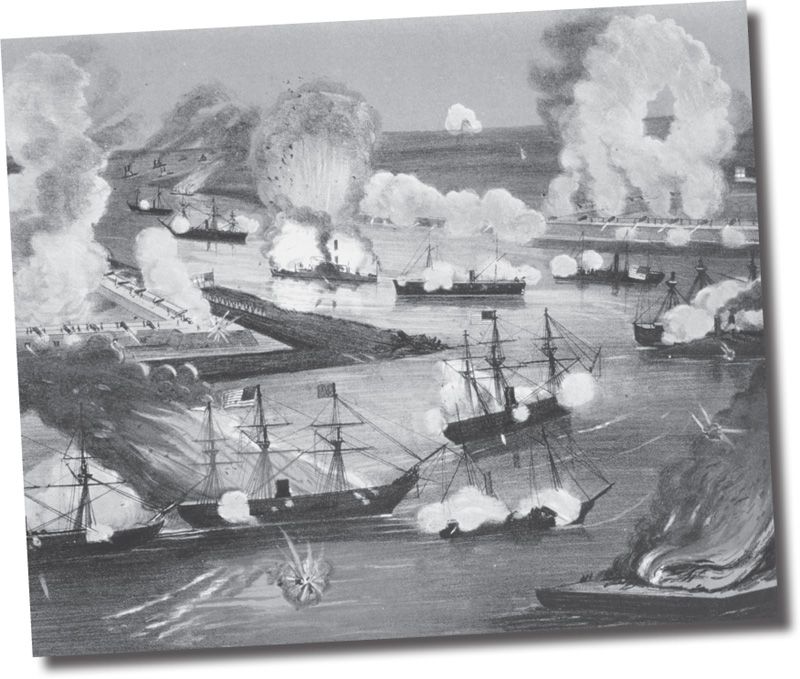
A lithograph depicting the Battle of New Orleans.
1. In fact, it was the squadron of David G. Farragut, and not the mortar squadron of his foster brother David Dixon Porter, that ran past the river forts and compelled the surrender of New Orleans. Porter’s squadron and Butler’s army both remained below the river forts for several more days. Porter, however, had a talent for self-promotion and managed to get his version of events out first.
THE CAPTURE OF NEW-ORLEANS.
APRIL 28
The news of the capture of New-Orleans which we received from the South at a late hour last night, clears up gloriously the mystery which for some time has hung around the movements of our navy and army upon the Lower Mississippi. We had already had intelligence that our bomb ketches1 had opened fire upon Fort Jackson, 60 miles below the city, and yesterday morning we published news derived from the rebels that one of our gunboats had run past that work. But the defenders of the fort, it was said, had sent word to their friends that they were confident of their strength, and were able to endure the shelling as long as our fleet was able to keep it up. That news was up to Tuesday last. It appears certain that, notwithstanding the rebel bombast, Fort Jackson, and probably, also, Fort St. Philip, on the opposite side of the river, were reduced that very day;2 for by the gray dawn of Wednesday morning, our armada had steamed past the fortifications, and by noon it appeared, with power and terror, before the Crescent City. At this point the telegram stops short, and leaves us completely in the dark as to what has been done during the past four days. Whether Gen. BUTLER, as is probable, sent in a demand for the capitulation of the city,3 and what may have followed — a compliance with, or refusal of the terms of the demand — we do not yet know. But it is altogether unlikely that any serious attempt was made to defend the city itself. Indeed, New-Orleans was utterly incapable of defence, when once our fleet got in front of it.4 With a hundred gun and mortarboats riding high above the city, ready to pour down upon it a torrent of fire and iron, it would be madness for the rebels to dream of any other terms than unconditional surrender. It has been thought that the land force accompanying the expedition was too small to repossess a city, which must still count somewhat like a hundred and fifty thousand inhabitants. And so it would be if the military contingent had to act alone. But the fact is, that the naval arm when once raised over the city, was of itself sufficient to hold it in complete subjection. And the only work for the troops would be to seize and garrison some few important positions in the city, raise the Stars and Stripes over the United States property and other public places, and act as a repressive police force. The rebels will be disarmed; the Union element, which is known to be strong in New-Orleans, will be organized; and Gen. BUTLER, from his headquarters in the St. Charles Hotel, will put in force whatever other measures are necessary for the securing of public order.
The seizure of this, the greatest city of the Jeff. Davis Confederacy, will be a terrible disheartenment for the rebels, and is in itself almost equivalent to a defeat of BEAUREGARD’s army at Corinth, if that army has not yet been destroyed by the forces of Gen. HALLECK. At all events, it will compel the rebels of the Southwest to fight their last battle on their present line of operation. BEAUREGARD is pressed, if not already assailed, by HALLECK in front; Gen. [Ormsby] MITCHEL will prevent his retreat toward Mobile; BUTLER forbids his approach to New-Orleans; and our gunboats can pass up the Mississippi and attack Memphis in front — acting in conjunction with Commodore FOOTE above. The way is also opened for the gunboats to pass up the Red River and across the entire State of Louisiana to Shreveport; to pass up the Arkansas River and through the entire State of Arkansas to Fort Smith; and to pass up the Yazoo River and through a great part of the State of Mississippi. In fact, it opens up a passage through more than a half of the remnant of a Confederacy still nominally held by the rebel rulers. Thus, by this splendid stroke of our river navy, we see not only the fall of the Southern Metropolis, but also a moral and territorial gain for the National cause, which far overshadows in importance even this. If the news be allowed to reach the rebel army at Corinth — and it certainly cannot be kept from it for more than a day or two — it must complete its demoralization; for it will demonstrate beyond a peradventure that the cause in which it fights is hopeless. There can be no prospect to the rebels of recapturing the city; for the railroad leading to it will be destroyed, and a descent by the river is impossible. The whole of Southern Louisiana is a vast plain, and in no event can the rebels make a stand anywhere near the city.
New-Orleans is the great commercial and financial emporium of the South. It is to the Gulf coast what New-York is to the Atlantic coast. Its fall will be to the South a worse blow even than the capture of New-York by an enemy would be to the North. Through it more than half of the cotton crop of the entire South passes to the world, while its exports of sugar, molasses, tobacco and corn exceed those of any other Southern city. There is probably not much cotton there now, but the fact that we also virtually possess a great part of the cotton-growing territory, will secure its speedy export with or without the will of the planters.
It is nearly half a century since an enemy appeared before New-Orleans. That enemy was repulsed with a slaughter which renders memorable the plains of Chalmette. But this time an army captures the City almost without loss of blood — though it has doubled its population many times since then. Such are the advances made by science; and such are the irresistible powers which the Nation now brings into the field against its enemies.
The Mississippi is now virtually opened throughout its entire length.5 That was the work which the men of the Northwest laid out for themselves a year ago. The West has done a good share of the work; but it has been left to the men of the East to complete it.

Major General Benjamin F. Butler, U.S.A.
1. These were seagoing vessels under the command of Commander David Dixon Porter that carried large heavy mortars that fired 13-inch projectiles on a high arcing trajectory to bombard targets at extreme range. The shells from these mortars were called “bombs.”
2. The forts were not reduced, but Farragut ran past them anyway on the night of April 24.
3. It was not Butler who demanded the surrender of the city, for his troops were still on transports below the fort. Farragut sent Navy Captain Theodorus Bailey to raise the U.S. flag above the customhouse.
4. New Orleans had been stripped of its defenses in order to reinforce Albert Sidney Johnston on the eve of the Battle at Shiloh.
5. Not quite. Though Farragut took his squadron upriver to Vicksburg, he could not capture the city without a land force. Vicksburg would hold out until July of 1863. See Chapter 14.
THE FLIGHT AND FIGHT IN THE PENINSULA.
MAY 7
It is almost bewildering to attempt to follow the campaign in the Virginia peninsula, as reported in the rapid throng of telegrams. Not one, but half-a-dozen centres of action attract the eye in the complex though converging scheme of operations in front and flank and rear, adopted by Gen. MCCLELLAN for the capture of the enemy. If anything could be unlike the unity of action that has characterized the siege of Yorktown for the past month, it is the exciting and shifting spectacle now presented by the rebel force in mingled fight and flight, pressed and pursued by the Army of the Union.
What were the plans and hopes of the rebel commanders when, to save themselves from certain destruction, they resolved to abandon their stronghold at Yorktown?1 To form a new defensive line this side of Richmond? We can hardly think so; and neither the abandonment of that powerful position, on whose defences ten months’ labor was spent, nor the form of the retreat — leaving behind them vast supplies of cannon, stores and equipments, indispensable in forming a new line of defence — encourages the surmise that they had any such hope. What, in all likelihood, they did and do hope, is to protract the advance of the National force so as to cover the retreat of the rebel “Government” from Richmond, and such of their military force as can be withdrawn. With this view they have established a series of works, extending back the whole line to the rebel capital, and on these works hundreds and thousands of negroes have for months been employed. These will form so many stepping-stones, as it were, where they may make successive stands, and both delay and cripple the advancing Union army. Whether their demoralized force is the stuff with which to carry out this programme, remains to be seen. But it is obviously the plan of the chiefs, and Gen. MCCLELLAN, in his latest dispatch, mentions it as the unanimous testimony of the prisoners taken, that the rebels will “dispute every step to Richmond.”
The first of these stopping-places is Williamsburgh, and here the rear of the enemy, in strong force, has taken up its position, under Gen. JOE JOHNSTON. Indeed, so strong is the enemy at this point, that Gen. MCCLELLAN, who hurried up thither on Monday, found his progress barred by a force a “good deal superior” to his own.2 When, however, the Commander states that his entire army is considerably inferior to that of the rebels, we must, of course, understand thereby the force before Williamsburgh, exclusive of the division of FRANKLIN, then on its way up York River, and the reserves left behind at Yorktown. Our details of the engagement which took place at Williamsburgh on Monday, are yet very imperfect, but it seems to have been a severe encounter, in which our troops displayed all their wonted bravery and vigor, and gained some positive advantages. Gen. MCCLELLAN modestly confines his present intentions to “holding them in check,” but this is qualified by the significant phrase, “while I resume my original plan.”
What does this expression signify? Obviously it means the plan indicated in Gen. MCCLELLAN’s first dispatch of Sunday, sent on the heels of the retreat of the rebels. In this he says: “I move FRANKLIN’s Division and as much more as I can transport by water up to West Point to-day.” It appears, however, that the movement was not executed that day; but the gunboats alone were sent up on a reconnaissance, with intent that the transports should follow if the report proved favorable. We have already intelligence that the gunboats have reached West Point, capturing or destroying many rebel transports on their way, and subsequently landed a force and destroyed a bridge on the railroad leading to Richmond. We may therefore suppose that Gen. MCCLELLAN’s plan was promptly carried out. If so, twenty-five thousand men are now at the neck of the peninsula, a dozen miles in the rear of JOHNSTON’s force, barring its escape to Richmond.3 The entire rebel army is thus confined in a cul-de-sac, with outlet nowhere, and the two Union forces pressing upon it from opposite sides. Whether they fight with the passion of beasts driven to bay and goaded to desperation, or, as they have done on so many other occasions, quietly resign themselves to inevitable fate, their ultimate capture can hardly be escaped. It would be impossible to imagine a more intensely exciting situation than that presented by the campaign in the peninsula, whither all eyes are now directed.
1. Joseph E. Johnston’s Confederate army evacuated its position on the Yorktown line on the night of May 3 and fell back toward Williamsburg. This changed the campaign from one of a static siege to a pursuit.
2. McClellan’s army significantly outnumbered Confederate forces throughout the campaign. At the Battle of Williamsburg (May 5, 1862), Union forces of some 41,000 fought rebel forces of about 32,000.
3. McClellan successfully put a force ashore at Eltham’s Landing at the head of the York River on May 7, 1862, but that force was pushed back by a division under John Bell Hood and did not manage to get behind Johnston’s army.
GEN. McCLELLAN AND THE POLITICIANS.
A LETTER FROM SENATOR WILSON.
MAY 16
Senator [Henry] WILSON [of Massachusetts]1 has fully answered certain charges which have been preferred against him by political opponents, in the following letter:
SENATE CHAMBER, WASHINGTON, MAY 9, 1862.
DEAR SIR: I have this day received your note, in which you say that it is reported by some persons that the Secretary of War [Edwin Stanton], Mr. [Charles] SUMNER, myself and others are interfering with Gen. MCCLELLAN’s military plans. I am sure Mr. SUMNER in no way, directly or indirectly, has interfered or attempted to interfere with any of Gen. MCCLELLAN’s military plans, or with the plans of any other General in the field. Mr. STANTON entered the War Office at a time of anxiety and gloom, when the most thoughtful men of the country were oppressed with solicitude concerning the condition of the country, foreign and domestic. Mr. STANTON carried into the War Office industry, zeal and an iron will, actuated by an intense and vehement desire to promptly crush out this rebellion. He pressed upon all, in both the military and civil service, the importance of prompt and decisive action. He may have committed some errors, but I am sure he has done intentional injustice to none. I do not know that he has ever interfered with any of the plans of Gen. MCCLELLAN, but I do know that he has labored with unflagging zeal to place all the resources of the Government at the disposal of Gen. MCCLELLAN and other military commanders. I believe that EDWIN M. STANTON deserves, not the censure, but the gratitude of all men who would promptly suppress this unhallowed rebellion.
I have never interfered, either directly or indirectly, with the plans of Gen. MCCLELLAN, or an other of our military Commanders, nor has the Military Committee or any of the members of that Committee so interfered. The Military Committee, composed of four Republicans and three Democrats, is now, and has been, a unit in regard to military affairs. The members of the Committee may have their opinions in regard to men and operations in the field, and as individuals they may have canvassed the acts of military men with that freedom with which American citizens and legislators may canvass the acts of public men in civil and military life, but they have not in Committee, or in the Senate, or elsewhere, attempted in any way to interfere with the plans of military commanders, or to advise Congress or the Government to interfere with those plans. The members of the Committee have never been actuated by partisan feelings in regard to military appointments or operations. Since the war commenced, nearly 2,500 names have been before the Committee to be canvassed and passed upon; of this number nearly 250 were Generals. I have never been actuated by political considerations in any of these nominations, and I am sure I can say the same for each of the other members of the Committee. I have aided in securing the appointment in the army of nearly one hundred citizens of Massachusetts. I am sure that at least half of them are men who are politically opposed to me, and some of them, or their relatives and friends, have been the most active of my political enemies....
I have believed, and I have acted upon the belief, that it was my duty, as a member of the Senate, and Chairman of the Military Committee, to support Gen. MCCLELLAN and other military commanders, and to place at the disposal of the War Department the resources of the country, and to leave the responsibility of action with the Executive Department and the military commanders. The other members of the Committee, and I think I may say that nearly all, if not all, the members of the Senate, concur in this opinion. Gens. SCOTT, MCCLELLAN, FREMONT, MCDOWELL, BANKS, BUTLER, BURNSIDE, and other leading Generals, can bear ample testimony to this statement, in regard to the operations in the field, as in civil affairs, I form my opinions from the facts that come within my knowledge, and, as is my habit, have expressed these opinions freely, perhaps too freely, but I am not the partisan or the enemy of any of our military commanders. I go as far as he who goes the farthest in applauding the successful efforts of any and all of our military men. I regret to see that we have a class of men who are swift to censure and arraign others, both in the civil and military service, who are striving to impress the country with the conviction that there is in Congress a party disposed to interfere with the plans of Gen. MCCLELLAN. To accomplish their objects, some of these people do not scruple to misquote or misrepresent the feelings, words and acts of the men the seem desirous of placing in a false position, but such conduct can only harm themselves.
VERY TRULY YOURS, HENRY WILSON.

Senator Henry Wilson of Massachusetts.
1. Senator Henry S. Wilson of Massachusetts (1812–1875) was a staunch Republican and antislavery activist who was chairman of the influential Senate Military Affairs Committee. He subsequently became Vice President of the United States during Grant’s second term.
NEWS FROM WASHINGTON
THE PROCLAMATION OF GEN. HUNTER.
HIS IMMEDIATE RECALL PROBABLE.
MAY 18
The more that is known of Gen. HUNTER’s instructions from his Government, the more indefensible and insubordinate does his conduct appear.1 It is conceded now that the President not only did not authorize his foolish proclamation, freeing the slaves of three States, but he actually forbade him to issue any proclamation whatever. There was deep regret in Washington when Gen. SHERMAN, who had done all the hard work in South Carolina and Georgia, was superseded, and HUNTER sent to reap the laurels of Pulaski’s reduction. HUNTER lately abandoned the while Unionists at Jacksonville, Fla., to unnamed cruelties from the rebels, because, as he alleged, he had nut forces enough in his Department to protect them, But while not able to free loyal whites from oppression, he undertakes the liberation of a million blacks. His removal from command is a foregone conclusion. The President to-day said to a Senator that he was waiting for authentic information, and that if Gen. HUNTER had either given free papers to negroes or issued the proclamation attributed to him, he would immediately suspend him from his command....
1. On May 9, Major General David Hunter (1802–1886), in command of the Department of the South, declared all slaves within his command area to be free.
IMPORTANT FROM WASHINGTON.
GEN. HUNTER’S ORDER REPUDIATED BY THE PRESIDENT.
MAY 20
Whereas, There appears in the public prints what purports to be a proclamation of Major-Gen. HUNTER, in the words and figures following, to wit:
HEADQUARTERS DEPARTMENT OF THE SOUTH, HILTON HEAD, S.C., MAY 9, 1862.
GENERAL ORDERS, NO 11. — The three States of Georgia, Florida and South Carolina, comprising the Military Department of the South, having deliberately declared themselves no longer under the protection of the United States of America, and having taken up arms against the said United States, it becomes a military necessity to declare them under martial law. This was accordingly done on the 25th day of April, 1862. Slavery and martial law in a free country are altogether incompatible. The persons in these three States, (Georgia. Florida and South Carolina,) heretofore held as slaves, are therefore, declared forever free. [Official,] DAVID HUNTER,
MAJOR-GENERAL COMMANDING.
ED. W. SMITH, ACTING ASST.-ADJT.-GEN.
And whereas, The same is producing some excitement and misunderstanding;
Therefore, I ABRAHAM LINCOLN, President of the United States, proclaim and declare, that the Government of the United States had no knowledge or belief of an intention on the part of Gen. HUNTER to issue such a proclamation, nor has it yet any authentic information that the document is genuine; and, further, that neither Gen. HUNTER, nor any other Commander or person, has been authorized by the Government of the United States to make proclamation declaring the slaves of any State free, and that the supposed proclamation now in question, whether genuine or false, is altogether void, so far as respects such declaration. I further make known, that whether it be competent for me, as Commander-in-Chief of the army and navy, to declare the slaves of any State or States free; and whether at any time, or in any ease, it shall have become a necessity indispensable to the maintenance of the Government to exercise such supposed power, are questions which, under my responsibility, I reserve to myself, and which I cannot feel justified in leaving to the decision of commanders in the field. These are totally different questions from those of police regulations in armies and camps.
On the 6th day of March last, by a special message, I recommended to Congress, the adoption of a joint resolution, to be substantially as follows:
Resolved, That the United States ought to cooperate with any State which may adopt a gradual abolishment of Slavery, giving to such State in its discretion to compensate for the inconveniences, public and private, produced by such change of system.
The resolution, in the language above quoted, was adopted by large majorities in both branches of Congress, and now stands an authentic, definite and solemn proposal of the nation to the States, and people most immediately interested in the subject matter. To the people of these States I now earnestly appeal — I do not argue, I beseech you to make the arguments for yourselves. You cannot, if you would, be blind to the signs of the times. I beg of you a calm and enlarged consideration of them, ranging, If it may be, far above personal and partisan politics. This proposal makes common cause for a common object, casting no reproaches upon any. It acts not the Pharisee. The change it contemplates would come gently as the dews of Heaven, not receding or wrecking anything. Will you not embrace it? So much good has not been done by one effort in all past time, as in the Providence of God it is now your high privilege to do. May the vast future not have to lament that you have neglected it.
In witness whereof I have hereunto set my hand and caused the seal of the United States to be affixed.
Done at the City of Washington this 19th day of May, in the year of our Lord one thousand eight hundred and sixty-two, and of the Independence of the United States the eighty-sixth.
ABRAHAM LINCOLN.
THE PRESIDENT AND GEN. HUNTER.
MAY 20
No one can be surprised by the announcement that Gen. HUNTER’S military order, emancipating all the slaves in South Carolina, Georgia and Florida, on the absurd pretext that “martial law and Slavery are incompatible in a free country,” is repudiated by President LINCOLN. Gen. HUNTER will be largely indebted to the President’s forbearance if he is not recalled. His order involved a very gross departure from his official duty, was utterly unjustifiable in itself, and was calculated very greatly to embarrass the General Government in its great task of dealing with the rebellion.
From the very beginning of this rebellion, President LINCOLN has been perfectly clear and decided on the subject of Slavery. He has refused to make this war one of emancipation, and has steadily treated it as designed to restore the integrity of the Union and the supremacy of the Constitution. He has not yielded one iota to the fierce and relentless pressure brought to bear upon him in favor of a sweeping abolition policy. He required Gen. FREMONT to modify his proclamation of freedom to the slaves of rebels, so as to conform strictly to the law of Congress. He has more than once declared himself hostile to any scheme of emancipation which was not gradual in its operation, which did not compensate the owners and which did not provide for colonizing the enfranchised slaves. He is not likely, to change these views merely to accommodate Gen. HUNTER. This country has had no President for years who has shown greater tenacity of purpose — a more fixed and immovable adherence to a line of policy — than President LINCOLN. He has his own views of the public exigency and of the way to meet it. He knows the objects to be accomplished and how to reach them. He has evinced all the firmness of JACKSON without his violence, and enjoys all his popularity without its drawbacks. He commands to-day the confidence of the American people to a degree unsurpassed by any of his predecessors. Such a man is not likely to surrender his own opinions or to abandon his own policy, without better reasons than those assigned by Gen. HUNTER. It is urged in defence of the General’s act, that the yellow fever season is approaching, and that he needs acclimated negroes to work upon his fortifications. He gives no such reason for his decree. He bases his action on no such ground. Besides, the yellow fever is not to be averted by a military order, nor can laborers be commanded by such a process. If he needs slaves for work, let him seize them for military purposes; his powers are ample for so doing. But proclaiming their freedom neither swells the numbers of his workmen, nor gives him command of their labor. So far as practical results are concerned, it is brutum fulmen. If it takes effect and actually frees the slaves, it plunges those States into an abyss of blood and terror which might glut the most wolfish hatred, but which could not contribute in the least toward the peace and union which the war professes to seek.
We have very little doubt that Slavery is to receive its death-blow at the hands of this rebellion. That its political power is already destroyed no sensible man can doubt. The day has gone by forever when Slavery could dictate the policy of the General Government — control the action of nominating Conventions, terrify Congress into the enactment of laws for its special benefit, or ostracise those who refuse to believe in its divinity as unfit for public office in a free Republic. If the rebellion were to end today, and every Southern State were to return to the Union, the slaveholding interest would hold forever hereafter only a secondary and subordinate position in the Government of the country. That the leaders of the rebellion will consent that it should hold such a place without a further struggle for the maintenance of its supremacy, is not probable. They will fight on its behalf to the end. But the contest now is with the political power of Slavery. The point to be decided is, which of the two, Slavery or the Constitution, is strongest in the control of the Government.
We believe that Slavery will be beaten in the battle, and that the supremacy of the Constitution will be maintained. We hope that its supremacy will be restored over every State and every part of our common country, without any such violent rupture of their local institutions as shall plunge them into social chaos. The political power of Slavery will be forever destroyed. Its supreme dictatorship over thought and speech and freedom of action, will be annihilated. If this result can be accomplished now, all the rest will follow in due time. Slavery, as a form of labor, as a social institution, cannot long survive its downfall as a political power. And its extinction will be most safely reached, if it shall thus come gradually, as a result of the working of social laws, with due preparation, and accompanied by just guiding and restraining influences.
When the military power of the rebellion has been broken, we shall be able to judge of the possibility of such an issue. If the Southern people shall then insist on peace, and accept it on terms honorable to themselves, and safe for the Union, we may hope for a return of our former material prosperity, with a healthier and better development of our political principles. If they refuse peace, and still insist on war, — if after their armies have been defeated, and their resources exhausted, they persist in gratifying their blind and baseless hatred of the Government of the Union, they must be prepared for such a form of war as the emergency may require. They will then have no right to complain if their whole land should be swept with the besom of destruction, and its social forms and usages replaced by others more in conformity with the civilization of the age and the principles of the Government under which we live.

Major General David Hunter, U.S.A.
THE RETREAT OF GEN. BANKS.
HIS WHOLE FORCE AND TRAINS ACROSS THE POTOMAC IN SAFETY.
MAY 27
WASHINGTON, MONDAY, MAY, 26
The following was received at the War Department, at 11 P.M.:
WILLIAMSPORT, MONDAY, MAY 26 — 4 P.M.
To the President:
I have the honor to report the safe arrival of my command at this place last evening at 10 o’clock, and the passage of the Fifth Corps across the river to-day, with comparatively but little loss. The loss of men in killed, wounded, and missing in the different combats in which my command has participated since the march from Strasburgh on the morning of the 24th inst., I am unable now to report; but I have great satisfaction in being able to represent that, although serious, it is much less than might have been anticipated, considering the very great disparity of forces engaged, and the long-matured plans of the enemy, which aimed at nothing less than the entire capture of our force. A detailed statement will be forwarded as soon as possible. My command encountered the enemy in a constant succession of attacks, and in well contested engagements at Strasburgh, Middletown, Newton, at a point also between these places, and at Winchester. The force of the enemy was estimated at from 15,000 to 20,000 men, with very strong artillery and cavalry supports.
My own force consisted of two brigades, less than 4,000 strong, all told, 1,500 cavalry, ten Parrot guns, and six smoothbores. The substantial preservation of the entire supply is a source of gratification. It numbered about five hundred wagons, on a forced march of fifty-three miles, thirty-five of which were performed in one day, subject to constant attack in front, rear, and flank, according to its position, by the enemy in full force....
Our troops are in good spirits, and occupy both sides of the river.
N.P. BANKS, MAJOR-GENERAL COMMANDING.
WHAT IS THOUGHT IN WASHINGTON.
MAY 27
WASHINGTON, MONDAY, MAY 26
The repulse of Gen. BANKS from the Shenandoah Valley excited the greatest surprise because the country was kept so ignorant of his force. It turns out that, instead of having a corps d’armee and “a large force,” as you state in Sunday’s TIMES, and as the country generally has believed, he had not more than a full brigade left to him when he was attacked by the enemy. BANKS repeatedly and earnestly protested against bring stripped of his command; and many of his friends advised him to resign, but this he bravely refused to do. There is felt to be a heavy responsibility on somebody in this matter, and it is not just to put it all on Secretary STANTON. The President magnanimously “takes the responsibility,” but it is well known he only “permitted to be done” that which his own judgment disapproved.
The enemy’s raid is at an end, and has fallen far short of his expectations, and the country may yet have reason to rejoice in what has occurred, if it shall result, as every one hopes, in the President’s throwing off the dangerous counsels he sometimes yields to, and trusts more to his own clear head and honest heart.
There is no need for a moment’s anxiety about Washington, and Gov. ANDREW’s Proclamation No. 2 excites a general smile.1 Gen. JACKSON’s rebel army is probably nearer to Staunton, Virginia, at this reading, than he is to Washington, and much more anxious to reach the former place than the latter.
The events of the two past days have wonderfully stimulated our Government, and there is now a “movement along the whole line.” Dress parades at Fredericksburgh, it is supposed, will cease, and Cabinet visits to that point be suspended till the war is over. On the whole, the martial aspect of affairs is more encouraging since the escapade of Gen. JACKSON than before.
There is universal sympathy felt and expressed here [Washington] for Gen. BANKS, and the hope of all is that he may be furnished an army suitable to his rank, and allowed to become his own avenger... and the fact that he retreated so far in the face of an enemy so overwhelming, and crossed his men in good order and good spirits, is taken as proof of the highest generalship. No other course could have kept JACKSON from crossing into Maryland.
The dispatch this morning received from Gen. BANKS, dated at Williamsport, Md., and announcing the belief that his whole force, trains and all, would cross the Potomac in safety, was hailed with the liveliest satisfaction. The dispatch from the Secretary of War which Gen. BANKS refers to as having read to his troops amid the liveliest cheers, is understood to have contained the thanks of the President and Secretary, for his excellent conduct of the retreat. High military authority pronounces it one of the most masterly movements of the war, and regular officers here, who have been slow to acknowledge the generalship of Gen. BANKS, now accord to him great tact and ability as a commander. The fact that at Winchester, with a small force of less than five thousand men, he stubbornly held his ground, and resisted the enemy’s force of three times his own, and afterwards retreated in order, is taken as evidence of superior generalship.
There are no details of the fight at Winchester.2 The allusion to it in the dispatch of Gen. BANKS creates anxiety among the friends of troops in his command. It is feared that many of the wounded were of necessity left to the mercy of the enemy.
A report was circulated this afternoon — probably founded on an intimation in the dispatch of BANKS to the effect that JACKSON has drawn back his advanced force, and was not likely to attempt to get possession of the Baltimore and Ohio Railroad, although he swore an oath when routed by [James] SHIELDS, to seize that thoroughfare at an early day. He may again have to make good his escape from the gallant Irish Brigadier.
The steps taken to regain the lost ground would, if known to the public, establish the vigilance of the President; but for prudent reasons they must not be developed at this time.3 It is enough to say that they are considered all sufficient to insure not only the safety of the capital, but also to prevent the further advance of the enemy in the direction of the Potomac, and probably to insure the capture, bag and baggage, of JACKSON’s entire force. Should the well devised plans be carried out, as there is every reason to suppose they will be, what yesterday seemed a serious disaster to our cause may be made to result in a very decided and important triumph over the enemy.
1. On March 11, 1862, Governor John A. Andrew (1818–1867) of Massachusetts issued a proclamation calling for “Thursday, the third day of April next, to be observed throughout this Commonwealth, as a day of public HUMILIATION, FASTING, AND PRAYER.”
2. At the Battle of Winchester (May 25, 1862), 16,000 soldiers under Jackson attacked and routed a force of 6,500 under Banks. Union forces suffered 2,000 casualties to the Confederates’ 400.
3. President Lincoln determined to trap Jackson in the lower valley by directing Fremont from western Virginia, and James Shields’ division of McDowell’s Corps, to move into the valley. Jackson managed to avoid the trap by hard marching.
WHAT STONEWALL JACKSON HAS DONE FOR THE UNION.
MAY 30
The raid of the rebel JACKSON down the Shenandoah Valley, has not been without its most salutary fruits. In this case, as in so many others during the progress of the unholy rebellion against our Government, our reverses have seemed designed by Providence to strengthen and glorify our cause....
The Union is stronger for this sudden attack upon a weak point. It has awakened the country to an appreciation of Major.-Gen. N. P. BANKS, one of the ablest and most useful of our chieftains and statesmen. It has drawn out, in the most unexpected manner, new and gratifying evidence of the inexhaustible patriotism and resources of the Union — rendering it sure that our Government is more than equal to any possible strain that may come upon it. So much has the raid of JACKSON done for the Government per se.
On the other hand, the result cannot but be most disheartening to the enemy. They have boasted always of their ability to bring the war into the loyal States; and they threaten often to do so. They have professed to believe that Maryland is enslaved, and that on the first appearance of a rebel army on her borders, her people would break out in irrepressible revolt against the Government at Washington. The raid of JACKSON extinguishes both delusions. They find how signally a distinguished General has failed, under circumstances more favorable than will ever occur again, to put a single rebel soldier on the soil of a loyal State. And they find how Maryland, instead of springing to arms to hail their coming as that of deliverers, is set a-surging with loyal indignation at their approach, bringing speedy and fierce punishment on every manifestation of sympathy with the rebel cause....
For all these blessings that we have enumerated, and for many more that we could easily call attention to, have we not reason to thank STONEWALL JACKSON, and him only? No man on our own side, animated by the best intent, could have done so much in a single campaign for the strengthening of the Union cause as he has done.

An Edwin Forbes sketch of the Battle of Cross Keys during Jackson’s Shenandoah Valley Campaign.
THE PROGRESS OF THE CAMPAIGN.
MAY 30
To the public, at the present moment, military and naval operations seem everywhere to have come almost to a dead halt. The main body of our Eastern Army is, and has been since the early part of the month, in front of the rebel Capital, and of the main body of the Eastern rebel army; but nothing more decisive than a few skirmishes have yet taken place. The main body of the Army of the West has been planted before Corinth ever since the battle of Pittsburgh [Shiloh]; a period of now three months; but of its doings we know nothing excepting the fact that it has not yet fought a battle or moved upon the enemy’s works. These two mighty armies — jointly numbering over two hundred thousand men — have certainly not been inactive during their respective brief periods of pause; but neither have they dazzled the public with any of those grand actions which have been by it daily expected.
So also it is and has been for some length of time, with the minor divisions of the army. Gen. MCDOWELL has been between one and two mouths on the Rappahannock, and his column has lain there peacefully since the beginning, and in tranquility remains there still. Gen. FREMONT has been in the mountains of Western Virginia, with a very respectable force, for some time; but excepting one or two engagements of small detachments of his army, he has done nothing. Gen. BURNSIDE has been quiescent for a month; Gen. HUNTER for a still longer period; and our troops in Florida do not take possession of that easily captured State. Our iron-clad gunboats are stuck just below Richmond; our flotilla is stuck just above Fort Pillow; and there being no rebels on the sea now to fight, our navy is everywhere at its ease.
This state of things contrasts strongly with the extraordinary activity all along the line, in the two months preceding the one just passing away. Then all around rebeldom was daily and ceaselessly heard the thunderings of war. Great battles fought; great armies driven back; great cities captured and states repossessed; forts falling daily; strategic positions occupied; and both our navy and army furnishing, through each morning’s newspaper, some new illustration of their prowess and activity.
All these things stood out largely before the public eye, and fully satisfied the demand that our army should do something. These victories have greatly altered the aspect of the rebellion, and, it must be remembered, have necessarily altered somewhat the look of the campaign’s progress. We cannot continue to take forts every day; they are nearly all taken now. We cannot enjoy a captured city with our breakfast every morning; there are only two or three more rebel cities worth capturing. We cannot expect to see the rebel army of the West fall back from Corinth as it fell back from Bowling Green; for where now shall it fall back to? We can hardly hope to see the rebel army of the East fly as suddenly from Richmond as it previously fled from Manassas and from Yorktown; for to give up the rebel Capital is virtually to give up the rebel cause. All this great but still minor work is now done; and there needs only the defeat or dispersion of the two great rebel armies at Corinth and Richmond before the whole rebellion is brought to a close. An assault on these two points, and on these two armies, is a thing not at all similar to any of the previous and preparatory operations.
Before Richmond and Corinth, the whole strength of the South is arrayed. To suffer a repulse at either place would be to incur a fearful risk. Our military leaders, therefore, are wise in being cautious of prematurely beginning assaults, and in making such preparations as will enable them to throw against the enemy all the force that can possibly be rendered available. This, the daily chronicle of events and movements shows they are doing. And, though the impatient public may not be gratified every day with a new and glittering victory, it can see that, from these preparations, the consummation of victory will speedily be realized.
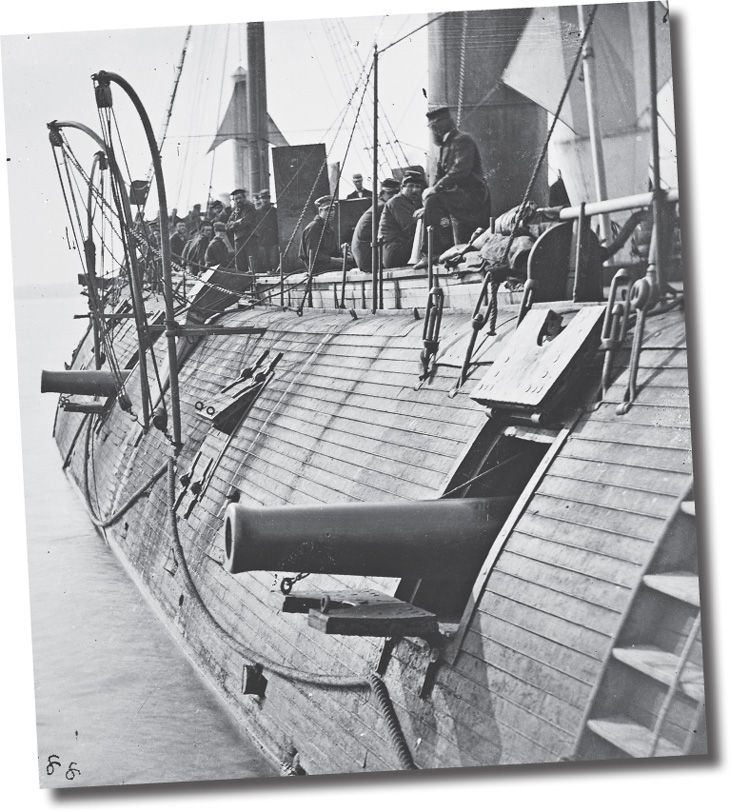
Federal ironclad gunboat Galena patrols the James River.
WHAT ARE OUR IRON-CLADS DOING?
MAY 30
It seems, as matters now stand, that our fleet of iron-clad gunboats on the James River is destined to have no part in the operations against Richmond. Ever since their repulse from Fort Darling, a fortnight ago, they have been, and are still, lying idle, fifteen or twenty miles below City Point.1
We cannot but think this is a great mistake. Their cooperation would secure the immediate capture of Richmond, and would also secure important results attainable by no other means. Whether the rebel army in front of Richmond is beaten there or concludes to evacuate the city, its retreat in either case must be by a line that can be completely commanded by our gunboats. Let them either destroy or hold the railroad bridge of the Danville line across the James River at the Capital, while they do the same by the line of communication over the Appomattox at Petersburgh, (within easy striking distance of our fleet from where it now is,) and the only two routes of retreat southward will be effectually cut off. This omitted and the best strategy of MCCLELLAN will be unavailing — the rebels will make good their flight.
We fear there is no evidence that the Navy Department proposes pursuing this course. The inference is either that it regards the task as impracticable, or the end to be gained as not worth the effort. We can hardly suppose that even the Navy Department will be so blind as to take the latter view; we must, therefore, conclude that it regards the obstructions and defences between Fort Darling and the rebel Capital as too formidable to repeat the attempt. We have no precise information as to the nature of these obstructions; but it is well known that they are of recent adoption, and it is also well known that no obstructions can be placed in the channel of a river that cannot be cleared away or blown up in a few days. All our previous naval expeditions have found their course arrested by similar devices, and notably in the approach to New-Orleans every form of obstruction that rebel ingenuity could devise — sunken vessels, chains, torpedoes, fire-ships and what not — were placed to retard the passage of our fleet, which, mark well, were not iron-clads, but wooden gunboats. But engineering skill made short work with these impedimenta. The same skill and energy would speedily send our fleet to Richmond. At least we should like to see it tried, in place of that inertia that keeps our iron-clad vessels lying idle for a fortnight.
1. A squadron of navy warships, including the partially armored USS Galena and the ironclad USS Monitor, attacked Confederate defenses at Drewry’s Bluff just seven miles downriver from Richmond on May 15, 1862. The attack was driven off, and the Galena in particular suffered severe damage.