
CHAPTER 9

General McClellan’s headquarters near Yorktown, Virginia.
The dominant news story in the summer of 1862 was the progress — or lack of progress — of George McClellan’s Peninsular Campaign in Virginia. Then on the last day of May, the rebel army under Joseph E. Johnston struck at McClellan’s army outside Richmond. The Battle of Fair Oaks, also called the battle of Seven Pines, was not strategically decisive, but it did have two important results: first, Johnston himself fell wounded and had to give up command to Robert E. Lee, who proved far more aggressive than his predecessor; and second, McClellan was so appalled by the heavy losses that he became even more cautious. In effect, the initiative in the campaign passed from the Federals to the Confederates.
Unsurprisingly, these circumstances increased the number of McClellan’s public critics, including several Northern newspapers that called for McClellan to be replaced. The Times continued its support, but that support had its limits. After Lee launched a series of headlong counterattacks against McClellan’s army in late June, in a campaign known to history as the Seven Days Battles (June 26–July 1, 1862), even The Times had to acknowledge that “the public faith in his ability to lead an army in the field to victory, has been greatly shaken.” In late July, Lincoln summoned Major General Henry W. Halleck from the Western Theater to assume command as general-in-chief, a title once held by McClellan.
As the summer marked McClellan’s fall, it also marked the rise of Robert E. Lee. Previously the military advisor to Jefferson Davis, Lee made the army his own, and even though the Seven Days Battles were more costly to the rebels than to the Union, Lee succeeded in driving off the approaching foe, and Richmond celebrated its deliverance and its new savior. The other Southern hero that summer was Thomas “Stonewall” Jackson, whose rampage through the Shenandoah Valley, followed by a quick movement to Richmond to join Lee during the Seven Days, made him as exalted a Southern icon as Lee himself. Though The Times initially disparaged both Jackson and his campaign, dubbing him “that old rebel hypocrite and knave,” by July The Times was wondering if there was a “danger of his taking a column, and with it marching suddenly in the direction of Washington?”
There was news from the West, too. In Louisiana, Major General Benjamin Butler earned the criticism of Southerners and Unionists alike in his role as the occupier of New Orleans. Annoyed that the women of the city were making disparaging remarks whenever they passed a Union officer on the sidewalks, he issued an order declaring that “whatever woman, lady or mistress, gentle or simple, who, by gesture, look or word, insults, shows contempt for, thus attracting to herself the notice of my officers and soldiers, will be deemed to act as becomes her vocation as a common woman.” Such aspersions on Southern womanhood enraged the local population. But Butler also earned the opprobrium of Unionists when, after encouraging runaway slaves to come within the Union lines, he issued an order to “to turn out all [blacks] not employed by the officers.”
Upriver from New Orleans, the fighting continued at Vicksburg (which The Times spelled “Vicksburgh”) where the Union gunboat squadron of Charles Henry Davis coming from the north, and the ocean-going squadron of David Glasgow Farragut coming from the south, joined to assail the Confederate bastion. Despite a severe bombardment, it soon became evident that Vicksburg could not be taken without troops.
Finally, the character of the war itself continued to evolve. The Second Confiscation Act, signed into law on July 17, 1862, declared that “every person who shall hereafter commit the crime of treason against the United States” would lose his property, including “all his slaves” who would “be declared and made free.” Many in the North did not see this as progress. A bitter and poisonous unsigned editorial printed on June 14 was a reminder that racism remained a powerful sentiment in the North as well as in the South. At the same time, however, Congress debated the wisdom of arming slaves for combat. The war for Union was already becoming a social revolution.

The Battle of Fair Oaks.
McCLELLAN VINDICATED BY HALLECK.
JUNE 1
The evacuation of Manassas by the rebels was the signal for an outcry against Gen. MCCLELLAN, because he had not prevented it. And when Yorktown was evacuated, the same outcry was repeated. And men asked why he had not attacked the rebels, why he had not prevented their retreat, why he had not known of it before, and there were not wanting those who intimated that MCCLELLAN could not do anything except build fortifications, and that if we expected to have anything done on the east of our line, in the way of fighting, we should have to send for Gen. HALLECK to take the chief command.
We look with some interest to see how the gentry who thus howled after MCCLELLAN will look upon the recent evacuation of Corinth.1 They cannot treat it as an evidence that HALLECK is not a fighting General, because their mouths will be stopped by their own statements made heretofore, that he was the man, and that all the fighting took place in his Department. They will either have to give up HALLECK, too, or else to admit that victories are won sometimes by the trench and the battery, as well as by the sword and bayonet. Whatever conclusion they come to, however, the country will recognize the fact that these three evacuations have been three of the greatest victories of the war. The Richmond papers so recognize them. One of these papers, in an article upon the subject, quotes very appositely the answer of MARIUS to SILA — “If thou art a great general, MARIUS, come down and fight.” “If thou art a great general, SILA, make me come down and fight.”2 The fact was that MARIUS was a great general, and, though we doubt not that at the time he was scoffed at by those who stayed at home in Rome for staying behind his intrenchments, he could afford to wait for time to do him justice. And so will it be with our leader. He will not fight till he is ready, unless, indeed, the rebels have some greater general, who can make him fight, which has not yet been shown. And, when the time does come, we doubt not he will show himself as good a fighter as MARIUS ever was.
1. After the Battle of Shiloh, Beauregard retreated to the railroad crossroads of Corinth, Mississippi. Halleck, with a vastly superior army, followed and slowly began to encircle the position. On May 30, Beauregard quietly decamped, leaving Halleck the prize but without an engagement. The Times notes that this was similar to what happened to McClellan at Manassas. Yet while McClellan was excoriated for being too cautious, Halleck was praised for his strategy.
2. Gaius Marius and Lucius Cornelius Sulla (not Sila) fought in the Roman Civil War of the first century B.C.
OUR NAVY AT NEW-ORLEANS.
JUNE 3
For some inscrutable reason, the Navy Department has thus far withheld from the public the official reports of the naval officers engaged in the memorable action which led to the capture of New-Orleans. We are thus compelled to rely for our knowledge of what was done upon such newspaper correspondence as the authorities permit to see the light, and upon private letters to friends at home. One of the latter, which has been handed to us, contains some interesting memoranda concerning the participation in the fight of the Brooklyn, Capt. [Thomas T.] CRAVEN. The Press has made the fact pretty widely known already, that this ship bore the brunt of the fight, and that her commander behaved in the most gallant manner. But the following paragraph, from the private letter referred to, gives still further testimony on this point. The writer says: “After the battle Flag-Officer FARRAGUT took Capt. CRAVEN by both hands, and said publicly, ‘You and your noble ship have been the salvation of my squadron. You were in a complete blaze of fire, so much so that I supposed your ship was burning up. I never saw such rapid and precise firing. It never was surpassed, and probably was never equaled.’” This is high praise and from a high quarter, but all the reports thus far received show that it was deserved.
EMANCIPATING THE SLAVES OF REBELS.
JUNE 5
[The] House yesterday voted to reconsider the slaves of rebels confiscation bill,1 which was rejected by a very close vote a fortnight ago. The majority for reconsideration was 21, the total vote being; for, 84; against, 65. It is not likely that the rejected bill will pass the House or become a law in its original form; but the necessity of some action in the premises is admitted on all hands. Probably not less than a hundred thousand slaves have been directly engaged in forwarding this rebellion; and leaving out altogether Slavery as the ultimate inducing cause of the revolt, it is very doubtful whether, in a military point of view, it could have attained anything like its present proportions without the labor and the aid of Southern slaves. It cannot be that this rebel live stock shall be protected and preserved for the future use of the rebels. It cannot be that we should neglect to inflict a just punishment upon the slaveholding traitors and usurpers who have plunged the country into this bloody war. Still, hasty action on a subject of such vast and enduring import is dangerous to all parties: and while justice should be inexorably administered, it should also be administered discreetly, and in such a manner as not to reflect unjustly upon those who may be innocent. There is no doubt of the correctness of the oft-made assertion, that a large part of the Southern people was forced into this rebellion. As things went, it was a virtual impossibility for them to resist it. When, then, the question of confiscation assumes a practical shape, these men should have an opportunity of proving their virtual innocence. Neither their civil rights nor their estates should be interfered with, without trial; and it is to be hoped that the bill which may pass Congress will make ample provision for this. It must not be forgotten that while the people of the South had a duty of fealty to the Government, the Government also had a duty of protection to them; and that the Government is morally as culpable for failing in its imperative duty as the loyal men of the South were for failing to do their whole duty. We do not say that when the protection due the Southern loyalists was for so long a time withheld, the latter were inexcusable for succumbing to the de facto powers. We only say that there was a joint culpability of citizen and Government. And as soon as the Government, by suppressing the rebellion, sets itself right toward the Southern people, the latter also should have an opportunity to set themselves right toward the Government. For convicted traitors — for those who have willingly furnished slaves to aid the rebel cause, there should be punishment and confiscation severe and exemplary; but, as we already said, in providing for this, care should be taken that the innocent do not suffer with the guilty. We are glad to learn that the feeling of Congress is in favor only of judicious legislation on the question.
1. The First Confiscation Act of August 6, 1861, had authorized the confiscation of slaves who worked for the Confederate military. The act under debate here became the Second Confiscation Act, and freed the slaves of any Confederate official, military or civilian, who did not surrender within 60 days of the act’s passage.
GEN. McCLELLAN TO HIS SOLDIERS.
JUNE 6
McCLELLAN’s HEADQUARTERS, TUESDAY EVENING, JUNE 3
The following address was read to the army this evening at dress parade, and was received with an outburst of vociferous cheering from every regiment:
HEADQUARTERS ARMY OF THE POTOMAC, CAMP NEAR NEW-BRIDGE, VA., JUNE 2, 1862.
SOLDIERS OF THE ARMY OF THE POTOMAC:
I have fulfilled at least a part of my promise to you. You are now face to face with the rebels, who are held at bay in front of the Capital. The final and decisive battle is at hand. Unless you belie your past history, the result cannot be for a moment doubtful. If the troops who labored so faithfully, and fought so gallantly, at Yorktown, and who so bravely won the hard fights at Williams-burgh, West Point, Hanover Court-house and Fair Oaks, now prove worthy of their antecedents, the victory is surely ours.
The events of every day prove your superiority. Wherever you have met the enemy you have beaten him. Wherever you have used the bayonet, he has given way in panic and disorder.
I ask of you now one last crowning effort. The enemy has staked his all on the issue of the coming battle. Let us meet him and crush him here, in the very centre of the rebellion.
Soldiers, I will be with you in this battle, and share its dangers with you. Our confidence in each other is now founded upon the past. Let us strike the blow which is to restore peace and union to this distracted land. Upon your valor, discipline and mutual confidence the result depends.
(SIGNED,) GEO. B. MCCLELLAN, MAJOR-GENERAL COMMANDING.

A Currier and Ives lithograph of Brigadier General Thomas Meagher commanding troops at the Battle of Fair Oaks.
THE REBEL GEN. JO. JOHNSTON REPORTED TO BE MORTALLY WOUNDED.
JUNE 7
McCLELLAN’S HEADQUARTERS, JUNE 6
Two deserters, who came in this morning, state that Gen. Jo. Johnston was seriously, if not mortally wounded, through the groin, by a Minie ball, during the late battle. Gen. G.W. SMITH is now in command. Other information received goes to corroborate the report.1
These deserters state that the rebel loss is estimated at ten thousand in killed, wounded and missing.2
No material change has taken place in the position of the enemy.
A contraband has arrived who left Richmond yesterday. He represents things there as in a terrible state of confusion and uncertainty. No troops are in the city excepting those doing guard duty and attending to the sick and wounded, all being compelled to remain outside.
There were no signs of evacuation; but, on the contrary, everything goes to show a determined resistance on the part of the rebels....

A Sanitary Commission lodge at Alexandria, Virginia.
1. Joseph E. Johnston was wounded twice on May 31: hit in the shoulder by a musket ball, and struck in the chest and thigh by fragments from an artillery shell. Though it was feared he had been killed, he survived the battle and, later in the war, he commanded Confederate armies in the West. Gustavus Woodson Smith (1821–1896) superseded him temporarily until Davis appointed Robert E. Lee to command.
2. Confederate losses were about half that: 6,134 in all, as compared to just over 5,000 Federal casualties.
MORE WORK FOR WOMEN — THE WOUNDED SOLDIERS.
JUNE 8
The wounded from the battle-field of Fair Oaks, and other Virginia fields, are now arriving here daily. Six hundred came in last evening, and were sent to the different places previously chosen for the purpose in this City. These wounded and sick men will all be taken care of by the Government, aided by the Sanitary Commission, and by the efforts of professional and other benevolent persons in the City. Still there is much that private beneficence and attention can do for them. They need comforts, delicacies, attentions, underclothing, and a thousand other things. Any one who has had sickness in the house, and knows those things that the sick and suffering need, can do daily a little work that will relieve much suffering. Any woman, any lady, with a little leisure, a needle, and a kind heart, can make herself of service. If she has no other time, let her work for the suffering soldiers on Sundays. It is no harm, but rather a positive virtue, to ply the needle or kindle the fire on the holy day for such a purpose. Most of these private benefactions had better reach the soldiers through the Sanitary Commission, which is in need of constant renewals of labor, supplies, and money. It depends upon private contributions for the means of carrying on its great work. The public have well supported it hitherto; but it needs much more at present, when such large numbers of sick and wounded are daily thrown upon its care. Let no woman waste any time while this war lasts. The sex cannot fight, (not in regiments, we mean,) but they can serve their country equally effectively, otherwise.
The benevolent also should have an eye upon the families of those of the soldiers who need aid. Many of them are in want, and no man who has offered his life for his country should ever be allowed to suffer, either in his person or his family, because he has done so.
AFFAIRS BEFORE RICHMOND — DELAY OF THE MOVEMENT OF THE ARMY.
JUNE 9
There is an ominous pause in the movements of our Army in front of Richmond. It is now a week since the rebel attempt, with an overwhelming force, to break our lines was repulsed and punished with dreadful slaughter, but also, it must be remembered, at very serious cost to ourselves. Gen. MCCLELLAN’s order, issued immediately after that sharp engagement, indicated a purpose on his part to push forward speedily, and force his way into Richmond. The terrible storm of Wednesday last so swelled the streams he has to cross as to delay the movement for four or five days, — and it may be that this is the only reason why that movement is delayed.
It is not impossible, however, that other causes may have something to do with it. Gen. MCCLELLAN has said nothing, so far as the public are informed, of the relative strength of the opposing armies, or of his ability, without additional aid, to cope with the rebel hosts that have gathered from every quarter for the defence of Richmond. The Government at Washington cannot be misinformed as to the number of effective troops whom he could lead to such an encounter; — though it may be ignorant or incredulous, of the strength of the forces with which MCCLELLAN is required to contend.1 An error on one point would be as fatal as on the other. We have reason to believe that MCCLELLAN rates the rebel army in front of him at a higher figure than the War Department; whether his information is likely to be more, or less, accurate, the public can judge. Hitherto, it may be well to remember, he has not been at fault in this respect. His delay before Yorktown, while it incurred the censure of the ignorant and impulsive, proved to be the salvation of his army and of the cause.
We understand that Rev. Dr. STYLES, whose ministrations at the Mercer-street Church in this City must be well remembered, and who has for the last year resided in Richmond, states in a private letter recently received by a friend in New-Haven, that the Confederate army there numbers 200,000, and that it is well disciplined, and determined to make a desperate fight in defence of the city. One or two rebel officers who have been taken prisoners, are reported to have made statements to the same effect; and so far as we are aware, the whole weight of testimony entitled to credit, favors the belief that the rebel army approximates, if it does not actually reach, that high figure. It is always safe to look upon the worst side of such a question, and it is wiser, as well as safer, to overrate than to underrate the strength of an enemy. There is no reason why Gen. MCCLELLAN, or the Government, in the present aspect of affairs, should run any risk whatever of a defeat or even of a half victory in front of Richmond. It is the last stronghold of the rebels. At every other point their power has been broken and their armies scattered. A decisive victory here ends the campaign, if not the war. We can take our own time — and can make victory absolutely certain. Indeed, it is our duty to do so before we venture upon a fight. If the general contest were undecided, if our armies were needed elsewhere, if delay involved loss to us and augmented strength to the enemy, or if our cause needed the prestige of victory, or of a desperate attempt to secure it, there would be reason for taking risks, and for trusting to superior valor and endurance, without regard to numbers. But to do so now would be a crime — one which, if the attempt were not crowned by success, would incur the swift and lasting reprobation of the people upon the authority, whether military or civil, who should prove to have been responsible for it. We do not believe that either Gen. MCCLELLAN or President LINCOLN will take any such risk, or put the Union cause in any such needless jeopardy.
In one of the recent dispatches from Gen. MCCLELLAN’s headquarters, it is stated that a reconnaissance had shown that the enemy had no troops between the Rappahannock and the army under Gen. McClellan’s command. This establishes the fact that MCDOWELL can effect a junction with MCCLELLAN, and bring to his aid the forty thousand men under his command in two days’ march, and without encountering any obstacles.2 It may possibly intimate, also, the desirableness of such a junction preparatory to an attack upon Richmond. Of its wisdom and prudence, provided Washington would not be left unduly exposed, there cannot be a moment’s doubt. Indeed, we find it somewhat difficult to understand how the President should consent to an attack, while there is even a probability that the rebel force outnumbers MCCLELLAN’s, without the active aid and cooperation of MCDOWELL’s corps.3 The force now under BANKS and FREMONT seems to have been strong enough to chase JACKSON back through the valley of the Shenandoah, if not swift enough to overtake him. It does not seem, therefore, as if it could be extra-hazardous to rely upon that force for the protection of the capital, while MCDOWELL goes to aid in the capture of Richmond. We see, by the telegraph, that MCDOWELL and his Staff were in Washington on Saturday. We hope it was to arrange for some speedy movement in that direction.
It is not unlikely that we may hear of an assault upon Richmond at any moment. When we do we shall have the utmost confidence in its success: for we do not believe that MCCLELLAN will incur for himself, his army, the Government and the Union, the enormous risks of an assault for which he cannot predict an absolute and nearly certain success — unless, indeed, he should be ordered peremptorily from Washington to make it: and we have too much reliance on the President’s prudence to believe that any such order will issue. If, on the other hand, the movement is not made at once, we shall find a full justification for the delay in the necessity of providing for the cooperation of other forces, in order to secure that certainly of success to which, in the present condition of affairs, the country is entitled.
1. McClellan insisted that he was badly outnumbered by the rebel army, claiming at one point that the enemy had over 200,000 soldiers. In fact, McClellan’s army outnumbered the Confederate forces throughout the campaign. After Seven Pines, McClellan had approximately 105,000 to Smith’s (formerly Johnston’s) 60,000.
2. When Lincoln learned how few troops McClellan had left behind for the defense of the capital, he ordered that Irvin McDowell’s corps, the last to embark, be instead retained at Washington. Subsequently, he allowed McDowell to begin moving southward to join McClellan, but only if McDowell remained in between the rebel army and Washington.
3. This was McClellan’s argument, but it was palpably false. Even without McDowell, McClellan significantly outnumbered his Confederate foe.
THE SHENANDOAH CAMPAIGN.
JUNE 10
OPERATIONS IN SOUTHWESTERN VIRGINIA. — FREMONT has now reached Harrisonburgh, the furthest point up the Shenandoah Valley that was reached by Gen. BANKS; and Stonewall JACKSON has retreated as steadily before him as he did before BANKS, and a good deal more hastily.1 It seems utterly impossible to overtake that old rebel hypocrite and knave. He was within a few miles of Staunton last Saturday, and has probably reached that place by this time, and from there he most likely has taken the railroad to some point east of the Blue Ridge. Harrisonburgh, where our forces were last Saturday, is but twenty miles from Staunton. FREMONT was getting minor and indecisive fights out of JACKSON, and was expecting hourly that the latter would make a grand stand. Judging from his antecedents, however, it is unlikely that he will do anything of the sort.
But when all the Generals and troops pursuing the rebels up the Shenandoah Valley — FREMONT, BANKS, SIGEL, and SHIELDS — shall reach Staunton — what then? Turn around and march back again, for want of anything more to do? We hope not. There are two things that may be done. Leave a force at Staunton strong enough to hold it, and let the rest of our troops go and reinforce somebody in the field who needs troops. Or let the whole of the force in the Valley push through from Staunton to Charlottesville, seize the East Tennessee and Virginia Railroad, capture Lynch-burgh, and preoccupy that Southwestern section of Virginia, where, JEFF. DAVIS says, if driven from Richmond, he will carry on the campaign for twenty years. The thirty or forty thousand troops in pursuit of JACKSON could easily, by a rapid move across the mountains, block any such game as this before JEFF. DAVIS begins it.
1. After Jackson drove north to the Potomac in May, Lincoln ordered the reinforcement of Union armies in the valley, sending Fremont and the division of James Shields (of McDowell’s corps) there. McClellan later claimed that this was a principal cause of his failure on the Virginia Peninsula. Jackson fell back southward, while Federal forces tried to catch him. A skirmish at Harrisonburg (June 6) cost the South the life of Brigadier General Turner Ashby. But on June 8 and 9, in the battles of Cross Keys and Port Republic, Jackson turned on his pursuers, defeated both Fremont and Shields, and still managed to get to Richmond in time to join Lee for the big counteroffensive.
THE MYSTERY OF NEGROPHILISM.
JUNE 14
Of all topics now engaging the thoughts of gods and men, the American negro is unquestionably the chief. From the lowest place in the scale of human existence, he has reached the highest; and even yet the interest in him seems unabated. To what new honors he is reserved — to what remarkable career he is predestined — it would be a rash prophet that would attempt to foretell. But the evidences are abundant that he is the central figure of the nations — the unit of existence around which “the rest of mankind” parade themselves as mere cyphers.
It would be hard to tell whence this extraordinary interest in the negro has come. It does not arise from his beauty, for no writer on aesthetics has ever pretended to find either beauty or grace in the shambling African. It cannot be because of his illustrious or romantic history, as a race or as a nation; for classic literature is extremely barren of the records of orators, statesmen, philosophers or warriors of negro origin. It cannot be because of any physical affinity between the white race and the black, for the black has always been declared unsavory, and naturally beset by laziness and vermin. And lastly, it cannot be because of the sympathy of the whites with a weak, down-trodden and enslaved race; for the negro of Africa (from which the American negro was taken,) is weaker to-day, and more oppressed, and nearer a barbarian and cannibal, than his American cousin has ever been. And yet no Anglican Duchess, nor American Greeley, is ever heard wailing over the sorrows of the sons of Ashantee.
The passion for the American negro must be considered, therefore, entirely abnormal — a phenomenon, which was defined once by a Western pioneer as “something that never had happened before, and never would happen again.” The African in America is an exotic — he is a hot-house plant, and, like all exotics, he is valued just in proportion to the care required in his cultivation — the intrinsic value of the plant never being considered at all.
The American Government about a year ago sent an amateur attache of the Patent-office to Europe to buy seeds, with a view to improve the American botany. He saw a stylish, if not gaudy, annual blooming profusely along the highways abroad, and he caused the ripened seeds to be gathered carefully and shipped in a box to Washington, to be distributed by thoughtful Congressmen among their constituents throughout the Union. A shrewd farmer paid a visit to the Department, caught a sight of the treasure, and pronounced it the seeds of one of the most pestiferous kinds of thistle that ever beset the labors of husbandman!
The American negro is an exotic, and our people nurse him in their hot-house as though Africa was not teeming with millions like him — like him, truly, but with a thousand attractive variations; negroes that hunt negroes, that buy negroes, that sell negroes, that kill negroes, and that eat negroes; negroes that go naked through life, and negroes that clothe their shame with beads on their necks and rings on their fingers. Three hundred years ago we got our Africans from that unfortunate continent which, Mr. SEWARD once very aptly said, “Nature had fortified against civilization.” We took them naked into our land, and lo! they have come in the end to clothe the whole world.
MALTHUS1 wrote a book on political economy which was calculated to discourage marriage, on the ground that the human family was increasing faster than the production of food necessary for their subsistence. If celibacy did not stop the breed, he was afraid that famine would. The odious philosopher died amid the execrations of the female world.
But there is something, after all, in the theory. Population will increase in any country almost in the exact ratio of the increase of clothing and food, cheaply available to the masses. There is no ability to calculate how much the naked African that was brought to America has contributed to the white population of the world by furnishing them cheap cotton for shirts and gowns. All civilized nations feel the importance of our African, and all have become profoundly interested in his future. He has not only multiplied and replenished himself, but he has caused the civilized world to prosper and multiply. A genuine black diamond he is, and every country is holding out its arms to receive him. WENDELL PHILLIPS bids him flee from the South and head for the North Star. Hayti sends Commissioners here, and begs him fly to that sea-girt isle and get a free home. Liberia calls aloud that Africa has become proud of her American lineage, now that they walk erect, and wear broadcloth, and begs them to return to a doting mother, and flourish in the reformed Court of Dahomey. Even Denmark, far up in northern latitudes, has heard of our tropical contraband, and directs her representative at Washington to say to Mr. LINCOLN that she will be glad of all the specimens we can spare, to plant in her West India possessions.2
With such a rush for our American negro, who can deny that he is the world’s pet and favorite? Is it surprising that our Southern States wish to keep what other countries deem so valuable, and are trying so hard to get? Has not the South taught the world the value of African labor, and is not mankind better off to-day than if this discovery had never been made?
These speculations, however, are profitless. What is it about our American negro that recommends him to the absorbing and passionate attention of the world? Why are many thousands fanatics about him, and more thousands fools about him? Is it possible that black is the primeval and regal color of the race — that Adam was a black man, as well as Cain and Abel; and that Cain turned white only when caught in crime and driven out to be a vagabond on the earth? This we know is the faith of the dusky gospellers of the South, and, doubtless, they are rejoicing to see the day returning when Heaven’s favor will triumph over the white man’s crime, and the black man will again gather fruits in tropical Edens, untroubled by visions of shovel or hoe.
1. A reference to Thomas Malthus (1766–1834) author of An Essay on the Principle of Population (1798).
2. During the discussion about the colonization of emancipated blacks outside the United States, the Danish Island of St. Croix in the West Indies indicated a willingness to receive some former slaves.
GEN. BUTLER AND THE WOMEN.
JUNE 15
The [New Orleans Daily] Delta publishes a carefully prepared sketch of the manner in which Gen. BUTLER has dealt with the rebels in New-Orleans, and introduces the following letter, which was sent to Mayor MONROE during the controversy about the famous “women of the town” order:
HEADQUARTERS DEPARTMENT OF THE GULF, NEW-ORLEANS, MAY 16
SIR: There can be, there has been, no room for misunderstanding of General Order No. 28.
No lady will take any notice of a strange gentleman, and a fortiori of a stranger, simply in such form as to attract attention. Common women do.
Therefore, whatever woman, lady or mistress, gentle or simple, who, by gesture, look or word, insults, shows contempt for, thus attracting to herself the notice of my officers and soldiers, will be deemed to act as becomes her vocation as a common woman, and will be liable to be treated accordingly. This was most fully explained to you at my office.
I shall not, as I have not, abated a single word of that older; it was well considered; if obeyed, will protect the true and modest women from all possible insult. The others will take care of themselves.
You can publish your letter, if you publish this note, and your apology.
RESPECTFULLY, BENJ. F. BUTLER, MAJOR-GENERAL COMMANDING.
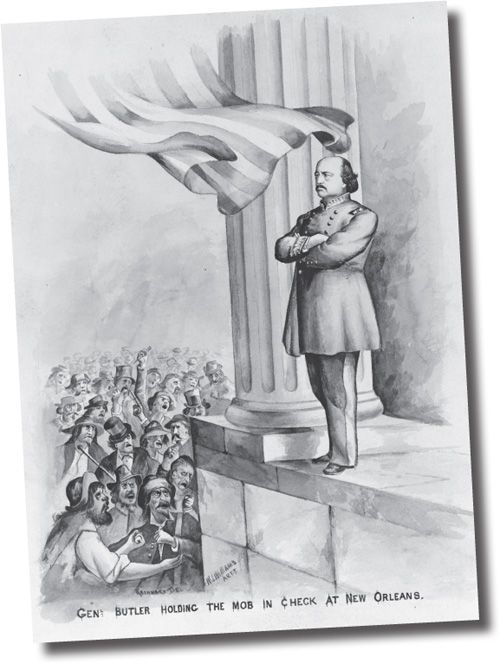
Print depicting New Orleans citizens’ angry reaction to General Butler’s rule.
IN FRONT OF RICHMOND.
JUNE 26
We suppose that, by an attentive perusal of our daily budget of correspondence and telegrams from our army in front of Richmond, the reader will obtain as correct an idea of the situation and prospects there as it is in the power of words to give. It is briefly this: — that affairs are in an exceedingly critical condition; that any hour may bring on a conflict which will rage along the entire line, and that that conflict is very likely to decide the fate of Richmond; that our army is in fine condition, morally, physically, and militarily, for the battle; that it is prepared, and quite ready for it; that it has been largely reinforced; that daily, though slowly yet surely, it is planting itself in more favorable positions, and making headway, ceaselessly, toward the rebel capital....
POPE AGAINST JACKSON — FLANK MOVEMENT UPON RICHMOND.
JUNE 27
The country will be rejoiced this morning to learn that President LINCOLN has at last, by a word, brought order and unity out of the confused and discreditable condition of army affairs that has so long existed in the Valley of the Shenandoah and on the Rappahannock. The forces under FREMONT and BANKS in the Valley, and those under MCDOWELL at Fredericksburgh and elsewhere, are consolidated into one army, divided into three corps, and the whole of them put under the command of Gen. POPE. The first work of the new Commander will of course be to take in hand that audacious rebel marauder, Stonewall JACKSON, (and in this business of rebel catching, he has had more experience than any man in the field,) and drive him finally out of the region which he has so long ravaged — or, what would be still better, and more accordant with POPE’s antecedents, “bag” or destroy him and his entire command.1
1. McClellan considered the formation of this Army of Virginia a direct attack on his own authority. He resented the implication that two generals were needed to manage affairs in Virginia, and believed that in any case all available troops should be sent to his army on the peninsula.
FROM GEN. M’CLELLAN’S ARMY.
THE STEP IN ADVANCE TOWARD RICHMOND.
JUNE 27
JUNE 25 — EVENING.
Gen. HOOKER, at 9 o’clock this morning, advanced his Division with the view of occupying a new position. The result was that his troops met with a most determined resistance from the enemy, which lasted until four o’clock in the afternoon, but the rebels were forced to give way before the invincible courage of our men....1

The Battle of Gaines’s Mill.
1. This was the Battle of Oak Grove (June 25, 1862), the first of the “Seven Days.” McClellan sought to push his front line to within siege-gun range of Richmond, but Union forces advanced only about 600 yards at a cost of about a thousand casualties. It was the last Union initiative of the campaign.
AFFAIRS BEFORE RICHMOND. ATTACK OF THE REBELS UNDER JACKSON
UPON OUR RIGHT WING.
JULY 1
CAMP BEFORE RICHMOND, SATURDAY, JUNE 28
The Army of the Potomac has no longer need to complain of inactivity, for the comparative quiet of the past month has given place to three days of as desperate, determined and bloody work as the fiercest clamorer for active movements could desire. Though the contest is not yet decided, the result thus far, in its bearings on the general plan of operations, is all that could be desired. We have no great victory to report, no long list of trophies to record, and the movements of an army may present the indications of a reverse, but to those who have been familiar with the position of things here, and the plan of operations they necessitated, matters are assuming a new and more hopeful aspect, for an apparent retreat has really brought us practically nearer to Richmond than we have been at any time before. A military manoeuvre, among the most difficult of any when performed in face of an enemy, has been successfully accomplished, and, with forces concentrated upon a new base we are prepared to operate more efficiently than ever against an enemy divided and in the wild pursuit of an imaginary success. He has been tempted to his ruin; and if I read the signs of the times, his joy will be turned into mourning, and that ere many days. It is vain to be temperate, and I may seem over-hopeful in the midst of apparent disaster, but ... MCCLELLAN appears more completely the master of his position than at any time before.1
It was soon apparent, after Fair Oaks, that the rebel attack upon our left wing had induced a change of programme, and what the new plan has been I think to-day is showing. Up to that time our left wing was the weak point, and to that the chief efforts of the enemy were directed, but with the withdrawal of our main body to the south side of the Chickahominy, the right wing, with its exposed line of communication between the river and White House, has been ... inviting attack, and though the rebels have apparently been chiefly concerned with efforts against our left wing, there have not been wanting signs and evidence that their real purpose was directed against the right, whose exposed situation must have been fully revealed to them by the bold dash of [J. E. B.] STUART’s Cavalry across our rear....
On Thursday [June 26] they came ... Crossing the river in strong force, under cover of a heavy fire from their batteries on the opposite side, the enemy pressed down the road against the position of Gen. [George A.] MCCALL, first attacking his First Brigade, consisting of the Bucktails, and the Fifth, Eighth, Ninth and Tenth Pennsylvania Regiments. These troops were soon reinforced by the six regiments forming the other two brigades of the division, and from their strong position behind the swampy ravine of Beaver Dam Creek, held the greatly superior force of the enemy at bay from the time of attack until the going down of the sun, at near 9 o’clock....2
That night an order came from Gen. MCCLELLAN for Gen. PORTER to withdraw his forces gradually to a point near Meadow’s Bridge. After a few hours’ sleep upon their arms, our troops were aroused, and, in accordance with the plan of operations, Gen. MCCALL, at 3 o’clock, opened a fire of artillery on the enemy who vigorously responded, until our forces began gradually to retire before them as if retreating, but maintaining their ranks in good order, crossing a bridge over a creek on the way, destroying it behind them, compelling the enemy to wait the slow construction of a new passage-way in the fire of our opposing artillery and heavy musketry fire from the Ninth Massachusetts....
It was now near noon, and our troops had taken fresh courage for effort from the hour or two for rest and refreshment which they had enjoyed. Then the enemy were reported to be again advancing; they opened fire on our men from the woods skirting the plain in which the latter were posted.3
First commencing with the usual picket skirmishing, and then swelling into the roar of the artillery duel, the struggle opened between the advanced guard of the two armies, until by 3 or 4 o’clock in the afternoon the battle raged fiercely all along the lines, until within an hour or two of sunset, when the storm lulled for a time, and then the rebels, who had been meanwhile reinforced, came on with fresh vigor to the assault... Not until after 9 o’clock did the men find rest, which, we may be sure, came not unwelcomed to such of the men as had passed through the struggle, commencing early in the afternoon of the previous day....
And so the sun went down upon that battle-field strewn with the bruised and mangled forms of what have once been men, of what were still men, though shorn of their full proportions, and bidden to go maimed and halting through life.... And who can estimate our loss, when none but an Omnipotent eye can, in the confusion of the first hours that follow the engagement, search out the fate of all who appear not with their comrades as they gather with their regiments at night?4 It will surely exceed a thousand, and I hope not pass the 1,500; but a few days more will tell, while, meanwhile, the list must swell greatly, for the battle is not yet fully ended. Strategy or no strategy, there must still be desperate fighting....

The Battle of Malvern Hill.
1. The Times reporter was hopelessly overoptimistic. To be sure, the attempted turning movement was extremely costly to the Confederate attackers, and MClellan did indeed manage to extricate his right wing from north of the Chickahominy River, but he had lost control of events and for the rest of the campaign would focus on trying to fend off relentless rebel attacks.
2. This was the Battle of Beaver Dam Creek (June 26, 1862), as A. P. Hill’s Confederate division assailed the position of Union Major General Fitz John Porter. “Stonewall” Jackson was supposed to have led the assault, but he was late in arriving and the Confederates attacked without him. It was a Union tactical victory in that Confederate losses were far heavier, but the fury of the assault convinced McClellan to order Porter to fall back.
3. This was the Battle of Gaines’ Mill (June 27).
4. Union losses in the two battles totaled 7,201; Confederate losses were 9,477.
THE NEW CALL FOR TROOPS.
MILITARY FEELING IN THE CITY.
JULY 3
The important position held by the Empire State in its relations to the country at large is indicated by the fact that its quota of the three hundred thousand fresh troops called for by the President will be fifty thousand, or one-sixth of the whole number.1
These fifty thousand, from present indications, will not be slow in forthcoming. The mere supposition of peril to the cause of the Union, consequent on Gen. MCCLELLAN being in insufficient force to fall at once on the rebel capital, has created an excitement in the city that could only have been surpassed by the certain knowledge of defeat and the responsibilities which that knowledge would have entailed....
1. On July 1, Lincoln called for an additional 300,000 soldiers, “chiefly of infantry,” and quotas were assigned to the various states.
THE LINES BEFORE RICHMOND.
JULY 2
We are still without any specific information as to the present status of our army on the James; but all the items of news that trickle from official and unofficial sources, the gleanings from persons who left the lines as late as Sunday, and from the bearings of movements known to have been successfully accomplished, the inference is that the work which Gen. MCCLELLAN has in hand is progressing to a favorable result....
What Gen. MCCLELLAN’s programme of action now may be will very soon develop itself. Army correspondents are busy predicting that he will be in the rebel Capital by the Fourth of July, and some papers have published the news that he is already there. He is, doubtless, as anxious to get there as any body can be, knowing what a destructive effect such a movement would have upon the rebellion and the rebel army. Things are evidently in that peculiar condition at present when any hour may flash over the wires the news that he is there, and that the rebel army is in a worse place. In the meantime, he needs that every soldier that can possibly be spared be pushed on to reinforce him, that so, when he does strike, he may make of his stroke a sure thing.

Map published in The New York Times of the region where General McClellan conducted his Peninsula Campaign.
THE NEWS FROM RICHMOND — THE NEW CALL FOR VOLUNTEERS.
JULY 3
We have at last full reports of recent movements in front of Richmond. We are sorry to say that they do not fully sustain the encouraging interpretation which the public sought to put upon the brief announcement, that our right wing had been attacked and had withdrawn to the other side of the Chickahominy. We have now no room to doubt that our army has met with a very serious reverse, and that it is in a condition of peril, which, if not imminent, at least calls for the instant and energetic efforts of the Government and the country.
Two of the regular corps of the TIMES Reporters left Gen. MCCLELLAN’s headquarters, which are now on the James River, on Monday afternoon, and reached this City last evening. They were spectators of the events which they describe, and although their reports are of necessity written in haste, and may, therefore, err in matters of detail, there is no reason whatever to doubt the entire accuracy of the narrative they give of the principal movements of the opposing forces.
It seems from their statement, that the right wing of our army, numbering about 20,000 men, was attacked on Friday by an overwhelming rebel force of not less than 50,000, and that after a hot and protracted fight, sustained with the greatest gallantry by our troops, they effected their retreat across the Chickahominy. This leading fact was known before. But it now for the first time appears that they did not wait to destroy the bridges across the swamp so effectually as to prevent the passage of the rebels, — that our forces on the left, for some reason or other, did not dispute the passage, although they had planted batteries for the purpose of doing so, but decided to abandon their position, — and that accordingly, on Saturday night and Sunday, the whole left wing, comprising the main body of the army, under [Samuel P.] HEINTZELMAN, [Erasmus D.] KEYES and [Edwin V. “Bull”] SUMNER, fell back along the line of the railroad and the Williams-burgh Road, turned the foot of the White Oak Swamp, which approaches the Chickahominy, and marched to the James River, a distance of from ten to fifteen miles ….
Our whole army, therefore, now lies upon the James River, at a point called Turkey Bend, within reach, and under cover of our gunboats. Supplies will speedily reach it from Fortress Monroe, and it seems, indeed, to have withdrawn its stores in good order and without serious loss.
Beyond all question, this intelligence will fall with heavy weight upon the public heart. It is entirely unexpected, and shatters the high hope which the whole country has of late indulged, that, with the fall of Richmond, the end of the rebellion was close at hand. But this depressing effect will be temporary. A day’s reflection will rouse the whole country to the necessity of another effort to crush the rebellion....

A federal field hospital at Savage Station, Virginia.
BUTLER AND THE CONTRABANDS.
EQUIVOCAL CONDUCT OF THE GENERAL — FATE OF NEGROES EMPLOYED WITHIN OUR LINES.
JULY 3
To the Editor of the New-York Times:
The Thirteenth Connecticut Regiment took up quarters on May 15th in the New-Orleans Customhouse. Within a few days after our arrival, 200 negroes had crossed our lines. Families came with their luggage, having heard that the Yankees were to make them free; boys with market baskets, saying that they were “going home;” women, wearing iron neck-yokes, and bearing various marks of cruelty.
Both Gen. BUTLER and the Colonel of the Thirteenth, were importuned to grant the privilege of looking after these refugees. Several attempted seizures were prevented by the Colonel and other officers. Animated discussions were frequent between Secessionists and soldiers. Soldiers cheered when slaves refused to go back to their kind masters. The unsuspecting negroes laughed at the imagined advantage which the American Flag gave them.
GEN. BUTLER’S ORDER.
Next in the sequence of events to this search for slaves, came the order to turn out all not employed by the officers.
Inasmuch as the flocking of negroes to our protection must have been foreseen, why did not the General prohibit their admission, rather than receive and then turn them out?
The day before the order was carried into effect, boys and girls, men and women, went from room to room with solicitations for work. Said a mother, “take my children, if I must go back to suffer.” Well nigh one hundred were kept as cooks, waiters, Company laundresses, hospital nurses and laborers about the Custom-house. Those for whom no place could be found, plead with us to rescue them — depicting the revenge they must suffer for confiding in the Yankees, and telling us that we ought not to have taken them at first, and then to send them back. At the fixed time all the negroes were collected in the open area of the Custom-house. Dread, sorrow, despair could be seen on many faces. Women who had fled miles from a hated despotism, mothers with their infants, families of children, the old and decrepit, were there. One by one, such as had not tickets of employment, moved away, attended by guards. Tearful entreaties were in vain. Children often preferred to stay, even if their parents must go. Bitterly disappointed and hopeless they lingered in the basement, still imagining that their friends, the Yankees, would help them. Puzzling questions rained like shot from this despairing group. A few stayed till midnight before venturing to leave....
The duty of the Government need not be equivocal, as to the condition of the slaves to whom the double pledge has been given of reception within our camps, and taking into our employment. It should be taken out of the power of any General to return or to countenance the return of men and women who have done hard work in the service of our armies, and who must suffer bitter revenge as the penalty of their confidence and their labor. Such negroes, and all giving information to our Government, should have free papers. How can any other policy look the North, or Christian civilization anywhere in the face?
A CHAPLAIN.
IS WASHINGTON SAFE?
JULY 7
If “Stonewall” JACKSON be not dead — and there is now a doubt thrown over the statement that he was veritably and actually killed in the late battles — is there no danger of his taking a column, and with it marching suddenly in the direction of Washington? The movements of this daring rebel, during the last two months, have been as rapid and successful as they have been extraordinary in other respects. It is but a few weeks since he pounced upon and defeated the forces of [Robert H.] MILROY and [Robert C.] SCHENCK, in the Shenandoah Valley. From that work he entered upon the pursuit of Gen. BANKS, drove him to Winchester, defeated him there, pursued him a distance of seventy or eighty miles up to the Potomac; then retired, and during his retreat defeated FREMONT and SHIELDS; then swept over the Blue Ridge and across Eastern Virginia to the Chickahominy, and attacked the right wing of our main army ten days ago — with what success is known to our readers — having in this brief space of time fought four battles at distant points, and traversed a distance of four or five hundred miles. In each of the instances his movement was more or less of a surprise, and each of them would have been declared by most men quite impossible before it was actually done. It would undoubtedly be a difficult thing for JACKSON, whether he be or be not dead, to take twenty thousand rebels and move north to Fredericksburgh, thence to Manassas, thence eastward to the Potomac; and it is not likely he will try. We believe, moreover, that our troops now at Washington and the points named are fully prepared to resist such a movement. At least we hope so. And we also hope, that now that it is known that JACKSON’s forces are at Richmond, our troops in the Shenandoah Valley and elsewhere in Eastern Virginia, will be so disposed of as to effectually prevent any other northward movements of this rebel, if he be alive, or of his ghost, if he be dead.
SENATE DEBATE ON ARMING SLAVES.
JULY 10
The question of employing negroes as soldiers or as military laborers was again up in the Senate yesterday, and the debate upon it was very interesting.... The question was treated entirely in its practical bearings; and with a view to legislation for filling up the new requisition of troops called for by the President. The speakers were very serious; and their views were evidently greatly affected by the recent rebel doings on the Peninsula. There was strong opposition to what was called the “white-kid-gloved,” “rose-water” mode of conducting the war; and Mr. SHERMAN1 argued that we “could not fight against savages unless we became part savage ourselves,” and that “rather than that the Union should be destroyed, he would organize a great army of black men, and desolate every Southern State.” Other speakers were not behind this in strength of expression or in determination to adopt any and every means to put down the rebellion. To the proposition of the Senators from New-York and Kentucky, there certainly can be no reasonable objection. There is a vast amount of military labor on which the slaves in the districts occupied by our army might be employed, and the doing of which by our troops has in some places terribly affected their health and general sanitary condition, and quite unfitted whole regiments for the proper duties of the field. The lines upon lines of prodigious earthworks, constructed before Corinth by our gallant Western soldiers, and the hard labor of which sent thousands of them to their graves in those dismal swamps, should all have been built by the slaves of the insolent rebels of West Tennessee, who were within easy reach, but who, by HALLECK’s Order No. 3, were excluded from the lines.2 So in South Carolina, so in New-Orleans, on the Mississippi, in the Valley of Virginia, and elsewhere. There is enough military work, other than fighting to be done, to employ all the rebel slaves we now have, or are likely to catch for some time. We believe that, just now, it would be better to employ them in this work than to use them as soldiers, for which plenty of far more efficient men can be found. This would be a good point to begin with, and to stop at, at present. And to use them in this way our military commanders should be promptly authorized and ordered.
1. John Sherman (1823–1900) was a United States senator from Ohio and the brother of William T. Sherman.
2. On November 20, 1861, Halleck had ordered that escaped slaves would no longer be “admitted within our lines.”
OPERATIONS AGAINST VICKSBURGH.
JULY 14
OPPOSITE VICKSBURGH, WEDNESDAY, JULY 2
Last Thursday, the mortar vessels, sloops of war and gunboats of Flag-Officer FARAGUT’S fleet arrived below here.
Lying below the city now before us, our officers saw its strength, but resolved nevertheless on an immediate attack. It was necessary there should be a cooperating naval fleet above the town, and Flag-Officer [Charles H.] DAVIS’ fleet had not arrived. Early next morning it was resolved a portion of the vessels should run by.... Instantly as they came in range the batteries opened. Rifle and round shot whistled among the masts, and often “hulled” the vessels with rapid and terrible broadsides. Our fleet answered, and the immense improvements recently made in war vessels’ ordnance became manifest. So accurate was the return fire, that every battery was speedily enveloped in clouds of dust, and the gunners again and again driven from their posts, only to be forced back by bayonets in the rear.
Just below, the splendid mortar fleet of Commodore PORTER had commenced playing, and a shower of missiles fell into and around the doomed city. Buildings were scattered, and soldiers and citizens fled hastily away. The morning air drove down upon stream and city the dense smoke of conflict, and one of the most terrible cannonades of the war went on, each combatant hidden from the other’s view....
Vicksburgh cannot be taken by the navy, although it may be destroyed, and we will have to patiently wait until a land force arrives. Determined that they should have little rest. Commodore PORTER improved the position of his mortar vessels, and at short intervals threw shell. The rebels from their batteries thought our fleet lay at the bend, and that troops were being landed. It was, apparently, a tempting opportunity for “boarding,” throwing overwhelming bodies on the two or three thousand soldiers that might be opposed to them, and by one grand coup de main gaining success. Doubtless VAN DORN was in ecstacies over the sudden idea, and his evil genius prompted him to make one of the boldest, and as it proved, most unsuccessful dashes yet undertaken. Cautiously marching 6,000 troops out from their camps, far behind the bluffs, he skirted the woods, passed unseen below the vessels on that side of the river, and cautiously approached his intended victims. Hidden in dense timber, he deployed his troops with the rare military skill of a veteran, and when two hundred yards from the river ordered a charge. Uttering an exceedingly terrifying yell, the butternut multitude rushed forward, and so quickly, that they were surprised themselves at arriving so soon upon the open bank, and still more at being greeted by a terrible discharge of grape. Quicker than the approach was the retreat, and a headlong flight ensued. Some hundreds were for a few moments seen struggling waist deep through a swamp, while other regiments were ordered near to prevent any attack upon the miring warriors. Three were captured, but the number killed and wounded is unknown. The prisoners stated that VAN DORN and BRECKINRIDGE were at Vicksburgh, and would endeavor, at every cost, to hold it. They belonged to regiments, one of which numbered two hundred, the other a hundred and fifty men. Gen. DUNCAN and three Captains, with thirty privates, according to them, were killed during the fleet’s passage.
Finding that Vicksburgh would holdout, Flag-Officer FARRAGUT determined to open the Mississippi in another way, namely; by cutting a canal across the bend, and leaving Vicksburgh far to one side.1 Instantly the work commenced. Negroes were gathered from every plantation around, and three or four hundred of them set to work. The canal is already partly finished, and in a week will be completed. The bed is to be sunk eight feet below water level. Naval officers are confident of its success. Were the river rising instead of falling there would be little doubt but that the work might be brought to a successful issue. As it is, the probabilities are of its failing. No rebel forces are upon the bank opposite Vicksburgh, and from there it is easy to view the city, and the position of the batteries and fleets. Yesterday I visited Commodore PORTER’s mortar fleet. It is composed of seven steamers and twenty schooners, commanded by DAVID D. PORTER, probably the best naval officer in the United States service2….
These vessels are none of them shot-proof, and had it not been for the following precautions, numerous casualties must have happened: Masts and sides are completely draped with branches, and lying, as they do, close to the bank, it is impossible to see them at any distance. They seem a part of the surrounding forests, and hostile shot have to be directed by guesswork.
1. The canal was actually Grant’s idea, not Farragut’s.
2. Porter was a ferocious self-promoter who played up to reporters precisely so he could get newspaper mentions like this one.
THE PRESIDENT AND THE CONFISCATION BILL.
JULY 18
Whatever doubts have rested upon the President’s views of confiscation, are quieted by the message sent to Congress yesterday. The measure, as amended, meets with his entire approval.1
Congress, with great promptness, modified the bill in deference to the scruples of the President in regard to some of its provisions....
The Confiscation bill, as originally passed, authorized the President to seize the property of persons engaged in the rebellion and convert it to the uses of the Government. This would be depriving not only the persons actually guilty of treason, but their children and descendants to the remotest generation, of their property. The President deemed this clause to be in violation of the Constitution. Even if he should sign it, therefore, which he could not do if that was his opinion, the law would be utterly inoperative, because its validity must depend in the last resort upon the decision of our Courts, and they will necessarily be governed by the provisions of the Constitution. Congress has very wisely cured this defect by limiting the penalty for treason so as to conform to the requirements of the Constitution.
The Confiscation bill cannot fail to have a marked effect upon the conduct of the war. It fixes definite and severe legal penalties to the crime of rebellion, and adds to the actual perils of war the certain and severe punishments of courts of law. In the absence of such a law the rebels had a very great advantage over us. They were not restrained by the Constitution, or anything else, from inflicting whatever severities they chose upon Union men. We meet them now upon their own ground. We are clothed by law with all the powers they have usurped in the conduct of the war. We invade the South as we would invade Mexico or Canada, under the laws of civilized warfare, but determined to use every weapon which the country offers....
1. Lincoln signed the Second Confiscation Act on July 17.
TWO IMPORTANT POINTS OF MILITARY POLICY SETTLED.
JULY 23
The President, through the Secretary of War, has just issued a very important order, which will settle, for the remainder of this war, two points of military policy, regarding which there has been wide discussion, and for lack of which there has been much embittered feeling. The first provision of the order is, in brief, that military commanders within the rebel States shall seize any property which may be needed for supplies or other military purposes; and the second provision is that commanders shall employ as laborers so many slaves as are needed for military or naval purposes. Both of these measures are strictly within the established rules provided for an army when operating in an enemy’s country....
THE WORK OF GEN. HALLECK
JULY 24
Gen. HALLECK’s new position and duties are at length authentically and officially defined. He is to take “command of the whole [of the] land forces of the United States, as General-in-Chief,” with his headquarters at Washington. This is the third or perhaps the fourth, functionary of that grade which we have had since the opening of the war — SCOTT, MCCLELLAN, and STANTON, or rather the President, having preceded HALLECK. It is just a year ago that Gen. MCCLELLAN was assigned to the position; and he performed its arduous duties for about nine months. The events that have taken place over the country since he entered upon active field work, show the imperative necessity for some strong, clear-headed military man to guide the movements of all our armies.
Gen. HALLECK enters upon his great duties at a moment and under circumstances requiring the exercise of the most comprehensive and skillful genius. The work before him is tremendous. But he has a magnificent army with which to accomplish it; and a great nation at his side to strengthen and encourage him. The tools to operate with are at his hands, and anything that he may need, which the nation has, will be given to him. He enters upon his duties with a large amount of popular confidence and respect, which it is the duty of every man and journal now to encourage, and to increase, as his actions will warrant. If he achieves the same amount of success in the East that he has had in the West, within the past year — if he causes the rebel host at Richmond to dissolve or fly as the rebel armies at Bowling Green, Columbus and Corinth have dissolved or fled — it will not be many months before the enemy’s forces now at Richmond will be reduced to roving guerrillas, scouring through the States of the far South. The country looks to him and will wait upon him with assured confidence.

A romanticized Currier and Ives lithograph of Major General Henry W. Halleck.
GEN. McCLELLAN AND THE TIMES.
JULY 25
We feel greatly obliged to those journals which have complimented the TIMES by attaching so much importance to its assumed “change of tone” in regard to Gen. MCCLELLAN. Even the Evening Post, which is nothing if not bilious, is fairly entitled to a share of our gratitude.
But we need scarcely remind our neighbors that they very grossly exaggerate the matter in question. We have nothing to retract of any opinions we have expressed of Gen. MCCLELLAN, least of all, have we indicated any concurrence in the damaging denunciations in which many of our contemporaries have seen fit to indulge. We repeat what we have said hitherto, that in the great work of organizing an army he has proved his possession of the highest ability; — that his siege of Yorktown (whether it might have been avoided or not) was a masterpiece of successful soldiership; — that his preparations for an advance upon Richmond were complete and perfect; — that he has the rare quality of inspiring confidence and thorough respect among his troops, — and that his conduct of the retreat to the James River was a most masterly execution of one of the most difficult and dangerous movements which an army is ever compelled to make.
To all this we still adhere. But it does not in the least affect the truth of what we have also said, that the public faith in his ability to lead an army in the field to victory, has been greatly shaken. That the fact is so, no man of common sense can doubt, and no man of common honesty would think of denying. Whether public confidence in him is justly shaken or not, is another question. If what is said on his behalf, that he was never allowed the means he deemed requisite to carry out his plans, is true, then the public verdict is unjust. We stated all this very fully in the very article from which our critics quote: but they find it convenient to omit mention of it altogether.
We are very glad that President LINCOLN has seen fit to leave Gen. MCCLELLAN in command of the Army of the Potomac, and to intrust to him still the task of taking Richmond. Certainly no other General could take command of that army now, with half as good a prospect of leading it successfully against the rebel capital. It cannot be denied that Gen. MCCLELLAN’s abilities as a leader in the field are still to be proved. But we believe that, with proper support, he will vindicate the claims which have been put forward in his behalf.
THE PRESIDENT’S PROCLAMATION — SOVEREIGN AND BELLIGERENT RIGHTS OF THE GOVERNMENT
JULY 28
The President has just issued a Proclamation which forms another step in the grand process against the giant crime of Rebellion. By this Proclamation, made in pursuance of the sixth section of the act of Congress, entitled “An Act to suppress insurrection, to punish treason and rebellion, to seize and confiscate the property of rebels, and for other purposes,” approved July 17, 1862, he warns “all persons within the contemplation of said sixth section, to cease participating in, aiding, countenancing or abetting the existing rebellion, or any rebellion against the Government of the United States, and to return to their proper allegiance to the United States, on pain of the forfeitures and seizures as within and by said sixth section provided.”
The historian who shall record the progress of the present war will have no trouble in determining the theory on which it was conducted by the United States. Vast though the proportions were which the revolt assumed from the very start, the Government had no difficulty in at once making the diagnosis of the disease in the body politic as an insurrection, a rebellion. The acts of hostility against the Government had, perhaps, assumed such formidable proportions as to be appropriately designated as war; but it was a war of persons owing allegiance to the General or National Government, and not a war of Governments. As Prof. [Joel] PARKER [of Harvard Law School] has well said, those acts were not more than acts of treason because millions were engaged in them, and they were not less than treason because of the assumed titles, military and civil, or of the assumption of State or Confederate authority, under color of which they were committed. Gigantic though the proportions are which the rebellion has since grown to, and complicated though the relations which we hold to the revolted States have become, the complexion of the Southern treason remains, in the eyes of the Government, unchanged. No lapse of time, no change of circumstance, has produced any alteration in the mode of treatment of the “so-called Confederacy” by the United States. The rebels who opened their batteries on Sumter are rebels still, not “belligerents.” The Proclamation which the President issues to-day is the same in theory as that which he made fifteen months ago. In his proclamation of the 15th April, 1861, he called on the persons forming treasonable combinations to “disperse and retire peaceably to their respective abodes, within twenty days from this date.” He now addresses the same combinations, commanding them within sixty days to “cease participating in, aiding, countenancing or abetting the existing rebellion.” It is probable enough that the last Proclamation will be heeded no more than was the first. But with that fact we are not now dealing.
In a superficial aspect, it may seem inconsistent with this theory, that not only has the Government repeatedly entered into various transactions of a quasiinternational character, such as flags of truce, exchanges, & e.g., with the Confederates; but that it has just concluded with the rebel authorities a general cartel for the exchange of prisoners, based on the cartel of 1812. The Richmond journals, it will have been noticed from the extracts we have given, are jubilant over this procedure as an acknowledgment of the “quasi-nationality” of the Confederates. “This cartel,” says the [Richmond] Enquirer, “marks an important era in the war. We are by it made belligerents, and the Government of the United Slates treats with the Government of the Confederate States through Commissioners.” The rebels are welcome to whatever comfort or encouragement they can extract from this transaction. But the journal mentioned is entirely off the mark, in claiming that it inaugurates any “new era” in the war. It is needless, at this late day, to recur to the principles and precedents that govern the exchange of prisoners between parties holding to each other the relations that obtain between the United States and the rebels. The whole matter is summed up in the one principle that, in a civil war such as ours, the Sovereign has all the rights of a belligerent in addition to those of Sovereign. This doctrine, though held by the masters of international law, from SUAREZ1 downwards, we have, it must be confessed, been somewhat slow to understand and take advantage of. And this jealousy of our sovereignty, and the attendant unwillingness to do aught that might seem to recognize the rebels even by implication — a spirit shared to some extent by the Government as well as by the people — have proved no inconsiderable drawback to an efficient conduct of the war. But the potent education of events has not been without avail. Henceforth woe put forth all our strength unweakened by any such pedantic legal limitations. Whatever belligerent rights it may be conducive to the great end of the war to employ, them we may freely put forth. The rights of sovereignty meanwhile reside in the United States, where they have been from the beginning and where they shall continue to be. And while in our sovereign capacity we may show toward those misguided men who have lifted up their hands against their country all needed forbearance — while we make the war what Mr. SEWARD at its outbreak announced in his diplomatic correspondence that it should be, “An example of moderation and generosity such as history does not show the like of;” it is our own fault if we do not call out all the means that can give unity, energy and success to the work of putting down utterly the rebellion.
1. Probably a reference to Francisco Suarez (1548–1617), a Jesuit and a pioneer in international law.
NEWS FROM WASHINGTON.
IMPORTANT PROCLAMATION OF THE PRESIDENT.
THE CONFISCATION ACT.
JULY 28
A PROCLAMATION.
In pursuance of the sixth section of the Act of Congress entitled “An Act to suppress insurrection, to punish treason and rebellion, to seize and confiscate the property of rebels, and for other purposes,” approved July 17, 1862, and which Act, and the joint resolution explanatory thereof, are herewith published, I, ABRABAM (sic) LINCOLN, President of the United States, do hereby proclaim to and warn all persons within the contemplation of said sixth section to cease participating in, aiding, countenancing, or abetting the existing rebellion, or any rebellion, against the Government of the United States, and to return to their proper allegiance to the United States, on pain of the forfeitures and seizures as within and by said sixth section provided.
In testimony whereof I have hereunto set my hand and caused the seal of the United States to be affixed.
Done at the City of Washington, this twenty-fifth day of July, in the year of our Lord one thousand eight hundred and sixty-two, and of the Independence of the United States the eighty-seventh.
ABRAHAM LINCOLN.