
CHAPTER 10

General Robert E. Lee, C.S.A., an 1864 photograph by J. Vannerson of Richmond.
It was the second autumn of this unexpectedly long war — but perhaps first among all its seasons in terms of historical importance, because it brought nothing less than a new cause for the Northern war effort: black freedom.
Between August and October of 1862, as armies engaged in furious battles in both Eastern and Western theaters, public agitation built for both emancipation and colonization, while home-front and volunteer charity activities reached new levels of participation, replenishing troops and engaging women in the war effort as never before.
It was a season of military engagements on both new and old ground alike. As McClellan withdrew from the Virginia Peninsula, Northerners were stunned to learn that Union forces under the command of General John Pope, and Confederate forces now led by Robert E. Lee (a veteran officer once dismissed as “Granny”), met again at Manassas (Bull Run), Virginia, for the second time in thirteen months. The reporting from the front proved much the same, too: optimistic early dispatches, later modified by subsequent acknowledgment of a Confederate rally, but never quite confirming the true nature of the Federal disaster.
The defeat the Second Battle of Bull Run left Lincoln both disconsolate and “outspoken,” at least behind the closed doors of the White House, about the reigning belief that “McClellan wanted [Second Bull Run Commander John] Pope defeated.” But the President was not yet ready to dismiss “Little Mac” from overall command. Instead, he defended him publicly, and spent hours privately imploring the general to restore cohesiveness to the army.
Readers of The Times would also learn about fresh fields of glory in such distant places as Corinth, Mississippi, and Perryville, Kentucky. The results there were largely inconclusive, but as the coverage suggested, the war was inexorably widening. Meanwhile a growing “fire in the rear” — Northern antiwar copperheadism, threatened to sap crucial support for the Union cause. In the end, other momentous revolutions — one social, the other technological — left the most lasting impressions on the nation.
In the wake of the latest Bull Run defeat, Lincoln prepared to play what he believed would be his last hand: an order emancipating slaves in the rebellious states. After drafting a proclamation and reading it to his Cabinet in July, the President had bowed to his ministers’ insistence that he table the decree until a Union battlefield victory allowed the administration to issue it from a position of strength, rather than desperation. Otherwise, as Secretary William H. Seward advised, it might be seen as a “last shriek, on the retreat.” In the meantime, Lincoln offered a series of public feints intended to prepare a white voting public he feared would punish the administration for acting in behalf of the slaves. His activities — belying no immediate intent to proclaim freedom, coupled with an insensitivity toward the plight of both enslaved and free African-Americans (indeed, he declared for the record that free blacks ought to cheerfully relocate in Africa or the Caribbean) were meant to remind anxious Northern whites that the Administration considered emancipation a military, not a philanthropic, option. The lingering result was to taint Lincoln as insensitive to the slaves themselves — the roots of a historical debate that continues to this day.
The opportunity for the President to act came after General Lee, seeking a victory that would altogether destroy Northern morale, audaciously marched his forces into Maryland. McClellan repaid Lincoln’s patience at last with a victory in the bloodiest single day’s fighting in the entire Civil War — indeed, in all of American combat history — at Antietam on September 17. Though dismayed that McClellan failed to pursue the Confederates back into Virginia (even The Times was soon complaining again about the general’s chronic inertia), the triumph was enough to justify Lincoln’s pact with his Cabinet, himself, and, he said, with God. On September 22, he announced the preliminary Emancipation Proclamation, giving the Confederacy one hundred days’ notice to end its rebellion or lose its slave property forever. Of course, the society-altering story dominated the press for weeks. The war for the Union now became a war for expanded liberty as well, as evidenced in the new virulence of the campaign for New York governor.
Another revolution — a subtler one, but carrying enormous consequences — occurred around the same time. In a New York gallery, Mathew Brady put on public view his shocking photographs of the Antietam battlefield — littered with bloated corpses. Military art had long focused on heroes who fought and, even if they fell, died bloodlessly in comrades’ arms. Such photography — instantly made, quickly developed, and brutally realistic — abruptly changed the romantic sensibility about warfare. Civilians now saw for themselves the horrifying human consequences of the fighting — and recoiled at the sight. War would never again be fought in a vacuum.
THE UNION PRESCRIBED FOR BY DR. VALLANDIGHAM.
AUGUST 4
Mr. VALLANDIGHAM1 has hopes that the Union will be restored, and has so informed his constituents in a recent speech. We are sure our readers will rejoice and take courage. But Mr. VALLANDIGHAM is not too sanguine. He sees that it will take some time and some labor, that something has got to be done before that goal is reached. And what do our readers suppose it is that must be done to attain that end? Fill up the last call for volunteers? Take Richmond? Destroy Stonewall JACKSON? Take Vicksburgh [sic] and town? Hang JEFF. DAVIS? Overrun all the Gulf States? Break down the military despotism which now rules over them? Emancipate the negroes? Carry out the confiscation act? Adopt a more stringent military policy or a more lenient one? None of all these things are necessary in the view of the Ohio patriot. The one thing needful is far different. It is not anything to be done in the military way. Labor and money spent in raising armies and training soldiers and preparing munitions of war are all thrown away, he thinks. Nor is it anything to be done in rebeldom. Things are all right there, you see. There is nothing there which interferes with the restoration of the Union. Take Mr. VALLANDIGHAM’s word for that. We all who desire that restoration, must cease at once all these mistaken efforts which we are making, and, following the advice of this wise and honest statesman, turn our attention to “annihilating the Northern Abolition Party,” for this he assures us is the only way to a restoration of the Union....
No doubt if our people want to be trodden under foot by these barbarian slavedrivers — if they wish to see JEFF. DAVIS in the White House, and those who have cherished and held dear the principles of our Fathers, and the rights of man, driven out of the land, or given over to imprisonment and death — if they wish to see such a restoration of the Union as that, then they will do well to follow the advice of Mr. VALLANDIGHAM. We doubt whether even his constituents wish such a restoration, or would follow such advice. Anywhere else such a suggestion could only lead those who heard it to the unanimous expression of the opinion that the worst kind of gammon is Vallandi-gammon.2
1. Clement Laird Vallandigham (1820–1871), Democratic Congressman from Ohio, was a leader of the antiwar, anti-Lincoln “copperheads.”
2. A whimsical reference to the board game, backgammon, and perhaps a play on words — since “gammon” is a certain cut of ham.
UNION FOR THE SAKE OF THE UNION.
AUGUST 8
President LINCOLN did an honor to himself in doing justice to Secretary STANTON, in the brief speech he delivered at the war meeting in Washington, on Wednesday afternoon.1 He declared that the Secretary of War had, at no time, withheld anything from Gen. MCCLELLAN that it was in the President’s power to give him. And he further asserted that the supposed quarrel between STANTON and MCCLELLAN had less existence between them than between some of those presuming to be their friends. Secretary STANTON has suffered very much in public estimation, because of his supposed refusal to reinforce Gen. MCCLELLAN for the great battles before Richmond. It is now found that he suffered wrongly, and that the President acted justly in refusing to dismiss him in order merely to appease a popular clamor. But the President fails to indicate where lies the blame for the inability to reinforce Gen. MCCLELLAN. The latter was in the enemy’s country, in front of his capital, and opposed by an immense army, daily increasing in numbers....
Perhaps the War Department is not to blame for not knowing how many soldiers it had in the field, and for stopping enlistments at the very time when the organization of a reserve was so necessary. We are glad to find the President giving so hearty an indorsement to the War Secretary; for it is better to have the people confide in all their officers than distrust any, seeing that they will be retained in their places by the President. And whatever errors or omissions may have marked the past, we may safely accept the President’s statement of human philosophy, that, “in the selfishness of their natures,” our leaders must all desire success; and, desiring it, they will work for it all the more zealously and effectively, perhaps, for having made some mistakes, and seen the unhappy results flowing from them. Let us have, then, the good old motto again, “Union, for the sake of the Union.”

President Abraham Lincoln and George McClellan confer in General McClellan’s tent near Antietam on October 3, 1862.
1. Aware that McClellan had circulated rumors that Stanton had sabotaged his recent Peninsula campaign by ordering troops transferred to the defense of Washington, Lincoln made a rare public appearance to defend his Secretary of War on August 6. Lincoln magnanimously praised both Stanton and McClellan, and insisted, “justice requires me…to take [blame] upon myself”
THE END OF THE REBEL RAM ARKANSAS.
AUGUST 11
The rebel ram Arkansas,1 which made so brilliant a debut on the Mississippi a few weeks ago, has closed its career in precisely the same manner as the Merrimac did — namely, by an act of suicide.2 Rebel rams seem to have an inherent predisposition to felo de se,3for the two chief representatives of that type of marine creature have adopted this method of taking off. Each signalized its advent in the most spirited style, each seemed for a while to have things all its own way, and both have finally been hedged around with so many obstructions that a desperate making away with themselves was the only outlet left them.
The distant theatre on which the Arkansas played its part, has perhaps caused its career to be followed with less interest than attended that of the Merrimac; but no one can be blind to the immense stake for which it played, and how near it came to winning it. The successful manner in which it made its advent by the raid on our gunboats at Vicksburgh, proved its powerful fighting qualities, and showed that we had nothing on the Mississippi fit to cope with it. What wonder, then, if a wild, ambitious dream possessed the minds of its commander and the Richmond usurpers — if they saw in it — who knows? — perhaps the mistress of the Mississippi, and the means whereby New-Orleans itself might be won back and the whole river reclaimed to rebel rule?
It appears, according to the Richmond Dispatch, that the Arkansas had started on this mission and was on its way to cooperate in the attack on Baton Rouge, when its machinery became disabled, and whilst attempting to adjust it, was set upon by the National gunboats, and so entrapped that nothing was left for the rebels but to blow it up....
1. The Arkansas, laid down at Memphis and completed with much effort up the Yazoo River, was one of two large ironclads designed by the Confederates to defend the Mississippi River. The Louisiana was destroyed when Farragut captured New Orleans, the Arkansas as noted here.
2. Though Navy Captain William “Dirty Bill” Porter, brother of David Dixon Porter and captain of the ironclad Essex, claimed to have disabled the Arkansas by cannon fire, the fact was that the engines of the Arkansas failed and she was driven ashore and set on fire by her crew.
3. Latin for “suicide.”
THE PRESIDENT AND COLONIZATION.
INTERESTING INTERVIEW WITH A COMMITTEE OF COLORED MEN.
AUGUST 15
WASHINGTON, THURSDAY, AUGUST 14
This afternoon the President of the United States gave audience to a Committee of colored men at the White House.1 They were introduced by Rev. J. MITCHELL, Commissioner of Emigration. E. M. THOMAS,2 the Chairman, remarked that they were there by invitation, to hear what the Executive had to say to them.
Having all been seated, the President, after a few preliminary observations, in formed them that a sum of money had been appropriated by Congress, and placed at his disposition, for the purpose of aiding the colonization in some country of the people, or a portion of them, of African descent, thereby making it his duty, as it had for a long time been his inclination, to favor that cause; and why, he asked, should the people of your race be colonized, and where? Why should they leave this country? This is, perhaps, the first question for proper consideration. You and we are different races. We have between us a broader difference than exists between almost any other two races. Whether it is right or wrong I need not discuss; but this physical difference is a great disadvantage to us both, as I think. Your race suffer very greatly, many of them, by living among us, while ours suffer from your presence. In a word, we suffer on each side. If this is admitted, it affords a reason, at least, why we should be separated. You, here, are freemen, I suppose.
A VOICE — Yes, Sir.
The PRESDENT [sic] — Perhaps you have long been free, or all your lives. Your race are suffering, in my judgment, the greatest wrong inflicted on any people. But even when you cease to be slaves you are yet far removed from being placed on an equality with the white race. You are cut off from many of the advantages which the other race enjoys. The aspiration of men is to enjoy equality with the best when free, but on this broad continent not a single man of your race is made the equal of a single man of ours. Go where you are treated the best, and the ban is still upon you. I do not propose to discuss this, but to present it as a fact, with which we have to deal. I cannot alter it if I would. It is a fact about which we all think and feel alike, I and you. We look to our condition. Owing to the existence of the two races on this continent, I need not recount to you the effects upon white men, growing out of the institution of Slavery. I believe in its general evil effects on the white race. See our present condition — the country engaged in war! our white men cutting one another’s throats — none knowing how far it will extend — and then consider what we know to be the truth. But for your race among us there could not be war, although many men engaged on either side, do not care for you one way or the other. Nevertheless, I repeat, without the institution of Slavery, and the colored race as a basis, the war could not have an existence. It is better for us both, therefore, to be separated. I know that there are free men among you who, even if they could better their condition, are not as much inclined to go out of the country as those who, being slaves, could obtain their freedom on this condition. I suppose one of the principal difficulties in the way of colonization is that the free colored man cannot see that his comfort would be advanced by it. You may believe that you can live in Washington, or elsewhere in the United States, the remainder of your life; perhaps more so than you can in any foreign country, and hence you may come to the conclusion that you have nothing to do with the idea of going to a foreign country. This is (I speak in no unkind sense) an extremely selfish view of the case. But you ought to do something to help those who are not so fortunate as yourselves. There is an unwillingness on the part of our people, harsh as it may be, for you free colored people to remain with us....

An unidentified African-American who participated in the American Colonization Society’s program.
1. Lincoln’s lecture to this delegation of free African-Americans was widely reported in the press — as the President intended. Though he had already drafted an emancipation proclamation, Lincoln remained worried that its imminent announcement would cause unrest in the North and the border states, so he used occasions like this one to suggest he continued to favor Colonization and was not prepared to consider racial equality. This little speech may have been one of the most mean-spirited of Lincoln’s career. Even if it met the President’s immediate public relations goals, it has haunted his historical reputation since — especially among people of color.
2. James Mitchell worked for the Department of the Interior as an agent for emigration, and Edward M. Thomas was president of the Anglo-African Institute for the Encouragement of Industry and Art. Four months before this meeting, Congress appropriated $500,000 for colonization.
MR. LINCOLN TO MR. GREELEY.
AUGUST 24
The President’s response to Mr. GREELEY’s1 public letter, addressed to him last week, is explicit enough, and settles one or two disputed points as to Mr. LINCOLN’s opinions and policy. His one and paramount object in the war is “to save the Union” — to save it with or without Slavery, under one set of circumstances or another, or by one agency or another, but at all events to save it somehow. His simple platform is “The salvation of the Union.” To this end his whole policy looks, and whatever he does or fails to do is with reference to its bearings upon this one great point. He could not have said anything more satisfactory to the country in general.
The letter, like all Mr. LINCOLN’s literary attempts, exhibits the peculiarities of his mind and style; but the logical sequence and precision, and the grammatical accuracy of this, is greatly in advance of any previous effort. It is in infinitely better taste, too, than the rude epistle to which it is an answer.
EXECUTIVE MANSION, WASHINGTON, AUG. 22
Hon. Horace Greeley:
DEAR SIR:
I have just read yours of the 19th, addressed to myself through the New-York Tribune. If there be in it any statements or assumptions of fact which I may know to be erroneous, I do not now and here controvert them. If there be in it any inferences which I may believe to be falsely drawn, I do not now and here argue against them. If there be perceptible in it an impatient and dictatorial tone, I waive it in, deference to an old friend, whose heart I have always supposed to be right.
As to the policy I “seem to be pursuing,” as you say, I have not meant to leave any one in doubt.
I would save the Union. I would save it the shortest way under the Constitution. The sooner the national authority can be restored the nearer the Union will be “the Union as it was.” If there be those who would not save the Union unless they could at the same time save Slavery, I do not agree with them. If there be those who would not save the Union unless they could at the same time destroy Slavery, I do not agree with them. My paramount object in this struggle is to save the Union, and is not either to save or destroy Slavery. If I could save the Union without freeing any slave. I would do it, and if I could save it by freeing all the slaves, I would do it, and if I could save it by freeing some and leaving others alone, I would also do that. What I do about Slavery and the colored race, I do because I believe it helps to save this Union, and what I forbear, I forbear because I do not believe it would help to save the Union. I shall do less whenever I shall believe what I am doing hurts the cause, and I shall do more whenever I shall believe doing more will help the cause. I shall try to correct errors when shown to be errors; and I shall adopt new views so fast as they shall appear to be true views. I have here stated my purpose according to my view of official duty, and I intend no modification of my oft-expressed personal wish that all men, everywhere, could be free. Yours,
A. LINCOLN.
1. Horace Greeley, editor of The New York Tribune, had published “The Prayer of Twenty Millions” on August 20, charging Lincoln was “strangely and disastrously remiss” for not ordering emancipation. Again keeping his intentions secret, the President wrote a brilliant reply to assure the country that whatever he decided about slavery would be for union-saving reasons. He then made sure The Times and other rival papers had access to his letter. Of course he was being disingenuous, having already decided to issue a proclamation as soon as Union armies own a victory.
THE SECOND BATTLE OF BULL RUN.
AUGUST 31
In the closing week of June last, the so-called Confederate President, JEFF. DAVIS, from his chamber at Richmond, listened to the thunder of the cannon of hostile armies battling before his capital. In the closing week of August, President LINCOLN, from the White House, heard the deep peals of the artillery of the contending hosts which, having now changed location, are struggling for supremacy before the National Capital. The geographical change of position does not indicate that Richmond is any the less likely to fall, or that Washington is any the less safe now than it was then. In truth, the fact rather is, that if we have any one General with sense and pluck enough to take advantage of the palpable opportunity the rebels have given us, we may be said to he much nearer to Richmond now when the battlefield for its possession is a hundred miles away from, it than we were two months ago, when our fevered and shrunken army had shoveled its way up to within seven miles of its outskirts.
The accounts of the sanguinary battles of the last four days fought in the rear of Gen. POPE’s1 army, have been very meagre and contradictory. They have been confined to POPE’s two very brief official reports, dated the 28th and 30th, and to such information as could be picked up by an active corps of correspondents stationed at Washington, Alexandria, and other points outside of the army lines from which they have not yet been expelled. Many of these statements are rumors brought by fugitive soldiers, fleeing Unionists, women and negroes, and from their evident want of truthfulness, many of those which we have received have been excluded from our columns. Gen. POPE’s official dispatches give us no details....
Of Friday’s battle, which was fought on the identical battle-field of Bull Run, he reports: “We fought a terrific battle with the combined forces of the enemy, which lasted with continuous fury from daylight until after dark, by which time the enemy was driven from the field, which we now occupy.” And he further states our loss on that day as being “not less than eight thousand men, killed and wounded,” while the enemy’s loss he puts down as at least “two to our one.”2 Of the battle of yesterday we have as yet nothing official; but the telegraph from Washington reports that one was actually raging, and that the cannonading could be heard in that city....
All these engagements seem to have been to the last degree indecisive.3 Up to The rebels have, within the week, exhibited an audacity, if not a desperation, that is extraordinary; and now, in falling back to Centreville, and in throwing detachments of their army to Vienna, to Leesburgh, and even, it is said, to the line of the Potomac, they show that they are making the grand struggle for life or death. If this Richmond rebel army, which has thus pierced almost to our Capital, be permitted to retire again into Central Virginia, there will be plenty of future fighting for us on fields infinitely less advantageous than that they have now challenged us to combat upon. They have given us an opportunity to destroy them never equaled in the history of this war, and seldom offered by an army to its adversary in any war. With our far superior numbers and position, there will be terrible culpability somewhere if the chance be not taken advantage of.
1. Major General John Pope (1822–1892) was brought east at Stanton’s urging, after the fall of Island No. 10. Stanton, who was no friend of McClellan, wanted to establish a rival to “Little Mac” in Virginia.
2. Union losses in this battle were 1,724 killed and 8,372 wounded, plus another 5,958 missing; Confederate losses were 1,481 killed and 7,627 wounded.
3. In fact, the Union suffered a major defeat at the Second Battle of Bull Run (August 28–30, 1862), leaving victorious Confederate armies again dangerously close to Washington. Union forces lost 10,000 killed and wounded, plus another 6,000 missing, while Confederate losses totaled 8,300.
THE REBEL INVASION OF THE LOYAL STATES.
SEPTEMBER 9
It seems to be settled that a force of at least 40,000 rebels has crossed the Potomac and taken position at Frederick, in Maryland, about sixty miles west of Baltimore, and about forty north from Washington. They have been permitted by the Government to cross without resistance. Telegraphic reports from the Capital would almost lead us to believe that they had been invited there, — for we are assured that the Government is perfectly satisfied with their position, and that none of them will ever return. We hope this may prove to be true; — but we would rather see it proved than give full credence to it in advance. As we remarked yesterday, we have too many of these official assurances already on hand unredeemed, to be especially eager for more....

A woodcut depicting the second day of fighting in the Second Battle of Bull Run.
THE GREAT BATTLE OF THE WAR.
SEPTEMBER 18
At last our Generals in the field seem to have risen to the grandeur of the National crisis. The desperate attempt of the rebel leaders to force their way into the heart of the North, has been fairly met with the whole strength of the National armies before Washington, and before the sun goes down upon this day we shall learn the issue of the greatest battle ever fought upon American soil — a battle which, in the numbers of the troops engaged, in the fierce energy with which the prize of victory has been contested, and in the tremendous importance of that prize itself, must take its place among the grand decisive conflicts of history.
In the absence of anything approaching to full and coherent details of the scene and scope of this great contest, it is impossible for us to attempt any systematic view of the movements by which the action was brought on; but thus much it is, we think, safe to say, that by noon of yesterday the National army under Gen. MCCLELLAN, numbering 100,000 men, had become engaged along its whole line with the combined and concentrated rebel forces of Gens. LEE and JACKSON, in numbers certainly not inferior to our own.1
The battle, raging apparently from a point near Sharpsburgh to the vicinity of Harper’s Ferry, was under circumstances and in a position which make it next to impossible that the result of the conflict should be anything less than decisive of the fate of one or other of the opposing hosts. The fortunes of the fight, though wavering and uncertain through the earlier portion of the day, were steadily inclining to the National advantage, and down to 2 o’clock P.M., (the hour of our latest authentic intelligence at this present writing from the immediate scene of action,) the hope of victory was plainly with our army. Should this hope resolve itself into glorious certainty, the direct fruits of our triumph cannot easily be overestimated....

A Kurz and Allison lithograph of the Battle of Antietam.
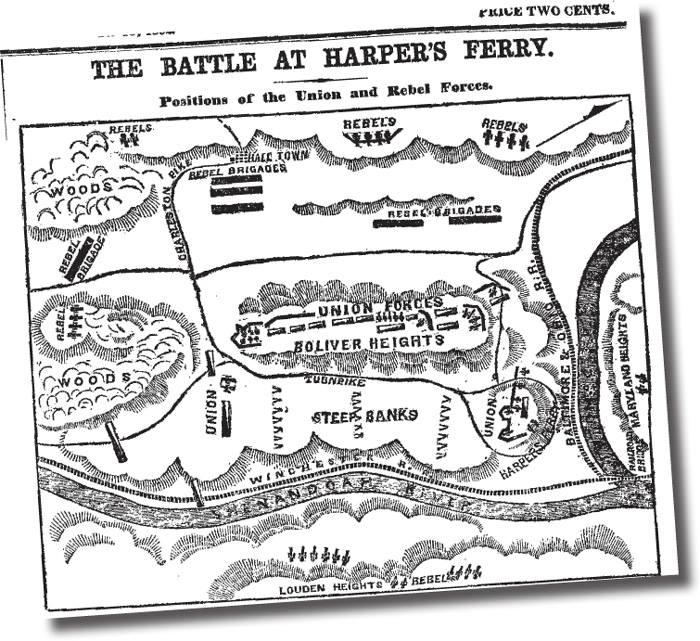
The New York Times map showing troop positions during the Battle of Harper’s Ferry, part of the Antietam campaign.
1. In fact, McClellan’s army of 87,000 significantly outnumbered Lee’s army of 41,000. McClellan lost some 12,400 casualties to Lee’s 10,000.
A GLORIOUS VICTORY.
THE LATEST REPORTS BY WAY OF HARRISBURGH.
DREADFUL CARNAGE ON BOTH SIDES.
SEPTEMBER 18
HARRISBURGH, WEDNESDAY, SEPT. 17 — 10 P.M.
Gen. MCCLELLAN has achieved a glorious victory1....
REPORTS FROM THE PRESS CORRESPONDENT.
HARRISBURGH, WEDNESDAY, SEPT. 17
A great battle has been fought, and we are victorious.
The carnage on both sides was awful.
Gen. LONGSTREET was wounded and taken prisoner.
HARRISBURGH, WEDNESDAY, SEPT. 17 — 10 P.M.
Dispatches just received at headquarters from Hagerstown say: “We have achieved a glorious victory.”
LONGSTREET is not killed, but is wounded and a prisoner. Gen. HOOKER was wounded in the foot.2 No particulars are received.
1. At the Battle of Antietam (Sharpsburg).
2. Confederate Major General James Longstreet was neither wounded nor captured; Union Major General Joseph Hooker was wounded in the foot during the morning attack and had to leave the field.
A PROCLAMATION BY THE PRESIDENT OF THE UNITED STATES.
A DECREE OF EMANCIPATION.
SEPTEMBER 23
WASHINGTON, MONDAY, SEPT. 22
By the President of the United States of America:
A PROCLAMATION.
I, ABRAHAM LINCOLN, President of the United States of America, and Commander-in-Chief of the Army and Navy thereof, do hereby proclaim and declare, that hereafter, as heretofore, the war will be prosecuted for the object of practically restoring the constitutional relation between the United States and the people thereof in which States that relation is, or may be suspended or disturbed; that it is my purpose, upon the next meeting of Congress, to again recommend the adoption of a practical measure tendering pecuniary aid to the free acceptance or rejection of all the Slave States so called, the people whereof may not then be in rebellion against the United States, and which States may then have voluntarily adopted, or thereafter may voluntarily adopt, the immediate or gradual abolishment of Slavery within their respective limits; and that the efforts to colonize persons of African descent with their consent, upon the Continent or elsewhere, with the previously obtained consent of the governments existing there, will be continued.
That on the first day of January, in the year of our Lord one thousand eight hundred and sixty-three, all persons held as slaves within any State, or any designated part of a State, the people whereof shall then be in rebellion against the United States shall be then, thenceforward, and forever, free; and the Executive Government of the United States, including the military and naval authority thereof, will recognize and maintain the freedom of such persons, and will do no act or acts to repress such persons, or any of them, in any efforts they may make for their actual freedom.
That the Executive will, on the first day of January aforesaid, by proclamation, designate the States and parts of States, if any, in which the people thereof, respectively, shall then be in rebellion against the United States; and the fact that any State, or the people thereof, shall on that day be in good faith represented in the Congress of the United States by members chosen thereto at elections wherein a majority of the qualified voters of such State shall have participated, shall, in the absence of strong countervailing testimony, be deemed conclusive evidence that such State and the people thereof have not been in rebellion against the United States.
That attention is hereby called to an act of Congress entitled “An act to make an additional article of war,” approved March 13, 1862, and which act is in the words and figure following:
Be it enacted by the Senate and House of Representatives of the United States of America in Congress assembled, That hereafter the following shall be promulgated as an additional article of war for the government of the army of the United States, and shall be obeyed and observed as such.
ARTICLE —. All officers or persons in the military or naval service of the United States are prohibited from employing any of the forces under their respective commands for the purpose of returning fugitives from service or labor who may have escaped from any person to whom such service or labor is claimed to be due, and any officer who shall be found guilty by a court-martial of violating this article shall be dismissed from the service.
SECTION 2. And be it further erected, that this as shall take effect from and after its passage. Also to the ninth and tenth sections of an act entitled “An act to suppress insurrection, to punish treason and rebellion, to seize and confiscate property of rebels, and for other purposes,” approved July 17, 1862, and which sections are in the words and figures following:
SEC. 9. And be it further enacted, That all slaves of persons who shall hereafter be engaged in rebellion against the Government of the United States, or who shall, in any way give aid or comfort thereto, escaping from such persons and taking refuge within the lines of the army; and all slaves captured from such persons or deserted by them and coming under the control of the Government of the United States, and all slaves of such persons found on (or) being within any place occupied by rebel forces and afterwards occupied by the forces of the United States, shall be deemed captives of war, and shall be forever free of their servitude and not held again as slaves.
SEC. 10. And be it further enacted, That no slaves escaping into any State, Territory or the District of Columbia, from any of the States, shall be delivered up, or in any way impeded or hindered of his liberty, except for crime or some offence against the laws, unless the person claiming said fugitive shall first make oath that the person to whom the labor or service of such fugitive is alleged to be due, is his lawful owner, and has not been in arms against the United States in the present rebellion, nor in any way given aid and comfort thereto, and no person engaged in the military or naval service of the United States shall, under any pretence whatever, assume to decide on the validity of the claim of any person to the service or labor of any other person, or surrender up any such person to the claimant, on pain of being dismissed from the service.
And I do hereby enjoin upon and order all persons engaged in the military and naval service of the United States, to observe, obey and enforce, within their respective spheres of service, the act and sections above recited.
And the Executive will in due time recommend that all citizens of the United States who shall have remained loyal thereto throughout the rebellion, shall (upon the restoration of the constitutional relation between the United States and their respective States and people, if the relation shall have been suspended or disturbed,) be compensated for all losses by acts of the United States, including the loss of slaves.
In witness whereof, I have hereunto set my hand, and caused the seal of the United States to be affixed.
Done at the City of Washington, this Twenty-second day of September, in the year of our Lord one thousand eight hundred and sixty-two, and of the Independence of the United States the eighty-seventh.
ABRAHAM LINCOLN.
BY THE PRESIDENT. WILLIAM H. SEWARD,
SECRETARY OF STATE.
THE PRESIDENT’S PROCLAMATION.
SEPTEMBER 23
There has been no more important and far reaching document ever issued since the foundation of this Government than the proclamation of President LINCOLN concerning Slavery and slaves, published this morning....
The wisdom of the step taken — we refer at present to that clause in the document which declares free the slaves of rebel States after the 1st of January — is unquestionable; its necessity, indisputable. It has been declared time and again by President LINCOLN that as soon as this step became a necessity, he should adopt it. Its adoption now is not a confession that the military means of suppressing the great rebellion have proved a failure; but simply that there is a point at which any other legitimate appliances that can be called in, shall also be availed of. Slavery is an element of strength to the rebels if left untouched; it will assuredly prove an element of weakness — it may be of total destruction — to them and their cause, when we make such use of it and its victims as lies in our power.
From now till the 1st of January — the day when this proclamation will take effect — is little over three months. What may happen between now and then, in the progress of the war, it is hard to say. We earnestly hope, however, that by that time, the rebellion will be put down by the military hand, and that the terrible element of slave-insurrection may not be invoked. If, by that day, the rebel army be overthrown, and their Capital captured; and, if the slaveholding rebels still prove malignant, irrepressible, and, as in the Southwest, disorganizers and marauders, then let that which Vice-President STEPHENS called the corner-stone of the Southern Confederacy be knocked from under it, and see whether the whole fabric of rebellion will not necessarily tumble to the ground.
A POLICY AT LAST.
SEPTEMBER 26
The President’s proclamation, suspending the writ of habeas corpus in certain cases,1 excites quite as much disgust in the minds of the opponents of the Administration as did the Proclamation of Emancipation. The latter was pronounced objectionable because immediately impracticable, and as tending to provoke the augmented animosity of the South. The former is represented to be a return of the Administration to the policy of restricted speech and summary imprisonment, which excited so much popular discontent last Winter.
Both papers, however, are free from the defects complained of, while they possess others for which the entire country has been clamorous. The Government has lacked a determined policy. It has assumed no fixed relation to the Slavery difficulty. And whatever may be the view taken of the expediency of the emancipation measure at the present moment, it certainly has the merit of placing the Administration in an intelligible and entirely definite position before the country, so that the standing charge of indecision ceases to be applicable. So with the proclamation touching arrests. Heretofore they have been made without regard to any fixed principle. Sentiments and acts which were in one locality indulged with perfect impunity, in another involved a prompt consignment to Fort Lafayette. And while the bench generally declined to interpose the habeas corpus to discharge the prisoner, judges were found always ready to issue that great prerogative writ. It is not, therefore, to introduce a new system of espionage and arrest, that the recent declaration is issued; but to restrain and define and mitigate the operation of a system which is already in active use....

President Lincoln reading the Emancipation Proclamation to his cabinet in July 1862, painted two years later by New York artist Francis B. Carpenter.
1. Lincoln issued his proclamation two days after the Emancipation Proclamation, September 24, 1862.
THE EMANCIPATION EDICT.
SEPTEMBER 30
Our secession scribes deal very gingerly with the President’s proclamation. They say much less terrible things about it than they threatened in advance. It is not to be supposed that they have experienced any change of heart in regard to Slavery; but they evidently consider it somewhat more dangerous than it used to be to praise and glorify the peculiar institution. They croak a little, it is true, about making this a war for abolition, but they do it faintly and with evident misgivings. Like Macbeth’s amen, it “sticks in their throats.”
The proclamation is simply a weapon of warfare — perfectly legitimate and perfectly proper. From the very moment when the slaveholding aristocracy raised the banner of rebellion against the Government, it has been perfectly competent for the Government to resort to emancipation as a means of crushing their hostility. We had just as much right to free their slaves, as we had to take their horses, to seize their ships or destroy their lives. It was ridiculous and absurd to say that we might wage war against them, — that we could bombard their towns, kill their troops, confiscate their goods, occupy their lands, forfeit their cattle, their crops, and everything else that they possessed, — but that we could not strip them of their slaves. What gave such supreme sanctity to this specific form of property or of labor? Not the Constitution — for it does not even, in explicit terms, mention its existence. What was there that thus consecrated, beyond all reach of punishment, the very root and cause of this gigantic crime?
The whole question of dealing with Slavery has, from the very beginning, been one of expediency. We had a perfect right to decree its abolition — to strike a fatal blow at its existence, — whenever it could be done with advantage to the Union cause. It was to be decided, like any other movement of the war, like the planning of a campaign or the direction of an army, purely by considerations of public expediency. Whenever it would produce more good than harm, it was to be done. Until then, it would have been impolitic and therefore unwise.
The Proclamation has done great good already. It has had a good effect upon the public mind in the Northern States. It has carried the conviction everywhere that the Government is in earnest in its contest with rebellion — and that it has at last a policy, a clear and distinct system of conduct, by which it seeks to crush it. It has met a strong and fervid aspiration of the Northern heart, and given new life and vigor to the determined purpose of the Northern mind. It increases the motives for perseverance in this gigantic contest. It holds out the hope that besides restoring the Union, we shall extinguish forever that dire curse which poisoned the very fountain of liberty, and detracted infinitely from the value of the Union itself. It holds out the promise of reestablishing the Constitution in all its old supremacy, and at the same time of removing that dreadful evil which has weakened its authority and prevented it from securing the blessings it was intended to confer on ourselves and our posterity.
One thing only now remains: — let us push forward our armies, clothed as they are with this new and terrible power. Let us carry them into the very heart of the slave-holding States, that they may there give full and complete effect to this edict of emancipation. Let us crush the military power which is the only bulwark of Slavery at the present moment, and at the same time put an end to the rebellion itself. Henceforth they must stand or fall together.
THE STATE CANVASS — THE SEYMOUR PARTY AND THE REBELLION.
OCTOBER 6
The Seymourites make very wry faces when forced to swallow a little of their own medicine. Ever since the war began they have been calling the Republicans and other Anti-Slavery men traitors; they have been denouncing them most vehemently as enemies of the Government — as haters of the Constitution and the Union, and as seeking the overthrow of both. They have charged them with conspiring against our Generals in the field; with seeking to cripple the operations of our armies, and to give victory and conquest to the rebels. And they have been calling very lustily for their arrest and imprisonment, — for the suppression of their Presses and the confinement of their persons in Fort Lafayette.
This was very fine fun, while they had it all to themselves. But when they are compelled to swallow a little of the same mixture themselves, they take a very different view of the subject. They are shocked at the bad manners of their opponents. The absurdity of calling men traitors, merely because they differ from you in opinion, strikes them with much more force than it did a month ago. They always supposed this to be a free country, — where every man had a right to his own judgment on public affairs; and it seems to them exceedingly unkind to stigmatize them as disloyal, because their judgment does not agree with ours. This is very good doctrine, but they are new converts to it. While they could amuse themselves by pelting the Abolitionists with stones of this sort, it never struck them as particularly objectionable; but between the boys and the frogs in such a game they have suddenly discovered there is quite a difference.
We congratulate our political opponents on the theoretical improvement in their manners. We have no disposition to call names or bandy epithets. Nor have we anything to do with the personal motives which prompt their political action and give it character; that is a matter for which they must give account elsewhere. But we have a right to hold them responsible for the tendency and effect of their political action, and we intend to exercise it. We have never said that Gov. SEYMOUR1 was a rebel or a traitor: we do not believe he is. We have never said that any of his supporters were personally rebels or traitors, though we believe that at heart many of them are both. But we have said, and we repeat, that the election of SEYMOUR to be Governor of this State, under the present circumstances of the country and the canvass, will give substantial aid and comfort to the rebellion. It will be a heavy blow and great discouragement to the Government in its contest for self-preservation. It will do more to encourage the rebels to persevere in their war upon the Constitution and the Union, than could possibly be done within this State in any other way. And there is not a man living who would have more reason to rejoice over such a result, or to whom it would carry more solid comfort and encouragement, than the President of the rebel Confederacy.
Every man knows this to be so. Mr. SEYMOUR himself knows it. The Atlas and Argus2 knows it. The party have put forward so clearly, the real spirit and animus of the movement, in the speech of Mr. SEYMOUR which they adopted as their platform, that in spite of their faint protestations of loyalty and patriotism, it is impossible for any man to doubt the real drift and tenor of the action they propose to take. Whatever ulterior object, may lie behind the movement, — whether they design to surrender the Government to JEFF. DAVIS, and thus preserve the Union, or to “let the South go,” and thus destroy it, — one thing is very clear; — they mean to encourage the rebels to persevere in the war, and to cripple the Government in its efforts to push it to a victorious end. If they don’t mean — this, what do they mean? They have organized their movement on the specific and exclusive ground of opposition to the Government. They denounce its action against the rebellion; they brand as illegal and tyrannical its efforts to protect itself against spies and traitors at home; they magnify its faults and vilify its motives, and do everything in — their power to make it odious and offensive in the eyes of the world; — and then they put forward Mr. SEYMOUR as the representative of this hostility to the Government, and, as such, ask the people of the State to elect him Governor. Is not this giving aid and comfort to the rebellion? If not, what would be?
Now we don’t imitate the example our opponents have set us in calling them traitors, and invoking the penalties of treason against them. We have not asked that Mr. SEYMOUR should be sent to Fort Lafayette,3 or that the editors of the Atlas and Argus should be hanged, drawn and quartered, for the aid they are proposing to give the rebel Confederacy. We appeal to the PEOPLE. We ask them to squelch this attempt to hamstring the Government while engaged in a life and death struggle with its foes. We ask them to say whether the political weight of the Empire State shall thus be cast into the scale of rebellion against the Government. The friends of SEYMOUR appeal to them to end the war. But how? By its vigorous prosecution? By striking the rebels as quick, as hard, and as often as possible? By making them feel the full evils of the war they have invoked, as a penalty for the crimes they have committed? By stripping them of the means of waging war? By seizing their agents and preventing them from giving them aid and comfort?
This is Gen. WADSWORTH’s4 method, not Gov. SEYMOUR’s. This is precisely the method on which Gov. SEYMOUR and the party at his back are making war. It is precisely the method they are trying to stop. They are for ending the war by compromise, — by concessions to the South, — in a single word, by a surrender. We appeal to the People to judge between them, and we have not the slightest apprehension as to the verdict they will give.
1. Horatio Seymour (1810–1886) was the Democratic candidate for governor of New York.
2. A pro-Democratic newspaper in Albany, the state capital.
3. A prison in New York.
4. James S. Wadsworth (1807–1864) left his command to serve as military governor of Washington from March to September 1862. He was Seymour’s opponent for governor of New York at this time. After losing the election, he returned to active command, and fought at Chancellorsville and Gettysburg, dying in action at the Wilderness.
EMANCIPATION AND FREE NEGROES.
OCTOBER 7
Thousands of well-meaning persons have been alarmed at the prospective emancipation of the slaves, from a belief that they would flood the North and bring their labor into direct and disastrous competition with our own. This has been a favorite argument with Pro-Slavery Democrats, who have used it very vigorously, first in opposition to the war and now in support of SEYMOUR’s election. They aim especially to alarm the Irish laborers, who are naturally sensitive on a point which threatens to affect so nearly their own interests....
It is common, we know, to say that the whites and negroes cannot exist together at the South except in the relation of masters and slaves, — and that if the latter are set free they must be colonized, either to the North or to some foreign country. We do not believe this. The prejudices of the present class of Southern whites, especially slaveholders, are doubtless very strong — perhaps unconquerable. But in the long run the laws of political economy are more powerful than social or personal prejudices, — and sooner or later they will overcome them. When it shall once be decided that Slavery is to end, — that this form of labor can no longer exist in the Southern States, the question will instantly arise, What shall be substituted for it? It may be a system of apprenticeship — it may be the system of hired wages — or it may be a modification of one or the other, or a combination of both. But one thing is clear: — negro labor will always be more needed and more valuable in the Southern States than anywhere else; — and therefore it will always remain there. The staple productions of that region are better adapted to negro culture: the climate is better suited to the negro constitution, — and the interests, material and moral, of the whole world, require that negro labor should continue to cultivate the Southern soil; and so long as this is the case, there it will stay....
HOW GOVERNOR SEYMOUR CENSURES THE REBELLION.
OCTOBER 7
We have already more than once urged the fact that Gov. SEYMOUR devotes ten times as much space and labor to the condemnation of our own Government as he does to that of the rebellion. “But he does condemn the rebellion, nevertheless,” say his supporters, — “and that is all you have any right to ask.” Perhaps it is — and perhaps not. But let us see how he condemns the rebellion. “We charge,” says Mr. SEYMOUR, “that this rebellion is most wicked, because it is against the best Government that ever existed.” That starts off very well. It seems explicit and emphatic. But Gov. SEYMOUR proceeds to enlarge upon the point. “Rebellion,” he says, “is not necessarily a wrong; it may be an act of the highest virtue.” Possibly, then, there may be some extenuation for this rebellion. “To resist a bad government is patriotism, — to resist a good one is the greatest guilt.” Here, then, is the test which Mr. SEYMOUR proposes to apply. If our Government, in its actual and practical workings when the rebellion broke out, was a good one, then the rebellion was wicked. If not — not. Now what has Gov. SEYMOUR to say on this point? “Our Government and its administration are different things; — but in the eyes of the civilized world, abuses, weakness or folly in the conduct of affairs go far to JUSTIFY RESISTANCE.” And then Gov. SEYMOUR comes back to the main staple of his speech, and proceeds to show that “abuses, weakness and folly in the conduct of affairs” have characterized our Government since its administration passed into Republican hands.
Gov. SEYMOUR is very chary in his use of language. He picks his way over this delicate ground as tenderly as if he were treading on eggs. But he leaves no room to doubt that his real drift was to excuse the rebellion, while he seemed to condemn it. Not that he would have started it himself, — not that he is personally and at heart a rebel or a traitor; but he sees extenuating circumstances in the case. While “legal tribunals can only regard resistance to laws as a crime,” he sees very many things in the action of the Government, — very many of those “abuses, weaknesses and follies in the conduct of affairs,” — which “go far to justify resistance.” We are to be very tender of the Southern rebels. We must think twice before we confiscate their property, or set free their slaves, or disturb their peace. They have had great provocations. The Government, in its practical administration, has not been a very good one. It has been a very bad one — and “to resist a bad Government,” says Gov. SEYMOUR, “is patriotism.”
Now are we very far out of the way when we say that to elect Mr. SEYMOUR Governor of New-York, on the strength of such sentiments, — on this speech as a platform, — in the very midst of the war waged by these rebels on the Government, while they are threatening the North with invasion, and the Constitution and the Union with utter overthrow, — would be to give them aid and comfort?...
PROGRESS OF THE SEYMOUR CAMPAIGN.
OCTOBER 8
Our Seymour friends are not having quite as good a time with their canvass as they anticipated. They have encountered several unexpected obstacles. The changed condition of the country, and especially the altered aspects of the war, cause them considerable embarrassment. The fact is, they jumped into their partisan movement against the Government at a moment of disaster and discouragement. Reverses had overtaken our arms. Our armies had been driven back in their advance upon the rebel capital, and had been beaten in their attempt to defend our own. Discord prevailed among our Generals, — hesitation and weakness seemed to characterize our Executive councils, — and a feeling of profound despondency had seized upon the public mind.
This was the moment chosen by the Pro-Slavery Democracy to rally their forces for a combined and vigorous assault upon the Government. Every man who had sympathized with the rebellion seized the opportunity offered by the public calamities to stab the Government which was contending against it. They gathered from every quarter of the State, men who had been imprisoned for disloyal practices, men whose sympathies with rebels had been more prudent, but none the less active; men whose reverence for Slavery was greater than their love for the Constitution; men who from the very beginning of the war had done everything they dared to check its progress and diminish its results, — met for the express purpose of raising the standard of discontent and hostility to the Administration, upon which alone depended the hope of the country for the conquest of the rebellion. Unquestionably they derived strength from the circumstances of the country. Thousands, whose hearts were depressed by the reverses of the war, were ready for the moment to seek a remedy in any quarter....
But the state of things has changed essentially since this movement was set on foot. The prospects of the war have brightened. Our armies have achieved brilliant victories, which have removed from the public heart its weight of despondency. And the Government has taken steps which indicate greater vigor in the prosecution of the war, and a clearer perception of the tendencies and necessary results of the rebellion. The public confidence in the Administration rises just as its energy increases; and now the universal demand is, that the Government shall be sustained, thoroughly and heartily, in its contest with the rebellion. The people are becoming impatient therefore of the Seymour movement, which seeks its overthrow; and unless we are greatly mistaken in the tendencies of public opinion, Gov. SEYMOUR will have serious reason to regret, by the time the election is over, that he ever intrusted, his political fortunes to so desperate a venture as that of crippling the Government of his country in the midst of a desperate war.
THE VICTORY AT CORINTH.
DESPERATE ASSAULT UPON THE PLACE BY FIFTY THOUSAND REBELS.
OCTOBER 9
CORINTH, MISS., SUNDAY, OCT. 5
The correspondent of the St. Louis Democrat has the following details of the battle at Corinth:
“On the morning of the 3d, our outposts were attacked by the enemy in force, about six miles northeast of Corinth, and before 9 o’clock the engagement became general end fierce, and a sanguinary battle was fought.1
Our men under ROSECRANS stood up manfully, and fought with great coolness and bravery; but regiment after regiment, and brigade after brigade poured in upon us, and we were forced slowly backward, fighting desperately. The rebels pushed forward with determined obstinacy, and held every foot of their advantage ground.
They outflanked our inferior force and were forming in the rear, and we were obliged to fall back still further to prevent this movement from being accomplished. The enemy were now inside our breastworks pushing us backward toward the town when darkness put an end to fighting that day.
During the day’s fight our loss was heavy, but that of the enemy must have largely exceeded ours.
Three pieces of the First Missouri Battery were captured after having stood for hours before the enemy’s fire. Brig.-Gen. [Pleasant A.] HACKLEMAN fell mortally wounded at the head of his men, and died the same evening. Gen. [Richard James “Uncle Dick”] OGLESBY was shot in the breast.
About 4 o’clock A.M. of the 4th, the enemy opened on the town with shot and shell. Our batteries replied, and for an hour or more a heavy cannonading was kept up. At the expiration of that time, two rebel guns had been disabled, and, shortly after-daylight, their battery of seven guns was captured.
A portentous quiet soon occurred, and it was evident that some movement was being made by the enemy. The Western Sharpshooters, under Col. [Patrick E.] BURKE, were ordered forward as skirmishers, to feel the enemy. At 9 1/2 they met him three-quarters of a mile in advance of our line of battle, advancing rapidly in heavy columns upon the town. Immediately a murderous fire was opened on this heavy line by our skirmishers, who slowly began to retire, returning the fire of the enemy with effect.
The woods seemed alive with rebels, and it appeared impossible for this gallant regiment to escape destruction in their retreat over the three-quarters of a mile of open ground which intervened between them and our temporary works of defence.
In a few moments the engagement became general; our batteries opened a destructive fire on the exposed ranks of the rebels, mowing them down like grass. Their slaughter was frightful, but with unparalleled daring and recklessness they pushed impetuously forward.
They charged our works desperately, broke our lines of infantry, and captured a small fortification, in which a battery of the First Missouri was planted. All seemed lost, and a temporary panic seized our men, and the rebels once more marched into the streets of Corinth; but new batteries opened on them, and our men, under the direction of a few courageous officers, and stimulated by their example fought desperately, and the advance of the enemy was checked.
They wavered, and then fell back. Our lost battery was regained, and once more it hurled destruction into their ranks. The day was saved, and the enemy was in full retreat ….”
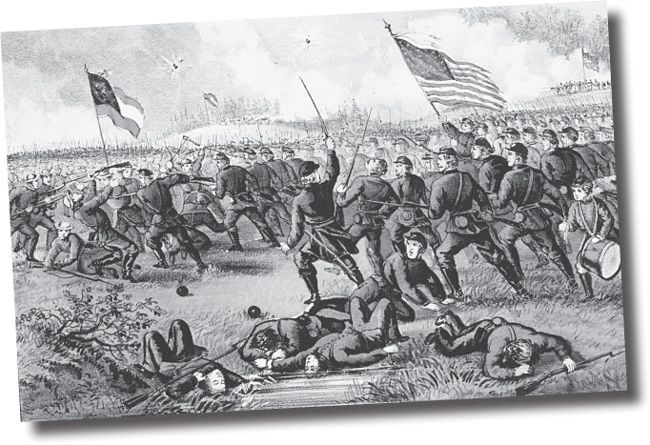
A Currier and Ives lithograph of the Battle of Corinth.
1. However inconclusive, the Battle of Corinth, Mississippi (October 3–4), showed that the Union’s western armies could defend key railroad lines against the Confederates. The Union suffered 2,800 casualties at the battle, the Confederates 5,986.
THE BATTLE AT PERRYVILLE, KY.
THE ENEMY IS EVERYWHERE REPULSED.
OCTOBER 12
GEN. BUELL’S REPORT. PERRYVILLE, KY., VIA BARDSTOWN, OCT. 10
To Maj.-Gen. Halleck, General-in-Chief:
I have already advised you of the movements of the army under my command from Louisville.1 More or less skirmishing has occurred daily with the enemy’s cavalry. Since then it was supposed the enemy would give battle at Bardstown. My troops reached that point on the 4th inst., driving out the enemy’s rear guard of cavalry and artillery. The main body retired toward Springfield, whither the pursuit was continued.
The centre corps, under [Major] Gen. [Charles] GILBERT, moved on the direct road from Springfield to Perryville, and arrived on the 7th instant within two miles of the town, where the enemy was found to be in force.
The left column, under [Major] Gen. [Alexander] MCCOOK,2 came upon the Nashville road about 1 o’clock yesterday, the 8th instant. It was ordered into position to attack, and a strong reconnaissance directed.
At 4 o’clock I received a request from Gen. MCCOOK for reinforcements, and learned that the left had been severely engaged for several hours, and that the right and left of that corps were being turned and severely pressed. Reinforcements were immediately sent forward from the centre.
Orders were also sent to the right column, under [Major] Gen. [Thomas] CRITTENDEN, which was advancing by the Lebanon road, to push forward and attack the enemy’s left, but it was impossible for it to get in position in time to procure any decisive result.
The action continued until dark. Some fighting also occurred on the centre. The enemy were everywhere repulsed, but not without some momentary advantage on the left.
The several corps were put in position during the night, and moved to the attack at 6 o’clock this morning. Some skirmishing occurred with the enemy’s rear guard. The main body had fallen back in the direction of Harrodsburgh.
I have no accurate report of our loss yet. It is probably pretty heavy, including valuable officers.3
Gens. [James Streshly] JACKSON and [William Rufus] TERRILL, I regret to say, are among the killed.
D.C. BUELL, MAJOR-GENERAL COMMANDING.
1. This battle proved the apogee of General Braxton Bragg’s invasion of Kentucky (August–September 1862). He made a fatal error by not attacking Union forces quickly, preferring to head into Bluegrass country, where he believed he could attract additional recruits.
2. A member of the astonishing military family known as the “Fighting McCooks.”
3. Union losses in the Battle of Perryville were 845 Union soldiers killed and 2,851 wounded; Confederate losses were 510 killed and 2,635 wounded.
THE OHIO ELECTION.
DEFEAT OF VALLANDIGHAM!
OCTOBER 15
CINCINNATI, TUESDAY, OCT. 14 — MIDNIGHT.
The election passed off very quietly. The Democrats have elected the entire county ticket. PENDLETON, Dem., in the First District, and the present member, is reelected.
In the Second District, LONG, Dem., probably beats GURLEY, Rep.
Returns from the other counties come in slowly. VALLANDIGHAM, in the Third District, is probably beaten.
THE ELECTIONS YESTERDAY; Overwhelming Triumph of the Union Ticket in Pennsylvania.
PHILADELPHIA, TUESDAY, OCT. 14.
The following is a special to the Press:
HARRISBURGH, Tuesday, Oct. 14.
Glorious news from all parts of the State. BLAIR, BAILEY and MCPHERSON are elected by heavy majorities, Gen. MCCALL is shelved. It is thought here we will carry the State by 50,000. THAD. STEVENS goes back to Congress.
WHY THE ARMY WAITS.
OCTOBER 20
It was about this time last year that the public were comforted by the story that Gen. MCCLELLAN’s army was waiting for the leaves to fall, so that our men might be able to see the enemy upon whom they were to bring to bear their musketry, artillery and bayonets. The story was a capital one, and relieved the popular impatience until such time as the leaves fell, which, in turn, was followed by that period of moral and material mud, in which the nation and the army stuck so long. We have not heard anything of the Virginia leaves falling this year yet as an excuse for delay; but a Washington telegram the other day solemnly announced that our army was waiting for shoes before it attempted to advance. That yarn is not near as good as the one of last year; for last year’s left the time indefinite, inasmuch as it depended upon a slow natural phenomenon: but we suppose it car be demonstrated that, Lynn and Boston could shoe all MCCLELLAN’s troops in three or four days, at the end of which time a bran new excuse will have to be invented. While the army, however, is waiting for new brogans, we suggest that Government examine, and see that each man of it is supplied with pantaloons; for the weather will soon be so cold, that if it is discovered they are without that article of clothing, it will be impossible for a single regiment to advance — except, of course, the gallant Seventy-ninth New-York Highlanders, who go into battle without breeches. Let all these matters be attended to at once, and quickly; and then, let our army, with its new shoes, kick the rebels southward till they are beyond the furthest limits of the Confederacy.

Harper’s Weekly woodcut depicting women sewing clothes and darning socks for troops.
PATRIOTIC WORK FOR WOMEN.
OCTOBER 12
The women of the United States have done nobly since the war opened, in working for the soldiers. They began by making have-locks,1 scraping lint, putting up delicacies and comforts for the sick and the well: they have volunteered for nurses, and for hospital service, and in every way conceivable they have served those who were suffering for their country. This work is still actively kept up all over the land; and to each appeal of the army medical authorities, or the Sanitary Commission2 for aid of any kind, a prompt response has always been made. Cold weather is now coming on in Virginia as well as here; and the Sanitary Commission makes a request that the energies of the patriotic ladies of the land be now turned to the knitting of socks and the making of underclothes for the soldiers. Of lint there is enormous quantities on hand, and havelocks have long been discarded. Warm socks, warm undershirts, and warm drawers, are the things that are now wanted. Let every fine lady, young and old, let every mother who has a son, every sister who has a brother, every maiden who has, or expects to have a beau in the army, let every woman in the country and in the city, who has days or hours or minutes to spare, and who loves her country, devote their spare time to this patriotic work....
1. Named for a British officer, havelocks were white linen or cotton cap covers designed to cover soldiers’ necks and protect them from the sun. Many disdained them, and used them for coffee strainers.
2. The U.S. Sanitary Commission promoted cleanliness, health, education, and nourishment in Union camps. Founded in 1861, the commission was directed by Frederick Law Olmsted, best known as the landscape architect of New York’s Central Park.
BRADY’S PHOTOGRAPHS.
PICTURES OF THE DEAD AT ANTIETAM.
OCTOBER 20
The living that throng Broadway care little perhaps for the Dead at Antietam, but we fancy they would jostle less carelessly down the great thoroughfare, saunter less at their ease, were a few dripping bodies, fresh from the field, laid along the pavement. There would be a gathering up of skirts and a careful picking of way; conversation would be less lively, and the general air of pedestrians more subdued. As it is, the dead of the battle-field come up to us very rarely, even in dreams. We see the list in the morning paper at breakfast, but dismiss its recollection with the coffee. There is a confused mass of names, but they are all strangers; we forget the horrible significance that dwells amid the jumble of type. The roll we read is being called over in Eternity, and pale, trembling lips are answering to it. Shadowy fingers point from the page to a field where even imagination is loath to follow. Each of these little names that the printer struck off so lightly last night, whistling over his work, and that we speak with a clip of the tongue, represents a bleeding, mangled corpse. It is a thunderbolt that will crash into some brain — a dull, dead, remorseless weight that will full upon some heart, straining it to breaking. There is nothing very terrible to us, however, in the list, though our sensations might be different if the newspaper carrier left the names on the battle-field and the bodies at our doors instead.
We recognize the battle-field as a reality, but it stands as a remote one. It is like a funeral next door. The crape on the bell-pull tells there is death in the house, and in the close carriage that rolls away with muffled wheels you know there rides a woman to whom the world is very dark now. But you only see the mourners in the last of the long line of carriages — they ride very jollily and at their case, smoking cigars in a furtive and discursive manner, perhaps, and, were it not for the black gloves they wear, which the deceased was wise and liberal enough to furnish, it might be a wedding for all the world would know. It attracts your attention, but does not enlist your sympathy. But it is very different when the hearse stops at your own door, and the corpse is carried out over your own threshold — you know whether it is a wedding or a funeral then, without looking at the color of gloves worn. Those who lose friends in battle know what battle-fields are, and our Marylanders, with their door-yards strewed with the dead and dying, and their houses turned into hospitals for the wounded, know what battle-fields are.
Mr. BRADY has done something to bring home to us the terrible reality and earnestness of war. If he has not brought bodies and laid them in our dooryards and along the streets, he has done something very like it. At the door of his gallery hangs a little placard, “The Dead of Antietam.” Crowds of people are constantly going up the stairs; follow them, and you find them bending over photographic views of that fearful battle-field, taken immediately after the action. Of all objects of horror one would think the battlefield should stand preeminent, that it should bear away the palm of repulsiveness. But, on the contrary, there is a terrible fascination about it that draws one near these pictures, and makes him loath to leave them. You will see hushed, reverend groups standing around these weird copies of carnage, bending down to look in the pale faces of the dead, chained by the strange spell that dwells in dead men’s eyes. It seems somewhat singular that the same sun that looked down on the faces of the slain, blistering them, blotting out from the bodies all semblance to humanity, and hastening corruption, should have thus caught their features upon canvas, and given them perpetuity for ever. But so it is....
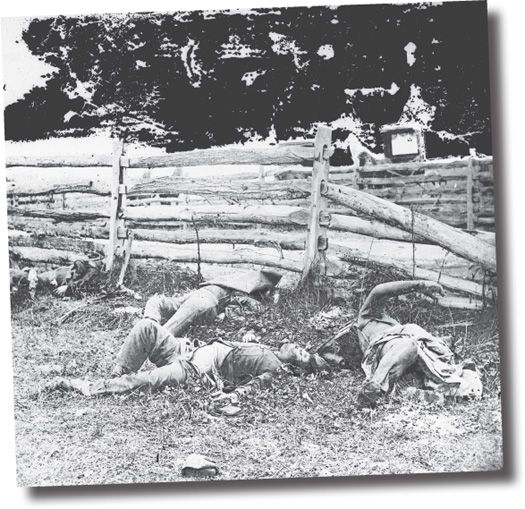

Top and Above: Photographs taken of Confederate dead from the Louisiana regiment at Antietam attributed to Mathew Brady.
SEYMOURISM AS CONSERVATISM.
OCTOBER 21
The Seymourites of this State love to style themselves Conservatives. They are somewhat chary of the old appellation of Democrats. Seeing that the leading portion of the old party of that name are now in armed rebellion, and that its best portion are now staunch supporters of the Government in distinction from themselves, and mindful too of the prejudices of their old foes, and present allies, the Know-Nothings, they rather shun a designation so unpleasantly suggestive, and take to one of a little more attractive east. They fancy that they gain a point in adopting a name usually connected with respectability.
But what do these politicians mean by it? Does it involve any idea appropriate to the period? Every man, of course, knows what conservatism implies in the “piping times of peace.” We can all understand, and in some sort admire too, the disposition to walk in the good old ways, and to cultivate the virtues of contentment, moderation, and prudence. In ordinary times, the conservative policy is simply the policy of keeping things quiet, and maintaining the status quo. But we are not living in ordinary times. We are in the midst of the most dreadful civil war this globe has ever known. Death is now the only quiet, and rivers of blood the only status quo. Is it the conservation of these things the Seymourites mean? We suppose not. They are said to have a particular aversion to all such sights and experiences.
Well, then, is it the conservation of the Constitution and the Union they are after? It is precisely this which Gen. WADSWORTH seeks, and every man in the State who intends to vote for him. It is precisely this which President LINCOLN, and all his constitutional advisers, and all his Generals, are trying to accomplish. The sole object of the war is to save the Constitution and the Union. It was so declared in the beginning, and will be so followed to the end. In this sense, those who support the war are conservatives, and the only conservatives. The rebels who struggle to break up the Constitution and the Union, and they who give them aid and comfort, are the true and only destructives....
The difference between the Administration and its enemies lies here exactly. While the former holds everything subordinate to the salvation of the Constitution, which it has sworn to protect without condition, the latter holds everything subordinate to the security of Slavery, which they have never failed to serve without limit. While the former works for and looks for no end of the war, but in the complete restoration and vindication of Federal authority, the latter seeks and anticipates a peace short of that — a peace which shall be a compromise, and, by new concessions, reconcile Slavery to the present Government; or, that failing, a peace which shall be a surrender, and remit Slavery to a distinct and independent Government. In short, while the former would destroy Slavery, if need be, to save the Nation, the latter would destroy the nation, if need be, to save Slavery. So much for the conservatism of the Seymourites.
SEYMOURITE EXPEDIENTS
OCTOBER 31
THEIR SPIRIT AND EFFECT. — Denounce the Proclamation as a usurpation, and declare Slavery inviolable — and encourage the rebels.
Abuse the President, if he attempt to stimulate the Generals to a forward movement, as a civilian ignoramus and an impertinent intermeddler — and encourage the rebels.
Magnify the public debt, discredit the National currency, hold out the bugbear of foreign intervention, concoct false reports about the conclaves of Governors, threaten riots in the street, mutinies in the camp, violence upon Congress, and a deposition of the President — and encourage the rebels.
Restore the old party lines, regear the old party machinery, revive the old party catchwords, and spare no means to divide the North — and encourage the rebels.
Select candidates of notorious peace antecedents and proclivities, support them with speakers who heap curses upon the Abolitionists as the cause of the war, and who name occasions and contingencies for leaving the Confederacy to itself — and encourage the rebels. Vote against JAMES S. WADSWORTH, Col. MCLEOD MURPHY, ELLIOTT C. COWDIN, and the other nominees of their spirit, and for HORATIO SEYMOUR, FERNANDO WOOD, BENJAMIN WOOD, and the others of that stripe — and encourage the rebels.