
CHAPTER 11

Lincoln’s image emerges in high relief over the words of the Emancipation Proclamation.
In November 1862, voters throughout the Union at last had their official say — about the war, the Lincoln administration, and emancipation. Their verdict did not cheer the President or the Republican Party. Democrats made strong gains in the House and Senate in these bellwether off-year elections and won crucial statewide contests throughout the North. In New York, notwithstanding dire editorial warnings from The Times and other pro-Republican papers, a gubernatorial candidate vigorously opposed by The Times, Horatio Seymour, took the state house for the Democratic Party. The Times quickly concluded that a politically wounded Lincoln would have no option but to compromise and seek peace. Instead, the very morning after Election Day, the President boldly dismissed General McClellan and replaced him with Ambrose E. Burnside.
But things did not improve. In December, Burnside began an offensive against Robert E. Lee’s Confederate army, hoping to get across the Rappahannock River at Fredericksburg, Virginia, before Lee could react. But the delivery of Union bridging equipment was delayed, and by the time the pontoons were in place, Lee had entrenched on the high ground behind the city. Burnside attacked anyway, and the result was an overwhelming catastrophe for Union forces, thousands of whom were all but massacred as they charged up Marye’s Heights into the blazing guns of impregnable Confederate defenders. The defeat triggered a wave of second-guessing and Congressional investigations, and Times readers were invited to speculate whether Burnside was incompetent or had been ordered by ignorant superiors into an attack he opposed.
For the Union, the news from the west was only marginally better. In Tennessee, Major General William S. Rosecrans advanced cautiously against the rebel army under Braxton Bragg along the banks of Stones River near Murfreesboro. Bragg, however, decided to preempt things by attacking first. In a battle that spanned the observation of the new year (December 31, 1862, to January 2, 1863), the two armies fought a bloody engagement that ended indecisively. As usual, details of the fighting in the west were “extremely meager and unsatisfactory,” but afterward, Bragg retreated, making it officially a Union victory even though Rosecrans’s army suffered some 13,000 casualties to Bragg’s 10,000.
Things went from bad to worse for Lincoln’s beleaguered government when senators from his own party attempted to force moderate Secretary of State William H. Seward out of the Cabinet. Senate Radicals considered Seward an obstacle to the vigorous prosecution of the war and emancipation. With characteristic political deftness, Lincoln outfoxed his challengers to keep his Cabinet intact. But as Secretary of the Navy Gideon Welles, a sad witness to the attempted coup d’état, observed at the close of the year: “It is not to be denied ... that the national ailment seems more chronic. The disease is deep-seated. Energetic measures are necessary, and I hope we may have them.”
One hoped-for cure was at hand. After reminding Congress in his December annual message that “we cannot escape history,” Lincoln and the nation braced for the most revolutionary change in American life since the Revolutionary War itself: the final Emancipation Proclamation, scheduled for presidential approval on New Year’s Day, January 1, 1863. New York Times editor Henry J. Raymond wrote Lincoln in late November to propose that the final Proclamation be crafted as a “Military order” so it would not “revolt the Border States,” “make triumphant the opposition,” and “destroy the Union.” Lincoln promised the editor: “I shall consider it,” then proceeded exactly as the editor had counseled.
On December 31, 1862, Raymond wired the White House to ask that the Proclamation be telegraphed to the Associated Press by day’s end, so it might be published quickly without “robbing it of its New Year’s character” (no papers would be published the day after the holiday). Lincoln did not comply. Still working to rewrite his momentous order, he did not issue his document until late in the day January 1, forcing exactly the kind of two-day news lag about which Raymond had warned.
On New Year’s Day, white and black citizens gathered at rallies and in churches throughout the North to await definite word that Lincoln had signed the document as promised — some doubting until the last moment that he would actually do so. In Washington, Lincoln in fact waited until he could leave a White House New Year’s Day reception, then delayed signing until the circulation returned to a right hand “numb” from hours of handshaking. Only then did he affix his name to the “engrossed” document. “If my name ever goes into history,” he told the tiny knot of witnesses gathered in his office, “it will be for this act, and my whole heart is in it.”
The New York Times agreed, heralding 1863 as a new “era in the history, not only of this war, but of this country and the world.”
A VOTE FOR SEYMOUR, A VOTE FOR THE UNION’S DEATH.
NOVEMBER 2
...If New-York elects Mr. SEYMOUR1, England and France will understand that Mr. LINCOLN’s Administration has been repudiated by the people, and that the war is condemned by the majority of the voters and must stop! Such a conclusion would be legitimate in England, because a defeat of the Government candidates and policy would compel the Ministry to resign, and lead to the formation of a new Ministry to carry out the views of the Opposition. We know how wrong a view this would be in its attempted application to the United States, but it would be in accordance with the custom and unwritten constitution of English politics. If, therefore, New-York State shall join the States of Ohio and Indiana in assuming a doubtful position, or one of quasi hostility to the Administration of Mr. LINCOLN, we may expect to find the governing minds of England treating the President and Cabinet at Washington as already superseded by popular cote, and therefore no longer entitled to respect as the Government of the United States! Recognition would follow as a matter of course, and as a matter of duty; and Earl RUSSELL might placate the world by the ingenious argument that in recognizing the independence of the Southern States the English Government had only followed the example of the chief Northern States, Ohio, New-York, &c., which by their votes had condemned the war as hopeless, and called for a Convention and negotiation?
The man who wishes, to see England and France recognize the fact of the Union destroyed should vote today for Seymour.

New York Governor Horatio Seymour.
1. Horatio Seymour (1810–1886), the antiwar, pro-Compromise Democratic candidate for governor of New York.
LET THE PRESIDENT STAND FIRM.
NOVEMBER 8
Nobody who knows the vaulting audacity of the man FERNANDO WOOD, can doubt, now that he is elected, that he will make good his promise to his liegemen, to “go to the President and tell him that without we have a change of measures, so help me God! we will make a change of men.” The President may as well make up his mind at once to be soon bullied and brow-beaten in a style that he has never before seen or heard of; — that is to say, if he does not “put his foot down” at the first rampant word. Of course FERNANDO does not intend to operate slope. He will choose unto himself seven other spirits as presumptuous as himself, and with them he will assume to speak in the name of the triumphant Democratic Party. Not entirely without reason, either. Every reader of history understands that in revolutionary times. It is almost invariably the oldest and the most violent who lead; and really if the Democratic Party, as revived, is to have any leadership in Washington, we know of nobody so likely to succeed to it as FERNANDO WOOD. At all events, whatever the power behind him, this man will attempt to use against the President all the airs of authority and all the arts of intimidation, of which his long discipline in the democratic politics of this city — the most mephistophilian school extant — has made him the complete master.
With bald impertinence, if it he offered, of course the President will know how to deal. But FERNANDO has acquired some knowledge of the usages of society, and will probably take care to phrase himself in a manner that shall secure him from being shown the door. Notwithstanding the coarseness of his manifesto here, he will, most likely, when it comes to the ease in hand, make a special effort to pitch his dictation in as respectful a key as possible. We trust, however, that the President will abide dictation from FERNANDO WOOD in no way. He should meet the very first approach to it peremptorily, with the same spirit as that with which his predecessor. Old ZACHARY TAYLOR, silenced a correspondent, and, in many respects, a counterpart of this same WOOD, ROBERT TOOMBS,1 when engaged on a similar errand. Of course, it is fit for the President to receive suggestions, and even advice, from any intelligent citizen, whether in or out of public life. But he degrades himself and his high office, if he endures the first word of either behest or menace, from any quarter whatsoever.
Unquestionably, in consequence of the late elections, every influence, proper and improper will be brought to bear upon President LINCOLN to obtain his committal to some compromising policy. Let him see to it that he stands firm. The determination he has so often expressed to uphold the Federal authority in all its breadth must be kept to unflinchingly. Nothing is so demoralizing as vacillation. Of all forms of weakness, this is the most mischievous — the one most sure to invite disasters and contempt. Human nature looks with involuntary respect, and a certain fear, upon those who choose their course with clear and deliberate foresight, and pursue it, when chosen, with unswerving resolution; who form their decisions cautiously and considerately, but refuse to reconsider them in difficult conjunctures, or to abandon them before unforeseen obstacles. There is an instinctive feeling that such men have within them the qualities which command success. They challenge confidence and support in advance. The President has been crossed in a way he hardly looked for — has experienced a defection that may well occasion anxiety; but there must be no irresolution that sways backward and forward with the fortunes of the day; no undervaluing for a moment of the great cause of the Constitution to which he has, committed himself; no misgiving lest right, if he sustains it faithfully, should, in the end, not triumph. The President has no alternative but to go straight on, consistently and persistently, to the end. It was long ago decided that the rebels, of their own motive, had cut short all forbearance and blocked up all accommodation. The whole guilt of this conflict rests with them; and not for an instant can the Government falter until its authority is vindicated, and the submission complete.
The legitimate influence of the late elections is directly the reverse of what the FERNANDO WOOD2 type of politicians will endeavor to make it. Instead of encouraging conciliation, it urges intenser hostility. It is not the olive branch the people mean, but the more trenchant sword. The loyal States are more impatient this day than ever for swift, sweeping war — the summary extermination of the rebellion by terrific battle. If President LINCOLN will only see that this cry is answered, the great-souled people will stand by him more devotedly than ever; and the insolent pack which now threatens him will make haste to hide their heads.
1. Robert A. Toombs (1810–1885), a Georgia senator who resigned to vie for the presidency of the Confederacy, and thereafter served in the Confederate army while serving simultaneously in its Congress.
2. Wood, former mayor of New York City, had won election to the 38th Congress in 1862 as an antiwar Democrat.
THE ELECTION
NOVEMBER 8
FROM THE ALBANY EVENING JOURNAL.
The returns received, although imperfect, indicate the election of the Democratic ticket by a few thousand majority. The result is none the less mortifying because it was not altogether unexpected. In the present terrible crisis of the country, New-York should occupy no equivocal position. That she now does, will embarrass the Government and give heart to its enemies....
The result is what we feared at the time, but which we hoped might be averted by hard work and general organization. Besides this fundamental error, other causes aided to effect this result. The Democratic orators and Press availed themselves of every salient point in the legislative, financial and military departments of the Government, to warp the judgment, prejudice the minds, and arouse the passions of the people. Every error of Congress, the unavoidable derangement of the currency, all the mishaps of the army, the oppression of conscription, the burdens of taxation, and the prolongation of the war, were all charged upon the Republican Party. Falsehood, perversion and misrepresentation were never more freely employed, and the public mind was never so ready to absorb whatever was persistently pressed upon it. Starting in the contest at a disadvantage voluntarily assumed, it was impossible — felt to be so at every stage of the campaign — to regain ground then lost, or to counteract, by simple truth and unimpassioned argument, the effect of these persistent and unpatriotic perversions, and the blind passions they excited. We will not venture to predict the effects of the election of Mr. SEYMOUR upon the future. While we have looked upon its happening with apprehension, we have not permitted ourselves to believe that it would ultimate in unmitigated disaster. We have unwavering faith in the patriotism of the great body of the people; and, however disposed, no man in any responsible position would dare to initiate or suggest any measure designed to thwart the loyal purpose of the Administration to call into requisition the concentrated power of the Government to crush out the rebellion and to restore the Republic. The Democratic Party, by its recent success, is given an opportunity seldom vouchsafed to any political organization to demonstrate its loyalty, and to attach to itself the gratitude and confidence of the people. Whether the leaders of that party have the wisdom and patriotism to achieve such results, remains to be seen. We hope for the best, and shall rejoice if our expressed fears, and the apprehensions of those who labored to avert these successes, shall be proved unjust and unfounded.
THE DEMOCRATS AND THE ELECTION.
NOVEMBER 9
Throughout the whole of the late political campaign we recognized the fact that the votes to be cast for Mr. SEYMOUR would come from two entirely opposite classes of voters; that every one who opposed the war and was in favor of peace, immediate and on any terms, would be found voting for him, and that many would also vote for him who were earnestly and honestly in favor of prosecuting the war vigorously till the rebellion was suppressed. We recognize this fact now. The Tribune declares that it found no supporter of SEYMOUR, who did not support him “as the Peace candidate.” Our own experience is different. We found many who supported him claiming that he would push on the war heartily. They seemed to us under a very strange hallucination, and we warned them repeatedly that they were going in bad company, and were in danger of being cheated upon this very point, which seemed to us a vital one. They did not give heed to our warnings, and the election of Mr. SEYMOUR is the result.
The election has not done away with the fact of which we have spoken. It has rather brought Mr. SEYMOUR and his supporters face to face with it. It is still true that men have voted for him believing that his election would tend to help the rebels in successfully maintaining their position, and that others have voted for him believing that his election would speed on the war to the overthrow of the rebellion; and both parties, now that the result which they hoped for is attained, are outspoken in their views of it. We know of one instance, and we doubt not there have been many, in which it has been openly declared by Mr. SEYMOUR’s supporters since the election that they would now proceed and carry out their original programme of bringing the two sections together under the Montgomery Constitution, and then by Convention, or some other means, excluding New-England from the new nation; and in our opinion the call now made in some quarters for an immediate meeting of the new Congress, which cannot by law meet till a year from next December, unless convened by the President, points in this direction.
And therefore we warn the loyal portion of Mr. SEYMOUR’s supporters, as we have warned them before, that there is danger in this direction. It cannot be denied that the result of the late elections has been to place in positions of power and influence some men whose sympathies are not with us, but with the rebels — men to whom the rebels look with hope for help, and whom they consider to bear the same relation to the body of loyal men at the North as “the five just men in Sodom” did to their besotted fellow-citizens. It remains to be seen whether these men shall be able to wield the power which has been placed in their hands for the overthrow of the nation before the people can interfere. The voice of the people cannot be uttered again in a popular election for a year. We know well that if the efforts of these men to destroy the nation shall be made, and shall not be successful before that time comes round, there will be another political revolution which will throw them out of power with more speed than they have now been put in.
We shall do all in our power to prevent their success; and we call upon the loyal supporters of Mr. SEYMOUR to watch them and work against them, for the preservation of the country; assuring them that in such a work they will find themselves seconded and supported by the great body of the loyal men of the land.
SUSPENSION OF THE DRAFT.
NOVEMBER 9
A dispatch from Adjutant-General HILL-HOUSE still further postpones, and this time indefinitely, the long talked-of and much dreaded draft. The reason assigned is, the difficulty of procuring correct returns of the persons who have enlisted in all the counties, so as to apportion rightly among the counties the number to be drafted from each.
The practical operation of the effort of the Government to get soldiers into its service by draft, is far from satisfactory. There must be a glaring defect somewhere in the laws, and it is the duty of Congress at its next session to find where the trouble is and remedy it. In midsummer, the President of the United States deeming the Republic in imminent danger, ordered a draft of 300,000 men to its immediate support in the field. More than three months have passed, and yet not a man has been obtained from the great State of New-York under the President’s order for a draft. Nor is it possible to tell when the first conscript will be had. If in this mode the Government is to be preserved when in great danger, then is its continued existence extremely precarious.
We cannot for a moment think that the authorities of New-York State have purposely obstructed the draft; though we must not shut out the fact that other States — Connecticut, Pennsylvania and Ohio, for instance — have long since complied with the requisition of the General Government, and enforced the conscription. We have subjected the Republicans and Unionists in New-York State, who were the earnest supporters of the Government, to all the injuries and losses politically of the draft, in the late canvass. We had thorough searching enrollments; ostentatious parade of the voluminous lists under the protection of soldiers to the place of sacred deposit; formal and protracted sessions of Commissioners and Surgeons, for the purpose of relieving from the draft all who were rightfully exempt. All this was in progress in the heat and excitement of the State canvass, and it was doubtless the means of much disaffection to the Government among the electors. And now, when all the harm possible has been done, and after the Government is defeated before the country, we are told that the draft cannot take place as soon as expected, and it is postponed till further orders.
All this delay and confusion must be attributed to the original, cardinal mistake, of allowing credits to counties for volunteers furnished previously to the draft. This rests on no sound principle. A volunteer goes to the war because he is willing and prepared, and chooses to go. He does not put himself in the hands of his county in order that it may trade on him, and make aught by his going or staying. Reject this mischievous mistake of attempting to equalize — the source of endless and fatal delay and confusion — and any draft ordered by Government could be filled in ten days.
THE REMOVAL OF GEN. McCLELLAN.
NOVEMBER 10
Gen. McCLELLAN has been removed from the command of the Army of the Potomac and Gen. BURNSIDE1 appointed in his place. The immediate cause of this removal has been Gen. McCLELLAN’s refusal to advance against the enemy, even under the most peremptory orders of the General-in-Chief [Halleck]. It will be seen, by a letter from Gen. HALLECK to the Secretary of War, which we publish in another column, that on the 1st of October Gen. MCCLELLAN was urged by Gen. HALLECK to cross the Potomac and give battle to the enemy, — being at the same time reminded of the disadvantages of delaying until the Potomac should be swollen, and the roads impaired, by the autumnal rains. Finding that this produced no effect, Gen. MCCLELLAN was “peremptorily ordered” by Gen. HALLECK, on the 6th of October, to “cross the Potomac and give battle to the enemy or drive him South.” For three weeks this order was not obeyed, and the only excuse given for not obeying it, so far as appears, — the want of supplies, is shown by the letter of Gen. HALLECK to have been utterly without foundation. The disclosures of that letter, concerning Gen. MCCLELLAN’s constant and reiterated complaints of lack of supplies, are very remarkable and deserve special attention.
We presume that this particular instance of disobedience of orders, though the immediate occasion, is not the whole cause of Gen. MCCLELLAN’s removal. It is pretty generally understood that this is only the culmination of a systematic disregard of orders, of a steady and obstinate tardiness in the conduct of the campaign against the rebels, and of a consequent inefficiency in command, which would long ago have secured his dismissal under any Administration less timid than that which has now possession of power. The fifteen months during which he has had virtual control of the war have been utterly barren of results to the cause he has professed to serve. Few commanders in history have had such splendid opportunities, and fewer still have so ostentatiously thrown them away. With an army capable of the most heroic achievements, powerful in numbers, unrivaled in discipline and equipment, eager always for active and onward movement, he has accomplished absolutely nothing but successful retreats from inferior forces, and the defence of the Capital at Washington, which he should have left no foe capable of menacing. The rebel armies have grown up in his presence, and by his toleration. Through all his long career he has made but one attack and won but a single victory: and that became absolutely fruitless through his failure to follow it up.
We have no theory on which to explain this most extraordinary failure of Gen. MCCLELLAN as a commander, or the still more extraordinary persistence of the President in committing the fortunes of the war to his hands. Gen. MCCLELLAN has shown too many of the qualities of an accomplished soldier to attribute his failure to simple incapacity. That he is absolutely disloyal to the Government we have never permitted ourselves to believe. Yet we think it quite probable that his heart has never been in the war, — that through it all he has had hopes of a compromise which should end it, and that he has feared the effect upon such a compromise of a stern and relentless prosecution of hostilities....
In this view of the case, Gen. MCCLELLAN has been encouraged by the political partisans who, at an early stage in the war, made him their prospective candidate for the Presidency, and came thus to have an interest in putting him in opposition to the Administration which he professed to serve. They defended his errors, and made themselves the special champions of his worst mistakes. They had unquestionable provocation and some excuse for much of this in the intemperate zeal with which he was assailed; but they betrayed him into an undue reliance on the support of a party, and a ruinous subserviency to their wishes and views. We know not how else to account for the steady and systematic disregard he has shown of the wishes and orders of the Government, and for his adherence to a deliberate and methodical inactivity, which has brought the cause of the Union to the very verge of ruin....
Gen. BURNSIDE has been three times offered the command of the Army of the Potomac. He declined it twice, partly from a strong feeling of personal affection for Gen. MCCLELLAN, and partly from thorough confidence in his military capacity, and his devotion to the Union cause. This confidence, we suspect, was somewhat shaken during and after the battle of Antietam; while the treatment he has since received for having remonstrated against the General’s causeless suspension of the fight, has probably released him from the personal obligations on which he was previously inclined to lay such controlling stress. We presume, therefore, that he will now accept the command. He has shown thus far during the war great military ability, and a thorough, unqualified, unquestioning devotion to the cause he serves....

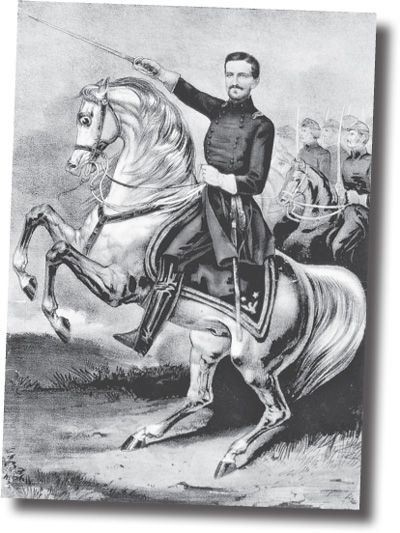
Major General Ambrose E. Burnside, U.S.A.
1. Ambrose E. Burnside (1824–1881).
GOV. SEYMOUR ON THE ELECTION.
NOVEMBER 10
Gov. SEYMOUR made a speech at Utica on Thursday night, to a large crowd that came to congratulate him on the result of the election. We find no report of his speech, and only a meagre reference to it in the Utica papers. We do not see that he threw much light on the specific manner in which his election is to restore the Union, though he was profuse in declarations that it would have that effect. “The success of the Democracy,” he said, “would bring back the country to the position of years ago, when the Constitution was the supreme law, and the laws were impartially administered. Henceforth the laws were to be obeyed, and constitutional authority respected.” We can understand how all this may happen in the North, — but not how Mr. SEYMOUR’s election is to restore that happy time to the Southern States. He says that “from this time henceforth it would seem there is a great Union party all through the South, who desire to cooperate with a party they know to be ready to welcome them back into the Union.” This may be so — but as yet we don’t see it.
Mr. SEYMOUR talks as if there had been a rebellion in the North, which the Democracy had succeeded in putting down. He says not one word about the Southern rebellion, nothing about aiding the Government to crush it out and thus restore the Union. He denies that the Democrats are disloyal, and says that they intend to sustain the Government “in all its Constitutional acts.” He did not specify, however, what these are, so that we are left to a wide field of conjecture as to the exceptions which Gov. SEYMOUR would feel inclined to make.
THE PRESIDENT’S MESSAGE.1
DECEMBER 2
WASHINGTON. DEC. 1
[“...]The proposed emancipation would shorten the war, perpetuate peace, insure this increase of population, and proportionately the wealth of the country. With this we should pay all the emancipation would cost, together with our other debts, easier than we should pay our other debts without it. If we had allowed our old National debt to run at six per cent. per annum, simple interest, from the end of our Revolutionary struggle till to-day, without paying anything on either principal or interest, each man of us would owe less upon that debt now than each man owed upon it then; and this because our increase of men through the whole period has been greater than 6 per cent., and has run faster than the interest upon the debt. Thus, time alone relieves a debtor nation so long as its population increases faster than unpaid interest accumulates on its debt. This fact would be no excuse for delaying the payment of what is justly due; but it shows the great importance of time, in this connection, the great advantage of a policy by which we shall not have to pay until we number a hundred millions, what, by a different policy, we could have to pay now when the number is but thirty-one millions. In a word, it shows that a dollar will be much harder to pay for the year than will be a dollar for emancipation on the proposed plan. And then the latter will cost no blood, no precious life. It will be a saving of both....
I cannot make it better known than it already is, that I strongly favor colonization; and yet I wish to say, there is an objection urged against the colored persons remaining in the country, which is largely imaginary if not sometimes malicious. It is insisted that their presence would injure and displace white labor and white laborers. If there ever could be a proper time for mere arguments, that time surely is not now. In times like the present men should utter nothing for which they would not willingly be responsible through time and eternity.
Is it true, then, that colored people can displace any more white labor by being free than remaining slaves? If they stay in their old places they jostle no white laborers. If they leave their old places, they leave them open to white laborers. Logically there is neither more or less of it. Emancipation, even without deportation, would probably enhance the wages of white labor, and very surely would not reduce them. Thus the customary amount of labor would still have to be performed. The freed people would surely not do more than their old proportion of it, and very probably, for a time, would do less, leaving an increased part to white laborers, bringing their labor into greater demand, and, consequently, enhancing the wages of it. With deportation, even to a limited extent, enhancing wages to white labor, is mathematically certain. Labor is like any other commodity in the market; increase the demand for it, and you increase the price of it. Reduce the supply of black labor, by colonizing the black laborer out of the country, and by precisely so much you increase the demand for and the wages of white labor. But it is decided that the freed people will swarm forth, and cover the whole land. Are they not already in the land? Will liberation make them any more numerous? Equally distributed among the whites of the whole country, and there would be but one colored to seven whites. Could the one in anyway greatly disturb the seven? There are many communities now having more than one free colored person to seven whites, and this without any apparent consciousness of evil from it. The District of Columbia and the States of Maryland and Delaware are all in this condition. The District has more than one free colored to six whites. Yet, in its frequent petitions to Congress, I believe it has never presented the presence of free colored persons as one of its grievances. But why should Emancipation South send the freed people North? People of any color seldom run unless there be something to run from. Heretofore, colored people, to some extent, have fled North from bondage, and now, perhaps, from both — bondage and destitution; but if gradual Emancipation and deportation be adopted, they will have neither to flee from. Their old masters will give them wages, at least, until new laborers can be procured; and the freed men, in turn, will gladly give their labor for the wages till new homes can be found for them in congenial climes, and with people of their own blood and race....
I do not forget the gravity which should characterize a paper addressed to the Congress of the nation, by the Chief Magistrate of the nation, nor do I forget that some of you are my seniors, nor that many of you have more experience than I in the conduct of public affairs; yet I trust that in view of the great responsibility resting upon me, you will perceive no want of respect to yourselves in any undue earnestness I may seems to display. Is it doubted, then, that the plan I propose, if adopted, would shorten the war, and thus lessen its expenditure of money and of blood? It is doubted that it would restore the national authority and national prosperity, and perpetuate both indefinitely? Is it doubted that we here, Congress and Executive, can secure its adoption? Will not the good people respond to a united and earnest appeal from us? Can we, can they, by any other means, so certainly or so speedily assure these vital objects? We can succeed only by concert. It is not “Can any of us imagine better?” but “Can we all do better?” Object whatsoever is possible, still the question recurs, “Can we do better?” The dogmas of the quiet past are inadequate to the stormy present. The occasion is piled high with difficulty, and we must rise with the occasion. As our case is new, so we trust think anew, and act anew. We must disenthrall ourselves, and then we shall save our country.
Fellow Citizens — We cannot escape history.
We, of this Congress, will be remembered in spite of ourselves.
No personal significance, or insignificance, can spare one or another of us.
The fiery trial through which we pass, will light us down in honor or dishonor to the latest generation.
We say that we are for the Union. The world will not forget that while we say this, we do know how to save the Union. The world knows we do know how to save it. We, even we here, hold the power and hear the responsibility.
In giving freedom to the slave, we assure freedom to the free, honorable alike in what we give and what we preserve.
We shall nobly save or meanly lose the last best hope of the earth.
Other means may succeed. This could fail.
The way is plain — peaceful, generous, just — a way which, if followed, the world even applaud and God must forever bless.[”]
ABRAHAM LINCOLN.
The Message of President LINCOLN ... is a concise, clear and perspicuous document. It will of course be read by every one able to read in this country, and by every person in Europe and over the world, who takes an interest in the military and civil affairs of this Government and people....
What the President has to say of prospective emancipation, and of the colonization of the enfranchised slaves, will not command universal assent, and we deem it very doubtful whether Congress will enact the laws necessary to carry his recommendations into effect.2 But no one can doubt that the President has made them from the most patriotic motives, and with a sincere desire to contribute all in his power to the permanent settlement of the most important question of the age.
1. As was customary, The Times published the President’s annual message to Congress — precursor of the State of the Union message — in full, and added editorial comments.
2. Lincoln laid out a complex, conservative plan for compensated emancipation in the loyal states and colonization of freed blacks. And yet he ended the message with ringing rhetoric, declaring, “The fiery trial through which we pass, will light us down, in honor or dishonor, to the latest generation.” For the full text, see Basler, The Collected Works of Abraham Lincoln, 5:518–537.
OUR FOREIGN RELATIONS.
THE CORRESPONDENCE BETWEEN THE STATE DEPARTMENT AND HON. C. F. ADAMS, OUR REPRESENTATIVE AT LONDON.
DECEMBER 8
The correspondence between the State Department and the American Representatives abroad has reached us in advance of its submission to Congress. The publication is of the highest importance. It tells in the most authentic form the story of our intercourse with foreign nations during the most difficult stage of the National career; how faithfully and ably the justice and progress of our cause have been presented to the Governments of Europe, and why the various difficulties necessarily incident to a contest such as ours have been prevented from becoming the provocations of an external war by the conciliatory weapons of diplomacy. It will be seen that the labors of Secretary SEWARD have been as heavy as they have been successful; and have embraced the discussion of a large number of questions, the chief of which is evidently the Relations of Europe to the War.
The efforts of the Secretary of State have been mainly directed to the neutralizing, as far as practicable, the effect of European recognition of the Southern insurgents as belligerents, to prevent any measure looking to the recognition of their independence, or lending direct and moral aid to the cause of rebellion. To communicate constantly to our foreign agents the events of the war, glozed with such commentaries as should go to satisfy the Governments to which they were accredited that those events were rapidly conducing the struggle to a close, has been a material portion of the Secretary’s task, and one into which he has thrown all his skill as a dialectician, and all the confidence of a sanguine temperament. We propose for the present to confine our extracts to the correspondence with Mr. CHARLES FRANCIS ADAMS, the Minister to England.
DEPARTMENT OF STATE, WASHINGTON, NOV. 10
SIR:
It is probable that the ground which the enemies of the Union in Europe will next assume, in prosecuting their war against it, will be an alleged defection of popular support of the Government at the elections recently held in the loyal States. The reports of the results of these elections in the forms adopted by the Press are calculated, though not designed, to give plausibility to this position. I observe that these reports classify the members of Congress chosen as Union and Democratic, or Union and opposition. Such classifications, though unfortunate, do less harm here, where all the circumstances of the case are known, than abroad, where names are understood to mean what they express. Last year, when the war began, the Republicans, who were a plurality of the electors, gave up their party name, and joining with loyal Democrats, put in nomination candidates of either party under the designation of a Union party. The Democratic Party made but a spiritless resistance in the canvass. From whatever cause it has happened, political debates during the present year have resumed, in a considerable degree, their normal character, and while loyal Republicans have adhered to the new banner of the Union party, the Democratic Party has rallied end made a vigorous canvass with a view to the recovery of its former political ascendency. Loyal Democrats in considerable number retaining the name of Democracy from habit, and not because they oppose the Union, are classified by the other party as “opposition.” It is not necessary for the information, of our representatives abroad that I should descend into any examination of the relative principles or policies of the two parties. It will suffice to say that while there may be men of doubtful political wisdom and virtue in each party, and while there may be differences of opinion between the two parties as to the measures best calculated to preserve the Union and restore its authority, yet it is not to be inferred that either party or any considerable portion of the people of the loyal States, is disposed to accept disunion under any circumstances, or upon any terms. It is rather to be understood that the people have become so confident of the stability of the Union that partisan combinations are resuming their sway here, as they do in such cases in all tree countries. In this country, especially, it is a habit not only entirely consistent with the Constitution, but even essential to its stability, to regard the administration at any time existing as distinct and separable from the Government itself, and to canvass the proceedings of the one without the thought of disloyalty to the other. We might possibly have had quicker success in suppressing the insurrection if this habit could have rested a little longer in abeyance; but, on the other hand, we arc under obligations to save not only the integrity or unity of the country, but also its irrestimable and precious Constitution. No one can safely say that the resumption of the previous popular habit, does not tend to this last and most important consummation, if at the same time, as we confidently expect, the Union it sell shall be saved.
I am, Sir, your obedient servant,
WILLIAM H. SEWARD.
CHARLES FRANCIS ADAMS, &C., LONDON.
THE EFFICIENCY OF THE BLOCKADE
DECEMBER 10
Five hundred and forty-three vessels seized by the blockading squadrons, worth, with their cargoes, forty millions of dollars! Verily this is a splendid record, and yet it but faintly tells the story of the actual amount of service rendered to the good cause by this ceaseless, noiseless agency.
In casting the fortunes of the war, we are too apt to look exclusively to the battlefield. We measure progress, or the contrary, by bulletins. We must have sounding events, or nothing, we fancy, is doing. This is a mistake. The silent agencies of this war are quite as serviceable in bringing it to a favorable end as gunpowder. We believe, in fact, they are worth more. Of the two we could better afford to give up campaigning than to give up the blockade. The former is at best but of uncertain progress; what is gained to-day may be lost to-morrow, and it is possible that all may end in disasters. The latter knows no vicissitudes, and, if long enough maintained, can possibly have but one result — and that favorable to the belligerent that employs it. What ends a war, where both adversaries are alike courageous, is the exhaustion of one of them. It is of little consequence how that exhaustion is produced — whether by blows or by stilling — so that it be brought about. Three years of strict blockade, without aggressive fighting, we believe, would reduce the South to greater weakness than three years of such fighting, without a blockade. But we have it in our power to use both means; and through both we expect to subdue this rebellion in less time than three years. In estimating the progress of the war, we should, then, avoid the common error of paying regard only to deeds of arms.
Our fighting has not as yet evoked any such cry of distress as the blockade constantly occasions. The stern, relentless exclusion from all the markets of the world, comes home with sharp effect to every man, woman and child in the Confederacy. It has not only thus wrought great personal distress, but has dragged the rebel Government itself into hopeless bankruptcy, by destroying the value of the Southern staples, upon which it was calculated that public credit could be secured abroad. The cotton-planters have not been able to sell their cotton, because it could not leave the country, and without such sale, they have had only the scantiest means of supporting themselves and their slaves. Those of them who were induced to pledge their cotton to the Government, as a basis for its credit, got nothing in return — the Government expressly refusing to give its notes or bonds for what was of no present value to it. The cotton pledged, it was found, did not add a dime’s worth to the Government’s credit across the water; and, of course, the Government could not afford to give any of its own credit, poor enough at best, in return. The cotton has proved alike worthless to the planter and to the Government. It was thought to be gold; under the blockade it has turned out to be rubbish.
Of all the countless delusions of the rebels, the most stupendous and the most fatal one was the taking it for granted that the blockade would not be long permitted by Europe — that the necessities of the Old World for the raw material from which millions find work, would perforce override our national rights. It is now settled that our national rights will not be interfered with. Providence has secured this by interposing a greater necessity for the wheat of the North than could possibly exist for the cotton of the South. It is doubtful whether the European Powers, in any event, would have violated our blockade; but, as matters now stand, it is impossible. Peace with the North is the supreme consideration. The blockade will continue unmolested until we choose to end it — in other words, until rebellion yields. And its silent, ceaseless pressure must tell with constantly increasing effect upon the South — paralyzing trade, industry, currency, credit, every thing which in these modern times gives strength and resource to a people. The rebellion, under any circumstances, could not long endure it; least of all, when called to such desperate exertions such as our invading armies must henceforth compel.
IMPORTANT FROM VIRGINIA.
THE GREAT BATTLE FOUGHT ON SATURDAY AT FREDERICKSBURGH.
DECEMBER 15
SATURDAY, DEC. 13
IN THE FIELD — 11 O’CLOCK, A.M.
The great battle, so long anticipated between the two contending armies, is now progressing.
The morning opened with a dense fog, which has not entirely disappeared.
Gen. REYNOLDS’1 Corps, on the left, advanced at an early hour, and at 9:15 A.M., engaged the enemy’s infantry. Seven minutes-afterward the rebels opened a heavy fire of artillery, which has continued so far without intermission.
Their artillery fire must be at random, as the fog obstructs all view of almost everything.
Our heavy guns are answering them rapidly.
At this writing, no results are known.
HEADQUARTERS OF THE ARMY OF THE POTOMAC,
SATURDAY DEC. 13 — 11 P.M.
The fog began to disappear early in the forenoon, affording an unobstructed view of our own and the rebel positions....
The troops advanced to their work at ten minutes before 12 o’clock at a brisk run, the enemy’s guns opening upon them a very rapid fire. When within musket range, at the base of the ridge, our troops were met by a terrible fire from the rebel infantry, who were posted behind a stone wall and some houses on the right of the line. This checked the advance of our men, and they fell back to a small ravine, but not out of musket range.
At this time another body of troops moved to their assistance in splendid style, notwithstanding large gaps were made in their ranks by the rebel artillery. When our troops arrived at the first line of the rebel defences, they “double quicked,” and with “fixed bayonets” endeavored to dislodge the rebels from their hiding places. The concentrated fire of the rebel artillery and infantry, which our men were forced to face, was too much for them, and the centre gave way in disorder, but afterwards they were rallied and brought back.
From that time the fire was spiritedly carried on, and never ceased until after dark....
Our troops sleep to-night where they fought to-day. The dead and wounded are being carried from the field.
...It is impossible to form an accurate idea of the loss on either side, as the firing is still going on, rendering it extremely difficult to remove the killed and wounded.
The city suffered terribly from the enemy’s artillery, and is crowded with our troops, the front extending but a short distance beyond.
The balloon has been up all day.2 During the morning but little could be seen, owing to the dense fog; but the afternoon was remarkably clear.
This evening the rebels have been shelling Fredericksburgh, endeavoring to drive our troops out of the place, but without success.3

A Kurz and Allison lithograph of the Battle of Fredericksburg.
1. Major General John F. Reynolds (1820–1863), commanded the Union I Corps at Fredericksburg and was killed in action seven months later at Gettysburg.
2. Undoubtedly a reconnaissance balloon, of limited use on a battlefield shrouded in smoke and fog.
3. The Union suffered 12,653 killed, wounded, and missing at Fredericksburg; the Confederate total was 5,309.
THE FACTS CONCERNING FREDERICKSBURGH CALLED FOR.
DECEMBER 19
The country will be gratified to learn that the Congressional Committee on the Conduct of the War were yesterday “directed to inquire into the facts relative to the recent battle at Fredericksburgh, Virginia, and particularly as to what officer or officers are responsible for the assault which was made upon the enemy’s works, and also for the delay which occurred in preparing to meet the enemy.” We trust the committee will push this matter through with a promptitude equal to that with which they have performed other essential services to the country, and let the facts be known to the people at once, so that swift punishment may follow upon the crime. The feelings of the country are terribly strong upon this subject, and instead of decreasing, are daily becoming more intense. We assure those in authority that it will be dangerous to trifle with them.
...Congress must drag forth the guilty party, that he may receive the maledictions and the justice of the country. Fifteen thousand heroes killed and wounded in vain (ah! not in vain!) demand it. A hundred and fifty thousand brave souls, who for a long day breasted the iron storm of the rebel artillery, demand it. A country and a people suffering fearfully, will compel it. Neither the heroes dead nor the heroes living, nor the country in general, would begrudge the blood necessary to save the Union. But it must not be forever shed in vain.

Photomechanical print showing Confederate troops fighting at the Battle of Fredericksburg.
THE RESIGNATION OF SECRETARY SEWARD.
A CAUCUS OF REPUBLICAN SENATORS REQUESTS HIS WITHDRAWAL
DECEMBER 21
The following is the statement of the Washington Star, regarding the resignation of Secretary SEWARD,1 which was briefly referred to in our morning edition of yesterday:
“A majority of the Senate, in caucus, on the 17th inst., adopted a resolution which, as first prepared, declared a want of confidence on their part, in the Secretary of State, but which was modified so as to express to the President a unanimous recommendation of a partial reconstruction of the Cabinet. A committee was appointed to wait upon the President, and communicate their action. On being informed of the fact, the Secretary of State on the same day sent to the President his resignation, and requested that it might be immediately accepted. The Assistant Secretary of State sent in his resignation at the same time and in the same manner. The Secretary and Assistant Secretary still remain at their desks, awaiting the appointment of their successors.”
1. Following the Union defeat at Fredericksburg, a caucus of Republican senators pressed Lincoln to reshuffle his Cabinet. The President outmaneuvered the delegation by inviting them to confront Seward face-to-face; they quickly backed down and Lincoln refused his secretary of state’s offer to quit, along with that of his treasury secretary, Salmon P. Chase, thus averting a major government crisis.
THE CABINET CRISIS.
A FULL EXPOSITION OF THE CAUSES WHICH LED TO IT.
DECEMBER 22
WASHINGTON, SATURDAY, DEC. 20
The political crisis which has been impending so long, was precipitated by the military disaster of Saturday last. Not even the most reckless politicians affect to regard it with indifference, and the universal feeling is one of gloom and apprehension....
The occasion for the extraordinary demonstration on the part of the Senate, which has led to this political crisis, was the repulse of the Army of the Potomac, in its attempt upon the rebel lines at Fredericksburgh. It was evident that the country would be roused by that disaster to the highest pitch of indignation, and men who had political ends to serve were quick to appreciate the opportunity thus afforded of directing public sentiment against the objects of their resentment. Naturally enough Mr. SEWARD was the special victim first selected....
I do not, therefore, believe that the authorities at Washington can, in any just sense, be held responsible for the result of that specific action. But I am inclined to think that Gen. BURNSIDE has reason to complain that the Government did not fulfill the conditions which he had laid down as absolutely essential to the success of his movement upon Fredericksburgh, when he first proposed that movement the day after receiving his command, and to which the President and Gen. HALLECK gave their explicit assent. But my letter is already too long to permit me to state the facts on which I base this opinion. Yours,
&c., R[AYMOND].
A TERRIBLE BATTLE.
ATTACK UPON THE REBELS AT MURFREESBORO BY GEN. ROSECRANS.
JANUARY 3
NEAR MURFREESBORO, WEDNESDAY, DEC. 31
The following has just been received by telegraph from Cincinnati, dated Murfreesboro, Jan. 1, 1863:
A terrible battle was fought yesterday. The latest from the field is up to noon. The rebel centre had been broken, and things looked favorable. The losses are reported to be enormous. STANLY, ROUSSEAU and PALMER are wounded, and the rebels CHEATHAM and RAINS are killed.1
Gen. ROSECRANS2 occupies Murfreesboro.
(SIGNED,) J.T. BOYLE, BRIGADIER-GENERAL.
Major General William S. Rosencrans, U.S.A.
1. David S. Stanley (1828–1902); Lovell Harrison Rousseau (1818–1869); John McC. Palmer (1817–1900); Confederate General James E. Rains (1833–1863) was indeed killed at Murfreesboro (Stone’s River), but Benjamin Franklin Cheatham (1820–1885) was not. Union casualties for the two-day engagement totaled 12,966; Confederate, 11,739.
2. Major General William S. Rosecrans (1819–1902)
EMANCIPATION. PRESIDENT LINCOLN’S PROCLAMATION.
THE NEGROES TO BE RECEIVED INTO THE ARMED SERVICE OF THE UNITED STATES.
JANUARY 3
WASHINGTON, THURSDAY, JAN. 1
Whereas, on the twenty-second day of September, in the year of our Lord one thousand eight hundred and sixty-two, a Proclamation was issued by the President of the United States containing among other things the following, to wit:
By the President of the United States of America — a Proclamation:
“That on the first day of January, in the year of our Lord, one thousand eight hundred and sixty-three, all persons held as slaves within any State or designated part of a State, the people whereof shall there be in rebellion against the United States, shall be then, thenceforth, and forever free; and the Executive Government of the United States, including the Military and Naval authority thereof will recognize and maintain the freedom of such persons, and will do no act or acts to repress such persons or any of them in any effort they may make for their actual freedom.
“That the Executive will, on the first day of January aforesaid, by Proclamation, designate the States and parts of States, if any, in which the people therein, respectively, shall then be in rebellion against the United States, and the fact that any State or the people thereof, shall on that day be in good faith, represented in the Congress of the United States by Members chosen thereto at elections wherein a majority of the qualified voters of such States shall have participated, shall in the absence of strong countervailing testimony, be deemed conclusive evidence that such State and the people thereof, are not then in rebellion against the United States.”
Now, therefore, I, ABRAHAM LINCOLN, President of the United States, by virtue of the power in me vested, as Commander-in-Chief of the Army and Navy of the United States, in time of actual armed rebellion against the authority and Government of the United States, and as a fit and necessary war measure for suppressing said rebellion, do, on this first day of January, in the year of our Lord one thousand eight hundred and sixty-three, and in accordance with my purpose so to do, publicly proclaimed for the full period of one hundred days from the day of the first above-mentioned, order and designate as the States and parts of States wherein the people thereof respectively, are this day in rebellion against the United States, the following, to wit:
ARKANSAS, TEXAS, LOUISIANA — except the Parishes of St. Bernard, Plaquemines, Jefferson, St. Johns, St. Charles, St. James, Ascension Assumption, Terrebonne, Lafourche, St. Mary, St. Martin, and Orleans, including the City of New-Orleans — MISSISSIPPI, ALABAMA FLORIDA, GEORGIA, SOUTH CAROLINA, NORTH CAROLINA and VIRGINIA — except the forty-eight counties designated as West Virginia, and also the counties of Berkley, Accomac, Northampton, Elizabeth City, York, Princess Ann and Norfolk, including the cities of Norfolk and Portsmouth, and which excepted parts, are for the present, left precisely as if this proclamation were not issued.
And, by virtue of the power, and for the purpose aforesaid, I do aver and declare that all persons held as slaves within said designated States and parts of States are, and henceforward, shall be FREE, and that the Executive Government of the United States, including the military and naval authorities thereof, will recognize and maintain the freedom of said persons.
And I hereby enjoin upon the people so declared to be free, to abstain from all violence unless in necessary self-defence, and I recommend to them that in all cases, when allowed, they labor faithfully for reasonable wages.
And I further declare and make known that such persons of suitable condition, will be received into the armed service of the United States, to garrison forts, positions, stations, and other places, and to man vessels of all sorts in said service.
And, upon this — sincerely believed to be an act of justice, warranted by the Constitution — upon military necessity — I invoke the considerate judgment of mankind and the gracious favor of Almighty God.
In witness whereof I have hereunto set my hand and caused the seal of the United States to be affixed.
Done at the City of Washington, this first day of January, in the year of Our Lord one thousand eight hundred and sixty-three, and of the Independence of the United States of America the eighty-seven.
ABRAHAM LINCOLN.
BY THE PRESIDENT,
WM.H. SEWARD,
SECRETARY OF STATE.

A postwar lithograph shows President Abraham Lincoln holding the Emancipation Proclamation that he had just signed.
THE PRESIDENT’S PROCLAMATION
JANUARY 3
President LINCOLN’s proclamation, which we publish this morning, marks an era in the history, not only of this war, but of this country and the world. It is not necessary to assume that it will set free instantly the enslaved blacks of the South, in order to ascribe to it the greatest and most permanent importance. Whatever may be its immediate results, it changes entirely the relations of the National Government to the institution of Slavery. Hitherto Slavery has been under the protection of the Government; henceforth it is under its ban. The power of the Army and Navy, hitherto employed in hunting and returning to bondage the fugitive from service, are to be employed in maintaining his freedom whenever and wherever he may choose to assert it. This change of attitude is itself a revolution.
President LINCOLN takes care, by great precision in his language, to define the basis on which this action rests. He issues the Proclamation “as a fit and necessary war measure for suppressing the rebellion.” While he sincerely believes it to be an “act of justice warranted by the Constitution,” he issues it “upon military necessity.” In our judgment it is only upon that ground and for that purpose that he has any right to issue it at all. In his civil capacity as President, he has not the faintest shadow of authority to decree the emancipation of a single slave, either as an “act of justice” or for any other purpose whatever. As Commander-in-Chief of the army he has undoubtedly the right to deprive the rebels of the aid of their slaves — just as he has the right to take their horses, and to arrest all persons who may be giving them aid and comfort, — “as a war measure” and upon grounds of military necessity.
It may seem at first sight a matter of small importance in what capacity the act is done. But its validity may, in the end, depend upon that very point. Sooner or later his action in this matter will come up for reviewal before the Supreme Court; and it is a matter of the utmost importance to the President, to the slaves, and to the country, that it should come in a form to be sustained. It must be a legal and a constitutional act, in form as well as in substance. We wish that for this reason the President had given it the form of a Military Order, — addressed to his subordinate Generals, enjoining upon them specific acts in the performance of their military duties, — instead of a Proclamation addressed to the world at large, and embodying declarations and averments instead of commands.
What effect the Proclamation will have remains to be seen. We do not think that it will at once set free any considerable number of slaves beyond the actual and effective jurisdiction of our armies. It will lead to no immediate insurrections, and involve no massacres, except such as the rebels in the blindness of their wrath may themselves set on foot. The slaves have no arms, are without organization, and in dread of the armed and watchful whites. Besides, they evince no disposition to fight for themselves so long as they see that we are fighting for them. They understand, beyond all question, that the tendency of this war is to give them freedom, and that the Union armies, whatever may be their motive, are actually and practically fighting for their liberty. If the war should suddenly end, — if they should see the fighting stop, and the Constitution which protects Slavery restored to full vigor in the Slave States, their disappointment would vent itself in the wrathful explosion of insurrection and violence. But so long as the war continues, we look for nothing of that kind. Whenever our armies reach their immediate vicinity, they will doubtless assert their freedom, and call upon us to “recognize and maintain” it. Until then, they will work for their masters and wait for deliverance....

An allegorical portrait of Abraham Lincoln created from the text of the Emancipation Proclamation.
THE BATTLE IN TENNESSEE
JANUARY 3
The last day of the old year went out in quiet all over the great theatre of military operations excepting in Middle Tennessee. But there, on that day, one of the greatest, and we judge it will prove to be the very greatest battle yet known in the Southwest, was fought. The only other Southwestern battle that equals it in the magnitude of the forces engaged, was the battle of Pittsburgh Landing — and that only on the second day, after the arrival of BUELL’s1 column. The army of Gen. ROSECRANS comprises the greater part of the magnificent force so long drilled and manoeuvred by Gen. BUELL in Kentucky and Tennessee, and which was transferred to Gen. Rosecrans after BUELL had failed, in Northern Kentucky, to destroy with it the same rebel army which it has now again met near Murfreesboro. The opposing rebel force is, next to the army at Fredericksburgh, the largest rebel army in the South. It was recently reviewed by JEFF. DAVIS; and in the account of the review published in the Chattanooga Rebel, the columns of Polk, Bragg, Hardee, Breckinridge, Cheatham and others were mentioned as being present. The whole, we believe, was under the immediate command of Gen. BRAGG, who handled the same army during the campaign in Kentucky. For, although Gen. JOSEPH JOHNSTON is the Commander of the Department, it was said when he took command that he was only to be a sort of closet strategist or Generalissimo, and not to lead in the field. We judge it would be a fair estimate to put each of the armies at least eighty thousand men....
Concerning the engagement of that day, we have a dispatch from Gen. BOYLE,2 which comes from Murfreesboro on New-Year’s Day, asserting that the battle had been a terrible one, and that the losses were reported to be enormous, but that things looked favorable for us at noon. Another dispatch, dated on the afternoon of the battle, said that the enemy had been driven a mile, that his intrenchments were in our hands, and that we were then advancing our whole line. But the reports are as yet extremely meagre and unsatisfactory, and for what we know of the further progress of operations, we shall have to refer our readers to the telegraphic columns, where will be found everything received up to the moment of going to press.
1. Don Carlos Buell (1818–1898) had been replaced as a commander by Rosecrans before the Battle of Murfreesboro.
2. Jeremiah T. Boyle (1818–1871), commander of Union forces in Kentucky.
ARRIVAL OF GENERAL BUTLER AND STAFF.
HIS VIEWS ON THE CONDUCT OF THE WAR
JANUARY 3
The arrival of Gen. BUTLER this evening, accompanied by Col. SHAEFER and other members of his Staff, caused a very decided sensation, and his rooms at the National Hotel were immediately besieged by numbers of people anxious to see and hear the man who succored Washington, captured Baltimore, and evangelized New-Orleans. He was visible to very few, however, as his duty called him early in the evening to wait on President LINCOLN at the White-House. Gen. BUTLER seems in excellent health, and is apparently all the better for the severe labors of his late command. He is entirely uninformed of the intentions of the Government as regards himself, but says that, on the arrival of Gen. BANKS at New-Orleans as his successor, he was convinced that he was not wanted there, and he thought he would come to Washington. It is needless to say that he is ready and anxious to serve his country, in whatever way his labors can be made most useful.
The intimations which have reached the public occasionally, in regard to the Anti-Slavery convictions of Gen. BUTLER, have done him no injustice. He is satisfied, he says, that in this war the whole property of the South is against the Government; that it is a revolt of the upper classes against the people; that so long as these upper classes retain their property, it will be used to aid the rebellion. It is a war of three hundred thousand property holders against the Union, or even less than this number, for they are not all fools. In depriving these class rebels of their property in slaves, they, of course, are weakened. The rich slaveholders must be extinguished as a class. He does not say “exterminated,” but “extinguished.” Their property must change owners. This done, they may go to Mexico, or to Cuba, or stay here, as they choose, for they will then be harmless. His expressions are equally strong in affirming the sincere loyalty of the poorer classes. Entertaining these opinions, he confesses to some chagrin on reading Gen. BANKS’ disclaimer, in his proclamation, of any designs against Slavery; and had almost feared that in giving frank expression to his own views in his farewell address, he had gone counter to the policy of the rulers from whose counsels Gen. BANKS had so lately come.
Gen. BUTLER’s interview with the President was prolonged till a late hour, and took place in the presence of Secretary SEWARD and Senator BROWNING, the former being sent for on the General’s arrival.
THE TENNESSEE BATTLE.
The city is filled with rumors in regard to the late battle in Tennessee — some favorable and some adverse. The latest dispatches known to the President, at 8 o’clock, were an indication of the success of ROSECRANS and his gallant army.
WEST VIRGINIA A STATE.
The President signed the West Virginia bill yesterday morning. It has still to be ratified by a Convention of the new State before being put in force. In case it shall be thus ratified, it is not yet known what will be the effect upon the present State Government of Virginia, — whether the State officers and Senators will resign their positions, or whether the Governor and members of the Legislature resident outside the new State, only seven in number, will remove to Alexandria and continue their functions.
EXECUTION OF THE INDIANS IN MINNESOTA.
THEIR CONFESSIONS OF GUILT — DESCRIPTIONS OF THE PARTING SCENES.
JANUARY 4
The St. Paul (Minn.) Press of Saturday last brings us details of the execution of the thirty-nine Indians whose death sentence was sanctioned by President LINCOLN....1
The prisoners received their sentence very coolly. At the close of the first paragraph they gave the usual grunt of approval; but as the second was being interpreted to them, they evidently discovered the drift of the matter, and their approval was less general and with but little unction. Several Indians smoked their pipes composedly during the reading; and we observed one in particular who, when the time of execution was designated, quietly knocked the ashes from his pipe and filled it afresh with his favorite kinnekinnick....2
Late on Thursday night, in company with Lieut.-Col. MARSHALL, the report of the Press proceeds, we visited the building occupied by the doomed Indians. They were quartered on the ground floor of the three-story stone building erected by the late Gen. LEECH.
They were all fastened to the floor by chains, two by two. Some were sitting up, smoking and conversing, while others were reclining, covered with blankets and apparently asleep. The three half-breeds and one or two others only, were dressed in citizens’ clothes. The rest all wore the breech-clout, leggings and blankets, and not a few were adorned with paint. The majority of them are young men, though several are quite old and gray-headed, ranging perhaps towards seventy. One is quite a youth, not over sixteen. They all appeared cheerful and contented, and scarcely to reflect on the certain doom which awaited them....
At precisely 10 o’clock the condemned were marshaled in a procession, and headed by Capt. REDFIELD, marched out into the street, and directly across through files of soldiers to the scaffold, which had been erected in front.... They went eagerly and cheerfully, even crowding and jostling each other to be ahead, just like a lot of hungry boarders rushing to dinner in a hotel. The soldiers who were on guard in their quarters stacked arms and followed them, and they in turn were followed by the clergy, reporters &c.
As they commenced the ascent of the scaffold, the death-song was again started, and when they had all got up, the noise they made was truly hideous. It seemed as if pandemonium had broken loose. It had a wonderful effect in keeping up their courage. One voting fellow, who had been given a cigar by one of the reporters, just before marching from their quarters, was smoking it on the stand, puffing away very coolly during the intervals of the hideous “Hi-yi-yi,” “Hi-yi-yi,” and even after the cap was drawn over his face, he managed to get it up over his mouth and smoke. Another was smoking his pipe. The noose having been promptly adjusted over the necks of each, by Capt. LIBBY, all was ready for the fatal signal.
The scene at this juncture was one of awful interest. A painful and breathless suspense held the vast crowd which had assembled from all quarters to witness the execution.
Three slow, measured and distinct beats on the drum by Major Brown, who had been announced as signal officer, and the rope was cut by Mr. Duly, the scaffold fell, and thirty-seven lifeless bodies were left dangling between heaven and earth.

A lithograph depicting the public execution by hanging of the thirty-eight convicted Sioux warriors.
1. A military commission had sentenced 303 Sioux to death after an August 1862 uprising in Minnesota. Although the state’s white population overwhelmingly favored retribution, Lincoln insisted on reviewing the case records personally. He pardoned all but 39 of the Indians, who were executed in Mankato on December 26. The mass hangings, however tempered, created a sensation.
2. Traditional Indian tobacco mixture that included leaves and bark.
COLORED JUBILEE IN BROOKLYN.
JANUARY 4
The colored people of Brooklyn held a grand jubilee on Friday evening in the Bridge-street African Methodist Church, in honor of the President’s Proclamation of freedom. A platform was erected in front of the pulpit for the use of the officers of the meeting, over which was extended a banner bearing the inscriptions: “Wilberforce.” “Our Country and the Day we Celebrate,” “Clarkson,” “Emancipation in 1827, New-York State,” “Emancipation in 1834, British West Indies.” This banner also represented three slaves with broken fetters under the folds of the British flag. Immediately opposite the platform, at the other extremity of the church were hung pendant from the choir gallery, the inscriptions: “Inasmuch as ye do it unto the least of these little ones, ye do it unto me;” “The Glory of a United People.” At 8 o’clock the church was very comfortably filled, not a few of the audience being whites, among whom were numerous ladies. The meeting was called to order by the nomination of Rev. J.H. GLOSTER (colored) as President, and a number of Vice-Presidents and Secretaries. Rev. Mr. KING (colored) opened the proceedings with prayer, after which the audience joined in singing “Blow ye the trumpet, blow.”
The President then addressed the meeting. We lived, he said, in the midst of great events. We now saw thirty millions of professedly free and eminently civilized people engaged in a most desolating war, out of which had grown the principle of liberty for all mankind. He then went on to show that Slavery was the bane of any nation that incorporated that institution in its governmental system, instancing Egypt in the time of Pharaoh, Rome under the Caesars, and following the course of history down to our own times. Rome sacrificed liberty in the millions of her slaves and this caused her ruin. This would be the destiny of all Governments that followed her example. From the position of mistress of the world, Rome sank to nothingness, because of Slavery. In our country God had sanctified holy liberty — it was a spirit inborn in the first settlers in America, for the old Puritans combined the principles of liberty and religion in their earliest acts. He then alluded to the proclamation — rejoiced at it as a precious boon of freedom, but regretted that it did not extend to all who are held in Southern bondage. The only hope of rescue from the perils that environed us was by conforming to the moral of the proclamation. Providence was working in that proclamation for the benefit of the black man. The establishment of freedom throughout all our broad domain was, he thought, only a work of time....
OUR GREAT BATTLES: THEIR FEWNESS AND INDECISIVENESS.
JANUARY 17
It is extraordinary that, though it is now over a year since the National and the rebel forces under arms have each comprised many hundreds of thousands, the number of firstclass battles by which we mean battles wherein at least fifty thousand are engaged on each side have not exceeded four all told. These are Shiloh, Antietam, Fredericksburgh, and Murfreesboro. There was severe fighting on the Peninsula, during the memorable seven days; but at no time was there what could rightly be called a general engagement. At Gaines’ Mills, the heaviest action of all, only 35,000 of our forces were engaged. No other example can be found in modern history of such great armies, with so few great collisions. Of minor fights there has been no lack. They number scores. It is of the great effective conflicts alone that the list is so strangely meagre.
But even our four large battles will not bear impartial examination. Not one of them is entitled to rank among our best-fought battles. In not one of them was the best use made — or anything like it — of the material in hand …. We refer to the actual destruction suffered and inflicted. With scarcely an exception all the ablest and most telling battles in history have been the bloodiest. Our sensibilities shrink from this, but it is useless to hide it. It is one of the grim conditions of war.
GEN. GRANT AND THE JEWS.
JANUARY 18
One of the deepest sensations of the war is that produced among the Israelites of this country, by the recent order of Gen. GRANT, excluding them, as a class, from his Military Department. The order, to be sure, was promptly set aside by the President, but the affront to the Israelites, conveyed by its issue, was not so easily effaced. It continues to rankle, and is leading to sharp controversies and bitter feuds in the ranks of the Faithful. It seems that a committee of Jews, in this City, took it upon themselves to thank the authorities at Washington for so promptly annulling the odious order of GRANT. Against the conduct of this committee the bulk of the Jews vehemently protest. They say they have no thanks for an act of simple and imperative justice — but grounds for deep and just complaint against the Government, that Gen. GRANT has not been dismissed from the service on account of his unrighteous act. The matter has been made to assume an importance that requires a mention of it in our columns, as constituting an exciting chapter in our current history.1
As to the odious principle of Gen. GRANT’s order, there can be no doubt whatever. To condemn any religious body, as a class, and by wholesale, is contrary to common sense and common justice — contrary to Republicanism and Christianity. Gen. GRANT may have been harassed by hangers-on of his army, who were swindlers and extortionists. It was desirable that he should be rid of such. But will he say that all the swindlers that beset him are Jews? We are of opinion that there are degrees of rascality developed by the war that might put the most accomplished Shylocks to the blush. We have native talent that can literally “beat the Jews.” Gen. GRANT’s order has the demerit of stigmatizing a class, without signalising the criminals. All swindlers are not Jews. All Jews are not swindlers ... and it is a humiliating reflection that after the progress of liberal ideas even in the most despotic countries has restored the Jews to civil and social rights, as members of a common humanity, it remained for the freest Government on earth to witness a momentary revival of the spirit of the medieval ages....
But, rejecting all such considerations, we rely on the general principles of republican right and justice for the utter reprobation of GRANT’s order. Men cannot be condemned and punished as a class, without gross violence to our free institutions. The immediate and peremptory abrogation of GRANT’s order by the President saved the Government from a blot, and redeemed us from the disgrace of a military assault upon a people whose equal rights and immunities are as sacred under the Constitution as those of any other sect, class or race.

Major General Ulysses S. Grant, U.S.A.
1. Grant’s “General Order No. 11,” issued December 17, barred “Jews, as a class” from Grant’s military department for allegedly “violating every regulation of trade.” After receiving letters and delegations protesting the ill-advised order, Lincoln ordered it revoked, avoiding a public rebuke that would embarrass one of his most promising generals.
THE CHANGE OF COMMANDERS.
JANUARY 27
The Army of the Potomac, during the less than two years of its existence, has had a larger number of Generals at its head than has fallen to the lot of any great army of modern times during an equal period. From the days when it was organized by Gen. SCOTT, to the time when it was led to the fatal field of Manassas by Gen. MCDOWELL, — and after that during the period of its reorganization by Gen. MCCLELLAN and its campaign on the Peninsula, — subsequently during its operations under Gen. POPE, and its Maryland campaign after the reinstatement of MCCLELLAN — down to the appointment of Gen. BURNSIDE and the campaign of the Rappahannock, — it has been without a leader capable of handling it so as to produce by it those victorious results which the nation deemed it capable of achieving.
Its last commander, Gen. BURNSIDE, who now in turn gives place to a General from whom, the country hopes much, held his position for just eleven weeks and three days. He assumed the command at a time when the whole country was thoroughly tired out by the successive and interminable delays of Gen. McCLELLAN. He had a reputation for activity, courage, skill, hearty devotion to the cause, and honest greatness, excelled by no man in the army. Above all, he had the prestige of success.... And, notwithstanding the failure at Fredericksburgh, and the want of success in his projected movement last week,1 he leaves his command without having lost the esteem and admiration of the country.... Unfortunately, there were matters and men working against him in the circle of his own Generals, in the condition and circumstances of his army, and in the events of fortune; and, feeling himself powerless against these, Gen. BURNSIDE has laid down his command.
His successor, Gen. HOOKER, brings with him an excellent reputation. He, too, has been tried in the field, and in high command; and, taking his career from the beginning, he has perhaps been the most uniformly successful of all our officers in his work. He will have a better support from his subordinate Generals than fell to the lot of his predecessor, and with the mass of the soldiers he will be equally popular. While he remains in command, we shall do all that lies in our power to sustain him, for the sake of the great cause for which he leads our army. Of his party predilections we know and care nothing. But he is entitled to public confidence, and it is all-important to the army and the country that he should have it.
1. A horrendous “mud march” through boggy roads near Fredericksburg.