
CHAPTER 12

Watch, waiting for midnight, January 1, 1863, when the Emancipation Proclamation was scheduled to take effect.
The second winter of the Civil War heated up considerably in the early months of 1863, as Americans extended their ongoing debate over the long-term consequences of emancipation. Supporters giddily compared Lincoln’s edict to a second declaration of independence — even a second Sermon on the Mount. But unanswered questions troubled many others. Would African-Americans really now serve in uniform? Could they be trusted to carry weapons? Would their recruitment lead to social equality? (The Times trusted not.)
Certainly the basic rights of the common soldier — white as well as black — were very much in the news as spring approached. Legislatures at the time debated the novel idea of granting men in uniform the right to vote — even from distant campsites — a basic right Americans only later came to take for granted. The initiative meant much to the future of both the Union war effort and the Lincoln administration. Though some wondered if the soldier vote might not hurt the administration’s cause, the President was convinced that the soldier vote would tilt the final counts in the Republicans’ favor in the following year’s national elections, in which he had every intention of seeking a second White House term.
Men on the march needed nutrition, as well as the franchise, and The Times openly worried that hardtack was too often being substituted for bread in military diets, threatening the health of the troops on campaign. Ironically, during this same period, on March 2, Richmond’s starving women erupted in a so-called Bread Riot — which President Jefferson Davis himself put down first by turning out his pockets, and then with a speech ordering the mob to disperse at risk of being shot. The home front was changing drastically — with more and more women, North as well as South, now often bearing sole responsibility for their own destinies as well as those of their families, and ready to demand jobs and food from governments they believed were indifferent to their deprivation.
The political alignment of the states was shifting, too. Notwithstanding shaky constitutional arguments — after all, how could part of a state secede from a state, if an entire state could not secede from the Federal Union? — West Virginia statehood became a reality, complete with a constitution that called for gradual emancipation. The Lincoln administration would now have two new Republican senators to swell its shaky majority in Washington and a reliable political toehold south of the Mason-Dixon Line. Further south, in Louisiana, The Times noted a groundswell for abolition as additional territory came under Union control. Though most Northern-occupied parishes of the state had been excluded from the requirements of the Emancipation Proclamation precisely because they no longer fell under Confederate jurisdiction, Lincoln was now encouraging local leaders to move on their own to widen the promise of freedom.
As spring approached, Union forces began major actions — trying again, for example, to move land and naval forces against the well-protected citadel on the Mississippi at Vicksburg. Just before midnight on April 16, Admiral David Dixon Porter successfully ran a squadron of ships past Confederate batteries firing from the bluffs, a public relations triumph for the North that also set the stage for subsequent attacks on the city.
It remained quiet for these three months in the Eastern Theater — but observers sensed a spring awakening and predicted a major battle in Virginia. Lincoln chose a new commander for the Army of the Potomac, Joseph Hooker, known in the press as “Fighting Joe.” Eager to encourage him, Lincoln even allowed Hooker to bypass customary military protocol and report directly to him. But the President seemed concerned about the general’s boastfulness, and on January 26 wrote him an extraordinary letter. “I believe you to be a brave and skilful soldier, which, of course, I like,” said Lincoln. But he was suspicious of Hooker’s boastfulness, and had “heard, in such a way to believe it, of your recently saying that both the Army and the Government needed a Dictator. Of course it was not for this, but in spite of it, that I have given you the command. Only those generals who gain successes, can set up dictatorships. What I now ask of you is military success, and I will risk the dictatorship.”
The letter remained private. Unaware of Lincoln’s concerns, The Times remained certain not only that there would be a major battlefield test, but also a vindication of the President’s public faith in his new commanding general. Not for the first time, these hopes for an easy, early triumph were destined to be dashed.

Freed African-Americans enter Union lines at Newbern, North Carolina.
EMANCIPATION IN LOUISIANA.
THE EFFECT OF THE PRESIDENT’S PROCLAMATION.
FEBRUARY 2
FROM OUR OWN CORRESPONDENT.
DEPARTMENT OF THE GULF,
NEW-ORLEANS, MONDAY, JAN. 19
The first of January, 1863, is past, and the President’s Proclamation, declaring Slavery abolished in the United States of America, has been given to the world; — it is an accomplished fact; it is history, and what is most, it is an irrevocable decree against human bondage ever again existing under the flag of the Union. It is astonishing to me, when I think of the vast consequences to follow to my own county and to the world, that a document so wonderful in its character could be issued without some attending miracle — some strange yet cheering natural phenomenon. So important, indeed, do I deem this proclamation of Mr. LINCOLN, that I consider it surpassed in the magnitude of its humanity only by the inspiration of the Sermon on the Mount, and it will, in my opinion, for all time be pointed at as an instrument the most wonderful in consequences and benign in influence that was ever given to the world by human agency. It was proper and right that the first enthusiastic and practical recognition of this proclamation should come from Louisiana. This State, swindled out of its allegiance to the Union against the wishes of its people, sacrificed by one of the most unprincipled sets of politicians that ever disgraced humanity, is the first to spring forward to greet the only remedy that will enable its oppressed people to once more take their place among the honored and prosperous sons of this great Government....
If anything can take place that will shame the Secessionists of the Free States into decency and patriotism, this resolution, and the circumstances under which it was heralded to the world, should do it....
FRED. DOUGLASS ON THE PROCLAMATION.
HE PRONOUNCES IT A MIGHTY EVENT FOR THE COLORED RACE, THE NATION AND THE WORLD.
FEBRUARY 7
A large and respectable audience collected at Cooper Institute to hear FREDERICK DOUGLASS’ views on the Proclamation.
Mr. DOUGLASS was introduced by Rev. H. H. GARNETT, and spoke substantially as follows: He had come to talk to them of the greatest event of the century — of our whole history. That event was the fact that since the first day of January there had not been a slave in any State recognized as in rebellion against the Government, and that any slave had now the right to defend himself against the slaveholder as against a common robber. [Applause.] Assuming that the Proclamation of the President would be made good, it was impossible to conceive of a greater overturning by any nation, than would be occasioned. He hailed the Proclamation with joy, notwithstanding all that could be said against it. Our Star Spangled Banner now has a meaning. It affords shelter to all nations and all colors. He stood here not only as a colored man, a colored American, but as a colored citizen. The Attorney-General had announced that color is no disqualification of citizenship in the United States. [Applause.] We are all liberated — the black and the white — and the army is authorized to strike with all its might, even if it does hurt somebody. [Laughter and applause.] Mr. LINCOLN has dared to apply the old truth of human liberty to this time. He has dared to declare the truth of the Declaration of Independence. If adhered to, that truth will carry us through the struggle through which we are passing. [Applause.] As one who had been a slave, and bore upon his person the marks of Slavery, it was but natural that he should look at the Proclamation as a colored man.... Though wrung out by the stern dictates of military necessity, it was in reality a moral necessity. We had been fighting the rebels with our soft white hands, and kept back our iron black hands [Applause]....
The black man could not be expected to go into the army as he had heretofore gone through the community — but, he must fight under the same protection and guarantees as the white soldier. He wanted the Government, to compel the same guarantees for the safety of black prisoners as well as of white prisoners [applause.] He was with the Government so soon as the recruiting office was thrown open, and the right hand of fellowship extended. [Applause.] Stop calling us niggers, and call us soldiers, and, in such a war, we will fight with a will. [Applause.] The most delicate lady can be near a negro when he is a servant. The only objection to him is when he appears as a gentleman. [Laughter.] The negro fought the British, under [Andrew] JACKSON. Why not fight the rebels under HOOKER? [Applause.] He believed the negro would yet have his opportunity to be a soldier. He had faith in the virtue of the North, but none in the villainy of the South. [Laughter and applause.] JEFF. DAVIS would set us the example of employing negro soldiers.
For himself, he had felt whiter, and had combed his hair more easily since the 1st of January. [Laughter.] Mr. DOUGLASS detailed with much humor the proceedings of the Boston meeting, and the reception of the President’s Proclamation. Concluding with a hopeful prognostication for the future. The proceedings closed with the singing of the new John Brown song.
WHAT COMPROMISE WITH THE REBELS MEANS.
FEBRUARY 9
The agents of secession who are now laboring at the North for compromise and peace, profess to be working in the interest of the Union, and with what FERNANDO WOOD would call “a single eye” to its restoration. But we would once more warn those whom they are bout to supply with their “political information,” that compromise or peace upon any other terms than the naked, unconditional submission of the South, would be just as fatal to the Union as if we acknowledged the independence of the Confederacy to-morrow. This is a fact which some simple people, bewildered by he bombastic effusions of “the Conservatives” about liberty and the Constitution, are beginning to forget, but if we all forget it, we do so at the risk of destruction as utter and complete as ever overtook any nation....
PEACE MOVEMENTS.
FEBRUARY 12
The Copperheads are fast getting into line. They of Indiana briskly follow those of New-Jersey and Illinois. In fact, they take the track with a little more fierceness. The others have as yet only asked for an armistice; these demand one, and threaten independent State action unless the Government complies. If the present Congress will not authorize a Convention of all the States, they present as an alternative that Indiana, by her delegates, will meet as many of the States, both Confederate and National, as will send delegates to Nashville, and proceed to make peace on their own responsibility.
We hail these movements with satisfaction, because they show unmistakably the essentially disloyal character of all opposition to the war. The strength of faction hitherto has been in its avoidance of all definite action and plans. It has devoted itself to general and indiscriminate fault-finding about the conduct of the war, rather than labored directly for its cessation. It has found its account in taking advantage of the popular feeling — unhappily too well founded — that the war has not been carried on with proper vigor and sound judgment. By continued clamor and intrigue, and the careful concealment of their real designs, they succeeded in securing anti-administration majorities in many of the Legislatures, which were elected in the Fall. Safe for the present, from the reach of the people they have betrayed, they lose no time, after the Legislatures have met, to bring out and push forward their reserved schemes. This has been done already in the three Legislatures which are deemed most manageable. The measures submitted vary just enough to avoid the appearance of their having been prepared in concert, while they all tend exactly to the same end — a suspension of hostilities and a peace with the rebels on any terms. This object is now made so patent that nobody can longer mistake it.
The revolutionary shape given by the Indiana resolutions is simply a little fuller development of the work in hand. It is a necessity; for it is certain that there can be no peace at present without a revolution. The Executive at Washington has neither the disposition nor the power to make peace. It is sworn to maintain the Constitution and the laws, and can have no other dealings with the rebels than to fight them, or receive their unconditional submission. Congress has as little discretion. It can make laws under the Constitution, but aside from that it is powerless, so far as all definitive action is concerned. It can, indeed, if two-thirds of both Houses agree, propose amendments to the Constitution. But two-thirds will not agree to do any such thing; and even if they would, three-fourths of the States can never be brought to ratify its proposed amendments, which, under the Constitution, would be necessary to give them any force. Even were a convention called, the latter necessity would in like manner exist. Under the Constitution, there is no possible method of changing a syllable of it without the express acceptance and confirmation of three-fourths of the States. This concurrence cannot be gained. Even if the “Confederate States” would put their proclaimed independence in abeyance long enough to go into such a Convention, they would consent to no arrangement that did not confirm that independence; and it is just as certain that the Northern States generally would not peaceably grant such independence, or anything approaching it. As from the beginning of the rebellion, so now — war alone can settle it.
These plotters, if they would go on at all, have no alternative but to override all constitutional barriers, and trust entirely to independent State action, which, of course, must be irregular and revolutionary. It is thus that the leaders in Indiana propose to put their State in direct relations with the rebellion. Could they, in conjunction with their fellow-workers in Illinois, carry their measures, they undoubtedly might subject the National Government to great embarrassment....
We are in no dread of these legislative movements. It, in fact, rather gives us satisfaction to see them. While they can never succeed, they are yet palpable proofs of the treacherous spirit and treasonable intent of the politicians who have been so busy in stimulating disaffection. The people need just such evidences that this disaffection was only meant to be preparative for revolution. Everybody, in fact, may now understand better than before that the only safety is in adhering faithfully to the war policy; and in laboring rather to incite the Administration to redoubled effort than to weaken its arm, or chill its spirit. The near affinity of Faction with Treason is made plainer than ever.
THE USE OF NEGROES AS SOLDIERS.
FEBRUARY 16
Whether negroes shall or shall not be employed as soldiers, seems to us purely a question of expediency, and to be solved satisfactorily only by experiment. As to our right so to employ them, it seems absurd to question it for a moment. The most bigoted and inveterate stickler for the absolute divinity of Slavery in the southern States, would scarcely insist that, as a matter of right, either constitutional or moral, we could not employ negroes as soldiers in the army. Whether they are, or are not, by nature, by law, or by usage, the equals of the white man, makes not the slightest difference in this respect. Even those at the North who are so terribly shocked at the prospect of their being thus employed, confine their objections to grounds of expediency. They urge:
1. That the negroes will not fight. This, if true, is conclusive against their being used as soldiers. But we see no way of testing the question except by trying the experiment. It will take but a very short time and but very few battles to determine whether they have courage, steadiness, subjection to military discipline, and the other qualities essential to good soldiership or not. If they have, this objection will fall; if not, then beyond all question they will cease to be employed.
2. It is said that whites will not fight with them, — that the prejudice against them is so strong that our own citizens will not enlist, or will quit the service, if compelled to fight by their side, — and that we shall thus lose two white soldiers for every black one that we gain. If this is true, they ought not to be employed. The object of using them is to strengthen our military force; and if the project does not accomplish this, it is a failure. The question, moreover, is one of fact, not of theory. It matters nothing to say that it ought not to have this effect — that the prejudice is absurd and should not he consulted. The point is, not what men ought to do, but what they will do. We have to deal with human nature, with prejudice, with passion, with habits of thought and of feeling, as well as with reason and sober judgment and the moral sense. Possibly the Government may have made a mistake in its estimate of the effect of this measure on the public mind. The use of negroes as soldiers may have a worse effect on the army and on the people than they have supposed. But this is a matter of opinion, on which men have differed. Very prominent and influential persons, Governors of States, Senators, popular Editors and others have predicted the best results from such a measure, while others have anticipated the worst. The President has resolved to try the experiment. If it works well, the country will be the gainer. If not, we have no doubt it will be abandoned. If the effect of using negroes as soldiers, upon the army and the country, proves to be depressing and demoralizing, so as to weaken rather than strengthen our military operations, they will cease to be employed. The President is a practical man, not at all disposed to sacrifice practical results to abstract theories.
3. It is said we shall get no negroes — or not enough to prove of any service. In the Free States very few will volunteer; and in the Slave States we can get but few, because the rebels will push them Southward as fast as we advance upon them. This may prove to be so. We confess we share, with many others, the opinion that it will. But we may as well wait patiently the short time required to settle the point. When we hear more definitely from Gov. SPRAGUE’s black battalions and Gov. ANDREW’s negro brigades,1we shall know more accurately what to think of the measure as one for the Free States; and when we hear further of the success of Gen. BANKS and Gen. SAXTON2 in enlisting them at the South, we can form a better judgment of the movement there. If we get very few or even none, the worst that can be said will be that the project is a failure; and the demonstration that it is so will have dissipated another of the many delusions which dreamy people have cherished about this war.
4. The use of negroes will exasperate the South: and some of our Peace Democrats make that an objection to the measure. We presume it will; but so will any other scheme we may adopt which is warlike and effective in its character and results. If that consideration is to govern us, we must follow Mr. VALLANDIGHAM’s advice and stop the war entirely.... We are not quite ready for that yet.
The very best thing that can be done under existing circumstances, in our judgment, is to possess our souls in patience while the experiment is tried. The problem will speedily solve itself — much more speedily than heated discussion or harsh criminations can solve it. If it proves a success, we should all be glad to adopt the policy. If it proves a failure, none will be more interested in dropping it than the Government.

A Union officer teaches African-American soldiers how to use their firearms.
1. References to two New England governors who favored black recruitment: William Sprague (1830–1915) of Rhode Island and John A. Andrew (1818–1867) of Massachusetts.
2. General Rufus Saxton (1824–1908) served as military governor of the Georgia-South Carolina coastal islands, and executed the War Department’s first orders to recruit “colored” troops.
THE CONSTITUTION OF WESTERN VIRGINIA.
FEBRUARY 18
WHEELING, TUESDAY, FEB. 17
The amendment known as the “Willey Amendment,” inserted by Congress in the new Constitution of the new State of Western Virginia, was unanimously ratified today by the Constitutional Convention.1 It will be submitted to the people on the 26th of March. There is no doubt that it will be over-whelmingly ratified. The amendment provides for gradual emancipation, commencing July 4, next.
1. Weary of the precedents involved in granting statehood to the western counties of Virginia, Lincoln insisted that their new constitution include gradual abolition. He would make his feeling known in a proclamation issued on April 20. West Virginia achieved statehood on June 20.
IMPORTANT FROM VICKSBURGH.
THE GUNBOAT INDIANOLA RUNS BY THE REBEL BATTERIES.
FEBRUARY 19
CHICAGO, WEDNESDAY, FEB. 18
A special dispatch from Memphis, dated the 17th inst., says:
“The new Monitor gunboat Indianola ran the blockade of Vicksburgh on Friday night. In spite of the rebel precautions, the Indianola obtained a full view of the rebel batteries, all of which vied with each other to sink her. She passed all the rebel batteries safely.”
CORRESPONDENCE OF THE MISSOURI DEMOCRAT.
MOON LAKE, MISS., SATURDAY, FEB. 7
To-day I have had the pleasure of making a trip on the mosquito gunboat Forest Rose, Capt. BROWN, master, through the Yazoo Pass into Moon Lake, which at present is swollen to a size even beyond the Mississippi River. The expedition is an exploring one, under the direction of Gen. GORMAN1 and Lieut.-Col. WILSON,2 of Gen. GRANT’s staff, who are endeavoring to find a navigable road into the Yazoo River.
We entered the pass about 10 o’clock this morning, passed through the channel which was made a few days ago in the levee, and after passing through a narrow and swift current for about a mile, we came out into Moon Lake. This lake is several miles long, and twenty feet deep in the shallowest place, It is at least half a mile in width. We entered the pass again after sailing through the lake, but were soon arrested in our progress by fallen trees which have been cut down on both sides of the narrow bayou, and in some cases making a complete lock....It may be slow work, yet I am satisfied that within ten days small boats may easily pass from the Mississippi River at the Delta to the Yazoo. There is no additional news from Vicksburgh. Our troops are threatened with being drowned out, and Gen. GRANT consequently may have to withdraw his forces temporarily....
SPECIAL DISPATCH TO THE CHICAGO TRIBUNE.
MEMPHIS, MONDAY, FEB. 16 — 10 P.M.
Advices from Vicksburgh to Friday, says the Queen of the West has been supplied with coal, and had gone on another expedition down the river.3 It is believed that a grand movement is to be commenced, shortly, which will put Vicksburgh in our possession. The movement is so formidable in character that it is certain of success. It is feared the enemy may evacuate before it is fully brought to bear. The nature of the movement is contraband.

Admiral Porter’s fleet at the mouth of the Yazoo River.
1. Willis A. Gorman (1816–1876) played only a small role in the Vicksburg campaign.
2. James H. Wilson (1837–1925), one of the youngest of the war’s Union generals.
3. The Union ram Queen of the West ran past the Vicksburg fortifications on February 2 and quickly destroyed four rebel steamers. But Confederates captured the vessel and added it to their fleet. Ironically, it was the Union navy that destroyed its onetime prize ship on April 14.
MUTINY OF NEWSBOYS.
FEBRUARY 21
The newsboys in the army are in a state of insubordination. They are evidently “demoralized.” The telegraph advises us that they have refused to do duty, unless Gen. HOOKER rescinds the order restricting their numbers to one to each division. This is quite in keeping with the general course of things in the army, so far as a portion of its officers and men are concerned. We are not at all surprised that the newsboys should have come to the conclusion that they had as good a right to command the army as Gen. HOOKER. He ought to get in the habit of submitting his orders for their approval, before issuing them. We shall probably have a strike of the sutlers next, then of the persons employed in the Quartermaster’s Department, and we should not be at all surprised to find the example finally infect the Generals of Divisions.
Gen. HOOKER merits the thanks of the country for bringing the sale of newspapers, and the conduct of army correspondence, within some systematic regulations. He is the first of our Generals who has made any serious attempt to remedy the gross abuses which have obtained in these Departments. We hope he will make the reform thorough and effective, and that when he has once laid down a rule, he will insist upon rigid observance of it.
EPITHETS AND NICKNAMES A STUDY FOR THE TIMES.
FEBRUARY 22
Men betake themselves so naturally to the use of epithets, as a weapon, in any contest, that the study of the epithets in use during any given period is often a very necessary preparation for the history of it. This is likely to be a more or less important part of history in proportion to the intensity of public feeling at the time. The fluctuations of feeling, and the different directions which it has taken, may be pretty accurately traced in the epithets applied at the different stages of the progress of events. The past two years have formed no exception to this rule. Let us look a little at their history from this point of view.
Among the rebels we notice rather a paucity of the epithets which characterize. Their poverty of invention exhibits itself clearly here. They have called us Abolitionists; probably, because that was the worst thing they could think of, and they had become habituated to using it against their adversaries in previous political and even personal contest. They have also called us Unionists, and Lincolnites; but here their inventive powers were pretty much exhausted, and they have had to fall back upon ordinary billingsgate and call us thieves, savages, brutes, hyenas, fiends, and the like.
At the North, too, there have been in constant use from the first, epithets expressing the aspect which the rebellion has borne to us. We have called our opponents generally Rebels, and this very epithet of ours has been a source of strength to us. It carried moral weight with it. Not but that there have been brave and true men in history, who were rebels. But history has not given them that epithet permanently. She has generally applied it not to her favorites, but to those whose company good men would avoid.
The epithet Secessionist has also been in constant use. This, too, was a characterization. It touched one of the important points in the controversy, and we have applied it not only to the rebels, but with equal pertinency to their Northern sympathizers. In fact, it has been chiefly against these that the fire of epithets has been directed. At the outset they were sometimes designated as conditional Unionists. This name marked the early stage of the contest, before the lines were drawn, when yet policies were undefined and the conflict had not assumed its present vast proportions. That term has pretty nearly passed out of use. It marked a period of transition, and with that period it in great measure passed away.
Then the epithet of Skedaddlers arose. It came from the far West, but had its popular application in the early struggle in Virginia, before the rebels had fought themselves into steadiness, and their frequent retreats won them this contemptuous title. But when questions arose among ourselves as to the draft, we transferred it almost entirely to that set of poltroons who tried to evade their country’s call, who became afflicted with all sorts of diseases and “pangs unfelt before.” who all at once found important business abroad, or intimate friends in Canada. And along the Northern line, after one stout young fellow was caught trying to get away in his sister’s crinoline, these parties were divided into skedaddlers and she-daddlers. These epithets, too, have pretty much passed into history. They mark the period of the draft.
Copperhead is the term which characterizes the present period. Its use shows the increased intensity of the struggle. The sly and slimy courses which the rebel sympathizers have adopted to assail the cause of the Union — the venomous zeal with which they have lost no opportunity to strike their fangs into Government credit and Government treasures — these are fitly embraced in the term, and it has been the very aptness of the epithet which has given it existence, and will make it through future history an epithet which will cast light upon the feelings and passions which pervade this present hour.
It is a chance if this term does not shortly undergo a modification. It is from among the Copperheads that the recent demonstrations toward peace have arisen, for which reason they have also been called Peace-Secesh — Peace-at-any-price-men, & c.; and when in the New-Jersey Legislature one of them introduced resolutions appointing three Copperheads, or peace commissioners to Richmond, some loyal man, a shipbuilder evidently, disgusted with such poltroonery, and in view of the probable reception of such commissioners at Richmond, suggested an appropriation to have them sopper-bottomed before they went. The change would not be a great one from Copperheads to Copper-bottoms, and the term would certainly be quite appropriate to those in whom subserviency to party and to Slavery, has so killed out the manly feelings and impulses that they cannot be kicked into hostility to their former masters, but are never so well content as when groveling before them, and begging to be ruled over.
These terms, Conditional Unionist, Skedaddler, Copperhead, express the positive, comparative and superlative degrees of the same thing, viz: a sympathy with the rebellion, and they have shown themselves so nearly related, that it was almost certain that any one who began with the positive degree should come out with the superlative. What further new degrees of comparison may be required, only the progress of events can show; but whatever may be that progress, there will be no loss for an epithet to characterize it. These epithets, in the future as in the past, will mark the varying changes of the times.
AN UNDISCRIMINATING WAR.
FEBRUARY 24
We have an announcement now and then from the West that the gunboats or National forces have destroyed this or that town or landing on the Mississippi River, “in retaliation for the firing of guerrillas on steamboats from the place.” This sort of news is more or less gratifying to the public, because it conveys the idea of prompt punishment for a very foolish and cruel style of warfare frequently adopted by the rebels.
We are in possession of information, however, which places these transactions in a less favorable light, and leads us to doubt the justice or the chivalry of the mode of revenge adopted for these river annoyances. The supposition that the inhabitants of the little towns on the river bank harbor and encourage the bandits that occasionally come in to assail passing steamboats, is contrary to reason, as we are assured it is to fact. These resident people feel and know themselves to be entirely unprotected and at the mercy of the gunboats that are constantly patroling the river in their front. To provoke the National forces by so silly an act as firing on a passing boat, is but to bring down utter ruin on their homes from the next gunboat that comes by. The fact is, that the people resident on the western river banks are disposed to be on the best terms with the National forces, and desire to have the navigation of the river free and harmless. They institute, whenever and wherever they can, a petty trade with the boats and with the country back of them, and they profit largely wherever they are permitted to do so. They know the guerrillas, by their predatory invasions to the river side, as their deadliest enemies, and dread their coming as an event threatening them with calamity.
It may be said that the residents of the villages and landings on the river should organize and keep the guerillas away. But this suggestion comes from ignorance of facts. The truth is that people in the Southwestern seceded States were at the beginning of the war wholly disarmed by the rebels, on the pretence of arming the Confederate soldiers in the field. But the arms so gathered up were not used in the field, we know. The intention was merely to take them from the hands of the masses, whose fidelity to treason was distrusted. It is because the people are unarmed that very small guerilla squads can enter western villages with impunity, and put the lives and property of hundreds of noncombatants in peril.
Another fact serves to strengthen the view of the case we are taking. The guerrillas that depredate in the Southwest are rarely citizens of the locality where their evil deeds are committed. Their acts are those of unrestrained brigandage, and those who follow the lawless pursuit find it easier to prey on strangers than upon the people with whom they have ties of acquaintance and consanguinity. Hence the guerrilla bands are generally not citizens of the county that is cursed by their presence, and care nothing for the “retaliation” that follows their acts; and to burn a town because guerrillas have been found lurking and depredating in it, is merely to crush a people by national wrath whom internal enemies have signalized by their unwelcome and disastrous presence. We have unquestionable information that much cruel wrong has been done to wholly innocent communities by the thoughtless destruction of their homes, in consequence of guerrilla parties being found in the vicinity. This is a cheap mode of earning military fame; and Western Commanders should see to it that more discrimination is observed, in future, in trying to punish guerillas. If the miscreants cannot be followed and chastised, in propria persona, it is a poor satisfaction to burn houses that shelter women and children; which houses, perhaps, the guerrillas have plundered before leaving, numbers, a quarter of a million of dollars, and the receipts three-quarters of a million; and there is now in the hands, of the Assistant Treasurer at New-York, a half million of dollars saved through these operations, which, says Mr. CHASE, belongs more rightfully to the laborers who planted, cultivated and gathered the cotton, than to any other possible claimant. The management of the negroes and the cultivation of the soil has, since the time up to which this report comes, been transferred from the Treasury to the War Department; but we have no doubt that Secretary STANTON, at the close of next year, will be able to make an equally favorable exhibit.
We have already had an inkling of this report by telegraph, but it is well worthy of reading and study. The negroes have enough sins, including their black skins, to bear, without having to endure all the false assertions of their malignant foes in the North.
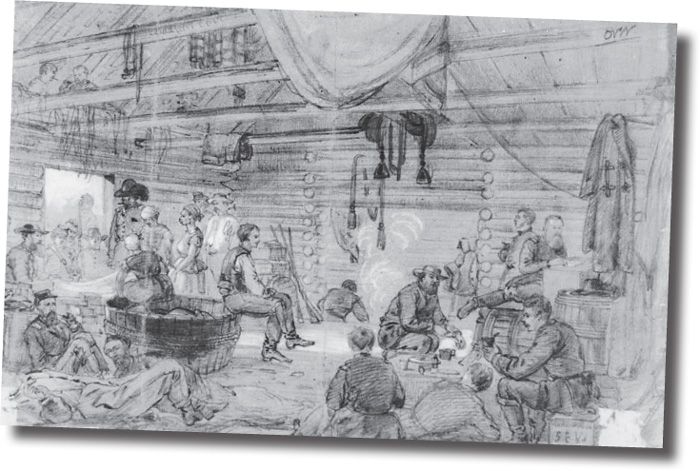
Alfred Waud’s sketch of Skedaddlers Hall, Harrison’s Landing, Virginia.
IMPORTANT FROM WASHINGTON.
PASSAGE OF THE CONSCRIPTION BILL BY THE HOUSE.
FEBRUARY 26
WASHINGTON, WEDNESDAY, FEB. 25
The strong affirmative vote to-day in the House on the Conscription bill surprised even its friends, and is a hopeful sign of renewed determination to prosecute the war with vigor. Out of the thirty Southern members, twelve voted for the bill, and several were absent.
PROPOSED REORGANIZATION OF THE ARMY.
Gen. MCDOWELL has submitted to the Military Committee of the two Houses a plan for consolidating the regiments in the field, or for filling them up to the maximum, and keeping them full, from troops to be raised under the new Conscript law. The plan does away with the present anomalous state of affairs, in which a wasted regiment, perhaps hardly counting a hundred and fifty muskets, has the full complement of staff, line and field officers for a thousand men. It proposes to make such a change as will consolidate parts of regiments in whole ones, thereby disposing of supernumerary officers; then forming them into brigades, with a Brigadier for each, and then into divisions with a Major-General to command. It gives the President power to muster out of the service officers whom the consolidation may leave without commands, always discriminating in favor of those oldest in the field and most noted for services and ability. Gen. MCDOWELL appeared in person before the Committee and explained his plan at length. The Committee were very forcibly impressed with his views, and will endeavor to carry them out before Congress adjourns. The chance of the passage of a bill based on Gen. MCDOWELL’s suggestions at this stage of the session are not, however, first-class. Both the General and the Committee are of the opinion that the army as at present organized must be very inefficient.
GEN. M’CLELLAN.
It is understood that Gen. MCCLELLAN has obeyed the summons of the Committee on the Conduct of the War, and has appeared to testify again on matters touching which he has before given evidence. Some curiosity is felt to ascertain whether any member of that Committee will deny the fact on the floor of the House.
GEN. HOOKER’S DISCIPLINE.
Gen. HOOKER has arrested thirty deserters, had them tried by Court-martial and sentenced to be shot. It is believed he will inexorably enforce the sentence. The case is noteworthy, as almost the first where the rule against desertion has seemed likely to be executed, and as illustrative of the vigorous means by which Gen. HOOKER is raising the efficiency of the Army of the Potomac.
GEN. W. T. SHERMAN AND THE PRESS
MARCH 1
Gen. W[illiam].T. SHERMAN has addressed the following card to the editor of the Memphis Bulletin:1
CAMP BEFORE VICKSBURGH, FEB. 6, 1863.
SIR: Whilst intensely interested and engaged in obeying the laws of our Government and the constituted authorities, far to my rear in the North, for whose cause I thought I was fighting, I find myself universally denounced as the inveterate enemy of the Press. You published your paper under my rule in Memphis for several months, and know the simple order I prescribed. There were no anonymous publications; anything worth printing was with the real name of the author. No publication of the movements of troops, arrivals and disposition of regiments, or anything the knowledge of which would enable the enemy to guess at our purpose. No comments upon the motives and conduct of officers calculated to encourage jealousies and discord among the people or our troops. These are about all the restrictions I ever placed on the Press. You also know that while I suffered the efforts of the enemy to learn our plans and intentions, I was minutely informed of all the enemy did or could do.
You have heard me again and again say it publicly that all men must forego their private opinions and personal wishes and obey the law; not because the law was of their liking or disliking, but because it was the law, which all good citizens and soldiers must obey, to secure unity of action. Without such implicit obedience, there could be no Government. Now, what is the law of the land? See act of Congress, approved April 10, 1806....
People at a great distance, in their quiet homes, cannot measure the difficulties here, and cannot judge of acts and events so remote. I can well afford to wait and see others do better. No amount of detraction or defamation will change what I conceive to be the only hope of restoring our proud nation to its proper station among the nations of the earth, viz.: a cheerful, willing and intelligent submission to the laws of our country and the constituted authorities of the Government.
W.T. SHERMAN, MAJ.-GENERAL.
1. General William Tecumseh Sherman probably hated journalists as much as he hated rebels — particularly after reporters claimed he had suffered a nervous breakdown early in the war. Sherman at one time banned the press entirely from his army.
WHAT THE SOLDIERS THINK.
MARCH 1
The following is an extract from a letter of an officer of the Ninth Army Corps, who has borne an important part in nearly every battle of the Army of the Potomac. It is dated HAMPTON, Va., Sunday, Feb. 15, 1863.
The chimneys of the burnt dwellings, the blackened walls of the church, bear witness that the storm of war has swept over this plain. Here and there an earthwork, weather-beaten and weed-grown, shows where the picket skirmishes took place in the early part of the war. Nearly a week ago we landed at the same wharves and encamped near the same place. Nothing here has changed — the same level brown fields, scarred with old furrows; the same dark pine woods and dreary marshes, crossed by low sandy roads full of large mud-holes and quick-sands. The place is the same; but where are the thousands that gathered here, full of pride and patriotism, less than one short year ago? Yorktown, Williamsburgh, Seven Pines, Fair Oaks, Mechanicsville, Hanover Court-house, Chickahominy, Beaver Dam, Gaines’ Mill, Peach Orchard, Golding’s, Garnett’s, Savage Station, White Oak Swamp, New-Market, Turkey Bend, Malvern Hill, Malvern, Bristow, Groveton, Bull Run, Chantilly, South Mountain, Antietam, Fredericksburgh, the hundred skirmishes, the deadly camp diseases. How many they have taken from us. Divisions now are smaller than brigades were then; and the people say we have done nothing.
We have done much, and will do more, but we want help and not weak complaining.
Can the North falter, and make unavailing the treasure, suffering and blood which we have given to redeem our Union? We must go on and win, or lose all. No halfway measures or half countries.
Union or annihilation.
FRESH BREAD VS. “HARD TACK.”
MARCH 4
We are glad to hear of the success of the system inaugurated by Gen. HOOKER for supplying his army regularly with fresh bread. If we may judge of the style of ovens used by the pictures of them given in the illustrated papers they are simple and well contrived, and ought to turn out a good loaf or biscuit. There are professional bakers enough in every brigade of the army to work the matter, as well as the dough, properly. As each soldier is entitled to a pound loaf every other day, we suppose between sixty and seventy thousand loaves will be consumed per diem by the infantry, artillery and horse-marines under command of Gen. JOE HOOKER.
DE QUINCEY1 says that one can form some conception of the vast mass of human beings who dwell in London by observing the prodigious droves of cattle that march into it daily, never to march out again, but to be devoured by the Cockneys; and on the same principle, some conception can be formed of the magnitude of Gen. HOOKER’s army by pondering upon the prodigious pyramid of bread (not to speak of cattle) that it makes away with daily. Sixty thousand pound loaves, if put together endwise, would stretch from the Battery to Seventieth-street; if piled on top of each other, would reach — not quite to the Dog-Star; if they were used for a breastwork, with a hungry army to defend them, all the rebels in the South, with JEFF. DAVIS at their head, could not capture it.
We hope that as Gen. HOOKER has introduced the fresh bread ration into his army, he will look around occasionally to see that the bakers furnish a good, light, digestible article. There is nothing worse for the stomach and pluck of the troops than damp, heavy, half-cooked bread. A single meal of it, on the eve of a battle, would almost certainly insure defeat. We are no special admirers of the bran-bread school of philosophers; but in favor of bran-bread itself, as an article of diet, there are excellent arguments, which would have more than ordinary force in the army. Everybody knows that there are some quite valuable elements of the flour lost in the super-refining process; and many a dyspeptic can testify to the value of the invention of Rev. Mr. GRAHAM. Corn bread or “dodgers,” also, would form an excellent article for the army — cheap, nutritious and wholesome. All the Western troops would far prefer it to the flour bread, and their preference would be justified by chemistry, physiology and experience. The rebel soldiers, it is true, live on this article to a great extent; but we do not see that that furnishes any argument why our gallant boys should live on an article which is in every way its inferior. Corn bread and bacon; corn bread and coffee! They’re dishes fit for a sovereign, or an army of sovereigns, such as Gen. JOE HOOKER commands.

A typical long-term Union army camp. Note the chimneys and log walls with the tents. In the background, a sentry is marching on a wooden breastwork erected to protect the camp.
1. Of course, English author Thomas De Quincey (1785–1859) had also advocated consuming opium.
THE COPPERHEADS AND THE CONSCRIPTION BILL.
MARCH 10
VALLANDIGHAM, in his speech before the Copperhead Association of this City, again threatened “resistance” to the conscription.1 The word resistance, in any connection, from the lips of such a notorious dastard, naturally produces contempt simply. Of course these factious speech-makers have no idea of committing themselves personally to an armed fight against the Government. There never yet, from Cleon down, was a creature of that sort whose bite was like his bark. Courage is a high quality, and it is never found associated with the base elements that make up the demagogue.
Yet it does not do simply to despise these men. Impotent as they are in action, and every way contemptible in spirit, they yet are very pernicious. CARLYLE hit off the species exactly when he says: “Consider that little spouting wretch. Within the paltry skin of him, it is too probable, he holds few virtues beyond those essential for digesting victuals; envious, cowardly, vain, a splenetic, hungry soul — what heroism in word or thought or action will you ever get from the like of him?” And yet it is a mistake, he observes, to deem them harmless or insignificant. They are “ugly and perilous.” The mischief is that their rant may mislead the unreflecting. It may inflame bolder tempers. It may instigate impetuous men to lawless acts, who are a thousand times more honest at heart. Though VALLANDIGHAM, himself, is incapable of lifting a finger in the “resistance” he prates about, his language may excite others to such resistance. His words, notwithstanding his disclaimer in another column, were studiously adapted to revive, on a yet wider field, the violence which was raised against the last draft in certain localities in Pennsylvania and Wisconsin....
We trust that the Government will meet these sedition-mongers promptly, the first instant they trench upon the law. VALLANDIGHAM and his associates have given notice that the conscription shall be resisted. They have thrown out unqualified defiance. Very well; let it be tested which is the stronger — they or the lawful authorities of the United States. A new draft, in accordance with the late act of Congress, cannot be far distant....
The Government will find no difficulty in joining clear issue with Mr. VALLANDIGHAM, at the very first word he utters against the draft after the order for it is issued. Let there be no lingering until the resistance actually takes shape; but let the blow fall at once upon the caitiffs who instigate it, and yet dare not commit themselves personally to its perils. Theirs is the greatest guilt; and they should be the first to feel the penalty.
1. Lincoln signed the Federal Conscription Act on March 3, 1863. The law imposed compulsory military service on all males between 25 and 45, but allowed for exemptions for certain disabilities and circumstances, and also for the hiring of a “substitute” at $300.
COMPENSATED EMANCIPATION — THE CONDITION OF MISSOURI
MARCH 5
While so much has been done by Congress to sustain the Administration in its measures of national policy, there will be a regret felt by many that the bills providing for compensated emancipation of slaves in the States of Maryland and Missouri failed to become laws. No part of the President’s policy for conducting the present war to an issue consistent with the interests of freedom and humanity has had a more prominent place, or, in all his messages, a more extended and earnest advocacy, than this scheme for ridding the Border States of Slavery1....
The answer of those who have permitted the bills before Congress to fail is, that the Democrats opposed them, and would have “filibustered” them to death if they had been pressed. And, besides, that they would have excited prejudices among the people against the Administration on account of the resulting tax, if the bills had been passed. These can hardly be reckoned good reasons for abandoning any policy believed to be right and promotive of human freedom. And it is doubtful if the loss to the cause of emancipation by reason of this abandonment of a plan so cordially adopted, and acted on by one State, at least — Missouri — in good faith, will not counterbalance all the gain expected from the possible exemption from Copperhead abuse. Every other measure of the Administration was passed, despite the filibustering of the Democrats. Why should this very important one be abandoned to such an unpatriotic enemy?
1. Lincoln was consistently frustrated in his efforts to promote gradual, compensated emancipation in the border slaveholding states.
VICKSBURGH AND THE YAZOO.
MARCH 17
There seems now to be no doubt that our fleet which made its way through the Yazoo Pass and down the Cold water to the Yazoo River has at least met with its first success. A dispatch from Vicksburgh says that it had captured twenty-six rebel steamboats, eighteen of which were destroyed, and our gunboats had arrived at Haines’ Bluff, which forms the outer defence of Vicksburgh on the Yazoo. An official dispatch from Admiral PORTER, under date of the 7th inst., confirms the statement of our fleet’s having arrived in the Yazoo. He heard the signal of nine minute guns and three guns afterward in quick succession, which were agreed upon to be fired by the Commander of the expedition on his reaching that point.
We suppose we may now expect daily and hourly to hear of the combined attack on Vicksburgh; for it will be impossible for Gen. GRANT to leave the men and vessels of the Yazoo expedition where they now are. The signal was probably a signal for him to get ready to cross with his army and navy and cooperate in the attack. We shall not speculate either on prospects or results, for a few days are likely to give us the accomplished facts.
We learn also from New-Orleans that Gen. BANKS about the same time that this signal was fired on the Yazoo, had his army and navy all ready at Baton Rouge for an advance upon Port Hudson. It was probably intended that all these movements should be simultaneous. If so, the problem of the rebellion in the Valley of the Mississippi is likely to be solved before the close of the first quarter of 1863.
THE COPPERHEADS AND FUTURE HISTORY.
MARCH 18
...Our people generally find it very difficult to bring home to themselves the fact that they are living in the most momentous days of the age. On a little reflection, they will allow it, and yet too many of them conduct themselves after their old political habits, as if the war were nothing more than one of the old political struggles in a new shape. They do not appreciate that their present public conduct has got to be judged more severely than ever before, and by altogether new standards. That which divides Americans now relates not to measures of mere expediency, but to practical acts involving national life or national death. The difference lies not between Whiggism and Democracy, or between Democracy and Republicanism, all of which were compatible with the most thorough loyalty; but it lies essentially between loyalty and disloyalty — between faithfulness to the Republic in its hour of peril, and defection. Posterity will so see it, and will judge in that light exclusively.
When this tremendous scene shall have passed — and it cannot last long at longest — every actor in it will receive honor or dishonor. Every American, high or low, is an actor in it. He can’t escape it if he would, for neutrality is in itself defection and disloyalty. It will be known and remembered how every man bore himself in this crisis of the nation’s life — every man from ocean to ocean. With men in general it will not be written on the page of history, but it will be written on a tablet yet more distinct, the living memory. Ten, twenty, thirty, fifty years hence it will be inquired about, and it will be known how every living American who was on the stage in the Great Rebellion then acted — whether he took sides for or against the Government; and every man, woman and child in the parish will understand it. The honor or dishonor of it will cleave not only to the individual himself, but to his children.
There are those living who remember the odium which, after the Revolution, clung to every Tory to his latest breath. No intellectual accomplishment, nor any moral worth, could exempt from it. But more than that, it was transmitted to his children and his children’s children. Even to this day, the American whose ancestor at that time was known as a Tory, hears of it with burning shame. Similar contempt was entailed upon the blue-light Federalists of the last war. So far as regards the private character of its members, the Hartford Convention of 1814 was probably equal to any political assembly ever held in this country; but after the war closed, every man of them to his dying day was held in dishonor. He could no more obtain a public office than if he had been positively disqualified by law. The ban of public opinion was upon him. Though it was very clearly shown in subsequent years that the majority of the Convention had no such treasonable intentions as were imputed to it, yet it is enough that it was a peace assemblage, calculated to embarrass the Government. To this day the Hartford Convention is a by-word. There were Federalists who did not approve of the Convention, and yet even they do not escape. It is still everywhere a reproach to have been at that time an opponent of the Administration at all....
THE PORT HUDSON REPORT.
MARCH 19
WASHINGTON, WEDNESDAY, MARCH 18
Gen. DIX, at Fortress Monroe, reports that the Richmond papers of the 16th inst, give an account of an attack on Port Hudson by Admiral FARRAGUT, on the 15th inst., in which he was repulsed. One vessel, the steam frigate Mississippi, is said to have been sunk, and another vessel, name not given, is reported to have successfully passed the batteries, and is now between Port Hudson and Vicksburgh. The report is not fully credited here.1

A New York Times map showing Fort Hudson on the Mississippi River.
1. In fact, Farragut had bombarded this strategic point on the Mississippi River on March 14; the Union lost a ship named the USS Mississippi. Union attacks continued until July.
THE CONSCRIPT LAW AND THE POOR MEN.
MARCH 26
The Peace Democrats have commenced an attack on the Conscription law of Congress, because, as they allege, it makes a distinction between the rich and poor. The Mozart Hall1 Democrats, led by FERNANDO WOOD, have proclaimed hostility to the act on this ground, — one of their resolutions, passed formally at headquarters on Tuesday night, declaring that
“The people everywhere should be awakened to the infamous distinction which it [the Conscription law] makes between rich and poor, whereby the former is allowed to buy his freedom for the sum of three hundred dollars, while the latter, unable to command that sum, is to be torn away from his employment, his home and his family, and forced, at the point of the bayonet, into the ranks of the army.”
The tableau of the reluctant conscript pricked away from home by bayonets is calculated to be effective, and if the objection to the law, as thus presented, were well taken, its moral force would be greatly impaired. But the fact is otherwise. The complaint made of the law is wholly unjust, and the attempt to create prejudice against it must fail. The law does not fix three hundred dollars as the sum that any one must pay in order to obtain exemption from the draft. It gives to the Secretary of War discretionary power to fix the sum which shall buy exemption in each individual case, but in no case shall over three hundred dollars be demanded. The Secretary may require of a rich man $300 for exemption, and he may let a poor man off — one who deserves exemption for reasons of sickness and helplessness of his family — for the sum of $3, if he will, intended to relieve poor families from too large a share of its burdens....
With such exemptions as these, which are of manifest propriety, and which preclude, as far as law can, the possibility of aged and infirm parents or orphaned children suffering — and with the discretion which is given to the Secretary of War to fix the sum of exemption money, in every case, as low as the condition and necessities of the drafted person may render proper — it cannot occur that any, the slightest, injustice can happen under its enforcement. It was intended to bear equally on all classes, according to their condition, and it does, in its letter and spirit, treat the poor as justly as the rich.
Mozart Hall imagines, no doubt, that it has started out on a very promising tack in originating this impeachment of the Conscription act; but so soon as the people, having their attention drawn to the subject, learn how wise and benign in its provisions the law really is, they will have a stronger reason than ever to distrust, as utterly false and disloyal, the opposition of the Copperheads to the necessary war measures of the nation.
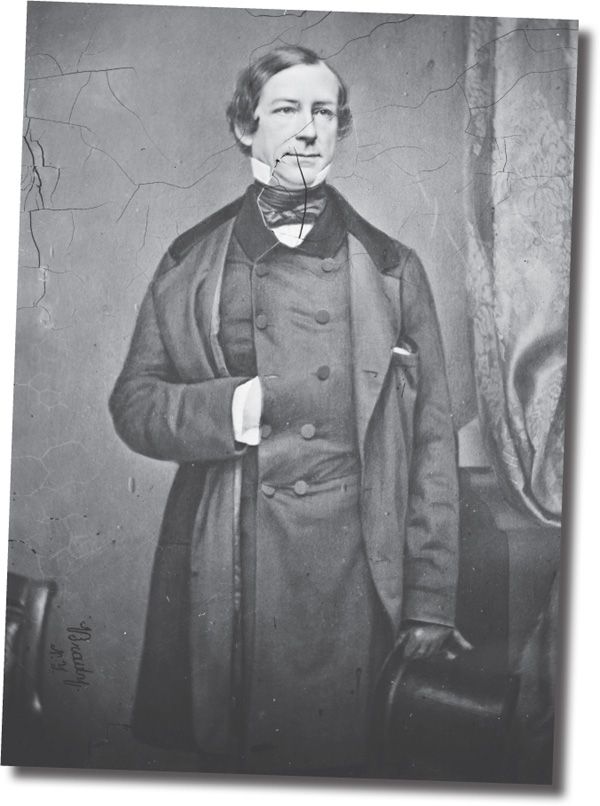
Democratic Congressman Fernando Wood of New York.
1. A Manhattan Democratic political club.
ELECTION IN WESTERN VIRGINIA.
MARCH 27
WHEELING, W.V., THURSDAY, MARCH 26.
An election was held to-day for ratifying the Willey amendment and Constitution of the new State of Virginia. This city gives 1,375 for the amendment to 3 against. The county will vote in like proportion. Returns from the State show an almost unanimous vote in favor of the amendment.
SHALL THE SOLDIERS BE DISFRANCHISED?
APRIL 1
In another column may be found a Bill, now before the Legislature of New-York, providing that every qualified and duly registered voter of the State, now in the military or naval service, shall be entitled to vote at every general State election hereafter held in the election district where he has a residence. It is very carefully guarded against all chance for fraud or other abuse, and is adapted to the sole purpose of enabling our gallant fellow-citizens, who are engaged in defending the integrity of the Republic, to exercise the most sacred right which the Republic guarantees. The Republican majority of the Committee have reported in favor of the bill; the Democratic minority have reported against it.
We trust that the measure will be brought to a test vote in both branches at as early a day as possible. The army and the people are alike anxious to see what record the two great parties of this State will make on this question.
Of course the ground on which the opponents of the measure rest their objections is that of pretended unconstitutionality — their favorite ground from the outset in respect to all measures unfavorable to the peace policy. All the resources of special pleading are exhausted to make out that no vote can be valid under any circumstances unless cast within the geographical limits of the election district by the very hand of the voter. No attempt is made to show the justice or the fairness of denying the absent soldier his most valued franchise; the disposition is simply that of Shylock when he cried, “I stand here for law....”
We cannot comprehend either the mind or the heart of any really loyal man who interposes these wretched quibbles and cavils to prevent his neighbor, who has answered his country’s call, from exercising the same civil rights he himself enjoys, though he has not answered it. We should suppose the mere thought would overwhelm him with shame. Are not those officers and soldiers the very bravest, noblest, best patriots in the land? Do they not sacrifice immeasurably more than any other of our people for the common good? Have they not as much at stake in the policy of the Government? Is not their property as much subjected to taxation, their liberty and their life as much exposed to peril? Are not their opinions as intelligently formed and as honestly entertained? The man does not live who dares deny any of these things. And yet men who call themselves respectable, have the hardihood to try to torture the Constitution into some construction that shall reduce these citizen-soldiers from the rank of freemen to the condition of voiceless, voteless myrmidons. Even the rebel chiefs — soulless traitors as they are — have soul enough to leave their soldiers the right to vote. That right is exercised by every regiment in the Confederacy. It is only here we see the political depravity that would rob the soldier of his birthright....
Does facing the enemy forfeit the franchise? That is the question. Get these peace-plotters on the record. We much mistake the character of the two hundred thousand New-York soldiers now in the field, and of the honest, patriotic body of the people who, though at home, are still for sustaining the Government, if the time does not come when every man in this Legislature who shall vote against a measure so distinctly dictated by every consideration of justice and equality, will not feel like fleeing to the clefts of the rocks. We repeat — Give the soldier his franchise, and fix his home enemies on the record.
NEGRO EQUALITY AND SLAVERY.
MARCH 29
That any portion of the Republican party or any but a very small and insignificant portion of the people of the North believe the negro race to be the equal of the white race, or that any such doctrine is to be found in the speeches or writings of any but a half dozen of the extreme Abolitionists, we totally deny. Moreover, we cannot help thinking that these Disusionists are just as well aware of this fact as we are. It is not about negro inequality we differ with the South or with the Democrats. There is nothing within our knowledge so well established, as that some races are inferior to others, morally, intellectually and physically. One might as well deny that some men were more eloquent, or more clever, or handsomer, or stronger than others, as to deny this. Where we part company with the Stephenses and the Morses1 is in drawing the inferences from this patent truth. They hold that where a body of weak, ill-favored, stupid men are dwelling alongside a stronger, better-looking, abler and more energetic ones, it is the right of the latter to rob, beat and sell the former. This is the great “truth” on which the Confederacy is founded. It is, too, the great “truth” on which the social organization of all the Slave States rests. As long as it is confined in its operation to those States, we cannot constitutionally, perhaps, overthrow its application. But we object, and shall always object, to its extension to territories in which it does not now exist, and which are under our protection, and for whose future we are legally and morally responsible; and we object to the use of our Courts, or armies, or ambassadors for its dissemination or support.
We do so, because we not only believe it to be fatal to the material and moral welfare of every community which adopts it, but because we hold that the sound republican theory of human rights and human duties makes physical weakness and mental or moral deficiency titles to pity and protection, and not invitations to fraud and violence; that the more helpless and inferior a man is by nature, the more carefully should the laws of a democratic commonwealth enforce his claim to his wages, his wife, his children, and his own body. We do not advocate, because we do not believe in, negro equality. We would not, if we could, give negroes a share in the Government. But we heartily indorse Mr. BATES’ doctrine that they are entitled to protection, not only none the less but all the more because they are inferior; and they are entitled to it in an especial manner at our hands, because we have, more than any people in the world, preached the doctrine of the inherent dignity and value of humanity in its humblest, most helpless and most degraded condition.
1. A professor who had published a racist rant in the pro-Democratic New York World.
BREAD RIOT IN RICHMOND.
THREE THOUSAND HUNGRY WOMEN RAGING IN THE STREETS.
APRIL 8
BALTIMORE, TUESDAY, APRIL 7.
Col. STEWART, of the Second Indiana Regiment, one of the fourteen United States officers just released by the rebels, and who has just arrived here, makes the following statement: On Thursday last he saw from his prison window in Richmond a great bread riot, in which about three thousand women were engaged, armed with clubs, guns and stones. They broke open the Government stores and took bread, clothing and whatever else they wanted. The militia were ordered out to check the riot, but failed to do so. JEFF. DAVIS and other high officials then made speeches to the infuriated women, and told them they should have what they needed. They then became calm, and order was once more restored. All the other released Union officers confirmed this statement.

Richmond women rioting in front of a bakery.
THE ADVANCE OF GEN. LONGSTREET.
APRIL 16
CORRESPONDENCE OF THE BALTIMORE AMERICAN: SUFFOLK, VA., SUNDAY, APRIL 12
The some-time expected advance of the rebel Gen. LONGSTREET 1 upon this place occurred yesterday. He made a forced march from beyond the Blackwater with a force of not less that thirty thousand men, evidently intending to surprise the post. But we had been well informed of his movements, our pickets were strengthened, and though he was within three miles of us at dark last night, he has made no attack up to this hour — 8 o’clock in the morning. We have taken quite a number of prisoners from Gen. HOOD’s Texas brigade, which held the advance, and are well informed of the strength and movements of the enemy. You may look for stirring news from here in my next if LONGSTREET should not, as I fear he will, fall back. We are fully prepared for him, even if his force is doubled.
1. Because Lee dispatched James Longstreet and his corps to re-capture the city of Suffolk, Longstreet was not present at the Battle of Chancellorsville.
WAR MOVEMENTS IN THE WEST.
APRIL 16
The absorbing interest felt by the country in the fight at Charleston1 led to an undue magnification of the value of the struggle there. A few days have elapsed, and confidence with calmness has returned to the public mind. Attention is now again directed to the great armies in the field under HOOKER, ROSECRANS and GRANT. There is hope for the Republic in these armies. Their leaders are a gallant trio — much alike in many of the high qualities of soldiers — hopeful in spirit, fervid in patriotism, bold in emprise and execution. In brief time the armies of these three leaders will be in motion, seeking the face of the enemy.
The dispatches from the West to-day will attract attention as indicating, perhaps, a rapid flank movement of GRANT to the aid of ROSECRANS, by passing from Memphis toward the Tennessee River. The Memphis and Charleston railroad furnishes convenient facilities for this movement, leading direct to Huntsville, quite in the rear of the rebel army in Tennessee....
No season could be more favorable for active operations of ROSECRANS and GRANT’s armies in the West than the mild and cheerful Spring now at hand, and we shall be mistaken greatly if those zealous leaders do not improve their opportunity, and give the nation substantial cause for joy and triumph.
1. Union naval forces were determined to retake Charleston, where the war had begun two years earlier, even if it meant leveling the bastion they had once tried to protect: Fort Sumter.
SCARCITY IN THE SOUTH — THE TESTIMONY OF JEFF. DAVIS.
APRIL 17
The Copperhead journals, whose general policy it always is to darken, so far as they can, every prospect of subduing the rebellion, have taken particular pains to argue down, or, in lack of argument, to sneer down, the likelihood that it must soon suffer serious straits from the want of food. Calculations based upon the figures of the last census tables — conclusions drawn from the known agricultural resources of the region now within the command of the rebels — accounts of great scarcity, which from every direction have been constantly finding their way across the lines — and the prices current of the great staples of food as given in the principal Southern papers, have done nothing to diminish the assurance of these rebel-sympathizing prints that there is and always would be plenty of provisions in Dixie. Even the Proclamation of Gov. [Zebulon B.] VANCE, of North Carolina, last month, invoking the attention of his people to this great “danger,” had no effect upon these “never-can-conquer” dogmatists. They have flouted straight on.
But these people have much faith in JEFF. DAVIS. We therefore commend to them the address of the arch-traitor to the people of the Confederate States, to be found in another column. It was issued from the “Executive Office,” in Richmond, just one week ago to-day, and has all the advantage of freshness. After depicting in high colors the remarkable success of the “young Confederacy” thus far, he declares that there is “one danger” which he “regards with apprehension.” He makes free to say that unless there is a special effort made to produce “grain and live stock and other articles necessary for the subsistence of the people and army, the consequences may prove serious, if not disastrous.” Even at the present time, he says, “the supply of meat for the army is deficient,” and “the ration is now reduced to one-half the usual quantity in some of our armies.” We take it this is conclusive testimony. Determined as our Copperhead organs are to believe nothing to the disadvantage of the rebellion, we presume they will now accept the fact that it is hardly as full-fed as they have pretended.
The truth is that this difficulty in obtaining the necessaries of life is doing more to break down the Confederacy than all other causes combined.
GEN. HOOKER’S MOVEMENTS — PRECAUTIONS IN ADVANCE.
APRIL 30
If we are rightly informed, our army on the Potomac is once more on the move, and we may expect, within the next few days, a good deal of successful or unsuccessful fighting. We entertain confidence in Gen. HOOKER; first of all, because he has shown himself, in a subordinate position, to be a man of ability; and, secondly, because he has that confidence in himself without which ability is useless. We are satisfied that he will fight and march with the expectation of winning uppermost in his mind, and will not pass the most momentous hours of great conflicts in making preparations for disastrous retreat. But we do most earnestly, for the sake of the nation as well as for his, beg of politicians and strategists, of all sects and parties, to let him severely alone for the next half year at least. If he achieves a great military reputation inside that period, he will have accomplished a very extraordinary feat, but there is not the smallest probability that one week less than that time will suffice for any such purpose.
Consequently, even if he should win a battle within the month of May, it will still be premature to announce that the “back of the rebellion is broken,” and it will be in the highest degree rash to pronounce him either a young or a middle-aged Napoleon....
If we win a battle in the month of May, it will doubtless furnish strong reason for believing that we have at last got the right man in the right place, but it will not prove it. The whole campaign will prove it, and nothing less. And the public may rely on it that it will take a whole campaign, and perhaps two, to reduce the South to subjection. Nothing can be more inconvenient, and nothing can be more ridiculous, therefore, than to crown Generals with laurels, and dub them saviors of the nation, and worthy of its highest civil honors, in the month of May, and then have them uneasily “changing their base,” and proposing to burn their baggage in order to save themselves from destruction in the month of July. We are far past the happy time when all that we needed in a President was that he should be unknown, or harmless and good-natured. Our great public rewards must be, henceforward, won in the old-fashioned way, by hard work, by brilliant achievements, by unquestioned ability and victorious and undisputed success. So that common policy, as well as justice, demands that Gen. HOOKER should have a fair field and no favor; that all factions should keep their hands off of him, and let him do his duty. One of them cannot adopt him as its champion without setting the others to bark at him; and no man can do his work well with two packs of this kind barking mingled applause and censure at his heels.
GALLANT WORK AT VICKSBURGH.
APRIL 22
The feeling of disappointment that has, for some time, existed over the supposed failure of our army and gunboats before Vicksburgh, was suddenly removed yesterday by the news from the Southwest. It is announced that on the night of Thursday last, the gunboats Tuscumbia, Lafayette, Benton, Pittsburgh, Carondelet and Gen. Price, with three transports, ran the rebel batteries at Vicksburgh, and all went out safely below except one transport, which was burned.
In this list of gunboats will be recognized some of the very best iron-plated vessels we have on the Western waters. The Lafayette and Tuscumbia, in particular, are vast iron-clad floating batteries, which are now seeing about their first service on the Mississippi, and which we expect will give an excellent account of themselves on whatever work they are sent. The other four boats mentioned are of a highly serviceable, but much inferior class, partly clad with cotton and partly with iron, and two of them, at least, will be remembered as historically and honorably associated with the reduction of Forts Donelson and Henry, Island Ten, Fort Pillow and Memphis. The passage of this formidable fleet below Vicksburgh puts an end to all doubt as to the mastery of the Red River, and of the Mississippi between Vicksburgh and Port Hudson. It settles beyond quibble the question of the absolute supremacy of the National Government over every mile of the navigable waters of the Mississippi, save immediately in front of the batteries of Vicksburgh and Port Hudson.
But it is not the control over the navigation of the Mississippi alone, and the consequent severance of the rebel Confederacy from its dependencies west of that river, that gives, at this moment, this gunboat movement its most salient significance. The communications across the Mississippi had already been seriously disturbed and almost broken up by Admiral FARRAGUT’s presence between the two great rebel positions. All the gunboats that have passed Vicksburgh were not needed to patrol the river and destroy the vagrant rebel craft still left on its waters. They are intended to play an immediate and important part in the reduction of Port Hudson. And this work being accomplished, Vicksburgh will be flanked on the south and forced to yield to the National power.
In connection with this news of events at Vicksburgh, we learn also that Admiral FARRAGUT is communicating easily with his fleet below Port Hudson. And from New-Orleans we have intimations that a new combination, almost assuring success, is making against Port Hudson. Putting all these developments together, and interpreting them by the aid of our knowledge of Admiral FARRAGUT’s splendid qualities as a leader who seeks victory through the fiercest flames of battle, we cannot but derive confidence and hope that the tedious struggle for the possession of the two strongholds on the east bank of the Mississippi is about to be brought to a speedy close, and that our late misgivings are to be changed to the realization of complete and unexpected victory.