
CHAPTER 13

Detail of a postwar woodcut showing General Grant’s troop transports running the Confederate defensive batteries during the siege of Vicksburg.
May marked the traditional onset of the campaigning season, and Joseph Hooker was eager to put his splendid army into action. Since Fredericksburg, the Rappahannock-Rapidan river line had become the de facto military boundary between the opposing armies in Virginia, and Hooker led his army across that boundary on April 26 to inaugurate what history would record as the Chancellorsville Campaign. With that army went Lorenzo Livingston Crounse, the chief field correspondent for The New York Times. Communications between the front lines and the major cities of the North had improved tremendously since 1862, and for the next two months Crounce’s reports offered readers of The Times a detailed and often vivid narrative of the fighting. His lengthy report on the Battle of Chancellorsville, which appeared on May 5, is an eyewitness account (though of only one side) that stands up to the best modern narratives. The outcome of the battle — another Confederate victory — was crushing to the hopes of the North. When he heard the news, President Lincoln paced the White House hallways in anguish asking, “My God, my God, what will the country say?”
These months also witnessed the slow unfolding (too slow, it seemed to some) of the Vicksburg Campaign in the west. There, Ulysses S. Grant tried several stratagems to work his way around behind the Confederate citadel until his successful effort in May. After landing at Bruinsburg on the east bank of the river on April 30 (four days after Hooker crossed the Rapidan), he moved inland to Jackson, the Mississippi state capital, which fell on May 14. He then turned westward and defeated the army of Confederate Major General John C. Pemberton in the Battle of Champion Hill, or the battle of Big Black River, two days later. By the third week of May, he had clamped a siege around Vicksburg, and by the end of June the beleaguered defenders inside the city were running desperately short of food.
One hundred and twenty miles south of Vicksburg (as the crow flies), Nathaniel Banks was besieging Port Hudson, Louisiana. There, the politically sensitive issue of using black soldiers to fight for the Union cause received a boost from the performance of two black regiments in an attack on Port Hudson on May 27. Two regiments of Louisiana militia called the Louisiana Native Guards had initially paraded (though not fought) under Confederate colors until the fall of New Orleans, then they changed sides and became part of the Union army. Port Hudson was their first trial by combat. In a report printed by The Times, Banks wrote, “No troops could be more determined or more daring. They made, during the day, three charges upon the batteries of the enemy, suffering very heavy losses, and holding their position at nightfall with the other troops on the right of our lines.”
In addition, the politically sensitive question of what constituted disloyalty in wartime came to the fore with the arrest of former Congressman Clement L. Vallandigham, a bitter critic of the administration and the war. Arrested for disloyalty by Burnside, his case was resolved by sending him southward into Confederate lines. Denying that he was disloyal, Vallandigham later made his way out of the Confederacy to Canada, and then back into the United States, where the government left him alone.
Meanwhile, in the aftermath of his victory at Chancellorsville, Lee began a move westward into the Shenandoah Valley in June, and then northward, down the Valley, and across the Potomac. As cavalry forces skirmished along the slopes of the Blue Ridge, Lincoln called for more volunteers and called up the Pennsylvania militia. The object of Lee’s advance was unclear. Was it the Pennsylvania state capital at Harrisburg? Or was it Philadelphia, Baltimore, or Washington itself? The Army of the Potomac, still under the command of Joe Hooker, moved northward, too, under a hot summer sun, as the two armies headed for a clash of monumental proportions.
DETAILS OF THE CROSSING ABOVE FREDERICKSBURGH.
MAY 2
The Rappahannock is again crossed by the Army of the Potomac, and this time without the shedding of a drop of blood, or the firing of a single gun.
The great movement which we have been so long anticipating began in earnest at daylight on Monday morning [April 27], by the movement of a very heavy force up the Rappahannock. The Eleventh Army Corps, Gen. [Oliver Otis] HOWARD,1 had the advance on the march, and still has it. At this hour it is hardly prudent to enter into the minute details of the force and the march, as they have undoubtedly a great deal of work yet before them.
The weather on Monday was remarkably fine — even sultry, and the men found marching in over-coats too fatiguing. They threw them away in large numbers, and the track of the column can be traced by the abandoned clothing.
Tuesday morning we had a cloudy sky, and before 9 o’clock a drizzling rain began falling. But our column kept steadily moving, and by 1 o’clock Gen. HOWARD’s advance arrived at Mount Holly Church, one mile from Kelly’s Ford, having marched sixteen miles since daylight. The rain continued until the middle of the afternoon, when it ceased, it having at no time been very severe, but just enough to make marching heavy, and to stall one or two of our very small number of wagons in some of the chronic mud-holes. Otherwise, the move prospered. The arrival of the troops in the vicinity of the Ford was well masked by Col. BUSHBECK’s brigade, of the Eleventh Corps, who had been guarding the post for two weeks.
The troops marched rapidly and in fine spirits. [Henry W.] SLOCUM camped last night near Hartwood Church, and MEADE just east of it — all were well up by 4 P.M. to-day.
At 8 this morning Gen. HOOKER left his headquarters, and accompanied by his personal Staff, rode straight to Morrisville, 20 miles distance, and but six miles to the Ford. His passage through various columns of troops was marked for miles by tumultuous cheer, enthusiastically genuine.
At Morrisville he makes his headquarters for the day and night. A consultation of corps commanders, including [Cavalry commander] Gen. [George] STONEMAN, who had come from Warrenton Junction, was at once held, and then and there Gen. HOOKER first revealed to these, his principal subordinates, a portion of the plan and nature of the present movement. Beyond what has been already developed, none but these officers know anything, Yet there is reason to believe that it is startling in the magnitude of what it contemplates, and general officers remarked this afternoon that if officers and men did one-half their duty, it could not fail of success.
HOWARD rested his men four hours, and they were then got under arms ready to support the operations at the ford. The pontoon train for the bridges arrived with great promptness, having come from Bealeton Station, being transported thither by a railroad from Alexandria. They are the usual wooden boat, save being smaller in size than those formerly used. The pontoons and timber were all unloaded on the bank of Marsh Creek, near its mouth, and the boats launched before dark.
These operations, be it known, were conducted in plain sight of the enemy, who appeared only in small force — a few straggling pickets, who seemed to be there as lookouts only. They kept a sharp watch, but not a shot was fired. The work went rapidly on. The pontoons were at once shoved from the mouth of Marsh Creek into the Rappahannock. Seventeen boatloads of men from Col. [Adolphus] BUSHBECK’s brigade were thrown over at once, followed by a reinforcement of as many more.
The bridge-laying began at 8 o’clock, and proceeded vigorously, under the direction of Capt. COMSTOCK, Engineer Officer on Gen. HOOKER’s Staff. By 9 1/2 P.M., one bridge was completed, and another under way. HOWARD’s corps was put under motion for crossing, BUSHBECK’s brigade leading, followed by [Carl] SCHURZ’s division, then by [Charles] DEVEN’s, the balance of [Adolph] VON STEINWEHR bringing up the rear. This force was disposed on the south bank, for the night, doing picket duty on the different roads. Just before our forces landed a small body of cavalry, numbering twenty, perhaps, dashed down nearly to the river, and halting for a short time, leisurely surveyed our operations and then retired.
That there was no resistance at the Ford caused much surprise. Not a single shot was fired. The enemy had rifle pits, but did not use them. We took no prisoners.
There is the best reason for believing that up to noon to-day the enemy had not discovered this movement. Every citizen on the line of march was put and will be kept under close guard until they can do no damage. We speculate freely on the events of the morrow ere we reach our destination, which is Culpepper on the one hand, and Ely’s Ford, on the Rapidan, on the other. We shall undoubtedly meet the enemy before we reach either place, though each are less than a day’s march distant. STUART’s cavalry have not shown themselves to any extent, and FITZHUGH LEE is reported absent, sick.
We are certain of one or more things. There are no heavy fortifications in front of us, there are no very strong positions which can be defended. The enemy must have as great a force as ours to beat us back.
Bridges will undoubtedly be laid at other fords, further down the river, for the benefit of our transportation, which is in a safe place. Once well across here, we can protect the laying of bridges at any of the fords below.
The sun set clear and red to-night, and gave promise of a fair day to-morrow. But the night is thick with mist, and the moon is “eating fog,” which sailors say is a sure sign of a coming storm.
Before to-morrow night there will undoubtedly be some blood-letting. Our commander looks and feels as though he was in his element.
There are other important movements on foot by other portions of the army.
A correspondent of the Herald, named [J. H.] VOSBURG [Vosburgh], was captured yesterday, by three dismounted rebels, who crossed the river below Ellis’ Ford, and stole him away, horse and all, while he was enjoying a secesh breakfast. He had foolishly gone outside the lines to get greater comforts than the camps afford — hence his grief. His host, who is a rebel parson, named MCMURRAY, betrayed him. This parson lives on property owned by P. W. ENGS, of New-York. His reverence was gobbled in return, and from a host will become a hostage.
I am in bivouac to-night with Lieut.-Col. [Duncan] McVICAR, Sixth New-York cavalry, an intrepid officer, who pickets the line in the immediate front of our operations.
Gen. PLEASANTON’s cavalry division will take the advance in the morning....
L. L. C.

Major General Olivier Otis Howard, U.S.A.
1. Oliver Otis Howard (1830–1909) was a regular army officer who had graduated fourth in the class of 1854. He replaced German-born Franz Sigel as commander of the mostly German XI Corps, which bred some resentment by the rank and file. Howard had received the Medal of Honor for his service at the Battle of Fair Oaks (Seven Pines) on the Peninsula in 1862, where he also lost an arm.
MILITARY MOVEMENTS — THE ACTIVITY OF OUR ARMIES.
MAY 3
The opening of the month of May shows an almost universal activity in our armies, great and small. Everywhere we are acting on the offensive, with the trifling exceptions of the affairs in Missouri and in Western Virginia. Gen. HOOKER’s movements are, of course, those which most profoundly excite the interest and stir the heart of the nation, for they are more important than any other — we may say than all others put together. His army is the grand army of the nation, and his work is to strike the fatal blow at the rebellion’s head. In the inception of the movement which commenced on Monday last, he certainly appears to have shown consummate skill. He moved both of the wings of his army rapidly and cleanly; and so well were his purposes and aims covered, that the rebels at each point seem to have been taken entirely unawares. The laying of the pontoons and the crossing of the river were admirably performed, and in less than two days from the time his movement commenced the main body of his army had made a march of twenty miles, crossed a difficult river, and was ready for action on the other side. It would appear that it was by far the larger part of his army which marched north from Falmouth, and crossed the Rappahannock at Kelly’s and adjacent fords. Judging by our letters, it is the lower movement that is a feint; but what is to be the real mode of action on the upper line cannot yet be told. What last week opened, however, this week will undoubtedly develop; and we prefer waiting for events to indulging in useless speculations. The movement which seems most obvious and likely to the non-military observer will probably be the movement which Gen. HOOKER will not make.
The army of Gen. GRANT seems at about the same moment to have commenced an important movement. On Sunday evening last, according to a dispatch of yesterday, nearly the whole of the army stationed at Milliken’s Bend (18 miles above Vicksburgh, on the right bank of the river) was in motion, with six days’ rations. ...The point of destination is not given; but latterly GRANT has been planting his forces at New-Carthage, 25 miles below his old quarters opposite Vicksburgh; and it is generally believed that his purpose is to throw his troops quickly over on to the high ground on this side of the river, from which they will be able to make a land attack on Vicksburgh with greater advantages than have ever heretofore fallen to their lot. We shall watch the denouement of this great scheme with an interest only second to that with which we watch the manoeuvres of Gen. HOOKER.
The only one of our great armies that gives no sign of movement is the army of Gen. ROSECRANS. Several times it has appeared as if he was about again to attack the rebels; but the signs have failed, and to-day he seems solidly planted at Murfreesboro. It is very probable that he is waiting for the result of combinations and movements which have only lately been commenced.
It looks as if we should have a very active Summer. Before it passes away, each of our chief armies will have fought great battles, the result of which, we devoutly hope, will be the complete quelling of the rebellion.
FROM THE ARMY OF THE POTOMAC.
MAY 3
TWO MILES BELOW FREDERICKSBURGH,
THURSDAY, APRIL 30 — 11 O’CLOCK A.M.
The following inspiring address is being read to the various troops, amid tremendous cheering and other demonstrations of delight:
HEADQUARTERS ARMY OF THE POTOMAC, NEAR FALMOUTH, VA., APRIL 30
It is with heartfelt satisfaction that the General Commanding announces to the army that the operations of the last three days have determined that our enemy must ingloriously fly, or come out from behind their defences and give us battle on our own ground, where certain destruction awaits him. The operations of the Fifth, Eleventh and Twelfth Corps have been a series of splendid successes.
BY COMMAND OF MAJ.-GEN. HOOKER.1

Major General Joseph Hooker, U.S.A.
1. Joseph Hooker (1814–1879) had commanded the III Corps and was elevated to command of the Army of the Potomac by Lincoln on January 26, 1863. Lincoln was aware that Hooker had declared that the Union could win only with a military dictator in charge. In his letter of appointment, Lincoln wrote him: “I have heard, in such way as to believe it, of your recently saying that both the Army and the Government needed a Dictator. Of course it was not for this, but in spite of it, that I have given you the command. Only those generals who gain success can set up dictators. What I now ask of you is military success, and I will risk the dictatorship.”
THE GREAT BATTLE OF SUNDAY.
MAY 5
Another bloody day has been added to the calendar of this rebellion. Another terrible battle has been fought, and more fields crimsoned with human blood. [A] Few more such days as this will find no armies left on either side to fight battles.
My last letter brought up the situation to Saturday morning [May 2]. It was then certainly expected that the enemy would begin the attack as soon as it was day, and our dispositions were made accordingly. But the attack did not begin. Events proved that the enemy did design to attack, but he chose to make that attack in a manner and at a point different from what was generally anticipated by us on Saturday morning. Daylight grew broader and yet no guns. Finally, about 6 o’clock, a brass Napoleon, looking down the plank road in front of the Chancellor House, saw a regiment come into the road in column and attempt to deploy. One or two doses of canister caused them to deploy rather irregularly, and more like skirmishers on the retreat.
Soon after, Gen. HOOKER and Staff began an inspection of our lines, which occupied full two hours. Every portion was visited, and the work of the night was closely inspected. On the extreme left new lines were chosen, and the engineer officers soon marked out the line and character of the defences to be erected. When, the inspection closed, the intrenchments were pronounced to be of the very best character, especially those on the right, where the columns of [Henry W.] SLOCUM and [Oliver O.] HOWARD were posted.
There had been only slight disturbances during the night, as both forces had been busy with their axes rather than their muskets. From Gen. HOWARD’s front came a report that the enemy was engaged all night in cutting a road past his picket line to the right. How much attention was paid to this fact at the time I do not know, but subsequent events proved that it was very significant.
The day continued to pass in a very dull manner for a day of battle, and only here and there was there anything more even than desultory skirmishing and picket firing.
About 3 o’clock the pickets on the right of Gen. SLOCUM’s front reported that from a certain position wagons had been seen moving in a westerly direction nearly all day. It was at once surmised that this might be a retreat, but subsequent events proved that it was a part of an affair of altogether another nature. To ascertain, however, what it really was, Gen. [Daniel] SICKLES, who was still in reserve, was ordered to make a reconnaissance in heavy force in that direction. This was done with great promptness, and the divisions of Gens. [David] BIRNEY and [Amiel] WHIPPLE, with Gen. [Francis C.] BARLOW’s brigade, from HOWARD’s corps, were pushed out to the front, BERDAN’s brigade of sharpshooters1 having the advance, and supporting [George E.] RANDOLPH’s battery. Our troops moved rapidly and soon became more or less engaged, especially with the artillery and the sharpshooters as skirmishers. BERDAN soon sent in some sixty prisoners, belonging to the Twenty-third Georgia, including one Major, two Captains and three Lieutenants. Being upon the ground, I examined these prisoners, and soon found that the “wagon train” which we had seen moving during the day was composed mainly of ordnance wagons and ambulances, and that Stonewall JACKSON and Staff were at the head of a column of troops which the wagons followed.
Nothing more was needed to convince us that this daring opponent was executing another of his sudden movements, and it was at once resolved to checkmate him. Gen. SICKLES was ordered to push on, and Gen. [Alpheus S.] WILLIAMS’ division of SLOCUM’s column was ordered to cooperate. BIRNEY pushed ahead with great vigor, and with RANDOLPH’s battery soon sent to the rear as prisoners of war the entire remnant of the Twenty-third Georgia regiment, numbering over four hundred officers and men. The column of the enemy which had been moving up this road was now literally cut in two, and Gen. WILLIAMS had commenced a flank movement on the enemy’s right, which promised the most auspicious results.
But at 5 o’clock a terrific crash of musketry on our extreme right, announced that JACKSON had commenced his operations. This had been anticipated, but it was supposed that after his column was cut, the corps of Gen. HOWARD, (formerly Gen. SIGEL’s,) with its supports, would be sufficient to resist his approach, and finding that he was himself assailed in the rear, he would turn about and retreat to escape capture.
But to the disgrace of the Eleventh Corps be it said, that the division of Gen. [Carl] SCHURZ, which was the first assailed, almost instantly gave way. Threats, entreaties and orders of commanders were of no avail. Thousands of these cowards threw down their guns and soon streamed down the road toward headquarters. The enemy pressed his advantage. Gen. [Charles] DEVENS’ division, disaffected by the demoralization of the forces in front of him, soon followed suit, and the brave General was for the second time severely wounded in the foot, while endeavoring to rally his men. Gen. HOWARD, with all his daring and resolution and vigor, could not stem the tide of the retreating and cowardly poltroons. The brigades of Cols. [Adolphus] BUSHBECK and [Nathaniel] MCLEAN only remained fighting, and maintained themselves nobly as long as possible. But they too, gave way, though in good order, before vastly superior numbers.
Gen. HOOKER now sent to the aid of Gen. HOWARD the choicest division of his army, the creation of his own hand — the famous Second Division of the Third Corps, commanded by Major-Gen. [Hiram G.] BERRY. Capt. [Clermont] BEST soon moved his batteries on a ridge running across the road, and after a short, but sanguinary contest the further advance of the enemy was stayed.
Of course this disaster compelled the recall of SICKLES and SLOCUM, who had been pursuing their work with remarkable vigor. Gen. WILLIAMS’ division returned only to find a portion of their works filled with the enemy. SICKLES’ division could not communicate with the rest of the army at all by the way they advanced, and only at great risk by any other route.
This was the position at dark, and it did not look very promising. But our energetic commander was more than equal to the emergency. New dispositions to repair this disaster were at once resolved upon. Communication was at once had with Gens. [David] BIRNEY and WHIPPLE, and a night attack ordered, to restore the connection of the lines. Gen. [Hobart] WARD’s brigade, of Gen. BIRNEY’s division, made the attack at 11 at night, aided by Capt. [Clermont] BEST’s guns, massed on the ridge in front of the enemy. BIRNEY’s position was on the extreme left of this new line of battle, but WARD’s terrific attack was entirely successful, communication was restored, and in a charge made by the brigade, a portion of the artillery lost by HOWARD was gallantly retaken by Gen. HOBART WARD.
This night attack was the most grand and terrific thing of the war. The moon shone bright, and an enemy could be seen at good musket range. The air was very still, and the roar and reverberation of the musketry and artillery past all conception. Malvern Hill was a skirmish compared with this, save in the degree of slaughter. But it was successful — the enemy were driven back nearly half a mile, and our tired men once more slept on their arms. That night’s work was ended.2
Now I come to Sunday [May 3]. It was perfectly evident, from the position of affairs on Saturday night, that there must be a change of our lines, which would throw the enemy out of our rear and into our front again. It will be seen by what skillful generalship the enemy was fought and checked on front, and flank, and rear, while this was being done.
Gen. REYNOLDS’ First Army Corps arrived at United States Ford on Saturday afternoon. It was immediately put into position on our right, which was withdrawn from the plank road to the Ely’s Ford turnpike. This line was immediately formed by Gens. REYNOLDS and MEADE, the latter’s position, on the left, having been relieved by Gen. HOWARD’s Eleventh Corps, which, notwithstanding its disorganized condition was so far reorganized during the night as to be fit for duty again this morning. They were assigned the position on the left, where it was probable there would be little or no fighting, and were protected by the strong works built the day before by Gen. MEADE’s corps. Our new line now assumed the shape of a triangle, prolonged at the apex, the right of the line being somewhat longer than the left. As the portion of the line on the right was new, time was necessary to fortify and intrench it, and the work was carried on vigorously by the Fifth and First army corps.
It was very evident at daylight this morning that the day would bring forth a terrific battle. We knew that the enemy had been re-enforcing his line all night, at the expense, undoubtedly of the strength of his force on our left. His intention was, evidently, to fight for the possession of the plank road, which it was perfectly apparent he must have, as that portion of it which we then held, was subject to the enemy’s assaults in front and on both flanks.
But the possession of this road was not obtained by the enemy save at our own time, at his severest cost, and after one of the most desperate, tenacious and bloody conflicts, for its short duration, of the whole war. At 5 o’clock A.M. the rebels could be plainly seen up the plank road, about a mile and a half from the Chancellor House, which Gen. HOOKER still retained as his headquarters, though a shell had gone through it the evening before, and another had cut down a tree directly in front of it.
Our line of battle was formed with Gen. BERRY’s gallant division on the right. Gen. BIRNEY next on the left, Gen. WHIPPLE and Gen. WILLIAMS supporting. At 5 1/2 A.M. the advance became engaged in the ravine, just beyond the ridge where Capt. BEST’s guns had made their terrific onslaught the night before, and where they still frowned upon the enemy and threatened his destruction.
The rattle of musketry soon became a long continued crash, and in a few moments, as battalion after battalion became engaged, the roar surpassed all conception, and indicated that the fight would be one of the most terrible nature. Gen. BERRY’s division, which had checked the enemy’s advance the night before, engaged him again, and if it were possible for them to add more laurels to their fame, then they did it thrice over again. The enemy advanced his infantry in overwhelming numbers, and seemed determined to crush our forces. But the brave men of SICKLES and SLOCUM, who fought their columns with desperate gallantry, held the rebels in check, and inflicted dreadful slaughter among them. Gen. [William H.] FRENCH’s division was sent in on the right flank of our line at about 7 A.M., and in a short time a horde of ragged, streaming rebels running down the road, indicated that that portion of the enemy’s line had been crushed. At 8 o’clock A.M., Gen. FRENCH sent his compliments to Gen. HOOKER, with the information that he had charged the enemy and was driving him before him.
SICKLES maintained the attack upon his line with great endurance. The enemy seemed determined to crush him with the immensity of his forces, and, as subsequently shown from the statements of prisoners, five whole divisions of the rebel army were precipitated upon this portion of the line, for from these five divisions we took during the day an aggregate of over two thousand prisoners.
The exploits of our gallant troops in those dark, tangled, gloomy woods may never be brought to light; but they would fill a hundred volumes. It was a deliberate, desperate hand-to-hand conflict, and the carnage was perfectly frightful. Cool officers say that the dead and wounded of the enemy covered the ground in heaps, and that the rebels seemed utterly regardless of their lives, and literally threw themselves upon the muzzles of our guns. Many desperate charges were made during the fight, particularly by BERRY’s division. [Gershorn] MOTT’s brigade made fifteen distinct charges, and captured seven stands of colors, the Seventh New-Jersey, Col. FRANCINE, alone capturing four stands of colors and five hundred prisoners.
Gen. [Darius] COUCH’s Second Army Corps, though only in part present, did excellent work. It was Gen. FRENCH who charged and drove the enemy on the flank, and it was the indomitable HANCOCK who gallantly went to the relief of the hard-pressed SICKLES.
The engagement lasted without the slightest intermission from 5 1/2 A.M. to 8:45 A.M., when there was a temporary cessation on our part, occasioned by getting out of ammunition. We held our position for nearly an hour with the bayonet, and then, being resupplied, an order was given to fall back to the vicinity of the Chancellor House, which we did in good order. Here the contest was maintained for an hour or more, not so severely as before, but with great havoc to the enemy, and considerable loss to ourselves.
The vicinity of the Chancellor House was now the theatre of the fight, and my visits to that spot became less frequent. Gen. HOOKER maintained his headquarters there until 10 A.M., when it was set on fire by the enemy’s shels, and is now in ruins. Chancellorsville is no longer in existence, having perished with the flame, but Chancellorsville is in history, never to be effaced.
Our new line was now so far established as to render it safe to withdraw all our forces on that front, which was accordingly done, and at 11:30 A.M. the musketry firing ceased.
The engagement had lasted six hours, but had been the most terrific of the war. Our artillery had literally slaughtered the enemy, and many of the companies had lost heavily in men themselves, but the guns were all saved.
The enemy was now no longer in our rear, but had been shoved down directly in our front, and is now directly between us and our forces in Fredericksburgh, and we were again in an entrenched and formidably fortified position. The enemy has gained some ground, it is true, but at the sacrifice of the flower of his force, five of his seven divisions having been cut to pieces in the effort, and over 2,000 of them have fallen into our hands.
Our right wing, under Gens. REYNOLDS and MEADE was not engaged, save the division of Gen. HUMPHREYS, which went into the woods on the enemy’s left flank, and fought valiantly under their brilliant leader, until their ammunition was exhausted.
During the afternoon the enemy has made several attempts to force our lines, particularly at the apex of our position, near the Chancellor House, but Capt. WEED has massed a large quantity of artillery in such a position as to repulse with great loss everything placed within its range. The enemy tried several batteries and regiments at that point at different times during the afternoon, and they were literally destroyed by the fire of our terrible guns. Nothing can live within their range.
Our present position is impregnable if our troops continue to fight as they have to-day. Gen. LEE, the prisoners say, has issued an order that our lines must be broken at all hazards. Let them try it again, with what they have left. They can, and perhaps will destroy themselves by attacks upon this position.
Our troops are perfectly cool and confident. They have fought with great spirit and enthusiasm and will continue to do so.
L. L. CROUNSE.
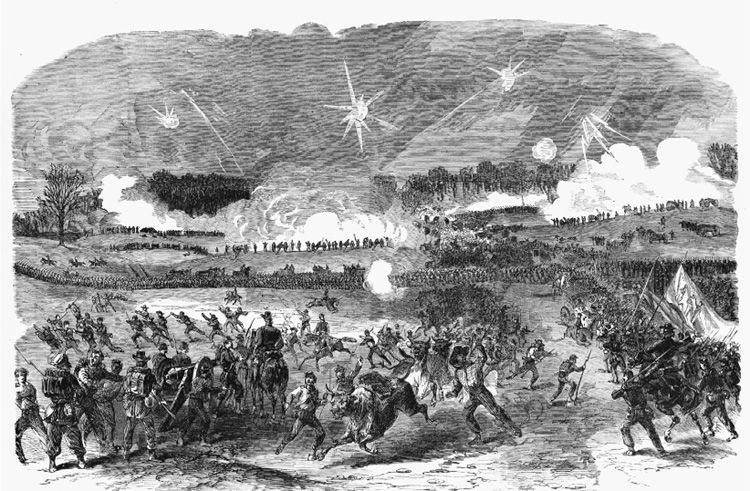
The Battle of Chancellorsville.
1. Colonel Hiram Berdan (1824–1893) led two regiments of sharpshooters that acted as scouts for the Army of the Potomac.
2. Crounse does not mention the most important event of that evening because it took place on the Confederate side of the field. While returning to his own lines after an evening reconnaissance, Thomas “Stonewall” Jackson was mortally wounded by fire from his own soldiers.
FROM HOOKER’S ARMY.
FURTHER DETAILS OF THE GREAT BATTLES.
MAY 6
HEADQUARTERS IN THE FIELD, NEAR CHANCELLORSVILLE, SUNDAY EVENING,
MAY 6
At this hour of writing, it is impossible to estimate the loss in to-day’s battle on either side.1 We know that ours is heavy — heavier than ever before in a battle of so short duration. We further know that the loss of the enemy is admitted by themselves to be perfectly frightful. We had the advantage in artillery, and our shells and canister tore and mangled their ranks fearfully. The prisoners are silent as to the loss of prominent officers, but some of the Alabamians in A.P. HILL’s division say that he was killed early in the day, and that Gen. RAYNOR is now in command of the division.2
Probably no battle was ever fought upon ground more unfavorable for the maneuvering and deploying of troops. Nearly the whole country in this vicinity is covered with dense forest, much of it being of the same character as “The Wilderness,” lying only a short distance west of this point. The timber is mostly dead, and still very dense; then, to make the forest still more impenetrable, there is a denser growth of dead underbrush, so that it is hardly passable for man — certainly not for beast — and the worst place conceivable for handling troops. Yet a very great part of today’s terrible battle was fought in this almost impenetrable jungle, and many dead and wounded on both sides still lie there, concealed in the gloomy depths of “The Wilderness.” The only open ground upon which the battle was fought, was the plain on the south side of the plank-road, near Chancellorsville, half a mile long, and perhaps three hundred yards wide. The only open ground in our present position is a semi-circular crest, extending from the left of Gen. SYKES’ position to the right of Gen. HOWARD’s. Immediately in front of this are dense woods, concealing our skirmishers and those of the enemy. This crest is our artillery position, and here guns enough are massed to blow to atoms the armies of a dozen Southern Confederacies. The enemy seem to have a proper appreciation of the courtesies in waiting for them from this position. Twice to-day they have essayed out of the woods toward our guns, and twice have those guns sent to their earthly doom untold numbers of desperate wretches. The artillery at this point is in charge of Capt. WEED, Chief of Artillery of the Fifth Army Corps.
The exact count of prisoners thus far taken, during the battle of Sunday, is not yet known, but it must be, all told, nearly, if not quite, two thousand. They were brought in singly, in squads, in companies and by regiments; and our men say that they could have taken many more, “but for the trouble of bothering with them on the field of battle.” They would rather shoot than capture. Two regiments were taken entire — the Twenty-third Georgia and the Fourth Alabama — the former yesterday and the latter to-day. Then there are detachments from fifty or sixty other regiments, including many North and South Carolina, Virginia, Mississippi and Louisiana regiments. The enemy has undoubtedly taken several hundred of our men, mostly wounded, with some from the Eleventh Corps, who couldn’t run fast enough to get away.
The unaccountable and inexcusable conduct of a large portion of this corps, was the means of turning to ashes a grand victory almost within our grasp, while the position was only retrieved by the superb generalship of the Commanding General. A portion of the troops, the brigades of Cols. BUSHBECK and MCLEAN, stood their ground manfully until overpowered by vastly superior numbers. Gen. BARLOW’s brigade was absent with Gen. SICKLES.
The manner in which Gen. HOOKER proposed to checkmate the rear attack of JAKSON strikingly illustrates the bold and daring character of our commander. Finding that JACKSON was marching by the old Catharpin road post our right front, Gen. HOOKER promptly ordered Gen. SICKLES to attack that impudent column on the flank. This was not more quickly conceived than vigorously executed. In one hour and a half from the time the movement began the head of Gen. BIRNEY’s division was engaging the enemy, and our force and vigorous attack were so great that the enemy’s left flank was speedily turned, his columns doubled back one upon the other, and his men seized with demoralization and panic. WILLIAMS’ division ably assisted this dashing movement, while Gen. GEARY attacked sharply on our centre front, and the prospects were cheering indeed. The Eleventh Corps was strongly intrenched. Its position ought to have been held, and somebody is to blame for this disgraceful affair which smote us so sorely, just as we were about to reap rich fruits from the boldest move yet projected since we crossed the river. And to remedy the effect of this disaster, we have spent this day in fighting which only puts us in our former condition, and the enemy once more in our front. Albeit we have inflicted on LEE a murderous loss, and so shattered his columns that he must have time and reinforcements to enable him to fight again as savagely as he fought to-day. Beside, his position is now such that he must inevitably attack our strong position, or retreat. Retreat in his case, with our swift-marching army after him, is most surely disastrous. He may precipitate his whole force upon SEDGWICK, who can retire to the Heights of Fredericksburgh, and wait for HOOKER to follow up in his rear. Two or three times Gen. HOOKER has said that he would compel the rebels to come out of their fortications and attack him on his own ground. It is brilliant generalship, indeed, that has so faithfully fulfilled this promise. To-day the enemy literally leaves his fortifications, and stands before our intrenched camp, essaying its capture.
The question of supplies must now be of great moment to the enemy. His communication by rail, if not totally severed by our cavalry, must be seriously interrupted by the presence of our forces in the vicinity of Hamilton’s Crossing, five miles below Fredericksburgh, which has been the rebel supply depot during the Winter. The prisoners taken to-day had nothing to eat, and some of them say no rations had been issued to them for three days.
Our men never behaved more magnificently. Cool, confident and brave, they fought with splendid valor, and were even complimented by the prisoners who fell into our hands. The demoralization of the Eleventh Corps did not affect the rest of the army in the least. Some how or other they looked upon it as a matter of course. Gen. HOOKER’s appearance on the field, under severe fire, created tumultuous enthusiasm among the men, and he was cheered to the echo time and again. When it became known that he had been struck by a piece of spent shell, (although uninjured,) the cheers grew louder still.
To the indefatigable efforts of Major-Gen. HOWARD, commanding the Eleventh Corps, is due the fact that before daylight this morning this corps was so far reorganized as to be placed on duty again in an important position. Gen. HOWARD is one of our bravest and best officers. His emotions at the conduct of some of the brigades cannot be described. Had he been longer in command of these men, undoubtedly this stampede would not have occurred....
The headquarters of the Army of the Potomac in the field are to-night under a large tree, just in the rear of our front line of rifle-pits and abattis. Gen. HOOKER has just dined on hard tack and cold ham. The gentlemen of the Staff are looking for their “pack mule.”
L. L. CROUNSE.
1. Officially, Union casualties at Chancellorsville were 17,197 (a number that includes nearly 6,000 missing), and Confederate casualties were 13,303 (including 2,000 missing). Significantly, as a percentage of the forces engaged, the Union lost 12 percent while the Confederacy lost 21 percent.
2. When Jackson was wounded, Hill took over his corps while Brigadier General Harry Heth took command of Hill’s division. When Hill was himself wounded, Lee assigned his cavalry chief J. E. B. Stuart to corps command. Crounse’s mention of a “General Raynor” may refer to Dorsey Pender, who took over Hill’s division after Heth was wounded.
THE CONTEST ON THE RAPPAHANNOCK.
MAY 7
The telegraph last night was altogether dumb in regard to military movements on the Rappahannock; and the few items of news that reached us by mail and otherwise during the day and evening did not bring us down beyond Monday. The extensive operations of Sunday were not renewed on Monday, and there was, on that day, no general battle between the armies. In the afternoon one division had a fight for half an hour with a rebel column, but beyond that nothing was done by HOOKER or LEE, except to prepare with all their might for the renewal of the action, which each knew could not be postponed....
THE DISCOMFITURE OF GEN. HOOKER
MAY 8
The retrograde movement of Gen. HOOKER to this side of the Rappahannock has been to the people one of the very sharpest of their many disappointments. They had counted with peculiar confidence on a triumphant issue. The superb condition and splendid spirit of the army, the personal prestige of its chief, who had never fought but to conquer, the remarkable ability with which the new campaign was planned, and the signal success with which its first stage was consummated, to all appearance justifying the bulletin of the commander that “the enemy must ingloriously fly, or come out from behind their defences and give us battle on our own ground, where certain destruction awaits him” — all combined to raise the public expectations to the highest pitch. When next came the tidings that the army was hastening back over the river, with all its material, there could not but be a most painful revulsion of feeling. Every loyal man is in truth smitten to the very soul, and with reason....
FROM HOOKER’S ARMY.
ABANDONMENT OF THE SOUTH SIDE OF THE RAPPAHANNOCK.
MAY 8
Our intelligence this morning puts beyond doubt the fact that Gen. HOOKER’S army has again retired to the north side of the Rappahannock. From various sources we collect the following facts in regard to the movement.
There was no fighting on Tuesday [May 5] of any consequence, and the rumors to that effect were founded on a misapprehension.
The sharpshooters were quite active, and the artillery opened occasionally, but results were unimportant. The enemy had evidently massed his army on our right.
About 5 o’clock in the morning it commenced raining. The water fell in torrents over an hour, deluging the roads, tearing up the corduroys, sweeping away bridges, and threatening the destruction of the pontoons. The river rose with great rapidity, and soon overflowed the ends of the pontoons, rendering crossing impracticable. The upper pontoon [bridge] was taken up, and used in lengthening out the others, and after several hours of very hard labor the bridges were once more ready. It was soon evident that Gen. HOOKER, seeing his position was rendered temporarily untenable by the storm, had determined to cross over again to this [side] of the Rappahannock. On Tuesday the order was given to retreat. New roads were cut. The trains and reserve artillery were sent back, and the evacuation was commenced.
Pine boughs were spread upon the pontoons to prevent the noise of crossing, and at 10 o’clock Tuesday night the troops commenced falling back....
OFFICIAL DISPATCH FROM GEN. GRANT.
MAY 10
GRAND GULF, MAY 3, VIA MEMPHIS, TENN., MAY 7
Maj.-Gen. Halleck, General-in-Chief:
We landed at Bruinsburgh, April 30th, moved immediately on Port Gibson, met the enemy, 11,000 strong, four miles south of Port Gibson, at 2 A.M. on the 1st inst., and engaged him all day, entirely routing him with the loss of many killed, and about 500 prisoners, besides the wounded. Our loss is about 100 killed and 500 wounded.
The enemy retreated toward Vicksburgh, destroying the bridges over the two forks of the Bayou Pierre. These were rebuilt, and the pursuit has continued until the present time.
Besides the heavy artillery at this place, four field pieces were captured and some stores, and the enemy were driven to destroy many more.
The country is the most broken and difficult to operate in I ever saw.
Our victory has been most complete, and the enemy are thoroughly demoralized. Very respectfully.
U.S. GRANT, MAJOR-GENERAL COMMANDING.
LATEST FROM THE ARMY.
DEATH OF STONEWALL JACKSON.
MAY 13
HEADQUARTERS ARMY OF THE POTOMAC,
TUESDAY, MAY 12
The Richmond papers of yesterday announce the death of Stonewall JACKSON, on Sunday afternoon, from the effects of his recent amputation and pneumonia. His burial was fixed for to-day. The military band in Fredericksburgh had been performing dirges a greater portion of the afternoon....

A Currier and Ives lithograph of the death of Stonewall Jackson.
WHERE SHALL VALLANDIGHAM GO?
MAY 13
We published on Monday morning the charges upon which Mr. VALLANDIGHAM1 was recently tried by Court-martial in Cincinnati. We have no doubt that the evidence offered was sufficient to establish their truth. There remains the question, what sentence the Court will pass upon him. If we could have our choice in the matter, it should be that he be sent South beyond our lines. Taking his life might seem too hard, imprisonment would quite likely make a martyr of him, but every one will recognize the fitness of sending him to Dixie, to join that noble company of traitors whose praises he has sounded so loudly, and to receive from them in person that meed of praise which they have so steadily bestowed upon him at a distance.
It is quite time that he should appear upon another stage. He has appeared before our Northern people in the character of a pacificator quite often enough. He has inculcated, everywhere he has gone, the doctrine that nothing could be gained by war. Let him go now and try what he can do in that line on the other side. Let him urge upon the rebels the manifold evils of the war which they are waging, and the utter impossibility of accomplishing anything by battle. He has lifted up a testimony among us against the dangers of military power. Let him have the chance to lay open the same matter before the rebels, for they are, to say the least of it, in as much danger as we in this direction. He has dilated to us upon the glories of the Union, and its benefits to us all in the years that are past. Let him see what he can accomplish by portraying them before those who have assailed it. He has been earnest in setting before our people the horrors of abolition. Let him go and suggest to the slaveholding rebels how much rebellion has done for abolition. He has exhausted his resources for opprobrious terms for those who would put arms in the negroes’ hands, who would fight by their side, or consent to receive a helping hand from them. Let him go and pour out the vials of his condemnation upon those at the South who would conscript the slaves into the rebel army, as Gen. BANKS found was about to be done in Louisiana.
It would be very interesting, perhaps instructive, to see what reception he would meet with. Will the rebels clothe him in robes of honor, and send him upon a triumphal procession, as one whom they delight to honor? We rather incline to think that they will let him alone severely. While he was among us he might do them some good. When he has crossed our lines he is to them but one more mouth to feed, unless indeed he should don the butternut uniform and shoulder a rebel musket. He may, perhaps, avoid being conscripted, if he strongly maintains that he is a citizen of the United States, as we see that an act providing for the conscription of such citizens “sojourning in the Confederate States,” which passed the rebel Congress, failed to become a law by JEFF. DAVIS not signing it, and we all know that the rebels would never force a man into the army, except with the fullest warrant of law.
On the whole, we are inclined to think that sending him South now would do more good to our cause, than his presence has done us harm heretofore. Not that he will say anything to help us — not that anything he could say would have the slightest influence upon the rebel leaders, for as soon as he crosses their lines, he is a squeezed orange. But the fact of our ejecting him will be one which must be widely spread, and it will speak most convincingly to every one who hears it of the determination of the North, which is hardening from flint to adamant, to suppress this rebellion, and to grind to powder all those who would sustain it; — and so, if we could reach the ear of the powers that have it in charge, we should urge upon them to send him across our lines, treating him as tenderly, but as inflexibly, as IZAK WALTON would have the angler treat the frog.2

Clement L. Vallandigham.
1. Clement L. Vallandigham (1820–1871) was an anti-war Democrat from Ohio. He publicly denounced “King Lincoln,” and called for Lincoln’s removal from the presidency. On May 5 he was arrested on orders from General Burnside for violating General Order No. 38. This was an embarrassment for Lincoln, who would have preferred that Burnside ignore Vallandigham altogether. The question posed here is: What to do with him now?
2. Izaak Walton, in his famous book The Compleat Angler (1653), wrote that the fisherman should use the frog “as though you loved him, that is, harm him as little as you may possibly, that he may live the longer.”
VALLANDIGHAM IN DIXIE.
HIS TRANSFER TO THE REBEL LINES.
MAY 26
MURFREESBORO, MONDAY, MAY 25
VALLANDIGHAM arrived here on a special train under a strong escort, at 10 o’clock last evening, having left Louisville this morning, and passed through Nashville without stopping.
He was quietly taken in a carriage to the quarters of Maj. MILES. Provost-Marshal-General, where he was received by Gen. [William S.] ROSECRANS and a number of other officers. He appeared to be fully composed, and abstained from the expression of any disagreeable sentiments.
At 2 P.M., his southward journey commenced. Major MILES, with a mounted escort, started down to take him below our lines in Shelbyville. The prisoner was very cheerful, and discussed his situation indifferently, but on approaching the nearest rebel picket, commanded by Col. WEBB, of the Eighth Alabama, some eight miles out, he became perceptibly affected.
Upon taking leave of his companions, he said in substance: “I am a citizen of the United States, and loyal to them. I want you to understand that you have brought a prisoner to the Confederate authorities.”
To Col. WEBB he made similar remarks. The former received him with a remark that he had read his speeches, but did not like him; that he could not receive him within the Confederate lines, but he would permit him to remain at his post until he had ascertained the pleasure of the authorities.
The flag of truce party then left VALLANDIGHAM and returned.
GRANT AND JOHNSTON.
JUNE 1
It is now fifteen days since the battle of Big Black Bridge [Big Black River or Champion Hill], and fourteen since the investment of Vicksburgh. With the first of these events, Gen. JOHNSTON saw the desperateness of the rebel situation at Vicksburgh, and the necessity of the utmost energy in concentrating all possible troops to flank GRANT, and, if possible, to raise the siege. We have had no special information as to his success during these fifteen days in bringing up reinforcements — though the dispatch said to have been sent by him to PEMBERTON assured the latter that in fifteen days he would aid him with a hundred thousand men. His facilities for bringing forward men are not very great, as the railroads are few, ricketty and much damaged by our raids, and the places from which reinforcements can be obtained are very distant. We have the evidence of eye-witnesses that troops have been brought from Charleston, which is distant from Jackson 767 miles; and if they have been brought from Charleston, they have doubtless also been brought from Savannah, Mobile, and all the garrisoned positions in the Gulf States, if not from North Carolina. We have also had numerous rumors that reinforcements were being got from [Braxton] BRAGG’s army....
GRANT, however, with his right on the Mississippi River, above Vicksburgh, is in far better position to receive reinforcements than JOHNSTON, and the War Department is, doubtless, fully advised of his necessities....
RAILROADS AND THE WAR.
JUNE 8
Never has the old adage, “it is an ill wind that blows nobody good,” been more completely verified than in the effect the present war has produced on the railroad interests of the loyal States. At the time of the breaking out of the rebellion, and for a number of years previously, the majority of the great railroads of the Middle and Western States, were financial failures. They were dragging out a weak and crippled existence — staggering under Floating Debts, Preferred Stock, First, Second, Third, and even Fourth and Fifth, Mortgage Bonds. The ownership of railroad Shares was considered almost a premonitory symptom of bankruptcy, and Bankers had learned to fear a connexion with railroad enterprises as something fatal to their credit.
There were a few exceptions to this general condition of great leading railroads. The New-York Central persevered in paying dividends, though it was sometimes doubted whether they were fairly earned. The Michigan Central kept itself in pretty good fame. The Cleveland, Columbus and Cincinnati line was a notable exception of a profitable railroad. The Galena and Chicago, and the Chicago and Rock Island Roads, though having once enjoyed an apparently solid prosperity, had gone far down in popular estimation, and stockholders had begun to be familiar with the necessity of “passing dividends.” These railroads, with a number of local and less important roads in Ohio and Indiana, were all that stood with even tolerably hopeful character at the time of the breaking out of the war. As to the rest, they were in the main admitted and gigantic failures. Stockholders, though still clinging to their shares, had ceased to think of dividends, and almost ceased to hope for any change that would give real value to their property ….
Two years and a half of war have passed, and a magical change is observed. The business of every road has been enormously increased, and this increase has been so steadily maintained that munificent revenues are flowing into once exhausted treasuries. These incomes have been sufficient in many cases to retrieve the fortunes of the roads entirely; by wiping out floating debts, perfecting roads, increasing rolling stock, and inducing lately inexorable creditors to enter into reasonable arrangements for adjusting their claims, and permitting the roads to continue in the hands of stockholders. In some cases where receivers had been appointed, the revenues of the roads have so outrun all calculation, that roads have been surrendered back again to their owners, and are now earning handsome dividends on the stock that was so lately valueless and in actual process of legal extinguishment....
NEGRO SOLDIERS — THE QUESTION SETTLED.
JUNE 11
We have from the outset avoided all discussion of the question of employing negro soldiers, because we have regarded it as a purely military question, which it was the province of the military authorities alone to settle. The political bearings of the policy we have steadily refused to recognize. The efficiency of our armies has been our paramount concern; for on that alone depends the suppression of the rebellion, and without that suppression the nation is ruined, and all politics are worthless.
The military inquiries to be determined were four: Whether the negroes were able and willing to fight at all? Whether their nature could be kept under such constraint that they would fight in accordance with the laws of civilized warfare? Whether the white soldiers would not become so much disaffected and demoralized by the enlistment of blacks as to more than countervail any possible advantage that could be gained by it And whether white soldiers could not of themselves speedily close the war?
...But at last we have an official report from Major-Gen. BANKS himself, which describes the part taken by the colored regiment in the battle of Port Hudson, whose terrible nature tested the fighting qualities of all, white and black, to the utmost. Gen. BANKS says:
“On the extreme right of our line I posted the First and Third regiments of negro troops. The First regiment of Louisiana Engineers, composed exclusively of colored men, excepting the officers, was also engaged in the operations of the day. The position occupied by these troops was one of importance, and called for the utmost steadiness and bravery in those to whom it was confided.
“It gives me pleasure to report that they answered every expectation. In many respects their conduct was heroic. No troops could be more determined or more daring. They made, during the day, three charges upon the batteries of the enemy, suffering very heavy losses, and holding their position at nightfall with the other troops on the right of our lines. The highest commendation is bestowed upon them by all the officers in command on the right.
“Whatever doubt may have existed heretofore as to the efficiency of organizations of this character, the history of this day proves conclusively to those who were in condition to observe the conduct of these regiments, that the Government will find in this class of troops effective supporters and defenders. The severe test to which they were subjected, and the determined manner in which they encountered the enemy, leaves upon my mind no doubt of their ultimate success.
“They require only good officers, commands of limited numbers, and careful discipline, to make them excellent soldiers.”1

The Battle of Port Hudson.
1. At the Battle of Port Hudson (May 27, 1863), the all black 1st and 3rd regiments of the Louisiana Native Guards participated in the Union attack. These units, initially formed as part of the Louisiana State Militia, had paraded under Confederate colors until the fall of New Orleans, then they changed sides and became part of the Union army. Port Hudson was their first trial by combat.
THE REBEL INVASION.
JUNE 16
The excitement that was produced in the City yesterday by the publication in the TIMES of the news that LEE’S rebel army had crossed the Rappahannock and was marching northward, and that HOOKER’S army had also left camp to take up a new line of operation, will be greatly increased to-day by the news of the battles in the Shenandoah Valley on Saturday and Sunday — the rebel advance into Pennsylvania — and the call of the Government for 120,000 more troops — 20,000 of whom are to be from this State. It may be thought passing strange that we were not permitted to hear of these important battles two days ago. They were known in Baltimore and Washington on Sunday, and details of them were published in the Baltimore papers of yesterday morning. It is the withholding of the news of rebel movements, that does more than anything else to precipitate the country into demoralizing excitements. We were assured last week, up to its very last day, that the rebel army was still at Fredericksburgh — while the fact is, that they must have begun their march with the week, for on Friday they appeared before Winchester, in the Shenandoah Valley, with 18,000 men, and another force as high up as Martinsburgh, on the line of the Baltimore and Ohio Railroad. The people of Pennsylvania were in as great darkness as ourselves, and the rebel army, by a forced march might actually have filed into Philadelphia while its shad-bellied citizens were reading in their morning papers that all was quiet on the Rappahannock. Now, as a matter of course, on learning the facts, they are in an unparalleled condition of excitement; and even the Copperheads, who were preparing to hold their great Peace meeting in Independence-square, may first have to fight two or three battles with the rebels for its possession....
LEE’S NEW CAMPAIGN — THE OPPORTUNITY IT OFFERS US.
JUNE 17
The Northward movement of the rebel army is certainly very audacious, though we are not yet able to divine its precise course, nor the special object it may have in view. We do not even yet know whether it has crossed the mountains or is still on the upper waters of the Rappahannock. Some think that LEE will offer HOOKER battle on the present ground now held by our army, near the old Bull Run battlefields; others hold that he is going to march his whole army into Pennsylvania by the Shenandoah Valley, and attempt a short campaign in the North; while others think his object is an attack on Washington from the rear. A short time must develop the truth in the matter. His plan and course are doubtless clearly enough marked out in his own mind. But their execution will depend very much upon us. We have already an army in the field near Washington far superior in numbers to his; and twice a hundred thousand volunteers are rushing to arms in the five States nearest to the theatre of operations. If we have energy and vigor in our movements; if we have intelligence and unity in our plan; if we have skill and sagacity in our leadership, there is no reason under Heaven why LEE’s new campaign should not prove as disastrous as it is daring....
THE CAVALRY FIGHT AT ALDIE.
FULL PARTICULARS BY OUR SPECIAL CORRESPONDENT.
JUNE 20
ALDIE, WEDNESDAY, JUNE 17
The advance of Gen. [David M.] GREGG’s cavalry command reached this place at about 2 o’clock this afternoon, where two brigades of the enemy, commanded by Gen. STUART in person, were found in possession. After three hours’ hard fighting they were forced to retire. The fight, while it lasted, was one of the sharpest that has occurred during the war, and as a consequence the loss of officers and men on both sides is very heavy.1
The enemy’s pickets were first encountered a little east of the village by Companies H and M, of the Second New-York (Harris Light) cavalry, under the command of Lieut. DAN. WHITTAKER, and were by them driven through the town back to a ridge of hills half a mile to the west, extending across from the Middleburgh and Snicker’s Gap Road, where the rebel force was in position ready for action. The advance brigade, under Gen. [Judson] KILPATRICK, immediately moved through to the westerly edge of the town. The First Maine, Col. [Calvin] DOUTY, was sent off to a point half a mile to the left, and the Fourth New-York, Col. CESNOLA,2 to the right, to support a section of ANDREWS’ battery placed on a rise of ground north of the Snicker’s Gap road. The enemy at thistime occupied the hill, as before stated, where they had four guns in position; a line of their skirmishers occupied a fence on the eastern slope, and a long ditch, just in front off which were half a dozen stacks of hay — thus commanding both Middleburgh and Snicker’s Gap roads. A stronger position could not well have been selected.
When the exact position of the enemy had been ascertained by drawing; their fire, Gen. KILPATRICK rode up to the Second New-York (Harris’ Light.) and said then was the time for them to wipe out the reflection cast upon them for their alleged misconduct in the fight of last week, at Brandy Station, He ordered them to charge into the valley and secure the hay-stacks — the ditch or ravine at the rear of this position had not then been discovered. Companies H and M. accompanied by Lieuts. WHITTAKER, RAYMOND, MARTINSON, HOMAN and STUART, moved off down the Middleburgh road, the fence to the right was quickly thrown down, and with a dash, this forlorn hope rushed up to the hay-stacks. For the first time their fire was opened from the ditch little to the rear of the hay-stacks. This was filled with rebel cavalry — many of them armed with rifles. Capt. GRINTAR, with Lieuts. MATTISON and SHAEER, and Company K, dashed up immediately to the support of these companies, F, I, D and G, went to the light up the Snicker’s Gap road a piece, turned to the left, crossed the field, and reached the scene of conflict in time to take an active part. The contest for twenty minutes at this point was about as spirited a scene as is often witnessed on a battle-field. The Sixth Ohio, Maj. [William] STEADMAN, was sent up the road to the left to support the Harris Light, when the whole command, with the Major at its head, dashed into the fight just in time to decide the unequal contest. The rebels were forced to abandon their position, and all who were not killed or captured fled precipitately up the hill. They made a short stand behind the fence, when a dash from a battalion of the Fourth New-York, called in from its position behind the battery, together with the other regiments already named, drove them pell mell over the hill. The First Maine, at about this time, was called in from the left, and with the First Massachusetts, stationed on the Snicker’s Gap road, to a position held by the Second battalion of the Fourth New-York. The rebels, at this time, charged down the same road and drove before them a squadron, when Gen. KILPATRICK ordered the First Maine, Col. DOUTY, First Massachusetts, Lieut. Col. [Sylvanus] CURTIS, and a battalion of the Fourth New-York, under Col. CESNOLA, to charge up the road. There was a little hesitancy at first, when Gen. KILPATRICK, accompanied by Col. DOUTY of the First Maine, and Capt. COSTAR of Gen. PLEASANTON’s Staff, went to the front and called upon the troops to follow. There was no hesitancy then. The Maine boys gave three cheers for Gen. KILPATRICK, and the whole column made a dash up the road in the face of a terrible fire from carbines, rifles and cannon, sweeping everything before them. This virtually ended the fight. The rebels, after a little more skirmishing, fell back, and our forces to-night occupy their position.
More than 100 prisoners were captured — members, principally, of the First, Third, Fourth and Fifth Virginia cavalry. They say they were under the command of Gen. STUART. Among the prisoners is one Colonel, three Majors and a lot of line officers. The Major and sixty men, who were stationed behind the hay-stacks, were nearly all captured. The Major considered his position impregnable, not believing that any cavalry would dare make a charge upon the place, swept as the whole field was by three lines of guns....
E. A. PAUL3

Edwin Forbes’s sketch of the Battle of Aldie.
1. In the Battle of Aldie (June 17, 1863), a column of about 2,200 Union cavalry under Brigadier General Judson Kilpatrick attempted to force its way through a screening force of 1,500 Confederate troopers under Brigadier General Thomas Rosser. Despite furious fighting at close range, the Union cavalry was forced back. Union losses (300) were about three times those of the Confederates.
2. Luigi Palma di Cesnola (1832–1904) was an Italian-American adventurer who was wounded and taken prisoner in this battle. For his actions, he was subsequently awarded the Medal of Honor.
3. Edward A. Paul was the cavalry correspondent of The Times.
THE REBEL INVASION.
THE REBELS REPORTED MOVING ON HARRISBURGH.
JUNE 17
HARRISBURGH, PENN., TUESDAY, JUNE 16 — 1 A.M.
Everything looks very gloomy here.
The indications are that the rebels will be within sight of Harrisburgh to-morrow, and in the absence of troops to stop the advance of the rebels, the destruction of all the bridges along the Susquehanna is inevitable.
The troops, as fast as they reach this city and report for duty, are sent to the different fords on the river, where works are being constructed to prevent the crossing of the rebels.
The hills on the opposite side of the river are illuminated by the fires of the working parties engaged in throwing up intrenchments. The attempts to get troops from Washington have failed, and all the energies of the State must be directed toward arresting the progress of the rebels.
The rebels must not be allowed to cross the Susquehanna River. The country south of the river there is no hope of saving from devastation and pillage.
THE ARMY OF THE POTOMAC.
THE WHOLE ARMY PUSHING FORWARD WITH GREAT RAPIDITY.
JUNE 20
FROM OUR SPECIAL CORRESPONDENT.
ON THE MARCH, VIRGINIA,
WEDNESDAY, JUNE 17
The Army of the Potomac progresses with huge strides toward the supposed position of the enemy. A fearful collision cannot be avoided many days longer. The weather is terribly hot, the roads, fields, the very air filled with interminable clouds of dust, and the brave men suffer, but they march with a velocity such as never before has been known on this continent. Twenty to twenty-three miles per day in such weather is something unheard of heretofore. One day has been spent since Saturday to let all the corps get up well in hand, and the whole army is now pushing forward with great rapidity. Further particulars concerning our march it would be imprudent to give now, but I venture to say that when all the facts are known, it will be acceded that this march has no parallel....
Everything is reduced to the very lightest marching order. Trains are cut down, wagons and baggage are being reduced to a smaller limit than ever before. Yesterday Gen. HOOKER ordered his Staff, and the members of all the Staff Departments at headquarters, to dispense with all their baggage, including valises, carpet bags, &c., and they were sent to the rear to-day. All they take is a change of under-clothing, rolled in their blankets, or put in their saddle-bags or pockets, wherever most convenient. Headquarters goes in lighter orders than anything else.
Notwithstanding the intense heat, there is very little straggling. A strong Provost-Guard of cavalry brings up the rear of each corps, and everything moves with great vigor.
The direction of our march may be spoken of probably, in a day or two, when it will have become apparent to the public.
A curious fact connected with the late cavalry fight I must not forget to relate before the recollection of the fight has died away. A couple of days after the fight Gen. [Alfred A.] PLEASANTON’s command made a requisition for twenty grindstones with which to grind up their sabres. This is a positive fact, and illustrates very pointedly the nature of the contest. Hand-to-hand it was in earnest.
L.L. CROUNSE.
THE SIEGE OF VICKSBURGH.
JUNE 27
It is now forty days since the siege of Vicksburgh was commenced. It was on the 18th of May — the day after that on which was fought the last of the five victorious battles which illustrated GRANT’s march, that the investment of the city was effected. The three corps of the army moved up to the siege work after their field struggles with irresistible determination and unflinching valor — [William T.] SHERMAN’s corps on the right, [James B.] MCPHERSON’s in the centre and [John A.] MCCLERNAND’s on the left. During these forty days, the hard labors of the siege have been prosecuted steadily and unintermittingly. By day and by night, the great siege guns have flung their tremendous projectiles into the doomed city; while several times in the day and night, the bells of the clocks of Vicksburgh gave the signal to our mortar-boats in the river to open their fires and throw their death-laden bombs among the rebels. Latterly we have been informed that Gen. GRANT was about to use red-hot shot in his bombardment, which would probably have the effect of at least destroying the town; but as its people are all said to have taken refuge in caves dug in the hill-sides, they might escape any serious inconvenience from this cause. Since the general assault made upon the rebel works, four days after investment, nothing farther of the kind has been attempted — though Gen. GRANT’s action in dismissing from command Gen. MCCLERNAND, who was mainly blamed for the failure of that attack, indicates that GRANT did not consider the failure to take the works by storm to be owing to their impregnability to direct assault1....

A Kurz and Allison lithograph presents an unusual perspective on the siege of Vicksburg.
1. John A. McClernand (1812–1900) was a former Democratic congressman from Illinois and therefore a so-called “political general.” Lincoln had agreed to allow him to raise an army in the Midwest to clear the Mississippi River, and McClernand was subsequently disappointed to find himself subordinate to Grant. His battlefield performance was adequate, but what turned Grant against him was his proclivity to issue public statements inflating the contributions of his own corps to the detriment of others. The politically sensitive Grant checked with Lincoln first, and when the president did not object, he dismissed McClernand from his command.
GEN. HOOKER AND HIS DETRACTORS.
JUNE 22
There seems to be in certain quarters a determination that Gen. HOOKER shall not succeed. Nothing has been left unsaid or undone to weaken the confidence of his soldiers in his leadership, and to prepare the people for his being overmatched and overwhelmed. Flippant criticism, jaunty raillery, bitter sneers, high dudgeon, rueful repinings and hysterical despair — all the resorts that could excite contempt for the commander and alarm for the country — have been exhausted. Gen. HOOKER still retains command, and will to the end of the campaign.1 The Government trusts him, the soldiers follow him, the people believe in him. But if the spirit that has been shown against him be any index, it may well be doubted whether his triumph over LEE would excite more disappointment and grief among the rebels than among the Copperheads....
The Army of the Potomac, though considerably reduced in numbers, was never in so effective a condition as it is to-day; and there is no good reason for doubting that the same skill which has so shaped it, will be equally competent to handle it. If this turns out otherwise, sincerely as we may regret it, we shall not seek to evade the truth. But we protest against a condemnation before trial. It can spring from no worthy motive. It can secure no good end. It is unjust to Gen. HOOKER, it is injurious to the army, and in every sense it is a public scandal.
1. Six days after this article appeared, on June 28, George G. Meade replaced Hooker in command of the Army of the Potomac. That was not the end of Hooker’s service, however. He led two corps (15,000 men) to the Western Theater in 1863 and fought well in the Battles for Chattanooga (see Chapter 16).
REMOVAL OF GEN. HOOKER — APPOINTMENT OF GEN. MEADE.
JUNE 29
The country will be astounded by the news from Washington this morning that Gen. HOOKER has been relieved from the command of the Army of the Potomac, and Gen. Meade appointed as his successor. We have had no hint hat a change was anticipated; and probably it has not been anticipated long. No reasons for the change are given; but it is doubtless owning to the fact that the Government has at last come too entertain the feeling so widely prevalent in the country, of a want of that perfect confidence in Gen, HOOKER, which is so essential at a crisis like this. During the recent and present movements of the rebel army against Washington, the manouevers of Gen. HOOKER were, to a great extent, incomprehensible to the general public; but we had daily assurances fromWashington that our army was being so handled and placed as to insure the circumvention of LEE in his designs. Those of us who knew what HOOKER’s movements had been for the past fortnight, found in them some things that were admirable and others that were inexplicable. But we could only wait patiently for results, devoutly hoping that those who had the Government of the country and the ordering of the army in their hands, and who were thoroughly informed concerning much that was dark to mere observers, were working for the public salvation to the best of their knowledge and ability. If so it be that Gen. HOOKER has been removed for good cause, the country will cheerfully acquiesce in the removal.
We have, to the best of our ability, sustained Gen. HOOKER in his efforts as commander of the Army of the Potomac from the day he took command until now. We know the necessity of upholding the confidence of the people, and of the army in its leader, as long as he is retained in that position. Whenever we have not been able to applaud, we have remained silent, publishing only the news of events and the details of movements and actions, and permitting every intelligent man to form his own conclusions....
Gen. MEADE takes command of the army at a very critical moment, and while it is placed in a critical position. As already indicated, the main body is on this side of the river, and north of Washington, but we cannot give any further details. The whole country will unite in devoutly hoping fro him the greatest success. And we earnestly trust that, after so many changes, we have at last, in this hour, fallen upon an officer capable of leading the nation and its gallant army to victory.