
CHAPTER 14

Detail of an illustration of the fighting at Devil’s Den during the Battle of Gettysburg.
On June 28, a courier from Washington arrived at the campsite of the Army of the Potomac and informed Major General George Gordon Meade that he had been appointed to replace Joseph Hooker in command of the Union army. Hooker had insisted that the garrison at Harpers Ferry be added to his field army and, when the government disagreed, he submitted his resignation expecting to shock the civil leaders into compliance. Instead Lincoln accepted it. Meade was the obvious alternative but, in addition, Lincoln hoped that as a Pennsylvanian, he would fight well, as the President said, “on his own dunghill.” Three days later, on the rolling farmland south of Gettysburg (which The Times spelled Gettysburgh), the Union Army of the Potomac and the Confederate army of Northern Virginia fought the bloodiest battle in the history of the Western Hemisphere.
News of the battle trickled into New York bit by bit in telegraphic reports from the front, almost like radio bulletins. Though, as usual, the reporters from the field put a hopeful face of their accounts of the fighting, not until July 6 was it clear that Meade’s army had won an unquestioned victory. The New York Times of that date was virtually filled with articles about the victory and Lee’s retreat. Six of the articles from that date are reproduced here. Once again, The Times’s Lorenzo Crounse provided day-by-day — almost hour-by-hour — reports. But other Times reporters were there, too. Samuel Wilkeson arrived in Gettysburg on the night of July 1, only to learn that his son, Lieutenant Bayard Wilkeson of Battery G, Fourth U.S. Artillery, had been mortally wounded that afternoon by an artillery shell. Taken to a poorhouse that was being used as a field hospital, young Wilkeson had been left behind when the Union army fell back through town to Cemetery Hill, and he died that night. His father’s field report, which appeared in the July 6 issue of The Times, is especially poignant for its cri de coeur at the outset: “Who can write the history of a battle whose eyes are immovably fastened upon a central figure of transcendently absorbing interest — the dead body of an oldest born, crashed by a shell in a position where a battery should never have been sent, and abandoned to death in a building where surgeons dared not to stay?”
News of the victory triggered celebrations all across the North, including in New York City. Then, only days later, came news of the capitulation of Vicksburg in far-off Mississippi, and the surrender of its garrison — an entire Confederate army. When Gideon Welles brought the news to Lincoln, the President threw his arm around his secretary of the navy and proclaimed, “I cannot in words tell you my joy over this result. It is great, Mr. Welles, it is great!” Indeed, the capture of Vicksburg was even more strategically important than the defeat of Lee’s army, and led Northerners — and some Northern newspapers — to begin talking about a swift end to the war. Alas, despite the importance of these events as a turning point, it is noteworthy that more American soldiers — on both sides — died in the twenty-two months of war after Gettysburg and Vicksburg than in the twenty-seven months of war that preceded them.
For New Yorkers, celebration of the twin victories turned to horror when, only days later, the city erupted in five days of bloody rioting on the streets of Manhattan. Labeled the “New York City Draft Riots” by historians, the five-day rampage was initially triggered by opposition to the draft, but was fed by complex social, ethnic, and economic issues, including a fear within the poor white working class (especially the Irish) that free blacks would take their jobs. Eventually the protests morphed into a horrific race riot. The police crackdown provoked its own opposition, and the fighting became a war of the white working poor against the symbols of authority. Before it was over, 105 citizens were dead.
The Times took a hard line toward the rioters, insisting that the perpetrators constituted “the lowest and most ruffianly mob which ever disgraced our City,” and it called for the mayor to put his foot down. “The duties of the executive officers of this State and City are not to debate, or negotiate, or supplicate,” The Times opined, “but to execute the laws.” The solution to quelling the riots, the paper declared, was for the authorities to “Give them grape, and plenty of it.” And that is what happened. On July 16 and 17, five regiments of the Union army arrived in New York, including several batteries of artillery. Only then did the riots end.
THE REBEL INVASION.
HIGHLY IMPORTANT FROM THE ARMY OF THE POTOMAC.
JULY 2
SPECIAL DISPATCH TO THE NEW-YORK TIMES.
HEADQUARTERS ARMY OF THE POTOMAC,
TUESDAY EVENING — 8 P.M.
I am just in from the front, and send by a messenger to Frederick a brief dispatch of the occurrences of yesterday and today. The rebel force which made the raid on the Baltimore and Ohio Railroad consisted of STUART’S whole force, with eight pieces of artillery.1On Monday night they arrived at Westminster and interrupted the Western Maryland Railroad. They threw out strong pickets, and shot two citizens who attempted to escape and give us information. Early this morning, Gen. [David M.] GREGG attacked STUART and drove him all the way from Westminster to Hanover, Pennsylvania — a distance of eighteen miles. During the forenoon Gens. [Judson] KILPATRICK and [George A.] CUSTER drove STUART out of Hanover after a splendid fight, and they are still pursuing him; part of his force going toward Gettysburgh and part toward York.
During the day Gen. [John] BUFORD drove a regiment of rebel infantry out of Gettysburgh, who also retired in a northeasterly direction.
You may expect to hear of brilliant news. The whole army is in splendid spirits.
1. As his infantry marched northward down the Shenandoah Valley, Lee assigned J. E. B. Stuart with three of the army’s five cavalry brigades to screen the advance. Stuart decided he could do that best by riding around the Federal army (as he had done twice before). On June 29, his troopers broke the B&O Railroad north of Cooksville, and that afternoon they rode through Westminster, Maryland. At Hanover, Pennsylvania, an attack by Kilpatrick and Custer caught Stuart by surprise and he was nearly taken prisoner, escaping only by jumping his prized mare over a deep gulley.
THE WAR IN PENNSYLVANIA.
JULY 3
The people of New-York and the country generally, as well as the Government at Washington, were in hourly expectation of the news of a battle in Southern Pennsylvania yesterday, when they learned by the special and exclusive dispatch from Gettysburgh to the NEW-YORK TIMES that one had actually been fought on Wednesday [July 1] at that place. The dispatch was brief, but up to 2 o’clock this morning no material facts had been added to it.
We had known previously, and we announced on Wednesday, that the columns of the rebel army, which had been scattered over a wide region in Pennsylvania, were being drawn in toward Chambersburgh, and had also taken up their march in a southeasterly direction — it appears now, in a direct line for Gettysburgh. We knew also that the Army of the Potomac under Gen. MEADE was advancing northward in the same direction, and we had published a letter from the army, dated at Middleburgh, Md., which is only fifteen miles south of Gettysburgh. Those who observed these facts were prepared for early news of a collision in that vicinity.
The battle raged for nine hours — beginning at nine in the morning, and ending at four in the afternoon. We had but two corps engaged, out of the seven into which the Army of the Potomac is divided — or probably not much over thirty thousand men. Opposed to these were the forces of [James] LONGSTREET [actually Richard S. Ewell] and [A. P.] HILL — or probably about two-thirds of the rebel army. In the day’s fight nothing decisive was achieved by either side, though casualties are reported as heavy; and in the death of that splendid soldier, Gen. [John F.] REYNOLDS, and also of Gen. [Gabriel] PAUL, we have suffered irreparable losses.1 In the afternoon, two other corps of our army had arrived on the ground, and at the close of the evening, the whole Army of the Potomac had reached the field, and its different corps had been strongly posted by Gen. MEADE for a renewal of the mortal struggle yesterday morning.
The rebels, we suppose, on learning the news of Wednesday’s battle, also hastened to the field their columns outlying on the line of the Cumberland Valley Railroad, and, if there were a collision yesterday, it was doubtless between the two armies in force.
“The Army of the Potomac is in fine condition and very enthusiastic,” says the dispatch of to-day. It would seem that, being well posted, well concentrated, and in good spirits, all it needs to insure victory is skillful handling. To Gen. MEADE the whole country anxiously looks for that.
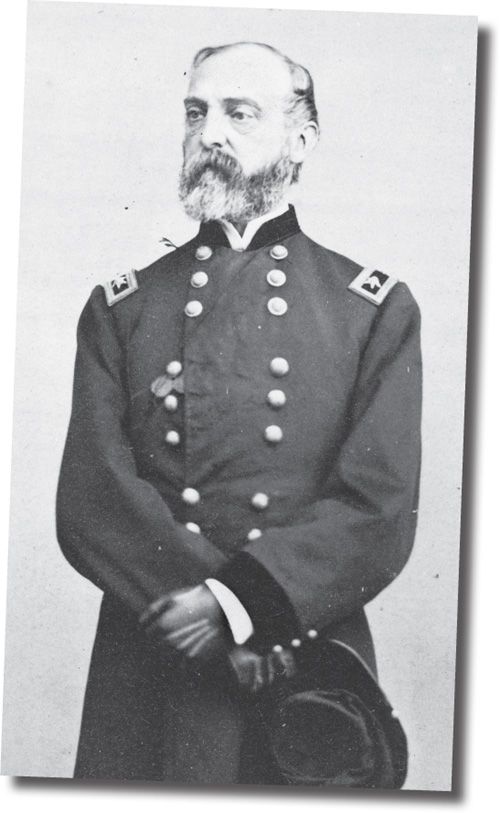
Major General George G. Meade, U.S.A.

Lieutenant General James Longstreet, C.S.A.
1. Major General John F. Reynolds (1820–1863), commander of the Union First Corps, was killed while directing his men into the fight atop McPherson’s Ridge on July 1. Brigadier General Gabriel Rene Paul (1811–1886) was shot in the head and severely wounded but survived, though his military career was effectively ended.
DETAILS OF WEDNESDAY’S BATTLE.
BATTLE-FIELD NEAR GETTYSBURGH.
JULY 6
THURSDAY, JULY 2 — 12 P.M.
The engagement yesterday [July 1] was very sharp, and one of the bloodiest, for its duration, yet encountered by the Army of the Potomac. It was entirely between our Advance Guard, the First corps, supported subsequently by the Eleventh, and the combined forces of the rebel Generals HILL and EWELL.
[James S.] WADSWORTH’S Division, which encamped Tuesday night at Marsh Creek, five miles south of Gettysburgh, moved forward in the morning, and at 10 A.M., were at Gettysburgh. Half a mile beyond the town they met the rebels in force, who were advancing rapidly, Gen. REYNOLDS, apparently under the impression that the force was not more than equal to his, immediately attacked the enemy with great vigor, and drove them back, capturing 400 prisoners, including one Brigadier-General ([James J.] ARCHER) on the spot. It was just before this, while forming the line of battle, that Gen. REYNOLDS was killed by a rebel sharpshooter, concealed near by, who shot him through the head. The enemy had taken a position which was very strong, but our men, with fixed bayonets, drove them from it. WADSWORTH, with two brigades, now became hotly engaged, and held the position fuller an hour unsupported. The second division, under Gen. [James S.] ROBINSON, then became engaged, and also one brigade of Gen. [Abner] DOUBLEDAY’s command, his division being commanded by Col. [Thomas A.] ROWLEY after Gen. REYNOLDS was killed, DOUBLEDAY being assigned to the corps. About half-past one o’clock, the Eleventh corps arrived on the field from Emmetsburgh, and formed on the right of the First corps, but did not get engaged until 3 P.M. The fighting on the left now became very heavy, the enemy pouring in large masses of troops on both flanks. But our men stood their ground with great tenacity, especially the First corps. WADSWORTH’s and ROBINSON’s divisions, aided in the most gallant manner by Col. ROY STONE’s brigade, of Gen. DOUBLEDAY’s division.
Two lines of the enemy, who advanced against WADSWORTH’s division, were literally crushed, nearly every man being killed or wounded, so accurate was the aim of our men — especially of Gen. SOL. MEREDITH’s brigade of Western men [the Iron Brigade].
At length the enemy displayed a strong force on each bank, and compelled our men to fall back, they having no supports within reach. This they did in good order, passing through the town to just the southern and eastern edge of it where a new position was taken on a range of high hills circling around the town from north to south [Cemetery Hill and Cemetery Ridge].
The Eleventh corps in action was commanded by Gen. [Carl] SCHURZ. His division was on the right of WADSWORTH’s, and Gen. BARLOW’s on the right of SCHURZ’s, with [Adolph] STEINWEHR’s in reserve. The conduct of the corps partially redeemed the reputation lost at Chancellorsville, though in coming through the town, in retiring, there was considerable confusion, an a great many stragglers were lost. There way very little artillery in the early part of the fight. [James] HALL’s Second Maine battery distinguished itself, as also did STUART’s Battery B, Fourth artillery, who mowed the rebels down by hundreds.
We lost no artillery, and by 6 o’clock Gen. HANCOCK, who had been ordered up to take command on the field, arrived, and, with Gen. HOWARD’s assistance, soon formed new lines to the east and south of the town. We still occupied a portion of the place, but the enemy held the most, of it and with it many of our wounded, who were brought there during the fight.1
The principal portion of the fight took place near the Pennsylvania College, which building is now used by the enemy as a hospital.
By dark the Twelfth, Third and Second corps had arrived as reinforcements, and Gen. [Henry W.] SLOCUM was temporarily in command.
Gen. MEADE arrived about 9 o’clock P.M., and immediately began making the dispositions to give or receive battle.
I send a duplicate list of such casualties among officers as I have thus far obtained — one to go by telegraph. The losses on both sides were very heavy. In MEREDITH’s brigade, the loss reported this morning is 728 killed and wounded, out of 1,850 who went into the fight, and 400 more are yet unaccounted for.2
Col. ROY STONE, of the Pennsylvania Bucktails, behaved with great gallantry, and was severely wounded. His brigade—the first time under fire — behaved like veterans.
There is no cause whatever for discouragement at the result of yesterday’s fight. It was simply an advance of two corps engaged with, two whole corps (two-thirds) of the rebel army.
Our forces are now all up, and dispositions are making for a grand attack. All the morning both armies have been deploying their columns, preparatory to a great contest. We occupy and hold the Baltimore pike, Taneytown road, and Emmettsburgh Pike, all leading south and east to Baltimore and Washington.
The country is generally open and rolling, affording great opportunities for the use of artillery. There is not much timber, and the rebels have fewer advantages than heretofore. Our losses cannot at present be estimated. They are already among the thousands and number some of our best hundreds.
Gens. REYNOLDS and, PAUL are killed, the latter having died of his wounds this morning.3 Gen. [Francis] BARLOW is severely wounded, and in Gettysburgh — a prisoner. Gen. [Alexander] SCHIMMELFENNIG is a prisoner, but not hurt.4 Col. LUCIUS FAIRCHILD of the Second Wisconsin, has lost his left arm, and is a prisoner, but be sent me word, last night, that he was doing well and in glorious spirits.
I have no time to send further particulars. The enemy are now feeling our line, preparatory, apparently, to making an attack. He may receive one before he can give one. Large misses of artillery are arriving and being pat in position, there being many fine opportunities for its use.
The great fight will probably begin this afternoon, and continue through to-morrow.
L.L. CROUNSE.
1. There was some initial confusion when Hancock arrived. After learning of Reynolds’s death, Meade sent Hancock galloping ahead of his corps to take command of the forces on the field. But Howard, who was already on the field, ranked Hancock by date of rank, and he was somewhat offended to be superseded by a junior. He nevertheless accepted Hancock’s authority and worked with him to establish the new defense line.
2. The Iron Brigade lost 1,153 men out of 1,885 engaged, a loss of 61 percent.
3. Paul survived, dying in 1886.
4. Francis Barlow (1834–1896) was wounded north of Gettysburg atop the knoll that now bears his name and very near where Samuel Wilkeson’s son fell wounded. Brigadier General Alexander Schimmelfennig (1824–1865) suffered the ignominy of being discovered by Confederates and captured after hiding in a back yard pig sty during the Union army’s retreat through the town.
SPECIAL DISPATCHES TO THE NEW-YORK TIMES.
BATTLE-FIELD NEAR GETTYSBURGH.
JULY 4
THURSDAY JULY 2 4:30 P.M.
VIA BALTIMORE, FRIDAY A.M.
The day has been quiet up to the present moment. The enemy are now massing a heavy force on our left, and have just began the attack with artillery. The probability is that a severe battle will be fought before dark. The rebel sharpshooters have been annoying our batteries and men all day from the steeples of the churches in Gettysburgh. We hold the Emmettsburgh and Baltimore roads.
L. L. CROUNSE.
BATTLE-FIELD NEAR GETTYSBURGH.
FRIDAY MORNING JULY 3, — THREE A.M. VIA
BALTIMORE, ONE P.M.
At the close of my last dispatch at 4 1/2 P.M. yesterday, the enemy had just opened a heavy attack by artillery on our left and centre. The tactics of the enemy were soon apparent — a massing of their main strength on our left flank, which covered the Frederick road, with the determination to crush it. So intent were the enemy on this purpose, that every other part of the lines was left alone.
The fighting was of the most desperate description on both sides. Our gallant men fought as they never fought before. We had against this great onslaught of the enemy three corps — the Second, Third and Fifth. The Third and Fifth joined hands, and fought heroically. The Second ably supported them, and at the same time held its own position. One division of the First was also engaged.
The fighting was so furious that neither party took many prisoners. We captured about 600 in one or two charges.
The losses, considering the duration of the conflict, are more than usually heavy on both sides. Many of our most gallant officers have fallen. Gen. [Daniel] SICKLES’ right leg was shot off below the knee. Amputation has been performed, and he is doing well.
Late in the evening, Gen. MEADE called a council of his corps commanders, and it was re-solved to continue the fight so long as there was any one left to fight.
L. L. CROUNSE.

Peter F. Rothermel’s colossal 1872 painting, as engraved by John Sartain, showed the Union repulse of Pickett’s Charge on the final day of the Battle of Gettysburg— the so-called “high water mark” of the Confederacy.
NEWS OF THE DAY.
THE REBELLION.
JULY 6
Our news from the great battlefield of Gettysburgh this morning is of the most cheering and satisfactory character. The great battle of Friday — the third in the series — proves to have been by far the most desperate one of the war, and to have resulted in the complete discomfiture of the enemy. At daylight LEE’s right-wing batteries opened upon our left, and shortly afterward those of his centre followed, but little damage being done by his fire. Soon afterward an impetuous infantry attack was made upon our right, which was repulsed after a sharp struggle — the enemy leaving a considerable number of prisoners in our hands. There was then a lull of several hours, and at 10 o’clock LEE, having massed about 80 pieces of artillery, opened a terrific cannonade upon our centre, but their range being imperfect, it did comparatively little damage to us, and was replied to by our artillery with the best effect. Under cover of this fire, LEE advanced his columns of infantry, and made several desperate attempts to carry our lines by assault, but each successive charge was repulsed with terrific havoc in the rebel ranks. About 4 1/2 o’clock P.M., the fire of the enemy’s artillery slackened, and at 5 it had entirely ceased, and their infantry had withdrawn to cover. During the latter we captured upwards of 3,000 prisoners, and lost but very few. LONGSTREET is very positively stated to have been mortally wounded, and to have fallen into our hands. Gen. MILL is said by prisoners to have been killed outright during the battle.
The official dispatches from Gen. MEADE to the War Department are brief but, corroborates the statements made by our correspondents regarding the events of the battle. At the close of the engagement, he says, the movements of the enemy induced him to believe a retreat was intended. He accordingly pushed forward a strong reconnaissance, which found the enemy in force. On the morning of Saturday, the Fourth, however, it was found that the enemy had withdrawn from the position occupied by him on the day previous, abandoning a large number of killed and wounded on the field. Gen. MEADE’s latest dispatch is dated 8 1/2 o’clock A.M. yesterday.
News was received in Baltimore yesterday afternoon that the rebels were in full retreat.
THE GREAT BATTLE OF FRIDAY.
OUR SPECIAL TELEGRAMS FROM THE BATTLE-FIELD.
JULY 6
Another great battle was fought yesterday afternoon [July 3], resulting in a magnificent success to the National arms.
At 2 o’clock P.M., LONGSTREET’s whole corps advanced from the rebel centre against our centre. The enemy’s forces were hurled upon our position by columns in mass, and also in lines of battle. Our centre was held by Gen. [Winfield S.] HANCOCK, with the noble old Second army corps, sided by Gen. DOUBLEDAY’s division of the First corps.
The rebels first opened a terrific artillery bombardment to demoralize our men, and then moved their forces with great impetuosity upon our position. HANCOCK received the attack with great firmness, and after a furious battle, lasting until 6 o’clock, the enemy were driven from the field, LONGSTREET’s corps being almost annihilated.
The battle was a most magnificent spectacle. It was fought on an open plain, just south of Gettysburgh, with not a tree to interrupt the view. The courage of our men was perfectly sublime.
At 5 P.M. what was left of the enemy retreated in utter confusion, leaving dozens of flags, and Gen. HANCOCK estimated at least five thousand killed and wounded on the field.
The battle was fought by Gen. HANCOCK with splendid valor. He won imperishable honor, and Gen. MEADE thanked him in the name of the army and the country. He was wounded in the thigh, but remained on-the field ….
The conduct of our veterans was perfectly magnificent. More than twenty battle flags were taken by our troops. Nearly every regiment has one. The Nineteenth Massachusetts captured four. The repulse was so disastrous to the enemy, that LONGSTREET’s corps is perfectly used up. Gen. [John] GIBBON was wounded in the shoulder. Gen. [Alexander] WEBB was wounded and remained on the field. Col. [John S.] HAMMELL, of the Sixty-sixth New-York, was wounded in the arm.
At 7 o’clock last evening. Gen. MEADE ordered the Third corps, supported by the Sixth, to attack the enemy’s right, which was done, and the battle lasted until dark, when a good deal of ground had been gained.
During the day EWELL’s corps kept up a desultory attack upon SLOCUM on the right, but was repulsed.
Our cavalry is to-day playing savagely upon the enemy’s flank and rear.
L. L. CROUNSE
GETTYSBURGH.
JULY 6
The Army of the Potomac, under its new leader, has won its greatest victory. The tremendous actions of the first three days of the month of July at Gettysburgh have been followed by the complete discomfiture of the entire rebel army, which so audaciously and exultingly crossed the Potomac, and planted itself on Pennsylvania soil less than a fortnight ago. Entertaining not a doubt of triumph, it advanced with flying banners, defiant shouts, and steady tread. From the Rappahannock to the Blue Ridge, from the mountains to the Potomac, from the Potomac to the Susquehanna, they swept unmolested over a distance of two hundred miles; and at the beginning of last week, were just preparing to consummate their triumphant campaign. They condemned the Army of the Potomac, sneered at its late leader, and boasted that they could kick him and his army around the continent. Their commander had already led them in five great campaigns, two of them in their inception offensive, two defensive, and one what JOMINI1 styles offensive-defensive; and all of them they regarded as victorious. There were but three things more needed to insure their final success, and these were — to rout the Army of the Potomac, capture Washington, and hold their army on our soil until they could dictate terms of peace and enforce the recognition of the Southern Confederacy. By the seizure of Philadelphia and Baltimore, they could also thoroughly humiliate us, and after the fashion they established at York, could fill the coffers of the Confederacy, and gratify their army with plunder.2 Their task was simple and their assurance unbounded.
So at least it appeared last Monday. So it appeared on the first day of the month of July.
But their lately exultant and defiant army of invasion — where is it, and what is it now?
Defeated in the very opening of the campaign, Defeated in three great battles in which their whole force of infantry, cavalry and artillery was engaged. Defeated by the Army of the Potomac, Defeated by Gen. MEADE, who then fought his first battle at the head of the army, Defeated with tremendous loss in killed and wounded, in prisoners and in artillery; and defeated when defeat was destruction. Defeated after struggling for three days with a fury more than mortal and an energy madder than that of despair....
1. Baron Antoine-Henri Jomini (1779–1869) was a French general and military theorist who wrote several books on the theory of war, including The Art of War (1838) which was used as a text at the U.S. Military Academy.
2. At York and elsewhere in Pennsylvania, Confederate forces coerced a payment from the townspeople on threat of having their city put to the torch.
DETAILS FROM OUR SPECIAL CORRESPONDENT.
JULY 6
HEADQUARTERS ARMY OF POTOMAC,
SATURDAY NIGHT, JULY 4
Who can write the history of a battle whose eyes are immovably fastened upon a central figure of transcendently absorbing interest — the dead body of an oldest born, crashed by a shell in a position where a battery should never have been sent, and abandoned to death in a building where surgeons dared not to stay?1
The battle of Gettysburgh, I am told that it commenced, on the 1st of July, a mile north of the town, between two weak brigades of infantry and some doomed artillery and the whole force of the rebel army. Among other costs of this error was the death of REYNOLDS. Its value was priceless; however, though priceless was the young and the old blood with which it was bought. The error put us on the defensive, and gave us the choice of position. From the moment that our artillery and infantry rolled back through the main street of Gettysburgh and rolled out of the town to the circle of eminences south of it. We were not to attack but to be attacked. The risks, the difficulties and the disadvantages of the coming battle were the enemy’s. Ours were the heights for artillery; ours the short, inside lines for maneuvering and reinforcing; ours the cover of stonewalls, fences and the crests of hills. The ground upon which we were driven to accept battle was wonderfully favorable to us. A popular description of it would be to say that it was in form an elongated and somewhat sharpened horseshoe, with the toe to Gettysburgh and the heel to the south.2
LEE’s plan of battle was simple. He massed his troops upon the east side of this shoe of position, and thundered on it obstinately to break it. The shelling of our batteries from the nearest overlooking hill, and the unflinching courage and complete discipline of the army of the Potomac repelled the attack. It was renewed at the point of the shoe [Cemetery Hill] — renewed desperately at the southwest heel [Little Round Top] — renewed on the western side with an effort consecrated to success by [Richard S.] EWELL’s earnest oaths, and on which the fate of the invasion of Pennsylvania was fully put at stake. Only a perfect infantry and an artillery educated in the midst of charges of hostile brigades could possibly have sustained this assault. [Win-field Scott] HANCOCK’s corps did sustain it, and has covered itself with immortal honors by its constancy and courage. The total wreck of [Alonzo] CUSHING’s battery — the list of its killed and wounded — the losses of officers, men and horses [Andrew] COWEN sustained — and the marvellous outspread upon the board of death of dead soldiers and dead animals — of dead soldiers in blue, and dead soldiers in gray — more marvellous to me than anything I have ever seen in war — are a ghastly and shocking testimony to the terrible fight of the Second corps that none will gainsay. That corps will ever have the distinction of breaking the pride and power of the rebel invasion.
For such details as I have the heart for. The battle commenced at day light, on the side of the horse-shoe position, exactly opposite to that which EWELL had sworn to crush through. Musketry preceded the rising of the sun. A thick wood veiled this fight, but out of its leafy darkness arose the smoke and the surging and swelling of the fire, front intermittent to continuous, and crushing, told of the wise tactics of the rebels of attacking in force and changing their troops. Seemingly this attack of the day was to be made through that wood. The demonstration was protracted — it was absolutely preparative; but there was no artillery fire accompanying the musketry and shrewd officers in our western front mentioned, with the gravity due to the fact, that the rebels had felled trees at intervals upon the edge of the wood they occupied in face of our position. These were breastworks for the protection of artillery men.
Suddenly, and about 10 to the forenoon, the firing on the east side, and every where about our lines, ceased. A silence as of deep sleep fell upon the field of battle. Our army cooked, ate and slumbered. The rebel army moved 120 guns to the west, and massed there LONGSTREET’s corps and HILL’s corps, to hurl them upon the really weakest point of our entire position.
Eleven o’clock — twelve o’clock — one o’clock. In the shadow cast by the tiny farm; house 16 by 20, which Gen. MEADE had made his Headquarters, lay wearied Staff officers and tired reporters. There was not wanting to the peacefulness of the scene the singing of a bird, which had a nest in a peach tree within the tiny yard of the whitewashed cottage. In the midst of its warbling, a shell screamed over the house, instantly followed by another, and another, and in a moment the air was full of the most complete artillery prelude to an infantry battle that was ever exhibited. Every size and form of shell known to British and to American gunnery shrieked, whirled, moaned, whistled and wrathfully fluttered over our ground. As many as six in a second, constantly two in a second, burning and screaming over and around the headquarters, made a very hell of fire that amazed the oldest officers. They burst in the yard-burst next to the fence on both sides, garnished as usual with the hitched horses of aids and orderlies. The fastened animals reared and plunged with terror. Then one fell, then another — sixteen laid dead and mangled before the fire ceased, still fastened by their baiters, which gave the expression of being wickedly tied up to die painfully. These brute victims of a cruel war touched all hearts: Through the midst of the storm of screaming and exploding shells, an ambulance, driven by its frenzied conductor at full speed, presented to all of us the marvelous spectacle of a horse going rapidly on three legs. A hinder one had been shot off at the hock.... During this fire ... soldiers in Federal blue were torn to pieces in the road and died with the peculiar yells that blend the extorted cry of pain with horror and despair....
Then there was a lull, and we knew that the rebel Infantry was charging. And splendidly they did this work — the highest and severest test of the stuff that soldiers are made of. HILL’s division, in line of battle, came first on the double quick. Their muskets at the “right-shoulder-shift.” LONGSTREET’s came as the support, at the usual distance, with war cries and a savage insolence as yet untutored by defeat. They rushed in perfect order across the open field up to the very muzzles of the guns, which tore lanes through them as they came. But they met men who were their equals in spirit, and their superiors in tenacity. There never was better fighting since Thermopylae than was done yesterday by our infantry and artillery. The rebels were over our defences. They had cleaned cannoniers and horses from one of the guns, and were whirling it around to use upon us. The bayonet drove them back ...So terrible was our musketry and artillery fire, that when [Lewis] ARMISTEAD’s brigade was checked3 in its charge, and stood reeling, all of its men dropped their muskets and crawled on their hands and knees underneath the stream of shot till close to our troops, where they made signs of surrendering. They passed through our ranks scarcely noticed, and slowly went down the slope to the road in the rear....
What remains to say of the fight?... My pen is heavy. Oh, you dead, who at Gettysburgh have baptised with your blood the second birth of Freedom in America, how you are envied! I rise from a grave whose wet clay I have passionately kissed, and I look up and see Christ spanning this battle-field with his feet and reaching fraternal and lovingly up to heaven. His right hand opens the gates of Paradise — with his left he beckons these mutilated, bloody, swollen corpses to ascend.
S. WILKESON

An Alexander Gardner photograph shows Confederate dead at Devil’s Den.
1. Samuel Wilkeson’s reference here is his son, First Lieutenant Bayard Wilkeson, commander of Battery G, Fourth U.S. Artillery, who was mortally wounded on Barlow’s Knoll on July 1. Wilkeson’s right leg was shattered by a Confederate cannonball and was hanging only by a shred of skin. Tradition has it that young Wilkeson cut off the leg with his own knife. Samuel Wilkeson supposedly wrote this report while gazing on his son’s body.
2. Other writers have suggested that the Union’s position resembled a fishhook.
3. Brigadier General Lewis Armistead (1817–1863) led one of the three brigades in George Pickett’s division, and was the only general officer to pierce the Union line on July 3, leading the charge with his hat on his sword point, up to the very muzzles of a Union artillery battery commanded by Alonzo Cushing. The spot where Armistead fell mortally wounded is generally considered to be the Confederate “high water mark” at Gettysburg.
THE GREAT BATTLES.
SPLENDID TRIUMPH OF THE ARMY OF THE POTOMAC.
ROUT OF LEE’S FORCES ON FRIDAY
JULY 6
HEADQUARTERS ARMY OF POTOMAC, NEAR
GETTYSBURGH, FRIDAY, JULY 3 — 8 1/2 P.M.
The following has just been received: Major-Gen. Halleck, General-in-Chief:
The enemy opened at 1 P.M., from about one hundred and fifty guns, concentrated upon my left centre, continuing without intermission for about three hours, at the expiration of which time, he assaulted my left centre twice, being, upon both occasions, handsomely repulsed, with severe loss to him, leaving in our hands nearly three thousand prisoners.
Among the prisoners is Brig.-Gen. ARMISTEAD and many Colonels and officers of lesser rank.
The enemy left many dead upon the field, and a large number of wounded in our hands.
The loss upon our side has been considerable. Maj.-Gen. HANCOCK and Brig.-Gen. [John] GIBBON were wounded.1
After the repelling of the assaults, indications leading to the belief that the enemy might be withdrawing, a reconnaissance was pushed forward from the left and the enemy found to be in force.
At the present hour all is quiet....
The army is in fine spirits.
GEORGE G. MEADE, MAJ.-GEN. COMMANDING.

Edwin Forbes’s sketch of federal troops pursuing Lee’s army during a rainstorm after the Battle of Gettysburg.
1. Winfield Scott Hancock (1824–1886) was a conspicuous target on horseback during the charge. He was severely wounded when a bullet struck the pommel of his saddle and entered his inner right thigh carrying wood fragments and a large bent nail. He survived his wound and seventeen years later, in 1880, he was the Democratic candidate for President. John Gibbon (1827–1896) was wounded by a minie ball through the left shoulder.
THE PRESIDENT TO THE COUNTRY.
JULY 6
WASHINGTON, D.C, JULY 4 — 10:30 A.M.
The President announces to the country that news from the Army of the Potomac, up to 10 P.M. of the 3d, is such as to cover that army with the highest honor; to promise a great success to the cause of the Union, and to claim the condolence of all for the many gallant fallen; and that for this, he especially desires that on this day He, whose will, not ours, should ever be done, be everywhere remembered and reverenced with profoundest gratitude.
(SIGNED) LINCOLN.
THE REBELS REPORTED IN FULL RETREAT.
JULY 6
BALTIMORE, SUNDAY, JULY 5
The [Baltimore] American has just put upon its bulletin the important announcement that the rebel army it in full retreat, which was commenced on Friday night. Many thousand prisoners — and a large number of cannon are captured.
THE GREAT VICTORY.
GEN. MEADE’S ORDER OF THANKS TO THE ARMY.
JULY 7
HEADQUARTERS ARMY OF POTOMAC, NEAR
GETTYSBURGH, JULY 4.
GENERAL ORDERS NO. 68.
The Commanding General, in behalf of the country, thanks the Army of the Potomac for the glorious result of the recent operations. Our enemy, superior in numbers, and flushed with the pride of a successful invasion, attempted to overcome or destroy this army. Baffled and defeated he has now withdrawn from the contest. The privations and fatigues the army has endured, and the heroic courage and gallantry it displayed, will be matters of history to be ever remembered.
Our task is not yet accomplished, and the Commanding General looks to the army for greater efforts to drive from our soil every vestige of the presence of the invader.
It is right and proper that we should, on suitable occasions, return our grateful thanks to the Almighty Disposer of events, that, in the goodness of His providence He has thought at to give victory to the cause of the just.
By command of
(SIGNED) MAJ.-GEN. MEADE1
1. When he read Meade’s directive “to drive from our soil every vestige of the presence of the invader,” Lincoln blurted out. “Drive the invaders from our soil! My God! Is that all?” In his view, all of the country was “our soil,” and the object was not to drive the rebels out but to restore the Union. The President indulged himself to the extent of writing a critical letter to Meade about this and other things, but then, thinking better of it, he consigned the letter to a drawer and instead sent Meade a letter of congratulations.
THE PURSUIT OF LEE.
OUR SPECIAL TELEGRAMS FROM THE ARMY OF THE POTOMAC.
JULY 7
GETTYSBURGH, PENN., MONDAY, JULY 6
The reports from the extreme front are very cheering. Our cavalry, supported by infantry, are close upon the heels of the enemy, and important results are likely to occur before night....
GETTYSBURGH, PENN., VIA HANOVER,
MONDAY, JULY 6 — 8 P.M.
The latest Intelligence from the front is to the effect that the enemy is making all possible speed toward the Potomac. I have just come in from the front, and have learned that the lead of the rebel retreating column commenced to pass through Greenwood, twelve miles northwest of Hagerstown, yesterday morning at 10 o’clock....
The rebels are reported to have a trestle bridge just built across the Potomac above Williamsport. If so, I fear their main force may escape.
L. L. CROUNSE.
TROUBLE AMONG IRISH AND COLORED STEVEVEDORES [SIC].
JULY 8
BUFFALO, MONDAY, JULY 6
There was a difficulty between the Irish stevedores and negroes, this afternoon, in consequence of the former trying to prevent the negroes from unloading propellers [that is, propeller-driven ships]. One negro shot an Irishman, it is said, in self-defence, which was the signal for a general onslaught on all the negroes, several of whom are reported killed, and a number severely wounded. Tonight all is quiet, but the longshoremen and stevedores are determined to prevent the negroes from working on the docks.
THE SURRENDER OF VICKSBURGH.
JULY 8
The State of Mississippi passed its ordinance of secession on the 9th day of January, 1861. Four days afterward the Governor of the State ordered artillery to Vicksburg, “to hail and question passing boats on the Mississippi River.” From that time until the Fourth of July, 1863 — a period of nearly two years and a half — there has been no passing of that point on the great river, except by the sovereign pleasure of the rebels, or under a tempest of fire that threatened annihilation. For the last four days the passage has again been free to the American flag, without batteries opened, or questions asked, and so it will remain until the end of time.
We may now, in fact, consider the entire Mississippi substantially open. Though Port Hudson still held out against Gen. BANKS at the latest advices, its fall was daily expected. The surrender of Vicksburgh forthwith settles its fate.1 When the stronghold succumbs, the outworks have no alternative. The desperate defence which the rebels have made, both at Vicksburgh and the smaller post, is the best proof of the transcendant importance which they attached to the command of the river. They have fought as if the very life of the Confederacy turned upon the issue there; and it was the foreboding that this issue must go against them that excited that desperation which impelled the reckless dash of LEE into Pennsylvania. No man has understood better than JEFF. DAVIS, whose own home is on the banks of the Mississippi,2 that the power which holds that “inland sea,” as Mr. [John C.] CALHOUN termed it, rules the continent; and that this lost — even if all else were won — the independence of the Confederacy would be but a name. He has done his best, both by proclamations and through Congressional resolutions, to propitiate the Northwest into some sort of an acquiescence in his possession, by promises of a joint free navigation of the river. What cajolery failed to do, he has done his best to make good by defiance. There has never been a fortification on the continent — if Quebec, perhaps, be excepted — at all to be compared in strength with that which has so long and so marvellously withstood the National armies and navies on the Mississippi. Every resource of the most consummate engineering skill was expended to make the work absolutely impregnable. And in fact it is still doubtful whether even GRANT’s army, than whom there are no better soldiers in the world, could have taken it by any series of assaults, however often repeated. Deficiency in supplies, if we are to judge from our present information, alone compelled the garrison to capitulate — the same agency upon which all investing armies have to rely when all other means fail. The Confederate Government perhaps may find some little solace for their pride, that Vicksburgh at last yielded to the necessities of physical nature, rather than to the overwhelming rush of serried battalions. But the surrender is to them none the less fatal, while to us there is the exceeding gratification of reflecting that this substantial result was secured at comparatively little sacrifice of life.
This is a proud day for Gen. GRANT. It may well, too, be a proud day for President LINCOLN, who has so firmly stood by him through good report and evil report. There has been no such indomitable resolution, since this war, as that exercised by GRANT in his long work of reducing this rebel Sebastopol. Nothing like it. There is not a man in a million who would not have been disheartened by the long succession of failures. Every conceivable expedient had been thoroughly exhausted, except the last one, which was so desperate on its face, that even the stoutest-hearted might well have been appalled by it. We look in vain through all history, for another instances of such a passage of vessels in the face of miles of the heaviest batteries, as that by which Gen. GRANT’s transports were taken below Vicksburgh. And we hardly remember another such instance of an army launching, itself with but two or three days’ rations, into an enemy’s country, with too small numbers to make even the attempt to keep its communications in the rear open, without any definite knowledge of the topography of the country, or of the location of its adversaries, or of the fortified works it might find in its path, certain only that the region somewhere contained hostile forces far outnumbering its own. Such an inland enterprise would heretofore have been deemed quite as rash as the other one on the water. And yet the result of all this terrible daring has been a success which overtops every other that the war has presented, or, indeed, can present, for it is decisive of the fate of the war. GRANT, for the last year, at least, has as completely ignored the word impossible as NAPOLEON boasted that he did through his whole career. If he should lay down his sword to-morrow, he would already have earned an imperishable name in American history. But no sword can be reckoned upon with more confidence than his to the end of the war; and, unless we grandly mistake, it will make many a notable mark yet.

Some of the shelters constructed by the citizens of Vicksburg during the siege.
1. Port Hudson surrendered on July 9.
2. Jefferson Davis’s plantation, Brierfield, was on a bend in the Mississippi River just south of Vicksburg.
THE NEWS IN WASHINGTON.
GREAT JUBILATION.
JULY 8
SPECIAL DISPATCH TO THE NEW-YORK TIMES.
WASHINGTON, TUESDAY, JULY 7
The Cabinet was in regular session to-day Admiral PORTER’S Vicksburgh dispatch was received by Secretary WELLES, and read to the President. The news immediately spread throughout the city, creating intense and joyous excitement. Flags were displayed from all the Departments, and crowds assembled with cheers. Secretary STANTON issued an order for a salute of one hundred guns.
The fall of Vicksburgh, conjointly with the Gettysburg successes, is regarded as the turning point in the war. The President and high officials express a determination that the campaign shall not slacken off in consequence, but be carried on with renewed vigor ….
At 8 P.M., a crowd assembled in front of the National Hotel, and marched up Pennsylvania-avenue, headed by the Marine Band, to the executive Mansion, serenaded, and enthusiastically cheered the President, with repeated cheers for Gens. GRANT, MEADE, ROSECRANS, the Armies of the Union, etc. The President appeared at the window, amid loud cheers, and said:
“FELLOW-CITIZENS: I am very glad indeed to see you to-night, and yet I will not say I thank you for this call but I do most sincerely thank Almighty God for the occasion on which you have called. (Cheers.) How long ago is it? Eighty odd years since on the Fourth of July for the first time in the history of the world a nation, by its representatives, assembled and declared as a self-evident truth, ‘that all men are created equal.’ (Cheers.) That was the birthday of the United States of America. Since then the Fourth of July has had several very peculiar recognitions. The two most distinguished men in the framing and the support of the Declaration were THOMAS JEFFERSON and JOHN ADAMS — the one having penned it, and the other sustained it the most forcibly in debate — the only two of the fifty-five who sustained it being elected president of the United States. Precisely fifty years after they put their hands to the paper, it pleased Almighty God to take both from this stage of action. This was indeed an extraordinary and remarkable event in our history. Another President, five years after, was called from this stage of existence on the same day and month of the year; and now in this last 4th of July, just passed. When we have a gigantic rebellion at the bottom of which is an effort to overthrow the principle that all men were created equal, we have the surrender of a most powerful position and army on that very day, (Cheers,) and not only so, but in a succession of battles in Pennsylvania, near to us. Through three days, so rapidly fought that they might be called one great battle on the first, second and third of the month of July: and on the 4th the cohorts of those who opposed the Declaration that all men are created equal, “turned tail” and run. (Long continued cheers.) Gentlemen, this is a glorious theme, and the occasion for a speech, prepared to make one worthy of the occasion. I would like to speak in terms of praise due to the many brave officers and soldiers who have fought in the cause of the Union and liberties of their country from the beginning of the war. These are trying occasions, not only in success, but for the want of success. I dislike to mention the name of one single officer, lest I might do wrong to those I might forget. Recent events bring up glorious names, and particularly prominent ones; but these I will not mention. Having said this much, I will now take the music.”1

A New York Times map showing federal troop dispositions during the Siege of Vicksburg.
1. Several scholars have noted the similarity between this extemporaneous speech and Lincoln’s subsequent Gettysburg Address delivered in November.
THE CONSCRIPTION AND THE WAR.
JULY 10
The Administration is acting wisely in ordering the immediate enforcement of the draft.1 We have just achieved two great victories which it seems should paralyze the war power of the rebellion. We have beaten its greatest army, and captured its most powerful stronghold. Upon LEE’s army the eastern half of the Confederacy depended for protection. Upon Vicksburgh the western half depended for safety. After LEE’s defeat and Vicksburgh’s fall, it might seem that the rebellion would come to a speedy end, and without further effort on the part of the North. We shall soon know the effect of these losses on the rebel States; but we are prepared to hear that no signs of submission appear, and that redoubled bitterness and frenzy rule the Southern heart.
The rebels have had great losses, heretofore, and they have met them patiently and stoutly. Their losses of Forts Henry and Donelson, of Forts Philip and Jackson, and of the Cities of New-Orleans and Norfolk, were great calamities, but they did not destroy their spirit or purpose. The obstinacy of the rebels has been sufficiently proved by their action in the past. They have evinced a recuperative power after mishaps, and given evidence of a fertility of resource, and an ingenuity in creating the appliances of war, for which they had never before had credit. We see no reason to believe that their spirits will now, all at once, give way, that their obstinacy will be broken, or their aptness for war will fail. With all the harm we have just done them, their power is yet immense. And no cause so desperate as theirs is likely to be abandoned until the last moment, and when there is no longer a leader or an army to stand in its defence.
Granting that we utterly disable Gen. LEE, and that we drive the rebel arms from the Mississippi River, we must still have the work of invasion and conquest to prosecute. And this is harder than the work of expelling from our soil an invader, or capturing a stronghold to which we advance with such a line of communication as the Mississippi River opens to our army. How much harder it is to invade successfully than to beat back an invader, let two years’ history in Virginia tell — let us recall events from Bull Run to Chancellorsville. We have an instructive lesson, also, in the State of Tennessee. With a railroad and river behind it, our army has, for half a year, been held fast bound in sight of the hills and steeples of the City of Nashville. Gen. ROSECRANS lay half a year at Murfreesboro, after a great victory over the enemy. He durst not pursue; because every mile of advance, penetrating inland into the enemy’s country, weakened his army, exposed him to annoyances and attacks on flank and rear, and endangered his communications with his depots of supplies at Nashville and Murfreesboro. Such dangers will always beset an invading army.
We have captured many points around the edges of the Confederacy — Norfolk, Suffolk, Roanoke Island, Newbern (N.C.,) Port Royal, (S.C.,) San Augustine and Pensacola, Fla., Ship Island, New Orleans, and at one time, Galveston, Texas.2 But we have done nothing but hold those places. Every attempt to penetrate inland from them has been baffled. It is only when we have controlled deep navigable waters that our armies have been able to invade and hold their own in the rebel States. Armies as large as those that have hitherto made the attempt to penetrate Virginia must renew that attempt. Armies greater than Gen. ROSECRANS now leads may be required to capture Chattanooga, and go into Georgia. Gen. GRANT, with all his reinforcements, may not be able to protect the Mississippi River from the depredations of PRICE on the West, hold Vicksburgh and Jackson, and pursue Gen. JOE JOHNSTON’s new army to the interior of Alabama, with the hope of getting a safe fight out of him.
Therefore, the conscription is necessary. Even after the late great victories, a new army of 300,000 men must be got ready to move upon the Confederacy. Let the rebel States see that not only are they beaten now, by the forces at present in the field, but that in the Fall they must meet the same veteran armies, recruited, and 300,000 stronger. And then, if they mean to stop short of annihilation, they will certainly see the propriety and necessity of yielding.
1. Congress passed the first Conscription Act on March 3, 1863. The Confederacy had passed a Conscription Act almost a year earlier, on April 16, 1862.
2. Federal forces captured Galveston, Texas, in October 1862, but it was retaken by Confederate forces in January 1863
THE CONSCRIPTION A GREAT NATIONAL BENEFIT.
JULY 13
The National Enrollment Act, the enforcement of which was commenced in this City on Saturday, will be carried into execution until the quota of the State of New-York and of every State in the Union shall be raised and in the field. It may not be necessary that a man of those drafted shall ever go into line of battle during this war. Yet it is a national blessing that the Conscription has been imposed. It is a matter of prime concern that it should now be settled, once for all, whether this Government is or is not strong enough to compel military service in its defence....
For a time after the act was passed, the chiefs of faction were free in their threats that any attempt to carry it out should be resisted by force and arms. In some few localities they succeeded in working up popular passion against its first processes, even to a fighting pitch; but it was very quickly made apparent that the people at large would never sustain any such resort to violence, and that it was worse than idle to contend thus with the Government. Since then, the talk of these factionists on the platform and in their newspaper organs has been that the appeal shall be carried to the ballot-box. They flatter themselves that, by working diligently upon the basest motives and meanest prejudices, they can secure popular majorities that will force a repeal of the measure, or at least deter the Government from carrying it out to its complete execution.
Well, let them do their worst. We want it determined whether the majority of the American people can be induced by any such influences to abandon the cause of their country. So far as the Government itself is concerned, we have no fear that it will fail to do its duty....
THE RIOTS YESTERDAY.
JULY 14
The outrages upon law and public order yesterday, in this metropolis, will revive the heart of every rebel, and of every hater of our institutions the world over. The assiduous fanning of every malignant passion by a portion of our public Press, and by platform demagogues, has at last resulted in an open outbreak, and for hours a mob, embracing thousands, raged at its full bent through an extended section of our City, with arson and bloody violence. The absence of nearly our entire military force, in their great patriotic work of aiding to beat back the invaders of Northern soil, gave these public enemies a rare opportunity for carrying things with a high hand. The law was not only defied but was successfully resisted. For the first time within the memory of this generation, it could not command means for its protection. It stood paralyzed, helpless, humbled. It was a spectacle that may well crimson the check of every true American with shame. Yet, if that were all, there might be some resignation, for public humiliations have been no rarity in New-York. But, unfortunately, there is danger in it, as well as disgrace. There is something portentous in this lawlessness at this juncture.
It has long been declared by the rebel journals, and also by the European journals in the interest of the rebels, that the Conscription act could not be enforced, and that this would compel a discontinuance of the war. The anti-war journals here in the North, while they in general have not ventured to recommend violent resistance to the Conscription, have yet studied to excite against it every unreasoning passion and prejudice. Malignants, too, of the Vallandigham type, have for months been doing their best, by artful harangues, to foment a spirit of resistance. These men understood their work thoroughly. Their business was to bring about violence, and at the same time keep themselves personally uncommitted to violence; and [Marc] ANTONY himself never managed that business more skillfully. Every discerning man saw what it would end in — the mob in the street taking upon themselves all the risks, these gentry in their closets rejoicing in the fray in which they dared not mingle. The Government could not blind itself to this flagitious course of action. It made some effort to defeat it; but it was found that this only armed these public enemies with new power, for they turned it to their advantage by pretending that it was now a question of freedom of speech, and gained new influence by setting themselves up as its champions. Thus the dangerous element has been continually growing. It has spread more or less through every part of the North. It has reached all the baser portions of society everywhere, and made them restless, and ready for almost any violence. In most communities this spirit is effectually kept under by superior public opinion. But there are localities where this public sentiment has no such force. This has been shown in the rural districts by the outbreaks which have already occurred in Ohio and Indiana. It is now being shown amid a city population, where the passions of men are far more inflammable, and where the facilities for effective organization are far greater. What its real strength is no man can yet measure; but yesterday’s demonstrations sufficiently attest that it is quite strong enough to be formidable and dangerous.
The practical question now is, how this spirit of resistance is to be met. Is it to be done by discussing the merits and the necessities of the Conscription act? Decidedly No! It will be a fatal mistake for the friends of the Government to suspend their action on the turn of any such question. No man who is at heart for the war, by which alone the Government can be sustained, has a serious doubt about either the constitutionality, or the justice, or the propriety, or the necessity of this resort for replenishing the national armies....
The issue is not between Conscription and no-Conscription, but between order and anarchy. The question is not whether this particular law shall stand, but whether law itself shall be trampled under foot. Is this City to be at the mercy of a mob? Have the statutes of the land to await the approval of all the Jack Cades of society before they can attain any binding force? Nobody ever imagined that this conscription act would suit either rebels in the South, or rebel-sympathizers in the North. No valuable law is ever passed that has the favor of the evil-minded. Yield to them the ratification of our public legislation, and you will speedily be reduced to the condition of being without any law whatever. There is not a man’s life in this City that is safe, nor a dollar’s worth of property, if the spirit which dominated this City yesterday is to be left to its own working. It is as fatal to our whole civil and social organization as the plague is to the physical constitution of man. To give way before it is simply to invoke destruction. Our authorities, we perfectly understand, have been taken at a great disadvantage. These riots have been precipitated upon them at the very time when they were least able to meet them with promptitude. It has proved to have been a great mistake to suffer our city to be so completely stripped of its military defenders. But it is idle now to repine over this. There are yet available means enough, if seasonably and properly taken in hand, to crush, before another twenty-four hours, this twin hydra of the rebellion utterly, beyond all possibility of its ever writhing again. But it will require boldness, decision, nerve of no ordinary character. The responsibility is practically with Gov. SEYMOUR and Mayor OPDYKE. Men in their positions never were confronted with more stupendous duties.
SHALL RUFFIANS RULE US?
JULY 14
The mob yesterday was unquestionably started on the basis of resistance to the draft. But that was a very small part of the spirit which really prompted and kept it in motion. It was, probably, in point of character the lowest and most ruffianly mob which ever disgraced our City. Arson, theft and cowardly ferocity seemed to be the animating impulse of a very large portion of the mass that composed it. We have never witnessed a more disgusting or more humiliating sight than was offered in every street which these gangs of outlaws tramped through with their hideous uproar. A large portion of them were mere boys, and their special delight seemed to be to hunt negroes. One would have supposed that every colored man, woman and child must be a wild beast — to judge from the savage and eager delight with which they were chased and beaten and stoned by these wretched brutes in human form. It seems inconceivable that so much of pure, unadulterated ferocity — so much of that clear, undiluted cruelty which feels a keen and ecstatic relish in the infliction of torture upon others for its own sake, can dwell in the human heart. But such hideous outbreaks as that of yesterday draw aside the curtain and show us how much of the wild beast, in spite of our better qualities, really belongs to the baser elements of our social life.
There is but one way to deal with this coarse brutality. It is idle to reason with it, — worse than idle to tamper with it; it must be crushed. Nothing but force can deal with its open manifestations....
THE MOB IN NEW-YORK.
RESISTANCE TO THE DRAFT — RIOTING AND BLOODSHED.
JULY 14
The initiation of the draft on Saturday in the Ninth Congressional District was characterized by so much order and good feeling as to well-nigh dispel the forebodings of tumult and violence which many entertained in connection with the enforcement of the conscription in this City. Very few, then, were prepared for the riotous demonstrations which yesterday, from 10 in the morning until late at night, prevailed almost unchecked in our streets. The authorities had counted upon more or less resistance to this measure of the Government after the draft was completed, and the conscripts were repaired to take their place in the ranks, and at that time they would have been fully prepared to meet it; but no one anticipated resistance at so early a stage in the execution of the law, and, consequently, both the City and National authorities were totally unprepared to meet it. The abettors of the riot knew this, and in it they saw their opportunity. We say abettors of the riot, for it is abundantly manifest that the whole affair was concocted on Sunday last by a few wire-pullers, who, after they saw the ball fairly in motion yesterday morning prudently kept in the back ground. Proof of this is found in the fact that as early as 9 o’clock, some laborers employed by two or three railroad companies, and in the iron foundries a the eastern side of the City, formed in procession in the Twenty-second Ward, and visited the different workshops in the upper wards, where large numbers were employed, and compelled them, by threats in some instances, to cease their work. As the crowd augmented, their shouts and disorderly demonstrations became more formidable. The number of men who thus started out in their career of violence and blood, did not probably at first exceed threescore. Scarcely had two dozen names been called, when a crowd, numbering perhaps 500, suddenly made an irruption in front of the building, (corner of Third-avenue and Forty-sixth-street,) attacking it with clubs, stones, brickbats and other missiles. The upper part of the building was occupied by families, who were terrified beyond measure at the smashing, of the windows, doors and furniture. Following these missiles, the mob rushed furiously into the office on the first floor, where the draft was going on, seizing the books, papers, records, lists, &c. all of which they destroyed, except those contained in a large iron safe. The drafting officers were set upon with stones and clubs, and, with the reporters for the Press and others, had to make a hasty exit through the rear. They did not escape scatheless, however, as one of the enrolling officers was struck a savage blow with a stone, which will probably result fatally, and several others were injured.
SCENES BY AN EYE-WITNESS
At 11 A.M. word reached the Park Barracks of the disturbance, and Lieut. RIED and a detachment of the Invalid corps immediately repaired to the scene of the riot. They went by the Third avenue route, the party occupying one car. On the way up, crowds of men, women and children gathered at the street corners, hissed and jeered them, and some even went so far as to pick up stones, which they defiantly threatened to throw at the car. When near the scene of disturbance, Lieut. RIED and command alighted, and formed in company line, in which order they marched up to the mob. Facing the rioters the men were ordered to fire, which many of them did, the shots being blank cartridges, but the smoke had scarce cleared away when the company (which did not number more than fifty men, if as many.) were attacked and completely demoralized by the mob, who were armed with clubs, sticks, swords and other implements. The soldiers had their baronets taken away, and they themselves were compelled seek refuge in the side streets, but in attempting to flee thither several, it is said, were killed, while those that escaped, did so only to be hunted like dogs, but in a more inhuman and brutal manner. They were chased by the mob, who divided themselves into squads, and frequently a single soldier would be caught in a side street, with each end blocked up by the rioters. The houses and stores were all closed (excepting a few liquor shops, which had their shutters up, but kept the back door open,) no retreat was, therefore, open for him, and the poor fellow would be beaten almost to death, when the mob becoming satiated and disgusted with their foul work, be would be left sweltering in blood, unable to help himself.
Elated with success, the mob, which by this time bad been largely reinforced, next formed themselves into marauding parties, and paraded through the neighboring streets, looking more like so many infuriated demons, the men being more or less intoxicated, dirty and half clothed. Some shouted,” Now for the Fifth-avenue Hotel — there’s where the Union Leaguers meet!” Others clamored among themselves for the muskets which they had taken from the soldiers. The streets were thronged with women and children, many of whom instigated the men to further work of blood, while the injured men left the crowd, and found seats up the street corners….
By this time the Fire Department of the District arrived on the ground, and were preparing to work on the fire; but were prevented from doing so by the mob, who threatened them with instant death if their orders were disobeyed. The ears were stopped from running either way; the horses in several instances were killed, and the cars broken to pieces; the drivers were threatened with violence if they attempted to move on, as by this means the City authorities would hear of the outbreak.
The fire, which had now consumed the wheelwright’s shop, had extended to the Provost-Marshal’s office, which was soon enveloped in flames, from which issued a large and dark volume of smoke.
The rioters meantime danced with fiendish delight before the burning building, while the small boys and “Rocks” and “Softs” sent showers of stones, against the office, smashing in the doors and windows, the fire seeming to do the work too tardily to suit them. The murky atmosphere and the heavy black clouds which lined the horizon, formed a strange, weird spectacle, which was made the more complete by the demoniac yells of the mob.
It new became evident to the firemen that if the flames were not subdued the whole block would be consumed; and, accordingly, several attempts to operate on the fire were made, but without success, as their apparatus was seized by the mob, and the firemen themselves were severely beaten. At this stage of the proceedings. Chief-Engineer DECKER, or some other high official of the Fire Department, appeared amongst the crowd, and, after much persuasion and talking, finally succeeded in quieting the rioters. The military, however, soon appeared on the ground, which aroused the ire of the mob, who renewed their violence with increased numbers....
The Orphan Asylum for Colored Children was visited by the mob about 4 o’clock. This Institution is situated on Fifth-avenue, and the building, with the grounds and gardens adjoining, extended from Forty-third to Forty-fourth-street. Hundreds, and perhaps thousands of the rioters, the majority of whom were women and children, entered the premises, and in the most excited and violent manner they ransacked and plundered the building from cellar to garret. The building was located in the most pleasant and healthy portion of the City. It was purely a charitable institution. In it there are on an average 600 or 800 homeless colored orphans. The building was a large four-story one, with two wings of three stories each.
Among the most cowardly features of the riot, and one which indicated its political animus and the cunningly-devised cue that had been given to the rioters by the instigators of the outbreak, was the causeless and inhuman treatment of the negroes of the City. It seemed to be an understood thing throughout the City that the negroes should be attacked wherever found, whether then offered any provocation or not. As soon as one of these unfortunate people was spied, whether on a cart, a railroad car, or in the street, he was immediately set upon by a crowd of men and boys, and unless some man of pluck came to his rescue, or he was fortunate enough to escape into a building he was inhumanly beaten and perhaps killed. There were probably not less than a dozen negroes beaten to death in different parts of the City during the day. Among the most diabolical of these outrages that have come to our knowledge is that of a negro cartman living in Carmine-street. About 8 o’clock in the evening as he was coming out of the stable, after having put up his horses, he was attacked by a crowd of about 400 men and boys, who beat him with clubs and paving-stones till he was lifeless, and then hung him to a tree opposite the burying-ground. Not being yet satisfied with their devilish work, they set fire to his clothes and danced and yelled and swore their horrid oaths around his burning corpse. The charred body of the poor victim was still hanging upon the tree at a late hour last evening....
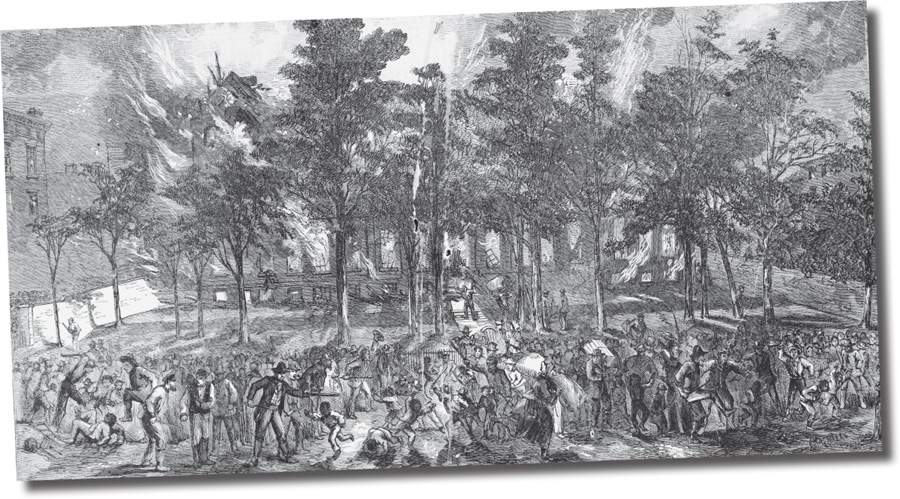
The burning of the Fifth Avenue Orphan Asylum for Colored Children by rioters in New York.
THE RIOT IN SECOND AVENUE.
EIGHTEEN PERSONS REPORTED KILLED, SEVERAL FATALLY INJURED.
JULY 15
Between 12 and 1 o’clock yesterday, the rioters commenced their attack upon the Union Steam Works, situated on the corner of Twenty-second street and Second-avenue. The guns taken from the armory on Monday were stored in this building, and the most active efforts were made by the insurgents to secure them.
The rioters turned out in large force, numbering from 4,000 to 5,000 people — including children. The shops and stores for half a mile around were closed, and the streets were filled with crowds of excited men, women and children.
At 2 P.M. three hundred Policemen, under the command of one of the Inspectors, arrived upon the ground. The rioters had in the meantime taken possession of the building, and, when the officials made their appearance, they attempted to escape by the rear windows; but too late to escape the notice of the Police. Finding themselves caught in a tight place, they made an attack on the Police. This assault the Officers met by a volley from their revolvers, and five of the mob were shot.
About twenty rioters remained in the building; there was but one way for them to make their exit. The police filled the door, and each had, in addition to his usual weapons, a loaded revolver. The mob became desperate and made a deadly assault upon the police; they in turn used their weapons so effectually that fourteen of the mob were almost instantly killed. A scene, which defies all powers of description then followed. Men, women and children rushed through the streets in the most frantic state of mind, and as the dead and wounded were borne from the place, the wild howlings of the bereaved, were truly sad to hear....
At about 8 1/2 o’clock yesterday morning a telegraphic dispatch was received that a large crowd of rioters were gathering all along the Second-avenue, in the neighborhood of Thirty-fourth-street, threatening all the houses along that thoroughfare. A strong force of police, about 300, were immediately detailed under Inspector [Daniel C.] CARPENTER to break up the crowd.... On arriving at Thirty-second-street, the railroad track was found obstructed, and the police then formed in a solid column and marched down to the Second-avenue. They were met by the assembled mob with silence. When the whole force had got in the block between Thirty-fourth and Thirty-fifth streets, they were closed in upon by the mob and assailed by a thick shower of bricks and stones, which rained from the houses and windows in the neighborhood. For some moments the men wavered and the peril was imminent, when the reassuring voices of the officers in command recalled them, who then returned the shower of stones with their revolvers. The order was then given to charge, and a most furious onset was made on the rioters, driving them into the houses, the officers chasing them all over the buildings and driving them into the street, where they were scattered by a most vigorous application of clubs. All the side streets were then cleared, and the police marched over the battle-ground victorious....

Police fight rioters in front of the New York Tribune office.
THE RAGING RIOT — ITS CHARACTER, AND THE TRUE ATTITUDE TOWARD IT.
JULY 15
The mob in our City is still rampant. Though the increasing display of armed force has done something to check its more flagrant outrages, it is yet wild with fury, and panting for fresh havoc. The very fact of its being withstood seems only to give it, for the time, new malignity; just as the wild beast never heaves with darker rage than when he begins to see that his way is barred. The monster grows more dangerous as he grows desperate....
This mob is not the people, nor does it belong to the people. It is for the most part made up of the very vilest elements of the City. It has not even the poor merit of being what mobs usually are — the product of mere ignorance and passion. They talk, or rather did talk at first, of the oppressiveness of the Conscription law; but three-fourths of those who have been actively engaged in violence have been boys and young men under twenty years of age, and not at all subject to the Conscription....
It doubtless is true that the Conscription, or rather its preliminary process, furnished the occasion for the outbreak. This was so, simply because it was the most plausible pretext for commencing open defiance. But it will be a fatal mistake to assume that this pretext has but to be removed to restore quiet and contentment. Even if it be allowed that this might have been true at the outset, it is completely false now. A mob, even though it may start on a single incentive, never sustains itself for any time whatever on any one stimulant. With every hour it lives, it gathers new passions, and dashes after new objects. If you undertake to negotiate with it, you find that what it raved for yesterday, it has no concern for to-day. It is as inconstant as it is headstrong....
You may as well reason with the wolves of the forest as with these men in their present mood. It is quixotic and suicidal to attempt it. The duties of the executive officers of this State and City are not to debate, or negotiate, or supplicate, but to execute the laws. To execute means to enforce by authority. This is their only official business. Let it be promptly and sternly entered upon with all the means now available, and it cannot fail of being carried through to an overwhelming triumph of public order. It may cost blood — much of it perhaps; but it will be a lesson to the public enemies, whom we always have and must have in our midst, that will last for a generation. Justice and mercy, this time, unite in the same behest: Give them grape, and plenty of it.
AN EVENING RIOT IN THE FIRST AVENUE.
THE RABBLE IN CONFLICT WITH CITIZEN-VOLUNTEERS — THIRTY OR FORTY PERSONS KILLED.
JULY 16
A messenger brought information to the Seventh regiment Armory, at 6 o’clock last evening, that the mob was in great strength in the First-avenue, between Eighteenth and Nineteenth streets, apparently organizing, preparatory to moving upon a marauding expedition. Col. [Cleveland] WINSLOW, of the [New York] Fifth regiment, (Duryea Zouaves,) then in command at the Armory, immediately ordered a detachment of volunteers under arms, consisting of three companies, comprising an aggregate of 150 men, and a battery of two howitzers. Placing himself at the head of this force, ... Col. WINSLOW led his command at the double quick to the scene of the disturbance. Passing down Nineteenth-street, the howitzers were brought into position, promptly unlimbered, and trained up and down the First-avenue, while the infantry formed in line to support them. The locality abounds in tenement-houses, where the class of persons live of which the mob is composed, and into these buildings the mass of the rioters took refuge on the appearance of the soldiers. From the roof and windows of every house the mob at once opened an attack, delivering a brisk and persistent fire upon the military of musketry and pistols, as well as a volley of bricks and other missiles. To this assault the soldiers replied, and the howitzers raked the avenue up and down with canister, of which ten rounds were discharged. It is estimated that this fire killed as many as thirty persons, and the effect was a partial dispersion of the rioters, although some of the more bold among them lurked behind the corners of the buildings, whence they would sally out, discharge their guns, and again go to cover....
About 11 o’clock the riot in Nineteenth-street and First-avenue was renewed. Capt. PUTNAM and Capt. SHELBY, of the United States army, with two field pieces and 150 men, repaired to the scene. They were assaulted with stones and brickbats from the tops of houses and from windows. They fired upon the mob and cleared the streets. The brickbats came so thick from the houses that it became necessary to give the order to turn the fire on the buildings. Five rounds of grapeshot were fired, with destructive effect. It is impossible at this late hour to give the number killed.1 The troops remained on the ground until 12 1/2 o’clock, at which time perfect quiet reigned in the neighborhood.
1. A total of 105 New Yorkers were killed in the rioting.