
CHAPTER 15

Detail from a Kurz and Allison lithograph of the Battle of Chickamauga.
As Lee’s veterans had streamed back across the field at Gettysburg after the failure of Pickett’s Charge, a subordinate officer turned to General Meade and asked permission to salute him as the next President of the United States. Meade scoffed at the notion, but there was a short-lived boomlet for Meade’s candidacy that summer, though it was complicated by the fact that he had been born in Cadiz, Spain, which some argued made him constitutionally ineligible. Once it became clear that the twin victories at Gettysburg and Vicksburg were not going to result in a swift end to the war, the interest faded.
As July turned into August, the gravitational center of the war shifted away from the battlefields in the east and moved west to Tennessee, where Union Major General William S. Rosecrans attempted to outflank the army of Confederate General Braxton Bragg at Chattanooga. Commanding a bend in the Tennessee River as well as being the nexus of several railroads, Chattanooga was the gateway to the South. Initially there was much impatience with Rosecrans in the North for his apparent caution. With Meade defeating Lee in Pennsylvania, and Grant taking Vicksburg, it seemed to many that Rosecrans was insufficiently bold in his maneuvers. The Times defended him as vociferously as it had defended McClellan, Burnside, and Hooker, insisting that Rosecrans was forced to operate in “an Alpine region, which presents every imaginable obstacle to military operations or military movements, where there are few or no roads, while such as there are scarcely passable.” Its support was justified when Rosecrans, in a series of deft moves, flanked the Confederates out of their defensive positions in middle Tennessee, crossed the Tennessee River, and forced Bragg to evacuate his stronghold and fall back into Georgia. Rosecrans occupied Chattanooga on September 9.
The campaign was not over, however; Bragg had retreated, but he was not in flight. He received reinforcements from across the South, adding 9,000 men under Simon Bolivar Buckner and smaller elements of Joe Johnston’s army from Mississippi. Most important, Davis and Lee acceded to the pleas of James Longstreet (himself a Georgian) to send two divisions from the Army of Northern Virginia to the west by rail. The divisions of John Bell Hood and Lafayette McLaws, veterans of the Wheatfield and Peach Orchard at Gettysburg, arrived at Ringgold, Georgia, on September 18, and the very next day Bragg turned on Rosecrans and assailed him. The Battle of Chickamauga (September 19–20, 1863) was a bloody and confusing engagement that ranks second only to Gettysburg in terms of total casualties.
As usual, the first reports to reach New York from the battlefield spoke of great courage in the Union ranks and predicted a Federal victory. The reality was much grimmer. Long-street’s veterans charged through a gap in the Federal defensive line and put Rosecrans’s army to flight — all but one corps, that is. The men of George H. Thomas’s XIV Corps stood their ground on Snodgrass Hill, a stand that allowed the rest of the army to escape back to Chattanooga, earning for the Virginia-born Thomas his sobriquet as the “Rock of Chickamauga.” Even after it became clear that the battle had gone against the Union, The Times wrote not of defeat, but of hope. “There is little cheer on the surface of the dispatch,” it acknowledged, “but we think there is ground for encouragement. The fact that ROSECRANS held his ground for two days is a very favorable sign.”
That may have seemed to be grasping at straws, but in fact, The Times accurately (if somewhat coldbloodedly) put its finger on a key factor in the war, and that was that in winning its victory, the rebel army had suffered more losses than it could afford. Nearly 35,000 men fell in the battle, and because the Confederates had assumed the burden of the tactical offensive, the majority of them wore butternut and gray. Bragg lost 18,454 men out of an army that numbered 65,000 — twenty-one percent of his entire command, the same as the percentage that Lee’s army had suffered at Chancellorsville. As The Times pointed out, the South could not afford such victories, for “every battle thins the ranks of the faithful few.” The terrible arithmetic of war was unarguable: “Whether they win or lose, as long as fighting makes gaps in their columns which they cannot fill, the only result of their struggles is to defer for a short time the doom of the Confederacy.”
GEN. MEADE’S CITIZENSHIP.
AUGUST 1
To the Editor of the New-York Times:
You published in the TIMES, Sunday, July 26, a note from “J.C.,” in response to the question — “Is Gen. MEADE eligible to the office of President?” Your correspondent, arguing from a clause in the Constitution, (Art. 2, sec. 1, cl. 4.) dogmatically answers this question in the negative.1 He summarily disposes of the act of Congress of April 14, 1802, commonly known as the Naturalization Act, by an indirect denial of its constitutionality. He very sagely asserts:
“The law of Congress cannot override the Constitution. It cannot make a foreign born a natural born person of the United States any more than it can make a dead man a live man. If it can, it can make the Prince of Wales a natural born citizen of the United States, and make him eligible to the office of President. Congress cannot change the place of a man’s birth. A man excluded by the Constitution cannot be made eligible by act of Congress.”
Several newspaper editors have also expressed opinions adverse to the eligibility of Gen. MEADE, in view of the constitutional provision that no person except a natural born citizen, or a citizen of the United States at the time of the adoption of the Constitution, shall be eligible to the office of President. I remember reading an article in the TIMES to this effect; also one in the Chicago Tribune, obviously based upon that in your journal.
I beg leave to differ with these writers, and to explain why I do so....
In his edition of Blackstone’s Commentaries, CHITTY2 says: “Natural born subjects are persons born within the allegiance, power or protection of the Crown of England, which terms embrace not only persons born within the domination of His Majesty, or of his homagers, and the children of subjects in the service of the King abroad, and the King’s children, and the heirs of the Crown, all of whom are natural-born subjects, by the Common Law, but also under various statutes, all persons, though born abroad, whose father and grandfather by the father’s side were native-born subjects at common law.” (Book 1, chap. 10. note 1.)
Adopting as our guiding rule — what cannot be reasonably objected to — this exposition of English law, as that law was understand and interpreted antecedent to the American Revolution, both in the British Islands and their dependences, we may justly conclude that the eminent men who framed our Constitution really mean: by the phrase “a natural burn citizen,” not only a person born within the United States, but also any person, though born abroad, whose father was a natural born citizen of, and owed allegiance to the United States. It would not be very complimentary to the memory of the founders of the Republic to say that they were less liberal in dealing with their own citizens than had been the British monarchy in its treatment of its subjects....
Very truly yours,
MICHAEL HENNESSY. NO, 54 SUMMIT-
STREET, BROOKLYN, July 30, 1863.
1. Meade had been born in Cadiz, Spain, the son of Richard Worsam Meade, a wealthy Philadelphia merchant serving in Spain as a naval agent for the U.S. government.
2. This is a reference to the volume of Blackstone’s Commentaries on the Law edited by J. Chitty and published in 1826.
A VISIT TO THE FIELD OF GETTYSBURGH.
AUGUST 2
A correspondent of the Philadelphia Press writes from Gettysburgh:
“We took our start from Cemetery Hill, and passed over all our lines on the first day. Shells, solid shot and bullets are still lying around, one would think as thick as ever, although a great many persons have, ever since the battle, made it their business to hunt bullets and sell them by the pound. Many thousand pounds have been gathered and disposed of in this way. Nearly every stranger returns from the field with his pockets filled with lead. Government has forbidden any of the relics to be removed, so whatever visitors can conceal about their persons they are most likely to take with them. All who come from a distance naturally desire to return home with some trophy of war. On account of this propensity, some very amusing scenes are sometimes enacted. Quite a number of those who come in from the country are not aware, that these broken implements are ‘contraband of war,’ so in their innocence, they pick up a handful of bayonets, or sometimes they think it would be a capital idea to take along a good Enfield rifle; they shoulder arms, walk off coolly and exulting over their fortune, when all at once they are arrested in their triumphant march, and deprived of their plunder....”
THE LAWS OF WAR.
AUGUST 3
We have the text of the Proclamation of the President concerning retaliation upon the rebels for the maltreatment of the black troops in our army.1 By this document, it is ordered “that for every soldier of the United States killed in violation of the laws of war, a rebel soldier shall be executed, and for every one enslaved by the enemy or sold into slavery, a rebel soldier shall be placed at hard labor on the public works.” We suppose no man can deny the validity of this principle, its absolute justice, or its conformity to the laws of war. There are probably, altogether, not less than twenty thousand colored soldiers now in the National service, and since they have been in numerous battles lately, and some of them were, of course, taken prisoners of war, it was necessary that some rule should be established to counteract the atrocious proclamation of JEFF. DAVIS, which threatened all captured soldiers of this class and all white officers commanding them, with summary execution. Having entered upon war, the rebels are bound by, and must be compelled to abide by, its laws.
1. Lincoln’s executive order was dated July 30 and can be found in Basler, ed., The Collected Works of Abraham Lincoln, 6:357.
THE SIGNIFICANCE OF THE KENTUCKY ELECTION.
AUGUST 7
The strongest argument of the Copperheads,1 from their first origin, has been the necessity of conciliating the Border States and keeping them well-affected. In itself it was a fair argument. No intelligent man could deny that it was a matter of great moment that Maryland, Kentucky, and Missouri, which originally held back from the Confederacy, should still be retained on the side of the Union. This was important physically, for their combined population was over three millions; and still more important morally, for they were all Slave States, and their interests were identical with those for the defence of which the rebellion had been originally undertaken.
The fault was not in the argument that the object was an important one, but in the assumption that it could never be effected except by Copperhead methods. There was what was called a “Border State policy,” which, it was claimed, must be particularly favored by the Government. The distinctive features of this policy were such a conduct of the war that Slavery should suffer in the least degree possible, and the procurement of peace at the earliest day, by overtures and a liberal compromise. The Administration was denounced by the Copperheads in the most unmeasured terms for refusing that policy. The confiscation bills, and the President’s Emancipation Proclamation, and the stand taken that loyalty was to be unconditional, were declared to be expressly calculated to drive the Border States into the arms of the Confederacy; and there were no maledictions strong enough to be vented against the Government for its blindness and its treachery. The abuse which these Copperheads have kept up against the Administration in behalf of the wronged Border States has been what they lived on — their meat and their drink — ever since they were spawned into life.
Well, isn’t it extraordinary that, after all this peculiar concern for their feelings and their interests, these same Border States should spurn the Copperheads with greater vehemence than any other part of the country? Kentucky, which has been the special object of solicitude, has rejected WICK-LIFFE, the very paragon of Copperheads, by a majority almost unexampled in the political history of the State — and that, too, though his opponent boldly espoused the entire general policy of the Government.2 No Northern State, during the last year, has pronounced so emphatically for the continuance of the war without reserve or qualification as Kentucky has just done....

A cartoon showing Columbia, representing the United States, defending herself against traitorous Copperheads.
1. The term “copperheads” refers to a group of antiwar Democrats who called for immediate negotiations to end the conflict. The term was applied to them by their opponents (like The New York Times) who likened them to the poisonous snake of the same name.
2. Former governor Charles A. Wickliffe (1788–1869) ran for governor in 1863 as a Peace Democrat. He lost to Thomas E. Bramlette (1817–1875) in a landslide.
PROCLAMATION BY GOV. SEYMOUR.
A WARNING AGAINST RESISTANCE TO THE DRAFT.
AUGUST 18
ALBANY, MONDAY, AUG. 17
Gov. SEYMOUR1 has prepared a proclamation, warning all citizens against any disorderly conduct when the draft is made in New-York and Brooklyn.
The feeling in regard to the draft, which takes place in the Sixth District to-morrow, is somewhat equivocal, but the preponderance of indications among the disaffected is that no opposition will be attempted. Certain it is, sure as fate, that any violent demonstrations against it will be met with instant and exemplary punishment. Gen. [John A.] DIX2 is not a man who will for one moment hesitate in the discharge of a duty. When he was queried as to what to do with any one who, in the early days of New-Orleans disloyalty should attempt to haul down the Stars and Stripes, his response, “Shoot him on the spot!” rang in clarion tones throughout the land. Let those who would forcibly dispute the sovereignty of the Government, and so attempt to prevent the enactment of its laws, have a care. Let them take the measure of the man to whom the protection of that sovereignty is, in this Department, intrusted....
In regard to the character of the preparations made by the authorities, nothing is known in detail; that they are abundant, there is no question, and that they will, if occasion requires their use, be effective, there is not a particle of doubt.
We hear of one jolly party of Democrats and Republicans in the Sixteenth Ward, who have agreed, if any of them are drawn, to have a grand “powwow” and a masquerade procession; the first man drawn is to be King, and on the night of the procession the most absolute homage is to be paid him; the largest liberty and the greatest amount of fun are to be his perquisites. It is just such sensible, goodnatured views as this indicates, which will rob the draft of the especial horrors and hardships with which it has interestedly been surrounded.

An election-year broadside castigates antiwar Democrats.
1. Horatio Seymour (1810–1886) served as New York governor in 1853–54 and again in 1863–64. A Democrat, he opposed many of Lincoln’s policies, including the draft, which he believed violated the Constitution. Nonetheless, he did not believe the answer was in street violence and he supported the crackdown.
2. John A. Dix (1798–1879) was a former Democratic senator from New York and a “political general.” Considered too old for field command, he had several administrative commands during the war. In August 1863, he commanded the Department of the East.
PROCLAMATION BY GOV. SEYMOUR.
AUGUST 19
EXECUTIVE CHAMBER, AUG. 18
I have received information that the draft is about to be made in the Cities of New-York and Brooklyn, and I understand that there is danger of disorderly and riotous attacks upon those who are engaged in executing the law of Congress.1
I cannot believe that any considerable number of citizens are disposed to renew the shameful and sad scenes of the past month, in which the lives of so many, as well of the innocent as of the guilty, were destroyed. Our Courts are now consigning to severe punishment many of those who were then guilty of acts destructive of the lives and property of their fellow-citizens. These events should teach all that real or imaginary wrongs cannot be corrected by unlawful violence. The liberties of our country and the rights of our citizens can only be preserved by a just regard for legal obligations, and an acquiescence in the decision of judicial tribunals....
I hereby admonish all judicial and executive officers, whose duty it is to inforce the law and preserve public order, that they take vigorous and effective measures to put down any riotous or unlawful assemblages; and if they find their power insufficient for that purpose, to call upon the military in the manner pointed out by the Statutes of the State. If these measures should prove insufficient, I shall then exert the full power of the State, in order that the public order may be preserved and the persons and property of the citizens be fully protected.
HORATIO SEYMOUR.
1. During the Civil War, New York and Brooklyn were separate cities. New York was the largest city in the country by population, and Brooklyn was the third largest.
THE ARMY OF THE CUMBERLAND.
AUGUST 20
The report we had a few days ago of a movement by the Army of the Cumberland, in two columns, on Chattanooga, has not been confirmed, and was not in itself very probable. The fact is, the further progress of the army of Gen. [William S.] ROSECRANS is not conditioned so much on the movements of the enemy in front, for we believe it is able to whip [Braxton] BRAGG at any time, but on circumstances of another nature, of which people generally take small cognizance. Glance at the position of his army from Tullahoma to Bridgeport, on the Tennessee, and then run the eye northward, to Louisville and Cincinnati, on the Ohio, and consider that every pound of food for man and beast has to be transported over the intervening distance, through a country infested by guerrillas and exposed to constant cavalry raids, and some idea may be formed of the enormous task Gen. ROSECRANS has in keeping up his line of communications.
A front of operations removed three hundred miles from the base of supplies — which is Gen. ROSECRANS’ situation — presents a combination of difficulties of which few are able to form any conception, and which it must absorb the best energies of any commander to overcome. In such circumstances the course which military prudence dictates is the formation of what are styled “secondary or eventual bases,” enabling the commander to cut loose from his primary base, and thus shorten his line of communications. Readers of NAPOLEON’s campaigns will remember what care that great master of the military art took to form these secondary bases, whenever his operations conducted him to inconvenient distances from his starting point. Of course in warfare in this country, where there are no depots of supplies, and few or no resources from which an invading army can draw, the necessity becomes a hundred-fold greater.
It is now no secret that Gen. Rosecrans is engaged in the important task of transferring his base. The completion of the fortifications at Nashville, which when done will render that place another Gibraltar, will enable him to remove his base of supplies from the Ohio to the Cumberland, thus shortening his line of communication by the whole intervening distance. The completion of the works at Murfreesboro will also give him a powerfully fortified intermediate depot. Every energy is now being bent to these tasks, and their consummation is, we trust, only a matter of a few weeks more labor. When this is done it is evident that he can advance with some degree of safety and confidence, and he will not be under the necessity of frittering away half of his force in guarding his line. Until this is done his present position can be only provisional. A movement by BRAGG by way of East Tennessee threatening his communications, must make him about-face instanter, as it did BUELL, under the same circumstances and in almost the same situation, last Summer.
We have no doubt that Gen. ROSECRANS will find it easy to give his army all the employment it needs; but we conceive that military operations on a grand scale in the West will be conditioned on such things as we have indicated, and especially the completion of the fortifications of Nashville and the construction of the military railroad route toward Cumberland Gap and East Tennessee. By this time, too, we hope, the situation will be such as to authorize the junction of several of our non-isolated forces in the West. The campaign against Chattanooga should not be undertaken without a great army, for its possession will change the whole character and complexion of military operations both East and West.

Major General William S. Rosecrans, U.S.A.
ROSECRANS ON THE WAR-PATH.
AUGUST 22
We have private advices from the Army of the Cumberland that make it positively certain that ROSECRANS is again on the war-path. It might not be prudent, at this moment, to mention such details as we have; but this much we may say, that the advance is under such circumstances and with such combinations as look toward the most important results.
We need not say that the operations in Tennessee will be followed with the liveliest interest by the whole nation. ROSECRANS is on a line of operations where every step he takes has a momentous bearing, not merely with reference to the special rebel force he may encounter, but with regard to the whole theatre of war. If he takes Chattanooga as his “objective” — and we need not say that he aims at nothing short of this — we will have seized a point whose possession by us will radically change the whole aspect of warlike operations. Chattanooga is a natural citadel in the heart of the Confederacy, and on the salient angle of the great rebel line of communications between the East and the West. This seized, we shall hold interior lines and force the rebels to operate on exterior lines, thus completely turning the tables on them....
MARKET PRICE OF SLAVES.
AUGUST 22
Slaves command a higher price in Kentucky, taking gold as the standard of value, than in any other of the Southern States. In Missouri they are sold at from forty dollars to four hundred, according to age, quality, and especially according to place. In Tennessee they cannot be said to be sold at all. In Maryland the negroes upon an estate were lately sold, and fetched an average price of $18 a head. In the farther States of the Southern Confederacy we frequently see reports of negro sales, and we occasionally see boasts from rebel newspapers as to the high prices the slaves bring, notwithstanding the war and the collapse of Southern industry. We notice in the Savannah Republican of the 5th, a report of a negro sale in that city, at which, we are told, high prices prevailed, and at which two girls of 18 years of age were sold for about $2,500 apiece, two matured boys for about the same price, a man of 45 for $1,850, and at woman of 23, with her child of 5, for $3,950. Twenty-five hundred dollars, then, may be taken as the standard price of first-class slaves in the Confederacy; but when it is remembered that this is in Confederate money, which is worth less than one-twelfth its face in gold, it will be seen that the real price, by this standard, is only about $200. In Kentucky, on the other hand, though there is but little buying or selling of slave stock going on, we understand that negroes are still held at from seven to twelve hundred dollars apiece.
FROM ROSECRANS’ ARMY HIGHLY IMPORTANT AND GRATIFYING NEWS.
AUGUST 25
STEVENSON, ALA., SUNDAY, AUG. 23
The advance of the Army of the Cumberland appeared in front of Chattanooga on the 21st inst., and opened fire on the city at 10 A.M.
The enemy replied from nineteen guns, mostly small ones, which did little damage; but also with one 83-pounder, which swept the opposite shore, and one fire from which killed a horse and took off the leg of A. B. MCCOOK, of LILLY’s battery.1
Our fire was very destructive, and every battery which opened on us was disabled.
LILLY’s battery threw shells with great precision into the embrasures of the enemy.
The works of the enemy on the river are reported to be very strong, the parapets of which are not less than fifteen feet wide. Several water batteries on a level with the river have also been discovered. Moored at the wharf are two steamers, and opposite the city is a pontoon bridge of forty-seven boats.
The largest of the steamers was sunk by our fire and the smaller one disabled.
An attempt to destroy the pontoon bridge was frustrated by the sharp fire of the rebel sharpshooters.
Forty prisoners were taken. Two rebels were killed and several wounded....
Important events must soon transpire in the vicinity of Chattanooga and Harrison.

The Union Army of the Cumberland on the march.
1. Lilly’s Battery was organized and commanded by Eli Lilly (1838–1898) who, after the war, founded the firm of Eli Lilly and Company.
THE PROGRESS OF GEN. ROSECRANS’ CAMPAIGN.
AUGUST 31
The dispatches which have been reaching us with regard to the advance of the Army of the Cumberland, have been of a nature to cause public anticipation to outrun the actuality of operations, and even the possibility of operations. The bombardment of Chattanooga, of which we had intelligence a week ago, turns out to have been no more than a few shell thrown across the river by Col. [John T.] WILDER, whose light-moving column of mounted infantry and battery of horse-artillery had made a flying visit to the neighborhood of Chattanooga. But the movements of the adventurous leader of the flying brigade, who has no heed for supplies, roads, trains or communications, are no criterion for the movements of the main body of the army which is strictly dependent on these conditions. Gen. ROSECRANS is now operating in a region of country the difficulties of which are almost inconceivable. The front of operations which he gained in his last advance, when he turned the rebel position at Tullahoma, and compelled BRAGG’s retreat to Chattanooga, brought him just to the base of the mountains. Thence to Chattanooga, eighty or a hundred miles, is through an Alpine region, which presents every imaginable obstacle to military operations or military movements, where there are few or no roads, while such as there are scarcely passable. To those who glibly talk of “throwing” troops here, or “throwing” troops there, a fortnight or three weeks will doubtless seem an unpardonably long period to occupy in a journey of three or four score miles; but should they go to ROSECRANS’ field of operations and find that roads had to be made before they could “throw” even themselves, they would probably acquire and beget a little of that “temperance” that would give them “patience.” It is in this arduous but indispensable work that Gen. ROSECRANS has been engaged for the past fifteen or twenty days. Details of whole divisions have been out road-making, hauling trains, &c.; and the result is that he has at length succeeded in transferring his whole army across the Tennessee River.
The crossing of the Tennessee is announced as having taken place yesterday at four different points, though the points themselves are not designated, and we are thus left in the dark as to the nature of ROSECRANS’ designs. His strategy will, of course, have to consult the position and movements of the enemy. Now, there are a good many indications that BRAGG, fearing another flank movement on the part of Gen. ROSECRANS, that would cut him off and leave him in the mountains, has withdrawn into the open country below, simply observing Chattanooga and the Tennessee line with a small force. It, as at present appears probable, he is holding the line from Dalton to Rome, his design would seem to be to cover that line of railroad, and be ready to fall on ROSECRANS at any point where he may attempt to debouch from the mountains.
It is not unlikely, therefore, that Gen. ROSECRANS will now cease to make Chattanooga his objective point, (though he will, of course, swing his left round in that direction, and occupy it on account of its commanding importance as a as a strategic point of manoeuvre,) but will make directly for the rebel army. There is certainly nothing the Army of the Cumberland desires so much as a fair stand-up fight with a foe that has never met it but to run. Still, from the extreme difficulties that hedge and hamper the march of Gen. ROSECRANS, we have no right to expect active work for a good many days to come.
WILL THE REBELS ARM THEIR SLAVES?
AUGUST 31
The report that JEFF. DAVIS has decided to organize five hundred thousand black troops, with a promise of land and freedom, is not entitled to credit. Undoubtedly there is rebel authority for it, as is stated; but that is nothing in its favor. Sensation-mongers ride their high horse in Dixie, as well as in all other parts of the land. There are conclusive reasons, extrinsic and intrinsic, for disbelieving it....
We may set it down as absolutely certain that whenever the alternative of arming the negroes or submitting to the national rule once definitely takes shape before the Southern mind, there will not be a moment’s hesitation which of the two to choose. Humiliating as an acknowledgment of defeat, and a return to the old Government, may be, it will be accounted a thousand times preferable to the converting of half a million of slaves into trained soldiers, and thereby fitting them to become masters of the land. The rebel chiefs will never have the temerity even to propose the measure for public consideration. Infinitely less would they dare attempt, as this report represents, to impose it by their own arbitrary will, without regard to the popular feeling, or any pre-announcement of their intention. They could not keep their seats twenty-four hours after such an act. They would find a doom from their own people worse even than any that awaits them from the unchecked progress of the National arms. It is possible some of them may get clemency from the National Government by timely submission; but they might better meet the three Furies than confront their own people after their declaration of a purpose like that ascribed to them by this report.1
1. The Times was correct. When in January of 1864, Confederate Major General Patrick Cleburne proposed that the Confederacy should free and arm its slaves, his proposal was not only rejected—Jefferson Davis ordered that it must never be spoken of again. In February of 1865, in the last days of the war, when Robert E. Lee urged arming slaves, the rebel Congress passed an act authorizing it, though the war ended before any armed slaves took part in the war. See Chapter 24.
THE PRESIDENT AND GEN. GRANT.
TO WHOM BELONGS THE CREDIT OF THE VICKSBURGH CAMPAIGN.
SEPTEMBER 2
When it was officially known that Vicksburgh had surrendered to the victorious legions of GRANT, the President wrote the General the following private letter of acknowledgment and thanks for the “inestimable service” he had rendered the country.
EXECUTIVE MANSION, WASHINGTON, JULY 13
Major-General Grant:
MY DEAR GENERAL:
I do not remember that you and I ever met personally. I write this now as a grateful acknowledgment for the almost inestimable service you have done the country. I wish to say a word further. When you first reached the vicinity of Vicksburgh, I thought you should do what you finally did — march the troops across the neck, run the batteries with the transports, and thus go below, and I never had any faith except a general hope that you knew better than I, that the Yazoo Pass expedition and the like could succeed. When you got below and took Port Gibson, Grand Gulf and vicinity, I thought you should go down the river and join Gen. BANKS; and when you turned northward, east of the Big Black, I feared it was a mistake. I now wish to make the personal acknowledgment that you were right and I was wrong.
Yours, very truly,
(SIGNED) A. LINCOLN.
GEN. ROSECRANS’ ADVANCE.
THE ARMY WELL ACROSS THE TENNESSEE.
SEPTEMBER 7
A dispatch dated “four miles South of Bridgeport, Sept. 3,” says:
The army is well across the Tennessee, and occupies a strong position several miles south of the river. No resistance was made to the crossing.
Reconnaissances have been made to Trenton. Georgia, without finding the enemy in force. He is said to be intrenched east of Chattanooga.
The trestle bridge at Bridgeport, just completed this morning, gave way this afternoon, while the train of the Fourth Michigan battery was crossing. One mule only was drowned, the water not being over four feet deep. Several brigades of infantry and batteries had just preceded the train. The bridge will be replaced by to-morrow. There are several more at different points. Gen. ROSECRANS and Staff crossed this afternoon.

An Alfred Waud sketch of the Battle of Chickamauga.
THE RIGHT MAN IN THE RIGHT PLACE.
SEPTEMBER 7
The President’s letter to the Springfield Convention receives the unqualified admiration of loyal men throughout the breadth of the land.1 Various as have been their sentiments on some of its topics, it is yet their universal testimony that nothing could have been more true or more apt. Its hard sense, its sharp outlines, its noble temper, defy malice. Even the Copperhead gnaws upon it as vainly as did the viper upon the file.
Men talk about a courtly felicity of speech, and term it a rare accomplishment. So indeed it is. Nothing but high culture and the most patient practice confers it. Here is a felicity of speech far surpassing it, yet decidedly uncourtly. The most consummate rhetorician never used language more apt to the purpose; and still there is not a word in the letter not familiar to the plainest plowman. But what is still better than even felicity of expression, is felicity of thought. Not only the President’s language is the aptest expression of his ideas, but there is a similar fitness of his ideas to the occasion. He has a singular faculty of discovering the real relations of things, and shaping his thoughts strictly upon them, without external bias. In his own independent, and perhaps we might say very peculiar way, he invariably gets at the needed truth of the time. When he writes, it is always said that “he hits the nail upon the head,” and so he does; but the beauty of it is that the nail which he hits is sure to be the very nail of all others which needs driving....
It is almost fearful to contemplate what might have been the consequences had we an Executive of different mould. We have had Presidents of a headstrong temper, who, when hard pressed, would listen to no counsel, but rush on self-willed; others of a feebleness of spirit that made them the mere playthings of circumstances, or the passive tools of other men’s arts. We have had Presidents who would have found it almost impossible, in any exigency, to rise above a party level; others who, though they might detach themselves from party, would do so only to seek the swift popular current that should bear them on to a second term. Had we a man now at the head of affairs belonging to any of these classes, the national ruin would be almost inevitable. There could have been hardly a hope of escaping wreck, in this dreadful storm, under such pilotage. The very knowledge that we had so unreliable a hand at the helm would have almost paralyzed effort. There would have been no such collected energy as we have seen, no such steady confidence in the great popular heart. All would have been uncertainty, dissension and confusion. We have had many reasons to be thankful to heaven for its orderings in aid of our rightly acquitting ourselves toward this wicked rebellion; but for no one thing have we so great cause for gratitude as for the possession of a ruler who is so peculiarly adapted to the needs of the time as clear-headed, dispassionate, discreet, steadfast, honest ABRAHAM LINCOLN.
1. This is a reference to a public letter that Lincoln sent to James C. Conkling on August 26, 1863, in which he answered the complaints of those who had been angered by his Emancipation Proclamation. “You say you will not fight to free negroes,” the President wrote. “Some of them seem willing to fight for you; but no matter. Fight you, then, exclusively to save the Union.” Perhaps the most famous passage in this letter was this one: “There will be some black men who remember that with silent tongue, and clenched teeth, and steady eye and well-poised bayonet, they have helped mankind on to this great consummation; while, I fear, there will be some white ones, unable to forget that, with malignant heart, and deceitful speech, they have strove to hinder it.” The letter can be found in Basler, ed., The Collected Works of Abraham Lincoln, 6:406-10.
MOVEMENTS IN EAST TENNESSEE OCCUPATION OF KNOXVILLE BY GENERAL BURNSIDE.
SEPTEMBER 10
On Sunday intelligence was received in this city from Gen. BURNSIDE that a portion of his army had entered and taken possession of Knoxville, the principal military position and city of East Tennessee, and that the Star-Spangled Banner, in all its brilliancy, was again floating over that late rebel stronghold. Gen. BUCKNER, with a strong rebel force, upon learning of the arrival of Gen. BURNSIDE at Kingston, concluded to retire toward Chattanooga, which he did successfully. Gen. BURNSIDE went with a portion of his army and took possession of Knoxville, while the remaining portion crossed from Kingston over the railway, which had been torn up, and, taking the pike, went in pursuit. The main portion of Gen. Burnside’s army is pushing on to reinforce Rosecrans, and no doubt exists but that the advance has already reached the army of the Cumberland BUCKNER has reinforced BRAGG, and reports are current, and believed at the headquarters of ROSECRANS, that a portion of JOHNSTON’s army from the extreme South has also arrived and reinforced “a little more grape, Capt. BRAGG.”1
Gen. ROSECRANS at an early hour yesterday morning was in front of the rebel works at Chattanooga, and his army in position for a battle. As an evidence that the General had decided to give the enemy battle yesterday is the fact that he telegraphed yesterday morning early the Archbishop in this city a request that all the Catholic Churches be opened during the day, and that masses be held for the success of the Federal arms this day, (yesterday,) as he had fully determined to attack the rebel works. In obedience to this request, the churches were thrown open, and masses held as desired.2 Stirring intelligence from that army may confidently be expected, as there is, no doubt, a severe and hotly-contested battle now progressing, or will immediately take place at that point.

General Braxton Bragg, C.S.A.
1. Bragg earned his first national reputation in the Battle of Buena Vista (February 23, 1847) during the Mexican-American War. There, when General Zachary Taylor’s army was under great pressure from charging Mexican infantry, he is reputed to have told Bragg, then a captain, “A little more grape, Captain Bragg.” An illustration of this event by Currier became a popular print of the 1850s.
2. Rosecrans was born a Methodist, but converted to Catholicism while serving as an instructor at West Point and remained a devout Catholic until he died.
CAPTURE OF CHATTANOOGA.
SEPTEMBER 10
We have the news that on Tuesday last the rebel army evacuated Chattanooga, and yesterday Gen. ROSECRANS’ army marched in and took possession of the great Western mountain stronghold. The rebels are reported to have fled southward into Georgia; but sure it is that if they could not hold their unsurpassed natural fortress at Chattanooga, they can hold no point from the mountains to the seaboard.
The manoeuvres of Gen. ROSECRANS show that he expected to force BRAGG’s army to a fight, and he had advanced a column to Trenton, twenty miles southwest of Chattanooga, but the rebels had an easy line of retreat which he had not yet been able to cut, and thus they escaped down the Western Georgia Railroad. It would have been better had ROSECRANS achieved his object, and thus at once brought the war in the Southwest to a finality; but it seems to be reaching a finality very rapidly as it is.
THE MAIN REBEL ARMY.
THE REPORTS OF ITS RETREAT TO RICHMOND.
SEPTEMBER 14
From the best information that can be obtained, it is now rendered certain that the inactivity of the rebel army [in Virginia] is at last broken by an important movement — not an offensive movement against this army, but a movement rendered necessary by the cooperate condition of their affairs in the Southwest, and by which they hope to check, if not retrieve, the tide of disaster which has been steadily rushing on them for the last year. It is believed that one corps of LEE’s army, or about one-third of it, under LONGSTREET, is now moving to Richmond, there to be transferred, two divisions of it to the Southwest, and one to Charleston. And if LONGSTREET, whose ability as a leading subordinate commander is unquestioned, should soon appear in principal command on either of these fields, it will not be surprising, — not at least to this army....
The weakening of the rebel army in front of us would seem to indicate that the rebels in Virginia will remain entirely upon the defensive for the coming campaign. They count upon the presumed weakness of this army; rendering two-thirds of their army, acting strictly upon the defensive, able to resist our advance; at any rate, if not able to do it this side of Richmond, they are confident of their ability to do it there. And as long as they hold Richmond they hold Virginia, even if they do surrender a considerable portion of its territory....
GEN. LEE STUMPING IN THE NORTH.
SEPTEMBER 17
It would appear from the Richmond Enquirer, that fraternal feeling has so far revived at the South that Southern politicians are anxious to act once more with their old allies, the Northern Democrats, at the approaching election. We have always doubted the statements made by FERNANDO WOOD1 and others of his way of thinking, as to the willingness of any considerable portion of the Secessionists to cooperate with their old associates in winning victories at the polls, but the article to which we have referred so strongly confirms the view of the matter taken by these gentlemen, that we cannot permit ourselves to doubt any longer. The Enquirer expresses the greatest anxiety for the success of the “Northern Democratic party,” which it appears is already so nearly on a par with its antagonist, that “the least advantage thrown in its favor will insure its success.” The mode in which the writer proposes that the South should lend its aid in the matter, will probably be pronounced by some captious persons somewhat irregular; and there is no denying that it does seem a little singular. But the eccentricity can easily be accounted for by ascribing it to the warmth of the Southern temperament, and the extreme violence which has of late characterized the proceedings of the Abolitionists. The Enquirer suggests, in short, that the South should aid the Democratic party by deputing LEE “to advance once more on MEADE.” “Let him,” says it, “drive MEADE into Washington, and he will again raise the spirits of the Democrats, confirm their timid, and give confidence to their wavering.” And it adds:
“It matters not whether the advance be made for purposes of permanent occupation, or simply for a grand raid, it will demonstrate that in the third year of the war they are so far from the subjugation of the Confederate States that the defence of Maryland and Pennsylvania has not yet been secured. A Fall campaign into Pennsylvania, with the hands of our soldiers untied — not for indiscriminate plunder, demoralizing and undisciplining the army, but a campaign for systematic and organized retaliation and punishment — would arouse the popular mind to the uncertainty and insecurity of Pennsylvania. This would react upon the representatives in Congress, strengthening the Democrats, and mollifying even Hardshell fanaticism itself.”
We have no doubt that some of the zealots who now urge “a vigorous prosecution of the war,” for the filling of their own pockets, regardless of the blood and desolation with which it covers the land, will with fiendish ingenuity, endeavor to twist these words into a declaration of hostile intent and try to persuade the public that the Enquirer advocates an armed invasion of the North, and really believes that this would help the Democratic party. Those who are familiar with Southern language, however, as well as with Southern feeling, will not be the victims of any such imposition. The whole paragraph which we have quoted is the aphorical — a style of composition to which Southern writers are much addicted, and in which they greatly excel. We all know the extent to which it has been used of late years by politicians even at the North, and that they draw most of their similes from military life. The preparation for an election is said to be “a campaign.” The leader of a party is called its “standard bearer.” The party, when bringing its strength to bear at the polls, is said “to wheel into line.” Its divisions are called “its wings,” and it spends most of its time “marching shoulder to shoulder.” Occasionally a politician is “left out in the cold,” or compelled “to take a back seat in the rear car,” but generally he is supposed to pass his time in the army.
We have only to mention this practice to make it clear to all candid minds that the “advance on MEADE,” which the Enquirer recommends, is simply a figurative mode of advising the Southern population to go to the polls at the approaching elections — that MEADE is “to be driven into Washington” means simply that the Republican party is to be driven out of Washington, by dint of majorities at the polls, just as we constantly talk of inflicting on our adversaries at elections “a Waterloo defeat,” or “outing them horse, foot and dragoons.” When a Northern newspaper uses these phrases, no one supposes the writer to mean that a bodily conflict is to take place, in which one party is to be sabred and bayoneted and shot till it retires; and why should we impute such meaning to Southern editors?. When the Enquirer talks of the hands of our soldiers being “untied” during “a Fall campaign in Pennsylvania,” and “inflicting systematic and organized retaliation and punishment,” it is simply a strong way of stating the old Democratic proposition, “to the victors belong the spoils.” The plunder referred to is neither more nor less than the wresting the spoils of office from Republican hands, through the aid of Southern stump orators, or “soldiers,” as the Enquirer chooses to call them; and when it says their “hands are to be untied,” it means their tongues. If there were any doubt about this elucidation, the context would remove it, for one or two lines before the passage we have extracted, the writer says plainly and explicitly: “Gen. LEE must turn politician as well as warrior, and we believe he will prove the most successful politician the Confederacy has ever produced.” Nothing can be plainer than this. LEE, with a number of other Southern speakers, or “soldiers,” is to stump Pennsylvania this Fall in the interest of the Democratic party.
This interpretation ought not to be necessary and would not be necessary, but for the malignity with which, alas! party warfare is now carried on. In no way is it displayed with such persistence as in insinuations and often direct charges from various quarters; that the Democratic party seeks or desires help from the public enemy. Some malicious people will have it that the success of the rebellion not only aids it, but is desired by it; and others go so far as to ascribe the interviews of the Democratic leaders with Lord Lyons, last year, to their anxiety to degrade the nation by inviting foreign interference in our domestic affairs. No reputation is safe from slanderous tongues.
1. Fernando Wood (1812–1881) served as mayor of New York 1854–1857, and again 1860–62. He was openly sympathetic to the Confederacy and in 1861 had suggested that New York should secede from the Union and become a free city in order to maintain commercial ties with the Confederacy. In 1863 he was elected to Congress.
HIGHLY IMPORTANT.
GEN. ROSECRANS’ ARMY. A BATTLE IMMINENT.
SEPTEMBER 19
HEADQUARTERS IN THE FIELD, TEN MILES
NORTHEAST OF LAFAYETTE, GA., WEDNESDAY, SEPT. 16
On evacuating Chattanooga the enemy retired to Lafayette and massed a force at that place, taking possession of the gaps of the Pigeon Mountain directly in front of Gen. THOMAS’ column. The rebel force had been made formidable by new additions from [Joseph E.] JOHNSTON, [Thomas] HIND-MAN, [Simon] BUCKNER AND [Dabney] MAURY.
Deserters report the enemy now superior in numbers to the army they had at the battle of Murfreesboro ... in all, thirty-five brigades of infantry, not less than 65,000 men.
Thus formidable in numbers and position, ROSECRANS was compelled to concentrate his forces, necessarily much scattered in crossing the Lookout Mountains. The lines of the opposing armies may now be represented as a crescent, shaped by the Pigeon Mountains, which extend like the arc of a circle around Lafayette. The rebels hold the interior and we the exterior lines.
The two forces are within a few miles of each other, but are effectually separated by the range of mountains. The rebel position can only be approached by the Cattlet’s, Wing and Blue-Bird Gaps, which are well guarded. This position of the rebels covers excellent lines of retreat on Rome and Calhoun, where they will probably make a new line should they be defeated here. There are rumors that they have been retiring for a day or two; but they are considered unreliable.
Gen. ROSECRANS left Chattanooga on Sunday, and is now engaged in making dispositions for a new situation. He has been ill, but is in fine spirits.
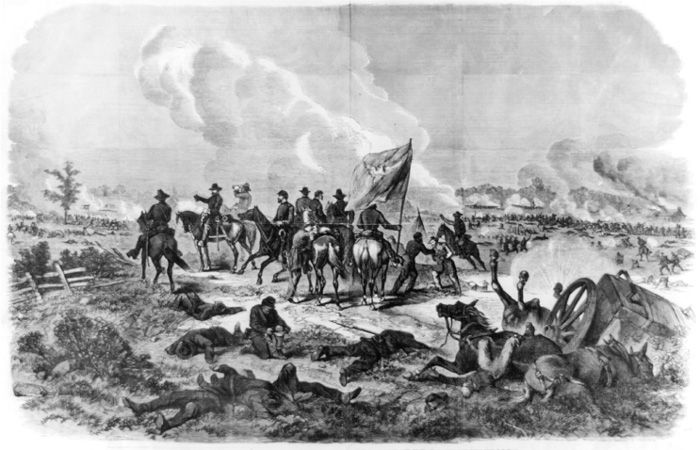
Frank Leslie’s Illustrated Newspaper woodcut depicting the Battle of Chickamauga.
COMMUNISM IN DIXIE.
SEPTEMBER 20
One of the ablest citizens of Louisiana has put forth his views through the South Carolinian — the organ of the present State Government of South Carolina — on the proper policy for the rebel Government to adopt in this crisis. His scheme is altogether a nice one.
“The war,” he says, “can no longer be conducted as it has been. Our currency is so depreciated that it will soon cease to be available. I see but one remedy. Let no more paper money be issued. Let the whole Confederacy be divided into two classes — the combatants and the producers. As long as this war shall last, every one of us must be satisfied with shelter, food and clothing, and nothing else. The soldiers and officers, from the highest to the lowest, must fight without pay. Why should they need money, when provided with necessaries, and their families taken care of? Let all the resources and productions of every farmer or planter be put at the disposal of the Government, without pay. Let every woman and every child, old enough for the purpose, be made to work without pay. Let the President and every civil officer or employe have no pay. In fact, let it be a penal offence to buy or sell anything; but let food, raiment, shelter and medicine be secured to every one under a parish or county organization, controlled or supervised by the General Government.”
This would be the most gigantic scheme of practical socialism that the world ever saw. All the resources and productions of every Southern farmer and planter is to be placed at the disposal of the rebel Government without pay; it is to be a penal offence to buy or sell anything; labor is to be universal and compulsory — every woman, even, and every child, being forced to work without pay; and the rebel Government, from the stores thus placed at its disposal, is to furnish every man, woman and child — of both colors, we suppose — in the Confederacy with all needed food, raiment and shelter. It is as wild a scheme of socialism as ever was conceived in the brain of man. There would be perfect equality as regards property, perfect equality as regards labor, and perfect equality as regards compensation.
We know the immense and despotic power of the rebel Government over the Southern people; but we should think it beyond even its power to force every human being of both sexes in the Confederacy to work — to force all workers and property-holders to turn over the fruits of their labor and their property into a common fund — to force all soldiers and officers to fight without pay — to force every civil officer or employee to labor without pay. But if “one of the ablest citizens of Louisiana” favors the scheme, we do not see why JEFF. DAVIS should not try it.
THE IMPENDING FIGHT IN GEORGIA.
SEPTEMBER 20
We are in expectation of stirring news from the Department of Gen. ROSECRANS. The combined and rapid advance of this chief and Gen. BURNSIDE evidently took Gen. BRAGG by surprise, and compelled the abandonment of Chattanooga. The evacuation of this place was not intended by the Confederates. Since the first of this year they have been at work upon it, steadily increasing its fortifications, and trying to make it impregnable. They meant to hold it to the last, and were sure they could do so. But, as in the case of Columbus, Fort Pillow, Memphis, Corinth, Vicksburgh and Port Hudson, they only spent their labor for the benefit of Nationals. As soon as their work was done at Chattanooga, they quietly gave up the place to Gen. ROSECRANS.
The prompt reinforcement of Gen. BRAGG by LONGSTREET and detachments from JOE JOHNSTON’s army, shows what the intentions of the rebel Government were. They did not intend to retreat, and BRAGG is enabled to stop his flight and turn upon his pursuers, almost in sight of his late stronghold. He is said to be stronger in men now than Gen. ROSECRANS. The two armies confront each other, and a battle is momentarily expected.
The immense importance of the impending contest must be admitted. If ROSECRANS should be worsted, the effect would be very bad in Tennessee. Much of the State would be again overrun by guerrillas, and the loyal population of the State, now just prepared to return to the Union, would be frightened and deterred from their contemplated action. If the Confederate army should be beaten, the rebellion would be instantly lost. Alabama and Georgia would be open to the advance of the Union troops, and thus the heart of the Confederacy be pierced. The result would be quickly fatal. Into these two States are now gathered the major part of the property and chiefs of the rebellion. The bulk of the slaves of Virginia, Tennessee, Mississippi and Eastern Louisiana have been gradually withdrawn before the march of our armies, and have found refuge, along with their masters, in Alabama and Georgia. The influx of this class of persons from Mississippi, at the time of GRANT’s occupation of Jackson, was so great, it will be remembered, that the Governor of Alabama was obliged to take steps to stop it. He feared the effect on the food supplies of his State.
The accumulation of slaves in the States of Georgia and Alabama must, at the present time, be enormous. It is not unlikely that half the remaining slave wealth of the Southern States is compacted within their borders. And the effect of the Union army’s advance among them would be disastrous. A spark might be as safely admitted into a powder magazine. The rebels appreciate this perilous state of things, and hence they are preparing, no doubt, to make a superhuman effort to check and drive back Gen. ROSECRANS. We trust this brave General, backed now by BURNSIDE, will be equal to the shock coming against him. It would be gratifying to know that Gen. GRANT was hard by, with part of his veteran army, to take part in the grand and final contest for the possession of the citadel of the enemy’s strength. But there is no reason to hope for this. Gen. ROSECRANS must rely on his unaided strength to fight one of the most critical and important battles of the war. As a lover of honorable fame, this is, perhaps, the very thing he would desire, for he is confident of victory, and the glory of success will be exclusively his own.
HIGHLY IMPORTANT.
A GREAT BATTLE FOUGHT NEAR CHATTANOOGA.
SEPTEMBER 21
SPECIAL DISPATCH TO THE NEW-YORK TIMES
WASHINGTON, SUNDAY, SEPT. 20
HEADQUARTERS OF THE ARMY OF THE
CUMBERLAND, CRAWFISH SPRINGS, GA.,
SEPT. 19
A desperate engagement commenced this morning at 11 o’clock. The rebels made a heavy attack on the corps of Gen. THOMAS, forming the left wing of our army, and at the same time they attacked the right wing, which was thought to be a feint.
Gen. [Alexander] MCCOOK’s and Gen. [Thomas] CRITTENDEN’s troops were thrown into the engagement as convenience offered, the main portions of their forces being on the march at the time.
The fight on the left was of a very desperate character. The enemy were repulsed, but, on being reinforced, regained their position, from which they were subsequently driven, after a severe engagement of an hour and a half.
Gen. [George H.] THOMAS’ forces then charged the rebels for nearly a mile and a half, punishing them badly.
About two o’clock in the afternoon the rebels made a fierce dash on our centre, composed of the divisions of Gens. [Horatio] VAN CLEVE and [Joseph] REYNOLDS.
Gen. VAN CLEVE’s forces were struck on the right flank, and being vigorously pushed by the rebels fell back, until Gen. CARTER’s line was broken and the troops became much scattered.1
Gen. THOMAS on the left, and Gen. [Jefferson C.] DAVIS on the right, then pushed forward their forces vigorously toward the gap, and, after a hard fight, recovered the ground which had been lost on the extreme right.
The fight disclosed the intention of the rebels, which evidently was to get between us and Chattanooga.
The general engagement, which commenced at 11 A.M., ended about 6 P.M....
The battle is not yet over. It will probably be renewed to-morrow.
Rebel prisoners taken represent that the corps of Gens. [Daniel H.] HILL, [Leonidas] POLK, JOHNSTON and LONGSTREET, were in the engagement.2
Our men are in the best of spirits, and eager to begin anew.
ROSECRANS, in a dispatch to HALLECK, says:
“In the early part of the fight the rebels drove us some distance, capturing seven guns. Later in the action however, we drove the enemy, reoccupying all our lost ground and capturing ten pieces of artillery. A number of prisoners, representing forty-five regiments, were captured by our forces.” The battle was probably renewed yesterday morning.

Repulse of a Confederate attack by federal troops at Crawfish Creek during the Battle of Chickamauga.
1. There was no General Carter at Chickamauga. Almost certainly, this is a reference to Colonel Charles G. Harker, who commanded the Third Brigade, First Division, in Crittenden’s Corps.
2. This is mostly correct. Daniel Harvey Hill was present with his command, though Ambrose Powell Hill’s Corps remained in Virginia. Also, while there were elements of Joe Johnston’s army present, Johnston himself remained in Mississippi.
POSTSCRIPT.
BAD NEWS FROM ROSECRANS.
DEFEAT OF OUR ARMY IN GEORGIA.
SEPTEMBER 21
MONDAY, 4 O’CLOCK A.M.
We have the following brief and very painful news from Gen. ROSECRANS’ army. The occupation of the telegraph lines for military purposes prevents, for the present, the transmission of details:
LOUISVILLE, MONDAY, SEPT. 21 — 12:45 A.M.
Our army under Gen. ROSECRANS has been badly beaten, and compelled to retreat to Chattanooga, by BRAGG, with heavy reinforcements from LEE, BEAUREGARD and JOE JOHNSTON.
THE BATTLE IN GEORGIA.
SEPTEMBER 21
Gen. ROSECRANS has again met the enemy, whom he fought and defeated at the opening of the year, and whom he has been pursuing for the past three months, for the purpose of fetching to the test of battle. It has been an unaccountable mystery why Gen. BRAGG should have executed such a series of retreats as he has carried his army through since it occupied Murfreesboro — why he should have evacuated in succession points of such vast natural and artificial strength as Shelbyville, Tullahoma, and especially Chattanooga? The reason, however, was probably simply because, though his positions were very strong, his army was not of sufficient magnitude and courage to cope with the well-trained Western legions that Gen. ROSECRANS marched upon him. Had ROSECRANS attacked him in front of any of the positions named, BRAGG, with his advantages, might have had a show of success; but the flanking movement so skillfully executed by Gen. ROSECRANS in each instance, necessitated that BRAGG should come forth from his stronghold and give battle on ground where his acquired advantages availed him nothing.
At last, however, in the evacuation of Chattanooga, BRAGG had got to a point in his retreats when further backward movement was destruction. To have retreated from Rome or Atlanta would have been to give up Alabama, Mississippi and Upper Georgia, and would have given us a pass to the important parts of the Carolinas sloping from the Alleghanies. BRAGG and all his army knew this — JEFF. DAVIS and the whole Confederacy knew it. Hence, as a matter of necessity, BRAGG halted his columns but a short distance south of Chattanooga, and DAVIS made haste to reinforce him from West and East. The army of JOE JOHNSTON, which, since its defeat at the capital of Mississippi, had been unable to subserve any military purpose, and had wandered from one point to another, was brought up to Georgia from its latest camping ground on the Tombigbee, and attached to BRAGG’s force. The corps of LONGSTREET, or, if not exclusively his corps, a large force from the army of Gen. LEE, was hastened westward from Virginia, and combined with BRAGG’s and JOHNSTON’s armies. The considerable force under BUCKNER, which retreated from East Tennessee, before Gen. BURNSIDE, was consolidated with the rest, and doubtless all the other detachments of infantry and cavalry that have been roaming and operating throughout the Southwest, were hastened forward at the critical moment to the critical point. With all these bodies and reinforcements, a very large and formidable army was mustered to confront the Army of the Cumberland.
The rebels began the attack on Rosecrans’ army, the lines of which were established along Chicamauga Creek, a short distance south of Chattanooga, shortly before noon on Saturday. They adopted the style of tactics which they have so often practiced with success — massing their troops, and attacking with fury, in succession, the different corps of our army, forcing its wings and centre. In each attack they seem to have been temporarily successful, but only temporarily, for, at nightfall, our lines were reestablished as they had been before the battle began, and Gen. ROSECRANS held his ground, having severely punished the rebels. Gen. ROSECRANS has telegraphed to Washington that he anticipated that the battle would be renewed yesterday, and another dispatch represents our men as in the best of spirits and eager to begin the fight anew. The rebels, undoubtedly, attacked on Saturday with the whole of their force, as this is the policy which they have universally pursued, when they had the initiative in the action, and their failure in the first day augurs ill for their success yesterday. There has been no instance in the war in which the rebels, foiled in the first day of the battle, retrieved their fortunes on the day succeeding. And they were even less likely than usual to succeed on this occasion against the hero who, at Murfreesboro, wrenched victory from the very jaws of defeat.
THE BATTLE IN GEORGIA.
SEPTEMBER 22
As was anticipated by Gen. ROSECRANS, the great battle which opened on Saturday forenoon, and raged till after nightfall, was reopened on Sunday morning, and continued throughout the day. The aspect of the battle of Sunday is no better than was that of Saturday. On Saturday, the rebels first massed their troops on our right, then on our centre, then on our left, attacking each in succession, and gaining important advantages, and though at evening our army occupied the same ground as when the action commenced, it would appear that Gen. ROSECRANS suffered severely. On Sunday the enemy again advanced in force; but the only details of the battle given are, that it raged fiercely all day — that two of ROSECRANS’ divisions gave way in panic, but were subsequently rallied, while the remainder of the army stood its ground, and it is reported that at night we were driving back the rebel advance. The casualties were very heavy — the dispatch asserting that the killed and wounded on both sides will not fall short of thirty thousand.
There is little cheer on the surface of the dispatch, or in the details as given, but we think there is ground for encouragement. The fact that ROSECRANS held his ground for two days is a very favorable sign. In their desperate and overwhelming assaults of Saturday and Sunday, the rebels failed to drive him back, or at least failed to keep him back. On Saturday ROSECRANS was unable to bring his artillery favorably into action, and this was probably also the case on Sunday, as the ground of the battle was the same on both clays. If he has subsequently succeeded in getting it into good position, we do not fear for the result....
THE MILITARY BEARINGS OF THE GEORGIA BATTLE.
SEPTEMBER 23
Whatever may prove to have been the facts and results of the late battle in the northwestern corner of Georgia, we may all find comfort in the reflection that although our winning a great battle just now might bring the Confederacy to the verge of dissolution, our losing one can do but little for its salvation. We are long past that stage of the war in which a single defeat can stay our progress. The fact, for fact it seems to be, that the rebel army of Virginia has been largely drawn upon to supply BRAGG with the means of striking the blow under which ROSECRANS is now reeling, proves that the surmise which gave them but one army remaining of the various hosts which they possessed, a year ago, is well founded. They have no longer an army of the East and an army of the West, an army in Virginia and an army in Tennessee. When they seek to accomplish great things at any one point, it has to be by forces drawn from all others. This is unquestionably a game in which great skill and judgment, celerity and audacity, may be displayed, and it would be childish to refuse the rebels the credit of displaying every one of these qualities. But, then, it is a desperate game — a game which Generals play rather to save their honor than to retrieve their fortunes. It was probably never played so magnificently, and may never he played so magnificently, as in that brilliant campaign by which NAPOLEON sought to save Paris after the fatal field of Leipsic. There was something awful in the genius with which, during that terrible month, he shot small masses of raw levies up and down the chord of the arc, in the vain effort to stem the great tide which was gradually hemming him in. and under which he soon after sunk in the court-yard of Fontainebleau. But fortune was still on the side of the big battalions, and proved, for perhaps the hundredth time, that no amount of either energy or ability can, at the close of long wars, make up for the exhaustion of the supply of men.
It is from this that the South is now suffering. Its losses on the battle-field have been enormous ever since the beginning of the war, and its reverses have every month diminished the area of its recruiting ground, so that a levy en masse would produce very different results, even now, from those which it would have produced two years ago. At that time it would, if JEFF. DAVIS had ordered it, have brought almost the whole armsbearing population south of Mason and Dixon’s line into the field. Today it could not, supposing it to be obeyed, bring more than that of five States. But it will not be obeyed even in these; and when matters come to such straits as this with any Power, the ability to raise men by force diminishes in the precise ratio of its need of them. We have the confessions of the warmest Southern partisans that the martial ardor of the people has so far declined, that not only do those not already on the rolls not rush to arms, but half those who are on them skulk at home with the connivance of their friends and neighbors.
So that every battle, whatever its nominal result may be, is a defeat for the South, simply because every battle thins the ranks of the faithful few who still keep the field, — doubtless the choice spirits of the Confederacy. Whether they win or lose, as long as fighting makes gaps in their columns which they cannot fill, the only result of their struggles is to defer for a short time the doom of the Confederacy. If they utterly destroyed the armies of ROSECRANS and BURNSIDE tomorrow, it could only be by the sacrifice of three-fourths of that of BRAGG, and there would still remain those of BANKS and GRANT — of [Frederick] STEELE, [Stephen A.] HURL-BUT and [Grenville] DODGE, and behind all, the millions of the North. The fact is the game is, for all practical purposes, over. It has been well played, and what we now witness is but the frantic maneuvering of a solitary king, to avoid checkmate on a board crowded with adverse pieces. Every fight which occurs after this is simple butchery, which, though it may gratify the hate or ambition of the rebel leaders, can have no real influence upon the fortunes of the fabric which they have cemented with so much blood and so many tears.
THE GREAT BATTLES.
IMPORTANT DETAILS.
SEPTEMBER 23
SPECIAL DISPATCH TO THE NEW-YORK TIMES
WASHINGTON, TUESDAY, SEPT. 22
Shortly after noon to-day a dispatch was received here from an officer in command at Chattanooga, speaking in most encouraging terms of the general result of the actions of Saturday and Sunday last, wherein, according to his representations, the Union army achieved a substantial success instead of being beaten — the enemy being more damaged in killed, wounded, &c. On Sunday night Gen. ROSECRANS changed the position of his army to points near Chattanooga, with Gen. THOMAS’ command still occupying the front, which shows how much less that officer’s corps was crippled than the first newspaper accounts alleged. Our total loss in prisoners was but 2,000, while 1,300 rebel prisoners had been sent to the rear when the dispatch in question left Chattanooga, and more were being expected in from the front. The army is in excellent spirits, and the brightest anticipations are entertained.
FROM ROSECRANS’ ARMY.
NO FIGHTING YESTERDAY.
SEPTEMBER 25
WASHINGTON, THURSDAY, SEPT. 24
A dispatch from Gen. ROSECRANS, dated at his headquarters last night, says:
“I cannot be dislodged from my present position.”
Another dispatch from one of Gen. ROSECRANS’ Staff, written at forty minutes past 11 o’clock last night, says:
“No fighting to-day, the 23d.”
MAJ.-GEN. THOMAS.
SEPTEMBER 26
The full accounts that are reaching us from the hard-contested field near Chickamauga Creek do justice to the services of one of the ablest and most successful Generals in the Union army — Maj.-Gen. THOMAS. It appears that this gallant soldier bore the brunt of the rebel attack unharmed, on both days of the fight, though the onset in each case was impetuous and overwhelming. It is no discredit to the corps of Gens. MCCOOK and CRITTENDEN that they were broken by the outnumbering hosts of the enemy. The metal of these men had been tried before, and they are known and approved as among the bravest of our Union soldiers. But if a part of the gallant army of ROSECRANS could be driven back without disgrace, it must not be denied that unusual credit and renown are due to that portion which withstood every shock, and dealt horrible slaughter upon a foe so numerous as to be deemed invincible. This is the signal merit of the corps of Gen. THOMAS in the sanguinary battle in Northern Georgia. The stubborn fighting of this portion of the army is all that saved the fortunes of the day, as we understand the contest at this distance; and if the enemy fails to follow up his supposed advantages, it will be mainly because of the damaging blows inflicted by this heroic General.
Gen. THOMAS is a Southerner, a native-born Virginian, and will be remembered as the leader of the Union forces in that first fortunate and decisive battle in Kentucky, Mill Spring, in which Gen. ZOLLI-COFFER lost his life, and the rebel Gen. CRITTENDEN was driven across the Cumberland and out of the State in such confusion and rout. He has the prestige of success, and richly deserves the gratitude of the nation.

Major General George H. Thomas, U.S.A., the “Rock of Chickamauga.”
WHAT BRAGG MAY DO.
SEPTEMBER 27
Some of our Western exchanges took a gloomy view of the results that might follow a “bad defeat” of ROSECRANS near Chattanooga. They anticipated, in that case, a flank movement by BRAGG that would bring him immediately northward again through Tennessee into Kentucky. And ROSECRANS, if beaten in battle, would not be able to follow and head him off, as Gen. BUELL did so successfully on the former occasion....
On the whole, it does not appear that BRAGG can reenact the campaign he performed last year, fruitless as that remarkable episode was. If ROSECRANS is too much crippled to pursue, BRAGG is unquestionably too much exhausted to march, as he would have to march before entering Kentucky. The audacious enterprise could hardly be put on foot before overwhelming masses could be thrown in the way, and the enemy met nearer to Chattanooga than to Chaplin Hills.
The danger in Tennessee is not that BRAGG will flank ROSECRANS as he did BUELL, and march North, but that he will send cavalry raids to the rear and break the communications of ROSECRANS with Nashville. Such a movement would compel ROSECRANS to weaken his front to protect his rear, and the great extent of line to be guarded, though threatened by only a small portion of the foe, might so weaken his garrison at Chattanooga as to render its hold of that place doubtful. Let the Government see to it that communications are kept open between ROSECRANS and Nashville, and BRAGG will remain in Georgia.