
CHAPTER 16
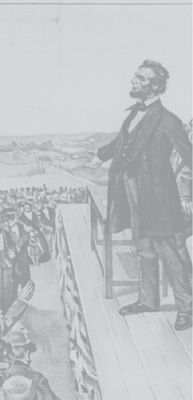
Detail of an illustration depicting President Abraham Lincoln delivering his Gettysburg Address.
After his headlong flight from the battlefield at Chickamauga in September, Rosecrans fell back to Chattanooga and prepared for a Confederate assault. Bragg followed cautiously but, instead of assaulting the enemy, placed his army on the high ground south of the city to inaugurate a kind of siege that would sever Union supply lines and starve Rosecrans out of the city.
In Washington, Lincoln and General-in-Chief Halleck decided not to wait for such an eventuality, and they made two decisions: first, to reinforce Rosecrans by sending Joseph Hooker with two corps from the Army of the Potomac to Chattanooga by rail; and second, to send Ulysses S. Grant there to take overall command. Grant’s orders gave him the authority to relieve Rosecrans if he thought it advisable (Lincoln believed Rosecrans had lost his “spirit and nerve”), and Grant decided not to wait, sending orders ahead by telegraph for George H. Thomas to take his place.
Grant arrived in Chattanooga on October 23 and dealt first with the problem of dwindling provisions. He opened a line of supply over the Tennessee River at Brown’s Ferry, establishing what the soldiers called the “cracker line.” After that, Grant turned his attention to the challenge of driving off Bragg’s besieging army. With Hooker’s 16,000 men and 20,000 more on their way under William T. Sherman, Grant could now begin to think offensively. The Times obligingly treated its readers to a detailed appreciation of Grant, elaborately comparing his achievements in the war to date to no less than the fabled Hercules.
Meanwhile, the Lincoln administration had reason to celebrate after learning of glorious results at the polls in mid-October. In Pennsylvania, pro-Lincoln Governor Andrew Curtin easily won a second term. Republican gubernatorial candidates were victorious as well in Iowa and Indiana. The President could take special consolation from the results in Ohio, where his nemesis, former Congressman Clement Laird Vallandigham, went down to a stunning defeat in his attempt at a political comeback. “Valiant Val,” as his copperhead supporters dubbed him, was badly defeated for governor by Republican John Brough. The Times joined other pro-war journals in exulting at the Democratic embarrassment. Not only had Vallandigham lost, he had been compelled — as a convicted traitor — to campaign from exile in Canada.
Amid much heartening news, Lincoln decided to accept an invitation to make a rare visit to a battlefield in November — in this case the sacred ground of Gettysburg, for the dedication of a new Soldiers’ Cemetery to accommodate the thousands of corpses left unattended after the July conflagration there. Organizers asked the President, almost reluctantly, to give but “a few appropriate remarks” at a ceremony to which the nation’s foremost public speaker, Edward Everett, had been asked to deliver the principal address.
Lincoln had scant time to prepare for his appearance exhaustively, but wrote at least one draft of his brief comments at the White House before departing for Pennsylvania. The Times reported that he was greeted enthusiastically when he arrived in Gettysburg on November 18, after which he retired to his room to edit his manuscript further.
When Lincoln rose the next day to deliver his 271-word speech, few on the scene expected anything like the masterpiece he delivered — not only an eloquent justification for the sacrifices Union troops had made at that battlefield, but also an extraordinary hymn to use the war to complete the “unfinished work” proposed by the founders. To the legalistic “prose” of the Emancipation Proclamation, this master writer had at last provided the explicatory “poetry” that consecrated the fight to save the Union and eradicate slavery.
Within the next few days, The Times obligingly reprinted the President’s brief text without comment, reserving its most lavish praise for Everett’s purple stem-winder. Everett himself knew better. Writing to Lincoln the day after their joint appearance at Gettysburg, the old orator graciously admitted: “I should be glad, if I could flatter myself that I came as near to the central idea of the occasion, in two hours, as you did in two minutes.”
Lincoln must have been gratified, but as he had said a year earlier, “breath alone kills no Rebels.” By month’s end, the President and the readers of The Times received the news they were waiting for: stirring reports of unqualified Union triumphs at Chattanooga on Lookout Mountain and Missionary Ridge.
A LATEST FROM CHATTANOOGA.
STORIES FROM OVER THE REBEL LINES.
OCTOBER 17
CHATTANOOGA, SATURDAY, OCT. 10
Since the 7th, no hostile demonstrations have been made by the enemy upon our front. Their batteries on the northeastern slope of the Lookout Mountain have undoubtedly been withdrawn, while those on the left have remained silent.
Yesterday and the day before our guns on the left and right opened, and compelled Gen. BRAGG to remove his headquarters from Missionary Ridge, and drove away the whole signal corps on Lookout Mountain.
Up to noon to-day both sides have been quiet.
Day before yesterday, a rebel picket, composed of a Sergeant and six men of the Third Kentucky, deserted to us. They report that the mysterious engagement within the rebel lines, observed from our left on the 6th, was a fight between a brigade of Georgia militia and the regular troops. The former refused to cross the State line, and their refusal brought on the collision. Strange as the story is, it is credited at headquarters. That a fight took place is confirmed by hundreds of eyewitnesses on our side....

An 1886 Louis Prang chromolithograph showing General Grant and other senior staff observing the Battle of Chattanooga.
OUR SPECIAL ARMY CORRESPONDENCE.
OCTOBER 18
ARMY OF THE POTOMAC,
THURSDAY, OCT. 15
Another day has been devoted to the by-play or the strategic efforts of the commandants of the two great armies now moving in parallel lines, each endeavoring to secure the advantage of situation — movements that always precede a general engagement. Nothing but skirmishing, (and only little of that,) moving of trains and immense columns of troops has been done to-day, but the shock of battle is imminent, and no one can tell what an hour may bring forth. Both armies are seemingly in readiness, and, apparently at least, eager for the fray. No men ever fought with more determination than that portion of the gallant and battle-stained Second corps, engaged yesterday at Bristow’s [sic] Station,1 under the accomplished and energetic WARREN.2 With the enemy there was an unmistakable difference. While their officers fought as only desperate men can fight in a failing cause, their men did not seem to be imbued with the same spirit, and fled or surrendered themselves as prisoners of war, more readily than has been their wont in previous trials of strength. I have good authority for reporting this state of things, but as obvious facts are more potent with the reader, I will cite in evidence of this want of spirit, that in one single division of HILL’s corps, (so say the prisoners,) one Colonel was killed, and three other Colonels and one General were wounded, 470 of the 700 prisoners reported captured, I have seen; I have also seen and examined five of the six pieces of artillery captured, the sixth piece haring been left behind owing to the want of means to bring it from the field; moreover, forty-seven of the prisoners say they are tired of fighting Yankees, and have signified a wish to take the oath of allegiance. These men say they know many others now in the rebel ranks who are only awaiting an opportunity to come within our lines and give themselves up....
Everything thus remains; the army is ready for any new scheme of LEE’s, or, if he decides to retreat, to follow him up again. It is evident that MEADE has foiled the rebel General, and left him somewhat doubtful what to do next.
J.
1. The Battle of Bristoe Station on October 14, not far from the familiar terrain of Manassas, Virginia, proved little more than a large, inconclusive skirmish.
2. General Gouverneur Kemble Warren (1830–1882).
THE NEGRO SOLDIER QUESTION.
OCTOBER 18
The opposition which was made at first to the employment of negroes in our armies, has all but passed away, as indeed it could not fail to do, for it was founded in great part upon erroneous views as to their capacity, which have been entirely dissipated by a little experience. But that there should have been such opposition at all, will always be one of the singular features of the history of the rebellion. One would have thought the employment of negroes in the army during the Revolution and the war of 1812, and their constant employment in the navy, would have prevented the rise of any such feeling.
There is another feature about the matter which is also notable. It has been found easiest to make use of the negroes by forming them into separate regiments and companies. It would not be possible to employ them if they were to be introduced into the ranks of our armies indiscriminately. But in the Revolution it was just the reverse. There were numbers of negro soldiers who stood in the ranks with their white fellow citizens on many a hard fought field, beginning with the battle of Bunker Hill, where PETER SALEM, the colored man, spoken of by Mr. EVERETT in his address on the inauguration of the statue, of Gen. WARREN, shot Maj. PITCAIRN, of the British marines; and there never seems to have been any opposition to it at all. But there was very heavy opposition to the formation of separate bodies of negro troops, and in many of the States, as Col. LAURENS, who went to South Carolina with a project for raising such battalions, wrote to Gen. WASHINGTON, “the single voice of reason was drowned by the howlings of a triple-headed monster, in which prejudice, avarice and pusillanimity were united.”
Still, such regiments were formed and did good service — as witness the Rhode Island regiment of blacks — but the instances were few; while in almost all, if not in every one of the States, colored soldiers, not only of the free men, but of those who had been slaves, were received into the ranks of their white regiments without objection. It is possible that one reason for this latter fact maybe found in that absence of personal repugnance for the negro, which the Southerners have always claimed, and which they have often pointed to as a proof of the excellence of the “institution.” Most of the States during the Revolution being Slave States, might be subject to the same influences as our Slave States now, and freed from prejudices to which these also claim that they are not exposed; and the history of this war will prove, we have no doubt, that from the first there have been cases of negroes fighting in the ranks of the rebellion. Not, however, in any such numbers, as the muster rolls of the Revolution would show. And the reason of this is manifest. Our fathers fought in the Revolution for freedom. That was the sign by which they must conquer. That was emblazoned amid the glories of the banner under which they fought. And feeling this great truth pulsating in their every heartbeat, they could not but look kindly upon the effort of any slave to make himself a freeman among freemen, by offering his life as readily as they were offering theirs for their common country.
But with the rebels it is the reverse. They have set Slavery as the foundation-stone of their Government. They have plunged into rebellion and crime of all sorts in defence of Slavery. The liberty which they claim to be fighting for is a liberty to enslave others. They declare their Confederacy to be “a God-sent missionary” to teach “Slavery, Subordination and Government.” We, on the other hand, fight on different conditions. All the logic of the struggle leads us more and more toward universal freedom. Every dollar spent, every drop of blood shed, is an argument in this direction, and leaves behind an influence which leads us to take a bolder stand and more decided measures for freedom to each and to all. The bravery of the black man has already silenced the opposition to these regiments.
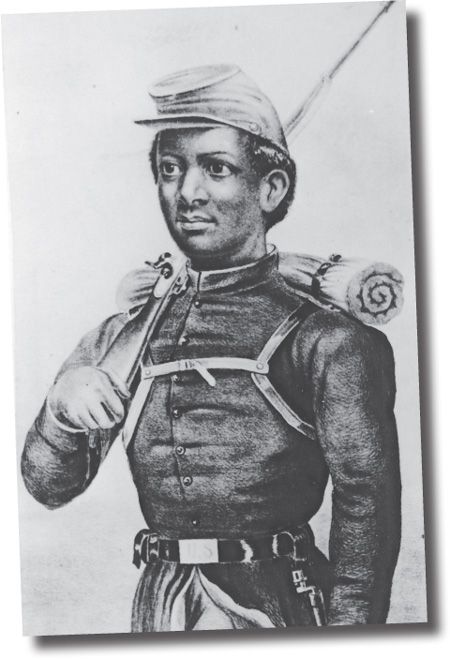
An African-American volunteer soldier as imagined in a period lithograph.
FROM OHIO.
VALLANDINGHAM’S DEFEAT1 — the ghost oF the copperheads
OCTOBER 18
CINCINNATI, OHIO, FRIDAY, OCT. 16
Did you hear the clap of thunder from Ohio? Was it not a startling Alpine peal, leaping from crag to crag across the continent, and warning our own and other nations that a frightful bolt had struck somewhere. It was here it struck — here in this stretch of “Northwestern territory,” lying between the Ohio River and Lake Erie; the first soil consecrated to Freedom by National act on this continent — here the bolt struck on Tuesday last, paralyzing every arm that would raise again the black banner of Human Slavery, and sealing, as it were, by Divine wrath, the work long since decreed by Divine goodness. “The voice of the people is the voice of God,” and never was that voice uttered with more emphasis and effect than in the late election. Defeated partisans, lately raging with fury, stand appalled and abashed by the visitation, and meekly admit the irreversible and overwhelming judgment against them. But I will leave it to the “Veteran Observer” to philosophize for you on the extraordinary phenomenon of the Ohio election.
Six weeks ago I passed through this broad State, from west to east, somewhat leisurely — and I told you, as the result of my observations, that VALLANDIGHAM would be beaten by 100,000 majority. No one else seemed to think so — least of all the people of Ohio. When I came back here — reentering the State on the day of the election, and passing through it all day long, while the ballots like snow-flakes were falling — I found the Union men working for dear life at the polls. They gathered in the voters anxiously and hastily, as a farmer gathers in his hay-cocks when a dark storm is brewing. I met sons of Ohio who had come all the way from Memphis to cast a ballot. Chicago and New-York sent home their contributions, and even the eminent Minister of Finance, Secretary CHASE, drooped for a brief time his national reckonings, and returned hither to vote the Union ticket! Loyal Ohio was terribly excited, if not alarmed, and dealt on Tuesday last her most tremendous blow. She struck as if for existence as well as honor, and the wires have told you the result. I think the 100,000 majority will be more than realized. The majority of the home vote will approach 70,000, and the soldiers’ vote will swell that to almost its own extent, for few soldiers vote for VALLANDIGHAM. It is well the majority in the home vote is so vast. If VALLANDIGHAM had received a majority of these, and the votes of the army had overcome that majority, we should have had no end here, or in the great rebel organ in England, of lamentations over the fatal advances of “military despotism” in America.
Now that the affair is over, there is something almost ludicrous in the condition of “copperheadism.” It seems that there was nothing of strength or danger in it. It was like one of the ghosts of your theatres — sepulchral in aspect, dark in its haunts and sulphurous in smell — but when robust loyalty dashed forward to grapple with it, it vanished into thin air, and sought its fit infernal shades. It never had even “the ghost of a chance” of success.
1. When President Lincoln learned that Republican John Brough (1811–1865) had soundly defeated copperhead Democrat Clement L. Vallandigham for governor, he was heard to declare: “Thank God, Ohio has saved the nation.” Vallandigham, convicted of treason, conducted his campaign in exile from Canada.
ROSECRANS RELIEVED BY GRANT.
OCTOBER 21
We have this morning the news that Gen. ROSECRANS has been relieved from the command of the Army of the Cumberland; and that Major-General ULYSSES S. GRANT takes command of that Department and of the Army of the Tennessee, (GRANT’s old army,) the Army of the Cumberland, (ROSECRANS’ late army,) and the Army of Kentucky (BURNSIDE’s.) Gen. THOMAS, who fought so splendidly at Chickamauga takes the immediate command vacated by Gen. ROSECRANS.
It now remains to the great and unconquerable hero of the Mississippi Valley — who has defeated more armies, reduced more strongholds, and conquered more territory than all our other Generals put together, or than any General since the days of NAPOLEON the First — it remains for Major-Gen. GRANT to overcome the rebels now intrenched among the mountains of the West, as he has already routed them through the length and breadth of the great River of the West.
THE VOTE OF THE SOLDIERS AGAINST THE COPPERHEADS.
OCTOBER 21
Will some Anti-Administration man, who is wont to protest that his party is very sharp-set against the rebellion, have the goodness to tell us why the vote of the soldiers, when they have the chance to vote, goes so overwhelmingly against its candidates? Don’t the soldiers know what good, stiff loyalty is? Don’t they go for it when they see it? Either they must be very dull in apprehension, or very deficient in public spirit — or there must be some screw loose in Copperhead patriotism. Now, how is it? Are the soldiers fools? Or are they renegades? Will some Copperhead tell us which? If they are neither, what then are we to think of their judgment of the Copperheads?
Possibly it may be intimated that the officers are all for the Administration because they hope for promotion, and the soldiers because they fear the officers. We doubt, however, whether any responsible man of the opposition will seriously aver this, however much he may hint it. It would be a very bold act. Even could it be plausibly made out that the officers were all a pack of sordid adventurers, caring everything for self and nothing for country, it would be pretty tough business to maintain that the half million of American citizens in the rank and file are subject to their political orders — that they have ceased to be freemen and become mere liegemen and vassals. Copperhead audacity we know is great; but it is not quite equal to that. It is too well established that Americans don’t yield their manhood in any such fashion....
Wherever the soldiers have the power to vote, they invariably use that power with trenchant effect upon the enemies of the Administration. They don’t strike the rebels with the sword one whit more resolutely than they do the Copperheads with the franchise....
This staunch, consistent, thorough-going loyalty of the army is a mighty political fact. Its influence in bracing the hearts of loyal civilians all over the land, and nerving the arms of those who officially direct the war, is beyond measure valuable. In fact it may, we believe, be truly said that the National cause would be utterly, hopelessly lost, if the army should imbibe the spirit or become partial to the policy of the enemies of the Administration. The war would inevitably languish and die under such a military feeling. Thank heaven, it is not in the human nature to lapse in any such way as that. Every day’s perils encountered for his flag only make the soldier all the more devoted to it; and he worships it the most, when most rent by the battle’s rage. The war is one constant school of patriotic training to all engaged in it. The army has, from the beginning, hated all factionists and malcontents, and that hatred will deepen to the end. The soldiers will retain that feeling when they return to civil life; and we may be sure that in their day, at least, copperheadism in any form will never dare lift itself above the dust.
THE REMOVAL OF GEN. ROSECRANS.
OCTOBER 22
As we are not of the number of those who think that the President ought to take the vote of the people and of the army before removing or appointing a General, we have no fault to find with the dismissal of Gen. ROSECRANS from his command in Tennessee. We are bound, at least in courtesy, to suppose that there are good reasons for a step in many respects so grave, and that in this, as in other things, the President has been guided, in the exercise of an undoubted prerogative, by a sense of duty, and by nothing else. What these reasons are it would be idle now to inquire. It would be just neither to Gen. ROSECRANS nor to the Government to discuss seriously the dozen rumors which are flying from lip to lip touching the General’s alleged mistakes, or shortcomings, or misfortunes. We may be sure that we shall know in due time whatever he considers it necessary for the vindication of his own fame that we should know, and until that time comes we may well be spared the task of investigating the probability or improbability of every bit of camp gossip that is offered to us in explanation of one of the most untoward incidents of the war.
THE ARMIES IN THE WEST — THEIR NEW CHIEF.
OCTOBER 23
As, at the fall of Vicksburgh in July last, the three great armies which the rebels had long maintained were reduced to two — those of BRAGG and LEE — so now, the three firstclass armies which we have maintained for nearly two years have been reduced to two — those of GRANT and MEADE. That splendid army, eighty thousand strong, which in the first months of the year was planted in front of Vicksburgh, and in May, June and July last lay in its rear, exists no more as a unit. Part of it has gone down the Mississippi to Gen. BANKS, part has gone up the Arkansas to Little Rock, part is in East Tennessee, a large part has gone to join the army of Chattanooga, and many detachments are scattered at the various military posts along the line of the Mississippi River. But nearly, if not quite all of these troops are in the new Military Division or Department of Gen. GRANT, and to the old army under his command is now added the late army of Gen. ROSECRANS. This will give Gen. GRANT a very large army — at least twice as large as that under Gen. MEADE, and six times as large as that under any other General in the country.
The first work of Gen. GRANT will doubtless be to combine these armies, as far as possible, into one active body; and in those cases in which incorporation is impossible or undesirable, he will so place and operate the various bodies as to produce essential unity of purpose and object. The lack of this has of late been the greatest drawback to success in the Southwest. Gen. BURNSIDE has had an independent command in East Tennessee; and though, weeks ago, we had the assertion that his army was in conjunction and cooperation with that of ROSECRANS, there was in reality no communication between the two departments beyond the scout of an occasional small body of cavalry. Going west a hundred miles from BURNSIDE’s headquarters at Knoxville, we had the army of ROSECRANS at Chattanooga. West of the latter, some forty miles, we had the army under Gen. HOOKER, which the latter also claimed to be an independent command; and as HOOKER ranked ROSECRANS, it is said he declined obeying his orders. Still further West, we had a large body of troops under Gen. DODGE at Corinth, and here began the forces of Gen. GRANT, which were scattered from Memphis northward through West Tennessee, and down the Mississippi as far as Vicksburgh, and beyond. At these various points and along these various lines, we have probably at this moment not far short of two hundred thousand troops. This army, massed and properly handled (if there be any living man, or if there ever were a man, who could properly handle it on the field,) or, if not concentrated in mass, were it wielded and directed by one strong hand, guided by a broad brain, could trample out any Southern army, or march to any point, or achieve any object in the Confederacy. But, under four independent commanders, hundreds of miles apart, without communication with each other, each “working at his own job,” little or big — each and all, it may be, working laboriously and conscientiously, but disjointedly and lacking mutual purpose — how could we expect the highest results — particularly when it was evident that since the opening of the Mississippi, the great object of the campaign in the West was one and simple? The appointment of Gen. GRANT to the chief commandership of the military division of the Mississippi (its limits as yet unknown to us) and the armies therein, unifies all operations, and he will doubtless bend all his powers and forces to the achievement of a common result. This army, massed and properly handled (if there be any living man, or if there ever were a man, who could properly handle it on the field,) or, if not concentrated in mass, were it wielded and directed by one strong hand, guided by a broad brain, could trample out any Southern army, or march to any point, or achieve any object in the Confederacy. But, under four independent commanders, hundreds of miles apart, without communication with each other, each “working at his own job,” little or big — each and all, it may be, working laboriously and conscientiously, but disjointedly and lacking mutual purpose — how could we expect the highest results — particularly when it was evident that since the opening of the Mississippi, the great object of the campaign in the West was one and simple? The appointment of Gen. GRANT to the chief commandership of the military division of the Mississippi (its limits as yet unknown to us) and the armies therein, unifies all operations, and he will doubtless bend all his powers and forces to the achievement of a common result.
Gen. GRANT we believe to be just the man for the post. Having been granted plenary powers in his Department, he will doubtless make short work with any officer of any grade who will not cordially cooperate in carrying out his plans; and to all such, the example made of MCCLERNAND by Gen. GRANT last Summer, will stand as a solemn warning. In many respects, GRANT’s new field of action is more difficult than his former one. But having already performed his other Herculean labors with such consummate success — having fought the Nemean lion at Donelson, and sent its carcass to Chicago — having burned the heads of the Lernaean hydra at Shiloh — having captured the Arcadian stag at Vicksburgh — having hunted the Erymanthian boar till it was captured at Arkansas Post — having destroyed the swarm of Stymphalian guerrillas who haunted the Mississippi, feeding upon human flesh — having cleansed the Agean stables throughout his Department — and having performed other and sundry of the labors of the great Greek, it now only remains that he seize the rebel dog Cerberus1 that guards the gates of the Confederacy in Northern Georgia, and force him back howling to Hades.

Lieutenant General Ulysses S. Grant, U.S.A., in a William Sartain engraving based on a painting by Christian Shussele.
1. An elaborate reference to the mythological Labors of Hercules, including: clubbing and strangling the Nemean lion to death; killing the multiheaded Hydra snake in the Lernaean swamps; snaring the sacred hind of Artemis; capturing the Erymanthian beast that roamed the mountains between Arcadia and Achaia; destroying the man-eating Stymphalian birds; and cleansing King Augeas’ stables at Elis. Now, The Times continued, Grant was ready for the 11th labor, confronting the three-headed dog Cerberus that guarded the gates of Hell.
THE WAR IN VIRGINIA — THE LATE CAMPAIGN.
OCTOBER 24
The Fall campaign of Gen. LEE, which has, been in progress for nearly a fortnight past, and about which we have known so very little and speculated so much, is probably already closed. His army crossed to the northern bank of the Rapidan with cooked rations for fourteen days, on the 9th inst., and it recrossed the river on Wednesday of this week, and returned to the point from which it had started — having been gone almost the precise length of time for which provision had been made. During that time they made a march which, by the line they took, could not have been short of sixty miles, had a number of heavy skirmishes, and fought an action in which one-half of their force was engaged.
The object of the campaign certainly does not appear on the face of it. We are accordingly left to speculation, to such deductions as may be made from their movements, and to such evidences of their design as the rebels may have left behind them. The fact that they made two efforts to flank MEADE, and a desperate effort to get in his rear at Centreville before he should be able to get to that position, indicates that their army was formidable; and of this fact, indeed, we have positive proof from the details given by the rebels themselves. But their efforts at flanking were failures, and they retreated without having had a general engagement and without having attempted any of the great things which some Northern writers had marked out for them....
Now that the late campaign may be supposed to be closed, the new question is, What next? It is credited at headquarters that another of LEE’s corps (A. P. HILL’s) has now rushed westward to Georgia, to strike a quick blow at the army of Gen. THOMAS at Chattanooga. We believe that the latter army, under its new direction, and with the cooperation of the forces heretofore acting independently, will be able to endure even this.
FROM THE REBEL STATES.
ADDRESS OF JEFF. DAVIS TO BRAGG’S ARMY.
OCTOBER 25
HEADQUARTERS ARMY OF TENNESSEE,
OCT. 14
SOLDIERS: A grateful country recognizes your arduous services, and rejoices over your glorious victory on the field of Chickamauga. When your countrymen shall more fully learn the adverse circumstances under which you attacked the enemy, though they cannot be more thankful, they may admire more the gallantry and patriotic devotion which secured your success. Representatives of every State of the Confederacy, your steps have been followed up with affectionate solicitude by friends in every portion of the country. Defenders of the heart of our territory, your movements have been an object of interest, anxiety, and hope.
Our cause depends on you, and happy it is that all can reply upon your achieving whatever, under the blessing of Providence, human power can effect.
Though you have done much, very much remains to be done. Behind you is a people providing for your support, and depending upon your protection. Before you is a country devastated by your ruthless invaders, where gentle women, feeble age and helpless infancy have been subjected to outrages without parallel in the warfare of civilized nations.
With eager eye they watch for your coming to their deliverance, and homeless refugees pine for the hour when your victorious arms shall restore their family shelters from which they have been driven and forced to take up arms to vindicate their political rights, freedom, equality and state sovereignty, which were a heritage purchased by the blood of your Revolutionary sires.
You have but the alternative of being slaves of submission to a despotic usurpation or of independence, which a vigorous, united and persistent effort will secure.
All which fires a manly breast, moves a patriot, or exalts a hero, is present to stimulate and sustain you. Nobly have you redeemed your pledges, given in the name of freedom, to the memory of your ancestors and the rights of your posterity.
That you may complete the mission to which you have devoted yourselves, will require of you such exertions in the future as you have made in the past, and the continuous self-denial which rejects every consideration at variance with the public service, as unworthy of the holy cause in which you are engaged.
When the war shall be ended the highest need of praise will be due, and probably be given, to him who has claimed the least for himself in proportion to the service he has rendered. And the bitterest self-reproach which may hereafter haunt the memory of any one will be to him who has allowed selfish aspiration to prevail over his desire for the public good.
United as we are in a common destiny, obedience and cordial cooperation are essential. There is no higher duty than that which requires one to exert and render to all what is due to their station. He who sows the seeds of discontent and distrust prepares for a harvest of slaughter and defeat.
To your gallantry, energy and fortitude you crown this harmony with due subordination and cheerful support of lawful authority.
I fervently hope that this ferocious war, so unjustly waged against our country, may soon end, and that, with the blessing of peace, you may be restored to your homes and useful pursuits, and I pray our Heavenly Father may cover you with the shield of His protection in your battle, and endow you with the virtues which will close your trials in victory complete.
JEFFERSON DAVIS.
ORATIONS OF EVERETT AND BEECHER.
NOVEMBER 20
We devote a broadside of this morning’s TIMES to the publication of two orations which we are sure will command the attention of the day. And not of this day only. Elaborate and finished discourses from two such men as EDWARD EVERETT and HENRY WARD BEECHER, upon topics of such great National interest as those they discuss, will not lightly be passed over, much less ignored altogether, by any intelligent citizen. Mr. EVERETT’s theme is the “Battle of Gettysburgh,” and the occasion is the dedication of that historic field as a National Cemetery1....
Mr. EVERETT’s oration is, of course, classical and ornate in its diction, felicitous in illustration, well-wrought and strong in its logic, correct and explicit in its statement; in a word, it is eloquent, in the best sense of that much-abused term. His exordium is of great beauty; and his peroration is splendid. If we might offer a single point of criticism on the oration, it would be upon that part of it, constituting one-half of its body, which gives a narrative of the marches, manoeuvres, skirmishes and strategy of Gens. HOOKER and LEE, Gens. PLEASONTON and STUART, from the time at which the two armies left the opposite banks of the Rappahannock until they confronted each other on this side of the Potomac, and also the detailed account of the preliminaries of the battle, and of the action itself. Mr. EVERETT enters into a very minute statement of these things; and the elaborateness of the details, the large number of names, places and circumstances he has occasion to recall, will tend to confuse and repel those who are less familiar with the events than himself, and crowd out those “glittering generalities” which he or any other great orator might be expected mainly to deal in on such an occasion. It may be said that these things were dwelt upon, as the oration is intended and expected to be enduring and historical; but so also will be the reports of Gens. MEADE and LEE, from which the facts are largely drawn. After he gets through with this, however, Mr. EVERETT does justice to his subject and himself.
1. The Times thus published and praised Everett’s now-forgotten oration a full day before reprinting the elegiac little speech that Lincoln had delivered afterward.
THE HEROES OF JULY.
A SOLEMN AND IMPOSING EVENT.
DEDICATION OF THE NATIONAL CEMETERY AT GETTYSBURGH.
NOVEMBER 20
The ceremonies attending the dedication of the National Cemetery commenced this morning by a grand military and civic display, under command of Maj.-Gen. COUCH. The line of march was taken up at 10 o’clock, and the procession marched through the principal streets to the Cemetery, where the military formed in line and saluted the President. At 11 the head of the procession arrived at the main stand. The President and members of the Cabinet, together with the chief military and civic dignitaries, took position on the stand. The President seated himself between Mr. SEWARD and Mr. EVERETT after a reception marked with the respect and perfect silence due to the solemnity of the occasion, every man in the immense gathering uncovering on his appearance.
The military were formed in line extending around the stand, the area between the stand and military being occupied by civilians, comprising about 15,000 people and including men, women and children. The attendance of ladies was quite large. The military escort comprised one squadron of cavalry, two batteries of artillery and a regiment of infantry, which constitutes the regular funeral escort of honor for the highest officer in the service.
After the performance of a funeral dirge, by BIRGFIELD, by the band, an eloquent prayer was delivered by Rev. Mr. STOCKTON....
PRESIDENT LINCOLN’s ADDRESS.
The President then delivered the following dedicatory speech:
Fourscore and seven years ago our Fathers brought forth upon this Continent a new nation, conceived in liberty and dedicated to the proposition that all men are created equal. [Applause.] Now we are engaged in a great civil war, testing whether that nation, or any nation so conceived and so dedicated, can long endure. We are met on a great battle-field of that war. We are met to dedicate a portion of it as the final resting-place of those who here gave their lives that that nation might live. It is altogether fitting and proper that we should do this. But in a larger sense we cannot dedicate. We cannot consecrate, we cannot hallow this ground. The brave men, living and dead, who struggled here have consecrated it far above our power to add or detract. [Applause.] The world will little note nor long remember, what we say here, but it can never forget what they did here. [Applause.] It is for us, the living, rather to be dedicated here to the refinished work that they have thus so far nobly carried on. [Applause.] It is rather for us to be here dedicated to the great task remaining before us that from these honored dead we take increased devotion to that cause for which they here gave the last full measure of devotion; that we here highly resolve that the dead shall not have died in vain; [applause] that the Nation shall under God have a new birth of freedom, and that Governments of the people, by the people and for the people, shall not perish from the earth, [Long continued applause.]
Three cheers were then given for the President and the Governors of the States.
After the delivery of the addresses, the dirge and the benediction closed the exercises, and the immense assemblage separated at about 4 o’clock.
About 3 o’clock in the afternoon, the Fifth New York regiment of heavy artillery, Col. MURRAY, was marched to the temporary residence of Gov. SEYMOUR, where they passed in review before the Governor, presenting a handsome spectacle. Upon the conclusion of this ceremony, which attracted quite a crowd of sight-seers. Gov. SEYMOUR presented a handsome silk regimental standard to the regiment, accompanying the gift with the following speech:
GOV. SEYMOUR’S SPEECH.
SOLDIERS OF NEW-YORK: We love our whole country, without reservation. But while we do so, it is not inconsistent with that perfect and generous loyalty to love and to be proud of our own State. This day, when I took part in the celebration that was to consecrate yonder battle-field, while I felt as an American citizen, proud of my own country, and proud of the gallant services of her citizens, in every State, nevertheless my eye did involuntarily wander to that field where lie the glorious dead of our good and great State, and when I returned, to see marching before me your manly and sturdy columns, not knowing you belonged to New-York, my heart did quicken and my pulse tingle, to learn that you were acting commissions issued by myself; I am most proud and most happy that I have had this opportunity, on behalf of the merchants of the great commercial City of New-York; to present to you this glorious banner, which has been sent as a token of their confidence is your loyalty and your courage, and your fidelity in the hour of danger. Sergeant, I place these colors in your hands in the firm confidence that they will be borne through every field of triumph, of toil and of danger, in a way that will do honor to yourselves, to the great State which you represent, and the still greater country, to which we all belong. My God bless you as you serve your country in the distant field of danger. We find in those glorious fields you left behind you are not indifferent to this conflict; are not indifferent to the welfare of the whole Union. I do not doubt, therefore, that when you shall return from your dangerous fields of duty, you shall bring back this standard to place among the archives of our State with honorable mention of the services her sons have performed. I do not doubt that though it may perhaps be returned torn and stained, yet it will be still more glorious, and with glorious recollections clustering around it. In concluding these remarks, I ask in return of the men of New-York, to give three cheers for the Union of our country, and three cheers for the flag of our land.
Gen. SCHENCK followed in a short speech. A subscription of $280 was made by the Marshals attending these ceremonies, to he devoted to the relief of the Richmond prisoners.
In the afternoon, the Lieutenant-Governor elect of Ohio, Col. ANDERSON, delivered an oration at the Presbyterian Church.
The President and party returned to Washington at 6 o’clock this evening, followed by the Governors’ trains. Thousands of persons were gathered at the depot, anxiously awaiting transportation to their homes; but they will probably be confined to the meagre accommodations of Gettysburgh till tomorrow.
THE GETTYSBURGH CELEBRATION.
FROM OUR SPECIAL CORRESPONDENT.
NOVEMBER 21
GETTYSBURGH, PENN.,
THURSDAY EVENING, NOV. 19.
All the noteworthy incidents of the celebration here to-day have already been sent off to you by telegraph, and it would have gratified your correspondent exceedingly if he could also have got off, but fate, combined with the miserable railroad arrangements, has ordained that he should spend another night in this over-crowded village. The only train that has been permitted to leave here, to-day, was the special train bearing the President and his party, which left at 6 o’clock this evening. Even the mail train, which should have left at 8 o’clock this morning, was detained for fear it would come in collision with some of the numerous trains that have been following each other in rapid succession from Hanover Junction, bringing visitors to the Dedication. How they are all to sleep here to-night it is difficult to imagine. All the hotels as well as the private houses were filled to overflowing last night. Every housekeeper in Gettysburgh has opened a temporary hotel, and extends unbounded hospitality to strangers — for a consideration. People from all parts of the country seem to have taken this opportunity to pay a visit to the battle-fields which are hereafter to make the name of Gettysburgh immortal. The Dedication ceremonies were apparently a minor consideration, for even while Mr. EVERETT was delivering his splendid oration, there were as many people wandering about the fields, made memorable by the fierce struggles of July, as stood around the stand listening to his eloquent periods. They seem to have considered, with President LINCOLN, that it was not what was said here, but what was done here, that deserved their attention. During the last three days, the scenes of the late battles have been visited by thousands of persons from every loyal State in the Union, and there is probably not a foot of the grounds that has not been trodden over and over again by reverential feet. But little over four months have passed away since the champions of Slavery and Freedom met here in deadly strife, and already the name of Gettysburgh has become historical, and its soil is classic ground. This, too, while the contest is yet undecided, and the camp-fires of the contending armies still illumine the Southern sky. If the people of the North can thus forestall history, it is because the manifest justice of their cause enables them to see the future in the present, and to behold in the fresh made graves of their fallen sons the shining monuments of their glory in ages to come.
The National Cemetery which has been consecrated to-day by such imposing ceremonies is located in the very midst of the fierce strife of those terrible July days, and many of the Union heroes fell on the ground comprised within its inclosure. It is little over half a mile to the south of the Gettysburgh Court-house, in the outskirts of the town, on what is called Prospect Hill, which is but a continuation of the elevated ridge known as Cemetery Hill. This hill, it will be recollected, formed the northernmost line of the Union armies during the last two days of the battle, and was several times stormed by the rebel infantry without success. The new cemetery is contiguous to the town cemetery of Gettysburgh and comprises 17 1/4 acres. It was purchased by the State of Pennsylvania at something like $25,000, and is to be devoted exclusively to the loyal dead who fell in the three days’ battles. The present appearance of the cemetery is not very inviting, but the plan on which it is laid out is excellent, and when it is finished and covered with green sward, it will be one of the most beautiful burial-grounds in the country. The graves will form semicircular rows, one within another, the whole presenting an appearance similar to the Senate Chamber or House of Representatives at Albany. Sections of the semicircle are allotted to the various States whose soldiers fell at the Gettysburgh battle, the different sections being divided from each other by a foot-walk. The number of States represented is eighteen, and at either end of the semicircle is a section devoted to the “unknown” dead, or those whose identity cannot be established. This class, however, is fortunately not so large as one would naturally be led to suppose. I am told that nearly all who fell in the last two days of the battle can be easily identified by the temporary head-boards placed ever their graves by their comrades. Out of 1,300 who have thus far been exhumed from the various battle-fields and buried in the new cemetery, there are not more than one hundred whose identity is not used. The work of exhuming the bodies and reburying them in the National Cemetery is to be done by the various States individually, or at least at their expense. It is proposed to erect a large monument near the base of the semicircle, to which all the States will contribute, and leave each State to erect such other monuments in its own section as it may see fit. All the bodies exhumed from the battle-fields are placed in most substantial coffins, and buried two feet apart in trenches from four to five feet deep. At the head of the coffins will be built a continuous stone wall 1 1/2 feet in thicknesss and extending from the bottom of the trench to the surface of the ground. On the top of this wall a smooth granite or marble railing will be erected 1 1/2 feet in height and one foot thick, on which will be inscribed the names of the dead, with the regiment and State to which each belonged.
The position of the new cemetery is very fine, and commands a view of the whole country for miles around, including the entire ground covered by the Union and rebel lines. It is less than a quarter of a mile from the house occupied by Gen. MEADE as his headquarters, about half a mile from Culp’s Hill, where the hardest fighting occurred on the 3d of July, and about two miles from Round Top, which was occupied by the extreme left of the Union lines, and was the scene of the hand-to-hand fight of the 2d.
In wandering around these battlefields, one is astonished and indignant to find at almost every step of his progress the carcasses of dead horses, which the negligence, or laziness or stupidity of the people of Gettysburgh have permitted to remain above ground since the battle, and which still breed pestilence in the atmosphere of this whole region. I am told that more than a score of deaths have resulted from this neglect in the village of Gettysburgh, during the past Summer; and in the house in which I was compelled to seek lodgings there are now two boys sick with typhoid fever, attributed to this cause. Within a stone’s throw of the whitewashed hut occupied as the headquarters of Gen. MEADE I counted yesterday no less than ten carcasses of dead horses, lying on the ground where they were struck by the shells of the enemy.
The ceremonies of the Dedication today, of which you have already read a full account, passed off without accident, and nearly in accordance with the programme previously published. There was not, however, so large a military display as was anticipated, and the procession was unexpectedly slim, for the reason that most of the guests who were expected to join it were either off viewing the battle-fields, or hurried up to the cemetery before the procession started. The opening prayer, by Rev. Mr. STOCKTON, was touching and beautiful, and produced quite as much effect upon the audience as the classic sentences of the orator of the day. President LINCOLN’s brief address was delivered in a clear, loud tone of voice, which could be distinctly heard at the extreme limits of the large assemblage. It was delivered (or rather read from a sheet of paper which the speaker held in his hand) in a very deliberate manner, with strong emphasis, and with a most business-like air. Previous to the President’s address, the following ode, by Maj. B. B. FRENCH,1 was sung by a vocal Club from Philadelphia, in a dirge by J.C. PERCIVAL, which was to have been sung: “Tis holy ground — This spot, where, in their graves, We place our country’s braves, Who Fell in Freedom’s holy cause Fighting for Liberty and Laws — Let tears abound. Here let them rest — And Summer’s heat and Winter’s cold, Shall glow and freeze above this mold — A thousand years shall pass away — A nation shall still mourn this clay, Which now is blest. Here, where they fell, Oft shall the widow’s tear be shed, Oft shall fond parents mourn their dead, The orphan here shall kneel and weep, And maidens, where their lovers sleep, Their woes shall tell. Great God in Heaven! Shall all this sacred blood be shed — Shall we thus mourn our glorious dead; Oh, shall the end be wrath and woe, The knell of Freedom’s overthrow — A country riven? It will not be! We trust, oh God! Thy gracious power To aid us in our darkest hour. This be our prayer: “Oh Father! save A people’s freedom from its grave — All praise to Thee!” After the dedication ceremonies were over, the President returned to the residence of Mr. WILLS, whose guest he has been since he arrived here, and from thence walked to the church on Baltimore-street, to listen to an oration by Lieut.-Gov. ANDERSON, of Ohio. He walked up to the church arm in arm with the famous TOM BURNS, the only man in Gettysburgh who had patriotism or pluck enough to take a gun on his shoulder and help the Union army defend his town. Soon after the arrival of the President at Gettysburgh last evening, he was serenaded by a Baltimore band, and after numerous calls for “the President,” “Old ABE,” “Uncle ABE,” “Father ABRAHAM,” “the next President,” &c., &c., was induced to make his appearance at the door. He said he was fired, and old not feel like speaking, and as a man who did not feel like talking was apt to say foolish things, he begged to be excused from making a speech. The audience cheered the sentiment, and the President, taking it for granted he was excused, retired to his room. The crowd then called on Secretary SEWARD, who was stopping near by with Mr. HARPER, editor of a paper printed here, and were more successful. After two or three airs by the band, mingled in the calls for the Secretary, Mr. SEWARD made his appearance, and spoke as follows:
MR. SEWARD’S SPEECH. FELLOW-CITIZENS: I am now sixty years old and upward; I have been in public life practically forty years of that time, and yet this is the first time that ever any people or community so near to the borders of Maryland was found willing to listen to my voice; and the reason was that I said forty years ago that Slavery was opening before this people a grave-yard that was to be filled with brothers falling in mutual political combat. I knew that the cause that was hurrying the Union into this dreadful strife was Slavery, and when I did elevate my voice it was to warn the people to remove that cause when they could by constitutional means, and so avert the catastrophe of civil war that now unhappily has fallen upon the nation, deluging it in blood. That crisis came, and we see the result. I am thankful that you are willing to hear me at last. I thank my God that I believe this strife is going to end in the removal of that evil which ought to have been removed by peaceful means and deliberate councils. [Good.] I thank my God for the hope that this is the last fratricidal war which will fall upon the country — a country vouchsafed by Heaven — the richest, the broadest, the most beautiful, most magnificent and capacious ever yet bestowed upon a people, that has ever been given to any part of the human race. [Applause.] And I thank God for the hope that when that cause is removed, simply by the operation of abolishing it, as the origin of the great treason that is without justification and without parallel, we shall thenceforth be united, be only one country, having only one hope, one ambition and one destiny. [Applause.] Then we shall know that we are not enemies, but that we are friends and brothers, that that this Union is a reality, and we shall mourn together for the evil wrought by this rebellion. We are now near the graves of the misguided, whom we have consigned to their last resting place with pity for their errors and with the same heartful of grief with which we mourn over the brother by whose hand, raised in defence of his Government, that misguided brother perished. When we part to-morrow night, let us remember that we owe it to our country and to mankind that this war shall have for its conclusion the establishing of the principle of Democratic Government — the simple principle that whatever party, whatever portion of the Union prevails by constitutional suffrage in an election, that party is to be respected and maintained in power until it shall give place, on another trial and another verdict, to a different portion of the people, [Good.] If you do not do that, you are drifting at once and irresistibly to the very verge of the destruction of your Government. But with that principle this Government of ours — the freest, the best, the wisest and the happiest in the world — must be, and, so far as we are concerned practically will be, immortal. [Applause.]
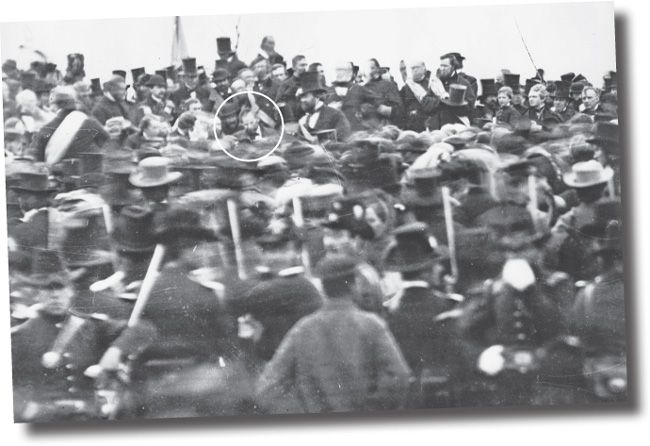
President Lincoln on the speaker’s platform at Gettysburg, November 19, 1863—the only photograph of the President on the day he delivered his most famous speech.
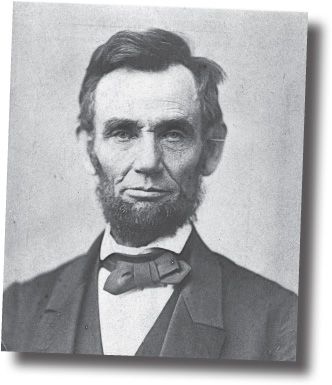
Abraham Lincoln a few days before leaving for Gettysburg, photographed in Washington by Alexander Gardner.
1. Benjamin Brown French (1800–1870) was U.S. commissioner of public buildings during and after the Civil War, during which time he served as well as grand master of the Knights Templar of the United States. French wrote what he called “some rhymes for the celebration” after arriving in Gettysburg on November 14. He later confided: “I never was so flattered at any production of my own, in relation to that same Hymn. All who heard it seemed to consider it most appropriate, and most happily conceived.” See Benjamin Brown French, Witness to the Young Republic: A Yankee’s Journal, 1828–1870, ed. Donald B. Cole and John J. McDonough, Hanover: University Press of New England, 1989, 432–435.)
THE GEN. GRANT’S DEPARTMENT.
THE ARMY AT CHATTANOOGA — THE QUESTION OF SUPPLIES.
NOVEMBER 23
CHATTANOOGA, SUNDAY, NOV. 15
The operations of this army for the present, and for some time to come, will relate to supplies and recuperation. When Gen. THOMAS succeeded Gen. ROSECRANS its condition was extremely critical. The time has not yet arrived for relating how really we were besieged, and how nearly we were to the point of retreat for the want of subsistence; how much less than even half rations were for days served to the men, and even less to the animals, hundreds and thousands of which have died of starvation and excessive work. This vital question of subsistence was the first to which Gen. THOMAS gave his attention; and in the briefest time possible it was happily solved by the skillful movement conceived and executed by Gen. W. F. SMITH,1 Chief of the Engineers, by which Brown’s Ferry was snatched from the enemy, though carefully guarded by LONGSTREET, the river opened to Bridgeport, and the wagon-hauling reduced from sixty-five miles in distance, over a route perfectly indescribable for its difficulties — an average of ten days each way in time — to two miles at the shortest and seven miles at the longest, over a comparatively good route. This movement, which the enemy has pronounced “masterly,” relieved this army from a difficulty under which it could not for a week longer have rested, and since that hour there has been no question of its ability to meet the expectations of the country.
But the country should take into consideration that much time is absolutely required to furnish and recuperate an army like this — not only its present wants, but to supply this point as a depot for future operations. Practically, its base is at Cincinnati and Louisville, a distance wholly unprecedented in the history of army movements. All the supplies, all the clothing, all the ordnance — everything the army needs — must be brought over that long reach of railway. To increase the difficulty, the road from Nashville to Bridgeport (we hope it will be open to Chattanooga before long) is to nearly worn out, had so poorly equipped, that it can perform scarcely a quarter service, and is in daily danger of breaking down entirely. The Louisville and Nashville road is some better, but is so wretchedly managed that hardly one-half the service is got out of it that should be. Both roads are liable to raids from rebel guerrillas and bushwhackers. There are other difficulties to which it is unnecessary to allude — all of which, taken together, render supplying the army a task of peculiar character. Nevertheless, the chief obstacle having been removed, there is no ground for apprehension, and all doubts are at an end. We are under the clearest, brightest sky imaginable, compared with what our condition was before the taking of Brown’s Ferry, a name and a position that every man in this army will remember with the liveliest feelings. Let the country be patient. This army will do its work in good time, and it will do it well.
Little or nothing is known of the plans of the rebels, beyond the expedition dispatched against BURNSIDE, which, though it may obtain some successes, they will be but temporary, and of little or no account in deciding in favor of the rebels the great struggle to take place in this immediate locality. BRAGG’s line stretches from Lookout Mountain, below which, contrary to what seems to be the general impression, he still holds ground to Missionary Ridge and the river above Chattanooga, nearly or quite the whole distance of the semicircle being in full view of our line of defences. All thought or expectation of his ever attempting to operate directly against those defences has ceased to be entertained. There are not men enough in the Confederacy to make an impression on them. What, therefore, BRAGG intends to do, can only be conjectured, but not easily. His flanks are by no means as secure as our own. With him the question of supplies is a far more difficult one than with us. His army, it is settled, is not in the heart that ours is; and the next three months — should that length of time be passed in inactivity — will bring upon him new embarrassments, certainly bring him no better prospects, while it will give to us that condition always a necessary precedent to vigorous action and heavy blows.
Gen. GRANT, whose headquarters are now here, but will be in the saddle, or wherever else his great duty calls, is not idle; nor will he commit any grave mistake; we all feel confident of that. The energies of the army will not be flittered away on purposelessundertakings, on nothing that will not make for the great end in view, — the complete success of our arms. Like a great player, he will make no move on board for the mere purpose of causing his antagonist to make another without some certain prospect of deciding the game in favor of the Union cause. Something like the game of Vicksburgh may be repeated here, for which time, resources and skill are absolute requisites. But no time will be lost. The country may make sure of that, too.
Beyond the fact that Gen. SHERMAN, with a considerable force, is soon to arrive, there are certain things — movements, doings, and so on — that should not be more particularly referred to, which indicate purpose, skill, will and capacity equal to the great work.
Of the stern, grim fact of scarcity of every description of food, not only in the rebel army, but more especially with the home population, of even their ordinarily plentiful part of the South, we have abundant assurance. Word now and then comes back surreptitiously from those who fled from this place when BRAGG retreated, to friends and relatives left behind, to the effect that they have gone to a hard lot and worse fare. Tennesseeans are not treated with favor by their Georgia brethren, who affect to despise them because they did not keep back the “Yankee invaders.” Georgians say, furthermore, that Tennesseeans should have remained where there ought to be plenty of “hog and hominy,” and not have fled to the State that was already supporting a million of extra consumers.
Great pains are taken by BRAGG to prevent Tennesseeans in his army to indulge their favorite disposition to desert to our lines. It is known that special care is taken to put none but reliable men, those who are proof against desertion, on guard. Notwithstanding this precaution, many desert; and within the last few days the number has become greater than ever before. What reason there is for this I am unable to say. Those who came in yesterday reported that our cavalry had got in the rear of BRAGG, and burnt five railroad bridges between him and Atlanta. Of the truth of this, there is no corroborating testimony; nor is there, I believe, anything known at headquarters calculated in prove or disprove the report. The deserters say, also, that rations are scarce in BRAGG’s army, and that that is the reason they deserted. They say that thousands of others would do the same thing had they the opportunity of making the attempt with a reasonable chance of success. Many of those who came in yesterday were fired on by the rebel pickets, but none of them were hit.
Of our situation, let there be no uneasiness. At the same time let not too much be expected in too short a time.
RODERICK.
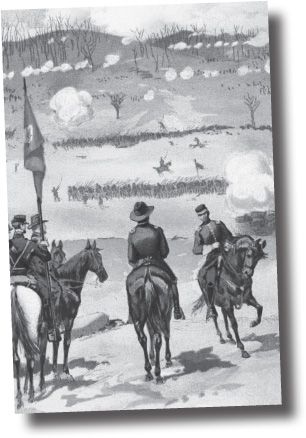
The Battle of Missionary Ridge near Chattanooga.
1. William F. “Baldy” Smith
IMPORTANT FROM CHATTANOOGA.
GENERAL GRANT MOVING ON THE ENEMY’S WORKS.
OUR FORCES HOLDING ALL THE HIGH GROUND IN FRONT OF MISSIONARY RIDGE.
NOVEMBER 25
SPECIAL DISPATCH TO THE N.Y. TIMES.
WASHINGTON, TUESDAY, NOV. 24
The latest news, up to 10:40 this evening, from GRANT is of a most satisfactory character. Gens. THOMAS and SHERMAN have got well ahead.
The fighting in our immediate front has lasted all day long. At every point along the line we have forced the rebels backward. There is joy in the War Department.
CINCINNATI, TUESDAY, NOV. 24
The Commercial of this city has a special dispatch dated Chattanooga, the 23d instant, which says:
“Deserters last night reported that the rebels were falling back of Chickamauga Station.
Their artillery has been withdrawn from our front.
The whole rebel army is apparently in retreat. A reconnaissance this afternoon reveals that the enemy apparently are in force between us and Missionary Ridge.
Gen. WOOD,1 in charging up Orchard Ridge, carried the rifle-pits under a severe musketry and artillery fire, taking 200 rebel prisoners.
We now hold all the high ground this side of Missionary Ridge.
Our troops are in line of battle, and will lie on their arms to-night.
Hard fighting is inevitable to-morrow, unless the rebels withdraw to-night.[“]
WASHINGTON, TUESDAY, NOV. 24
The Star of this afternoon contains the following account of a brilliant preliminary movement by Major-Gen. THOMAS:
CHATTANOOGA, TENN., MONDAY, NOV. 23
The reconnaissance in force made by Major-Gen. THOMAS has been completed in the most brilliant and successful manner.
The troops employed were the divisions of Gens. WOOD and SHERIDAN, of the Fourth army corps, under the immediate direction of Gen. GRANGER.2
The object of the movement was not only to ascertain the strength of the enemy, but to occupy two bold knolls in front of our left, half way between our lines and Missionary Ridge.
The principal attack was made by Gen. HAZEN’s brigade, commanded by that General, supported on the left by Gen. WILLICH’s brigade, and on the right by the whole division of Gen. SHERIDAN.3
The entire field was distinctly visible from Fort Wood, in front of which Gen. HAZEN’s4 line of battle was formed, and as the whole army was under arms, with Gen. HOWARD’s5 corps formed in a solid column, as a reserve to the attacking force, the spectacle was one of magnificence.
The field being commanded by the heavy guns of the fort, only one field-battery was taken into action. This was planted on an elevated knoll, in the centre of which Gen. SHERIDAN’s line of battle was formed before the order, to advance was given.
The troops moved out of their position just before 1 o’clock in the afternoon, and remained in line for three-quarters of an hour in full view of the enemy.
At last, everything being ready, Gen. GRANGER gave the order to advance, and Gen. HAZEN and Gen. WILLICH pushed out simultaneously.
The first shot was fired at 2 o’clock in the afternoon, and in five minutes the lines of Gen. HAZEN were hotly engaged while the artillery of Fort Wood and Gen. THOMAS were opened upon the rebel rifle-pits and the camps behind the line of fighting.
The practice of our gunners was splendid, the camp and batteries of the enemy being about a mile and three-quarters distant; but our fire elicited no reply, and it was soon evident that the rebels had no heavy artillery in that part of their intrenchments at least.
Our troops rapidly advancing, as if on parade, occupied the knolls, upon which they were directed at 2:20 o’clock.
Ten minutes later Gen. WILLICH, driving across an open field, carried the rifle-pits in his front, whose occupants fled as they fired their last volley; and Gen. SHERIDAN, moving through the forest that stretched before him, drove in the enemy’s pickets and halted his advance in obedience to orders on reaching the rifle-pits, where the rebel force was a waiting for his attack.
No such attack was made, however, the design being to recover the heights on our left, but not to assault the rebel works.
We have taken about 200 prisoners, captured mostly from Alabama troops, and have gained a position of great importance, should the rebels still attempt to hold the Chattanooga Valley, as with these heights in our possession, a column moving to turn Missionary Ridge is secure from flank artillery.
The rebels fired their small cannon only during the affair.

A Kurz and Allison lithograph of the Battle of Missionary Ridge.
1. Thomas J. Wood (1823–1906), who was criticized for his actions at this battle for failing to move rapidly when ordered to close a gap in Union lines.
2. Gordon Granger (1822–1876), whose decisiveness and bravery helped save Rosecran’s army at Chickamaugua.
3. William B. Hazen (1830–1887); August von Willich (1810-1878); and Philip H. Sheridan (1831-1888).
4. General William B. Hazen (1830–1887).
5. O. O. Howard (1830–1909).
GLORIOUS VICTORY!
GEN. GRANT’S GREAT SUCCESS.
GEN. HOOKER ASSAULTS LOOKOUT MOUNTAIN.
NOVEMBER 26
DISPATCHES TO THE ASSOCIATED PRESS.
CHATTANOOGA, WEDNESDAY, NOV. 25
We are completely victorious. The enemy is totally routed and driven from every position. Our loss is very small and the enemy’s is heavy in prisoners. Finding Gen. HOOKER so successful in his movements against Lookout Mountain, the enemy evacuated that position during the night.
Gen. HOOKER took possession early this morning. The enemy moved south and got on Missionary Ridge on the battle-field somewhere near Chickamauga. He is expected to intercept the flying foe. Gen. HOOKER is said to have captured 2,000 prisoners in his magnificent assault of Lookout Mountain.
Gen. SHERMAN being all prepared to begin an assault at 8 A.M. to-day, upon the strong position of the enemy at the north end of Missionary Ridge. He had the day before taken a hill near the position of the enemy, but commanded by their artillery. He had to descend into a valley, and he then made another ascent to the position held by the enemy. Two unsuccessful assaults were made by Gen. SHERMAN, but, with the cooperation of the centre, he ultimately gained the position, and completed the great victory.
The brigade of Gen. CARSE, with a portion of Gen. LIGHTPEWS brigade, composed the storming party in the first assault. They were repulsed with quite a heavy loss after an attack persisted in for an hour; but being reinforced they, were enabled to hold a part of the hills. In this attack Gen. CARSE was wounded quite severely in the thigh. The Thirty-seventh Ohio and Sixth Iowa and One Hundred and Third Illinois regiments were in the attack. A second assault was made at 3 1/2 o’clock, in which MATHIAS’ [sic]1, LOOMIS’ and RAUL’S brigades were engaged. The force reached within twenty yards of the summit of the hill and the works of the enemy, when they were flanked and broke, retiring to their reserves.
In this assault Gen. MATHIAS was wounded and Col. PUTNAM, of the Ninety-third Ohio, killed, their persistent efforts compelled the enemy to mass heavily on his right in order to hold the position of so much importance to him. About 3 o’clock Gen. GRANT started two columns against the weakened centre, and in an hour desperate fighting, succeeded in breaking the centre, and gaining possession of the ridge in which the enemy was posted, the main force was driven northward toward Gen. SHERMAN, who opened on them, and they were forced to break, and seek safety in disordered flight down the western slope of the Ridge, and across the western ridge of the Chickamauga. We have taken not less than 5,000 prisoners and perhaps 10,000. Gen. HOOKER will probably intercept the flying enemy in the vicinity of Rossville and the region east of it.
There are reports that we have taken a whole corps.
Among the casualties are Lieut.-Col. ESPY, of the Sixty-eighth Indiana regiment; Major MCCAWLEY, of the Tenth Iowa; Col. OMARS, of the Ninetieth Illinois; Lieut.-Col. STUART, of the Ninetieth Illinois; Major WALKER, of the Tenth Missouri; Major WELSE, of the Fifty-sixth Illinois; Major INNISS, of the Sixth Iowa, wounded; Major IRWIN, of the Sixth Iowa, killed.
Full reports of the killed and wounded cannot be attained, as most of the killed were in Gen. SHERMAN’s corps, and remained at dark in the hands of the enemy. The list will be telegraphed to-morrow. The prisoners say that BRAGG was on the Ridge just before they were taken.
The successful storming parties consisted of WOOD’s and BAIRD’s divisions on the left centre and JOHNSTON’s and SHERIDAN’s on the right centre. Some of our wounded were left in the hands of the enemy after Gen. SHERMAN’s unsuccessful assault, but were ultimately recovered.
CHATTANOOGA, WEDNESDAY, NOV. 25 — 10 P.M.
The captured artillery is reported at about forty pieces. Gen. HOOKER captured five boxes of new muskets on Lookout Mountain.
We are in entire possession of the field. We have control over the railway and river to Bridgeport. Two boats came through this morning. Our loss will not amount to more than 300 killed and 250 wounded in the three days operations. The success has been most brilliant.
The enemy is reported to be bivouacking two miles beyond Missionary Ridge. Col. PHELPS, of the Thirty-eighth Ohio, and Major GLASS, of the Thirty-second Indiana, are killed. Gen. JOHN E. SMITH2 is reported wounded. Col. AVERY, of the One Hundred and Second New-York, lost a leg, and Major ELLIOTT is the same as dead.
1. Charles (Karl) L. Matthies (1824–1868).
2. John Eugene Smith (1816–1897) survived his wounds and went on to join Sherman on the “March to the Sea.”
OFFICIAL REPORTS FROM GEN. THOMAS AND GEN. GRANT.
NOVEMBER 26
WASHINGTON, WEDNESDAY, NOV. 25
The following official dispatch from Maj.-Gen. GRANT has been received at the headquarters of the army here:
CHATTANOOGA, TENN.,
TUESDAY, NOV. 24 — 12 M.
Major-Gen. H.W. Halleck, General-in-Chief:
Yesterday, at 12 1/2 o’clock, Gen. GRANGER’s and Gen. PALMER’s1 corps, supported by Gen. HOWARD’s, were advanced directly in front of our fortifications, drove in the enemy’s pickets, and carried his first line of rifle-pits between Chattanooga and Citer’s Creek.
We captured nine commissioned officers and about 100 enlisted men.
Our loss is about 111.
To-day Gen. HOOKER, in command of Gen. GEARY’s2 division, Twelfth corps; Gen. OSTERHAUS’3 division, Fifteenth corps, and two brigades, Fourteenth corps, carried the north slope of Lookout Mountain, with small loss on our side, and a loss to the enemy of 500 or 600 prisoners; killed and wounded not reported.
There has been continuous fighting from 12 o’clock until after night; but our troops gallantly repulsed every attempt to take the position.
Gen. SHERMAN crossed the Tennessee River before daylight this morning, at the mouth of the South Chickamauga, with three divisions of the Fifteenth corps and one division of the Fourteenth corps, and carried the northern extremity of Missionary ridge.
Our success so far has been complete and the behavior of the troops admirable.
GEORGE H. THOMAS, MAJOR GENERAL.
SECOND DISPATCH.
CHATTANOOGA, TUESDAY, NOV. 24 — 6 P.M.
Maj.-Gen. Halleck, General-in-Chief, Washington:
The fighting to-day progressed favorably.
Gen. SHERMAN carried the end of Missionary Ridge, and his right is now at the Tunnel, and his left at Chickamauga Creek.
The troops from Lookout Valley carried the point of the mountain, and now hold the eastern slope and point high up.
I cannot yet tell the amount of casualties, but our loss is not heavy.
Gen. HOOKER reports 2,000 prisoners taken, besides which a small number have fallen into our hands from Missionary Ridge.
U.S. GRANT, MAJOR-GENERAL.
1. John McCauley Palmer (1817–1900) had been a legal associate and political supporter of Lincoln in Illinois, and later served as his state’s governor.
2. John W. Geary (1819–1873) later served as governor of Pennsylvania.
3. Peter J. Osterhaus (1823–1905) led the drive against Braxton Bragg.