
CHAPTER 17

Detail of a print showing the Point Lookout prisoner of war camp in Maryland. Approximately 50,000 Confederate enlisted men were contained within the walls of the camp between 1863 and 1863.
Another winter of unresolved war opened in frustration over ongoing stalemates east and west. The Federal assault on Charleston continued unabated — but with no signs of easy triumph and few signs of progress. The Confederate siege of Knoxville proceeded as well — punishing both the armies and the city. Once again, The Times wondered what the hunkered-down troops would do when spring finally arrived.
In December, all eyes turned to America’s two Presidents, Abraham Lincoln and Jefferson Davis, as they offered annual messages to their respective Congresses. Davis’s to the fourth session of the First Confederate Congress was frank, bellicose, and resentful. Conceding that the South had suffered “grave reverses” on the battlefield the previous summer, Davis blamed the Lincoln administration’s “savage ferocity” and its refusal to continue exchanging prisoners of war. That policy shift was harsh but strategically logical: Confederate soldiers were far scarcer than Union soldiers, and the more Confederates that remained in prison, the greater the proportional impact on the strength of its depleted army. However heartless the policy, the keeping and feeding Union prisoners under Southern confinement strained the Confederate home front, which was having difficulty feeding its civilian population.
Lincoln endeavored to judge the human consequences of the new policy firsthand. On December 27, he journeyed with Secretary of War Stanton to visit the newly established prisoner-of-war camp at Point Lookout, Maryland. Its commanding officer, General Gilman Marston, told the President exactly what he wanted to hear: that there was a “strong feeling of attachment to the Union” and “disgust for the rebellion...among his prisoners.”
In his own annual message to the 38th Congress on December 8, Lincoln supplied his usual rousing eloquence — reminding the legislative branch that a secure Union would set an example for the rest of the world. He also offered a new policy that looked past the fighting to the eventual restoration of the Union. Lincoln’s Proclamation for Amnesty and Reconstruction proposed to re-establish state governments in the rebellious states upon approval of only 10 percent of all voters who had participated in the 1860 election. And it offered to pardon all rebels who took an oath of loyalty to the Union. But Lincoln’s magnanimity went only so far. The proclamation specifically excluded high-ranking Confederate military and naval officers, “officers or agents of the so-called confederate government” (small “c” intentional), and “all who have engaged in any way in treating colored persons or white persons... unlawfully as prisoners of war.”
Lincoln brought the controversial issue full cycle on January 2, ordering General Benjamin Butler to discharge any prisoner at Point Lookout who was ready to take the oath prescribed in his order. The released prisoners could either enlist in the Union military or go home in peace, but only if their homes lay “safely within our military lines.” On February 18 Lincoln ordered a relaxation of the three-year-old blockade on those Southern ports now controlled by the Union. But to be certain his army would be manned for as long as it took to win the long conflict, Lincoln also ordered a draft of 500,000 men on February 1 to serve for three to four years or until the war ended.
That month, while the armies in the east remained stalled in their winter camps, William T. Sherman conducted a campaign into the heart of Mississippi aimed at the town of Meridian, an important railroad center that was home to a Confederate arsenal, hospital, and prisoner-of-war camp. Sherman set out on February 3 with a main force of 20,000 infantry, plus a cooperating cavalry force of 7,000 under Brigadier General William Sooy Smith. Union forces reached Meridian on February 14, and Sherman ordered his troops “to wipe the appointed meeting place off the map” by destroying the railroads and burning much of the town to the ground. Afterward, Sherman is reported to have said: “Meridian with its depots, store-houses, arsenal, hospitals, offices, hotels, and cantonments no longer exists.” It was a harbinger of the hardening war, and a portent of things to come.
Yet if President Lincoln was coming to the belief that such actions might bring victory closer, he was soon enough reminded otherwise. On February 20, Confederate forces prevailed at the Battle of Olustee, the only major Civil War engagement fought in Florida. The Union casualty figure was 1,861: an almost surreal reminder of the year this long war had started.
GEN. GRANT’S OPERATIONS — WHAT NEXT?
DECEMBER 1
Those who fancy that Gen. GRANT will pursue BRAGG from the hills of Georgia down to its plains, or down to the seaboard, will most likely find themselves mistaken. It is a painful necessity of our Western heroes that each hero of them requires his “pound of flesh” every day, not to speak of an equal weight of “hard tack;” and those who will for a moment reflect on the amount of solid victual required to sustain the hearts of fifty or sixty thousand men for a week, will at once see the difficulty of sending them on a campaign, which, at its best, would occupy them for months, through a region bare of food, and into which it is impossible for Gen. GRANT to convey supplies. We do not think it would be feasible to maintain the army of Gen. GRANT even at Atlanta during the Winter; for, though the forces of BRAGG may be pretty thoroughly demolished or dispersed, there would still be bodies of them left to roam through the country, who would operate on our lines after the style of MOSBY in Virginia, and with a hundredfold the effect. We doubt whether, even if the rebels had but ten thousand men in Northern Georgia, against ten times that number on the Union side, it would be possible for GRANT to plant his army fifty miles south of Chattanooga and maintain his communications with it. On this account, we do not entertain the idea that Gen. GRANT will, at this time, push on his victorious columns, as many seem to imagine he must do. There is an operation secondary to the route of BRAGG, which would be in keeping, and in which, there is reason to believe, Gen. GRANT is at present engaged. We refer to the cutting off and defeat of LONGSTREET’s column in East Tennessee. In his official dispatch of Friday morning last, and in his operations of Thursday, GRANT gave us ground to believe that this was the matter next in hand — that is, to intercept LONGSTREET in his attempt to join himself to BRAGG. Even if he had the idea of pushing down into Georgia after the flying rebels, it would be necessary to attend to this first; for he could not allow a column of eighteen or twenty thousand men to exist and operate in his rear, to threaten his lines and threaten Chattanooga itself. It will not be until we have determinate operations bearing upon LONGSTREET, that the next movement of Gen. GRANT will unfold itself.
As it is preposterous to conceive of Gen. GRANT extending his lines down into Georgia, we think it altogether likely that his next movement will be to contract his lines around Chattanooga. The aim and end of the late campaign was to push the menacing rebels from his front — to effectually raise the siege of Chattanooga, if the rebel attempt at investment may be called a siege. This has been done in the most perfect and conclusive manner; and as nothing whatever would be gained by forcing his advance southward, until such time as he is ready to begin the grand advance that shall change his base to the Atlantic seaboard, we have no idea that such unmilitary step will be taken. If, therefore, it should soon be announced that GRANT’s army has fallen back to Chattanooga, there need be no dreadful disappointment expressed. The view of the case and of the campaign just set forth is confirmed by a telegram just received from Chattanooga as we write, which announces that “there has been no fighting for two days,” and that “the campaign in Northern Georgia is probably ended.”
GRANT’s grand campaign, in the direction of Augusta, the final campaign of the war in the Southwest, commences properly with the incoming Spring. A great depot, or base, will by that time have been established at Chattanooga — the army will have recruited from its prodigious labors of the last few months, and it will take up the final march under its great leader, well assured of a final success.

A Kurz and Allison lithograph of the Battle of Missionary Ridge.
THE PRESIDENT’S PLAN OF RECONSTRUCTION.
DECEMBER 11
We long ago took decided ground against all schemes of provincializing the rebel States — maintaining that they were radically wrong in principle, and would prove calamitous in result. The President’s plan of restoring our Federal system to its normal operation, therefore, finds us already thoroughly committed to it in every essential particular.1 But, apart from our own foregone conclusions, we cannot help feeling the convincing power of the mere enunciation of the President’s programme. Feasibility, justice, consistency, and security, are so patently met by it, in the fullest measure, that it challenges at once the acquiescence of all truly loyal men. Of course Faction will bark at it. It is the very nature of Faction to fly at any public good. But this manifestation of instinct will only be corroborative of the intrinsic excellence of the plan. There has not been a great efficacious measure in this war whose first appearance was not assailed thus. Could this prove an exception, we should at once surmise there must be something wrong about it.
What is the problem to be solved? It is — How to restore truly and safely the part of the Union which revolted.
The scheme to provincialize the rebel States does not meet it, for it would not be a true restoration. It would be, on the other hand, a destruction. Our Federal system is composed of States. The Federal Constitution is the basis on which States agreed to establish a common Power. It has its name — Federal — from that fact solely. Otherwise it would be purely national. The fact that the General Government is the paramount Government, to which the people of the States are directly responsible in certain relations, don’t in the least affect its Federal character. There may be disputes about the measure of State rights — that is to say, about the extent to which the States accorded or reserved powers — but there never has been a dispute, and never can be, that the Union was originally and essentially one of States, and that the nation itself has no existence but as THE UNITED STATES. The transformation of a State into a province — supposing any power, military or other, could do it — would be to just that extent a retrenchment of the Union, an elimination of the nationality. Georgia, as a province, would be no more a part of the Union than Canada. It might be, indeed, a territorial appendage of the Union, an external possession of it; but, in no legitimate sense, a part of it. Therefore, those who talk of restoring the Union by provincializing any of the States advance a self-contradiction. There can be no true restoration except by conserving the integrity of all the parts to be restored.
But again, on the other hand, they who advocate a restoration without any Federal action whatever — a restoration which shall be simply an emergence from the war, and resumption of the old status without any new limitations or conditions — fail to meet the other requirement of the problem, safety. What endangers this Union, is not the rebellious spirit in itself, as a passive thing, but the rebellious spirit in outward act — not the feeling cherished, but the power exerted. The object of the war is not to convert traitorous into loyal sentiments, but to protect itself from the military power of those sentiments. So the object of the whole policy of the Government must be to protect itself from the power of the rebel spirit, however exerted. It is certain that the rebel spirit, for a time, at least, will survive the war which crushes its military power. Deprived of its war-weapons, it will seek other; means of hostile action; particularly the ballot, which, in the hands of enemies, is perhaps more formidable to any Government, than any other. There will be a necessity, therefore, for the Government of the Union to protect itself from this rebel power of hampering, and crippling, and destroying it by voting. Self-preservation just as much forbids it to tolerate enemies in its Senate-house as enemies in the field. To insure security, traitors must be stripped of their civil power, as absolutely as of their military power, and must remain so disabled until they cease to be traitors, by renouncing their treason. This is the only safeguard. We don’t remember yet to have seen the plain, distinct avowal that the rebel civil power of a State shall remain intact after its rebel military power is crushed, for everybody would feel it almost treason to sustain a principle assuming just that shape. Yet this is simply the full, consistent development of the doctrine of restoration by non-interference. No man, not an outright supporter of the rebellion, can deny that the safety of the Government requires it to put its hand on the rebel civil machinery at some point. It is only those who don’t value, or who don’t stop to regard the safety of the Government at all, that deny or ignore this. But if it be allowed that the civil machinery of the rebels is to be touched at any point, the whole principle of non-interference collapses.
The President’s plan avoids all incongruities, and fulfills each cardinal requirement. By preserving the integrity of the States, it secures a Federal restoration, true alike in name and fact. By necessitating an oath of loyalty as a condition precedent to amnesty and pardon and the renewal of civil rights, it deprives unrepentant traitors of the malign use of any civil power, and thus makes the Federal restoration safe. The plan, in principle and application, is perfectly adapted to the exigency, and will be approved by the loyal people.
1. Citing his broad “power to grant reprieves and pardons for offences against the United States,” President Lincoln issued his Proclamation of Amnesty and Reconstruction on December 8, 1863, the same day he submitted his third annual message to Congress. For text, see Basler, ed., The Collected Works of Lincoln, 7:53–56..
PRESIDENT’S LINCOLN’S PLAN OF RECONSTRUCTION.
— VIEWS FROM WASHINGTON.
DECEMBER 13
The conflicting theories and speculations which have been afloat for a twelvemonth past in regard to the mode of restoring the rebellious portions of the South to their allegiance, and to the enjoyment of peace and protection under the Constitution have been happily blended into a practical measure by the President’s Proclamation and Message.1 Those who maintained that the States in rebellion had ceased to be States, and that they should be treated as unorganized territories; and those who advocated the contrary theory, will find in the Proclamation that practically the President has secured all that either had in view. The great object of one class of persons was to secure the abolition of Slavery, and of the other, to maintain the ancient landmarks, and in some sort, the continued existence of the States. Both these ideas are embodied in the plan of the President.
There are those who think that any plan of reconciliation and restoration is premature at present; but it is only necessary to recur to the actual condition of things in Arkansas, Tennessee and Louisiana, to remove all doubt as to the propriety of the President’s course. In each of these States the rebel power is completely broken, and their populations are practically without any regular governments. The rebel State functionaries have run away, and there remains only the military control of the General Government. This is very necessary to prevent the inroads of the enemy, and to crush the latent disloyalty which would otherwise break forth; but there still is lacking the machinery of Civil Government, Courts of Justice, and a constabulary force for the preservation of order.
The plan, suggested by the President, is admirably fitted to supply this want. In the total disruption of Southern society, which the rebellion has caused; in the waste and dispersion of the male inhabitants of mature age, it would be absurd to expect that half of the voting population could now be rallied, or even found within the limits of the State. If, therefore, one-tenth of those who voted in 1860, can now be found ready to take the oath of allegiance presented, the General Government will be well warranted in recognizing them as “the people” with authority to reconstruct the machinery of State Governments, upon the conditions stipulated. I regard the appearance of the Proclamation as most opportune....
OBSERVER

A Mathew Brady studio photograph of President Abraham Lincoln taken on February 9, 1864.
1. Lincoln’s annual message to Congress focused on what he called “the new reckoning.” Lincoln optimistically declared: “The crisis which threatened to divide the friends of the Union is past.” And he warmly saluted Union troops, “to whom, more than to others, the world must stand indebted for the home of freedom disenthralled, regenerated, enlarged, and perpetuated.” For the text, see Basler. ed., The Collected Works of Lincoln, 36–53.
THE NATIONAL AUTHORITY — A TEST VOTE IN CONGRESS.
DECEMBER 20
Well, the House has taken a test vote on the really vital principle of the war. It has long been plain to discerning minds that behind all this talk about habeas corpus, emancipation, State rights, and other questions which mere party men have sought to keep in the foreground, there has been a controlling influence quite distinct from anything that appeared in the controversy. It was something that shaped and colored the opinions of men, and predisposed them in advance to approve or denounce — something that was “the master light of all their seeing.” Between the supporters and opponents of the Administration there has been a higher issue, not so palpable as the others, because abstract, and yet that dominated all the others. The leaders of the Opposition have in general tried to keep it from view, and to this mainly they are indebted for the little success they have ever achieved.
This superlative issue is, whether authority is a necessity of this Federal Government or not. Mr. CALHOUN, JEFF. DAVIS, and all the rebel crew have maintained that the Federal Government had no authority at all. They held that a portion of the people, through the State organizations, might nullify it or secede from it, which was equivalent to holding that the Federal Government had no authority. Power, resting on permission, is not authority. Authority involves coercive right. Mr. BUCHANAN committed himself to the same doctrine in his last annual message, wherein he denied any Federal right to coerce States, or the people of a State acting through the State Government. Gov. SEYMOUR of Connecticut took the same ground in the gubernatorial canvass of that State last Spring.
But the leaders of the Opposition generally do not believe in, or if they do, they do not dare to take this extreme ground that there is no such thing as Federal authority. They may or may not allow its existence, but if it does exist, they do not consider it at all a necessity. According to them, it can be dispensed with just as convenience or transient expediency may prompt. Up to a certain mark they have no particular objection to it, but beyond that they are disposed to treat it as an intrusion and a nuisance. Of course they don’t say so, exactly. This would hardly answer, for the people have still some remnant of the old-fashioned prejudice about the supremacy of law and the inviolable sanctions of Government. But the language and acts of their leaders for the last two years have indicated their disbelief in the necessity of maintaining authority. They have manifested it indirectly, but none the less unmistakably.
The war against the rebellion was undertaken to vindicate and enforce Federal authority. The first Proclamation of President LINCOLN — that of the 15th of April, 1861, calling for 75,000 militia — set forth that the object was to “cause the laws of the United States to be duly executed.” That is the end, the sole end, and nothing but the end of the war. On that principle the President stands, and ever has stood. His language from the beginning has been that the men in rebellion could have peace by obeying the laws and submitting to the authority of the United States, and in no other way whatever. His opponents have never confronted him squarely on that ground, but they have sought to deprive him of the means of prosecuting the war effectually upon it. They undertook to take from him the right of suspending habeas corpus, though its suspension in case of rebellion is expressly recognized by the Constitution as a necessity. They undertook to break down the National Enrollment Act, which was necessary to supply the armies in the field against the rebellion. They undertook to put the war under an interdict against touching Slavery, when it was not a human possibility to carry on the war with any effect without touching Slavery. They have in this way constantly operated against the methods used by the President to maintain the national authority, and have used every variety of pretext to do it without rousing the people to the fact that they really did not believe in maintaining the national authority. It was high time that this matter should be exactly understood.
Mr. GREEN CLAY SMITH,1 of Kentucky, submitted to the House of Representatives the following resolution:
“Resolved, That as our country and the very existence of the best Government ever instituted by man, is imperiled by the most causeless and wicked rebellion that the world has ever seen, and believing as we do that the only hope of saving the country and preserving this Government is by the power of the sword, we are for the most vigorous prosecution of the war until the Constitution and laws shall be enforced and obeyed in all parts of the United States, and to that end we oppose any armistice, or intervention, or mediation, or proposition for peace from any quarter, so long as there shall be found a rebel in arms against the Government; and we ignore all party names, lines and issues, and recognize but two parties in this war, patriots and traitors.”
That resolution struck directly at the heart of all this difference between the Administration and its opponents. It was an assertion of the right and the necessity of an unyielding maintenance of authority by the National Government. It was a recognition that this nation lives in law, and not in chance, or individual pleasure; and that when this vital principle is assailed, it cannot be surrendered, in whole or in part, but must be protected and preserved in its absolute integrity. A court of justice has judicial authority, conferred by law; but if that authority is used to negotiate with criminals, it ceases to be authority, and becomes a mere parleying between equals. Law is maintained not by negotiation, but by judgment. If clemency is to come in at all, it comes after the law has asserted itself, and not before. Just so if clemency is to extend to the rebels, if concession in any shape is to be given them, it must be done after the lawful authority of the United States has vindicated itself. That resolution presented this vital principle distinctly. What was the vote upon it? Ninety-three members of the body said yes to it; Sixty-four said no. Every man of these sixty-four is an opponent of the Administration of President LINCOLN.
This settles the matter. The animus which will prompt the future votes of these men against the measures of the Administration is now put beyond all further doubt. They oppose not because the measures are inexpedient as means, but because they are calculated to promote an end which they do not believe in — enforcement of law on one hand, unconditional submission on the other. They occupy a position between loyalty and rebellion — but nearer the latter than the former, for while they may agree with the one that authority exists as an abstraction, they agree with the other in the much more practical thing that there is nothing in it that ought to be exercised. They may accord with the loyal men so far as regards the form, but they actually do accord with rebels so far as relates to the substance — with the one in the theory, the other in the practice.
The division of this resolution supplies a classification long needed. It puts a distinctive mark on our Representatives, that is the only really essential one. The principle it involves will hereafter assume a yet bolder form, and, in all probability, will make the main issue in the great elections of the coming year.

Congressman Green Clay Smith of Kentucky.
1. Green Clay Smith (1826–1895) was a congressman from Kentucky who had resigned as brigadier general of volunteers to take his seat as an Unconditional Unionist.
HOW THE AMNESTY PROCLAMATION WORKS.
DECEMBER 20
It is not yet three weeks since that Amnesty Proclamation was issued. Of course no sensible man ever imagined that it would have any speedy effect within the rebel lines. It would require time for it to be brought to the knowledge of the people. And, again, after a right understanding of it had been gained, it would take a yet longer time for definite resolutions to be formed upon it, and definite lines of action to be adopted. In fact, under the despotism which presses everywhere in the Confederacy, any popular demonstration in response to the President’s offer was extremely improbable. The chief value of that offer, so far as relates to those parts of the South yet unreached by our arms, was simply moral. It was calculated not so much to excite a counter-revolution, as to predispose the common people of the South to a prompt and cheerful submission, when our armies shall advance. It was adapted to wean the people from the desperation into which the rebel leaders, had sought to plunge them by the representation that there was no such thing as yielding but at the cost of perpetual vassalage. We must, therefore, expect that the results of the Proclamation will only gradually reveal themselves, and must await them in patience. That they will come in due time, and in a very valuable shape, we have not a doubt.
The rebel Congress affects to treat the Proclamation with sovereign contempt. Of course it does; and for two reasons. First, there is not a man of them who is not expressly excluded from the benefit of its provisions, by being “civil officers of the so-called Confederate Government.” And again, there is probably not a man of them who is not a slaveholder, and the oath to support the Emancipation Proclamation, until declared null by the Supreme Court, must be to all slaveholders like holy water to the Evil One.
The Proclamation of course was not designed to appease and win over the Slave Power. The man is a fool who at this day believes in this possibility, under any device short of a complete and absolute surrender of this Government to that power. It made the rebellion; it staked its all on the rebellion, and whatever the attitude of the Government, it will adhere to the rebellion to the last gasp. But the Slave Power and the Southern people are not identical. The one is only a small part of the other, though it has hitherto been the supremely controlling part. There is nothing inherent to prevent their being dissociated. On the contrary, there long has been the strongest reason why the Slave Power should be repelled by the common people of the South; for it is an undeniable truth that it always kept them in ignorance, poverty and degradation, and, through its instrumentality alone, they have for the last two years been subjected to the most terrible woes that have befallen any people. By virtue of every right feeling and sound principle, there certainly ought to be a break between the slaveholders and the poor whites. It is just and wise in President LINCOLN to labor to produce it. If once effected, the rebellion would speedily sink, and the complete reconciliation of the vast majority of the South would follow with little delay or trouble. The Amnesty Proclamation takes away all inducement to follow the Slave Power to “the last ditch,” and die with it there. By proffering reinstatement every right and privilege valuable to an American citizen; it, in fact, makes all each desperation morally impossible. Arbitrary power, which is still wielded exclusively by those to whom Slavery is the supreme concern, will for the present hold the people to the fight. But it will be able to push the people to no such extremity as it once believed it could do, if the necessity were upon it. There may be, and probably will be, good stiff fighting yet up to a certain point; but, before being pressed beyond that point, there will be general escape through the wide and safe gate which this Amnesty Proclamation will always keep open.
GEN. GRANT’S WINTER OPERATIONS.
JANUARY 13
Whatever may take place in any other department, the public attention naturally centres, even at this quiet season, upon the great central department, the operations in which must again bisect the Confederacy and eventually end the rebellion. We presume no one expects any grand military operations to be undertaken in that region at present. But there is much to do — indeed, there is much being done — which is all-important and highly essential to future operations. Spring opens next month in the latitude of Chattanooga, and the month of March may admit of a movement.
But the extent of Gen. GRANT’s Department is so vast, and the character of his operations so vital, that it is eminently necessary that the preparations now making should be entirely and permanently complete, before another step in advance is taken. Hitherto, operations in that immediate vicinity have been attended with unparalleled difficulties as to supplies and transportation. Actual experience is necessary to convey a truthful and adequate idea of the obstacles overcome, and the sufferings endured by the armies under ROSECRANS, THOMAS, GRANT and BURNSIDE, during the past ten months. To permanently remove these obstacles — to render it certain that no step backward shall be taken on any account, is Gen. GRANT’s present work. One line of railroad is no longer sufficient as a means of communication and supplies; two must be had, and with the Tennessee River, possibly three lines between Chattanooga and Nashville, or any other secondary base, may be kept up. Nashville was fortified, and by the accumulation of immense supplies, rendered the great secondary base of the army in the Middle Department, before the advance through Tennessee could be commenced. And so with Chattanooga. Its strategic relations to the remaining part of the Confederacy indicate it as another point for a great secondary base of supplies; the point from which the last onward movement in that quarter, and probably the final movement in the suppression of the rebellion, is to be made. Considering, then, the magnitude of the force which must be concentrated for this work, it is easy to see that Gen. GRANT’s winter operations, though they are not resounding with the clash of arms, nor stirring us with bulletins of victory, are of a character not less important than the vital movements which are dependent upon them.
Information reaches us now and then from the Department of the Mississippi, going to show what is being done in the matter of opening and establishing lines of railroad and water communication. The line of the Nashville and Chattanooga Railroad, now about being opened to Chattanooga for the first time, has long been inadequate to the proper supplying of even a small army. It is full of heavy grades, has poor rails, and miserable rolling stock. But it is employed to its fullest capacity. Within the past ten days the great bridge over the Tennessee, at Bridgeport, has been completed; also, that over Running Water Creek, near Chattanooga, 25 feet high and 800 feet long. This brings the cars into Chattanooga, from whence they can run to Atlanta or Augusta, to Knoxville or Richmond, whenever the condition of affairs shall permit. Another line of railroad will soon be, if it is not already, in full operation between Nashville and Bridgeport, (or Stevenson) Alabama. This is the Tennessee and Alabama Railroad, which intersects the Memphis and Charleston Railroad at Huntsville, the latter forming a junction with the Nashville and Chattanooga Railroad at Stevenson — thence over the track of the latter, or by river from Bridgeport, to Chattanooga. This gives Gen. GRANT substantially two routes of rail communication with his first secondary base. By next month, through the means of a railroad from Nashville to the Tennessee River, he will have two reliable railroad lines, and one water line available a portion of the year, (the Cumberland River), with his primary base, the Ohio River....
That indomitable Western energy which carries all before it will prevail, and though the next movement in the Southwest may not be in February, nor perhaps even in March, yet when it does take place, there will be no backward steps, and no such word as fail. With Spring-time comes vegetation, and the subsistence of animals will be less difficult, and as the army advances it will, as it has heretofore, inevitably find a considerable quantity of supplies that has escaped the rebel fighting-man. So let the Government not fail to see to it that Gen. GRANT has an army in numbers sufficient for his work; all other armies are of secondary account; the last fatal blow to the rebellion is to be struck by Gen. GRANT; the rebels appreciate this, and such efforts to avert it as they are capable of they are making. It would be a shame if any pains, or labor, or material, or men should be withheld, which, if furnished, might speedily give us a crowning and final success.
HOW SOON WILL THE WAR END?
JANUARY 21
This question is asked, in public and private, a hundred times a day, and but few of the answers are ever based upon any sound reasoning or reliable facts. It is in small, almost insignificant occurrences and expressions that the true condition of the rebellion, and that of the people of the South, is most truly indicated. A Richmond paper of a recent date announces with extreme gratification the arrival of one hundred live fat hogs in the neighboring city of Petersburgh, styles it a “very pleasant kind of invasion,” much more agreeable than to be “invaded by a hundred lean, slab-sided Yankee prisoners,” coming to eat pork instead of producing it. Another article recommends a plan by which every portion of the cattle and hogs slaughtered for the use of individuals and the army may be made available, and significantly adds that in “many portions of the States the supply of these animals is exhausted.” Thus, day after day, these little irrefutable indications of the condition of the rebellion manifest themselves in a plain, unprejudiced manner, and are worthy, therefore, of general credence. Let those who study the progress of the war carefully note these certain developments, and they can obtain an idea of how soon the war will end, which will be far more reliable than if based on almost any other reasoning or hypothesis. The people of the South are so despotically ruled, that their demands for peace will be stifled so long as there are bayonets at the command of the rulers. But as the progress of our armies narrows still more closely the country on which they depend for food, actual starvation, now threatened, will become an inevitable fact, unless submission to the rightful Government is promptly accorded. So long as the lines of the armies of the rebellion covered the States of Kentucky, Tennessee, Arkansas and Texas, the weapon of starvation was one on which we could place no dependence. But the condition of affairs now justifies the public in placing some dependence on the indubitable evidences of a speedy dissolution which appear from time to time in the rebel journals, and which they cannot repress if they would.
THE RESTORATION OF LOUISIANA.
JANUARY 21
The wheels have started. The work of bringing back the “Confederate” States has begun. Maj.-Gen. BANKS, under the authority of the President, has issued a proclamation to the loyal citizens of Louisiana, providing for an election of Governor and other State officers on the 22d of February next, and the installment of such officers on the 4th of March; also, for an election of delegates, on the first Monday of April, to a Convention for the revision of the Constitution. He has taken this step on the assurance that more than one-tenth of the population desire the speedy reinauguration of civil rule on the basis of the Amnesty Proclamation of the President, and that the movement will be carried through in absolute good faith to the National Government.
The experiment will be watched with great interest. Its success, which is confidently anticipated, will demonstrate the complete efficiency of the plan of the President, as applicable to every “Confederate” State. Louisiana was driven into the “Confederacy” more reluctantly, perhaps, than some of the other States; but, after a brief period, it yielded to the dazzling promise that New-Orleans should be the great emporium of the new slave empire, and became as fanatical as any in its devotion to the treason. No part of the “Confederacy” that we have yet regained has exhibited such intensity of hate to the old flag, as was shown by both sexes and all classes in New-Orleans on its first occupation by Gen. BUTLER, a year ago last May. So far as appearances indicated, it was not possible that rebels could be more irreclaimable. And yet, under a regimen at first severe and then relaxing, the rebel spirit has been gradually giving way to loyal sentiment, and it is believed that there is now enough of the latter to control the State, if trusted with civil powers. If the programme of Maj.-Gen. BANKS is carried out, within two months Louisiana will be as literally and completely a loyal State in the Union — with a loyal State Government and loyal representatives in both branches of Congress — as New-York itself.
What will be more notable yet, Louisiana, within three months, will have a Constitution as thoroughly purged of negro Slavery as our own1....
If this method of restoring Louisiana succeeds — and it is almost impossible to doubt that it will — all further concern for the fate of Slavery anywhere will be entirely useless. By the simple re-establishment of loyal State power, the whole question of Slavery is decided in fact, if not in form. This ought to content all rational men.

Major General Nathaniel P. Banks, U.S.A.
1. Lincoln moreover urged the state’s new governor, Michael Hahn, to include negro suffrage in its new constitution—for “the very intelligent, and specially those who have fought gallantly in our ranks”—the first time an American President ever endorsed the right of African-Americans to vote. “They would probably help,” Lincoln said, “to keep the jewel of liberty within the family of freedom.” See Basler, ed., The Collected Works of Lincoln, 243.
JOHNSTON’S RETREAT — MOVEMENT OF THE REBEL ARMY.
JANUARY 29
A dispatch wearing all the appearance of authenticity reaches us with the important intelligence of the rebel Gen. JOHNSTON’s withdrawal from the front which he has lately held at Dalton. The news, up to the hour of writing, lacks official confirmation; but it comes in a circumstantial and veracious form. This is the most important military event that has happened since the battles in front of Chattanooga, though it is still a text that does not add it of a perfectly satisfactory interpretation.
If the whole of JOHNSTON’s force has withdrawn toward Atlanta, as would seem to be the inference from the dispatch, (since the advanced pickets were found no further north than Kingston, Ga., forty miles south of Dalton,) the ultimate purpose of the movement must remain a military enigma until further developments of the rebel intentions are made. But it is not impossible that while all that was left of JOHNSTON’s force retired in the direction of Atlanta, a strong column may have previously passed up the valley for the purpose of furnishing LONGSTREET with the reinforcements necessary to enable him to make his long-meditated attack on Knoxville. It would seem difficult that such a movement could have taken place without its becoming known to the Commander at Chattanooga, for we have occupied a position en echelon to bar the head of the valley, and it has been understood that a force of observation has held a position at Cleveland, which, if the case, would make it difficult for any body of troops to pass, unbeknown, into the valley; but indeed the movement of the whole rebel army appears to have been conducted with such marvelous secrecy that the withdrawal does not seem to have been known to the Union Commander till a flag of truce, sent into the rebel lines, came back after having gone forty-five miles South without finding the enemy! With this tact before us, there is no great unlikelihood that a column may have passed up by a circuitous route to form a junction with LONGSTREET.
The supreme strategic value to the rebels of the position LONGSTREET holds in the great valley of East Tennessee, and the facility it presents for a movement through the debouches of the mountains on GRANT’s communications, were indicated in this journal a few days ago, when we also pointed out the probability of LONGSTREET’s being reinforced from JOHNSTON in precisely the manner here supposed. Of course, if additional rebel forces have passed up into the valley, it can only be with a view to immediate action, for the body already occupying that position were too numerous for the scanty supplies of the country, from which they have been compelled to live. There is very great probability, therefore; that we shall speedily hear that the garrison at Knoxville has been assailed by a force greatly superior in point of strength to that under command of Gen. FOSTER.1 But we presume there is little doubt that Gen. GRANT will see to it that all the strengthening needed at that point is added.
We are pushed to this interpretation of the scantily-reported fact of the rebel retrograde movement, from the utter absence of any other adequate rationale of the withdrawal. The rebels had lately taken up a very strong line, not precisely at Dalton, but along the Coosawattee, an affluent of the Coosa, about midway between Dalton and Rome. Here they had a position as technically strong as that of LEE on the Rapidan, and strategically stronger, from the fact that, owing to the mountain walls that hem the only approach, it was not susceptible of being turned. Military men at Chattanooga have indulged the full belief that JOHNSTON would lie posted there for the winter, awaiting the approach of our army in the Spring. The present reported movement upturns this calculation, and raises other contingencies. It leaves us mentally somewhat in doubt as to the precise turn events are likely to take, but it does not disturb a whit the confidence with which the country can look forward to any military event that may happen in that region.
1. John Gray Foster (1823–1874) gave up his command a few weeks later when his horse fell on him. After recovering from his injuries, he commanded the Department of the South.
THE DRAFT FOR HALF A MILLION OF MEN.
FEBRUARY 1
An Executive order, published to-day, fixes the long-delayed draft for the 10th of March.1 It also carries the number for which the drawing will be made from three hundred thousand men, which was the number called for last October, up to Half a Million. Against this number, however, will be credited all who may have enlisted or been drafted prior to the 1st of March and have not been credited to other calls. We have no data regarding the number that is thus to be subtracted from the 500,000, and can, of course, form no precise estimate how many may enlist during the month of grace yet remaining. We are thus left in doubt as to the exact number that will need to be drafted; but as volunteering has been quite brisk and gives promise of being so, a very handsome subtrahend should appear. There is reason to believe that the number needed will not go over three hundred thousand men.
We are to conclude from the ordering of this draft that the Administration, taking into account the needs of the country, and the comparative availability of the two methods of raising troops, has adopted it as a measure of necessity. The Government can have no predilections for the draft so strong that it should prefer it as a system to volunteering. Were there any well grounded certainty that the armies of the Republic would be within a reasonable time filled up by volunteer recruits, we have no doubt the Administration would gladly put aside the severe regimen of the conscription. But there is no such certainty, while there is the present and imperative certainty that if the rebellion is to be put down, our armies must be increased to do it. It is therefore as the country shall elect: if the men needed are not forthcoming it must be accepted as a verdict in favor of the draft.
In attempting to estimate the efficiency of the coming draft to accomplish the object proposed, it is impossible to go beyond general conjecture, for the provisions under which it will be made have not yet been elaborated by Congress. The bill, passed by the Senate, is to come up for discussion in the House to-day, and will, doubtless, be completed and become a law in the course of the week. Those who have followed the history of this bill through the Senate debates are aware that it will be much more rigid in its provisions than the act of last year. The price of commutation is raised from $300 to $400. Besides, persons furnishing substitutes from any source but the class not liable to draft (as aliens, persons under twenty years of age, etc.,) become themselves subject to draft, on the exhaustion of the enrollment. This measure was adopted as an indispensable means of avoiding such an abuse of commutation as would presently have exhausted the military basis itself.
To all those who, on theoretical or practical grounds, dislike the conscription, there now remains but one course — to volunteer themselves, or to encourage volunteering. There is a month during which the stimulus of the large bounties offered by the Government, as well as State and local bounties, can operate, and after that they cease. The more we do now, the less onerous the draft will be on the ides of March.
1. Lincoln’s order called for half a million men “to serve for three years or during the war” (Basler, ed., The Collected Works of Lincoln, 7: 164).
RECONSTRUCTION IN TENNESSEE.
PROCLAMATION BY GOV. JOHNSON.1
FEBRUARY 1
NASHVILLE, JAN. 26
Whereas, in consequence of the disloyalty of a large majority of the persons filling the offices established by the Constitution and laws of Tennessee, and of the majority people of the of the State, and as part of the legitimate fruits of secession and rebellion against the Government of the United States the people of Tennessee have been deprived for nearly three years of all free, regular and legitimate civil government, and they are now without a Governor chosen in the ordinary way, Legislature, representation in the Congress of the United States and without courts, judges, chancellors and the various legitimately authorized county officers; and Whereas, it is believed that a majority of the people of the State are ready and desire to return to their allegiance to the Government of the United States, and to reorganize and restore the State Government to the exercise of its rightful functions, as a State of the American Union, under the Constitution of the United States, and as an initiatory step in such reorganization and restoration, it is determined to open and hold an election on the first Saturday in March next, in the various precincts, districts, or wherever it is practicable so to do, in the respective counties of the State, as prescribed by the laws and Constitution of the State, to wit: Justices of the Peace, Sheriffs, Constables, Trustees, Circuit and County Court Clerks, Registers and Tax Collectors.
Now, therefore, in virtue of the authority vested in me, and for the purpose of bringing the State of Tennessee within the provisions of the Constitution of the United States, which guarantees to each State a republican form of government, I do order said elections to be held in the various counties on the first Saturday in March next, for the officers aforesaid and none other.2
But, inasmuch as these elections are ordered in the State of Tennessee, as a State of the Union under the Federal Constitution, it is not expected that the enemies of the United States will propose to vote, nor is it intended that they be permitted to vote, or hold office.
And in the midst of so much disloyalty and hostility as have existed among the people of this State, towards the Government of the United States, and in order to secure the votes of its friends, and exclude those of its enemies, I have deemed it proper to make known the requisite qualifications of the electors at said elections. To entitle any person to the privilege of voting, he must be a free while man, of the age of twenty-one years, being a citizen of the United States, and a citizen of the county where he may offer his vote, six months preceding the day of election, and a competent witness in any Court of Justice of the State, by the laws thereof, against a white man, and not having been convicted of bribery, or the offer to bribe, of larceny, or any other offence declared infamous by the laws of the State, unless he has been restored to citizenship in the mode pointed out by law. And he must take and subscribe, before the Judges of the Election, the following oath:
“I solemnly swear that I will henceforth support the Constitution of the United States, and defend it against the assaults of all its enemies; that I will hereafter be, and conduct myself as, a citizen of the United States, freely and voluntarily claiming to be subject to all the duties and obligations, and entitled to all the rights and privileges of such citizenship; that I ardently desire the suppression of the present insurrection and rebellion against the Government of the United States, the success of its armies and the defeat of all those who oppose them; and that the Constitution of the United States, and all laws and proclamations made in pursuance thereof, may be speedily and permanently established and enforced over all the people, States and Territories thereof; and further, that I will hereafter heartily aid and assist all loyal people in the accomplishment of these results. So help me God.”...
BY THE GOVERNOR: ANDREW JOHNSON.
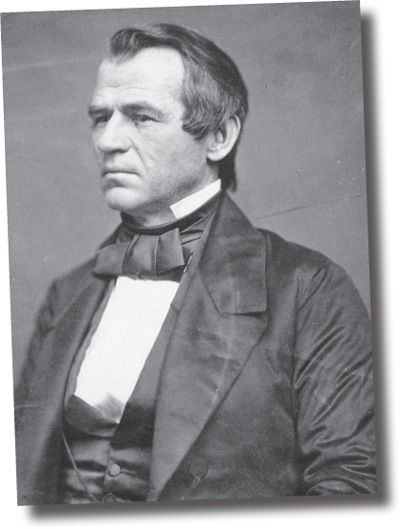
Senator Andrew Johnson of Tennessee.
1. Andrew Johnson (1808–1875) had been the only Southern senator to remain in Congress after secession. He became war governor of Tennessee, and later, Vice President of the United States, succeeding Lincoln after his assassination in 1865.
2. Pro-Union Tennesseans had met on January 21 to propose a new constitutional convention to abolish slavery.
COAST EXPEDITIONS — WASTE OF STRENGTH AND TIME.
FEBRUARY 4
We hearrumors — we know not how well founded — of another Burnside coast expedition as in preparation. Much as we respect the brave officer who is reported to be about to lead it, we sincerely trust that no men will be raised for another coast attack. It is apparent now to the dullest eye that the grand mistake of our strategy in the whole war has been our want of concentration. It may be doubted whether a single one of our coast expeditions, with the grand exception of the attack on New-Orleans, has tended to the successful closing of the war.
The strength of the rebellion, as we have repeated over and over again, is in its organized armies, and while these exist, we may capture every port and every large city, and still not have touched the life of the rebellion. In the Revolutionary War, the British took and occupied some of our largest cities and best harbors without in the slightest degree affecting the result of the struggle. The rebel papers say truly that they have now reached that point of the war in which they are best defended by the immense extent of territory, so that our armies, after guarding their communications, will not be able to penetrate to the heart of the country with forces larger than their own.
This redoubles the importance of largely reinforcing the two great armies of the Republic, Gen. GRANT’s and Gen. MEADE’s. Any troops withdrawn from them, for however brilliant side-attacks, will only delay our final victory....
Let us have no more coast expeditions, however brilliantly executed and bravely born. Let us fritter away no more gallant lives and sums of treasure. Every nerve should be strained to fill up the ranks of the two great armies so that when the Spring campaign opens, decisive blows may be struck, which shall tell directly toward the crushing of the rebellion. Time hastens, and it is too late now for anything but the most effective strokes.
GEN. GRANT AND THE LIEUTENANT-GENERALSHIP.
FEBRUARY 6
The proposition to revive the military grade of Lieutenant-General, with the view of conferring the title on Gen. GRANT, commands the hearty approval of the country1; and if the purpose of the resolution which has passed the House of Representatives was simply to confer a great honor on one who has greatly served his country, few would question its entire propriety. We do not think much of the argument of some of the members opposed to the resolution, that, as the war is not yet over, it would be better to wait till the finale and see whose head towers above all others, and then give him the crown. The services of Gen. GRANT have already been so signal as to merit a signal honor; and we should be willing to see it become a law that any General, who shall take a hundred thousand prisoners and four hundred pieces of artillery, shall thereby be entitled to the rank of Lieutenant-General. We have always held that our military hierarchy is entirely too restricted; it was arranged for the cadre of the insignificant army we have hitherto kept on foot; and we should be glad to see. not only the revival of the grade of Lieutenant-General, but the creation of the still higher grade of General, as prizes held out to the laudable ambition of commanders, and as a proper extension of the military hierarchy, to meet the vast proportions of our military organism.
1. Congress had begun to consider awarding Grant a military rank no officer had held since George Washington. The Times soon came out against the initiative, pointing out that the President alone had such power, and worrying that a promotion might take the Union’s most successful general out of action.
VALLANDIGHAM IN THE SUPREME COURT.
FEBRUARY 16
The United States Supreme Court has decided against the application of VALLANDIGHAM to annul the sentence passed upon him by the military court. It pronounces that it has no jurisdiction over the case. In other words, that the military authority for the common defence, in time of war, inheres in the Commander-in-Chief to the exclusion of the civil authority.
This is a hard blow upon the Copperheads. There has been no end to the vituperation they have vented against Gen. BURNSIDE and President LINCOLN for usurping judicial authority over VALLADIGHAM, which belonged only to civil tribunals. Neither did they hesitate when Judge LEAVITT, the District Judge in Ohio, refused the application for a writ of habeas corpus, to pour upon him, even though a Democrat, their foulest venom. He was the miserable tool of a tyrant, a puppet, a minion, a creature destitute of respect for either himself or his station, a perjured betrayer of his trust. The World, the Cincinnati Enquirer, and all the Copperhead organs, fairly reeked for months with the virus excited by the case; and it was emitted with the most indiscriminate spite upon every official who had connection there with, whether military or civil. We are rather curious to see what will be their demeanor towards the Supreme Court. The majority of that court hitherto, alone of all the functionaries of the Government, have been spared their abuse. This has been owing, we suppose, to an inference, from certain antecedents of the court, that it had proclivities in their favor. But no warrant for this has been found in any utterance of the court since the beginning of the rebellion. In no single instance has its opinion been at variance with the executive action of the President. But in this case the Copperheads did hope for something favorable to their factious ends. The decision will be a sharp disappointment. Will they dare to give their malignity, here too, full play?

Clement L. Vallandigham, Ohio Democrat.
THE REBEL CONSCRIPTION AND ITS EFFECTS.
FEBRUARY 19
As the end of the rebellion draws nearer, and its condition becomes more desperate, the oppression under which the Southern people labor is made to bear more heavily upon them, and there begin to be symptoms of a speedy resistance on their part. The newspapers, which have been and are heartily in the service of the leaders, indicate it by the violence with which they speak of the shifts and schemes employed by the people to escape from the tyranny which is burdening them. And it is indicated more plainly by the notes of hostility and defiance which rise, and grow louder and louder, in those parts of the Confederacy where the people have not wholly thrown away their care for their own freedom in the intensity of the struggle the past three years. In North Carolina especially, do we find these developments.1 Public meetings are held, whose resolutions attack the Conscription Act, denounce the despotism of the Confederate Government, and call upon Gov. VANCE2 to convoke a convention, and newspapers declare that “North Carolina cannot and will not submit to have every able-bodied man conscripted, and the whole State turned into a military camp.”
Nothing seems to have excited this spirit of resistance more than the determination to force into the ranks the men who had furnished substitutes, and thus became exempt from military service under the former conscription. And no wonder. No Government in the world could afford to commit such a breach of faith, unless under the plea of the most stringent necessity. Thus, its adoption is the clearest proof of the desperate condition of their cause, a proof which must come home with tenfold vividness to every one who is the victim of it.
That very sense of the desperate state of affairs must have in its turn the effect upon these men, who are thus dragged into the service, of making them feel that this great crime is committed upon them to no purpose. From men forced into the ranks with such feelings what can be expected? The streams of deserters which now flow steadily toward our lines from every place where rebel soldiers are collected, will gather increased volume as soon as these victims of treachery begin to be brought out to fill the thinning ranks....
A more terrible oppression never ground a people more uselessly. Even the rebel leaders themselves feel that they are straining the patience and faith of their dupes to the uttermost. Their speakers declared that these measures were worse than “the ruthless conscription which NAPOLEON inflicted on France.” They pronounced the act a “desperate measure.” It was “breaking up the farms and reducing the agricultural interests of the country to about naught;” it was “breaking down and crippling resources that were left to carry on the war. But the plea of necessity prevailed, and the measures were adopted.
In view of such facts and statements, the words of the Salem Press, that “every day convinces us more and more that we are on the eve of events which are pregnant with the fate of the Confederacy,” and those of the Montgomery Mail, that “there is a movement on foot which will create more consternation at Richmond than anything that has occurred during the war,” become very suggestive.
1. Protests had broken out in North Carolina against the new Confederate draft law, enacted December 28, 1863, abolishing the provision allowing substitutes.
2. Zebulon B. Vance (1830–1894), was elected governor of North Carolina in 1862 following service in the Confederate Army during the Seven Days campaign near Richmond earlier that year.
PROGRESS OF SHERMAN’S OPERATIONS — THE CAMPAIGN IN THE SOUTHWEST.
FEBRUARY 20
If we may put faith in the reports of SHERMAN’s advance which reach us through rebel sources, and which have every evidence of authenticity, the march of that General has been one of the most rapid and brilliant in military annals. His column, or at least the vanguard of it, has already tapped the communications of Mobile by striking the Mobile and Ohio Railroad in the vicinity of Meridian.
In discussing, a few days ago, the probable line of march of SHERMAN’s force, we assigned it Meridian and the Mobile and Ohio Railroad as a primary objective, and said he would do well if he made the point aimed at in three weeks or a month. It has taken that vigorous and energetic commander less even than the shorter of these periods to make good the prime object. SHERMAN’s column left Vickburgh on the 3d inst.; on the 5th it crossed the Big Black; on the 7th it is reported to have occupied Jackson; and the intelligence we publish to-day reports a fight at Enterprise, which is located on the railroad line running northward from Mobile, somewhat over a hundred miles north of that city, and about twenty miles south of Meridian. This report comes through rebel sources, and it receives confirmation by tidings from Chattanooga, announcing that SHERMAN has destroyed the bridges over the Mobile and Ohio Railroad.
The progress of Gen. SHERMAN’s advance, the line of march he has taken up, and the points embraced in the scope of his operations, add the authority of fact to the theory of his advance put forward by this journal as a simple matter of speculation. It is obviously the purpose of this portion of Gen. GRANT’s army to preoccupy the strategic lines of the Tombigbee and the Alabama, and to seize the great region of productive territory covered and commanded by these lines. The importance of this conquest is comparable as a strategic stroke, and in the weight it must have in determining the issue of the war, only to the longitudinal bisection of the Southern territory by the opening of the Mississippi, and to its lateral bisection by the possession of Chattanooga. This conquest once fairly consolidated by the opening up of the two rivers just named, will give us command of the great water-shed between the Mississippi and the western boundary of Alabama. It will, in fact, “corral” the rebel forces within the restricted parallelogram of the Atlantic States.
It would be folly to conceal, however, that this great result can only be obtained by a protracted and difficult campaign; for the country to be occupied is of vast extent, and though it is not believed that the rebels have at present in that region a force sufficiently large to be a very formidable barrier to SHERMAN’s progress, yet it is scarcely credible they should give it up without a blow.
THE PAY OF COLORED SOLDIERS.
FEBRUARY 21
HEADQUARTERS FIRST SOUTH CAROLINA
VOLUNTEERS, BEAUFORT, S.C., SUNDAY, FEB. 14
To the Editor of the New-York Times:
May I venture to call your attention to the great and cruel injustice which is impending over the brave men of this regiment?
They have been in military service for more than a year, having volunteered, every man, without a cent of bounty, on the written pledge of the War Department, that they should receive the same pay and rations with white soldiers.
This pledge is contained in the written instructions of Brig.-Gen. SAXTON,1 Military Governor, dated Aug. 25, 1862. Mr. Solicitor WHITING,2 having examined those instructions, admits to me that “the faith of the Government was thereby pledged to every officer and soldier under that call.”
Surely if this fact were understood, every man in the nation would see that the Government is degraded by using for a year the services of the brave soldiers, and then repudiating the contract by which they were enlisted. Yet this is what will be done should Mr. WILSON’s bill,3 legalizing the back pay of the army, be defeated.
We presume too much on the supposed ignorance of these men. I have never yet found a man in my regiment so stupid as not to know when he was cheated. If the fraud proceeds from Government itself, so much the worse, for this strikes at the foundation of all rectitude, all honor, all obligation.
Mr. Senator FESSENDEN4 said, in the debate on Mr. WILSON’s bill, Jan 4, that the Government was not bound by the unauthorized promises of irresponsible recruiting officers. But is the Government itself an irresponsible recruiting officer? and it men have volunteered in good faith on the written assurances of the Secretary of War, is not Congress bound, in all decency, either to fulfill those pledges or to disband the regiments?
Mr. Senator DOOLITTLE5 argued in the same debate that white soldiers should receive higher pay than black ones, because the families of the latter were often supported by Government. What an astounding statement of fact is this! In the white regiment in which I was formerly an officer (the Massachusetts Fifty-fourth) nine-tenths of the soldiers’ families, in addition to the pay and bounties, drew regularly their “State aid.” Among my black soldiers, with half pay and no bounty, not a family receives any aid. Is there to be no limit, no end, to the injustice we heap upon this unfortunate people? Cannot even the fact of their being in arms for the nation, liable to die any day in its defence, secure them ordinary justice? Is the nation so poor, and to utterly demoralized by its pauperism, that after it has had the lives of these men, it must turn round to filch six dollars of the monthly pay which the Secretary of War promised to their widows? It is even so, if the excuses of Mr. FESSENDEN and Mr. DOOLITTLE are to be accepted by Congress and by the people.6
Very respectfully, Your obedient servant,
T.W. HIGGINSON. COLONEL COMMANDING 1ST S.C. VOLUNTEERS.
1. Rufus Saxton (1824–1908) was assigned to the recruitment of ex-slaves into the Federal army.
2. William Whiting (1813–1873) was solicitor of the War Department, whose opinions on presidential war powers had helped Lincoln conclude that he could issue the Emancipation Proclamation; later served briefly as a congressman from Massachusetts.
3. Senator Henry Wilson (1812–1875) of Massachusetts.
4. Senator William Pitt Fessenden (1806–1869) of Maine.
5. Senator James R. Doolittle (1815–1897) of Wisconsin.
6. Not until 1865 did black soldiers receive pay equal to their white counterparts.
SHERMAN’S SPLENDID ADVANCE — MOBILE THREATENED.
FEBRUARY 21
Although the grand objects of SHERMAN’S advance have been from the start evident to every one capable of looking at the map with a military eye, yet we have, ever since he crossed the Big Black, been left in tantalizing obscurity as to his progress. This state of things has been the necessary consequence of the manner in which Gen. SHERMAN has made his march. Having gone forward to stay, and expecting to open up a new base on the Gulf, he cut himself entirely loose from his base on the Mississippi, abandoned his line of communications, tore up the railroad and bridges in his rear, and thus severed all communication with the world that is behind and awaits with eagerness the reports of his progress. In this condition of things it was plain enough that we should have to depend on the rebels for our current history of this important movement.
They give us to-day a chapter that must be as sombre and saddening to them as it is bright and inspiring to us. The raising of the curtain reveals that far-off theatre of war all astir with advancing hosts — SHERMAN, with his column in the heart of Mississippi; FARRAGUT, with his fleet in the immediate neighborhood of Mobile. All that we have been predicting for this expedition is now fully justified; and the bold and brilliant campaign, revealed in its magnificent ensemble, is already half accomplished at a stroke.
An official dispatch to the rebel War Department at Richmond, under date of the 18th inst., announces Gen. SHERMAN’s arrival at Quitman, on the Mobile and Ohio Railroad. Quitman is about twenty-five miles south of Meridian, and being thus taken in reverse, that important strategic point — the point of intersection of the Mobile and Ohio and Southern Mississippi Railroads — was evacuated by the rebels on the 14th inst. Considering that this march of a hundred and fifty miles has been accomplished in ten days, the rebels do not overestimate it when they characterize it as “without comparison, the boldest movement of the war.” We ventured to speak of it ourselves in similar terms on Saturday last.
The point at which Gen. SHERMAN has tapped the communications of Mobile would seem to indicate his intention to push forward one of his columns on the rear of that place. The rebels there are anticipating as much, and declare he will not be allowed to take Mobile “without a desperate battle.” If this determination has the effect to keep the rebels there till he gets in position to bag them, we sincerely hope it will be persevered in. From Quit-man to Mobile he has a march due south of a little better than a hundred miles. The entire distance from Meridian to within five miles of Mobile is unfortified, and has been up to a very late period unprotected by rebel troops. In the rear of Mobile, and as much as five miles from the city, are three heavy lines of earthworks. The first line is on the southeast side of the city. The second is on the east side of the river, opposite the termination of St. Michael-street. Down the river to the left is the landing of the Mobile and Ohio Railroad. Here is located Spanish Battery, consisting of three rifled 32-pound guns and one 10-inch gun. Further down the bay, to the left, is Pinto’s Battery. Between this and Fort Morgan are Batteries Choctaw, Cedar Plain, Grand Spell and Lighthouse Battery — in all six — consisting each of six 32-pound rifled cannon. This fortified region is, however, described as low and flat, and not capable of defence, even when thus fortified — the lay of the land being an effectual barrier to such defence.
But if it be Gen. SHERMAN’s purpose to make a march on the rear of Mobile, he will not be left alone: he will have the powerful cooperation of FARRAGUT’s fleet, and the land force from New-Orleans. From the somewhat obscure rebel dispatches, we gather that FARRAGUT had already made an attack on the works at Grant’s Pass, at the entrance of Mobile Bay; but contrary weather had somewhat delayed operations. There is little fear, however, of his being behindhand in any part of the work intrusted to him.
GEN. GRANT AND THE LIEUTENANT-GENERALSHIP.
FEBRUARY 26
The Senate deserves public thanks for its decisive vote, striking out Gen. GRANT’s name from the joint resolution reviving the grade of Lieutenant-General. The attempt of the House to prescribe, as it virtually did, that one particular man, and no other, should receive that rank, was unconstitutional, unseemly, unsafe. But for so many other odd performances of the House, it would have excited astonishment.
The Constitution makes the President the sole executive head of the nation, and devolves upon him the entire executive responsibility. In consistency therewith, it gives him the sole appointing power, subject only to the approval of the Senate. The House has no more constitutional right to say that Gen. GRANT shall be Lieutenant-General than it has to say that some other popular General shall be Secretary of War, and some other one yet Minister to England. The fact that the office to be filled is military instead of civil, makes not the slightest difference. The Constitution makes no distinction. The President has the same appointing power to all offices, military and civil alike. There never was a clearer unconstitutional assumption than in that resolution. Nothing is made by saying that the President was only “recommended” to make that appointment. The House has no voice in the matter whatever — either to request or to dictate. It has as little right to trammel the Executive judgment as to control it. The Constitution expressly gives the President the power to recommend measures to Congress, but it gives no authority to Congress to make recommendations of men to the President. It intends that the House of Representatives shall confine itself to its own legislative business....
But Gen. GRANT is about to commence a grand and, as he believes, a decisive campaign, and he deems that he can best serve his country in his present work. He considers himself better qualified for the field than for the closet. The President so judges him, and so do the people.1 Why should the House, then, take it upon itself to say that he shall be transferred to a different sphere? How can they reconcile it with the public interests that this great Spring campaign, just in its incipient stage, should be hazarded by the withdrawal of him who conceived it, and who, more than any other man, has the executive ability to consummate it? It is preposterous to maintain that Gen. GRANT can conduct that Southwestern campaign in Washington as well as he can at the seat of war. With all his genius, he is not superior to NAPOLEON; and NAPOLEON, during his great campaigns, was never in Paris, but always with his army.
If the majority of the House wish well to Gen. GRANT, they will let him alone. One of his crowning virtues, thus far, has been his steady determination to know nothing of politics, and to attend exclusively to his business as a soldier. All solicitations to lend his name to party schemes he has repelled with a firmness that has proved him every inch a man. Had Gen. MCCLELLAN shown any such elevation of spirit, he never would have sunk to his present discredit. Of course, there will be, and ever must be, a breed of pigmy politicians, who are always on the spring to be the first to mount to the shoulders of rising greatness, it being their only way to make themselves conspicuous. Gen. GRANT shakes them off with a sovereign contempt it is refreshing to behold. If they have any regard for his comfort or for their own appearance before the country, they will now stop infesting him, and leave him free to do his own chosen work, in his own chosen way.
There is not the slightest danger that Gen. GRANT will fail of being properly honored and rewarded by his country at the appropriate time. He himself has no concern about this. He finds his complete content in the consciousness of grand duties grandly performed. He can but know that he is making a name for history, in the light of which all the distinctions which Congress, or which even the people can bestow, pale into insignificance. But, notwithstanding that, the people will insist, and ought to insist, when his work is done, upon conferring on him every mark of their admiration, and gratitude. This will surely come in its due season, and by a spontaneous, irrepressible impulse of the popular heart, immeasurably more gratifying to the recipient than any of these equivocal demonstrations of eager politicians. The House will do well to study and, if possible, emulate the wise composure of Gen. GRANT and of the people.
1. Lincoln appointed general-in-chief with the three stars of a lieutenant general the following month.
THE SEVERE REVERSE TO THE FLORIDA EXPEDITION.1
OUR FORCES OVERPOWERED BY NUMBERS AND COMPELLED TO RETREAT
FEBRUARY 27
The steamship Fulton, Capt. WOTTON, from Port Royal on Wednesday last, arrived here at a late hour last night, bringing information of a sad reverse to our expedition, under Gen. SEYMOUR,2 in Florida.
We are unable to give details, because after the Fulton had put out into the bay, she was boarded by the provost-Marshal and Quartermaster, with orders from Gen. GILLMORE2 to deprive the passengers of all private letters in their possession. Thus, the letter of the correspondent of the TIMES, who had returned from Jacksonville, on purpose to send full particulars, and who had inclosed a partial list of the killed and wounded, amounting to five hundred names, was seized and retained until the next mail — a week hence. The cruelty of this short-sighted proceeding, considering the anxiety of relatives and friends, is evident. Gen. GILMORE’s dispatches were sent on, and will doubtless soon be made public.
To a passenger by the Fulton we are indebted for the following main facts of the battle:
On the afternoon of the 20th, our troops, under Gen. SEYMOUR, met the enemy, 15,000 strong, fifty-five miles beyond Jacksonville and eight miles beyond Sanderson, on the line of the Jacksonville and Tallahassee Railroad. The battle was desperately fought during three hours, and at sunset our forces, overpowered by numbers, retired to Sanderson, taking with them the greater part of the wounded.
The Seventh Connecticut, Seventh New-Hampshire, Fortieth Massachusetts, Forty-eighth and One Hundred and Fiftieth New-York and Eighth United States were engaged. Col. FRIBLEY, of the Eighth United States, was left dead on the field. Col. REED, a Hungarian officer, was mortally wounded.
All the officers of HAMILTON’S Battery were wounded. Capt. HAMILTON (wounded in the arm) and Lieut. MYRICK (wounded in the foot) are at Gen. GILL-MORE’S headquarters at Hilton Head.
Col. GUY HENRY, of the Fortieth Massachusetts, had three horses shot under him, but escaped hurt.
The Cosmopolitan arrived at Beaufort, on Monday evening, with 240 of the wounded; Col. REED among them who was living when the Fulton left, on Wednesday.
The enemy’s loss is not known. They captured five guns.
It is supposed that the troops were from BRAGG’S army. Gen. HARDEE himself was on the field, having come to Florida on a visit to his family, and also to form a second marriage.
Our loss is variously estimated at from 500 to 1300 Seventy-eight rebel prisoners brought by the Fulton. The Fulton’s passage was remarkably short and pleasant; a striking contrast to the previous one.
We understand that the Purser of the Fulton has a list of the killed and wounded, which he will show, but will not allow it to be copied.

A Kurz and Allison lithograph of the Battle of Olustee.
1. Later known as the Battle of Olustee, on February 20, 1864, notable for the engagement—and near slaughter—of the Eighth U.S. Colored Troops. The Union lost more than a third of its forces.
2. Truman Seymour (1824–1891) was relieved after this failed invasion of Florida.
THE REAL MILITARY IMPORTANCE OF FLORIDA.
FEBRUARY 28
The rebels certainly have a faculty of turning up where they are not expected; and the late blow they have delivered — namely, at our force in Florida — is the most unexpected of all. Everybody agrees that Florida has no strategic value, either to ourselves or the rebels. It is quite removed from the great lines of operation; and as a military possession seems hardly worth while being made a serious bone of contention. But the rebels appear to have discovered in it some kind of value, and that, too, of sufficient moment to have made it worth their while sending a powerful force to oppose and punish the Union expedition that has lately made that peninsula the theatre of its operations. For an adequate explanation of this we are driven to fall back on the consideration of the material value of Florida to the rebels, in the point of view of the question of its supplies of beef cattle, respecting which important developments were lately made.
The very important circular of the rebel Chief Commissary of Florida, received from our special correspondent and published in the TIMES a few days since, gives a new turn to our notions of the military value of that State. While it remains perfectly true that Florida possesses no strategic relations of sufficient importance to authorize the detachment of a force strong enough to insure its permanent occupation, yet the disclosures of its material value to the rebel cause, made in the document referred to, prove conclusively that Gen. GILLMORE’s1 expedition is a most timely blow in the very spot in which the rebels are now most sensitive. Operations that aim at cutting off the rebel armies from their supplies, and depriving them of extensive areas of productive territory are, at the present stage of the war, secondary in importance only to the destruction of their armed forces in the field — if, indeed, they are not equal in substantial value. It was this fact that gave its immense importance to the stroke that severed the rebel communications with the Trans-Mississippi region; and it is the prospective results in the same direction that add a double value to the operations of SHERMAN in Mississippi and Alabama. The occupation of Florida shares this characteristic with the conquests just mentioned. The circular of the rebel Commissary shows that both JOHNSTON’s army in Georgia and the army of BEAUREGARD at Charleston, have for sometime been dependent mainly on Florida for their supplies of beef cattle. This is made manifest by citations in the circular from the letters of commissaries of both these armies....
Now, crediting part of the urgency of these statements to the pressure which these officials would naturally use in order to stimulate exertion in those addressed, these representations nevertheless show very clearly how exceedingly straitened the rebels are for supplies, and the importance attached to Florida in this particular. As some attempts have been made by the Copperhead presses to deny the authenticity of this document, (which has every internal evidence in its favor, and was found by our correspondent among the private papers of the rebel writer,) we may add, that the wealth of Florida in beef cattle has long been known to our old army officers, who have campaigned in that State. The prairies afford excellent pasture; cattle require little care from their owners and no housing in Winter; and, in most parts of the State, hogs fatten without any other support than that which they derive from the roots and mast of the forest. It was intended that the Union force, which has planted itself in Florida, should keep up constant and extensive raids, and cut off the rebels from their beef-supplies. We trust that, despite the ill luck that has met the opening of the Florida campaign, the work may still be kept up, if its results should promise to be really as important as is surmised.
1. Quincy Adams Gillmore (1825–1888) was in charge of the campaign to reduce Fort Pulaski, which guarded the sea approach to Savannah, Georgia.
RECONSTRUCTION.
CONVENTION OF LOYAL PEOPLE IN WEST TENNESSEE.
FEBRUARY 28
CARIO, ILL., FRIDAY, FEB. 20
The following particulars of the Convention of Loyal People of West Tennessee, are taken from the Memphis Bulletin:
“The adjourned meeting of the Convention of Loyal People of West Tennessee, which met in this City, on the evening of the 23d instant, was a large and enthusiastic affair.
A loyal and eloquent address was made by Dr. BUTLER, of Arkansas.
The following resolutions, in substance, were unanimously adopted:
First — Disavowal of further participation in and responsibility for the rebellion, and providing that proper measures be immediately adopted for reorganizing the State Government on the basis of absolute loyalty to the Union and the Constitution.
Second — All acts passed by the Legislature, dissolving the relation of the State of Tennessee to the United States are declared to be without authority and null and void. Third — Declares for the resumption of Federal relations in the Union, with such reforms in the State Constitution as will make future rebellion and secession impossible.
Fourth — The importance is recognized of making the State Constitution republican in fact as well as in name, by guaranteeing the natural and inherent rights of all persons in the State: also providing that Slavery shall henceforth cease and be forever prohibited; also denying the elective franchise to all persons who have been engaged in the rebellion, who fail satisfactorily to establish their fidelity to the National Government and its laws.
Fifth — That immediate steps be taken to reorganize the State under the Constitution and laws of the United States, and to that end all the loyal people are invited to take the oath of allegiance to the United States, prescribed by Gov. ANDREW JOHNSON.
Seventh — Requests Gov. ANDREW JOHNSON to issue a proclamation for the election of delegates to a convention to amend the State Constitution, so as to confirm the fact of emancipation already accomplished by the rebellion and the war.
Eighth — Requests the Loyal Union State Executive Committee for West Tennessee to lay these resolutions before Gov. ANDREW JOHNSON, and to confer with him as to the accomplishment of the facts therein set forth.
Ninth — The acts of President LINCOLN and his Administration in suppressing the rebellion are indorsed, and they pledge their support to sustain and complete the work.”...