
CHAPTER 19
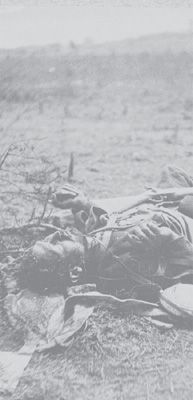
A dead Confederate soldier after the Battle of Spotsylvania.
May of 1864 was the bloodiest month of the American Civil War. On May 4, the Army of the Potomac, officially under George Meade but supervised by Ulysses S. Grant, crossed the Rapidan River to inaugurate what has gone down in history as the “overland campaign.” Lee’s Army of Northern Virginia assailed it almost at once in the tangle of undergrowth south of the Rapidan called the Wilderness. For more than a month, the two armies slugged it out across the northern Virginia countryside, enduring combined casualties of nearly 100,000 men. At the same time, reports from the west showed that William T. Sherman had inaugurated his campaign in north Georgia, and from Louisiana came news of the denouement of Nathaniel Banks’s expedition up the Red River. For readers of The Times, it was like a three-ring circus as Union armies seemed everywhere on the march.
It was all part of a deliberate strategy. Lincoln had been urging just such a coordinated offensive since the spring of 1862, but Grant was the first of his generals to achieve it. The principle worked particularly well in Virginia for on the same day that Meade’s army crossed the Rapidan, General Franz Sigel in the Shenandoah Valley and General Ben Butler on the Virginia Peninsula moved forward as well. The idea was to compel Robert E. Lee to choose which of these thrusts to oppose. If he focused on one, the others could advance. As Lincoln famously put it: “Those not skinning can hold a leg.”
In the end, Lee was able to focus on the Army of the Potomac because of missteps by both Sigel and Butler that blunted their offensives. Sigel was defeated in the Shenandoah Valley by a scratch force at the Battle of New Market (May 15, 1864), and Butler became bottled up in the cul-de-sac of the Bermuda Hundred near Petersburg, Virginia. As a result, the heaviest fighting — indeed the fiercest fighting of the war — took place between Grant and Lee. Nearly every day came reports of another engagement and more slaughter. From the Wilderness, to Spotsylvania, the North Anna River crossing, and at Cold Harbor, the furious battles blended together in a near-continuous maelstrom of bloodletting. To follow the campaign, readers of The Times relied on the stories sent in by William Swinton (1833–1892), a Scottish-born academic and reporter who was so dedicated to digging out the news that Grant accused him of eavesdropping on his conversations with Meade. Henry Ward Beecher called Swinton “our American Napier,” comparing him to the seventeenth-century mathematician and philosopher John Napier. William C. DeWitt declared his work “the finest contribution which America has ever made to the war literature of the world.” After the war, Swinton became a professor at the University of California and a well-known writer of histories and textbooks, some of which are still in print. In several of his reports from the front, Swinton kept a running diary recording his impressions hour by hour as the battle was being fought.
Reports from the west arrived later and were sketchier. Sherman commanded three armies — what in the twentieth century would be called an “army group.” The bloodshed in northern Georgia was significantly less than in Virginia largely because the opposing generals — Sherman and Confederate General Joseph E. Johnston — relied more on maneuver than direct assault. Sherman flanked his rebel opponent out of Dalton, Resaca, and Cassville, and tried to do so again at New Hope Church, though this time Johnston got in front of him and forced a series of battles in the last week of the month. Despite these different strategies, the result was the same: both Union armies moved inexorably southward, forcing the smaller rebel armies back toward the cities they defended: Richmond in Virginia, and Atlanta in Georgia. This time the undeniable progress of the Union armies was evident to all, and readers of The Times began to hope, once again, that the end might be near. The Times owner and editor, Henry Raymond, who was also chairman of the Republican Party, credited President Lincoln for this success. “Every right-minded man,” he wrote, “sees in these magnificent successes the crowning glory of President LINCOLN’s administration.”
A GIGANTIC COOPERATIVE MOVEMENT.
ADVANCE OF THE ARMY OF THE POTOMAC.
MAY 5
The Army of the Potomac began its forward march on Monday. The crossing of the Rapidan was effected without opposition on Tuesday and Wednesday [May 3-4] at Culpepper, Jacobs’, Germanna and Ely’s Fords. No rebels were seen, except a few pickets, who retired as we advanced. If LEE intends to make a stand this side of Richmond, it is possible he may be met near the old battleground of Chancellorsville, but it is the general impression that he has fallen back from his position on the Rapidan to Richmond, in order to protect that City from the formidable force now marching upon it from the rear [Butler’s Army of the James], and which is as likely to strike on one side of the James River as the other.
Culpepper is being strongly fortified, and will be used as a depot for stores.
It is reported here to-day that a strong column of troops under Gens. [Darius] COUCH and [Franz] SIGEL are marching from Winchester up the Shenandoah Valley as a cooperating column, destined eventually to cut the Virginia and Tennessee Railroad, while BUTLER’s force, or a part of it, strikes the other railroad at or near Peters-burgh, thus severing all railroad communications between Richmond and the South.
Gen. BUTLER took the field in person at the head of the army on the Peninsula yesterday, and his host is marshaled by such leaders as W. F. SMITH, [Quincy Adams] GILLMORE, [Alfred H.] TERRY, and GODFREY WEITZEL.
The movement assumes an expeditionary character. An immense fleet of transports, and a strong squadron of monitors and gunboats will convoy it up one of those broad rivers to the gates or to the back door of Richmond, and perhaps the iron-clads may once more try the strength of the rebel batteries and line the James, the Pamunkey, and the Rappanhannock.
The feeling prevails that there is desperate work before this army. But there is nerve and strength for it. The iron-clads lie in the still waters off Newport News, and the fleet of gunboats are in communication with them. All the auguries are favorable.
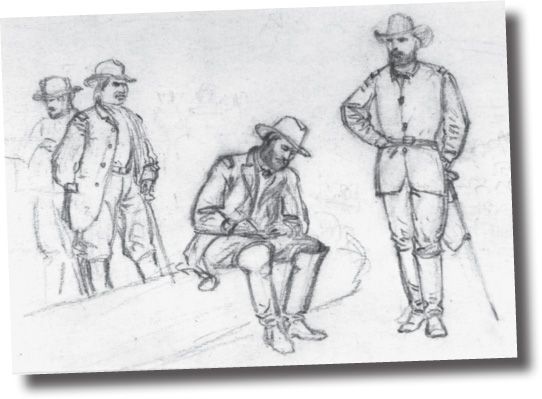
Alfred Waud’s sketch of General Grant writing a dispatch reporting that the Army of the Potomac has crossed the Rapidan River.
THE CAMPAIGN OPENED.
MAY 6
Lieut.-Gen. GRANT has spoken the word, and the long-anticipated “forward march” of our great armies has begun. On the first secular day of the current month, the soldiers struck their tents by the Rapidan, and probably also by the Tennessee; and, with rifle and knapsack, with the enthusiasm of volunteers and the stern spirit of veterans, advanced to the struggle with the rebellion.
The movements of our armies are not very well defined to the vision from this point. Of the army of the Potomac it is known that, taking up its advance from its camping ground near Culpepper, it had effected the crossing of the Rapidan by Wednesday morning. Of the cooperating army on the Peninsula [Butler’s], it is reported that a portion advanced to and occupied West Point, at the head of York River, on Monday. From the West, it is reported that on the same day the army at Chattanooga [Sherman’s] was to move forward in three columns; but the report of this movement is rendered dubious by the latest advices. Now, if any one can deduce the plan of the Virginia campaign from the telegraphic statement that MEADE’s troops crossed the Rapidan at Jacob’s, Culpepper, Germanna and Ely’s Fords, and from the additional statement that a body of BUTLER’s troops ascended the York River to West Point, he is free to attempt it. The Lieutenant-General in command of all the forces, evidently has determined that the campaign shall soon reach a crisis, for a telegram has been received from him in Washington, dated Wednesday, which says that forty-eight hours would determine whether he was to have a battle on the line of the Rapidan or under the works around Richmond. So that this day is the day of decision. This style of operation is characteristic of GRANT. He prepares for a movement deliberately and carefully, but when once ready for it, his blows fall with tremendous rapidity and vigor. Witness his November battles in front of Chattanooga; witness his marches and battles in the rear of Vicksburgh this month last year; witness his early operations on the Cumberland and Tennessee Rivers.
Of the movements and strategy of the rebel armies, we are no better informed than in the case of our own. LEE, it would seem, has fallen back from his defensive line on the south bank of the Rapidan; but the speculations of the Washington scribe as to his position and plans are not worth much. If we might judge of LEE by his antecedents, we should think he might manoeuvre his army very adroitly and deceivingly, and try to strike our forces piecemeal. If there is any detached body operating at a distance from the main army, and beyond the possibility of immediate support, it would not be unlikely that he would rush at it, and try to destroy it, expecting thus at once to effect this lesser object, and disarrange GRANT’s entire plan of campaign. But we shall know in a few days what his mode of action is, as well as what is his success in carrying it out....
GEN. MEADE’S ADDRESS TO HIS ARMY.
MAY 6
HEADQUARTERS ARMY OF THE POTOMAC, WEDNESDAY, MAY 4
SOLDIERS:
Again you are called upon to advance on the enemies of your country. The time and the occasion are deemed opportune by your Commanding General to address you a few words of confidence and caution. You have been reorganized, strengthened and fully equipped in every respect. You form a part of the several armies of your country — the whole under the direction of an able and distinguished General, who enjoys the confidence of the Government, the people and the army. Your movement being in cooperation with others, it is of the utmost importance that no effort should be left unspared to make it successful.
Soldiers, the eyes of the whole country are looking with anxious hope to the blow you are about to strike in the most sacred cause that ever called men to arms. Remember your homes, your wives and children, and bear in mind that the sooner your enemies are overcome the sooner you will be returned to enjoy the benefits and blessings of peace. Bear with patience the hardships and sacrifices you will be called upon to endure. Have confidence in your officers and in each other. Keep your ranks on the march and on the battle-field, and let each man earnestly implore God’s blessing, and endeavor by his thoughts and actions to render himself worthy of the favor he seeks.
With clear consciences and strong arms, actuated by a high sense of duty, fighting to preserve the Government and the institutions handed down to us by our forefathers, if true to ourselves, victory, under God’s blessing, must and will attend our efforts.
GEORGE G. MEADE, MAJ.-GEN. COMMANDING.
FROM THE RED RIVER.
GEN. BANKS AT ALEXANDRIA — GUNBOATS ABOVE THE FALLS.
MAY 7
ALEXANDRIA, LA., SATURDAY, APRIL 23, VIA CAIRO, TUESDAY, MAY 3
The Red River expedition, as far as an offensive campaign against the rebels is concerned, is for the present at an end. Gen BANKS and army are now falling back upon this place, the advance of the baggage trains having arrived last night. The whole army will be here in a day or two.
The gunboats and transports have nearly all arrived at a point just above the falls, two miles above Alexandria. Some of the transports are aground up the river, but will all probably be able to get to the falls. The majority have dropped over the falls empty. There is only about three feet of water on the shoals. The iron-clads above, some six or eight, all draw over six feet and cannot be brought over. It is rumored that Admiral PORTER has declared that his men shall remain on their boats if the land forces leave the river, and await a rise.1
It is impossible at present to determine whether Gen. BANKS will hold Alexandria or not. It is believed that the low stage of water in the river will force him to fall back to the Mississippi River — to what point will be determined by circumstances.
Rebels in the country back of and below this place came in yesterday within thirteen miles, and burned 2,000 bales of cotton belonging to [loyalist] Lieut.-Gov. [James Madison] WELLS.
Yesterday the steamer Superior, was fired into, 25 miles below here, with cannon and musketry. Three men were killed and eleven wounded. They were soldiers belonging to the Third Rhode Island Cavalry. A gunboat came to the relief of the Superior, and shelled the woods for miles. Soldiers went ashore and fired some buildings in retaliation.
Lieut.-Col. PARKER, Third Rhode Island Cavalry, gave orders to his men, on the Superior, to fire on every white man, woman or child seen on the shore as the boat came up. The order was executed. Two or three unarmed citizens, riding along on shore about fifteen miles below here, waved their hats to the boat as a friendly recognition, but were fired upon, and fell from their horses. They were doubtless Union men, as all rebel citizens have left that part of the parish. Houses were shelled along the river. The banks of Red River are steep and the river narrow. The high levee protects guerrillas with a complete breastwork. Transports hereafter will go accompanied by gunboats.
The Superior was also fired into with cannon at Tunica Landing, on the east side of the Mississippi River, fifteen miles below the mouth of Red River. Eleven shells were thrown at her. Three struck and went diagonally through her cabin. One shell went through the pilot-house. The Superior was very roughly handled. Five cannon shots and shells struck her on the way up here, and a hundred musket balls.
Hot work may be expected between here and the mouth of the river, and the scenes that have taken place on the Mississippi may be reenacted on Red River. Plantations will doubtless be destroyed indiscriminately, and the torch and cannon be applied to the innocent and guilty alike....
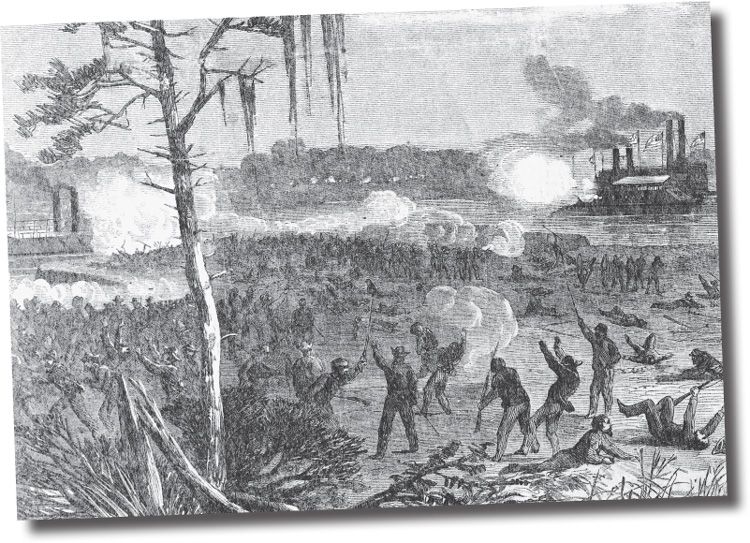
Confederate troops attack Union gunboats on the Red River.
1. In the event, most of the navy gunboats were saved thanks to an ingenious dam built by Colonel Joseph Bailey that raised the level of the water in the river and allowed the ships to slip through.
THE RED RIVER EXPEDITION.
THE GUNBOAT EASTPORT BLOWN UP.
MAY 7
CAIRO, FRIDAY, MAY 6
A gunboat from the Red River brings information that finding it impossible to get the Eastport off and being attacked by the enemy while endeavoring to lighten her, Admiral PORTER ordered her to be destroyed to prevent her falling into hands of the enemy....
THE BATTLE.
IMPORTANT NEWS FROM VIRGINIA.
A GREAT BATTLE BEGUN ON THURSDAY.
MAY 8
WASHINGTON, SATURDAY, MAY 7
The statements which were received here today, and which are entitled to belief, are that Gen. LEE made a tremendous and violent attack to pierce our centre, hoping thereby to divide our forces and to secure a victory; but Gen. [Ethan Allen] HITCH-COCK’s corps came to the relief, and, amid a murderous fire, formed in line of battle, and thwarted the designs of the rebels. The loss was heavy on both sides.1
Gen. [Philip] SHERIDAN was profitably engaged in another part of the field, and sent the Chief in command a message that he had routed STUART’s cavalry.2
The attack of LEE was on our advancing columns, who doubtless anticipated a victory by his onslaught, before the main body could advance to the field of battle.
The appearances on Thursday were that the hostilities would be renewed on Friday.
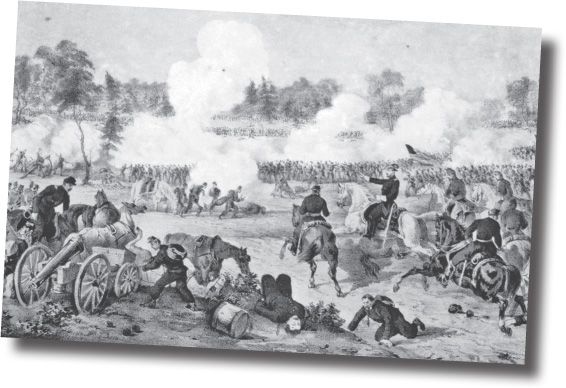
A Currier and Ives lithograph of the Battle of the Wilderness.
1. The Battle of the Wilderness began on May 5 and lasted until May 7. Union losses over the three days totaled 17,600 while Confederate casualties totaled 11,125. Once again, however, Confederate losses were heavier when expressed as a percentage.
2. Sheridan’s troopers fought a series of cavalry engagements with Stuart’s men from May 5 to May 8. They did not, however, rout Stuart’s forces, which got the better of each engagement. When Meade reprimanded Sheridan for not effectively performing his duties of screening and reconnaissance, Sheridan went to Grant and asked to be released for independent raiding missions. Grant agreed.
THE EXPEDITION UP THE JAMES.
MAY 9
STEAMER GRAYHOUND, OFF FORT POWHATAN.
JAMES RIVER, VA., THURSDAY, MAY 5
The movement of the Union army in this direction, which, for weeks past, has been vaguely expected, commenced this morning. The obligation to keep silence respecting the hostile preparations, which for prudential reasons was imposed, is now removed; and here, under the shadow of the commanding fortification, erected by the rebels in 1862, for the purpose of interrupting McClellan’s water communications after his reverses before the rebel Capital, known as Fort Powhatan, I commence the record of the campaign. Premising that up to this point every circumstance has been auspicious, and that not the slightest symptom of resistance on the part of the enemy to our advance in the direction of Richmond has been encountered, either from guerillas, torpedoes or any other source, I shall go back a few weeks, and briefly trace from its conception the enterprise which, to the present point, in all its details, has been a wonderful success.
THE PLAN
To Major-Gen. BUTLER, I am told, is exclusively due whatever credit shall result from the inception and execution of the plan. When, four weeks since, Lieut.-Gen. GRANT, the actual commander of the armies of the United States, visited Fortress Monroe, it was for the purpose of ascertaining the views of Gen. BUTLER respecting an advance upon the rebels by way of the Peninsula, to be carried out in cooperation with the Grand Army of the Potomac. Gen. GRANT had considered the various plans proposed with this object in view, but had committed himself to none, and was inclined, therefore, to listen attentively to what Gen. BUTLER might suggest. The sequel proves that the proposition of Gen. BUTLER fully commended itself to the judgment and acquiescence of the Commanding General, and measures were taken at once to put it in execution.
Briefly the project was to advance upon Richmond by the James River; get a foothold as near the city as possible, on the south bank of the stream; seriously interrupt the communications of the rebel Capital southward, and eventually compel the evacuation of LEE’s army of their strongly fortified position on the Rapidan, thus forcing the rebels to give GRANT battle, or press rapidly rearward to the walls of their Capital. This plan will be generally admitted to be both bold and comprehensive, while the arrangement of its preliminaries has been marked by the rarest shrewdness and military sagacity....
THE ADVANCE OF THE MAIN FORCE
As on every occasion when a large piece of machinery is put in operation, there is certain to be more or less friction of the parts, so this complex machine of a gallant and mighty army did not move smoothly according to the programme. The Eighteenth Corps (Gen. Smith’s) having the advance, was promptly up to time, dawn finding all the steamers used for its transportation steaming by Newport News into the mouth of the James river. But the steamers of the Tenth (Gen. Gillmore’s) Corps were still quietly at anchor off Fortress Monroe. Here was an unsuspected source of detention. Gen. BUTLER had every reason to suppose that the sailing orders were perfectly understood, and would be implicitly followed by his Corps Commanders. It was easy to perceive that he was both distressed and annoyed at the delay. He had hoped to reach his intended port of debarkation (City Point, fifteen miles below Richmond) at three o’clock in the afternoon. This he expected to accomplish, even in the case that the possession of two points on the way up the river, viz., Wilson’s Wharf and Fort Powhatan, should be contested by the enemy, as it was very likely would be done. There was nothing for it, then but to learn the cause of this dilatoriness of the Tenth Corps, and to hasten the vessels forward. This was done....
The scene in the hazy light of the beautiful Spring morning was picturesque and animated. Crowded steamboats labored heavily through the still water, pontoon trains and lumbering canal barges, to be used in disembarking, were in tow of the swifter transports. The long, low lines and wedge-like shapes of those naval nondescripts, the monitors, with their high cylindrical turrets amidships, gave variety to the scene … “Give her all the steam you can, Captain,” shouts the General, with upraised cap, and as the crowds of blue-coats recognize him, they burst out vociferously in cheers. The scene as we pass up the river, is charming in the extreme. The high wooded banks of the stream present us every variety of delicate foliage with which the Spring delights to clothe the earth in vernal beauty....
GLORIOUS NEWS.
DEFEAT AND RETREAT OF LEE’S ARMY.
MAY 9
TO GEN. JOHN A. DIX, NEW YORK WASHINGTON, SUNDAY, MAY 8 – 9 A.M.
We have no official reports from the front, but the Medical Director had notified the Surgeon-General that our wounded were being sent to Washington and will number from six to eight thousand.
The Chief Quartermaster of the Army of the Potomac has made requisition for seven days’ grain, and for railroad construction trains, and states the enemy is reported to be retiring.
This indicates Gen. Grant’s advance, and affords an inference of material success on our part....
You may give such publicity to the information transmitted as you deem proper.
It is designed to give accurate official statements of what is known to the department in this great crisis, and to withhold nothing from the public.
EDWIN M. STANTON, SECRETARY OF WAR
A SPEECH FROM THE PRESIDENT — GEN. GRANT NOT JOSTLED FROM HIS PLANS.
MAY 10
WASHINGTON, MONDAY, MARCH 9
A large number of persons, on short notice, assembled in front of the Executive mansion to-night, and, with the band of the Twenty-seventh Ohio Volunteers, now on their way to the field, complimented the President with a serenade.
The President appeared on the portico and made a brief speech, in which he said the honor extended was not so much, perhaps, to him, as to Gen. GRANT and the gallant officers and soldiers under his command. He was exceedingly gratified to know that Gen. GRANT had not been jostled from his plans, but was now on the line of movement according to the original design. While, however, we might rejoice at what had already been accomplished, much more remained to be done.
The proceedings, which were of short continuance, terminated with repeated cheers for the President, Gen. GRANT, and the army....
THE RESULT OF FRIDAY’S FIGHTING VERY ADVANTAGEOUS — LEE FALLING BACK.
MAY 10
WASHINGTON, MONDAY, MAY 9
The extra Star says:
“Reports from the front, not official, by parties that left there on Saturday, are to the effect that the result of the fighting on Friday [May 6] was yet more advantageous to the Union cause than that of Thursday, resulting in LEE’s falling back, according to some reports, twelve miles, leaving his dead and wounded in our hands.
GRANT, according to the same report, has a field full of prisoners, and had advanced to Spottsylvania Court-house.
A verbal message received at Gen. HALLECK’s headquarters, by a messenger from the Army of the Potomac, is to the effect that the battle closed on Friday, the enemy having fallen back about twelve miles, leaving his dead and wounded on the field.
On Saturday, at 3 o’clock, LEE’s army was in full retreat through Spottsylvania, and when the messenger left, Gen. HANCOCK was entering the place in pursuit.1
We have captured many prisoners, but the number is not known.
Gen. WADSWORTH is reported killed, and Gen. WEBB wounded.2
Gen. BUTLER is reported to be within ten miles of Richmond. This information comes by a boat from Alexandria [Virginia], passengers from there reporting the arrival of parties from GRANT’s army with news to that effect.
Parties in Alexandria County yesterday heard firing, as from heavy siege guns, in the direction of Spottsylvania Courthouse, from 11 A.M. until 1 P.M. The distance is over sixty miles, but the day was quiet and the wind from the southwest, making it not improbable that the firing was from the battle going on yesterday between GRANT and LEE....
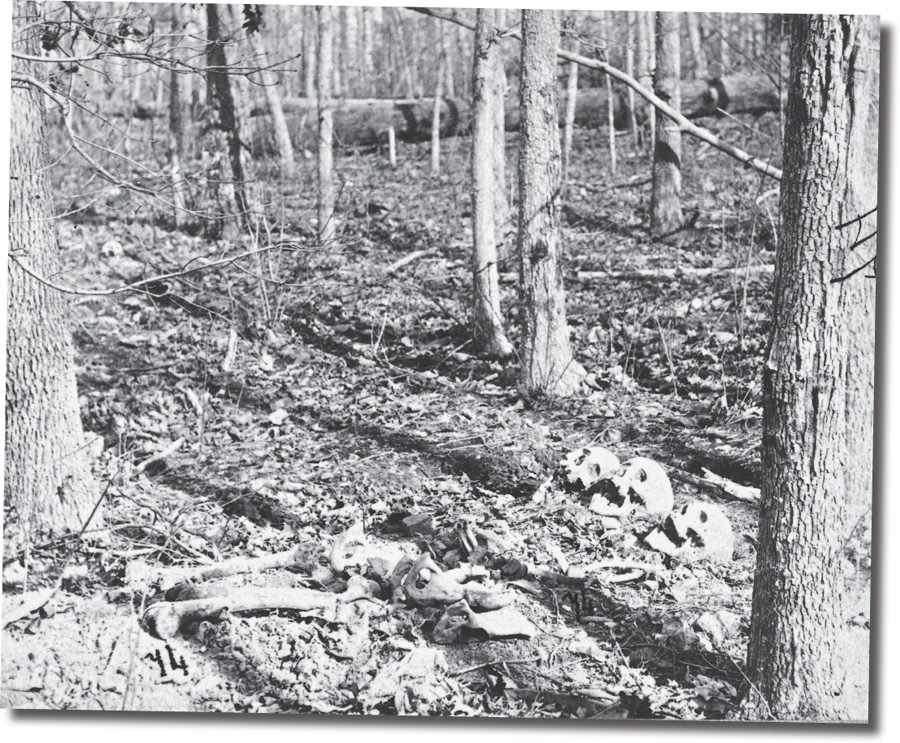
The battlefield after the fighting at the Wilderness. Note the gathered skeletons of slain soldiers in the foreground.
1. The report is not quite accurate. Lee’s army had much of the better fighting in the Wilderness, but Grant nevertheless moved his army southward toward Spotsylvania Court House on the night of May 7. Lee scrambled to get there ahead of him, which he did by a matter of minutes.
2. James S. Wadsworth was mortally wounded in the fighting on May 6; Alexander S. Webb was shot through the head, but survived.
GRANT’S ADVANCE.
OFFICIAL DISPATCHES TO SUNDAY NOON.
THE REBELS MAKE A STAND AT SPOTTSYLVANIA.
MAY 11
WASHINGTON, TUESDAY, MAY 10
To Maj.-Gen Dix:
Dispatches have been received this evening from Lieut.-Gen. GRANT dated at 1 o’clock yesterday.
The enemy have made a stand at Spott-sylvania Court-house. There had been some hard fighting, but no general battle had taken place....
The army is represented to be in excellent condition, and with ample supplies.
Gen. [John C.] ROBINSON and Gen. [William H.] MORRIS are wounded. No other casualties to general officers are reported ….
Gen. GRANT did not design to renew the attack to-day, being engaged in replenishing from the supply train, so as to advance without it.
EDWIN M. STANTON, SECRETARY OF WAR.
(Signed,) BENJ. F. BUTLER, MAJOR-GEN.
WASHINGTON, TUESDAY, MAY 10 — 7 A.M.
Maj.-Gen Dix:
A dispatch from Gen. SHERMAN, received at midnight, states that we are fighting for the possession of Rocky Face Ridge, and I have knowledge that [James B.] MCPHERSON took the Snake Creek Gap and was within seven miles of Resaca this morning.1
You will remember that on Saturday the rebels were forced from Tunnel Hill by Gen. [George H.] THOMAS and took position at Buzzard Roost, in a bend at Mill Creek, just north of Dalton.
This is represented to be a very strong position, which Gen. THOMAS was unable to drive the enemy from on a former occasion, when he advanced on Dalton; but Resaca is a position on the railroad, about fifteen miles south of Dalton, and this will place MCPHERSON, with a strong corps of veteran troops in the rear of the enemy, while THOMAS advances upon the front and [John] SCHOFIELD closes in on the flank from Cleveland....
EDWIN M. STANTON, SECRETARY OF WAR.
1. This was the first of Sherman’s several flanking movements in northern Georgia. Pinning Joseph E. Johnston’s Confederate army in place with two of his armies, he sent James McPherson’s Army of the Tennessee around Johnston’s left through Snake Creek Gap. Johnston hurried back to Resaca to block him, but he had to give up his defensive position at Rocky Face Ridge to do so.
NEWS OF THE DAY.
THE REBELLION.
MAY 11
The latest news from Gen. GRANT’s army in Virginia is up to Monday [May 9] at noon, at which time Gen. GRANT sent a dispatch to Secretary STANTON that the rebels were making a stand at Spottsylvania CourtHouse, and that though there had been some hard fighting, no general engagement had been fought. Gen. SEDGWICK was killed in a skirmish by a ball through the head from a sharpshooter. Gen. GRANT wrote that he was replenishing the provisions of his army from the supply train, so he could advance with out it. The wounded were being received and cared for at Fredericksburgh.
The news from Gen. BUTLER’s army is highly important. He fought a severe battle with BEAUREGARD’s forces on Monday, drove them three miles, occupied the railroad and captured many prisoners.1 Gen. [August] KAUTZ’s cavalry expedition had cut the railroad at Stony Creek, south of Petersburgh, and BEAUREGARD’s force had thus been cut in two. Gen. BUTLER’s telegraphs that his position is impregnable, and that Gen. Grant need not fear that LEE can be reinforced by BEAUREGARD.2
Advices also come from Gen. SHERMAN’s army, indicating that the corps under THOMAS and HOOKER are attacking JOE JOHNSTON’s position near Dalton in front, while SCHOFIELD attacks on the flank, and McPHERSON is operating in the rear. All the very latest advices everything was going well.
1. This was the Battle of Swift Creek (May 9, 1864), in which Butler made a thrust toward Petersburg, but did not follow up. After skirmishing, Butler seemed content to tear up the railroad tracks and did not press further.
2. This was certainly putting the best face on it. Butler’s assignment was to act offensively; to report that his position was “impregnable” communicated to Grant that he had instead gone over to the defense. In fact, Butler’s decision to entrench in the Bermuda Hundred effectively took him and his army out of the campaign.
THE RED RIVER EXPEDITION.
THE ARMY RETURNED TO ALEXANDRIA.
MAY 12
ALEXANDRIA, LA., WEDNESDAY, APRIL 27
All day yesterday and to-day the army has been reentering this place, returning from the disastrous expedition toward Shreveport. Gens. BANKS, [William B.] FRANKLIN and A.J. SMITH are now here, together with their respective commands. Alexandria begins to assume the appearance it wore four weeks ago, when the army, with high hopes and full of life, took up its march for Shreveport. Crowds of officers, soldiers and citizens are everywhere to be seen. The levee is lined with steamers, and the tents of a large army surround the place.
Gen. FRANKLIN and Gen. A. J. SMITH held a consultation at Grand Ecore last week, and agreed upon a programme by which they could bring the army successfully back to Alexandria. FRANKLIN laid this plan before Gen. BANKS, and told him that he (FRANKLIN) had held a consultation with Gen. SMITH, and that they had agreed upon the plan, and that he would undertake to conduct the retreat, if he (BANKS) would not interfere. Gen. BANKS assented, and thus virtually turned the command over to Gen. FRANKLIN. Gen. BANKS must have felt humiliated at this proposition, but he submitted. He took a cavalry escort and came on to Alexandria, arriving here a day or so in advance of the main army....
Admiral PORTER is now about sixty miles above here, trying to save the iron-clad gunboat Eastport. This boat got aground, sprung a leak and sunk near Grand Ecore, but was subsequently raised. She came on down a few miles, when she again met with a similar misfortune. The Admiral is now endeavoring to save her....
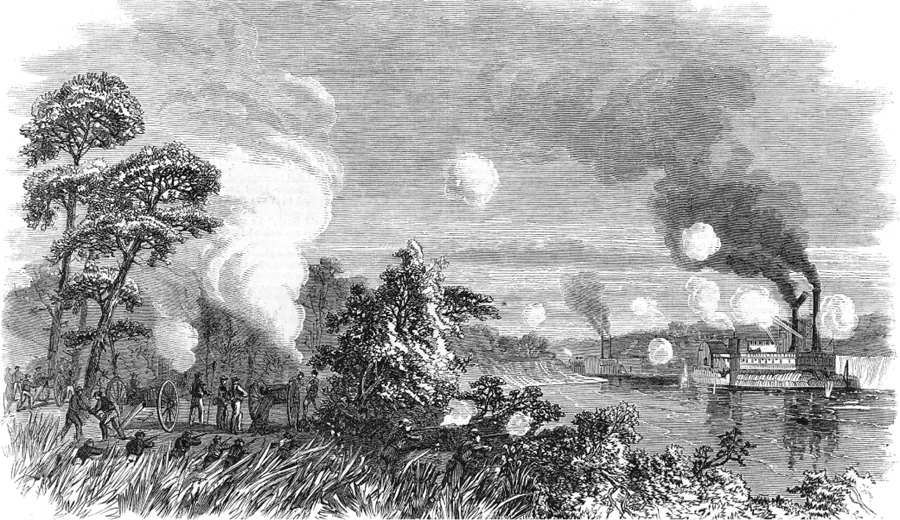
Artillery duel between Confederate land forces and federal ships on the Red River.
THE BATTLE OF SUNDAY, MAY 8.
MAY 13
NEAR SPOTTSYLVANIA COURT-HOUSE, Va., MONDAY, MAY 9 — 2 P.M.
I [William Swinton] have this morning returned from our advanced line of battle, which lies within two and a half miles of Spottsylvania Court-house, the enemy confronting in force. Our army reached this position yesterday morning, WARREN’s corps having the advance, and heavy fighting took place during the day. It was hoped that we could have reached Spottsylvania before the enemy would be able to make that point but in the foot race which the two armies ran on Saturday night, from the battle ground of the Wilderness, the rebels beat us. LONGSTREET, it appears, started at 11 P.M. of Saturday; our advance left at 10 P.M. The two columns marched by parallel roads, but LONGSTREET’s corps had time to arrive and form line of battle, and when our force was thrown out to feel the enemy this morning, he was found in position. Our first attack was made by [Joseph J.] BARTLETT’s brigade of [Charles] GRIFFIN’s division, on the right of the road, with [John C.] ROBINSON’s division on his left. BARTLETT had been ordered by Gen. WARREN to attack in column, under the belief that only rebel cavalry would be found. Instead of this, however, he ran on the whole of LONGSTREET’s corps, and his brigade, already reduced by the fearful losses of the three days’ battle of the Wilderness, was frightfully cut up. One of his regiments, the First Michigan, went in a hundred strong and came out with but twenty-five, having lost three-fourths of its numbers in fifteen minutes. ROBINSON’s division, which held the left, was also roughly handled, and broke in disorder. Seeing this, Gen. WARREN seized the division flag and rallied the men in person. Fresh troops were thrown in, and after fighting from 8 A.M. till 12 M., our troops had gained the object sought — an open space up to the woods in which the rebel line was formed. In this engagement Gen. ROBINSON was severely wounded in the leg, and will have to lose his limb.1
At 6 P.M., two fresh divisions, namely, those of [Samuel] CRAWFORD, (Fifth Corps,) and [George Washington] GETTY, (Sixth Corps,) were thrown in, and after a severe engagement lasting for an hour and a half, CRAWFORD carried the rebel position, took their first line of breastworks and captured over a hundred prisoners. This ended the action of yesterday. For the numbers engaged our losses were extremely severe, and will count up to 1,000.
This morning found our line established two and a half miles this side of Spottsylvania Courthouse, and securely intrenched. LONGSTREET has also been strengthened by the arrival of EWELL’s corps. The rebel line lies on a ridge a mile in front of the Court-house, and it will be a position somewhat difficult to carry, should it be decided to make a direct attack.
It will be observed on the map that our present position carries us many miles south and in the rear of Fredericksburgh, whose famous fortified heights are in our possession without the need of firing a shot. It will be used as a depot and for hospitals, and several thousand of our wounded were, yesterday, sent there. A small army of 2,500 greybacks have also just been marched by headquarters en route to the same point. They are generally hearty-looking fellows, and rather better clad and shod than I have before seen them.
Everything thus far has gone on satisfactorily, although it would doubtless have been better had we been able to find an opportunity of fighting a decisive battle.
The Army of the Potomac is in superb condition and spirits — in fact, was never before in any such condition. We are going on to Richmond, depend upon it; at least, some more formidable obstacle than has yet appeared will have to present itself to stop us....
P.S. — We have this moment been shocked by the announcement that Gen. [John] SEDGWICK, Commander of the Sixth Army Corps, has just been killed by a shot through the head. He was standing up with his staff in his advanced line of breastworks, and was picked off by a rebel sharpshooter, perched in a tree. The ball entered the face a little below the eye, and came out at the back of his neck. He lived for half an hour after being struck, and then expired. His body has just passed headquarters in an ambulance. It will be embalmed and sent North.2 The profoundest grief is felt at the death of the lionhearted chieftain, and it is felt that we could better afford to lose a whole division of the army than one whose valor, illustrated on so many fields, we can ill spare at this time. He never fought so well as in the arduous three days’ fight in the “Wilderness,” and it was a matter of general remark how splendidly SEDGWICK had been doing. It is presumed that Gen. [Horatio] WRIGHT will take the vacant command of the Sixth Corps.
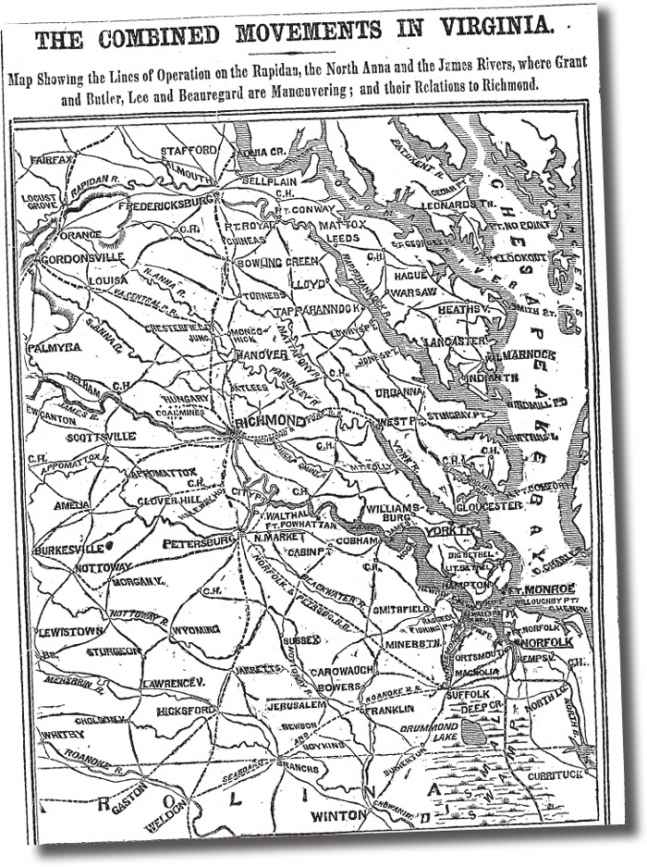
A New York Times map of Richmond and the surrounding area, the scene of the last great campaign in Virginia.
1. John C. Robinson (1817–1894) received a bullet through the knee in this attack and his left leg was amputated. It ended his military career.
2. Toward the latter part of the war, it was not uncommon in the Union armies to embalm bodies, especially those of officers, on the battlefield.
THE BATTLE OF TUESDAY, MAY 10.
MAY 13
WASHINGTON, THURSDAY, MAY 12
The following dispatch has just come to hand:
HEADQUARTERS ARMY OF THE POTOMAC, NEAR SPOTTSYLVANIA C.H., Wednesday, May 11
Yesterday’s operations now assumed the character of the most bitter and perhaps the most bloody of the series of battles which have been fought since we crossed the Rapidan. Knowing as we do, that our cavalry force has been working havoc with LEE’s communications, that his supplies are almost exhausted, that the lines of investment are being drawn around Richmond, and that echoes of disaster reach his ear from afar off Tennessee, and presage the downfall of the fabric of the rebellion, we are left to infer that the attack of yesterday1 was a desperate, and, let us hope, final attempt to retrieve the rebel fortunes by dealing a crushing blow at this army. It is enough to say that it failed, and though he inflicted a severe loss of life upon us, he suffered not less himself, and we still hold a position against which the rebel fury may dash itself in vain. It would seem to have been the policy of LEE in the series of battles which he has delivered during the past week, to contest the advance to Richmond at every available point, to wear us away by degrees, and then, perhaps, to fall upon the Union forces under BUTLER, and endeavor to annihilate them. This plan he has carried into execution with a masterly skill, inspired by a fury perfectly diabolical.
We are steadily pressing the rebels southward. The enemy have been greatly favored by the nature of this country, in whose dense woods and tangled chapparal the lithe and wary are much more at home. Fortunately, if we once carry the position which they now hold in front of Spottsylvania Court-house, we shall be out of the “Wilderness” and reach open country.2...
The losses of the army up to this time exceed anything that any previous battle has cost us.3 Nothing has been developed up to this hour respecting the enemy’s position or intentions for the day, and there is nothing to indicate whether they will retreat, remain on the defensive, or assault.
W. SWINTON.
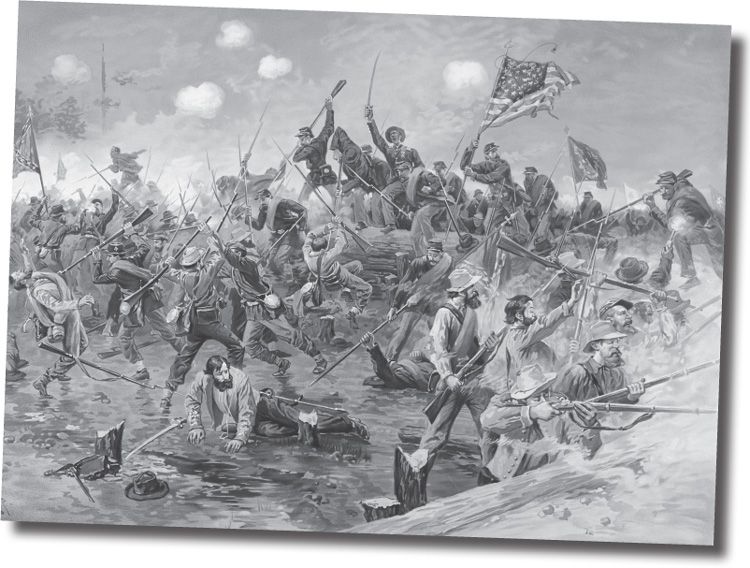
A painting by artist Thure De Thulstrup depicting the Battle of Spotsylvania.
1. This was an attack by the division of Harry Heth against the division of Francis Barlow on the afternoon of May 10.
2. When Union troops finally reached the open ground south of the Wilderness, several of the units began singing an old gospel song: “Ain’t we glad to be out of the Wilderness...”
3. Grant’s total losses from the crossing of the Rapidan to May 14 totaled 33,000 men; Lee’s losses in the same period totaled 23,000.
FROM SHERMAN’S ARMY.
PROSPECTS OF THE CAMPAIGN IN GEORGIA.
MAY 13
The Indianapolis State Journal says:
“Capt. WILLIAM C. McGONIGAL, of our Second Cavalry, but recently of Gen. THOMAS’s Staff as Inspector of Railroads, arrived in the city early yesterday morning, with about ninety men of his regiment, who long ago reenlisted as veterans but have only just now found an opportunity to get home. He left Chattanooga on Saturday and therefore brings us as late news as the telegraph, and more of it. He says SHERMAN’s force is greatly superior to JOHNSTON’s, how much it would not be proper to state, and that it is thought by no means improbable that the latter will make no stand this side of Atlanta....
SHERMAN is advancing by way of Dalton, toward Atlanta or the rebel army, whichever gets in his way first, and Gen. MCPHERSON, with the Fifteenth and Sixteenth Corps, is advancing toward Rome, and in that direction cooperating with SHERMAN. JOHNSTON’s force is estimated to be about 30,000 men, or but little over, and if LEE is kept busy by GRANT but few reinforcements can be added to it.1 The chances of success certainly seem to be good in this central spot of rebeldom. The railroads, Capt. MAGONIGLE says, are able to supply the whole army of the department and accumulate about thirty-seven per cent. of each day’s transportation, so that the rebels are not likely to make much by our inability to keep going when we start.”
1. Once he was reinforced by the army of Leonidas Polk, Johnston’s force numbered almost twice as many as estimated here (Johnston reported his strength as 60,564 in June), though that was still just over half the number available to Sherman.
THE GREAT CAMPAIGN.
GEN GRANT’S DECISIVE BATTLE.
MAY 14
WASHINGTON, FRIDAY, MAY 13 — 5.30 A.M.
Maj.-Gen. Dix:
Official dispatches just received by this Department dated yesterday, 8 A.M. at the battle-field, near Spottsylvania CourtHouse. They state that during the night, Gen. HANCOCK marched from his previous position on our right and occupied the ground between Gens. WRIGHT and BURNSIDE; at daylight he attacked with his accustomed impetuosity, forcing the first and then the second line of the enemy’s works, capturing the whole of Gen. EDWARD JOHNSON’s Division and part of EARLY’s, together with Maj.-Gen. JOHNSON, Gen. GEO. H. STUART, and from thirty to forty cannon.1...
1. This attack on a rebel salient, called “the mule shoe,” achieved initial success because Lee had been planning to abandon the position to shorten his line. He had removed the artillery but not the infantry when Hancock struck.
LEE’S ARMY.
MAY 14
The terrible series of battles which, during the last ten days, have tried the mettle of our army, and the remarkable succession of victorious bulletins which have thrilled the nerves of the nation, seem to be reaching their consummation. The great army of the rebellion, which has held its ground against the power of the United States for three long years, which has fought more great battles than any army that has existed in the world for the last half century, which has twice crossed to this side of the Potomac, and four times driven back mighty armies led by four Generals in succession — the veteran army of ROBERT E. LEE is breaking up. Or rather, it is being defeated, demolished, crushed and annihilated by the courage of our soldiers and the masterly generalship of their Commander....
SPECIAL DISPATCHES TO THE N. Y. TIMES.
FULL DETAILS OF THE GREAT BATTLE.
MAY 14
The four hours that have passed since the date of my last dispatch have been occupied with vigorous hammer-and-tongs work that does not appear to have greatly advanced the upshot of the contest, save in the destruction of life to the enemy that may have been accomplished. The resistance of the rebels is most stubborn, and it seems from present appearances that we shall be thrown over till to-morrow, when we shall have a continuation of the same, unless indeed the enemy be so harassed in his communications as to compel him to retreat.
But whatever may be the determination of the enemy, there will be no change nor let up in the resolve of this army, of its Commander and of the head of the armies of the United States. That resolve is to put the matter through, cost what it may. In doing this we shall add to the already appalling list of losses we have experienced in this unparalleled battle of eight day’s duration, but we shall end by crushing the enemy to powder ….
Gen. MEADE’s fame rises every day from the masterly manner in which he handled this army. He enjoys the highest confidence and respect of Gen. GRANT.
It is now certain that the struggle is over for the day. It has been a good day’s work. The sun is setting and we hold two miles more ground than we had when it rose, besides the captures already mentioned.
Thursday, May 12
Let the twelfth day of May be written in the calendar as one of the fasts of the Republic, for it marks the date of one of the deadliest and most decisive victories of the war. Knowing the ebbs and flows of battle, I refrain from attempting to anticipate what the after hours of to-day may bring forth; but if victory continues to smile on this army as it has up to this hour — 2 P.M. — tonight will see the greatest army of the rebellion not merely beaten, but destroyed.
HANCOCK this morning, by a splendid assault, turned the enemy’s right flank, carried both their lines of breastworks, captured forty-two pieces of artillery, and from 5,000 to 7,000 prisoners, and is now rolling up their line.1 The other corps have joined in and engaged in furious battle, which continues at the hour of writing. In the impossibility of at present obtaining accurate details, and desirous of sending the outlines of the battle at the earliest moment, I transmit the rough jotting of my note-book, which must stand until a full recital can be written out.
SIX O’CLOCK A.M. — At midnight last night HANCOCK with his corps changed from his position on the extreme right, and went in on the left of the line between the Sixth Corps and BURNSIDE’s, where there had been a gap. At 5 o’clock this morning he assaulted the enemy’s position, carried their second line of breastworks, and turned the right flank of the rebels. It was a complete surprise, favored by a mist, which concealed our movements. He has taken 3,000 prisoners and three Generals, namely, Gen. STUART [actually George H. Steuart], commanding a brigade in Gen. [Edward] JOHNSON’s division of EWELL’s corps; Major-Gen. JOHNSON, Commander, and another Gen. JOHNSON, commanding a brigade. This is entirely reliable, as I have heard the dispatch conveying the joyfull intelligence read aloud by the Chief-of-Staff.
Everybody is in the best of spirits....
SEVEN A.M. — A most interesting scene is now before us at headquarters. Maj.-Gen. ED. JOHNSON, who, with his whole division, was captured this morning, has just been brought up, under charge of an officer, to headquarters in the woods, where Gens. GRANT and MEADE and their staffs are seated around a bivouac fire. Gen. MEADE, who had been an old friend of Gen. JOHNSON, shook hands with him and introduced him to Gen. GRANT … Almost all the staff appear to have been old friends and acquaintances of JOHNSON, and numerous mutual inquiries in regard to old army comrades are being made. Gen. HUNT, Chief of Artillery, when he met him, had a mind to make a set speech, but the old familiar formula, “Ed, I’m glad to see you,” came out in a salutation, to which JOHNSON replied: “Well, HUNT, under the circumstance, I am not glad to see you.”
An Aid who has just come in from Gen. HANCOCK’s headquarters says that when the captured Gen. STUART — G.H. — was brought in, HANCOCK extended his hand, but the high-born captive drew back, saying that “his feelings would not allow him to shake hands” — an incident which has just created a merry laugh at headquarters ….
TEN A.M. — The whole line is now engaged, including the Corps of WARREN’s Fifth, of WRIGHT’s Sixth, of HANCOCK’s Second, and of BURNSIDE’s Ninth. From the present position of headquarters, which is near enough to be under fire, we can distinguish BURNSIDE’s and HANCOCK’s line of battle in our front, and WRIGHT and WARREN stretched off to the right. It is too densely wooded to see the manoeuvres, or even the line of battle, but we mark the line by the margins of smoke rising up above the trees, and the flashes of artillery.
ELEVEN O’CLOCK — There is a lull along the line, with the exception of a vigorous cannonading, which continues. The rebels have been fighting with an obstinacy that challenges the name of sublime, and LEE has been putting forth his best powers. The situation at this hour leaves our line holding all the ground they have gained; but they are not now advancing. The men are excessively fatigued, and it is now somewhat doubtful whether the issue can be decided in to-day’s battle.
TWELVE M. — The rain has ceased and the sun has just burst forth. May it be another sun of Austerlitz.2 BURNSIDE, who has hitherto had but one division (POTTER’s) of his corps engaged, is ordered to make an attack with his whole force. The left has been the cardinal point ever since HANCOCK’s turning movement.
TWO P.M. — It has been impossible yet to dislodge the rebels, who hold their position most stubbornly. LEE has repaired his left on a strong position, and his line is covered all along by breastworks. A tremendous cannonade is now being made for the purpose on the enemy’s position. Though victory now appears highly probable, you must not be surprised if the final result is not achieved to-day. The rebels will fight to the last, and have already, in the wonderful eight-days Battle of the Wilderness — of which this is but a continuation — made good all the boasts ever made of their prowess. They will really die in the last ditch, and only then. They are, however, now out of supplies, their rations having, according to the statements of prisoners, been exhausted last night, and if SHERIDAN’s destruction of their communications has been as complete as is believed at headquarters, they will be able to get no more. Quite a number of deserters have come in from all the corps, and they say if there is a chance many more may be expected to-night.
Of our losses thus far during this day’s severe battle it is impossible to form anything like an accurate estimate; but they must be extremely heavy. The losses of officers is also very great, but I forbear to mention names until the facts are placed beyond dispute. Gen. WRIGHT, commanding the Sixth Corps, was this morning wounded in the soft part of the leg, but still continued to command.
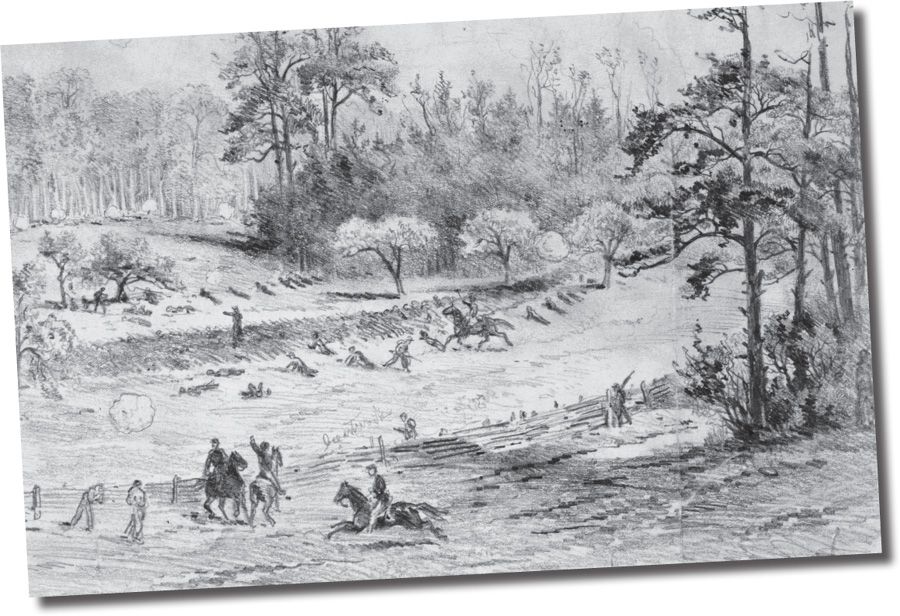
Alfred Waud’s sketch of the action during the Battle of Spotsylvania.
W. SWINTON
1. Grant’s predawn assault on May 12 against “the mule shoe” was initially a complete success. Hancock’s corps took 4,000 prisoners in part because many of the Confederates suffered from wet powder in their rifled muskets due to rainfall the night before. Both Ed “Allegheny” Johnson and George H. Steuart (not Stuart) were captured. then the fighting bogged down, in part because Grant had not properly prepared a second wave to take advantage of the success. The two armies also suffered some 17,000 casualties (9,000 Union; 8,000 Confederate).
2. In the Battle of Austerlitz (December 2, 1805), Napoleon ordered a unit to storm Pratzen Heights. As the men began to climb, the heavy mist that had obscured the field cleared, and the sun shone forth. The defenders of the Pratzen Heights were astonished by the sight of their attackers and broke.
LEE’S RETREAT BECOMING A ROUT.
MAY 14
WASHINGTON, FRIDAY, MAY 13 — 10 o’clock P.M.
Dispatches just received from one of your correspondents at the front, dated Headquarters, eight o’clock last night, say that the rebels are in full retreat to North Anna River, with fresh troops in hot pursuit.1
1. This conclusion was premature. Lee held his position at Spotsylvania until Grant began another flanking maneuver around his right on May 20.
LATEST FROM THE BATTLE-FIELD
MAY 14
HEADQUARTERS ARMY OF THE POTOMAC, NEAR SPOTTSYLVANIA COURT-HOUSE, FRIDAY, MAY 13
The terrible pounding which the rebels received yesterday, has compelled them again to fall back, which they did during the night. Reconnaissances this morning develop nothing but a skirmish line on their front. The operations of yesterday brought our lines so closely up to theirs, that they could hardly have hoped to hold their position to-day. It is not expected that they will fall back far, but will make another stand at the first defensible position. Should they not find such until they come to the North Anna, they will undoubtedly dispute the passage of that stream.1
This army holds them with the grasp of a bull-dog, and will never let go while life remains.
WILLIAM SWINTON.
1. Lee fell back only to another line he had prepared across the base of the “mule shoe.”
THE PRESIDENT AND THE WAR.
MAY 16
It was quite fashionable two or three weeks ago for the Copperhead press to sneer at the idea that President LINCOLN would permit any decisive fighting to be done until the Presidential nomination had been made. His chances, they assumed, depended on the prolongation of the war; and although scarcely willing to impute openly to him the infamously selfish design of sacrificing the country to his personal ambition, they were not ashamed to imply that he was governed by such a motive.
The recent campaign in Virginia has very effectually silenced that calumny; for one of its most conspicuous features has been the zealous cooperation of every department of the Government and every branch of the public service, in the great and complicated movement by which it has been marked. The plan of the campaign and the supervision of its details undoubtedly belong to Gen. GRANT; but he has had, at every stage of its execution, the zealous, vigorous and effective support of the supreme authorities at Washington. President LINCOLN has done everything in his power to insure success; and Secretary STANTON has, in the same manner, devoted all the energy and impulsive enthusiasm of his nature to the prompt supply of everything essential to the perfect execution of the plans and purposes of the Lieutenant-General. Nothing in the history of the war is more remarkable than the perfect accuracy and harmony with which the gigantic machinery of this movement has been worked. It was by far the most complicated plan of campaign which has been attempted; yet every man at every point seems to have “come to time,” and to have done, thoroughly, at the date appointed, the precise task to which he was assigned....
With equal energy and promptness the Government has been sending forward supplies and reinforcements. The moment it was seen that LEE was repulsed, and that Washington was no longer in danger, the troops collected and held there in reserve were pushed forward to repair the losses of the heroic Army under MEADE, and by this time the Army of the Potomac must have at least as many effective men as it had when the campaign opened.1 This fact of itself is decisive of the result. LEE cannot be reinforced. JOHNSTON’s Army cannot come to him for SHERMAN not only holds it fast, but threatens it with destruction. BEAUREGARD cannot aid him, for BUTLER holds him in check, and even if both were free, the destruction of their railroad lines would so retard their progress that they could not reach LEE in season to arrest the coming catastrophe.
The country may rely, with unfaltering trust, upon the supreme devotion of the President to the defence of the Government and the suppression of the rebellion. He has never, in a single instance, given the slightest ground for the imputation of being governed by personal ambition, or by any other motive than devotion to the public good. Most certainly he has in this instance given the most decisive rebuke to those who, in the recklessness of party zeal, charged him with delaying the war for his own promotion.
1. Though Grant’s army lost more men than Lee’s in these battles, Grant was able to replace his losses. In mid-May, Grant asked Lincoln to “rake and scrape” all the reinforcements he could, and by May 25, Lincoln had sent him 33,000 more men, almost exactly the number he had lost since crossing the Rapidan.
GEN. SHERMAN’S ARMY.
THE REBELS ABANDON RESACA.
MAY 17
WASHINGTON, MONDAY, MAY 16
Official advices received here, to-day, from Gen. SHERMAN, announce that he had forced JOHNSTON out of his formidable position at Resaca, the latter evacuating the position during last night, SHERMAN would pursue vigorously. Atlanta is the point now aimed for by both armies.
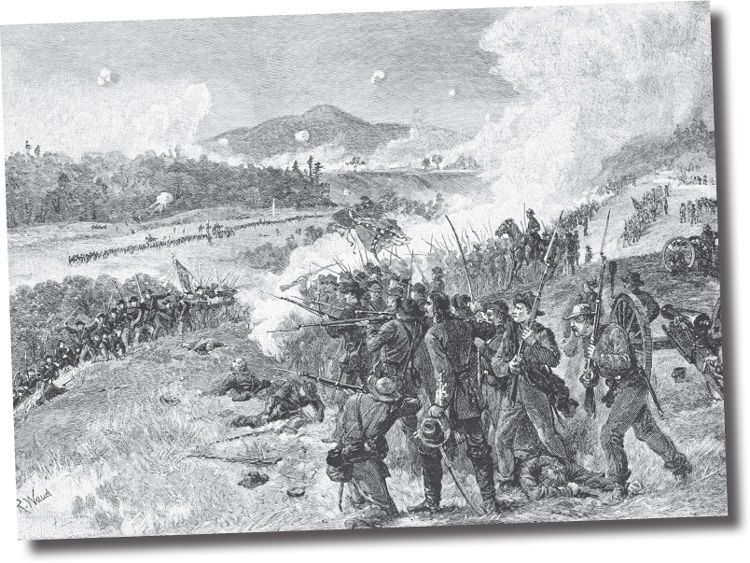
A woodcut of the Battle of Resaca.
GEN. SIGEL’S REPULSE — ITS LESSON.
MAY 19
We have one more victim of “superior forces” to add to the long list which already adorns our military annals. Gen. [Franz] SIGEL on Sunday last, “fought the forces of [John] ECHOLS and [John D.] IMBODEN under BRECKINRIDGE, at New-Market,” and in consequence of the enemy’s forces being superior in number, “he gradually withdrew from the battle-field, having lost five pieces of artillery and six hundred killed and wounded.” Translated into simpler English, this means that he was well beaten, though not routed.1
One does not need to be a professional soldier to arrive at the conclusion, from what has happened in the course of this war, that fighting “superior forces” of the enemy is a losing business. Some of our Generals are constantly doing it, and whenever they do it they are defeated. It seems to us, that this ought to settle the question of its propriety, or rather of its impropriety. Does it not seem, after all that has happened, that it would be well to let the enemy alone, whenever he is found numerically stronger than the attacking force? A battle is not a prize-fight. Its object is not to test either the pluck or endurance of the combatants, but to secure possession of certain positions. And when an enemy is in such force that attacking him is not likely to result in driving him from his position, it is great cruelty to attempt it. When a General, therefore, coolly informs us — and how many Generals have done so! — that he voluntarily, and with the choice of staying quiet or retreating open to him, assails a much heavier force than his own, and gets badly thrashed, it is simply a euphemistic mode of informing us that he is either a very stupid or a very inhuman person....
1. Major General Franz Sigel’s Army of the Shenandoah, numbering 6,275, was routed by a force of 4,000 Confederates (including 257 cadets from VMI) under Confederate Major General John C. Breckinridge in the Battle of New Market on May 15, 1864. The tone of The Times report here carries with it a hint of sarcasm.
REOPENING OF THE GREAT STRUGGLE IN VIRGINIA.
MAY 19
We have a special dispatch from our correspondent at Lieut.-Gen. GRANT’s headquarters, under date of yesterday morning, 5 o’clock, in these words: “The struggle has this moment begun with skirmishing on our extreme right. We fully expect a great, a bloody, and, we trust, a decisive battle today.”1 The progress and result of the day’s work — whether the skirmishing swelled into a general battle — whether the two Commanders spent the hours in a game of strategy — whether the issue was for or against the Union arms — we do not yet know.
But this preliminary work gives sufficient proof — if we had not abundant other evidence — that the Lieutenant-General means to indulge in no long period of inaction, and that no obstacles that can possibly be overcome will be allowed to retard the progress of his campaign. In him is embodied the earnestness, the persistency, the endurance, the quickness, the valor, of the American people. He feels all the impatience with treason which is felt by the nation. And not a soldier in the army nor a loyal citizen in the whole land, has more of a single-hearted determination to expend every energy, faculty, and power, in the imperative work of crushing out the rebellion.
We know the great losses his army has already suffered; we hear privately and otherwise of the fearful mud of Virginia; we learn that the soldiers are greatly exhausted with their recent fighting and marching. But we have seen also, under GRANT’s management in the West and in the East, what can be accomplished by able generalship.
There is proof that LEE has succeeded in getting some reinforcements as well as Gen. GRANT, and our correspondent yesterday stated that the rebel General had not abandoned his works on the River Po. It is possible that the contest is yet for Spottsylvania Court-house.
1. Rather than mark the prelude to another battle, the skirmishing on May 18 presaged another of Grant’s maneuvers around Lee’s right flank. The Union army left its lines on May 20 and raced for the North Anna River. Once again, Lee matched this move, setting up a defensive line behind the river.
GEN. GRANT’S SUCCESSES AND PRESIDENT LINCOLN.
MAY 20
The Copperhead journals have at last found how to extract some comfort from GRANT’s success. They are discovering that this success is just the thing to defeat the renomination of President LINCOLN! They feel quite certain that the Baltimore Convention, in view of these victories, will adjourn until September, and then select a more available candidate.1
Now we would not have the heart to say one word tending to deprive these people of their one poor little solitary consolation, were there a particle of reason in it. But it is better to be rationally unhappy than to live in a fool’s paradise. Of course, we appreciate the frame of mind superinduced upon both classes of Copperheads by the achievements in Virginia. To the straight-out “Peace Democrat” they come as gall and wormwood, because they are fast making an end of his favorite assumption that the rebels cannot be conquered. They aggrieve the partisans of MCCLELLAN, because they are proving conclusively, before the eyes of all living men, that the reasons assigned by President LINCOLN, in his memorable correspondence with MCCLELLAN, for the overland, in preference to the Peninsular, campaign against Richmond, were sound reasons, and that MCCLELLAN’s objections and fears were absurd. But, in common decency, the enemies of the Administration ought to submit to all this in silence, if they do not choose to recant. They only make themselves ridiculous by pretending to find in these achievements a cause for the repudiation of President LINCOLN by the people.
Every right-minded man sees in these magnificent successes the crowning glory of President LINCOLN’s administration. If there is a man in the National army who, from the beginning, has been more tenaciously adhered to, through good report and through ill report, by President LINCOLN, than any other, it is ULYSSES S. GRANT. Had his constancy been less, Gen. GRANT long since would have been thrust aside through the influence of his detractors. All the splendid generalship he has revealed during the last year has only justified the early confidence in him which President LINCOLN so notably manifested, by promotion after promotion. The unqualified trust, too, with which the entire planning of the present campaign was committed to Gen. GRANT, and the tremendous energy with which everything needful was supplied, reflects most signal credit upon the Government at Washington. It passes comprehension that any man in his senses should imagine that Gen. GRANT’s success is President LINCOLN’s condemnation. President LINCOLN is today more implicitly confided in by the great loyal mass of the people than ever, and his renomination, which two months age was almost morally certain, is now as fixed as any earthly event can be. We say this not because we assume to know the special intentions of the majority of the Baltimore Convention, but because it is certain that no delegates of the people will or can disregard a popular feeling so decided....
1. The political convention held in Baltimore on June 7–8 did nominate Lincoln for a second term. It titled itself the National Union convention, rather than the Republican convention, in order to attract the support of War Democrats.
ANTI-SLAVERY PRINCIPLES AND PRESIDENT LINCOLN.
MAY 21
The Union Convention of Vermont, which has just adjourned, unanimously adopted a resolution declaring ABRAHAM LINCOLN the first choice of the people of that State for the next Presidential term. This is another proof of the falsity of the pretense that Mr. LINCOLN has not the confidence of the earnest Anti-Slavery men of the country. No State in the Union has so steadily and so emphatically testified its abhorrence of human chattelism as Vermont. In its very earliest history, one of its judges refused to recognize an affidavit of the ownership of a fugitive slave, saying that he “would take no evidence short of a bill of sale from the Almighty;” and that has ever been the spirit of the State in every line of its public action. Its mountains have not been firmer than its Anti-Slavery principles....
GRANT’S FLANKING OPERATIONS.
MAY 30
The official dispatches from the War Office, as well as our own dispatches from army headquarters, furnish accounts of the new flanking operation which the Lieutenant-General has under way. Ten days ago, GRANT having previously tried hard to force the lines of Spottsylvania, began his march on their right flank, and instantly LEE was compelled to retreat. He fell back, however, but a few miles, and again assumed battle-front on the north side of the South Anna, a line which they had long been preparing, and meant to defend to the last. To compel a retreat from this position, the new flanking movement was begun on Thursday night last [May 26]. The army re-crossed the North Anna, whose lines it had forced a few days before, struck a short distance east, and then south for the Pamunky, at the Hanovertown crossing of which it arrived on Friday. The full effect of this march on the army of LEE yet remains to be developed. But that development cannot be long delayed. From GRANT’s position on the Pamunky, it is only about fifteen miles to the immediate defences of Richmond, which is a shorter distance than LEE has to travel from the South Anna to reach them.
People who do not study the movements intelligently are making anxious inquiries about GRANT’s base. GRANT’s base is all right. After he had left his lines on the Rapidan, at the opening of the month, he very soon found a new base at Fredericksburgh; subsequently, as he progressed, he abandoned the latter in turn, and made a base at Port Royal. This also, we fancy, he will now abandon; but there is another excellent base all ready for him, not far from his present lines on the Pamunky. When GRANT does not carry his base along with him, as he has done on several occasions, he always finds one very handy. He thus not only outwits LEE, but also [Confederate cavalry raider John S.] MOSBY.
The remarkable series of flanking operations which GRANT began on the Rapidan, and has carried on upon the Po, the Anna, and down as far as the Pamunky — the marvelous skill with which he has manoeuvred the army, and the great success which he has achieved, are deserving of profound admiration. Mainly by force of arms it was that he drove LEE’s army from the Rapidan, but chiefly by force of intellect he has driven LEE from the all but impregnable positions that he had prepared on the road to Richmond.
There has been a popular impression, springing, perhaps, from the character of the first great battle of our present Lieutenant-General at Fort Donelson, that GRANT, as a soldier, was merely a hard fighter — that his style was simply that of concentrating great masses of men, hurling them upon the enemy or his works, and achieving success, by what is called “pounding,” or “Stanton’s strategy.” The operations in the rear of Vicksburgh, one year ago, showed that this conception was erroneous; for although there never was harder fighting than at the battle of Champion Hills, yet even the grandeur of the fighting seemed obscured by the splendor of the strategy. At the November victory at Chattanooga, again, we heard much of the heroic achievements of the different divisions of the army, and all that ever was said on this point, and much more, was well deserved; but no one who has read the greatest of all military documents, GRANT’s Chattanooga report, and observed the maze of strategical and tactical combinations from which victory was brought forth, can have failed to perceive that the intellectual part of the battle — the mode in which GRANT wielded the forces of his brain — lent lustre even to the sublime valor of the simple men of the sword. The impression of his military character, however, to which we at first referred had not died out when the Lieutenant-General, three months since, transferred his headquarters to Virginia, and very many were greatly afraid that the wily and practised LEE would prove more than a match for the muscular Western Hercules. The idea that he was merely a fighter was greatly confirmed in the public mind by the reports of the first two days’ battle in the Wilderness; for we heard only of ceaseless, desperate and deadly struggles between huge masses of men, and could discern little or nothing of the soldierly skill that presided over the movements of these masses. Since, however, the course of events and our correspondents have revealed somewhat of the strategy that GRANT has pursued during this memorable month of May — since we have been able to gain glimpses, not only of the movements, but of their mode and their aim, we have been enabled very clearly to discover, not only the blaze of musketry and the march of columns, but the flashing of genius and the triumphs of intellect.
What would it not have cost GRANT to “move directly upon the enemy’s works” at Spottsylvania with his whole army? Our intelligent correspondent at headquarters confesses that the position could not thus have been taken, or, in other words, that GRANT might have dashed his whole army against the works in vain. What might we not have paid for the line of the North Anna had GRANT done nothing there but pounding? What streams of bloody currency we might have given for the line of the Little River, of the South Anna, and others, had it not been for the skill of this Commander? The present moment is a critical and a perilous one for him, for the army, and for the country; but we devoutly hope that these intellectual gifts, on which, along with the courage of our soldiers, our hopes are now based, may enable him to continue in his course of victory until the land is free from rebellion.
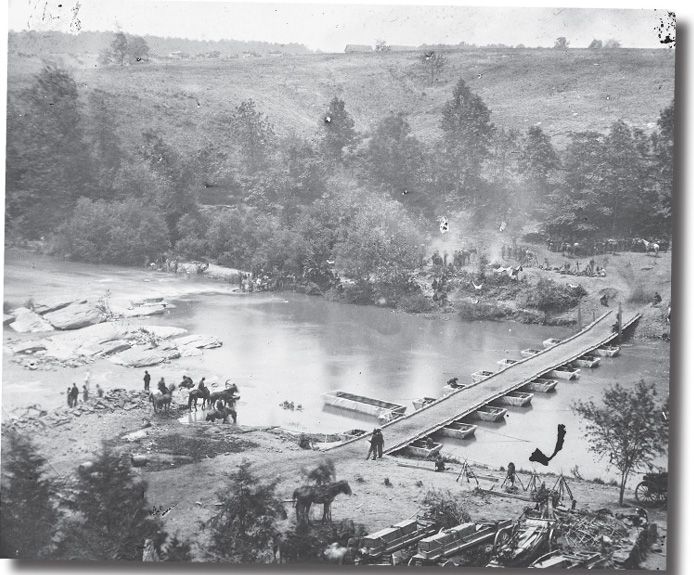
A federal pontoon bridge over the North Anna River near Jericho Mills, Virginia.
SHERMAN’S GREAT FORWARD MOVEMENT.
MAY 30
SPECIAL CORRESPONDENCE OF THE CHICAGO
EVENING JOURNAL.
NASHVILLE, WEDNESDAY, MAY 25, 1864
I am under the impression that Gen. SHERMAN resumed his forward movement from Kingston, Ga., last Monday morning; but up to this time, I have seen no official confirmation of the fact. If he did advance then, you will doubtless have heard of a battle or a foot race ere this reaches you.1 Altoona, on the Etowah River, is nineteen miles beyond SHERMAN’s front on Sunday last, and the only possible place for a stand north of Atlanta. JOHNSTON must either fight there, or fall back to the latter place, which is much weaker. Therefore, why should he retreat?
[Leonidas] POLK’s army, and all the Mobile garrison, except two or three companies of heavy artillery, are with JOHNSTON; he has as many men now as he could have a week or a month hence. Altoona is among mountain fastnesses; Atlanta is on a broad plain; and the question now is, if he does not fight at the former place, will he at the latter?
After all, I have one query to ask the reader to reflect upon, and it is this: is not JOHNSTON too weak to fight SHERMAN? and is he not falling back to make the distance between GRANT and SHERMAN greater, by railroad, while that between JOHNSTON and LEE, by the same method of travel, is constantly diminishing? and is JOHNSTON not gradually reinforcing LEE? and when overtaken, will there be any of his army left? I am not prepared to solve this problem; perhaps its solution may come before this letter reaches you, though I think not that soon.2
Suppose brigade after brigade were transferred to BEAUREGARD, at Peters-burgh, thus making his army sufficiently strong to annihilate BUTLER, or compel him to retreat; what then? I hope and believe both GRANT and SHERMAN are providing against such a possible contingency. The result of such a concentration of the rebel forces, would be to enable us to defeat them easier than at present, provided we could concentrate as readily as they; but if we failed to do this, then disaster would follow. A junction between BEAUREGARD, LEE and JOHNSTON, would leave but a single force to fight and follow; but suppose they were to unite before those of BUTLER, GRANT and SHERMAN?
I never saw more delightful weather. Vegetation springs up as if by magic. Green peas and ripe strawberries are luxuries in which our people can indulge, to their heart’s content.
LATEST.
Since the above was written, I have learned positively, from official dispatches, that SHERMAN moved on Tuesday morning [May 24] by way of Dallas, completely flanking Altoona. He has with him thirty days’ provisions of all kinds, and finds plenty of green pasture for his cavalry horses. Other supplies are being sent forward to Kingston without delay, as the railroad is completely repaired to that place. The rebels retreat in such haste that they do little damage to the bridges.
1. Sherman’s three armies left Kingston, Georgia, on May 23 seeking to get around Johnston’s left flank. Johnston scurried southward to interpose himself in front of Sherman at New Hope Church where a series of fierce battles were fought May 25–28.
2. Though Johnston had begun the campaign with a determination to fight Sherman in northern Georgia and then launch a counteroffensive, by now he was beginning to make the argument presented here: that a deliberate retreat into the Confederate heartland was actually a good strategy, for it lengthened Sherman’s supply lines and shortened his own. He was not, however, sending any reinforcements to Lee in Virginia.