
CHAPTER 20

Detail of a Kurz and Allison lithograph of the Battle of Cold Harbor.
On the last day of May, Grant executed another crab-like shift to the left from the banks of Totopot0moy Creek to Cold Harbor, a small crossroads only about a mile west of the site of the 1862 Battle of Gaines’ Mill. In effect, Grant had returned to the same battlefields over which the armies had fought more than two years before. The difference was not only that Grant had done so by moving overland — keeping the Army of the Potomac between Washington and the enemy — but also that the two intervening years had dramatically depleted the manpower of the Confederacy. Now, after making four flanking marches to get around Lee’s right, Grant decided that he would try again to punch through Lee’s center. On June 3, he ordered a general assault on the rebel lines at Cold Harbor. Though historians have often cited this as the epitome of the kind of butchery that characterized the entire Overland Campaign, to Times readers it was simply one more bloody battle among many others. Grant reported the assault to Secretary of War Stanton, and put “the number of our killed and wounded at about three thousand,” acknowledging that it did not gain any “decisive advantage.”
After that, Grant maneuvered again around Lee’s right, this time crossing to the south side of the James River and assailing Petersburg. Lee was dependent on Petersburg because the railroad lines connecting Richmond with the rest of the Confederacy all passed though that city. Though a quick Union dash into Petersburg might have captured it, Confederate forces arrived there in time to prevent it, and the campaign in Virginia settled into a lengthy siege of Richmond and Petersburg. After the high expectations of late May and early June, the public again became impatient. On June 22, The Times ran an article entitled “Public Impatience About Military Movements.”
On the political front, Lincoln’s re-election hopes were threatened by John C. Fremont, the 1856 Republican candidate, who resigned his commission as a major general in order to accept the nomination of a splinter group of progressive Republicans. The move threatened to split the vote of Republicans, and to prevent that, Lincoln accommodated Fremont by asking for the resignation of Fremont’s rival, Montgomery Blair, as postmaster general. Thus assuaged, Fremont agreed not to run. Lincoln won the nomination, but he did not run as a Republican. The party restyled itself as the National Union Party in order to attract War Democrats, and in pursuit of that, the party dropped Hannibal Hamlin, the dour incumbent from Maine, in favor of Andrew Johnson, a Tennessee Democrat. As The Times noted, this demonstrated “the thoroughly unsectional character of the Union party.”
Another political problem was Chase. Though Chase had formally withdrawn as a presidential candidate, he continued to cause Lincoln political difficulties and occasional embarrassment. When Lincoln expressed dissatisfaction with Chase’s intervention in an issue of political patronage in New York, Chase offered his resignation. To Chase’s surprise, Lincoln accepted it. “Of all I have said in commendation of your ability,” Lincoln wrote to him, “I have nothing to unsay, and yet you and I have reached a point of mutual embarrassment in our official relations which it seems can not be overcome, or longer sustained.”
In the west, William T. Sherman continued his adroit maneuvering against Joe Johnston’s Army of Tennessee. Jefferson Davis had watched with growing alarm as Sherman drove deeper and deeper into Georgia. As The Times noted, Johnston did not strike at Sherman, and instead “simply tried to retard our advance at such commanding positions as were found along the line of the railroad.” Like Grant at Cold Harbor, Sherman made one attempt to smash through Joe Johnston’s Confederate defenses before resuming his campaign of flank marches. At Kennesaw Mountain on June 27, he found that the rebel army was still too tough to crack. So he moved eastward again, and crossed the Chattahoochee River on July 16. For Davis, that was the last straw, and he removed Johnston from his command on July 17, replacing him with John Bell Hood. Knowing what was expected of him, Hood immediately unleashed a series of furious offensives against Sherman at Peachtree Creek (July 20) and the Battle of Atlanta (July 22). Alas, for Southern hopes, those battles not only failed to slow Union progress, they also seriously depleted Hood’s own army. By the end of July, Hood, with barely 35,000 men, retreated back into the city, and Sherman began to envelop it. As July turned into August, Hood’s position became increasingly precarious and the war itself had coalesced around two poles: Grant’s siege of Richmond and Petersburg, and Sherman’s siege of Atlanta.
As The Times noted, the auguries were good, but the paper also reminded its readers not to be impatient. “It is highly desirable,” the paper declared in June, “both for our own comfort and for the sake of the country and the cause, that we should all try and acquire a calmer and more critical temper in talking and thinking of the war.”

Sketch depicting the death of Colonel John McMahon, commander of 164th New York State Volunteers, at Cold Harbor.
IN FRONT OF RICHMOND.
STUBBORN VALOR OF THE NATIONAL TROOPS.
JUNE 6
HEADQUARTERS OF THE ARMY OF THE
POTOMAC, FRIDAY, JUNE 3 — 9 P.M.
Fighting has been going on nearly all day along the line, principally with artillery. The casualties have been quite large.
When [Francis] BARLOW’s division charged the enemy’s works [at Cold Harbor] early this morning he succeeded in getting possession of 17 guns and taking 250 prisoners. But not being supported he was exposed to an enfilading fire, and was compelled to evacuate the works which he had so gallantly captured, and also had to abandon the guns....
The Eighteenth Corps [William F. “Baldy” Smith] were engaged skirmishing most of the day, and made a charge on a line in their front but were unable to hold it. They fell back to their former position.
The Sixth corps [Horatio G. Wright], on the left of the Eighteenth, have been engaged more or less all day and have suffered a great deal the past two days.
An attack on the left centre of the Second Corps [Winfield S. Hancock], supposed for the purpose of feeling our left, was made an hour ago, but the enemy were soon driven off. The loss is not known....
Our losses in the past two days, at Cold Harbor, will number nearly five thousand killed and wounded, while the enemy’s loss will be nearly the same.1
The change in position to-day has been very little, our advance being about a mile beyond Cold Harbor....
1. On June 3, Grant ordered an assault by three corps against the Confederate lines at Cold Harbor. Only Francis Barlow’s division of Hancock’s corps managed to break the enemy line, and it was soon driven out. The Union lost between 3,000 and 7,000 men to the defenders’ 1,500. After the war, Grant wrote, “I have always regretted that the last assault at Cold Harbor was ever made.”
THE ACCEPTANCE OF FREMONT.
JUNE 6
Of course FREMONT accepts. He laid the plot on purpose to accept. His griefs would run to seed if he did not accept. His “whole charge of ancients, corporals, lieutenants, gentlemen of companies, discarded unjust serving men, revolted tapsters,” would all go to the dogs if he didn’t accept. It is plainly enough now but an ill venture; yet, being in so far, there was no alternative but to stand to it.
It was needful not only to accept, but to give reasons. FREMONT has given them, in the letter we published yesterday. They are very vague. Words lie so thick about them that it is not easy to make them out. But we gather that his acceptance is necessary because Mr. LINCOLN has violated personal liberty, and the liberty of the press, and especially the right of asylum; because his foreign policy has been feeble and without principle; and because the war has been managed with incapacity and selfishness, with all “the abuses of military dictation, without its unity of action and vigor of execution.” These, every one sees at once, are Copperhead reasons, pure and simple....
Gen. FREMONT by this letter breaks definitively with the Union party. We are sorry for it. Not for the party’s sake, but for his own. The party is sure to prevail. It will not feel his loss. But it is not pleasant to reflect that a name which was once peculiarily associated with a grand struggle against the slave power in the political field should now be connected with a movement tending only to encourage that power, when in flagrant rebellion. The wish of Gen. Fremont is to draw off a portion of the Union party to his own support — in other words to divide it. No extensive division could take place without neutralizing its power, and giving the next Presidency to the party which is opposed to the war, and in favor of negotiating with JEFF. DAVIS — the party for whose success the rebels have a special solicitude. The spirit must come either from hostility to the aims and objects of the Union party, or from a personal feeling against Mr. LINCOLN. If the former, JOHN C. FREMONT is ex animo a Copperhead. If the latter, he is a man who permits his personal spites to overrule his public duties. The special anti-Lincoln tone of his letter, his expressed willingness to support any other nominee of the Baltimore Convention, indicates that the latter branch of the alternative is the correct one. This conclusion finds an additional support in the fact that he has once proved himself capable of this same littleness of action. When Gen. POPE was transferred to the Department of Northern Virginia, Gen. FREMONT, though in the face of the enemy, refused to retain his command in the Mountain Department, for the avowed reasons that his personal relations with Gen. POPE were such that he could not acknowledge the latter as his military superior. It was a display of personal spleen of which a true soldier would be incapable. A similar grudge against President LINCOLN seems to be his ruling motive now. But whether it be this or a new-born hatred of the Union cause that impels him, he is alike dishonored. The impotence of his effort does not make it a whit the less odious.

A Currier and Ives poster for the short-lived presidential candidacy of John C. Fremont.
THE CLEVELAND CONVENTION.
LETTER OF ACCEPTANCE OF FREMONT.
JUNE 6
NEW-YORK, SATURDAY, JUNE 4.
GENTLEMEN:
In answer to the letter which I have had the honor to receive from you, on the part of the representatives of the people assembled at Cleveland on the 31st of May, I desire to express my thanks for the confidence which led them to offer me the honorable and difficult position of their candidate in the approaching presidential election....
My own decided preference is...not to be myself a candidate; but, if Mr. LINCOLN be renominated, as I believe it would be fatal to the country to endorse a policy and renew a power which has cost us the lives of thousands of men and needlessly put the country on the road to bankruptcy, there will remain no alternative but to organize against him every element of conscientious opposition, with the view to prevent the misfortune of his reelection.
In this contingency, I accept the nomination at Cleveland, and as a preliminary step, I have resigned my commission in the army. This was a sacrifice it gave me pain to make. But I had for a long time faithfully endeavored to obtain service. I make this sacrifice now only to regain liberty of speech and to leave nothing in the way of discharging to my utmost ability the task you have set for me.
With my earnest and sincere thanks for your expressions of confidence and regard, and for the many honorable terms in which yon acquaint me with the actions of the committee, I am, gentlemen,
Very respectfully and truly yours,
J. C. FREMONT.
THE PLATFORM OF THE UNION PARTY.
JUNE 8
The Union party, now for the first time meeting in National Convention, for the first time gives its combined sanction, and an authoritative form, to its tenets. Its series of resolutions embrace nothing novel; they are but the reassertion of principles which have already shaped the character and policy of the Administration; and yet their clear and systematic statement, accredited by the unanimous assent of the party in convention assembled, is an important act, which will pass into history.
The prime characteristic of the resolutions is their thoroughness. Never before was this exhibited in any national convention of any great party. Democratic, Whig, American, Republican — they all, in greater or less degree, were subject to the necessity of dealing largely in carefully qualified and restricted language. In respect to the great question of Slavery, the difference between them was only a difference where the limitation should be made. The Republican platform, in which the line against Slavery was drawn the farthest, yet exhibited special solicitude in its framers to preserve intact the inviolability of Slavery in the States. In fact, the shaping of a political platform, so as to supply a party with a distinctive and peculiar foothold, and at the same time not disturb the conservative and compromising spirit of the people, has always been a work of high art, requiring consummate political experience and skill. Among the political debris of the past can be found specimens of party platform joinery, so exactly set and fitted, that the mosaics turned up from Pompeii are but mere botchwork in comparison. As you go back to look at them, you are almost lost in wonder that political craft could have ever attained such nicety of measurement. The present platform shows nothing of the kind. Without a curve or an indentation, or a dovetail, or any balancing or adjusting method of any sort, it stands out in simple square outlines, every plank and every line running straight through from one end to the other, without break or deviation.
Upon the matter of the rebellion, a resolution sets forth an unqualified determination to accept of nothing short of unconditional surrender. Upon the manner of prosecuting the war, a resolution declares for the utmost possible vigor. Upon Slavery, a resolution demands its utter and complete extirpation from the soil of the Republic. Upon the policy of employing negro soldiers, a resolution declares its absolute approval. Upon the question of protecting these soldiers, a resolution calls for the full protection of the laws of war. Upon the paramount authority of the Constitution and laws of the United States, and the necessity of bringing rebels and traitors to due punishment, none but positive terms are employed. Upon the Monroe doctrine, the encouragement of foreign immigration, the maintenance of the national credit and currency, the speedy construction of the Pacific Railroad, and every other important point, the doctrine is thorough, and the language explicit.
The great Union party is fortunate in being thus able to plant itself upon a basis so completely consistent with every loyal obligation and every principle of justice and truth. It has been enabled, by the irresistible course of events, to get clear of the old compromising and temporising necessities. It has reached the fullness of time where political expediency and moral right completely coincide, and where matured public opinion is prepared to meet and steadily support it. It can now set forth its great principles with the strongest emphasis, and keep, rigidly to their extreme logical consequences, without danger of estranging from the war any portion of the people who have any heart in it at all. The very radicalism of these resolutions, which two years ago would have been a fatal reproach against them, is now their most potent recommendation.
The Copperheads will have a very different task of it when they come to frame their platform. Instead of a few consistent, solid, stable principles, they have got to join together the most diverse and incongruous dogmas and policies. Every sort of opinion respecting the right of making war upon rebellion, respecting the expediency of continuing the war, respecting the policy of offering terms to the rebels, and the kind of terms that should be offered, respecting the future treatment of Slavery, will have its exponents in the Chicago Convention. To assimilate these opinions will be impossible. There will be no alternative but either to make a platform without any definite principles and policy, or to make such a one as cannot be sustained by more than a fraction of the party, and thus be a cause of party division instead of party union. We don’t doubt that a vast deal of ingenuity will be exercised to contrive a basis on which all can make shift to stand, and quite likely it may be accomplished. A common hatred is always a strong stimulant to cooperation, and all these varieties of Copperheads, if they agree in nothing else, most certainly are of one feeling against President LINCOLN. Perhaps they will all consent to resolutions of any conceivable shape, that may afford a chance, or something they can imagine to be a chance, of defeating their common enemy. We await with a good deal of curiosity their action in this matter. But it is curiosity unmingled with the slightest apprehension. Whether they unite or divide, make one platform or a dozen, is all the same. No earthly device can prevent the vast majority of the people from pronouncing resolutely and decisively in favor of the principles and the nominations just put forth by the great loyal convention at Baltimore. That ratification by the people is as sure as their national spirit is indestructible.

Abraham Lincoln 1864 presidential campaign badge.
THE BALTIMORE PLATFORM AND THE QUESTION OF RECONSTRUCTION.
JUNE 11
The Copperheads, who are nothing if not querulous, complain of the Union platform for not touching upon the question of reconstruction. They say that the supporters of the Administration have different opinions on this cardinal point, and that it was pusillanimously avoided in order to escape discord. They try to make it appear that the seeming unanimity of the Convention was secured only by concealment and evasion.
Now we do not grudge the Copperheads any comfort they can find in this view of the case. They need comfort badly enough, considering their broken fortunes and ruined prospects. They are quite welcome to the fact that loyal men do hold very different opinions on this question of reconstruction, and also to the fancy that the Baltimore Convention was afraid to make an attempt to settle it. It is no discredit to be afraid to do a foolish thing.
The simple truth is that the time has not yet come for a fixed conclusion upon the best mode of reconstruction. Such a decision now by the Union party would be premature, unsafe, and unwise. The prime element in the problem is as yet indeterminable — we mean the disposition of the Southern people after the overthrow of their armies. This, in the very nature of the case, cannot be known except by practical experience after that overthrow takes place. We may speculate about what it will be, ever so confidently, and yet it is nothing but speculation — the stuff that dreams are made of....
First subdue the rebels. When that is done, and not before, can it be known what the Southern temper toward the Government will be, and what course of action that temper will make practicable and expedient. We must trust the President and Congress, and, if need be, the loyal States, with their Constitution-amending powers, to settle that, when the time comes, in the light of actual facts. It would be sheer folly to seek to do the thing now.
OLD ABE’S CHOICE.
JUNE 13
A gentleman in conversation remarked to President LINCOLN on Friday that nothing could defeat him but GRANT’s capture of Richmond, to be followed by his nomination at Chicago and acceptance. “Well,” said the President, “I feel very much like the man who said he didn’t want to die particularly, but if he had got to die, that was precisely the disease he would like to die of.”
JAMES RIVER.
GEN. GRANT ON THE SOUTH SIDE.
JUNE 16
WASHINGTON, JUNE 15 — 7 A.M.
To Major-Gen. Dix:
The movement of the Army of the Potomac to the south side of Richmond, across the Chickahominy River and James River, has progressed far enough to admit the publication of some general facts, without danger of premature disclosure.
After several days’ preliminary preparations, the movement commenced on Sunday night [June 12]. The Eighteenth Army Corps, under command of Gen. [William F. “Baldy”] SMITH, marched to White House and there embarked on transports for Bermuda Landing. Gen. [Horatio] WRIGHT’s corps and BURNSIDE’s moved to James Bridge, when they crossed the Chickahominy and marched thence to Charles City, on the James River. Gens. HANCOCK’s and [Gouverneur] WARREN’s corps crossed the Chickahominy at Long Bridge, and marched thence to Wilcox’s, on the James River....
A dispatch from Gen. SHERMAN’s headquarters, dated at 3 o’clock yesterday afternoon, near Kenesaw, states that the General is in front, advancing his lines on Kenesaw. Another unofficial dispatch, dated at 9 o’clock last night, reports some advance to-day; that Gen. THOMAS has gained ground, and that one rebel brigade is nearly surrounded. It further reports that the rebel Gen. POLK was killed today, and his body sent to Marietta.1...
EDWIN M. STANTON, SECRETARY OF WAR.
1. Lieutenant General Leonidas Polk (1806–1864) was both an Episcopal bishop and a general in the Confederate army. He was killed by a Union artillery shell while standing with several other officers atop Pine Mountain on June 14, 1864.
THE ENGAGEMENTS BEFORE WASHINGTON AS VIEWED BY A SOLDIER.
JULY 18
SPECIAL CORRESPONDENCE OF THE NEW-YORK TIMES.
...Washington has been in serious danger.1 At the time of the appearance of the first Butternut at Rockville, Md., the capital city had not force enough to man four rifle-pits. It was uncertain at which point of the thirty odd miles the columns of [John C.] BRECKINRIDGE and [Jubal] EARLY might be hurled. And when it was learned at midnight of Sunday, the 10th instant, that the enemy were massing their columns against Fort Stevens, with the knowledge of our weakest point of defence — which was the most alarming feature of the whole affair — the terror of the citizens amounted almost to paralysis....
The report Sunday night, that the enemy were at Rockville, eighteen miles distant, brought all the reserves from the Alexandria side.
As your correspondent and the sunlight passed up Fourteenth-street, the thunder of the guns of Fort Reno, which were bellowing under the frantic practice of the militia, was swaying the people to and fro with excitement. A broad grin was very hideously perceptible on the secession mouth, and many an anxious face looked out from behind a waving flag, and many a hearty “God bless you,” came from a loyal heart as we marched up the road.
Arriving at Fort Stevens, in the suburbs of the city, we found a few regiments scattered around. In that lazy indifference which is evinced only by the veteran at such an hour. The rifle-pits were sparely occupied, and troops slowly coming in, comprised only of dismounted cavalry and convalescents from hospital.
We were ordered three miles to the left to Fort Reno, and stationed there in the rifle-pits; but until one o’clock the grumbling of the men under the intolerable heat in that shadeless plain “was all the sound we heard.” After resting a few moments, we were ordered back again. On our arrival one-third of the regiment and fire commissioned officers had bean stricken down with heat and sun-stroke.
By two o’clock the rebel skirmishers were appearing and disappearing, in that snake-in-the-grass style so becoming to their status, near the residence of Hon. FRANK BLAIR [in Silver Spring]. By three o’clock their skirmish line had worked its insidious way within pistol shot of the gunners at the fort, and matters were becoming decidedly interesting, sufficiently so to beguile the President, the Secretary of State and his son, many of the foreign Legations, and all the military notabilities of the capital, to the scene.
So close were they that one of the gazers from Fort Stevens was shot on the parapet, and the whistle of a bullet was heard close beside the President’s carriage, which, at this stage of the proceedings, was in a position enabling its distinguished occupant to crack a joke in response to the crack of the rebel rifle.2
Whether it was this last outrage that determined the officers in charge or not we do not know; but about this time proceedings were being taken to put an end to this rebel recreation.
A line of skirmishers, composed of the Veteran Reserves, some dismounted cavalry and hundred-day men, were deployed in front, and steadily drove back for a short distance the whole rebel line....
A vast audience with hushed voices and earnest gaze were looking out upon the scene, and there, in sight of the greatest men of the day, with honest ABRAHAM on one side of the rifle-pits and dishonest JOHN C. BRECKINRIDGE on the other....
1. In an effort to loosen Grant’s grip on Richmond and Petersburg, Lee sent Major General Jubal Early northward through the Shenandoah Valley to invade the North. Early crossed the Potomac and turned east toward Washington arriving in Silver Spring on the outskirts of the capital on July 11.
2. President Lincoln went out to Fort Stevens north of the city to watch the fighting. While standing atop the parapet of the fort, a physician near him was shot in the thigh. According to tradition, a young officer (reputed to be Oliver Wendell Holmes) then told the President to “Get down, you fool,” though no contemporary source confirms it.
THE ARMY.
PROGRESS OF THE ASSAULT ON PETERSBURGH.
JUNE 20
WAR DEPARTMENT,
WASHINGTON, JUNE 19 — 9:45 P.M.
To Major Gen. Dix:
This evening a dispatch from City Point, dated at 9 o’clock this morning, reached the Department. It reports that our forces advanced yesterday to within about a mile in front of Petersburgh, where they found the enemy occupying a new line of intrenchments, which after successive assaults we failed to carry, but hold and have intrenched our advanced position. From the forces of the enemy within their new line it is inferred that BEAUREGARD has been reinforced from LEE’s army.1...

Alfred Waud’s sketch of federal sharpshooters at Petersburg.
1. As Lee had done at Spotsylvania, Beauregard constructed a shorter defensive line closer to the city and retreated into it June 15. Three days later, part of A. P. Hill’s Corps from Lee’s army marched into Petersburg to support Beauregard.
THE SIEGE OF PETERSBURGH.
JUNE 22
CORRESPONDENCE OF THE PHILADELPHIA INQUIRER.
BEFORE PETERSBURGH, SATURDAY, JUNE 18
— 10 P.M.
Reviewing the operations of to-day, I may safely write that affairs are progressing favorably. Standing on the heights occupied by the rebel line of fortifications captured by the Eighteenth Corps on the evening of the 15th, I could distinctly see the extreme right of our front line of battle resting on the Appomattox River not more than half a mile from Petersburgh. This was near sunset to-night. From the point where I stood, a broad, flat plain extends toward the Appomattox on the right, and toward Petersburgh in front, and looking across these flats to the right of the line, at a distance of more than two miles, it appears close to the suburbs of the city.
It has swung around since early this morning a distance of two and a half miles, and is now that much nearer Petersburgh. This morning the front of the right wing ran obliquely to the river, and was much extended, two divisions covering more than two miles of ground; but in sweeping up the river its length has been shortened one-half. On the left we have been equally successful, for although there has not been so great an advance there as on the extreme right, the movement was less of the nature of swinging on a pivot, and the average distance gained is nearly equal. At all events we have gained on the left not less than a mile since four A.M., and this gain was sufficient to throw our line across the Petersburgh and Norfolk Railroad. This places us in possession of two of the several branches that diverge east, southeast, south and southwest from Petersburgh.1
The next is the Petersburgh and Roanoke Railroad [also called the Weldon Railroad], the main artery of the rebel Confederacy, and the only direct line of communication between Richmond and the seaboard and Gulf States. It is on this that the strategic value of Petersburgh mainly depends. The centre has not advanced so far beyond its former position as the two wings; but up to last night it was considerably nearer Petersburgh than the right or left, and a greater advance of the two latter portions of our lines was necessary. On an average our present position is probably a mile in advance of the one held this morning. This advance has been made without any severe fighting. The way had been paved for it by the assaults of yesterday, in which the enemy had lost portions of their lines of intrenchments.
In my last I mentioned the assault by the Third Division of the Ninth Corps [Willcox’s], at 3 P.M. yesterday, which was unsuccessful. The charge was made on the line of breastworks opposite our left, and running across a cornfield front of and parallel with a track of pine woods. The Third Division advanced from their own position across a ravine running parallel with the breastworks, and over the crest of its further declivity into the open fields before the works. Then, under a heavy fire, they advanced across the field nearly to the rifle-pits before them; but their having to cross a slight hollow, which afforded shelter from the shower of bullets that had been pelting them, they stopped and did not advance further. At 6 P.M. Gen. [James H.] LEDLIE’s division of the First [actually Ninth] Corps was ordered to renew the attempt.
Gen. LEDLIE formed his attacking column under cover of the ravine above mentioned, in three lines — the First Brigade, Col. [Jacob P.] GOULD; Second Brigade, Col. [Ebenezer W.] PIERCE, and Third Brigade, Col. [Elisha G.] MARSHALL, succeeding each other in the order named. Reaching the open field at the top of the slope, and emerging, they started on a run for the intrenchments, with fixed bayonets, and without stopping to fire a gun. Two batteries to the left and one to the right poured a heavy enfilading fire of grape and canister into them as they advanced, while another was firing at extremely short range directly in front, combined with musketry. It was a terrible tempest of deadly missiles to pass through, and many a good man fell on the way, but the work was nevertheless accomplished in gallant style.
The enemy displayed the utmost pertinacity, and in the rifle-pits the fight was waged hand to hand, and large numbers of dead rebels were left in them, mingled with our own men. After being driven from the main line, the enemy rallied at the second and smaller line, not more than one hundred yards in the rear, from which also they were driven, but rallying, again retook them, but again were compelled to retreat. Still they returned to the charge four separate times, rushing from the woods in our front with a determination that seemed inexhaustible; and after dark, when the firing had somewhat subsided, their skirmishers crawled forward and scooped out in the light sand soil their little rifle-pits, as close as possible to our lines. During the night, however, they withdrew to a position further back.
The Second Maine Battery, Capt. THOMAS, and Fourteenth Massachusetts, Capt. WRIGHT, posted in the rear of the ravine above-mentioned, did splendid service in this assault. A caisson belonging to the rebel battery in front was blown up by one of their shells. The woods just in its rear bore evidence of tremendous shelling, and on the space where the fire had been concentrated a considerable number of dead were found, killed by shot and shell. On this space I was shown a remarkable spectacle. At a distance of two or three rods apart, and in line with each other, were three dead rebels, each killed in precisely the same way, the top of the skull being taken completely off and the brains of each lying near him. From their relative positions it seems that all three had been killed by the same round shot.
The severity of the fighting in this assault is attested by the losses sustained, which are estimated at nearly one thousand. Major HEDGES, of the Fourteenth New-York Heavy Artillery, was killed while leading his men in a charge. Col. MARSHALL, of the same regiment, received a contusion of the thigh. Lieut. MCKIBBEN, Fourth United States Infantry, A.D.C. to Gen. LEDLIE, was wounded in the neck. That the rebels suffered severely was evident from the number of dead left on the ground. In the intrenchments they lay, in some places, three or four deep, while the ground between the intrenchments and the woods was thickly strewn with them. Muskets lay scattered around by scores, and the evidences of the hot work that had taken place, were visible everywhere.
Beside their losses in killed and wounded, the enemy left in our hands, at this point, a considerable number of prisoners and one stand of colors, captured by LEDLIE’s division. Those portions of the rebel lines continuous with the section whose capture is above narrated, and not already in our hands, were occupied by us in the first advance this morning at 4 A.M., on the broad flats near the Appomattox, on the right of the Second Division of the Sixth Corps, and even [John H.] MARTINDALE’s division of the Eighteenth Corps gained the rebel line of works in their front in the first charge.
At this part of the lines our further advance was delayed for some time by the rebel sharpshooters, who occupied a house near by, and whose fire was especially troublesome. Battery H, First Ohio, Capt. DORSEY, getting the range of the house, quickly dislodged them. Three successive advances were made during the day along the whole line, to a greater or less extent, the first occurring at four A.M., the second about noon, and the last between three and four P.M., each succeeding with but little difficulty, except the afternoon attack by portions of the Second Corps in the centre or right centre, where the enemy showed a more spirited resistance, and inflicted on us a partial repulse. The fact is, there has been no very severe fighting on any part of the line to-day, and our advantages have been gained at comparatively small cost.
It is evident that a deep game of strategy is being played by the Commanders of the opposing armies, in which, of course, the object of each is to learn as much as possible of the designs and dispositions of the other while keeping his own concealed; and under such circumstances too much care cannot be exercised to guard against improper disclosures.
Among the casualties of the day are Col. [Joshua L.] CHAMBERLAIN, commanding the First Brigade, First Division, Fifth Corps, wounded.2
It appears to be the opinion now that only a portion of LEE’s force is opposed to us here, and it is apprehended that he will concentrate, against BUTLER at Bermuda Hundred. No uneasiness, however, is felt on this score, as we are prepared at that point for any attack that may be made. I refrain from giving any statement of our forces at this point, or even the exact information of our line of battle, as in the present peculiar state of affairs the publication of such information might be injurious.

Alfred Waud’s sketch of federal artillery at Petersburg.
1. The railroads connecting Petersburg to the rest of the Confederacy were crucial, for if Grant could break them, Lee would be unable to sustain his army in Richmond. After breaking the Norfolk & Richmond, only two railroads remained: the Weldon Railroad southward, and the South Side Railroad to the west.
2. This is the same Colonel Chamberlain who won fame on Little Round Top on July 2, 1863, at Gettysburg while in command of the 20th Maine.
OUR CANDIDATE FOR THE VICE-PRESIDENCY.
JUNE 22
The thoroughly unsectional character of the Union party is strikingly evinced in the ardent satisfaction with which the nomination of ANDREW JOHNSON for the Vice-Presidency is hailed by the party throughout the North. We have yet to hear of the slightest murmur. Neither in the Middle nor in the Eastern States is there any complaint that both candidates on the ticket come from the States west of the Alleghanies. All local jealousy is swallowed up in the general sense of the propriety of making special recognition of the peculiar desert of Southern loyalty.
This display of feeling is of much more significance than a superficial glance would discover. Every one who has been in the habit of reading the extracts copied from the Southern newspapers, has seen that the constant effort of the leaders of the rebellion has been to fill the popular heart with rancor against the North, as a geographical division. The term “Yankee” is made the epitome of everything that is odious, and is applied indiscriminately to all who dwell north of Mason and Dixon’s line. When Northern parties are spoken of, a certain difference is made between the epithets applied to each. The supporters of the Administration usually get the benefit of the adjectives that express pure hate; while its opponents are more apt to be favored with those that imply contempt. But whatever discrimination there may be in the language used, there is one constant object — and that is the surcharging the Southern heart with the intensest aversion to the Northern people. As the Carthagenian was taught to regard the Roman, as the Frenchman, a half century ago, was taught to regard the Englishman, as his natural enemy, so the Southern man has every influence brought to bear upon him to make him inveterately hostile to the Northern man. This is just what might be expected. The supreme object of the rebellion is separation from the North; and, of course, the more complete the moral separation, the easier becomes the material.
On the other hand, the supreme object of the Union party is to prevent separation and promote union. They are not for fighting the South at all, as a geographical division. They do not even allow the fact that the rebellion is exclusively seated in the South, and that the great majority of the Southern people have given their adhesion to it, to induce upon them anything like an anti-Southern feeling. It is the rebellion alone that they hate. A Southern man who opposes the rebellion, who stands firmly by the old flag, instead of suffering any distrust or prejudice on account of his nativity, in fact is admired and applauded all the more because of his nativity. ANDREW JOHNSON to-day has a far stronger hold upon the great popular heart of the North than he could have had if he had been born in the North. He is no more loyal than hundreds of thousands of others. But the peculiar glory of his loyalty is that it is Southern loyalty; and it is because the people are particularly desirous to recognize and honor that loyalty that his nomination to the second office in the gift of the people affords such particular satisfaction. This manifestation is conclusive evidence of the genuine national spirit of the Union party. It is a new proof that the party is truly entitled to the grand name it bears, — a yet further pledge that the party, in its work of restoring the Union, will know no such thing as sectional antipathy.
This nomination for the Vice-Presidency receives peculiar favor for another excellent reason. It not only attests the true Union feeling, but it vindicates the genuine free-labor principle. It completes the thoroughly representative character of the ticket. The New-York World, with a maladroitness as laughable as the spirit was contemptible, sneered at the ticket as made up of “a rail-splitting buffoon and a boorish tailor, both from the backwoods, both growing up in uncouth ignorance” — ending its period with an allusion too obscene to be republished. In like manner the Richmond Examiner announces the ticket as “a renomination for President of ABRAHAM LINCOLN, the Illinois rail-splitter, and for Vice-President, ANDREW JOHNSON, known in the West as the Tennessee tailor, one of the meanest of that craft.” The idea of both the Copperhead and the rebel is the same — namely, that LINCOLN and JOHNSON are unworthy of honor because they once lived by manual labor. It is an idea inseparable from a friendship for Slavery. That institution, every body knows, rests solely on the assumption that manual labor should be the lot of an inferior caste only. In every slave-holding country, that manner of work is always accounted a degradation. Nothing is more natural than that the upholder of Slavery should taunt the Union party for naming candidates who were at one period of their lives plain working men. Nothing is more fit than that the Union party which has declared that Slavery must be exterminated from the land, should have selected two just such candidates. It is precisely in keeping with the character of a free-labor party. It presents palpably to the people the question whether labor is or is not worthy of honor. It is believed by the Union party that the majority of the people esteem work; and that the public men of the country who have risen from the hardest and the humblest work to high positions by native force of character and by self-education, are the very men who are most to be commended, and who best illustrate both the power and the beauty of American institutions. This certainly was the prevailing feeling in the early days of the republic. It is well to test whether it yet survives or not. We reckon that it will unmistakably manifest itself in November, in spite of all the malign influences of Slavery upon the public mind during these latter years. We think that the fling at the former employments of the candidates of the Union party will be proved a very stupid thing — of all acts the one least calculated to impair their good name or injure their popularity.

Andrew Johnson 1864 vice presidential campaign button.
PUBLIC IMPATIENCE ABOUT MILITARY MOVEMENTS.
JUNE 22
Since the successful passage of the James River, and the advance on Petersburgh, many people have begun once more to fix a day on which Richmond is to be in our possession. The more sanguine spirits have, as might have been expected, fixed upon the Fourth of July, while others refuse to defer the realization of their hopes for more than one week more at the outside. The speedy capture of the place is looked forward to by a still larger number, who refrain from meddling with dates, but expect the news of it every week. All this, we need hardly say, is but a repetition of what we have been witnessing ever since the war began. After the commencement of every new movement, if it should be attended with the smallest success, a portion of the public has at once rushed to the conclusion that “the back of the rebellion was broken;” that the rebel army was demoralized, and incapable of further resistance. We witnessed this after Mill Spring, after Roanoke, after Fort Donelson, after the fall of New-Orleans, and after that of Vicksburgh. No amount of experience of the risks and uncertainty of war, and of the desperation with which the enemy is fighting, seems sufficient to counteract this most unfortunate tendency to exaggeration. More recently, we have witnessed it after the battle of the Wilderness. GRANT’s successful advance threw the public into its usual fever, and they looked for nothing less than his unbroken progress and immediate entry into Richmond.
This would all be, perhaps, a harmless amusement, if it were not that each of these fits of exaltation is followed by great despondency, a general disposition to abuse the Government, to doubt the General-in-Chief, and, of course, also by an upward tendency in prices. We had a week or two of the deepest dejection after it was discovered that the battle of Spottsylvania had not caused LEE’s army to dissolve in thin air; and we fully expect that we shall have another week or two of despair as soon as it is discovered, as it will be, probably, in a few days, that the capture of Petersburgh Heights has not rendered Richmond untenable, or reduced the Confederate forces in Virginia to inaction.
It is highly desirable, both for our own comfort and for the sake of the country and the cause, that we should all try and acquire a calmer and more critical temper in talking and thinking of the war, and that we should, as far as possible, prevent our desires from clouding our judgment ….
THE PRESIDENT’S VISIT TO THE ARMY.
JUNE 26
HEADQUARTERS DEPARTMENT OF VIRGINIA AND NORTH CAROLINA, IN THE FIELD, THURSDAY, JUNE 23, 1864
Gen. BUTLER’s army was honored yesterday by a visit from President LINCOLN. As if they had regard for his presence and safety, the rebels retrained from firing a shot all day, and His Excellency examined the whole length of the line of intrenchments without interruption. He also made a trip up the James River, visiting Admiral [Samuel Phillips] LEE’s squadron, going directly to the place where, on Tuesday, the missiles of the enemy plumped and hissed down into the murky waters of the stream,1 and no salute from the shotted guns at the rebel rams were fired to do him honor. I am inclined to think that “our Southern friends” must have been ignorant of the proximity of so distinguished a guest, or their hospitality would have been shown in their own peculiar manner. This is the only explanation of a silence which otherwise must be construed into contempt, and that quality which JEFF. DAVIS and his colleagues cannot afford to exhibit toward Mr. LINCOLN.
The particulars of the President’s tour of observation may be written briefly, as they were not marked by any striking incidents. As early as eight o’clock A.M. Gen. BUTLER, accompanied by only a few members of his Staff, rode down to the Point of Rocks Landing, on the Appomattox River, and embarked on the fine steamer Greyhound, Capt. MARTIN, which took them to Bermuda Hundred. Here they were joined by the President, Messrs. [Gustavus] Fox and [Charles H.] DANA, Assistant Secretaries, Col. [Adam] BADEAU, and other officers of Gen. GRANT’s Staff, when the trip was resumed up the river. Arriving at the flag-ship of Admiral LEE, that officer and Fleet-Captain [John S.] BARNES joined the party, and the Greyhound went on until she came to the fleet of monitors at Farrar’s Island, which on Wednesday were the targets of the rebel battery on the heights just beyond. Here the President, Gen. BUTLER and some of the more distinguished officials left the Greyhound, and visited the double-turreted monitor Onondaga and machinery and construction were examined apparently with great interest, this being the first opportunity Mr. LINCOLN has had to personally inspect the iron-clads of the Onondaga’s class.
Having remained on board the iron-clad a sufficient period to see all the novelties about her, the party landed at Crow Nest, on the south side of the river, where horses were in waiting for their use. Thence a brilliant cavalcade set out to inspect the line of works which are stretched along our position at Bermuda Hundred. Mr. LINCOLN and Gen. BUTLER rode in advance, the latter to the left, Admiral LEE, and Mr. FOX and Mr. DANA next, and the remainder of the party followed as near as possible in the order of their rank.
It was not long before the first soldiers met with on the road recognized the President, whose tall form and not very graceful appearance on horseback would attract attention under any circumstances. Immediately he received three hearty cheers, which he acknowledged by raising his beaver [hat]. The hurrahing, thus initiated on the extreme right of the line was continued along its entire length of three miles and Mr. LINCOLN for the rest of the ride was compelled to remain uncovered, with his head exposed to the broiling heat of the sun. Such is the penalty of greatness! The cheering must, however, have been gratifying enough to make amends for the heat, dust and other physical discomforts which the President experienced. There was no mistaking the genuine, heartfelt enthusiasm of his reception by the troops in the field. Voluntarily forming in ranks in front of their earthworks, the men were unremitting in their compliments, and an evident smile of satisfaction lighted the President’s sallow face, with its mingled expression of care and sadness, as he rode along. At one point of the line the unthinking enthusiasm of the soldiers might have got the President into trouble. It was where our men have been greatly annoyed by sharpshooters. They could not restrain themselves from shouting as the visitors passed; but as soon as their hurrahing ceased, they ran back into their bomb-proofs hurriedly — a movement suggestive enough to make some of the cavalcade wish for a quickening of the houses’ paces; but neither the President nor Gen. BUTLER took the hint, riding along at the same jogging trot as before. Without presuming to criticise, I do not see that there was any necessity for either Mr. LINCOLN or Gen. BUTLER to take the risk of being shot by a sharpshooter. It may be very interesting, exciting and gratifying to curiosity, and all that sort of thing, to visit the picket line and catch some views of the enemy’s works; but surely men whose lives seem to be now indispensable to the nation have no right to get into such dangerous positions. It is like tempting Providence.
The President expressed himself very hopefully regarding the military situation, and said that he did not know one-half of what had been accomplished here by the army before this opportunity of personal observation. Himself and the other gentlemen of the party returned with Gen. BUTLER to his camp, where they rested awhile and refreshed themselves with lunch. Later in the afternoon the President took passage on the steamer Baltimore for Washington.
H. J. W.2
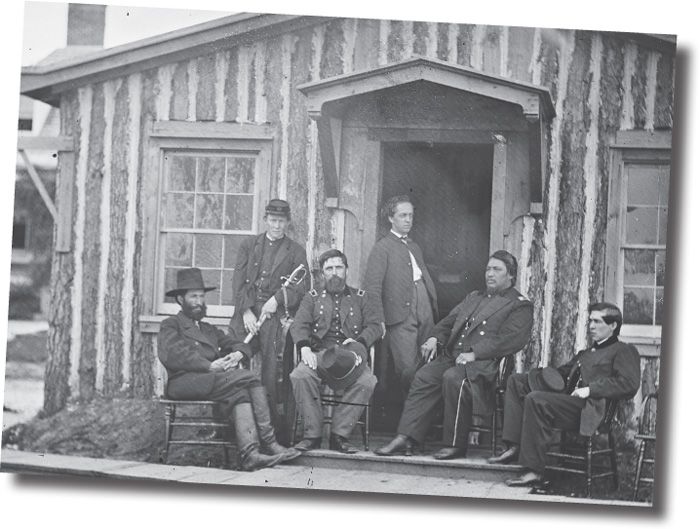
Members of General Grant’s staff at City Point, Virginia.
1. On June 21, the Confederates engaged in a long-range bombardment of the Union squadron in the James River near Trent’s Reach.
2. Probably Times reporter Henry J. Wisner.
THE ABOLISHMENT OF SLAVERY IN MARYLAND.
JUNE 25
BALTIMORE, FRIDAY, JUNE 24
The Constitutional Convention of Maryland, in session at Annapolis, passed, today, by a vote of 53 yeas against 27 nays, the following article of the Bill of Rights: “Hereafter, in this State, there shall be neither slavery nor involuntary servitude, except in punishment of crime, whereof the party shall have been duly convicted; and all persons held to service or labor as slaves are hereby declared free.”
THE PRESIDENCY.
ACCEPTANCE OF MR. LINCOLN.
JUNE 29
NEW-YORK, JUNE 14
HON. ABRAHAM LINCOLN — Sir, The National Union Convention, which assembled in Baltimore on June 7, 1864, has instructed us to inform you that you were nominated with enthusiastic unanimity for the Presidency of the United States for four years from the 4th of March next....
We are, Sir, very respectfully, your friends and fellow-citizens,
WM. DENNISON, OHIO, CHAIRMAN.
REPLY OF MR. LINCOLN.
JUNE 29
EXECUTIVE MANSION, WASHINGTON, JUNE 27
Hon. William Dennison and others, a Committee of the Union National Convention. GENTLEMEN:
Your letter of the 14th inst., formally notifying me that I have been nominated by the convention you represent for the Presidency of the United States for four years from the 4th of March next, has been received. The nomination is gratefully accepted, as the resolutions of the convention — called the platform — are heartily approved.
While the resolution in regard to the supplanting of Republican Government upon the Western Continent is fully concurred in, there might be misunderstanding were I not to say that the position of the Government in relation to the action of France in Mexico, as assumed through the State Department and indorsed by the convention, among the measures and acts of the Executive, will be faithfully maintained so long as the state of facts shall leave that position pertinent and applicable.
I am especially gratified that the soldier and the seaman were not forgotten by the convention, as they forever must and will be remembered by the grateful country for whose salvation they devote their lives.
Thanking you for the kind and complimentary terms in which you have communicated the nomination and other proceedings of the convention, I subscribe myself,
YOUR OBEDIENT SERVANT, ABRAHAM LINCOLN.
MR. CHASE’S RESIGNATION.
JULY 1
We have no reliable information as to the causes of Mr. CHASE’S resignation of the Treasury Department, though the fact itself seems to be sufficiently authenticated. We do not ascribe it to any anticipation of difficulty in carrying the financial department of the Government through the crisis which circumstances seem to have created for it, because Mr. CHASE is not the man to shrink from any duty or responsibility in which the honor and welfare of the nation are involved. The more threatening the aspect of affairs in his department, the more likely would he have been, other things being equal, to stand by the helm and do everything in his power to avert impending dangers. He has become involved, it is true, in a very embarrassing controversy with the State banks throughout the country, and has committed himself, perhaps too unreservedly, to certain theories of finance in connection with the war; and he may have thought that some other person could more gracefully introduce changes of policy, which experience has shown to be indispensable, than he could himself. But this is a very different thing, and has a very different motive, from abandoning the Ship of State because it seems to be threatened with danger.
We are inclined to attribute his resignation to another cause. It is very well known that, through the zealous and not always judicious efforts of his friends, Mr. CHASE had become deeply involved in the canvass for the Presidential nomination. Naturally enough, the great body of those who held office under his immediate appointment and oversight, were vehement advocates of his selection, and quite often lost sight of the proprieties of their position in their endeavors to promote his success. Mr. LINCOLN, it is notorious, made no attempt whatever to arrest this unusual and not very edifying demonstration, and his own nomination was made by a spontaneous popular movement, in opposition to the most strenuous efforts of the great body of persons holding office under the Treasury Department....
FROM SHERMAN’S ARMY.
THE ASSAULT ON THE KENNESAW MOUNTAIN.
JULY 4
CINCINNATI, SATURDAY, JULY 2
The Commercial has a special dispatch from Sherman’s headquarters, dated June 27, which states that an unsuccessful assault was made on the positions of the rebels at Kenesaw Mountain on the morning of that day at 8 o’clock.
Selected portions of the Fourth, Fourteenth and [“Black Jack” John] LOGAN’s Corps moved to the attack in three columns, striking the rebel intrenchments on the right, the left and the centre.
After a fierce fight, lasting between one and two hours, our troops were compelled to fall back everywhere, finding it impossible to carry the crest of the hill in the face of such a destructive fire.
Gen. HARKER fell in the assault on the right, and Col. DAN MCCOOK, both severely wounded.
Our position is now considerably in advance of that occupied before the assault.
Our loss is estimated at about two thousand.1

Battle of Kennesaw Mountain.
1. Union losses in the assault at Kennesaw Mountain were 3,000; Confederate losses were 552.
THE PIRATE SUNK OFF CHERBOURG BY THE KEARSARGE.
DETAILS OF THE ENGAGEMENT.
JULY 6
By the [ship] City of Baltimore, the general details of whose news we give elsewhere, we have the highly important and gratifying intelligence that on Sunday, June 19, the rebel pirate Alabama was engaged off Cherbourg by the United States steamer Kearsarge, which sunk her after an engagement lasting an hour and a half.
The following is a brief statement of the battle as given by the English papers:
The report that the rebel cruiser Alabama gone out from Cherbourg to fight the United States steamer Kearsarge, which was hovering off that port, turned out to be true, and resulted in the sinking of the Alabama. The encounter was witnessed by the English steam yacht Deerhound, and that vessel picked up Capt. [Raphael] SEMMES and the crew of the Alabama, took them to Cowes, and furnished the following details of the affair:
On the morning of Sunday, the 19th, at 10:30, the Alabama was observed steaming out of Cherbourg harbor, toward the steamer Kearsarge. At 11:10 the Alabama commenced the action by firing with her starboard battery, at a distance of about a mile. The Kearsarge also opened fire immediately with her starboard guns, and a sharp engagement, with rapid firing from both ships, was kept up, both shot and shell being discharged. In the manoeuvring both vessels made seven complete circles, at a distance of from a quarter to half a mile.
At 12 o’clock the firing from the Alabama was observed to slacken, and she appeared to be making head sail and shaping her course for land, which was distant about nine miles.
At 12.30 the Confederate vessel was in a disabled and sinking state.
The Deerhound immediately made toward her, and in passing the Kearsarge was requested to assist in saving the crew of the Alabama. When the Deerhound was still at a distance or two hundred yards the Alabama sunk, and the Deerhound then lowered her boats and, with the assistance of those from the sinking vessel, succeeded in saving about forty men, including Capt. SEMMES and thirteen officers....
ENGLISH FEELING AT THE SINKING OF THE ALABAMA.
JULY 6
The sinking of the Alabama by the Kearsarge appears to have been a source of very great mortification among the foreign friends of the rebels. It is amusing to read the comments of the English papers which represent that class, and to see the misstatements which they make, the contradictions of each other, which they are not careful enough to avoid, and the shifts and excuses which they are fertile in, to lessen, if possible, the pain of the blow. They universally agreed at first that the Kearsarge was badly disabled in the fight. In fact, to read the accounts, one would think that her victory was quite accidental. They also were in one accord that the Alabama was entirely overmatched, and that the Kearsarge had “higher steam power and rate of speed, a crew nearly double that under Capt. SEMMES,” and heavier guns.
Her guns were heavier no doubt, but her crew was only 180 in number to 150 on board the Alabama, and as to the superiority in speed, if there is anything which these same people have gloried over in reference to the Alabama, it has been that she could far outstrip any vessel that we had afloat. They have quite lamented over our inability to build a vessel that would steam so fast as she, in view of our claims to be able to accomplish something worth mentioning in building vessels. How does it come now, that all of a sudden we find such a superiority in speed admitted for the Kearsarge?
Of course, to read their account, all the glory was with the Alabama. They spread everywhere the picture of her crew firing their guns till their muzzles were under water and the vessel going down, without striking their flag, although SEMMES himself says that he hauled down his flag, at which time it is to be presumed his men ceased firing; and the log of the Deerhound says she did not strike till forty minutes after she fired her last shot.
They are very much puzzled to know why SEMMES went into a fight in which he was to be so badly beaten. The Liverpool correspondent of the Manchester Examiner explained it by saying that “SEMMES believed that WINSLOW, of the Kearsarge, a very young man, lacked experience and would rather run than fight.” WINSLOW is about sixty, but would have certainly been as little likely to prefer running to fighting, if he had been younger than he is; and if SEMMES did calculate in that way, he did not know his man.
The [London] Times says, “It is not in our power to say why Capt. SEMMES, who had gained so much glory, and so unquestionable a reputation for courage, that he could afford to be prudent,” came out to the fight. We doubt whether he would have done so if he could have avoided it; but if he did come out for the purpose of a fight, it seems to us quite probable that he was driven to it by the consciousness that his reputation for courage was very questionable. What he has ever done since he took command of the ship to show courage in is hard for us to see. His whole career has been one of running away from battle, with the sole exception of his attack upon the Hatteras, where he showed stratagem, but nothing else; and we are inclined to think that this feeling that to be always running after unarmed vessels, and flying from armed pursuers, was showing too much of the “better part of valor,” that drove him at last into a fight which real discretion probably would have led him to avoid, if possible.
Charges of inhumanity on the part of the Kearsarge were also freely made. SEMMES himself says that she fired five guns after he had struck his colors, and that there was no appearance of any boats coming from her after the ship went down. We should require very strong proof of this statement before we credited it for a moment, and as it is contradicted by all the other accounts, and as the Kearsarge took sixty-eight of the Alabama’s crew, which her boats actually picked up, it is quite certain that there is not the shadow of a foundation for this charge.
We are not surprised at the state of feeling which led to such misstatements. The English feel in their hearts as if the conflict was their own. It was fought with an English-built vessel, with English guns and English powder, and an English crew. SEMMES openly declared that his best men were trained on board an English man-of-war, the Excellent — and to have a vessel thus built, and thus manned and equipped, so easily destroyed by an American vessel, with so little injury to herself, touches the old sore spot, the first blow upon which was struck when the flag of the Guerriere came down. We can well afford to let their vexation work itself off in ovations to SEMMES, and rejoicings over his escape in an English vessel. We doubt, however, whether it will amount to enough to procure him another ship.

Sinking of the CSS Alabama off the coast of France.
GEORGIA.
JULY 6
The situation in Georgia is now of the deepest interest and importance. In the whole of our movements there during the past two months, the enemy has simply tried to retard our advance at such commanding positions as were found along the line of the railroad. Of course, in a mountainous region like that, it was very easy to make our advance difficult, and to delay us for a considerable time. But the enemy seem now to have got to the last defensive line of Atlanta outside of the city fortifications — the line of the Chattahoochee; and our army has followed him closely up to within a short distance of that line. If we can now force him to general battle, or if we can effect an investment of Atlanta, we shall soon see the breaking up of his army. If JOHNSTON evacuates Atlanta — which we do not believe he will do without a serious defence — he may still keep up the fight during the Summer in efforts to defend Milledgeville.
GEN. SHERMAN CONFIDENT OF SUCCESS.
JULY 26
Gen. SHERMAN’s latest dispatches show an assured confidence in the capture of Atlanta, though the prize may not be won as speedily as the public had anticipated. ...Gen. SHERMAN’s dispatches also express the most profound grief at the death of MCPHERSON. That gallant soldier was killed about eleven in the forenoon, while riding in advance of his Staff to form a defensive line to meet the rebel attack....
THE ADVANCE UPON ATLANTA.
JULY 27
EIGHT MILES FROM ATLANTA, GA., MONDAY MORNING, JULY 18
One of the most difficult jobs in the art of war is the successful crossing of a river in the face of the enemy, most especially when a structure has to be constructed under the fire of the opposing party. After considerable skirmishing, two pontoons were swung across the Chattahoochee, on the night of the 16th, and on the evening of the 17th the entire army and its baggage had been safely lodged on the south bank of the stream.
The successful passage of the Chattahoochee River was effected as follows: Early in the week, the Fifteenth, Sixteenth, Seventeenth, Twenty-third and Fourth Corps moved up the north bank of the river some fourteen miles, and crossed without opposition, leaving [Joseph] HOOKER and [John M.] PALMER on the opposite bank, with the railroad dividing their two corps. At a proper time, HOWARD moved down to the right, to be in readiness to form a junction with the two corps, and to protect them while crossing. At noon on the 17th inst., PALMER’s corps commenced crossing — [Union Major General] JEFF. C. DAVIS’ division in the advance. Before dark the Twentieth and Fourteenth were across, with their ammunition and baggage trains. At 9 o’clock that night, Gen. SHERMAN’s whole force was upon the Atlanta side of the Chattahoochee, Gen.
PALMER’s corps resting upon the river upon the right, near the mouth of Peachtree Creek, and in close proximity to where the railroad bridge (destroyed) spanned the stream, with HOOKER next on the left, then HOWARD and SCHOFIELD, while MCPHERSON’s three corps formed the left wing, resting upon the river some fourteen miles from the extreme right.
The skirmishing was quite lively all day and until the first division had effected a crossing, when the enemy’s sharpshooters retired, leaving us in full possession of the territory bordering upon the river....
From the river, of course, the direct route to Atlanta is by the railway and accompanying highway. Instead of advancing here, Gen. SHERMAN rests his extreme right at the crotchet formed by the river and the creek and extends his left northeast to a distance of more than fourteen miles, with the intention of cleaning out the enemy by swinging the left.
As soon as JEFF. C. DAVIS crossed, the rebels must have fled precipitately, as quite a considerable number of their dead and wounded were found upon the field. Our forces buried some twenty odd men, including two officers. The wounded included about the same number as the list of killed, and were the recipients of kind attention and medical treatment. One of the officers found and buried by the Sixty-ninth Ohio was labeled Major C. C. JAY, Thirteenth Mississippi. His pockets were turned inside out, and were bloody, giving one to understand that the surgeon had given him attention.
During this night (Sunday) the situation, at least for a non-combatant, was decidedly unpleasant. The lines were less than half a mile apart, our troops being engaged a portion of the night in erecting suitable defences.
Occasionally the rebels would salute us with a hissing shell or a cracking round shot, which made me feel duced restless, especially when they would strike (spud) in the dirt at a “respectable” distance, or lodge (chuck) in a tree in close proximity to my canvas-clad habitation. I felt on the whole, however, quite safe, as I was located nearly three-quarters of a mile from our own skirmish line.
The whole line moves this morning upon the enemy, and it is believed that if he is not too strong upon Peach-tree Creek, we shall have accomplished half the distance between this and Atlanta to-day.
We captured a half dozen prisoners in our advance yesterday, but they were all very sullen. They say that BRAGG is again in command, and that JOE JOHNSTON has been relieved for failing to cut up our rear.1....
MIDNIGHT.
I have just arrived from HOOKER’s and HOWARD’s headquarters, but learn nothing of interest. The ammunition and supply trains are coming up, and will park for the night in the rear of their respective corps.
The officers and soldiers of this army, although in ecstacies at their own successes, are much troubled in regard to the situation in the East, especially the raid [Jubal Early’s raid on Washington]. They are troubled lest while we capture their queen we may lose our castle.
A difference of opinion exists as to whether we are to take Atlanta with or without a battle. For my part, I think that point will be decided to-morrow. There are many rebel “ditches” in this locality, and the deuce may be to pay ere Atlanta falls. We may have to encounter strong opposition at the eastern extremity of Peachtree Creek, yet; then there are two more ditches, and then, the defences of the city present themselves, and must be carried by flank or storm.

A Kurz and Allison lithograph of the Battle of Atlanta.
1. The rumors were correct. Johnston had been relieved the day before (July 17).
REPORTS AND RUMORS.
JULY 27
A correspondent writes from Atlanta:
“The most interesting, and, perhaps, significant event of yesterday, was the arrival of Gen. BRAXTON BRAGG. Riding into the city yesterday, I saw the General and two or three other gentlemen — perhaps of his own personal staff — in a carriage, going out to Gen. JOHNSTON’s headquarters.”1
1. The purpose of Bragg’s visit was to evaluate the situation, recommend to Jefferson Davis whether or not Johnston should be retained in command, and, if not, who should replace him. Based largely on Bragg’s report, Davis dismissed Johnston on July 17 and appointed John Bell Hood in his place. Hood at once attacked.
THE BATTLE NEAR ATLANTA — NEWS TO THE 24TH.
AUGUST 1
TWO MILES FROM ATLANTA, SUNDAY, JULY 24
CORRESPONDENCE OF THE NEW-YORK TIMES.
After two of the severest conflicts of the campaign, Gen. SHERMAN has pushed his lines from the Chattahoochee River to within two miles of Atlanta, at whose gates he is now loudly knocking. On the 18th all the army had crossed to the south side of the river. On the 20th Gen. McPHERSON cut the railroad at Decatur, between Atlanta and Augusta. All communications by railroad from Atlanta are now severed, except the Macon route.
Gen. THOMAS’ three corps, the Twentieth, Fourth and Fourteenth, occupied on the 20th the line of Peachtree Creek, running east and west about five miles north of the city. Gen. HOOKER, with his corps, effected a crossing with but little resistance. Gens. WARD and WILLIAMS’ divisions occupied the right and left, and Gen. GEARY’s division the centre, a few hundred yards in advance. The little opposition offered in crossing had allayed all apprehensions of attack, and but little preparation had been made toward intrenching or rendering the line secure. In fact, Gen. HOOKER was waiting for WARD and WILLIAMS to align themselves with GEARY in order to advance to a crest further in advance, where the position was to have been strengthened and maintained until better information of the enemy’s whereabouts was obtained.
Before the lines were closed in upon GEARY his exposed right was assailed by an overwhelming force of the enemy, two corps strong.
The attack was made so suddenly that the men were many of them shot down before they could pick up their arms, which had been stacked while they rested waiting for the other divisions. The First Brigade was quickly demolished, and, leaving half its men dead and wounded on the ground, was driven in upon the second line, consisting of the Second and Third Brigades. These commands were made the centre of a cross-fire from the front and right flank, while several rebel regiments actually got in their rear and poured in from countless muskets a murderous fire. For an hour the contest was sanguinary and fearfully destroying to our men. Gen. GEARY, however, stood his ground, and though death and destruction were raining upon his devoted command from three sides, from foes as numerous, to all appearances, as the leaves on the trees, he would not yield or surrender, well knowing that soon the other divisions would come to his rescue. Gen. WILLIAMS was the first to charge the enemy’s left, which he did in gallant style, forcing the rebels back from one side of GEARY. Gen. WARD followed, by making a most vigorous assault upon their right, while their whole attention was turned upon the other two divisions, and succeeded in throwing them into confusion, from which, though three times our number, they were not able to recover. All our killed and wounded were regained, and some hundreds of theirs, which they could not carry off. Gen. WARD captured several stand of colors. Their repulse was most complete.1
This occasion is the second of the campaign where Gen. GEARY, by his magnificent resolution and the unconquerable determination “never to yield” of his division, has wrested victory where defeat seemed certain. On this occasion he was assailed by an almost countless enemy. Those who saw the attack from the high grounds of Peachtree Creek say that the enemy’s whole army appeared to be present — so numerous were the colors flying and so deep were their lines. The fight lasted from 3 o’clock until sunset. The loss of Gen. Hooker’s corps was in the neighborhood of sixteen hundred.
It is no exaggeration of facts to say that one-half of the substantial results gained by Gen. SHERMAN in this Summer’s campaign are due to the splendid fighting of Gen. HOOKER’s corps. It has added a new chaplet to his brow already glittering with victories achieved during his connection with the Western Army. In his three Lieutenants — Gens. GEARY, WILLIAMS and WARD — he has three able and brave men, whose services in the hard-fought battles of the Army of the Potomac and elsewhere have won for them imperishable laurels.
The Confederate line on Peachtree Creek was evacuated by their army on the night of the 21st. Gen. THOMAS advanced his on the 22d, as far as its present location, which, as I before stated, is but two miles from Atlanta. We hold a high ridge confronting the northern side of the city, which is protected by a ridge higher than ours, and strongly fortified. Day before yesterday, the 22d, the enemy concentrated a heavy column upon Gen. MCPHERSON, who holds the left of the line resting on the Augusta road. The battle raged all day with great violence. Not less than a thousand were slain on both sides. While the battle was progressing in front, a force attacked the trains and batteries in Gen. MCPHERSON’s rear. Report says that many of the batteries were captured, but afterwards retaken. Gen. MCPHERSON was killed, and his staff dispersed or captured. The loss in this army is terrible, but the fortunes of the day were retrieved. The enemy was repulsed with a loss of many prisoners, and a thousand killed. Prisoners report that the two repulses of the 20th and 22d, have almost destroyed HOOD’s army.2
It has been definitely ascertained that HOOD is in command. JOHNSTON was relieved “for yielding too much territory.” HOOD has manfully exerted himself to give up less, if we can judge of the matter by his desperate assaults. How he has succeeded may be judged from the fact that we can send our cannon shot into Atlanta.
Gen. SHERMAN’s lines encircle the city on the north, east and west. Gen. [Lovell H.] ROUSSEAU arrived with his [cavalry] command to-day. He crossed the Tennessee River at Florence, Ala., and raided across the country, severing the lines of communication west and northwest of the city. The Montgomery road is destroyed.
In the fight of the 20th Gen. HOOKER’s corps lost very heavily in officers. Among the slain are Col. GEORGE A. COBHAM, One Hundred and Eleventh Pennsylvania Volunteers; Lieut.-Col. [Charles B.] RANDALL, One Hundred and Forty-ninth New-York Volunteers, and Capt. THOMAS H. ELLIOTT, Assistant Adjutant-General to Gen. GEARY. The One Hundred and Forty-first New-York Volunteers lost all its field officers killed or wounded. In Col. [George A.] COBHAM the service lost one of its brightest ornaments. He was surrounded by the enemy and called upon by an officer to surrender. With a rare nobility of character he refused to yield, and for refusing was shot through the body by order of the rebel who made the demand, Mortally wounded, but not killed, COBHAM turned, and, with the calm dignity that always characterized him, ordered a soldier who stood near him to “shoot that fellow.” The order was promptly obeyed, and the murderer paid with his life the penalty of killing one of the noblest soldiers that the army ever contained....
While the losses of the army have been terrible during these battles, the enemy’s losses are deemed much greater than ours. Gen. SHERMAN will, by severing the rebel General’s communications, either force him out of Atlanta or destroy him inside of it. He is already weakened so much by his recent attacks that our lines are deemed impenetrable to his most determined efforts.
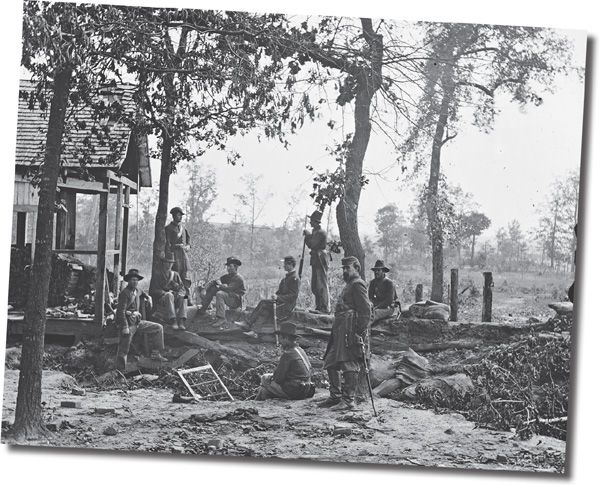
Federal picket post shortly before the battle of July 22.
G.C.
1. This was the Battle of Peachtree Creek (July 20, 1864). Union losses were 1,710, while Confederate losses were 4,796.
2. This was the Battle of Atlanta (July 22, 1864), also known as the Battle of Decatur or the Battle of Bald Hill. Hood sent Lieutenant General William J. Hardee on a long flank march around to the south to assail the corps of James B. McPherson, who was killed early in the fighting. Union losses in this battle were 3,641; Confederate losses were 8,499.