
CHAPTER 21

Detail of a woodcut depicting the Battle of Atlanta.
The relentless sieges of Richmond and Petersburg continued, as each side sought a solution that would break the stalemate.
Readers of The New York Times had long been treated to scoops about the latest developments in military technology: innovations like reconnaissance balloons and ironclad warships. But nothing could have prepared subscribers for the breathtaking news that arrived early in August: the explosion of arguably the largest and most devastating bomb ever detonated in any war. And nothing could have steeled readers for the almost unbearable news that the devastating innovation had failed to give Union troops the advantage they expected in their quest to take Petersburg, Virginia.
Generals Grant and Burnside had both been skeptical of the engineering proposal to dig a secret underground shaft all the way from Union positions before Petersburg to Confederate entrenchments guarding the city. The idea was to load explosives beneath rebel positions and then ignite them — opening a gaping hole through which Federal forces could break through. General Burnside approved the scheme.
The explosion itself succeeded (though it fizzled when the fuse was initially lit). The earthshaking predawn blast killed scores of soldiers and frightened away hundreds of others, leaving behind a scorched landscape that became known as “the Crater.” But in the Union attack that followed, the Federals made the crucial mistake of leaping into the Crater, rather than surrounding it. With Union troops trapped inside, Confederate reinforcements returned to target confused and directionless Union soldiers inside the Crater. Theresult was wholesale slaughter. The North further reeled from reports of atrocities — black soldiers executed on the spot even after laying down their arms and surrendering.
The disaster could not have come at a worse time for the Lincoln administration — with Election Day looming, only three months away. As The Times reported, often with barely concealed rage (editor Raymond, after all, was now serving as chairman of the Republican National Committee), Lincoln was being whipsawed by relentless criticism from both the left and the right. Democrats objected to the war’s brutality, while liberal Republicans excoriated Lincoln for being too lenient in his plans for reconstruction.
It took an episode of good old-fashioned personal heroism — in the face of, instead of in sync with, modern technology — to begin turning the tide. On August 9, Admiral David Glasgow Farragut, lashed to the rigging of his wooden flagship, the USS Hartford, damned the torpedoes and steamed past the rebel forts guarding the entrance to Mobile, Alabama. Farragut held on even when the frightening Confederate ram Tennessee brushed past with guns blazing. Observing the duel between the ironclads Monitor andVirginiatwo years earlier, Herman Melville had cheered: “Hail to victory without the gaud of glory.” Under Farragut, glory returned to the war at sea.
Still, most observers remained fully convinced that Lincoln would lose his bid for re-election — and lose badly. The war had simply raged for too long, and at much too high a cost, without victory. None of the skeptics were more despondent than Henry J. Raymond of The New York Times. On August 22, he wrote despairingly to Lincoln about “the political condition of the country as it strikes me.” Reported the editor/campaign manager:
“The tide is turning strongly against us.
Hon E. B. Washburne writes that ‘were an election to be held now in Illinois we should be beaten.’ Mr. Cameron writes that Pennsylvania is against us. Gov. Morton writes that nothing but the most strenuous efforts can carry Indiana.... And so of the rest. Nothing but the most resolute and decided action on the part of the government, and its friends, can save the country from falling into hostile hands.”
Desperate, Raymond boldly proposed that Lincoln now send a delegation to Richmond to ask Jefferson Davis to cease hostilities by “acknowledging the supremacy of the constitution, — all other questions to be settled in a convention of the people of the States.” In other words, Raymond was proposing, that Lincoln should renege on the promise of the Emancipation Proclamation if it would end the bloodshed and reunite the country. A few days later, Raymond called at the White House to renew his plea in person. Lincoln received him warmly, but bluntly told him that “to follow his plan of sending a commission to Richmond would be worse than losing the Presidential contest — it would be ignominiously surrendering it in advance.” Raymond reportedly left Washington somewhat cheered by Lincoln’s knowledge and determination. But Lincoln’s good friend Leonard Swett arrived shortly thereafter in New York to find “the most alarming depression possessing the minds” of all the city’s Republican editors. As he complained: “Raymond, the chairman of the National Committee, not only gave up, but would do nothing. Nobody would do anything.” Indeed, Lincoln himself ended the month convinced of his defeat as well. He even asked the members of his Cabinet to sign, sight unseen, a memorandum pledging cooperation with the next administration.
Then, in the space of just a few days, the fate of both the Republican President and the entire Union shifted dramatically. On August 31, Democrats convening in Chicago as expected nominated George B. McClellan for president, but saddled him with a peace platform that gave The Times ammunition to attack him as a Copperhead bent on humiliating the country he had once served in uniform. Even McClellan’s mild rebuke of the peace plank left him compromised.
Then, the very next day, on September 1, General Sherman captured Atlanta — the biggest prize yet in the Western Theater — after a campaign Lincoln cheered would remain forever “famous in the annals of war,” and which The Times had covered intensely for many days. Two weeks later, the Richmond Dispatch noted bitterly that “Yankeedom” was “making precisely such a use of the capture of Atlanta that we foresaw ... a continual support of Lincoln and the war.”
Indeed, these victories altered the political landscape, and Lincoln reaped the harvest. In a Thanksgiving proclamation giving thanks for Farragut’s and Sherman’s triumphs, the President indelibly linked the Union cause — and his own political destiny — not only to the heroes of the day, but also to a God he now predicted would “continue to uphold the government of the United-States against all the efforts of public enemies and secret foes.”
THE ASSAULT BY OUR TROOPS ON SATURDAY.
DESPERATE ATTEMPT TO CARRY THE ENEMY’S POSITION.
AUGUST 2
HEADQUARTERS OF THE ARMY OF THE
POTOMAC, SATURDAY, JULY 30
After the explosion at an early hour this morning,1 everything betokened a brilliant victory, but soon after matters assumed a different aspect, part of the attacking force having given way, thus exposing the balance to an enfilading fire from both artillery, and infantry.
The programme was as follows:
The mine was to be exploded at 3 o’clock in the morning; the batteries to open at once along the entire line immediately after the explosion, and the Ninth Corps to make the charge, supported by the Eighteenth Corps, AYRE’s division of the Fifth Corps, and the Third Division of the Second Corps.
The greater part of the arrangement was carried out as ordered, although the commencement was later than the hour designated, on account of the fuse going out twice.
The explosion took place at precisely 4:40 o’clock.
The roar of artillery that immediately followed was almost deafening.
At 5 1/2 o’clock the charge was made, and the fort, with part of the line each side, was carried in the most brilliant style.
The Second Division, which was in the centre, advanced and carried, the second line, a short distance beyond the fort, and here rested, holding their ground with the utmost determination.
It was at this time the Colored Division, under the command of Brig.-Gen. WHITE,2 was pushed forward and ordered to charge and carry the crest of the hill, which would have decided the contest.
The troops advanced in good order as far as the first line, where they received a galling fire, which checked them, and although quite a number kept on advancing, the greater portion seemed to become utterly demoralized, part of them taking refuge in the fort, and the balance running to the rear as fast as possible.
They were rallied, and again pushed forward, but without success, the greater part of their officers being killed or wounded.
During this time they seemed to be without any one to manage them, and finally they fell back to the rear and out of the range of the volleys of canister and musketry that were plowing through their ranks.

Alfred Waud’s sketch of the Battle of the Crater.
1. In June, Union engineers began digging a shaft nearly 600 feet long to a spot directly above Confederate entrenchments, filling it with four tons of gunpowder and igniting it on July 30. Nearly 300 Confederates perished in the explosion, and U.S. Colored Troops led the charge that followed. But Union officers foolishly ordered troops into the blackened trench, where they were surrounded and mowed down. The disaster cost the Union some 3,800 killed, wounded, and missing, with Confederate casualties at 1,500.
2. Julius White (1816–1890), who served as General Burnside’s chief of staff.
THE WAR IN THE WEST.
HISTORY AND ACHIEVEMENTS OF THE ARTILLERY ARM OF THE SERVICE.
AUGUST 2
An officer in Gen. SHERMAN’s army makes the following interesting statement regarding the progress and achievements of the artillery arm of the service in the Western armies:
“During the first years of the war the field artillery of the Eastern armies far excelled that of the West, and with good reason. Raised and equipped as were the former convenient to our best arsenals, they had the first pick of guns, obtained a uniform armament, and the choicest of ammunition to correspond. It was for them to test and adopt the latest inventions in projectiles and fuses. Schools of instruction were established for their benefit, and text books furnished in abundance; beside this, at the opening of the rebellion, nearly all the regular artillery batteries were incorporated in the Army of the Potomac. These batteries, during the months that that arm was organized under MCCLELLAN were made by Gen. BARRY,1 then his Chief of Artillery, to serve as leaven for the whole lump of plastic volunteer material placed in his hands. That this leavening process might be thorough in its operation, he adopted the following plan: An average of four batteries was the complement of each division of the army. Of these, three were volunteers and one reguar. The four were brigaded under command of the officer commanding the regular battery. The result of example and instruction thus afforded was the most astonishing progress on the part of the new batteries. They soon became, both in appearance and practical efficiency, dangerous rivals of their exemplars.
The Western artillery, on the other hand, bad to struggle onward and upward without such helps. What it learned was often the result of dearly bought experience. Inferior and defective material injured its efficiency. Guns of odd calibre and pattern, long since rejected from the Eastern service, was thrust upon it with such an entire disregard to uniformity, that some batteries actually took the field with as many different calibres as they had pieces. You can readily imagine that the replenishment of the ammunition chests of such patchwork organizations, would become next to an impossibility amid the confusion of a general engagement. Super added to these embarrassments and disadvantages, the artillery of the West has suffered especially from another cause that has done much to cripple the artillery of all our armies in the field. I refer to the withdrawal from this branch of the service of officers of the old army of long standing and experience, who, after the inauguration of the present conflict, accepted, in volunteer and staff organizations, that promotion that was denied them in their own. While noting the fact and its ruinous consequences, I cannot blame these officers individually for adopting a course that has been fully justified by subsequent events. And, to prove this, I have only to instance the present status of those regular battery commanders who, at the opening of the war, preferred to remain identified with the artillery and share its fortunes. These are now, after three years’ faithful service, battery commanders still, with no increased rank or pay, and no other prospect of direct promotion than the changes of the army list affords. In the meantime, the sense of justice and the professional pride of these men have been repeatedly outraged and wounded, by their having been compelled to serve subordinate to mere fledglings in both years and experience. Still, the service has suffered all the same, and the fault is due to imperfect legislation. By some strange oversight, every staff bill that has been passed by Congress has utterly ignored the claims and requirements of the artillery. While every corps and division staff is loaded down with officers of high rank on the Quartermaster’s, Subsistence and Inspector-General’s Departments, the poor devil of a Chief of Artillery, who has been selected for a position of equal importance and responsibility on such staff, must assume his extra duties with no increase of rank or pay, but, on the contrary, by relinquishing the immediate command of his battery, must drop certain perquisites which form a part of his remuneration as a battery commander. Is it any wonder that such injustice should have bred a spirit of dissatisfaction and revolt among its victims, and that, as a result, two-thirds of the best artillery officers we possess are to-day serving under volunteer appointments in the infantry and cavalry of the army? Aside from the pure injustice of the thing, the course the Government has pursued in the matter has been very unwise and impolitic. Notwithstanding these many drawbacks, the artillery of the West has make for itself not only a creditable but an honorable record, has sustained heavy losses in all of the great battles, and when it has lost guns has done so with honor. Upon its labors and achievements in the present campaign under SHERMAN, too much praise cannot be bestowed. The character, both of the country and the campaign, has been such as to develop and tax to the utmost its good qualities. GRANT’s artillery has been almost silent while the deadly infantry strife was raging among the tangled undergrowth of the Wilderness, but every hill side of Northern Georgia, from Tunnel Hill to the Chattahoochee, has echoed, by day and night, in thunder tones, the “deadly diapason” of our cannonade. I have never seen artillery employed so much at the very front as in this campaign. With a recklessness and audacity that have been quite at variance with all established laws, our batteries have always followed upon the very heels of our skirmishers. I have repeatedly seen a skirmishing line charge across a field and scarcely secure a precarious lodgment on a ridge beyond, before a section or battery has come rattling along to occupy and help to hold the same ground, its only immediate reliance and support the reserve of the skirmishers and the charges of canister in its guns. Again, where we have occupied for several days together, parallel lines of infantry parapet — two lines in reserve and the front line within eighty or one hundred yards of elaborate rebel works, as at New Hope Church. Dallas, and before Kenesaw, our artillery has always been found lining the foremost parapet — often in positions where our men could load their pieces only while lying at full length on their backs. Thus situated, it has, of course, shared the perils and the glory of repulsing the frequent attacks made by the rebels with the desperate purpose of breaking through our lines, and it is an equal credit to our infantry and artillery, to say that thus far not a gun has been lost....
1. William Farquhar Barry (1818–1879). In 1864, Barry became W. T. Sherman’s chief of artillery and served in that capacity during the Atlanta campaign.
THE LATE ENGAGEMENT BEFORE ATLANTA.
AUGUST 5
FROM OUR SPECIAL CORRESPONDENT.
CAMP IN THE FIELD, BEFORE ATLANTA, GA., SUNDAY, JULY 24
The 20th and 22d inst. have been the two most eventful days in the campaign of SHERMAN’s magnificent army in the Southwest. On those two days two great battles were fought, and two victories won. The former on the 20th, fought mainly by the Twentieth Army Corps, and the latter by the Army of the Tennessee, will each have its respective bearing on the total results of the war, and materially accelerate its felicitous termination. It cannot be but with a glow of self-satisfied thought and patriotic congratulation that every loyal citizen will review the events of those two days and raise his devout thanksgiving to the God of nations for the triumphs of the Union arms. The Twentieth Army Corps fought on Peachtree Creek, directly north of the city, and embraced in its line of battle many roads leading into it. The battle was fought against greatly superior numbers, and vastly more important strategic positions and developed itself as to time and situation where not very greatly expected. That the enemy, was not distant from us was patent to even unmilitary minds, but his purpose of making such a tremendous onset against us at the time and place he aid he had most profoundly concealed until, as he had doubtless flattered himself, the time for him to strike had come, when his whole design was unmasked and it was plain that the tug of war had commenced.
Peachtree Creek winds its course through a narrow valley, encompassed with innumerable bluffs, and entered by as many ravines. A place more opportune for a retreating array to take up his position of defence, it is difficult to conceive. The bluffs are in themselves superb military defences, while the dense forests that everywhere cover them cast the mantle of concealment over the presence and dispositions of the foe.
On the afternoon of the 19th inst., the Third Brigade of the Second Division of the Twentieth Army Corps, commanded by Col. IRLAND, crossed Peach-tree Creek, under cover of the fire of an infantry detachment of our troops detailed for that purpose. A temporary military bridge had been constructed without much trouble, and Col. IRLAND’s brigade crossed with but few casualties. He at once deployed skirmishers, and drove the enemy from the first bluff which immediately commanded the crossing of the creek, and occupied it by his own brigade, thus securing it for the transit for the remainder of our troops. In less than an hour and a half after the occupation of the above bluff by IRLAND’s brigade, the entire of Gen. GEARY’s1 command, two divisions of the Twentieth Corps, had crossed to support it. The men stacked arms and commenced throwing up intrenchments; sent out their pickets; and having put themselves in a tolerable posture of defence, rested for the remainder of the night. Nothing of interest occurred during the night but the occasional crack of the rifle, reminding us of our duty and making us vigilant.
The morning of the 20th was beautiful beyond description. The entire eastern horizon was mantled with a flame of golden light, and its softened atmosphere infused with the breath of immortality. Everything in nature was gay with an exuberance of joy, and her intelligent worshipers were led through her own inspiration to bow in devout adoration before Heaven. There was no augury in the character and associations of that morning of the carnage that evening would witness, no symptom of the coming storm, whose dire results were desolation and woe to many a home and heart, while it brought paeans of joy to the true and loyal throughout the land.
At early dawn, the First and Third Divisions of our corps commenced crossing the Creek, and at nine o’clock A.M., they were all over and had begun to take their positions in line of battle. The Third Division, commanded by Maj.-Gen. BUTTERFIELD,2 and at present, in his absence, by Brig.-Gen. WARD,3 took the left, while the First, commanded by. Brig.-Gen. WILLIAMS, the right, leaving the entire of our cross line of battle to the Second Division, commanded by Brig.-Gen. J.W. GEARY. This was the disposition of our troops up to noon on the 20th inst. Gen. WARD’s left flank was protected by the Second Division of the Fourth Army Corps, and Gen. WILLIAMS’4 right by the Fourteenth Army Corps. Up to this hour little had been done more than the disposition of the troops, and a small advance of our picket line. About noon or shortly thereafter, Gen. GEARY sent forward two or three regiments of the First Brigade, commanded by Col. CANBY, together with Col. IRLAND’s Third Brigade, to take up a new line of battle some 300 yards in advance of our then position. Accordingly they commenced feeling their way forward and up toward the enemy’s hiding place, and posted themselves from three to five hundred yards in advance of the line occupied on the night of the 19th. Here they threw up a temporary and short line of breastworks, sufficiently extended from right to left only to admit eight guns. Maj.-Gen. HOOKER surveyed the position, and shortly after the two batteries of our division were in their places, confronting the foe. By the contracted limits of the breastworks four guns of the two batteries were without cover. Two of them were thrown out on the right flank, and two on the left of the positions occupied by the other portions of the batteries. The two on the left in a corn-field, and the two on the right in the woods. In this position several discharges were fired, to elicit, if possible, a response from the enemy, and to determine his whereabouts. He, however, was too intent on his purpose to be provoked to utterance, and consequent betrayal. He had too much at stake. He observed a dogged silence.
Discovering no demonstrations nor even signs of the enemy near, Gen. GEARY in person went out some three hundred yards still further in advance and found no enemy nor sign of an enemy, more than in the capture of three prisoners, who stoutly affirmed there was no body of troops of any note in our front, guided partly by all he saw and partly by the reports of the captured men, he concluded to advance his batteries to another knoll and order Col. JONES, commanding the Second Brigade, to send out a regiment, his largest, to occupy the crest and throw up redoubts. Up to this period, for reasons unknown here, the right flank of the Second Division was left entirely uncovered, and exposed a deep ravine on his right, densely wooded, and affording an admirable cover for the enemy’s unperceived advance was unoccupied by any force of our army. Gen. GEARY fully expected that his right was covered by the simultaneous movement of the First Division with his own. This, however, proved not to be the case, and, minus this, the results we are about to relate followed. The Thirty-third New-Jersey, being the largest regiment in Col. JONES’ brigade, was detailed to occupy the new line and prepare for the artillery, in obedience to orders. Lieut.-Col. FOURAT commanding Thirty-third New-Jersey, ordered his command forward. He led them out in front of the batteries by the right flank, up a road through the woods about a hundred, yards, formed them in line of battle on the south side of the road, and halted them until he had seen for himself the ground to be occupied. This done, he returned, put his regiment in order, and led them to the destined place.
The most undisturbed quiet reigned around while these movements were being made. Nothing occurred to break the wilderness of silence but the rustling tread of our advancing force, the orders of the commanding officer and the occasional thug of the rifle on our extreme right. But it was the silence that precedes the hurricane, the quiet that heralds the tornado.
Gen. NEWTON, of the Second Division, of the Fourth Corps, on the extreme left of our corps line-of-battle, had made, during the afternoon, similar advances with Gen. GEARY, and with a seeming equal success was making headway into Dixie. The advance up to this hour, 3:50 P.M., when the Thirty-third New-Jersey left the road before-named developed nothing of the Confederate leaders designs. When, however, they had gained the top of the hill, and began to prepare for their work, the rebel hordes began to precipitate themselves upon them in treble lines of battle. On they came, howling like the devil, and raining death on the little band of patriot soldiers, who had gone to their work, with a bravery that has characterized them in half a dozen desperate engagements. Flight, or certain capture, or probable death, was before them. They retired, defending their isolated situation as well as they could; but they felt their defence was feeble at best, yea, alarmingly so, when, having retired only one hundred and fifty yards, they beheld masses of the enemy closing on both their flanks. It now became a question of pedestrian skill and adroitness whether the rebels should possess this regiment, or be foiled in their sanguine hopes of conquest and booty. It proved, however, that Jersey boys, brave in fight and magnanimous in conquest, are also fleet of foot when visions of the Libby or Castle Thunder haunt their imaginations, or loom up before them, with all their horrors, when pressed hard by the rebels. Unfortunately for them, 15 of their brave boys were shot deed and 19 wounded, while 33 were taken prisoners. They also lost their State flag. The One Hundred and Thirty-fourth New-York Volunteers were marching out to the support of the New-Jersey Regiment by the flank, and suffered in an equal ratio with it. On, on, on they came, howling and screaming all along our extended line, and drove back in their impetuous sweep almost everything that opposed itself to them. They came down on our exposed flank, scattering confusion, dismay and death on every hand, and for a short time held in their own power the destiny of our whole division. It was broken and scattered. But with a surprising celerity, by the commanding officers, aided by the presence of Major-Gen. HOOKER, the troops were rallied, formed in line of battle, and hurled back with interest on the rebels heads the destruction they sought to inflict on us. Victory was wrenched from the band of the conqueror, and defeat was changed to conquest....
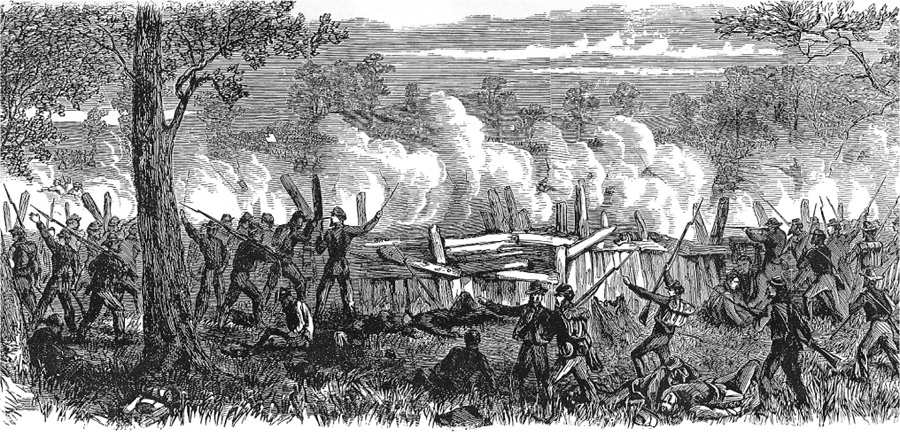
Confederate attack on General John Logan’s XV Corps during the Battle of Atlanta.
1. John White Geary (1819–1873), later a two-term governor of Pennsylvania.
2. Daniel Butterfield (1831–1901).
3. William Thomas Ward (1808–1878).
4. Alpheus S. Williams (1810–1878).
THE CRISIS IN GEORGIA.
AUGUST 5
FROM THE ATLANTA APPEAL, JULY 29.
The progress which the enemy has made toward the heart of the Confederacy, and the enterprise he has manifested by his raids upon our railroads and undefended points, ought to convince our people that there is no security from danger but in active, energetic self-defence. The people of the Gulf States have so long lived remote from the actual theatre of the war, that they have flattered themselves with the belief that their homes would never be visited by the relentless invader. The events of the last few weeks will serve to disabuse them of this fond delusion, and teach them that, if they would continue to live as free-men, they must arm and rally to the front in their own defence.
The guns of the tyrant foe are now thundering at their very doors, and supineness and inaction now are criminal; yea, suicidal. No one will for a moment deny but there are able-bodied men enough in the States of Georgia and Alabama either to annihilate SHERMAN and his army or to drive them howling back to the Ohio River. Will they not, at a crisis like this, come promptly to the rescue, and aid our veteran soldiers in the good and holy cause? If those living south of us would defend their homes, their property, their liberty and the rights they have inherited from a heroic ancestry, now is the time and Atlanta the place to make that defence. With them delay is not only dangerous, but fatal; for although our gallant army still stands between them and the foe, it may prove too weak to withstand the hosts that are being hurled against it. There is no safety to any one now living in the South but in the defeat of SHERMAN’s army. With the united efforts and numbers of the people and the army this can be effectually done within the next two or three weeks. The Government now has arms to place in the hands of every man and boy who is ready and willing to defend his country and his home.
It is not now as it was in the earliest stages of the war, when men refused to enter the service because of the scarcity of arms, and when the Government had nothing to offer them but shot guns and Irish pikes. Arms are now plentiful, and what is now needed is men and boys to load and shoot them. Come up, then without hesitation or delay, to the rescue of your country and the defence of your own homes and firesides. A few weeks more and it may be too late. If, through the listless indifference and slothfulness of the people, Gen. HOOD is compelled to give up Atlanta, large districts of country now protected by his army will be exposed to the devastating raids of the enemy, thousands who now have homes they can call their own will have them no longer, and they themselves be driven outcast and beggars upon the world. Let us, then, hope that in view of the dangers that now threaten them so imminently, the people of Alabama and Georgia will think seriously and act wisely, and promptly in this matter. Let them cease praying to Hercules and put their own shoulders to the wheel. All will then be well.
THE ARMY BEFORE ATLANTA.
AUGUST 6
CORRESPONDENCE OF THE CINCINNATI
GAZETTE.
NASHVILLE, TENN., SATURDAY, JULY 30
The battle of the 28th was but a passionate effort of the giant rebel to break the net in which he is fast being caught. It will be recorded in history as the episode of a siege, for the siege of Atlanta will date back from July 28. I believe the struggle of the 22d, in which MCPHERSON did not die until he had finished the investment and ran his rifle-pits through a part of the city, completed the investment and began the siege. At any rate, the siege is now begun, and the investment is complete. It is too late for HOOD to escape, if he wished to. Henceforth HOOD must sit and watch the meshes thickening around him from day to day, his only hope that a mistake on SHERMAN’s part may give him a loophole out of which to crawl. What amiable feelings, despite their accompanying terror and despair, must be HOOD’s as he sits watching his ruin and vainly striving to escape it. Next to those of the successful General, who watches the gradual tightening of his lines around a doomed city or army, the feelings of him who commands within must be most enviable.
Over the scene of HOOD’s despair at Atlanta can you not see the figure of old BRAGG exulting in the defeat of the army and the ruin of the men who rejected him. BRAGG is one of the most vindictive men to whom the rebellion has given prominence, and I have no doubt in my own mind that he rejoices in the shelving of JOHNSTON and the ruin of the others who have succeeded him. Expelled from the Army of Tennessee, hated and despised, he has not forgotten the scorn which the men and prints showered upon him, and gloats over the chance that gave the ruin of that army into his hands. Of course you have heard the story, flow he came from Richmond, and met the retreating army of JOE JOHNSTON at Atlanta. At his command the retreat was slopped, and on July 15 and 16 a council of war was held in the Gate City. There is one here who knows that it was a stormy council of crimination and recrimination, of bitter and rough criticism. BRAGG presided like Satan in the Council of the Fallen, and rejoiced over the troubles of each. His order first and last was fight. There were but three men in that council beside himself who cried “Bravo.” HOOD, a brave, bold fellow, with little brains; STEWART, with more brains than HOOD, and not less brave, and CHEATHAM, with less of bravery and brains than either. JOHNSTON has played the part of FABIAN until he has won some character. He will not risk it in the new part of a fighter. He retires. HARDEE refuses to place himself in BRAGG’s power, and declines to accept. Unfortunately for us, POLK had been killed in battle too soon, or we should have had a greater ass than HOOD in command. So HOOD gets the command, STEWART gets POLK’s corps, CHEATHAM that of HOOD, and they cross swords in the air, swear to do or die, and old BRAGG, taxing the train for Macon and Richmond, laughs at the folly of the men he has ruined. SHERMAN does not object, and the casting of the net goes bravely on.
A GREAT NAVAL BATTLE.
OUR FLEET PASSED FORT MORGAN AND CLOSE TO MOBILE.
DREADFUL HAVOC...
AUGUST 9
FROM HEADQUARTERS OF GEN. BUTLER,
MONDAY, AUG. 8 — 3 P.M.
To His Excellency, A. Lincoln, President:
The following is the official report, taken from the Richmond Sentinel of Aug. 8:
B. F. BUTLER, MAJOR-GENERAL1.
“MOBILE, Aug. 5
Hon. J. A. Seddon,2 Secretary of War: Seventeen of the enemy’s vessels, (fourteen ships and three iron-clads) passed Fort Morgan this morning. The Tecumseh, a monitor, was sunk by Fort Morgan. The Tennessee surrendered after a desperate engagement with the enemy’s fleet. Admiral BUCHANAN3 lost a leg, and is a prisoner. The Selma was captured. The Gaines was beached near the hospital. The Morgan is safe and will try to run up to-night. The enemy’s fleet has approached the city. A monitor has been engaging Fort Powell all day.
(SIGNED) D.H. MAURY, MAJ.-GEN.”4

An 1886 Louis Prang chromolithograph of the Battle of Mobile Bay.
1. Admiral Farragut successfully led 14 wooden ships and four ironclads past Fort Gaines and Fort Morgan at the Battle of Mobile Bay. The Times quickly and proudly shared the first official reports from the defeated Confederates, which did not include the admiral’s famous defiant cry about the mine-filled channel: “Damn the torpedoes, full speed ahead.”
2. James A. Seddon (1815–1880), the last Confederate secretary of war.
3. Franklin Buchanan (1800–1874) had commanded the CSS Virginia. He remained a prisoner until February 1865, returning to formally surrender Mobile to the Union.
4. Dabney H. Maury (1822–1900) was Confederate commander of the Gulf.
WHAT SHERMAN HAS ACCOMPLISHED — WHAT THE REBELS HAVE LOST.
AUGUST 6
FROM THE ST. LOUIS UNION.
We are permitted to make the following extract from a private letter received in this city by a gentleman from his kinsman, a high officer in SHERMAN’s army:
IN FRONT OF ATLANTA, Monday, July 25
We are in the immediate front of Atlanta, with the enemy well nigh shut up in its very defences. We occupy a curved line around the west, north and east sides of the city, about one to one and a half miles distant from it, and have the whole place under the fire of our guns, to doses of which, anything but homeopathic, we have been treating it during the past forty-eight hours. We have fought some half dozen severe battles, and, with losses to ourselves (in all) of about 12,000 to 15,000, have placed of the enemy at least 30,000 hors de combat. We have captured twenty guns, twenty-five or thirty stand of colors, have destroyed two important railroads, occupying a third for our own uses; have burned a large number of cotton, woolen, rolling, paper and grist mills, nearly 4,000 bales of cotton, numerous railroad depots, and large quantities of subsistence and other military stores. We have captured thousands of horses, mules, beef cattle and sheep; and have sent to the rear nearly 10,000 prisoners. I place Jo. JOHNSTON’s loss at 30,000, because, besides the above prisoners, we have either buried, or delivered up to him for burial, about 5,000 of his dead. Counting five wounded to one dead (which is a moderate proportion), and I think you will agree that I do not overestimate his entire loss. Unless some unforeseen accident or misfortune overtakes us, Atlanta will be ours very shortly.
THE PRESIDENTIAL ELECTION.
AUGUST 10
The Democrats everywhere are very confident of victory in the pending. Presidential canvas. Their exultation may be premature, but it is sincere. They evidently believe they are going to win. And they base their expectations of success mainly, if not entirely, on the dissensions which prevail in the Union ranks. They point to the fact that whole classes of professed Union men feel under no obligation to support the Union ticket. One denounces Mr. LINCOLN because he did not abolish Slavery soon enough — another because he assumed to touch it at all. One refuses to vote for him because he keeps Mr. BLAIR in the Cabinet, another because he keeps somebody or anybody else. FREMONT runs against him because he disregards the Constitution, and WENDELL PHILLIPS1 speaks against him because he recognizes that instrument at all. Some censure his lenient method of treating the people of the Southern States, — others his barbarous and inhuman mode of carrying on the war. One set of politicians vilify him for not admitting the Southern States at once into the Union, and WADE and DAVIS2, with equal malignity, brand him as a usurper for proposing to admit them at all. Every unsuccessful applicant for office, — every volunteer adviser whose counsels have been rejected, — every wiseacre who fancies he was created to conduct the Government, and who finds Mr. LINCOLN indisposed to accept his dictation, — the whole of that countless brood of political seers who knew from the beginning how “this thing” was coming out, and who found the President incredibly and idiotically deaf to their warnings and their threats, — are all now combined to vindicate their pre-science and gratify their resentments by voting against him. And upon this concurrence of disappointed and underrated malignants, the Democrats base their hopes of a party success.
It may be that they are right. Possibly such a combination of selfishness and reckless passion may override the settled judgment and patriotism of the people. It would not be the first time in the history of Republics that private passion has proved too strong for devotion to the public good. It is by no means impossible that the people of this country may be betrayed by these base and selfish intrigues into putting power into hands which will use it for the division and destruction of the country.
We wish now merely to remind those who profess to be Union men that, if this catastrophe should happen, they alone will be responsible for the result. It will be due wholly and exclusively to their dissensions; to their paltry, personal bickerings; to their miserable, petty jealousies; to their intolerance of difference on minor points, and to the determination, cherished by many among them, to secure for their own personal views predominance in the public councils, at whatever sacrifice of the public good. If they see fit to persist in the indulgence of these selfish aspirations, they may possibly, by a combination of their forces, point to the ruin of their country as the monument of their victory.
The Democrats are quite right, in view of this state of things, to exult in the prospect of an easy triumph. They have good ground, in these dissensions among Union men, for exulting over their coming defeat. They do well, moreover, to take time by the forelock in these exultations, and to boast of victories which they expect to win; for it is possible that they may not win them after all. It is not wholly impossible that before the election comes round, Union men may see the folly of subjecting themselves to the rule of a common foe because each cannot establish his personal sway over all his associates. And our Democratic neighbors must excuse us for hinting, furthermore, that it is not yet quite certain that their harmony, after the Chicago Convention, will be any greater than that of the Union men seems to them at the present moment.
1. Wendell Phillips (1811–1884), leading orator, reformer, and abolitionist.
2. A reference to a July bill aimed at toughening Lincoln’s 10 percent reconstruction plan, which Lincoln pocket vetoed. On August 5, Massachusetts Senator Benjamin Franklin Wade (1800–1878) and Maryland Congressman Henry Winter Davis (1817–1865), both so-called Radical Republicans, responded by publishing a “Manifesto” in the New York Tribune charging Lincoln with “dictatorial usurpation” of Congressional power. The Times rallied to Lincoln’s defense — no doubt inspired by the legislators’ decision to publish their newsworthy declaration in a rival paper.
THE FAILURE BEFORE PETERSBURGH.
AUGUST 11
SPECIAL CORRESPONDENCE OF THE NEW-YORK TIMES.
IN FRONT OF PETERSBURGH
Since the recent unfortunate fiasco this army has settled down into its wonted quiet. Of course, the failure of the plans laid to capture Petersburgh by surprise, as it were, is the grand topic of conversation among both officers and men, and all feel that there was a serious mistake made by some one. Who shall be held responsible, is the subject under consideration by a competent tribunal. The result of the investigation, it is generally believed, will not be the stereotyped one usually found by coroners’ juries upon investigating steamboat explosions and disasters upon railroads. The prevailing opinion is that in the present instance somebody should be held responsible for failing to accomplish such an important result as was reasonably anticipated.
Notwithstanding the croakers’1 prediction as to the unhealthiness of this climate, the general health of the army remains good — much better indeed than one year ago when on the Rappahannock. When this can be said in truth just after so great a disappointment, no higher meed of praise can be conferred upon this army, nor can there be any stronger evidence of its morale....
As the war progresses, it would seem as though the desperation of the opposing forces in the heat of battle increases with the time of the contest. I do not know that the Union soldiers are less chivalrous, or show less humanity toward their enemies; but one thing is certain, — during the last three months more men have been killed in action than ever before under similar circumstances. This result may be, in part, owing to the fact that very generally our men have arrived at the conclusion that there can be no peace until a majority of the active and intelligent leaders opposing them are laid under the sod; and the sooner the Government and the people arrive at the same conclusion the better, I opine, it will be for all concerned. Fighting is a kind of pastime for the whites in the slave States, and their withdrawal from the usual walks of life does not seriously diminish the raising of all crops essential to sustain life, because the whites in these States never were a producing class; the negroes were and are to this day — in all districts where the Confederates hold full away — the real producers, and just so long as this is permitted to be the case, the rebels can hold out against the Government. Had a systematic effort been made to remove this producing class during the last three years, the rebellion would have fallen through from the mere want of supplies.
E.A. PAUL.

Taking a break during the siege at Petersburg, federal troops prepare to watch some cockfighting.
1. Period slang for chronic complainers and critics.
THE WADE AND DAVIS MANIFESTO.
AUGUST 11
The National Intelligencer finds much to commend in the manifesto of Senator WADE and H. W. DAVIS against President LINCOLN, which we published a day or two since. In styling it, however, a “Republican Manifesto,” and in treating it as a Republican document, having the sanction or at least the toleration of the Republican party, that journal, it seems to us, somewhat transcends the facts of the case for the sake of giving a factitious weight to the document itself. We have seen nothing whatever to justify the assumption that either the Republican party, or the Union party, either indorse the sentiments of this extraordinary manifesto or regard the action of its authors in issuing it at the present crisis as anything but a treacherous and malignant attempt to stab a President whom they profess to support.1
The [Washington National] Intelligencer concurs in the view taken by these gentlemen of the course of the President in not signing the bill of Congress, but avowing his purpose to act upon some of the principles embodied in it. That journal says:
“In our paper of the 21st ultimo was intimated our objections to this most anomalous proceeding on the part of the Executive. If the President had vetoed the act of Congress he would have simply exercised a right vested in him by the Constitution, and would have been answerable to Congress and the country only for the soundness of the reasons by which he might have justified his veto. If the President had simply withheld his signature from the bill, and had thus suffered it to fall to the ground, he would have still acted within the legitimate prerogatives of his office. But to attempt by proclamation to make this bill a self-imposed rule for his guidance in some things, and to give reasons, not to Congress, but to the country, why he would not take it for his guidance in other things, seemed to us a solecism in politics, as much without defence in theory as it was without precedent in history.”
A “solecism in politics” may be a very terrible thing; probably it is, else our venerable cotemporary would not terrible at its shadow. But really we see nothing very remarkable or very terrible in the President’s action in this matter. He did not approve the bill as a whole, and, therefore, he did not sign it. This, says the Intelligencer, is all right. He acts “within the prerogatives of his office.” But if there are some things in the bill which the President does approve, — if there are principles in it which he is quite willing to make his own, and to adopt as guides to his own official action, we do not see why he may not properly do so, — nor why he may not, with equal propriety, tell the country or Congress, or both, his reasons for so doing. This is precisely what he has done, and it is all he has done. We see nothing in his action hostile to the Constitution or dangerous to the country, or necessarily fatal to anybody’s peace of mind. Nor are we in the least degree enlightened on this point by the elaborate epigrams of Mr. DAVIS or the ponderous moanings of the Intelligencer. If Mr. LINCOLN has committed no political “solecisms” more formidable than this, the country will probably survive.
1. Indeed, the Wade-Davis Manifesto backfired on its authors: Wade was condemned and Davis denied renomination to the House.
FROM MOBILE.
ADMIRAL FARRAGUT’S OFFICIAL REPORT.
AUGUST 16
WASHINGTON, MONDAY, AUG. 15.
The following official dispatches have been received by the Navy Department:
FLAGSHIP HARTFORD, MOBILE BAY, Aug. 5
SIR: I have the honor to report to the department, that this morning I entered Mobile Bay, passing between Forts Morgan and Gaines, and encountering the rebel ram Tennessee and gunboats of the enemy, viz., Selma, Morgan and Gaines.1
The attacking fleet was under way by 6:45 A.M., in the following order: The Brooklyn, with the Octoroon on her port side; Hartford, with the Metacomet; Richmond, with the Port Royal; Lackawana, with the Seminole; Monongahela, with the Tecumseh; Ossipee, with the Itasco; and the Oneida, with the Galena.
On the starboard of the fleet was the proper position of the monitors or iron-clads.
The wind was light from the Southwest, and the sky cloudy, with very little sun.
Fort Morgan opened upon us at ten minutes past 7 o’clock, and soon after this the action became lively.
As we steamed up the main ship channel, there was some difficulty ahead, and the Hartford passed on ahead of the Brooklyn.
At 7:40 the monitor Tecumseh was struck by a torpedo and sunk going down very rapidly, and carrying down with her all the officers and crew, with the exception of the pilot and eight or ten men, who were saved by a boat that I sent from the Metacomet, which was alongside of me.
The Hartford had passed the forts before 8 o’clock, and finding myself raked by the rebel gunboats, I ordered the Metacomet to cast off and go in pursuit of them, one of which, the Selma, she succeeded in capturing.
All the vessels had passed the forts by half past eight, but the rebel ram Tennessee was still apparently uninjured, in our rear.
A signal was at once made to all the fleet to turn again and attack the ram, not only with guns, but with orders to run her down at full speed.
The Monongahela was the first that struck her, and though she may have injured her badly, yet she did not succeed in disabling her.
The Lackawanna also struck her, but ineffectually.
The flagship gave her a severe shock with her bow, and as she passed poured into her a whole port broadside of solid 9-inch shot and thirteen pounds of powder, at a distance of not more than twelve feet.
The iron-clads were closing upon her, and the Hartford and the rest of the fleet were bearing down, upon her, when, at 10 A.M., she surrendered.
The rest of the rebel fleet, namely, the Morgan and Gaines, succeeded in getting back under the protection of Fort Morgan.
This terminated the action of the day. Admiral BUCHANAN sent me his sword, being himself badly wounded with a compound fracture of the leg, which it is supposed will have to be amputated.
Having had many of my own men wounded, and the surgeon of the Tennessee being very desirous to have Admiral BUCHANAN removed to the hospital, I sent a flag of truce to the commanding officer of Fort Morgan, Brig.-Gen. RICHARD L. PAGE,2 to say that if he would allow the wounded of the fleet, as well as their own, to be taken to Pensacola, where they could be better cared for than here, I would send out one of our vessels, provided she would be permitted to return, bringing back nothing she did not take out.

A Louis Prang chromolithograph of Admiral David Glasgow Farragut aboard the USS Hartford.
1. Admiral Farragut’s dispassionate report elevated his heroic status even further.
2. “Ramrod Page” (1807–1901), as he was known, remained a prisoner of war until June 1865.
WHAT IS AN HONORABLE PEACE?
AUGUST 19
“An honorable peace” is becoming a pet phrase of the Copperheads. It figures constantly in their party organs, and is finding a place in all their party platforms. The Copperhead State Convention of Maine just held, took pains to inlay it in three successive resolutions. They resolved that “the only hope of securing an honorable peace is by expelling the present corrupt, imbecile and revolutionary Administration;” that “the Administration is manifestly incapable of negotiating an honorable peace,” and that they “are in favor of an honorable peace at the earliest practicable moment.” It is high time to understand what this qualifying term honorable means.
The man would be accounted an imbecile who should talk of an honorable peace with the highwayman whose pistol was at his heart, or with the incendiary whose torch was at his roof. If he did not choose to fight he might parley, and induce his enemy to hold off by consenting to all demands. But it would be absurd to style a deliverance thus obtained an honorable peace. It might be a necessity, but it would be a humiliating one at best. In meeting the violence of outlaws, the question is not how to save your honor, but how to save your life. You may buy off the villains by a surrender of your property, if you do not like to play the man by self-defence; but the moment you begin to prate about your honor you make yourself not simply a coward but a fool. An honorable peace presupposes a respectable cause, or at least, a respectable color of a cause for the war, and a respectable standing in the parties to it. It may be a hard bargain for one of these parties, against whom the fortune of the war has turned; but it necessarily implies, if not equal power on both sides, at least an equal status.
The war with the self-styled “Southern Confederacy” has been prosecuted by our Government on the sole ground that this organization was a rebellion, pure and simple. President LINCOLN, as the head of the Government, has been fighting traitors banded to destroy the Government which he had sworn to defend and preserve. All the supporters of the Government have recognized that there could be no peace with these traitors but in their submission to the Government, or else in their absolute independence. That has been the only real issue in the war. The Government could know no other, for its first duty is the maintenance of its constitutional authority, which is its vital essence. It is this alone which has made its prosecution of the war right. It is this alone which has made the resistance of the rebels wrong. The Government is not fighting for its honor, but for its life. The rebels are not fighting for their honor, but to be “let alone” in their crime. The only truly “honorable peace” possible must come from a vindication of vital authority on the one side, and a submission to constitutional duty on the other....
CHICAGO CONVENTION.
MCCLELLAN NOMINATED FOR PRESIDENT.
SEPTEMBER 1
CHICAGO, WEDNESDAY, AUG. 31
The National Democratic Convention reassembled at 10 o’clock this morning.
The Wigwam is again densely packed, and the crowd outside is greater than ever ....
In announcing the vote of New-York Mr. SANFORD E. CHURCH said, that New-York regretted to pass by her favorite son,1 but she stands now as she has ever stood, ready to sacrifice her dearest personal preferences for the public good, holding it her duty above all others to do all in her power to rescue the country from the tyranny that oppresses it. Having full confidence in the Democracy, ability and patriotism of Gen. GEORGE B. MCCLELLAN, New-York gives him her entire electoral vote.
Several delegations having cast their votes for HORATIO SEYMOUR when the call of the States had been gone through with, Gov. SEYMOUR remarked that some gentlemen had done him the honor to name him for the nomination. It would be affectation to say that their expressions of preference did not give him pleasure, but he owed it to himself to say that many months ago he advised his friends in New-York that, for various reasons, private and public, he could not be a candidate for the Chicago nomination. Having made that announcement, he would lack the honor of a man, be would do great injustice to those friends to permit his name to be used now. As a member of the New-York delegation, he personally thought it advisable to support an eminent jurist of that State for the nomination, but he was not actuated in this by any doubt of the ability or patriotism of the distinguished gentleman who has been placed in nomination. He knew that Gen. MCCLELLAN did not seek the nomination. He knew that that able officer had declared that it would be more agreeable to him to resume his position in the army, but he will not honor any the less the high position assigned him by the great majority of the country, because he has not sought it. He desired to add a few words in reference to Maryland and her honored delegates here.... We are now appealing to the American people to unite and save our country. Let us not look back. It is with the present that we have to deal. Let by-gones be by-gones. He could say for our gallant nominee that no man’s heart will grieve more than his will for any wrong done Maryland. As one who did not support him in my delegation, and as one who knows the man well, he felt bound to do him this justice. He (Gov. SEYMOUR) would pledge his life that when Gen. MCCLELLAN is placed in the Presidential Chair, he will devote all his energies to the best interests of his country, and to securing, never again to be invaded, all the rights and privileges of the people under the laws and the Constitution.
The President [of the Convention] then announced the vote, which was received with deafening cheers, the delegates and the vast audience rising, the band playing, and the cheering lasting for several minutes.
Immediately after the nomination, a banner on which is painted a portrait of MCCLELLAN, and bearing as a motto, “If I cannot have command of my own men let me share their fate in the field of battle,” was run up behind the President’s platform, and was welcomed by the wild enthusiastic cheers of the multitude.
THE CONVENTION ... A GREAT CROWD. VALLANDIGHAM WORSHIP.
CORRESPONDENCE OF THE NEW-YORK TIMES.
The convention is held in a large amphitheatre, located on the lake shore, about a mile south of the hotels. It has been erected by the Democrats of Chicago, at a cost of some $7,000, and is well adapted for the purpose, and capable of accommodating 15,000 people. A portion has been reserved for the delegates, and another section for their friends, for which tickets are necessary, in order to secure an admission. There is a ladies’ gallery. These sections are seated. But the great presence chamber of the sovereigns is unseated, so that the people will have to stand “packed in a jam,” while the leaders are hatching out a candidate and a set of principles for them to swear by.
Arrangements have been made on as extensive scale by the “Invincible Club,” of this city, for a grand ratification demonstration on the evening of the day upon which the nomination is made. There is to be a torchlight procession, and every other kind of proceeding which will serve to make night hideous....
After the vote, VALLANDIGHAM made an appearance, and hats swung in the air, and lungs gave out their loudest notes. When this part of the programme had been gone through with, VALLANDIGHAM bowed and put himself on his blandest, and expressed his grateful emotions at this compliment from the people. He then exhorted to peace, harmony and union, everything for the cause, and told them that when the work of the convention was over, when a Democratic candidate, who was to rescue the Constitution and restore the liberties of the nation, was in the field, he should make it his business, in season and out of season, to address assemblages of his Democratic fellow-citizens in all parts of the country, until a glorious victory crowned their efforts.
OGDENSBURGH, WEDNESDAY, AUG. 31
The nomination of MCCLELLAN was received here with great rejoicing. Thirty-four guns were fired on the receipt of the news. This evening guns are firing, bands playing, bonfires blazing, rockets ascending, processions moving and people rejoicing. The Democrat office and many private residences are brilliantly illuminated. Prominent citizens are addressing the crowds.
POUGHKEEPSIE, WEDNESDAY, AUG. 31
A salute of one hundred guns was fired here this afternoon in honor of the nomination of MCCLELLAN and PENDLETON.
ALBANY, WEDNESDAY, AUG. 31
The nomination of MCCLELLAN caused great enthusiasm in this city. A hundred guns were fired at noon, and a hundred more at sunset. This evening a procession preceded by a band of music, and bearing torches and transparencies, is parading the streets. Banners bearing the name of MCCLELLAN, are displayed at different points....
1. Governor Seymour.
THE FALL OF ATLANTA.
SEPTEMBER 5
Five telegraphic words — “Gen. SHERMAN has taken Atlanta,” on Saturday, thrilled the nation with a joy not lees heartfelt, if somewhat less demonstrative, than that of France, when through the streets of Paris ran the cry: Sebastopol est pris. Indeed, the Sebastopol of Georgia has fallen, and with this splendid achievement one-half of the great campaign of the Summer is finished, and the seal of success already set upon the military operations of the year 1864. With nothing more done, the sum of that which has been done is victory.
Four months of constant and vigorous campaigning, a contested march of full two hundred miles, ten pitched battles, and two score of lesser engagements by night and day, make up the price we paid for Atlanta. It is worth them all; for our highest estimate will not outreach the magnitude of the solid fact. Considering simply the military results of SHERMAN’s campaign, in the first place, it has worsted and nearly destroyed the second army of the Confederacy. Fifty thousand men have dropped from the thinned ranks of that army since it lay encamped around Dalton on the first day of last May. Its riddled files have been partially supplied from the dregs of the Gulf States, the worst of fighting material — old men, boys, and such timorous conscripts as have hitherto, by many devices, eluded the clutch of the drafting officers. This motley array, whose cohesion was never of the strongest, has at length recoiled under a crushing and demoralizing defeat. Reeling back toward the coast, it parts at once with the city it was gathered to defend, and with that residue of hope under which this last effort has been made to hold the broad State of Georgia against the legions of the Union. Henceforth desertion will play a double part in the decimation of HOOD’s army....
This is the place which, while rapidly approaching the fulfillment of CALHOUN’s prediction, has been seized by the Union arms. At once the workshop, the granary, the storehouse, and the arsenal of the Confederacy, Atlanta and its environs were of incalculable value. The foundries, furnaces, rolling-mills, machine shops, laboratories and railroad repair-shops; the factories of cannon and small arms; of powder, cartridges and percussion caps; of gun carriages, wagons, ambulances, harnesses, shoes and clothing, which have been accumulated at Atlanta, are ours now. Much of the machinery and material has probably been destroyed or removed by the enemy; but that which is removed can never again be worked to such advantage as at Atlanta.
But the downfall of Atlanta does not mean the occupation of that city alone. It includes the assured possession of contiguous and valuable cities and regions — of Rome, Rossville and Marietta — where are manufactured guns, ammunition, cotton and woolen clothing in abundance. In one word, Atlanta is at the centre of a network of towns and villages, which have furnished forth half its war material to the entire Confederacy, from the Rappahannock to the Rio Grande. This valuable region is now all ours.
There is a geographical consideration also. Atlanta is the extremity of the vast grain-producing territory of northern Alabama and Georgia. Between it and the ocean lie the cotton lands. Atlanta ours, the great, rolling, fertile valleys at its back, teeming with food and forage, pass forever into our hands. Nor is even this all. A wide, mountainous region, comprising that portion of the Central Zone which is traversed by the manifold parallel ridges of the Alleghenies, is now surpassed, and the rest of SHERMAN’s course lies over smoother ground, and through country less hostile to military operations. Should he direct his head of column away to the South, he would soon encounter the Pine Mountains, or, if to the Southwest, he would again skirt along the Alleghany chain. But toward the sea, which is the path most likely to be adopted, the land is less difficult.
From this time Atlanta will assume the role of a base of operations. The rugged region betwixt that point and Chattanooga, than which nothing could be more defensible, is surmounted once for all. It can hardly be appreciated what advantage has been gained in the elimination from future campaigns of 150 miles of hilly and wooded country, arduous and perilous, always interposed at the outset against every campaign whose base is Chattanooga. Now, in fine, SHERMAN marches against the cotton lands of the South. He has uncovered, in taking Atlanta, the entire series of railroads which form junction there, and threatens with imminent destruction every important city in Alabama and Georgia. On his right, Selma, Montgomery, Opelika, Columbus, lie at his mercy. Should his columns be directed toward the ocean, as is probable, cavalry would be dispatched to do all that is essential in the occupation of the former points. In his front are the important cities of Macon and Milledgeville, and on his left the City of Athens. Against these towns, now, his operations will be directed, and even Augusta will not be safe. Three hundred miles away to the southeast, almost equidistant from Atlanta, lie Charleston and Savannah. In good time, even their distance from Atlanta will not preserve them from cooperative attack by land and sea. In effect, this successful General breaks the rebellious territory in twain, and has already severed the railroad communication of its eastern and western sections. The fall of Atlanta, and the southeasterly retreat of HOOD uncovers the Atlanta, West Point and Montgomery Railroad, which connects the former city and all the region east and south of it with Mobile, with Montgomery and the great Mississippi Valley. The occupation of one little town will throw us effectually across this road between Macon and Montgomery — the town of Opelika, which the rebel General has now been forced to leave to its fate. Of the other three railroads which converge at Atlanta, the Western and Atlantic, which runs to Chattanooga and Memphis, is of course ours. Two roads remain to the enemy — the Georgia Central, running via. Macon to Savannah, and the other road to Savannah and thence to Charleston via Augusta. But these two roads, forming an apex at Atlanta, thence constantly diverge. It follows that it will soon be impossible for the enemy to extend himself far enough to occupy them both. One or the other will be surrendered, with the towns through which it takes its course.
Such, then, are the immediate military results which will flow from this crowning success of the Georgia campaign. But its effect on our arms in Virginia cannot fail to be most fortunate. The news has already spread throughout the camps along the Appomattox, and the enthusiasm of our cities upon its reception is tame and commonplace to that of the Army of the Potomac. That confidence in the future, based on past triumphs, which we call prestige, will surely spread its infection to the gallant army on the James, and ere long Virginia will echo the note of victory back to Georgia.
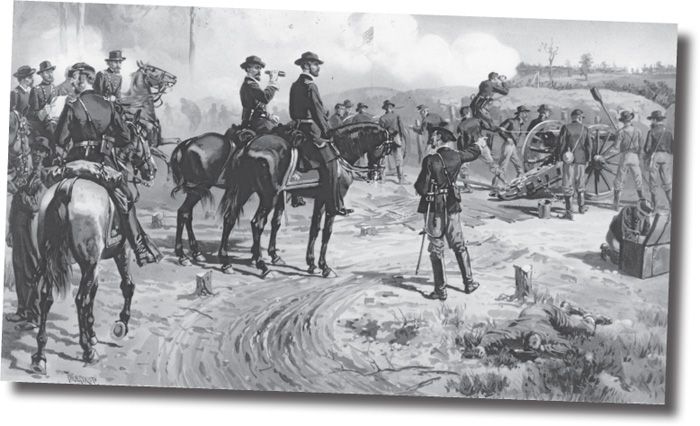
General Sherman, center on horse, at the Battle of Atlanta, an 1888 chromolithograp by Louis Prang.
UNCONDITIONAL SURRENDER.
SEPTEMBER 5
The Commander of Fort Morgan asked for terms. “The only terms we can make are unconditional surrender,” was the reply. Thus FARRAGUT in the last stage of the war reiterates the words of GRANT in the first. These words make the rule of the war. There is no different policy known in either army or navy. The champions of our flag invariably refuse to accept anything short of an absolute yielding to it. They will have the rebel bunting lowered flat to the earth before making a single concession. They are too jealous of the authority and dignity of the nation to chaffer, in its name, with defiant treason.
What these old heroes do, the Union party means to do. It, too, insists upon an unconditional surrender to the national authority, as a preliminary to the consideration of any minor question. Precisely here lies the prime distinction between the Union party and that opposed to it. The Copperheads are for treating with the “Confederate” authorities without requiring from them any previous recognition of the supremacy of the old Constitutional Government. So far as there is any recognition at all, as a condition precedent to discussion, they are, in fact, the ones to make it. The Chicago platform is a recognition for the nonce — a recognition quoad hoc1 — of Confederate independence, and, if fully carried out, would practically end in a recognition for all time. It carefully avoids the word rebellion, and every other implying that there is any allegiance due from the men who are fighting our Government. It asks that “immediate efforts be made for a cessation of hostilities, with a view to an ultimate convention of all the States.” Such efforts would involve diplomatic intercourse with the Jeff. Davis “government.” That in itself is recognizing that it has a certain civil status. That “government” has declared, again and again, that it will listen to nothing so long as what it calls the “invaders” are on its soil. If we withdraw our armies, it is a recognition on our part that they have been invaded, and that the “Confederate” soil is indeed independent soil.... Our Government could not more completely recognize the independence of the “Confederacy” for the time, than by suspending its military action in order that the “Confederate President,” the “Confederate Congress,” and a sovereign convention of the “Confederate States” should come to their respective decisions upon the question of “an ultimate convention” of all the States. It would be a practical acknowledgment that these authorities had discretion and authority in the premises....
Of course, there are many honest supporters of MCCLELLAN who think of no such application of his platform. But it is because they do not think at all....
JEFF. DAVIS could not possibly find any easier or cheaper road to reach what he has been so long in vain struggling for, than that which the Chicago Convention has designated.
But the loyal majority of the North do not intend that this road shall ever be opened. The path of peace these Confederates must travel begins at a different point altogether. It is Union ground from the start. The very first step involves submission, and a complete submission, to the old authority. Thus only can we have a clear and sure way to the adjustment of all the questions the war has generated; and thus only can our nationality be kept secure and inviolate.

Fort Morgan shortly after its capture in the Battle of Mobile Bay.
1. Latin for “as far as it goes.”
THE PRESIDENT AND OUR GENERALS — DIABOLISM IN HIGH PLACES.
SEPTEMBER 7
It is part of the plan of Copperhead operations against the Administration, whenever a General fails in the field, to declare, before anything whatever is known of the circumstances, that it was “LINCOLN” that was the cause of it; either by refusing reinforcements changing the plan of campaign, or performing some other knavish trick....
Occasionally, an attempt is made to lend a touch of solemnity to the farce by summoning LINCOLN and STANTON to answer to an imaginary indictment, for the failure of an assault in Georgia or the loss of a battle in Louisiana, before an imaginary tribunal, composed of the editor of the World or of the Daily News, or “any other man,” where the two culprits receive a frightful “wigging,” and are discharged with the assurance that if they are caught any more causing the loss of battles, of which they knew nothing until they were over, something still more dreadful will happen to them.
On the other hand, whenever a success is achieved, it is invariably assumed that for some time before the fight LINCOLN was maltreating the General who achieved it, and plotting for his overthrow, and the Democratic organs at once begin to pat him on the back, and stroke his head, and reassure the poor little fellow that naughty LINCOLN shall be made to let him alone. They always knew he was an able man, but LINCOLN, of course, put him in command of a large army, and kept him fully supplied with men and provisions, solely with the diabolical design of ruining him. Any one whom LINCOLN fairly hates it appears he appoints to high commands, like GRANT’s and SHERMAN’s, and few of his victims would ever escape him if it were not for the interposition of the [New York] World, and the occasional remonstrances of Gov. SEYMOUR and Mr. VALLANDIGHAM.
An amusing illustration of these Copperhead dealings with the President was furnished by the World on Saturday, in an article discussing the news of SHERMAN’s great victory. This news was a bitter pill, coming, as it did, just as the Copperheads were commencing their efforts for an “immediate cessation of hostilities;” but it had to be swallowed.
If there be one officer in the army, one of LINCOLN’S “dishonored subordinates,” more thoroughly distasteful to a genuine Copperhead than another, it is SHERMAN. There was not a traitor or conspirator at the Chicago Convention in whose nostrils he does not stink. SHERMAN knows it, too, and is proud of it. He is a soldier of the Cromwellian type; believes that when a country has to be conquered it ought to be conquered in such fashion that the work need never be done over again; he believes in making war support war; in making rebels face the consequences of rebellion; he believes that Slavery has been the cause of this war, and he believes that there will be no real peace until it has disappeared; and on all these beliefs he has acted. He does not recognize Slavery; he carries off negroes, chickens, bacon, corn, and everything he can lay hands on, wherever he goes, and uses them for the support of his own army. He gives all traitors and malcontents found within his lines the roughest and most summary justice. He does not allow negro recruiting in his lines because he wants to see able-bodied white Copper-heads in the army. There is not one of the Chicago leaders who dare give out any of his venom anywhere within fifty miles of his headquarters. In short, he is the antipodes of MCCLELLAN in every respect, the kind of men that “Conservatives” most dread to see at the head of our armies.... SHERMAN is only a soldier, and his victories would plunge President MCCLELLAN in a sea of trouble.
MCCLELLAN ACCEPTS THE PLATFORM.
SEPTEMBER 18
The [New York] World has announced that Gen. McCLELLAN accepted the Chicago platform “of course, when he accepted the nomination.” The News1 of the same date declared that the Peace men would not now make a separate nomination. There may possibly be no connection between the two statements, but it is certainly “a coincidence” that we should have them both on the same day.
It is well that matters have taken this shape. We want the builders of that platform to come squarely before the people. We want the men who accept it, and who thereby declare that peace should be sought through an immediate cessation of hostilities, instead of through a steady and unwavering and more determined prosecution of the war, to come before the people of this country for their votes. And if the people do not sink that platform and its makers as speedily as Capt. Winslow sunk the Alabama, and with as utter and everlasting a destruction, then are the people not worthy of being saved from the ruin which its success will bring upon them. We suggest to some of McClellan’s supporters that they had better now drop their talk of his having refused to accept the platform, kicked it over, made another platform of his own, etc. The World’s statement is doubtless by authority, Let us have no more attempts to misstate the issue of the contest but meet it squarely on both sides. We have had shuffling enough.
The London Times very well says: “If the Democratic Party make a fight for power, they must do it substantially on principles of peace.” The leaders of the party saw that this was so, and the platform which they adopted placed their fight upon those principles. Frightened by the temper with which it was received by the people, they endeavored by the letter of acceptance to cover up their position. The only effect of the effort was to show them that what The Times says was true, and they now come back squarely up the platform of “cessation.” Now let us have PENDLETON’s2 letter of acceptance, and then for a fair fight in a fair field, with no dodging.

An 1864 cartoon satirizing the Democratic national platform and presidential candidate, George McClellan.
1. The anti-administration New York Daily News.
2. Antiwar Congressman George H. Pendleton (1825–1889) of Ohio, Democratic candidate for Vice President.
WHAT NOW FOR SHERMAN?
SEPTEMBER 19
In the congratulatory order issued to his soldiers by Gen. SHERMAN when his army entered Atlanta, he says, after reciting the various steps in the triumphant campaign; the capture of Atlanta “completed the grand task which had been assigned us by our Government.” What the entire scope and precise limitation of these words may be, it is difficult to say. We suppose the capture of Atlanta was the task assigned to our brave Western army when it set forth from Chattanooga in May last, and beyond that work it was impossible at that time to draw out any fixed line of military action. So far, it was definite, simple and essential; but, Atlanta once attained, our further progress would depend upon the condition of our army, upon the condition of the rebel army, upon its position and line of retreat, and upon the general aspect of the war. East and West. If the campaign had closed with the destruction of HOOD’s force, the farther advance of Sherman’s army, as a mass into Georgia, would have been unnecessary: if, on the other hand, the rebel force were borne away intact, SHERMAN’s plans and movements would still remain to be dictated by great variety of circumstances.
In regard to the condition of HOOD’s army, we judge the fact to be that, though not utterly destroyed, it was well-nigh broken after the retreat from Atlanta. Its long retreat, or series of retreats, continued without cessation for four months.... Were SHERMAN to advance directly upon it, it would doubtless retreat to Macon; were he to attempt to march in a southeasterly or southwesterly direction, it would try to bar his way, retard his progress or harass his line.
The easiest movement, and not the least effective, for SHERMAN to make with the bulk of his forces, after leaving a portion of them well fortified in Atlanta, would be to strike southwesterly for Montgomery, the old capital of the Southern Confederacy, and from there march upon and seize Mobile. He would thus not only capture these two important points, and dominate all the surrounding country, but he would establish a water-base for our Southwestern army. He could make a grand march like this even though Hood were to remain where he now is, or indeed without paying much regard to the line of communication....
That purpose is the capture of Richmond. On this one object the whole military power of the Federal Union will now be concentrated. Grant will no longer be distracted by two great enterprises. One of them is accomplished and well off his hands. He is at liberty now to give his whole force to the other. He commands all the armies of the United States, and his pride is up. The task which engaged his immediate personal supervision is yet unaccomplished; while that which was entrusted to a lieutenant has succeeded. Every brigade and regiment that can be spared from any other quarter of the compass will now certainly be ordered to Petersburg. The Northern people and their generalissimo concur in the conviction that they have the rebellion at last so circumstanced that one great blow must certainly destroy it; and they believe that blow is to be stricken in Virginia.
Petersburg is falsely esteemed the key to Richmond. The fall of one they erroneously suppose involves the other. But it cannot be denied that if they bring together a force large enough to overwhelm Lee’s army, wheresoever the theatre of battle may be, they do imperil Richmond, and with it the Confederate cause itself.
THE VICTORY IN THE SHENANDOAH VALLEY.
SEPTEMBER 21
The signal victory in the Shenandoah Valley on Monday1 is one of that class which permits no cavil either as to its scope or its completeness. At the opening of the battle EARLY’S force, which, by Confederate accounts, has been positively put down at 27,000, was posted mainly at Bunker Hill, near Winchester, and at Darkesville. The Upequan [sic] creek was between our forces and the rebels and their works extended at some points on the centre and left to within three miles of the river. SHERIDAN’s line extended, early in the engagement, over five miles in length, from Berryville towards Bunker Hill. The attack was made by our cavalry under AVERILL2 by gray daylight on Monday, BRECKINRIDGE’s division, posted near Darkesville, having been steadily driven a distance of seven miles, by one o’clock in the afternoon. The attack of our main army also commenced early in the morning at the point where the Opequan Creek is crossed by the Berryville turnpike. From this point our forces, by a series of stubborn and sanguinary engagements which lasted until 5 o’clock in the afternoon, compelled the rebels to fall back, completely defeated EARLY’s main army, and drove it from one defended line of works to another, until what remained of the routed force, as Gen. STEVENSON tells us, was “sent whirling through Winchester;” all their dead, most of their wounded, and two thousand five hundred prisoners being left on our hands. The wounded in Winchester alone are found to number three thousand, and if the dead are counted in, the rebel loss will be found to exceed six thousand, or about one-fourth of the entire army under EARLY. In trophies and material our gain is also notable; fifteen army flags and five pieces of artillery having fallen into the possession of our army.
Our loss has been hastily computed at two thousand, and considering that the battle must have raged for nearly seven hours, the number will not be deemed excessive....
Never, probably, since he first set out from Lynchburgh at midsummer was EARLY so confident of his position as on this eventful morning, the 19th of September. Only one day previous the Southern reporter, who supplies military fictions for two of the McClellan organs here, writing professedly from the testimony of EARLY’s confidants, had assured the sympathizing friends of that rebel that “Gen. SHERIDAN” main body remains where it has been for the last two weeks, strongly intrenched at Berryville. It is utterly powerless to do anything toward driving Early out of the Valley.” The ink was barely dry upon the sheet which gave currency to these hollow pledges in behalf of EARLY when the thundering announcement rang through our streets, that this impregnable host of invaders, routed, beaten and all but cut in pieces, was using the last remnant of its strength in an inglorious and panic-stricken flight. Loyal men among us cheered lustily for the good cause. The craven-hearted peace-mongers went growling to their haunts.
1. The Third Battle of Winchester (Opequon Creek), Virginia was a triumph for Union forces under General Philip H. Sheridan. The seizure of the town cost 4,018 Union casualties, and 3,921 Confederate.
2. William W. Averell (1832–1900), who later became an inventor.