
CHAPTER 1
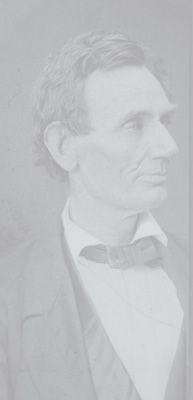
An 1860 photograph of presidential candidate Abraham Lincoln.
The unprecedented four-way campaign for President of the United States in 1860 dominated the press and intensified partisan discord during the summer and fall. With a quartet of presidential candidates competing in the race — one representing Northern Democrats, another Southern Democrats, a third reflecting Border State unionism, and a fourth standing for the new antislavery Republicans, Americans split not only along customary party lines, but along rigid sectional lines as well.
For the most part, the nominees themselves, true to the political tradition of the day, stayed home and allowed surrogates, broadsides, banners, pamphlets, cartoons, popular prints, and, of course, newspapers to do the campaigning on their behalf. Abraham Lincoln, the Republican candidate, remained at or close to his hometown of Springfield, Illinois, from May all the way through November, answering letters, advising on strategy, encouraging supporters to work hard on his behalf, and benignly greeting visitors, steadfastly declining to engage in active politics. But Republicans rallied vociferously throughout the Northern states, calling for an end to longtime Southern domination of the executive, legislative, and judicial branches of government.
In Connecticut, eager young Lincoln supporters formed a new organization called the Wide-Awakes, and branches quickly sprung up throughout the North. In city after city, members boisterously marched the streets by night, carrying torchlights atop Lincoln “rails,” and garbed in oilskin-glazed capes and caps to protect their clothing from dripping oil and sparks. Their precision demonstrations and slick “uniforms” aroused and entertained Northern voters, but alarmed Southerners. They regarded the Wide-Awakes as a paramilitary organization that might quickly be formed into a conquering antislavery army should Lincoln win the election. Even without taking the stump, the Republican nominee thus aroused virulent opposition among slavery supporters.
But his opponents had little hope of stopping Lincoln at the polls. From the time Democrats split into Northern and Southern factions that year, most observers believed that the Republicans would inevitably win a majority of electoral votes even though Lincoln’s name was kept off most presidential ballots in the Deep South. Senator Stephen A. Douglas, once an all-but-inevitable Democratic candidate, proved unacceptable to many slave holders for the same reason he had lost support among most antislavery Northerners: by advocating popular sovereignty. Under its terms, settlers in new western territories could vote on whether or not to allow slavery inside their borders. Northerners believed that the Douglas policy would extend and expand slavery, while Southerners, conversely, feared it would exclude and doom it. Bolting from their party’s convention in protest, pro-slavery Southern Democrats regrouped and nominated the nation’s sitting vice president, Kentuckian John C. Breckinridge, thus splitting the nation’s oldest political party in two. Douglas’s subsequent, unusual, and much-criticized personal campaign tour did little to enhance his popularity in the South.
Throughout the roiling 1860 campaign, Democrats aimed at least to block Lincoln from amassing enough electoral votes to win outright victory. Their best chance at stopping him was to win enough states to throw the final decision on the Presidency to the lame-duck House of Representatives, where the outcome was far less certain and coalescence around a compromise candidate was likely, or at least possible. But the strategy failed, even after Democrats in Pennsylvania abandoned Douglas and unified behind Breckinridge. On Election Day, Lincoln won an enormous victory in the Northern states, amassing 180 electoral votes nationwide, far more than needed for outright victory.
At Cooper Union, Lincoln had predicted that Republicans would win support wherever and whenever Southerners allowed them to contend for office. But Election Day proved him wrong. The final tally gave Lincoln 54 percent of the popular tally in the North and West, but only 2 percent in those Southern States where his name did appear on the ballot. In states like Missouri and Kentucky, where voters could indeed vote for him for President, Lincoln had won almost no support at all, a portent of a dangerous interregnum to come. In the end, Lincoln won the presidency without winning a single electoral vote in the South and less than 40 percent of the overall national popular vote.
The day after the voting, opponents of the so-called Black Republican defiantly unfurled a Palmetto Flag in Charleston, South Carolina. Lincoln was repeatedly hanged in effigy throughout the Deep South. And fire-eater Edmund Ruffin, who had almost diabolically supported Lincoln because he thought a Republican victory would hasten disunion, immediately began leafleting for secession. In a way, the war between the states had already begun.
The national capital received the news of Lincoln’s victory with nervousness. The pro-Democratic Washington Constitution, reaching “the lamentable conclusion that Abraham Lincoln has been elected President of the United States,” predicted “gloom and storm and much to chill the heart of every patriot in the land,” adding: “We can understand the effect that will be produced in every Southern mind when he reads the news this morning — that he is now called on to decide for himself, his children, and his children’s children whether he will submit tamely to the rule of one elected on account of his hostility to him and his, or whether he will make a struggle to defend his rights, his inheritance, and his honor.”
It took little time for many Southerners to make that momentous decision. Many in the South pointed to Lincoln’s entirely sectional election as the final straw in the long-running battle for political power. Though he had vowed at Cooper Union to leave slavery alone where it already existed, he had also reiterated there his resolve to oppose the spread of the institution into the territories. To the slave holding South, any attempt to use federal authority to bar localities from admitting slavery was tantamount to a declaration of war.
As he had acknowledged at Cooper Union: “Human action can be modified to some extent, but human nature can not be changed.” Addressing the South (though there is no evidence his message reached them), he added: “Your purpose, then, plainly stated, is that you will destroy the Government unless you be allowed to construe and enforce the Constitution as you please, on all points in dispute between you and us. You will rule or ruin in all events.”
That was one man’s opinion. But on November 6, that man was elected President of the soon-to-be-divided United States. “And,” as Lincoln would sadly acknowledge four years later, “the war came.”
THE DISRUPTION OF THE DEMOCRATIC PARTY.
MAY 4
The Charleston Convention has abandoned the attempt to nominate a Democratic candidate for the Presidency. The failure is due partly to the disorganized condition of the party, and partly to the blind blundering of the Convention itself. The contest between the two sections of the Union has at last penetrated the Democratic Party, and rendered it impossible for the two wings to agree upon a declaration of principles. When the majority adopted its platform the minority seceded. Thereupon the delegates who remained, and who constituted the rightful Convention, resolved that a vote of two-thirds, not of the actual body, but of the whole original number, should be essential to a nomination. In other words, the seceders were still to be counted, and to have all their original weight as members of the Convention! Upon what ground of reason or of common sense, the majority, and especially the delegates from this State, thus put themselves, bound hand and foot, into the power of the seceding minority, it is not easy to conjecture. The result was to give the South the victory. They have controlled the Convention, and prevented the nomination of any candidate. Whether, on reassembling at Baltimore, they will harmonize their differences, remains to be seen.
The disruption itself is a fact of very marked importance, not only in the history of political parties but of the country itself. It seems to sever the last link of nationality in the political affairs of the Union. When all other organizations have been gradually giving way, one after another, to the pressure of sectionalism, timid and conservative men have fallen back upon the national position of the Democratic Party, and felt that so long as this was maintained the Union would be secure. The first effect of this Charleston split will be to alarm this class by the dread of immediate dissolution.
Some of the Republican journals refer to this incident as only another proof of the “irrepressible conflict” between Freedom and Slavery, — and as showing that the contest must go on until one or the other is extirpated. If we believed this to be the true view of the question, we too should despair of the Union. But we do not. We do not believe that the conflict is between Slavery and Freedom, or that the existence of either will be affected by the result. We regard the struggle as one for political power, — and Slavery as playing merely a secondary and subordinate part on either side. Unquestionably, thousands of Northern men seek the overthrow of Slavery, and thousands of Southern men seek its permanence and extension, as the aim of their political contests. But both would be disappointed. Neither class would reap the advantage which it anticipates from victory. The Slave States have substantially controlled the policy of the Federal Government for the last fifty years. Upon all questions — tariff, currency, foreign relations — their views and sentiments have guided the action of the nation. For a long time they held this power by the legitimate tenure of numbers, weight and influence. Then came a period when they held it by alliances with Northern politicians. And for the last few years they have held it by coercion, — by menaces, by appeals to the fears of the timid, the hopes of the ambitious, and the avarice of the corrupt, in the Northern States. The time has come when they must relinquish their grasp. Power is passing into the hands of the majority — into the hands which hold the numbers, the wealth, the energy, the enterprise of the Confederacy. There is no help for it. It is among the inevitable events of political history. It can no more be arrested than the revolution of the earth around the sun, or the rising and falling of the tides of the sea.
Naturally, however, it excites a commotion. All great changes, — especially all restorations of disturbed balances of power, — are attended with more or less of turmoil and alarm. Righting a ship, which has long been so careened as to make it impossible to walk across her deck, throws everything into confusion, and the unaccustomed passenger who has valuables on board, is quite certain she is capsizing. He sees his mistake only when she stands upright, and with full sail makes direct for her destined port.
The South believes sincerely, we doubt not, that the North seeks power in order to crush Slavery. In our opinion it denounces Slavery mainly that it may acquire power. In many respects the policy of the Federal Government in Northern hands would be different from what it has been hitherto. Men would no longer be excluded from office for doubting the wisdom or the justice of the system Slavery. Federal power would not be used to force it upon unwilling communities. We should no longer be represented abroad by active apostles of Slavery, nor would that be held up to the world as the cherished glory of American institutions. But there would be no interference with Slavery in any Southern State, — no refusal to execute the constitutional provision for the rendition of fugitives, — no attempt to coerce the population of new Territories. A Northern President, — Northern in sentiment as well as geographical position, — would have a degree of influence over his own section, which would disarm the hostility which a Southern sectionalist would be sure to encounter.
One thing is very certain: — the South must make up its mind to lose the sway it has exercised so long. The sceptre is passing from its hands. Its own imprudencies have hastened the departure of its power, but it has always been merely a question of time. The South can either accept it as inevitable and make the best of it, — or plunge the whole country into turmoil, and bring down swift ruin upon its own borders, in the vain contest against national growth and development.
FROM CHICAGO.
ORGANIZATION OF THE REPUBLICAN NATIONAL CONVENTION.
EXTREME EXCITEMENT AND ENTHUSIASM.
MAY 17
SPECIAL DISPATCH TO THE NEW-YORK TIMES.
CHICAGO, WEDNESDAY, MAY 16
The throng of in-pouring multitudes, by rail, by sail and by wagon, has continued without cessation, all the adjacent States sending their innumerable representatives. The Convention met at the hour prefixed, in the great Wigwam, which holds, and today held, ten thousand people, while twenty thousand more surrounded the building. The proceedings, which will be found at length in the general report, were marked with the utmost good feeling and unbounded enthusiasm.
The organization has been completed, GEORGE ASHMUN,1 the Chairman, is for Mr. SEWARD,2 and only hesitates to declare himself from fear of the opposition of other States.
Mr. GIDDINGS3 was greeted with cheers, as was also Mr. GREELEY.4
The canvass outside is very animated. Mr. SEWARD would be nominated by acclamation, but for apprehensions of Pennsylvania. The delegates and others opposed to him are unsparing in their efforts to influence New-England and the Southern States. The great difficulty among the opponents of Mr. SEWARD is their inability to unite upon any other candidate. Each State says that its own candidate is the only one who can carry that State, and it is impossible as yet to get any Anti-Seward State to name any man outside its limits who can carry it. This fact leads the friends of Mr. SEWARD to believe that the rest must eventually come to them, from sheer inability to agree upon any one else. Under this conviction they will remain firm. They have been very courteous and conciliatory, but the failure of their opponents to suggest any other candidate strengthens their position. New-York, Michigan, Wisconsin, Minnesota and Iowa will have no second choice in any contingency.
The result is still entirely doubtful. Any attempts to predict the result would be worse than useless.
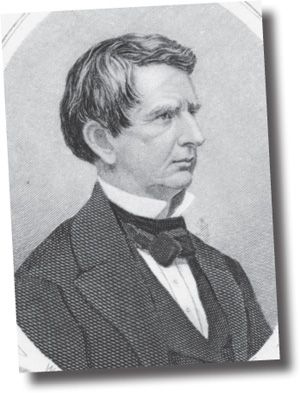
Senator William H. Seward of New York.
1. The son of a Senator, Massachusetts ex-Congressman Ashmun (1804–1870) became a railroad executive.
2. New York Senator William H. Seward (1801–1872) entered the convention as the overwhelming favorite for the Republican presidential nomination.
3. Joshua Giddings (1795–1864), Congressman from Pennsylvania, later U.S. minister to the British North American Provinces (Canada).
4. Horace Greeley (1811–1872) was editor of The New York Press & Tribune, The Times’s chief rival among Republican readers.
THE REPUBLICAN TICKET FOR 1860.
ABRAM, LINCOLN, OF ILLINOIS, NOMINATED FOR PRESIDENT.
THE LATE SENATORIAL CONTEST IN ILLINOIS TO BE RE-FOUGHT ON A WIDER FIELD.
MAY 19
SPECIAL DISPATCH TO THE NEW-YORK TIMES.
CHICAGO, FRIDAY, MAY 18
The work of the Convention is ended. The youngster who, with ragged trousers, used barefoot to drive his father’s oxen and spend his days in splitting rails, has risen to high eminence, and ABRAM LINCOLN, of Illinois, is declared its candidate for President by the National Republican Party.
This result was effected by the change of votes in the Pennsylvania, New-Jersey, Vermont, and Massachusetts Delegations.
Mr. SEWARD’s friends assert indignantly, and with a great deal of feeling, that they were grossly deceived and betrayed. The recusants endeavored to mollify New-York by offering her the Vice-Presidency, and agreeing to support any man she might name, but they declined the position, though they remain firm in the ranks, having moved to make LINCOLN’s nomination unanimous. Mr. SEWARD’s friends feel greatly chagrined and disappointed.
Western pride is gratified by this nomination, which plainly indicates the departure of political supremacy from the Atlantic States....
Immense enthusiasm exists, and everything here would seem to indicate a spirited and successful canvass. The city is alive with processions, meetings, music and noisy demonstrations. One hundred guns were fired this evening.
The Convention was the most enthusiastic ever known in the country, and if one were to judge from appearances here, the ticket will sweep the country.
Great inquiry has been made this afternoon into the history of Mr. LINCOLN. The only evidence that he has a history as yet discovered, is that he had a stump canvass with Mr. DOUGLAS, in which he was beaten. He is not very strong at the West, but it is unassailable in his private character.
Many of the delegates went home this evening by the 9 o’clock train. Others leave in the morning.
A grand excursion is planned to Rock Island and Davenport, and another to Milwaukee and Madison, and still another over the Illinois Central, over the prairies. These will detain a great many of the delegates and the editorial fraternity.
The Wigwam is as full as ever — filled now by thousands of original LINCOLN men, who they “always knew” would be nominated, and who first suggested his name, who are shouting themselves hoarse over the nomination. “What was it WEBSTER said when TAYLOR was nominated?” ask the opponents of LINCOLN. “What was the result of the election?” retort LINCOLN’s friends.
Thirty-three guns were fired from the top of the Tremont House.1
The dinner referred to in Tuesday evening’s dispatch was a private one, and I regret that inaccurate reading of it should have misrepresented the position of the delegation as regards Mr. GREELEY. His right to act as he deemed best politically, was not denied, and consequently there was no defence of his career needed.
Massachusetts delegates, with their brass band, are parading the streets, calling at the various headquarters of the other delegations, serenading and bidding them farewell. “Hurrah for LINCOLN and HAMLIN2 — Illinois and Maine!” is the universal shout, and sympathy for the bottom dog is the all-pervading sentiment.
The “Wide-Awakes,” numbering about two thousand men, accompanied by thousands of citizens, have a grand torch-light procession. The German Republican Club has another. The office of the Press and Tribune is brilliantly illuminated, and has a large transparency over the door, saying, “For President, Honest Old ABE.” A bonfire thirty feet in circumference burns in front of the Tremont House, and illumines the city for miles around. The city is one blaze of illumination. Hotels, stores and private residences, shining with hundreds of patriotic dips.
ENOUGH. HOWARD.3
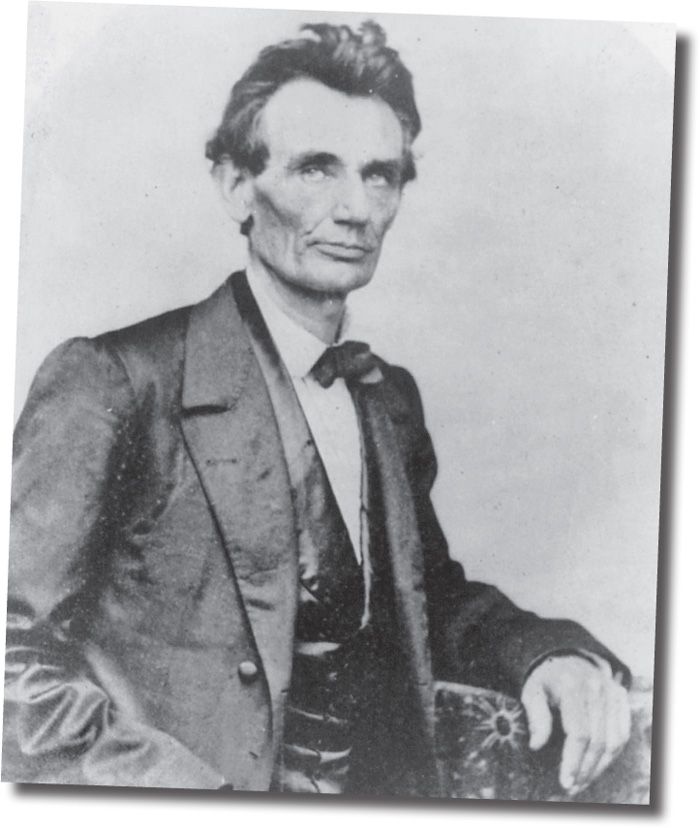
Photograph of Abraham Lincoln taken in Springfield two days after he won the Republican party nomination for president. It was engraved for the frontpiece of Lincoln’s first campaign biography.
1. Chicago’s leading hotel.
2. Maine Senator Hannibal Hamlin (1809-1891) was chosen by the Republicans as their candidate for vice president. It was not lost on readers that the last three letters of Lincoln’s given name, plus the first three letters of his family name, spelled out “Hamlin.” In the mid-19th century, the conventions chose the presidfential candidate’s running mate without consultation or influence.
3. New York Times correspondent Joseph Howard (1833–1908)
THE BALTIMORE CONVENTION.
JUNE 19
The Baltimore Convention is in full blast. Yesterday was spent mainly in preliminary movements, but some of these were not without significance. The New-York delegation seems to be, as the French say, master of the situation, and it is quite evident that its leading members intend to husband their influence by using it with caution. Nominally they are for DOUGLAS and their votes will probably be cast for him, as decidedly the strongest man whom the party can select for the Northern States. But it is also evident that their devotion to him is by no means of an uncompromising character. Their votes upon questions of order and of form indicate an unmistakable determination not to push their claims or their opinions to any extreme. When they find it impossible to carry DOUGLAS by a two-thirds vote, they will probably present some new name; and it will not be until after every conceivable effort shall have been made to secure the union of the party, that they will consent to the repeal of the two-thirds rule.
The most significant step taken yesterday was the action upon a resolution offered by Lieutenant-Governor CHURCH, of this State, that all the delegates admitted to seats in the Convention should be deemed bound in honor to support its nominees. Nothing could be intrinsically more just than suck a rule. Conventions become a mere farce when they cease to carry any obligation: — and if one portion of their members are held bound by their action, while another portion is entirely free, they become instruments of oppression. But the Southern Delegates refused utterly to assent to any such restriction of their liberty. They declared their determination to secede en masse in advance of any action, if such a rule should be adopted. And nothing can show more clearly the extreme complaisance of the New-York Delegation, than their refusal to second the previous question on this resolution, or to vote for it on its final passage.
It is very clear that every possible concession will be made to the South, consistent with the continued existence of the party in the Northern States. We see, however, no strong reason for believing that these attempts at compromise will prove successful. A large and active portion of the Southern delegates are clearly in favor of having two candidates, and trusting to the chances of an election in the House or by the Senate. The ultra Douglas men are quite willing to accept the issue thus tendered, and will prefer it decidedly to the nomination of any other candidate than the Illinois Senator. The action of the Convention to-day will probably throw more light upon the final result.
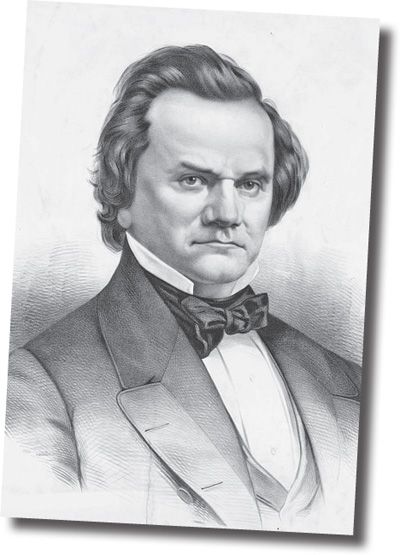
A Currier and Ives lithograph of Stephen A. Douglas, Northern Democratic candidate for president.
THE SECESSION MENACE.
HON. LAWRENCE M. KEIST ON THE DUTY OF THE SOUTH UNDER A REPUBLICAN PRESIDENT.
JULY 24
FROM THE CHARLESTON MERCURY.
Under the teachings of the Abolitionists the North is about to be consolidated against the South. It is futile to deny, unless all the signs around us betray, that the Federal Government is about to pass into the hands of the majority section, and that all its power will be used to cripple, and ultimately to destroy, the institution of Slavery as it exists among us. Neither to-morrow, nor the next week, nor the next year, might the dagger be planted in the heart of the South; out, if she submits to the sectional domination which is now threatened against her, this calamity will inevitably befall, unless the whole history of the world be reversed, and the essential principle of humanity be revolutionized. No people can safely commit their rights and civilization to the custody of another and hostile community, and it is idle to deny that the North is to the South a hostile community....
In my judgment, if the Black Republican Party succeeds in the coming election, the Governor should immediately assemble the Legislature, and that body should provide for a State Convention, which should protect the State from the dishonor of submission to Black Republican rule. Before the tribunal of the world, and at the bar of history, we shall stand justified, Freedom lives much more in the spirit of a people than in the forms of a government. We shall receive the plaudits of brave men for preserving freedom, and not reproaches for shattering a despotism. Senator HAMMOND, in his unanswerable and consummate arguments on the admission of Kansas and “Squatter Sovereignty,” has exposed the resources and the rights of the South. Upon both we may safely stand. The Union is just as travelers tell us many Eastern habitations are; a palace to look upon; all fair on its outside, and presenting the appearance of a house that should last for generations; but the master puts his walking stick or his boot-heel through the rafters, and he finds that the white ants have eaten all the substance out of the timbers, and that all that he sees about him is a coating of paint, which an intrusive blow may disperse in a cloud of dust. The skirting boards have already perished, the rafters are now ready to tumble in.
We of the South have done everything to preserve the Union. We have yielded almost every thing but our honors. Let us yield that only as an enemy yields his banner. I have the honor to be,
Your obedient servant,
LAWRENCE M. KEITT.
ORANGEBURGH, C.H., JULY 18
POLITICAL MISCELLANY.
HOW ALABAMA STANDS.
AUGUST 1
Col. CLEMENS, late editor of the Memphis Enquirer, in a letter to that paper, says of the prospects in Alabama, where he is now staying: “Placing no great reliance upon the reports I hear daily from other parts of the State, and judging only from the feeling manifested in this stronghold of Democracy, I tell you with entire confidence that you may set down Alabama as lost to BRECKINRIDGE. He could not carry the State to-day, and will grow weaker from this time until November. The only thing which ever gave the Secession Party any strength in Alabama was its assumption of the name of Democracy, and when that is torn away they will dwindle into a faction too contemptible to excite the fears, or disturb the peace of the country.” The Mobile Tribune cannot stop to count the BRECKINRIDGE papers in the State, but numbers sixteen DOUGLAS journals already. It puts it down as certain that Mr. BRECKINRIDGE cannot carry the State.1....
1. Notwithstanding this rather biased prediction, on Election Day Breckinridge won Alabama handily.
THE POLITICAL CAMPAIGN.
WESTERN POLITICS.
AUGUST 29
We have had a Bell-Everett State Convention in Ohio, and it is worth notice only so far as to say, that it was very small and very unimportant. In fact, this party is now only the fraction of a fragment — the remnant of a tribe that is lost; but, like the poor Indian, — still linger round the graves of their ancestors. FILLMORE had 28,000 votes in this State, and BELL may have 10,000, but, in no case enough to influence, even indirectly, the result. The prominent idea of these gentlemen now seems to be, to defeat Judge BRINKERHOFF — an honest, upright, fearless Judge of the Supreme Court. BRINKERHOFF is rather fervid in his Anti-Slavery sentiment, and may have given rather ultra opinions in the great case of Cotton vs. Freedom. But it seems to me this is hardly a crime, and certainly not enough to feed a political party upon. The Bell-Everetts here are not only an old gentleman’s party, but old gentlemen who don’t read the papers, and never heard of the great Meteor. But, enough: Let them be treated with respect, while we pass on to livelier topics....
I said in my last that there was a revolution going on in Virginia; and asked, is it impossible for Virginia to vote for BELL? Since that you have had a clear and able article of your own in the TIMES, on that subject, which I read with great interest. But you have only gone part of the way. I will pursue it a little further. For thirty years, Western Virginia has been AntiSlavery. The people of the West more than once threatened to separate the State, that they might abolish Slavery in the West. In remodeling the Constitution, they would have provided for gradual emancipation, but for the rotten borough system, by which the Eastern slaveholding counties controlled the Conventions. A compromise was made, as you have remarked, by which, the slaveholders control the Senate till 1865, but then their power will pass away. But now, you see they control the politics of the State, and their leaders are from eastern Virginia, and from districts, where light scarcely penetrates, and they are fully capable of believing that SEWARD and CHASE sent JOHN BROWN there to cut their throats and burn their houses....
In the coming election, these Anti-Slavery counties must in the main (quoad the Democracy) vote for DOUGLAS, while the Pro-Slavery counties in the main go for BRECKENRIDGE. Hence, the DOUGLAS vote in Virginia will be much larger than any one anticipated at first. Hence, it was the DOUGLAS Staunton Convention bid defiance to the gentlemen assembled at Charlottesville. The delegates assembled at Staunton came from mountains and valleys, where the voice of freedom is still heard. They saw the gathering of the clans, and knew the storm was coming. Hence it is, that the LINCOLN flag flies on the pole at Wheeling, and no man will pull it down. The coming storm will carry WISE, HUNTER, MASON, BRECKINRIDGE, down before it, into a gulf from whence they will never return. The politicians of all parties left the valley of the Ohio out; but they will be awakened with a clap of thunder from a clear sky. The North-west, — Kentucky, Tennessee, Missouri, and Western Virginia, will go together. The vote for LINCOLN, on the north side of the Ohio, and BELL, on the south, will carry everything; and convince the most stupid that the reign of King Cotton is over. The last people to find this out will be your old fogies; — your BROOKS, and HUNT, and DICKERSON, and HALLOCK — et id omne genus. But they will find it out after a while. It took about twenty years for one of our old Dutchmen, who voted for JACKSON, to find out that JOHN QUINCY ADAMS was not the son of GEORGE III. But he did find it out, and I never despair of teaching anybody. We have a school for idiots in our State, and it is astonishing how much they learn.
I agree fully with you, however, that in New-York, the friends of LINCOLN should work on the supposition that the coalition may accomplish something. I never knew a coalition that did anything; but there may be an exception. Gov. SEWARD used to be a most perfect tactician, and I agree with him, that the LINCOLN majority in New-York will be a very large one. I don’t believe the Americans, who vote for DOUGLAS, will be as many as the Democrats who vote for BRECKINRIDGE. New-York will poll 625,000 votes, and 320,000 will be given to LINCOLN, leaving the residue for DOUGLAS, BRECKINRIDGE and BELL.
A VETERAN OBSERVER.
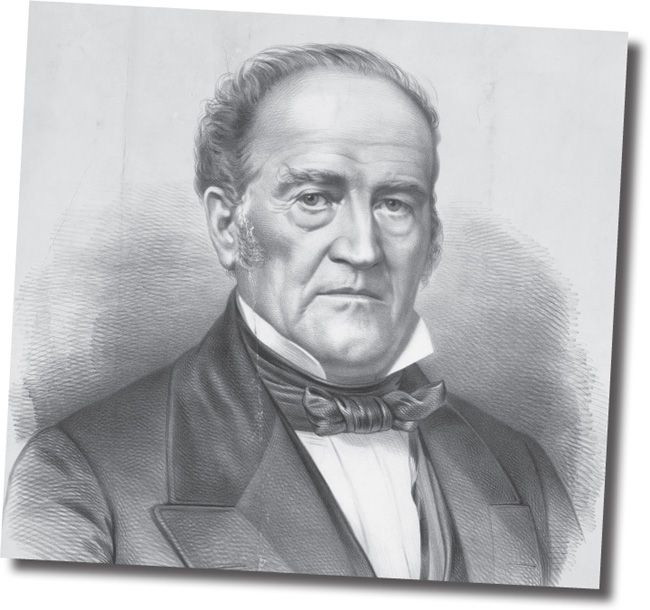
Senator John Bell of Tennessee, national Union Party candidate for president.
THE PRESIDENTIAL CAMPAIGN.
GRAND WIDE-AWAKE DEMONSTRATION.
OCTOBER 4
Round us a shield and bright as molten silver the moon uprose last evening about 7 o’clock, touching the cupola of the City Hall with right and throwing out into delicate relief the foliage and branches of the Park trees, as your Reporter hastened from the TIMES Office to Broadway, on his way to view the Wide-Awakes.
Even at that early hour, the Park itself and all the sidewalks were densely crowded, the stages and carriages having to slowly crawl up the centre of the street through dense fringes of excited and expectant humanity. Windows and stoops were packed with curious faces; all the corners displayed mass-meetings in embryo — fresh accessions constantly thronging up from the side streets to swell the numbers or supply the places of those lucky ones who had managed to push their way into the main upward-drifts of the palpitating current.
Stepping into a stage and driving up towards Union-square as fast as the many human obstructions would allow us, the scene became more animated and brilliant each moment, as we approached the main centre of attraction. Broadway never more thoroughly displayed its Metropolitan character — all ranks and varieties of men, women and children being collected and merged together behind its curbstone lines on either hand....
Endless seems the procession, fresh and yet fresh companies of the Republican army debouching from side-streets into the Avenue, as room is made for their entrance by the passage downward of those in the van. While waiting for their turn to mix in the march, these regiments of uniformed link-bearers bivouac on the curb-stones or squat complacently on convenient steps. All varieties of military evolutions appear familiar to them — their torches now rapidly forming into hollow square around some decorated wagon filled with ladies in star-spangled robes, or meandering in single file into a curved procession, designed to imitate the waving outline of those fences for which the chief Candidate on their ticket split his immortal rails.
No appurtenance of a military host is lacking here, each third or fourth company having trundled behind it a huge brass howitzer or field-piece, the mouth of which is expected to discourse most eloquent music next Fourth of March, when the patriarchal ABRAHAM of Illinois carries his carpet-bag and portfolio up the shouting steps of the White House. Here are pioneers with ugly hatchets, and it may be observed that all the torch-men carry their illuminating machines as soldiers carry their firelocks. Each captain and other officer is distinguished from his men by appropriate decorations or varieties of uniform — the officers having colored lanterns, with glass shades, while the mere privates bear Britannia-metal lamps, swung on metal forks at the top of each pole. Military bands at the head of every second company discoursed patriotic and thrilling music — fifes and drums predominating, but the ring of brazen instruments also lending vivacity and harmony to the general chorus. These bands, for the most part, are in uniform like the Wide-Awakes, and the incessant peals of their playing must be imagined during every step of our description.
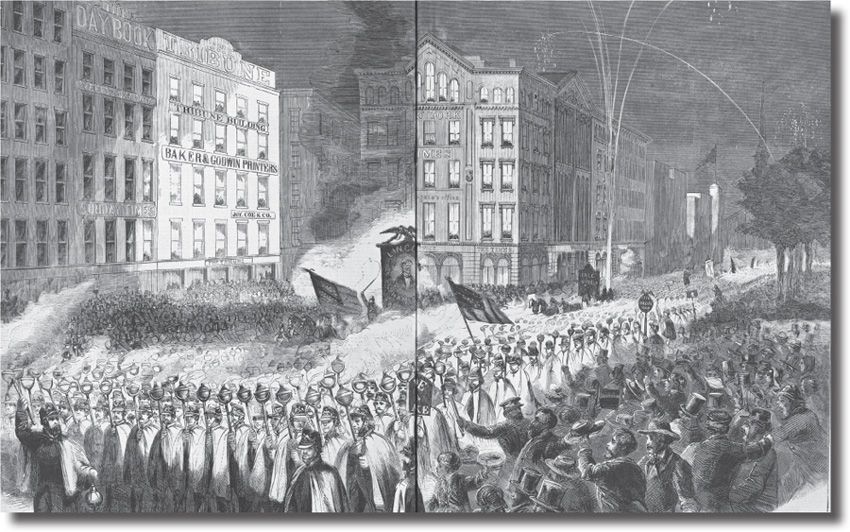
Republican Wide-Awake procession in New York City on the evening of October 3, 1860.
MR. LINCOLN’S CONSERVATISM.
OCTOBER 17
The Journal of Commerce insists, with steadfast earnestness, that the Republican Party is pledged to interfere with the rights and interests of the Slaveholding States. It quotes the oft-repeated and grosslydistorted declarations of Senator SEWARD and Mr. LINCOLN, asserting the fact of a radical hostility between Freedom and Slavery, but lays special stress upon a declaration imputed to Senator WILSON,1 that he trusted the Republican Party would retain and exercise the powers of the Government “till no man on the continent should hold property in another man.” The Journal treats this as conclusive of the radical and revolutionary designs of the Republican Party.
Now, if the Journal adopts this style of argument merely for the purpose of defeating LINCOLN’s election, we have nothing special to urge against it. It is quite as legitimate as three-fourths of the partisan logic of the day. But in our judgment it is not likely to prove effectual. The chances are that Mr. LINCOLN will be elected, — and that the control of the Executive Department of the Government will pass into his hands. We are therefore not only curious to know, but interested in knowing, whether the Journal will then insist upon the same views which it now urges upon this subject. In our opinion, the great mass of the members of the Republican Party do not lend the least credit to the representations of their opponents on this point. They do not believe that Mr. LINCOLN has the remotest wish or thought of interfering with Slavery in any Southern State. They do not believe that he will trespass, in the least degree, upon Southern rights, or do anything of which considerate and patriotic Southern men will have the slightest reason to complain. If Senator WILSON, or Mr. SUMNER, or Mr. LOVEJOY, have different expectations, we believe they are destined to be disappointed.
After Mr. LINCOLN shall be elected we think he will very promptly take steps to dispel the fogs that have been thrown around his political position, — and that he will present himself to the country as a Conservative, devoted to the Union, considerate equally of every section and of every State, and resolved faithfully and with firmness to maintain the Constitution in all its parts. We have no doubt that he will proclaim himself opposed to the extension or increase of Slavery, and equally opposed to any interference of Congress, or of the North, with Slavery in the Southern States. He has repeatedly declared himself in favor of an efficient Fugitive Slave Law, and opposed to negro suffrage and the political equality of the negro race. We regard these as eminently conservative views, and if his Administration adheres to them with firmness and fidelity, we believe it will contribute largely to the restoration of the public peace, and fortify the Constitution and the Union still more thoroughly in the affection and confidence of the American people....
1. Henry Wilson (1812–1875) of Massachusetts.
HOW TO ELECT A PRESIDENT.
OCTOBER 29
The Journal of Commerce1 has the following:
“The TIMES is again harping upon its original argument, that people ought to vote for LINCOLN to elect him, to prevent the worse result of his election by the House of Representatives.2 We believe the TIMES has the exclusive monopoly of this line of argument, — no other paper having stultified itself by following in its footsteps.”
This is very peremptory and, probably, very decisive for those who accept partisan assertions for logic. We confess, however, that we remain unconvinced. We don’t quite see the absurdity of the point, and shall feel under special obligations to the Journal of Commerce if it will so far condescend to our dullness as to attempt our enlightenment.
We do still insist that, in the existing condition of the country, carrying the election of a President into the House of Representatives, involves much more danger to the peace of the country than the election of LINCOLN by the people. According to all human probability, LINCOLN, BRECKINRIDGE3 and BELL,4 will be the three candidates before that body. LINCOLN will start with fifteen States certain, and BRECKINRIDGE with thirteen. Illinois has five Douglas Democrats and four Republicans on her delegation. One of the former, Mr. MORRIS,5 has publicly declared that he will vote for LINCOLN rather than see BRECKINRIDGE elected, and his vote will decide the vote of his State. Illinois, therefore, may be set down for LINCOLN if it be necessary either to prevent the election of his opponent, or to effect a choice. That leaves LINCOLN lacking but one vote. The seat of the Democratic member from Oregon is contested, and the House, which decides his claim, is against him. The admission of his contestant would give Oregon to LINCOLN, and secure his election.
Now, we put it to the Journal of Commerce, (1), whether it is not probable that LINCOLN would be elected by the House if the choice devolves on that body; (2), whether the South would be any more disposed to submit to his election when thus effected, than when made by the People; and (3), whether the opportunity for making forcible resistance, and for plunging the House and the country into civil strife and commotion, would not be far better and more tempting than would be afforded by LINCOLN’s election on the 6th of November?
These are very simple questions, and they admit of very direct answers. Possibly we are mistaken, but we consider them deserving of a different style of reply from that which the Journal of Commerce has adopted hitherto. We know something of the nature of a sharp sectional contest in the House of Representatives. Two struggles for the Speakership have thrown considerable light upon the measures resorted to by a desperate disunion faction, to avert a threatened defeat. They are not such as encourage us to look with complacency upon the experiment the Journal seems anxious to try. We have great faith in the strength of the Union and the power of the Constitution. We believe both will stand the strain of a popular election, conducted in strict conformity with the laws of the land, whatever may be its result; we have not equal faith in its ability to go through the fearful ordeal which the Journal invites.
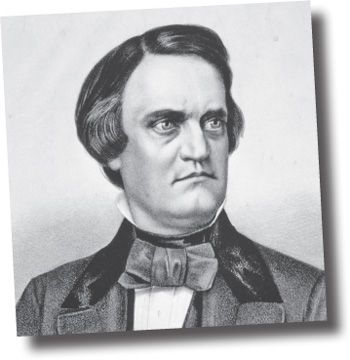
John C. Breckinridge, Southern Democratic Candidate for President in 1860.
1. One of New York’s pro-Democratic newspapers.
2. With Lincoln favored to win by October, desperate foes hoped he would fall short of an electoral majority against his three opponents, forcing the presidential election to the House of Representatives. There, voting would be conducted by delegation, increasing the chances of success by a compromise candidate.
3. John C. Breckinridge, Vice President of the United States, was the Southern Democratic candidate for President in 1860.
4. John Bell (1796–1869) of Tennessee was Constitutional Union candidate for the presidency in 1860.
5. Isaac Newton Morris (1812–1869).
BRECKINRIDGE SMOKED OUT.
OCTOBER 30
We have already published the meagre extracts of a letter from Mr. BRECKINRIDGE to a gentleman in North Carolina, in which he defines his position upon the question of disunion. We have no hesitation in declaring that it places him in a far worse position than he occupied while refusing to answer. His silence was suspicious, and left room for the inference that he might be tinctured with the treasonable sentiments which all the more distinguished leaders of his party own; but his oracular utterance leaves us little room to doubt that he is only for the Union so long as his party holds power.
It will be remembered that the questions put to Mr. [Stephen A.] DOUGLAS at Norfolk, were substantially these:
Do you consider the election of LINCOLN a just cause for breaking up the Union?
Do you believe in the light of peaceable secession without cause?
To these printed interrogatories Mr. DOUGLAS gave answers which did him honor. He not only denied the right of secession, for the cause supposed, but he declared his purpose to sustain Mr. LINCOLN in enforcing the laws. The same questions have been repeatedly addressed to Mr. BRECKINRIDGE, but he has studiously refused to answer, except to one gentleman, Mr. COHOON, the Mayor of Elizabeth City, North Carolina. And what is that question? He says, under date of October 5:
“Yours of the 1st instant has been received. The questions you ask are answered in my inclosed speech. I esteem Mr. YANCEY1 highly, and have known him long and favorably. * * * Mr. BRECKINRIDGE is not Mr. YANCEY. I love the Union, but the South better. If elected, the Union, under my care, shall never be dismembered.”
We substitute “dismembered” for “disseminated,” as it originally appeared, and was evidently a typographical or telegraphic error. This is the whole of the letter which has been permitted to see the light, and the inference from it is almost irresistible, that Mr. BRECKINRIDGE will pledge himself to stand by the Union only on the conditions of his own election to the Presidency. If every man in the country stood on this narrow platform, the Union would be rent into some thirty millions of atoms. This is carrying the doctrine of secession to its utmost limits. The question was, whether Mr. BRECKINRIDGE would sustain the Union if Mr. LINCOLN shall be elected President? He answers that he will remain faithful if elected himself, while, in the same breath, he avows an intense degree of sectional feeling. “I love the Union, but the South better.” Did ever Presidential candidate avow such a sentiment before? Could YANCEY and KEITT2 demand more of him?
As we never heard of a President who desired to break up the Union during his own term of office — for even Mr. BUCHANAN3 cannot agree to that — we are not surprised that Mr. BRECKINRIDGE gives the assurance that he will not rebel against his own Administration. But when this contemptible evasion is given in answer to the direct question, “will you counsel resistance to Mr. LINCOLN?” it would be an affectation of charity to doubt that he is at heart a Disunionist, or, at any rate, that he has too much respect for the preachers of disunion and treason to take ground against their plans. There can be no two opinions on this matter. The inference is irresistible.
1. William Lowndes Yancey (1814–1863) was a fire-eating Democratic Congressman from Alabama.
2. Lawrence Massilllon Keitt (1824–1864), Democratic Congressman from South Carolina — would be killed in action in 1864 at Cold Harbor.
3. Although not a candidate for re-election, President James Buchanan (1791–1868) remained very much an issue in the campaign to elect his White House successor. A “Doughface” pro-South northerner, Buchanan had favored a pro-slavery Constitution for Kansas and (according to charges by Lincoln) had conspired in the 1857 Dred Scott decision.
REPUDIATION AND DISUNION.
OCTOBER 30
The merchants of our City who are so busy in the Fusion movement,1 will do well to give some little heed to an article which we copy from the Charleston Mercury. It will probably come home somewhat closely to their “business and bosoms.” It discusses the advantages to the South of secession, — and foremost among them it places the Repudiation of all their Northern debts. If they can only get rid of the Federal Constitution, they will obliterate their indebtedness to Northern merchants forever. Disunion is to operate, therefore, as an enormous sponge — to wipe off all their obligations, and release them from the payment of all their dues.
This must be a pleasant prospect for our merchants who have been laboring so zealously in their cause. They have been representing that the South will have cause for dissolving the Union in case the North elects a Republican candidate. LINCOLN is quite certain to be elected, and dissolution involves the repudiation of Southern debts. Are the Messrs. HENRY quite as confident, as they have been hitherto, that the election of LINCOLN will justify secession? Will they think it quite right to lose all their dues, because the people of the Union, in the exercise of their constitutional rights, elect a Republican President? This proposition of the [Charleston] Mercury is the most flagitious scheme to which this disunion madness has given rise. No man, who was not at heart utterly dishonest, would propose to escape the payment of a just debt on the strength of any political differences whatever. No community not dead to all the instincts of commercial honor, would tolerate the suggestion of so base and discreditable a project. The object of throwing it thus shamelessly before the public, is doubtless in part to alarm the North and coerce our people into abandoning their political principles. It takes effect, however, upon those who have already done this in order to secure Southern favor and Southern trade. The whole Fusion movement in this State has been organized, and is sustained, by one or two mercantile establishments who have large transactions with the South, who have large creditors among the Southern merchants, and who are already doing everything in their power to meet the exacting demands of the Southern States. They are the men, and almost the only men, who would be seriously affected by the wholesale repudiation which the Mercury proposes.
We cannot congratulate the Messrs. HENRY on being very well backed by their Southern friends. Such suggestions as those we quote are rather cold comfort for men in their position. They are really only another turn of the screw, — another blow of the lash, — by which this whole Pro-Slavery movement in our community has been stimulated and pushed into activity. The South are utterly remorseless and relentless in their crusade. They make no appeal to generous sentiments or impulses in support of their cause. They rely solely upon fear. They have coerced our merchants hitherto by threatening to withdraw their trade. Fearing that this will not avail, they now threaten to repudiate their debts. The only consolation our merchants have in the premises is, that they cannot go any further. Their Southern overseers have touched bottom at last.
1. Many New York Democrats advocated that the state’s loyal voters should unite behind one of the two Democratic presidential aspirants to increase the party’s chances against Lincoln. Most turned to Breckinridge.
REPUBLICAN DEMONSTRATION AT LYONS.
SPEECHES OF GOV. SEWARD AND OTHERS — GREAT POPULAR ENTHUSIASM.
OCTOBER 31
SPECIAL DISPATCH TO THE NEW-YORK TIMES.
LYONS, N.Y., TUESDAY, OCT. 30
A very large Republican mass meeting was held here to-day. Over fifteen thousand persons came from Wayne and Cayuga counties expressly to take part in the proceedings.
Gov. SEWARD1 presided at the meeting and delivered a short opening address, in which he reviewed the history of the country with regard to Slavery, and defined the issues of the present canvass. He said that the early founders of the Government aimed to make all the States free in course of time, and that the present policy was a departure from the policy of the statesmen in the early days of the Republic. Mr. SEWARD’s address was quite brief. He was followed by Mr. P. CORBETT and Mr. WM. J. CORNELL.
Mr. H. J. RAYMOND,2 of New-York, who arrived in the Eastern train, spoke one hour on the issues of the canvass.
The Wide-Awakes are having a very imposing procession to-night. The town is illuminated, and the greatest enthusiasm prevails.
Gov. SEWARD goes to Seneca Falls tomorrow, and will speak in New-York on Friday.
The disunion panic creates great indignation in this section, and will give Republicans thousands of votes. Wayne County will give three thousand majority for LINCOLN.
1. Though greatly disappointed when the Republican Party rejected him and turned to Lincoln as its presidential nominee in May, Seward campaigned loyally for the Lincoln ticket throughout his home state — and elsewhere in the country. A former governor of New York, he was often referred to by that title — even when he became a senator and, later, Lincoln’s secretary of state.
2. Henry Jarvis Raymond (1820–1869), editor of the openly pro-Republican New York Times.
THE PRESIDENTIAL CAMPAIGN.
MORE SCHEMES OF THE DISUNIONISTS.
PLAN FOR PRODUCING A GENERAL FINANCIAL CRISIS.
OCTOBER 31
SPECIAL DISPATCH TO THE NEW-YORK TIMES.
WASHINGTON, TUESDAY, OCT. 30
The plan of the Southern Disunionists, as just exposed, is to hold back the Cotton crop, which has already been drawn on, and refuse to let a single bag be shipped to England. The result will be, as they suppose, a drain of specie and a general financial crisis.
Hon. A.R. BOTELER,1 of Virginia, brings intelligence from New-York tonight that New-Jersey is safe for Fusion, and that the chances are against LINCOLN in New-York.
A letter from Hon. A.H. STEPHENS,2 declaring that if the Union endures the principles of DOUGLAS will survive, is published in the States this evening.
The secessionists announce their purpose to make Virginia the New-England of the Southern Confederacy, and by stimulating her energies and developing her resources, to increase the value of her slave property. It is not expected that Virginia will join in the secession movement.
O [A REPORTER’S SIGNATURE].
1. Alexander Robinson Boteler (1815–1892) served a single term in Congress before resigning to join the Confederate army in 1861. He later served as a staff aide to General Thomas J. “Stonewall” Jackson, then entered the Confederate Congress.
2. Alexander Hamilton Stephens (1812–1883) was a veteran Whig congressman from Georgia — and for two years served as a colleague of one-term Representative Abraham Lincoln of Illinois. Though initially opposed to secession, Stephens quit the House when Georgia left the Union, and then became Vice President of the Confederacy.
THE SOUTH AND THE PRESIDENTIAL ELECTION.
OCTOBER 31
The best informed of our Southern correspondents begin to assure us that the extreme excitement which has for some time past reigned throughout the Southern States, in anticipation of the election of Mr. LINCOLN, already exhibits symptoms of decline. It is more than probable, now, that the State of South Carolina must be regarded as the sole pivot of the Southern revolution, and that the rest of the slaveholding Sovereignties will defer the resumption of their supreme attributes, and the open defiance of the constitutional authorities of the Union, until the Palmetto State shall act in the premises. Whether the Palmetto State will or will not act at all in the premises is another question, upon which we have not yet sufficient grounds for pronouncing a decisive opinion. South Carolina is a very peculiar State, and occupies a quite exceptional position in the Republic. Nowhere else have the ideas of the permanence of Slavery, and of the capacity of the South for independence, struck root so deeply as in the Commonwealth of CALHOUN. Yet, at the same time, it must be remembered that the society of South Carolina is singularly well organized, and therefore essentially conservative, and that the influence of property in that State is more direct and more openly recognized than in any other part of the Confederation.
Meanwhile it may not be out of place or untimely for us to suggest to the more temperate of our Southern fellow-citizens, as well in South Carolina itself as in the other Slaveholding States, one aspect of the approaching triumph of Mr. LINCOLN which well deserves to be gravely pondered by them before they make up their minds to regard that triumph as the signal for a complete severance of the ties which hold together our common country, and give to them and to us our name and place among the nations.
It has been far too generally asserted and far too easily believed that the election of Mr. LINCOLN is to be interpreted as a victory of the North, as such, over the South, as such, and, therefore, as the initial act in the final exclusion of the South from all control in the Federal Government. The overwhelming majorities which are now rallying to the support of the Republican candidate in the only States in which the antecedents of our political history have unhappily made the Republican Party for the present possible, are the protest of — the nation not only, nor even perhaps chiefly against the extension of Slavery into the National Territories, but also, and in a most important degree, against the intolerable demoralization of an existing Federal Government. No one can doubt that in several States of the North the opponents of Republicanism, as a political party in and by itself, outnumber the supporters of that party. In these States the election of Mr. LINCOLN will be very largely the work of men who act and vote for him simply because the existing Administration has made it impossible for them to act and vote for anybody else. Mr. BUCHANAN, since his advent to power, has surrounded himself with a camarilla of men who have made themselves odious to the country, not because they are Southern men and slaveholders, but because they have prostituted the highest offices of the State to the lowest personal objects. Indeed these men are not by any means exclusively Southern men either in their origin or in their policy. The recklessness of a Pennsylvanian Attorney-General, and the openly shameful Presidential diplomacy of such Northern Senators as Messrs. BRIGHT and FITCH,1 have done quite as much to make Mr. LINCOLN the coming man, as the Pro-Slavery devices of Messrs. [John] SLIDELL and DAVIS,2or the impetuous passions of others of the President’s slaveholding champions. The War-Secretary, FLOYD,3 of Virginia, who has outraged even the not very scrupulous sensibilities of the oldest Washington politicians by his official indecencies, has contributed to the support of Mr. LINCOLN not the impulse of his slaveholding proclivities, but the force of his administrative misconduct. Had Mr. BUCHANAN surrounded himself with Southern men of the honorable and dignified character once identified in the popular mind with the idea of a Southern leader, the course of events in our recent political history might have been gravely modified. The Calhouns, and Haynes, and Pinckneys of the past would never have brought upon the President of their preference that grand consent of public contempt which the Government of Mr. BUCHANAN has earned for itself, and of which it is now so soon to reap the final harvest.
This is a view of the actual crisis of our current history which neither Fusionists nor confusionists will be very swift to take. But it is a sound and practical view, nevertheless, and as such we commend it to the earnest attention alike of angry Southern patriots and of active Northern panic-makers, in the world of politics or in the world of finance. It will have its value after the 6th of November, and may not be altogether useless before that time.
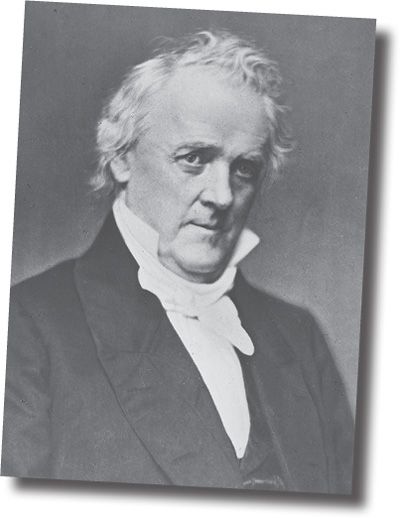
President James Buchanan.
1. Jesse D. Bright (1812–1875) and Graham Newell Fitch (1809-1892), Democrats from Indiana. Bright was later expelled from the Senate for acknowledging Jefferson Davis as the legitimate President of the Confederacy. Fitch, however, a medical doctor, went on to serve heroically as a colonel in the 46th Regiment of the Indiana Volunteer Infantry.
2. Slidell became even more famous in November 1861 when seized on the high seas en route to a diplomatic assignment representing the Confederacy (see page 124); Jefferson Davis (1808–1809) was then serving as a Democratic Senator from Mississippi.
3. John B. Floyd (1807–1863) of Virginia left the War Department toward the end of the Buchanan Administration. Though he initially opposed secession and favored the re-enforcement of Fort Sumter, he went on to serve in the Confederate army, reaching the rank of brigadier general.
ASTOUNDING TRIUMPH OF REPUBLICANISM.
ABRAHAM LINCOLN PROBABLY ELECTED PRESIDENT.
NOVEMBER 7
The canvass for the Presidency of the United States terminated last evening, in all the States of the Union, under the revised regulation of Congress, passed in 1845, and the result, by the vote of New-York, is placed beyond question at once. It elects ABRAHAM LINCOLN of Illinois; President, and HANNIBAL HAMLIN of Maine, Vice-President of the United States, for four years, from the 4th March next, directly by the People: These Republican Candidates having a clear majority of the 309 Electoral votes of the 33 States, over all three of the opposing tickets. They receive, including Mr. LINCOLN’s own State, from which the returns have not yet come, in the
|
New-England States |
41 |
|
New-York |
35 |
|
Pennsylvania |
27 |
|
New-Jersey |
7 |
|
And the Northwest |
61 |
|
Total Electoral for LINCOLN |
1711 |
Being 19 over the required majority, without wasting the returns from the two Pacific States of Oregon and California.
The election, so far as the City and State of New-York are concerned, will probably stand, hereafter as one of the most remarkable in the political contests of the country; marked, as it is, by far the heaviest popular vote ever cast in the City, and by the sweeping, and almost uniform, Republican majorities in the country.
The State of Pennsylvania, which virtually decided her preference in October, has again thrown an overwhelming majority for the Republican candidates. And New-Jersey, after a sharp contest has, as usual in nearly all the Presidential elections, taken her place on the same side. The New-England majorities run up by tens of thousands.
The Congressional elections which took place yesterday, in this State have probably confirmed the probability of an Anti-Republican preponderance in the next House of Representatives, by displacing several of the present Republican members.
The new House of Assembly for New-York will, as usual, be largely Republican.
Of the reelection of Gov. MORGAN2 there is little or no question. By the scattering vote thrown for Mr. BRADY in this City, the plurality of Mr. KELLY over Gov. MORGAN is partially reduced, while the heavy Republican majority in the country insures Gov. MORGAN’s success.
The rival Presidential candidates against Mr. LINCOLN have probably divided the Southern vote as follows:
FOR MR BELL.
|
Virginia |
15 |
|
Tennessee |
12 |
|
Kentucky |
12 |
FOR MR. BRECKINRIDGE.
|
South Carolina |
8 |
|
Florida |
3 |
|
North Carolina |
10 |
|
Mississippi |
7 |
|
Georgia |
10 |
|
Texas |
4 |
|
Alabama |
9 |
|
Arkansas |
4 |
|
DOUBTFUL. |
|
|
Missouri |
9 |
|
Delaware |
3 |
|
Louisiana |
6 |
|
Maryland |
83 |
AT THE REPUBLICAN HEAD-QUARTERS GENERAL REJOICING
The Republican rejoicings filled the City last night. They celebrated their triumph in the streets; they gathered in shouting crowds around the newspaper-offices; they inundated the Station-houses, and threw up their hats as the returns were announced; they assembled at the Head-quarters, No. 618 Broadway, in such numbers, that once wedged in one could not turn around to come out again. There Mr. DANIEL D. CONOVER took the Chair, and, with Gen. J. H. HOBART WARD and Mr. CHARLES SPENCER, received the returns, and from time to time computed the probable result. Mr. CONOVER read the figures, and every time he read the people cheered or jeered, according to the complexion of the news. The enthusiasm, which was wild, as soon as it was known how much below the estimate of the Fusionists was the result in the First Ward, increased steadily as the night wore on, and was incontinent at last. Never were there gathered together so many persons in so excellent a humor. While they were waiting for news from some Wards not yet heard from, all were talking and laughing at once; some were giving lusty cheers for LINCOLN and the whole Republican ticket; some were cracking jokes at the expense of the Opposition; those without were endeavoring to elbow their way in, and some within, half suffocated, were trying to force their way out. It was just such a hubbub of hilarity, in short, as you would expect to hear in the Republican Head-quarters on the night of the Republican victory. One, more enthusiastic, was incessantly proposing three cheers for somebody. He proposed three cheers for Gen. WARD; they were given with gusto. He proposed three more for Mr. CONOVER, and three more for Mr. SPENCER; they were given. Then he proposed “Three cheers for me.” They were not given. Then, by way of variety, he proposed three cheers for Mr. CONOVER again. Here that gentleman interposed and requested that less noise should be made, and that men would stand still; he did not know how long the floor of the room would support such a mass of enthusiastic people.
A man mounted a chair at the remote end of the room and shouted out the name of a friend, whom he said he wanted to go to a fire that was raging not far off. “There’s a fire every where,” said Mr. SPENCER, and that brought down the house — almost the floor — again. Loud as the din was during these interludes, as soon as the Chairman announced more returns, quiet was immediately restored — to be lost again amid a storm of cheers as soon as they were read. Thus, till a late hour, they kept it up at No. 618 Broadway.
At the Head-quarters of the various Republican Clubs, too, there were immense throngs. The City Wide-Awakes were at their rendezvous in force, and at Stuyvesant Institute the jam was irrepressible. The interior of the building was choked with people, the entrance was blocked up, and the sidewalk in front was black with Republicans. With the thunders of the thousands there assembled, the vicinity like the rest of the City, was kept thoroughly and wide awake.
1. Final figures gave Lincoln 180 electoral votes.
2. Edwin D. Morgan (1811–1881) was twice elected governor of New York, later serving as a major general of Union volunteers and commander of the Department of New York.
3. Three of these states ultimately fell into Breckinridge’s column, too. This table made no mention of Lincoln’s Northern Democratic opponent, Stephen A. Douglas, who finished second in the popular vote with 1,376,957 supporters, but won only 12 electoral votes (Missouri and New Jersey).
ELECTION DAY IN THE CITY.
ALL QUIET AND ORDERLY AT THE POLLS.
NOVEMBER 7
The clouds lowered gloomily over the City yesterday morning, when the polls were opened, and very shortly afterward rain began to drizzle, with every prospect of a wet day. Was it an omen, and if so, an ill omen to the Lincoln or Fusion ticket? It did not, at any rate, keep one or the other party from the polls, for never in the history of any political contest in this country, has more enthusiasm been exhibited, and the result has proved that though the “clouds” may have “lowered,” the hopes of the Republican Party were not “in the deep bosom of the ocean buried.” But of that anon and elsewhere.
People generally were awake — wide awake, in fact1 — very early yesterday, for they knew they had a duty to perform which could not occur but once in four years, and in the actual shape it assumed, perhaps not more than once in a lifetime. And whether they were Republicans or Fusionists, they went to work with a will. The clouds were dispelled; the sun shone forth as a beneficent sun should shine on such an occasion, and a general good time was the result. In short, although the stake to be played, according to the alarmists, was the continuation or severance of the Union, there was no disturbance, no discordance, no manner of ill-feeling, beyond the impatience produced by the extreme difficulty in getting in “my vote, Sir, my prerogative as an independent citizen, Sir, which I would not barter for my life, Sir.”
The vote polled in each Ward, and each District of each Ward, is said to have been the heaviest ever known in this City. At nearly every polling-place — and there were close upon three hundred in all the Wards — voters took their places en queue, and moved on very slowly to their duty as freemen. And wherever we had opportunities of observing them, they did it like men who were fully sensible of the responsibility, whether it came of conscience sake, or was derived from a recollection or a hope of “gilded gain.”
Considerable delay was caused at many polls by an indiscriminate challenging process, which occupied so much time that in nearly every Ward at sunset, when the polls closed, some hundreds of voters had not been able to “save the country,” and having given the day to that nobly patriotic purpose, they felt, very naturally, slightly irascible thereat....
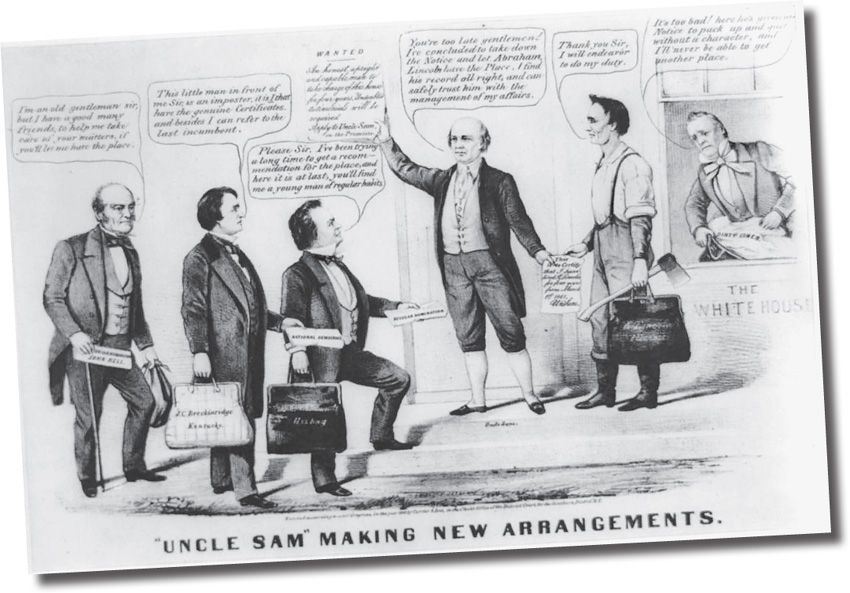
A pro-Republican 1860 presidential campaign cartoon shows the symbol of America ushering Lincoln to the White House.
1. A joking reference to the ubiquitous Wide-Awake clubs.
THE DAY AFTER ELECTION.
THE REPUBLICANS AND THEIR TRIUMPH.
NOVEMBER 8
The Republican pulse continues to beat high. Chanticleer is perched on the back of the American Eagle, and with flapping wings and a sonorous note proclaims his joy at the victory. The return of the First NAPOLEON from Elba did not create a greater excitement than the returns of the present election. All day yesterday the inquiry was in everybody’s mouth, “What’s the latest news?” Newspapers were in demand. What, with the cries of the urchins who vended them, the demonstrations of the jubilant and the groans of the wounded, the Metropolis of yesterday was to the every-day New-York as Babel to a charnel-house. Every omnibus that carried its dozen of citizens businessward in the morning was a reading room, a political meeting-house and a pseudo stock board, all in one, — e pluribus unum. Some read the papers, some fought the bloodless battle o’er again, bringing their batteries of profound argument to bear upon the proposition that they “knew LINCOLN would be elected;” and some in sarcastic mood bewailed with mock seriousness the heavy losses from depreciated stocks that were sure to follow the dire calamity of the inauguration of the chosen of a majority of the people. In the streets, in the restaurants, in offices and counting-houses — counting certain counting-houses out — such was the tenor of the talk, and the character of the occupations of all to whom a leisure moment came. There were few Fusionists to be found. There was a dearth of Democrats — a scarcity of those who professed and called themselves Bell-Everett men. Republicans everywhere seem wide awake, while “Drowsy tinklings lull the distant fold” of their bell-ringing opponents. Distant, indeed — for this side of Mason and Dixon’s line there is hardly a tintinnabulation, where but yesterday the Callithumpians seemed let loose.
We searched in vain for some one that could tell us of the feelings of the defeated. Every one declared himself a Lincoln man, or else said nothing. We visited the Custom-house and studied the triste physiognomies of the Federal office-holders.1 Some looked blue and sat shivering at their desks; but it was a cold day, — very cold, — much colder than the few that preceded it. At length passing through Nassau-street we met an acquaintance, — one whom we had heard during the campaign expressing his predilections for DOUGLAS, and his blissful anticipations of Arcadian Winters in office at Washington under the Douglas dynasty. We hailed him; he was in a great hurry and couldn’t stop, — bank just closing, — all that sort of thing. We took him by the button; that is the shot across the bows that will always bring one to. He stopped, and, after a moment’s attention to our inquiries. “My dear Sir,” he said, “I’m a Lincoln man, and always was!” We pursued our investigations in that direction no further. In all seriousness, we heard less about Disunion yesterday than we have heard any day in a month past; we heard quite as many jokes about Dry Goods and Salt River as have come to our ears within the same period; and we learned nothing that would lead us to suppose that the people of the fairly beaten parties will acquiesce now in the expressed, will of the people a whit less gracefully than the Republicans submitted when they were over-borne four years ago.
Of course, there will be demonstrations on the part of the Republicans “all the country through.” What shall be the nature of them is already a subject of discussion. The Republican State Executive Committee will meet next Tuesday — probably at Albany — and arrange the preliminaries of a grand celebration. The Chairman, Mr. SIMEON DRAPER,2 in jocose mood, observed yesterday, that for his part, he believed the best way would be to roast a large elephant somewhere in the centre of the State, and invite all the people. A bystander remarked that it would certainly be a “big thing.” The Wide-Awakes of the City will have a grand parade some day of this week or the next. Our metropolis just now is one great Rama. Lamentation is in the streets and wailing on the corners. People are weeping for their candidates and will not be comforted, because they are not. Mourners are visible in the parks, and in the “private parlors” of the hotels, and in all other public places. They go about with streaming eyes and red noses, surveying the field of battle, and bursting out with renewed grief when they recognize the features of a friend among the slain. Sometimes they become lugubriously jolly, sit down in each other’s laps, mingle their woes, clink their glasses together, and become convivial upon tears. These sad scenes are the inevitable result of all great victories. Battlefields are not pleasant for promenades on the day after a battle. The dead tell no tales, but the wounded...cry out pretty loudly. Their cries blend sadly with the shouts of the victors. It is useless to say: “They were rascals and deserved to be killed.” The conviction that they were fellow-creatures forces itself upon the most unthinking mind, and it is ever natural to sympathize with suffering humanity. A sensitive spirit would take no delight even in the agonies of an Alderman; and it is questionable whether any man, unless, indeed, he had been brutalized by several years in Congress, would feel any especial pleasure in witnessing the crucifixion of a Common Councilman. We venture to assert that even the most biased Wide-Awake is possessed of a feeling akin to sympathy, if not sorrow, as he meets a discomfited colonel, a disjointed captain, or a scattered sergeant in the late Democratic Army. And his heart would be harder than the nether millstone if he did not....
The quiet which attended the actual election on Tuesday was only a foreshadowing of the manner in which the result of that election was received yesterday. SHAKESPEARE says that man is a creature who “looks before and after.” The “after” of the election, with the “great hereafter” that was predicted by the Southern Press and Northern Fusionists, in case LINCOLN should be elected, was quite mildly treated by the parties which suffered defeat. It is to their credit that, being defeated, they bore it handsomely. Fusionist met Republican amicably at the breakfast table, — amicably in the street, amicably in the store, and, in fact, in an amicable manner, invited him to “just take a little, it won’t hurt you.”
One of our wandering reporters in a ramble around town, tried to find out some discordant element in the popular sentiment, and to that end visited the chief hotels, especially those which Southerners do most approve; also the restaurants, the public places of resort, and (but it was only as a matter of duty) the drinking saloons. Thus the New-York Hotel, the Lafarge, the Metropolitan and the St. Nicholas were approached with the very best results. Although a large number of Southern gentlemen and families were residing at each of these popular establishments, there were no symptoms of revolt, of dissatisfaction even, or of anything else than a disposition for enjoyment....
In places not so important as these large hotels, those restaurants and saloons, which (in the path of duty only) our wandering reporter visited, everything was equally quiet and congenial. Where, before election, and on the day of election, bands, of men, eight or ten strong, with tumblers in their hands, half filled with some kind of fluid, would impress, with said tumblers on the counter, and with very audible vocal accompaniment, their devotion to the “U-n-i-o-n,” there were the same men yesterday, a trifle melancholy, perhaps, “sadder but wiser,” quaffing lemonade, or ginger soda, with the very slightest dash of brandy in it, with no tap of tumbler or vocal accompaniment whatever. One thing was on some occasions, but not often, peculiar in their conduct. If, in the street, they espied a Republican friend approaching, something novel in a store window, some architectural ornament in a new building, or an examination of the sky, in anticipation of rain, would so divert their attention, that they allowed their Republican friend to pass. There was also a sheepishness in their countenances which strangely contrasted with their boastful and defiant physiognomy during the last five or six weeks.
Sometimes our Reporter encountered an officeholder — one in the Custom-house, for instance. He was an exception to the general rule of placability and pacificality. He was as ugly as a disturbed snake. Then, on the other hand, making a virtue of necessity, another would say, “Well, after all, perhaps LINCOLN’s election will be for the best — may tend to settle things generally, if he is not aggressive, and — do you think there will be a general routing out of us small office-holders?” This shadow of a man, rabid Fusionist on Tuesday, becoming a convert to bread and butter, and roast beef with gravy, devoutly wishes today that he had been a Lincolnite ever since the Chicago Convention.
Our wandering Reporter sums up his experience of yesterday in one comprehensive and satisfactory sentence: LINCOLN’s election, acknowledged gloomily and with discontent by his opponents, is, nevertheless, accepted as a fixed fact, without detriment to the Union or to the business relations with the South, but attended with unpleasant results to numerous parties who have to vacate lucrative posts to make way for new-comers.
The Bell-Everett3 Party gathered, last evening, at their rallying hall in Broadway, though with numbers much reduced, and with greatly chastened enthusiasm as compared with Tuesday night. Some two hundred persons visited the head-quarters during the evening, apparently to pick up such crumbs of comfort as the corrected returns might afford them, and to hear what might be dispensed from the rostrum. There was no formal organization of the meeting, but one of the officers introduced Mr. MORGAN, a gentleman from Tennessee. Mr. MORGAN excused himself from making any lengthy remarks, as he was suffering from a severe hoarseness, contracted by his severe labors during the last few days of the canvass. He had not closed his eyes since yesterday morning, and he had not, therefore, to open them very wide this morning to learn — as he did at a very early hour, by reference to bulletins — that they had been badly beaten. He regretted, as they all did — most deeply regretted — that they had not been victorious; but they would bear their defeat with that equanimity which a consciousness of being in the right inspired. They had now only to wait and see what would come of it, and who were responsible....
A procession of Wide-Awakes, under the lead of Alderman BRADY and Mr. VAN RIPER, visited the residences, first of JOHN KEYSER, in West Twelfth-street, and afterwards of JOHN T. SHAW, in Vandam-street, to congratulate them upon their election. Both gentlemen appeared and made pithy addresses in response to the cheers which called them out, and thanked their friends for the compliment of the visit.
An old man, giving the name of JAMES W. SLOVER, who represented that he had spent the last four weeks in electioneering for the Fusion Party presented himself at the poll of the Eighth election District of the Twenty-second Ward early on Tuesday morning and deposited his ballots without let or hindrance. In the afternoon his enthusiasm had increased to such a pitch that he tried to get in “just one more vote” for the candidates of his choice. To do this he presented himself, shortly before the polls closed, at the same place where he had voted in the morning, and his attempted fraud having been detected, he was taken into custody....
Mr. YANCEY made a speech in New-Orleans after his return from the North, in the course of which he said:
“If New-York is lost to Mr. LINCOLN, then we go into the scramble in the House. But the probabilities are that LINCOLN will get New-York. I traveled through New-York, and the Bell men were working faithfully for the Union ticket, and the Douglas men stood by with folded arms. Although I was using all the influence I possessed in favor of the Union ticket, and in favor of his getting the vote of that ticket in case it would secure the defeat of LINCOLN, yet the Douglas papers flung their Partisan arrows after me, denouncing me with the grossest calumny.
The Bell papers received me with respect, and parted with me with cordiality. The Douglas papers received me with calumny, and parted with me with lies. They used every effort to nullify whatever influence I might have excited in behalf of the Union ticket. What did this mean? It meant, perhaps, as many of our friends feared, that the Douglas party was in secret combination with LINCOLN. I fear, indeed, that this is the case. I wish to God it were not so. Yet if the Union ticket should be elected, and it could elect Mr. DOUGLAS, let its vote be given to him, not for his sake, but for the little good it might do the country.”
1. A reference to federally appointed clerks who owed their jobs to Democrats, and now likely to lose their patronage positions.
2. Simeon Draper (1804–1866) was a pro-Republican New York businessman later appointed by Lincoln to the lucrative patronage job of the Collection of Customs for the port of New York.
3. Bell’s running mate in 1860 was the distinguished Edward Everett (1794–1865), a former governor, senator, university president, minister to Great Britain, and secretary of state; he is best remembered as the orator who gave the lengthy principal address — now all but forgotten — at the dedication of the Soldiers’ National Cemetery at Gettysburg in 1863.
THE PRESIDENT ON THE CRISIS.
DECEMBER 5
The country has now the benefit of Mr. BUCHANAN’s advice on the political crisis. The Message is out, and discusses the subject at length. The document will scarcely reward the anxiety which has awaited its appearance. There are many things in it which are true, and some which are new; but its true things are not new, nor are its new things true. It is probably the most elaborate effort Mr. BUCHANAN has ever made to appear bold without taking any risks, and firm without the necessity of proving his firmness. It is possible that it may tranquillize the country, but if so, the disturbance of the public peace is much less serious than has generally been supposed.
True to his partisanship, if true to nothing else, Mr. BUCHANAN attributes the entire responsibility for existing public evils to the Northern States, — and it is they alone who are to make sacrifices of position and principle for their removal. The immediate peril, Mr. BUCHANAN says, arises not from refusals to surrender fugitive slaves, nor the exclusion of Slavery from the Territories, — but from the imminent danger of slave insurrections. There is no longer any feeling of security around the family altar; — and if this goes on much longer, the President; wisely remarks, separation will be unavoidable. We suspect the people of the South will not thank Mr. BUCHANAN for this definition of their dangers. They deny the existence of any such state of things as he describes. Their slaves were never more contented or more loyal, — and they even declare their readiness to put arms in their hands to aid in repelling anticipated inroads of barbarians from the North. The fact, moreover, that all the great slave insurrections which have ever occurred, took place before the agitation of the Slavery question commenced, would indicate some flaw in the President’s logic. With still more glaring injustice and want of truth, Mr. BUCHANAN charges the people of the North with seeking to interfere with Slavery in the Southern States, — saying that all the Slave States have ever desired is “to be let alone and permitted to manage their domestic institutions in their own way.” It may suit the President’s purposes thus to ignore the most conspicuous facts of our recent political history, — but it is scarcely becoming his position, or the character for fairness and truth which that position ought to imply.
The President is quite confident, in spite of all this, that disunion is not likely to take place just yet. The election of any man to the Presidency does not, in his judgment, afford any just cause for dissolution, nor should mere apprehensions of a contingent danger arising from his Administration, lead to such a result. The President must, from the very nature of his office, be conservative; nor is it probable in the present instance that Congress will enact any laws impairing the rights of the South in their slaves. Thus far no authority except that of the Territorial Legislature of Kansas has denied to slaveholders the right to take their “property” into the Territories, — and that Act will speedily be set aside by the action of the Supreme Court. The enactment of Personal Liberty bills by several of the States is declared to be a gross invasion of Southern rights; and the President expresses the belief that, “unless the State Legislatures repeal these unconstitutional and obnoxious enactments without unnecessary delay, it is impossible for any human power to save the Union.” We regret to find the preservation of the Union made thus absolutely dependent upon what we must consider a very remote contingency. We do not doubt the willingness of all the States concerned to abolish those laws, the moment the Fugitive Slave law shall be divested of those obnoxious and offensive features which provoked their enactment. Upon this view of the case, however, Mr. BUCHANAN does not think it worth his while to bestow the slightest attention. On the contrary, he presently recommends that, instead of being amended, the Fugitive Slave Law be incorporated into the Constitution.
Mr. BUCHANAN next comes to the great question of Secession: — and upon this subject, down to a certain point, his remarks are remarkably sound.
In the first place, he denies utterly the principle that a State has a right to withdraw from the Union at will. Such a position, he says, would render our Confederacy a mere rope of sand, — whereas it is, as he shows by a very clear and conclusive argument, a substantial Government, — perfect in all its forms, invested with all the attributes of sovereignty over the subjects to which its authority extends, and armed with force to execute its laws. The right of secession can only exist as the right of revolution.
In the next place, Mr. BUCHANAN recognizes the duty of the Executive to see to it that the laws are faithfully executed, — and “from this obligation,” he says, “he cannot be absolved by any human power.” But if it should become “impracticable” to do this, — through the “resignation of all the officers of the Government,” as it is at this moment in South Carolina, — he does not see what he can do about it. He must apply to Congress for more power. And this brings him.
In the third place, to say that he does not think Congress has any right to give him that power! He finds no authority in the Constitution for Congress to “coerce” a State into remaining in the Union. The question fairly stated, he says, is:
“Has the Constitution delegated to Congress the power to coerce a State into submission which is attempting to withdraw, or has actually withdrawn, from the Confederacy? If answered in the affirmative, it must be on the principle that the power has been conferred upon Congress to declare and to make war against a State. After much serious reflection, I have arrived at the conclusion that no such power has been delegated to Congress, or to any other department of the Federal Government.”
It seems incredible that any man holding a high official position should put forth such an argument. It is not a question of war at all, — nor is it a question between the State and the Federal Government. It is simply a question of obedience to the laws of Congress, — and the obligation rests upon the individual citizens of the State. It is their duty to obey those laws, and the State has no authority to release them from such obedience, because the Federal Constitution, and the laws made in pursuance thereof, are expressly declared by the Constitution itself to be the supreme law of the land — “anything in the Constitution or laws of any State to the contrary notwithstanding.” The Government has precisely the same power to enforce every law of Congress in South Carolina, that it has to enforce the Fugitive Slave law in Massachusetts. Mr. BUCHANAN does not invoke the war-making power in the one case — why should he in the other?...
The Message, in our judgment, is an incendiary document, and will tend still further to exasperate the sectional differences of the day. It backs up the most extravagant of the demands which have been made by the South, — indorses their menace of Disunion if those demands are not conceded, — and promises the seceding States that the power of the Federal Government shall not be used for their coercion. The entire North will be made doubly indignant by this flagrant dereliction of duty on the part of the Executive of the Nation, while the Disunionists of the South will be stimulated to fresh exertions in the work of ruin upon which they have embarked. The country has to struggle through three months more of this disgraceful imbecility and disloyalty to the Constitution.
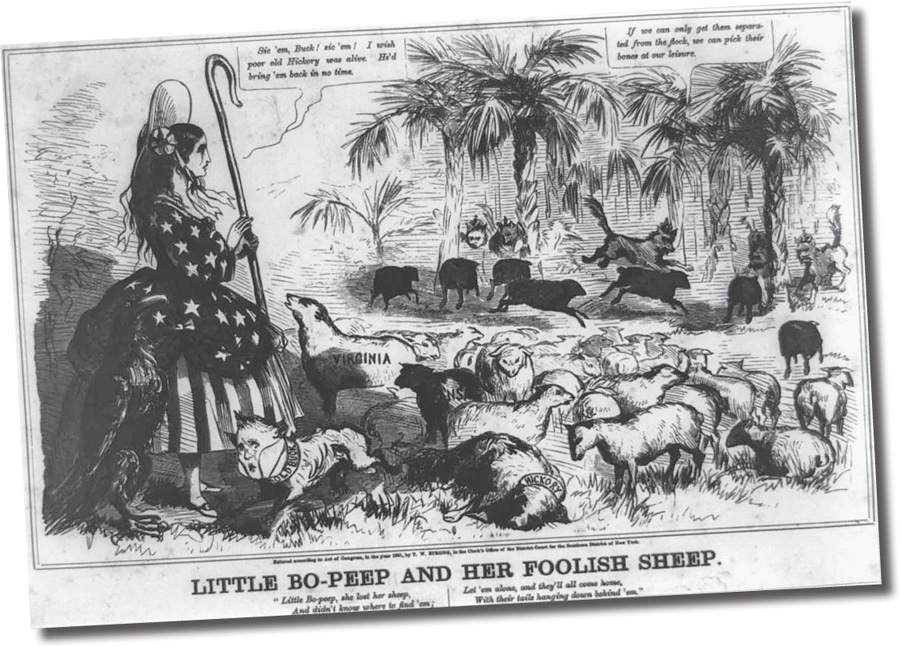
An 1861 cartoon likens the seceding states to sheep escaping the control of a shepherdess.
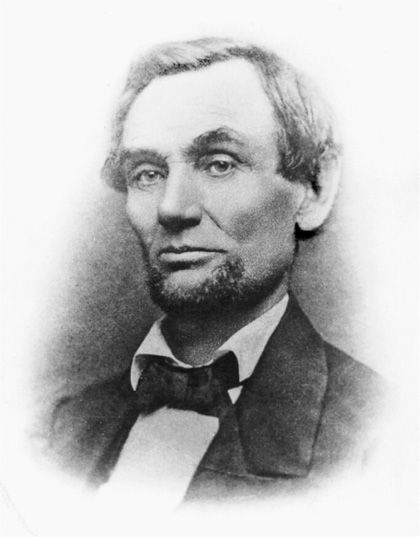
Newly bearded President-Elect Lincoln maintained official silence during the secession crisis, practicing what supporters called “masterly inactivity.”