
CHAPTER 2
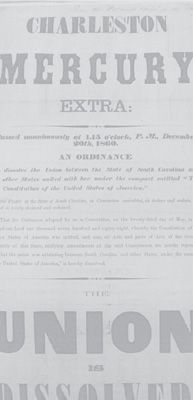
Poster announcing South Carolina’s secession from the United States.
Just seven weeks after Abraham Lincoln’s election as President — and notwithstanding his effort to avoid coercive language during and after his campaign — South Carolina seceded from the Union, the first Southern state to do so.
Lincoln’s sectionally lopsided victory had proved enough to unleash the nation-altering storm. The slave interest was immovably convinced that the so-called Black Republican threatened doom to the institution that kept three million African-Americans in chains.
The New York Times was on the scene at the Charleston secession convention to report on both the unanimous vote and the wild celebrations that erupted thereafter on the city’s streets. Yet, in a hopeful editorial, the paper clung to the belief that the move was but an isolated expression of fire-eating radicalism, and that Georgia, scheduled to consider secession next, would never follow South Carolina’s lead. In this hope, the paper and many others, including President-Elect Lincoln himself, proved far too optimistic. Southern unionism was fast evaporating.
Lincoln, still at home in distant Springfield, Illinois, and adamantly rejecting suggestions that he speak out to conciliate the South lest he appear to be begging for the right to be inaugurated, remained silent. He continued, however, to make himself available to journalists for the remainder of the four-month-long interregnum that Henry Adams dubbed “the secession winter.” While it did not send a correspondent west to report from Springfield, The Times did reprint reports on his activities from other newspapers — a common practice in that time. Editorially, the paper continued to stress and praise Lincoln’s moderation.
When the train transporting the President-Elect to Washington for his swearing-in reached New York State in mid-February, following stops in Illinois, Indiana, and Ohio, The Times began covering the inaugural journey in depth. Along with other journalists, Times reporter Joseph Howard traveled along with the presidential party. Under the recurring headline, “The Incoming Administrations,” readers were treated to exhaustive, and often amusing, accounts of Lincoln’s informal, though not particularly reassuring, chats at successive railroad depots, as he moved west from Buffalo to Albany. After delivering a major address to the state legislature, Lincoln and his party steamed south to New York City, where he elicited frosty greetings from the city’s Democratic mayor and merchants worried over the prospect of losing profitable commercial ties to the South. By now, six more states had decided to join South Carolina and form a government of their own.
For a time, the newspaper continued to express confidence in the President-Elect, reminding readers that Lincoln had made admirably conciliatory gestures to the South during his preinaugural speeches. But a sense of alarm soon began creeping into its coverage, particularly after Lincoln evaded hostile Baltimore en route to Washington — completing the final leg of his long journey secretly, by night, and, as a Times reporter inaccurately claimed (perhaps angry at being left behind), wearing a disguise. Now The Times began clamoring for Lincoln to unveil his policy plans even before his Inaugural Address. The President-Elect remained unmoved. Though he continued to appear publicly at the Willard Hotel in Washington, and even met with Northern and Southern delegates to a “Peace Convention” that was meeting under the same roof to craft a compromise to head off Civil War, he remained vexingly — some claimed stubbornly — quiet on how he intended to confront what even The New York Times was now calling a “crisis.”
Nor did the paper flinch from reporting a portentous irony: the concurrent inaugural journey of another American “president.” Jefferson Davis was sworn in February 18 as chief executive of the new Southern Confederacy, prompting William L. Yancey to exult: “The man and the hour have met.” The Times reprinted Davis’s long inaugural speech in full, but pointed out that his words seemed as bellicose as Lincoln’s had been pacific, a bad omen indeed for any prospects for reunion and peace.
The Times proved right. That there were now two separate American governments, facing the long-dreaded prospect of a war over slavery and union, was beyond question.
THE DISUNION CRISIS.
THE FORMAL SECESSION OF SOUTH CAROLINA.
DECEMBER 21
CHARLESTON, THURSDAY, DEC. 20
… The chair announced the appointment of the Committee to draft a summary of the cause of the Secession of South Carolina; also of four standing Committees.
Mr. RHETT’s1 resolutions to appoint a Committee of Thirteen for the purpose of providing for the assemblage of a Convention of the seceding States, and to form a Constitution, was adopted.
Mr. INGLIS2 made a report from the Committee to prepare and draft an ordinance proper to be adopted by the Convention.
An Ordinance to Dissolve the Union between the State of South Carolina and other States united with her under the compact entitled the Constitution of the United States of America:
We, the people of the State of South Carolina, in Convention assembled, do declare and ordain, and it is hereby declared and ordained, that the ordinance adopted by us in Convention, on the 22d day of May, in the year of our Lord 1788, whereby the Constitution of the United States of America was ratified, and also all Acts and parts of Acts of the General Assembly of this State ratifying the amendments of the said Constitution are hereby repealed, and that the union now subsisting between South Carolina and other States under the name of the United States of America is hereby dissolved.
The ordinance was taken up and passed by a unanimous vote of 169 members at 1 1/4 o’clock.
As soon as its passage was known without the doors of the Convention, it rapidly spread on the street, a crowd collected, and there was immense cheering....
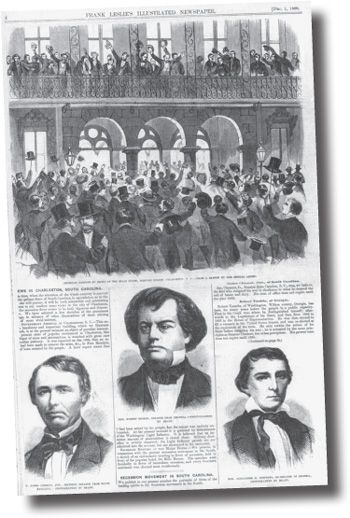
A page from Frank Leslie’s Illustrated Newspaper showing the secession meeting at Mills House in Charleston, South Carolina. The portraits at the bottom are, from left: Senator James Chesnut Jr. of South Carolina, Senator Robert Toombs of Georgia, and Senator Alexander H. Stephens of Georgia.
1. Robert Barnwell [Smith] Rhett Sr. (1800–1876), former congressman and senator, was a leading South Carolina secessionist and father of the editor of The Charleston Mercury.
2. John A. Inglis (1813–1879) was a Maryland-born politician, jurist, and educator.
THE SECESSION MOVEMENT.
DECEMBER 21
South Carolina passed the ordinance of secession yesterday at 1 o’clock P.M., by the unanimous vote of the Convention; and her action was greeted with a salvo of a hundred guns. As this step was universally anticipated, it will create no special uneasiness. It does not change the relations of South Carolina to the Union in the slightest degree, though it will very possibly be followed by acts that will have that effect. It is not easy to see how she can avoid refusing to pay duties at once, as her continuance in paying, upon her own theory, becomes now an act of gratuitous subjection and tribute to a foreign State. Meantime in other States, and especially in Georgia, the movement is becoming more considerate and dignified, if not less decided. The Cooperationists1 seem to have a majority in the Convention, and they may possibly decide not to imitate the hasty and separate action of South Carolina, but to await the cooperation of the other Southern or at least the Cotton-growing States. In various part of the South, moreover, conservative sentiments are beginning to assert themselves. There is no longer that dead monotony of Disunionism which marked the earlier stages of the movement. Very able men in nearly all the States have made very able arguments against rash and injudicious action, and have counseled a resolute attempt to obtain a redress of wrongs within the Union, before absolutely going out of it.
These things naturally encourage the hope of a better result than we have apprehended hitherto. It is thought that time will be gained at all events, and this is a matter of importance.
It will not do, however, to yield too far to these anticipations. Whatever the movement has lost in recklessness and haste, it may have gained in steadiness and strength. There is thus far no Union Party in the South; the only divisions are upon minor points. Some are for seceding now, while others would wait for the cooperation of other States. Some would secede without condition, while others would remain in the Union if their demands should be conceded. What those demands will be we can, of course, conjecture; — and we are bound to add that we see very little prospect that they will be granted.
If the South were in a mood to discuss the subject with candor and fairness, — if they were “open to conviction,” or willing even to have their palpable mistakes in matters of fact corrected, we should have little fear of the result. But it is not so, — nor do we see any immediate prospect of their becoming so.
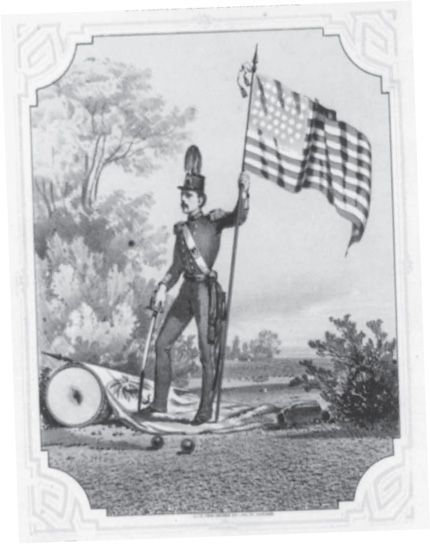
An 1861 sheet music cover illustrates the Union song “Down with the Traitors’ Serpent Flag.”
1. Delegates to the Peace Convention committed to compromise to prevent secession, even if it meant extending slavery westward and prolonging and protecting its existence indefinitely.
MR. LINCOLN AND NEGRO EQUALITY.
JANUARY 14
We copied some days since from the Albany Atlas and Argus, an extract of a speech said to have been made by Mr. LINCOLN in 1858, in which he denounced those States which withheld from the negro the right of suffrage. We proved that the extract must be a forgery, unless Mr. LINCOLN had directly and distinctly contradicted himself — for we quoted from his speeches the most explicit declarations which language could frame, of hostility to the admission of negroes to the right of suffrage.
The Atlas and Argus has investigated the matter, and arrives at the same conclusion. It states that the extract was from the Nashville Union and American — and that the language attributed to Mr. LINCOLN was really used by Gov. CHASE. It says:
“The speech referred to was made about Sept. 16, 1856, at a banquet at Chicago, and is reported in the Illinois Journal of that date....
And they were uttered, it is now said, by Gov. CHASE. This may or may not be so. One thing, however, we consider certain: — they could not have been uttered by him on the same occasion as the one on which Mr. LINCOLN spoke, because we know that Gov. CHASE and Mr. LINCOLN have never met, — or had not, up to the date of the last election....
We regard this matter of the alleged speech of LINCOLN as one of considerable importance. It was circulated as genuine throughout the South during the late canvas, — and did very much towards laying the foundation for that utter and complete misapprehension of his sentiments, which is the main cause of our present sectional dissensions. Now that it is known to be a forgery, the Atlas and Argus owes it to its political friends at the South to proclaim that fact distinctly, instead of striving to convey the impression that Mr. LINCOLN actually holds these opinions, in spite of his own disclaimers.1
1. In responding to this charge himself, but in the third person, Lincoln had told New York Times editor Henry J. Raymond on December 18, 1860: “Mr. Lincoln is not pledged to the ultimate extinctinction [sic] of slavery; does not hold the black man to be the equal of the white, unqualifiedly....”
ANOTHER INTERVIEW WITH MR. LINCOLN.
JANUARY 14
A correspondent of the Missouri Democrat gives the following particulars of a visit to Mr. LINCOLN:
“We found Mr. LINCOLN in his parlor surrounded by some six or eight gentlemen, who all proved to be temporary visitors like ourselves. Mr. LINCOLN met us with a frank welcome, shaking hands with us, and at once by his words and his manner, making us feel that our call was no intrusion; and on his invitation, we were soon seated with the circle of gentlemen who occupied his parlor. The subject of conversation was politics, and Mr. LINCOLN expressed himself upon every topic which was brought up with entire freedom. He said, at one period in the conversation, ‘he hoped gentlemen would bear in mind that he was not speaking as President, or for the President, but only exercising the privilege of talking which belonged to him in common with private citizens.’ I chose rather to be a listener than a talker, and paid careful attention both to Mr. LINCOLN’s matter and manner, and although he seemed to talk without regard to the fact of his being the President elect, yet it was discoverable that he chose his words and framed his sentences with deliberation, and with a discretion becoming his high position.
He was asked, ‘Do you think the Missouri Compromise line ought to be restored?’1 He replied that although the recent Presidential election was a verdict of the people in favor of freedom upon all the Territories, yet personally he would be willing, for the sake of the Union, to divide the Territory we now own by that line, if in the judgment of the nation it would save the Union and restore harmony. But whether the acquisition of Territory hereafter would not reopen the question and renew the strife, was a question to be thought of and in some way provided against.
He had been inquired of whether he intended to recommend the repeal of the anti-Fugitive Slave laws of the States?2 He replied that he had never read one of them, but that if they were of the character ascribed to them by Southern men, they certainly ought to be repealed. Whether as President of the United States he ought to interfere with State legislation by Presidential recommendation, required more thought than he had yet given the subject. He had also been asked if he intended to interfere or recommend an interference with Slavery or the right of holding slaves in the dock yards and arsenals of the United States? His reply was. ‘Indeed, Sir, the subject has not entered my mind.’ He was inquired of whether he intended to recommend the abolition of Slavery in the District of Columbia? to which he replied, ‘Upon my word I have not given the subject a thought.’3 A gentleman present said to him, ‘Well, Mr. LINCOLN, suppose these difficulties should not be settled before you are inaugurated, what will you do?’ He replied with a smile, ‘Well, I suppose I will have to run the machine as I find it.’
In speaking on the subject of a compromise, he said: ‘It was some times better for a man to pay a debt he did not owe, or to lose a demand which was a just one, than to go to law about it; but then, in compromising our difficulties, he would regret to see the victors put in the attitude of the vanquished, and the vanquished in the place of the victors.’ He would not contribute to any such compromise as that.
It was discernible in the course of Mr. L.’s conversation that he duly appreciates the difficulties which threaten his incoming Administration; also, that he regarded himself as grossly misrepresented and misunderstood at the South; nor did he conceal what was manifestly an invincible conviction of his honest and intelligent mind, that if the South would only give him a fair trial, they would find their constitutional rights as safe under his Administration as they had ever been under the Administration of any President.”
1. Senate and House committees were then considering offering a compromise that would include reviving the old Missouri Compromise line, and extending it to the Pacific.
2. Also called Personal Liberty Laws, these state statutes declared the national Fugitive Slave law invalid within their borders.
3. In fact, years earlier, during his one term in the U.S. House of Representatives, Lincoln had cosponsored a Congressional resolution to bar slavery in the District of Columbia.
INAUGURATION OF JEFFERSON DAVIS AS PRESIDENT OF THE SOUTHERN CONFEDERACY.
HIS INAUGURAL ADDRESS.
FEBRUARY 19
The Inaugural ceremonies, to-day [February 18], were the grandest pageant ever witnessed in the South. There was an immense crowd on Capital Hill, consisting of a great array of the beauty, military and citizens of the different States....
MR. DAVIS’ INAGURAL ADDRESS:
Called to the difficult and responsible station of Chief Executive of the Provisional Government which you have instituted, I approach the discharge of the duties assigned me with an humble distrust of my abilities, but with a sustaining confidence in the wisdom of those who are to guide and aid me in the administration of public affairs, and an abiding faith in the virtue and patriotism of the people. Looking forward to the speedy establishment of a permanent Government to take the place of this, and which, by its greater moral and physical power, will be better able to combat with the many difficulties which arise from the conflicting interests of separate nations, I enter upon the duties of the office to which I have been chosen with the hope, that the beginning of our career as a Confederacy may not be obstructed by hostile opposition to our enjoyment of the separate existence and independence which we have asserted, and which, with the blessing of Providence, we intend to maintain. Our present condition, achieved in a manner unprecedented in the history of nations, illustrates the American idea that governments rest upon the consent of the governed, and that it is the right for the people to alter and abolish governments whenever they become destructive to the ends for which they were established. The declared compact of the Union from which we have withdrawn was to establish justice, insure domestic tranquillity, provide for the common defence, promote the general welfare, and secure the blessings of liberty to ourselves and our posterity, and when in the judgment of the Sovereign States now composing this Confederacy, it has been perverted from the purposes for which it was ordained, and ceased to answer the ends for which it was established, a peaceful appeal to the ballot-box declared that so far as they were concerned the Government created by that compact should cease to exist. In this they merely asserted the right which the Declaration of Independence of 1776 defined to be inalienable. Of the time and occasion of its exercise, they as sovereigns, were the final judges, each for itself. The impartial, enlightened verdict of mankind will vindicate the rectitude of our conduct, and He who knows the hearts of men will judge of the sincerity with which we labored to preserve the Government of our fathers in its spirit....
As a necessity, not a choice, we have resorted to the remedy of separation, and henceforth our energies must be directed to the conduct of our own affairs and the perpetuity of the Confederacy which we have formed. If a just perception of mutual interest shall permit us peaceably to pursue our separate political career, my most earnest desire will have been fulfilled. But if this be denied us, and the integrity of our territory and jurisdiction be assailed, it will but remain for us with firm resolve to appeal to arms, and invoke the blessing of Providence on a just cause....
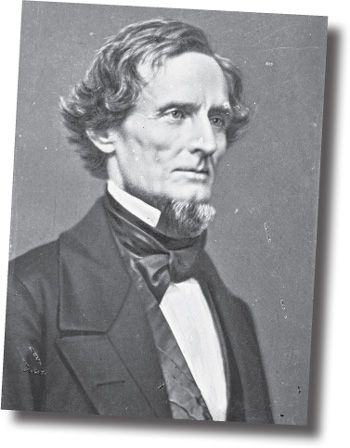
Jefferson Davis, the first and only President of the Confederate States of America.
THE INCOMING ADMINISTRATION.
PROGRESS OF THE PRESIDENT ELECT TOWARDS WASHINGTON.
FEBRUARY 19
SPECIAL DISPATCH TO THE NEW-YORK TIMES.
ALBANY, MONDAY, FEB. 18.
The Presidential party were awakened at the early and inconvenient hour of 4 1/2 o’clock this morning. Mr. LINCOLN’s general health is good, but the hoarseness of his voice and soreness of his chest do not seem to have been improved by his exertions in Buffalo. The almost entire monopoly of his time by Ex-President [Millard] FILLMORE in Buffalo was by no means objected to by the Republicans of the city. Mr. LINCOLN’s ground, most firmly taken, is that he is to be the President of the AMERICAN PEOPLE and not of the Republican Party. Hence he meets and desires to be with men of all parties, and Mr. FILLMORE, though not sympathizing with the principles of the Chicago Platform, is, nevertheless, the leading citizen of the city, and represents the Union-loving sentiment of the place. Therefore, the cordial welcome given by him to Mr. LINCOLN was eminently gratifying. The first 37 miles were made in 30 minutes.
At Batavia, gray as was the light and deep as was the snow, there was a very large gathering of people, who saluted Mr. LINCOLN with cheers and with the firing of cannon. Of course they wanted to hear him speak, but to their calls he replied that he did not appear before them or the country as a talker, nor did be desire to obtain a reputation as such. He thanked them for the kind attention manifested by their rising at so inconvenient an hour, and bade them farewell amidst a burst of genuine enthusiasm. Hardly had the train commenced its career again, when a smell as of burning wood and oil filled the cars, and it was ascertained that one of the journals was heated red. The applying of a proper remedy, however, occupied but a few moments, and all was as it should be. At Rochester, an assemblage estimated by the Mayor to number 30,000 people, thronged the avenues adjoining the depot....
The scene presented by so vast a crowd was truly magnificent, causing Mr. LINCOLN to recall, as he observed to the Mayor, his old campaigning days. The number of ladies present was very great, and from a very fair young source was presented a floral testimonial of regard for which any one would be grateful — President or citizen ….
The Democratic element was well represented by a magnificent locomotive, named Dean Richmond,1 which drew oddly enough the Presidential cortege from Buffalo to Rochester. This fact created a great deal of amusement among the party, and was productive of much good-natured raillery at the expense of the Republican Party....
The next stoppage was at Clyde, a town of some 3,000 inhabitants. They were all at the station, and brimfull of enthusiasm for the man of their choice. Stepping upon the platform, Mr. LINCOLN said:
“LADIES AND GENTLEMEN: I merely appear before you to say good morning and farewell. I have no time to speak in, and no speech if I had.” At this, Mr. PAINE, editor of the local paper, approached Mr. LINCOLN, and said that he had been deputed by the assemblage to shake him by the hand — which shake he would distribute in his next morning’s edition. An enterprising artist had placed upon a convenient wood-pile a camera with which he secured pictures of the rear end of the car, of Mr. LINCOLN, Mr. WOOD,2 a brakeman, and an unlucky reporter....
The announcement was made by telegraph that a very large crowd was waiting for him at Syracuse, who were determined to have a speech. The managers of the train seemed to be in the conspiracy, for the speed was greatly accelerated so as to reach the station several minutes ahead of time.
It was evident, on arrival at the depot, that the report had in no way exaggerated the excitement or the numbers of the crowd. At the intersection of the street with the track, was erected a nicely carpeted platform, on which were the Committee, Rev. Mr. WALDO, and a bald-headed eagle. The immensity of the gathering was equaled only by its absolute order and good behavior. Mr. LINCOLN was urged to go upon the platform, but having declined doing so elsewhere, he felt it his duty to treat all alike, and, therefore, did not go.
Having been welcomed in a rather extended, but cordial speech, by the Mayor, Mr. LINCOLN addressed the assemblage as follows:
LADIES AND GENTLEMEN: I see you have erected a very fine and handsome platform here for me, and I presume you expected me to speak from it. If I should go upon it you would imagine that I was about to deliver you a much longer speech than I am. I wish you to understand that I mean no discourtesy to you by thus declining. I intend discourtesy to no one. But I wish you to understand that though I am unwilling to go upon this platform, you are not at liberty to draw any inferences concerning any other platform with which my name has been or is connected. [Laughter and applause.] I wish you a long life and prosperity individually, and pray that with the perpetuity of those institutions under which we have all so long lived and prospered, our happiness may be secured, our future made brilliant, and the glorious destiny of our country established forever. I bid you a kind farewell.
Rev. Mr. WALDO, who is so infirm as to be scarcely able to totter, but who, nevertheless, voted for WASHINGTON and LINCOLN, was taken from the staging and brought upon the platform of the car, where he shook hands with Mr. LINCOLN, and came very near being pushed off the car by the crowd of people....
At Utica quite a large amount of business was transacted. On a freight-car had been elevated a large platform, the whole of which was rolled up to the rear of Mr. LINCOLN’s car. The entire Legislative Committee were on it, and expected to be introduced to Mr. LINCOLN when he should make his appearance, but Mr. WOOD peremptorily forbade it, saying that the time allotted to the citizens of Utica should not be used by the State. There was a tremendous shout when Mr. LINCOLN appeared, and in spite of a heavy fall of snow, the crowd augmented continually, until, as far as the eye could reach, could be seen a pushing, restless tide of humanity, with thousands of faces turned upward toward the future ruler of the nation....
During the entire trip Mr. LINCOLN has worn a shocking bad hat, and a very thin old over-coat. Shortly after leaving Utica, Mrs. LINCOLN gave an order to WILLIAM, the colored servant, and presently he passed through the car with a handsome broadcloth over-coat upon his arm and a new hat-box in his hand. Since then Mr. LINCOLN has looked fifty per cent. better, and if Mrs. LINCOLN’s advice is always as near right as it was in this instance, the country may congratulate itself upon the fact that its President elect is a man who does not reject, even in important matters, the advice and counsel of his wife.
To-morrow morning the party will go to Troy, and from thence to New-York. The following is an accurate list of the party proper:
Hon. A. LINCOLN. Mrs. LINCOLN and two children, servant and nurse. ROBERT T. LINCOLN. LOCKWOOD TODD, cousin of Mr. L. Dr. W.S. WALLACE, brother of Mrs. L. JOHN G. NICOLAY, Private Secretary. JOHN M. HAY, Assistant Secretary. Hon. N[orman].B. JUDD, of Illinois. Hon. DAVID DAVIS, of Illinois. Col. E[dwin].V[ose]. SUMNER, U.S.A. Major D[avid]. HUNTER, U.S.A. Capt. GEORGE W. HAZZARD, U.S.A. Capt. JOHN POPE, U.S.A. Col. E[phraim].E[lmer]. ELLSWORTH, of New-York. Col. WARD H. LAMON, of Illinois. J. M. BURGESS, of Wisconsin. GEO. C. LATHAM. W.S. WOOD, General Superintendent. B. FORBES, Assistant. Besides whom are the correspondents of the NEW YORK TIMES, Herald, Tribune and World; of the Chicago Tribune, and of Frank Leslie’s Newspaper. A telegraphic operator and the agent of the Associated Press are also of the regular number.
Mr. and Mrs. LINCOLN are highly gratified at the report that apartments are engaged at the Astor House [in New York City] — that being the hotel where personally they feel most at home, and where their friends can have the double pleasure of entertaining them, and benefiting an establishment which stands up for the Union....
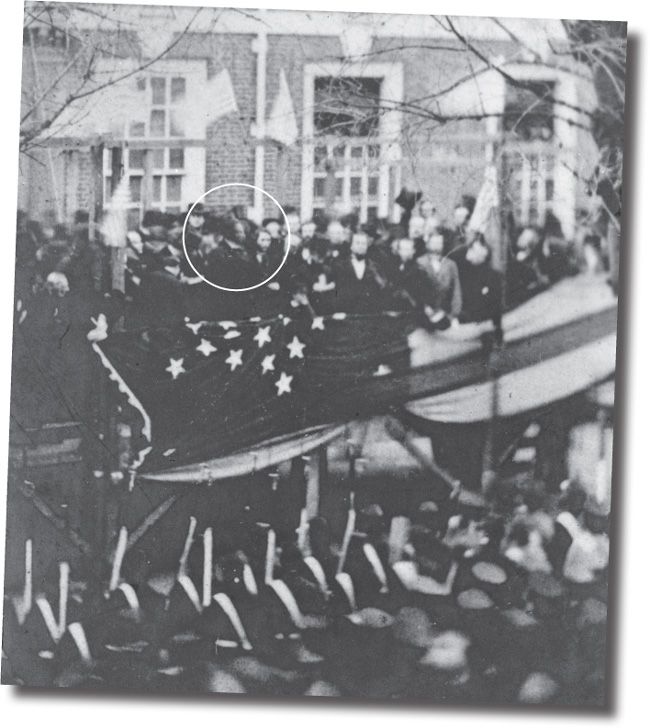
A photograph taken of Abraham Lincoln waiting to help raise the flag outside Independence Hall in Philadelphia on February 22, 1861, during his inaugural tour.
1. Named for Dean Richmond (1804–1866), president of the New York Central Railroad. He was one of the men held responsible for breaking up the Democratic National Convention at Charleston in 1860 by voting that two-thirds of the delegates were needed to select a candidate. His goal was to nominate Horatio Seymour of New York.
2. William D. Wood, of whom little is known, was a railroad man whom Lincoln had named, probably at the suggestion of Albany Republican boss Thurlow Weed, as superintendent of the Lincoln inaugural journey.
THE INAUGURAL OF PRESIDENT DAVIS.
FEBRUARY 19
The last act in the constitution of the Southern American Confederacy was achieved yesterday, by the inauguration of Gen. DAVIS in the Presidential office. The address of the new Chief Magistrate will be found at length elsewhere in this paper. It will be read with profound attention. It is natural, indeed, that the public should hang with intense interest on the utterances of those who are to wield the power and represent the dignities and honors of the State. This interest is heightened, if possible, when the occasion is an era — the severance of old relations or the commencement of a new career. Declarations, at such a time, are taken as the enunciation of the policy, or life, of the new order of things. That of the new Republic, its President tells us, is to be peace in its internal organization, from the homogeneity of its industries and interests. Nothing is to be feared from abroad; because, if war should come, the Southern people must again assert the principles for which their fathers bled in the Revolution. He tells us that the Southern Confederacy will have no complications. Its separation from the old Union is complete. No compromise, no reconstruction can now be entertained.
This speech does not convey much comfort to the Northern sympathizers with the Southern President, nor to the public. For ourselves, we place no very unfavorable construction upon it. If Mr. DAVIS be a man of common judgment or observation he is playing a part not very difficult to be understood. If, on the other hand, he is entirely sincere, then he certainly fails to comprehend the subject on which he speaks. There is a greater want of homogeneity in the Southern States than in almost any other people that can be named. The turning-point of secession is protection to Slavery. Not one-sixth of the people in the South own slaves. When they come to assume the expenditures necessary to be incurred for its maintenance, radical differences will arise. One-half of the area of the whole Southern States is better adapted to Free than Slave labor, and is rapidly becoming the theatre where Free-labor only is used. There is another cause of radical difference, as intense as that which is made the occasion of secession. These differences are to be confronted the moment secession assumes the offensive....
On the whole, we accept Mr. DAVIS’ address to be, as most addresses on similar occasions are, nothing more or less than a bit of Southern extravagance, required perhaps by the audience and the occasion. In a speech delivered a few days ago, on his way to the Convention, he tells us that if there are to be hostilities, they must be on the enemy’s soil. This is something of a boast for a people who cannot feed, equip or clothe a regiment without obtaining every article required at the North. We are a nation dealing in hyperbole; but this trait is always more pronounced under a hot than a tempered sun. In genuine gasconade, the people of the extreme South are every way a match for Mexicans. Extravagance of assertions is always in ratio to impotence and execution. So long as the Confederate States cannot build a ship, construct a gun, nor manufacture a pound of gunpowder; can neither clothe nor feed themselves; nor levy war upon us unless we furnish the munitions, fill their commissariat and supply the means of locomotion, we may quietly pursue our avocations. Their internal affairs we do not at present propose to meddle with. We want their trade, and we do not wish to disturb our own, and waste our means at the same time.
There is a very noticeable feature in Mr. DAVIS’ speeches, contrasted with those of Mr. LINCOLN. Mr. DAVIS’ first idea is to fight; “to baptize his principles in blood.” This thought, ever uppermost in the Southern mind, indicates the character of its civilization. Mr. DAVIS, at bay, shows his teeth, and tells us to come on, if we dare. He talks of fighting with entire impunity, and without a breath of censure, North or South. Mr. LINCOLN, at Indianapolis, expressed himself decidedly against coercion, but mildly inquired whether the Government might not proceed to execute the revenue laws. For this a torrent of execration was showered upon him. There is something very curious in the reception which these two men meet with. The President elect, bound by his oath to execute the laws, must not hint at such a proceeding; while entire tolerance is extended to the threats of resistance by parties who are in open rebellion. We would like to have some person cunning in such matters, solve this apparent contradiction.
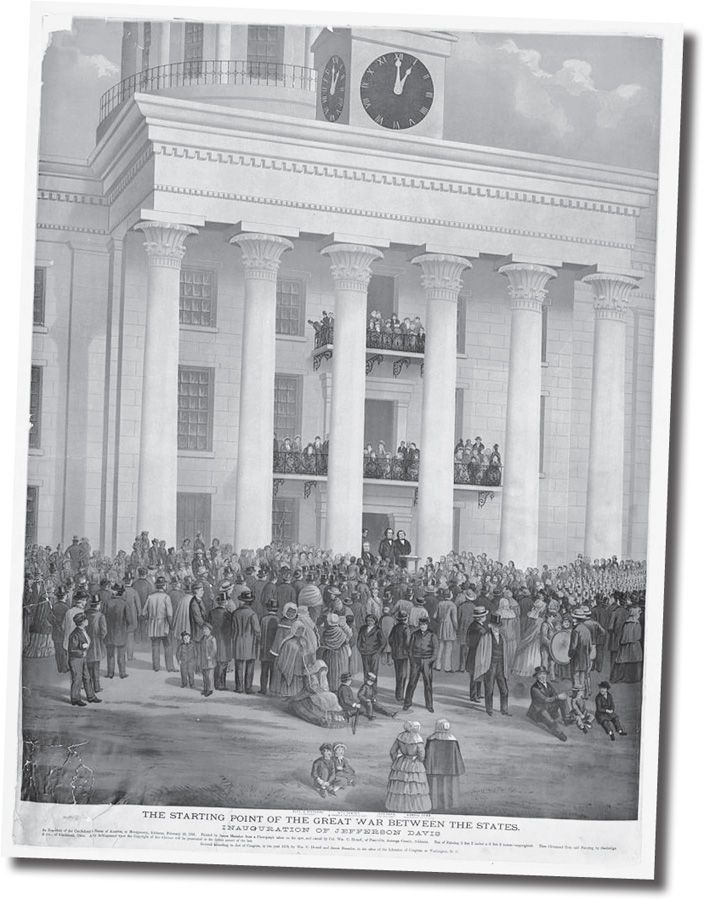
A postwar lithograph of the Montgomery, Alabama inauguration of Jefferson Davis as President of the Confederacy.
PRESIDENT LINCOLN AND THE CRISIS.
FEBRUARY 20
Mr. LINCOLN’s arrival at Washington is awaited with, eagerness and anxiety. His presence there has become a necessity, — not only to the success of judicious efforts for preserving the Union, but to the peace and harmony of the party which is responsible for the administration of the Government. The Peace Convention is making but little substantial progress. It will have great difficulty in reaching any harmonious conclusion, and still greater in securing for its action, the approval or even the serious attention of Congress. The fact, upon which we have so often insisted, — that the whole responsibility of meeting the crisis devolves upon the incoming Administration, seems now to be gradually recognized: and all parties, and all men, who desire the preservation of the Union, are looking forward with eager anticipation to the day when the policy of that Administration shall be disclosed.
Another fact is becoming painfully prominent — namely, that this policy will depend mainly on the President himself. The Republican Party, as such, has no policy for the crisis, — no settled plan upon which all are united, for carrying the country through the very serious perils which now surround it. Not that its members are indisposed to adopt some plan which shall be at once just and effectual, — nor that they underrate the serious character of the emergency and the necessity of wise and resolute action. With the exception of a small number, who are far more Abolitionists than Republicans, and who look forward to disunion with far more of complacency than of apprehension, the great body of the Republicans in Congress and out of it, are profoundly and sincerely solicitous for some honorable and safe mode of adjusting the sectional differences which threaten our country with the most serious disaster that can befall it. But the great difficulty in the case is the lack of a leader. Mr. LINCOLN has given no indication of the policy which he considers essential, and which he would desire to have adopted. His silence on this subject is unquestionably creditable to his prudence and his modesty, — but it has not been without its embarrassments. It has left the field open for a struggle of factions, and of personal aims at ascendancy, which have largely contributed to the demoralization of the party, and which, unless promptly arrested, must lead to its division and downfall. It has encouraged the vehement attempts which we daily witness to coerce Mr. LINCOLN into a specific and extreme policy, — by waging war upon every man of more moderate councils, by keeping before the public alleged declarations of Mr. LINCOLN, wholly unofficial and even private in their character, by which he is nevertheless to be required to guide his official conduct, and by brandishing over his head the pains and penalties which will follow his departure from the rigid line of policy thus marked out for him; and it has given special scope and opportunity for personal resentments and disappointments to clothe themselves in the garb of political principle and use the patriotism and loyalty of the country as the instruments of their revenge....
We have full faith in the disposition and ability of Mr. LINCOLN to meet the tremendous responsibility which rests upon him. We have no fear that he will either be seduced into fatal concessions of principle, or coerced into a reckless trifling with dangers which are none the less real because they are unreasonable, and which it is his duty to avert, although he is in no degree responsible for their existence. It can never be a matter of indifference, or of secondary moment, to him, whether the Union is destroyed or not, — nor is it possible for him, or for any one in his position, to attach more weight to the mere clamor of selfish and malignant partisans, than to the voice of the country which relies on him for deliverance from the dangers which threaten its existence. But, in common with all who look with concern upon the disturbed state of the country, we are looking forward with eager impatience to the time when he can indicate the policy which, in his judgment, the emergencies of the country require.
MR. LINCOLN IN NEW-YORK.
FEBRUARY 21
Yesterday morning Mr. LINCOLN breakfasted, by invitation of MOSES H. GRIN-NELL, Esq., together with a number of representatives of the mercantile wealth of the Metropolis. The party included Messrs. ASPINWALL, MINTURN, Capt. MARSHALL, W.M. EVARTS, Mr. WEBB, Ex-Gov. FISH, Mr. TILESTON, and other gentlemen of equal note.1
After returning to his hotel, Mr. LINCOLN was called upon by a veteran voter of 94 years of age, who has voted at every Presidential Election, and cast his last ballot for “Honest Abe.” The interview was pleasing to both parties.
The morning, up to 11 o’clock, was agreeably occupied in receiving the various distinguished gentlemen who called, and at the hour named the Common Council Committee, headed by Alderman CORNELL, made their appearance to escort the President to the Municipal head-quarters. Two carriages were provided for the Presidential party, who were forthwith hurried through the gaping crowd, amid the most enthusiastic cheering, to the entrance to the City Hall, whence, through the excellence of the Police arrangements of Mr. KENNEDY, an unobstructed passage was afforded to the Governor’s Room. The scene on the line of march was but a repetition of that which has characterized Mr. LINCOLN’S every appearance since the commencement of his present journey — only intensified up to the New-York standard.
Meanwhile Mayor WOOD, the Common Council and members of the Press, had been admitted to the Governor’s Room,2 and were eagerly awaiting the arrival which was at length announced by the shouts of the crowd on the stairs, reverberating through the building like a miniature thunder storm.
Escorted by Alderman CORNELL, Mr. LINCOLN entered, hat in hand, and advanced to where Mayor WOOD was posted, behind WASHINGTON’S writing desk, and immediately in front of Gov. SEWARD’S portrait. The bustle of the Aldermanic and Councilmanic rush for good places having in a measure subsided, Mayor WOOD, in a voice that seemed for moment slightly tremulous, spoke as follows:
Mr. LINCOLN: As Mayor of New-York, it becomes my duty to extend to you an official welcome in behalf of the Corporation. In doing so, permit me to say, that this City has never offered hospitality to a man clothed with more exalted powers, or resting under graver responsibilities, than these which circumstances have devolved upon you. Coming into office with a dismembered Government to reconstruct, and a disconnected and hostile people to reconcile, it will require a high patriotism, and an elevated comprehension of the whole country and its varied interests, opinions and prejudices, to so conduct public affairs as to bring it back again to its former harmonious, consolidated and prosperous condition.
If I refer to this topic, Sir, it is because New-York is deeply interested. The present political divisions have sorely afflicted her people. All her material interests are paralyzed. Her commercial greatness is endangered. She is the child of the American Union. She has grown up under its maternal care, and been fostered by its paternal bounty, and we fear that if the Union dies, the present supremacy of New-York may perish with it. To you, therefore, chosen under the forms of the Constitution as the head of the Confederacy, we look for a restoration of fraternal relations between the States — only to be accomplished by peaceful and conciliatory means — aided by the wisdom of Almighty God.
Mr. LINCOLN, who, during the Mayor’s speech, had preserved his characteristically thoughtful look, with that sort of dreamy expression of the eye, as if his thoughts were busily engaged, stepped back a few paces, drew up his tall form to its fullest height, brightened his face with a pleasant smile, and spoke as follows:
Mr. MAYOR: It is with feelings of deep gratitude that I make my acknowledgements for the reception that has been given me in the great commercial City of New-York. I cannot but remember that it is done by the people, who do not, by a large majority, agree with me in political sentiment. It is the more grateful to me, because in this I see that for the great principles of our Government the people are pretty nearly or quite unanimous. In regard to the difficulties that confront us at this time, and of which you have seen fit to speak so becomingly, and so justly, as I suppose, I can only say that I agree with the sentiments expressed by the Mayor. In my devotion to the Union, I hope I am behind no man in the nation. As to my wisdom in conducting affairs so as to tend to the preservation of the Union, I fear too great confidence may have been placed in me. I am sure I bring a heart devoted to the work. There is nothing that could ever bring me to consent — willingly to consent — to the destruction of this Union, (in which not only the great City of New-York, but the whole country has acquired its greatness,) unless it would be that thing for which the Union itself was made. I understand that the ship is made for the carrying and preservation of the cargo, and so long as the ship is safe with the cargo it shall not be abandoned. This Union shall never be abandoned unless the possibility of its existence shall cease to exist, without the necessity of throwing passengers and cargo overboard. So long, then, as it is possible that the prosperity and liberties of this people can be preserved within this Union, it shall be my purpose at all times to preserve it. And now, Mr. Mayor, renewing my thanks for this cordial reception, allow me to come to a close. [Applause.]
Mayor WOOD then stepped forward and shook hands with Mr. LINCOLN. The gentlemen of the Common Council, Comptroller HAWES and other distinguished personages, were introduced by Mayor WOOD, and then Mr. LINCOLN was requested to take up his position for the reception of the unterrified. He was first placed where the crowd passed him from right to left, but he did not seem to like that position, and said, pointing to the statue of WASHINGTON, “Let me stand with my back to the old General there,” which, with sundry jocular remarks, was acceded to, and the desired position assumed. A line of Police was then formed from one door to the other, so that the crowd could pass by Mr. LINCOLN and into the street rapidly....
1. Lincoln’s meeting with leading New York businessmen — most worried their Southern markets would vanish if Lincoln did not end the secession crisis through conciliation — was not particularly friendly.
2. A suite on the second floor of New York’s City Hall.
ARRIVAL AND RECEPTION IN NEW-YORK.
FEBRUARY 20
Punctually at 3 P.M., yesterday, the special train which conveyed the President elect and suite arrived at the new depot of the Hudson River Railroad, on Thirtieth-street, between Ninth and Tenth avenues. The building, which was thrown open for the first time on this occasion, was gaily decorated with flags. None were admitted there but those who had tickets. The Police were stationed in force within, and without, and in Thirtieth-street confined a swaying, compact crowd of men, women and children within the limits of the sidewalks. The carriage-way was kept clear, and there, drawn up near the depot, were thirty-five carriages, provided by Mr. EDWARD VAN RANST, for the accommodation of Mr. LINCOLN and those who were to escort him to his hotel.
Mr. LINCOLN, alighting without delay, passed through the passenger-room, preceded by General-Superintendent KENNEDY, supported by Col. SUMNER and Mr. DAVIS, of Illinois, and followed by his fellow-travelers and the representatives of various Republican organizations who had awaited his arrival in the depot. Amid cheers and the waving of handkerchiefs, he entered his carriage — the same in which the Prince of Wales rode, drawn by six black horses.
A few minutes later the procession started. First came a squad of mounted Policemen; then a carriage drawn by four horses, in which the Reception Committee of the Common Council rode; then the carriage in which the President elect, Col. SUMNER and Alderman CORNELL, Chairman of the Joint Committee....
A strong police force followed the last vehicle, which was an Express wagon, drawn by four plumed steeds, which conveyed the baggage of the party. The route was as fallows: Up Thirtieth-street to Ninth-avenue; down Ninth-avenue to Twenty-third-street; up, Twenty-third-street to Fifth avenue; down Fifth-avenue to Fourteenth-street; up Fourteenth-street to Broadway; down Broadway to the Astor House, Mr. LINCOLN’s headquarters during his stay in New-York.
The streets were lined with people. Up town their name was legion, and as the carriages proceeded, the crowd became constantly denser.
Everywhere almost flags were flying. All the principal hotels, except the New-York Hotel, displayed the national banner, and from many private houses it was flung to the breeze.
On top of a building on the corner of Eighth-avenue and Twenty-third-street, stood a company of Sixteenth Ward Wide-Awakes in uniform, with their campaign banners flying.
A few doors beyond an American flag was stretched across the street, under which was written “Welcome LINCOLN!”
In the court-yard of a dwelling-house in Twenty-third-street stood a group of little boys, with military caps and uniforms, waving little flags inscribed “LINCOLN and HAMLIN.”
Between Seventh and Eighth avenues the procession passed under a banner on which were these words from Genesis:
“Fear not, Abraham, I am thy shield and thy exceeding great reward.”
In the window of a store under the New-York Hotel a placard which said: “Welcome, welcome, none too soon!”
From the balcony and windows of this hotel, as elsewhere all along the route, the ladies waved their handkerchiefs, and everywhere the approach of the President elect was greeted with enthusiastic cheering. The front of the Republican Headquarters, No, 618 Broadway, was covered by a large flag and a transparency which bore the inscription: “Welcome to the President elect. Prosperity to his Administration and our Union.”
At Putnam, the publisher’s, No. 532 Broadway, was hung out a placard with the words originally uttered by Mr. LINCOLN himself, “Right makes might!”1
At the corner of White-street and Broadway was another group of Wide-Awakes, in costume, waving American flags.
At the store of ISADOR, BERNHARD & SON, No. 351 Broadway, was a banner with this device: “Welcome, ABRAHAM LINCOLN, we beg for compromise.[”]
It was precisely 4 1/2 P.M. when Mr. LINCOLN’s carriage reached the Astor House. The crowd at this point was packed, and, almost impenetrable. The Police kept the middle of the street clear with great difficulty and commendable firmness. The Police arrangements throughout were admirable, and only one instance came under our notice in which the guardians of the public peace failed to do their duty calmly, quietly and well; the officer, whose cap is numbered 1,355, stationed inside the Astor House, was unnecessarily rough and noisy.
Mr. LINCOLN and those who accompanied him alighted without delay and entered the hotel....
MOVEMENTS OF THE PRESIDENT ELECT TODAY.
The official reception of Mr. LINCOLN by the City authorities will take place in the Governor’s Room in the City Hall at 11 A.M. this morning, after which the President elect will receive his friends. He has accepted an invitation to visit Barnum’s Musseum to-day.2
Mrs. ABRAHAM LINCOLN, accompanied by the President elect and suite, will attend the opera to-night, and afford to the citizens of New-York one of the most favorable opportunities of paying polite courtesy and satisfying curiosity without any display of unnecessary or obtrusive rudeness. The opera selected for the occasion is the “Ballo in Maschera,” the scene of which, it will be remembered, is laid in Boston, the Cradle of Liberty.3 The arrangements will be completed in such a way as to prevent an undue crowd, so it will be well for those who would be present on this occasion to secure their seats in time.
The Wide Awake Central Committee will serenade Messrs. LINCOLN and HAMLIN at 12 o’clock to-night. The National Guard Band has been engaged for the occasion.
THE RECEPTION OF THE PRESIDENT-ELECT
If any doubt had previously existed of the steady loyalty and law-abiding temper of this City, it is set at rest by the welcome which yesterday greeted Mr. LINCOLN. An immeasurable outpouring of the people flooded the avenues and streets through which the escort passed; those untold and perhaps fabulous thousands of idle and starving workmen were, doubtless for want of other employment, in curious attendance; and, in fact, New-York may be said to have waited in person upon the coming of the future Chief Magistrate of the nation. And certainly no welcome could have been more cordial or respectful. The harmony of incessant cheers was unbroken by indecent language, or gesture, or act of violence. Along the protracted route the President was encountered everywhere by indications of the most earnest good will and respect for his person, and for his high and momentous vocation; and if there lurked anywhere those feelings of discontent and malignity which a portion of the City Press has been accustomed to dilate upon, they had the rare courtesy to mask themselves perfectly for this occasion.
There was perhaps some reason to anticipate much less creditable conduct. Mischief-makers have been feverishly busy all Winter in exaggerating the popular suffering, in aggravating the popular temper, and in impressing upon the masses a conviction that the responsibility for their woes rests immediately upon the triumph of the Republican Party, but directly upon Mr. LINCOLN, for not announcing the programme of his Administration, and so giving peace to the country. Acts of outrage and violence have been counseled and justified. Mob-law has had its advocates, and the South has been taught to expect, that the Winter could not pass without an uprising of the many-headed, and the plunder and destruction of the opulent classes. At the very culminating point of the Winter, when such bad dispositions, if they existed, would be wrought to a most mischievous pitch, the man who is marked as the fount and origin of the popular wrongs, comes among the multitude, and is received with every token of respect, satisfaction, and even personal regard. With this crucial test of the general sentiment, we trust the alarmists will feel authorized to rest from their fruitless labors; and take a lesson in loyalty from the impassible mob....
1. From the peroration of Lincoln’s February 27, 1860, speech at New York’s Cooper Union.
2. In the end, Lincoln’s wife and son visited the celebrated attraction; the President-Elect did not.
3. The new Verdi opera culminated with a political assassination. Lincoln left before the climactic scene.
THE BORDER STATES AND THE UNION.
FEBRUARY 21
We find it not easy to understand why any Republican should resist a policy so thoroughly in harmony with the professions of the party, and so imperatively demanded by the exigencies of The Times. Every Republican is now more than ever interested in preserving the Union and in securing for the Government a successful and satisfactory Administration. We must repeat, therefore, what we said the other day, that none but those who are of heart Abolitionists or Secessionists, or both, will resist every endeavor to retain the Border States in the Union by such acts of friendly conciliation as involve no sacrifice of principle, but only indicate a love of the Union and a desire to preserve it on its original basis. The Union men of the Border States have a right to ask so much at the hands of the North; — and if the Republican Party is stolid enough to reject the proffered friendship, they may rely upon it their opponents will profit by their folly, and speedily expel them from places of power which they were unfit to wield and unable to hold.
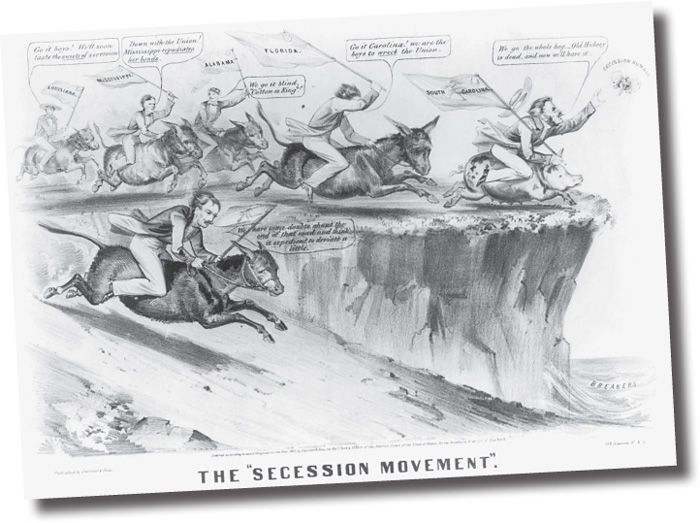
An early 1861 cartoon warns of more Southern states joining the new Confederacy.
HIGHLY IMPORTANT NEWS.
SECRET DEPARTURE OF THE PRESIDENT ELECT FROM HARRISBURGH.
ALLEGED PLOT FOR HIS ASSASSINATION.
FEBRUARY 25
HARRISBURG, SATURDAY, FEB. 23 — 8 A.M.
ABRAHAM LINCOLN, the President Elect of the United States, is safe in the capital of the nation. By the admirable arrangement of Gen. SCOTT, the country has been spared the lasting disgrace, which would have been fastened indelibly upon it had Mr. LINCOLN been murdered upon his journey thither, as he would have been had he followed the programme as announced in the papers and gone by the Northern Central Railroad to Baltimore.
On Thursday night after he had retired, Mr. LINCOLN was aroused and informed that a stranger desired to see him on a matter of life and death. He declined to admit him unless he gave his name, which he at once did, and such prestige did the name carry that while Mr. LINCOLN was yet dis-robed he granted an interview to the caller.
A prolonged conversation elicited the fact that an organized body of men had determined that Mr. LINCOLN should not be inaugurated, and that he should never leave the City of Baltimore alive, if, indeed, he ever entered it.
The list of the names of the conspirators presented a most astonishing array of persons high in Southern confidence, and some whose fame is not confined to this country alone.
Statesmen laid the plan, Bankers indorsed it, and adventurers were to carry it into effect. As they understood, Mr. LINCOLN was to leave Harrisburgh at 9 o’clock this morning by special train, the idea was, if possible, to throw the cars from the road at some point where they would rush down a steep embankment and destroy in a moment the lives of all on board. In case of the failure of this project, their plan was to surround the carriage on the way from depot to depot in Baltimore, and assassinate him with dagger or pistol shot.
So authentic was the source from which the information was obtained, that Mr. LINCOLN, after counselling with his friends, was compelled to make arrangements which would enable him to subvert the plane of his enemies.
Greatly to the annoyance of the thousands who desired to call on him last night, he declined giving a reception. The final council was held at 8 o’clock.
Mr. LINCOLN did not want to yield, and Col. SUMNER actually cried with indignation; but Mrs. LINCOLN, seconded by Mr. JUDD and Mr. LINCOLN’S original informant, insisted upon it, and at nine o’clock Mr. LINCOLN left on a special train. He wore a Scotch plaid cap and a very long military cloak,1 so that he was entirely unrecognizable. Accompanied by Superintendent LEWIS and one friend, he started, while all the town, with the exception of Mrs. LINCOLN, Col. SUMNER, Mr. JUDD, and two reporters, who were sworn to secresy, supposed him to be asleep.
The telegraph wires were put beyond reach of any one who might desire to use them.
At 1 o’clock the fact was whispered from one to another, and it soon became the theme of most excited conversation. Many thought it a very injudicious move, while others regarded it as a stroke of great merit.
The special train leaves with the original party, including the TIMES correspondent, at 9 o’clock.
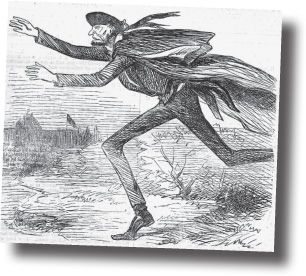
The third of a sequence of four cartoons satirizing Lincoln’s clandestine passage through Baltimore to Washington, D.C. for his inauguration. The caption read: “He wore a Scotch plaid Cap and a very long Military Cloak, so that he was entirely unrecognizable.”
1. Lincoln admitted only that by donning “a soft hat” he was not “recognized by strangers, for I was not the same man.” There is no evidence that he wore the elaborate disguise Times correspondent Joseph Howard invented for him in this report. But the calumny took hold, and cartoonists were soon depicting the President-Elect as a coward skulking into Washington in a tam and cloak, or wearing a kilt and dancing “the MacLincoln Harrisburg Highland Fling.”
THE PEACE MOVEMENT.
FEBRUARY 28
The movements at Washington in favor of Peace are drawing to their natural close. The Peace Convention adjourned yesterday sine die, having first adopted the plan reported by Mr. GUTHRIE, as amended by Mr. FRANKLIN, of Pennsylvania. The essential feature of this plan is its restoration of the Missouri Compromise line, with added securities for Slavery in the Southern portion of the Territory thus divided. This action of the Convention was transmitted to the Senate, and ordered to be printed, and referred to a Select Committee, with instructions to report to-day at 1 o’clock.
We do not anticipate the adoption of this plan, — nor do we think it desirable. It is open to very grave and serious objections, — and although the assent of Congress to it would undoubtedly secure the continued loyalty of the Border States, it would be at a greater expense to the country than is required. Still the Peace Conference has been of essential service to the country, — in gaining time for reflection, in discussing the general topics of sectional difference, and in preparing the way for the peaceful opening of the new Administration.
The proper remedy for all existing evils is to be found in the legislative action of Congress; — and the House of Representatives yesterday entered vigorously, and in admirable temper, upon this important task. They first rejected the proposal to call a National Convention to revise and amend the Constitution of the United States, by the decisive vote of 74 to 109. They thus, in our judgment, delivered the country from the most serious of all the dangers which have menaced its existence. They next rejected Mr. KELLOGG’s proposition, 33 to 158, — then that of Mr. CLEMENS, 80 to 113, and then adopted, by the decisive vote of 136 to 53, the resolutions reported by Mr. CORWIN’s Committee of Thirty-three.
These resolutions will be found at length in our Congressional report. They declare, substantially —
1. That all proper and constitutional remedies for existing discontents, and all guarantees for existing rights, necessary to preserve the Union, should be promptly and cheerfully granted:
2. That all attempts to obstruct the recovery of fugitive slaves are inconsistent with inter-state comity, and dangerous to the peace of the Union:
3. That the several States be requested to revise their statutes and repeal such as may be in conflict with Federal laws on this subject:
4. That Slavery is recognized as existing by usage in fifteen States, and there is no authority outside those States to interfere with it.
5. That the laws on the subject of fugitives from labor should be faithfully executed, and that citizens of each State should be entitled to all the privileges and immunities of citizens in the several States.
6. That there is no cause for a dissolution of this Government, and that it is the duty of Congress to preserve its existence on terms of equality and justice to all the States.
7. That the faithful observance of the Constitution, on the part of the States, is essential to the peace of the country.
8. That each State is requested to revise its statutes, and amend them if necessary, so as to protect citizens of other States who may be traveling therein against violence.
9. That each State be requested to enact laws to punish invasions of other States from its soil.
10. That copies of these resolutions be sent to the Governors and Legislatures of the several States.
11. That as no proposition has been made to abolish Slavery in the District of Columbia or Government dock-yards, or to interfere with the inter-State Slave-trade, no action on these subjects is needed.
The proposition to amend the Constitution, so as to prohibit amendments interfering with Slavery, received 120 votes to 71, — but as there were not two-thirds in its favor it was not passed.
These resolutions cover the whole ground out of which the existing disturbances arise, except that of the Territories. They are so plainly just as to command universal assent, — and yet they provide for all the tangible grounds of complaint that have arisen. If in addition to these resolution, Congress, will take the action proposed by Mr. ADAMS, and pass an enabling act for New-Mexico, they will lay a solid and unexceptionable basis for the adjustment of all our difficulties. We hope they will do so.
THE NEW ADMINISTRATION.
ABRAHAM LINCOLN PRESIDENT OF THE UNITED STATES.
THE INAUGURATION CEREMONIES.
MARCH 5
The day to which all have looked with so much anxiety and interest has come and passed. ABRAHAM LINCOLN has been inaugurated, and “all’s well.”
At daylight the clouds were dark and heavy with rain, threatening to dampen the enthusiasm of the occasion with unwelcome showers. A few drops fell occasionally before 8 o’clock, but not enough to lay the dust, which, under the impulse of a strong northwest wind, swept down upon the avenue from the cross streets quite unpleasantly. The weather was cool and bracing, and, on the whole, favorable to the ceremonies of the day.
Mr. LINCOLN rose at 5 o’clock. After an early breakfast, the Inaugural was read aloud to him by his son ROBERT, and the completing touches were added, including the beautiful and impassioned closing paragraph. Mr. LINCOLN then retired from his family circle to his closet, where he prepared himself for the solemn and weighty responsibilities which he was about to assume.
Here he remained until it was time for an audience to Mr. SEWARD. Together these statesmen conversed concerning that paragraph of the Inaugural relating to the policy of forcing obnoxious non-resident officers upon disaffected citizens. When Mr. SEWARD departed, Mr. LINCOLN closed his door upon all visitors, until Mr. BUCHANAN called for him to escort him to the Capitol.
From early daylight the streets were thronged with people, some still carrying carpet-bags in hand, having found no quarters in which to stop.
The busy have of preparation for the parade was soon heard on every side. The New-York delegation; over two hundred strong, formed in procession on Pennsylvania-avenue at 9 o’clock, and proceeded in a body to Mr. SEWARD’s residence to pay their respects....
It was nearly noon when Mr. BUCHANAN started from the White House with the Inaugural procession, which halted before Willard’s Hotel to receive the President elect. The order of march you will get from other sources, and I will only observe that the carriage containing Mr. BUCHANAN and Mr. LINCOLN, was a simple open brett, surrounded by the President’s mounted guard, in close older, as a guard of honor.
The procession, as usual, was behindhand a little, but its order was excellent. Nothing noteworthy occurred on the route. As it ascended the Capitol hill, towards the north gate, the company of United States Cavalry and the President’s mounted guard took their positions each side of the carriage-way, and thus guarded the inclosed passage-way by which the President’s party entered the north wing of the Capitol to go to the Senate Chamber.
The procession halted until the President and suite entered, and then filed through the troops aforesaid into the grounds.
On the east front, the military took their positions in the grounds in front of the platform, but the United States troops maintained their places outside until the line took up the President and party again after the ceremonies were over, to escort them back to the White House.
The arrangements at the Capitol were admirably designed, and executed so that everybody who was entitled to admission got in, and everybody who could not go in could see from without. The Senate Chamber was the great point of attraction, but only the favored few were admitted upon the floor, while the galleries were reserved for and occupied by a select number of ladies. The scene which transpired there was most memorable, producing a great and solemn impression upon all present. Mr. BRIGHT spent all the morning in talking against time on some Gas Company’s bill, greatly to the amusement of Senators, and the ill-concealed annoyance of spectators, who expected to hear some good speaking....
The Senate now waited in silence for the President elect. Gradually those entitled to the floor entered. The Diplomatic Corps, in full court dress, came quite early. The Supreme Court followed, headed by the venerable Chief Justice TANEY, who looked as if he had come down from several generations, and finally the House of Representatives filed in. For at least an hour Mr. HAMLIN was acting President of the United States, but at length, a little after 1 o’clock, the doors opened, and the expected dignitaries were announced.
Mr. BUCHANAN and Mr. LINCOLN entered, arm in arm, the former pale, sad, nervous; the latter’s face slightly flushed, with compressed lips. For a few minutes, while the oath was administered to Senator PEARCE, they sat in front of the President’s desk. Mr. BUCHANAN sighed audibly, and frequently, but whether from reflection upon the failure of his Administration, I can’t say. Mr. LINCOLN was grave and impassive as an Indian martyr.
When all was ready, the party formed, and proceeded to the platform erected in front of the eastern portico. The appearance of the President elect was greeted, as he entered from the door of the rotunda, with immense cheering by the many thousand citizens assembled in the grounds, filling the square and open space, and perching on every tree, fence or stone affording a convenient point from which to see or hear. In a few minutes the portico was also densely crowded with both sexes. On the front of the steps was erected a small wooden canopy, under which were seated Mr. BUCHANAN, Chief-Justice TANEY, Senators CHASE and BAKER, and the President elect, white at the left of the small table on which was placed the Inaugural, stood Col. SELDEN, Marshal of the District, an exponent of the security which existed there for the man and the ceremonies of the hour. At the left of the canopy, sat the entire Diplomatic Corps, dressed in gorgeous attire, evidently deeply impressed with the solemnity of the occasion, and the importance of the simple ceremony about to be performed. Beyond them was the Marine band, which played several patriotic airs before and alter the reading of the address. To the right of the diplomats sat in solemn dignity, in silk gowns and hats, the members of the Supreme Court. Then came Senators, members of the House, distinguished guests and fair ladies by the score, while the immediate right of the canopy was occupied by the son and Private Secretaries of Mr. LINCOLN. Perched up on one side, hanging on by the railing, surrounding the statue of COLUMBUS and an Indian girl, was Senator WIGFALL,1 witnessing the pageant.
Everything being in readiness, Senator BAKER came forward and said:
“FELLOW-CITIZENS: I introduce to you ABRAHAM LINCOLN, the President elect of the United States of America.”
Whereupon, Mr. LINCOLN arose, walked deliberately and composedly to the table, and bent low in honor of the repeated and enthusiastic cheering of the countless host before him. Having put on his spectacles, he arranged his manuscript on the small table, keeping the paper thereon by the aid of his cane, and commenced in a clear, ringing voice, that was easily heard by those on the outer limits of the crowd, to read his first address to the people, as President of the United States.
The opening sentence, “Fellow-citizens of the United States,” was the signal for prolonged applause, the good Union sentiment thereof striking a tender chord in the popular breast. Again, when, after defining certain actions to be his duty, he said, “And I shall perform it,” there was a spontaneous, and uproarious manifestation of approval, which continued for some moments. Every sentence which indicated firmness in the Presidential chair, and every statement of a conciliatory nature, was cheered to the echo; while his appeal to his “dissatisfied fellow-countrymen,” desiring them to reflect calmly, and not hurry into false steps, was welcomed by one and all, most heartily and cordially. The closing sentence “upset the watering pot” of many of his hearers, and at this point alone did the melodious voice of the President elect falter.
Judge TANEY did not remove his eyes from Mr. LINCOLN during the entire delivery, while Mr. BUCHANAN, who was probably sleepy and tired, sat looking as straight as he could at the toe of his right boot. Mr. DOUGLAS, who stood by the right of the railing, was apparently satisfied, as he exclaimed, sotto voce, “Good,” “That’s so,” “No coercion,” and “Good again.”
After the delivery of the address Judge TANEY stood up, and all removed their hats, while he administered the oath to Mr. LINCOLN. Speaking in a low tone the form of the oath, he signified to Mr. LINCOLN, that he should repeat the words, and in a firm but modest voice, the President took the oath as prescribed by the law, while the people, who waited until they saw the final bow, tossed their huts, wiped their eyes, cheered at the top of their voices, hurrahed themselves hoarse, and had the crowd not been so very dense, they would have demonstrated in more lively ways, their joy, satisfaction and delight.
Judge TANEY was the first person who shook hands with Mr. LINCOLN, and was followed by Mr. BUCHANAN, CHASE, DOUGLAS, and a host of minor great men. A Southern gentleman, whose name I did not catch, seized him by the hand, and said, “God bless you, my dear Sir; you will save us.” To which Mr. LINCOLN replied, “I am very glad that what I have said causes pleasure to Southerners, because I then know they are pleased with what is right....”
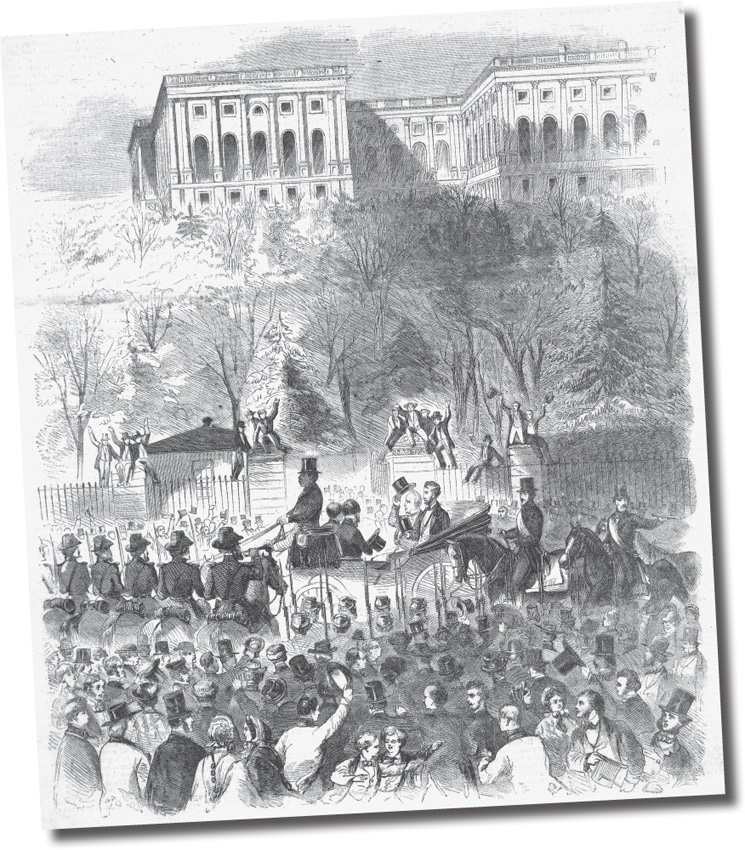
The inaugural procession of Abraham Lincoln on March 4, 1861. Lincoln rides alongside outgoing President James Buchanan.
THE INAUGURATION CEREMONIES
The day was ushered in by a most exciting session of the Senate, that body sitting for twelve hours, from 7 o’clock yesterday evening to 7 o’clock this morning.
As the dial of the clock pointed to 12 o’clock last night, and the Sabbath gave way to Monday, the 4th of March, the Senate Chamber presented a curious and animated appearance. The galleries were crowded to repletion, the ladies’ gallery resembling, from the gay dresses of the fair ones there congregated, some gorgeous parterre of flowers, and the gentlemen’s gallery seemed one dense black mass of surging, heaving masculines, pushing, struggling and almost clambering over each other’s backs in order to get a good look at the proceedings....
When the word was given for the members of the House to fall into the line of the procession, a violent rush was made for the door, accompanied by loud outcries, violent pushing and great-disturbance.
After the procession had reached the platform, Senator BAKER,2 of Oregon, introduced Mr. LINCOLN to the Assembly. On Mr. LINCOLN advancing to the stand, he was cheered, but not very loudly. Unfolding his manuscript, in a loud, clear voice, he read his address, as follows:
THE INAUGURAL ADDRESS.
Fellow-citizens of the United States:
In compliance with a custom as old as the Government itself, I appear before you to address you briefly, and to take in your presence the oath prescribed by the Constitution of the United States to be taken by the President before he enters on the execution of his office.
I do not consider it necessary at present for me to discuss those matters of Administration, about which there is no special anxiety or excitement.
Apprehension seems to exist among the people of the Southern States that, by the accession of a Republican Administration, their property, and their peace and personal security are to be endangered. There has never been any reasonable cause for such apprehension. Indeed, the most ample evidence to the contrary has all the while existed, and been open to their inspection. It is found in nearly all the published speeches of him who now addresses you. I do but quote from one of these speeches. when I declare that “I have no purpose, directly or indirectly, to interfere with the institution of Slavery in the States where it exists. I believe I have no lawful right to do so, and I have no inclination to do so.”...
The course here indicated will be followed, unless current events and experience shall show a modification or change to be proper, and in every case and exigency my best discretion will be exercised, according to the circumstances actually existing, and with a view and a hope of a peaceful solution of the national troubles and the restoration of internal sympathies and affections. That there are persons in one section or another who seek to destroy the Union at all events, and are glad of any pretext to do it, I will neither affirm or deny. But if there be such I need address no word to them. To those, however, who really love the Union, may I not speak. Before entering upon so grave a matter as the destruction of our national fabric with all its benefits, its memories and its hopes, would it not be well to ascertain why we do it. Will you hazard so desperate a step while there is any portion of the ills you fly from have no real existence? Will you, while the certain ills you fly to are greater than all the real ones you fly from?
Will you risk the commission of so fearful a mistake? All profess to be content in the Union, if all Constitutional rights can be maintained. Is it true, then, that any right plainly written in the Constitution has been denied? I think not. Happily the human mind is so constituted that no party can reach to the audacity of doing this. Think, if you can, of a single instance in which a plainly written provision of the Constitution has ever been denied. If, by the mere force of numbers, a majority should deprive a minority of any clearly written constitutional light, it might, in a moral point of view, justify revolution certainly would, of such right were a vital one. But such is not our case....
Physically speaking, we cannot separate — we cannot remove our respective sections from each other, nor build an impassable wall between them. A husband and wife may be divorced, and go out of the presence and beyond the reach of each other — but the different parts of our country cannot do this.
They cannot but remain face to face, and intercourse either amicable or hostile must continue between them. Is it possible then to make that intercourse more advantageous or more satisfactory after separation than before? Can aliens make treaties easier than friends can make laws? Can treaties be more faithfully enforced between aliens than laws can among friends?
Suppose you go to war, you cannot fight always, and when, after much loss on both sides and no gain on either, you cease fighting, the identical questions as to terms of intercourse are again upon you. This country, with its institutions, belongs to the people who inhabit it. Whenever they shall grow weary of the existing Government, they can exercise their Constitutional right of amending or their revolutionary right to dismember or overthrow it. I cannot be ignorant of the fact that many worthy and patriotic citizens are desirous of having the National Constitution amended. While I make no recommendation of amendment, I fully recognize the full authority of the people over the whole subject to be exercised in either of the modes prescribed in the instrument itself, and I should, under existing circumstances, favor rather than oppose a fair opportunity being afforded the people to act upon it....
My countrymen, one and all, think calmly and well upon this whole subject. Nothing valuable can be lost by taking time.
If there be an object to hurry any of you in hot haste to a step which you would never take deliberately, that object will be frustrated by taking time; but no good object can be frustrated by it. Such of. you as are now dissatisfied still have the old Constitution unimpaired, and on the sensitive point, the laws of your own framing under it, while the new Administration will have no immediate power, if it would, to change either. If it were admitted that you who are dissatisfied hold the right side in the dispute, there still is no single reason for precipitate action.
Intelligence, patriotism, Christianity and a firm reliance on Him who has never yet forsaken this favored land, are still competent to adjust in the best way all our present difficulty.
In your hands, my dissatisfied fellow-countrymen, and not in mine, is the momentous issue of civil war. The Government will not assail you. You can have no conflict without being yourselves the aggressors.
You have no oath registered in Heaven to destroy the Government, while I shall have the most solemn one to “preserve, protect and defend” it.
I am loth to close. We are not enemies but friends. We must not be enemies.
Though passion may have strained, it must not break our bonds of affection. The mystic chords of memory stretching from every battle-field and patriot’s grave to every living heart and hearthstone all over this broad land, will yet swell the chorus of the Union, when again touched, as surely they will be, by the better angels of our nature....
1. Louis T. Wigfall (1816–1874) of Texas resigned from the Senate 19 days after the inaugural, and later served as a Confederate general and member of the Confederate Congress.
2. Edward Dickinson Baker (1811–1861) was an old family friend of the Lincolns’.
THE INAUGURAL.
MARCH 5
Mr. LINCOLN’s Inaugural Address must command the cordial approval of the great body of the American people. The intellectual and moral vigor which pervades it will infuse new hope and loyalty into the American heart. The calm firmness with which it asserts the rightful authority of the Federal Government, — the declared purpose which it embodies to preserve, protect and defend the Union and the Constitution, the easy force with which it sweeps away all the cobwebs of secession logic, and vindicates the supreme duty of the Government to defend its own existence, cannot fail to impress even the most determined Secessionist with grave doubts as to the justice of his cause. The characteristic feature of the Address is its profound sincerity, — the earnest determination which it evinces to render equal and exact justice to every State, to every section, to every interest of the Republic, — and to administer the Government in a spirit of the most thorough and impartial equity. To this purpose every other consideration is made to bend. And no one who can understand and appreciate such a character as that of Mr. LINCOLN, will doubt that this spirit will mark every act of his Administration.
In our judgment the Inaugural cannot fail to exert a very happy influence upon public sentiment throughout the country. All men, of all parties, must feel that its sentiments are just and true, — that it sets forth the only basis on which the Government of this country can be maintained, while at the same time it breathes the very spirit of kindness and conciliation, and relies upon justice and reflection, rather than force, for the preservation of the Federal Union....
The Inaugural is equally explicit and emphatic in its proffer of concessions and guarantees to the alarmed interests of the Southern States. The President disavows in the most solemn manner, — and calls the record of his life to witness the justice of the disavowal, — all thought, purpose or inclination to interfere with Slavery in any State where it exists, — and declares his willingness to assent to an amendment of the Constitution which shall make such interference, on the part of Congress, irrevocably impossible. He declares that the obligation to return fugitive slaves is absolute and unquestionable, and calls for the enactment of laws which shall secure its fulfillment. In regard to differences of opinion as to the Territories, while he asserts the absolute necessity of yielding for the time, and while the decision stands unreversed, to the verdict of the majority and the decisions of the Supreme Court, he also declares his readiness to favor a Convention to amend the Constitution in these or any other particulars. It would scarcely be possible for him, in such an address, to go further towards the conciliation of all discontented interests of the Confederacy.
The Inaugural inspires the strongest and most confident hopes of the wisdom and success of the new Administration. It is marked throughout by consummate ability, a wise and prudent sagacity in the judgment of affairs, a profound appreciation of the difficulties and dangers of the crisis, a calm, self-possessed, unflinching courage adequate to any emergency, a kind and conciliatory temper, and the most earnest, sincere and unswerving devotion to the Union and the Constitution. If the dangers of the hour can be averted and the Union can be saved, this is the basis on which alone it can be accomplished. If the Union cannot be saved on this basis and consistently with these principles, then it is better that it should not be saved at all.
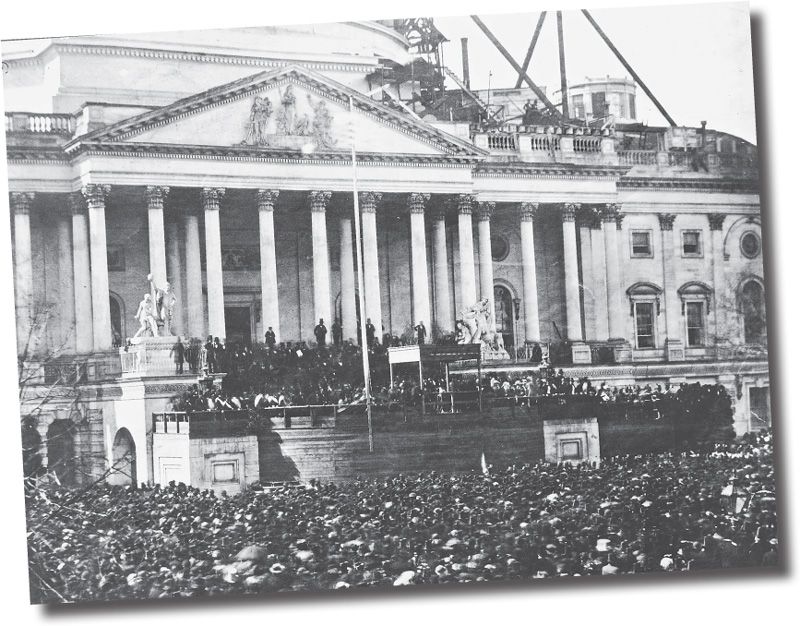
The inauguration of Abraham Lincoln on March 4, 1861. The scaffolding in the background was being used to erect the new capitol dome.