
CHAPTER 3
APRIL–MAY 1861
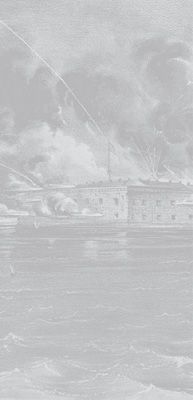
Fort Sumter, South Carolina, under attack by Confederate forces.
For weeks New Yorkers had talked of little else besides the festering crisis in Charleston Harbor, and yet the news of the first shot at Fort Sumter — and especially the news that Major Robert Anderson had surrendered the fort to the secessionists — caught most of them by surprise. Many were loath to believe it. When it was confirmed, it produced a frenzy of patriotic excitement that lasted throughout the rest of April and into May. The Times predicted, accurately as it proved, “The people will respond to this demand with alacrity and exultation.” All across the north, from Baltimore to Chicago to Cleveland, the news from Fort Sumter swept aside differences on policy and party.
Soon after the news from Charleston came Lincoln’s Proclamation of April 15, which called for 75,000 volunteers “to maintain the honor, the integrity, and the existence of our National Union.” As far as the South was concerned, this was coercion, and constituted a declaration of war. It triggered the secession of four more states to join the Confederacy: North Carolina, Tennessee, Arkansas, and, most important, Virginia. With Virginia’s secession, the Confederacy moved its capital from Montgomery, Alabama, to Richmond.
On the same day that Virginia seceded (April 17), the Confederate President, Jefferson Davis, announced that his government would begin to issue letters of marque, documents that authorized private citizens to fit out armed vessels to prey on the merchant shipping of the Union. This practice, known as privateering, had been a staple of America’s wartime strategy since the Revolution, but it had been declared illegal by the Declaration of Paris in 1856 (though the United States had not signed that protocol). The Times, unsurprisingly, viewed Davis’s decision with outrage. Then, two days later, on April 19, came Lincoln’s proclamation of a blockade, a decision that had been encouraged by The Times, and which the paper applauded. It did not prove to be the sudden crippling blow promised by its champions, though it did lead in the long term to hardship and war weariness in the South. Embedded in that proclamation, however, was another issue that caused the Lincoln administration much difficulty. Lincoln announced that “any person, under the pretended authority” of the seceded states who attempted to molest the shipping of the country “would be held amenable [accountable] to the laws of the United States for the prevention and punishment of piracy.” In the end Lincoln had to back away from that threat for fear of reprisals against Union prisoners of war.
That the war would have far-reaching social and legal consequences became evident that month as well, when Major General Benjamin Butler, until recently a congressman from Massachusetts and now a major general in charge of Fort Monroe on the Virginia coast, defined escaped slaves as “contraband of war” in order to justify his decision not to return them to their Virginia owners under the Fugitive Slave Law. In addition, The Times reported the arrest in Maryland of a pro-Confederate activist named John Merryman, an event that was made especially newsworthy when Lincoln decided to deny him the right of habeas corpus. That led to a lengthy national discussion about individual rights in wartime.
Lincoln called for Congress to meet on July 4, but that was nearly three months away, and in the meantime, war preparations continued on both sides. Recruiting offices in New York and elsewhere were overwhelmed. Regiments from Massachusetts marching through New York en route to Washington were greeted by an outpouring of enthusiastic, flag-waving patriotism unprecedented in the Republic. The wildly cheered march of New York’s own Seventh Regiment down Broadway symbolized the unity and enthusiasm of the public. These events erased the skepticism of those New Yorkers who had doubted that the crisis would ever escalate into violence, and silenced those who had secretly applauded the boldness of the South’s actions. In time, the enthusiasm would fade along with hope for a quick early victory, but the determination and commitment would remain. What was still unclear was, as The Times put it, “How shall the United States Government wage the war?” There was no precedent for such a conflict, and few in the spring of 1861 could foresee the horrible bloodletting to come. Most expected a quick and decisive confrontation. “Whoever has to die,” The Times opined, “it is better to die by the guillotine than by a cancer. Then up with the axe, and down with the head, and let the slide fall.”
FORT SUMPTER FALLEN.
PARTICULARS OF THE BOMBARDMENT.
APRIL 15
CHARLESTON, SATURDAY, APRIL 13 – EVENING.
Major [Robert] ANDERSON1 has surrendered, after hard fighting, commencing at 4 ½ o’clock yesterday morning, and continuing until five minutes to 1 to-day.
The American flag has given place to the Palmetto of South Carolina....
Major ANDERSON stated that he surrendered his sword to Gen. [P. G. T.] BEAUREGARD2 as the representative of the Confederate Government. Gen. BEAUREGARD said he would not receive it from so brave a man. He says Major ANDERSON made a staunch fight, and elevated himself in the estimation of every true Carolinian....
The scene in the city after the raising of the flag of truce and the surrender is indescribable; the people were perfectly wild. Men on horseback rode through the streets proclaiming the news, amid the greatest enthusiasm.
On the arrival of the officers from the fort they were marched through the streets, followed by an immense crowd, hurrahing, shouting and yelling with excitement....
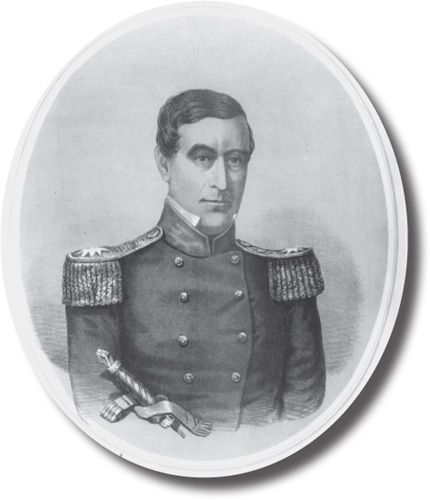
Major Robert Anderson, commander of the federal garrison at Fort Sumter.
1. Major Robert Anderson (1805–1871) was a native Kentuckian who commanded the Fort Sumter garrison.
2. Brigadier General Pierre Gustav Toutant Beauregard (1818–1893) was a native of Louisiana and the senior Confederate military officer in Charleston Harbor.
THE NEWS IN WASHINGTON.
THE EXCITEMENT AT THE CAPITAL.
APRIL 15
WASHINGTON, SUNDAY, APRIL 14
The excitement here throughout the day has been intense. People gather in groups on the streets and in the hotels, discussing affairs at Charleston and the probabilities of the future.
There is great diversity of opinion relative to the reliability of the news that Major ANDERSON has surrendered. The dispatches to the Associated Press are evidently full of blunders, which cast suspicion on the whole.
The President, nevertheless, has intelligence which satisfies him that the news is too true. Private dispatches from Charleston, signed by trusty men, also confirm it; but as the telegraph is known to have been constantly tampered with by the secession authorities, it is feared that even private dispatches may have been mutilated for the purpose of cutting the Government off from all possible means of correct information....
To-day’s excitement has betrayed many secessionists who hold public office, and who could not conceal their joy at the reduction of Fort Sumpter. Several fights occurred, and decided knockdowns. Gen. NYE, among others, has knocked down a couple of secessionists within the last day or two.1 The fact is, Northern men have got tired of having treason crammed offensively down their throats, and are learning to resent it by force, the only argument the chivalry seems to appreciate....
Everybody here sees that now war has commenced, the question which the Virginia Convention has to decide is simply whether Virginia will declare war against the United States or stand by the Government; whether she will invite the battle upon her soil, to her utter ruin, or aid in bringing the fratricidal strife to a speedy termination by sustaining the Government and Union.
The news from the North of the unanimity of public sentiment in favor of the Government and the strongest policy for the suppression of rebellion gladdens every heart. It is fully believed that all partisan considerations henceforth will be suspended, and that every effort will be directed to saving the country.
You have the President’s proclamation, making a requisition for seventy-five thousand volunteers, called from all the adhering States except California and Oregon. That news will thrill like an electric shock throughout the land, and establish the fact that we have a Government at last.
The Cabinet is a unit on these measures, and no man among them was more decided and active in their support than Mr. SEWARD, who urged conciliation and forbearance until the Disunionists were put clearly and thoroughly in the wrong.
The War Department is engaged to-night in calculating the number of troops which each State is entitled to furnish. New-York will be entitled probably to ten regiments. Pennsylvania and Massachusetts to a few less. The estimates are based upon the Federal representation of the States.
This proclamation is the fruit of a prolonged Cabinet meeting held last night.
THE BLOCKADE OF SOUTHERN PORTS.
No policy relative to closing the ports of the Seceding States is yet understood to be settled upon in detail. It is probable, however, that arrangements will be speedily made to cut off all communication with them by sea.2 There need be no doubt about the power of the Government to do this under its authority to prevent smuggling.
But, independent of that, the occasion justifies the Executive in assuming responsibility. He may well emulate Gen. JACKSON, who, when BOB LETCHER asked him under what law he could bring the Nullifier leaders of South Carolina to Washington for trial and execution, replied that if the Attorney-General could not find a law for it, he would get another Attorney-General who could.3 Self-preservation is the Government’s first duty, and its masters, the people, will justify it in every wise measure addressed to that end.
Gen. SCOTT has been at work all day, with all the energy of the soldier in the prime of life, making calculations for the disposition of the forces to be raised.
The Administration has satisfactory information that the Confederate States have proposed, immediately after reducing Fort Sumpter, to march on Washington with their army of twenty thousand men, for which they will have nothing else to do. Until recently, JEFFERSON DAVIS was disposed to postpone that step until the secession of Virginia and Maryland was effected, but as he despairs of that now, he believes that at the approach of his army those States will immediately unite their forces with his. Men who know those States well say he is in error.
There is one regiment of volunteers now in Baltimore ready to obey the call of the Government immediately, and they will be mustered into service. Virginia also is ready to furnish her quota. The Government designs to bring a force of volunteers to this city not only strong enough to defend it against all comers, but to render an attack on it improbable. Several additional companies of regulars are also ordered here. It is not improbable that this point will be made a grand rendezvous from which troops can readily be sent wherever required.
Congress is called in extra session on the 4th of July — a glorious day for a glorious work! This is essential in order to get the money that will be needed to enable the Government to sustain itself, and to pay as it goes. War is a costly experiment, as the Disunionists will find. It is no longer child’s play, and will impoverish them utterly in a few months, if they persist in it, for they must themselves be the aggressors, and transport their troops and supplies long distances. The hopelessness of their unrighteous struggle must speedily force itself upon their minds when they learn how vigorous is the Government in its present hands, and how unanimous the people are in sustaining it.
The President had not at nine o’clock to-night determined upon putting Washington under martial law. But there is little doubt that it will be done within a day or two. If so, it is hoped that possession will be taken of the telegraph office to prevent its employment by Disunionists for treasonable purposes....
1. Republican James W. Nye (1815–1876) had until 1859 been the police commissioner of New York City. In 1861, Lincoln appointed him to be the first governor of Nevada.
2. Lincoln announced a blockade of southern ports on April 19.
3. President Andrew Jackson believed it was essential to pass what was called the Force Bill in 1832 before Congress agreed to modify the tariff that had prompted South Carolina’s revolt. Robert Letcher was a congressman from Kentucky and Henry Clay’s chief lieutenant in the House of Representatives.
THE GREAT REBELLION — THE BEGINNING OF THE END.
APRIL 15
The curtain has fallen upon the first act of the great tragedy of the age. Fort Sumpter has been surrendered, and the Stars and Stripes of the American Republic give place to the felon flag of the Southern Confederates. The defence of the fortress did honor to the gallant commander by whom it was held, and vindicated the Government under which he served....
The Government of the United States is prepared to meet this great emergency with the energy and courage which the occasion requires, and which the sentiment of the nation demands. The PRESIDENT issues his proclamation to-day, convening Congress for the 4th of July, and calling for SEVENTY-FIVE THOUSAND volunteers for the defence of the Union, and the protection of the rights and the liberties of the American people.1 The people will respond to this demand with alacrity and exultation. They ask nothing better than to be allowed to fight for the Constitution which their fathers framed. Whatever may have been their political differences, there has never been a moment when they were not ready to sink them all in devotion to their common country, and in defence of their common flag. The President’s Proclamation will be hailed with an enthusiasm which no event of the last twenty years has called forth, — with a high-hearted determination to exterminate treason, which will carry terror into the hearts of the Confederates, who have conspired for the destruction of the freest and best Government the world has ever seen.
We repeat what we have had occasion to say more than once already, that the history of the world affords no instance of so utterly groundless a war, as that which the Southern Confederates have commenced upon the United States. The future historian will grope in vain for any adequate causes for such a movement. In no solitary instance have their rights been infringed, their liberties abridged, or their interests invaded by the Government of the United States. On the contrary, they have known that Government only by the blessings it has conferred upon them. It has fought their battles, enlarged their area, paid for their postal service, augmented their power and consideration abroad, and shielded their peculiar institution from the hatred and hostility of the civilized world. But for the Union, and the protection which it has afforded them, they would long since have sunk under the weight of their own evils, or been crushed by the enmity of hostile powers. During the whole period of their connection with the Union, they cannot point to a single instance of hostile or unfriendly action on the part of the United States. Not a single law has ever been passed interfering with Slavery in the slightest degree, while scores have been passed and enforced for its protection. Their fugitive slaves have been remanded in almost every instance where they have been claimed, and more than once the Army and Navy of the Federal Government have been used for that purpose. But the States which have commenced this horrid rebellion, have lost scarcely any fugitive slaves, while those States which have a right to complain of losses on this score, are still loyal to the Union and the Constitution. The John Brown invasion, the only instance of aggressive action from the North upon Slavery, during the whole history of the Government, was the act of a band of fanatics for which no considerable portion of the community was in the least responsible, and was suppressed by the Government of the United States itself. In no solitary instance have the rebel States had the slightest reason to complain of oppression or injustice at the hands of the Federal Government.
Indeed they have, themselves, more than once confessed that the question of Slavery had nothing to do with their rebellion. In the Convention which declared South Carolina to be out of the Union, it was openly avowed that Secession was merely the consummation of a purpose which had been pursued for the last thirty years. The same declaration has been made in other quarters. The fact is, the present movement is the result of as clear and deliberate a conspiracy as blackens the page of history. It was concocted and has been prosecuted by a few leading men in the Southern States, who have, year after year, made it their special business to inflame the public mind in the Southern States against the North, — by the most flagrant falsehoods and misrepresentations, — and to prepare the Southern people upon some favorable contingency, to be precipitated into revolution. They have accomplished their purpose. They have so debauched the minds of the great body of the people in seven of the States of the Union, that they have led them into open and flagrant armed rebellion against the Government of the United States.
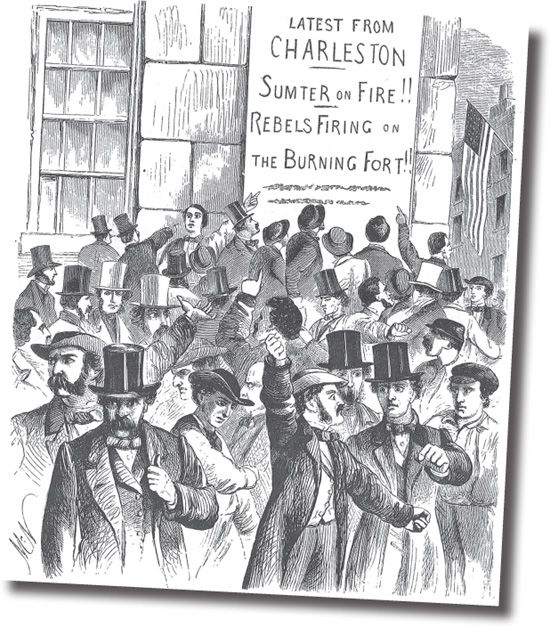
Reaction in the North over the attack on Fort Sumter.
1. Lincoln’s proclamation is in Roy P. Basler, ed., The Collected Works of Abraham Lincoln, 8 vols. (New Brunswick, NJ: Rutgers University Press, 1953–55), 4:331–2.
HENRY WARD BEECHER ON THE CRISIS.
APRIL 15
The good people of Brooklyn have shared with us all the anxiety, the excitement and the fears of the past week. Sunday is with them a day of rest, of moral culture, and of religious instruction, and one on which, for the better development of those attainments, they visit, one and all, the house of the Lord, and particularly that one of which Mr. BEECHER is the shepherd.1 Yesterday was no exception to the rule, only in that there was, if possible, a more dense mass of human beings packed within the walls of that sanctuary, and a more than ordinary curiosity on the part of strangers and a more than customary solemnity pervading the congregation. It was manifestly the belief of all there that the pastor would not fail to improve the occasion by preaching to the people of this age upon the necessities and the duties of the present trying hour, and that he would deal with so grand a subject in a manner befitting its character, its importance, and its universal occupation of the American mind.
The services began at 7 1/2 o’clock, and … the paucity of space compels us to reduce the report....
“The horrors of war, and the horrors of civil war especially, are easy to paint. I will yield no whit in keen appreciation of the dreadful calamities attendant upon such a sad condition — but with a fail realization and an entire conception of all the horrible possibilities of war, I say that I for one would...rather let there be war ten thousand times over than that slavery, with silent corruptions should be permitted longer to fester in our body politic. War is as resurrection, and though bad, very bad, is surpassed in evil by the results which flow from other sources. In our case, it will not be an unmixed evil. Eighty years of unexampled prosperity has hardened us, we have gone recklessly onward, doing this that and the other, as it might best advance our mutual interests. Our standard of morals has been commercial, and from a commercial stand point we have taken our observations. Should it please God to plunge this casualty into war, it will benefit us, in that we will be called upon at last, not only to talk, but to suffer for our faith, to bear for it and to endure for it....
Let this matter be settled now. Let it never come up again. If war must come, let us meet in; it’s better to brave it thoroughly now; to brave, if necessary, a protracted war, so that it is a final one, than for twenty years to come be troubled with an intermittent breaking out at every period. It has got to be settled one way or the other, The North has the population, the means and the courage — for there is no such breath of courage at the South as there is at the North.”
Mr. BEECHER appeared about six inches taller than usual, and his eye flashed fire as he looked upon the enthusiasm of his charges.
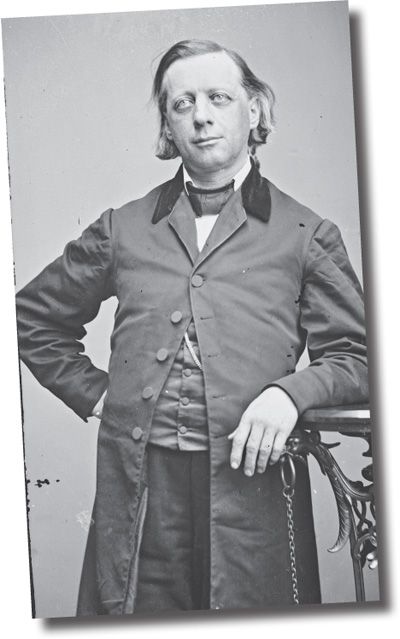
Reverend Henry Ward Beecher.
1. The abolitionist preacher Henry Ward Beecher (1813–1887) was the son of Lyman Beecher, brother of Harriet Beecher Stowe (author of Uncle Tom’s Cabin), and the minister at the Plymouth Congregationalist Church in Brooklyn.
IMPORTANT FROM VIRGINIA.
DEBATE IN CONVENTION ON THE PRESIDENT’S PROCLAMATION.
APRIL 18
FROM OUR SPECIAL CORRESPONDENT, RICHMOND, VA., MONDAY MORNING, APRIL 15
The public mind of old Virginia is to-day boiling like one of the ocean’s great whirlpools; or rather, I should say, rushing like the Gulf Stream’s torrent; for it has ceased to meet in jarring conflict, resulting in a round of policy without progress, but is dashing onward to action — decided, open and irrevocable. What that action is, I need not repeat; I have already signified it clearly enough in the TIMES.
A man may live fifty years and see no such period of excitement as has prevailed in Virginia since the insurgent guns opened on Fort Sumter. When the news came that the “Stars and Stripes,” that never fell before in the face of an enemy, had been lowered to the flag of the Confederate States, a delirium of joy seized the Disunionists of Richmond. They turned out by thousands, paraded the streets in companies, shouting the war cries of secession, were addressed at different points, as they passed through the city, by revolutionary orators, and finally proceeded to a State armory, and took without leave a number of field-pieces, with which they fired from Capitol Hill one hundred guns in honor of Sumter’s surrender. Not satisfied with this, a passion seized them to exalt the secession flag over the State House, and a band instantly proceeded to execute the purpose. The State flag, renowned and honored in the old Commonwealth for its brave motto, “Sic semper tyrannis,” was hauled down, and the banner of strange device — that of the seven Cotton States — dominated the haughty old State of Virginia! And many thousands of her sons and daughters shouted hosannas of submission!
Torchlight processions and illuminations at night succeeded the demonstrations of the day, and shouting, speech-making and revelry extended into the Sabbath morning....
THE WAR FEELING IN BROOKLYN.
APRIL 18
The war feeling in Brooklyn, and in fact throughout Long Island, is rapidly reaching that point when something must be done; in a word, the people are spoiling for a fight. Recruiting offices have been opened at different points, and those in charge expect to be able to fill up a Regiment at an early day. The regular State militia are drilling constantly in the State and City armory, and also evenings in the streets. The Regiments are rapidly filling up.
At about 9 o’clock last evening a party of about 1,500 men went to the offices of the Brooklyn Eagle and Daily News — Democratic papers — and requested the proprietors to raise the Stars and Stripes. The demand was speedily complied with, when the party moved on, and after giving three cheers for the Star, dispersed....
ENLISTMENT FOR THE WAR.
APRIL 19
The patriotic enthusiasm that has swept this City with a whirlwind of Union demonstrations, continued unabated yesterday. The universal display of the American colors in every available locality; the parading of the Boston troops through the streets, on their way to Washington; the busy preparations of the Seventh Regiment; the flocking of crowds to the numerous recruiting stations; the arrival of Major ANDERSON and the veterans of Fort Sumter; the running to and fro of military men; the resonance of martial music; the reception and discussion of the war bulletins from the South, made the occasion one of the most exciting in the annals of New-York City. Below we give succinct details of the various demonstrations:
Among the most prominent incidents connected with the Military movements of the City yesterday, was the arrival, by the early morning train from Boston, of the Sixth Regiment, Massachusetts Militia, en route for Washington.... The Bunker Hill boys were not without a reception, however, for early in the morning, and long before the train arrived, a throng of citizens, numbering 5,000 or over, had congregated about the New-Haven depot, at the corner of Twenty-seventh street, and when the cars came, the Regiment was greeted with long, loud and repeated cheers for the “Bay State Boys,” the “Boston boys,” the “Bunker Hill boys,” and various other titles indicative of the State from which they came. Capt. [Francis C.] SPEIGHT, of the Metropolitan Police, with 30 men, was present to preserve order, and to escort the regiment to their quarters at the various hotels which had been selected for their accommodation. After receiving the congratulations of the crowd the regiment formed in line and marched down Twenty-seventh-street to Fifth-avenue, thence up Broadway to Union-square, around the Square and down Broadway to the Metropolitan Hotel...Flags were displayed at all the hotels on the route, and waving handkerchiefs from the balconies and windows signified the warm greetings of the fair sex to the brave Bay State soldiers. Opposite the New-York Hotel a gray-haired old man mounted a stoop and addressing the soldiers and the people, said that he had fought under the Stars and Stripes in the War of 1812 against a foreign Power, and now that flag was dishonored and spit upon by those who should be its defenders. He closed his remarks by a “God bless our flag,” and left the crowd with the tears streaming down his wrinkled cheeks....
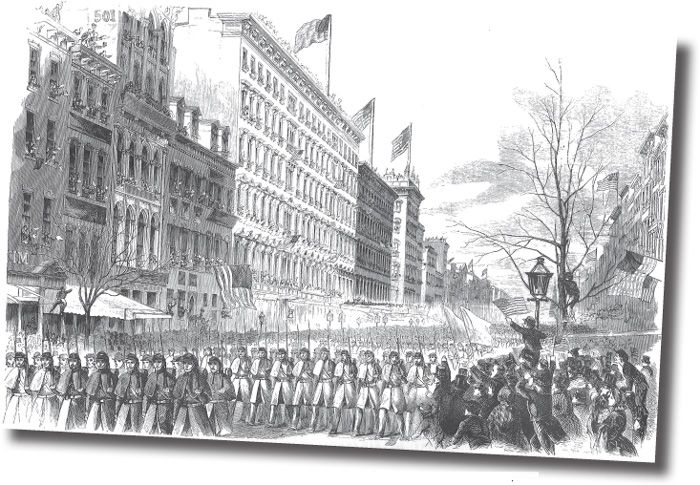
Departure of the New York Seventh Regiment, known as the “Silk Stocking” regiment.
VOLUNTEERS FOR THE UNION.
APRIL 19
The patriotism of the loyal States is at last aroused, our people gradually realizing that an attack on the National Government is no longer confined to the bombast of Southern speeches, but has become an active and embodied principle, dominant in seven of the extreme Southern States, and struggling for impious ascendency in all. Naturally, and as a tribute of honest respect to our late brethren, we were slow to suspect them of deliberate treason — reluctant to let the idea get lodgment in our minds, that any considerable portion of American citizens could be brought to unite in so foul and causeless a conspiracy. Great latitude was allowed in estimating the fiery expressions of Cotton State stump eloquence, — the loyal States feeling conscious of their strength, and reposing in complacent, and even amused, security, while listening to the bluster and braggadocio in which certain blatant captains of the “Gulf Squadron” have lived and moved and had their being for the past ten or a dozen years.
But, with the first shot fired against Fort Sumter, all these cherished illusions have vanished. The veil raised by our confiding affection is rudely torn aside, and we stand face to face with masses of armed and furious rebels, seeking our lives with weapons stolen from the national armories of the country by one of their own number, whom we had loaded with honors and invested with the solemnities of official trust. In the blackened and dented walls of Sumter — its terraces desolated by fire, its guns dismounted or unmanageable, its roof strewn with broken shells and flattened shot, its weaker parapets in ruins, and its magazines swept clear of the last pound of moldering biscuit on which the gallant handfull of its defenders had subsisted and defied the power of seven thousand assailants, until compelled by hunger to succumb, — in this sad scene of ruin, and raising our eyes to the snake-wreathed Palmetto emblem now floating from the staff which held aloft, through two days of fire, the banner of the Union, — we of the loyal States dismiss the generous illusions that have beset and betrayed us, acknowledging the rugged fact of rebellion, and casting aside all former considerations, while we prepare rapidly, though still with reluctance, for the bloody arbitration of civil war.
The rebels of the Cotton States, in our days of peace, have taunted the North with lack of physical courage. The brawlers of Cotton State tap-rooms, and the desperadoes of the Mississippi gaming-table, have been unable to account otherwise for the concerted refusal of many Northern representatives to violate the laws, both of God and man, by engaging in duels, whenever challenged, with adversaries who have reduced this species of private slaughter to a cruel and deliberate art. The challengers grew vain of the cheap glory thus purchased — their blunted intelligence or long habits of violence not allowing them to comprehend that moral repugnance and not physical fear — respect for law and not apprehension of death — the manifest inequality of the combat and not any unwillingness to engage in fair fight for a sufficient cause — lay behind the refusal of our Northern Congressmen and Senators, to adjourn debate from the floor of the house to an open field near Bladensburgh, and to exchange the weapons of logic and fact for the much briefer arguments invented by Cols. COLT and BOWIE.1
But in the aroused enthusiasm which now fills every street and highway with thronging cohorts of volunteers, — hundreds and thousands pouring out from every Ward, and District, and hamlet, and eager to be employed in defence of the Union, where only dozens or scores can be accepted; — in the elate and joyous military spirit, now flashing from every house-top in waving banners, filling every avenue and thoroughfare with files of glittering steel, and causing the air to vibrate, as fresh and yet fresh accessions of ardent Volunteers sweep onward, keeping time to martial music, in these first rudimentary demonstrations of the response to be made by the loyal States to Mr. LINCOLN’s call, those Fire-Eaters who have flattered themselves that we are not “a military people,” encounter their first rebuke, — to be bitterly emphasized hereafter whenever the shock of arms is reached....
1. A reference to Samuel Colt and James Bowie and the famous weapons they invented. The implication is that Southerners were accustomed to resorting quickly to weapons of violence rather than reasoned argument.
STARTLING FROM BALTIMORE.
THE NORTHERN TROOPS MOBBED AND FIRED UPON.
APRIL 20
There was a horrible scene on Pratt-street, to-day. The railroad track was taken up and the troops attempted to march through. They were attacked by a mob with bricks and stones, and were fired upon. The fire was returned. Two of the Seventh Regiment of Pennsylvania were killed and several wounded.
It is impossible to say what portion of the troops have been attacked. They bore a white flag as they marched up Pratt-street and were greeted with showers of paving-stones. The Mayor of the city [George William Brown] went ahead of them with the police. An immense crowd blocked up the streets. The soldiers finally turned and fired on the mob. Several of the wounded have just gone up the street in carts.
At the Washington depot, an immense crowd assembled. The rioters attacked the solders, who fired into the mob. Several were wounded, and some fatally. It is said that four rioters and four of the military are killed.1 The city is in great excitement. Martial law has been proclaimed. The military are rushing to the armories....
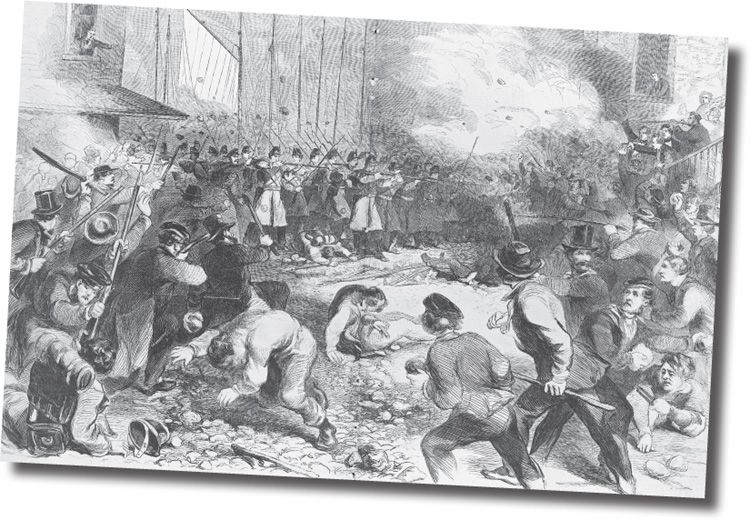
The Sixth Massachusetts Volunteer Regiment firing into a mob of Southern sympathizers on the streets of Baltimore.
1. Four soldiers (Corporal Sumner Needham, and Privates Luther C. Ladd, Charles Taylor, and Addison Whitney) and twelve civilians were killed in the riot. Some 36 other solders were wounded and left behind. It is uncertain how many additional civilians were injured.
THE GREAT CONFLICT.
APRIL 20
The secession of Virginia has cleared the skies.1 A treacherous enemy has deserted our ranks, who, while she remained, was incessant in her efforts to encourage the rebellion, to shield its outrages, and to arm the traitors, with an assurance that she would join them at the right moment in overthrowing a Government which she has been embarrassing to the utmost of her power by a feigned loyalty. She has now elected to make her soil the battle field. She could not have done us a better service.
If secession was incomplete without Virginia, we can crush it in its great leader, who brings it directly within reach of our blows. In dictating terms to Virginia, we can do it to the whole Union. We can dictate these at Richmond in sixty days, if we will. We can now make the war a short one. It should be ended in one campaign. A column of 25,000 men should, at the earliest moment possible, march from Washington on Richmond. Another, equally strong, should proceed from James River to Fort Monroe. Resistance to two well-appointed armies would be impossible. Once at Richmond, we should hold 500,000 slaves, rated in Virginia to be worth $400,000,000, as hostages for the good conduct of the enemy. Should we be forced to extreme measures, all the other States would take warning by the example made of their great leader. If Mr. LINCOLN does not now strike an effectual blow, upon him will rest the responsibility of a prolonged and cruel war. If Mr. BUCHANAN had, at the right moment, seized and hung a half dozen of the traitors, treason would have been quelled, and thousands of innocent lives, and the waste of hundreds of millions of property, would have been saved. Let Mr. LINCOLN take warning by the criminal neglect of his predecessor, and learn that in a great emergency, prompt action, which may involve 10,000 lives, will be the certain means of saving ten-fold that number, and the horrors of a prolonged civil war.
In Virginia, as the head and front of secession, we have a position the most vulnerable to attack. We hold complete control of all her outlets to the seas. With Maryland remaining loyal, we command her on every side but one. From Fort Monroe expeditions can penetrate by water far into her interior. Washington will soon be an immense fortified camp. Expeditions can penetrate the State from Pennsylvania, at numerous points on the North, and on the West from the Ohio, should not that section prove loyal, as we firmly believe and hope it will. Threatened on every side, she can concentrate no large bodies of troops, if she had them. If she had such, she could not keep them in the field, for want of means. She has no money in her treasury. She cannot borrow a dollar, nor can she raise any considerable sums by taxation.
At the very moment we are striking a blow at Virginia, we should fit out a large naval and military force to operate against the Cotton States. Both Charleston and Savannah might be threatened and captured by a force landed at Port Royal, a deep estuary about equidistant from these two cities. The capture of the City of Mobile, which is almost entirely unprotected, would be an easy matter. New-Orleans might be threatened or assailed at the same time. Such an expedition would keep President DAVIS and all the forces he could raise at home, and constantly on the look-out for his winged enemy, which, beyond reach of attack, could select its own time and place to deal a decisive blow. Such a force would compel Virginia to fight out her own battles single-handed, and with probably half of her people loyal, against the overwhelming force of the United States.
In this contest two issues of the deepest moment are involved; the supremacy of the laws, and the moral and political superiority of the North. We cannot admit the right of secession, because we cannot admit a proposition that involves our own destruction. If the will of a particular community, or individual, is paramount, then we accept anarchy as our necessary condition. We will never admit such a proposition. We will fight to the last man and the last musket first. Neither will we admit Slavery to be equally desirable as freedom. We will live up to our compact, and protect it as property in every loyal State, as we have done without complaint for seventy years. But when Slavery assumes a hostile attitude, and is fighting to put a chain round our necks, we will put forth all our power to confine it within its present area, and if no other resort is left us, we will proclaim freedom in its place. Mr. DAVIS has taken the initiative, and invites pirates and privateers to prey upon our private property. We will show him that we can retaliate with thousand-fold force, and remove from our system an element which, has brought upon us our present misfortunes, which has always been a source of discord, and which must always continue to he so while it exists.
Another point of great strategical importance is Cairo, at the confluence of the Ohio and Mississippi Rivers. This commands completely the States of Missouri and Kentucky, and a portion of Tennessee, and would be an admirable base of operations for a force, sent down the Mississippi. Upon this point a large force should be immediately concentrated, amply supplied with materials and munitions of war.
Now that we are in for a fight, let us finish it at a blow. The first thing is to know where we stand, to learn who are our friends, and who our foes. We want no relations that can embarrass the unity of our purposes or plans. We are infinitely stronger with Virginia an open enemy, than a treacherous ally. If Kentucky, or Maryland, or Tennessee, are not heartily with us, let them follow the example of Virginia. We want no friends who will be holding one of our hands while we are striking with the other. We not only want to have the issue squarely presented, but we want the battle fought with the antagonists ranged under the appropriate banners.
1. Virginia formally seceded from the Union on April 17.
THE PIRATE FLAG.
APRIL 20
Mr. JEFFERSON DAVIS, in his proclamation inviting applications for letters of marque and reprisal against Northern commerce, has hung out the true flag of the Confederates. Nothing more was needed to secure for the Southern movement the scorn and indignation of the civilized world. If there had been any doubt before of the attitude of commercial men in this country and of the commercial interest throughout the world towards the new Confederacy, this proclamation would have ended it. Under any circumstances, privateering has become an odious, indeed an infamous weapon of warfare. The whole tendency of modern civilization has been towards an amelioration of the laws of war. It is universally felt that the destruction of private property, in case of war, is a relic of barbarism, and that hostilities ought to be restricted to the public forces of the hostile powers. And although this principle has not yet secured recognition as part of the code of international law, the practice of nations has been towards its adoption. During the Crimean war each nation prohibited its subjects from accepting letters of marque, and privateering was formally discarded by Great Britain as a weapon of war.
The United States have recognized the salutary character of this principle more than once in their legislation. An act of Congress still stands upon the statute book, by which all American citizens are prohibited from fitting out privateers against friendly powers; and all the other nations of the world have enacted similar laws. Indeed, we have at the present time, treaties with France, Holland, Sweden, Prussia, Great Britain, Spain, and other Powers, by which it is agreed that no subject or citizen of either shall accept a commission or letter-of-marque to assist an enemy in hostilities against the other, under pain of being treated as a pirate. These treaties put an extinguisher at once upon any hope which JEFF. DAVIS may entertain of enlisting in his service privateers from any of the Powers of Europe, — or of securing the toleration of any European nation for his letters of marque and reprisal. Suppose that vessels were to be captured under authority of his letters: — into what port on the face of the earth could they be taken with the slightest hope of being recognized as lawful prize? Even if JEFF. DAVIS’ kingdom were a legitimate nation, duly recognized by the world as an established and independent power, the treaties to which we have already alluded would shut him out from all the ports of the civilized nations of Europe. There is not one in which he would not instantly be condemned as a pirate. And if any man, in this country or any other, permits himself to be enticed into accepting one of these letters and acting upon it, he may rely upon meeting the fate which his crimes deserve. Privateering, under the most favorable circumstances, is but one degree removed from piracy. It is only the positive law and usage of nations that establishes any difference. And in this case international law, treaty stipulations, and every consideration which nations hold sacred in their dealings with each other, brand the proclamation of JEFF. DAVIS as a formal sanction of piracy....
WANTED — A LEADER!
APRIL 251
In every great crisis, the human heart demands a leader that incarnates its ideas, its emotions and its aims. Till such a leader appears, everything is disorder, disaster and defeat. The moment he takes the helm, order, promptitude and confidence follow as the necessary result. When we see such results, we know that a hero leads. No such hero at present directs affairs. The experience of our Government for months past has been a series of defeats. It has been one continued retreat. Its path is marked by the wrecks of property destroyed. It has thus far only urged war upon itself. It confidingly enters into compacts with traitors who seek them merely to gain time better to strike a fatal blow. Stung to the quick by the disgraces we have suffered, by the disasters sustained, by the treachery which threatens the annihilation of all order, law, and property, and by the insults heaped upon our National banner, the people have sprung to arms, and demand satisfaction for wounded honor and for violation of laws, which must be vindicated, or we may at once bid farewell to society, to government, and to property, and sink into barbarism.
The spirit evoked within the last fortnight has no parallel since the day of Peter the Hermit.2 In the last ten days, 100,000 men have sprung to their feet, and, arming and provisioning themselves, are rushing to a contest which can never be quelled till they have triumphed. A holy zeal inspires every loyal heart. To sacrifice comfort, property and life even, is nothing, because if we fail, we must give up these for our children, for humanity, and for ourselves. Where is the leader of this sublime passion? Can the Administration furnish him? We do not question the entire patriotism of every member of it, nor their zeal for the public welfare. The President, in the selection of his Cabinet, very properly regarded the long and efficient services of men in the advocacy of the principles that triumphed in his election. To him the future was seen in the past. But in the few weeks of his official life all past political distinctions have been completely effaced. From a dream of profound peace we awake with our enemy at our throat. Who shall grapple with this foe? Men that can match his activity, quick instincts and physical force. A warrior — not a philosopher; a Cromwell — not a Bacon or a Locke.
Many of the Cabinet, having outlived the hot blood of youth, are vainly attempting to reason with this foe. As well might they oppose a feather to a whirlwind. JEFFERSON DAVIS has surrounded himself with spirits kindred to his own. Think of offering the olive-branch to such men as [Robert] TOOMBS and [Louis] WIGFALL. These men are seeking to put a chain about our necks, to secure our humiliation by the destruction of all our national interests, “Our money, or our life, or both.”
What are we called upon to defend. The welfare of 19,000,000 of freemen, with everything that render life desirable. Were the selection of the Cabinet to be made today, would not the past be entirely forgotten in the present? Would not all party ties be completely effaced? Is not the Cabinet the representative of the past, instead of the present?
Is it not exactly in the frame of mind it was in the day of its appointment? From the first its policy has been purely negative, and cooped up in Washington, surrounded on all sides by a hostile population, it still thinks only of self-defense, and yields to the demands of those seeking its destruction in the measured periods of diplomatic intercourse.
Well may the great heart of the North turn away sickened at such a spectacle. Is this a suitable response to the ardor of youth that rushes to the contest regardless of every consequence, and at the risk of severing every tie that can give grace or charm to life? The hope, and pride, and strength of the country is exposed without plan or forethought for the future, to an able, treacherous and relentless foe. We read to get the news of the first encounter. We all know how England swayed to and from under the loss of her best blood in the reckless charge of the light Brigade. How could our more mercurial natures bear up under a similar disaster to the gallant Seventh?3 It is the duty of the members of the Cabinet to look the thing squarely in the face and conscientiously ask themselves this question: “Are we disqualified from age, from inexperience in Executive action, from constitutional timidity, or from innate reluctance to face the horrors of war, to represent this people and country in this hour of travail?” If not, let them earn the gratitude of the people by giving way courteously to the exigencies of the hour, and laying their ambition on the alter of their country. By a timely act of self-sacrifice they may give relief to the anxious heart of this mighty host of earnest, patriotic men who are unselfishly exposing their lives and fortunes without any other object or motive than their country’s honor and welfare — the relief that follows the knowledge that they are directed by bold, strong and competent men, fitted by sterner natures for this revolutionary epoch of their country’s history.
1. Lincoln clipped this article along with other editorial critiques and filed it under the heading “Villainous articles.”
2. Peter the Hermit was a poorly dressed and poorly equipped pauper-priest who helped instigate and then participated in the First Crusade (1095–1099).
3. Like the British Light Brigade, the New York Seventh Regiment was a socially elite unit. Called a “silk stocking” regiment by some, it included men from some of the best families in New York.
LATEST FROM THE SEAT OF WAR.
APRIL 27
PHILADELPHIA, FRIDAY, APRIL 26
I have just arrived from Annapolis, which place I left at 8 o’clock last evening. Most of the middies at the Naval Academy have been sent to New-York in the Constitution, which sailed for New-York last night. Their quarters are occupied by the troops.1
The grounds of the Academy are now a military camp. Gen. BUTLER is in a command for which he is eminently qualified, as his conduct has already proved. He has seized upon the railroad between Annapolis and Washington, and it is guarded with troops. The track has been relaid, and communication is now open with the Capital.
Owing to the blockade of the Port and the seizure of the railroad, no provisions can be brought into Annapolis, and the inhabitants apprehend famine. The leading hotel was unable, yesterday morning, to furnish breakfast for myself and a friend, and we were obliged to scout around town for a meal. Flour has been sold at $20 per barrel. The troops have provisions in plenty, and this irritates the inhabitants. Not a Union flag is to be seen, nor did I hear one loyal sentiment uttered in the City. They blame the North for all their troubles, and express intense hatred towards the troops.
The troops arriving are moved on as fast as possible. The New-York Seventh Regiment, at last accounts, was en route for Washington, with several other Regiments. It was reported that the Secessionists would give them a running fight on the march, but this is not probable....
C. H. W.2
1. The U.S. Naval Academy was moved from its home in Annapolis to the Atlantic Hotel in Newport, Rhode Island, for the duration of the war. The frigate Constitution (Old Ironsides) had been used as a training ship at the Academy and carried the midshipmen to Newport.
2. These are the initials of Charles Henry Webb, a New York Times reporter.
WHAT THE ABOLITIONISTS THINK OF THE WAR.
DISCOURSE OF WENDELL PHILLIPS1 AT BOSTON.
APRIL 28
All Winter long, I have acted with that party which cried for peace. The anti-slavery enterprise to which I belong, started with peace written on its banner. We imagined that the age of bullets was over; that the age of ideas had come; that thirty millions of people were able to take a great question, and decide it by the conflict of opinions; and without letting the ship of State founder, lift four millions of men into Liberty and Justice. We thought that if your statesmen would throw away personal ambition and party watchwords, and devote themselves to the great issue, this might be accomplished. To a certain extent, it has been. The North has answered to the call. Year alter year, event by event, has indicated the rising education of the people, — the readiness for a higher moral life, the patience that waits a neighbor’s conversion. The North has responded to the call of that peaceful, moral, intellectual agitation which the anti-slavery idea has initiated. Our mistake, if any, has been that we counted too much on the intelligence of the masses, on the honesty and wisdom of statesmen as a class....
Our struggle, therefore, is no struggle between different ideas, but between barbarism and civilization. Such can only be settled by arms. [Prolonged cheering.] The Government has waited until its best friends almost suspected its courage or its integrity; but the cannon shot against Fort Sumter has opened the only door out of this hour. There were but two. One was Compromise; the other was Battle. The integrity of the North closed the first; the generous forbearance of nineteen States closed the other. The South opened this with cannon shot, and LINCOLN shows himself at the door. [Prolonged and enthusiastic cheering] The war, then, is not aggressive, but in self-defence, and Washington has become the Thermopylae of Liberty and Justice. [Applause.] Rather that surrender it, cover every square foot of it with a living body, [loud cheers;] crowd it with a million of men, and empty every bank vault at the North to pay the cost. [Renewed cheering] Teach the world once for all, that North America belongs to the Stars and Stripes, and under them no man shall wear a chain. [Enthusiastic cheering.]....
The noise and dust of the conflict may hide the real question at issue. Europe may think — some of us may — that we are lighting for forms and parchments, for sovereignty and a flag. But really, the war is one of opinions; it is Civilization against Barbarism — it is Freedom against Slavery. The cannon shots against Fort Sumter was the yell of pirates against the DECLARATION OF INDEPENDENCE: the war-cry of the North is its echo. The South, defying Christianity, clutches in victim. The North offers its wealth and blood in glad atonement for the selfishness of seventy years. The result is as sure as the Throne of God. I believe in the possibility of Justice, in the certainty of Union. Years hence, when the smoke of this conflict clears away, the world will see under our banner all tongues, all creeds, all races—one brotherhood; and on the banks of the Potomac, the Genius of Liberty, robed in light, four-and-thirty stars for her diadem, broken chains under feet, and an olive branch in her right hand. [Great applause.]
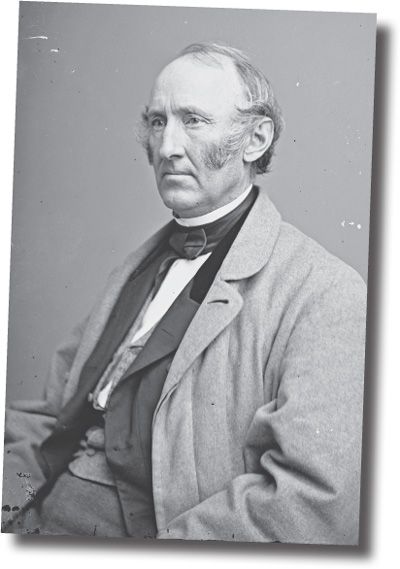
Wendell Phillips.
1. Wendell Phillips (1811–1884) was a leading abolitionist.
FROM KENTUCKY.
JOHN C. BRECKINRIDGE1 IN LOUISVILLE.
APRIL 28
LOUISVILLE, SATURDAY, APRIL 20
Mr. BRECKINRIDGE for an hour and a half addressed a large audience here this afternoon, with his customary fluency, graceful delivery, and melodious utterance. He was listened to with marked respect, but with little show of enthusiasm, and no general applause. The majority of his audience was evidently by no means prepared to indorse him. The staple of his speech was laudation of the South and abuse of the North. The South has always in its every act done right, and stood on the defensive! The North and the Republican Party have done all the wrong and committed all the aggression, and history will so declare! He casts upon the Republican Party and Administration all the blame for the tragic scenes now enacting! No seceded State has done anything meriting his censure. South Carolina did right when she bombarded Sumter! The President’s Proclamation of the 14th inst. was infamous — it was the declaration of a deliberate sectional war, deliberately inaugurated by a sectional President. His attempted blockade of Southern ports is illegal and unjustifiable.
Mr. BRECKINRIDGE advises Kentucky to put herself immediately in a post on of self-defence, so as to be prepared, in all events, to take care of herself. An armed neutrality may do as a temporary contrivance, but not as a permanent policy.2 It is utterly impossible for her long to maintain it. To hold a perfect neutrality, Kentucky should furnish not a man nor a dollar to either Government. If she did, she would cut off her communications with both. She don’t hold such a position now. While in the Union, she pays revenue, and helps to furnish Mr. LINCOLN with the sinews of war, for the conquest and subjugation of the South. This will not do. Kentucky must play her part to prevent civil war, and must throw her moral power and whole weigh against Mr. LINCOLN’S atrocious policy. She should have a State Convention before the 4th of July, and counsel with every slave State in the Union for opposition to an attempted solution of the controversy by arms. If Kentucky and her Southern sisters fail to avert civil war, no earthly power can keep her out of that war, and she will have to take a large part in it. The united protest and the united front of fifteen States and thirteen millions of people against the folly of Mr. LINCOLN’S war appeal, can keep the public peace and save the Union, if it can be saved. While he (BRECKINRIDGE) has never uttered a word or entertained a thought hostile to the Constitution and the Union, his loyalty to his noble Commonwealth is paramount. Whatever her position, whether in accordance with his judgment or not, he will stand by her. Kentucky must be a unit, and allow no party rancor or intestine strife. Her action should be prompt and quick. A State Convention of her people before the meeting of Congress should be held, and take ground for a peaceful solution and a reconstruction of the Union, But if, as Mr. B. says he greatly fears, the Union is past recovery and the separation of the seceded States is permanent, then, in his judgment, every consideration of geography, of commerce, of self-interest and self preservation, carries Kentucky entirely with the South!
1. John C. Breckinridge (1821–1875) of Kentucky had been Vice President of the United States under James Buchanan, and the Southern Democratic candidate for President in 1860. Siding with the Confederacy after hostilities began, he subsequently became a major general in the Confederate Army and eventually Davis’s secretary of war.
2. Unwilling to cast its lot with either side, Kentucky initially declared its neutrality in the war. As Breckinridge warned, however, such a stance proved too precarious to maintain, and eventually it became a battleground with Kentucky regiments fighting on both sides. Because it did not secede, it remained a Union state, though one with mixed loyalties.
HOW THE WAR SHALL BE WAGED.
MAY 1
The gauge of war having been offered by the Confederate States, and promptly accepted by the United States Government, it only remains to end the contest by the most desperate and fatal agencies of destruction that the respective parties can command. It is one of the triumphs of art and civilization, that, while they have not the power to change the nature of man and eradicate his passions, they give to his passions such formidable instruments of destruction that wars cannot be lingering.
We are now at war with the Confederate States. They have seized the Federal property; they have defied the Federal laws; they have attacked the National forts; pillaged the arsenals and treasuries; insulted the Nation’s flag; stoned and murdered its soldiers, and are now seeking to capture the Federal Capital and depose the constitutionally elected officers of the Government. Not stopping at attacks on Federal property, they have set the example of the seizure and confiscation of private properly, under circumstances of wrong not recognized by rules of honorable war, for no proclamation of hostilities preceded the seizure and confiscation. And as the crowning act of injury, the persons in revolt against government and society have seized and now hold as prisoners citizens of the United States, and next propose to arm lawless corsairs, and turn them out upon the high seas to plunder and kill as only pirates do.
So far, the United States Government have been submissive and apologetic only. They have carried the mails for those who rifled them at will. They have paid salaries to those who were seeking the Government’s overthrow. They have parleyed and expostulated with rebels in arms, and shunned the national highway with their troops, marching under the nation’s ensign, as if it were a pirate’s bunting or a helot’s disgraceful rag, that needed to hide itself in the corners and by-ways of the land.
But now, with God’s help, the tables will be turned, and war must become a game for two to play at. How shall the United States Government wage the war? In mercy, both to winner and loser, let it be short. If it is to cost one or two hundred millions of dollars, let every dollar be spent in ninety days. Whoever has to die, it is better to die by the guillotine than by a cancer. Then up with the axe, and down with the head, and let the slide fall....
NOT A WAR AGAINST THE SOUTH.
MAY 10
It is a great mistake to suppose that the war, which is now being initiated, is a war “against the South,” or against Southern institutions. It is true that geographically the North occupies one side of the controversy and the South the other, but this is simply owing to the fact that the treason which renders the war inevitable, originated and prevails only at the South, while loyalty to the Union is the universal sentiment of the Northern people. On the part of the South the war was begun, and is being prosecuted, for the overthrow of the Government, to pull down and destroy this free Republic, that for more than three-quarters of a century has been the astonishment and the admiration of the world. There never was a war so utterly, causeless forced upon a peaceful people. No right of any citizen has been invaded, no privileges withheld or interfered with. No right of any State has been invaded, no attribute of State Sovereignty interfered with. There is no pretence on the part of the seceding States that the rights of the citizen or the security of the State will be enhanced by successful revolution.
The Constitution of the Federal Government in all its essential features has been adopted as the organic law of the new Confederacy, while the Constitutions of the States themselves remain unchanged. Their relations to the central Government differ in no material respect from their relations to the Government at Washington. Still the people of the South, with a madness that is unaccountable, rush into rebellion as if the overthrow of government and the initiation of a bloody civil war were no crime.
The North have from the beginning acted only upon the defensive. The Federal property has been plundered or destroyed by the seceding States, and the North stood still. It was not until treason assumed such gigantic proportions as to threaten the destruction of the Union, that the loyal people of the Free States were roused from their dream of security and their hope of peace. That they are aroused the signs of the times abundantly testify, and that this war forced upon them is to be fought out to the bitter end is one of the things in regard to which no doubt need be entertained.
But it is not a war against the South. The loyal people of the Free States are engaged in no sectional struggle. In this conflict they know no North, no South, no East, no West. What they do know and feel is that the Constitution is imperiled; the Union in danger; that treason is mining beneath their foundation, and rebellion hewing at the pillars which sustain them; and knowing this, they are arming and will march and fight to the death against the traitors who would destroy these free and cherished institutions. They do not ask whether those traitors come from the South or the North. They do not inquire whether the conspiracy against the Republic is of Northern or Southern growth. Their sword would as readily seek a Northern heart that was false to the country as a Southern bosom, and the halter would be as readily fitted to the neck of a Northern as a Southern traitor. They make war in defence of the free institutions of the country; and if the march of their armies shall be southward it will only be because in that direction lies the treason that is to be crushed. The loyal man of Virginia or of South Carolina will be met as warmly, and embraced as cordially and earnestly, as if he were from New-York or Ohio. His greeting will be the more fraternal because it is the highest proof of integrity to resist the temptations of association, and remain faithful among the faithless....
HIGHLY IMPORTANT FROM MISSOURI.
MAY 13
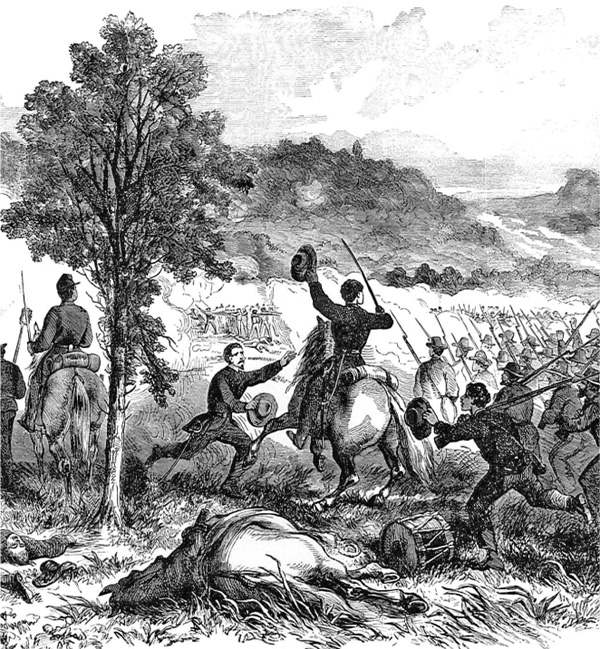
Detail of a period engraving of the Battle of Wilson’s Creek.
ST. LOUIS, SUNDAY, MAY 12
The city was the scene of another terrible tragedy last night. About 6 o’clock a large body of the Home Guards entered the city, through Fifth-street, from the Arsenal, where they had been enlisted during the day, and furnished with arms. On reaching Walnut-street, the troops turned westward, a large crowd lining the pavement to witness their progress.
At the corner of Fifth-street ladies among the spectators began hooting, hissing, and otherwise abusing the companies as they passed, and a boy about fourteen years old discharged a pistol into their ranks. Part of the rear company immediately hurried and fired upon the crowd, and the whole column was instantly in confusion, breaking their ranks, and discharging their muskets down their own line and among the people on the sidewalks. The shower of balls for a few minutes was terrible, the bullets flying in every direction, entering the doors and windows of private residences, breaking railings, and even smashing bricks in the third stories.1
The utmost confusion and consternation prevailed, spectators fleeing in all directions, and but for the random firing of the troops, scores of people must have been killed. As most of the firing was directed down their own ranks, the troops suffered most severely, four of their number being instantly killed, and several wounded....
1. On May 10 Nathaniel Lyon forced the surrender of the Confederate militia in St. Louis. As Lyon marched the prisoners through the city, a crowd gathered. Exactly what provoked the shooting remains unclear, but the most common explanation is that a drunkard stumbled into the path of the marching soldiers and fired a pistol into their ranks, fatally wounding one German soldier, Captain Blandowski. The volunteers, in retaliation, fired into the crowd, killing some 20 people, some of whom were women and children, and wounding as many as 50 more.
OBITUARY.
COLONEL ELMER E. ELLSWORTH1
MAY 25
We are again called upon to record the death of the commanding officer of a New-York Regiment. The flags which, half masted, expressed to all beholders the sympathy extended by our citizens to the family of Col. VOSBURGH2 had but just flung forth from staff top their Stars and Stripes, when again they were lowered in token of bereavement.
Without a doubt, the name of Col. ELLSWORTH is more familiar to the ears of New-Yorkers than that of any other officer who has left this City during the present emergency. He was not a resident here, but the peculiar introduction afforded him by the exhibitions of his Chicago Zouave corps,3 his subsequent participation in the Presidential tour from Springfield to Washington, and finally the deep interest felt in the Fire Brigade by all ranks and conditions of citizens, have combined to render him popularly famous and deserving of more than ordinary notice. To these is added a last but unanswerable argument in support of his fame — for we learn by reliable dispatches from Washington, that while on Virginia soil, in performance of an honorable duty, he was shot and infamously murdered....
He has been assassinated! His murder was fearfully and speedily revenged. He has lived a brief but an eventful, a public and an honorable life. His memory will be revered, his name respected, and long after the rebellion shall have become a matter of history, his death will be regarded as a martyrdom, and his name will be enrolled upon the list of our country’s patriots.
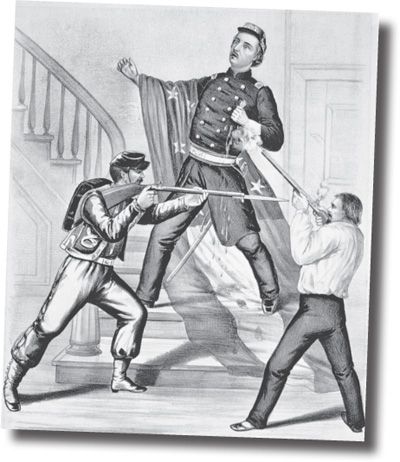
A Currier and Ives print depicting the death of Colonel Ellsworth.
1. Colonel Elmer Ellsworth (1837–1861) was killed by a Southern partisan while removing a Confederate flag from atop an Alexandria hotel. His death was notable not only for the circumstances and the fact that it was still very early in the war, but also because of his friendship with President Lincoln. After his death, his body lay in state in the East Room of the White House for a day before being sent on to New York for burial.
2. Colonel Abram S. Vosburgh, commanding officer of the 71st Regiment New York Militia, died in Washington of a heart attack on May 20. His body was returned to New York for a public funeral on May 23.
3. The 11th New York Regiment that Ellsworth commanded had been recruited from New York City’s fire departments. It was also a Zouave regiment, which meant that the men wore colorful uniforms (inspired by the French North African soldiers) consisting of baggy red trousers, short blue jackets, and caps with a tassel. For these reasons, the 11th New York was generally referred to as the “Fire Zouaves.”
SLAVES CONTRABAND OF WAR.
MAY 27
Gen. [Benjamin] BUTLER1 appears to be turning his legal education, to good account, in the construction of the law in reference to articles that are contraband of war. Three negroes, having escaped into Fort Monroe, he set them at work on the fortifications, and when demanded by an F. F. V.2 he replied that they were contraband of war, for the reason that they might be employed by the enemy, for the service to which he had assigned them. We believe the General did so far modify his refusal, as to offer to give up the negroes, providing their owner would take the oath to support the Constitution of the United states! All this, upon the Sacred Soil of Virginia! We think the people of the State will find the General a match for them in more ways than one.
1. Benjamin F. Butler (1818–1893) was a Massachusetts lawyer and politician who served several terms in the House of Representatives. A War Democrat with a state militia rank, Lincoln made him a brigadier general upon the outbreak of war, and he commanded troops at Fort Monroe on the Virginia Peninsula in May of 1861.
2. F.F.V. is an abbreviation for First Families of Virginia — a mocking reference to the aristocratic pretensions of Virginians.
THE ERROR IN THE FOREIGN VIEW OF THE CONTEST.
MAY 27
One of the most remarkable features of the present crisis in our national affairs are the crude and inadequate views taken of it by foreigners, particularly Englishmen. They appear to think the tie that holds the States together is a mere rope of sand, to be severed at will; that there is no good reason why the country should not be broken into two, three, or four Confederacies, instead of constituting one. They say that if the present Union combines elements that are uncongenial, or that have a mutual repulsion, why not leave them to their natural tendencies, instead of holding them together by force? The same idea was prevalent among a portion of our people at the North till the rupture actually occurred, when the alternative instantly presented itself to each section — the triumph over the whole country of its own ideas, institutions and industries, or subjection of all these to the other.
One of the parties must be now prepared to submit to this inevitable result. …We now can have no peace till one of the two civilizations triumphs. We lived together for a long time in harmony, upon the assumption that we constituted one nationality. This the seceding States deny, and seek to embody their own in a new Government, and by new laws and institutions. If a peaceful separation could have been effected in the outset, the antipathy that would instantly have sprung up would have been full of future wars. England and Scotland were always embroiled till they were united under one Government. The short cut to peace in this country is a reunion of the States, though this may cost us a great war. The weaker party must take and forever keep the subordinate place....
THE PROCLAMATION OF THE BRITISH GOVERNMENT.
MAY 28
We place, this morning, before our readers the Proclamation of the British Government in reference to the rebellion existing in certain States against the Government of the United States, forbidding its subjects to take any part in the contest, or to interfere with the blockade that may be established by either party, or to transport officers, soldiers, dispatches, arms, military stores or materials, and enjoining strict neutrality toward the belligerents, and placing both upon exactly the same footing.1
This proclamation cannot fail to be highly offensive to the United States, as it is a virtual recognition of the Confederate States; or, should this be disclaimed, as a direct encouragement, by a great nation, of a purely domestic quarrel — of an armed resistance to legally-constituted authorities, which is already assuming all the horrors of a civil war. Such an act is unexampled in the history of diplomatic intercourse. There is no more reason why England should take the position she has in reference to our controversy with the rebels, than with the Mormons....
Here is the policy that governs the United States in its intercourse with other nations. Will that Government use similar language to one of its subjects proposing to go to South Carolina to join the rebels? Will it proclaim the soil of that State to be still a part of our own Confederacy? We treated the outbreak in Canada as if it was a resistance to constituted authorities, to be put down by the local police, aided if necessary by the military arm. We did not speak of the contending parties then as standing in the same relation to us, nor extend to a rebellion the same consequence and dignity as to the Government seeking to put it down.
1. The British proclamation, dated May 13, 1861, ordered British citizens to respect a strict neutrality between the United States and “certain states styling themselves the Confederate States of America.” Despite protests by Union sympathizers (like The Times), it worked to the benefit of the Union cause since, among other things, it prevented Confederate raiders from using British ports for supply or refit.
AFFAIRS IN BALTIMORE.
HABEAS CORPUS CASE.
MAY 29
BALTIMORE, MONDAY, MAY 27
At 11 o’clock A.M., to-day, the United States Marshal made his return to the writ of habeas corpus issued by Chief Justice TANEY in the case of JOHN MERRYMAN, of the Hayfields.
The writ was returned served.
At the same time appeared in Court Major BELGER, one of Gen. CADWALADER’s Staff, and with permission of the Court read a communication from the latter officer, stating that Mr. MERRYMAN was held in arrest at Fort McHenry, on the charge of treason, and that he, Gen. CADWALADER, had received instructions from the President to suspend within the limits of his command the writ of habeas corpus.
The body of Mr. MERRYMAN not having been brought into Court in obedience to the writ, the Chief Justice ordered an attachment against Gen. CADWALADER, returnable to-morrow, Tuesday, at 12 o’clock P.M.
Great interest is felt in this case; one of the most important in its connection with the powers of the Executive, and the rights and liberties of the citizen, that has arisen since the formation of the Government.
Mr. MERRYMAN is a man of family, and a gentleman of property and position, President, also, of the Maryland State Agricultural Society, and widely known and respected. He was arrested on a general order, issued for the apprehension of “The Captain of a Secession Company in Baltimore County.” The order did not set forth any name or offence, and was executed at night by a detachment of the First Regiment Pennsylvania Volunteers, under a Capt. YOE. Mr. MERRYMAN is not the Captain of any company, but is a Lieutenant in a company of cavalry, commanded by Mr. CHARLES RIDGELEY, of Hampton.
The State of Maryland is still a member of the Union, and in her political character has taken no steps hostile to the Government. The United States Courts are here in full and free discharge of their functions, and the United States Marshal can execute processes without the slightest danger of obstruction in all parts of the territory occupied by her citizens. The Administration, in ordering these military arrests, and in suspending the privilege of the writ of habeas corpus, is not regarded here as being in any way justified by that salus populi which is supposed sometimes to overrule the Constitution.1
1. Roughly translated, this means: “The welfare of the people shall be the supreme law.”
DECISION OF CHIEF JUSTICE TANEY ON THE JOHN MERRIMAN HABEAS CORPUS CASE.
MAY 29
BALTIMORE, TUESDAY, MAY 28
St. Paul’s-street, fronting the United States Court house, was densely crowded, as was, also, the court-room, at noon today, to learn the proceedings in the habeas corpus case of JOHN MERRIMAN [sic].1
Gen. CADWALLADER2 having, as stated yesterday, declined acceding to the demand until he could hear from Washington, a writ of attachment was issued against him, to day, for contempt of court. The Marshal reported that, on going to Fort McHenry to serve the writ he was refused admittance. Chief-Justice TANEY3 then read the following statement:
“I ordered the attachment, yesterday, because upon the face of the return the detention of the prisoner was unlawful, upon two grounds.
First — The President, under the Constitution and laws of the United States cannot suspend the privilege of the writ of habeas corpus, nor authorize any military officer to do so.
Second — A military officer has no right to arrest and detain a person, nor subject him to the rules and articles of war for an offence against the laws of the United States, except in aid of the judicial authority, and subject to its control, and if the party is arrested by the military, it is the duty of the officer to deliver him over immediately to the civil authority, to be dealt with according to law.
I forebore yesterday to state orally the provisions of the Constitution of the United States which make these principles the fundamental law of the Union, because an oral statement might be misunderstood in some portions of it, and I shall therefore put my opinion in writing and file it in the office of the Clerk of the Circuit Court, in the course of this week.”
The Judge added that the military authority was always subordinate to civil. That, under ordinary circumstances, it would be the duty of the Marshal to proceed with posse comitatus and bring the party named in the writ into Court; but from the notoriously superior force that he would encounter, this would be impossible. He said the Marshal had done all in his power to discharge his duty.
During the week he should prepare his opinion in the premises, and forward it to the President, calling upon him to perform his constitutional duty, and see that the laws be faithfully executed, and enforce the decrees of this Court.
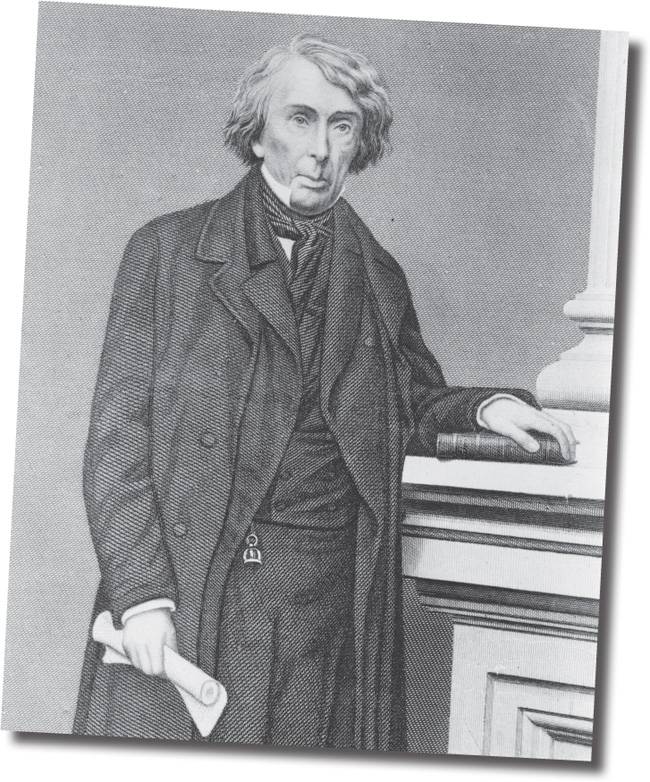
Roger B. Taney, chief justice of the Supreme Court.
1. John Merryman (1824–1881) was a Maryland citizen arrested for burning bridges in his state to prevent the passage of Union troops to Washington.
2. Major General George Cadwalader (1806–1879) commanded the troops that arrested Merryman. He denied Taney’s writ upon orders from Lincoln.
3. Roger Brooke Taney (1777–1864) was chief justice of the U.S. Supreme Court and author of the notorious majority opinion in the Dred Scott case (1857). In the Merryman case, acting as a circuit court judge, he ruled that only Congress could suspend the writ of habeas corpus. Lincoln ignored Taney’s decision and defended his actions before Congress, asking rhetorically: “Are all the laws, but one, to go unexecuted, and the government itself go to pieces, lest that one be violated?” In 1863 Congress formally suspended the writ.