
CHAPTER 4
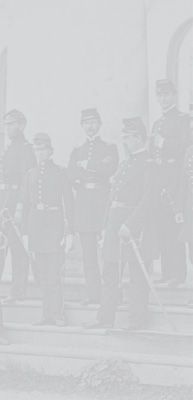
Union General Irvin McDowell and some members of his staff at Arlington House in 1862.
As the number of Union soldiers in and around Washington swelled, anxiety that the rebel forces might seize the capital gradually gave way to demands that the Union should initiate an offensive of its own. Horace Greeley, editor of the rival New York Tribune, ran the banner headline “On To Richmond” above the paper’s mast-head. Feeling the pressure of public expectations, Lincoln encouraged General Winfield Scott to authorize an offensive. Elderly and in fragile health, the 74-year-old Scott was aware that he could not lead the army in person, and he chose as the army’s commander 42-year-old Irvin McDowell, who was promoted from major to major general in one step. Lincoln then urged McDowell to take the offensive, and when the young general protested that his soldiers were “green,” Lincoln famously replied: “You are green, it is true. But they are green also. You are all green alike.”
There were four field armies in the Virginia theater in June of 1861. One was McDowell’s own force of about 30,000 men near Alexandria, just across the Potomac River from Washington. Some twenty miles to the south was a Confederate army of about 22,000 under Major General P. G. T. Beauregard, who had commanded the batteries that had fired on Fort Sumter. Beauregard’s army was encamped in the vicinity of Manassas Junction, where the Manassas Gap Railroad met the Orange and Alexandria Railroad, just south of Bull Run Creek. West of these two armies were two more: a Union force of 18,000 or so under Major General Robert Patterson at Harpers Ferry, where the northward-flowing Shenandoah River ran into the Potomac, and a Confederate force of about 12,000 men under General Joseph E. Johnston just to the south. Each Federal army outnumbered its Confederate counterpart, but if the two Southern armies could combine against one of the Union armies, it would more than even the odds, and that is what happened.
McDowell set out from Fairfax in northern Virginia on Tuesday morning, July 16, 1861. That same day, Robert Patterson cautiously probed southward from Harpers Ferry with the objective of pinning Johnston’s army in place. But Patterson’s feint was unconvincing, and almost at once, Johnston put his small army in motion marching toward Ashby’s Gap in the Blue Ridge Mountains, and from there to the Manassas Gap Railroad to join Beauregard.
The first contact between the armies came on July 18, when skirmishers from McDowell’s force encountered Beauregard’s army behind Bull Run Creek south of Centerville. Henry J. Raymond, the 41-year-old owner and editor of The Times, had accompanied the Union army to Centerville, and he filed a lengthy story of the skirmish. This early in the war, the confrontation seemed of great importance and deserving of extended treatment. His report is a personal narrative, written in the first person, and with little effort to maintain detachment.
Two days later, McDowell sent the bulk of his army on a long predawn flank march around the rebel left. This move began early on July 21 and achieved initial success, driving the rebel defenders off Matthews Hill, and across Youngs Branch to Henry House Hill — so named because the home of the widow Judith Henry was there. For several hours the two armies slugged it out on that broad plateau where “Stonewall” Jackson earned his nickname.
Once again, Raymond was a witness. In order to get his story back to New York as quickly as possible, he filed it at two o’clock on the afternoon of the battle while the armies were still engaged. Like all early reports from the front, Raymond’s announced a Union victory. But only about an hour after Raymond filed his story, late arriving reinforcements from Johnston’s army turned the tide, and it was the Federal army that began to retreat, a retreat that soon turned into a rout. When Raymond appeared at the army telegraph office — “sun-burned, dusty, and hardly recognizable” — to file an updated report, the army telegraph officer was reluctant to let him do so. Consequently the true account of the debacle at Bull Run did not appear in the pages of The Times until July 24.
Raymond filed an even longer story the next day (July 22) that appeared in the July 26 issue. Like his earlier reports, it was a personal account that focused particularly on the exploits of the 11th New York Regiment, called the Fire Zouaves — Elmer Ellsworth’s old regiment. At Bull Run, the Fire Zouaves were commanded by Colonel Noah Farnham, affectionately called “Pony” by the men because of his short stature (5’4“). Farnham was mortally wounded in the fighting that day, one of 35 killed from the regiment. This tale, a moving and detailed description of one unit’s fight, is a paean to the New Yorkers who fought and fell in the first great battle of the war.
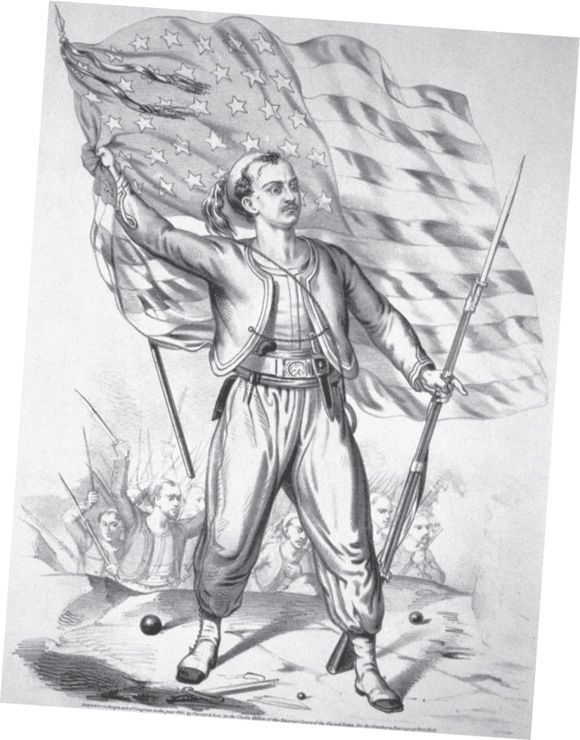
A Currier and Ives lithograph of a Fire Zouave.
THE BATTLE AT GREAT BETHEL.
JUNE 14
FORTRESS MONROE, VA., JUNE 11
Old Point Comfort, Fortress Monroe and parts adjacent, have been full of all sorts of rumors since last evening, respecting the preliminary engagement between the United States troops and the secession forces which took place, yesterday, at a place called “Bethel.”1
The first part of the work was well done, between 11 o’clock at night and daylight in the morning, by a detachment of the Naval Brigade. The manner in which they handled their boats, receiving and landing the regiments committed to their care, elicited the warm personal commendation of Gen. BUTLER, who was soon on the ground. From this point of landing, the troops marched toward Yorktown, suffering some detention and annoyance from the well-directed but mistaken fire of the Steuben rifles. These German soldiers are among our best, and at the proper time and place will be found powerful in defence of the Union.2
The regiments detailed were soon marched, one by one, into the open and marshy field in front of the secession works at Bethel. Here, under a raking fire, they behaved with great bravery. Many instances of valor occurred worthy of honorable mention. Among others, Col. [Frederick] TOWNSEND, of the Albany Regiment, dashed on horseback to within a few feet of the battery, in the midst of a shower of bullets, to ascertain the extent of the works and the best manner of assailing them. For hours together our men withstood the deadly fire of these intrenchments, behind which was a superior body of secession troops, entirely protected, wielding several large guns, among them rifled cannon, and commanded by experienced officers who had recently deserted from the United States Army. At the close of two hours’ hard fighting the Union forces withdrew in good order, to recruit, reinforce, arm with large ordnance, and renew the attack....
1. The Battle of Big Bethel (June 10, 1861) is often held to be the first battle of the war. Union troops venturing westward out of Fort Monroe ran into a Confederate defensive line behind Brick Kiln Creek near Big Bethel Church. After some desultory firing, the Union withdrew, though not (as the article states) “in good order.”
2. The Steuben Rifles was a New York infantry unit composed of men of German ancestry.
WESTERN VIRGINIA TO FORM A NEW STATE.
JUNE 19
The Convention now in session at Wheeling, in which are represented about forty counties of Western Virginia, have, by a formal and unanimous vote, resolved to cut loose from the Old Dominion and form for themselves a new and independent State.1 What name they will give to their new Commonwealth is not yet discussed. It may be ALLEGHANY. But whatever the name, the fact will be the same. The great State of Virginia is to be dismembered by the voluntary act of over a half million of her late citizens; and a new State formed from the Western part of her territory will claim a place in the Union....
The regret felt by a portion of the public at this action, arises from the fear that it may occasion embarrassment in failing to meet the approbation of Congress. If the Federal Government refuse to acknowledge the secession of a State, it cannot well recognize, in attempted secession, a cause for the dismemberment of a State by its loyal inhabitants, as a remedy for the evils with which they are threatened.
Then there are other questions touching the existence of Slavery in the new Commonwealth — for it would contain a considerable number of slaves — and the consequent increase of slave representation in the United States Senate would not fail to excite more or less jealousy in certain parts of the Union.
But these difficulties are rather technical than substantial. The division of a State and the creation of a new one out of a part of its territory is, under certain circumstances, feasible under the Federal Constitution. Virginia is a very large State, and very susceptible of division. It is not homogeneous in any respect. The Eastern part differs from the West in climate, soil and productions — in customs, political sentiments and institutions. The trade of the two divisions of the State falls into different channels and reaches the market by routes that require wholly different systems of internal improvements. And herein lies one cause for the deep feeling of alienation in Western Virginia from the Eastern portion of the State: — that the latter has, by an unfair basis of representation in the Legislature, founded on Slavery, controlled the internal improvement system of the State, and run up an enormous debt of near fifty millions of dollars which rests like an incubus on the people, for the advantage and development of the Eastern counties; while the West has received practically no share of the improvements they are taxed to pay for.
In the facts of their physical relation and political condition, there is abundant reason for Eastern and Western Virginia forming two separate and distinct Commonwealths; and apart from the connection of the present movement for dismemberment with secessionism, and the quasi acknowledgment of this modern, political heresy that is supposed to be involved, the erection of a new State in Western Virginia might well be advocated as a wise and necessary measure....
1. The first Wheeling convention met May 13–15, 1861, and voted to separate 39 counties from Virginia to form the new state of Kanawha, or West Virginia. In a disputed election, voters ratified the decision on May 23. A second convention held June 11–25 also voted to secede from Virginia. A pro-Union Virginia government in exile headed by Francis H. Pierpont approved the separation, but the difficulty was the existence of slavery. In the end, West Virginia was not admitted as a separate state until June 20, 1863, and only on the condition that a provision for the gradual abolition of slavery be inserted in its constitution.
WHERE WILL THE INSURGENT ARMY OFFER BATTLE?
JUNE 19
Our readers will not have forgotten our attempt to demonstrate, some weeks since, that the insurgent army was distributed over so large an area that its communications could not be maintained, and that, consequently, some of its isolated divisions must either retreat or be cut off. Gen. JOHNSON’s [Joseph E. Johnston’s] command at Harper’s Ferry, we ventured to suggest, was posted in a position utterly untenable — a very trap, whence it would be compelled either to retreat or surrender. A few days since, we began to receive news of the destruction of the bridges across the Potomac; then, of breaking up the boats on the Chesapeake and Ohio Canal; next, that the insurgents were tearing down the locks; and, finally, that they were destroying the dams on that costly work — together with accounts of much other of that preliminary devastation which usually marks the beginning, and too often the progress, of a retiring army.1
The question now naturally arises for speculation and solution — What is to be the line of the retreat, and the strategical movements which will necessarily result from it; and, finally, the point which the rebel army is likely to select as the place where it may stake the existence of the insurrectionary Government on the result of a battle?
Public opinion has very generally fixed upon Manassas Junction as the chosen field of the approaching conflict; but we cannot suppose — although we do not hold a very exalted opinion of Mr. President DAVIS, or, indeed, of either of his traitor Generals, all of whom, as leaders of armies, have yet their first spurs to win — that the insurgents will be imprudent enough to risk the fate of the rebellion on that ground. It is true that, after first hastily occupying, they have since been industriously strengthening, that position — which possesses in itself no peculiar natural advantages for defence — and have already assembled a very formidable force there. But we look upon that force as merely intended to cover the retreat of Gen. JOHNSON’s [Johnston’s] command, and the intrenchments which have been formed there as only the customary prudent precaution against an unexpected attack.2
As a question of political strategy on the part of the insurgents, the position now occupied by their army at Manassas Junction should certainly be maintained, in order to avoid the discouragement which a retreat always sheds over the spirit of a rebellion. But, viewed in a purely military aspect, there can be no doubt that the rebel army should retire upon Richmond — where, resting on James River, the surrounding hills and valleys, properly intrenched, would enable them to make a formidable and prolonged resistance.
In our view, this problem will be solved — though doubtless with much reluctance — in a council of war, with reference mainly to military prudence; and Manassas Junction, like Harper’s Ferry, is therefore, we think, destined to be speedily abandoned; while the force which has already retired from the Potomac, will retreat up the Valley of Virginia upon Staunton, leaving only the needful detachments temporarily to guard the passes of the Blue Ridge, and follow on as the rear guard of the retreating army....
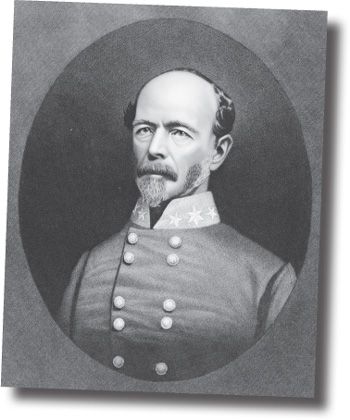
General Joseph E. Johnston, C.S.A.
1. General Joseph E. Johnston (1807–1891) was the senior ranking officer in the Confederacy at the time. Johnston himself argued that his position at Harpers Ferry was untenable, but Jefferson Davis urged him to hold it anyway. When Johnston withdrew nonetheless, it marked the beginning of a disagreement between them that would eventually poison their relationship.
2. In this, of course, The Times was in error. Beauregard preferred to defend his position at Manassas and Johnston brought his army from the Shenandoah Valley to reinforce him.
THE PRESIDENT’S MESSAGE.
JULY 6
It is common to herald a President’s Message to the world as an important document. And often it is so. But never was a Message less important than the one transmitted yesterday to Congress by President LINCOLN, of which a report will be found in the TIMES to-day, although the occasion is the most extraordinary that ever occurred in our country for the writing of a Message.1 The telegraph, or some strange fate that presided in the transmission and reprint of the document, has apparently coincided in this view of its value, for never before have we had a more painful jumble from which to extract the pith and meaning, the statement and sequence of a State paper.
We have at the outset what perhaps is in the original document, a faithful narrative of events in the progress of secession down to the bombardment of Fort Sumter. And there is a careful effort to establish the fact that the Seceding States had become the aggressors in their struggle against the Union by the act of bombarding that fort. And the enormity of this assault on Fort Sumter is particularly dwelt upon in view of the circumstance that the Government only intended to “send bread to a few brave and hungry men,” on the occasion when the assault to repel or prevent was made by South Carolina.
To our minds, the people of the United States attach little consequence, to the event, here magnified as the justifying cause for war. That was only the culminating act, the last, but not the worst, of a long series of insults, wrongs and robberies against the National Government, any one of which would have fully justified the steps for repressing rebellion that have since been taken.
The firing on the Star of the West was as much the beginning of the war as the bombardment of Fort Sumter.2 The erection of a hostile battery, without a gun fired, was an equal act of war and demanded chastisement. Long before the assault on Fort Sumter, the act of treason in South Carolina was complete; the Flag of the Nation had been hauled down from every Government building, and insulted, the property of the Government had been seized, and its officers forcibly withheld from the discharge of National duties. Let the case of Sumter go, and the pitiable question of a supposed armistice with South Carolina rebel rulers at the time. They have very little to do with the righteousness of this war....
1. Lincoln’s Message to Congress, presented on July 4, and containing the memorable rallying cry “this is a people’s contest,” can be found in Basler, ed., The Collected Works of Abraham Lincoln, 4:421–41.
2. In January 1861, President James Buchanan had sent the chartered steamer Star of the West to Charleston with supplies for Major Anderson’s beleaguered garrison. On January 9, it was fired on as it attempted to enter the harbor. Arguably, those shots, and not the ones three months later, were the first of the Civil War.
THE FIGHT AT BULL’S RUN.
A RECONNAISSANCE IN FORCE — THE TROOPS ENGAGED AND HOW THEY BEHAVED.
JULY 21
CENTREVILLE, VA., THURSDAY EVENING, JULY 18
This has been an eventful day for the Army of Advance, and the result will unquestionably be represented as a great victory on the part of the rebels.1 In a word, the affair was a reconnaissance in force of a wood at Bull’s Run, whose contents were unknown. It proved to be a masked battery, behind which some 5,000 of the rebels had entrenched themselves, and our five regiments, which were sent against it, were repulsed with considerable loss — a loss, the extent of which I cannot state with any accuracy, but which probably amounted to not far from in 150 killed and wounded.2 On our side, [William T.] SHERMAN’s battery, under Capt. [Romeyn Beck] AYRES, was the only one engaged. It behaved with great gallantry, but the extent of damage inflicted cannot be known, as it fired constantly into dense woods. Our forces were all withdrawn to the rear, the most of them as far back as Centreville, four miles from Bull’s Run, which is itself about the same distance from Manassas Junction. The attack will unquestionably be renewed in the morning, not only upon this masked battery but upon the entire rebel force at Manassas — with what result I shall probably be able to tell you to-morrow.
So much for the general result — now for the details of the affair, so far as they came under my personal observation.
I left Fairfax Court-house at a later hour than I intended, and reached Centreville at about 11 o’clock. The rebels here had thrown up intrenchments on a high hill, overlooking the road as it debouches from a fine wood, and a large open field, admirably fitted for defence. They had abandoned them, however — and this confirmed the general impression that they did not mean to fight. The troops which had been brought forward — comprising only a portion of Gen. [Daniel] TYLER’s brigade, were here halted for rest, and remained three or four hours. My carriage had become entangled in the baggage-train, and was some two miles in the rear. I began the tour of Centreville in search of food, as I had had no breakfast, and was nearly famished. While swallowing a cup of very poor coffee, which I persuaded the servants of a deserted mansion to sell me, I heard the sound of cannon in the direction of Manassas. I immediately pushed forward on foot, under a blazing sun, and after a brisk walk of three miles — during which the only refreshment I could procure was a little vinegar and water — I came to a wood through which the road leads over a high rise of ground, with an oatfield on the right, and on the left a meadow, in which is placed a small house, with an adjoining shed. In the oatfield, on the right, were stationed two of the Parrot guns, under Lieut. [Samuel N.] BENJAMIN. As you pass the crest of the hill, your eye falls upon a gentle slope of meadow on the left of the road — bordered on the lower side by a thick growth of low trees, and rising, after passing a ravine, to high ground on the other side. At the right of the wood was an open plain — with a house and barn some fifteen or twenty rods from the wood. As I approached the first hill, I saw SHERMAN’s battery drawn up on the left, behind the crest, and the First Massachusetts Regiment, in line of battle, some twenty paces behind, in a hollow, to be out of reach of the rebel batteries.
At about 1 o’clock, as the head of our column rose over the crest of the hill, it was saluted by a shot from the rebel battery quite across the ravine — which fired eight or ten rounds from two guns, and was briskly answered by Capt. AYRES. After about ten minutes, their firing ceased, and it was supposed that the rebels had retreated. They had fired no rifled cannon, and it was believed they had none.
Skirmishers were at once thrown out from the whole brigade, which was commanded by Col. [Israel] RICHARDSON, and consisted of five regiments, into the woods on the left — while the First Massachusetts was drawn up in line of battle immediately in front of the woods, and the Twelfth New-York, Col. WALWORTH [actually Colonel Ezra Walrath], just at their right. The Second and Third Michigan Regiments were sent to the extreme right, and marched in a right line from the road, towards the wood, and drew up in line of battle. The skirmishers pushed into the wood and were permitted to penetrate to some distance, without being fired on. Soon a few scattering shots were fired at them — and then the First Massachusetts Regiment and the Twelfth New-York were pushed in together. I had gone into the field bordering the wood, about one-third of the way to the wood, and watched them enter. They had been gone perhaps five or ten minutes when a full, round volley was tired directly in their faces from a breastwork in the, ravine, behind which the whole rebel force had been drawn up. They could not see their assailants, — they scarcely fired a single shot at them, but were shattered by the deadly fire thus suddenly opened upon them. At intervals of perhaps a minute this volley was repeated five or six times — the rebels accompanying each fire with tremendous shouts. Two howitzers, belonging to SHERMAN’s battery, were sent past me through the field into the wood, and opened fire, which was returned by the same vollies. After a few minutes a rebel battery of cannon, planted upon a small cleared space in the wood, which I could see very distinctly with my glass, opened fire, first upon the howitzers in their vicinity. But after two or three shots they sent half-a-dozen balls into the field where I stood, and over my head into the group of officers and soldiers gathered about the house to watch the firing. One shot struck some 20 feet from me, — another went through the shanty adjoining the house, and a shell exploded in the field some 20 rods from where I stood, without doing any damage.
At 2 1/2 o’clock a company of cavalry, Texas Rangers, belonging to the regular force, had crossed the field and taken possession, the men dismounting, armed with carbines, immediately in front of the wood. While stationed on the hill during the first firing, one of the rebel shots had fallen in their midst and severely wounded one of them who had been carried back into the wood. After the firing from cannon and musketry which I have mentioned had been continued some twenty minutes — many of the musket shots reaching the point where I stood — I saw the Twelfth New-York Regiment rush pell-mell out of the wood, followed by the Massachusetts men, marching in good order. Their appearance was the signal for a general retreat of the forces in that neighborhood. The regular cavalry wheeled and ran their horses up the hill at the top of their speed — putting those of us who were on the hill side in greater peril of life and limb than we had been before during the day. Two companies of the New-York Twelfth kept their ground well and came off in good order. The rest made good time in leaving a position which it could not be expected for a moment that they could hold. The Michigan regiments, on the right, kept their position for a time, but soon drew off with the rest.
It was clear that the rebels were intrenched in great force in the wood, and that they had a powerful battery there, some of the guns being clearly rifled cannon from the noise the balls made as they passed over our heads. Clouds of dust, coming towards the front from the hills in the rear, indicated that they were bringing up reinforcements. The withdrawal of our troops was in pursuance of a purpose to change the plan of attack. Orders were sent back for reinforcements. SHERMAN’s whole battery was ordered into the garden on the left of the road, just in front of the house; two guns were planted in the oatfield on the opposite side, and at 3 1/2 o’clock, a shot from the rebels flying over my head, followed by two from the Parrott guns in the oatfield rushing in the opposite direction; satisfied me that the safest place during an engagement was not between two hostile batteries. We fell back, therefore, behind the crest of the hill. The firing on both sides grew very brisk, and the shot from the rebels nearly all passed overhead, crashing among the trees of the wood beyond, and wounding several of the great number of persons, troops and others, who had collected there for shelter. Just then the Sixty-ninth New-York Regiment came up through the wood — the ears of its men being constantly saluted by these whistling balls — and was ordered to form in the field behind the house. It was soon followed by the Seventy-ninth, who did not, however, go out of the wood. The firing which had commenced at 3 1/2 o’clock ceased on both sides at five minutes before four, and our entire force was ordered to withdraw on Centreville.
This is the whole of it — and I have no time to add comments, as this hasty letter must be sent at once by a special messenger, who may reach Washington in time for the 4 1/2 o’clock mail to-morrow morning. Gen. MCDOWELL, who had been to visit the other column, came up just as the engagement was over. I believe he says the existence of this battery was well known, and that the men ought not to have been sent against it. Gen. TYLER, formerly of the U.S. Army is an officer of merit and experience. He displayed great coolness throughout the whole affair. I met a son of Gen. [Henry] LEAVENWORTH coming off the field, a lad of 17, who had staid in the wood to bathe his feet, after the Twelfth, to which he belonged, was driven out, and who says he was surprised to find he was not half as much scared as he had expected to be. While on the side-hill, being half famished with thirst, I asked a swallow from the canteen of a portly gentleman who was passing. He gave it to me, and I found it was Hon. Mr. LOVEJOY, of Illinois.3 There were half-a-dozen private gentlemen present as spectators.
The criticism which will be made on this mishap will be that men should not have been thus thrust upon a masked battery — that it is a repetition of the old Big Bethel and Vienna affairs. Gen. TYLER, however, says that it was only a reconnaissance in force — that the object he had in view was to determine what force and batteries the enemy had at that point — and that he now understands this perfectly. Undoubtedly, this is so; the only question is, whether the knowledge was not purchased at too dear a cost. Upon one thing you may rely. This misfortune will not delay the attack on Manassas. On the contrary, it will hasten it. But I think that, instead of leading troops directly against batteries, whether masked or not, Gen. MCDOWELL will turn their entire position. The movement of troops, to-night; indicates a purpose to throw the troops upon the north side of the intrenched camp, from this point, while other columns will approach it from other directions. The result will vindicate the movements.
H. J. R.4
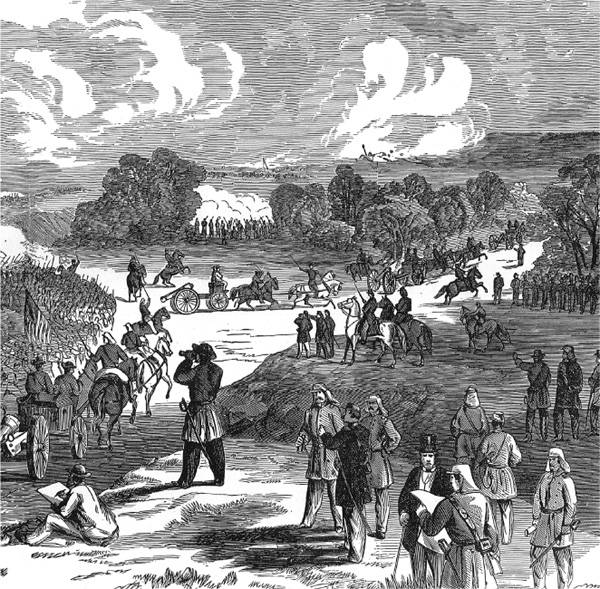
Preliminary movements by federal troops at Bull Run.
1. This article refers to the skirmish on July 18 at Blackburn’s Ford, and not the much larger general engagement three days later.
2. The estimate is quite accurate. Union losses were 85, and Confederate losses 66, for a total of 151.
3. Owen Lovejoy (1811–1864) was a Republican congressman from Illinois and the brother of Elijah P. Lovejoy, who had been murdered in 1837 for running an abolitionist newspaper.
4. Henry J. Raymond.
WILL GEN. SCOTT LEAD THE ARMY — GEN. MCCLELLAN — A CHANCE FOR SPECULATION.
JULY 21
WASHINGTON, FRIDAY, JULY 19
It is not known whether Gen. SCOTT intends to take the field in person. Some think he will; but it is probable that his age and feeble health may interpose barriers to an active participation in the fight. At any rate he will receive the glory of having planned the campaign, when success... crowns it, and his laurels will not be sullied by his remaining quietly at Washington. He may follow the Army and direct its movements, but it cannot be expected of a man 75 years of age, that he should lead the advancing columns which he has organized and assigned to their respective duties. If Gen. SCOTT shall, for the reasons here assigned, remain in Washington, there is ground to hope that he will call [George B.] MCCLELLAN1 to the command of the centre, putting him over the divisions of PATTERSON and MCDOWELL, and of the whole Army when its several parts shall converge together. The achievements of Gen. MCCLELLAN in Western Virginia1 have fully sustained the high expectations of his friends, and they now think that he should be placed in the more responsible command of leading the Grand Army to Richmond. He has already achieved all the glory that remains for him in the West, for if he expects to overtake [Henry A.] WISE,2 I predict that he will be sadly disappointed. Unless Gen. SCOTT in person shall take the field, and there is reason to apprehend that his health will not be equal to the task, — there is no man in the country in whom the people and the Army would repose so much confidence as in MCCLELLAN. His capture of the enemy’s camp, baggage, artillery and provisions, and an embarrassing number of prisoners, with a loss of less than fifteen killed, shows a power of combination and strategy from which we may expect the grandest achievements if he shall be placed in the right position. It must be remembered that Gen. MCCLELLAN’s Army is made up — with the exception of two companies — entirely of volunteers, and is indifferently provided with auxiliaries for prosecuting a successful campaign. The troops opposed to him were commanded by a distinguished Virginia officer, formerly of our Army, and the names of several others among the killed and prisoners may be found upon the Army Register for January, 1861.
The TIMES is unjust to the Virginians in its criticism upon the speed displayed by them in Western Virginia. There must have been some great natural impediments in their way — high-walled mountain barriers, or unfordable streams — to explain their ill-luck in getting out of the way of MCCLELLAN’s troops. At any rate, they have retrieved themselves by their expedition at Fairfax Court-House,3 and have well earned the new reading which some wag has given to the cabalistic letters, F.F.V. — viz., fast-footed Virginians.
It is due to the produce-dealers of New-York, and especially those of the West, to know that the Government is now paying $2.50 per bushel for beans. I understand from a Buffalo man that they can now be bought in that city for $1.37 1/2 to $1.50, and that the expense of transporting them to Washington is 20 cents — viz., to New-York 16 cents, and from thence to this city 4 cents. Here, then, is a chance for somebody to make money, and for the Government to save it. When the new crop comes in, it is said that beans will be sold for $1.25 in Buffalo. Peas, which are a good substitute for beans, sell for 75 cents at Buffalo, and may be had here at 95. These facts are sufficient to demonstrate that we have a liberal commissariat, and those who have provisions to sell should not stand back.
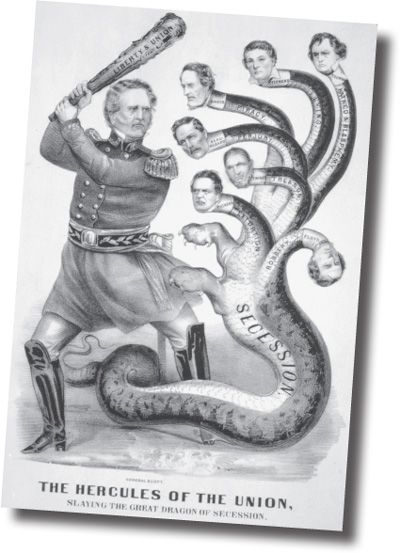
An editorial cartoon tribute shows General Winfield Scott slaying the Confederate states, represented by the mythological hydra.
1. George B. McClellan (1826–1885) won several small engagements in western Virginia in the summer of 1861, including the battles of Rich Mountain (July 11) and Corrick’s Ford (July 13), that established his reputation as a successful general.
2. Henry A. Wise (1806–1876), a former governor of Virginia, led a contingent of Confederate forces in this campaign. He soon quarreled with another Confederate political general, John B. Floyd, and the rift led to confusion and retreat. Indeed, McClellan’s early success in this campaign can be attributed in large part to the poor quality of these opposing generals.
3. A skirmish at Fairfax Courthouse on June 1, 1861, resulted in a small Confederate victory.
DISPATCH TO THE ASSOCIATED PRESS.
JULY 22
WASHINGTON, SUNDAY, JULY 21
The Secretary of War has received a dispatch that the fighting was renewed at Bull’s Run this morning. Our troops engaged the enemy with a large force, silenced their batteries, and drove the Secessionists to the Junction.
The city is wild with joy.
Firing was heard in this city to-day from the direction of Bull’s Run, from 11 till about 3. There was a cessation till nearly 5, and at 7 this evening the reverberation of cannon was again audible.
A gentleman who arrived to-night says at 3 o’clock this afternoon the Second and Third New-Jersey Regiments were ordered to march forward from Vienna, the First sending their baggage back to Camp Trenton. Other troops were hurrying forward to the scene of hostilities, and there is much military excitement and bustle in the direction of all the camps....
It is not doubted in military quarters that Gen. JOHNSTON was enabled to effect a junction with the Confederates some time during yesterday.
Official dispatches were sent to Gen. MCDOWELL at 2 o’clock this morning.
The New-York Thirty-seventh Regiment passed over into Virginia this morning, the band playing “Dixie,” amid the cheers of the soldiers and citizens.1...
1. The song “Dixie” debuted in a minstrel show in New York in 1859. During the 1860 election, Lincoln’s supporters used it in their rallies. During the war, Southerners changed the lyrics and declared it a regional anthem, though it continued to be played by both sides.
PREPARATIONS FOR THE BATTLE.
JULY 22
CENTREVILLE, SUNDAY, JULY 21, VIA FAIRFAX
COURT HOUSE, SUNDAY, JULY 21
We have successfully outflanked the enemy. At 2 1/2 o’clock this morning the various regiments about Centreville were formed for march, and at 3 o’clock they were in motion in the direction of Perryville, leaving Bull’s Run to the left. At 6 o’clock the first gun was fired by a thirty-pound rifled cannon, sent ahead to batter the masked batteries that might be encountered on the road. There was no reply from the enemy, and the advance moved on.
At Gen. MCDOWELL’s head-quarters, three miles beyond Centreville, the greater part of the army moved to the right, to avoid a bridge some distance beyond, said to have been undermined. They will pass over upon pontoons prepared by Capt. ALEXANDER, of the Engineer Corps, and who has inspected the country minutely in a previous reconnaissance, and to whom, in a great measure, the plan of the campaign is due.
A general battle is expected to-day or tomorrow, and which will probably decide the fate of the whole campaign.
If Gen. JOHNSON [Johnston] has not yet formed a junction with Gen. BEAUREGARD, he will be entirely cut off by this manoeuvre. Thrown back upon the mountains, his army will become utterly demoralized, and probably fall into the hands of Gen. MCCLELLAN, who is advancing beyond the Blue Ridge. And if he has formed a junction with Gen. BEAUREGARD, it opens our communication with Gen. PATTER-SON’s column; and thus reinforced, the National army can crush out opposition.
If we are driven back the army can retreat upon Centreville, and keep open the communication with Washington. If Gen. BEAUREGARD remains where he is, his communications in the rear are endangered, and Manassas Junction being situated in the apex of a triangle formed by railroads, a movement in his rear would destroy his communications with Richmond.
The only danger the National troops run by this flank march would be by a sudden advance of Gen. BEAUREGARD upon Centreville, interrupting communications and cutting off our supplies. But this manoeuvre would be desperate, as cutting himself off from supplies, and placing himself in an exhausted country, and between the National troops and the Potomac. The Sixty-ninth New-York Regiment1 was assigned the post of honor in advance. The members of this regiment have agreed unanimously to serve, although their time is now out.
All the New-York regiments will follow this example.
For five hours one steady column of troops passed through Centreville.
The morale of the soldiers is excellent. All are anxious for a battle, and when informed of the purpose to advance, the enthusiasm was beyond all description.
It is supposed that Gen. BEAUREGARD’s forces are larger than ours.
A battle is imminent at any moment, but it may not take place till to-morrow night....
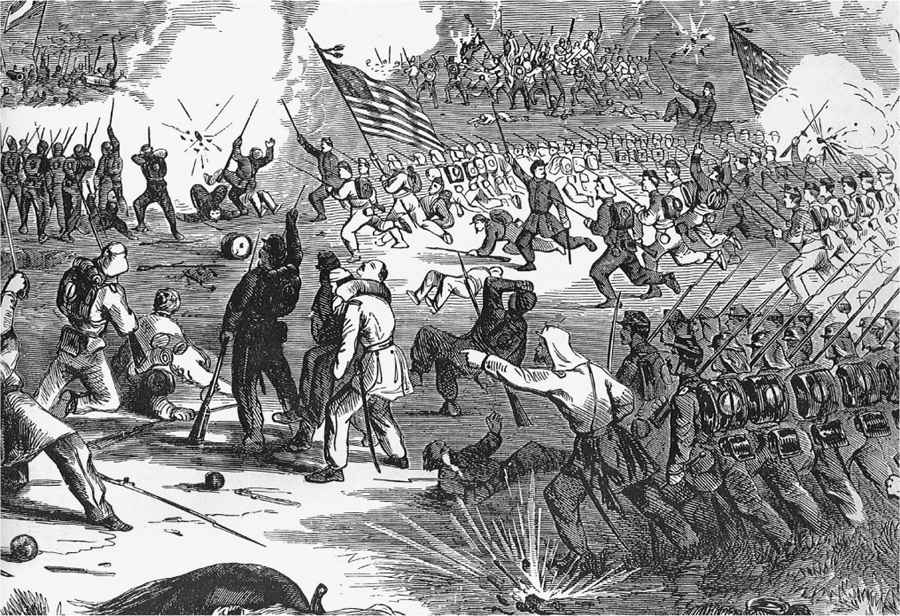
A Frank Leslie’s Illustrated Newspaper woodcut depicting the First Battle of Bull Run.
1. Recruited in New York City and known as the “Fighting 69th,” this regiment was composed largely of men of Irish descent and is the origin of the now famous “fighting Irish.”
THE GREATEST BATTLE EVER FOUGHT ON THIS CONTINENT.
JULY 22
BULL’S RUN, SUNDAY, JULY 21 — 2 P.M.
The great battle occurred to-day, and the result is not certain at the moment I write. Both sides have fought with terrible tenacity. The battle has been hot and steady for three hours, and the loss must be very heavy — certainly not under one thousand on each side.1
The Union Army advanced from Centreville in three columns at 3 o’clock this morning. Col. [Israel B.] RICHARDSON commanded the column by the road to Bull’s Run, where the action of Thursday took place, and Col. [Dixon] MILES lay on the road and at Centreville to support him.
Gen. [Daniel] TYLER commanded the centre division, which took the Warrenton Road — Gens. [Robert C.] SCHENCK and Col. [William T.] SHERMAN being in advance. He had the three Connecticut Regiments, two from Michigan, two from Wisconsin, and the Sixty-ninth and Seventy-ninth, from New-York. Gen. MCDOWELL, with Col. HUNTER and a very powerful division, went out on this road, which leads directly forward to Manassas, crossing Bull’s Run by a stone bridge, which had been mined.
The attack by these two points was intended mainly as a feint. The real attack was by [David] HUNTER, who took a narrow road two miles out leading to the right, having [Henry] HUNT’s and the Rhode Island batteries, and leaving Col. [Erasmus] KEYES on the centre at the crossing of the roads as a reserve. His orders were to proceed high up the stream, cut himself a path through the woods, cross over, and turn the position of the rebels on the north.
I went out with the centre column. At ten minutes before six we halted about a mile this side of the position of the rebels. The Sixty-ninth and Seventy-ninth Regiments of New-York were thrown to the right, in the woods, and the First and Second Ohio and the Second New-York to the left in advance....
At about ten o’clock heavy clouds of dust showed that reinforcements were coming up to the rebels from Manassas, and was continued through the next three or four hours.
At 11 o’clock [Captain Romeyn B.] AYERS’ [actually Ayres] Battery went to the front; the Sixty-ninth, New-York, was ordered to deploy into the field in front, and firing was heard from HUNTER’s Division, on the extreme right, far in advance.
The Ohio regiments were pushed forward with the Second New-York, and ran upon a masked battery of four guns, which killed and wounded quite a number of both. Of the latter, MICHAEL MCCARTY, Sergeant of Company H, was wounded, and afterwards was reported dead. Lieut. DEMSEY received a slight wound. Some twenty or thirty of the Ohio regiment broke and run, but the rest stood firm, as did the Second New-York.
[Captain John H.] CARLISLE’s Battery was brought to the front on the right, and soon drove the rebels out of the masked battery.
It was now 11 1/2 o’clock, when HUNTER’s column appeared across the Run, advancing on the flank of the rebels, and the engagement soon became very active in his position. He kept steadily advancing, pouring in a steady fire of artillery and musketry.
The whole Brigade under TYLER was ordered forward to his support. The Sixty-ninth and Seventy-ninth New-York, the First, Second, and Third Connecticut, and the Second Wisconsin were sent in. A constant roll of musketry marked HUNTER’s advance, and the artillery from our column played incessantly on the flank of the rebels. So far as I could see, the latter were pushed backward a considerable distance to the road directly in front of where I stood, across which they charged twice with the bayonet upon our troops, but were repulsed each time. Our men crossed the road and poured in upon them a terrible fire of artillery and musketry.
I write this at 2 1/4 o’clock, and am compelled to close in order to avail myself of a special messenger to Washington. The fight is still going on with great energy. The rebel batteries have again commenced firing upon us, and their balls and shells fall thick upon the road and in the field which I had selected as my observatory.
Gen. SCHENCK and two batteries are ordered up to repulse an attempt of cavalry to outflank us. I shall try to send the result in a later dispatch.
H. J. R.
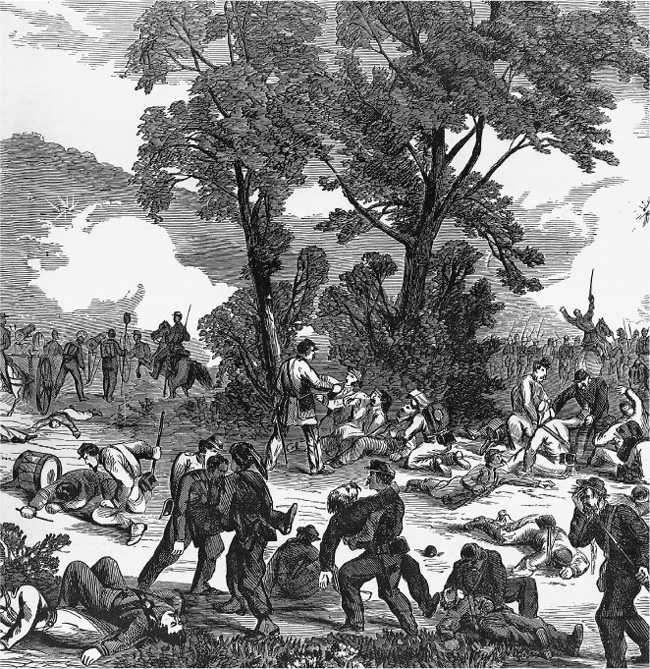
Caring for the wounded after the battle.
1. Actual casualties were: Union – 460 killed, 1,124 wounded, 1,312 missing; Confederate – 377 killed, 1,582 wounded, and 13 missing.
BULLETINS OF THE BATTLE.
JULY 22
WASHINGTON, SUNDAY, JULY 21
The following bulletins were received in official quarters, during the progress of the battle from the telegraph station about four miles from Bull’s Run:
FAIRFAX COURT-HOUSE, SUNDAY, JULY 21 — 11 A.M
There is rapid firing from heavy guns and frequent discharges of musketry.
11:40. — The fighting is very heavy, and apparently more on our left wing.
11:50. — There is evidently a battle toward our left in the direction of Bull’s Run, and a little north. The firing is very rapid and heavy.
1:45. — Heavy guns are heard again, and apparently nearer. The musketry is heavy and nearer.
2 P.M. — The musketry is very heavy and drawing much nearer. There is evidently a movement more to our left.
2:45 P.M. — The firing is a little farther off, and apparently in the direction of the Junction. Less heavy guns and more light artillery, as near as can judge.
3 P.M. — The firing has ceased ten minutes since.
3:35 P.M. — The firing has almost entirely ceased, and can only be heard with difficulty. I shall telegraph no more unless there should be a renewal of the battle, which has been so gloriously fought for the old Stars and Stripes, and from all indications here our troops have at least stood their ground.
FAIRFAX COURT-HOUSE, SUNDAY, JULY 21 — 3:50 P.M.
Our courier has not yet returned. Quartermaster BARTON, of the Second Regiment of Michigan, has just passed, and says that the officers, men, and citizens at Centreville say a general engagement of the whole line had taken place, three and a half miles this side of Manassas, and that our troops had driven and forced the Secessionist lines back to Manassas. We expect a courier now every moment.
CENTREVILLE, SUNDAY, JULY 21 — 4 P.M.
Gen. MCDOWELL has ordered the reserves now here under Col. MILES to advance to the Bridge over Bull’s Run, on the Warrenton road, having driven the enemy before him. Col. MILES is now three or four miles from here, directing operations near Blackburn’s ford.
FAIRFAX COURT-HOUSE — 4:45 P.M.
Two of our couriers have returned, but are unable to communicate in person with Gen. MCDOWELL. One of the couriers was on the field of battle. He says our troops have taken three masked batteries, and forced the enemy to fall back and retire. He says the battle was general on Bull’s Run for some distance. One of the batteries taken was in a wheat field, and the other some distance from it, and the third still further on.
5:20 P.M. — Another dispatch says that the Nationals have won the day. The loss on both sides is heavy, but the rout of the rebels is complete. The batteries at Bull’s Run are silenced, and two or three others taken.
5:45 P.M. — The firing has ceased. We shall send another courier there in a few minutes. The Colonel went at 4 o’clock and will be back soon. A still later report, not official, but from apparently reliable source, says that the column under Col. HEINTZELMAN has followed the rebels to Manassas Junction, and has opened fire on their entrenched camp, and was then shelling them.
The cannonading can occasionally be heard in Washington from Georgetown Heights.
The head-quarters of the Army is inaccessible to-night, the President and Cabinet being privately with Gen. SCOTT and Staff, and other distinguished gentlemen.
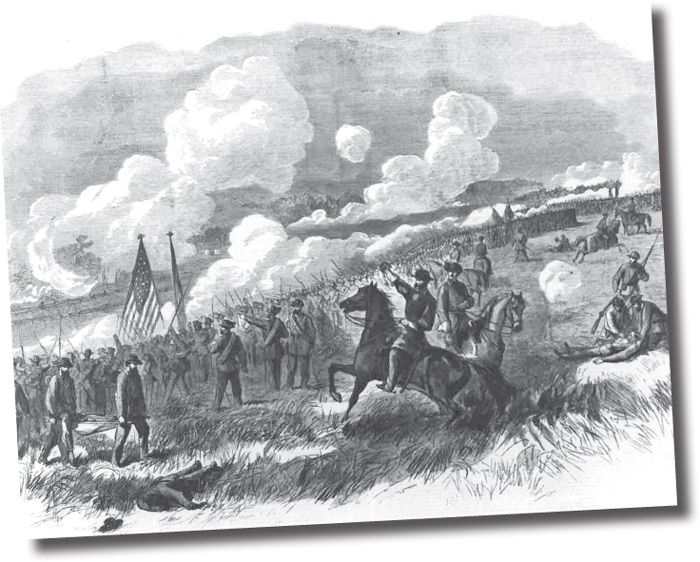
Colonel Ambrose Burnside’s brigade fighting at the First Battle of Bull Run.
EFFECTS OF THE BATTLE IN WASHINGTON.
JULY 22
WASHINGTON, SUNDAY, JULY, 21
The most intense excitement is everywhere existing to hear further from the field of battle. Every returning spectator of the event is immediately surrounded to relate his observations.
The demand for intelligence is insatiable, and unauthenticated rumors prevails, which serve to confuse the truth.
The smoke from the battle could be seen from the eminences in Washington.
A number of members of Congress, and even ladies, went to the neighborhood of Bull’s Run, to witness the battle. One of them reports Col. [David] HUNTER, of the Third Cavalry, acting as Major-General, was seriously, if not mortally, wounded.1
It is stated with confidence in all quarters that Col. [J. C.] CAMERON, of the Seventy-ninth Regiment, and brother of the Secretary of War [Simon Cameron], and Col. SLOCUM, of the Second Rhode Island Regiment, were killed.2
1. Brigadier General David Hunter (1802–1886) was wounded in the neck and cheek, but not seriously.
2. Colonel J.C. Cameron of the 79th New York and Colonel John S. Slocum of the 2nd Rhode Island were both mortally wounded.
VICTORY AT BULL’S RUN — SUMTER AVENGED.
JULY 22
The news from the seat of war must thrill every loyal American heart with deep emotion. The trust reposed by the country in its heroic Army has not been misplaced. After a battle of unparalleled severity, in which our soldiers fought against great odds in regard to position, and against forces not much inferior, if at all, in point of numbers to their own, they have come off more than conquerors — not only driving the enemy from their formidable positions, but seizing all their guns and equipments, and pausing only when the sheltered ranks of the rebels found safety, after retreat, in other and equally strong defences.
The intrenchments of the enemy at Bull’s Run were believed to be quite as impregnable as those at Manassas. The distance between the places is only a few miles, and after the repulse of our reconnoitering regiments, on Thursday, it is known that large reinforcements were sent forward by the rebels, and that they were exultant with the belief that their lines could not be forced. They had two days in which to make their defences complete, and BEAUREGARD’s entire Army, if not actually present, close behind them, from which to draw all of actual, and all of strategetic aid that their selected field was fitted to receive. That the rebels had chosen Bull’s Run as a position they would maintain, would seem to be evident both from its fitness, according to all descriptions for military defence, and from their reluctance to leave it. The fighting was terrific, we are told; the enemy contested every inch.; they did not cease to wield their guns until every battery was taken; and when they were finally expelled, it must have been in all cases at the point of the bayonet, for “all their guns and equipments” were left in the hands of the victorious Union Army. It was a bloody expulsion from their breastworks and guns, and not a retreat from a field that could no longer be contested.
We are aware that the public will have no care for editorial comments on this grand event. The occasion is too solemn, and the emotion it calls up too deep for expression in any language that we can command. We can only bow in heartfelt gratitude to the God of battles that he has seconded our noble Army, and caused victory to rest with the eagles of the Union. The glorious flag that fell at Sumter is now fully avenged. The folds that hid its bright stars when it was lowered in Charleston harbor, under BEAUREGARD’s guns, as a conquered ensign, flamed out again in the smoke and fire of the Bull’s Run batteries, and sent dismay to the hearts of the ingrates that had shouted impiously over its former brief humiliation.
The repulse of the enemy at Bull’s Run, we must believe is but the prelude to his greater and perhaps final overthrow at Manassas or Richmond. We now know that our gallant and laurel-crowned Army is equal to any work that rebel genius and rebel arms can give it; and in this hope we await events. But we cannot dismiss the subject without a word of consolation and of cheer to the many thousands whose hearts will bleed, even while they may shed tears of joy over this great victory. The list of the dead will soon be coming along, for such a victory is only bought at a fearful price, coined from the heart’s blood of fathers, husbands, brothers, sons. To those who are to be agonized by the terrible record, we can only say, no higher fame can be enjoyed, than to have perished in order to make liberty safe.
GEN. MCCLELLAN ASSIGNED TO THE COMMAND OF THE POTOMAC.
JULY 23
WASHINGTON, MONDAY, JULY 22
Gen. MCCLELLAN has been summoned by the Government from Western Virginia to repair to Washington to take command of the Army of the Potomac.
Gen. ROSENCRANZ takes his place in command of the Army of Western Virginia.1
The Corps d’Armee at Washington is to be instantly reorganized and increased. The orders have already been given. Offers of regiments already raised and being made, will be accepted with such rapidity as to insure that this will be accomplished in a few days. Large reinforcements from various districts are already on the way hither, orders having been telegraphed for them yesterday, while the battle was in progress.
1. Major General William S. Rosecrans (1819–1898).
WHO WON THE VICTORY?
JULY 24
Exaggeration played its usual trick with the news of Sunday’s battle. In the light of more detailed and authentic advices, it may fairly be considered doubtful whether either party has gained a victory; for while, panic-stricken, our exposed forces left the field, it is clear that the enemy never quitted their entrenchments to occupy it; in fact, they appear to have been so much intimidated by the encounter, as to pretermit the opportunity they undoubtedly possessed to cut to pieces our retiring troops. This omission may be explained in two ways. In the fighting throughout the day the National troops had exhibited every superiority of strength, tact, and courage, uniformly driving before them the enemy when he ventured beyond his defences, and even capturing three of his batteries in succession. Such exploits could not fail to fill the insurgent ranks with dread of the equal terms upon which they must stand were they to quit their lines; and, indeed, after the prodigies of valor our fellows had displayed, they had every reason to believe the backward movement was a feint to decoy them from their almost impregnable works, to ground where the conditions of the contest should be equalized.
There is much reason, also, to believe that the enemy suffered in killed and wounded far more severely than did the National forces. Testimony from a dozen independent sources is to this effect. They were thus probably in as bad a condition to pursue as our shattered columns were to fight; for by such arguments only can we account for the omission to follow the retreating Army into Washington itself; and for the ability of our people to retrace their steps, as they subsequently did, and recover guns and baggage, which had been abandoned in the flight, and which an enemy, assured of victory, would have hastened to gather up. From this review of the business we can only derive the impression that but for the reasonless panic which was communicated to our men, and the influence of which was favored by the broken and woody peculiarities of the country, which prevented any one regiment from knowing what had befallen its neighbor, the victory would have been ours, much more certainly than it can now be attributed to the enemy.
Later information illustrates another important point. In this conflict the rebels exerted and perhaps exhausted all the military energies at their command. Their Army, which was recruited by conscriptions and impressments, represents perhaps as large a force as they could, without the prestige of success, bring to the field; while it was directed by the only commanders upon whose skill they are willing to stake their fortunes. President DAVIS was in charge of the main body, while BEAUREGARD and JOHNSTON commanded the wings.1 Thus we have encountered all the strength and skill they can muster with a tithe of our strength, and without the employment of any of the military talent upon which our soldiers have learned to rely, because approved by military successes; and it is for this reason, in connection with the excessive numbers and better position of the enemy, that we have come out of the conflict with no better result. The reflection is at once encouraging and instructive.
1. This is inaccurate. Davis arrived at Bull Run just as the battle was ending and played no significant role in the management of the fighting. Johnston was the senior Confederate officer present, but since he arrived on the eve of the battle, he left the tactical management of the fight to Beauregard.
NOTES OF THE GREAT BATTLE.
HOW THE AFFAIR WAS REGARDED IN WASHINGTON AND ELSEWHERE — FACTS AND INCIDENCES — CAUSES OF THE DISASTER.
JULY 26
CORRESPONDENCE OF THE NEW-YORK TIMES.
WASHINGTON, MONDAY, JULY 22 — MIDNIGHT.
There can be no possible use in bemoaning the present state of things in this city, at the seat of war or elsewhere. One can best forget himself and his feelings by plunging at once in medias res1 as they are, and that I propose to do. On Sunday, our earlier dispatches gave most cheering accounts of the gallantry of our soldiers, of the rout of the rebels, and of the undoubted success of the United States troops, and well aware of the eager anxiety of all the citizens of the great metropolis concerning the events of the day, we promptly and regularly forwarded the news as obtained at headquarters. The scenes which took place at every public resort, at the corners of the streets and throughout the entire city indicated the hearty gratification and great enthusiasm of the people. So soon as a dispatch was received at the War Department or by some fortunate newspaper man, it was copied, put upon the bulletins, and read to the assembled hundreds, who joyfully greeted each and every word with rousing, sympathetic cheers, and as accessions were made to the surging crowd, the word of glad tidings was read and reread until the reader became hoarse, though the hearers called for more. The President in his Cabinet received the same news that so electrified New-York; Gen. SCOTT, in his little back office, heard with satisfaction the same bulletins that so excited the noisy crowds; and no one dreamed for a moment that while these spontaneous tributes of thankfulness to God, and of honor to our brave men, were bursting forth from eye, from lip, from heart, those very men were being mowed down upon the field of battle like grass upon the meadow.
Towards 10 o’clock at night there were rumors of trouble, stories of repulse, and narratives indicating disaster, but they were not credited. Gen. [Joseph K.] MANSFIELD stated distinctly at the hotel that the guns and equipments of the enemy were in the hands of our troops, and an official courier from Gen. MCDOWELL to the Commander-in-Chief telegraphed that a “great battle had been fought, and victory won,” and that he was on his way to this city with details. That for the time being settled the matter, and it was not until Mr. [Henry J.] RAYMOND, sunburned, dusty, and hardly recognizable, entered the telegraph office at midnight, that the news of our rout was even credibly suggested. It was then too late to countermand the dispatches already sent, and the telegraphic censor, undoubtedly thinking Mr. RAYMOND’s dispatch contained too much truth, struck it from the “all right” file, and the TIMES was compelled, as were its contemporaries, to go forth to its readers, with an incorrect statement of the day’s result.
This morning, at first slowly and by twos and threes, came the stragglers into town with melancholy faces, dirt-begrimed and weary, with corroborative accounts of the disaster. Many of them were wild with excitement. Men who, on ordinary occasions, are calm, cool, and sensible, seemed beside themselves, and gave utterance to the wildest, most incoherent and senseless statements concerning the light, the subsequent stampede, and the latest situation of affairs. It was apparently impossible to obtain anything approximating a truthful resume, or one which it would be safe to transmit to the thousands of loving ones at home, who wait on the telegraphic word as they would on the report from head-quarters. After a little, others, more composed, arrived, and we then hoped to get at something worthy of belief, but, after patient hearing and careful comparison, it was evident that if a thousand men, having seen the battle, should publish each an account, there would be exactly one thousand conflicting stories.
The rain poured down in torrents. Like the thick, heavy drops of an August thunder-shower, has been the fall of rain all day long. From early morning until now, the cumbersome baggage-wagons have jolted over the stones of our roughly-cobbled streets, bringing the wounded and the dying to the hospitals and the infirmaries. So, too, have the easier riding ambulances, all of which were filled with our disabled and suffering soldiers. Very many of the soldiers, having received discharges from their companies, sought the way to Gen. MANSFIELD’s head-quarters, that they might receive the necessary signature of some official therewith connected. I had occasion to go at an early hour to the office, and truly the scene there was a sorrowful one.
Gen. MANSFIELD occupies a house on the corner fronting the War Department. In the second story are his offices. Passing the sentry at the foot of the stairs, I entered the front room, which is his private office. It is uncarpeted. In the centre of the room was a large table covered with papers; at the further corner was a little box desk, at which sat the pale-faced, grief-stricken General, and at the opposite corner was another desk, on which leaned, fast asleep, the worn-out Secretary, Capt. DRAKE DEKAY. In the connecting room, waiting in turn to speak with Maj. TALBOT or Gen. MANSFIELD, was a group of men whose appearance I can never forget. One poor fellow, apparently about twenty-five years old, seemed to be in the last stage of consumption. He was, oh! how thin and pale, and when the sharp, curt voice of the peremptory official called his name, it was with the greatest difficulty he could tremblingly stagger to the desk. His head was covered with a handkerchief; his eyes fairly stood out from their bony sockets; his beard was half-grown, and his moustache but just starting; his pale lips were parted; his neck seemed unnaturally long, and his scanty uniform hung upon him like a sack. Unfortunately an informality in his papers made it necessary for him to go back to Alexandria, that an additional signature might be obtained; and when, after some ineffectual argument, he found it was useless to urge his illness as an excuse, he turned away with a look so full of weariness and so pitiful in expression, that I could not refrain from inwardly cursing the infernal system of routine and tape which so annoys and perplexes our entire military action. I handed the man a glass of water, at which he seemed surprised, but thanking me, gulped it down, and then asked permission to sit upon a bench in the hall until he could be somewhat restored. I left him asleep.
The others are in various stages of disability. Some had no shoes, others no hat; some fell asleep standing in their turn, others sat upon the floor and snored with exhaustion. All, however, were unprovided with decent clothing, and each man seemed an object of pity and of charity. But while I was waiting with them, a loud cheering was heard in the vicinity of the White House, and going thither, I met a company of Fire Zouaves, numbering one hundred and twenty-five, under command of First Lieut. EDWARD B. KNOX, who was formerly of the Chicago Zouaves, and is one of the ten first lieutenants selected from that corps by ELLSWORTH for the Fire Brigade. The company had halted near the White House, and instantly the men were surrounded by hundreds of people, each and all eager to talk with them concerning the events of the day. I tell you they were a sight to behold. All of them wore the red skull cap, the red shirt and regulation pants, and each carried his gun. Their heads are shaven close, so close that an attempt to part the hair would be absurd, and so close that to rumple it would be impossible. Their eyes were keen and clear, their faces almost black from exposure to the sun, their hands like marble, and their arms and limbs like iron. They were proud, boastful, full of excited and colored narrative, jolly, good-natured, and ready for more work. But they were only kept up by that nature which has so often kept them up after hours of self-sacrificing labor at a fire, and by the exciting cheers and huzzahs given them by the admiring crowd which thronged about them. Presently they took up their march for MANSFIELD’s Headquarters, before which they halted, while Lieut. KNOX went in to report. I went in with him, and was present at the meeting between the veteran and the younger officer.
Gen. MANSFIELD — Well, Sir. Who and what are you? Who are these men?
Lieut. KNOX — I am Lieut. KNOX, of the Fire Zouaves. These men, with a few others, are what is left of our regiment, and I want quarters for them.
Gen. MANSFIELD — Why you are only about a hundred. Is it possible (and here the tears came to his eyes, for he doubtless remembered the time when he thanked the twelve hundred for their courage at the fire) that you have sustained such a loss?
Lieut. KNOX — Yes, Sir. We had pretty lively work. There are about 400 of us left, out of the regiment. We have marched all the way from Fairfax, to-day, and we would like to get into quarters.
After this and some other conversation, the General, with great feeling, promised to find them a place at once, and sent DE KAY out for that purpose. While he was gone, I went out, that I might hear what the lire boys said.
One little short fellow, with a bright black eye, having his red skull-cap pushed on the back of his head, his arms akimbo, and his cheek dilated with the weed, was holding forth to a knot of admiring men and boys, somewhat in this fashion: “Fight! Oh, no. We didn’t fight — perhaps we didn’t. Just see here. After we’d been a standing three hours...in the grass, up come a long-legged cuss, and says he, follow me. We went, we did — first short, and then double-quick. All of a sudden pop, bang, bang, bang went the bloody guns on our left, that God only knew was there, for we didn’t, and the boys fell down like sheep. And then the way we took them batteries. Well, you ought to have seen it — that’s all. We saw our men drove away from their guns, and we made up our minds to get ’em, and we charged, yelling like bloody h--l, drove the seceshes back a deuced sight quicker than they come, and popped ’em down at every shot. But when we’d got the guns the fellers didn’t come to hold ’em, and of course we couldn’t work ’em, and we left. But the charge of those d--d Black Horse “Calvary” was the best thing. I say, Bill, those fellers weren’t no darned persimmons — no, Sir-ee — they did well, they did; but they don’t brag much where they are now. Well, Sir, they came a riding down on to us like the very devil, and we just come the three-rank arrangement on ’em — one rank was down there, the second just above their shoulders, and the third fellers stood up straight. On they came — sword and pistol in hand, and the horses galloping like d--n. Don’t fire till they get way up, says Pony — and we didn’t.2 The cusses didn’t know what to make of it, but we soon informed ’em. Pop went the first rank, and the poor devils fell out of their saddles like dead sheep. Bang went number two, and down come another batch, and I’ll be d--d if I believe there was a third of ‘em left when they turned tail and scud away, as if all h--l was after ’em.” The boys were very tired and hungry and thirsty, and the timely present of a lunch of bread and butter, sent by a lady in the vicinity, was cheerfully andgratefully received. For about half an hour they remained there, telling wonderful stories of personal adventure and regimental prowess, winding up invariably with a good round cursing of the General in command, and an earnest desire to have another chance at the “bloody seceshers.” Knowing that anything connected with the New-York Fire Brigade would prove interesting to the mass of the readers of the TIMES, I procured the following statement of Lieut. KNOX, of Company A, in that regiment:
The regiment was encamped on Saturday night at a place about a mile this side of Centreville. At 2 o’clock on Sunday morning, the men were aroused, and remained under arms until 7 o’clock, at which time they started forward. There were 950 men, all told, with “Pony” FARNHAM at their head.2 With cheers they moved briskly forward through the woods, singing and laughing and eager for the fight. They had marched about 14 miles, and were within three miles of the battlefield, when they heard the guns and saw the smoke from an eminence. This excited the men wonderfully, and at double-quick step they pressed on, with the intention of joining Col. [Orlando] WILCOX, who, with the Michigan regiment was a short way ahead. Halting at a pool of dirty water, they refreshed themselves, and went on until they came to a church three-quarters of a mile this side of the battle-field, where they left their overcoats and haversacks, and having formed by companies, again went on at double-quick step. As they passed a bit of woods they were fired at by some cavalry who were concealed there, but stopping only to return the fire, they moved on until they reached a fair halting ground. While there, the enemy succeeded in taking from the United States regulars a battery which was stationed in the woods at the right of the Zouaves, who were at once impressed with the idea that they had a mission, and that mission was to retake those guns. Whereupon with a wild, wild yell, three cheers and a loud, fierce cry of “Remember ELLSWORTH,” they dashed across the intervening space, rushed in the face of a murderous discharge from the cannon on the hill, and with loud whoops and hurrahs drove some away, killed the rest, occupied the position, and attempted to use the guns. The regulars did not return to receive at their hands the recaptured battery, and it was useless in their hands. While in possession of this battery a body of infantry who were in the woods in their right rear, fired with considerable effect several vollies into their midst, and the Colonel gave the order to leave the battery and dislodge the enemy. This they did effectually, and compelled the rebels to flee from the wrath behind. Unfortunately the Zouaves were not aware of the state of affairs on the other side of the woods, and with hot haste, and in considerable disorder, they rushed out only to find themselves the target for another body of infantry beyond, while the Black Horse Cavalry were seen charging full upon them. Things looked badly, when, fortunately, the infantry were engaged by another regiment, thus giving the Zouaves time to prepare for the charge from the horsemen. They formed hastily in line, kneeling, semi-kneeling and standing, that, ELLSWORTH fashion, they might receive their enemies with successive volleys. On came the Horse — a full regiment of brave men splendidly mounted, and as ready for mischief at those on whom they hoped to fall. To an early discharge from the cavalry the Zouaves made no response, although several of the men were killed, but waited patiently until the enemy was almost upon them, when, in quick succession, the three ranks fired, each man doing his best for the good cause. The shock to the rebels was great, but they rallied, behaving splendidly, and attempted a renewal of the charge, for which, however, the excited firemen were prepared, and for which the Black Horse Cavalry paid most dearly. They were completely shattered, broken up and swept away. Not more than a hundred of them rode off, and as they went, their rebellious ears were saluted with “One, two, three, four, five, six, seven, tigah, Zouave,” and such a “tiger repeat” as one can only appreciate when he has heard it. What happened after that, it is hard to detail. Grape and canister were poured in upon them thick and fast. Down on their faces till the shot passed on fell every man, and then “up and at ‘em” till the next volley, was the cry of them all. This continued for a long time, during which squad after squad was used up, man after man fell dead, or receiving a shot while on the ground, failed to rise at the next command. Then came the order to retreat, which slowly and gradually was obeyed. The regiment broke ranks — some of the men walked slowly off; others went into the woods and fought from behind the trees on their own hook; others falling in with different regiments, joined forces against, the common enemy, and other climbed the trees to see “what was up.” While in the woods the slaughter amongst the men was very great, and the cross fire to which they were there exposed did them more damage than all else beside. The retreat with them was as with all the regiments — not particularly an orderly one, but rather a free and easy retrograde movement, which, if not a stampede or a rout, was at least a very unmilitary operation.
From the above outline of Mr. KNOX’s very interesting statement, it will be seen that the firemen did then, as ever, their duty. They receive from all sides the most flattering commendation, and it is gratifying to know that immediate steps will be taken to recruit men enough to fill up the sadly broken ranks. New-York may well be proud of her representatives in this regiment, and it is only to be regretted that all did not do as well. They had a good breakfast at Willard’s, have been lions all day long, and are now quartered in the old homestead of the New-York Twelfth.
But I find that I am forgetting my notebook. In that I have noted many incidents which ought to be told, but it is now nearly 12 o’clock, at which hour the mail closes. I regret to say that the enemy to-day have proved themselves most brutal. I have the authority of one of the first artists of the country, who has just left my room, and also of a well-known army officer, for stating that the rebels shelled the Hospital Church, in which were our wounded men; that they fired repeated volleys at our ambulances, which were crowded with sick and dying soldiers; that they cut off the heads of men on the field, and absolutely kicked them from one to another; that they have bayoneted many of our men who lay wounded on the field of battle; that thievish knaves were on the ground early this morning, pilfering and pillaging, and that scenes of horror such as no imagination can suggest, or imagery convoy, have been of frequent occurrence since the disastrous termination of the engagement.
I have not time to quote opinions or suggest criticisms, but will say that the most thorough and immediate investigation of the affair is to be had, and no stone will be left unturned that the censure of the nation may be cast heavily upon the proper person. The enemy at noon to-day were not aware of the extent of our rout; by this time they are, and I violate no confidence when I state that, in high military quarters great fear is entertained concerning the possible developments of the next forty-eight hours
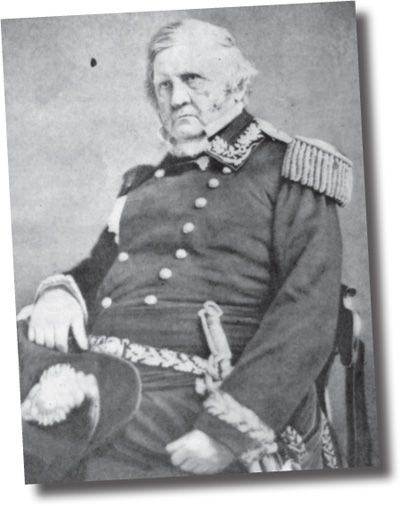
Lieutenant General Winfield Scott, U.S.A.
1. In the middle of things.
2. Colonel Noah Farnham (1829–1861) succeeded to the command of the Fire Zouaves after Elmer Ellsworth’s murder. He was called “pony” because of his height — five feet four inches. He was wounded by a musket ball to the head at Bull Run, and died on August 14.