
CHAPTER 5
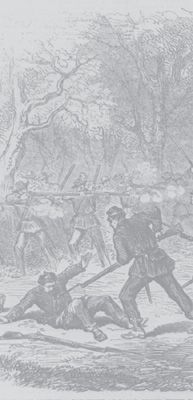
Detail of an etching of the Battle of Ball’s Bluff.
After the debacle of Bull Run, Lincoln brought 34-year-old Major General George B. McClellan to Washington to command the army. But “Little Mac,” as he was known, wanted to ensure that the army was ready. Consequently, as late summer turned to fall, McClellan’s growing army did little more than drill and train. Some observers grew impatient at this perceived delay and criticized the army’s new commander for indolence; others, including The Times, defended him on the grounds that he had inherited an army that was falling apart. At this point in the war, Lincoln was willing to grant his new general whatever time he needed — though that would change.
Meanwhile, the readers of The Times followed the emerging national conversation about the conduct — and ultimately the meaning — of the war. Some argued that rebels should not be treated as prisoners of war because it would legitimize their claim to nationhood. Lincoln had previously declared that rebel privateers would be treated as pirates; now, at least one reader thought that rebel soldiers deserved no better. More central to the national debate, however, was the inescapable issue of slavery. It was generally understood that slavery had caused the war, and more than a few New Yorkers began to wonder why the national government should continue to honor slaveholders’ rights in the rebellious states. To circumvent the Fugitive Slave Law (enacted in 1850), Major General Benjamin F. Butler had argued that escaped slaves were “contraband” and did not need to be returned to their disloyal masters. His clever legal stratagem worked, and for the rest of the war, escaped slaves were known as “contrabands.” But when Major General John C. Fremont in Missouri declared martial law in his theater, and announced that all the slaves of disloyal masters were now free, it was a direct blow at the “peculiar institution” and undisguised by any legal subterfuge. Unsurprisingly, it provoked both a public outcry (as well as some applause), and a rebuke from the President. Fremont sent his wife, Jesse Benton Fremont, to Washington to plead his case with the President, but the interview did not go well, and Lincoln removed Fremont from his position. Meanwhile, McClellan’s habit of returning escaped slaves to their masters brought complaints from other quarters.
In October, what was intended as a reconnaissance across the Potomac River at Edward’s Ferry led to the Battle of Ball’s Bluff (October 21, 1861). Though like the Battle at Bull Run it was first reported as a Union victory, it was a badly bungled affair that resulted in an ignominious Union retreat back across the river. Details of the battle were provided by Times reporter Elias Smith who was “embedded” (as we would say today) in Company H of the 15th Massachusetts infantry. His lengthy report is a vivid firsthand account from the ground level.
Among those killed at Ball’s Bluff was Colonel Edward D. Baker, the commander of the 71st Pennsylvania Volunteers (known as the California regiment since many of the soldiers were from the West Coast). Baker was not only a popular commander, he was also a sitting senator from Oregon and a personal friend of President Lincoln, who had named his second son for him. When Lincoln received the news, it struck him like a blow; witnesses saw the President stagger and nearly fall, and many saw the tears in his eyes.
In addition, reports of the battle in other papers (especially Horace Greeley’s Tribune) suggested that Brigadier General Charles P. Stone, a West Point graduate, was jealous of volunteer officers like Baker and had deliberately put him in an impossible position. Congress demanded an investigation, with not a few hinting darkly that treason was at work. McClellan, with his tolerant attitude toward slavery, was their real target, but it was Stone who took the fall. He was arrested and held without charges for six months. Though he served briefly in the Red River campaign in 1864 and the siege of Petersburg in 1865, his reputation never recovered. To conduct their investigation, Congress formed a new standing committee — the Committee on the Conduct of the War — that spent the rest of the war looking over Lincoln’s shoulder, second-guessing his decisions, and keeping a sharp eye out for any officer who failed their test of loyalty.
Throughout the early fall of 1861, many of the New York Times articles evince a people struggling to understand the meaning and impact of the war, and experimenting with new and increasingly radical notions of freedom and liberty.
ABOUT PRISONERS OF WAR, PRIVATEERS, &C.
AUGUST 7
To the Editor of the New-York Times:
In your paper of last Thursday you seem to have some hesitancy as to the proper way of treating prisoners of war, pirates and others found in arms against the Government and people of the United States. Do not accuse me of egotism if I assert that there is no need of any halting (but there is need of a vast amount of haltering) in the matter. What are the facts? A part of the people have attempted to subvert the Government by force of arms. The Government (the centralized and legal embodiment of the people) in maintaining its authority, also resorts to arms. Collisions and battles occur. Both sides take prisoners. Now comes the question, “What shall be done with these men?” I admit the question is one of vast importance, not only as regards the proper way of dealing with the rebellion, but also as to the personal rights and privileges, pains and penalties of the captured men. The Government should not treat its captured rebels as prisoners of war. Neither should it do that other and much worse thing, discharge them on their parole. To do the first is a virtual admission that the rebels are a lawful enemy. This must not be admitted. If it is, ground is laid for their recognition by foreign nations. The Government must do all in its power to place the rebels outside of law, and not allow them to claim or exercise any legal privileges whatever.
They are rebels, and should be treated as such. When taken in arms against the Government, they should be disarmed, and compelled to aid the Government in maintaining itself against the rebels. They should never be treated as prisoners of war, neither should the Government ever recognize a flag of truce from rebels. Every man bearing such a flag should be arrested as a rebel, the bearing the flag being prima facie evidence of his being a rebel; for if there were no rebels there could be no rebellion, and if there was no rebellion, there would be no war or collision needing the intercession of a flag of truce. Every bearer of one should be locked up as a rebel. No treating with them as lawful enemies. No discharging or swearing allegiance. Men that forswear their natural inherited allegiance, by engaging in a rebellion against a Government like ours, cannot be trusted on their oath, especially an oath taken under such circumstances. Never trust a rebel’s oath.
So much for land rebels. Now about rebels and pirates afloat. They should be hung at the yard-arm of the National vessel capturing them, without ever being brought ashore to be tried and sympathized with, and kept at the public expense. The summary hanging of a few would scare the rest and drive them from the ocean....
SINCLAIR TOUSEY.1
1. Sinclair Tousey (1815–1887) was a New York news-paperman and later the founder of the American News Company.
INDIRECT BENEFITS OF WAR.
AUGUST 8
Hard as the war we are now engaged in may bear upon individual interests, and calamitous as it doubtless is, for the time, to the commerce and trade of the country, yet it has its elements of good as well as of evil. The American people, in their fierce pursuit of those vast material enterprises, of the success of which we boast so much, were in danger of forgetting the necessity of providing for the possible contingencies of the future. More than three-quarters of a century of internal repose, and, with the exception of three or four years, of peace with all the world, afforded an opportunity of developing the natural resources of the country, of changing continental forests to farms and fields, of building up cities and towns; of creating for ourselves a world-wide commerce, and of advancement in a career of progress that carried us to a high position in the scale of nations. But this long period of peace made us negligent of preparing for the accident of war. In our prosperity we overlooked the teachings of history. The fallacy that the future would be as the past, that the Union would never be disturbed by internal revolt, because it never had been, that the people and the States would always be loyal to the Constitution, because they had never been otherwise, came to be with us an article of political faith, upon the assumed truth of which the policy of our Government was based. We kept no standing Army, because we had no martial neighbors whose enmity we feared, or whose power we had occasion to dread. Even the militia of the States came to be contemned as a useless pageant, and was fast falling into disrepute under the ridicule it attracted by its broad caricature of war. Thus, while all our energies were directed towards the accomplishment of physical enterprises, the martial spirit, so essential to the maintenance of the power and strength of a great nation, was fast dying out. We were warned of possible insurrection — of collision between the State and National Governments. We laughed at the folly of the admonition. We refused to listen to the roar of the cataract, even when its sound was in our ears, until in sight of the rapids down which the inevitable drift lay. We started at last from our dream of security, to see treason organized into open revolt, without a preparation in advance to meet it. We had no Army, no arms, no munitions of war; and for the time, the Government was at the mercy of a rebellion whose conspiracies had been ripening for years. Up to this time we had scarcely thought of country or of home. We had given no consideration to the idea that we might one day be required to preserve the power inherent in a united people by compelling national unity. Our prosperity was our boast and our idol, and in our folly we did not admit, even to ourselves, the possibility of its interruption. We had come to measure everything, even the Union itself, by the standard of commercial value.
If our boastful spirit, in reference to our national prosperity, excited the ridicule of Europe, the promptness with which the Northern States have risen to the level of the emergency will now command its respect. The energy displayed by them in defence of the Constitution, and in sustaining the Union, will serve to demonstrate that our patriotism has not been destroyed by our lust of gain, and that the martial spirit of the nation was not dead, but sleeping.
This war, melancholy as its presence may be, will educate our people in the science of arms, will revive and invigorate that martial spirit which is essential to a great nation, but which was in danger of becoming extinct in the welling prosperity of long-continued peace. While it will demonstrate the power, it will strengthen the bands of the Union, and give increased stability to Republican institutions. The teachings of the present will make us wise in the future. While our material prosperity will not be neglected, there will be a careful watch set against treason, and if it shall ever again venture into the daylight, a strong and mailed hand will be ready to strike it down. The experience in arms gained in this war by intelligent citizens from every part of the country, will keep alive military organizations that will be able to send into the field an Army respectable both in numbers and discipline, whenever, the exigencies of the times shall demand it.
Aside from these considerations, the business prosperity of the country will by no means suffer to the extent that the fears of some have led them to apprehend. The necessity for a foreign loan will add some two hundred millions or more in coin to the available capital of the nation. The expenses of the war are to be paid out at home. The millions thus expended will permeate all the channels of circulation. The daily average of half a million of expenditure will drift for a long while on the currents of trade before falling into the great reservoirs of capital. The genius of the American people is already accommodating itself to the new order of things. We can feel that we have already touched bottom in reference to the commercial evils of this war. And that, whether its duration shall be long or short, the course of trade will hereafter be upward. The business of the country, though to some extent changed, will revive, and if our business men will give heed to the lessons of economy inculcated by the occasion, they will enjoy a season of prosperity, as the result of the war, very different from that which their fears predicted.
POPULAR IDEAS OF THE REBELLION.
THE WAR AND SLAVERY.
AUGUST 9
WESTPORT, CONN., THURSDAY, AUG. 8
To the Editor of the New-York Times:
You say truly that this war in which we are engaged has for its object simply to put down the rebellion against our nationality. This is the object and the whole of it.
But how are we to accomplish this object? Many say, “Gather an immense Army, pay hundreds of millions of money, and go on from battle-field to battle-field, till the treason is stamped out; meanwhile, scrupulously respecting the institution of Slavery. In case it shall be found impossible to succeed in this way, then, as a last resort, decree emancipation.” The plan is to do all we can toward crushing out the rebellion without harming the peculiar institution; and if, after an immense outlay of money and life, we find that either the Republic or Slavery must die, then Slavery must take the death. It is assumed, and with reason, that a decree of emancipation by the war power would make short work with the rebellion. It is capable of demonstration that, with it and ten thousand men properly applied, a single month would suffice to revolutionize the larger part of the South into submission — and that with a less amount of suffering and outrage than ordinarily follows in the track of war.
Now, gentlemen, I have never been an ultraist; but I cannot help asking, why not adopt this conclusive measure at the outset? What is this Slavery? What has it done that it should be treated so tenderly, and be marked as the last thing to be thrown overboard in the endeavor to save the laboring ship? Here we are, proposing to sacrifice great commercial and manufacturing interests, hundreds of millions of ready money in the shape of taxes, and tens of thousands of precious lives in an experiment to get along without harming the institution of Slavery by this war. What have these rebels and traitors done that we should be so much more chary of their property than of our own — so much more tender of their investment in human flesh and blood than of the lives of our own sons and brothers? What is there so very precious about this very peculiar institution of our deadly enemies that we should shield it from harm with our own fortunes and bodies up to the last possible minute; that we should dare and sacrifice to the last extremity before consenting to have it perish? One would think Slavery to be the Kohinoor1 of the country, instead of the nation’s shame, the by-word of Christendom, the incorrigible fire-brand and disintegrator of our nationality, the mother of treason and rebellion. Was not this rebellion got up in the interests of Slavery? Are not these men who are stabbing at the public heart, slaveholders, and is it not because they are slaveholders that they are so stabbing? Is not Slavery at this moment the right arm with which treason is working against us? Who plant the masked batteries, who make the intrenchments, who drag and manipulate the munitions of war, who furnish the food to support the armies of our enemies, who raise the cotton from which, if at all, our foes must get the sinews of war — who but slaves? The system of American Slavery does not deserve the forbearance and sacrifices we are practising in its favor. On my conscience, I believe we are acting like fools in this whole matter.
To you, merchants and tax-payers — to you, citizens, whose brothers and sons are taking daily risks at the cannon’s mouth, it is not merely a question how this rebellion may be suppressed, but how it may be suppressed in the most speedy, economical, and effectual manner. If you fail to say “Yes” to this with all your hearts — then let me tell you that after all your sacrifices you will still have the great thing to do. All your costly make-shifts to spare your enemies and the assassins of your country will come to nothing. Slavery or the Republic must die. Let the people understand it — Slavery or the Republic must die. The sooner the lesson is learned the better. God Almighty will crowd us with reverses on reverses and almost kill us with mortification and blood-shedding, till we are ready to part with the monster that defies alike God and man.
1. This refers to the Kohinoor diamond, the most famous jewel in the world. It was said that whoever owned it could rule the world.
A BENEFIT OF DIRECT TAXATION.
AUGUST 9
There is one advantage that the nation will derive from the system of direct taxation soon to be inaugurated,1 that should go far to reconcile all good citizens to its inconveniences and its burdens. That is, the economy it will in the end, insure in the expenditures, and the honesty in the disbursements of the Government.
We cannot shut our eyes to the fact, that corruption and profligacy of the most alarming character and extent have, for many years past, disgraced the legislation of the country and the administration of our State and National Governments. This evil has increased with a rapidity that was frightful, and not a few of our most thoughtful Republicans have been learning to dread lest public virtue should, in a few years, be so thoroughly overthrown, that the continuance of the Government in form and vigor would be impossible. The fear was, not that the Government would be overthrown, but that it would rot down.
The chief cause of the public corruption and official degeneracy was undoubtedly the great prosperity of the people, the cheapness of our Government, and the consequent indifference of the people to the riotings and plunderings of their public servants. The National Government has been collecting and expending annually for nearly twenty years an average of say seventy millions of dollars a year. Scarcely a dollar of this vast sum could be said to be drawn directly from the pockets of the people.2 When, therefore, Texas Indemnity bills, and Gardner frauds, and Fort Snelling swindles were perpetrated,3 and the Government mulcted of perhaps ten millions a year, or nearly one-sixth of the whole amount of revenue yearly raised through the downright villainy of Congressional and Governmental agents, there was no citizen that felt sufficiently personally aggrieved to demand the punishment of the offenders and to prosecute with the interest and earnestness necessary to procure conviction.
The public feeling will become different now. The burdens of Government will begin to be felt, which has never been the case before. When every man in the community — every man in the United States — finds he must put his hands into his pocket and draw out a portion of his hard-earned gold and silver to deliver to a Government agent, he will not be indifferent any longer as to how that money goes. If it is stolen by the Collector, or squandered by Congress through lobby legislation, or sequestered by Cabinet officers through nepotism in contracts, the people who have paid will know it, and they will know how to punish.
It is remarkable, the contrast that exists between the punishment of public defaulters in England and France, or any Government in Europe, and in the United States. In any of the former, the convicted defaulters (and all defaulters are convicted if caught) go to the dungeons, chains and prison-hulks for life, and draw ignominy on themselves and families. In the United States no defaulter is convicted. Distinguished friends screen him in fashionable hotels, and dismiss him to Cuba, or some other foreign land. Or if his stealings be large enough, he may safely stay at home, buy his discharge through a flaw in the law, as [John B.] FLOYD4 did; and then he feted and feasted in the capitals of the country, as among the first gentlemen of the times. Defaulting is not stealing in the estimation of American society. It will be different when the money stolen is first taken directly out of the people’s pockets. And the correction of the standard of morality in this regard will be worth many millions of dollars yearly to the public Treasury, and more than can be expressed in dollars to the general cause of honesty and virtue; for it is notorious that the pernicious example of unpunished political embezzlements has affected and greatly impaired the safety of all commercial transactions in the United States.
1. In July 1861, Congress passed an act that levied a tax of 3 percent on all incomes over $800 per year. It was the first income tax in American history.
2. Virtually all federal revenues before the Civil War derived from duties levied on imports. Since the tariffs were intended to protect domestic industry rather than to generate revenue, the income often exceeded what the government could easily spend. Hence The Times’s argument that this led to corruption.
3. These all refer to scandals involving government funds in the antebellum years.
4. John B. Floyd (1806–1863) had been President Buchanan’s secretary of war. In December 1860, on ascertaining that Floyd had paid out large sums to government contractors in anticipation of their earnings, Buchanan requested his resignation. Floyd was indicted for malfeasance in office, but the indictment was overturned on technical grounds.
THE ADMINISTRATION AND THE FUGITIVE SLAVE LAW.
SEPTEMBER 2
Some time since Marshal MCDOWELL (U.S. Marshal for Kansas,) addressed a letter to the U.S. Attorney General, stating that he did not deem it his duty to return fugitives to Missouri, until she became more loyal, and asking for advice on the subject. The following reply we find in the Leavenworth Times:
ATTORNEY-GENERAL’s OFFICE, JULY 23, 1861.
J. L. McDowell, U.S. Marshal, Kansas: SIR: Your letter of the 11th of July, received 19th, (under the frank of Senator [Joseph] LANE, of Kansas,) asks advice upon the question whether or no you should give your official services in the execution of the Fugitive Slave law.
It is the President’s constitutional duty to “take care that the laws be faithfully executed.” That means all the laws. He has no right to discriminate — no right to execute the laws he likes, and leave unexecuted those he dislikes. And, of course you and I, his subordinates, can have no wider latitude of discretion than he has. Missouri is a State in the Union. The insurrectionary disorder in Missouri are but individual crimes, and do not change the legal status of the State, nor change its rights and obligations as a member of the Union.
A refusal, by a ministerial officer, to execute any law, which properly belongs to his office, is official misdemeanor, of which I do not doubt the President would take notice. Very respectfully,
EDWARD BATES1
1. Edward Bates of Missouri (1793–1869) was Lincoln’s attorney general.
IMPORTANT FROM MISSOURI.
PROCLAMATION OF GEN. FREMONT
SEPTEMBER 2
ST. LOUIS, SATURDAY, AUG. 31
The following proclamation was issued this morning:
HEAD-QUARTERS OF THE WESTERN DEPARTMENT, ST. LOUIS, AUG. 31
Circumstances, in my judgment, of sufficient urgency, render it necessary that the Commanding General of this Department should assume the administrative powers of the State. Its disorganized condition, the helplessness of the civil authority, the total insecurity of life, and the devastation of property by bands of murderers and marauders, who infest nearly every county in the State, and avail themselves of the public misfortunes and the vicinity of a hostile force to gratify private and neighborhood vengeance, and who find an enemy wherever they find plunder, finally demand the severest measures to repress the daily increasing crimes and outrages which are driving off the inhabitants and ruining the State.
In this condition the public safety and the success of our arms require unity of purpose, without let or hindrance, to the prompt administration of affairs.
In order, therefore, to suppress disorders, to maintain, as far as now practicable, the public peace, and to give security and protection to the persons and property of loyal citizens, I do hereby extend and declare established martial law throughout the State of Missouri. The lines of the Army of occupation in this State are for the present declared to extend from Leavenworth, by way of the posts of Jefferson City, Rolla, and Ironton, to Cape Girardeau, on the Mississippi River. All persons who shall be taken with arms in their hands, within these lines, shall be tried by Court Martial, and, if found guilty, will be shot. The property, real and personal, of all persons in the State of Missouri, who shall take up arms against the United States, or who shall be directly proven to have taken active part with their enemies in the field, is declared to be confiscated to the public use, and their slaves, if any they have, are hereby declared free men.
All persons who shall be proven to have destroyed, after the publication of this order, railroad tracks, bridges or telegraphs, shall suffer the extreme penalty of the law.
All persons engaged in treasonable correspondence, in giving or procuring aid to the enemies of the United States, in disturbing the public tranquillity by creating and circulating false reports or incendiary documents, are in their own interest warned that they are exposing themselves.
All persons who have been led away from their allegiance are required to return to their homes forthwith; any such absence without sufficient cause will be held to be presumptive evidence against them.
The object of this declaration is to place in the hands of the military authorities the power to give instantaneous effect to existing laws, and to supply such deficiencies as the conditions of war demand. But it is not intended to suspend the ordinary tribunals of the country, where the law will be administered by the civil officers in the usual manner and with their customary authority, while the same can be peaceably exercised.
The Commanding-General will labor vigilantly for the public welfare, and in his efforts for their safety hopes to obtain not only the acquiescence, but the active support of the people of the country.
(SIGNED) J.C. FREMONT, MAJOR-GENERAL COMMANDING.
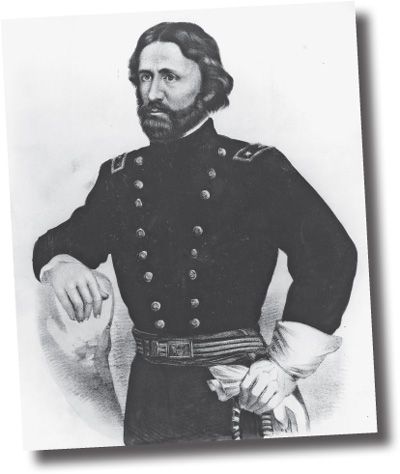
Major General John C. Frémont, U.S.A.
SLAVERY AND THE WAR — A BLOW THAT WILL BE FELT.
SEPTEMBER 2
There is no victory so complete as that which solves a great political dilemma, which has rested like a pall upon the public mind, destroying all life and spirit, paralyzing all enterprise and action, and producing all the consequences of a disastrous defeat. It is a happy stroke of genius that can overstep the bounds of tradition, or conventional rule, and show a clear path in a direction supposed to be set with insuperable difficulties. Such is the service rendered the nation by Gen. FREMONT’s proclamation, placing Missouri under martial law and visiting upon traitors, the penalties due to treason, with all the celerity of military dispatch. The traitor is to be divested of property, as well as life; and further, a blow is struck where it has long been seen it might fall, upon the institution which is both the cause and support of the rebellion. Self-preservation renders no other course as longer possible. If we would save ourselves, we must take from treason every weapon by which it can strike the deadly blow. We must maintain the rights of loyal men intact, but take from those in arms against us the means of keeping them in the field.
It has long been the boast of the South, in contrasting its strength with that of the North, that its whole white population could be made available for the war, for the reason that all its industries were carried on by the slaves, in peace as well as war; while those of the North rested upon the very men, who in case of hostilities must be sent into the field. For the North, consequently, to fight, would be the destruction of all its material interests; for the South, only a pleasant pastime for hundreds of thousands of men, who, without war, would have no occupation. The South was another Sparta, the Helots of which, a degraded caste, performed all the useful labor, leaving to the privileged one only the honorable occupation of arms. The vast host which the South has put into the field, has, to a great extent, made good these words. With the enemy at our throat, we must strike from under him the prop upon which his strength rests. It is our duty to save every life, and every dollar of expense in our power. By seeking to put down the rebellion only by meeting the enemy in the open field, is uselessly to sacrifice hundreds of thousands of lives, and hundreds, if not thousands of millions of money, and perhaps, after all, accept a disastrous defeat as the result.
In this crisis Gen. FREMONT has sounded the key-note of the campaign that will be echoed wherever we have a soldier in arms. He has taken a step which cannot fail to produce a very marked effect throughout the South. He has declared that every slave who may be employed or permitted by his master to aid in the rebellion against the United States, shall be free. This, it will be seen, is no general act of emancipation. It has nothing to do with that general crusade against Slavery which many have urged as the proper means of carrying on the war. It simply confiscates the property of rebels employed against the Government. It does not touch the slaves of loyal citizens, nor affect the institution in any way, except as those responsible for it may choose to identify its fate with that of the rebellion itself. But just so far as Slavery actively supports the rebellion must it become the object of attack. Up to the present time nothing can be more marked than the forbearance of the Government towards Slavery. While it has from the beginning seemed certain that, if the South persist in war, Slavery must inevitably perish in its progress, the Government has carefully avoided everything which looked towards hostility against the institution itself. The constitutional rights of the slaveholder have been as scrupulously regarded, and as carefully protected, as if he had not repudiated the Constitution, and was not making war upon the Government which gives him this protection.
This course of things is to be changed. Hereafter Slavery will not be allowed to stand in the way of a vigorous prosecution of the war. If slaves are employed against the Government, their masters will thereby lose all claim to their services. The fact of their being so employed will suffice to set them free.
It is impossible to avoid seeing that this proclamation of Gen. FREMONT, carrying into effect the law of Congress, will be understood at the South to have a much broader application. The rebels will denounce it as an act of wholesale emancipation, and the slaves will thus be taught to regard it in the same light. FREMONT’s name, it will be remembered, was widely connected in their minds, in 1856, with the expectation of immediate freedom,1 and this act will revive all the passions and aspirations which were then aroused. It is useless to speculate upon the tremendous results to which such an impression may give rise. But it is very clear that FREMONT’s proclamation is, up to this time, by far the most important event of the war.
1. John C. Fremont (1813-1890) had been the Republican candidate for President in 1856 on a platform that advocated the eventual eradication of slavery.
SPECIAL DISPATCH FROM WASHINGTON.
SEPTEMBER 13
WASHINGTON, THURSDAY, SEPT. 12
There is much feeling here among leading men, caused by the action of Gen. McCLELLAN in ordering the return of fugitive slaves, or, rather, their arrest in camps and imprisonment in jail to await the claim of their masters. This is in contravention of the spirit of the letter addressed by the Secretary of War to Gen. BUTLER, for it constitutes our troops but an army of negro catchers. It is directly in contradiction to the letter of FREMONT’s proclamation, which has been unanimously accepted by the people of the loyal States as the true interpretation of our relation to the slaveholders in rebellion against the Government....
RUMOR THAT GENERAL FREMONT IS TO BE SUPERSEDED.
SEPTEMBER 14
We learn that a rumor was prevalent in Washington yesterday that Gen. Fremont is to be superseded in his command and that Quartermaster-General [Montgomery] MEIGS is to take his place.
We have also what we deem good authority for saying that this rumor, unlike many others, is founded in fact; and that Mr. [Francis P.] BLAIR, at whose earnest recommendation Gen. FREMONT was placed where he is, accompanied Gen. MEIGS, in order to explain to Gen. FREMONT the reasons and the necessity for the step.
These reasons, we think it will be found, are that Gen. FREMONT exceeded his authority by the proclamations he issued — that being the main reason — and that he has in other respects acted in important matters not only without consulting the Government, but in contravention of its orders and practice.
(Notwithstanding the apparent positiveness of this statement we are informed, by telegraph from Washington, that Mrs. FREMONT left there yesterday morning for St. Louis with assurances that the General should not be interfered with. — ED. TIMES.)1
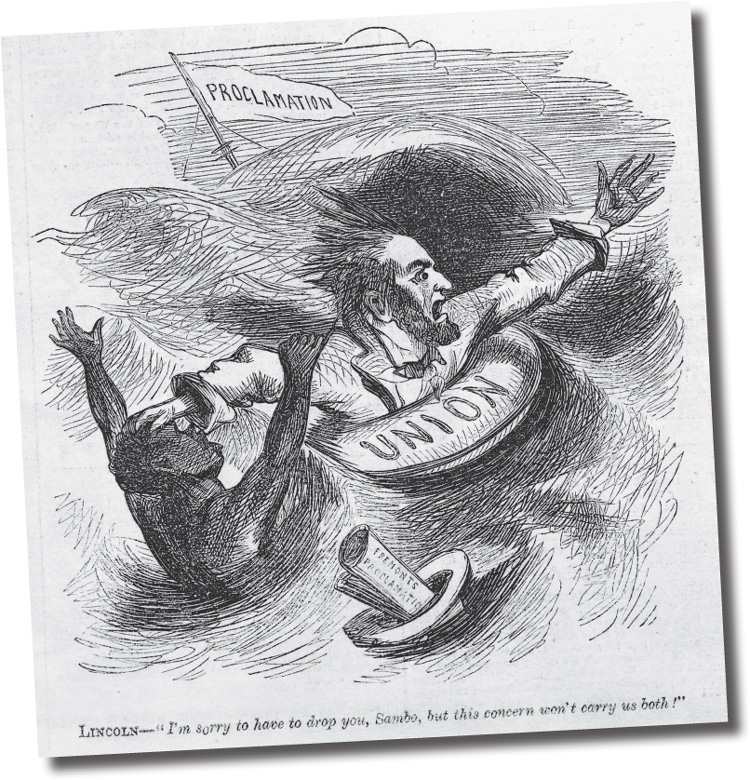
A period cartoon criticizes President Lincoln’s decision to revoke Frémont’s emancipation order.
1. Jesse Benton Fremont (1824–1902) traveled to Washington and met with President Lincoln to urge him to support her husband. The meeting was a disaster and Mrs. Fremont succeeded only in angering the President — something that was not easy to do. Lincoln’s decision to remove Fremont stood.
WHAT WE ARE FIGHTING FOR.
SEPTEMBER 17
In his appeal to the people for means to carry on this war, Secretary CHASE1 declares that “the National Government, compelled by a guilty conspiracy culminating in a causeless insurrection, is engaged in a war for the security of liberty, for the supremacy of the law, for the defence of the Union and for the maintenance of popular institutions.”
This is a broad and sweeping statement. If true to its full extent, it affords a full and complete justification of the war. Let us look at the particulars of it a little.
“Compelled by a guilty conspiracy.” Is not that true? How long the Government bore with those who would overthrow it! How earnestly it sought to do nothing which should be any excuse for passion’s usurping the sway over reason, choosing in repeated instances to risk the greatest injury, and to allow its enemies the greatest advantage, in order that its good intentions might be known! But all forbearance was but the incentive to further aggression, until the guns of Charleston harbor — which, like that famous shot on Concord Green, will be “heard round the world,” but with how different a voice — until the marshaling of troops and the boastful threat of burning Washington “compelled” the Government to defend itself. That this was the result of a conspiracy all know — a conspiracy the growth of years, as has been openly avowed by the conspirators, and carried on by fraud, theft, desertion, perjury and treachery, the conspirators’ weapons. And if the purpose of the war is as stated by Mr. CHASE, who can estimate the guilt of the conspirators who, for such purposes, have desolated so many homes, destroyed so many lives, brought upon our land such wide-spread devastation, and upon the hearts and hopes of all friends of humanity everywhere, such chilling fear and anxious doubt?
Was the insurrection in which that conspiracy culminated “causeless?” Their own leaders bearing witness, it was so. There was no oppression at the hands of the Government which they sought to overthrow. Its dealings with them were only beneficent. We hear them claim that they are but sustaining the right of the people to self-government. But if they succeed, they will only be where they were before. They had always governed themselves as much as is possible, where the rule that the majority shall govern is carried out. If they succeed in their attempt, they can do no more than that, and will in all human probability do far less. For if there are any lessons to be drawn from history, it is plainly to be seen that the tendencies of the Southern States are not towards self-government but towards a despotism.
And, if it is said that the insurrection was necessary for the protection of Slavery, let the increasing numbers of “contrabands” at Fortress Munroe, and the sound of FREMONT’s Proclamation, as it echoes through Missouri and through Kentucky, and thence downward to the Gulf, answer that the insurrection is Slavery’s death-blow. “Causeless!” must be the verdict of history upon this insurrection; as causeless as the inroad of any burglar into an unprotected house, whose servants have given him, by their aid, his only chances of success; causeless as any scheme which the ambition of man, set on fire of hell, has ever embarked in.
And the purposes of the war. Is it a war “for the security of liberty?” How can it but be such, when we fight to sustain a Constitution whose purpose is “to secure the blessings of liberty;” while the rebels fight to establish one, of which, as they themselves have said, Slavery is the cornerstone. We have believed as our fathers believed, that liberty was best secured by placing the Government in the hands of rulers chosen by the people. Their ruler has been appointed by a few delegates from conventions, chosen for no such object. We believe that the extension of the right of suffrage to all is one of the safeguards of liberty. They loudly advocate its restriction. We believe that the right of the majority to govern is essential. They scoff at the idea of being governed by a “vulgar Yankee majority,” and boldly advance the right of the minority to rule. Yes! Mr. SEWARD was right when he declared that Liberty is always in the Union, and clear though it was to his farseeing mind when he stated it, that it was so, he could hardly have anticipated that so short a time would bring so many proofs of its truth as the present state of facts, and the tendencies of the future throughout the rebellious States now plainly exhibit.
We fight “for the supremacy of the law.” If ever there was a violation of all law, of statute law and common law, of the laws of honesty and common sense, this insurrection is such an one. And if there were no other reason for putting it down, we, who claim to be a law-abiding people, should be earnest to put it down so thoroughly, and with so stern a punishment, that all men should learn, as they never learned before, that law is supreme, and that that very voice which calls upon us not to yield obedience to a human law which would compel us to wrong doing, calls upon us as loudly, and with as terrible sanctions, to yield to it implicit obedience in every other case.
We fight “for the defence of the Union” — that Union with which all our national associations are entwined — which has protected us from foreign foes upon our own soil, and when we went abroad — whose name and flag have been the symbol of hope to the oppressed nationalities of the world — whose overthrow would send a throb of grief to the heart of every friend of human progress, and bring a shout of triumph from the lips of every tool of despotism, the world over — that Union whose destruction is the overthrow of peace among us, and brings us to a period of standing armies and large navies, and incessant preparation for only another war with the same States, after we have allowed them to strengthen themselves by sea and land, at home and abroad; for that Union we are called upon to give our means. And if we gave them all, the sacrifice would be little, so that our children, for whom we love to labor and to save, should be spared from such long-enduring trouble and terror.
And, lastly, we seek “the maintenance of popular institutions.” We have always claimed that such institutions were the best for man; that they furnished more liberty, more scope for individual, and thus for national development and strength, than any others. But if they have no self-sustaining power — if they must yield to the first attack of an internal enemy — if they furnish us a Government only so long as we allow a selfish and ambitious privileged class to carry it on, then is their name but a delusion and a snare, and the sooner we give them up, and return to that which answered for the darker ages of the world, the better. See how earnestly our struggle is watched by those who have always hated us because of these claims of ours, and because we could point to our own growth as proof of their justice. See how quick they are to point out our weaknesses and to rejoice over our calamities, and to use our present disturbed state, which is the result, not of our popular institutions, but of that element which was not popular in them, as an argument against those who strive for liberty elsewhere. Fancy their malignant joy, if the insurrection is successful, and the United States, instead of being at liberty to lend a helping hand to the oppressed abroad, is thenceforth incessantly watched and worried by a malignant foe at her own door. Fancy their terror an dismay, and the joy of the friends of liberty, when our flag shall again in triumph “float o’er the free from the Gulf to the main,” and insurrection and treason shall have met with their deserved punishment.
If there were no other inducement for us, it would call forth our utmost exertions to give those friends that joy, and to deprive those foes of that triumphant “I told you so.”
Yes! Mr. CHASE has well characterized the war; and every day’s experience shows that his call upon the people will be answered as it deserves.
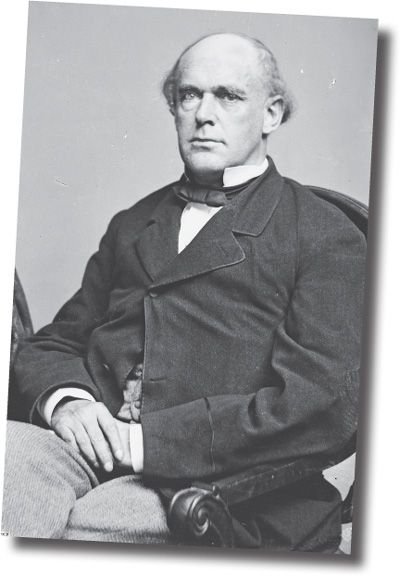
Secretary of the Treasury Salmon P. Chase.
1. Salmon P. Chase (1808–1873) was secretary of the treasury in Lincoln’s cabinet and a strong anti-slavery Republican.
GENERAL FREMONT’S COLUMN.
ARREST OF FRANK BLAIR — PROCLAMATION BY GENERAL FREMONT.
SEPTEMBER 18
Col. F. P. BLAIR. Jr.,1 was ordered yesterday, by the Provost-Marshal, to report himself under arrest on a general charge of using disrespectful language, when attending superior officers. With reference to the removal of Gen. FREMONT, the Democrat, this morning, holds the following language:
“The removal of Gen. FREMONT, we do not think, has been seriously considered by the Administration. Complaints have undoubtedly been made against him, and possibly charges preferred, which of course will be duly and properly investigated, but those proceedings we are now satisfied have never looked to a result so serious as his removal from this Department. His extraordinary energy and efficiency are too highly appreciated by the Government, and the man and his measures are too deeply seated in the affections of the people of the loyal States to admit the probabilities of any such event.”
The Republican learns that Col. [Humphrey] MARSHALL, when at Lexington, a few days ago, took possession of a quantity of property belonging to the State, including the books, papers and great seal of the State, which CLAIBORNE JACKSON took from Jefferson City.2 After the defeat of the State forces at Booneville by Gen. [Nathaniel] LYON, JACKSON publicly announced his intention to establish the capital at Lexington, claiming that he had full authority to do so. It may be that this programme has not been relinquished, and the present movement of [Confederate] Gen. [Sterling] PRICE,3 who doubtless is now in possession of Lexington, is with the view of planting the seat of Government there.
Whether the deposed Legislature, which adjourned in May last, to meet again to-day, will be ready to proceed to business, cannot be now ascertained.
Postmaster-General BLAIR and Quartermaster-General MEIGS left for Washington this morning.
It is understood that the precise charge on which Col. BLAIR was arrested is insubordination in communicating, while a military officer, with the authorities at Washington; making complaints against and using disrespectful language towards Gen. FREMONT, with a view of effecting his removal. It is stated that letters written by Col. BLAIR are now in possession of Gen. FREMONT....
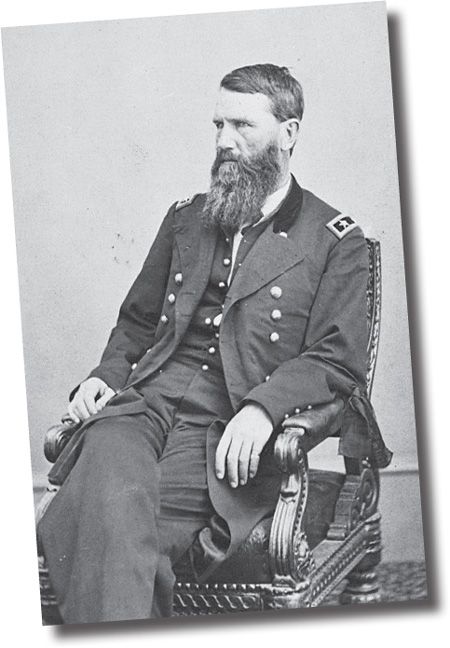
Francis P. Blair, photographed when he was a major general.
1. Francis P. (Frank) Blair, Jr. (1821–1875) was a former member of Congress from Missouri and the brother of Montgomery Blair, Lincoln’s postmaster general. Fremont and Blair were political rivals, and Fremont blamed Blair for contributing to the ill feeling toward him in Washington.
2. Claiborne Jackson (1806–1862) was governor of Missouri. Siding with the Confederacy, he was in effect a governor in exile after the Union occupied the state.
3. Sterling Price (1809–1867) had opposed secession in Missouri, but was outraged when Union forces seized Camp Jackson in St. Louis, and he threw in his lot with the Confederacy. Claiborne Jackson made him a major general of volunteers.
GEN. MCCLELLAN AND THE ARMY OF THE POTOMAC.
OCTOBER 22
WASHINGTON, FRIDAY, OCT. 18
CORRESPONDENCE OF THE NEW-YORK TIMES.
No man ever rose more suddenly into the front rank of eminent public characters than the young Commander of the Army of the Potomac. Six months ago, the name of McCLELLAN was only known to army officers, or to the men of business with whom he had been brought in contact, as President of a Western Railroad. To-day all eyes are turned toward him, either expressive of hope and confidence in his genius, courage and conduct, or of envy and ill-boding prophecy. When there seemed to be no especial need for his services to the country, he retired from the profession of arms, to which he had been educated, and in which, before he was thirty years of age, he had scarcely a peer, as regards accomplishments. But when the tocsin of rebellion was sounded, he was among the first to tender his services to the Government, which at once recognized his merit by placing him in a high command. His bold and brilliant achievements in Western Virginia justified the confidence reposed in him; and, after the mortifying defeat at Bull Run, he was called, as much by the acclamations of the people as by the Administration, to take the command of the Army of the Potomac. It need not be repeated here how thoroughly that army was disorganized, how totally disqualified it was for offensive operations, and how barely adequate it was to a defence of the Capital against a bold and vigorous assault of the rebel enemy. The great majority of the troops had been called into service for three months, and their term of service had nearly expired. The whole business of organization and training had therefore to be gone over again, and, in a word, a new army, composed of fresh volunteers, had to be substituted for that which had been repulsed and routed in July. To do this requires time. It cannot be done in a week or a month. It required several weeks to raise the troops and bring them here, and certainly two weeks are not too long to accustom farmers and mechanics to use the weapons of war with dexterity, to move in masses, on foot or on horseback, at the word of command; to acquire the habit of mind which enables the soldier to feel strong in the consciousness that he is only a part of a great engine, and that fidelity to his duty is his best guaranty of safety.
A correspondent of the TIMES alluded the other day to the public impatience with the cautious policy pursued by Gen. MCCLELLAN, and to the blame which begins to be laid to his door. His enemies are taking advantage of these complaints, and it begins to be whispered about Washington that a conspiracy has been formed against him, looking to his displacement and supercedure. It is true that the conspirators are not the men to bring forward a charge of inaction, or aversion to offensive operations against the enemy — because it so happens that the “rascally virtue,” prudence, is a distinguishing characteristic of MCCLELLAN’s enemies. But they nevertheless foster the spirit of complaint, and throw in the ingredients of fault-finding with the personnel of his military household. It is proper to notice some of these insinuations....
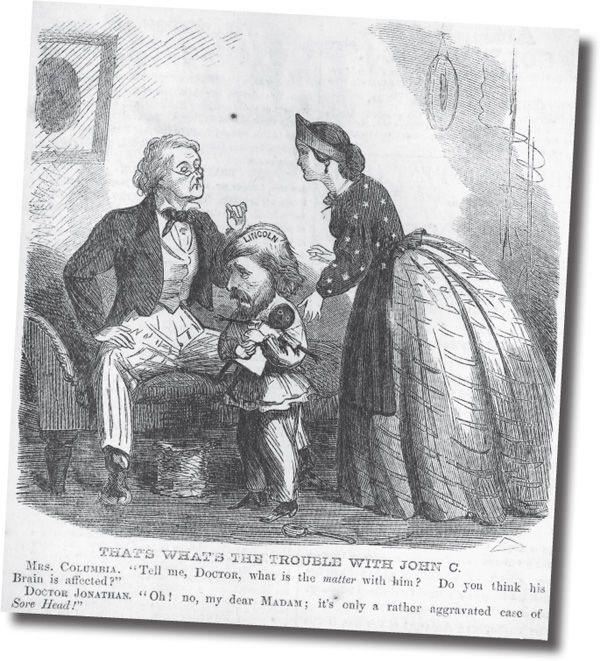
Political cartoon shows General Fremont as a child clutching an African-American doll, but encumbered by the unseen “Sore Head” President.
WHY THE WAR SHOULD BE AT ONCE ENDED.
OCTOBER 23
So long as the insurrection of the South seemed a spiteful rebellion against the results of a particular election we were compelled to regard it as utterly unjustifiable. If it meant only, as has been asserted, “bullet” against “ballot,” we should look upon it as a wicked and treasonable act; for never could the North be charged, notwithstanding its commercial bias, with a want of consideration for the institutions of the South. If, again, the question could be argued on pure grounds of expediency, we should here also, though not so decidedly, pronounce against the resolution taken by the South to divorce itself from the North. But the actual case is very different. The last twelve months have shown that Northerners and Southerners are as irreconcilable as Greeks and Turks, or Germans and Magyars. This war will but intensify and perpetuate animosities which the very nature of things had long ago created. “Sectional” antipathies have proved as stubborn as national antipathies. They could not be assuaged by compromise, and they will assuredly not be abolished by conquest. The armies of the North may overpower the armies of the South, but South and North can never be expected to amalgamate again. It is for this reason, and because territories so prodigious as those of the Southern States can never be retained by armed occupation, that we think the policy of the Federal Government wrong. If the whole case of the war is to be analyzed, we must needs say the Northerners have the right on their side, for the Southerners have destroyed, without provocation, a mighty political fabric, and have impaired the glory and strength of the great American Republic. But, as they have chosen to do this, as they have shown themselves hitherto no less powerful than their antagonists, as the decision of so large a population cannot be contemned, and as we cannot persuade ourselves that a genuine peace is likely to spring from protracted war, we should rejoice to see the pacification of America promoted by other means.
THE FREMONT TROUBLE.
OCTOBER 25
The Washington correspondent of the Philadelphia Press writes under date of Oct. 20:
“It seems to be an established fact that Gen. FREMONT is really to be removed. The charges against him were forwarded to the President by the friends of Mr. [Francis] BLAIR [Jr.]. It is reported that he has involved the Government in unnecessary expenditures to the amount of nearly ten millions of dollars; that he gave to his California friends contracts for fabulous sums without requiring any security whatever; that he denied the Government officers interviews with him, unless it particularly suited him; that he assumed supreme powers which were not delegated to him; that he did not obey the instructions of the Government unless they met his views. The friends of Gen. FREMONT here say, in unmistakable language, that he has been unfairly dealt with; that he has been villainously persecuted, because some members of the Cabinet are jealous of his popularity; and that, when an investigation takes place, he will make these things manifest, and show a cleaner record than any other officer of his rank in the service.”
THE BATTLE AT EDWARDS’ FERRY.
FULL DESCRIPTION OF THE ENGAGEMENT.
REPULSE OF THE UNION FORCES.
OCTOBER 25
FROM OUR SPECIAL CORRESPONDENT.
EDWARDS’ FERRY1 SUNDAY — 6 P.M, OCTOBER 20
The Union troops have commenced shelling the rebels on the Virginia shore across the river, whether merely to drive them out or as preliminary to an advance, we shall probably known in the morning. As I intend to make my letter, as far as possible, a journal from hour to hour of what actually takes place under my own observation, I shall not attempt to anticipate movements, but only record what I see and hear. The firing commenced at 4:35 this afternoon, from VAN ALLEN’s Battery of two Parrott guns — 12-pounders — the shells going well over to the Virginia side, to the north of Goose Creek. Their explosion is very distinctly heard. Seven shells have been thrown within ten minutes, without eliciting any response from our friends across the water. Gen. [Charles] STONE is directing the movement. The tenth and eleventh shells fired were long range, the explosion not being heard for ten seconds. The next two exploded in five. The direction given to the shells is varied so as if possible to find out the location of the rebels, who are supposed to be concealed in a thick wood to the southwest, on the hill, and apparently a mile from the month of Goose Creek. The fourteenth founded like a solid shot, and the three following shells, which made a loud explosion, brought no answering shot from the rebels.
At five minutes to 5 P.M. the battery in charge of Lieut. FRINK, situated in a field to the southeast and some quarter of a mile from the Ferry, also opened with shell, the two batteries keeping up the fire with rapidity, each missile exploding beautifully. Just as the sun is going down, the First Minnesota and Second New-York came down over the hill, and take the road to the Ferry. The sun sets gloriously, reflecting his rays from the thousands of bayonets which line the road. The firing is renewed again from both VAN ALLEN’s and FRINK’s Batteries. The troops are marching to the river with the intention either of crossing or of working a feint to do so, with a view of trying what effect the movement may have upon the enemy.
The air is perfectly still, and the close of this pleasant Sabbath is impressively calm and beautiful. The view of the Virginia hills from where I stand, near the battery, is almost enchanting. The echo of each report of our guns is heard from the opposite hills as distinctly as the report itself, and the explosion of each shell makes the third distinct report caused by each discharge. Something which resembles the sound of a drum-corps is distinctly heard from the Virginia side. The troops are drawn up along the bank in open order, and the order is now again passed along the lines to “Fall in.” There goes a boat-load of troops across the river, which looks like a real movement.
The two companies, after landing, were recalled, but at 12 o’clock three regiments crossed over, encamping on the Virginia side. This was evidently designed as the opening of the campaign in Upper Virginia, and to-morrow, no doubt, the whole force encamped near here will be thrown over. There is every prospect of lively, I hope not of disastrous, times. The rebels will not do anything we wish them to. I now proceed to the camp near the Monocacy, to observe movements.
MONDAY MORNING.
The engagement has been renewed this morning. At daylight, portions of the Massachusetts Twentieth, Col. [William R.] LEE, and the Massachusetts Fifteenth, Col. [Charles P.] DEVENS, not over 300 in all, crossed over three-quarters of a mile below Conrad’s Ferry. They crossed the island [Harrison’s Island], which at this point is about 150 yards wide, and three miles in its extreme length. These two companies — viz., I and D, commanded respectively by Captains BARTLETT and CROWINGSHIELD — met with no opposition on landing, and pushed on until they had reached the open space. This company (H, of the Fifteenth Regiment) went ahead as skirmishers, and were met in an open field by a company of 70 rebels, who fired the first volley, wounding ten and taking two prisoners. The company charged on them, and drove them back, but were in return driven back by a large cavalry force, besides a Mississippi rifle company.
This ended the contest for the morning; but a straggling fire was kept up on both sides until 1:30 P.M. when the rebels renewed the engagement with great fury. They attacked in front and on the right flank. At this time Gen. [Edward D.] BAKER’s Brigade was arriving. They consisted chiefly of the Philadelphia Zouaves, under command of Col. [De Witt Clinton] BAXTER.
Col. [actually Captain Thomas] VAUGHAN, of the Rhode Island [Battery B], had also arrived, and, with the greatest difficulty, succeeded in getting one of his six-pounder guns up the ascent, being obliged first to dismount the gun. This piece, with the two mountain howitzers belonging to the Twentieth Massachusetts, were all the heavy guns on the field. The fire was kept up from the right flank and front with great activity, the rebels raining a perfect storm of balls upon the Union forces. The Twentieth, although mostly raw recruits, stood the enemy’s fire like veterans. They ran up to the brow of the hill, delivered their fire, and only fell back to reload and repeat. This continued until 5 1/2 P.M., the Union forces maintaining their position steadily against the deadly, ranking cross-fire from the front and left of the woods.
At this juncture Gen. BAKER, who had dismounted from his horse, and was advancing at the head of his command, coolly, but, resolutely encouraging his men, received a ball through his head, killing him instantly.3 The General’s blood but pattered Capt. CROWNINGSHIELD, who stood beside him at the moment. He never spoke. His body was immediately taken to the rear by his men, who freely wept at their loss. He was placed in a scow, and transported to the island, and thence to the Maryland shore. His remains were sent to Edward’s Ferry, and thence to Poolsville, is horse, which had been left standing, was after wards shot. A small canvas satchell, containing his papers, I saw in the hands of a young man to whom they were delivered shortly before he fell.
This was the turning point of the battle. The rebels were five to one of the Union force, and the latter were finally ordered to leave the field. The retreat was made after the Bull Run pattern, with slight improvements, the men rolling, sliding, and almost turning summersaults down hill, to escape the galling fire which now assailed them from all points. The rebels were constantly reinforced, screaming like furies at each onset. Before retreating they threw the six-pounder down the hill into the river. The howitzers were left on the field, and fell into the enemy’s hands.
The Fifteenth and Twentieth Massachusetts Regiments suffered very severely, losing a large part of their numbers in killed and wounded.
The Tammany Regiment4 covered itself with glory. Capt. [Timothy] O’MEARA often rallied his command, throwing defiance into the very teeth of the enemy, and showing the rebels that he could scream equal to the worst of them. Capt. O’MEARA took charge of the landing, and refused to let any but wounded men enter the boat, ordering the sound troops to go back and pepper the rebels. His conduct was very gallant throughout, evincing a true and lofty courage. Lieut. [Nathaniel] MESSER took command of the scow, and continued to ferry over the wounded, who poured down the hill. Several times the rebels fired upon him as he was crossing with the wounded men. The fourth boat-load was capsized, by the men rushing into it in too great numbers, and the whole party, about fifty in number, well and wounded, were precipitated into the stream. Ten of the party, at least, were drowned. A great many tried to swim the river, and sank from exhaustion. One half of those who are missing were drowned in this manner. It is not yet known how many of our men have fallen into their hands. The destruction of life has been far greater, in proportion to the numbers engaged, than at Bull Run....
I arrived at the ferry, and crossed over shortly after 3 o’clock P.M. Only three scows were in use, carrying say fifty men each, and occupying at least thirty minutes in getting each load over! I met wounded men returning in their comrades’ arms, and bleeding from feet, legs, chest, head, arms, and every other description of wounds. I assisted in conveying them to a comfortable place in a large shed near the river, and proceeded toward the scene of action. Soon I reached an old farm-house, which was being used us an hospital. Groups of soldiers and persons not in uniform were crouching behind a corn-crib, built of logs, to shelter themselves from the bullets, which were now singing fearful music over our heads. The aim appeared to be at the house containing our wounded. In the yard, and covering its whole space, lay the wounded, dead and dying, in every stage of mutilation. The house contained two rooms, which were also full to repletion. Not a square foot of space remained unoccupied by the bleeding, wounded congregation. I took off my coat, and for half an hour rendered such assistance as an amateur surgeon could render. There was, as usual, a plentiful lack of surgical assistance, twenty poor fellows calling for aid, where only one or two could be attended to.
It was dark before the conflict closed, and I then recrossed the river and worked until this hour, (7 A.M. Tuesday morning,) in transporting the wounded in boats and litters to places of safety. I took my horse and rode to Edwards’ Ferry, where I obtained a canal boat, in which a large quantity of hay was placed for the, comfort of the wounded. I reached the Ferry, and by 2 o’clock this morning we had about forty poor wounded soldiers on board, and quietly proceeding to the Ferry. Some fifty wounded were taken to a barn half a mile from the line of the canal. A large number who could not be removed remained at the farm-house on the island, and multitudes were left dead and dying on the bank of the Old Dominion, their groans waking mournful echoes from the hills and woods. The officers have suffered severely. There is no way of ascertaining the actual number of casualties.5
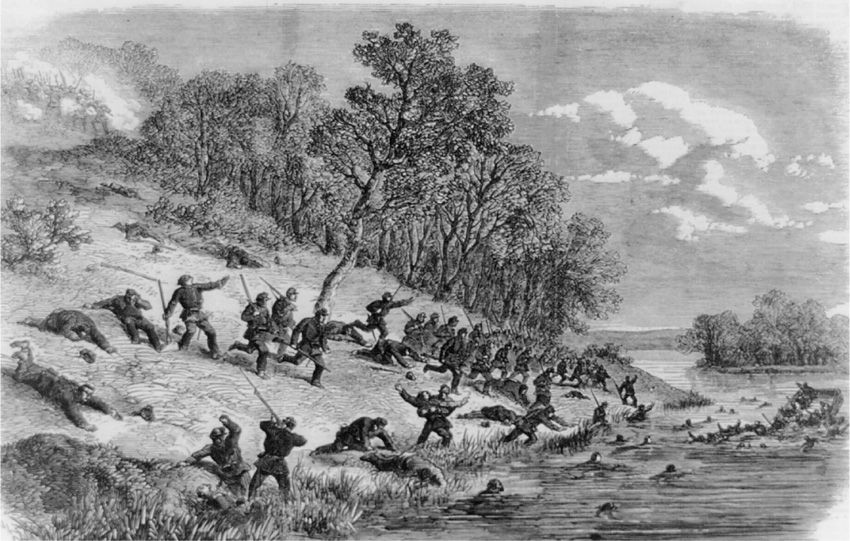
An Illustrated London News woodcut depicting a scene from the Battle of Ball’s Bluff.
STATEMENT OF LIEUT. MESSER.
Lieut. MESSER, of Company D, Twentieth Massachusetts Regiment, who was among the first to gain a position on the Virginia side, about 4 o’clock A.M., gives me the following description of the localities. The landing, which was made in a batteau carrying only 28 men at a time, was upon a steep, clayey bank, ten feet high, very slippery. Having gained the top of this muddy bank, they struck a path which they followed to the left for about one hundred yards, when they filed right, went up over the hill, at an angle of 45 degrees, the top of which was some 100 feet above the river level. Here they came to an open space 150 yards wide and 300 long, which was surrounded on the right, left and front with a dense forest, in which the enemy were strongly posted, but entirely protected from view. In the rear was he steep hill which they had ascended. On the centre of the opening was a gully, and at the left a cowpath; thus, with the river behind them, the troops fought desperately. To think of retreat was equivalent to death by bullet, by drowning, or of torture and imprisonment among the rebels. The fact that Gen. STONE was known to have crossed at Edwards’ Ferry, with a strong force, (it was between three and four thousand men,) with the intention of attacking the rebels in the rear, gave them great courage. How dreadful must have been the suspense waiting — waiting with such fearful odds against them — fighting in momentary expectation that they should hear the roar of friendly cannon in the enemy’s rear. The reason why the reinforcements did not arrive in time to cooperate is not yet explained. A story prevails here (at Edwards’ Ferry, where I am now writing,) that our force yesterday lost four out of six pieces of artillery after crossing into Virginia. It not generally credited here.
Gen. STONE sent an order late last evening to hold the island at any cost. The artillery and Harris Cavalry, in consequence, remained on the Canal line. It was generally believed that the rebels would shell us out of the island in the morning, if possible.
As I write, (7.30 A.M., Tuesday,) the rebels are firing from their side of the river. Possibly an engagement is now going on. The Sixteenth Indiana and Sixth Pennsylvania have just passed to cross the river. The firing increases, and affairs look like a general engagement to-day. We are where the rebels could reach us easily with shells. There is another camp of the Twentieth Massachusetts just arrived — Capt. JOHN SAUNDERS, of Salem. The space surrounding the ferry is now compact with men and horses....
The wounded were mostly sent down to Edwards’ Ferry by canal boats, and were carried thence in ambulances to Poolesville.
A heavy northeast rain-storm has been prevailing for 18 hours, and the Potomac is rapidly rising. The difficulty of crossing will soon be greatly increased.
Half of the Fifteenth Massachusetts are reported to be killed, wounded, or missing. The Twentieth is nearly as badly broken up. I saw a member of the Twentieth Massachusetts to-day who had been over to the Virginia shore to look after our comrades. He was fired on, and compelled to leave. The condition of the wounded who came down to Edwards’ Ferry this morning by a leaky canal-boat — the rain having wet many of them to the skin — was pitiable indeed. They are by this time safely in hospital....
I have no time for further details.
E. S.6
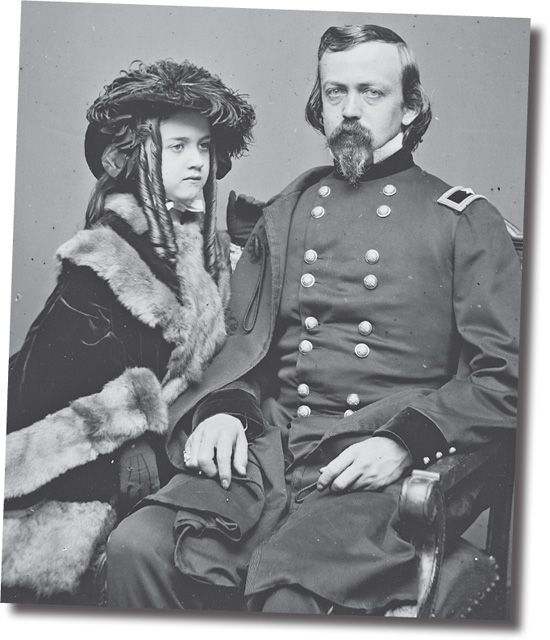
Brigadier General Charles P. Stone and his daughter, Hettie.
1. The Battle of Edward’s Ferry (October 21, 1861) became better known as the Battle of Ball’s Bluff. Though little more than a skirmish, it had profound political consequences, including the establishment of a Congressional committee — the Committee for the Conduct of the War — that exercised oversight authority throughout the war.
2. Believing that the enemy had left the area, McClellan ordered Brig. Gen. Charles P. Stone (1824–1887) to conduct what McClellan called “a slight demonstration” in order to see how the Confederates might react.
3. Colonel Edward Dickenson Baker (1811–1861), though English-born, was a veteran of the Mexican war, and a sitting U.S. senator from Oregon. He remains the only sitting U.S. Senator ever killed in battle. His popularity in the Senate was very likely a factor in making Stone a scapegoat.
4. The Tammany regiment was the 42nd New York Infantry. It had been organized by the Tammany Society and the Union Defense Committee from New York City.
5. Precise casualties remain difficult to determine, but best estimates show about a thousand Union casualties (449 killed or wounded, plus another 553 captured). Confederate losses were significantly less: 36 killed, 117 wounded, and 2 missing.
6. The initials of Elias Smith, a Times reporter.
THE REBELS STATING THEIR OWN CASE.
OCTOBER 25
It is not often that we get so complete a statement of the case of an enemy, as that published by us yesterday, copied from the Richmond Whig. “Unless,” says that paper, “we are prepared to conquer peace upon the enemy’s soil, the sooner we propose terms of submission the better. The enemy has command of the sea, and a defensive policy is simply to place ourselves at his mercy.” This confession, uttered in the Capital of Rebeldom, and directly under the noses of the despots that rule there, is the most notable thing that has yet come to us from the seceding States. It is evidence that the actual condition of the rebels is rapidly being understood by themselves. They do not act upon the offensive because they cannot. A defensive policy is nothing less than destruction, because it allows the North to take away from the South every attribute of independence, if not the very means of existence. What is the condition of a people who depend, for almost every luxury and necessity, upon other nations, and are completely cut off from intercourse with all others? For one whose productions and social organization are like those of the South, it is subjection in its harshest and most odious form. Suppose the Government should not proceed a step further, except to rigidly enforce the blockade, and protect the loyal States, can the rebels put forth a single claim to have their assumed nationality respected? The final result is no less certain than if we could instantly overwhelm them in the field with a resistless force.
We hear a great deal in England about the ability of the rebels to achieve their independence. What is the independence of a nation? Is it not the ability, in the face of the enemy, to exercise those functions necessary to a proper development of the material interests of its people? Is Virginia independent, throttled as she is by Fortress Monroe? Is Louisiana, that cannot send a bale of cotton out of the Mississippi, and that dares not allow one to reach New-Orleans? Is the South independent, when she is so effectually besieged that her reduction, with the force now employed, is a mere question of time? She cannot put forth the least effort to raise the siege. No matter if it take five years to reduce her to submission. We have a right to select our own mode of carrying on hostilities. The inconvenience to foreign nations is no cause of complaint. It is enough for us that our blockade is effectively maintained. It has one object — to starve the rebels to submission. So far, it is most effectual. Not a bale of cotton comes in sight of tide-water, much less to sea....
The truth is, that the very act of secession was the only thing necessary to demonstrate the utter impotence of the South. The rebels always denied that war could be caused by rebellion. England and France would never allow the North to resort to arms. The North itself could not afford to accept any alternative but submission. Hostile relations to the South, it was affirmed and believed, would bankrupt every Northern State. Upon this hypothesis the rebellion proceeded. The North is not only an unit in opinion, resolute in the prosecution of the war, but was never richer or stronger for offensive operations. With such a state of things assumed, the rebels themselves would have pronounced their attempt not only impossible of success, but the veriest piece of madness ever thought of. With all their frenzy they cannot help slowly coming to such a conviction. The universal want and distress prevailing at the South is certainly not proof of victories or strength. Without the sight of an enemy or of a ship, or of the power that causes a change from plenty to poverty, they cannot help asking the cause.
Is this likely to be removed? Not by any power the rebels can put forth. Will they not in time become wearied of a bootless contest, that inflicts no injury upon their enemies, but destroys themselves? In the outset they may, as the Richmond Whig does, throw the blame upon the military leaders. These are not in any degree in fault. They have, with the means at command, accomplished wonders. But they are leading a people who number only one to five of the North, and who, in all the means of warfare, are inferior in a vastly greater ratio. The trouble with the South is that they cannot reverse natural laws and make the weaker the stronger. Unless they can do this they must accept defeat as the inevitable alternative. Anywhere “to be weak is to be miserable.”
AFFAIRS ON THE UPPER POTOMAC.
THE LATE DISASTER.
OCTOBER 31
FROM OUR SPECIAL CORRESPONDENT.
POOLESVILLE, TUESDAY, OCT. 29
It is now a week since the battle took place between the opposing forces which met this side of Leesburgh [Ball’s Bluff]. During that time many versions of the affair have been given, all more or loss incorrect, and the country has been balancing between the blame which certain correspondents insist should fall upon Gen. STONE and the unbounded praise which the same parties lavish upon the late Col. BAKER.1 I have prepared, from official documents — the same from which Gen. STONE has made up his report — the following statement, which embraces every movement, every order and every result up to the time when Gen. BANKS assumed the command and the general retreat was ordered. Before giving that statement, I will remark that the order said to have been found upon the person of Col. BAKER, signed STONE, and ordering him to go on to Leesburgh, is a forgery. Gen. STONE is not NAPOLEON and does not sign his dispatches STONE, nor does he address Colonels as Generals, nor does he write ungrammatical orders. I have his word for it, that the document is a forgery.
It seems that on the 20th instant, Gen. STONE, having been advised of the movement of Gen. MCCALL to Darnestown, determined to make a demonstration to draw out the intentions of the enemy at Leesburgh. Consequently he proceeded, at 1 P.M., to Edwards’ Ferry, from this point, with GORMAN’s Brigade, the Seventh Michigan Volunteers, two troops of the [James H.] Van Alen Cavalry and the Putnam Rangers, sending at the same time to Harrison’s Island and vicinity four companies of the Fifteenth Massachusetts Volunteers, under Col. DEVENS, (who had already one company on the island,) and Col. LEE, with a battalion of the Twentieth Massachusetts ....
The movement of Gen. MCCALL, on the day previous, seems to have attracted the attention of the enemy, as just previous to the arrival of Gen. STONE at Edwards’ Ferry, a regiment of infantry had appeared from the direction of Leesburgh, and taken shelter behind a wooded hill near Goose Creek, 1 3/4 miles from the position of the Union troops at the ferry. Gen. STONE ordered Gen. GORMAN to display his forces in view of the enemy, which was done, without inducing any movement on their part, and then ordered three flat boats to be passed from the canal into the river, at the same time throwing shell and spherical shot into and beyond the wood where the enemy were concealed, and into all cover from which fire could be opened on boats crossing the river, to produce an impression that a crossing was to be made. Orders were also sent to Col. DEVENS, at Harrison’s Island, some four miles up the river to detach Capt. PHILBRICK and twenty men to cross from the island and explore by a path through woods little used, in the direction of Leesburgh, to see if he could find anything concerning the enemy’s position in that direction; but to retire and report on discovering any of the enemy. The launching of the boats and shelling at Edwards’ Ferry caused a rapid retiring of the force which had been seen there, and Gen. STONE caused the embarkation of three boat-loads of thirty-five men each, from the First Minnesota, who, under cover of the shelling, crossed and recrossed the river, the boats consuming in crossing from three to seven minutes. The spirit displayed by officers and men at the thought of crossing the river was most cheering, and satisfied the General that they could be depended on for most gallant service, whenever more than demonstration night be required of them.
As darkness came on Gen. STONE ordered GORMAN’s Brigade and the Seventh Michigan to fall back to their respective camps, but retained the Tammany Regiment, the companies of the Fifteenth Massachusetts and artillery near Conrad’s Ferry, in their position, waiting the result of Capt. PHILBRICK’s scout, he (STONE) remaining with his Staff at Edwards’ Ferry. About 4 P.M., Lieut. HOWE, Quartermaster of the Fifteenth Massachusetts, reported to Gen. STONE that Capt. PHIL-BRICK had returned to the island after proceeding unmolested to within a mile and a half of Leesburgh, and that he had there discovered, in the edge of a wood, an encampment of about thirty tents, which he approached to within twenty-five rods without being challenged, the camp having no pickets out any distance in the direction of the river. Gen. STONE at once sent orders to Col. DEVENS to cross four companies of his regiment to the Virginia shore, and march silently, under the cover of night, to the position of the camp referred to, to attack and destroy it at daybreak, pursue the enemy lodged there as far as would be prudent with the small force, and return rapidly to the island, his return to be covered by a company of the Massachusetts Twentieth, which was directed to be posted on a bluff directly over the landing place. Col. DEVENS was ordered to use this opportunity to observe the approaches to Leesburgh and the position and force of the enemy in the vicinity, and in case he found no enemy, or found him only weak and in a position where he could observe well and be secure until his party could be strengthened sufficiently to make a valuable reconnaissance, which should safely ascertain the position and force of the enemy, to hold on and report. Orders were dispatched to Col. BAKER to send the First California Regiment to Conrad’s Ferry, to arrive there at sunrise, and to have the remainder of his brigade in a state of readiness to move after an early breakfast. Also to Lieut.-Col. WARD, of the Fifteenth Massachusetts, to move with a battalion of a regiment to the river bank opposite Harrison’s Island, to arrive there by daybreak. Col. DEVENS, in pursuance of his orders, crossed the river and proceeded to a point indicated by a scouting party, Col. LEE remaining on the bluff with 100 men to cover his return.
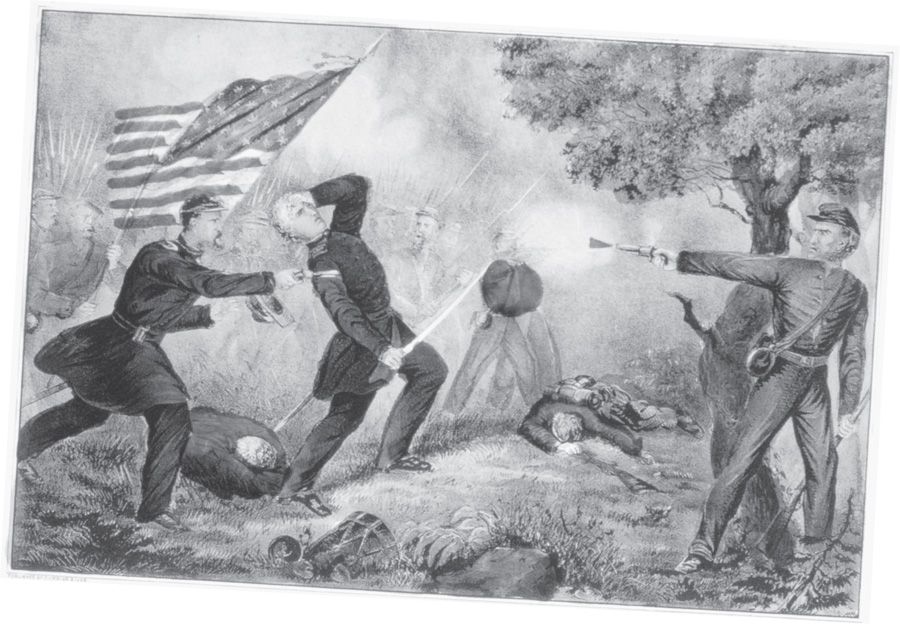
A Currier and Ives lithograph depicting the death of Colonel Edward D. Baker at the Battle of Ball’s Bluff.
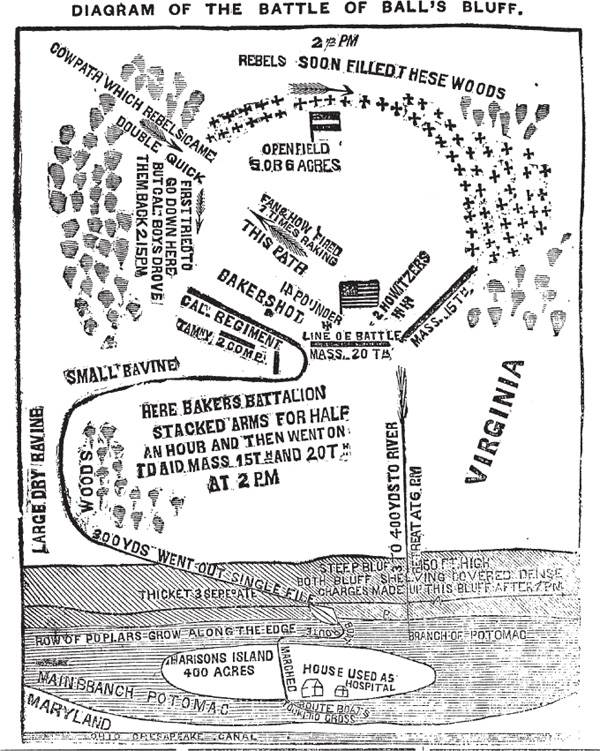
A map published in The New York Times showing troop dispositions at the Battle of Ball’s Bluff.
1. Witnesses to the Congressional committee declared that Stone secretly communicated with Southerners and that he returned runaway slaves to their owners. Secretary of War Edwin Stanton ordered Stone’s arrest on February 8, 1862, and he was imprisoned, though no charges were ever filed. He spent ten months in prison without a trial and was released in August, still with no explanation. Very likely, The New York Times played a role in his reinstatement. It editorialized: “General Stone has sustained a most flagrant wrong — a wrong which will probably stand as the very worst blot on the National side in the history of the war.” Stone got a second chance in 1864, when Nathaniel Banks selected him as his chief of staff for the Red River campaign. See Chapter 18.