CHAPTER ONE
In his ‘Presentation of the Plans’, at St Paul’s School, London, on 7 April 1944, General Montgomery displayed a series of lines on a map of Normandy, showing 21st Army Group’s expected progress to the Rivers Seine and the Loire. General Eisenhower, flanked by his senior naval, land and air planning officers, listened to Montgomery’s outline of OVERLORD. Explaining the revised version of COSSAC’s plan, Montgomery told them that he had increased both the frontage of the invasion and the number of the airborne and amphibious assault divisions to be committed on D-Day. Montgomery recounted:
‘It was vital to secure an adequate bridgehead at the outset, so that operations could be developed from a firm and sufficiently spacious base; in any event the area we could hope to seize and hold in the first days of the invasion would become very congested.’
Far more importantly, Montgomery stressed the need to hold the Germans on the Caen front, while the Americans cleared the Cotentin Peninsular and captured the port of Cherbourg. Montgomery analysed the ‘run of rail and road communications leading to Normandy’, and believed that:
‘Since the bulk of the enemy mobile reserve was located north of the Seine they would have to approach Normandy from the east and might be expected to converge on Caen.’
In summary, the need for sufficient ground in the beachhead and the need to fight to hold the Germans on the Caen front eventually led to the launch of Operation EPSOM.
Allied Progress Since D-Day
The first phase of the invasion had gone well. By the end of the first week, the beachheads had been linked up and progress inland had been sufficient to regard the Allied lodgement as secure. However, the area that Montgomery had intended to ‘seize and hold in the first days of the invasion’ was in the event much smaller than planned. After initial paralysis, effective German reaction had hemmed the Allies into their beachhead.
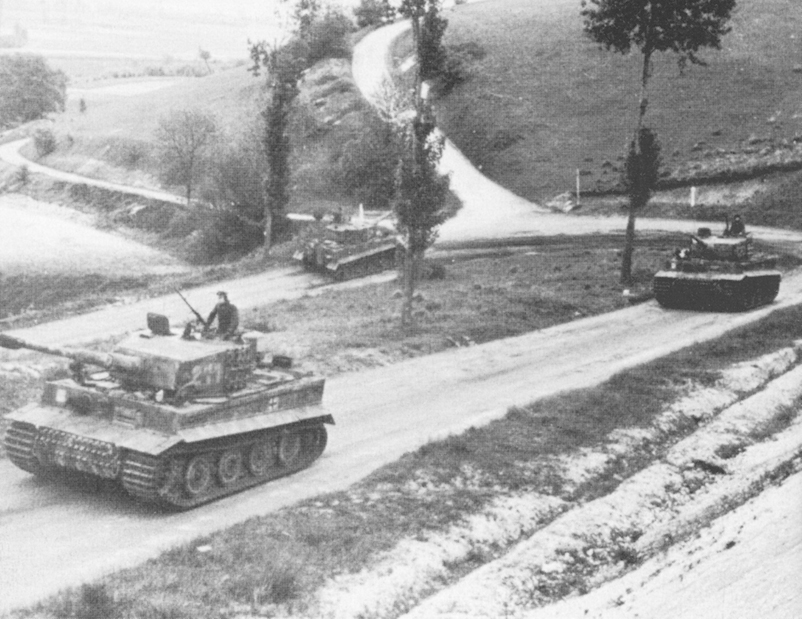
Despite the storm delaying the Allied build up, the Germans could not match the Allies because of the air attacks and sabotage to the French transport system. These Tigers of 101st SS Schwere Panzer Battalion are having to drive to the Normandy front.
In some hard fighting, First US Army, consisting of nine divisions, was making steady progress up the Cotentin Peninsular towards Cherbourg and had almost reached the western coast of the Peninsula. On the British front, 3rd Division’s D-Day mission had been to take Caen. This it failed to do and Montgomery was soon under significant pressure to create space for Leigh-Mallory’s Second Tactical Airforce’s airfields and the Army Group’s logistic infrastructure. Nevertheless, with the build-up of Allied ground troops exceeding that of the Germans, Montgomery was able to pursue his overall strategy of fighting the German armour on the Caen front. However, he was forced to recognize the importance of capturing ground around Caen rather than focusing on the defeat of the enemy.
Montgomery’s second all out attempt to seize Caen was launched from the west, after some heavy fighting east of the River Orne, on 12 June. 7th Armoured Division attacked into a thinly held gap in the enemy line between Caumont and Villers-Bocage. One officer wrote:
‘Here we were in this first week of battle exploiting a possible breakthrough with very little opposition, an armoured brigade in front and the infantry coming along behind in lorries. It was exciting to be on the move at such a pace.’
All this, however, ended at 0800 hours on 13 June when the Division, led by the Cromwell tanks of A Squadron 4th County of London Yeomanry, entered Villers-Bocage. Here they fell prey to four Tigers of SS-Obersturmführer Michel Wittmann’s Number 2 Company, 101 SS SchwerePanzer Battalion. The British tanks were ‘brewed up’ one after the other and the accompanying motor battalion of infantry were machine-gunned before they could respond. 7th Armoured Division was halted in its tracks. The battle lasted all day, costing Britain’s most glamorous formation twenty-five armoured vehicles and a considerable proportion of the desert veteran’s vaunted reputation. With the stopping of 7th Armoured Division’s advance, the Germans had managed to form a solid front, through which, future British or Canadian attacks, would have to fight, before the tanks of the armoured divisions could again be unleashed. However, before such a breakthrough could be contemplated, Second Army would have to gather its strength, as the landing programme was already falling behind the planned rates of build-up.
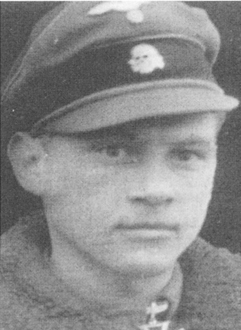
Right: SS-Obersturmführer Michael Wittmann and the results of his action at Villers-Bocage. He also commanded his Kompanie of Tigers from 101 SS Schwere Pz Bn during Operation EPSOM.
The German Strategy
Convinced by the Allied deception plan, code named FORTITUDE, Hitler and his staff in Berlin (OKW), still believed that the main Allied landing would strike the Fifteenth Armee in the Pas de Calais. However, with the failure to ‘throw the Allies back into the sea’, and with the Allies firmly established ashore, Panzergruppe West was demanding the dispatch of powerful panzer formations to counter-attack the lodgement. Six panzer divisions were soon on their way to Normandy from as far afield as Southern France (2nd Das Reich SS Panzer Division) and Russia (II SS Panzerkorps). The German aim was to mount a powerful counter-stroke against the Allies’ centre, driving north to the coast, between First US and Second British Armies and destroying them. The reinforced Panzergruppe West would then be available to support Fifteenth Armee in defeating a subsequent landing by General Patton’s fictitious First US Army Group.
Concentration of the panzer divisions, however, took much longer than expected; such was the effect of Allied bombing, special forces raids on nodal points in the transport network and air interdiction in both France and the Low Countries. Thus the formations that Hitler had released to the Seventh Armee in Normandy, were not only badly delayed en route but also reduced in combat effectiveness. For example, II SS Panzerkorps was forced to de-train in eastern France by Allied air sorties and make a tiring and mechanically wearing road move to Normandy; a distance of four hundred miles. Meanwhile, the panzer formations already in theatre, were committed to holding ground against the British and Canadians, as infantry divisions were also delayed and were making their way, on foot, to Normandy, under the cover of darkness.
By maintaining pressure on the Germans, Montgomery kept them off balance thus preventing Rommel from extracting his panzer divisions from the line and forming an operational reserve. In addition, Hitler’s insistence that there should be no withdrawal to more easily defensible lines and that ‘positions were to be held at all costs’, was a severe limitation to his field commanders.
12th (Hitlerjugend) SS Panzer Division
Amongst those panzer formations already facing the Allies in mid-June, was the Hitlerjugend. It had been in action since D+1 and was holding a ten-mile stretch of line west of Caen. The Hitlerjugend, or as Allied propaganda had portrayed it the ‘Baby Division’, was one of the newer German formations, raised in the aftermath of the disastrous capitulation of Sixth Armee at Stalingrad. In February 1943, Himmler wrote to the Reich Youth Leader:
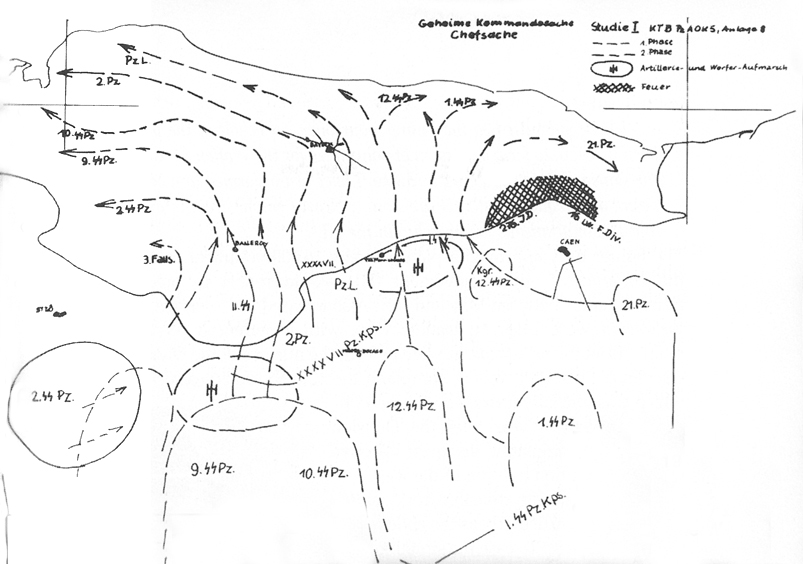
Plan No.1 from Army Group B (19 June 1944 for the planned counter-attack by Panzergruppe West).
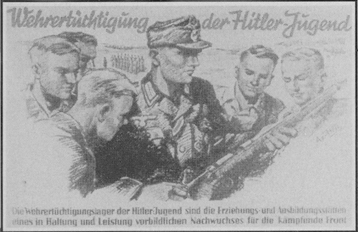
A poster advertizing military training for the Hitler Youth movement.
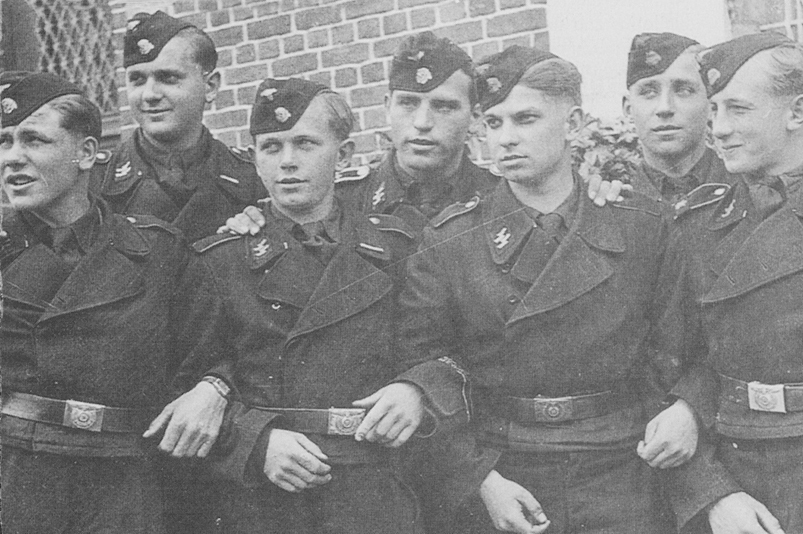
Teenage SS motor cycle reconnaissance troops belomging to the 12th (Hitlerjugend) SS Panzer Division.
‘I have submitted to the Fuhrer your offer, on behalf of the youths born in 1926, to form a division of volunteers for the Waffen SS to be of the same value as the Leibstandarte. I have also informed him of your desire and request that this division … clearly emphasizes its origins and its simultaneous membership in the HJ.’
The Führer duly approved a plan whereby 16,000 volunteer members of the Hitlerjugend youth movement (HJ) would report to pre-military training camps between May and July. Also released from service with the Wehrmacht were 2,000 HJ leaders who, with experienced SS veterans, mainly from the Leibstandarte, were to form the nucleus of the Division. SS-Oberführer Fritz Witt, was to command the 12th SS Hitlerjugend Division, which was officially formed on 1 June 1943. Almost exactly a year later the Division proved to be, arguably, the most effective German formation fighting in the west.
Forming an élite division from scratch was not easy, particularly as the Hitlerjugend had to train itself. To ease the situation, fifty Wehrmacht officers joined the division to fill certain key posts for which the Waffen SS were unable to provide suitable trained and experienced officers. Weapons, vehicles and all kinds of equipment were in short supply, even for the SS, who were increasingly taking the cream of the Reich’s production. Many recruits reported for duty in their HJ uniforms and those who transferred from the Wehrmacht or the Luftwaffe continued to wear their old uniforms for some time. Training was entirely orientated towards battle, with little emphasis on foot drill and other traditional elements of military discipline. As Divisionsadjutant SS-SturmbannfuhrerSpringer explained: ‘Priorities during training [were]: 1: Physical fitness. 2: Character development. 3: Weapon and combat training.’
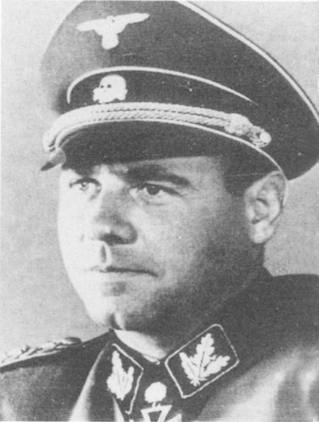
SS-Oberführer Fritz Witt. The first commander of the newly formed 12th (Hitlerjugend) SS Division.
Unit training took place in Belgium, but despite shortages of equipment, ammunition and fuel, the HJ volunteers, were developing into high quality eighteen year old soldiers.
In April 1944, the Hitlerjugend, now a fully fledged panzer division, moved to billets between the Orne and Seine, taking the place of 10th (Frundsberg) SS Panzer Division, which had been rushed east to face the Soviet’s spring offensive. Here it completed its training and provided 2,042 surplus soldiers to the Leibstandarte. This fostered even closer links with its sister formation, which it was now, in theory, grouped with as a part of I SS Panzekorps. Following an inspection of the Hitlerjugend, in a report dated 1 June 1944, SS-Obergruppenführer Sepp Dietrich declared:
‘The Division with the exception of the Werfer Battalion and the Panzerjager Battalion, is fully ready for any action in the west.’
The words of eighteen-year old SS Sturmmann Leykauff reveal the state of the Division’s morale on the eve of the invasion:
‘Everyone was waiting for the attack across the Channel. We were fully aware that decisive battles were approaching. Our first action lay ahead. We were looking forward to it.
‘The Allies planed to take apart the “Baby Milk Division”, as they called us. But we were not afraid. Sometimes we even got carried away a bit, and big-headed. After the intensive training on our weapons, we felt sure we could take the heat. It had been said that the enemy would be physically superior to us. Well, we knew that we were quick, agile and confident. We trusted our officers and NCOs who had been hardened in battle. We had known them since the beginning of training. During combat exercises with live ammunition we had enjoyed seeing them in the mud together with us, with steel helmet and submachine gun.’
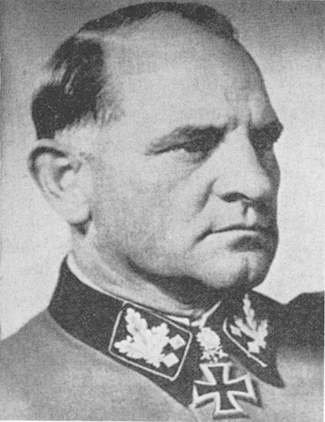
SS-Obergruppenführer Sepp Dietrich was able to report that the new division was ready for action.
Before dawn on D-Day, the Hitlerjugend stood-to but spent most of the day waiting. Despite repeated requests from Armygruppe B and Seventh Armee, OKW only released the division at 1430 hours. However, moving at 1740 hours, it was repeatedly attacked by fighter-bombers. The leading elements of the Division came into action west of Caen and quickly established a reputation amongst their British and Canadian opponents for having an uncompromising determination in battle that verged on fanaticism. Allegations of war crimes, such as the murder of sixteen Canadian POWs, in the days immediately after the invasion did much to shape the nature of future fighting with the Hitlerjugend.
Casualties suffered by the Hitlerjugend in the two weeks after D-Day were high but on a relatively static front, lightly wounded soldiers were evacuated and eventually returned to their units, while armoured vehicle casualties were recovered for repair or cannibalization. Thus, the number of soldiers and equipment available to face Operation EPSOM at the end of June was higher than the Hitlerjugend’s raw casualty figures would indicate.
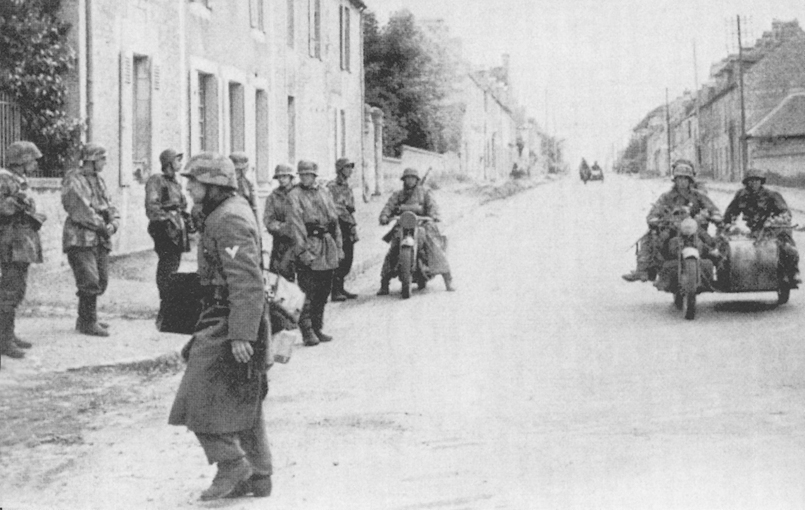
Motor cycle recce troops of the Hitlerjugend Division arriving near Caen, June 1944. These eighteen year olds head towards the coast and their first action watched by Wehrmacht infantry.
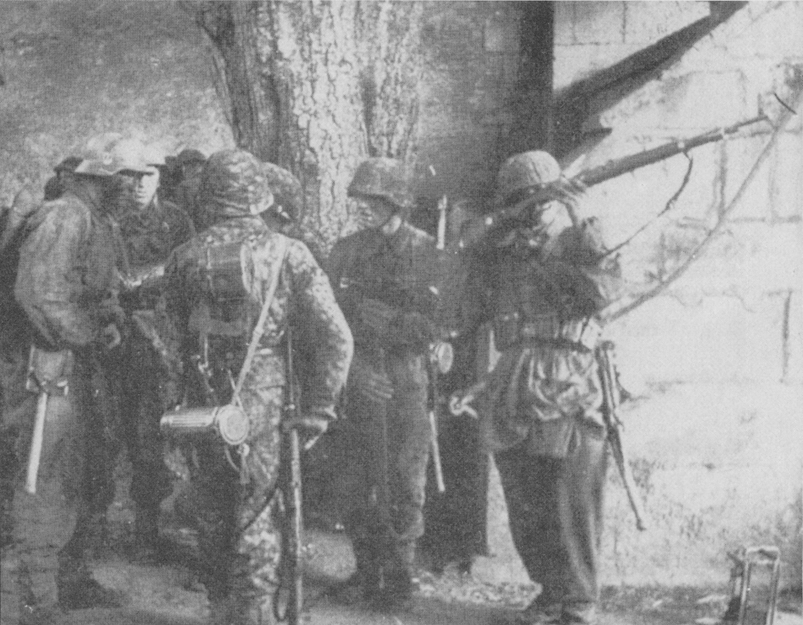
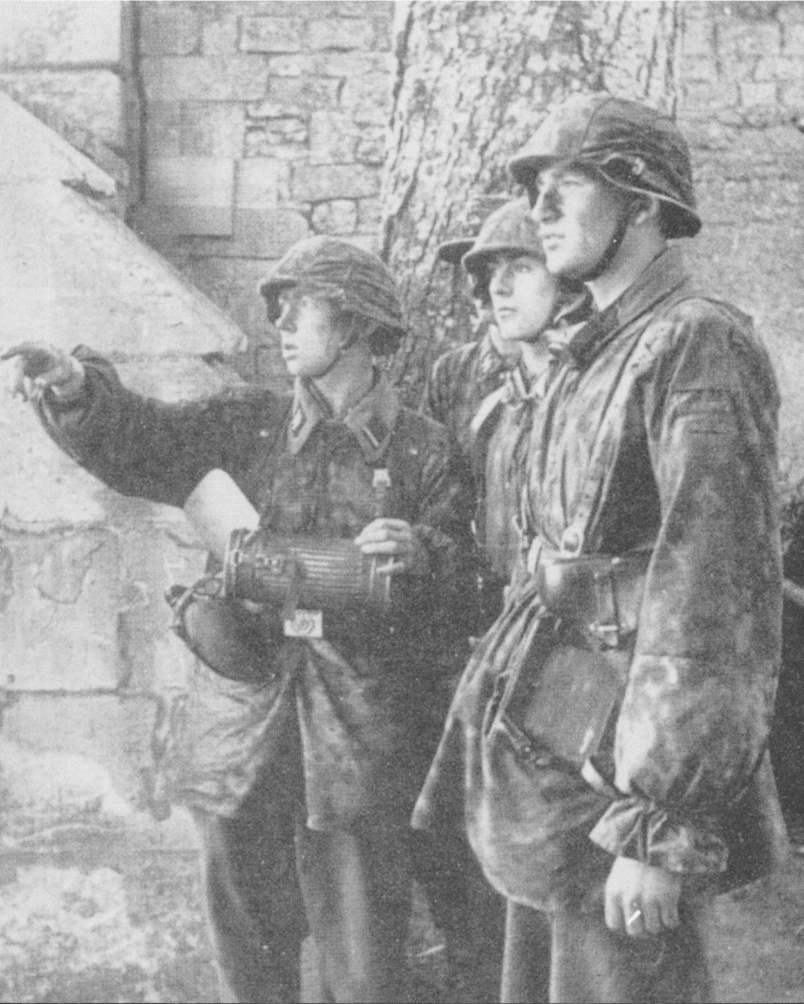
Below and opposite: Photographs taken during the Hitlerjugend’s first battle against the Canadians.
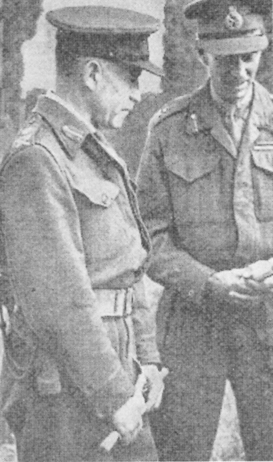
Lieutenant General Sir Richard O’Connor (left) commander of VIII Corps, consults with his superior, General Sir Miles Dempsey, commanding British Second Army.
The British
VIII Corps’s arrival in Normandy had been badly delayed by the Channel storm that raged from 19 – 22 June and dangerously slowed the Allied build-up, while giving the Germans an opportunity to balance the forces in Normandy. Lieutenant General Sir Richard O’Connor had performed spectacularly in the early desert campaigns before being taken prisoner. He had escaped and was given command of VIII Corps by Montgomery. His command had very few Regular Army soldiers and few veterans of the desert or Mediterranean in its ranks. Most of VIII Corps’s troops, the Infantry of 15th Scottish and 43rd Wessex, together with the tanks of 11th Armoured Divisions, were originally part-timers of the Territorial Army or were war raised units. However, after five years of war, there was little distinction between units manned by Regulars, Territorials or conscripts and in Operation EPSOM, they were to fight their first, long awaited, battle of the war.
15th Scottish Infantry Division had originally been raised as a New Army division in the Great War. Its divisional sign had been an ‘O’ – the fifteenth letter of the alphabet but following an inspection, King George VI suggested that the arms of Scotland be inserted into the badge.
‘On 2nd September 1939 the 15th Scottish Division was reborn. It had been begotten by national necessity out of 52nd Lowland Division.
‘The business had started that spring, when, with a wave of his magician’s wand the Secretary of State for War, had duplicated the Territorial Army. Unfortunately, Mr Belisha had omitted to duplicate with the same gesture the Territorial Army’s equipment, accommodation and training facilities.’
VIII CORPS

43rd Wessex

15th Scottish
11th Armoured
In the run-up to war, existing Territorial battalions provided cardres for new units, as volunteers flocked to the colours in a manner reminiscent of 1914. Many of the volunteers were old soldiers, whose military experience eased the problems of training. Initially the 15th was based in towns scattered across southern Scotland. However, by the end of September the Division was concentrated in the Borders, living in mills in Galashiels and Hawick. In October, ‘essential workers’ taken back by the Ministry of Labour and men not meeting new medical standards, were replaced by English recruits from the Midlands ‘who soon became Scottish as the Scots’.
As the Battle of France in 1940 reached its climax, 15th Scottish moved south to face Hitler’s expected invasion of the Essex coast. As the invasion scare receded, the emphasis increasingly swung to training but by autumn 1941, the manpower demands of the fighting in the Middle East forced the Division to become a ‘Lower Establishment’ formation. Men, units and even 45 Brigade left the Division during 1941 and 1942. However, in December came the news that the Division was to be built back up to ‘Higher Establishment’, which was reached by April 1943 and shortly afterwards the Division joined VIII Corps. Men posted to the Division, which now included conscripts from across the UK, were soon taking part in increasingly complex exercises on the Yorkshire Moors.
Suspicions that the Division was to take part in the Second Front were confirmed when General Montgomery visited and addressed units from the bonnet of a jeep. In common with other invasion troops, the King and Mr Churchill also visited 15th Scottish Division. In April 1944, the 15th moved south to begin the process of waterproofing and final training. The Division started to arrive in Normandy on 13 June but the storm of 19 – 22 June badly disrupted the Division’s arrival.
EPSOM’s second major formation was 11th Armoured Division, commanded by the experienced and successful thirty-seven year old Major General ‘Pip’ Roberts. This division had been formed in March 1941, largely from Territorial units such as the 2nd Fife and Forfar Yeomanry (F & F Y) and newly raised units such as 23rd Hussars (23 H). The 11th Armoured went through many changes of ORBAT and was in both reality and rumour frequently ‘just about to go overseas’. However, the Division was destined to train and retrain as tactical doctrine and equipment changed with regularity. Officers pawed over reports from the Mediterranean and exercise authors sought to reflect the latest tactics in exercises on the increasingly familiar training areas of Stanford in Norfolk and the bleak Yorkshire Moors.
With late arrivals such as the veteran 3rd Royal Tank Regiment (RTR) being incorporated into 29 Armoured Brigade, the Division moved to Aldershot for waterproofing. After a long wait, 11th Armoured Division landed in France on 13 and 14 June. However, it was another ten days before it tanks made their way forward to Operation EPSOM’s assembly areas.

4 Armoured Brigade.
The only veteran formation to take part in the operation was 4 Armoured Brigade, whose black and white desert Jerboa flash was worn on the battle dress of its soldiers. Originally raised as the Heavy Armoured Group of the Mobile Division (later 7th Armoured Division) in Egypt, 4 Armoured Brigade had been an ‘independent’ formation since 1943 and had fought in the desert, Sicily and Italy. The Brigade was one of those favoured formations, selected by Montgomery, to return to the UK to spearhead the invasion. It consisted of old Regular Army units; the Scots Greys and 2nd Kings Royal Rifle Corps (2 KRRC), a Territorial unit 3rd County of London Yeomanry (3 CLY) and a war raised unit, 44 RTR. This mixed military heritage did not matter a great deal, after years of practical experience of war in the Mediterranean. Landing on D-Day, the Brigade had two weeks of fighting behind them, making them in all respects the most experienced formation fighting during EPSOM.
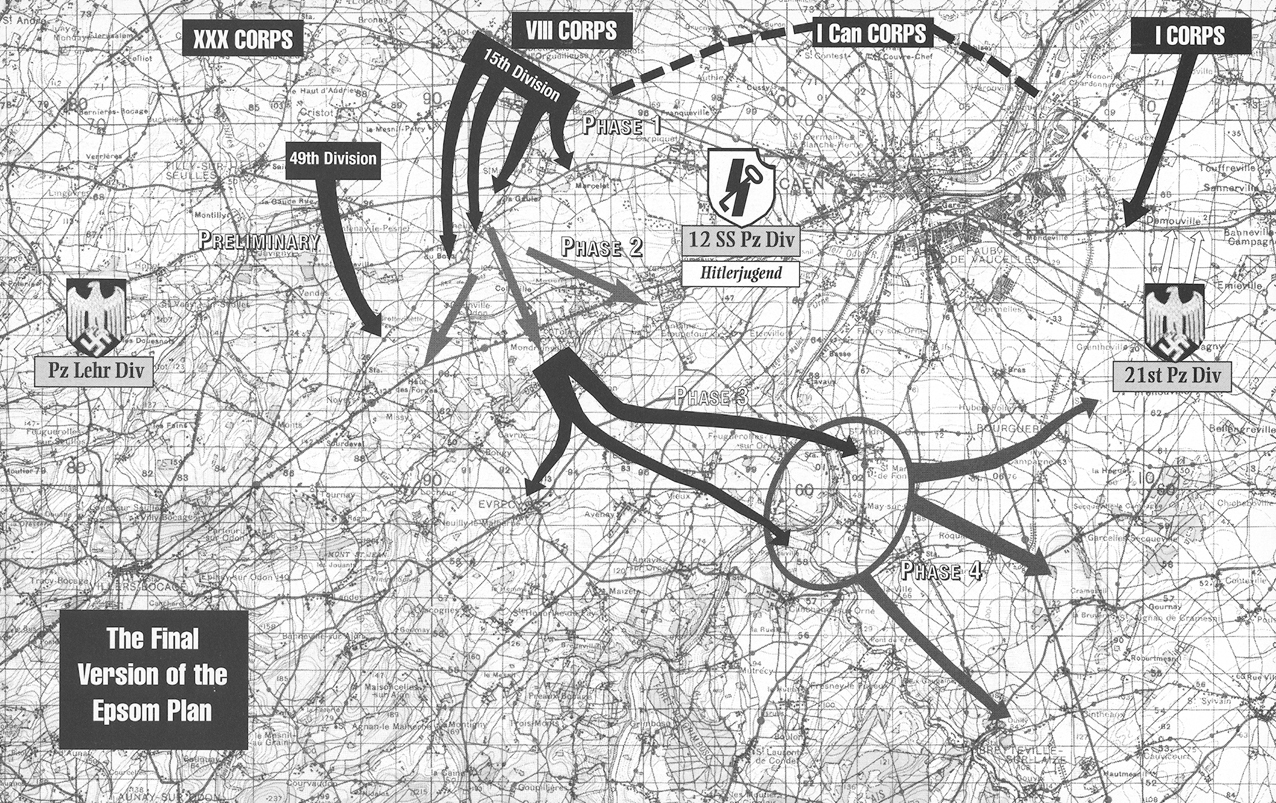
The EPSOM Plan
On 18 June, Montgomery issued Directive M502 to his army commanders, Generals Bradley and Dempsey, to whom he gave, respectively, the ‘immediate task’ of ‘the capture of CHERBOURG’ and ‘the capture of CAEN’. In his direction to Second British Army, he envisaged that: ‘The operations against CAEN will be developed by means of a pincer movement from both flanks’. Initially Montgomery intended that VIII Corps would deliver the main attack, east of the River Orne, on 22 June, following four days of attack by I and XXX Corps to the west of the city. However, as detailed planing began, it became obvious that a corps could not assemble in the tight bridgehead east of the Orne without the British intentions being all too obvious. The following day an amendment, M 504, was issued:
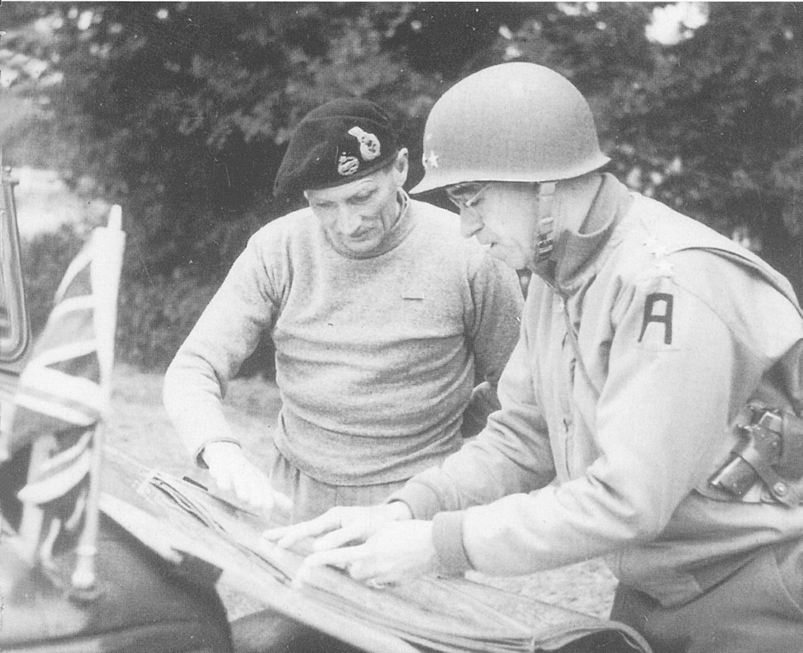
Generals Montgomery and Bradley photographed during their planning meeting 22 June 1944.
‘It has therefore been decided that the left wing of the of the pincer movement, from the bridgehead over the ORNE, shall be scaled down and be only of such a nature as can be done by the troops of I Corps already there.
‘VIII Corps will be switched to form part of the right, or western wing of the pincer movement … The final objective of VIII Corps will remain as given in para 12 of M 502 [Bretville-sur-Laize], but the Corps will advance to this objective on the general thrust line:
ST MANVIEU 9269 – ESQUAY 9460 – AMAYE SUR ODON 9757.
‘… The above operations will begin at or about dawn on 22 June. VIII Corps will be launched on its task on the morning of 23 June.’
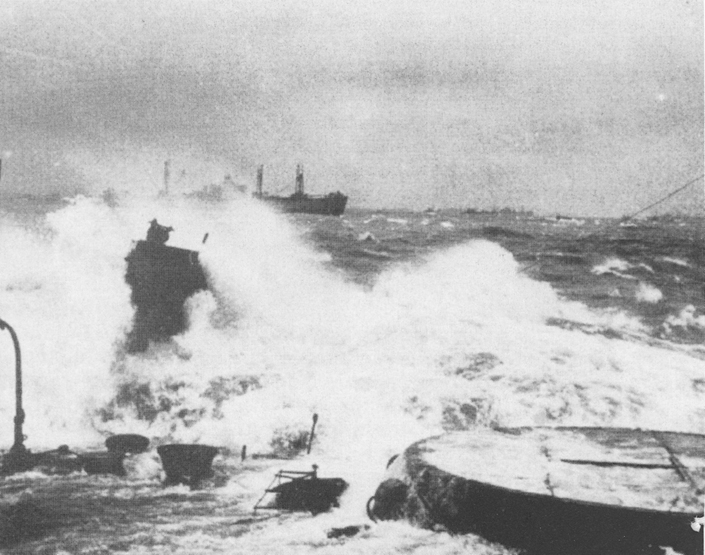
The storm that battered the Normandy coast seriously delayed the Allied build-up and gave the Germans some respite.
However, the storm that was already doing its best to destroy the Mulberry Harbours, seriously disrupted the landing programme and delayed the start of the preliminary operation east of the Orne until 23 June. The initial attack west of Caen began on 25 June and the main EPSOM attack, by VIII Corps, the following day.
The limited attack from the Orne Bridgehead, by 51st Highland Division, was designed to force the enemy to commit 21st Panzer Division and its reserves to this area. While the aim of the preliminary attack by 49th West Riding Division, on 25 June (Operation MARTLET), was to unbalance the enemy and to seize the Rauray Spur which dominated VIII Corps’s area of operations. General O’Connor considered it vital, if EPSOM was to succeed that the Spur was cleared of enemy. Supported by 8 Armoured Brigade and advancing parallel to VIII Corps, 49th Division’s subsequent objective was to secure the Noyers area. On VIII Corps’s left, I Canadian Corps would mount operations to capture Carpiquet, once the breakthrough was well established.
In making his EPSOM plan, General O’Connor considered the difficult ground across which his troops were to attack. From their start line, the attackers would have to negotiate, what the official historian described as:
‘…an area of wide hedgeless fields of standing corn [wheat], falling slowly to the Mue, an insignificant stream. From there southwards the landscape is more typical of the bocage, its small farms and orchards enclosed by thick and steeply banked hedges, its villages half hidden in hills and its outlines broken by woods and coppices. From the south west a ridge [the Rauray Spur] of higher ground extends across the battlefield with spurs running northwards towards Fontenay le Pesnel and Rauray on XXX Corps front and on VIII Corps towards le Haut du Bosq with a final hump [Ring Contour 100] south east of Cheux.’
Beyond Cheux was a belt of excellent defensive ground, which presented the enemy with cover and good fields of fire. Once through this area of bocage, a string of villages along the Caen to Villers-Bocage road offered the German more good positions from which it would be difficult to dislodge them. Beyond the road, the ground dropped sharply into the Odon Valley. This valley had precipitous wooded sides and the river itself had steep tree-lined banks together making it a serious obstacle to armour. To make matters worse, there was only one crossing on the main axis at Tourmauville. Therefore, engineers would be needed well up in the advance to improvise additional crossings for armoured vehicles.
Rising out of the close confines of the Odon Valley was the broad open plateaux of Hill 112. This feature is visable from much of the area west of Caen but it is not until standing on its upper slopes that its dominating position is fully appreciated. From Hill 112, a series of ridges sweep down to the valley of the River Orne. Beyond this valley lay the temptingly open country that offered good going towards VIII Corps’s objective at Bretville-sur-Laize.
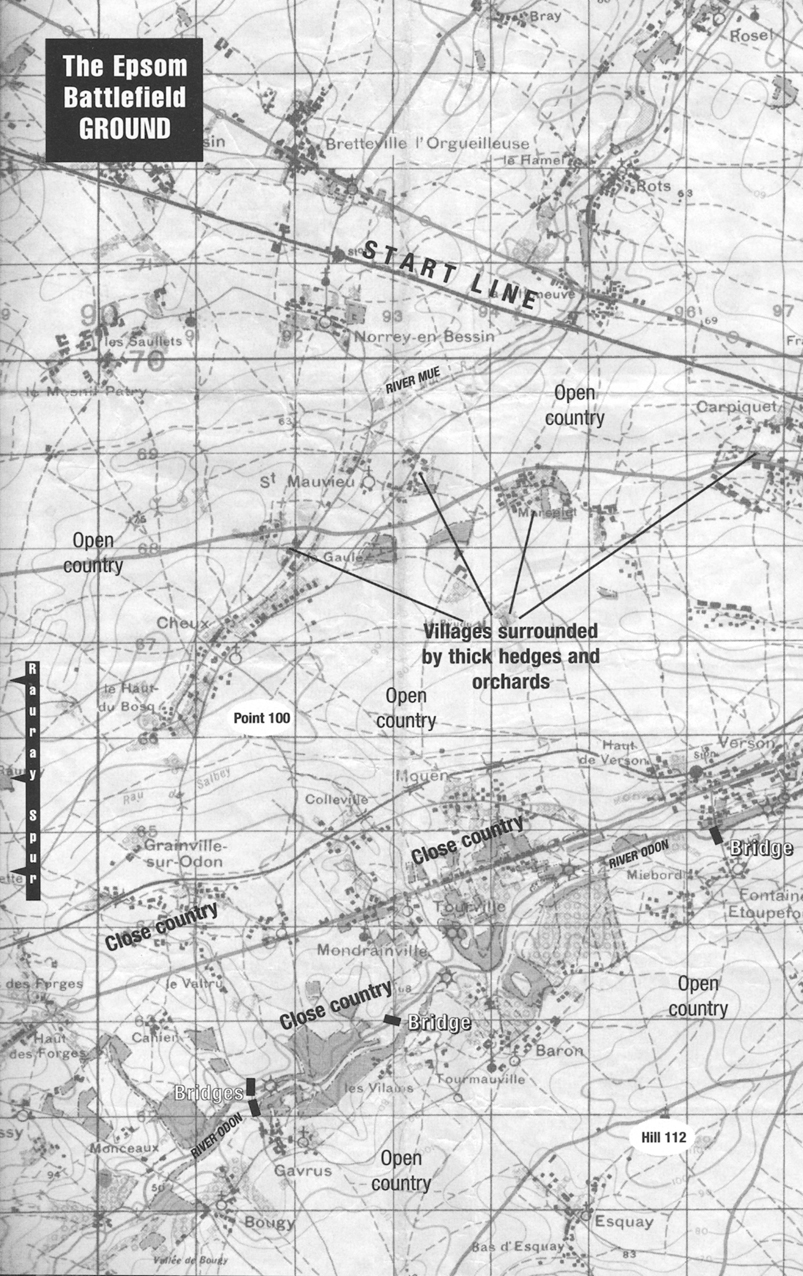
The second factor that General O’Connor considered was the enemy. SS Standartenführer Kurt Meyer’s 12 Hitlerjugend SS Panzer Division held ten miles of the front, from Fontenay-le-Pesnel, east to Carpiquet, across the N13 and on to the north east of Caen. Consequently, the Hitlerjugend were deployed in positions that lacked depth. VIII Corp’s intelligence sections believed that SS-Obersturmbannführer Mohnke’s 26 Panzer Grenadier Regiment (26 Pz Gr) that held positions between Fontenay-le-Pesnel and east to the N13, ‘amounted too little more than a well developed outpost line’. It was here that the British were to attack. So long was 26 Pz Gr’s sector that all three battalions were in the line, along with 12 SS Pioneer Battalion (12 SS Pi) who were under command. Unlike the British, the Germans considered their assault/field engineers to be a fully-fledged combat arm and expected to perform in close combat alongside.
Behind the infantry was SS-Obersturmbannführer Max Wunsche’s 12 SS Panzer Regiment (12 SS Pz Regt), with its two battalions dug-in in blocking positions, having also reconnoitred counter-attack options. A return dated 24 June 1944 reported the number of tanks operational: fifty-eight Panzer IVs and forty-four Panzer Vs (Panthers). This significant tank force was backed up by the guns of 12 SS Artillery Regiment and seventeen heavy anti-tank guns. The Division’s Chief of Staff, SS-Sturmbannführer Hubert Meyer, in sumarizing the Hitlerjugend’s design for battle, explained that the artillery:
‘… was in position behind Regiment 26 and depended on good co-operation with it, had also prepared for close defence and were well camouflaged. Because of the width of the sectors of the panzer grenadier companies, their positions did not have much depth. So the heavy infantry weapons, the panzers and the artillery were to form the strong points of the main battlefield.’
In the Waffen SS, no matter what the soldier’s employment, he was expected to be above all an effective frontline soldier.
Deployed to the north of the Odon, were four companies of dual purpose 88mm guns belonging to 4 FlakSturmregiment and the Hitlerjugend’s only uncommitted reserve: the half-tacks and armoured cars of the Divisional Reconnaissance Battalion. This battalion had a limited infantry capability and only a light armoured punch. However, in response to intercepts of VIII Corps radio traffic, I SS Panzerkorps moved two companies of 56-ton Tiger tanks belonging to 101 Schwere Panzer Battalion, into the area behind 26 Pz Gr as Korps reserve.
26 Pz Grs had held the front that the British were to attack since 15 June and, as SS-Sturmbannführer Hubert Meyer, recorded:
‘In addition to the fox holes, positions for riflemen and machine guns had been set up in houses. The positions for the heavy infantry weapons had been carefully selected, camouflaged and prepared for close defence. Mine barriers and barbed wire obstacles had only been set up to a minor extent …The Pioneerbatallion had reinforced its positions in a particularly expert manner. Despite the shortage of time, strong points for light and heavy infantry weapons had been established through extraordinary efforts.’
The British had, however, amassed a considerable force that was expected to sweep through what appeared to them to be a ‘lightly held crust’. Nominally, VIII Corps had 60,000 men under command for Operation EPSOM but some, such as 43rd Wessex Division, were only just landing and assembling on 25 June. The Corps, including its own artillery, the guns of the flanking corps and the heavy, medium and field artillery regiments of the 8th Army Groups Royal Artillery (AGRA), had approximately 736 guns in support. This gave a concentration of a gun for every sixteen yards of attack frontage. Also included in the firepower equation were the ships of the Royal Navy. The monitor HMS Roberts and three cruisers were able to add their considerable weight of fire, as the battlefield, eighteen miles from the coast, was well within range of naval guns. Finally, 250 heavy Royal Air Force bombers were planed to open the attack and ‘cab ranks’ of fighter-bombers would be on call above the battlefield.
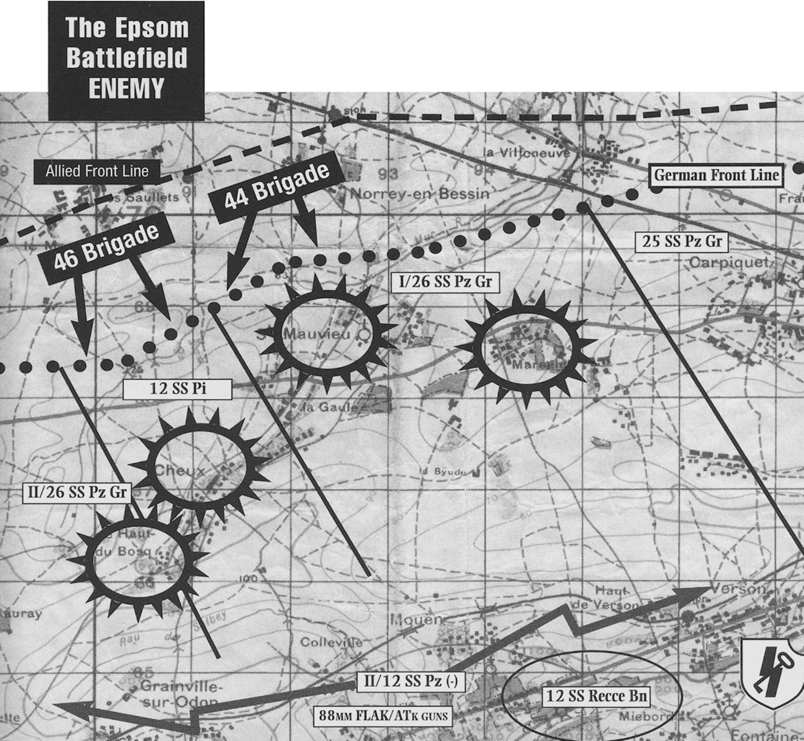
See map page 22
VIII Corps’s attack was to be delivered in four phases. Firstly, by two brigades of 15th Scottish Division advancing through positions held by 3rd Canadian Division, on a frontage of just 5,000 yards. The brigade groups consisted of their three normal infantry battalions and their artillery regiment, joined by the Churchills of 31 Tank Brigade and 79th Armoured Division’s specialist assault armour. H-Hour for Phase One was to be 0730 hours, two hours after dawn, which would allow plenty of daylight for accurate bombing and observation of the artillery’s ‘fall of shot’.

15th Scottish
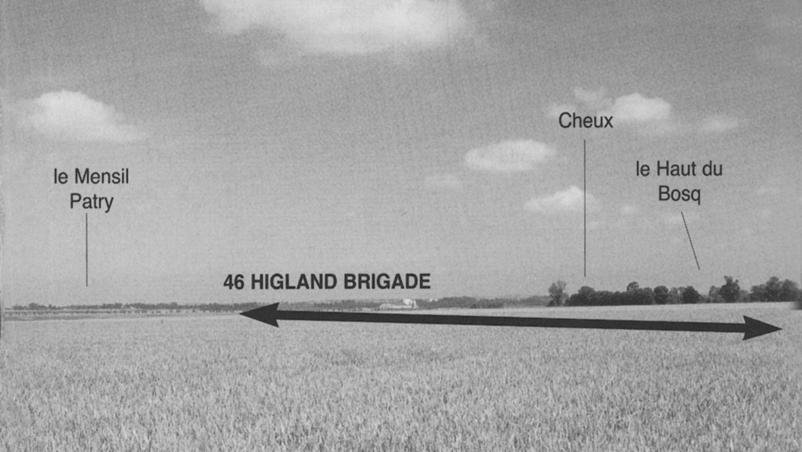
In Phase One, two battalions of 44 Lowland Infantry Brigade, supported by two Squadrons of 9 Royal Tank Regiment (9 RTR) were to advance on the Division’s left flank, across the open fields of the Mue valley, and take St Mauvieu and le Gaule. On the right, two battalion of 46 Brigade, supported by two squadrons of 7 RTR, had further to advance on the right to take the straggling villages of Cheux and le Haut du Bosq. Waiting behind 15th Scottish Division was 11th Armoured Division, with 4 Armoured Brigade under command.
From this point, in Phase Two, depending on the tactical situation, a ‘mobile column’ of 11th Armoured Division, spearheaded by recce Cromwells of A Squadron 2nd Northamptonshire Yeomanry (2 N Yeo), was to make a dash forward. They were to seize the Tourmauville Bridge, five miles into enemy territory. At the same time, 15th Recce Regt would advance and cover the left flank in the area of Mouen. Meanwhile, in recognition of the difficulties that the Odon Valley presented to armour, 227 Highland Brigade was to advance with two battalions up, supported by two squadrons of Churchills, seize the line of the Caen to Villers-Bocage road. They were then to clear the Odon valley in detail. Subsequently, they were to take over defence of the bridges at Tourmauville and Gavrus,
11th Armoured
In EPSOM’s third phase, 29th Armoured Brigade was to press on across Hill 112 towards the Orne with, if necessary, the help of 227 Brigade. Meanwhile, 44 and 46 Brigades having been relieved by 43rd Wessex Division, would take over defence of the villages on the northern slope of the Odon Valley between Granville and Mouen. 15th Recce Regt was then to advance south west across Hill 113. In the fourth phase, 46 Brigade would cross the Odon and relieve elements of 11th Armoured Division in the Evrecy area. 4 Armoured Brigade had a number of options but its main objective was to cross the Orne and establish a bridgehead with 159 Infantry Brigade. If possible, it was to drive across the open ‘tank country’ to Bretville-sur-Laize, thus completing the envelopment of Caen from the west.
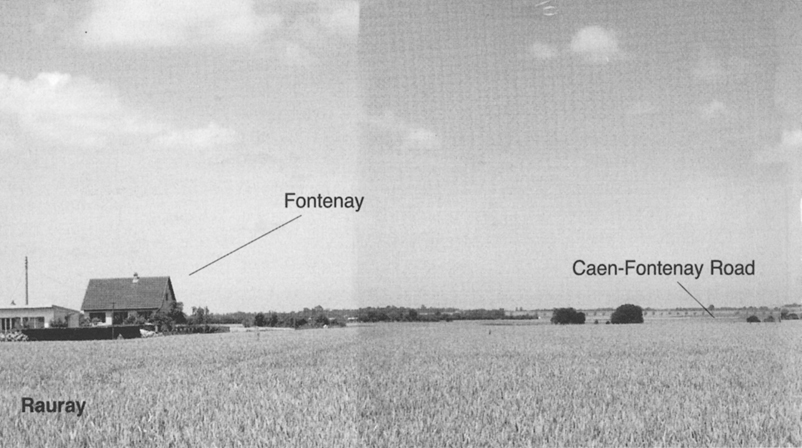
The Germans’ view from the edge of Rauray looking across the ground that 46 Brigade would advance on the first day of EPSOM.
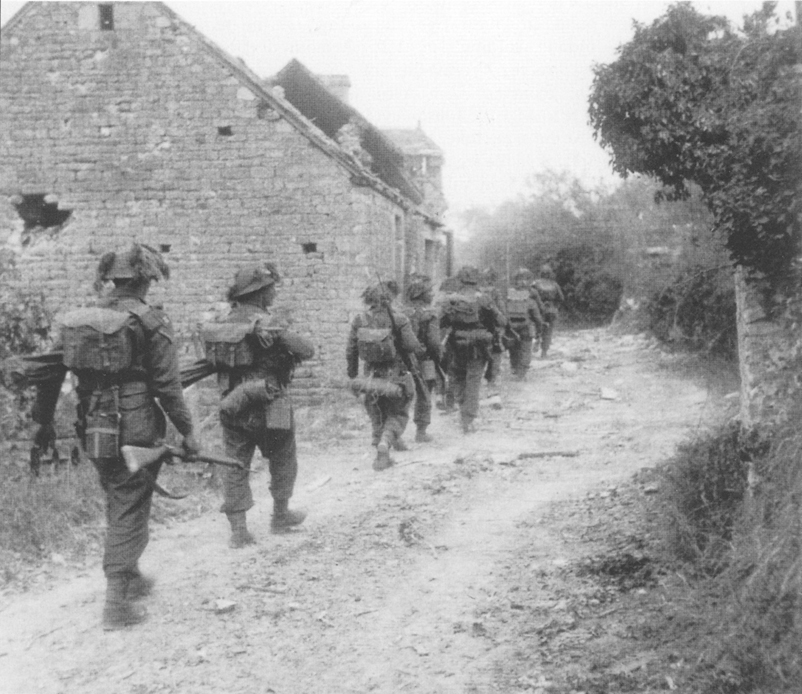
Infantry of the York and Lanes Regiment moving through the northern part of Fontenay on 25 June.
Following behind the Scots was the newly arrived 43rd Wessex Division. Its planned role, as explained by Brigadier Essame, was relatively simple:

43rd Wessex
‘The task of the Division was to follow the 15 (S) Division, taking over each objective as soon as possible after capture so as to enable the advance to be continued. The Commander emphasized the importance of St Manuvieu on the [open/unprotected left] flank.’
While VIII Corps was assembling for it’s ‘storm delayed attack’, German armoured formations were approaching their own concentration areas for ‘the drive to the sea’. However, as SS Sturmbannführer Hubert Meyer recounted:
‘A meeting took place on 24 June at Panzergruppe West. Taking part were … XXXXVII Pz Korps and I and II SS Panzerkorps. They were briefed on the operations. No one knew that the preparatory attack for the British operation Epsom would start the next day and that the race to assemble had already been lost. The decisions taken too late from the very first day of the invasion onward had caused our reinforcement to lag behind by fourteen days. A German offensive on 20 or 21 June [during the storm] would have caught the enemy at a moment of extraordinary weakness.’
In Operation EPSOM, the Allies struck first. It was a blow that the Germans were forced to react to and the opportunity for Panzergruppe West to seize the initiative was gone.
Operation MARTLET
Before considering Operation EPSOM, it is necessary to briefly examine the ‘preparatory’ attack mounted by 49th West Riding Division on the Rauray Spur, as this is essential to the understanding of battle as a whole.
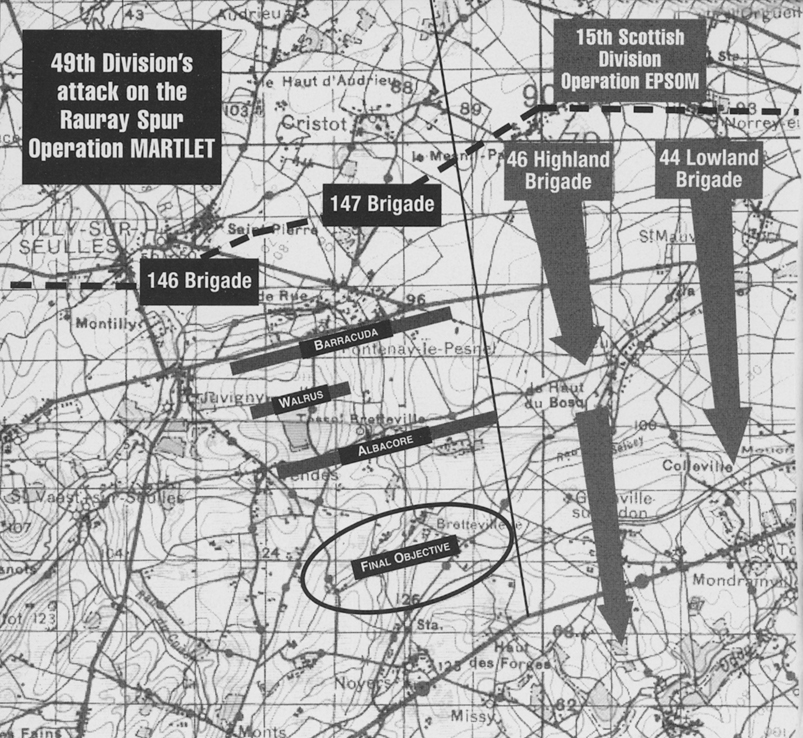
The Rauray Spur, over looking the ground across which VIII Corps was to attack, needed to be taken in order to deny the German the tactical advantage of dominating positions. However, at the operational level, MARTLET was also designed to ‘unbalance’ the enemy. This was to be achieved by forcing the Germans to commit their reserves, which would be ‘fixed’ in battle with the 49th Division when the main EPSOM blow fell.
Major General Barker had ample time to plan MARTLET in detail, as his Division was already holding the front from which he was to attack. His plan was to attack on a frontage of two brigades between Tilly-sur-Seulles and le Parc de Boislonde. In this stage, known as ‘Phase A – Code word BARRACUDA’, the 49th would take the village of Fontenay-le-Pesnel lying at the northern tip of the Rauray Spur. In ‘Phase B – Code word WALRUS’, 146 Brigade would advance across the Caen – Caumont Road. Its objectives, the northern edge of Tessel Wood, Point 111 and la Grande Farm, lay a mile to the south. The plan for ‘Phase C – Code word ALBACORE’, was for 147 Brigade to complete the immediate operation by seizing the Rauray Spur, while 146 Brigade would advance and protect the Division’s exposed right flank.
49th West Riding Division
The 49th’s attack was to fall on the junction between two German formations, the Hitlerjugend and the Panzer Lehr Divisions. Panzer Lehr had been formed by the Wehrmacht Panzer School from instructors and staff and was considered to rank amongst the premiere panzer divisions. One commentator said that ‘When this division arrived in Normandy it was probably better equipped than any other German division during the war.’ After a week in combat, on the eve of MARTLET, Panzer Lehr Regiment had a total of sixty-three Mark IVs and Panthers operational, with almost as many waiting in workshops to be returned to battle over the coming days.
Operation MARTLET was eventually set for 25 June, three days after the end of the storm. With settled weather, artillery gun positions received truck after truckload of ammunition, as supplies again flowed ashore. All two hundred and fifty guns within range were to fire in support of 49th Division.
Operation MARTLET – 25 June
The British artillery barrage began and, at 0415 hours, Phase A (BARRACUDA) began with three infantry battalions, supported by Shermans of 24 Lancers, following a creeping barrage through the standing corn. Almost immediately the attackers were engulfed in a ‘dense smoke laden mist. Visibility dropped down to five yards and unit commanders began to loose control.’ Infantry platoons lost their way and crossed boundaries into other battalions’ area, which added to the confusion.
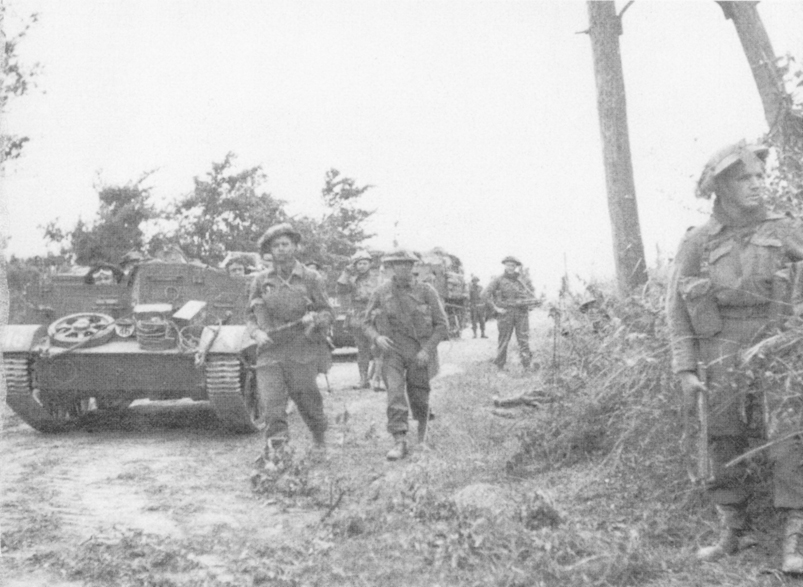
Scottish infantry moving up at the start of Operation EPSOM.
Disorganized, the British ran into the SS and Wehrmacht panzer grenadiers, who had turned the thick, stone walled houses of Fontenay-le-Pesnel and surrounding farms into fortified strong points. Having lost the barrage, the advance was soon well behind schedule. Two battalions eventually reached their objective on the Caen – Tilly Road to the west of Fontenay. However, 11 Royal Scots Fusiliers (11 RSF), tasked to clear the village, encountered determined resistance from 3rd Battalion, 26 SS Panzer Grenadier Regiment (III/26 SS Pz Gr). At 0815 hours, the reserve companies started fighting through the village but bitter hand to hand fighting in the buildings sapped the Fusilier’s strength and they dug in around the Calvary in the northern part of Fontenay.
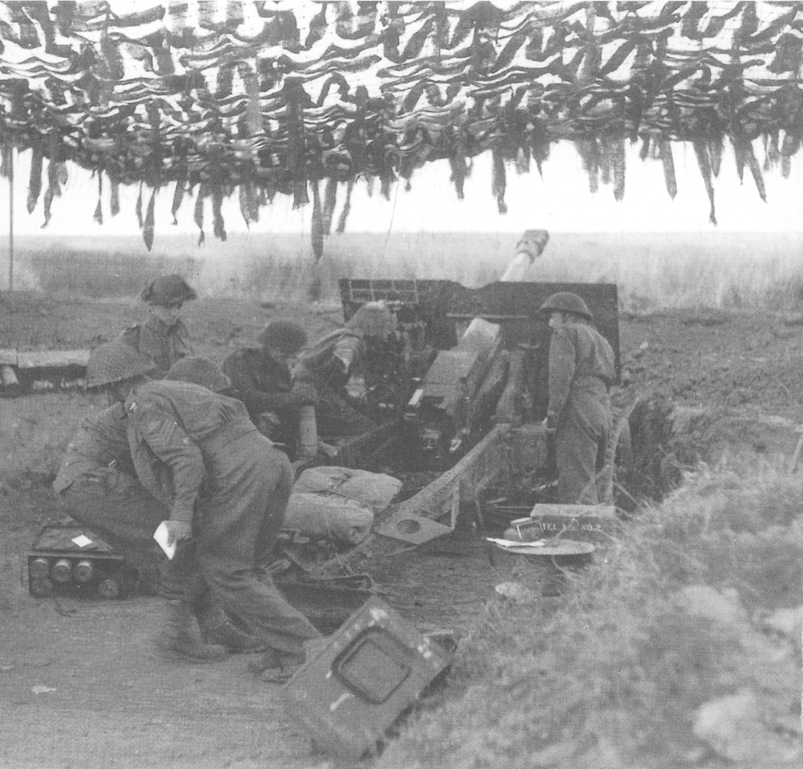
A 25 pounder of the 49th Division dug in and camouflaged firing during the attack on Rauray.
By late morning, the mist had burnt off and the Germans counter-attacked. 12th SS Panzer Regiment (12 SS Pz Regt), supported by SS-Obersturmbannführer Monke’s panzer grenadiers, launched the most significant attack from the east. The SS advanced down hill towards the village. However, the 49th’s anti-tank guns knocked-out the two leading Panthers as they advanced on Fontenay but a third panzer, remaining in cover destroyed one of the British anti-tank guns. A single Sherman was summoned and the remaining Panther was hit. Unsupported, the panzer grenadiers did not press home their counter-attack.
Phase B (WALRUS), had originally been scheduled to start at 0600 hours but the barrage that was to precede 1st/4th King’s Own Yorkshire Light Infantry (KOYLI) eventually began at 1215 hours. Advancing up hill, through a checkerboard of banks, ditches and hedges towards their objective on the northern edge of Tessel Wood, the KOYLI suffered seventy-five casualties. The Yorkshiremen dug-in and managed to beat off a serious Hitlerjugend counter-attack from the direction of Rauray.
Back in Fontenay, 7 Duke of Wellingtons (7 DWR or the ‘Dukes’), whose original mission was to take objectives south of the village, were instead tasked to clear the southern portion of Fontenay. H-hour was to be 2100 hours and the village was to be cleared by nightfall. This was largely achieved but the Germans were left holding some houses and woods to the east of the village.
Operation MARTLET had not succeeded in taking Rauray and the spur that still lay a mile to the south. However, the aim of sucking German reserves to face the West Riding Division’s attack was succeeding. Overnight SS Standartenführer Kurt Meyer was ordered to concentrate 12 SS Pz Regt against the threat posed by the West Riding Division, despite his claim of severe misgivings.
MARTLET – Dawn 26 June
Operation EPSOM was not to start until 0730 hours, which gave 49th Division two hours of daylight to complete Operation MARTLET by seizing the Rauray Spur. Major General Barker’s plan was for 8 Armoured Brigade, along with the Tyneside Scots, to attack south west from the gap between Tessel Wood and Fontenay, across the River Bordel towards Rauray. Meanwhile, 7 DWR was to resume its advance south from Fontenay and take St Nicholas Farm.
The Hitlerjugend’s overnight regrouping had produced a coherent front and the ‘Polar Bears’ (49th Div.) were denied the generous artillery support of the previous day during the attack on Objective ALBACORE. However, 24 Lancers and the infantry of 12 Kings Royal Rifle Corps reached the outskirts of Tessel Bretteville but another armour/infantry battlegroup failed to take the bridge near la Grande Farm and the Dukes failed to take St Nicholas Farm. This left the Lancers and KRRC dangerously exposed to the fire of the Panthers of 1st Battalion 12th SS Pz Regt and they were withdrawn. Maj Stirling of the 4th/7th Dragoon Guards wrote:
‘… this was a wretched day. The scene at the start-line was described as “a badly organized partridge shoot” because the infantry and tanks did not get lined up properly and our tanks were fired at by the infantry. C Squadron was overlooked from two sides. Two to six Tigers and Panthers were operating on the dominating high ground. On the left flank was a small wood in which four Tigers were sitting – cleverly placed so that it was impossible to get at them.’
By midmorning, the 49th Division had made very little ground. The failure to clear the Rauray Spur meant that, from the north east edge of the broad spur, panzers and artillery observers were able to enjoy views across Cheux to the EPSOM start line. The 60,000 men of VIII Corps were to advance into the guns of the Hitlerjugend.