
CHAPTER TWO
It began to rain on 25 June, as the Scottish infantrymen, along with their supporting tanks, started to move forward from their concentration areas. Some troops arrived in Normandy and went straight into Orders Groups (O Gp) for their first operation, as a result of the delay the storm imposed on the landing programme. In the worst case, some of the Divisional Troops were landing as the battle started.
Trooper Les Arnold, a gunner in one of 9 RTR’s two artillery observation post (OP) tanks, recalls the move to the Forward Assembly Area.
‘Infantrymen from 15th Scottish Division were moving up accompanied by their pipers; they could be heard for miles and cheered us up considerably. During the evening we moved down towards the start line nose to tail with very little light; I remember we passed close to a railway line and just missed driving into an anti-tank ditch.’
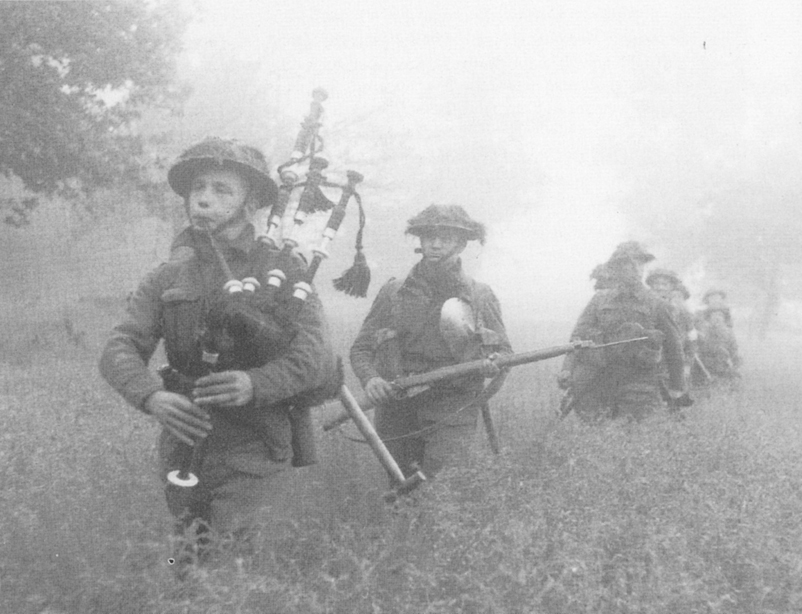
A Piper of 7 Seaforth Highlanders leads his company forward through the mist behind the leading Brigades.
Lieutenant John Stone commanded one of the significant number of armoured vehicles that broke down en route to the Forming up Point (FUP). Having been repaired:
‘We clanked along slowly and lonely, following the “route up” signs. … Suddenly from a ditch on the side of the road a Canadian voice “Pick”. Obviously a challenging password; what to answer? “Shovel” I said. “Axe, you stupid bastard”, was the tender reply. We clanked on and eventually reached the Squadron two hours before stand-to.’
Lieutenant Robert Woollcombe of 6th (Border) Battalion The King’s Own Scottish Border Regiment (KOSB) described the lot of the infantry on the night of 25/26 June.
‘Arriving from Secqueville into the forward assembly area at 3 a.m. in the drizzling rain. Pitch dark with the minute hand slipping leadenly to dawn. Dug shallow pits as a precaution against enemy counter shelling, and huddled with my batman, head to toe, with our anti-gas capes spread over us for some warmth. Then more fitful sleep, until at 5.30 the sentries stole around the silent positions with muttered words, shaking inert figures on the ground back into consciousness.
‘We woke dully, shivering. Still dark, and the drizzle still falling, with two hours to the barrage. …Then a subdued jangle of mess tins, the occasional glow of a cigarette end, and a straggling queue of men with slung rifles: shadowy blurs forming for porridge, compo [tinned composite rations] sausages, biscuits and tinned margarine, and a mug of steaming tea, in the first glimmer of dawn.’
With the arrival of dawn, the rain stopped for a time but was replaced with a mist that rose from the low ground and enveloped the battlefield. Conditions for fighter-bombers were marginal over Normandy. According to the official history:
‘On June the 26th flying weather was so bad in England that the large programme of air support for the opening of EPSOM had to be cancelled [at 0645 hours] and, for the first time since D-Day, practically no aircraft based in England left the ground. Only 83 Group, stationed in Normandy, would be able to help VIII Corps, and though they flew over five hundred sorties their support was handicapped by low cloud and mist.’
Unaware that the bombing was cancelled, platoon commander Lieutenant Woollcombe wrote about the final stages of battle preparation:
‘Green camouflage cream was shared out in grubby palms and smeared over our faces. Weapons were carefully cleaned and oiled. Magazines loaded bayonets fixed. Midday rations – slabs of bully beef and cheese with more biscuits – packed into haversacks. The boiled sweets and chocolate stowed into a handy pocket. Cigarette tins into another. … the men quietly chatting and smoking in little groups. Everyone was admirably controlled, but an air of tension about them. None quite knew what battle would be like, as we waited for H-Hour.’
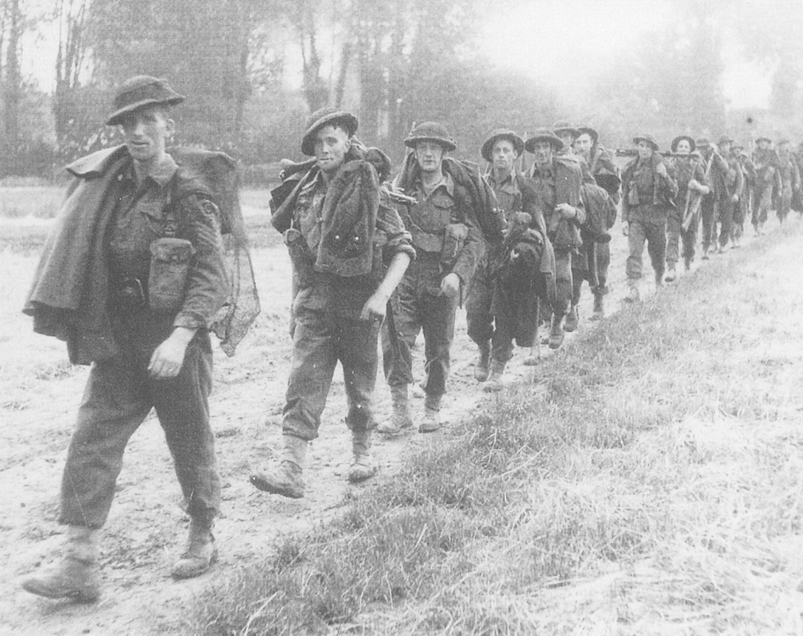
Morning of 26 June 1944, soldiers of 10 HLI moving up with their capes ready in case of further rain.
The Opening Barrage
It will be recalled that Montgomery had assembled 736 field, medium and heavy guns for EPSOM or sixty-four guns per kilometre, including the Rauray area, of attack frontage. The historian of 15th Scottish Division recalled the opening of the battle:
‘As H-Hour approached the suspense was extreme. At 7.29 AM. the orders came over the Tanoy speakers to the waiting guns: “Stand by to fire Serial 1 [of the fire plan] – one minute to go – 30 seconds – 20 seconds – 10 seconds – 5, 4, 3, 2, 1, FIRE.” With an ear splitting crack hundreds of guns hurled their shells overhead, the infantry and tanks advanced to close up to the opening barrage line, where our shells were bursting 500 to 1000 yards ahead. It was the moment for which the 15th Scottish Division had been preparing for five years.’
Nowhere was the wait for H-Hour more tense than amongst the infantry lying in the open in the wet corn. Lieutenant Woollcombe recalled:
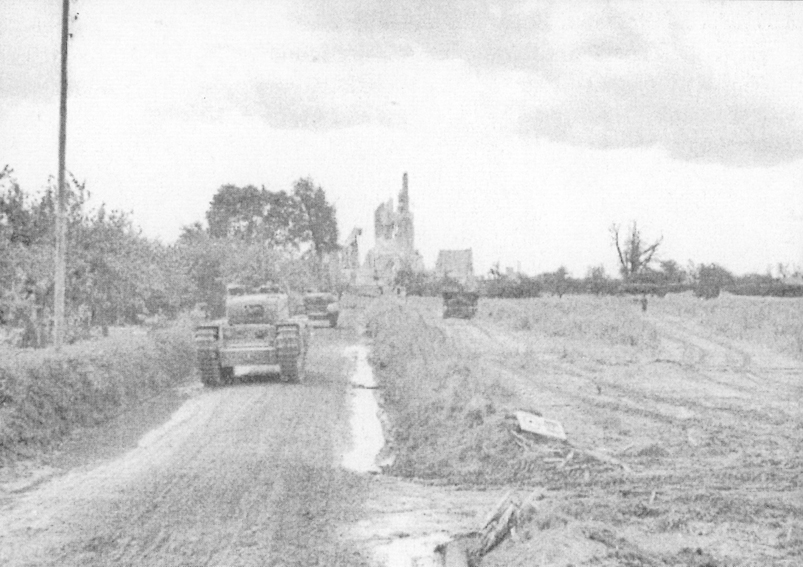
Tanks of A Sqn, 9 RTR, advancing from the battered church of Norrey-en-Bessin.
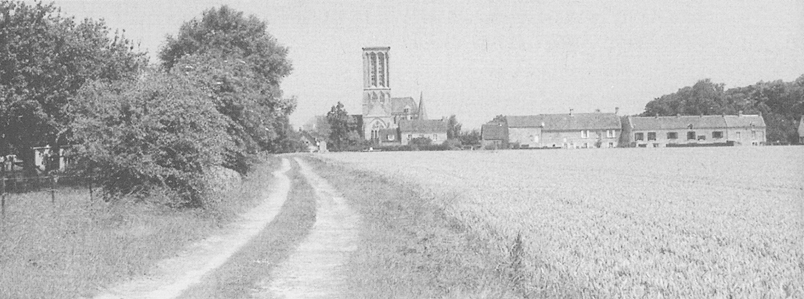
Norrey-en-Bessin and its rebuilt church today.
‘The minute hand touched 7.30 … On the second, nine hundred guns of all calibres, topped by the fifteen inch broadsides from the distant battleships lying off the beaches, vomited their inferno. Concealed guns opened fire from fields, hedges and farms in every direction. During short pauses between salvos, more guns could be heard further away.… It was like rolls of thunder, only it never slackened. … Hurling itself onto strongpoints, enemy gun areas, forming up places, tank laagers, and above all concentrated into the creeping mass of shells that raked ahead of our own infantrymen, as thousands of gunners bent to their task.’

Gunners of 15th Scottish Division prepare to fire a barrage of 25 pounder shells.
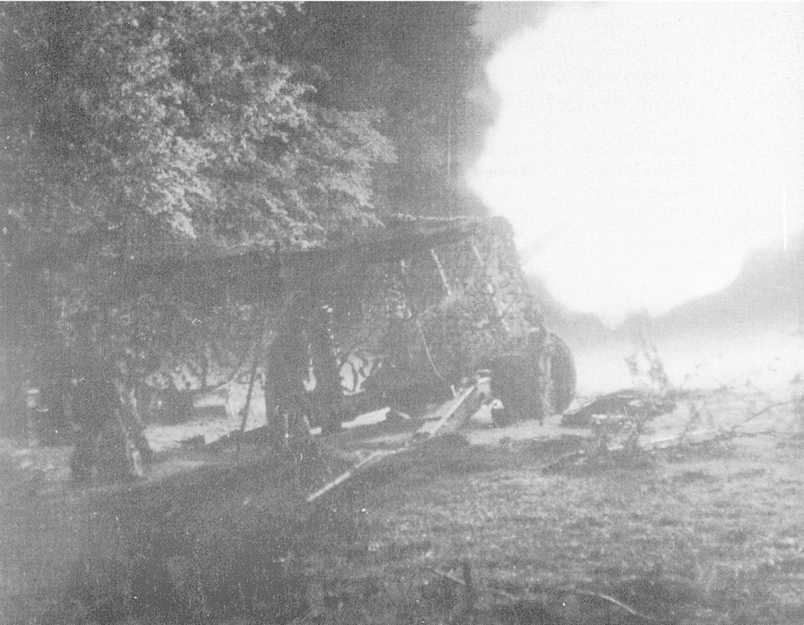
A 4.5″ gun belonging to 48 Field Regiment RA, in action at dawn.
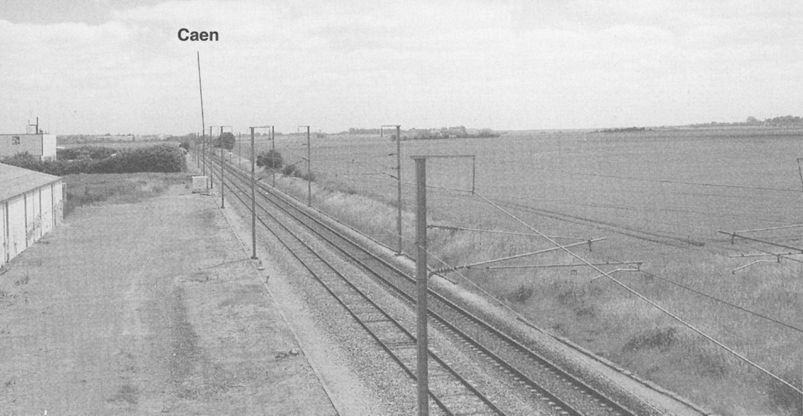
The railway line south of Bretteville used as the Operation EPSOM start line.
On the receiving end of the barrage was the Hitlerjugend. Its Commander SS-Standartenführer Kurt Meyer described what it was like:
‘The earth seemed to open and gobble us all up. All hell had been let loose. I lay in a roadside ditch listening to the noise of battle. There was no let up to the artillery barrage. All telephone lines had been destroyed and communications with Divisional Headquarters and units at the front no longer existed… My ears tried unsuccessfully to analyze the sounds of battle and all I heard was the permanent spitting, cracking and booming of the bursting shells, mixed with the noise of tank tracks.’
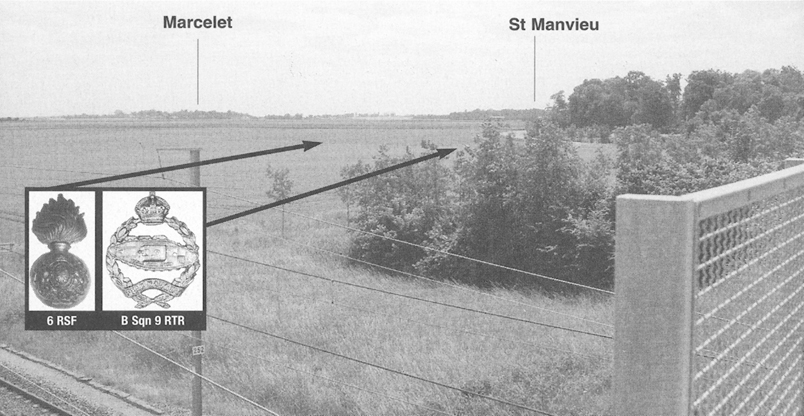
View from the railway bridge towards Marcelet and St Manvieu. 6 Royal Scots Fusiliers supported by 9 RTR advanced across these fields.

A troop of Churchills moving across the open ground in support of 15th Scottish Division.
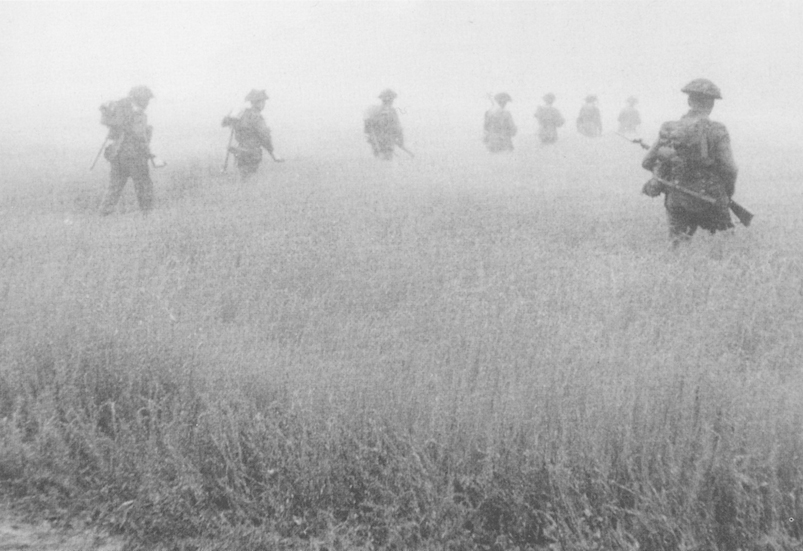
One of a series of photos taken by Sergeant Laing of 15th Scottish Division’s infantry moving forward through the corn and mist.
The barrage ‘stood for ten minutes on the opening line’, which coincided with the outpost line of the Hitlerjugend’s defensive position, while the British infantry and tanks moved forward from their FUP and crossed the start line into battle.
St Mauvieu and le Gaule
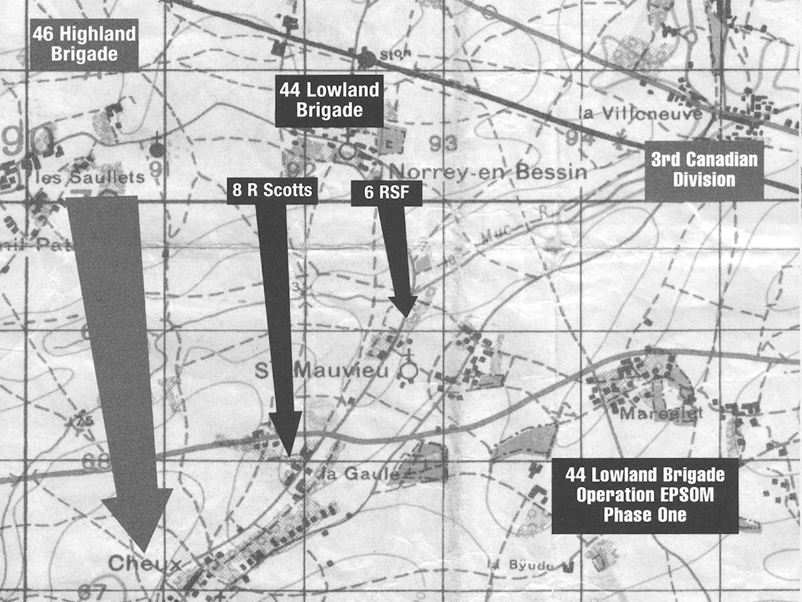
44 Lowland Brigade was to attack on EPSOM’s left flank. 6 Royal Scots Fusiliers (6 RSF), the same battalion that Winston Churchill commanded during the First World War, accompanied by the tanks of B Squadron 9 RTR, was to attack St Manvieu. Meanwhile 8th Royal Scots (8 RS or ‘8 Royals’), with A Squadron 9 RTR, had objectives astride the Caen-Fontenay Road and around the hamlet of le Gaule.
The attack did not start well for 6 RSF, as the only start line they could find was in a sunken road 125 yards from the opening barrage. This close to their own artillery fire, inevitably some rounds dropped short and, even with the cover of a sunken road, they suffered casualties from their own fire. In addition, two of the accompanying tanks from B Squadron were immobilized, having lost tracks on anti-tank mines near the start line, which had probably been laid by the Canadians. Such ‘friendly fire’ incidents are all too common during battle.
Another unexpected factor was that the dawn mist was replaced by the smoke of the barrage, which produced ‘conditions almost of a fog-bank’. So thick and unexpected was the ‘fog’ that keeping direction across the open fields of corn clothing the slopes of the shallow Mue Valley was a problem. However, a problem of far greater significance for the Fusiliers was enemy mortar and artillery fire. 12 SS Artillery Regiment’s observers, overlooking the area of the attack from Carpiquet, directed their own guns to fire at unseen targets just behind the British barrage. 9 RTR Trooper Reg Terrington, 8 Troop commander’s radio operator, recalled:
‘We crossed the start line and after a short while we were in the middle of a substantial barrage of shells. We couldn’t tell whether they were ours or theirs but either way it was most unpleasant. My Troop Commander, Peter Beal, told me afterwards that I looked a bit green but I was still smiling. He looked the same.’
Unprotected by armour, to add to their earlier woes, 6 RSF continued to suffer heavy casualties from the bursting shells. Crossing the Mue, they continued to advance, closely following the barrage through the Hitlerjugend’s outpost line towards St Mauvieu, which they reached at 0830 hours. At 1030 hours, the infantry eventually broke into positions held by I/26 Pz Grs around the straggling village and orchards of St Mauvieu. However, this was only achieved with the support of the demolition guns mounted on the AVREs of 81 Squadron, 6 Assault Regiment RE. The Fusiliers had suffered such heavy losses from artillery fire that their capacity for fighting through and mopping-up was greatly diminished. Meanwhile, the Churchills of B Squadron 9 RTR enveloped the village and engaged targets for the infantry. Even though they did not enter the village, three Churchills were recorded, in the war diary, as being knocked out at St Manvieu.
Lying just behind I/26 Pz Gr Regt’s main line of resistance, SS Sturmbannführer Krause had established a strong point of mutually supporting positions in St Manvieu. Sheltering in the strongly built cellars, they quickly recovered from the powerful British bombardment, occupied battle positions, and continued to resist all day.
The Hitlerjugend had not only prepared the stone houses for shelter and defence but had also dug alternative positions in the surrounding orchards, hedgerows and farm buildings. In the words of the Scot’s divisional historian: ‘Very confused fighting in the village went on throughout the day’.
SS-Sturmmann Aribert Kalke recorded the defender’s experience:
‘The artillery fire was constantly increasing, finally concentrating on the centre of the village. Explosions hit the front yard, directly ahead of the entrance to the command post. The house was shaken by hits.
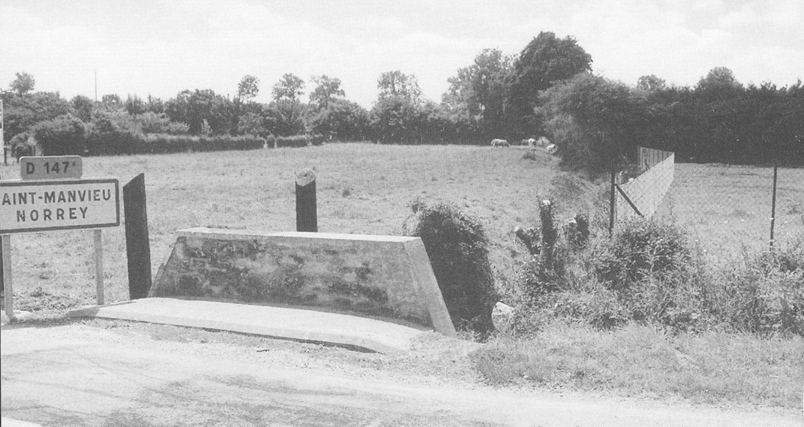
The bridge over the River Mue on the outskirts of St Manvieu. The Mue just about becomes a stream in the winter.
Between the explosions, we could hear the short, harsh barking of tank guns. The Battalion staff had sought cover in the cellar. Only a few men had remained in the upper levels. Radio contact with the companies had been lost… a messenger from 2 Kompanie dropped into the command post through the smoke and fumes. He was wounded… and reported [that] the Kompanie, engaged in bitter hand-to-hand fighting, had been overrun. The enemy had broken through… and the enemy were concentrating strong tank and infantry forces against 1 Kompanie. Enemy tanks were immediately outside the command post.
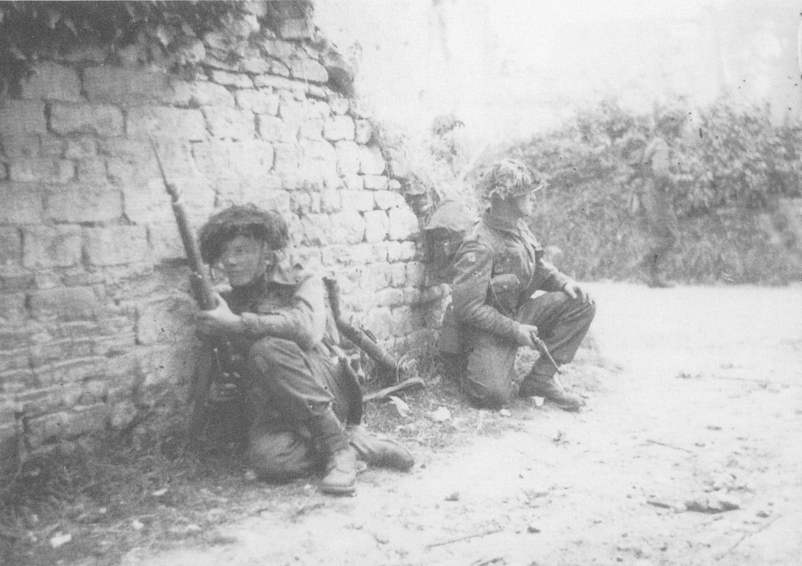
Infantrymen of 6 RSF photographed on the morning of 26 June 1944 in St Manvieu.
‘SS-Sturmbannführer Krause ordered his adjutant to establish contact with a panzer Kompanie located in the la Byude area [a mile south] and request a counter-attack immediately. When the artillery fire slackened a little, three of us left the command post by a rear exit at short intervals. A small dense wood offered us cover… We found ourselves in a grain field, which also gave us cover from being spotted … and we reached 9 Panzer Kompanie. The Kompanie commander categorically declined a counter-attack, as without accompanying infantry, panzers were not suited to fight in streets. Untersturmführer Holzel set up a new strong point with a few stragglers.’
Meanwhile, back in Battalion Headquarters at St Manvieu, a German war corespondent reported the battle and an act of heroism:
‘Heavier and heavier, the shells from the tanks hammered the Chateau’s park. The beams of the houses were splitting, bricks were flying from the walls. The earth was trembling. … For almost three hours, they lay salvo after salvo on the line of main defence outside St Manvieu and the village itself Foxholes were filled in, machine guns smashed and men were mercilessly ripped apart.
‘The enemy broke through the positions and overran St Manvieu. Like a pack of hungry wolves they surrounded the village. The handful of men in the battalion command post could count fifteen Shermans [sic]. … Whoever had weapons left to fight with was sent into action in the village, messengers, clerks and orderlies.
‘… The Battalion command post had suddenly become an important bastion – and it had no heavy weapons, only sub-machine guns and rifles, with Panzerfausts and magnetic mines. But there were two mortars still sitting in the village and their crews had twenty-five bombs left. These they fired amongst the oncoming infantry and tanks, causing confusion. SS snipers crept to the hedges and walls and fired at the [British tank] commanders who came out of their hatches too soon.
‘Some of the tanks turned away. They assumed the strongpoint to be much stronger and did not dare break in. But the calm did not last long, as the tanks returned and fired from all barrels. They picked the house as their target and damaged it so badly that the wounded had to be carried out.
‘Then there was a shout of alarm within the doggedly defending platoon. Aflame thrower tank was dominating the path to the command post. “That tank has to go” ordered the commander.
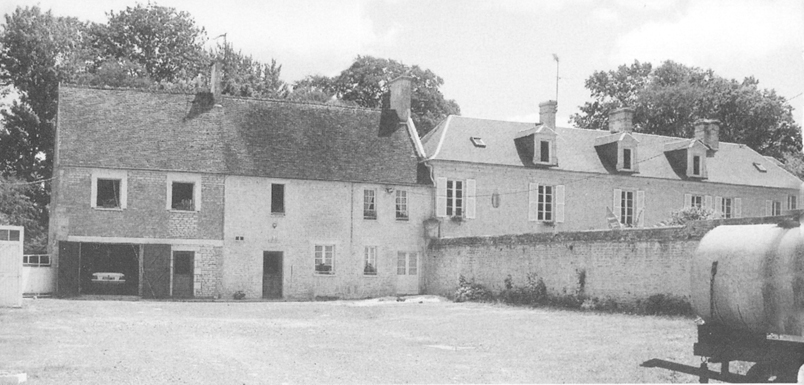
Buildings used as a strong point in the centre of St Manvieu and as HQ of 1 26 Pz Grs.
‘Unterscharführer Durr had heard the order. He did not hesitate. “I’ll go” he said. He took a Panzerfaust and went to scout the situation. It was difficult to get close to the tank, as it was dominating the terrain on three sides. ‘Unterscharführer Durr jumped across the inner wall of the yard and ran straight at the tank and fired. But the Panzerfaust did not pierce the tank. Maybe he had not aimed accurately enough in his excitement.
‘He was hit! Shot in the chest. Angry, Durr pulled himself up, ran back and picked up another Panzerfaust and ran up to the tank again. This time he aimed at the tracks, which ripped. Again, Durr was the target off violent machine gun fire. Crawling, he worked his way back. He spotted a magnetic mine and quickly grabbed it. A comrade wanted to hold him back.
‘For a third time he set out. He ran, stumbling, towards the tank, paying no attention to the bullets. He attached the charge and was about to get away when the charge dropped to the ground. He grabbed the mine, pressed it against the tank as it exploded.’
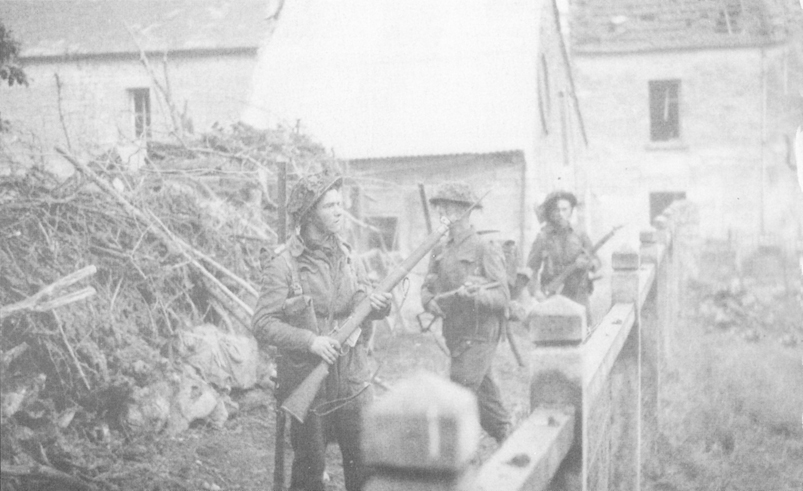
A section commander and two riflemen belonging to 6 RSF in St Manvieu.
SS-Unterscharführer Emil Durr was recovered from beside the knocked-out Crocodile, while the British had temporarily withdrawn. However, he died of his wounds four hours later. Durr was the first Hitlerjügend NCO to be awarded the Knight’s Cross.
Not all of the Hitlerjugend fought so tenaciously. Trooper Les Arnold recalled how:
‘The infantry captured some Hitler Youth soldiers who came swaggering into our lines; this attitude annoyed us particularly because we had heard that some of their units had shot Canadian prisoners’.
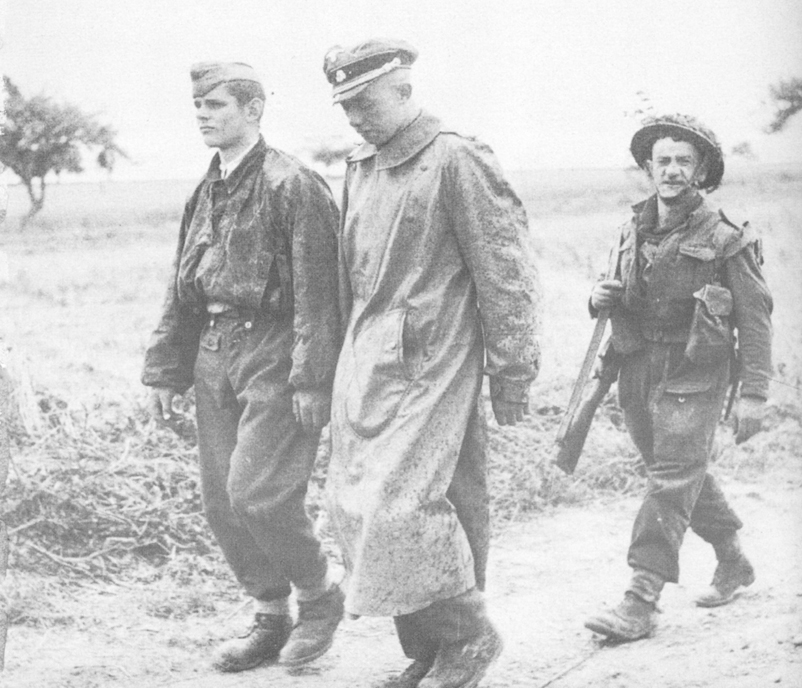
Britain’s answer to Germany’s finest, escorts these two members of the Hitlerjugend to the rear and interogation by a VIII Corps intelligence officer.
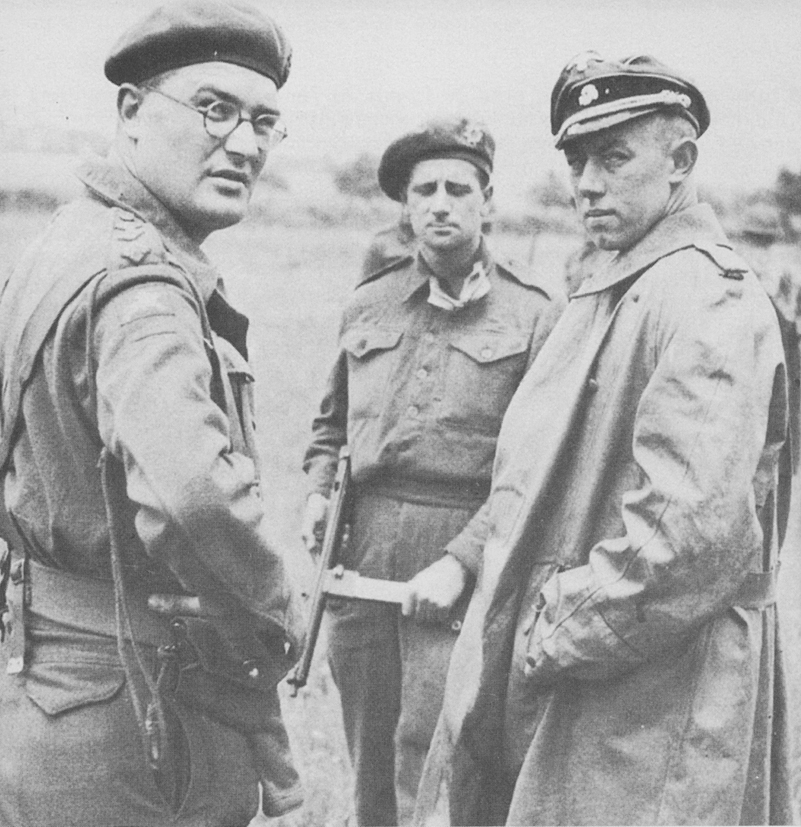
Officer of the Hitlerjugend being interogation by a VIII Corps intelligence officer.
Despite the loss of several Crocodiles, the strongpoint based on Battalion HQ I/26 Pz Gr was eventually flamed by 141 (The Buffs) Regiment Royal Armoured Corps. However, small groups and even individual Hitlerjugend continued to fight on all day and into the evening.
To the west of the Fusiliers, 8 Royal Scots formed up with A Squadron 9 RTR and crossing their start line, closed up behind the artillery barrage and followed it towards the Caen-Fontenay Road and the hamlet of le Gaule. Initially the Royals were able to keep up with the barrage, which advanced at the rate of a hundred yards every three minutes. However, the survival of enemy riflemen and Spandau teams, along with the fire of the Hitlerjugend’s artillery and mortars slowed them considerably. Consequently, the British artillery barrage moved on ahead, allowing time for the young SS soldiers to recover from the numbing effect of exploding shells and engage the advancing Scotsmen in the standing corn. The troop of Crocodiles was of considerable help in subduing determined resistance.
8 RS eventually reached the Caen-Fontenay road, two thousand yards from their start line, at 0930 hours, two hours after H-Hour. However, within an hour they had reached their objective and cleared le Gaule, and were digging in as fast as they could. The Royal Scot’s thrust had benefited from inadvertently striking the boundary between I/26 SS Pz Gr and 12 SS Pioneer Battalion to the west, which is traditionally a weak point in defensive positions. VIII Corps war diary recorded that:
‘It appeared that the village [le Gaule] was firmly in their hands, but numerous points of resistance were still being doggedly defended and had to be fought. This fact and a number of counter-attacks made the situation less favourable than initial reports indicated.’
Lieutenant Woollcombe was waiting with 6 KOSB, as 44 Brigade’s reserve, south of Norrey:
‘Crump!… Crump!… Crump!… Crump!… German shrapnel airburst. “Get down – stop walking about!” We lay for about ten minutes, watching the airbursts over some tall trees in the orchard. More appeared over Norrey. Then stray figures in battle-dress materialized out of the mist, coming back from the battle. Each with levelled bayonet prodding two or three helmetless and sullen bewildered youths in grimy camouflage smocks and trousers. They held their hands in a resigned and tired way, above their blond heads.
‘A miracle anything could have lived through the stunning bombardment they had taken, and a testimony to the efficiency of the slit trench.’
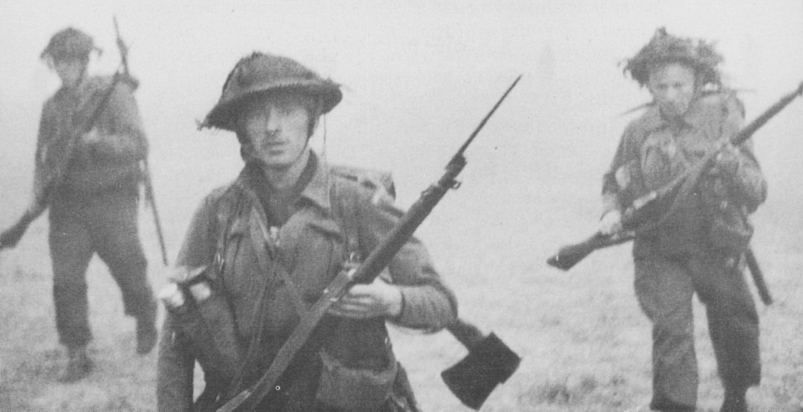
Heavy laden infantry advancing through the mist. Note how pouches are stuffed full, carrying extra bandoliers of ammunition and their jacket fronts contain extras.
One company of 6 KOSB was sent to help the Royals, while three companies were to be dispatched to St Manvieu. ‘Then Colonel Ben’s word came over the wireless. Gavin relayed us the signal.… “The Battalion will advance”. We arose and moved up the field in extended line of sections.’ During their advance, 6 KOSB came across small groups of panzer grenadiers in the corn or hedgerows who had been missed by the Fusiliers. Most surrendered promptly and were taken to the rear. Lieutenant Woollcombe recorded one surprise meeting:
‘Suddenly we froze at a burst of fire from Black’s Bren gun, firing from his hip, and instantly an apparition rose screaming from the corn and rushed towards us, throwing itself at my feet. It was an SS soldier.
‘… But he was in no state for offensive action, by a neat bit of shooting by Black, who had hit him in the shoulder. He knelt at my feet clutching my knees, frantic with pain and terror.
‘“Don’t shoot – don’t shoot – have pity” He knew that much English. We understood. To key up their resistance they had been told the British shoot all prisoners. He now expected death in cold blood.… We carried him into the Company position.’
Most of the Borderers now saw their first dead bodies; ‘khaki clad Fusiliers and camouflaged Hitler Youth, whose tender age was a surprise to many’.
6 KOSB arrived in St Manvieu, where the process of clearing the village, its trench systems, dug-outs and rubble was slow. Lieutenant Woollcombe recalled entering the village:
‘A number of dulled men in steel helmets, wearing anti-gas capes against the rain were discovered in a captured German position: Scots Fusiliers, twenty eight of them, all that was left of a company that had crossed the start-line that morning. The company commander was dead and a tired captain with handle bar moustaches was in command. … He had been reduced to a state of fatalism and recited to me their losses in a strain of mournful satisfaction.’
For the Scottish infantry it was a long day’s fighting in St Manvieu before they would finally crush the Hitlerjugend and be relieved.
Cheux and le Haut du Bosq
Having seen that his front south of Fontenay was holding against 49th Division’s assault, ‘PanzerMeyer’ raced back to his Headquarters in Verson where he received two messages. The first was from I/26 SS Pz Gr Regt. ‘The battalion was being attacked by strong forces. All attacks on St Manvieu had been repulsed up to that point.’ However, the second message was more disturbing.
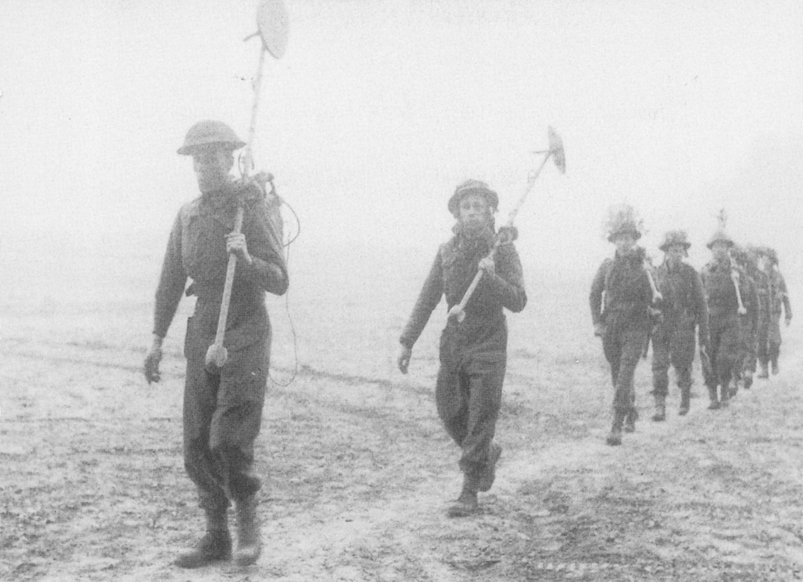
Sappers making their way forward through the mist, having been summoned to breach the Hitlerjugend, minefields.
‘The chief of staff [SS-Sturmbannführer Hubert Meyer] was still holding the telephone handset in his hand and reported: “That was our last conversation with the Pioneer Battalion commander”. He had reported: “Enemy artillery have destroyed my anti-tank defences. The battalion is being overrun by British tanks. Individual positions are still holding out around Cheux. Enemy tanks are trying to crush my dugout. Where are our tanks? I need a counter-attack from the direction of the Rau…” at that point, the line was cut. Radio communications had also been destroyed.’
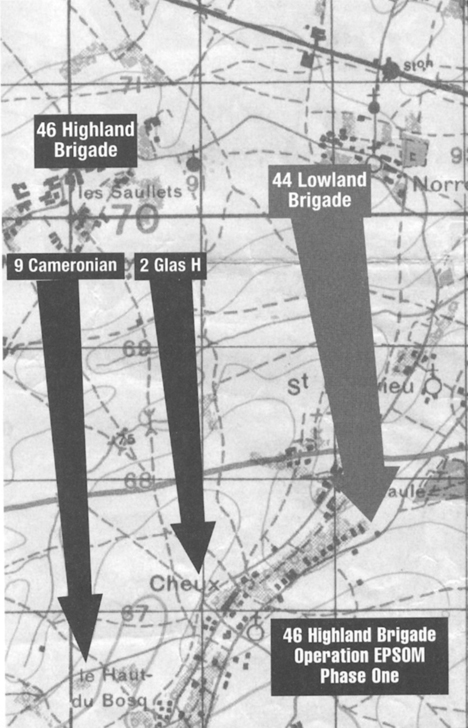
12 SS Pioneer Battalion’s (12 SS Pi) HQ was positioned on ‘a small hill immediately south of the road Caen – Fontenay half a mile west of le Gaule’, in the centre of 26 Pz Gr Regt’s sector. It was were being attacked by 46 Highland Brigade’s left assault battalion, 2 Glasgow Highlanders (2 Glas H), supported by fifteen Churchills from A Squadron 7 RTR. The Brigade’s right assault battalion, 9 Cameronian was attacking II/26 SS Pz Gr along with the tanks of B Squadron. The ‘Funnies’ of 79th Armoured Brigade supported both battalions.
46 Brigade had advanced only to find that, ‘Within a quarter of a mile of the start line, the forward battalions ran into a minefield. Despite casualties from anti-personnel mines, the rifle companies went on through, but the advance of the supporting Churchills and AVREs was held up’. The flails of B Squadron 22 Dragoons came forward and beat a path forward at one and a half MPH. The belt of minefields laid by 12 SS Pi had achieved its tactical aims extremely well. Not only did patches of mines and anti-tank fire covering the obstacle belt cause nine armoured vehicle casualties, it also slowed the tempo and cohesion of 46 Brigade’s attack from the outset. Exacerbating the resulting confusion was a failure of the No.38 sets to communicate effectively between tanks and infantry, which led to further separation of the two arms. In addition, the creeping barrage moved on and even a fifteen-minute dwell on the Caen-Fontenay Road was not enough for the Brigade to catch up. Consequently, until a route through or round the minefields could be found, the infantry of 46 Brigade were without tank or artillery support.

A Churchill of 7 RTR moving through a marked minefield gap on the morning of 26 June. Note the marker post to the left.
Even with the delay caused by the minefields, VIII Corps’s Intelligence summary records that a Hitlerjugend prisoner taken in the outpost line, said when the barrage started: ‘We had gone to ground and had emerged only to find ourselves surrounded by tanks or furious Scotsmen throwing grenades’. However, factors other than enemy defences were at work reducing the 15th Division’s military efficiency Chief amongst these was the mist and with a greater distance to their objectives, navigation was more important for 46 Brigade. Private Hamish McDougal of 7 Seaforth, following behind the leading battalions explained:
‘All I could see was two or three mates each side of me as we walked into that cornfield and heard our tanks moving. Before long we heard small arms fire, but with the fog we had no idea where it was coming from, or in fact if we were still going in the right direction. I heard the Lieutenant blow his whistle a few times to give us a clue where he was, but that stopped and we heard bangs as the tanks ran onto mines. Next we heard shouts and hadn’t a clue what was going on, but then suddenly, shells were landing amongst us.’
On 46 Brigade’s left was 2nd Glasgow Highlanders (2 Glas H), whose objective was Cheux but to reach it, they would have to fight through 12 SS Pi’s well-prepared defensive positions. The pioneers had used all their field-engineering skills to prepare deep shelters that were both well camouflaged and effectively sited. Consequently, many of the SS soldiers survived the barrage and were missed by the first wave of attacking infantry and armour. Appearing from their bunkers, they either shot into the rear of the leading wave of Scots infantry or engaged subsequent waves with rifle, Spandau or Panzerfaust fire. VIII Corps’ war diary described the German reaction in the centre of the attack:
‘The enemy was holding his positions and let us pass when he was not directly attacked, overwhelmed or overrun. He only revealed himself when presented promising targets or had himself been spotted. There were numerous points of resistance, which had to be cleared long after objectives had been reached, in the forward as well as the rear areas … It was remarkable that in all cases, that the enemy in these positions fought until the defenders had been killed or the positions captured.’
In many cases, the battle had totally bypassed isolated individuals or groups and, in several instances the Hitlerjugend’s signal log recorded radio contacts with groups that had been overrun three days earlier. Others managed to infiltrate back to their own lines under cover of darkness. One of these was the commanding officer and HQ staff of 12 SS Pi, who had last been heard of, with a tank attempting to crush his HQ dugout, at around 0900 hours. SS-Standartenführer Kurt Meyer recalled that:
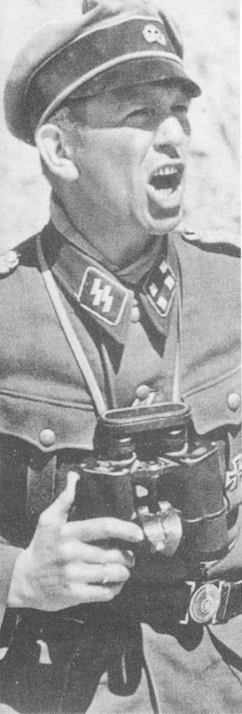
Kurt ‘Panzer’ Meyer
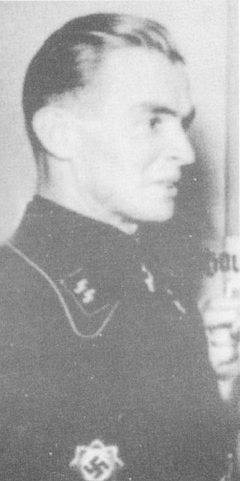
Hurbert Meyer
‘SS-Sturmbannführer Muller himself defended his command post against all the enemy attacks. A captured pioneer was finally sent into the bunker to ask his comrades to surrender. He preferred to stay there and share his comrades’ fate. The attack continued past the command post after demolition attempts had badly shaken the bunker and it looked like a mass grave. The survivors finally fought their way to our lines at about midnight. They were found completely exhausted at le Haut du Bosq, after having decided to take a short break.’
Behind the SS Pioneers’ main line of resistance, Cheux had been developed as a strongpoint. Defences were based on a battery of II/12 SS Panzer Artillery Regiment’s towed 105mm guns and 12 SS Pi’s supply platoons acting as infantry. 2 Glas H had a difficult advance, with elements of the battalion becoming lost in the fog, while others fought their own private battle with small groups of Hitlerjugend.
Private Angus Jones was amongst the Glaswegians lost in the fog:
‘… and it rained like hell and we all got fed up – it was all very different to what we had expected. As soon as we reached some ruins at the edge of Cheux, we set up for defence and waited for orders, but none came until a Sergeant Major we didn’t know ran up and said, “Don’t hang around lads – get on!” So we did, moving from house to house, under fire from Jerries we couldn’t see. There were shells and mortars and small arms fire zipping and banging around us and a lot of blokes never made it.’
A number of SS pioneers, who had escaped the battle on the main line of resistance, joined the SS gunners and supply troops led by two staff officers, SS-Untersturmführer Asmus – a technical engineer officer, and SS-Untersturmführer Lorenz – a supply officer. They fought from hedgerow, to house, to pile of rubble, as 2 Glasgow Highlanders fought through the ruins of Cheux. It was a protracted and bloody business, with mounting casualties on both sides. The fighting on the first day of EPSOM, which was also their first day in action, cost the Glasgow Highlanders twelve officers and nearly two hundred men.
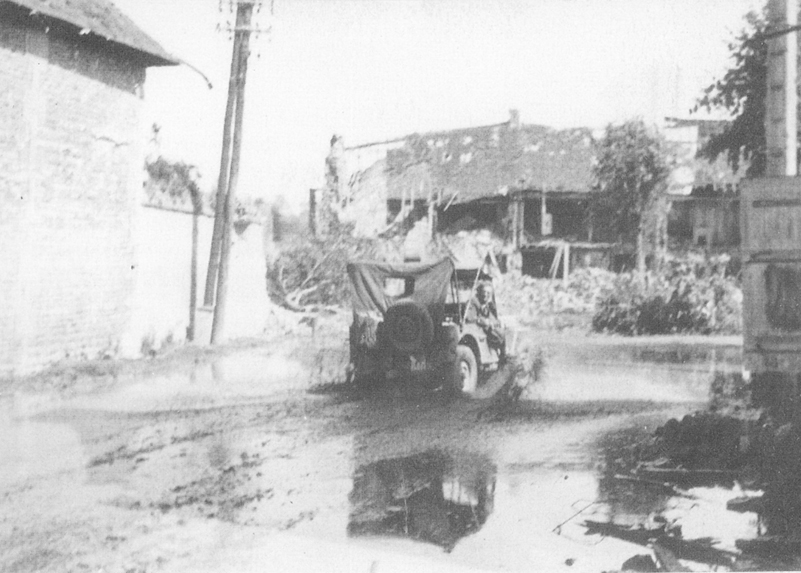
Floods and battle damage in Cheux 27 June 1944.
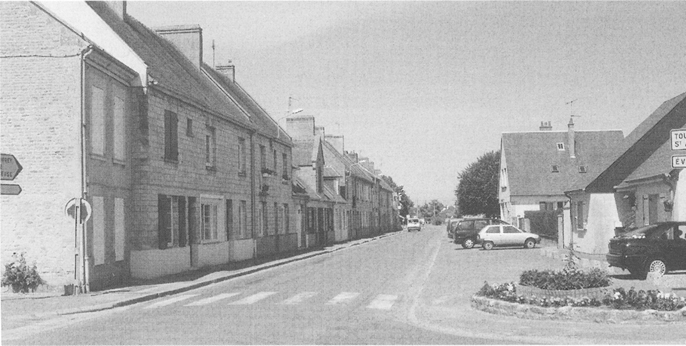
Rebuilt Cheux.
With furthest to advance, 9 Cameronian had objective in le Haut du Bosq but first they had to breakthorough II/26 Pz Gr’s main line of resistane. They were hardly across their start line before they came under artillary fire. SS-Oberscharführer Hans Hartmann of 5 Batterie II/12 SS Pz Arty Regt, positioned between le Haut du Bosq and Cheux, recalled how he engaged the Cameronians and the tanks of 7 RTR with his 105mm field guns:

The Mark VII Churchill of the type used by 7 and 9 RTR of 31 Tank Brigade. This example can be seen on Hill 112.
‘In the morning, our commander advised us that the Batterie OP was being abandoned. Thus, we were on our own. I went to the football field in front of us and climbed onto a goal. Approximately 4 Km away, south of le Mensil, I spotted an assembly of some twenty enemy armoured vehicles. We started an engagement with all four guns. It was so well aimed that the tanks dispersed in no time, judging by the explosions, one tank must have taken a direct hit. As the vehicles pulled away, they stirred up so much dust that we could no longer observe anything.’
Resuming their advance, the Cameronians had expected that 49th Division would be protecting the right flank, having taken the Raury Spur. However, the West Riding Division’s attack had failed and the Cameronians were exposed to flanking fire during the final stage of their advance to le Haut du Bosq.
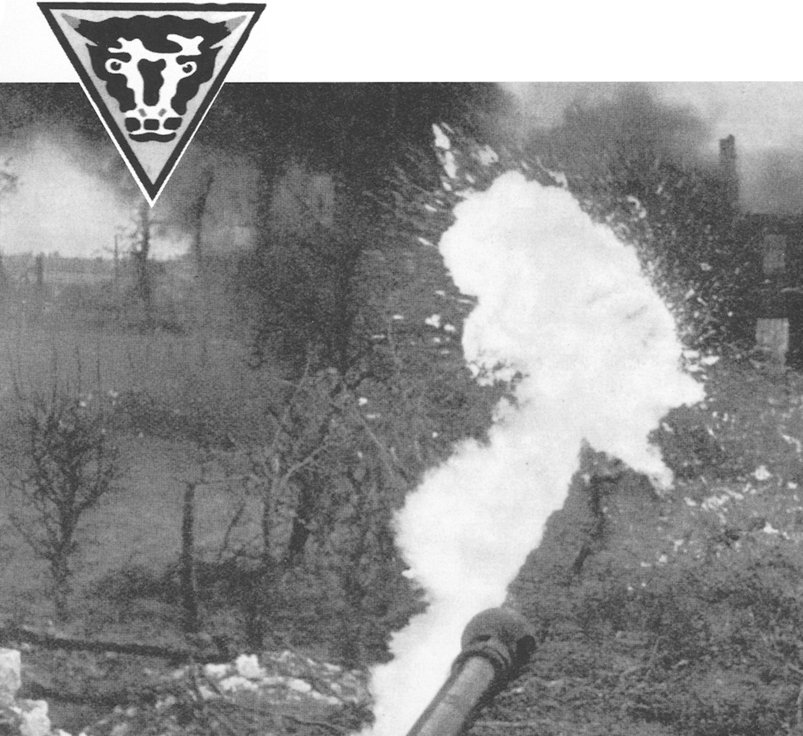
Despite artillery fire, minefields and continued ‘sniping’, the Cameronians continued to advance and were nearing le Haut du Bosq at 1100 hours. However, the hamlet had also been developed into a strongpoint based on two batteries of guns of I/12 SS Pz Arty Regt and Regimental HQ of 26 SS Pz Gr Regt along with its specialist platoons. Led by SS veterans, the Hitlerjugend were in well prepared positions that they were not going to give up without a fight. Under fire from Spandaus and anti-tank guns, the Cameronians were checked on the open slope up to le Haut du Bosq. They went to ground, while the Churchills of 7 RTR duelled with the anti-tank guns. However, help was at hand in the form of the Crocodiles of 141 Regt RAC. Lieutenant Andrew Wilson described a typical Crocodile flame mission:
‘Suddenly the hum of the headphones cut out. It was the Squadron Commander calling us forward. We were going in to flame.
‘At the start of the first rise Barber was waiting with the infantry CO. He made an up and down movement with his clenched fist, which was the sign for opening the nitrogen bottles on the trailers.
‘“Got where we are?” said Barber, pointing to the place on his map. His finger moved to an orchard four hundred yards away stayed there a moment, then moved to a field beyond it. “There are some Spandaus there. Flame them out. The infantry will follow you. A troop [of tanks] is waiting to cut off the enemy at the back” I wanted to ask: “How do you spot Spandaus ?” But it sounded too silly. With the other troop leaders, I ran back to the tanks. The crew were closing the trailer doors. “Mount I shouted. They climbed in and slammed down the hatches.
‘“Driver advance. Gunner, load HE.” The troops moved forward in line abreast, mine was on the left. As we came through a hedge, mortaring started. Everywhere infantry were crouching in half dug foxholes, trying to protect their bodies from the bursts of the bombs.
‘We went through a couple of fields. Any moment now we should see the orchard. I reached down and put on the switch, which let up the fuel into the flame gun. Suddenly it came into view: a bank of earth, another hedge, and beyond it the orchard. “There you are. Dead ahead driver.” The driver slammed into second gear. The tank reared up for a moment, so you couldn’t see anything but the sky; then it nosed over the bank, and through the periscope I was looking down a long empty avenue of trees. Somewhere in this avenue, someone was waiting to kill me. “If only I knew what to look for?”
‘My sergeant and corporal moved their tanks alongside mine. I ordered, “Co-ax [coaxial machine gun], fire” hut there was no target to indicate. The gun roared filling the turret with bitter fumes which made my eyes smart. Through the periscope, I saw the other troops start to flame, the yellow fire sweeping through the trees. “Better get my own flame going. Flame gun, FIRE”.
‘I heard the hiss, the slapping like leather of the fuel striking the target. The fuel shot out, spraying the trees, paving the ground with a burning carpet. The tank ran on through it. “Slap it on, flame-gunner, all you’ve got!” The flame leapt out with an almost unbroken roar. The driver was slowing up, uncertain where to go.
‘Suddenly the leader of the other troop called across the wireless: “Hello Item Two. Don’t go into this lot. Let them have it from where you are.” I saw nothing but blazing undergrowth. Surely, no one would have dared to stay there. But I kept the troop at the edge of the field, pouring in the flame, till the fire rose in one fierce, red wall.
‘Then the gun gave a splutter like an empty soda-water siphon. The other troop had finished, so I turned my tanks and followed. Beneath the trees with smouldering leaves, the British infantry were coming in with fixed bayonets. I never saw the enemy!’
The Cameronians burst through the burning hedgerows of le Haut du Bosq and at 1130 hours, they reported that they were mopping-up their objective. None the less, the Cameronians suffered casualties (dead, wounded and missing) totalling six officers and one hundred and twenty men, or the equivalent of an entire rifle company.
To complete EPSOM’s first phase, 7 Seaforth, hitherto 46 Highland Brigade’s reserve, was to advance from Cheux and occupy the exposed Ring Contour 100, some 1,500 yards to the south east. The feature, a broad rounded hump’ was held by a mixed bag of SS panzer grenadiers and other arms who had been pushed out of their positions during the morning. In addition, the first German reinforcement to the EPSOM sector, 15 Recce Kompanie, 25 Pz Gr Regt was just beginning to arrive. However, the Seaforth had been badly delayed in its advance by artillery fire, bypassed enemy riflemen and by the chaos in Cheux, Lieutenant James Hayter explained:
‘When we finally reached Cheux we were few and minus our tanks. There was nothing to see but mud, water, ruins, smoke and mist, and the air was alive with missiles. I tried to see how many chaps had made it, but this was difficult because of the conditions, but I knew that some were under cover. I lay amongst some redbrick ruins that were still quite hot to the touch. I carried a Sten gun and grenades; I had a Corporal close by and not far away two men with a Bren. All the rest were dead wounded or out of sight. Then we heard tanks but had no idea if they were theirs or ours. The noise was fantastic and I couldn’t understand how a battle could be fought in such a condition of mist.
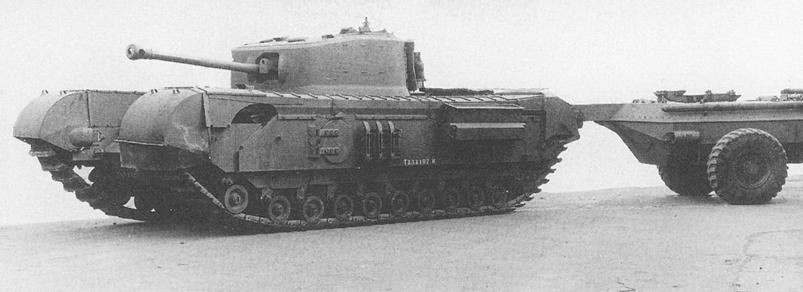
A close up of the Churchills armourments. In the turret a 75mm gun and a coaxially mounted 7.92mm BESA machine-gun. A second BESA was fired from the tanks hull.

79th Armd Div
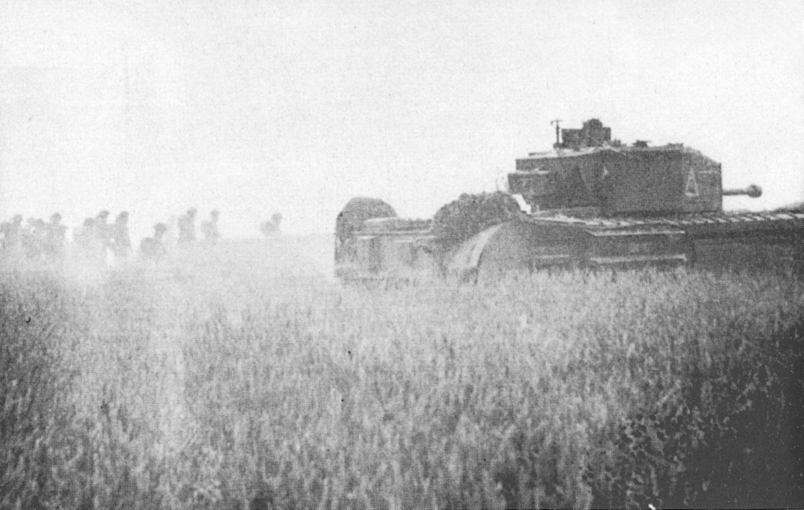
Infantry supported by a Churchill of 31 Tank Brigade advance through the mist and standing corn.
‘But then the mist began to clear and I saw Jerries not far off. They wore brown jackets and were, I thought, trying to collect some of their wounded, so we didn’t fire. Then some of our tanks [7 RTR] appeared and as they went by we gave them a wave. Two of these Churchills were brewed up, so we were again unsupported. Then the rain came down in torrents so we tried to hide under our capes, but had to stay vigilant.’
At 1400 hours, 7 Seaforth was ordered forward to take Ring Contour 100. Lieutenant Hayter continued his account:
‘… I’d lost my little compass and sense of direction. Then a Captain appeared in a scout car and told us the way before going off. But as soon as we started to move the Jerries let us have it with multiple mortars and all hell let loose. We were forced to get down in the rubble again and took a beating. Then came a pause in the enemy barrage and we were able to rush off out of Cheux in the direction indicated and joined up with others of a different unit. The mist had thinned and we were getting fire from all directions, including mortars. I felt something nick my right leg, but I kept going. We reached the railway line, I believe, at Colleville, but didn’t get any further that day, which had been a bad one.’
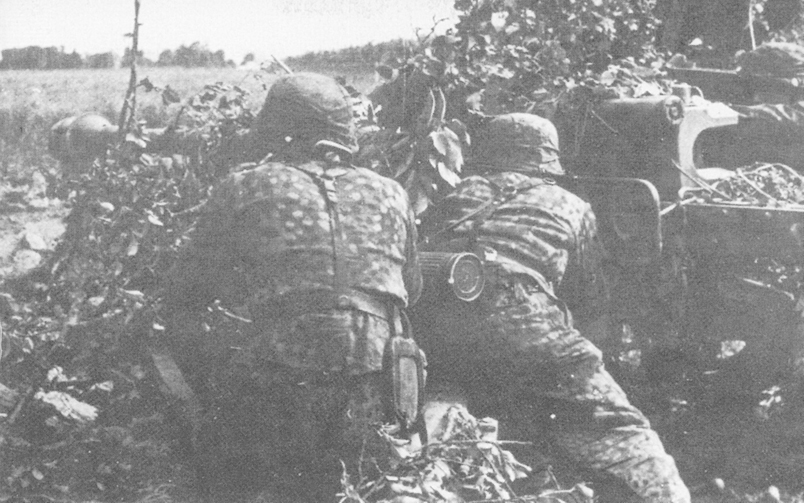
Young soldiers of the Hitlerjugend taking on the Allied tanks.
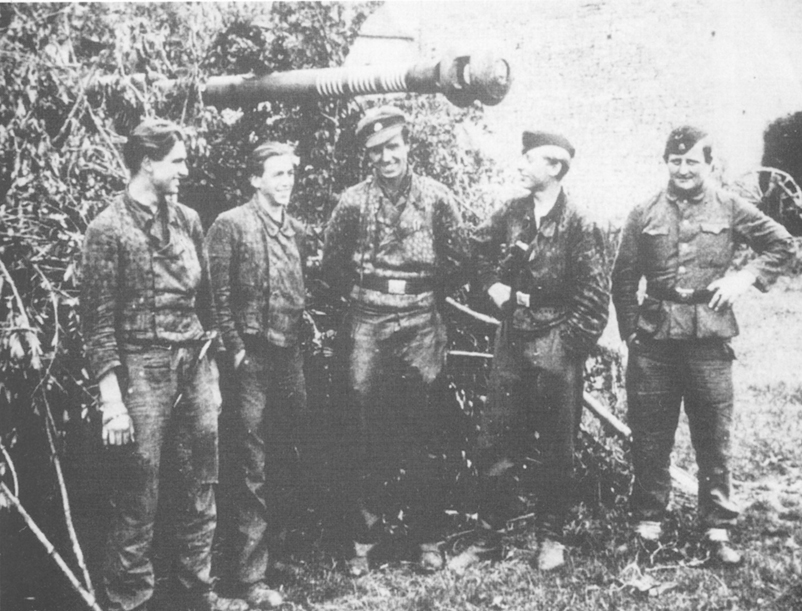
Unterscharführer Willy Kretzschman with his crew from 5 Kompanie II/12 SS Pz Regt. Note the fifteen kill rings on the barrel of their tank.
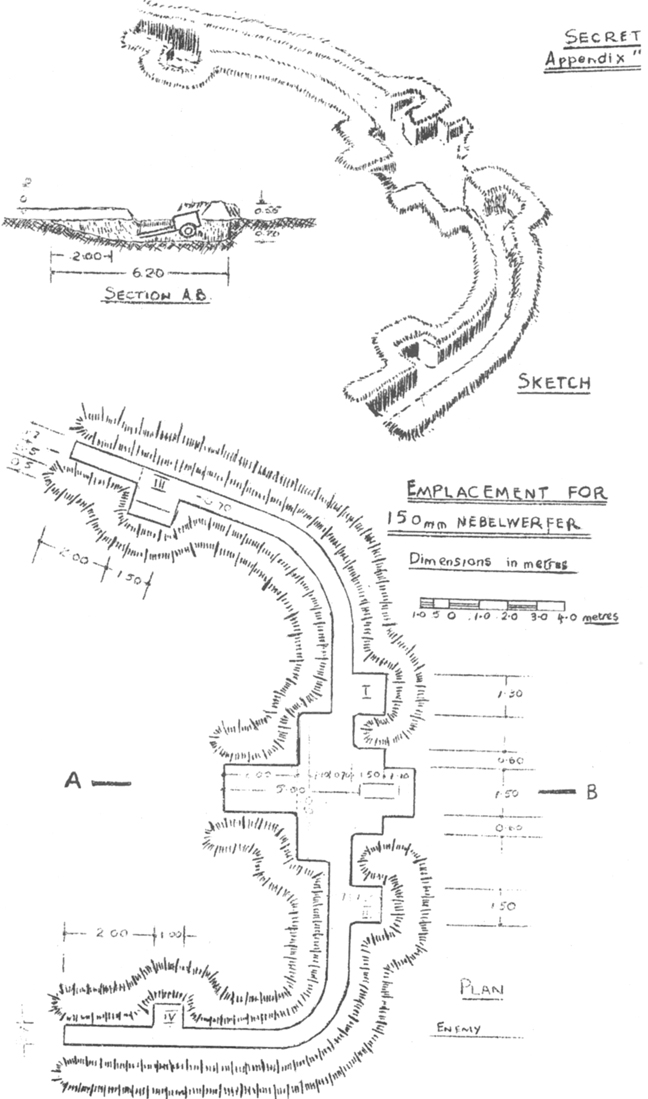
Most of VIII Corps had not previously encountered the Nebelwerfer, which were begining to arrive in significant numbers in Normandy. This diagram is taken from a VIII Corps Instum.
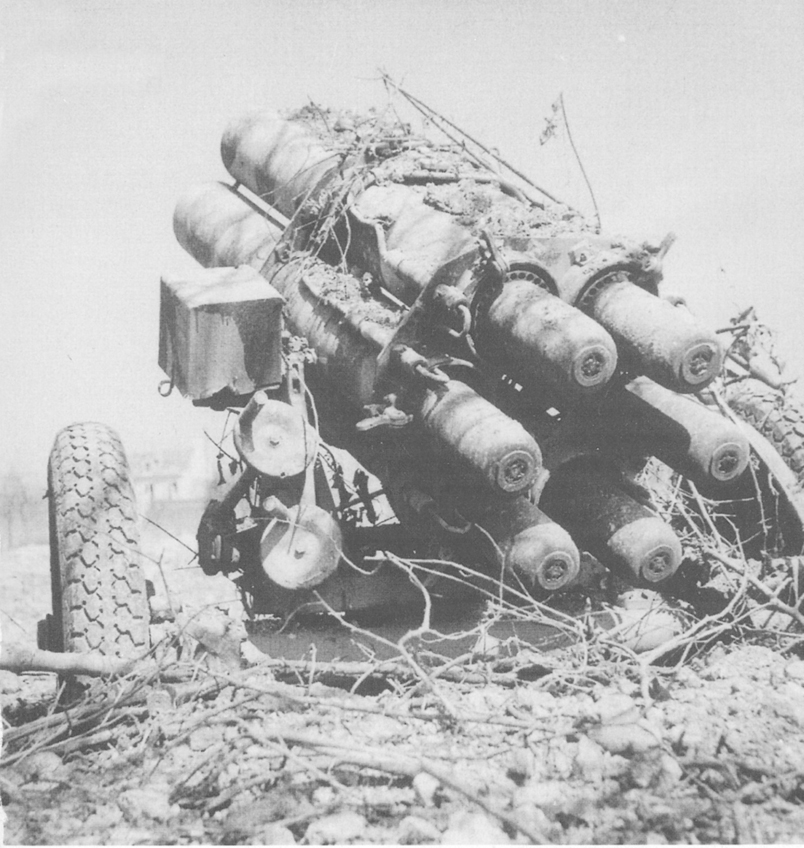
The Nebelwerfer’s six barrels enabled the Germans to hit targets hard. Even if not hit, the scream of the bomb as it descended, did much to undermine the morale of men in the target area.
According to the divisional historian, advancing across the top of Ring Contour 100 or the Hump:
‘The Seaforth found the reverse [southern] slope of the hump strongly held and failed to take it. After suffering fifty casualties, including four officers, and losing several tanks, the Seaforth dug in north of the hump, leaving the crest as a no-man’s-land between themselves and the Germans.’
With the capture of the villages of St Manvieu and Cheux and the northern slope of Ring Contour 100, 15th Division’s Phase One objectives had been reached but villages and orchards were in the grip of ‘sniper scares’. The Scots were already over three hours behind the schedule given in their operation order.
In summary, the skilful camouflage and thorough defensive preparations that the SS officers and senior NCOs had insisted on had paid off. The barrage had driven the SS to ground, only to appear as the leading Scots passed over them and unexpectedly engage the following companies. The cancelled heavy and medium bomber sorties would have collapsed bunkers and speeded the advance. However, bunker-busting delay fuses would also have cratered the ground, impeding armour/infantry co-operation. The delay in breaking through the Hitlerjugend’s outpost and main resistance line bought ‘Panzermeyer’ valuable time to react, as will be seen in the next chapter.

A Tiger belonging to 101 Schwere Panzer Battallion moving to the front. Note the SS Panzerkorps emblem on tank’s hull.